Early modern Europe has long occupied a unique position in the disciplinary imaginary of International Relations (IR) because of its association with the birth of an anarchic system of sovereign states.Footnote 1 IR scholars have regularly relied on this account of order in early modern Europe as a benchmark to interpret the extent and nature of contemporary changes in the international system, as well as to think through alternative forms of international order.Footnote 2 Furthermore, the system depicted in this historical account is repeatedly invoked as a point of comparison when studying international orders in different epochs and geographical areas.Footnote 3 For IR theorists, early modern Europe long constituted a privileged site to generate theory about systems change, that is, “fundamental discontinuities” in the nature of the international system,Footnote 4 as well as a potential repository of cases to test theories of conflict and cooperation that would apply to our own time.Footnote 5
The account of international order in early modern Europe that underpins all these endeavors once commanded wide acceptance in IR but is now increasingly disputed. First, some have sought to replace sovereign states as the basic political units of early modern Europe with entities they alternatively call composite states, absolutist states, or simply kingdoms, none of which were akin to modern sovereign states.Footnote 6 In a related vein, while some continue to hold that these political entities enjoyed modern forms of sovereignty, others disagree, explaining that political authority was often not absolute and indeed frequently overlapping, much as it was in the Middle Ages—a fact reflected in the absence of clear, map-based territorial definitions of rule, and the persistence of nonterritorial authorities.Footnote 7 Second, the notion of anarchy as the ordering principle of early modern Europe has not escaped critique; numerous scholars argue against it, claiming that the continent was riddled with hierarchies of status and precedence.Footnote 8 Third, many now question the analytical propriety of cordoning off a pristine early modern Europe from the rest of the world given its frequent diplomatic and legal interactions with entities across the globe, and its arguably less-than-central position in early modern world politics.Footnote 9 In sum, whereas consensus once existed regarding the description of order in early modern Europe, every element of the traditional account is now the object of fierce debate.
In the context of these disagreements, I provide a new account of order in early modern Europe grounded in the views of practitioners actually involved in ordering world politics at the time. To that end, I make two connected arguments. First, I argue that we can recover how such practitioners conceptualized international order by studying the tools they relied on to describe and organize political authorities in the world.Footnote 10 The analysis of these tools, which I refer to as “forms of knowledge,” allows us to glean what entities practitioners thought they were organizing, and how they conceived of these entities’ standing in relation to one another.Footnote 11 Whether or not the scope of the international order under consideration was “European” is thus left open to empirical investigation.
Second, I turn to a widespread though seldom-studied form of knowledge developed and used by what were then called “masters of ceremonies” in early modern Europe: courtly ceremonial. Courtly ceremonial was thought to be a branch of legal thought, the ius praecedentiae (right of precedence), concerned with discussing and assessing the rightful order of precedence among different political authorities. Based on its study, I make three arguments that revisit the three core points of contention regarding order in early modern Europe that I outlined earlier. First, until the mid-eighteenth century, crowns and republics were the main political authorities worthy of consideration; in the late eighteenth century, all eventually come to be described simply as “states.” Second, throughout early modernity, all political authorities stood in a relationship of hierarchy—a global order of precedence. Going beyond existing scholarship, I provide more granularity as to what defined this pecking order, showing that until the eighteenth century, it rested on a relatively stable set of criteria including their dignity, the antiquity of their titles, and many more. I further explain that over the course of the 1700s, two new criteria grew in importance: power and sovereignty, with the latter conceptualized in degrees (full, semi-, and disputable). Third, I argue that there was no clear limit to what political entities were worthy of consideration. Masters of ceremonies could, for instance, easily incorporate non-European entities into their schemes. Beyond the Ottoman emperor, prominent Asian and African political authorities appear in their discussions, and they are presented as equals to European royalty. Ultimately, I offer a new account of international order in early modern Europe and suggest that IR scholars should reconsider why they study early modern Europe and how they study international orders.
Europe As an Anarchic System of Sovereign States: Three Problems
Over the last two decades, the consensus that once existed in IR regarding the description of order in early modern Europe as an anarchic system of sovereign states has evaporated. Three specific issues stand out. The first concerns the nature of the political entities that made up the continent. Dissatisfied with the notion that it was populated by sovereign states, some claim that in fact Europe was made up of “composite states,” a term referring to heterogeneous polities such as “federative alliances” like the Hansa or the Swiss confederacy, “city-empires” such as Venice, Florence, and Genoa, “dynastic agglomerations,” of which Valois and Bourbon France and Stuart Britain are examples, and sui generis entities like the Holy Roman Empire.Footnote 12 Others emphasize the centrality of the “absolutist state,” yet also acknowledge the remarkable diversity of polities that existed alongside it, such as “hereditary and elective monarchies, merchant republics, confederations, aristocratic republics, constitutional monarchy, cities,” and “states of estates.”Footnote 13 Some see more homogeneity on the continent, explaining that “the basic political unit of ancien régime Europe was always the kingdom.”Footnote 14 For this reason, some in this latter group often claim that until the “late eighteenth century, the equivalent of what present-day IR theory calls ‘international actors,’ were still, on the whole, persons wearing a crown,”Footnote 15 with one scholar going so far as to claim that after 1713, “monarchs, unlike other actors (electors, princes, doges, etc.), were the only legitimate actors.”Footnote 16 Yet, some dissociate kings from kingdoms, explaining that the parties in early modern treaties of friendship were overwhelmingly kings, not states or even kingdoms.Footnote 17
Whatever these entities that populated Europe were, many argue that they were not defined in terms of absolute authority within clearly defined territorial borders—with such a conception triumphing in only the late eighteenth and early nineteenth centuries, rather than at the Peace of Westphalia or any earlier date.Footnote 18 Furthermore, while some continue to locate the emergence of modern notions of sovereignty in the sixteenth century, others explain that in early modern Europe, sovereignty was thought to be “divisible,” that is, it consisted of a bundle of rights that could be transferred and parceled out unevenly among different entities, all of which were sovereign and retained, for instance, the ability to engage in treaty relations, and to make war and peace.Footnote 19
The second issue concerns the notion of anarchy, a logical corollary of the idea that Europe was made of sovereign states, as they presumably recognized no authority above their own. Against this view of an anarchical system in which independent states coexisted as legal equals,Footnote 20 several voices have argued that the hierarchy that characterized medieval Europe did not vanish on the doorstep of early modernity but endured well into this period.Footnote 21 In the words of one observer, Europe was “thoroughly riddled with hierarchical ideas about status and precedence,” which placed actors on a “descending ladder.”Footnote 22 This hierarchy was not based on disparities in military or economic power, nor did it necessarily entail complete legal subordination. What criteria determined different entities’ position therein has not received detailed attention in IR, though a handful of scholars in and beyond the discipline have pointed out the growing importance of military power in the eighteenth century.Footnote 23
Third, while numerous accounts have discussed early modern Europe in isolation from the rest of the world, a major issue raised in recent scholarship concerns precisely the question of whether this analytic choice is at all defensible.Footnote 24 Previously, such a focus on Europe was at times justified by the continent's presumed overwhelming military and economic preponderance and its alleged influence over the rest of the world. However, this view, too, is increasingly disputed. For some, “Europeans did not enjoy any significant military superiority vis-à-vis non-Western opponents in the early modern era, even in Europe”Footnote 25—nor were they wealthier,Footnote 26 with one observer concluding that “no region stood at the apex of world dominion” in that epoch.Footnote 27 Another justification for the cordoning-off of early modern Europe was that relations among European polities were far more frequent and, presumably, of a qualitatively different type.Footnote 28 Yet, this too has been challenged. Scholars have pointed to Europe's sustained legal and diplomatic interaction with almost every part of the world in this period—not least through the activities of “company-sovereigns” such as the Dutch East India Company.Footnote 29 For some, the implication of these sustained contacts is that we should conceptualize early modernity as comprising multiple international systems, such as the “Indian Ocean international system” and the European one; for others, we should think of the early modern world as containing a single globe-spanning “international social space.”Footnote 30
In short, no consensus currently exists regarding the entities that populated the continent or how they stood in relation to one another, or even whether an artificially isolated early modern Europe constitutes an appropriate object of analysis. In response to these disagreements, I aim to recover how historical actors involved in ordering world politics understood international order.
Recovering Practitioners’ Conceptions of International Order
In this section, I develop an approach to recover historical conceptions of order, defined as the “systemic configuration of political authority” following Christian Reus-Smit.Footnote 31 I should point out at the outset that many recent groundbreaking works have not been interested in recovering the systemic organization of political authority when analyzing order in early modern Europe. Their approach instead consists in relying on and producing analytic categories devised after the epoch under consideration to grasp the nature of international order. In these accounts, early modern Europe is populated by entities such as “national states,”Footnote 32 “composite states,”Footnote 33 or yet still “absolutist states.”Footnote 34 Such compound terms are retrospective inventions. For instance, while the notion of “absolutism” appeared in the decades following the French Revolution,Footnote 35 the term “composite state” was popularized by Helmut G. Koenigsberger in the 1970s and 1980s.Footnote 36 This approach thus systematically repopulates the past with the mental furniture of later periods. To be clear, this is not a problem in and of itself: all social scientists and historians engage in this exercise to some extent. However, for IR scholars, a key task that emerges from this kind of scholarship is to assess how these concepts relate to and possibly distort the international imaginary of earlier epochs, and this can be carried out only once historical understandings of international order are recovered. In this sense, an approach concerned with unearthing the systemic organization of political authority can complement studies in this vein.
Traditionally, those IR scholars interested in recovering historical conceptions of international order in Europe have relied heavily on the works of “great thinkers” like Thomas Hobbes, Hugo Grotius, and Emer de Vattel.Footnote 37 Encapsulating this approach, Hedley Bull contrasts the early modern period with the Middle Ages by explaining that “the ambiguity of earlier thinkers as to what kind of groups or entities are members of the society of states gives way to a clear statement of the principle that international society is a society of states or nations.”Footnote 38 Because of its focus, this approach has been deeply influenced by the history of political thought, adopting the widespread thesis according to which by the seventeenth century “the concept of the State—its nature, its powers, its right to command obedience—had come to be regarded as the most important object of analysis in European political thought.”Footnote 39 While it displays a clear intent to rely on historical categories to understand the systemic configuration of political authority in early modern Europe, this approach's main drawback is its emphasis on great legal and political theorists. Indeed, there is no a priori reason to assume that great thinkers’ visions of international order were widely shared by groups of ordinary practitioners of world politics.Footnote 40 If anything, we remember these individuals precisely because they tend to depart from the common wisdom of their time, not because they espouse it.Footnote 41 To understand the nature of order in any given period, it is arguably to the most commonsensical ideas of an epoch that one should turn, and these are likely to be found not in the works of great luminaries but those of ordinary groups of individuals practically involved in ordering world politics.
The approach I want to put forward—inspired by a few relatively recent IR contributions—rests on two basic propositions. First, when recovering historical conceptions of international order, I want to shift the focus away from individual great thinkers toward groups of practitioners, such as diplomats, lawyers, or military strategists—what one might call the “orderers” of world politics. A significant number of scholars associated with or influenced by the practice turn, as well as social and cultural history, have championed this idea.Footnote 42 Second, building on Reus-Smit's definition from the outset of this section, historical practitioners’ conceptions of international order can be recovered by studying the tools they use to describe and organize political authority in the world. In what follows, I will refer to these tools as “forms of knowledge,” drawing on anthropologist Bernard Cohn's elaboration of the concept.Footnote 43 Forms of knowledge involve “the definition of a body of information that is needed, the procedures by which appropriate knowledge is gathered,” and guidelines regarding “its ordering and classification”; they can even be “transformed into sciences.”Footnote 44 To grasp the nature of international order based on forms of knowledge entails studying the tools that historical practitioners deemed appropriate to describe and organize the manifold political authorities in the world.
Some recent works taking practitioners as their starting point to understand international order can be understood as following this broad approach. They each locate a loose group of practitioners and examine the key form of knowledge they use to describe and organize political authority in the world. In so doing, these scholars seek a better understanding of the nature of order as it was perceived by contemporaries in different periods. Consider two examples. In a recent set of publications, Jordan Branch examines the adoption by a key group of practitioners, diplomats, of a key tool to organize political authority, modern cartography.Footnote 45 He demonstrates that until the late eighteenth century, diplomats did not use maps and cartographic references to negotiate peace treaties, thus dispelling the notion that political authority was defined in clear territorial terms before this time. A second example is Julia Costa-Lopez's research on medieval international order, in which she examines the legal concepts that Roman and canon lawyers of the late Middle Ages relied on to describe and organize political authority.Footnote 46 She observes that medieval international order was characterized by four distinct types of relations of authority, which various entities could exercise in different combinations. In so doing, she pushes IR to move beyond the endless search for a single ordering principle in medieval Europe, identifying instead a multiplicity.
Such forms of knowledge can be observed in two key places. First, Cohn's definition suggests that the production and use of forms of knowledge will often leave material traces. For example, to understand when diplomats adopted modern cartography in practice, Branch examines a key material artifact they produced, peace treaties, and shows that from the very end of the eighteenth century onward, they increasingly referred to “lines of division described in careful geographic and cartographic terms.”Footnote 47 He further explains that maps became regularly used at peace conferences in which such treaties were drafted. Such material traces are akin to what one scholar has recently termed “representants,” that is “objects, practices, and language that are socially recognized to stand in for the units of the international system.”Footnote 48 The second place where one can observe the adoption of forms of knowledge is at the point of transmission, namely in practitioners’ education.Footnote 49 Cohn frequently refers to education in his work and even stresses that forms of knowledge are sometimes transformed into sciences.Footnote 50 This process will often lead to “the formation of specialized journals, the foundation of specialists’ societies, and the claim for a special place in the curriculum,” as Thomas Kuhn once explained regarding paradigms.Footnote 51 The transmission of forms of knowledge through education will therefore leave material traces as well.
In the next section, I analyze the systemic configuration of political authority by studying the form of knowledge that a key group of European practitioners, masters of ceremonies, relied on throughout the early modern period: courtly ceremonial.
Courtly Ceremonial and International Order in Early Modern Europe and Beyond
Throughout the early modern period, individuals known as masters of ceremonies (the original “MCs”) were tasked with the organization of ceremonies at courts across Europe. Traditionally—and perhaps most famously in the work of Norbert Elias—the history of courts has been told almost exclusively as part of the history of state formation.Footnote 52 This long-dominant strand of aulic history typically holds that “the court was important because it contributed to the rise of the modern state,” in large part because it is thought to have played a pivotal role in neutralizing the nobility and sub-royal actors at large.Footnote 53 In recent decades, however, such accounts have been subjected to scathing criticism. One of the most prominent critics explains that the traditional view is a product of nineteenth-century historians’ “obsession with the antecedents of the modern state,” which had a potent influence on Elias's scholarship.Footnote 54 In fact, all sorts of entities in early modern Europe and beyond had courts, and they were understood in a correspondingly broad fashion. As late as 1732, Johann Heinrich Zedler defined them in his Universal-Lexicon using the traditional formula: “What is called a court is where the prince resides.”Footnote 55 The word prince used here could include a vast range of individuals, from popes and emperors through to the lowest prince-abbots or prince-provosts. In fact, even people falling outside this remit, such as the head of the Dutch East India Company in Asia, could have a court.Footnote 56 In short, in light of current historical scholarship, reducing courts to institutions bound up in an ineluctable process of state formation appears untenable.
In these courts, ceremonies were not irrational extravagances; they served to assert the prestige, honor, and authority of the entity “at the center of the drama,” as well as that of other political authorities present either in person or through their envoys.Footnote 57 Indeed, European rulers conceived of themselves as members of a social hierarchy that had existed since the Middle Ages, and the continual reaffirmation of their position within it through ceremonies—such as coronations, weddings, funerals, public acts associated with rulership, the introduction of ambassadors, and diplomatic negotiations—was part of the very process of ruling.Footnote 58 Every feature of these ceremonies was premised on the rank of those involved: the rooms in which meetings took place, the order in which participants could enter them, the seating arrangement, who could wear a hat, and who was obliged to doff it and at what moment.Footnote 59 So critical was the question of rank that one eighteenth-century observer noted that “princes cede towns, even provinces, but all the ability of the most adroit negotiations cannot convince them to give up a rank which they believe to be their right.”Footnote 60 This was indeed a world in which rulers like Ivan IV were willing to give up multiple fortified towns just to be called tsar.Footnote 61
Consequently, masters of ceremonies (who had to defend their own employer's rank) wrote manuals entirely devoted to one crucial question: the rightful order of precedence among the various political authorities of the world.Footnote 62 This was thought to be a legal problem and was the object of regular disputations among jurists, who would scrutinize and assess claims of precedence.Footnote 63 And indeed, almost all masters of ceremonies were jurists, and their reflections were known as being about the ius praecedentiae (the right of precedence), though several other labels emerged as systematic reflections on courtly ceremonial proliferated, beginning in the late-fifteenth-century papal court, where all Christian rulers increasingly sought permanent representation.Footnote 64
The task entrusted to masters of ceremonies was not an easy one, because there were always disgruntled actors who would try to claim a better position in the order of precedence—and conflicts could escalate far beyond the court.Footnote 65 The long-standing dispute between the French and Spanish crowns that began in 1564, when the king of France gained precedence over the Spanish crown at the papal court, is one example.Footnote 66 One of its high points was when, in 1661, the French ambassador to London jostled the Spanish ambassador's carriage in a race to occupy the place of honor. A battle ensued in which over twenty men died, while many others were injured. Following the incident, Louis XIV threatened war if Philip II would not back down and recognize the precedence of the French crown. Eventually, the Spanish ambassador in Versailles apologized and promised he would not seek equal treatment with the king of France's representative in the future.Footnote 67 Beyond this specific rivalry, the history of early modern international relations is littered with similar altercations, which sometimes did produce outright military confrontation. For instance, French ships bombarded Genoa twice, once in 1678 and again in 1684, to force it to recognize the French crown's claims of precedence. In 1685, it was a Spanish fleet that was forced to salute a French one, after fighting that resulted in many casualties.Footnote 68 The subject of precedence was then, manifestly, a topic of the highest import.
In what follows, I aim to recover how masters of ceremonies thought about international order by studying their manuals on courtly ceremonial, focusing on three key issues that—as I showed earlier—are currently objects of profound disagreement among IR scholars. First, what kinds of political authorities did masters of ceremonies think they were dealing with? Second, how did these entities stand in relation to one another, and according to what criteria were they ranked? And third, can the limits of the international order that masters of ceremonies discussed meaningfully be described as “European”? Though I will draw on works by a wide variety of masters across the early modern period, for reasons of space my discussion will be organized around four notable ones that will serve as points of reference, namely those of Paris de Grassis (1450~60–1528), Zacharias Zwantzig (unknown–1716), Jean Rousset de Missy (1686–1762), and Georg Friedrich von Martens (1756–1821). All four were jurists who contributed to discussions on courtly ceremonial and worked for a court at different moments in their lives. Grassis worked for the papal court, Zwantzig for the court of the elector of Brandenburg and king in/of Prussia, and Rousset de Missy for the Dutch stadhouder William IV. In spite of his fame, Martens had, by comparison with great thinkers such as Vattel, a far more “vivid connection to practice.”Footnote 69 He worked for the court of the elector of Brunswick-Lüneburg and represented the newly titled king of Hanover at the Congress of Vienna.
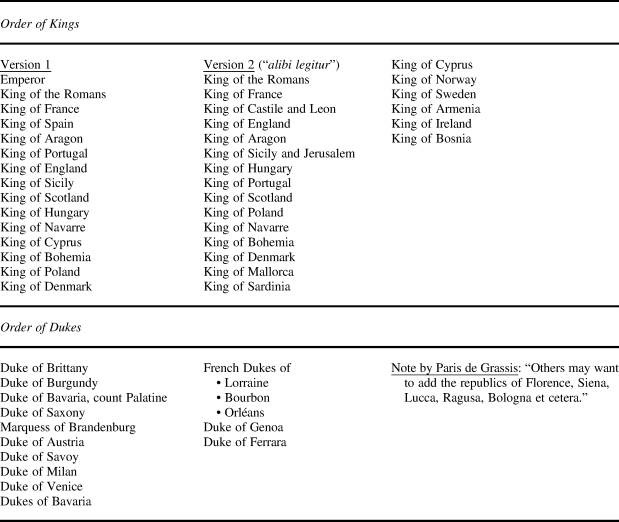
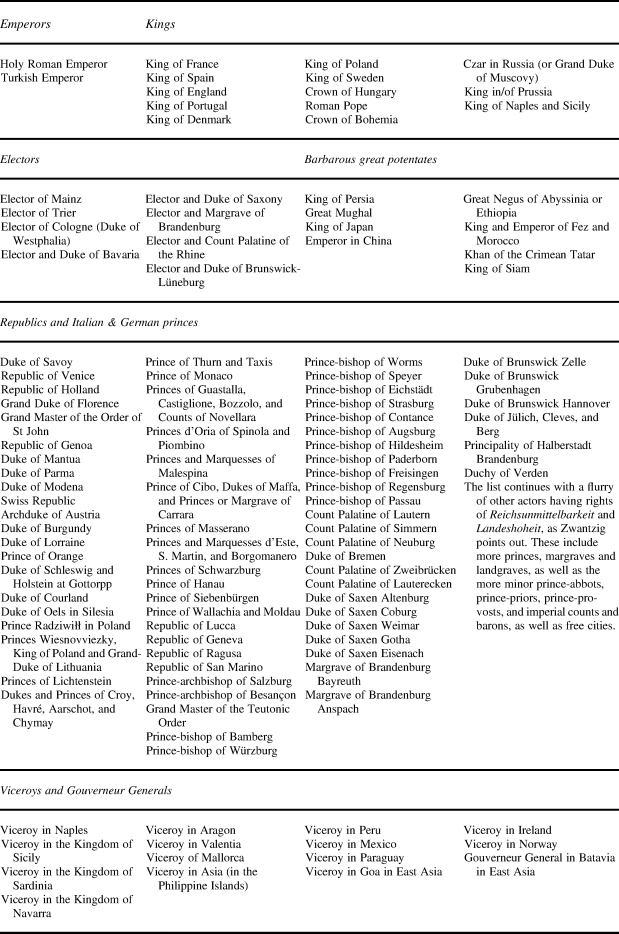
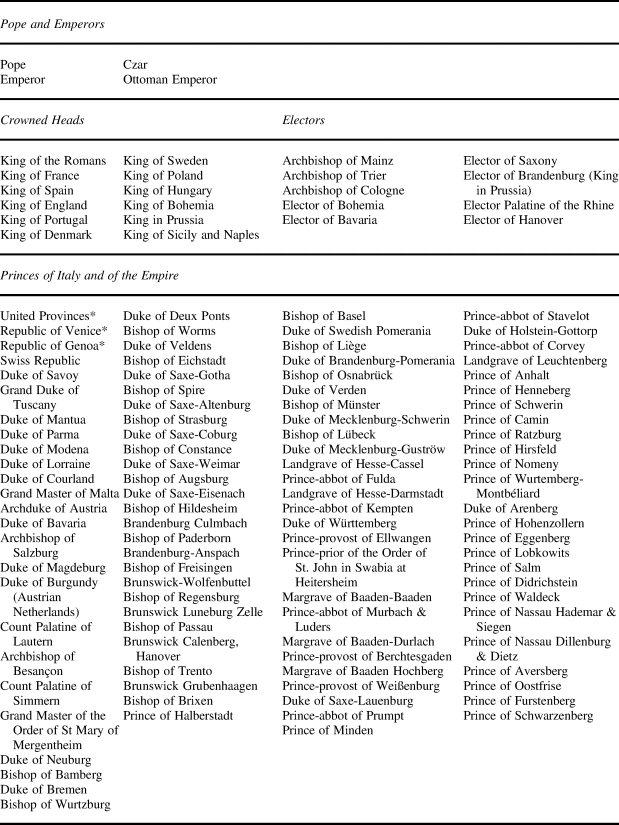
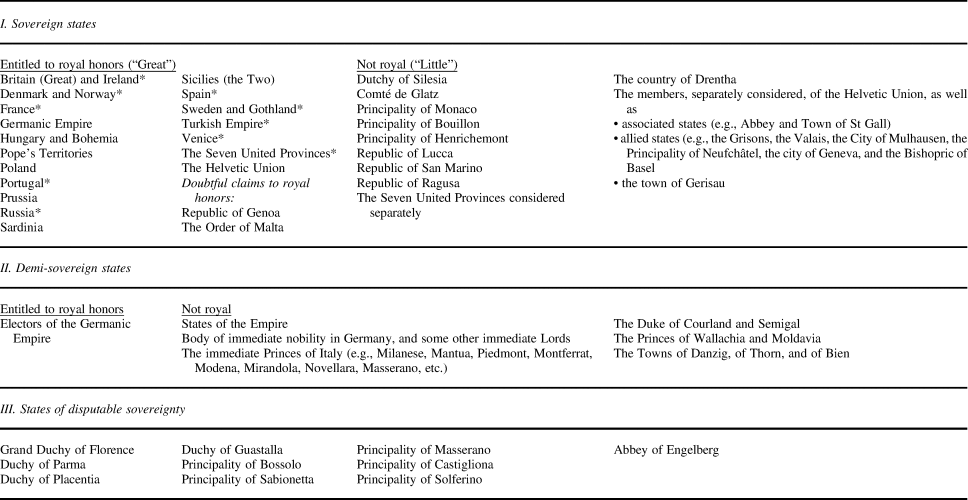
Paris de Grassis's Tractatus de Oratoribus (1508) is the most famous early-sixteenth-century manual and represents the early days of systematic reflections about the question of precedence at the papal court. It reflects Grassis's own practice in Rome and became a touchstone for many manuals on courtly ceremonial in the seventeenth and eighteenth centuries.Footnote 70 The other three manuals are Zwantzig's Theatrum Praecedentiae (1706), Rousset de Missy's Mémoire sur le rang et la préséance (1746), and Martens's Précis du droit des gens (1789). I have purposely selected some of the most highly regarded (by contemporaries) works from the beginning, middle, and end of the eighteenth century to guide my discussion because manuals on courtly ceremonial underwent the most dramatic changes in this time frame, and I want to capture them in a granular fashion.Footnote 71 While seventeenth-century works—for instance, those of Jakob Andreas Crusius and James Howell—are not altogether very different from those of the early eighteenth century, there is a yawning gap between the latter and late-eighteenth-century works such as Martens's Précis.Footnote 72 If Martens's manual illustrates the massive changes that were going on in courtly ceremonial by the time of the French Revolution, Zwantzig's exemplifies the expansion in the number of authorities under discussion since the time of Grassis, as well as the continuity with seventeenth-century manuals. Meanwhile, Rousset de Missy's manual illustrates the mid-eighteenth-century continuation of this tradition (he explicitly cites Zwantzig as his main source of inspiration), while also embodying new orientations that would eventually lead to the world of Martens. The orders of precedence they produced are synthesized in Tables 1 to 4.
Orders of precedence in Paris de Grassis's Tractatus de oratoribus (1508/09)

Source: Stenzig Reference Stenzig2014, 244–46. Version 1 of the Order of Kings is the most commonly cited, but de Grassis's work contains a Version 2, reproduced only in Stenzig's monograph. Version 1 is identical to that found in Paris de Grassis's diary entry from 1504, but Version 2 only exists in the Tractatus. See Stenzig Reference Stenzig2014, 549.
Ordering What? Political Authorities in Courtly Ceremonial
At first glance, manuals on courtly ceremonial depict a world composed of a wide variety of political authorities. Grassis's Tractatus mentions at least three types of actors, namely kings, dukes, and a few republics (Table 1). Zwantzig's 1706 work naturally includes those, but it adds many more (Table 2).Footnote 73 Here one finds emperors, prince-electors, prince-bishops, princes, and bishops, as well as margraves and landgraves. Beyond these familiar entities, there are also prince-abbots, prince-priors, and prince-provosts, as well as the numerous imperial counts and barons—all of which had rights of Reichsunmittelbarkeit (imperial immediacy) and/or Landeshoheit (translated as “territorial jurisdiction” by Andreas Osiander) — and finally, viceroys such as that of Naples or Ireland.Footnote 74 Rousset de Missy's 1746 work is not too dissimilar from Zwantzig's, as it contains many of the same actors, plus a few more eclectic ones, such as the grand master of the Teutonic Order.Footnote 75 All of these were recognized political authorities. They could, for instance, conclude treaties with one another as a matter of course: in 1700, the prince-abbot of Fulda signed a treaty with the king of Denmark, the bishop of Worms, the margrave of Baden-Durlach, and several other parties.Footnote 76 The abbot of Fulda had, with respect to such prerogatives, nothing to envy the king of France.
Order of precedence in Zacharias Zwantzig's Theatrum Praecedentiae (1706)

But beyond this first observation, a cursory look at the first three of these four sets of courtly ceremonial rankings (Tables 1 to 3) also reveals that one type of political authority outnumbers the others by a large margin. First and foremost, these rankings are populated by crowns—not the physical object of course, but an “invisible and immaterial Crown.”Footnote 77 The “king of Poland,” for example, refers to such an immortal abstract entity, the repository of many rights and obligations, which may be held by many different physical persons over time. Furthermore, a single physical person could hold multiple crowns; for instance, in the table that represents Zwantzig's order of precedence, the elector of Brandenburg is the same person as the king in/of Prussia. The holders of such crowns could retain their status as political authorities even in cases where they did not rule over anything, as was the case for kings in exile, like those of Armenia and Bosnia, in Paris de Grassis's Tractatus.Footnote 78 In short, crowns without a kingdom could be political authorities in their own right—an observation which dovetails neatly with claims regarding the persistence of nonterritorial authorities in the early modern period.Footnote 79
Order of precedence in Rousset de Missy's Mémoire sur le rang et la préséance (1746)

*Republics headed by a doge or prince.
Yet, crowns were not the only political authorities in early modern Europe. Republics appear in all four manuals, including the likes of Genoa, the United Provinces, Venice, and the Swiss Republic. But republics were not all republics in quite the same way. Some actually had a crowned head and were included in schemes of courtly ceremonial as such. Thus, in Paris de Grassis's Tractatus, Venice and Genoa are included not as republics but through their elected dukes (doges)—the duke of Venice and the duke of Genoa—alongside “equivalent” actors such as the duke of Bavaria. Those republics that could not be included through their crowned heads because they did not have one—Florence, Siena, and Lucca, for instance—appeared in a different place in the ranking, a point I shall come back to later.
But over time, perhaps the most striking shift in works on courtly ceremonial is the slow evolution of the language used to describe political authorities. From a list of individual crowns buttressed by a few republics, a shift takes place toward the discussion of more abstract categories, until the subject becomes largely reduced to precedence among “states.” In the early sixteenth century, Paris de Grassis discusses the rank of numerous kings and dukes, along with a small number of republics. By the early eighteenth century, Zwantzig discusses a larger number of political authorities, but the language remains ostensibly the same. He frequently uses the expression “great potentates, regents, kings, states and princes” (grossen Potentaten, Regenten, Königen, Staaten und Fürsten), or more simply “great lords and states” (große Herren und Staaten).Footnote 80 What we have here are lists in which one finds only two types of abstract entities that are not individual crowns: great potentates and states. The word state here is obviously not used in its modern sense, as a generic polity type that subsumes all sorts of regimes (republics, kingdoms, federations, and so on), otherwise it would hardly make sense as one more item in a list that includes entities like kings and princes. It is used here to refer to republics, one of the most common meanings of the word in this period.Footnote 81 As for the notion of great potentate, some scholars have already shown that it became particularly popular in speaking about important European political authorities that could not be discussed with the traditional language of majesty, such as the United Provinces.Footnote 82 To those I would add non-European political authorities who are at times referred to as “great potentates” in works of courtly ceremonial.Footnote 83
By contrast with those before him, Rousset de Missy's discussion of courtly ceremonial at times slips to rely on words like duchy instead of duke, or principality instead of prince, but this kind of slippage remains relatively rare. For instance, the word duché appears about 36 times, but duc, close to 400 times. There appears to be no specific reason for this, other than purely stylistic considerations, which should not be discounted for works addressed to a larger public. But it is significant that the use of these alternate terms is not seen as posing any major issue.Footnote 84 This development truly comes full circle at the end of the eighteenth century: in Martens's Précis, the authorities being ranked are exclusively states. By this point, the word state is used as a blanket term that encompasses all relevant political authorities: the word loses its straightforward association with republics, which increasingly had to be differentiated as “free” states.Footnote 85 Martens further distinguishes between “royal states,” a group that included a few republics “incontestibly entitled to royal honors,” and “sovereign states which are not royal.”Footnote 86 But there are also demi-sovereign states, some of which are entitled to royal honors and others not, as well as “states of disputable sovereignty”—distinctions I shall come back to later. The timing of this change toward a language of statehood maps neatly onto Evgeny Roshchin's argument about the changing subject of friendship, from princes to states, in late-eighteenth-century treaties.Footnote 87 But Martens's manual suggests that even by the end of the eighteenth century, the political authorities that constituted the world had not been narrowed down exclusively to sovereign states.
While it is tempting to attribute this shift toward identifying political authorities as “states” as an outgrowth of the transition away from natural law and toward positivism, recent legal scholarship cautions against this view. Martti Koskenniemi, for instance, has argued that Martens's work differed from the natural law tradition in style more than in substance, the latter displaying much more continuity.Footnote 88 And indeed, for a great thinker such as Emer de Vattel, describing a world made up of sovereign states while remaining firmly rooted in the natural law tradition did not pose any problem.Footnote 89
The Hierarchy of Courtly Ceremonial: Who Stands Where and Why?
Works on courtly ceremonial often shied away from and even explicitly denied producing exact rankings of precedence, in large part because this was such a delicate undertaking. Some, like Zwantzig, simply chose to publish under a pseudonym, while others, like James Howell, warned anyone who might be foolish enough to follow in his footsteps that “he is in danger to break his Neck.”Footnote 90 And yet, despite their fears and reticence, all writers on courtly ceremonial proceed in roughly the same manner when crafting their orders of precedence. Thus, Grassis discusses kings, attributing a specific place to each, before moving on to dukes. At the very bottom of Grassis's order of precedence, mentioned in passing perhaps because they fit so uneasily in what appears to be a world of crowns, one finds a few Italian republics: “Others may want to add the republics of Florence, Siena, Lucca, Ragusa, Bologna, etc.” (pone alios ut rerum publicarum videlicet Florentini, Senensis, Lucensis, Ragusiorum, Bononiensis et cetera).Footnote 91 They constitute what is perhaps a third class of actors beyond kings and dukes, the residue of international order. The unique feature of Paris de Grassis's Tractatus is that it ranks actors within each group individually, whereas later rankings do not—but that may have been possible precisely because the ranking was not official.
Later works on courtly ceremonial, such as those of Zwantzig and Rousset de Missy, display a similar pattern. Rousset explains that “Emperors precede Kings, Kings go before Princes, the latter before Dukes, Marquesses succeed those and precede Counts, to whom Barons must give way.”Footnote 92 Of course, the number of actors in these later discussions was far greater than in Grassis's work. They conventionally begin with the Pope—though for many Protestants he was arguably just another Italian princeFootnote 93—then move on to a set of emperors, invariably including the Holy Roman emperor, the Ottoman emperor, and at times the Russian czar, though in some rankings the latter is relegated to the status of a simple king (Table 2). This group is generally followed by a set of kings, who are then followed by prince-electors—that is, those princes entitled to elect the Holy Roman emperor. One notch down we usually find an astonishingly large set of princes. They constitute the vast majority of political authorities—to gloss over them is a little like discussing the nature of a given society by focusing exclusively on the top 1 percent. Republics also appear in these later manuals on courtly ceremonial, but this time they are far more than a mere residual category. One reason is that by the eighteenth century, many republics had a crowned head. Republics that were only briefly mentioned as a kind of afterthought in Paris de Grassis's order of precedence, notably Florence, could now be seamlessly integrated. In Rousset de Missy's work, Florence appeared as the grand duke of Tuscany, while Venice and Genoa appeared as republics but stood relatively high, in part because of their respective elected doges.Footnote 94
The hierarchical order of precedence that writers on courtly ceremonial reflected on was never entirely fixed; international social mobility was possible, if heavily curtailed. Take the example of republics, which were always at a disadvantage in early modern Europe. By the mid-eighteenth century, the United Provinces, a central player in world politics, were still considered of a lesser rank than imperial electors. But they managed to rise to a prominent position because of their adoption of the House of Nassau—and later the House of Orange-Nassau—as stadhouders.Footnote 95 Non-republican actors also found ways to rise in the order of precedence. For them, the path lay in obtaining a new crown. This is how the rulers of both Prussia and Savoy rose to claim royal recognition in the late ancien régime.Footnote 96
Each work on courtly ceremonial offers a specific set of reasons for placing political authorities in a specific rank. In one sense, then, these texts explicitly reflect on the underpinnings of international hierarchy. This was indeed so important that one prominent writer on courtly ceremonial, Johann Christian Lünig, sought to sum up how four of his forebears—Jacob Andreas Crusius, Balthasar Sigismund von Stosch, Zacharias Zwantzig, and Gottfried Stieve—dealt with these questions. These works rely on a remarkably stable set of criteria to order political authorities: their dignity, the antiquity of their titles, their treatment by the pope and the emperor, the origin and duration of their possessions, the prestige of their vassals, the status of their dynasty, and many more (see Appendix I for a larger snapshot).
Less obvious but nevertheless notable is the slow rise of power as a factor to determine where one stands in the precedence order.Footnote 97 Though it never becomes the primary factor, it slowly rises in importance (eventually providing an alternative route for international social mobility, that is, the accumulation of power), and by the mid-eighteenth century, some writers on courtly ceremonial end up also writing about questions of power politics. Rousset de Missy is one such character, and it is precisely for this reason that historian Friedrich Meinecke classified him as a “reason of state” thinker, famously dismissing his work on ceremonial as “a monstrous baroque compendium full of marvelous and antiquated things.”Footnote 98 Yet, even though Rousset de Missy uses the (increasingly popular at the time) language of “power” to discuss international politics, I agree with Edward Keene that this is an inaccurate description of his stance.Footnote 99 Although Rousset refers to international actors as puissances in the title of one of his works, the book is actually concerned with the rights and pretentions of the “king of France,” the “English Crown,” and the like, not so much with states and their power.Footnote 100 The type of discussion mixing a language of power with concrete measurements of it only really takes off in the late eighteenth century, merging a discourse on the interests of states with developments in British political arithmetic and German Statistik—constituting what might be seen as an alternative form of knowledge.Footnote 101
Yet, beyond power, there is another criterion for ranking political authorities that emerges at the very end of the eighteenth century, and which we do not find discussed so straightforwardly in earlier work: sovereignty. Martens's discussion of the “dignity” of states identifies three broad classes of actors: “sovereign states,” “demi-sovereign states,” and “states of disputable sovereignty” (Table 4).Footnote 102 By the end of the eighteenth century, he adopts this tripartite gradation of sovereignty as the primary way of differentiating among entities he refers to as states. Demi-sovereign states are those that “do not enjoy an entire independence” but nevertheless have a right “to be treated by other powers as independent states”; Wallachia, Moldavia, and the towns of Danzig, Thorn, and Bien are examples.Footnote 103 Martens does not define “states of disputable sovereignty,” but the category is self-explanatory. These are entities whose very status as independent political authorities is in question because they do not have sufficient sovereignty, for instance, the grand duchy of Florence or the abbey of Engelberg. Beyond this fundamental distinction, there is a second-order distinction between “great” states, which are entitled to royal honors (and which include a few republics), and “little” states, which are not—a feature not too dissimilar to earlier distinctions between kings and actors of a lesser rank, such as dukes, princes, and republics.
Order of precedence in Georg Friedrich von Martens's Précis du droit des gens moderne de l'Europe (1789)

*States identified as maritime powers by the author.
Where Do Orders of Precedence End?
The last theme on which I want to dwell is the question of the limits of international order. What emerges from an examination of manuals on courtly ceremonial is that its scope was unclear in at least two key respects. First, as was the case in the late Middle Ages, the notion of what political authorities ought to be addressed in discussions of precedence was not fully articulated; international order fades into a penumbra, the edges of which become clearer only at the end of the eighteenth century. For instance, in his early-eighteenth-century reflections, Zwantzig considers the place of the sons and broader families of emperors, kings, electoral princes, and princes.Footnote 104 He also goes on to discuss actors such as the Grandes of Spain, the Ducs et Pairs de France, and the Muscovite boyars. These are included after a string of viceroys comprising those of Peru, Mexico, and Goa (Table 2). Of the viceroys, Zwantzig explains that they largely govern their provinces with absolute and free rule, command, power, and violence, as if they were “oriental sovereign kings,” but also that they accept envoys and emissaries sent from foreign powers and give them audience.Footnote 105 To those viceroys he adds the gouverneur-general at Batavia, that is, the head of the Dutch East India Company in Asia—an addition that was by no means exceptional.Footnote 106 Of this gouverneur-general as well of the viceroys, it is said that they are for the most part considered to have a “delegata Potestate Regia” (delegated royal power) and that they frequently send large embassies to “Asiatic, African, and barbarous Indian kings.”Footnote 107 Consequently, they too are political authorities that must be placed within the order of precedence.
The second key point is that works of courtly ceremonial do not exclude non-Europeans as a matter of course. It is true that masters of ceremonies do not conventionally discuss very many of these. The Ottoman emperor makes regular appearances, but the same cannot be said of most others. Nevertheless, some widely read works did discuss them without needing to offer any exceptional justification. In Baldassare Castiglione's Book of the Courtier, an early modern bestseller on courtly behavior—130 editions were printed between 1528 and 1699—one of the fictional characters states that had he had time, he would have liked to speak about the courts of the “great Turkes” and of the “Sophyes kinge of Persia.”Footnote 108 Sanjay Subrahmanyam picks up on this point and notes that “the movement from Urbino to Istanbul or Tabriz seemed … to present no real problems for Castiglione's imagined courtiers.”Footnote 109 And this remained true as time passed: an ambassador such as Thomas Roe could be successively sent to the Mughal, Ottoman, and Danish courts. Early modern accounts of encounters with non-European courts also reveal the relative ease with which movement between courts took place. For instance, in his account of the first embassy of the Dutch East India Company to the court of Peking from 1655 to 1657, Joan Nieuhof notes that the Dutch emissaries carefully observed the treatment accorded to other delegations, reading this Asian court as they would a European one. They observed that an embassy from the Mogul court was placed in a “like degree of Honor and Dignity” as they were, while the ambassador of the court of Muscovy was dismissed because he “refus'd to bow to the Seal of the Emperor, so to preserve the Honor and Dignity of his Lord and Master.”Footnote 110 This brief analysis conducted by the Dutch was not unusual; in fact it was entirely in keeping with traditional ways of assessing the order of precedence, a task critical to asserting one's own rightful place within it.
Among the prominent writers on courtly ceremonial, Johann Christian Lünig and Zacharias Zwantzig dealt at length with non-European princes and courts. In his Theatrum ceremoniale, Lünig described the courts of the emperor of Morocco, the emperor of Japan, the king of Siam, the Mughal emperor, the king of Tonkin, and the emperor of China.Footnote 111 Meanwhile, Zwantzig dwells at length on “barbarous great potentates,” which include the king of Persia, the Mughal king in India, the emperor of Japan, the emperor in China, the king of Abyssinia or Ethiopia, the king and emperor of Fez and Morocco, the khan of the Crimean Tatar, and the king of Siam.Footnote 112 Though it may be tempting to see the use of the word “barbarous” for this group of rulers as a kind of civilizational discourse avant la lettre, that is, as part of the famous nineteenth-century distinction between the “civilized,” the “barbarous,” and the “savage,” I think that would be a mistake.Footnote 113 In Zwantzig's work, these entities are discussed just after imperial electors and before the princes, dukes, and republics of Europe—in other words, they are allotted a place of choice. Furthermore, and to take a concrete example, the author explains that European kings, popes, princes, and republics value a king of Persia as highly as European royalty, and that Persian legations are given “the honor of a Turkish Ottoman minister.”Footnote 114 Relatedly, Zwantzig explains that the “great Mogul” received from the Spanish, Portuguese, English, and Dutch “the respect of a great East Indian king and potentate, and all the honors of other Mahomedan Princes,” like the Ottoman or Persian ones.Footnote 115
Even more surprisingly, perhaps, non-Europeans were considered potential sources of legitimacy for claims of precedence made by Europeans against other Europeans. Zwantzig, for instance, relates the French king's failed attempts to convince the Ottoman emperor, the republic of Algiers, and the king and emperor of Fez and Morocco to grant him the status of emperor, in a bid to claim a rank equal to the Holy Roman emperor's.Footnote 116 These efforts suggest that their opinion carried weight in the eyes of the French crown and of other European political authorities. Such a view might create some dissonance when one considers the imperial and colonial endeavors in which Europeans were involved in that period—and, to be clear, masters of ceremonies did at times make disparaging comments about the sexual practices and superstitions found in non-European courts.Footnote 117 Yet, this kind of framing fails to take stock of the fact that no one region was militarily or economically dominant in the early modern world, and that Europeans therefore had to reckon with counterparts that were equally if not more powerful and wealthy than they were, and themselves also involved in imperial and colonial endeavors, often with greater success.Footnote 118
Conclusion: Rethinking Order in Early Modern Europe and Beyond
I began this paper by noting that the traditional account of early modern Europe as an anarchic system of sovereign states had sustained heavy blows and that, as a result, no consensus currently exists as to what kinds of entities populated the continent, how they stood in relation to one another, or whether it even made sense to discuss order in an artificially cordoned-off early modern Europe. In the context of these numerous disagreements, approaching the nature of international order by studying a widespread form of knowledge used to describe and organize political authority in the world—courtly ceremonial—helps us recover historical practitioners’ own views on these questions. In the eyes of masters of ceremonies, the continent was primarily made up of crowns and republics that stood in relationships of hierarchy, on the basis of a variety of criteria like their dignity, the antiquity of their titles, their treatment by the pope and the emperor, the origin and duration of their possessions, the prestige of their vassals, the status of their dynasty, and many more. But the limits of international order as it was conceptualized by masters of ceremonies were not distinctly European or even entirely limited to crowns and republics. Authorities such as the gouverneur-general of the Dutch East India Company at Batavia were frequently incorporated in orders of precedence, and non-European crowns were included with remarkable ease, with the prominent ones enjoying a rank equal to European royalty.Footnote 119
Over the course of the eighteenth century, the systemic organization of political authorities changed in two critical ways. First, military power and sovereignty emerged as new factors shaping international hierarchy. The former grew steadily in importance, offering a new route for upward mobility; herein lie the deeper origins of the nineteenth-century reorganization of international order around a set of explicitly designated “great powers.”Footnote 120 Subsequently, sovereignty emerged as another criterion to differentiate political authorities and rank them, this time in terms of the degrees of rights they had. The ensuing distinction between sovereigns, demi-sovereigns, and entities of disputable sovereignty endured in a variety of forms into the nineteenth and early twentieth centuries.Footnote 121 Second, in the latter half of the eighteenth century, all political authorities were eventually identified as “states.” This would seem to support the notion, put forth by several IR scholars in the last two decades, that the modern system of states emerged only sometime around the late eighteenth or early nineteenth century. Yet this claim requires qualification: this was not yet exclusively a system of sovereign states, as there were also demi-sovereign states, and states of disputable sovereignty.
While a number of historical and theoretical puzzles arise from the account of order offered here, I want to set those aside to focus on two broad implications of my argument for IR. The first concerns the purpose of studying early modern Europe. Until recently, the value for IR of studying early modern Europe has been bound up with the assumption that it bears strong resemblances to our present form of international order. Indeed, this assumption lurks in the background of several research programs mentioned in the introduction to this paper: it justifies IR theorists’ focus on early modern Europe to study the transition to a states-system, and systems change more generally; it underpins interpretations of the evolution of our own international order (for example, as “post-Westphalian”); it warrants the generation of theories of conflict and cooperation applicable to our world based on early modern European cases; and it is one of the main reasons that several scholars describe the contemporary international order as Eurocentric. My reappraisal, along with some of the more recent literature, implies that this assumption is unwarranted. In my account, early modern Europe bears far greater resemblance to the medieval international order than to the contemporary one, lending additional support to the “continuity thesis.”Footnote 122 It is thus better framed as a point of contrast, rather than as a world similar to ours. Seen in this light, the purpose of studying early modern Europe is not so much to glean lessons about international order that have contemporary relevance, but rather to confront the conceptual tools of IR with a very different world and thereby reveal their blind spots and presentist assumptions.
The second implication flows from the first and concerns how IR scholars approach international orders past and present. When studying past international orders, it has long been customary to look for polities that might replace the sovereign states of contemporary international relations. As we saw with the case of early modern Europe, this analytic lens is profoundly distorting. It erases any kind of political authority that does not conform to our idea of a polity—like a crown—recasting it as some functional equivalent that stands in for, yet somehow differs from and falls short of a sovereign state—a kingdom, for instance. This endless search for polities that are somewhat equivalent to sovereign states but somehow different is the very process through which past international orders are shoehorned into a thoroughly modern conception of international order. As I hope to have shown here, studying the tools used to describe and organize political authority in the world helps us escape this modern conceptual straitjacket by producing radically different accounts of past international orders. Beyond that, this alternative approach can also help us rethink contemporary changes in IR, for instance, by forcing us to ask whether the traditional notion of a system of sovereign states does in fact capture the systemic configuration of political authority by different groups of practitioners of world politics in our time. Given the proliferation of debates regarding the subjects of international law in the last few decades, there is good reason to believe that it does not.
Supplementary Material
Supplementary material for this article is available at <https://doi.org/10.1017/S0020818323000188>.
Acknowledgments
This article is dedicated to the memory of my dear friend Stephen Presser, who passed away on 26 March 2023. I want to thank Julia Costa López, Arthur Duhé, Eric Haney, Edward Keene, Maïa Pal, Lizzie Presser, Maja Spanu, Claire Vergerio, and Tomas Wallenius, as well as participants in seminars at the Center for International Peace and Security Studies (CIPSS/CEPSI) in Montréal, the Graduate Institute for Design, Ethnography and Social Thought (GIDEST), and the Heilbroner Center for Capitalism Studies in New York. Finally, I also thank Hermann Derwanz for his research assistance, as well as the two anonymous reviewers for their thoughtful engagement and advice.