Introduction
Despite its conspicuous presence in the lower digestive tract of most domesticated poultry species, the nutritional significance of the caeca remains unclear. McNab (Reference McNAB1972) concluded his review stating that ‘the role of the caeca is still something of a mystery’. Although a large number of original research and review papers published during the last 40 years has increased our understanding, uncertainty still prevails, not the least being the quantitative importance of the functions of the caeca. For instance, water and mineral absorption in the lower digestive tract is important both as a way of providing these essential nutrients to the bird and as a way of avoiding wet litter and thus undesirable environmental conditions in the poultry house (Thomas, Reference THOMAS1982).
Nutrients, such as undigested starch and protein, as well as fibre that bypass the small intestine will reach the caeca, but it is not known in what form and under what circumstances these fractions enter the caeca. Once digestive tract contents enter the caeca, they may be fermented to produce volatile fatty acids (VFAs). The quantity of energy accounted for by the caeca is still uncertain, particularly for modern high-yielding poultry, and the effect of dietary composition also remains unclear. In fact, caecectomy has not been shown to have any considerable effect on nutrient utilisation (Chaplin, Reference CHAPLIN1989; Son et al., Reference SON, KARASAWA and NAHM2000), which suggests that the caeca are not essential organs in highly selected domesticated galliformes, at least not in a feed efficiency perspective.
To answer these questions, it is essential that we understand the anatomical and physiological functions of the caeca in the fowl. It is interesting to note that the caeca are often not present in passerines and colombiformes (Clench and Mathias, Reference CLENCH and MATHIAS1995), which are classified as granivorous avian species (Klasing, Reference KLASING2005), while the galliformes and the anseriformes, which are classified as omnivores and graminivores (geese), have well-developed caeca. This suggests that the caeca play a role in the breakdown of fibre in birds that occasionally feed on fibre-rich vegetable material.
The large microflora population in the caeca may play a significant role in the health of the bird and as a host for zoonotic bacteria (Dunkley et al., Reference DUNKLEY, CALLAWAY, CHALOVA, MCREYNOLDS, HUME, DUNKLEY, KUBENA, NISBET and RICKE2009), but this extensive topic is outside the scope of the current review.
Anatomy
The presence of caeca is a common characteristic of the avian digestive tract, and although being absent in a number of species, caeca of various sizes and forms can be observed in the majority of avian species (Clench and Mathias, Reference CLENCH and MATHIAS1995). The pair of caeca in most domesticated species, except in pigeons where they are absent, arise at the junction of the ileum and colon as elongated blind sacs directed along the ileum (McLelland, Reference McLELLAND1989).
The caeca in galliformes are usually long and particularly well developed with a constricted proximal portion, measured by Clarke (Reference CLARKE1978) to be one to two millimetres wide in three-week-old chickens, and join the colon just distal to the muscular ring separating the ileum from the colon. Apart from folds that may be found in some species, the caeca of galliformes are not sacculated, as can be seen in the caeca of the ostrich (McLelland, Reference McLELLAND1989). The proximal, constricted region of the caeca has been found to contain numerous villi, and lymphoid cells and many goblet cells (Strong et al., Reference STRONG, REIMER and BRAUN1989). In fact, Ferrer et al. (Reference FERRER, PLANAS, DURFORT and MORETO1991) concluded that the structure of the surface of the proximal caeca bore many similarities to the surface of the jejunum, supporting their hypothesis that nutrient absorption may take place there. In addition to the narrow opening and presence of an interdigitating meshwork due to the villi, Clarke (Reference CLARKE1978) also described a muscular ring of tissue anterior to the caecal opening, which would further contribute to a filtering of material entering the caeca. Dantzer (Reference DANTZER1989) and Ferrer et al. (Reference FERRER, PLANAS, DURFORT and MORETO1991) found the caeca to contain numerous microvilli, with the longest ones observed in the proximal caeca. Fenna and Boag (Reference FENNA and BOAG1974) found that the neck-like zone of the proximal caeca contained both ridges and villi which acted as a filter when the liquid fraction of the colon contents was forced into the caeca. In the medial and distal part of the caeca, there are more folds and poorly developed villi (Ferrer et al., Reference FERRER, PLANAS, DURFORT and MORETO1991; Yu et al., Reference YU, TSAI, HSU and CHIOU1998).
In studies of wild avian species, it has been shown that the caeca are highly adaptive, and will change in size according to the nature of the diet. In Willow Ptarmigan, the length and weight of the caeca have been shown to increase dramatically as the birds adapt to a fibre-rich winter diet (Fenna and Boag, Reference FENNA and BOAG1974; Pulliainen and Tunkkari, Reference PULLIAINEN and TUNKKARI1983). Pulliainen and Tunkkari (Reference PULLIAINEN and TUNKKARI1983) thus found the caeca to be more than 30% longer in the winter than in the summer. The time needed for caecal adaptations to take place is uncertain. According to Redig (Reference REDIG1989), two to three months are required for the caeca to adapt to a new diet. Duke et al. (Reference DUKE, ECCLESTON, KIRKWOOD, LOUIS and BEDBURY1984) observed that the caeca were 25% longer and contained twice the amount of dry matter for turkeys after adaptation to a high-fibre diet (40% oat hulls, 15% wheat middlings and 10% alfalfa) for 4.5 months. However, this does not fit with observations in broiler chickens, where significant changes in size of the caeca and fermentative activity have been observed after only a few weeks on a diet providing more fermentable material to the caeca (Longstaff et al., 1988; Jorgensen et al., Reference JORGENSEN, ZHAO, KNUDSEN and EGGUM1996; Jozefiak et al., Reference JOZEFIAK, RUTKOWSKI, JENSEN and ENGBERG2006; Rehman et al., Reference REHMAN, BÖHM and ZENTEK2007). Jozefiak et al. (Reference JOZEFIAK, RUTKOWSKI, JENSEN and ENGBERG2006), for example, observed a significant increase in both the weight of the empty caeca and the contents in the caeca when a barley diet, providing a larger quantity of soluble fibre, was offered for five weeks instead of an oat-based diet. Beta-glucanase addition did not affect caeca weight. Similarly, Rehman et al. (Reference REHMAN, BÖHM and ZENTEK2007) observed a significant increase in both weight of the caeca and weight of the contents after five weeks with 1% inulin added to the diet. Longstaff et al. (1988) even found significant changes in weight and length of the caeca in broiler chickens only two weeks after dietary changes.
Caecal and colonic movements
Movement of material in the caeca and the lower digestive tract have been extensively reviewed (Duke, Reference DUKE1989; Clench, Reference CLENCH1999). These researchers showed that antiperistaltic movements propel material from the proximal towards the distal end of the caeca and contribute to filling the caeca and mixing the contents, while peristaltic movements contribute to mixing and emptying of the caeca. Two types of waves were recorded. The major contractions occurred 1.2 times per minute and were both peristaltic and antiperistaltic propulsive contractions, although antiperistaltic movements occurred twice as often as peristaltic movements. The minor contractions occurred 2.6 times per minute and were apparently mixing contractions only (Duke et al., Reference DUKE, EVANSON and HUBERTY1980). The contractions normally faded upon approaching the caecal tip or the proximal caecal sphincter.
Janssen et al. (Reference JANSSEN, LENTLE, HULLS, RAVINDRAN and AMERAH2009) observed both circular and longitudinal contractions in their study of motility of isolated caeca, and found similar minor circular contractions, but mainly when the caecum was not distended, and at a much higher frequency. When the caecum was distended, they observed higher amplitude circular movements that tended to move contents in the distal and proximal end towards each other, and thereby contributed to mixing. Duke (Reference DUKE1989) and Duke et al. (Reference DUKE, ECCLESTON, KIRKWOOD, LOUIS and BEDBURY1984) observed caecal emptying on average twice per day in turkeys; at dawn and in mid-afternoon. This contrasts to ordinary defecation, which has been shown to occur slightly more than once per hour in broiler chickens (Warriss et al., Reference WARRISS, WILKINS, BROWN, PHILLIPS and ALLEN2004). Due to the infrequent emptying, retention time in the caeca will usually be long, as indicated by the fact that caecal content was not significantly reduced after 24 hours of food deprivation (Hinton et al., 2000; Warriss et al., Reference WARRISS, WILKINS, BROWN, PHILLIPS and ALLEN2004). The caecal contents are expelled due to synchronised high-amplitude peristaltic movements of both pair of caeca and the colon.
Apart from during voiding of faecal and caecal material, continuous antiperistaltic movements of the colon have been observed (Duke, Reference DUKE1989). It has been shown that these antiperistaltic movements will transport material from the anal opening or the coprodeum into the caeca in a very short time (Akester et al., Reference AKESTER, ANDERSON, HILL and OSBALDISTON1967; Sorvari et al., Reference SORVARI, NAUKKARINEN and SORVARI1977), although this does not occur in African ostrich (Laverty and Skadhauge, Reference LAVERTY and SKADHAUGE2008). Fenna and Boag (Reference FENNA and BOAG1974) injected barium sulphate into the oesophagus of quail and studied movement of this material through the digestive tract by the use of an image-intensifying fluoroscope. The material was transported into the ileum and colon within 25 minutes, and was thereafter moved into the caeca by what was described to be opposing peristaltic movements in the ileum and antiperistaltic movements in the colon. After 120 minutes, barium sulphate was only found in the caeca and cloaca. No reflux into the ileum was observed, in agreement with observations by Akester et al. (Reference AKESTER, ANDERSON, HILL and OSBALDISTON1967) and Janssen et al. (Reference JANSSEN, LENTLE, HULLS, RAVINDRAN and AMERAH2009), and as stated by Hill (Reference HILL1971). Sacranie et al. (Reference SACRANIE, SVIHUS, DENSTADLI, MOEN, IJI and CHOCT2012), however, demonstrated that a small proportion of Cr-EDTA injected into the colon was refluxed into the small intestine. If this is true, the amount and composition of microflora in the small intestine may be affected by the lower digestive tract, including the caeca.
The type of material that enters the caeca
There is a view that nutrients that escape the small intestine in poultry automatically end up in the caeca. Scientific evidence demonstrates that this is not true. It appears that the types of material that enter the caeca are finely-ground particles and/or soluble, low-molecular weight, non-viscous molecules.
Son et al. (Reference SON, RAGLAND and ADEOLA2002) found that 18% of the excreted dry matter and 17% of the excreted water entered the caeca of cockerels, and thus concluded that material entering the caeca is of quantitative significance. For starved birds, the proportion of material entering the caeca was even higher. The mechanism for separating and transporting digesta content into the caeca has been described by Björnhag (Reference BJÖRNHAG1989). It is obvious that water and salt, as well as monosaccharides, are refluxed into the caeca.
Longstaff et al. (1988) observed that the weight of the caeca plus contents increased at least three-fold and that the length increased up to 30% when diets containing 20% glucose were replaced with diets containing the same quantities of pentoses and uronic acid. This indicates that a large portion of the monosaccharides not absorbed in the small intestine passed into the caeca. However, large particles seem unable to pass into the caeca. Björnhag and Sperber (Reference BJÖRNHAG and SPERBER1977) found that while the small intestinal dry matter content contained nearly 50% particles larger than 0.2 mm, only 3% of the caecal content consisted of such large particles. Vergara et al. (Reference VERGARA, FERRANDO, JIMENEZ, FERNANDEZ and GONALONS1989) demonstrated that the soluble marker Cr-EDTA, to a large extent, was refluxed into the caeca, appearing there two hours after oral administration in a gelatine capsule and peaking with 55% of the marker present in the caeca seven hours after administration. Björnhag and Sperber (Reference BJÖRNHAG and SPERBER1977) gave turkeys polyethylglycol of a molecular weight of 5,000 through the drinking water, and found that this material accumulated in the caeca. Conversely, only a maximum 8% of a less soluble marker Cr2O3 was found in the caeca at any time, and virtually none of chromium-mordanted rice husk ground to less than 0.5 mm in size entered the caeca (Vergara et al., Reference VERGARA, FERRANDO, JIMENEZ, FERNANDEZ and GONALONS1989). Rougiere and Carré (Reference ROUGIERE and CARRÉ2010) also found that only between 0.6 and 1.7% of chromium-mordanted sunflower hulls and slightly more (3.5%) of dietary titanium oxide entered the caeca. This emphasises the fact that only small and soluble particles will enter the caeca. It follows that the extent of fermentation of undigested material, e.g. fibre, in the lower parts of the avian gut is dependent on the functionality of the gizzard. Structural components such as coarse seed particles, fibrous components or grit stones must be ingested for the gizzard to become well developed (Svihus, Reference SVIHUS2011), enabling it to grind food constituents into small particles for downstream digestion in the small intestine (Hetland et al., Reference HETLAND, SVIHUS and OLAISEN2002; Hetland and Svihus, Reference HETLAND and SVIHUS2007; Amerah et al., Reference AMERAH, RAVINDRAN and LENTLE2009). Hetland et al. (Reference HETLAND, SVIHUS and OLAISEN2002) found that in chickens with well-functioning gizzards, over 40% of the particles entering the duodenum had a particle diameter smaller than 0.04 mm. It is postulated that these finely ground particles would more easily enter the caeca than larger particles.
From the above, it appears logical that small, soluble and non-viscous molecules, such as di- and oligosaccharides, will be able to enter into the caeca in generous amounts. This also fits with observations of extensive fermentation of lactose and short-chain oligosaccharides like raffinose, stachyose and verbascose in the digestive tract of both adult cockerels and broiler chickens (Carré et al., Reference CARRÉ, GOMEZ and CHAGNEAU1995). Caecal anatomical and functional characteristics, as well as studies mentioned above showing an extensive passage of polyethylglycol into the caeca, indicate that non-viscous, low-molecular weight carbohydrates may be able to pass easily into the caeca. Furthermore, the fact that Duke et al. (Reference DUKE, ECCLESTON, KIRKWOOD, LOUIS and BEDBURY1984) and Gasaway (Reference GASAWAY1976) were able to demonstrate fermentation of cellulose in the caeca suggests that complex polysaccharide particles may also enter the caeca. Although not stated, the fact that radioactively labelled cellulose was used probably indicates that it was finely ground and/or of a small molecular size. Indeed, entry and/or fermentation in the caeca of large fibre particles appears to be very low since dietary fibre components with a small amount of soluble fibre, such as pea hulls, are not well utilised (Jorgensen et al., Reference JORGENSEN, ZHAO, KNUDSEN and EGGUM1996).
Another factor that may impede digesta entry into the caeca is viscosity, which is often associated with soluble and large molecular weight carbohydrates. But Jamroz et al. (Reference JAMROZ, JAKOBSEN, KNUDSEN, WILICZKIEWICZ and ORDA2002) found both soluble and insoluble arabinoxylans and beta-glucans from barley in the caeca of broiler chickens, indicating that these classes of fibre do pass into the caeca. In the absence of any data on the molecular weight of the polysaccharides or the relative amount entering the caeca, it is difficult to draw a blanket conclusion regarding entry of polysaccharides into the caeca.
That some soluble fibre may enter the caeca and be fermented there, was indicated by Maisonnier et al. (Reference MAISONNIER, GOMEZ, CHAGNEAU and CARRÉ2001), who found a significant positive association between the relative caecal weight of individual broiler chickens and guar gum degradation. Choct et al. (Reference CHOCT, HUGHES, WANG, BEDFORD, MORGAN and ANNISON1996), however, found no significant increase in VFA production in the caeca of broiler chickens despite adding as much as 6.6% highly soluble and viscous arabinoxylans to the diet, thus indicating that the passage of fermentable material into the caeca was not facilitated. This is particularly interesting since arabinoxylan addition resulted in a large decrease in digestibility of both starch and protein, which should have provided ample material suitable for fermentation. Possibly, the high viscosity of material entering the colon impeded passage of material into the caeca. This appears to be true as the addition of xylanase effectively depolymerised the arabinoxylan and resulted in a large increase in caecal fermentation. Furthermore, this supports the hypothesis that small, non-viscous polysaccharides can enter the caeca, but not large, highly viscous materials. Jozefiak et al. (Reference JOZEFIAK, RUTKOWSKI, JENSEN and ENGBERG2006; Reference JOZEFIAK, RUTKOWSKI, KACZMAREK, JENSEN, ENGBERG and HOJBERG2010) did not observe a large effect of addition of enzymes, but this could be due to a much smaller viscosity effect in the negative control in these experiments. This hypothesis is supported by data from Langhout and Schutte (Reference LANGHOUT and SCHUTTE1996), who found no increase in fermentation in the caeca, as measured by VFA content, by adding viscous pectin into the diet, while addition of similar amounts of less viscous pectin resulted in significant increases in fermentation. In addition, Denstadli et al. (Reference DENSTADLI, WESTERENG, BINIYAM, BALLANCE, KNUTSEN and SVIHUS2010) found a higher content of arabinose and xylose in the caeca of broiler chickens given diets containing large quantities of brewer's spent barley pre-treated with a xylanase. With added xylanase the large molecules of arabinoxylan were probably cleaved into smaller polymers, perhaps facilitating entry into the caeca.
Akester et al. (Reference AKESTER, ANDERSON, HILL and OSBALDISTON1967) and Björnhag and Sperber (Reference BJÖRNHAG and SPERBER1977) provide evidence that a large portion of urine is transported in a retrograde action through the colon and then enters the caeca. This action rinses out and brings along water-soluble material from the colon content on its way. Moran (2006) described this as a washing of colon contents with urine before entry of the fluid containing soluble material into the caeca. Uric acid forms colloid spheres (0.5 to 13 µm) together with sodium, potassium, calcium and chloride. This prevents the uric acid from forming crystals which would block the renal tubules (Braun and Campbell, Reference BRAUN and CAMPBELL1989). These colloid urate spheres also hinder too strong an effect of urine content on osmolality (Laverty and Skadhauge, Reference LAVERTY and SKADHAUGE2008). As these colloid particles enter the caeca, they bring with them a large portion of the associated ions. Reflux of urine into the caeca also provides water and electrolytes to the bird, and a nitrogen source for the microflora to synthesize amino acids. Although it is uncertain whether amino acids can be absorbed for utilisation by the bird, provision of a nitrogen source will stimulate microflora activity. Björnhag (Reference BJÖRNHAG1989) reports on an experiment where layer hens were fed a low-, a normal- or a high-protein diet, and the proportion of the urine produced entering the caeca was measured. Between 6 and 22% of the urine entered the caeca, with a significantly larger proportion for the low-protein diets. Similarly, Björnhag and Sperber (Reference BJÖRNHAG and SPERBER1977) found that between 20 and 34% of the urine in turkeys entered the caeca. Thus, it appears that urine backflow into the caeca may be a way for the bird to conserve nitrogen. Duke (Reference DUKE1989) hypothesised that urine and other fluid materials are refluxed along the periphery of the colon due to low-amplitude antiperistaltic movements, while the core consisting of less soluble material is moved towards the cloaca by higher-amplitude peristaltic movements. Such selective retention allows the bird to combine a rapid passage of coarse un-fermentable material with an extended retention time of fine, fermentable material, since retention time in the caeca is three to four times longer than in the rest of the digestive tract (Duke, Reference DUKE1986).
Importance for electrolyte and water reabsorption
One important function of the caeca is electrolyte and water absorption, where the caeca have been described as the quantitatively most important segment of the gut. Thomas (Reference THOMAS1982), in his comprehensive review of water and electrolyte absorption in the fowl, stated that net water absorption in the gut does not occur until after the ileum, and is mainly due to reabsorption of electrolytes and water of intestinal and renal origin in the caeca. Thus, Son et al. (Reference SON, KARASAWA and NAHM2000) found that the excreta of layer-type chickens contained 2.2% more water after caecectomy.
Karasawa and Maeda (Reference KARASAWA and MAEDA1992) measured water balance in colostomised chickens (10 month old leghorn cockerels two months after surgery), and found that the colostomised birds were drinking and excreting 20% more water after colostomy, resulting in twice as much water excreted than the control birds. Although the amount of water retained was the same in both groups at ad libitum intake, water restriction resulted in significantly less water being retained after colostomy, thus demonstrating the essential role of the lower digestive tract in the water economy. Furthermore, Thomas (Reference THOMAS1982) estimated that 36% of the water and 75% of the sodium of renal origin were absorbed from the lower digestive tract, with the caeca being the most important organ.
Caecectomy has indeed been shown to increase water intake and excreta water excretion (Son et al., Reference SON, KARASAWA and NAHM2000; Reference SON, RAGLAND and ADEOLA2002), but only temporarily according to Thomas and Skadhauge (Reference THOMAS and SKADHAUGE1989), and the capacity to absorb water appears to be restored by other segments of the lower digestive tract within 12 to 15 days. However, Son et al. (Reference SON, RAGLAND and ADEOLA2002) found a significant increase in water consumption and water excretion in caecectomised roosters 14 days after caecectomy when compared to control birds. In fact, the whole lower digestive tract may be said to be ‘an integrator of renal and intestinal function’ (Thomas, Reference THOMAS1982), where electrolytes, water and nitrogen balance are secured through reabsorption and recycling, and where the caeca play a major role. That caeca may play a prominent role for water conservation can be deduced from data obtained by Maisonnier et al. (Reference MAISONNIER, GOMEZ, CHAGNEAU and CARRÉ2001), where caeca weight of individual broiler chickens on identical diets were negatively correlated to the amount of water excreted relative to feed intake. This indicates that large and well-developed caeca contributes to a lower amount of water lost through excreta.
Microflora composition
The newly hatched bird must be inoculated with microflora through the environment. Tanikawa et al. (Reference TANIKAWA, SHOJI, SONOHARA, SAITO, SHIMURA, UKUSHIMA and INAMOTO2011) showed that the E. coli dominated during the first days, and that even though the microflora diversity increased substantially until the termination of the experiment at 14 days of age, the diversity was still rather small. This illustrates that the environment and the access to a diverse microflora probably have a large effect on microflora composition. Barnes et al. (Reference BARNES, MEAD, BARNUM and HARRY1972) found that although the total microflora content in chickens did not vary much between 2 and 6 weeks of age, the bacterial composition changed with age. Similarly, van der Wielen et al. (Reference VAN DER WIELEN, KEUZENKAMP, LIPMAN, van KNAPEN and BIESTERVELD2002) found that diversity increased rapidly from one to eleven days of age, and thereafter remained stable.
The bacterial flora of the caeca in the chicken has been described by numerous authors, and although significant differences can be found due to environmental differences and methods for their quantification, some common characteristics can be seen. Mead (Reference MEAD1989), reviewing the issue, stated that the caeca usually contain 1011 obligate anaerobic bacteria per g wet weight, with gram-positive cocci, non-sporing bacteroidaceae and non-sporing Eubacterium spp. being dominant. This is similar to that reported by other authors (Jozefiak et al., Reference JOZEFIAK, RUTKOWSKI and MARTIN2004). Jozefiak et al. (Reference JOZEFIAK, SIP, RAWSKI, RUTKOWSKI, KACMAREK, HOJBERG, JENSEN and ENGBERG2011) found that the caeca contained 7.71 and 8.53 log cfu/g wet caecal content of coliforms and lactic acid bacteria, respectively. Jozefiak et al. (Reference JOZEFIAK, RUTKOWSKI, KACZMAREK, JENSEN, ENGBERG and HOJBERG2010) found similar values, and also showed that the number of these bacteria was higher on a rye diet than on a barley diet, thus demonstrating the effect of diet composition on caecal microflora. No large effect of beta-glucanase and/or xylanase on microflora composition was found, although a tendency for a reduced number of enterobacteriaceae was observed. The microflora of the ileum and caeca of conventional and organically raised broiler chickens was studied by Bjerrum et al. (Reference BJERRUM, ENGBERG, LESER, JENSEN, FINSTER and PEDERSEN K.2006). They concluded that bacterial strains closely related to Faecalibacterium prausnitzii, a bacterial strain known to ferment mono- and oligosaccharides into butyrate and lactate, were dominant in the caeca. Lu et al. (Reference LU, IDRIS, HARMON, HOFACRE, MAURER and LEE2003) found major changes in the complexity and composition of the gut microflora to occur during the first two weeks of life, with the caeca harbouring predominantly clostridia. Using novel molecular tools, Torok et al. (Reference TOROK, OPHEL-KELLER, LOO and HUGHES2008; Reference TOROK, ALLISON, PERCY, OPHEL-KELLER and HUGHES2011) determined that bird age and diet induced changes in the microflora of broiler chickens, but that age seemed to override the effect of diet for the caecal microflora. Of note was the finding that the microbial composition of individual birds varies vastly. Apajalahti et al. (Reference APAJALAHTI, RINTTILÄ and KETTUNEN2012) reported a highly significant correlation between the caecal microbial composition and the energy harvesting efficiency of individual birds, suggesting the possible role of the caecal microflora on production performance.
The interaction between microflora composition, diet composition and performance is a very complex matter, and despite excellent recent reviews on some aspects (e.g. on the effect of enzymes by Bedford and Cowieson, Reference BEDFORD and COWIESON2012), a thorough review would require a separate, extensive discussion and therefore it is not in the scope of this review.
Contribution of the caeca to dietary energy
The anaerobic degradation of material entering the caeca produces mainly VFAs. Annison et al. (Reference ANNISON, HILL and KENWORTHY1968), analysing contents from the entire digestive tract of young hens, showed that VFAs were found in the highest concentrations in the caeca, and that these fatty acids were transferred to the blood and thus could contribute energy to the bird. Annison et al. (Reference ANNISON, HILL and KENWORTHY1968) indicated that VFAs could provide up to 11% of the metabolisable energy for mature chickens, whereas subsequent work has estimated the amount of energy that can be attained from caecal fermentation to be around 3-5% of the total energy needs of the chicken (Choct et al., Reference CHOCT, ANNISON and TRIMBLE1992; Jorgensen et al., Reference JORGENSEN, ZHAO, KNUDSEN and EGGUM1996; Jamroz et al., Reference JAMROZ, JAKOBSEN, KNUDSEN, WILICZKIEWICZ and ORDA2002).
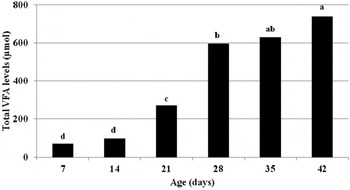
Jozefiak et al. (Reference JOZEFIAK, SIP, RAWSKI, RUTKOWSKI, KACMAREK, HOJBERG, JENSEN and ENGBERG2011) found significant amounts of VFAs in the caecal contents, with a decreasing order as follows: acetic acid (65%), butyric acid (16%) and propionic acid (12%). While a large amount of lactic acid was found in the crop and ileum, none was detected in the caeca. Similar results were found by Jamroz et al. (Reference JAMROZ, JAKOBSEN, KNUDSEN, WILICZKIEWICZ and ORDA2002) and Jozefiak et al. (Reference JOZEFIAK, RUTKOWSKI, JENSEN and ENGBERG2006), although a small amount of lactic acid was detected in the caeca by the latter authors. Choct et al. (Reference CHOCT, HUGHES and BEDFORD1999) found a total of 340 mmol VFA in the caeca of broiler chickens fed a low-AME wheat diet, and this value increased to 519 when a xylanase was added to the diet. Due to the large content of VFAs, pH is usually slightly acidic at below 6.5 (Jamroz et al., Reference JAMROZ, JAKOBSEN, KNUDSEN, WILICZKIEWICZ and ORDA2002; Jozefiak et al., Reference JOZEFIAK, RUTKOWSKI, JENSEN and ENGBERG2006; Reference JOZEFIAK, SIP, RAWSKI, RUTKOWSKI, KACMAREK, HOJBERG, JENSEN and ENGBERG2011), although a neutral pH has also been observed (Hinton et al., 2000; Rehman et al., Reference REHMAN, BÖHM and ZENTEK2007). The total VFA production of caeca increases between 7 and 42 days of age in broiler chickens, as shown in Figure 1 (Fischer, Reference FISCHER2003). These data demonstrate that the full fermentation capacity of caeca is not reached before 28 days of age in broiler chickens. Thus, it is possible that caecal fermentation is not able to play a significant role during the first weeks of age in the modern broiler chicken.
When it comes to birds of flight, the constraint of bodyweight is probably a major reason for the limited fermentation capacity. It is, in this context, interesting to note that flightless birds, such as the emu and ostrich, appear to be able to satisfy a major part of their dietary energy need from hindgut fermentation (Jozefiak et al., Reference JOZEFIAK, RUTKOWSKI and MARTIN2004). Also, the level of feeding and fibre content of the diet are of importance.
Effect of age on total volatile fatty acid levels in the caecum of broiler chickens (Fischer, Reference FISCHER2003).

Nitrogen utilisation
Due to the significant reflux of urine into the caeca, uric acid and urea will be degraded there. Barnes et al. (Reference BARNES, MEAD, BARNUM and HARRY1972) found that the majority of the organisms in the caeca were able to degrade uric acid. Braun and Campbell (Reference BRAUN and CAMPBELL1989) described how uric acid is broken down by bacteria to ammonia and carbon dioxide, in addition to other compounds. Karasawa (Reference KARASAWA1989) showed that 77% of the uric acid injected into the caeca of cockerels was degraded within 60 minutes, mainly into ammonia, and that the ammonia produced was rapidly absorbed by the bird (Karasawa et al., Reference KARASAWA, OKAMOTO and KAWAI1988). As demonstrated by Mortensen and Tindall (Reference MORTENSEN and TINDALL1981) in work with willow ptarmigan, amino acids have been shown to be produced, although these authors were not able to observe any quantitatively significant mechanism for their transport into the blood from the caeca. As described by Moretó and Planas (Reference MORETÓ and PLANAS1989), amino acids are absorbed in the proximal part of the caeca in 5 to 7 weeks old chickens, where well-developed villi can be found. These findings were confirmed by Obst and Diamond (Reference OBST and DIAMOND1989), who used an everted sleeve technique with caeca from 12 week old chickens to demonstrate a considerable absorption of proline through the caecal wall, with the proximal portion being most prominent. By studying uptake with or without sodium, it was estimated that 23% of the uptake was through carrier-mediated transport. Lerner et al. (Reference LERNER, SATTELMEYER and RUSH1975) also observed significant absorption capacity for methionine, but that this carrier transport system was lost during the first week after hatching.
In a situation where the bird lacks nonessential amino acids, it has been speculated that even absorbed ammonia from the caeca can contribute to an increased supply of these amino acids through the glutamate synthesis pathway (Karasawa, Reference KARASAWA1989). Karasawa and Maeda (Reference KARASAWA and MAEDA1994; Reference KARASAWA and MAEDA1995) showed that protein utilisation was higher for intact than for colostomised cockerels when the birds were given protein-deficient diets supplemented with urea, thus indicating a beneficial effect of caecal fermentation. However, caecectomy was not shown to decrease nitrogen retention in a later experiment, even in birds given low-protein diets (Son and Karasawa, Reference SON and KARASAWA2000). Although Sibbald (Reference SIBBALD1987), in his extensive review on bioavailability of amino acids, states that the effect of the caeca on amino acid availability is inconsistent, a reduced amino acid digestibility has been reported with caecectomised chickens compared to conventional chickens (Biggs and Parsons, Reference BIGGS and PARSONS2007). However, this could be due mainly to the fact that undigested amino acids, to a larger extent, are degraded by microflora in conventional than in caecectomised birds, and thus does not necessarily indicate a positive effect of the caeca on protein utilisation. Ravindran et al. (Reference RAVINDRAN, HEW, RAVINDRAN and BRYDEN1999) showed that while the difference between ileal and excreta amino acid digestibility were small for various plant protein sources, fish meal and blood meal, digestibility was much higher in when measured on excreta than on ileal contents for feather meal and three types of meat meal. This indicates that for poorly digestible protein sources, the caeca and the colon may play a significant role.
Diet composition and caecal fermentation
As discussed above, understanding the mechanisms for passage of material into the caeca and its fermentability are keys to understanding the extent of fermentation. In fact, although there is a basic understanding of the mechanisms whereby digesta flows into the caeca, knowledge of exactly which compounds enter the caeca is still not clear.
Jozefiak et al. (Reference JOZEFIAK, RUTKOWSKI and MARTIN2004) have discussed extensively the potential for different carbohydrate fractions to be fermented into VFAs by the caecal microflora. They concluded that only small amounts of NSPs are fermented, but even small changes in fermentable fibre may significantly affect caecal fermentation. Marounek et al. (Reference MAROUNEK, SUCHORSKA and SAVKA1999) studied fermentation of different carbohydrates in caecal contents in vitro, and found that lactose and raffinose gave the highest VFA production, followed by starch, inulin and pectin. Xylans gave significantly lower VFA production, and carboxymethylcellulose was not fermented at all. In wild galliformes adapted to a high-fibre diet, up to 34% of the cellulose in the diet can be digested, mainly due to caecal fermentation (Gasaway, Reference GASAWAY1976).
One indirect indication of the extent to which different fibre sources are degraded by bacteria inhabiting the caeca and other parts of the lower digestive tract is to study total fibre breakdown through the digestive tract. Carré et al. (Reference CARRÉ, GOMEZ and CHAGNEAU1995) found that less than 6% of the NSPs in maize- or maize/pea-based diets were digested, with slightly higher values for adult cockerels than for growing broiler chickens. The alfa-galactooligosaccharides raffinose, stachyose and verbascose, however, were completely digested in cockerels and had digestibility values between 83% and 92% in broiler chickens. The same researchers also noted that the excretion of VFAs was more than twice as large in the broiler chicken than in the adult cockerel, thus indicating that absorption of the fatty acids produced were also poorer in broiler chickens than in adult cockerels. Using a higher NSP diet, Jorgensen et al. (Reference JORGENSEN, ZHAO, KNUDSEN and EGGUM1996) found that the total tract digestibility coefficient of the fibre varied from around 0.3 in low-fibre control diets and a diet with oat bran added, to about 0.1 for diets with pea fibre added.
A more direct study to assess the potential of the caeca to degrade fibre was carried out by Duke et al. (Reference DUKE, ECCLESTON, KIRKWOOD, LOUIS and BEDBURY1984). Cellulose with radioactively marked carbon was either given orally or was injected into the caeca of turkeys adapted for several weeks to either a low-fibre or a high-fibre diet, and production of carbon dioxide containing the radioactively marked carbon was measured. Adaptation to a high-fibre diet increased the percentage of cellulose degraded to carbon dioxide from 2.9 to 10.4, and a comparison with caecectomised birds indicated that the efficiency was twice as high in intact birds as in caecectomised birds. A significant amount of the cellulose was found in the caeca, indicating that even cellulose ground to a fine powder will, to some extent, be refluxed into the caeca and be fermented there. Langhout et al. (Reference LANGHOUT, SCHUTTE, de JONG, SLOTJES, VERSTEGEN and TAMMINGA2000) observed that the caeca doubled in weight when 3% highly methylated citrus pectin was added to the diet of broiler chickens raised under germ-free conditions, but did not find this to be the case for conventionally raised birds. This may be explained by a reduction in digesta viscosity associated with the use of irradiation to sterilise feed for germ-free birds (Campbell et al., Reference CAMPBELL, CLASSEN and BALLANCE1986). Irradiation would reduce viscosity and pectin molecular weight permitting caecal entry, while intact, viscous methylated citrus pectin would, as theorised earlier, not enter the caeca.
Changes in the microflora composition of the caeca due to changes in fibre content in the diet may also be an indication of passage of fibre components into the caeca. Rodriguez et al. (Reference RODRIGUEZ, REBOLÉ, VELASCO, ORTIZ, TREVINO and ALZUETA2012) found that the number of E. coli and Lactobacilli increased when wheat and barley replaced maize in the diet. Also, addition of NSPases to the wheat/barley diet increased the number of Bifidobacteria in the caeca, while addition of inulin to this diet decreased the number of E. coli. Again this shows that solubility is an important starting point for the provision of substrates to the caecal flora, as wheat and barley are known to contain higher levels of soluble arabinoxylans and beta-glucans than maize. Correspondingly, Rougiere and Carré (Reference ROUGIERE and CARRÉ2010) found only a tendency for a slight increase in the caecal weight by including 15% sunflower hulls in the diet of broiler chickens. It is possible that the small amount of low-molecular weight carbohydrates present in the material contributed to the slight increase.
Oligosaccharides, such as fructooligosaccharides, are soluble low-molecular weight carbohydrates that are easily fermented by gut microflora, and which will have a large potential for being transported into the caeca and being fermented there, as discussed previously. Xu et al. (Reference XU, HU, XIA, ZHAN and WANG2003) found that the total number of anaerobes, Bifidobacteria and Lactobacilli, in the caeca increased while the number of E. Coli decreased, when a fructooligosaccharide was added to broiler chicken diets. Similar results regarding Bifidobacteria and Lactobacilli were observed by Baurhoo et al. (Reference BAURHOO, PHILLIP and RUIZ-FERIA2007) when a mannanoligosaccharide was added to broiler chicken diets. Courtin et al. (Reference COURTIN, SWENNEN, BROEKAERT, SWENNEN, BUYSE, DECUYPERE, MICHIELS, DE KETELAERE and DELCOUR2008) did not find any difference in the number of caecal enterobacteria and Lactobacilli by adding 0.2% xylo-oligomers, but the number of Bifidobacteria increased markedly (from 103 to 108) after only a week on diets containing these oligosaccharides. Despite an increased size of the caeca, Rehman et al. (Reference REHMAN, BÖHM and ZENTEK2007) did not find any significant changes in VFA content by adding 1% inulin.
The extent to which indigested starch is fermented in the caeca may be assessed by studying the difference between ileal and total tract starch digestibility. Weurding et al. (Reference WEURDING, VELDMAN, VEEN, VAN DER AAR and VERSTEGEN2001) reported ileal starch digestibility values ranging from 72.3% to 98.9% when they fed broilers different starch sources. Surprisingly, there was no difference in starch digestibility values between the posterior ileum and the total tract in broilers aged 27-28 days of age despite these occasional large amounts of starch escaping the ileum. Conversely, others have shown that diets which causes a low ileal starch digestibility (below 85%) may exhibit at least a 10% higher total tract starch digestibility, which approached digestibility values for diets exhibiting a high ileal digestibility (Marron et al., Reference MARRON, BEDFORD and MCCRACKEN2001; Zimonja and Svihus, Reference ZIMONJA and SVIHUS2009). Others have also shown that starch digestibility does not increase on a total tract level when it is already high at the ileal level (Gracia et al., Reference GRACIA, ARANIBAR, LAZARO, MEDEL and MATEOS2003; Svihus et al., Reference SVIHUS, JUVIK, HETLAND, KROGDAHL and Å.2004; Gutiérrez del Álamo et al., 2009). This indicates that, under some conditions, starch may be degraded by the microbial population in the caeca and other parts of the lower digestive tract if it escapes digestion in the small intestine.
Conclusions
Due to anatomical and physiological adaptations, only small and/or soluble particles will be refluxed into the caeca together with urine and digestive fluids. Here, salts and water will be reabsorbed, and uric acid and carbohydrates will be fermented by the abundant microflora to ammonia and VFAs. Thus, the caeca may play a role for the nutritional status of the bird, although the quantitative significance for high-yielding domesticated poultry remains to be elucidated.