From 944 to the 980s (when he was ultimately removed from office), Basil, natural son of emperor Romanos I, ranked among the most powerful men in Constantinople.Footnote 1 He is known to have commissioned a number of luxury objectsFootnote 2 and is speculatively identified as the patron of a few further works of art and literature.Footnote 3 I hesitate to add two more items to this already long list, but the supporting evidence seems to me strong enough to be worth considering.
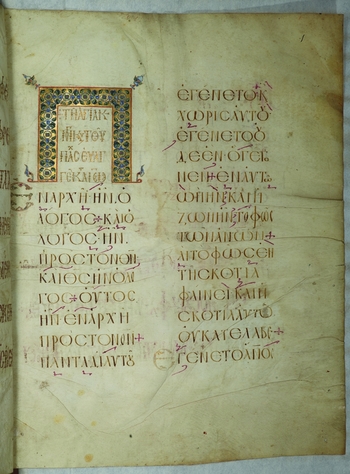
Manuscript Supplément grec 567 in the National Library of France is a short gospel lectionary, containing readings just for the Divine Liturgy on Sundays (from Easter onward) and on a few major feast days.Footnote 4 Henri Omont recognised in it a fairly mannered – and therefore late – kind of majuscule handwriting and tentatively ascribed it to the fifteenth century.Footnote 5 Amédée Gastoué observed that the ‛ekphonetic’ (musical) signs which accompany its biblical text (Fig. 1) cannot be later than 1200.Footnote 6 Jean Ebersolt proposed an even earlier date:
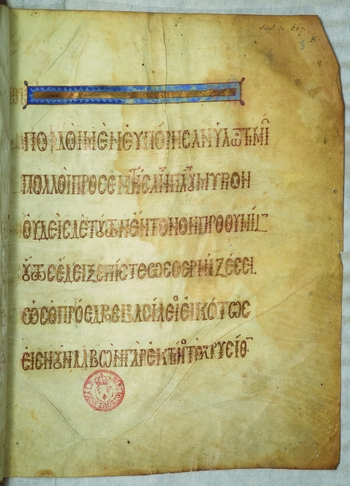
Au fol. B sont écrits en or des vers en l'honneur du « proèdre Basile » qui possède une foi ardente, la conviction que les richesses spirituelles sont préférables aux biens matériels. Un monastère, un asile de vieillards, un bain pour les indigents, un hôpital, tels sont les bienfaits qu'il a répandus autour de lui. Il s'agit sans doute du haut dignitaire, qui joua un rôle important à Byzance, au Xe siècle; cf. G. Schlumberger, op. cit. [Nicéphore Phocas (Paris 1890)], p. 291 s.Footnote 7
Paris, Bibliothèque nationale de France, MS Suppl. grec 567, fol. 1r

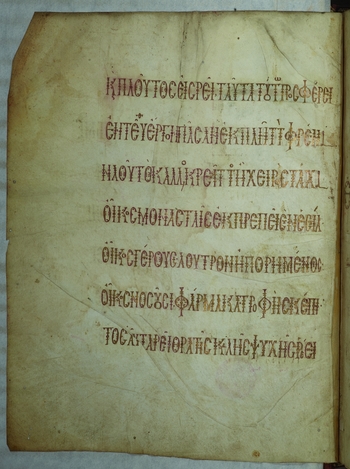
The text that Ebersolt paraphrases has not been edited in print before (Fig. 2–3):Footnote 8
Paris, Bibliothèque nationale de France, MS Suppl. grec 567, fol. Br

Paris, Bibliothèque nationale de France, MS Suppl. grec 567, fol. Bv

The leaf on which this poem once ended has been cut out of the book.Footnote 9 The verses must be original to the volume, since the parchment on which they are written is ruled in a manner very similar to the ruling for the biblical text.Footnote 10 Unlike a regular ‛book epigram’,Footnote 11 their topic (in their present defective state, at any rate) is not the gospel lectionary where they are inscribed but a monastery to which that lectionary had been given:
Many people own plenty of material riches and many have acquired abundant wealth, but nobody among them has demonstrated the intense earnestness of [his] faith with such burning ardour as the proedros Basil – for, being aware who is the source of gold and wealth,Footnote 12 he offers these [back] to Him. Hence [the] deed that amazes everyone's mind: a beautiful church [. . .],Footnote 13 a house for monks with a splendid refectory (?), a house for the aged, a bath for the poor, a house for the sick, medicines, food, shelter – such are the fruits of his good soul. . .
The poem's mention of an old people's home, a hospital, and a bathhouse adds to the sparse textual evidence for tenth-century Byzantine charitable institutions.Footnote 14 Psellos writes of a ‛most splendid monastery that [Basil the Bastard] had built and dedicated to the great [St] Basil (whose name he bore), magnificently erected with great expense in labour (πολλῇ δαπάνῃ χειρός), combining intricacy with beauty, and more than sufficiently provided with abundant donations’.Footnote 15 It might well have been this convent that originally owned the Paris gospel lectionary: 1 January is one of the few feast days for which it contains a reading.Footnote 16
Nothing stands in the way of dating the manuscript between 963, when Basil was made proedros (being the first ever holder of this title) and 985 or so, when he was deposed:Footnote 17 the type of decorative capitals in which the above poem is written (Fig. 2–3) is primarily, if not exclusively, attested in the tenth century,Footnote 18 while the gospel text itself (Fig. 1) is in a ‛liturgical majuscule’ easily attributable to that same period.Footnote 19
Similar handwriting is found in a gospel lectionary now in Naples (Biblioteca nazionale ‛Vittorio Emanuele III’, MS gr. 2*, ex Vindob. Suppl. gr. 12).Footnote 20 Copied in gold ink on purple-coloured parchment, this unusually small book contains a very limited selection of passages and must have been intended for private perusal.Footnote 21 Its opening page carries the words ‛Basil's power’ (Βασιλείου κράτος), inscribed within a cross.Footnote 22 Kurt Weitzmann understood this as an ex-libris of the (illiterate) Basil IFootnote 23 – but there are obstacles to dating the manuscript in that emperor's reign (867-886). First, the headband (evidently not a later addition) on the title page is filled with ornament of the ‛flower-petal’ type,Footnote 24 which originated in the mid-tenth century.Footnote 25 Second, one of the scribes who produced the lectionary supplied his text with ekphonetic signs,Footnote 26 and such signs are not attested with certainty before 900.Footnote 27 Beside Basil I, there are just two other possible patrons for the Naples manuscript: Basil II (r. 976–1025) and his great-uncle Basil the Bastard. The word κράτος is more appropriate for an actual emperor, but during the reign's first decade it really was the older Basil who ran the affairs of state.Footnote 28 The Bastard's resulting self-confidence could have been reflected in the embellishment of a book made for his personal use – before hubris brought about his downfall.