Nineteenth-century Pittsburgh and New Orleans were dirty: garbage and dead dogs were used as fill for the streets (Thompson Reference Thompson1880: 33) and piled up as high as 16 feet in yards (Pittsburgh Post 1880a, 1880b). City streets were “a natural outlet for filth . . . rugs are beaten on sidewalks and roofs, dogs are taken out on a leash to defecate, kitchen garbage is set out on the sidewalk for scavengers to remove, old clothing and dead animals are thrown into the gutter” (Soper Reference Soper1909: 8). Rotting piles of garbage were not only noxious, but also they spread disease, hindered commerce, and impeded safe travel. Traditional methods of disposing of trash—burying, burning, feeding to hogs, or allowing animals to roam the streets—were untenable in these large metropolitan areas of a quarter of a million residents each. Something had to be done, but what? Pittsburgh and New Orleans were large economic centers, ravaged by disease, and counseled by national sanitary experts. By the mid-1890s, when they both decided to establish trash collection at public expense, each considered and even tried contract collection, but while Pittsburgh stuck with contract, New Orleans turned to city collection. Why did two similarly situated cities choose to address the same problem with two different solutions?
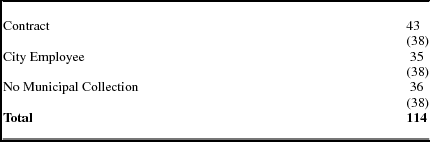
Pittsburgh and New Orleans faced a challenge common to cities at this time. Municipal governments across the country created a wave of garbage ordinances in the mid-1890s to tackle the growing “garbage problem,” but there was a lack of consensus about the best way to address it (see Chapin Reference Chapin1901: 695–96). Providence (Rhode Island) Superintendent of Health Dr. Charles Chapin's 970-page Municipal Sanitation in the United States includes the garbage collection practices of 114 identifiable cities.Footnote 1 Looking across the country, garbage collection practices were nearly evenly divided between contract (43), public (35), and no municipal collection (36).Footnote 2 Table 1 displays the number of cities that had each type of collection. A chi-square test, which evaluates the difference between what is observed versus what would be expected if the results were distributed evenly, shows there is no statistical difference (p = .607). On their face, garbage collection practices do not seem to trend one way or the other.
Municipal garbage collection is nearly equally divided into three types.
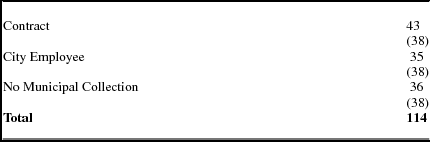
Chi square with two degrees of freedom = 1.000, p = .607.
Source: Authors’ analysis of data from Chapin Reference Chapin1901.
Note: Expected values (if row and columns are independent of one another) in parentheses.
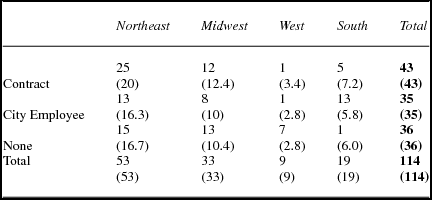
While there was little convergence across the country, there are distinct regional tendencies. Table 2 shows the breakdown in collection practices by region. The Northeast collected trash most often by contract, the West overwhelmingly provided no collection, the Midwest—sandwiched between the Northeast and the West—split trash collection nearly evenly between contract and none, while the South relied predominantly on city provision. A chi-square test confirms that the observed results are statistically different (p = .000) from what we would expect if region and collection type were unrelated. Mirroring the choices of Pittsburgh and New Orleans, the Northeast collected trash by contract with private providers more than twice as often as city employee or no provision, while the South had city provision more than twice as often as the other two options combined. Why?
The South favors city employee.
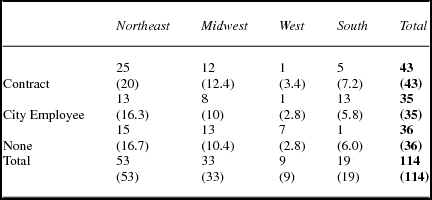
Chi square with six degrees of freedom = 25.720, p = .000.
Source: Authors’ analysis of data from Chapin Reference Chapin1901.
Note: Expected values (if row and columns are independent of one another) in parentheses.
In this paper, we delve deep into the history of trash collection practices in Pittsburgh and New Orleans relying on primary archival research, secondary histories, and aggregate data collected by sanitarians and US government officials to understand why these two cities chose city or contract collection and what lessons they offer for unraveling the puzzling regional patterns in table 2. In comparing the decisions of these two cities, our task is not to identify the best method of garbage collection. Both cities spurned the offers of resources that may have led to more effective and/or civic-minded collection and cleaner cities. And both cities were still dirty after trash collection programs were put in place. Our aim is to understand how decisions were made and what these choices looked like in practice. Cleaning up cities was not an easy task: it required resources, coordination, compliance of residents, new technology, new skills, and oversight. Throughout the Progressive Era, cities continually failed at any number of these tasks. Hence our focus here is on the choices available in the late nineteenth and early twentieth centuries and the decisions made by Pittsburgh and New Orleans that shed light on the garbage problem, chosen solutions, and potential explanations for the North-South difference we find.
Regulating Garbage
Prior to the choice between provision by city or contract, municipal governments used a regulatory tool available in nineteenth-century law—the law of nuisance, drawn from the common law tradition (Novak Reference Novak1996: 60). Nuisance regulations—requiring residents and householders to behave in particular ways—shaped “private” behavior to accomplish public ends. New Orleans and Pittsburgh used nuisance regulations to require property owners to keep and repair sidewalks and residents to pay for waste removal. But nuisance regulations proved to be inadequate. These laws, which relied on individual behavior with enforcement by city inspectors and sanitary police, failed to bring about results. Municipal records from Pittsburgh document a mounting number of complaints. Residents found sweeping streets time consuming and contracting with scavengers to remove trash unnecessarily expensive. It was far easier and cheaper to shirk their responsibilities or dump waste illegally. Pittsburgh health inspectors, charged with addressing nuisance complaints, lamented in their annual reports: “At present fully one-half of the garbage, etc., is deposited upon the public streets, alleys, and vacant lots, under cover of darkness, and the balance, when mixed with the daily accumulation of ashes, is removed from the premises by some one of the many irresponsible persons engaged in the business. . . there are many vacant lots, and they are the receptacles of all the garbage of the surrounding neighborhood” (as described in Waring Reference Waring1887: 870). New Orleans experienced similar difficulties: “Chamber slops [the waste water from sleeping chambers] are, theoretically, generally thrown into the privy vaults; but to obviate the necessity for the costly emptying of vaults, such liquids are often surreptitiously discharged along with the laundry and kitchen wastes, which, according to universal custom, are carried by superficial or shallow drains to the street gutter” (Reference Waringibid.: 288). Nuisance laws provided for the public welfare on paper. In practice, residents and scavengers dumped household trash and human waste illegally, filling streets, vacant lots, and waterways.
If nuisance regulations had the disadvantage of being ineffective, they had the distinct advantage of being inexpensive for cities. Residents bore the costs (time, money) of carrying out duties on behalf of city governments and were loosely overseen in their endeavors by city inspectors responding to complaints. If cities wanted to provide more comprehensive services, they would have to find a way to create, fund, and implement them, far easier to do in Pittsburgh than New Orleans.
Choosing Contract: Pittsburgh's Machine and the American Reduction Company
Pittsburgh's unified political leadership was a crucial advantage. Pittsburgh's well-oiled political machine united business and politics and made contracting personally beneficial to key machine actors. Pittsburgh's machine centralized city control in a partnership of City Treasurer Christopher Magee and street-paving contractor and Pittsburgh Republican Party Executive Committee Chairman William Flinn. The machine ruled Pittsburgh politics, connecting government and business in a hierarchical organization run clearly by a “boss” since 1880. Magee and Flinn centralized their grip on the city by implementing changes to the city charter in 1887. They took the power of appointments away from the city council and granted it to department heads. The Democratic Pittsburgh Post branded it the “Mageesburgh Charter” and proclaimed that Pittsburgh had been “given over to the boss.” For Magee and Flinn, the new charter and the Upperman bill, which authorized second-class cities such as Pittsburgh to provide for improvement of streets, lanes, alleys, highways, sewers, and sidewalks, and required “plans” for streets, “set the table for a veritable banquet of lucrative public works” (Bauman and Muller Reference Bauman and Muller2006: 21). Muckraker Lincoln Steffens described the effect of their actions: “The Magee-Flinn machine, perfect before, was made self-perpetuating. I know of nothing like it any other city. Tammany in comparison is a plaything, and in the management of a city [New York City's] Croker was a child beside Chris Magee” (Steffens Reference Steffens1957 [Reference Steffens1904]: 115).
With patronage and therefore city elections tightly managed by Magee-Flinn, the machine controlled city government. Magee used his position to command utility and transportation franchises, the deposit of city funds, and the granting of construction contracts, as well as funnel funds from the Pennsylvania Railroad and steer lucrative contracts to Flinn (Couvares Reference Couvares1984: 64). Flinn and Magee also struck up a fraught arrangement with the state Republican Party boss, M. S. Quay (Bauman and Muller Reference Bauman and Muller2006: 34–35).
After the Republican Party swept political office in the election of 1894, the newly elected regime got right to work when it took office in January 1895. It immediately raised revenue by introducing a new tax (Pittsburgh Post 1895b). Pittsburgh's director of the Department of Public Safety was enlisted to draw up a general sanitary code for the state as state health authorities discussed compulsory vaccinations, hygiene, typhoid, rural public health, and the proper use of disinfectants (Pittsburgh Post 1895a).
In response, the Pennsylvania legislature passed an 1895 act to create bureaus of health in cities of the Second Class (population between 100,000 and 1 million). The bureaus were empowered to address conditions that would imperil public health, including garbage, rubbish, dead animals, privy waste, and tainted food. The state authorized the director of the Department of Public Safety (under which the Bureau of Health was located) “to enter into a contract or contracts with such parties as may be found necessary, for the removal of all offal, garbage and swill from private premises and for the disposal of the same” (Pennsylvania Public Law 350 No. 258, sec. 20, June 26, 1895).
Although the legislation seemed beneficial to the public welfare in cities generally, by specifying cities of the Second Class, the new law pertained only to Pittsburgh and neighboring Allegheny (which Pittsburgh would annex in 1907). It was written for the benefit of Pittsburgh and the Magee-Flinn machine that controlled it. In practice, the legislation legally empowered the machine-controlled Department of Public Works to distribute public money to machine-affiliated contractors.
The city wasted no time in taking up this opportunity. Pittsburgh's garbage ordinance of 1895 provided for the systematic collection, removal, and disposal of garbage, offal, dead animals, and condemned meat in the city at the public expense by contract (City of Pittsburgh 1896: 313). The director of the Department of Public Safety was authorized to enter into a contract or contracts with private parties (ibid.: 765). The first garbage contract of $93,890 per year for four years, to collect, remove, and dispose of garbage, offal, and dead animals, was awarded to Charles Flinn, William's brother (City of Pittsburgh 1900: 22). Charles Flinn constructed a reduction plant, an innovative process first used in Buffalo in 1886 to extract reusable products by drying out the garbage, placing the material in extractor tanks, and recovering grease (Osborn Reference Osborn1912: 937). Because reduction processes required sorting of garbage so only appropriate items were processed by the reduction plant, it was efficient for the garbage collection company to have a relation with the reduction company.Footnote 3 Charles served as president of the newly created American Reduction Company, with the sanction of city authorities (Fisher et al. v. American Reduction Company 189 Pa. 419 [1899]).
Health officials marked 1895 as a new and important year in sanitary administration (City of Pittsburgh 1896: 307–8). The annual report of the Pittsburgh Department of Public Safety noted that “1895 was a remarkable year in many respects, perhaps in none more so than in its influence upon public sanitation” not just in Pittsburgh but also across the state with the adoption of new sanitary measures. Apart from a few complaints of offensive odors, Pittsburgh officials reported satisfactory improvement (City of Pittsburgh 1899: 208). They had reason to be optimistic. The reduction plant was initially successful. William Flinn ordered materials from Cincinnati, site of another reduction company.Footnote 4 He was pleased with the quality of grease that the reduction plant produced, without excess water or impurities, and was able to net a profit of $921.Footnote 5
Despite the initial success of the 1895 ordinance, garbage collection was uneven in subsequent years. There were early indications that the plant would not be the profit maker it promised. The quality of grease was uneven.Footnote 6 Flinn admitted that there few workers employed at the plant, and those that were did not work full time.Footnote 7 Charles Flinn was irregular in garbage collection.Footnote 8
There were numerous complaints in regard to the uncertainty of garbage and rubbish collections. Ashes and dirt not coming under rubbish were stored in unregulated barrels, and their removal depended on the owner or tenant. There was a lack of uniformity and inadequate supply of garbage pails. Filth notices or orders to get garbage pails were frequently given, but the department has unnecessarily and deplorably failed to prescribe standard receptacles for garbage. “The results are unfit and impossible to keep clean contrivances” (City of Pittsburgh 1912: 30).
The Civic Club of Allegheny County (CCAC) cataloged these complaints. Formed in 1895 as a merger of The Ladies Protective Health Association—a municipal housekeeping group committed to cleaning up garbage, polluted water, and smoke—and the Twentieth Century Club, the CCAC was committed to cleaning up the city streets and its corrupt government (Bauman and Muller Reference Bauman and Muller2006: 40). The first activities of the CCAC sought pure water and garbage disposal (Civic Club of Allegheny County 1915). The CCAC drew attention to poor administration of garbage collection, keeping lists of complaints about alleys and sanitary conditions, particularly in the working-class South Side (Civic Club of Allegheny County 1903). Public health officials reported that the dump did not have enough watchmen, and those employed were not uniformed. Neighboring residents complained of foul odors (City of Pittsburgh 1912). Carts were not covered with canvas as required (City of Pittsburgh 1938: 666; New York Bureau 1913: 24). The weighing of cart loads was not supervised by a weighmaster, allowing garbage collectors to overcharge the city (New York Bureau 1913: 23).
The CCAC's watchdog activities suggest that Pittsburgh's garbage collection practices fell short of ideal sanitary practices. Still, despite the American Reduction Company's documented failures, it continued to receive the garbage collection contract year after year. Through regime change and political reform in 1910, the American Reduction Company retained the city contract until 1931 (Pittsburgh Post-Gazette 1931: 1).
Enabling City Collection: New Orleans’ Ring and the Widows Carts
Like Pittsburgh, New Orleans political leaders were corrupt. But the corruption looked very different than the Magee-Flinn machine. Pittsburgh's machine was a public-private partnership, connecting politics and business in Pittsburgh. It was hierarchical and tightly controlled by a boss. Thus, the machine was able to address concerns of Pittsburgh's business and political elite, please Pittsburgh's residents, and quell dissent. The New Orleans Ring, by contrast, did not have a lock on power, was in contention with New Orleans’ business leaders, and was decentralized. Decisions about trash collection reflect these broader political disadvantages.
New Orleans politics in the late nineteenth century was characterized by instability. Elections swung from Ring to reform and back to Ring again. In 1880, Joseph Shakspeare served as reform mayor but his term lasted only two years before control passed to William Behan, a Ring candidate, in 1882. However, failing to serve the Ring, Behan joined the Citizens Reform Party before being defeated in 1884 by J. Valsin Guillote, the Ring candidate. Four years later, with hope for political and civic reform, Shakspeare was reelected as mayor. But by 1892, the Ring was back in power, this time with John Fitzpatrick as mayor.
In this climate, as political control seesawed between Ring and reform, political leaders grasped at ways to build coalitions and consolidate power. The reformers paired with business and civic leaders to create elite coalitions for change while the Ring drew its support from lower- and working-class residents, especially ethnic Irish, Germans, and later Italians (Ettinger Reference Ettinger1985: 345). Though both parties shared a distasteful racial record, black residents split their vote requiring both reform and Ring to court this swing-voter constituency in order to win office.
Even when they won elections, mayors had a difficult time controlling the ins and outs of New Orleans’ decentralized politics, which empowered the city's many ward leaders and administrative offices. The Ring differed from Pittsburgh's machine. It lacked a real boss. As its name suggests, power was shared among ward bosses (Ettinger Reference Ettinger1985: 344). Authority was fractured, control difficult, and boodle (bribes) common.
Ring politicians, like John Fitzpatrick—a first generation Irish “self-made man,” came up the ranks. Fitzpatrick climbed up from an orphanage to fire companies to clerk of court to the Big Boss of the Third Ward and eventually became the commissioner of public works (Ettinger Reference Ettinger1985: 347–48; Haas Reference Haas1981: 10–11). Fitzpatrick was a popular leader who used his position as the administrator of improvements and later commissioner of public works to dole out municipal patronage through both reform and Ring administrations. Fitzpatrick drew support from working-class voters, putting many on the payroll. His hostility to the commercial elite kept businesses out of political power and precluded any investment in new garbage technology (Arensen Reference Arensen1994: 76).
Instead, the Department of Public Works relied on an antiquated day-labor system of carts where the city paid cart owners per day to work for various public works programs, including garbage collection. Records from June 1883 show the department spent $7,614 on street “labor” (quotes in the original) and $3,422 on carts. The department employed 80 carts to work an average of 22 hours, at $2 per day.Footnote 9 But still, garbage was collected only sporadically.
Though department carts were supposed to haul trash to the garbage wharf where it was loaded on the barges of a private contractor, towed downriver, and dumped, garbage collection never covered the entire metropolitan area adequately. Smelly refuse was allowed to stand for days on some streets. Furthermore, the garbage boats broke down several times and lay idle for months. This led to the practice of merely dumping the garbage on some neutral grounds in sparsely settled sections. Frequently, when repairs were done on canal banks, garbage was used as filling (Jackson Reference Jackson1969: 159–60).
When John Fitzpatrick was elected mayor in 1892, he called attention to the contracts given out by the previous administration and promised to see that obligations were actually carried out (United States 1939). Still, a year later, there were growing complaints about trash. “In streets innumerable the garbage cart does not pay a visit for days, nay, for weeks, at a time: and householders are in consequences compelled, as they have no other recourse, to throw out their refuse matter in the streets day after day. In the course of time it naturally accumulates in large quantities to become as the summer sun pours his fiery rays upon them putrescent and disease-breeding masses” (New Orleans Times Democrat 1893). New Orleans’ partisan newspapers both ran stories about the mounting trash problem. The New Orleans Times Democrat noted that “it would be superfluous to tell readers of the Times-Democrat that there is nothing more unsatisfactory in the so-called performance of his official duties by the present Commissioner of Public Works of this City than the removal of garbage. It is not, in fact, a removal of garbage on any systematic and workable plan, it is a mere apology for removal, and a miserable apology at that” (ibid.).
To solve the growing problems, city officials fielded an increased number of proposed ordinances from burning garbage under city ordinance to using new garbage receptacles (City of New Orleans 1892–96). The Board of Health reported that “so many complaints come in from all directions. . . the garbage service of this city needs to be completely changed, since it is radically defective” (Daily Picayune 1893a). The city council planned to take up the problem with a fact-finding expedition to determine how other cities dealt with their garbage problems. The Daily Picayune was critical: “Why is it that the refuse is not gathered up promptly and carried away to the garbage boats? Is it because there are too few carts, or because there is official neglect?” (Daily Picayune 1893b). The city had a system of trash collection. But it did not have enforcement mechanisms (Ellis Reference Ellis1992: 94). Ordinances provided how garbage and waste should be disposed by residents, but they instead dumped waste in courtyards, streets, and gutters. Similarly, ordinances provided for city collection yet trash collection occurred sporadically, sometimes not coming to neighborhoods for weeks or months at a time. And though regulations provided for watchmen at city dumps, sanitary inspectors found “ragged children” picking through garbage heaps (Reference Ellisibid.). City officials and employees who failed to carry out their duties faced no punishment. Sanitary improvements were a response to public health concerns, but health officials generally lacked influence over their administration (Schultz and McShane Reference Schultz and McShane1978: 396).
The Ring's political base made it amenable to patronage under city collection while the city had a fraught history with contract. When the city council contracted out garbage collection, along with street repair and drainage work in 1877, it saved money. The contractors used only a third of the number of employees and half the number of carts. But the quality of services declined. Perhaps more importantly to the fate of contract collection, white workers feared loss of city jobs to “colored men [who] might obtain employment on the public works where now the steady Democracy found their bread and butter” (Arensen Reference Arensen1994: 46).
New Orleans tried contract collection once again in the Fitzpatrick regime. Supporters of contract collection touted the positive effects of free enterprise, “holding the contractor personally responsible for the faithful performance of the work” (Daily Picayune 1892). Through ordinances, the city could specify requirements for the carts and their drivers as well as the responsibilities of New Orleans’ residents. Opponents worried that it would further corruption and advantages for particular contractors (Melosi Reference Melosi2005: 24; Troesken Reference Troesken1999).
Despite the overwhelming opposition of the Daily Picayune, Mayor Fitzpatrick accepted the bid of E. G. Schleider of the Southern Chemical and Fertilizing Company to build a plant that would burn garbage and create fertilizer on August 30, 1893. The fertilizer company was known to be a front for Maurice Hart, a businessman “with an obscure and questionable background” (Ettinger Reference Ettinger1985: 356). New Orleans’ residents bristled at a contract awarded to Hart. Shortly after the contractor began, the streets were strewn with trash and city government was marred by scandals (Jackson Reference Jackson1969: 137–60). Citizens refused to comply with the contractor's requirements to sort their household waste, or to put their garbage in the designated garbage box (Daily Picyune 1894a, 1894b, 1894c; Ettinger Reference Ettinger1985: 355–56). The scandal snowballed as a grand jury criticized the terms of the garbage contract for being too generous to Hart. When Mayor Fitzpatrick upped the ante by threatening residents with fines of up to $10 or imprisonment for noncompliance, it only exacerbated the situation. The city ended the contract without ever having adequate garbage collection or the promised reduction plant built. The contractor, Southern Fertilizer, was disbanded.
The garbage debacle, together with a failed railroad franchise, brought the Fitzpatrick administration under greater scrutiny. The press nicknamed the city's administration the “Boodle Council” after one-third (10) of the city's council members were indicted (Ettinger Reference Ettinger1985: 337). Fitzpatrick, too, fell under suspicion and the opposition filed suit to remove him from office, but he was found innocent of all charges.
In a stunning election in April 1896, the Ring was out of power. Walter Flower was elected mayor on the head of a reform ticket. The new city charter went into effect later in July, making important changes once again to the way New Orleans government would work. Like Pittsburgh, the city consolidated power in one chamber and vested executive power in the mayor, treasurer, and comptroller. The mayor, in turn, selected the commissioner of public works, commissioner of police and public buildings, and the city engineer. Aside from these elected and appointed officials, the charter also established civil service provisions (Notes on Municipal Government 1897). After the great defeat of the contracting system, garbage collection returned to “normal,” namely, spotty collection and dumping in the Mississippi River.
Though encumbered by debt and financially constrained, New Orleans political officials rebuffed offers by the civic-minded Auxiliary Sanitation Association, an association created by business and civic leaders in 1879 to pay for and implement garbage collection practices (Ellis Reference Ellis1992: 87–94). The city relied instead on its antiquated (and ineffective) system of “widows carts,” which paid women cart owners to collect trash. In 1900, the city of New Orleans reported 134 garbage carts on the payroll, of those 88 were listed under women's names.Footnote 10 All of the women who worked for the city were white and mostly Irish widows. The city employed these “widows carts” to benefit particular women, especially the wives of deceased ward leaders. Friends would chip in to purchase a dump cart and mule, which the widow would then use (or hire out) for collecting garbage (Refuse Collection in New Orleans 1922: 419). The city spent a great deal of money for this service, roughly $93,000 per year on garbage service in 1900.Footnote 11 In 1901, during the Capdevielle administration (1900–4), the Department of Public Works had 110 carts in service, assigned to different wards to pick up garbage daily, delivering 440 loads a day to the river.
When the city controlled garbage collection, patronage determined which women would get carts. Influential individuals would make their case to the commissioner of public works, sometimes explicitly making the claim that particular individuals were “deserving.” In a letter dated June 18, 1900 to the commissioner of public works, Rob Ewing makes the case that Mrs. William Mallyn “who I wrote you about getting a cart. . . is a widow and especially deserving.” He concludes, “I trust you will help her.” The handwritten note by the Department of Public Works indicates the appeal was successful, saying “ordered to work for July 1900” (City of New Orleans 1900). In a letter dated May 14, 1900 to T. J. Moulin, the commissioner of public works, Joe A. Malloy, of the clerk's office of the Criminal District Court for the Parish of New Orleans, pens “the following are the names and addresses of the parties of the 11th ward whom I desire will be given a cart each.” The eight names include five women. Like the letter from Ewing, the handwritten note by the Department of Public Works says, “OK, orders issued May 15, 1900” (ibid.).
Still, New Orleans remained dirty and health officials struggled to make the policies on paper work in practice. In an attempt to improve the administration of trash collection, the general superintendent of public works laid down rules for foremen. They were to see that both drivers and carts showed up promptly for roll call; monitor the condition of streets, bridges, and gutters in their respective wards; see that ordinances were complied with; be sure that workers were in uniform (foremen wore a gray suit and gray hat, laborers wore white, and drivers were to wear a red shirt); be sure workers were not lingering in coffeehouses or barrooms; and “always be wide awake, energetic, prompt and painstaking in furnishing the city's interests, and complying with orders received, and other duties.”Footnote 12 Foremen were to be sure that carts were in proper condition; carts were the right size, with a “tight body and high tail”; signs printed “City Cart, 10” × 12””, painted white with black letters, were affixed on each cart; and they were covered with tarpaulins.Footnote 13 The general superintendent provided for workers to leave their measurements and receive their uniforms.Footnote 14 Nevertheless the general superintendent had his work cut out for him. He had to oversee decaying boats, half-loaded carts, absent workers, and a general appearance of neglect of the streets and gutters.Footnote 15
The superintendent would drop workers and cart owners from the rolls, and women were not immune. Mrs. Cosurus of the 7th Ward and Mrs. Rizo of the 9th Ward were dropped. Mrs. Hendricks was dropped from the sewer gang.Footnote 16 Mrs. Roge was issued a warning; given that the foremen had reported that her cart failed to report for duty, if she failed to show up, her cart would be dropped from the rolls.Footnote 17
New Orleans officials actively managed the carts. George S. Smith, Department of Public Works bookkeeper and later commissioner, both placed women on the rolls and took them off. In January 1909 he added 13 women cart owners to the rolls.Footnote 18 In February 1909, he instructed the general superintendent to place Mrs. John Weber's cart at work, as well as Mrs. Harrison. Mrs. Strehmeyer was added to the Fly Gang No. 3, but as a replacement for Mrs. Folger.Footnote 19 Smith added three women cart owners to the 17th Ward and one to the 16th Ward in January 1909.Footnote 20 He also put a woman cart owner on notice. In March 1910 he notified the general superintendent of 10 women cart owners (along with two male cart owners) who had reported late or whose carts were in poor condition.Footnote 21
Smith laid down rules for superintendents, reminding them that they had full power and authority (and responsibility) over their respective districts. They were to immediately suspend workers who were intoxicated, negligent, or disobedient. They were to be familiar with and comply with all pertinent ordinances. They were to make note of shoddy conditions of streets, bridges, wharves, and drainage in their districts and report as such. They were to phone the public works office every day between 2 PM and 3 PM. They were to take complaints in duplicate and immediately attend to them. They were to keep time sheets for workers and no time sheet was sent to the office until the work was actually done. They were to have a horse and buggy to be sure they could cover the territory they supervised.Footnote 22 Foremen were instructed to make a daily report of men and carts; responsible for their condition and service and conduct; to be sure cart operators did not enter barrooms during working hours; and working the set hours of 7 AM to 5 PM. The foreman was to be sure that garbage was not left on sidewalks when it was transferred to the cart.Footnote 23 Despite the crackdown, there were still disciplinary problems. In 1910, for example, Smith needed to step in to identify the driver who burned refuse on the street rather than taking it to the dump.Footnote 24 In 1911 the general superintendent needed to notify district superintendents that they needed to suspend workers who were slipping out of work to attend baseball games.Footnote 25
Public and Private?
Though the carts were owned by widows and the collectors were essentially subcontractors, New Orleans was considered to have city collection because the widows carts were under the oversight of the Public Works Department. While we found no evidence of widows carts in other southern cities, we did find a motley assortment of practices (scavengers, convict labor, and administrative departments) that all fall under the umbrella of city collection. To contemporary observers, contract collection in table 2 looks familiar to what we might think of it today, but city collection encompassed many creative arrangements definitely outside of civil service. Our findings, then, suggest the disproportionate emphasis on city collection in the South is a result in the difference between the specificity of contract collection compared to the vagueness of city collection, defined as much as what it is not (legal contracts with business) as what it is (managed by city officials).
Charles Chapin, the sanitarian who collected the aggregate data on which we rely, describes collection by contract as involving standard practices: cities usually advertised for bids and provided detailed specifications of the work to be done. Contractors were to be bonded and comply with Health Department regulations. Contractors were expected to check in daily to receive any complaints, and that would require a telephone and an employee designated to respond to the complaints (Chapin Reference Chapin1901: 689–90). Indeed, when New Orleans eventually prepared for collection by contract in 1917, the ordinance clearly specified the mutual obligations of the city and the contractor (as well as with the Metropolitan Life Insurance Company of New York, which assumed the debt of the city) (New Orleans Ordinance No. 4668, 1917).
Contract collection in the South, as in Pittsburgh, involved businesses that were willing to invest in the new technologies being touted by the emerging flock of sanitary professionals.Footnote 26 An entrepreneurial company could provide a city with sophisticated disposal technology by building and running the plant as well as collecting garbage. The five southern cities that were classified as collecting by contract in Chapin's study all followed this pattern. Wheeling, West Virginia contracted with the American Stoker Company (Chapin Reference Chapin1901: 722). San Antonio's contract was connected with the Brownlee Crematory for disposal (Reference Chapinibid.: 726). A few years later it even invested in a fuel-brick plant, built to convert garbage into fuel analogous to bituminous coal (Homaday Reference Homaday1915). Wilmington, Delaware had long contracted out, but for the less expensive and less advanced disposal method of cremation. Washington, D.C. replaced a fledgling, fairly effective contractor service with a new contract for a reduction plant in 1892. After complaints and a fire, the company went into receivership. Congress appropriated money for a new contract with clear specifications in 1895, but the contractor and commissioner disagreed on the type of furnace to use, so the city used both a Brown furnace and a Smith furnace. Both were ineffective and contractors could collect only 40 percent of the city's garbage, and the rest was sent down the river (Woodward Reference Woodward1901). The city eventually reformed this arrangement in 1900 by issuing four separate contracts, for garbage and dead animals, ashes, miscellaneous, and night soil. Augusta collected under contract when Chapin conducted his study, but it reverted to city collection within five years (City of Augusta 1906: 28).
The waffling between contract and city collection was not uncommon. Other southern cities, like New Orleans, tried and failed to contract out for one of these new technologies. Savannah had contracted out its Scavenger Department for several years but took over public control in 1888 (City of Savannah 1889: 17). The city passed ordinances requiring householders, merchants, and other occupants of buildings to keep their sidewalks clean (City of Savannah 1888: 198). Householders were to separate garbage from ashes. These provisions were largely ignored, with merchants’ clerks simply sweeping debris into the streets, and householders not separating their waste making the crematory inefficient (City of Savannah 1890: 145; 1892: 6). The crematory was noted as an annoyance to nearby residents (City of Savannah 1896: 215–16). By 1899 it proved inadequate to accommodate municipal collection, and the city was sending only stock and paper to be burned, dumping the rest outside the city limits (City of Savannah 1900: 130). Charleston had traditionally dumped garbage in its salt marshes, but in 1917 it entered into a contract with the Griscom-Russell Company for an incinerator called The Destructor (City of Charleston 1917: 214). Although it was reported to be running well in 1918, difficulty in obtaining parts and materials for repair led to its suspension from October 1919 to September 1920 (City of Charleston 1918: 118–19; 1920: 120). In 1921, The Destructor did not operate at all (City of Charleston 1921: 117).
Along with a lack of consensus about the best way to collect trash came plenty of experimentation within cities. One thing, however, is consistent: when southern cities contracted out (or, at least, tried to contract out) collection, they followed a specific process as described by Chapin and worked in conjunction with businesses that provided sophisticated disposal technologies. A widow who owned a cart would not be counted among these entrepreneurs. She would not be considered a capable contractor.
City collection, however, involved neither specific processes nor business capacity. If cities chose so-called primitive methods of garbage disposal (such as dumping) they used a system with “the special merit of great simplicity, demanding neither elaborate apparatus nor skilled labor” (Waring Reference Waring1887: 288). In fact, there is a wide variety of practices that were considered city collection and people who were city collectors. In Atlanta, the city maintained a fleet of carts, teams, and workers, and disposed of trash through a crematory (Andrews Reference Andrews1896: 234; Report of the Health Officer of the District of Columbia 1896). It was hailed for its smooth administration of a sanitary collection system for white residents (Kohnke Reference Kohnke1898: 66; Martin Reference Martin1902: 514). Black residents, however, did not share in the delivery of these services to their neighborhoods until Lugenia Hope founded the Atlanta Anti-Tuberculosis Association and persuaded white reformers and public officials that infectious disease could only be eradicated if the city provided garbage collection and other services to black neighborhoods (Godshalk Reference Godshalk2005: 239–40; Hall Reference Hall1993: 80; Rabinowitz Reference Rabinowitz1994: 312). Charleston's Department of Streets and Lamps started municipal garbage collection nearly a century ahead of other American cities (City of Charleston 1866: 48–49). Its early adoption of municipal garbage collection can be explained by the need to collect garbage to use as fill to expand the land at the edges of the city. Additionally, Charleston had a source of cheap labor, renting out the slaves of local residents to serve as the “negroes” under the two city scavengers. In the late 1880s, Charleston found another cheap source of labor in hiring convicts to do municipal work. It assured a steady supply of labor by making arrests for violation of the garbage ordinances (City of Charleston 1917: 282–83). Birmingham, founded as a planned city in 1871, tended to contract as a matter of course rather than driven by the disposal methods, as other cities were (Connerly Reference Connerly2005: 13). By the turn of the century, however, city collection looked preferable, and the city put it into place. The city had a tradition of using convict labor for both private and city services, and it clamped down on vagrancy laws (Harris Reference Harris1972; Lewis Reference Lewis1994). By 1909, local club women were given the authority to oversee the work, even to dismiss “incompetent workers.” White women essentially acted as overseers of black men (Dorr Reference Dorr1910: 38; La Follette's Weekly Magazine 1909: 10). Southern cities, in particular, had cheap labor available, owing to the exploitation of black workers. Peonage laws, vagrancy laws, and the lease of convict labor brought black workers back to farms as laborers, modernizing the conditions of slavery (Cohen Reference Cohen1976). As municipalities grew, southern cities adopted these practices for municipal service, as well.
While contract collection was often inadequate, city collection was not guaranteed to be better developed, more effective, or substantially different than the scavenger system it replaced (Larsen Reference Larsen1969: 242–43). Though scavengers could be a nuisance, rifling through trash and disposing it on empty lots or dumping it in the river, they also were a flexible resource on which many cities relied at one point or another. Colonel Benjamin Butler, for example, gathered together a crew of 1,100 unemployed poor whites, contrabands, and prisoners in New Orleans to clean up during the Civil War (Hoy Reference Hoy1995: 53–54). When engaged as such, they were city employees. Savannah listed scavengers as city employees, paying them by the day (City of Savannah 1903: 122). Even Pittsburgh refers to the authority “to employ scavengers” (City of Pittsburgh 1887: 40–41). Because “collection by contract” was a classification reserved for those of a certain status, widows and scavengers fell short of such legal recognition, and they were classed as public employees and overseen by city administrators. Although they addressed the garbage problem, they were not official juridical actors with whom the city would make a legal contract.
City collection did mean, however, that city officials—not citizens—paid individuals to collect trash. Washington, D.C., which had tried many different contracts, maintained an unofficial scavenger economy. Householders, frustrated with the contractors’ rules for collection and the need to wait until garbage day, made one-on-one arrangements with poor, black farmers, who would pick up the garbage (and other waste material), bring it outside of the city, and feed it to their swine. The city allowed these arrangements, even issuing permits, until the practice was forbidden after a single operator of a reduction plan gained an exclusive contract (Woodward Reference Woodward1901: 201–2).
In short, though there were numerous public-private partnerships in effect, even simultaneously, “collection by contract” was a classification reserved for a particular set of procedures and those of a certain status. City collection, by contrast, encompassed a wide variety of practices and people.
Conclusion
Garbage was not the first public problem—or more specifically public works problem—that nineteenth-century cities tended to address. Instead, municipalities usually prioritized water, sewers, and street cleaning before they turned to garbage (Melosi Reference Melosi2005). The development of these other services laid the foundation for cities to collect trash at the same time that they affected how householders dealt with their garbage. When privies were replaced by sewers, for example, householders sometimes used the old privy as a private garbage dump (Chapin Reference Chapin1901: 186). Or, when cities adopted street sweeping machines, householders and merchants would follow these new machines dumping their refuse in the street (Waring Reference Waring1887: 2). Clearly, householders’ actions defeated the purpose of public works programs (creating dumps out of privies and streets) and occasioned the need for more regulation.
In each of these cases, cities chose public and private solutions (Jacobson and Tarr Reference Jacobson and Tarr1995). To learn more about how and why municipal governments make these choices, we examined garbage collection in two large, urban, economic centers. In both cases, faced with mounting trash and disease outbreaks, municipal officials chose garbage collection solutions that benefitted their political standing. Pittsburgh's machine chose contract with a company controlled by Republican Party boss William Flynn while New Orleans’ Ring chose city collection through patronage to shore up its shaky political standing. Even though sanitarians laid out the best practices for garbage collection and civic associations offered to help finance and manage garbage collection, elected officials in both cities chose political solutions to the garbage problem. Often, earnest city administrators tried their best to make these programs work, but collection was imperfect (at best) as evidenced by continued complaints about filthy streets.
Looking closely at how trash collection worked in practice in Pittsburgh showed a contract system in which the city was empowered to seek bids for trash removal, advertised for a collector, created a contract, and renewed that contract based on performance. Although corruption played a key factor in each of these steps—the city was empowered because it was aligned with Republicans in the state legislature, officials advertised for a specific collector, they created a contract with the party boss's brother, and the contract was virtually guaranteed to be renewed even over complaints, lawsuits, and dirty streets—it was a straightforward, formal public-private contract.
In New Orleans, by contrast, the process of city collection through day labor looked very different than contract collection or civil service. City officials employed “deserving” individuals (most often Irish and widows) who owned garbage carts to collect trash. The superintendent of public works actively worked managing hiring, firing, and day-to-day details of the operation (the uniforms operators wore, signage on the carts, and contact with supervisors). Corruption played a key role in the system, as influential individuals identified and lobbied for deserving women.
The broader implications of our cases suggest that while contract collection meant contracts with established business, public collection entailed a wide variety of practices. Indeed, southern cities with private collection followed a pattern very similar to Pittsburgh while those with public collection engaged in a motley assortment of practices, such as employing scavengers, extending patronage to widows, utilizing convict labor, deputizing local women with racialized authority, or establishing the classic administrative developments of state building, with coordination among departments. With this in mind, the aggregate data on turn-of-the-century trash collection presented in table 2 can be read as showing that northern municipalities often contracted with private providers while southern cities used a variety of idiosyncratic practices actively managed by government officials.
Our identification of a motley assortment of public approaches makes us hesitant to make any conclusions about what “public” indicates. It does not necessarily mean that the garbage was picked up, streets and sidewalks were clean, workers were well regulated, or the city had the capacity to do the work. It does, however, shed light on how governments work. Despite the clear demarcation of contracting with so-called private actors, there are plenty of private actors woven into the mechanisms of public garbage collection. Public versus private simply does not capture the difference.
Contemporary researchers ask important questions about addressing problems through direct government or contract solutions. Some scholars, like Dubin and Navarro (Reference Dubin and Navarro1988: 217), ask: “What form of market organization should policymakers choose to ensure efficient provision of such impure public goods as. . . household refuse collection?” (see also Kemper and Quigly Reference Kemper and Quigly1976; McDavid and Mueller Reference McDavid and Mueller2008; Savas Reference Savas1977; Spann Reference Spann and Borcherding1977; Young Reference Young1972). We find evidence that questions about efficient provision were asked by committed sanitarians and health officials, but they lacked the power to make the decision about how trash would be collected. Other scholars have asked why governments choose particular solutions and have found these decisions are a result of limited capacity (Soloway and Chvotkin Reference Soloway, Chvotkin, Freeman and Minow2009); corrupt or reform regime type (Clemens Reference Clemens, Shapiro, Skowronek and Galvin2006); ideology (Bel and Fageda Reference Bel and Fageda2008; Dubin and Navarro Reference Dubin and Navarro1988); strength of unions (Chandler and Feuille Reference Chandler and Feuille1994; Dubin and Navarro Reference Dubin and Navarro1988; Ferris Reference Ferris1987); regulatory limitations imposed by other levels of government (Chandler and Feuille Reference Chandler and Feuille1994; Ferris Reference Ferris1987; Walls et al. Reference Walls, Macauley and Anderson2005); policy diffusion (Haider-Markel Reference Haider-Markel2001; Mintrom Reference Mintrom1997; Mintrom and Vergari Reference Mintrom and Vergari1998; Mooney and Lee Reference Mooney and Lee1995, Reference Mooney and Lee1999; Shipan and Volden Reference Shipan and Volden2008; Walker Reference Walker1969); and population density (Bel and Miralles Reference Bel and Miralles2003; Chandler and Feuille Reference Chandler and Feuille1994; Nelson Reference Nelson1997; Walls et al. Reference Walls, Macauley and Anderson2005). Our own study of nineteenth-century Pittsburgh and New Orleans suggests not only that politics matters (as it might for ideology) but also that politics drove elected officials’ decision making. Trash collection reflects the political economy of these two municipalities. Moreover, the solutions in practice often defy the dichotomous labels of public and private and assumptions that underlie each (see also Jacobson and Tarr Reference Jacobson and Tarr1995; Perry and Rainey Reference Perry and Rainey1988).