Secure property rights are commonly seen as critical to economic development. North (1973) famously attributed the “Rise of the Western World” to the relative security of property rights in northwestern Europe and recent studies have linked secure property rights to high rates of economic growth, investment, and per capita wealth (Barro 1997; Johnson, McMillan, and Woodruff 2002; Kaufmann, Kray, and Zoido-Laboton 1999). However, if secure property rights are so beneficial, then why are they so rare? More precisely, what factors promote secure property rights? Some scholars emphasize that societal factors, such as broad levels of social trust or civic participation, are conducive to secure property rights. Others focus on the partisanship of political elites. Most commonly, scholars attribute the security of property rights to various features of the state.
Legal scholars, historians, economists, and political scientists have made important contributions to this debate, but many issues remain unresolved. This is unfortunate because analyses of the security of property rights raise core theoretical issues. First, they call attention to the role of the state in the economy. In the spirit of Hobbes, one longstanding theory identifies private competitors in the market as the main threat to property rights and looks to state institutions as a remedy. To strengthen property rights, policymakers should give courts, police forces, and state bureaucracies sufficient resources and discretion to protect property against trespass by private agents.
An equally longstanding theory locates the threat to private property within the state itself. In the tradition of Locke, Weingast (1993, 287) cautions: “The fundamental economic dilemma of a political system is this: a government that is strong enough to protect property and enforce contracts is also strong enough to confiscate the wealth of its citizens.” State agents, with their great advantage in the use of force, are uniquely positioned to threaten property rights. Thus, the key to protecting property is placing constraints on state agents. To strengthen property rights, policymakers should increase the independence of courts from other state officials and empower groups within civil society as a bulwark against arbitrary behavior by state agents. These arguments have long been conducted on a philosophical plane, but scant evidence exists to determine which of these threats to property are more severe and which proposed solutions are more effective.
Second, many argue that effective institutions—broadly understood—are related to the security of property rights, but we have little knowledge about which specific institutions are especially important (Acemoglu, Johnson, and Robinson 2001). Given scarce resources should governments seek to create more effective courts, police forces, or state bureaucracies? Or would their efforts be better spent on strengthening informal institutions, such as dense social networks that promote trust and prevent opportunism? Few studies have sought to identify the relative importance of different institutions for the security of property rights.
Similarly, our knowledge of how institutions affect the security of property is limited. Do courts, for example, increase the security of property rights primarily by protecting rightholders against threats from state bodies or from other private agents? Courts may be relatively effective in disputes between private agents, but relatively ineffective in disputes with state officials. The theoretical conclusions and policy prescriptions that follow from these two perspectives are quite different. Advising countries to “get the institutions right” is of little help if we do not know which institutions are important and how they work.
Third, these debates inform the study of property rights themselves. Few studies have tried to distinguish precisely which aspects of property rights are especially important. Are property rights that are free from trespass sufficient to promote investment? Or must rightholders believe that their property rights are also credible, that is, unlikely to be subject to arbitrary change over time? The former view suggests that scholars and policymakers should focus on building state capacity to prevent trespass, whereas the latter implies a focus on constraining state power to reduce arbitrary changes in property.
These questions have important consequences for social science theory, but they also have signal implications for policy. Over the last decade, international financial institutions, individual countries, and private donors have poured vast sums into Asia, Latin America, and the postcommunist world to promote stronger legal institutions. One observer recently noted that a “rule of law revival” is under way among international policymakers (Carothers 1998). Yet few studies have tried to identify the institutional, social, and economic determinants of secure property rights at the individual level. This essay uses evidence from two original surveys of business elites in Russia in 1998 and 2000 to begin to address these issues.
PROPERTY RIGHTS
Property rights are typically treated as a bundle of rights that include the power to consume, obtain income from, and alienate assets, such as land, labor, or capital (Barzel 1989, 2; Riker and Weimer 1993). Individuals, groups, or the state may exercise rights over these assets as is typically the case with private, common, and state property, respectively. Property rights vary along many dimensions, but three have received special attention: the clarity of allocation, the ease of alienability, and the security from trespass. In recent years, scholars have also suggested that secure property rights must be credible, that is, unlikely to be subject to arbitrary changes over time.
These features of property rights influence economic performance by determining the extent to which rightholders are rewarded for their efforts. If rightholders view their assets as subject to competing claims by others, difficult to sell, vulnerable to theft, or lacking in credibility, then the costs of exercising these rights increase. Where these costs exceed the expected return, they will have little incentive to engage in productive economic behavior, and economic performance will suffer.1
For tractability's sake, neoclassical economics is built on assumptions of complete private property rights and perfect competition. A central task of the new institutionalism is to relax these assumptions and explore how institutions affect the ease with which rightholders can exercise claims on their assets in a variety of settings.
Rightholders may employ private agencies to increase the security of property rights, but in complex economies the state can generally protect property rights more efficiently than other organizations due to its economies of scope and scale (North and Thomas 1973). Among their tasks, state agencies, such as the police, regulators, and the procuracy, enable the state to make property rights free from trespass, particularly by private agents. Courts can increase the security of property rights by resolving disputes among private agents, but also by placing constraints on state officials. Thus, property rights lie at the intersection of economics and politics. These aspects of property rights are fairly well understood, but the factors most important for making property rights secure are not. Most arguments fall into one of four categories.
Private Threats and State Institutions
One line of argument emphasizes private threats against property rights and looks primarily to the courts, police, and bureaucracies to prevent trespass. Because administering justice against private threats is a public good, effective state institutions foster secure property rights. This view gives pride of place to police and regulatory bureaucracies and focuses on the role of courts against private predators, such as unscrupulous competitors and criminals. Broadly put, rightholders who perceive various state institutions to be effective in preventing trespass should view their property rights as secure.
This argument rings true in the postcommunist world, where tales of private threats to property by organized criminal groups are commonplace and many attribute weak property rights in the region to ineffective state institutions (Frye 2002; Holmes 1996). Roland (2002, xix) observes, “If anything, the experience of transition shows that policies of liberalization, stabilization and privatization that are not grounded in adequate institutions may not deliver successful outcomes.” Observers of Russia have little trouble pointing to ineffective state institutions that range from poorly trained bureaucrats making policy in unheated buildings to outgunned policemen in Russian-made Ladas chasing criminals in German-made Mercedes.2
In recent years, police in Russia have become better equipped.
Graham (
2002, 39) notes, “The real drama of the first decade of the new Russia was the fragmentation, degeneration, and erosion of state power.”
A related argument emphasizes the corrosive effect of corruption on property rights. Corruption of public bureaucracies raises the costs of conducting business, increases uncertainty, and distorts investment (Shleifer and Vishny 1998). These effects are readily apparent in the postcommunist world where corruption has taken a heavy toll (Hellman, Jones, and Kaufmann 2000; Johnson, McMillan, and Woodruff 2002).
These arguments locate the primary threat to property in private agents and trace the security of property to state institutions. Thus, secure property rights should be associated with effective and uncorrupted courts, police, and other public agencies.
State Threats, Credible Commitment, and Discretion
The credible commitment argument stresses that the arbitrary use of state power by government officials may attenuate property rights. Again, examples from Russia abound.3
Simachev (2003, 5) reports data from a 2002 survey of 300 business managers in three cities in Russia: “The most common violations of property rights came from the local and regional government. Among large enterprises (more than 500 employees) every second firm experienced a property rights violation by the regional government.” Most recently, the arrest of Mikhail Khodorkovsky, Russia's richest man, and several of his associates for a variety of alleged economic crimes has raised concerns over the selective enforcement of laws and the arbitrary use of state power.
Even if state officials are well trained, well equipped, and uncorrupt, where politicians and bureaucrats can disregard legal decisions, property rights are likely to be vulnerable. This “grabbing hand” view of business–state relations implies that regardless of managers' views of the capacity of legal institutions in general, they may still fear violations of their property rights by state agents (Frye and Shliefer
1997).
Central to this argument is the theoretical problem of credible commitment. Property rights are often weak because economic activities involve time-inconsistent exchanges between state and private agents.4
More precisely, laws and policies often promise benefits in the future for changes in behavior today. For example, to encourage investment, a government may pass a law promising tax benefits for 5 years for firms that invest. After a firm invests, however, it is vulnerable to ex post violations of its property rights by state agents. If courts do not constrain state agents, the latter may impose confiscatory taxes regardless of legal rules to the contrary. Anticipating this possibility, rightholders will view their property as vulnerable and be reluctant to invest in the first place (Diermeier et al.
1997).
Independent courts that raise the costs to the government of violating the law ex post may mitigate this problem. North and Weingast (1989) argue that during England's “Glorious Revolution,” Parliament replaced the notoriously corrupt Star Chamber with a far more independent court that could credibly punish both Parliament and King for violating the security of private property. This institution made it more difficult for the state to expropriate wealth. This constraint on state power, in turn, increased the security of private capital and encouraged investment, including loans to the government. By significantly raising the costs of ignoring inconvenient judicial decisions, the government “tied its hands” and strengthened property rights (Root 1989). The problem of credible commitment underpins the irony that state agents with few constraints on their behavior may attenuate property rights precisely because rightholders understand that their property rights depend on the discretion of state agents. State agents who develop means to commit to comply with judicial decisions may foster more secure property rights.
Such commitment, however, comes at the price of a loss of discretion. And some argue that in a highly uncertain transition environment there may be reasons to value discretion. Facing the unprecedented challenge of transferring property rights from state to private actors across the economy in a short period, bureaucrats and politicians may benefit from the ability to act quickly as new and unanticipated policy challenges arise. In this sprit, Holmes (1995, 75) notes, “One of the main priorities in Eastern Europe today is to preserve the government's capacity to re-adjust to changing circumstances. Politicians must therefore be able to renegotiate the rules while they are playing the game….” Institutions that tightly circumscribe state agents may limit the flexibility required to protect property in a transition setting. Though not neglecting the role of courts, this view emphasizes the value of enabling institutions that provide state officials with the discretion to make policy and resolve disputes. This “helping-hand” view of relations between business and the state is particularly favored by advocates of the “Chinese model” for transition economies and suggests that constraints on state power should, on balance, weaken property rights (Stiglitz 1999).
Societal Explanations: Social Trust and Civic Participation
A third group of arguments focuses on societal factors, such as social trust. Arrow (1974, 357) notes, “Virtually every commercial transaction has within itself an element of trust…. It can plausibly be argued that much of the economic backwardness in the world can be explained by a lack of mutual confidence.” Dense social ties and widespread norms of reciprocity reduce the transaction costs of exercising property rights. Expecting business partners to bear reputational costs for violating property rights, rightholders in high trust societies can invest with confidence (Greif 1994). This view is common in the postcommunist world where some attribute variations in the strength of property rights to social ties developed under communist rule. For example, Russia's experience of 70 years of communist rule with little room for trust-building social organizations compares poorly with Poland's 40 years of communist rule that allowed for the Solidarity labor movement and a politically active Catholic Church (Hoff and Stiglitz 2002).
Other observers identify civic participation as an important societal factor influencing the strength of property rights (Raiser 1999). Members of encompassing social groups may have more opportunities to lobby state officials and may therefore be more likely to invest. Moreover, having overcome the collective action problem necessary to create the organization, members may be better placed to punish state officials for violations of property rights through coordinated political action (Putnam 1994; Weingast 1997). Facing powerful groups of rightholders, state officials may prefer to respect property rights rather than subvert them. In sum, societal explanations suggest that strong property rights should be associated with broad-based trust among business partners and high rates of civic participation in social organizations.
Elite Partisanship
A fourth argument ties the security of property to the partisanship of political elites. Many have noted that political leaders committed to market-oriented reforms can increase the security of property (Przeworski 1991). Where economic agents believe that state officials are weakly committed to building a market economy based on private property, they will likely view their property rights as insecure. State officials often expend great effort to convince private agents that they will not deviate from policies that inflict costs in the short run but will improve the economy and strengthen property rights in the long run (Diermeier et al. 1997).
Such arguments have particular relevance in transition economies. Because constituencies in support of private property are often weak or absent early in the transformation, elites may play a lead role in defending the nascent private sector. In addition, fluid constitutional frameworks may allow the ideological commitments of leaders to assume greater prominence. The elite partisanship theory suggests that rightholders who believe that political elites are committed to building an economy rooted in private property may have greater confidence in the security of their property rights.
THE SURVEY
Postcommunist Russia offers an excellent opportunity to assess these theories. Because developed economies typically have strong legal institutions, elites committed to a market economy, relatively high levels of social trust, and fairly secure property rights, it is often difficult to disentangle relationships among these variables. In contrast, because the creation of state institutions, social relationships, and the security of property rights have proceeded at different paces in postcommunist Russia, this case offers greater possibilities for understanding the process of the creation of secure property rights.
Using surveys of business elites to study property rights offers several advantages over existing literature. Many works on credible commitment and property rights rely on historical case studies.5
See footnote 4. This essay differs from existing work in other respects. In contrast to other surveys of business elites, it analyzes how perceptions of political elites influence property rights. Whereas Frye and Shleifer (1997) evaluate the effects of the organization of regulation on property rights and present comparisons of means in a small sample, this essay highlights the distinction between the state's ability to protect property in disputes with private and state agents, offers multivariate tests, and uses different data.
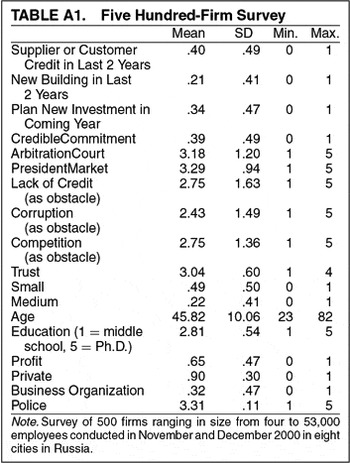
These studies have made valuable contributions, but the microfoundations of the credible commitment logic often receive little empirical attention. Moreover, it is difficult to capture the perceptions of a large number of participants in historical studies. Here I am able to assess the individual-level determinants of secure property rights by using an original survey of company managers in 500 firms in Russia conducted in October–November 2000. Researchers from VTsIOM, the All Russian Central for Study of Public Opinion, interviewed high-level business managers in Moscow, Nizhnii Novgorod, Novgorod, Smolensk, Tula, Ufa, Voronezh, and Ekaterinburg. The survey included firms in rich and poor, urban and rural, and left and right governed regions. Firms were selected using a stratified random sampling technique. I obtained data from the state statistical agency (Goskomstat) on the number of employees and the types of firms in each region and then stratified the sample by size and type of firm. Researchers then selected firms at random from within these strata using Goskomstat data and regional business directories. Each firm within each stratum had an equal possibility of being included in the survey. Given the fluidity of Russia's transition economy, it is difficult to determine how closely the sample reflects the true population at any given moment.
6 Goskomstat reporting on small firms are particularly inadequate (Yakovlev 2001).
However, the distribution of firms in the sample across sectors, size, and profit rates roughly mirrors a national sample.
7 In comparison to the national population of firms, industrial firms are slightly overrepresented (42% versus 54%) and retail firms are slightly underrepresented (27% versus 15%) in this sample. Firms in the eight other sectors are included at roughly the same rate as the national population.
The sampling frame included firms from Goskomstat categories of 10 economic sectors and excluded firms in the agricultural, communal services, health, social services, educational, and cultural sectors.
Due to costs, I included only firms in the capital city in these regions. This problem is less severe than it appears at first glance because the majority of firms are located in the capital city in each of these regions. Interviewers spoke face to face with the chief executive officer, the chief financial officer, or the chief manager of at least 60 firms in each region. The response rate for the sample as a whole was 56%.8
Given the length of these elite-level interviews, this response rate is reasonable. The response rate for the American National Election Study was 60% in 2000. In four regions the response rate was over 70% and in three other regions it was above the mean. In Smolensk, the response rate was 44%. Dropping observations from Smolensk produces no substantive change in the results.
Most questions in the survey were innocuous and generated few incentives to dissemble, but a few may have been regarded as sensitive.9
Some questions were used in previous surveys in the postcommunist world.
I tested all of the questions in a pilot survey that included debriefings with some respondents. I also received comments from representatives of business organizations and from entrepreneurs known to the researchers. I asked several potentially sensitive questions using crude ordered or binomial categories to alleviate some of these concerns. Previous research and pilot surveys suggested that managers are reluctant to reveal rates of profitability given the potential public and private costs of disclosing precise financial information. For example, rather than asking firms to identify how much profit they made last year, I asked whether they made a profit, took a loss, or broke even. Similarly, to measure investment I asked managers whether they had built a new building or renovated their place of business rather than how much they reinvested in their firm. These investment measures can be verified by researchers and do not require the revelation of detailed financial data. What is lost in precision, I hope to gain in validity.
Just over half the managers (55%) ran heavy or light industrial firms; 20% ran retail trade companies; and 25% headed firms in the construction, transport, or communications sectors. The average firm had 840 workers; the smallest and largest firms had 4 and 53,000 employees. Almost two thirds (65%) of the firms were formerly state-owned but had undergone privatization. Twenty percent were created after 1989 as new private firms; 15% remained state owned. Sixty-eight percent of firms claimed to have made a profit in 1999, 20% came out even, and 12% claimed to have lost money. Ten percent of the firms said that they had no serious competitors. Two percent of the firms were members of formal financial industrial groups, but just under a third were members of some type of production association. Thirty percent of firms were members of a business association, such as the Russian Union of Industrialists and Entrepreneurs.
THE SECURITY OF PROPERTY RIGHTS
To measure the security of property rights, I use three indicators of investment.10
The responses are from business elites rather than the population at large. Like most firm surveys, responses may suffer from survivor bias. This is likely more problematic for samples that include only small firms.
I asked managers whether they had constructed a new building in the last two years, had extended trade credits to suppliers or buyers in the last two years, or were currently planning to make a significant new capital investment in the coming year. Twenty percent of managers had constructed a new building, 40% of managers had extended supplier or customer credits, and 31% of managers planned to make a new capital investment in the next year. These types of activities are good proxies for secure property rights because each requires significant immediate costs with only the promise of future revenue. Moreover, given the diversity of firms in the sample, it is difficult to find a common measure of the security of property rights suitable for all firms.
CREDIBLE COMMITMENT AND STATE INSTITUTIONS
The survey included a variety of questions to assess perceptions of the performance of state arbitration courts (GosArbitrazh) in Russia. Reformed in the early 1990s from a Soviet era predecessor, these courts hear economic disputes between private legal entities and between private legal entities and state agents.11
Courts of general jurisdiction hear cases involving physical rather than legal persons. Observers have been more critical of these courts than the state arbitration courts. State arbitration courts were reformed somewhat in December 2001. See Solomon 2002. Regional legislatures are now excluded from the appointment process.
Typical cases involve taxes, debt collection, bankruptcy, and privatization. The state arbitration courts are organized largely along regional lines with 82 courts of first instance located in Russia's 89 regions. Ten higher-level arbitration courts hear appeals, as does a Supreme Arbitration Court. State arbitration courts heard over 400,000 cases in 2000 and employ about 2700 judges who until recently were appointed for life (Solomon
2002). The Ministry of Justice at the federal level provides salaries and budgets for these courts, but local and regional governments often provide additional informal monies to supplement frequent shortfalls in financing. Judges are appointed by the executive branch after they have been screened and approved by a corporate organization of judges.
Respondents were asked how frequently they turned to state arbitration courts to resolve business disputes. Seventy percent of firms had experienced some violation of property rights over the last two years that they considered sufficiently grave to merit taking to court. Managers were far less likely to take such a dispute to court if the conflict was with the local or regional government rather than with another private firm.12
Win rates of citizens against state officials are roughly 80%, which suggests the possibility of selection bias in the cases that citizens bring to court (Solomon 2002). Thus, court use is a poor proxy for court effectiveness. Measuring all respondents' perception of court effectiveness minimizes this selection process.
Forty-four percent of firms that had a dispute with the local or regional government over the last two years turned to state arbitration courts to resolve at least one conflict. In contrast, 66% of managers who experienced a property rights violation by a business partner in the last two years took at least one dispute to court, indicating a greater willingness to use courts in cases involving private rather than state entities. Thus, it is fairly common for managers to use the courts in disputes with state and private entities, but they are more likely to take the latter to court than the former.
13 Hendley (2002) finds that businesses are suing the state at increasing rates. Because the data presented here capture perceptions of arbitration courts at one point and do not measures change over time, the two findings may be entirely consistent.
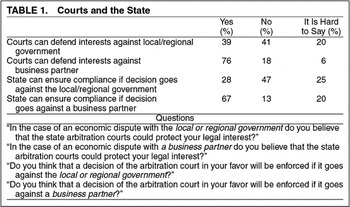
These responses reflect only the experience of managers who had a conflict in the last two years. To gain responses from all managers, interviewers asked a series of hypothetical questions that probe managers' expectations that courts could protect their rights in cases involving state and private entities. Managers said that state arbitration courts were much less effective in protecting their rights when the state was a party to the case. Interviewers asked managers: “In the case of an economic dispute with the local or regional government do you believe that the courts could protect your legal interests?” They then asked, “In the case of an economic dispute with a business partner do you believe that the courts could protect your legal interests?” Similarly, they asked whether the state could enforce decisions to protect their property rights in disputes with state officials and with private entities.
Table 1 reveals that 76% of managers expected state arbitration courts to protect their interests in cases involving other private businesses, but only 39% of managers said that courts could protect their interests in cases involving the local or regional government. Moreover, managers said that local and regional governments were much less likely to abide by judicial decisions than were private businesses.
Managers gave relatively high marks to state arbitration courts in comparison to other state institutions. When asked to rate the performance of a variety of state institutions on a scale of one to five, state arbitration courts received a score of 3.1, a higher rating than most other bureaucracies, including the police, the courts of general jurisdiction, and the bailiffs, which received scores of 2.9, 2.7, and 2.7, respectively.
The results were similar when managers were asked the extent to which they associated effectiveness, honesty/lack of corruption, professionalism, accessibility, and objectivity with the state arbitration courts. Using an unweighted additive index that averages responses to these questions on a scale of one to five, managers rated the performance of the state arbitration courts 3.2. Managers do not believe that state arbitration courts per se work badly. Instead, they view arbitration courts as somewhat more effective than other state institutions, as modestly effective in conflicts with private actors, but relatively ineffective in cases involving the local or regional government.14
Ericson (1997), Hendley, Murrell, and Ryterman (2000, 88), and Pistor (1996) also provide fairly positive views of the performance of state arbitration courts.
QUANTITATIVE ANALYSIS
To assess the determinants of the security of property rights, I begin by estimating the following equation:
The dependent variable, Investment, is one of the three indicators of the security of property rights described above. It measures whether firm managers constructed a new building, extended credit to a customer or supplier, or planned a new investment. Because the dependent variable is dichotomous, I use a probit model. I employ robust standards errors and clustering on each city to account for heteroskedasticity in the data.
The independent variables include CredibleCommitment, which equals one for managers who expected state arbitration courts to protect their property rights in a dispute with the regional or city government and zero otherwise.15
The zero category combines respondents who answered “no” with those who answered “it is hard to say.” Dropping the “it is hard to say” responses from the analyses does not change the substantive results save for Model 2, in which CredibleCommitment retains its sign but not its significance. Placing the “it is hard to say” responses in an intermediate category produces similar results. Without clustering, the results are similar save for Model 2 in which the coefficient on CredibleCommitment is insignificant.
This question is particularly appropriate because it captures the possibility that a manager who has never had a conflict with the local or regional government may be deterred from investing due to the threat of state officials unconstrained by the judicial system.
To assess arguments linking state institutions to the security of property rights, the model includes two variables. ArbitrationCourt and Police measure the respondent's evaluation of the effectiveness of state arbitration courts and the police, respectively, on a scale of one to five. It is appropriate to include ArbitrationCourt because CredibleCommitment may be endogenous to the respondents' perceptions of the courts in general.16
CredibleCommitment and ArbitrationCourt are correlated at .16 (p<.01), which suggests that managers viewed the effectiveness of courts as largely distinct from whether they could use the courts against state agents. All analyses use STATA 6.0.
This variable controls for the possibility that respondents' perceptions of the ability of the courts to constrain state officials merely reflects their expectations about the overall performance of state arbitration courts. As a measure of bureaucratic effectiveness, I add
Corruption, which measures the extent to which managers perceived corruption in the state bureaucracy to be a problem on a scale of one to five.
To test the impact of societal factors on property rights, I add Trust, which is a four-point variable measuring the extent to which respondents believed that they could trust other businesspeople in their region. The survey asked, “In general can one trust other businesspeople in your region to fulfill their contractual obligations in dealings with other businesspeople?” About two-thirds (70%) of the managers answered yes or more or less yes. The survey also generated a measure for civic participation using a dummy variable for membership in a business association as a proxy.
I examined managers' perceptions of the executive's commitment to private property to evaluate the elite partisanship argument. The survey asked, “What type of economic system is most appropriate for Russia: One based on state ownership of property and controlled prices or one based on private property and free prices? Please place yourself on a five-point scale where one equals a command economy and controlled prices and five equals an economy based on private property and free prices.” On average, managers placed themselves at 3.5 on the five-point scale. Interviewers then asked the managers how they expected President Putin would answer the question: Managers said that Putin was a cautious supporter of the market and placed him at 3.1. PresidentMarket captures respondents' perceptions of President Putin's commitment to a market economy.
Variables related to the manager, the firm, and market conditions may influence decisions to invest. I include variables to account for the age and education of the manager. I add dummy variables for small firms (<150 employees) and medium-sized firms (>150 and <500 employees). I include a dummy variable that equals one for private firms and zero for state-owned firms. Because profitable firms may invest at higher rates, I include a dummy variable for firms that claim to have made a profit in the year 2000.17
Turning a profit in the last year is an imperfect measure of the financial performance of a firm, but given the unwillingness of respondents to provide more detailed information on their financial conditions of their firm, it is perhaps the best that can be achieved.
Variables related to market conditions may influence investment. I include Competition and LackOfCredit, which measure the extent to which competition and a lack of credit were obstacles for their business on a scale of one to five. The sector and city in which a firm is located may shape investment patterns. In particular, firms in different sectors and cities may face different opportunities to invest and different levels of demand for their product. The model includes controls for 10 economic sectors; fuel, machine tools, metals and chemicals, light industry, construction, transportation, communications, retail trade, and finance. The excluded category is food processing. The model also includes dummy variables for each city. Doing so guards against the possibility that hard to measure omitted variables specific to any location or sector drive the results. I present the models with dummy variables for sector and for sector and city.
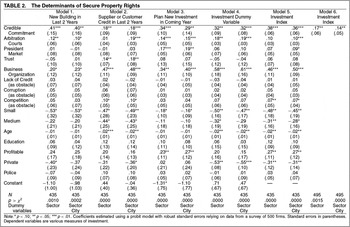
Model 1 in Table 2 examines the impact of these variables on the probability that a firm has constructed a new building in the last two years. The results reveal strong support for the credible commitment argument. As indicated by the positive and significant coefficient on CredibleCommitment, managers who expect the courts to protect their property rights in a dispute with the local or regional government were more likely to have invested in a new building than were other firms. Managers who had a favorable perception of the performance of the court system were also more likely to invest.18
This result is sensitive to the coding of the perceived performance of the court system. Elsewhere in the survey managers were asked to rate the performance of a variety of political institutions, including arbitration courts, on a scale of one to five. When this measure of the performance of arbitration courts is added to Models 1–6, it is insignificant and does not affect the sign or significance of other coefficients of interest. Using a variable that measures whether respondents expected courts to protect their rights in disputes with a private agent rather than ArbitrationCourt in Models 1–6 produces very similar results.
Members of business organizations invested at higher rates, whereas private and small firms invested at lower rates than other firms.
Other variables provided little leverage.19
Controlling for other factors, firms in Voronezh invest at higher rates than firms in Nizhnii Novgorod, Moscow, Ekaterinburg, Novgorod, Smolensk, and Tula.
Proxies for social trust, corruption among state bureaucrats, competition from other firms, and a lack of credit had little impact on investment patterns in this specification of the model.
Model 2 in Table 2 explores the probability that a firm extended customer or supplier credit in the last two years. As before, the coefficient on CredibleCommitment is significant and positive, indicating that managers who believed that courts could constrain state officials were more likely to extend credit to suppliers and buyers than were other managers. This finding suggests that commitment concerns influence firm behavior even in matters not directly involving state agents. Members of business organizations extended credit at higher rates than did nonmembers. In this model, competition, firm size, and social trust promoted the extension of credit to other firms, whereas other variables did not have a significant impact on credit patterns.
Model 3 assesses the probability that firms are planning to make a significant new capital investment in the coming year.20
By examining plans for future investments, I hope to reduce the possibility for reverse causality (Besley 1995).
Again, the variables
CredibleCommitment and
AribtrationCourt have a significant impact on the probability of new investment.
In addition, the stronger were managers' perceptions that President Putin was committed to a market economy, the more likely the firm planned to make a capital investment.21
Evaluations of the commitment of the respondent's governor or mayor to a market economy based on private property had little effect on the security of property rights.
This is the cleanest test of the elite partisanship argument. In previous models, interviewers asked managers whether they had invested in the last two years, a period in which both Boris Yeltsin and Vladimir Putin served as president. This model, however, explores how current perceptions of President Putin's commitment to private property influenced future levels of investment. This suggests that perceptions of executive partisanship are important for the security of property rights.
Profitable firms were also more likely to be planning to make a new investment than were other firms. Members of business organizations also planned to invest at higher rates than did nonmembers. Other variables had little impact.
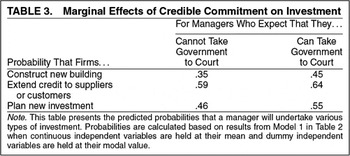
As indicated in Table 3, the substantive impact of CredibleCommitment is large. Predicted probabilities for each model with continuous variables set at their means suggests that for a profitable midsized private firm that is a member of a business organization, having confidence that the courts can protect your rights in a dispute with the local government raises the probability of investing in a new building from .35 to .45; extending credit, from .59 to .64; and planning a new capital investment, from .46 to .55. In sum, the perceived capacity of courts to discipline state agents was consistently associated with stronger property rights.
INITIAL ROBUSTNESS CHECKS
To assess robustness, I recoded the dependent variable Investment as a dummy variable that equals one for any firm that built a new building, or extended credit, or planned a new investment, and zero otherwise. Sixty-four percent of firms made at least one of these three forms of investment. I also created an index of investment that ranges from zero to three, depending on the number of investment activities that each firm undertook. Thirty-six percent of firms engaged in none of these investment activities, 40% engaged in one, 17% engaged in two, and 7% engaged in three. Using the independent variables from Model 1, I estimated a probit model on the dummy variable measure of investment and an ordered probit model on the index of investment. The results are essentially unchanged as indicated by the coefficients on CredibleCommitment in Models 4 and 5 in Table 2.
I split the sample by whether respondents had experienced a property rights violation. I also split the sample by whether respondents had experienced an economic conflict with the local or regional government. I then reestimated Model 5 using each subsample. In all four analyses, the coefficient on the variable for CredibleCommitment remained significant. Thus, even managers who have not experienced a violation of property rights by state officials are deterred from investing if they believe that courts cannot compel state agents to comply with judicial decisions.22
Unless noted in the text, these results are not reported, to save space, but are available from the author.
I explored the possibility that CredibleCommitment is a proxy for political power. I added a dummy variable that measured whether a manager believed that his firm could influence legislation on matters of importance to the firm. I also interacted CredibleCommitment with other potential proxies for political power, such as size and profitability. Adding these variables did not change the substantive results.
Finally there may be some concern that the variables for corruption and the effectiveness of arbitration courts may be endogenous to the perceived ability to take the government to court. I reestimated the ordered probit model without Corruption and without ArbitrationCourt, respectively, and the results were largely unchanged. In both cases the coefficient on CredibleCommitment retains its sign and significance.
I also conducted the analysis including only the variable CredibleCommitment and the dummy variables for city and sector. The coefficients reported in Model 6 suggest that doing so produces little change in the results.23
Alternative models that include measures of the perceived performance of the regional bureaucracy, the bailiffs, and the procuracy on a one-to-five scale do not affect the substantive results on the variables of interest but, in some cases, reduce the size of the sample.
These findings are robust to specifications that include both sectoral and city dummy variables, that present different specifications of the model, and that use different codings of the dependent variable.
AN ADDITIONAL ROBUSTNESS CHECK: SURVEY DATA FROM 1998
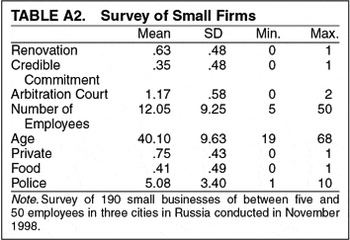
These results appear robust but may depend on the survey instrument. They also may be a reflection of the Putin era. To assess these possibilities, I analyze data from a 1998 survey of small business managers in three cities in Russia: Ulyanovsk, Smolensk, and Moscow. This survey asked similar questions, but focused only on small businesses. Researchers interviewed 190 managers of retail firms, such as groceries, pharmacies, and auto parts stores that had between four and 50 employees.24
MASMI, a decade-old Moscow-based polling agency, conducted the survey. Response rates ranged from 55% to 75% depending on the city. Each firm had a physical storefront. Shops were chosen at random from business directories. Shops operating in the informal economy are likely to be registered and to advertise in such directories (Yakovlev 2001, 37–39). The survey was conducted face-to-face in Russian in the fall of 1998 after a sharp financial crisis. Most questions ask about activities over the last two years and focus on behavioral measures that may be less strongly colored by recent events.
Interviewers asked small business managers whether they expected the courts to protect their property rights if they were involved in different types of disputes. Firm managers again exhibited greater confidence that the courts could protect their property rights vis-à-vis other private actors than vis-à-vis local government agents. Fifty-five percent of managers expected the courts to protect their property rights in a dispute with a business partner, but only 35% of managers expected the state arbitration courts to protect their property rights in a dispute with the local government. CredibleCommitment equals one for managers who expect the courts to protect their property rights in a dispute with the local government and zero otherwise.
The measure for investment in this analysis is whether firm managers have renovated their place of business. The term in Russian is kapitalniii remont and indicates a significant investment, such as replacing pipes, resurfacing the floor, or installing new equipment. Sixty-three percent of managers conducted a renovation. Renovation equals one for firms that renovated and zero otherwise.
As above, the statistical analysis introduces controls for the age of the manager; the perceived effectiveness of the courts on a scale of one to five; the sector in which the firm is located (food sector=1; others=0); the size of the firm as measured by the number of employees; and the extent to which corruption, competition, and the performance of the police were perceived to be obstacles to their business on a scale of one to 10. The instrument in this small business survey was less extensive than in the survey described above. As a result, the specifications of the statistical models differ somewhat.
Evidence from Model 7 in Table 4 is consistent with preceding analyses. The coefficient on CredibleCommitment is positive and significant. Moreover, its substantive impact is large. A simulation using coefficients from Model 7 that takes continuous variables at their means and dummy variables at their modal values suggests that the probability of renovation for a manager who does not expect the courts to protect his property rights vis-à-vis local officials is .46. The corresponding figure for a manager who expects the courts to protect their rights vis-à-vis local officials is .55.
The coefficient on a variable that captures the respondent's assessments of the performance of courts more generally, ArbitrationCourt, is statistically insignificant. Thus, the direct impact of the performance of courts on the security of property rights is sensitive to differences in samples and types of investment.
Retail firms with more employees were more likely to renovate than were other firms. In contrast to the preceding analysis, managers who perceived corruption to be a greater problem were significantly less likely to renovate their business than were other managers. This difference may be due to the inclusion of only small businesses in this analysis. Corruption is generally thought to be more problematic for small businesses in Russia (Frye 2002: Hellman, Jones, and Kaufmann 2000). Firms that faced greater competition or had little confidence in the police were no more likely to renovate than were other managers.
These results indicate that rightholders' concerns about their capacity to take the government to court hindered secure property rights during both the Yeltsin and the Putin administrations, which suggests that the problem of credible commitment has deep structural roots in this case.
CONCLUSION
At the time the 2000 survey was conducted, then U.S. Treasury Secretary, Lawrence Summers noted, “No challenge in Russia today seems to me greater than the establishment of property rights and contract enforcement” (Reuters, October 7, 2000). But Russia is not unique. A prominent review recently noted, “Virtually no transition country succeeded in rapidly developing a legal system and institutions that would be highly conducive to the preservation of private property and the functioning of a market economy…. This lack of a market-oriented legal structure appears to have been the Achilles' heel of the first dozen years of transition” (Svejnar 2002, 7). Property rights are a critical issue in the postcommunist world and beyond. Indeed, when discussing economic development more generally, North (1993, 14) noted, “Commitment is not the whole solution to the problems we confront. But throughout history (and in the present ailing economies) it is overwhelmingly the most pressing issue.”
Using evidence from original surveys of business elites conducted in 1998 and 2000, this essay identifies several factors that influence the security of property rights. First, managers who expected courts to protect their interests in disputes with state agents invested at higher rates.25
President Putin has made improving the performance of the Russian state, including judicial institutions, a priority, but his other policies may offset these reforms. Putin has concentrated power in executive branches at the federal and regional level, but this research suggests that such efforts will produce modest results absent strong courts to constrain executive power.
This result holds controlling for other factors, including the perceived effectiveness of courts in general. Evidence linking the effectiveness of state institutions to the security of property rights was mixed. Managers who perceived the courts to be ineffective invested at lower rates, but this result was sensitive to differences in question wording and samples. Perceptions of the performance of the police and corruption in the bureaucracy were not associated with the security of property rights. Stronger and more consistent evidence pointed to the failure of courts to constrain state agents as an impediment to secure property rights.
Second, civic participation was consistently associated with secure property rights. Members of business associations were more likely to have constructed new buildings, extended credit to buyers or suppliers, and planned new capital investments in the coming year. In contrast, managers who exhibited high levels of trust were more likely to extend credit but were no more likely to make other investments.26
Trust and membership in business organizations are correlated only at .02.
Finally, there was some evidence that confidence in President Putin's commitment to a market economy was associated with stronger property rights. That managers conditioned their investment on perceptions of President Putin underscores the importance of executive partisanship for property rights.
The Role of the State in Transition and Developing Countries
These findings have broader implications for social science and public policy. They contribute to our understanding of the role of the state in transition and developing economies by emphasizing the value of constraints on state power. Many observers identify private predators as the main challenge to secure property in the region and argue that state bureaucracies are too poorly equipped to meet this threat. To increase state capacity it is necessary to retrain bureaucrats and reequip state police. This argument resonates with the literature on governance in political science and economics.
However, managers did not view state agents so much as ineffective, but as not credibly bound by legal institutions. State agents posed a threat to property in part because they stood above the law, and this lack of legal constraint undermined the security of property rights. The ability of courts to tie the hands of state agents had a strong impact on the security of property rights, even controlling for the perceived effectiveness of various state institutions. Thus, increasing constraints on state agents may bolster the capacity of the state to protect property.
The results contribute to one aspect of an ongoing debate in economics on the proper reform strategy for Russia. Although Shleifer and Vishny (1998) and Stiglitz (1999) recognize the importance of judicial institutions for property rights, the former are more skeptical of granting decisionmaking authority to state bureaucracies during the transition. Whereas Shleifer and Vishny recommend limiting the discretionary authority of regulatory bureaucracies, Stiglitz draws on the China model and suggests giving state regulatory bureaucracies far greater sway. The evidence presented here is generally more consistent with the Shleifer and Vishny view. On balance, firm managers valued bureaucratic commitment over discretion when making investment decisions.
These results also suggest the value of a more nuanced treatment of the elusive concept of state capacity. Because effectiveness varied widely across bureaucracies it is useful to disaggregate the state. Moreover, because the effectiveness of courts varied depending on the parties to the dispute, it is helpful to identify the policy dimensions along which state capacity is measured. Finally, analyses of state capacity typically consider what the state can do. Can it extract resources from society? Can it create meritocratic bureaucracies? Can it overcome societal resistance to its policies? These are useful components of state capacity, but this analysis suggests that it is also important to consider how constraints on state power influence state capacity. Because providing the public good of secure property rights is a key aspect of state capacity, scholars should devote greater attention to this issue.
Informal Institutions
Debates about the impact of informal institutions on property rights in transition and developing economies emphasize two different mechanisms. Some point to the importance of broad social trust among members of a community, whereas other stress the value of civic participation as a means to protect property. This essay finds that civic participation is a powerful predictor of various types of investment, but general social trust is only associated with a propensity to give credit. This suggests that business associations can be an important means to protect property. More broadly, these results reinforce the argument that constraints on state agents—here through the countervailing power of private business organizations—bolster the security of property rights.27
Members of business associations may perceive their property rights as more secure because the association increases their lobbying power or because they strengthen social networks. Initial evidence suggests the merit of both arguments. I asked managers to identify what types of benefits, if any, they received from a business organization. Sixteen percent of all firms identified “representation of business interests in the executive and legislative branch” as a benefit of membership. Twenty-three percent of all firms said that “expanding professional contacts” was a benefit of membership. Adding dummy variables for the responses to these questions to Models 1–6 reveals that members of business organizations who said that the “representation of business interests” was an important benefit of membership were significantly more likely to extend credit and plan new investments than were other firms. A dummy variable for those who said that “expanding professional contacts” was a benefit of membership was significantly associated with extending credit and planning new capital investment.
Privatization and the Origins of Secure Property Rights
These findings add a qualification to debates on the roots of secure property rights. Arguments taken from neoclassical economics emphasize that property rights emerge based on private demand for scarce goods. Demsetz's (1967) influential interpretation of the emergence of private ownership of land among native American hunters notes that only after the fur trade began and land became scarce did local populations have an incentive to create secure property rights. This insight is a step forward, but its impact is limited by omitting state agents (Riker and Sened 1991).
Arguments drawn from political economy and the new institutional economics stress that secure property rights are the result of rulers seeking to maximize revenue or other political benefits (Levi 1988). Riker and Sened (1991) argue that property rights over airport landing slots in the United States in the 1980s became secure when federal bureaucrats saw a benefit in enforcing these rights. Only when the revenue gains and political benefits from enforcing property rights exceeded the costs did state officials make property rights over landing slots at airports secure. This essay suggests that demand from market participants and supply from state agents is insufficient to create secure property rights. Where institutions or countervailing interest group power do not compel state officials to abide by legal norms, property rights remain insecure. Secure property rights are not solely granted from above by state actors or seized from below by private actors, but emerge through political struggle between state and private agents.
These results also suggest that transferring state-owned assets into private hands will not necessarily lead to secure property rights. As others have noted, privatization may bolster property rights by clarifying competing claims to assets, but supporting institutions are needed to significantly reduce the costs of exercising property rights (Roland 2000; Stiglitz 1999).
Legal Reform
Finally, scholars and policymakers have devoted great attention to legal reform in recent years. Carothers (1998, 1) noted, “One cannot get through a foreign policy debate without someone proposing the rule of law as a solution to the world's troubles.” Extensive surveys of business elites on governance issues by the World Bank and the EBRD in recent years further attest to interest in the issue. Despite great interest in the topic, there is little consensus. One partial explanation for the slow progress is that few studies have considered that the quality of legal institutions may depend significantly on the parties to the dispute. That company managers in Russia have far greater confidence in the courts in disputes with private than with state agents indicates that such distinctions are essential to understanding the legal environment in Russia and perhaps elsewhere. Future analyses of legal institutions should distinguish between the performance of courts in disputes with state and that in disputes with private agents.
This distinction suggests several guidelines for policy reform. Most importantly, it emphasizes the value of building courts that are less vulnerable to pressure from state bureaucrats and elected officials. One recommendation is to create court jurisdictions that do not coincide with electoral jurisdictions. A judge whose jurisdiction falls exclusively under one governor (as in Russia) will likely face greater pressure than one whose jurisdiction falls under several governors. More subtly, this distinction suggests that increasing bureaucratic capacity without increasing judicial constraints on state agents will lead to less secure property rights. At a minimum, reform of the judiciary should proceed hand in hand with the efforts to build the capacity of state police and bureaucracies.
This essay identified a number of social, economic, and political factors that influence the security of property rights—a key feature of economic performance and state capacity. Future research should seek to identify the conditions under which state agents make credible commitments to secure property rights.28
Case studies suggest that a peaceful international environment may promote more secure property rights. North and Weingast (1989) argue that British elites frequently seized property arbitrarily to raise short-term funds to compete with France. Root and Campos (1994) argue that organized labor, capital, and state elites in East Asia created credible tripartite bargaining arrangements while facing only a moderate threat of the spread of communism. Thus, efforts to promote secure property rights in Russia should be coupled with policies to foster a more secure international environment.
I thank Greg Caldeira, Richard Ericson, Marcus Kurtz, Aleksander Radygin, Kira Sanbonmatsu, and three anonymous reviewers for comments. I also thank seminar participants at George Mason University, Harvard University, The Higher Economics School of the Russian Federation, Northwestern University, and Rutgers University. This paper was presented at the Annual Meeting of American Political Science Association and the American Association for the Advancement of Slavic Studies in 2003. The Mershon Center of Ohio State University, the National Council for Eurasian and East European Research, the Ohio Foundation and the Social Science Research Council provided generous funding for this project.







Comments
No Comments have been published for this article.