Introduction
The abundance of many insect species fluctuates widely from year-to-year mostly following changes in the environment, such as resource availability or weather. The degree of fluctuation that occurs from year-to-year is often referred to as population variability, which can be quantified by the metric PV (Heath Reference Heath2006). The metric PV is a proportion between 0 and 1, and represents the sum of the absolute values for all differences between annual estimates of abundance in a time series, divided by the number of such differences. It has advantages compared with metrics such as standard deviation or coefficient of variation of annual abundance that previously were used for this purpose (Heath Reference Heath2006). For example, PV can be estimated for many distributions of annual abundance (Heath Reference Heath2006) and is normally distributed (Heath Reference Heath2006; Lamb et al. Reference Lamb, MacKay and Alyokhin2017). The metric PV is robust for various patterns of seasonal abundance (Lamb et al. Reference Lamb, MacKay and Alyokhin2013), and values of PV differing by as little as 0.06 in a range of 0–1 can be distinguished statistically with time series of 15 or more years (Lamb et al. Reference Lamb, MacKay and Alyokhin2017).
Species with similar life histories living in the same habitat and subjected to the same year-to-year changes in the environment can exhibit distinctly different levels of PV. Taylor and Woiwod (Reference Taylor and Woiwod1980) hypothesised that such population variability is “a density-dependent species characteristic”. For example, three species of aphid (Hemiptera: Aphididae) living together on the same plants in field plots showed substantial differences in PV (Lamb et al. Reference Lamb, MacKay and Alyokhin2011). Similarly, four species of bird lice (Phthiraptera: Menoponidae, Philopteridae) living together on the same host showed distinct levels of PV (Galloway and Lamb Reference Galloway and Lamb2014), as did a weevil (Coleoptera: Curculionidae) and a fly (Diptera: Psilidae), both herbivores of the same crop in the same plots (Lamb and Boivin Reference Lamb and Boivin2017).
If population variability is a species trait, then closely related species might be expected to show more similar levels of PV than distantly related species. However, differences in level of specialisation of related species could affect their adaptation to environmental variability in the same habitat, with more generalist feeders expected to show less population variability than more specialised ones (Redfearn and Pimm Reference Redfearn and Pimm1988). Here, we test these hypotheses by comparing the PV of three species: seedcorn maggot, Delia platura (Meigen), onion maggot, Delia antiqua (Meigen), and cabbage maggot, Delia radicum (Linnaeus) (Diptera; Anthomyiidae). We expect that three species from the same genus will have more similar PV values than species from the same habitat that are not related to Delia Robineau-Desvoidy. Moreover, two of these species are oligophagous and truly phytophagous (D. antiqua and D. radicum), and therefore more specialised feeders than D. platura, which is polyphagous and partly saprophagous (Finch Reference Finch1989). Testing such hypotheses can be problematic because many years of annual estimates of abundance are required for each population, ideally 15 or more years (Lamb et al. Reference Lamb, MacKay and Alyokhin2017). Rarely are such long-term data sets available to test the proposed hypotheses for appropriate species and habitats.
In this study, we report time series of 17–32 years of population data for the three Delia species from a muck soil, agricultural habitat in southern Québec, Canada. The PV of these species is compared with those of the carrot weevil, Listronotus oregonensis (LeConte) (Coleoptera: Curculionidae) and the carrot rust fly, Psila rosae (Fabricius) (Diptera: Psilidae) from the same habitat, species in different families or orders from Delia, which show widely divergent PV values. The PV values of the carrot herbivores were reported elsewhere in the context of testing the hypothesis that introduced herbivores have higher population variabilities than native ones (Lamb and Boivin Reference Lamb and Boivin2017).
The three Delia species are pests accidentally introduced from Europe (Weiss Reference Weiss1915; Gibson and Treherne Reference Gibson and Treherne1917; Biron et al. Reference Biron, Landry, Nénon, Coderre and Boivin2000). The seedcorn maggot mostly feeds on decaying matter (Howard et al. Reference Howard, Garland and Seaman1994) and on emerging sprouts of numerous plants including many agricultural crops and can be an important pest in some crops (Broatch et al. Reference Broatch, Dosdall, Clayton, Harker and Yang2006). The onion maggot feeds only on some species of Allium Linnaeus (Amaryllidaceae) including cultivated onion (Dindonis and Miller Reference Dindonis and Miller1980). The cabbage maggot deposits its eggs near cruciferous plants, including cultivated cabbage (Brassica oleracea var. capitata Linnaeus; Brassicaceae), cauliflower (B. oleracea var. botrytis Linnaeus; Brassicaceae), rutabagas (Brassica napobrassica (Linnaeus) Miller; Brassicaceae), and radishes (Raphanus raphanistrum sativus (Linnaeus) Domin; Brassicaceae) and larvae feed in the plant root (Ferry et al. Reference Ferry, Le Tron, Dugravot and Cortesero2009).
Materials and methods
The data for this study came from a long-term monitoring programme for pests of vegetable crops conducted at the experimental farm of Agriculture and Agri-Food Canada at Ste-Clotilde (45°09′N, 73°41′W) in southwestern Québec, Canada, in an area of muck soil that has been actively farmed for vegetables since the 1950s. Adults of the three species were captured in baited cone traps (Dapsis and Ferro Reference Dapsis and Ferro1983) near experimental field plots of onion and crucifers planted for the monitoring programme and maintained without insecticides. The plots typically were 30×30 m but varied somewhat in size from year-to-year for operational reasons. Baits were replaced regularly to maintain the attractiveness of the traps. Three traps were placed 5 m apart, and 2 m outside each plot. Traps were monitored twice weekly through spring and summer and weekly at the end of the season. In the onion field, two plots were seeded at intervals to obtain onions suitable for oviposition throughout the season and the cone traps were baited with propyl disulphide placed in a plastic capsule (Dindonis and Miller Reference Dindonis and Miller1980). The crucifer field was planted with rutabaga or cabbage, depending on the season, and the cone traps were baited with a piece of rutabaga. We captured adults of the seedcorn maggot in the same traps used to monitor the two other Delia species (Dindonis and Miller Reference Dindonis and Miller1980). For D. antiqua and D. platura data were collected from 1983 to 2016, with the exception of 1994–1995 (32 years), while for D. radicum, data were collected from 1992 to 1995, 2002 to 2005, and 2008 to 2016 (17 years).
The average catch per trap was used to estimate abundance at each sample date for the three species. The seasonal patterns of trap catches were assessed to determine which parameter might be most useful for estimating annual abundance. Captures of the three species were almost continuous through each season making the end of one generation and the beginning of the next difficult to distinguish. Therefore, the sample day with the peak catch was used to quantify the timing and size of each generation. Usually this peak catch was well defined by a series of samples with low catches before and after the peak. Three parameters were used to estimate annual abundance for each year: the sum of peak catches for all generations, the total catch per trap for the year, and the mean catch for all sample dates during the flight season (excluding 0 catches at the beginning and end of the season). These three parameters were compared to assess which might contribute the least sampling error to the estimate of PV. Population variability for each generation and species was estimated by the metric PV using spreadsheets of annual trap catches (Microsoft Excel 2010; Microsoft, Redmond, Washington, United States of America), based on the formula provided by Heath (Reference Heath2006).
Relationships among peak abundances for each species were assessed by Pearson product moment correlation (SYSTAT Software 2009). Linear regression analyses were used to reveal trends in abundance over the time series (SYSTAT Software 2009). A trend in abundance with time would increase PV, causing it to appear higher than the background variability actually was. The effect of any such trends could be reduced by repeating the calculation of PV using the residual errors of the annual abundances from a regression analysis to estimate annual abundance, removing the population trend (Lamb and Boivin Reference Lamb and Boivin2017). Differences in PV between species were assessed by a t-test with three consecutive 10–11-year time series providing replicate estimates for onion maggot and seedcorn maggot, and two consecutive 8–9-year time series for cabbage maggot (SYSTAT Software 2009). To assess whether the three Delia species had more similar PV values than unrelated species, they were compared with those of the carrot weevil and carrot rust fly which were studied in the same habitat at the same time (Lamb and Boivin Reference Lamb and Boivin2017), using a one-way analysis of variance (SYSTAT Software 2009).
Results
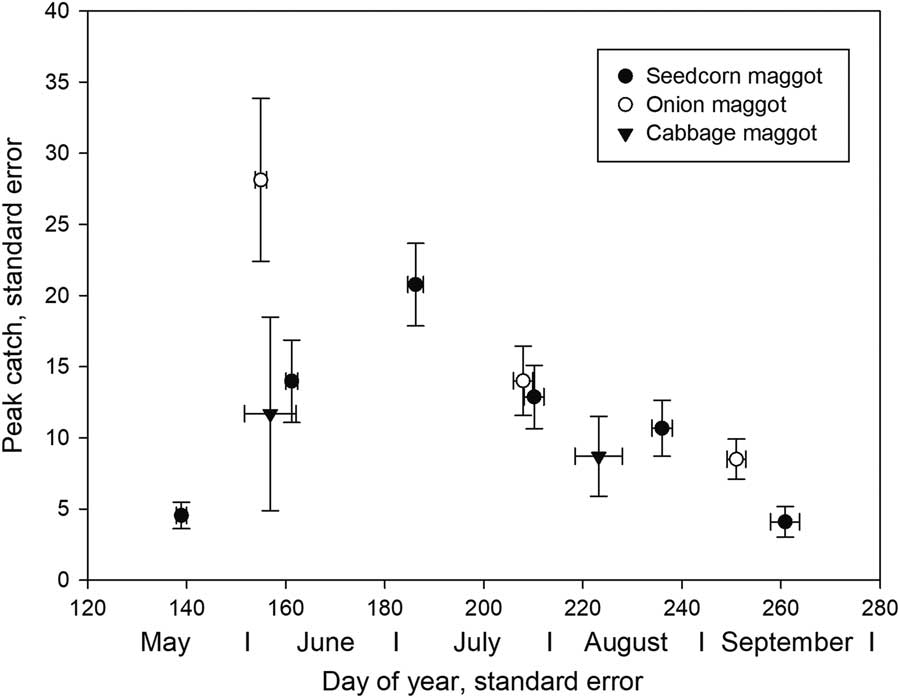
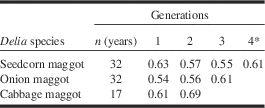
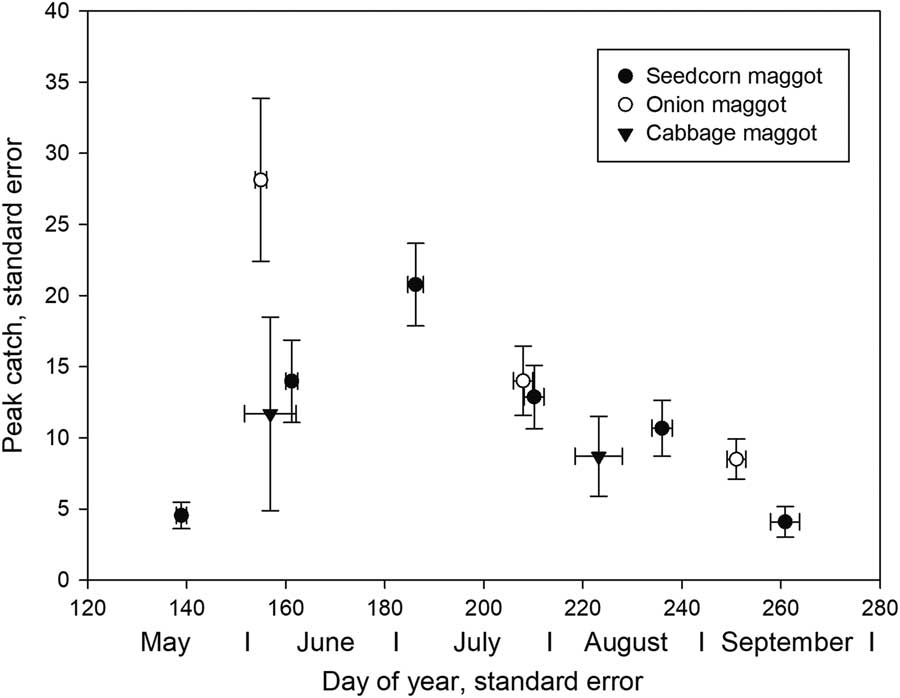
The first generation of each of the three Delia species peaked in late May or early June with onion maggots being most numerous (Fig. 1). Cabbage maggot had two generations, the second peaking in early August. Onion maggot had three generations, the peak catch declining over the season. Seedcorn maggot had as many as six peak catches in one year and five in nine of the 32 years, but usually four peaks were evident (Fig. 1). Some of the early and late peaks may not have reflected a generational peak, but a period of particularly suitable conditions for flight. Peak catches within a year were often but not always correlated for two of the three species (onion maggot: r=0.54 for generation 1 and generation 2, r=0.55 for generation 2 and 3, P=0.001, n=32; seedcorn maggot: r=0.48, r=0.45, r=0.43 between generations 1 and 3, P<0.02, n=32; cabbage maggot: r=0.12 for generation 1 and generation 2, P=0.66, n=17). The peak catches for each generation of the species had similar PV values ranging from 0.54 to 0.69, with the highest PV for generation 2 of the cabbage maggot (Table 1).
Peak catch and timing of peak (means±standard errors, n=17 or 32 years) for successive generations of three Delia species captured in baited traps adjacent to plots of host plants in southern Québec, Canada.
Population variability (PV, see text) for the peak abundance of each generation of three species of Delia based on trap catches assessed every three to seven days through the season, 1983–2016.

* n=26 years because in six years the population had only three peaks.
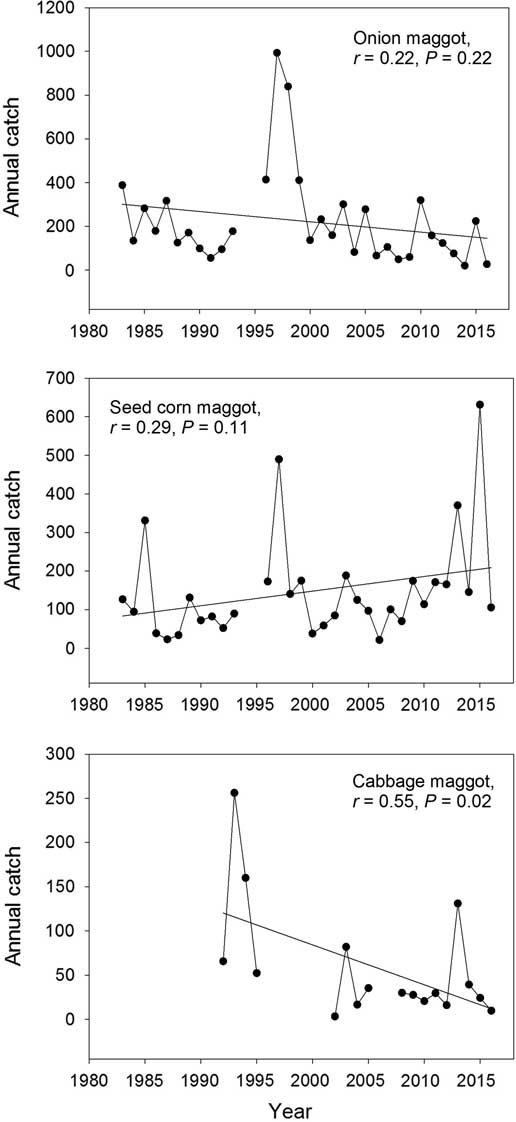
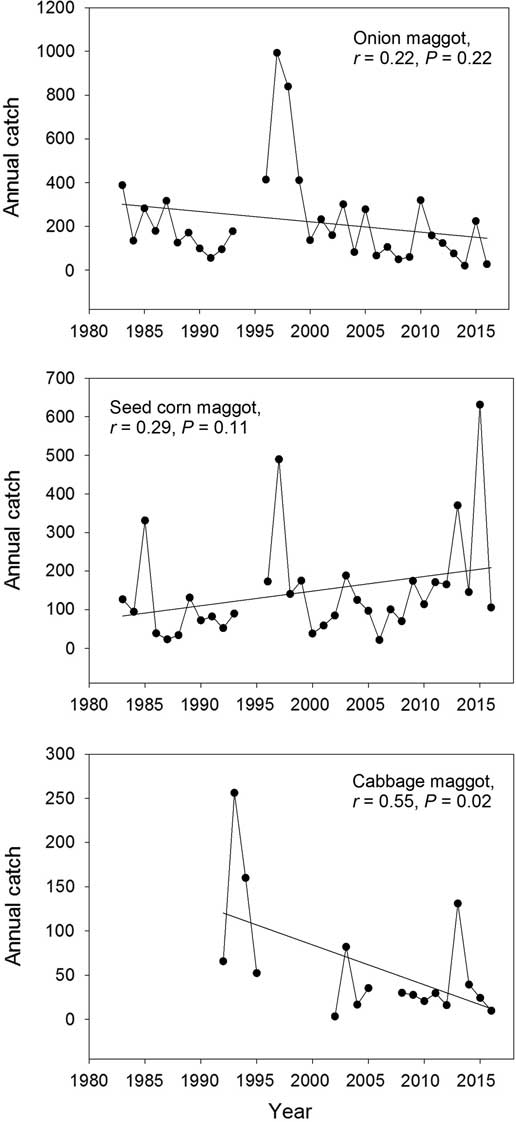
The annual catch of the three Delia species fluctuated widely among years (Fig. 2). Neither the onion nor seedcorn maggot showed a significant trend in catch over 34 years, but the mean annual catch per trap of cabbage maggot, over 50 flies per season in the early 1990s, declined to fewer than 50 flies per season in 11 of 13 years after 2002 (Fig. 2). The time series of the three species showed little evidence of being temporally coordinated (Fig. 2). Onion maggot had one two-year peak in abundance in 1997–1998 that was greater than twice the average; seedcorn maggot had four such single-year peaks in 1985, 1997, 2013, and 2015; and cabbage maggot had three such peaks in 1993–1994, 2003, and 2013. No correspondence in the timing of peaks occurred between onion and cabbage maggots, whereas seedcorn maggot had a secondary peak in common with each of the other two species, and three peaks that did not coincide with peaks in the other two populations.
The annual catch (total catch per trap) of three Delia species captured in baited traps adjacent to plots of host plants in southern Québec, Canada, from 1983 to 2016. The linear regression relationships (with correlation coefficients and probability levels) are provided for annual catch versus year.
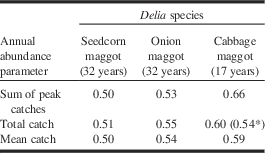
Three parameters that were estimated from trap catches to assess which parameter contributes least to sampling error had remarkably similar PV values for each of the three species (Table 2). The highest PV was 0.66 for sum of peak catches for cabbage maggot, but PV values for total catch and mean catch per sample date differed by 2% or less (Table 2). The annual total catch was selected to estimate annual abundance, because this parameter was the one used previously to estimate annual abundance for carrot weevil and carrot rust fly (Lamb and Boivin Reference Lamb and Boivin2017).
Population variability (PV, see text) calculated for each of three annual abundance parameters (sum of peak catches, total catch, mean catch per sampling date during the flight season) based on trap catches counted every three to seven days over the season, for three species of Delia.

Note: No statistically significant differences were detected among species, based on t-tests using three 10–11-year time series (or two 8–9-year time series for cabbage maggot) as replicates.
* PV for total catch corrected for a significant decline of the population over the time series.
The PV values for three annual catch parameters were consistently lowest for seedcorn maggot, about 5% higher for onion maggot, and about 5% higher again for cabbage maggot, suggesting that PV differed among the three species (Table 2). The annual estimates of the three catch parameters were highly correlated for each species (r>0.88, P<0.001), however, and therefore do not provide independent estimates of PV for comparisons among species. Using 10–11-year time series of annual total catch to provide three independent replicate estimates of PV for seedcorn and onion maggot revealed no significant difference in PV between these two species (t=0.3, P=0.8, df=4). Similarly, using corresponding 8–9-year time series of annual total catch to provide two independent replicate estimates of PV to compare seedcorn, onion, and cabbage maggot estimates revealed no significant difference in PV among the three species, with the caveat that sample size was minimal. For this three-way comparison, variances of the PV values were not equal and so a Kruskal–Wallis one-way analysis of variance was used (H=3.7, P=0.2, df=2). The relatively high value of PV for total catch (0.60) for cabbage maggot was due to the decline in annual catch over the time series (Fig. 2). When PV was corrected for the decline using the residual errors around the regression line, PV dropped to 0.54, essentially the same as that for onion maggot (Table 2). The PV of annual abundance was about 7% lower for seedcorn maggot than for the other two species, but this difference was not sufficiently large to be statistically significant.
The PV values for the total catches of the three Delia species ranged from 0.51–0.55 (corrected for the population trend in cabbage maggot). Over a similar time period, 1983–2015 (33 years), and in the same agricultural habitat, PV for carrot weevil was 0.39 and for carrot rust fly was 0.67 (Lamb and Boivin Reference Lamb and Boivin2017), apparently lower for the former and higher for the latter than the PV values observed for the Delia species. A one-way analysis of variance of PV for the four species with 32–33-year time series, and using PV estimates for three 10–11-year time series as replicates, confirmed differences in PV among species (F=16.7, P<0.001, df=3). The Holm-Sidak method for multiple comparisons confirmed that carrot weevil had a lower PV than either seedcorn or onion maggot (P<0.03), that carrot rust fly had a higher PV than seedcorn or onion maggot (P<0.03), and that no difference in PV was detected between seedcorn maggot and onion maggot (P>0.05). Given that the PV for cabbage maggot, 0.54, was intermediate between that of seedcorn maggot and onion maggot, and did not differ statistically from either, we conclude that its PV was also higher than that of carrot weevil and lower than that of carrot rust fly.
Discussion
These three Delia species living together in a muck soil agricultural habitat have similar population variabilities with PV in the range of 0.51–0.55. The similarities in their PV values might be due to their similar responses to year-to-year changes of the environment in their common habitat. However, this conclusion is not supported by the lack of correspondence in the temporal change in their abundances through the time series. Furthermore, two unrelated species, a weevil and a fly from a different family, living in the same habitat, have different PV values than the Delia species, lower for the carrot weevil at 0.39 and higher for the carrot rust fly at 0.67 (Lamb and Boivin Reference Lamb and Boivin2017). These similarities and differences provide support for the hypothesis that related species have more similar population variabilities than unrelated species, an example of the genus specificity of PV. The similarity of PV for related species adds a new dimension to the generality that PV is a species-specific trait (Taylor and Woiwod Reference Taylor and Woiwod1980; Lamb et al. Reference Lamb, MacKay and Alyokhin2011; Galloway and Lamb Reference Galloway and Lamb2014; Lamb and Boivin Reference Lamb and Boivin2017), reflecting similar adaptations to the same environmental fluctuations in related species with similar life histories.
The PV for three Delia species, all accidentally introduced from Europe, was 0.51–0.55, higher than the PV of 0.39 for the native carrot weevil living in the same agricultural habitat. This observation is consistent with the hypothesis that introduced species have higher population variabilities than native species (Lamb and Boivin Reference Lamb and Boivin2017).
Although the three Delia species have similar life histories, being multivoltine with two to four generations per year with long flight seasons, the cabbage maggot and the onion maggot are oligophagous herbivores, whereas the seedcorn maggot is polyphagous and partly saprophagous (Finch Reference Finch1989). The seedcorn maggot is a more generalist feeder than the other two species and therefore is expected to have lower PV (Redfearn and Pimm Reference Redfearn and Pimm1988). Nevertheless, no difference in PV was detected among the three species, providing no support for this hypothesis. Perhaps, similarities in their life history traits and habitat were more important in determining the level of variability of their population densities than differences in their feeding biology. The life history traits that shape the fluctuations in population densities of species, and their relative importance, need to be determined and PV could provide an effective tool to do so.
Estimates of PV for the three Delia species were based on catches of adults in attractant traps, an indirect method for estimating abundance. We assume that the annual catch of adult flies in such traps is closely related to the annual abundance of each of the species. The trap catches are related to the crop damage that these insects cause (G.B., unpublished data), but the abundance of each of the species has not been estimated directly. Trap catches are likely subject to vagaries in the weather that affect the flight activity of the adult flies and therefore, the catch. The flight season in conjunction with the length of the trapping period, and the frequency with which traps are emptied might also affect catch, and therefore sampling error that would contribute to PV. We estimated three parameters for annual abundance of the flies in the traps that we anticipated might affect and perhaps reduce the different sources of sampling error. The sum of peak catches for the generations might reduce the contribution of day-to-day vagaries in flight activity by focussing on the peaks; the total catch might smooth out variation in catch over time; the mean catch per sample date might reduce variation due to differences in flight period and sampling period, because zero catches from before or after the flight period were eliminated. However, the three parameters gave remarkably similar estimates of PV, increasing our confidence that the estimates of PV accurately reflected the year-to-year flight of the flies. Nevertheless, we must still assume that PV values for the catch of flies reflect the annual variation in abundance of the three species.
Our understanding of PV would benefit from further investigation of PV for the three Delia species in other habitats, to assess the uniformity of the PV of the species. In studies of unrelated species, aphids were found to have similar PV values in habitats separated by more than 100 km (Lamb and MacKay Reference Lamb and MacKay2010; Lamb et al. Reference Lamb, MacKay and Wool2012). Such comparisons are challenging because of the many years of population data required to estimate PV adequately. Nevertheless, because of their pest status, the three Delia species have been studied in many habitats across North America and Europe and therefore data from such studies could provide useful insights into the factors that influence PV.
Acknowledgements
The authors would like to thank Danielle Thibodeau, Josiane Vaillancourt, and Julie Frenette for technical assistance.