


The 2022 midterm election results surprised many. The traditional midterm slump for the sitting president’s party, coupled with high inflation rates coming out of the COVID-19 pandemic, suggested that Democrats stood to lose big in the US House and US Senate as well as state house contests throughout the country (Rakich Reference Rakich2022; Tien and Lewis-Beck Reference Tien and Lewis-Beck2022). In June 2022, the US Supreme Court (SCOTUS) in Dobbs v. Jackson Women’s Health Organization, 597 U.S. 215 (2022), overturned Roe v. Wade, 410 U.S. 113 (1973), shifting the abortion-policy decision making to Congress and/or state legislatures. In so doing, SCOTUS rejected the abortion right that Roe had established and that Planned Parenthood of Southeastern Pennsylvania v. Casey, 505 U.S. 833 (1992), had reaffirmed under an undue burden standard. The Dobbs decision opened the door to either Congress regulating abortion rights with one uniform national standard or 50 state policies that could range from an outright ban to unfettered access to abortion services (Mayer et al. Reference Mayer, Morris, Aistrup, Anderson and Kenter2023). In the immediate aftermath of the Dobbs decision, President Joe Biden and the Democrats seized on the abortion issue as their best chance to limit electoral losses in the 2022 midterm elections.
Every four years since 2014, the Public Religion Research Institute (2025) has surveyed adults across the 50 states on whether abortion should be legal in most/all cases versus illegal in most/all cases. In 2018, a majority in 18 states believed that abortion should be illegal in most/all cases. By 2022, just months before SCOTUS’s Dobbs decision, the number of states where pro-life attitudes were a majority decreased to only eight states. This point was magnified by several state referenda on abortion access. On August 2, 2022, Kansas voters sent shockwaves through the pro-life community by rejecting an amendment (59% to 41%) to the state constitution that would have stated that abortion was not protected by the liberty clause of its state constitution. Kentucky’s voters followed up with a similar rebuke of a pro-life amendment placed on the November 2022 general election ballot (Mayer et al. Reference Mayer, Morris, Aistrup, Anderson and Kenter2023). Since the Dobbs decision, abortion-rights supporters have prevailed in most statewide ballot contests. Pro-life forces have won only three of 16 abortion-related ballot referenda, and all three outcomes occurred in November 2024. In Florida, a pro-choice amendment won 57% of the vote but failed because the state requires a 60% threshold for passage. By contrast, pro-life positions prevailed in South Dakota, where 59% voted to uphold the state’s ban, and in Nebraska, where 55% supported a 12-week abortion ban (Ballotpedia Reference Ballotpedia2025). Going into the 2022 midterm elections, 38% of voters ranked either inflation or the economy as the number one issue, and only 3% cited abortion (Gallup Organization 2022). However, CNN exit polls revealed that 27% of voters on Election Day cited abortion as the most pressing issue of the 2022 midterm elections (Edwards-Levy Reference Edwards-Levy2022). Whereas abortion may have been less salient to Americans in their everyday lives, it was top of mind when they walked into the voting booth. Mobilizing around the abortion issue, Democrats stemmed their 2022 midterm losses to single digits.
Based on the 2022 general election results, the Dobbs decision had the potential to turn the abortion issue into an “easy issue” (Carmines and Stimson Reference Carmines and Stimson1980, Reference Carmines and Stimson1989). Easy issues are rare because the policy choices presented to the voters by strategic politicians in both political parties are stark, leading them to define clear policy positions that are in opposition to one another. Voters perceive the differences between the parties and view the issue as salient, casting their votes based predominantly on issue congruence with the parties and their candidates. With easy issues, strategic politicians seek to increase the size of their coalitions at the expense of the other party (Riker Reference Riker1986). Post-Dobbs, the GOP seemed to be most vulnerable to the cleaving effects of the easy issue that the Dobbs decision had created. In 2022, various Pew Research Center surveys found that Republicans had a larger minority within their ranks who were pro-choice (~20%) compared to the Democrats who were pro-life (~14%). As Mayer et al. (Reference Mayer, Morris, Aistrup, Anderson and Kenter2023) noted, in the pre-Dobbs world, pro-choice voters who were Independent or Republican could vote for pro-life Republicans because the legal edifice of Roe fundamentally protected a women’s access to abortion. However, with SCOTUS’s overturning of Roe, these pro-choice voters no longer had this protection, creating a path for abortion to become an easy issue for which strategic politicians—especially in the Democratic Party—could take advantage.
In the 2024 GOP presidential primary, pro-life forces framed the abortion issue as one that should be decided at the congressional level, legislating uniform restrictions on abortion access and calling for the codification of a federal statute expressly preempting state law. Ambassador Nikki Haley played the role of a strategic politician, attempting to distinguish herself from Trump and the rest of the GOP field by opposing a national standard and instead advocating to keep the abortion issue as a state legislative issue (Burnett, Colvin, and Cooper Reference Burnett, Colvin and Cooper2023). After Trump had secured the GOP presidential nomination, he noted that when the abortion issue was framed as a national issue, it tended to work in favor of Democrats. In an act to attempt to create strategic ambiguity, Trump changed his position on abortion in April 2024, stating that he would not sign any legislation regulating access to abortion. Rather, he would leave abortion policy in the hands of state legislatures (Strassel Reference Strassel2024).
From an easy-issue perspective, strategic politicians not only seek to cleave off parts of the other party’s coalition, they also act to block attempts by the other party to cleave off parts of their own coalition. When Trump changed the framing of the abortion issue to a state’s-rights/federalism-process issue, promising to keep the federal government from preempting states (Haberman, Swan, and Gold Reference Haberman, Swan and Gold2024), he was seeking to keep his coalition intact. Trump was openly betting that his new abortion stance would help to keep pro-choice Republicans and Independents in his camp, despite their policy differences on abortion access.
Trump was openly betting that his new abortion stance would help to keep pro-choice Republicans and Independents in his camp, despite their policy differences on abortion access.
THEORY
How do voters translate preferences on reproductive rights into electoral decisions? Classical theories of issue voting suggest that voters support candidates and political parties whose positions align with their own (Downs Reference Downs1957; Fiorina Reference Fiorina1981). However, real-world voting behavior often is more complex. Most citizens lack detailed policy knowledge, and their preferences are shaped and constrained by elite cues, partisan identities, and issue framing (Lupia and McCubbins Reference Lupia and McCubbins1998; Zaller Reference Zaller1992).
Following the Dobbs decision, abortion policy became newly salient—and newly unsettled. The policy landscape fractured as states pursued divergent abortion laws while national elites debated whether to preempt states and impose a federal standard. As noted previously, this development raised the possibility that abortion could evolve into what Carmines and Stimson (Reference Carmines and Stimson1989) called an easy issue. Strategic politicians play a central role in framing easy issues. They may amplify their differences with the other candidates or they may deflect them to avoid alienating key constituencies. One tool at their disposal is strategic ambiguity—that is, the use of vague or flexible language to appeal to multiple audiences (Shepsle Reference Shepsle1972; Tomz and Van Houweling Reference Tomz and Van Houweling2009). Trump’s 2024 position on abortion—claiming credit for overturning Roe while opposing a federal ban—could be described as a calculated act of strategic ambiguity. By emphasizing state-level decision making, Trump offered pro-choice Republicans and Independents a justification for their continued support of him, without making symbolic (or moral) concessions.
Federal officials often invoke federalism as a rhetorical strategy to defuse contentious moral issues. For example, before Obergefell v. Hodges, 576 U.S. 644 (2015), many prominent officeholders—including Barack Obama—framed same-sex marriage as a matter best “left to the states.” Trump’s approach to abortion in 2024 mirrors this strategy, transforming a polarizing debate into a procedural question of jurisdiction. Trump’s emphasis on state-level control rather than national legislation may have provided ideological cover for voters who supported reproductive access but were reluctant to see the federal government enforce it. In this way, attitudes about how policy should be decided (i.e., federal versus state control) may have mattered more for vote choice than abstract support for the actual policies.
EXPECTATIONS
If Trump’s strategic ambiguity on abortion functioned as intended, voters’ abortion attitudes and their preferences over federal versus state control should have jointly shaped support for him. We formalize that expectation in three hypotheses.
H1: Voters who are more pro-choice are less likely to support Trump.
H2: Voters who support state control of abortion issues will be more likely to support Trump than those who support a single national abortion policy.
This leads to our core expectation:
H3: Among voters who support abortion access, those who prefer state control should be more likely to support Trump than those who prefer a single national abortion policy.
Thus, hypothesis H3 is based on the premise that Trump’s strategic ambiguity gave pro-choice voters more space to support him when they also believed abortion policy should be decided at the state level.
DATA AND METHODS
Our data are from a team module in the 2024 Cooperative Election Study (CES). The CES is a two-wave, nationally representative survey of US adults. The pre-election wave was administered in September and October 2024 and the post-election wave in November 2024. The following analyses include survey weights provided by the CES.
Our independent variables were drawn from a battery of questions fielded in the pre-election wave. First, respondents were asked:
-
1. Do you support or oppose a constitutional right to abortion and reproductive health?
-
2. Do you support or oppose access to abortion medications (i.e., the abortion pill mifepristone) prescribed by licensed physicians?
Response options ranged from 1=strongly support to 5=strongly oppose. We reverse-coded these options so that higher values reflected stronger support for access (i.e., 5=strongly support). We used both abortion-access questions as a reliability check. We expected to find that both questions affected presidential vote choice in similar ways.
Second, respondents were asked whether the relevant policy should “be decided by each of the 50 state governments, or should there be just one policy determined nationally by the US federal government?” We constructed a binary measure for policy locus-of-authority preference, coded 1 for respondents who selected “each of the 50 state governments” and 0 for those who selected “just one policy determined nationally by the US federal government.”
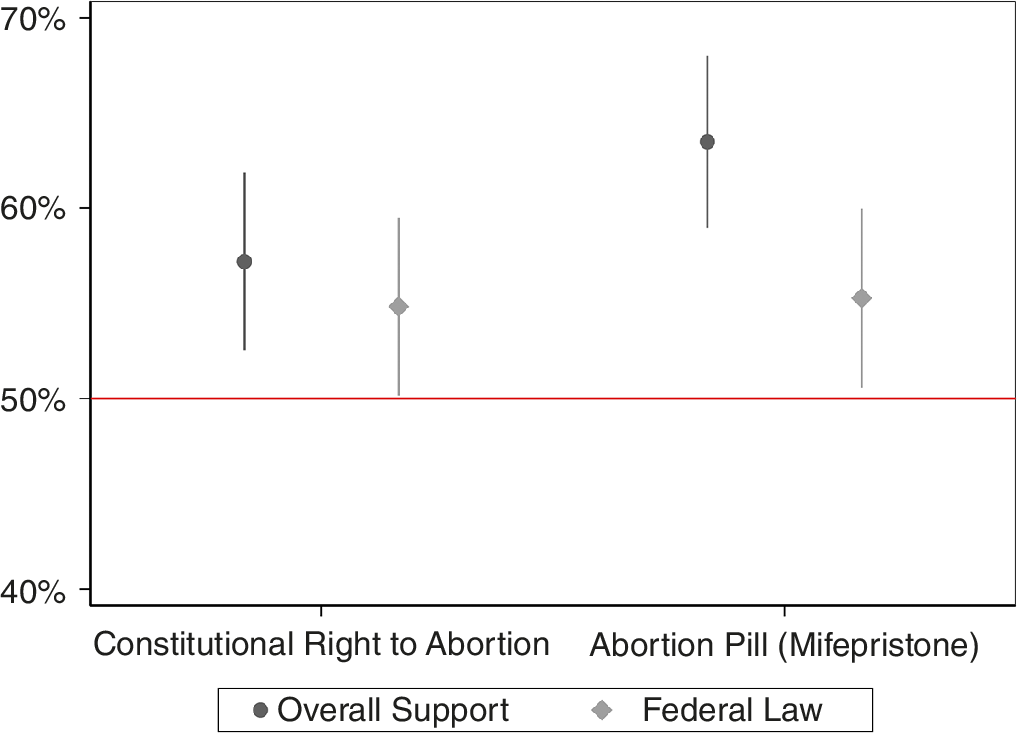
Democrats entered the 2024 cycle hopeful that Republican efforts at the state level to limit access to reproductive health care would yield electoral advantages for their party. As shown in figure 1, a majority of Americans supported both a constitutional right to abortion (57%) and access to mifepristone (63%). However, figure 1 also shows that widespread support did not translate cleanly into a desire for federal legislation. Approximately 45% of respondents preferred that both issues be left to the states rather than governed by a single national abortion policy. The disconnect between policy and process preferences may explain why Democrats struggled to convert abortion and reproductive rights into broader electoral gains in 2024.
Support for Reproductive Access and Federal Policy, by Issue

Figure 1. Long description
The Y axis represents percentage support ranging from 40 percent to 70 percent with a horizontal red line at the 50 percent mark. The X axis lists two categories.
1. Constitutional Right to Abortion. Overall Support is represented by a dark grey circle at approximately 57 percent with an error bar extending from 53 percent to 62 percent. Federal Law support is represented by a light grey diamond at approximately 55 percent with an error bar extending from 50 percent to 59 percent.
2. Abortion Pill Mifepristone. Overall Support is represented by a dark grey circle at approximately 64 percent with an error bar extending from 59 percent to 68 percent. Federal Law support is represented by a light grey diamond at approximately 55 percent with an error bar extending from 51 percent to 60 percent.
All data points and error bars sit above the 50 percent red baseline.
Because we were interested in how these reproductive health care attitudes translated into election outcomes, our dependent variable was vote choice in the 2024 presidential election. Respondents in the post-election wave of the survey were asked who they voted for for president. We coded the dependent variable as a dichotomous variable wherein 1=Donald Trump and 0=Kamala Harris/Other. Respondents who reported not voting were excluded from our analysis.
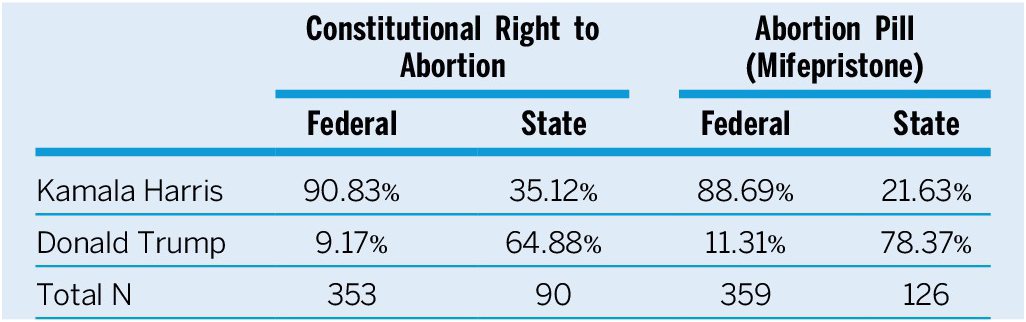
To preview the relationship between institutional preferences and vote choice, table 1 presents 2024 presidential vote choice by locus-of-authority preference among respondents who expressed support for each reproductive health policy. Across both issues, we observed a clear pattern. Whereas Harris dominated among supporters who wanted a federal policy, Trump won a majority of those who supported access but preferred that the policy be determined by “each of the 50 state governments.” Among respondents who supported a constitutional right to abortion, 91% of those who favored a federal law voted for Harris, whereas almost 65% of those who favored state control voted for Trump. The gap was even starker for mifepristone: among supporters, 89% of those who favored federal policy voted for Harris compared to only 22% of those who preferred state control. These descriptive patterns underscore our central claim that abstract support for reproductive health care does not necessarily translate into support for Democratic candidates. Instead, institutional framing matters.
Vote Choice in the 2024 Presidential Election by Support for Federal or State Reproductive Health Care Laws, Among Supporters
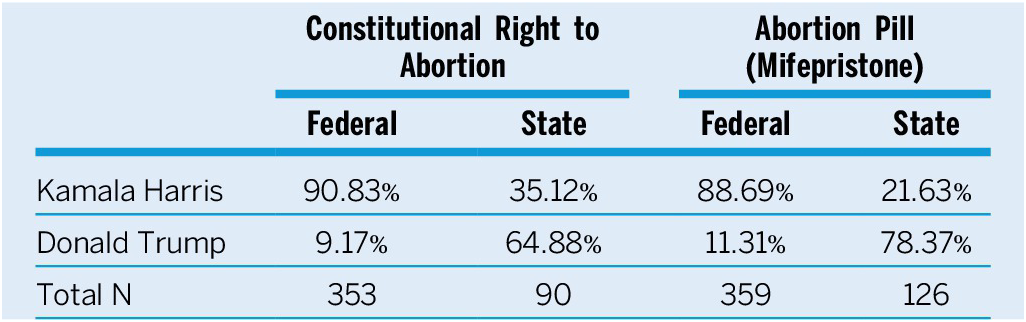
Table 1 Long description
The table compares support for Kamala Harris and Donald Trump across four categories of reproductive health care law supporters.
1. Constitutional Right to Abortion:
- Federal Support: Kamala Harris 90.83 percent, Donald Trump 9.17 percent (N = 353).
- State Support: Kamala Harris 35.12 percent, Donald Trump 64.88 percent (N = 90).
2. Abortion Pill (Mifepristone):
- Federal Support: Kamala Harris 88.69 percent, Donald Trump 11.31 percent (N = 359).
- State Support: Kamala Harris 21.63 percent, Donald Trump 78.37 percent (N = 126).
The data indicates that Harris has overwhelming support among those favoring federal protections, while Trump leads among those favoring state-level jurisdiction.
FINDINGS
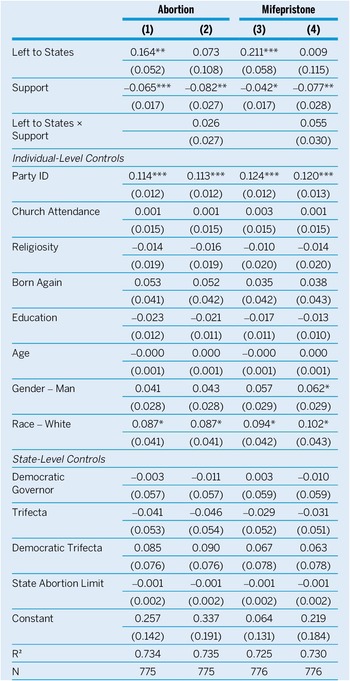
We estimated a series of linear probability regression models predicting a vote for Trump. Each model included the 5-point support variable and the binary policy locus-of-authority preference for one reproductive issue (i.e., abortion or mifepristone). Individual-level control variables included political party identification (i.e., 7-point scale), church attendance,Footnote 1 religiosity, born-again status, age, education, gender, and race (i.e., white versus non-white). State-level control variables included an indicator of the governor’s party (i.e., Democratic versus non-Democratic), a statewide political party control (i.e., trifecta) variable, an interaction between those two variables, and the state’s abortion limit (i.e., in weeks) at the time of the survey. Regression results from these models are presented in table 2.
The Relationship Among Vote Choice, Reproductive Health Care Attitudes, and Locus-of-Authority Preferences
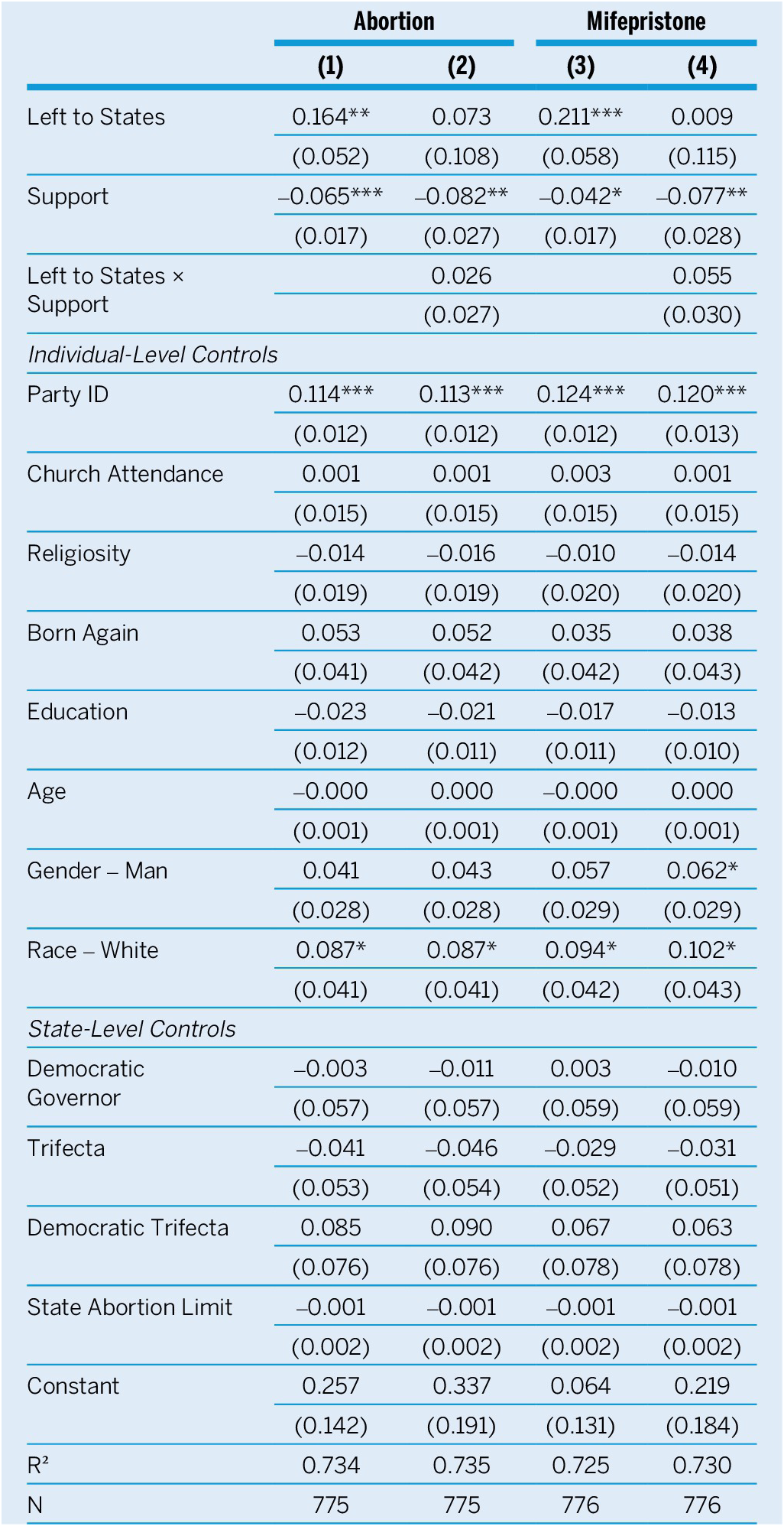
Table 2 Long description
The table presents regression coefficients with standard errors in parentheses for four models. Models 1 and 2 focus on Abortion, while Models 3 and 4 focus on Mifepristone.
Key variables and coefficients:
* Left to States: Model 1 is 0.164 (p < 0.01); Model 3 is 0.211 (p < 0.001).
* Support: Model 1 is -0.065 (p < 0.001); Model 2 is -0.082 (p < 0.01); Model 3 is -0.042 (p < 0.05); Model 4 is -0.077 (p < 0.01).
* Left to States x Support: Model 2 is 0.026; Model 4 is 0.055.
Individual-Level Controls:
* P A R T Y I D: Significant positive coefficients across all models (0.113 to 0.124, p < 0.001).
* Race - White: Significant positive coefficients across all models (0.087 to 0.102, p < 0.05).
* Gender - Man: Significant in Model 4 (0.062, p < 0.05).
* Other controls including Church Attendance, Religiosity, Born Again, Education, and Age show non-significant results.
State-Level Controls:
* Democratic Governor, Trifecta, Democratic Trifecta, and State Abortion Limit all show non-significant coefficients.
Model Fit:
* R-squared values range from 0.725 to 0.735.
* Sample size N is 775 for Abortion models and 776 for Mifepristone models.
Note: *p<0.05; **p<0.01; ***p<0.001
Regression results in columns 1 and 3 of table 2 show that locus-of-authority preferences were predictive of vote choice in the 2024 presidential election. Across both issue areas, the dummy variable Left to States was positive and statistically significant. In substantive terms, favoring a state-based approach to reproductive health care was associated with a 16- to 21-percentage-point increase in the probability of voting for Trump. Not surprisingly, the Support variable also was a statistically significant predictor of vote choice in both the abortion and mifepristone models. In both models, support for access was negative and statistically significant, indicating that stronger support for abortion rights and access to mifepristone were associated with a lower likelihood of voting for Trump. However, our central question had not yet been answered decisively. Were pro-choice voters who preferred state control more likely to support Trump than pro-choice voters who preferred national control?
Therefore, we included an interaction between the Left to States and Support variables to test the conditional nature of our expectations. The results from the interaction between support for abortion and locus-of-authority preferences (see table 2, column 2) supports our expectations. The effect of a one-unit change in support for abortion when an individual preferred federal control was -0.082 (p=0.003); the effect when an individual preferred state control was -0.057 (p=0.002). In other words, support for abortion was not “canceled out” by a preference for state control—it remained negatively (and significantly) associated with a Trump vote choice across both groups but less so for those who preferred state control. Strong supporters of a constitutional right who wanted federal control had a predicted probability of 0.297 for voting for Trump compared to 0.498 for strong supporters who preferred state control. That is, individuals who were comfortable with “leaving it to the states” were 20 percentage points more likely to have voted for Trump (p=0.003).
The results for mifepristone were even more strongly consistent with our core expectations. The effect of a one-unit change in support for mifepristone access when an individual preferred federal control was -0.077 (p=0.006) but only -0.022 (p=0.234) when they preferred state control. The effect of increasing support for mifepristone access had a null effect on vote choice when an individual was comfortable with “leaving it to the states.”Footnote 2
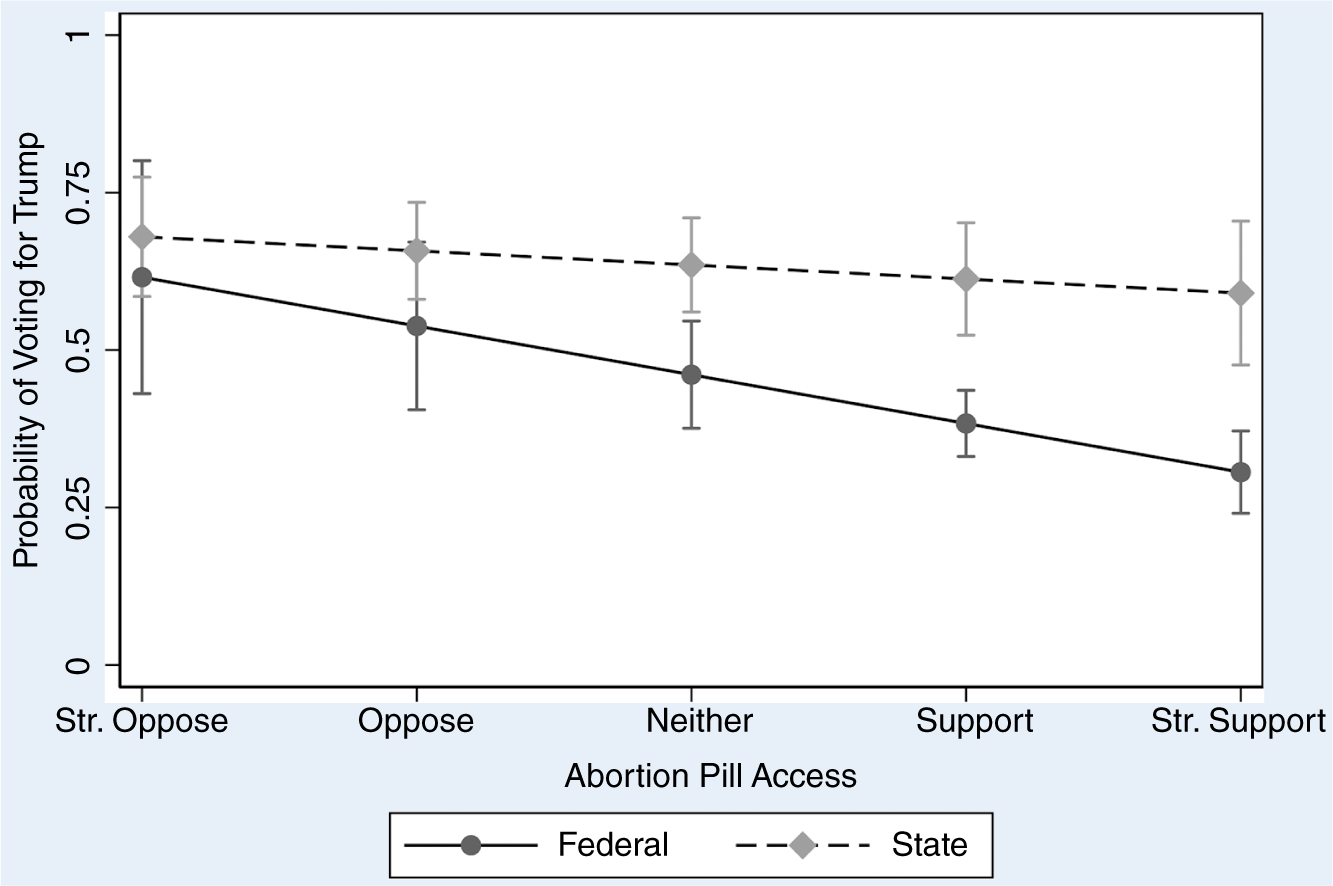
This pattern aligns with our theoretical expectation that Trump’s federalism framing had effectively decoupled mifepristone attitudes from vote choice among those who preferred state-level decision making. Figure 2 presents the predicted probabilities of voting for Trump across support for mifepristone, by locus-of-authority preference. Strong supporters of mifepristone access who preferred state control were 28 percentage points more likely (p=0.000) to have voted for Trump than strong supporters demanding federal control; the predicted probability was 0.590 versus 0.306.
Predicted Probability of Voting for Trump Across Support for Mifepristone Access, by Locus-of-Authority Preference
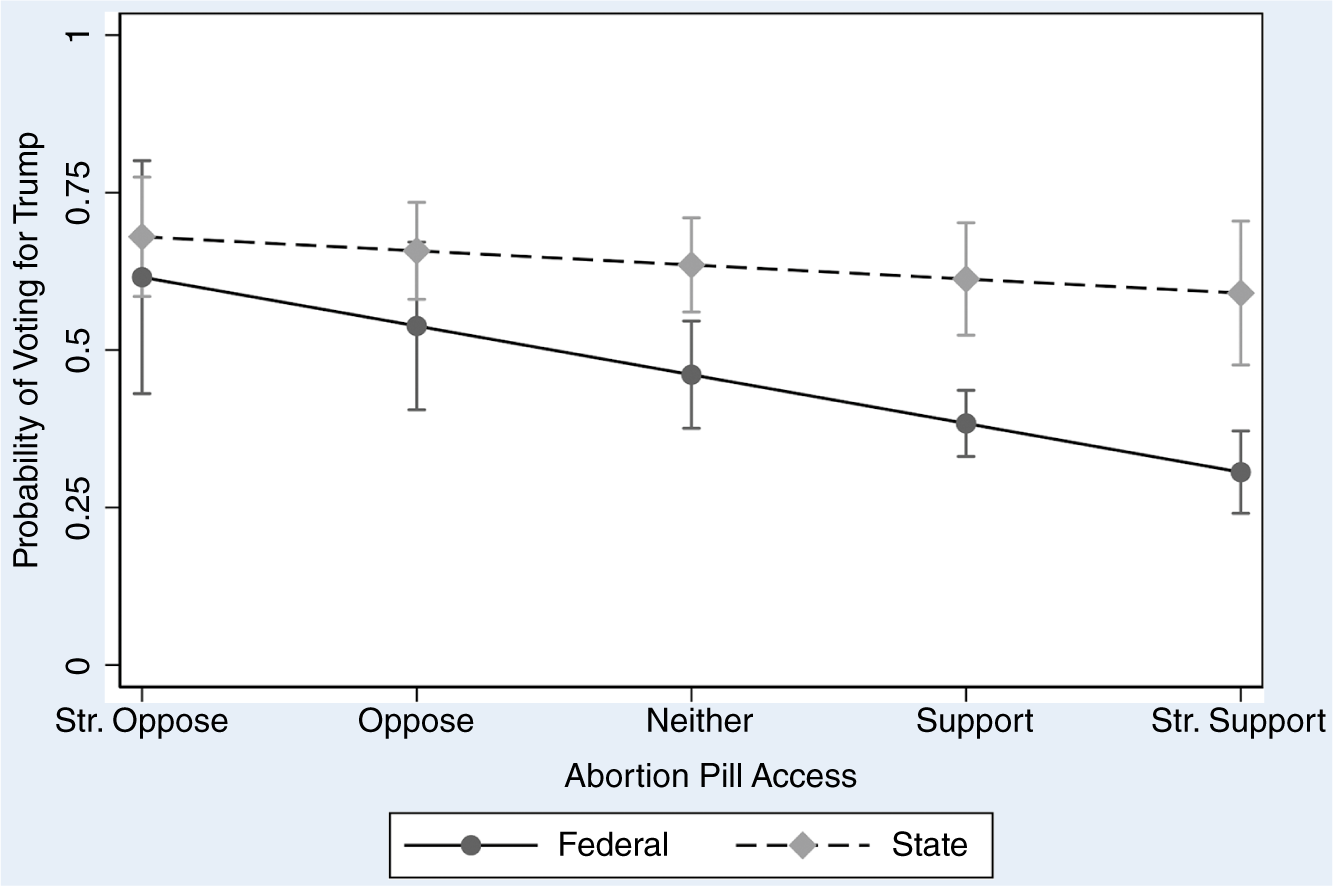
Figure 2. Long description
The Y-axis represents the Probability of Voting for Trump, ranging from 0 to 1 in increments of 0.25. The X-axis represents Abortion Pill Access support levels: Str. Oppose, Oppose, Neither, Support, and Str. Support.
Two data series are plotted with error bars:
* Federal (solid line with dark circles): Shows a significant negative linear trend. The probability starts at approximately 0.62 for Str. Oppose and declines steadily to approximately 0.30 for Str. Support.
* State (dashed line with light gray diamonds): Shows a much flatter, slightly negative trend. The probability starts at approximately 0.68 for Str. Oppose and remains relatively high, ending at approximately 0.60 for Str. Support.
The gap between the two groups widens as support for abortion pill access increases, indicating that those who prefer state-level authority maintain a higher probability of voting for Trump regardless of their stance on mifepristone.
CONCLUSION
Reproductive health care attitudes mattered before the 2022 midterm elections. For decades, many Americans have identified one key element of reproductive health care—abortion—as a defining political issue (Adams Reference Adams1997; Hout Reference Hout1999). Consequently, abortion attitudes have long shaped partisanship, vote choice, and resulting abortion policy (Abramowitz Reference Abramowitz1995; Jelen and Wilcox Reference Jelen and Wilcox2003; Norrander and Wilcox Reference Norrander and Wilcox1999).
Pundits have long argued that under Roe v. Wade, the pro-life movement had the advantage in abortion politics. With abortion rights constitutionally protected, anti-abortion activists could campaign against a status quo they opposed without having to grapple with any policy consequences of a change in policy. In other words, abortion worked electorally for Republicans as long as it remained hypothetical. Dobbs v. Jackson Women’s Health Organization threatened to upend that dynamic. By overturning Roe, SCOTUS effectively handed abortion policy making back to elected officials and made the GOP’s position suddenly real and visible in a way it had not been for decades. In the immediate aftermath of Dobbs, the salience of abortion surged. As noted previously, public opinion tilted sharply in a pro-choice direction, and most statewide ballot initiatives sided with reproductive-rights advocates. Democrats outperformed expectations in the 2022 midterm elections, and many credited abortion backlash as the driving force.
By overturning Roe, SCOTUS effectively handed abortion policy making back to elected officials and made the GOP’s position suddenly real and visible in a way it had not been for decades.
However, the 2024 election was a more complicated narrative. Although Americans remained broadly supportive of reproductive access—including abortion and mifepristone—that support did not translate automatically into support for Democratic candidates. Our findings provide support for the expectation that preferences regarding the locus of authority for abortion policy shaped vote choice. For abortion, support for a constitutional protection remained a strong predictor of vote choice regardless of locus-of-authority preferences. However, for mifepristone access, the federalism frame apparently was more effective. Among those comfortable with state-level decision making, support for mifepristone did not significantly predict vote choice. In this sense, Trump’s federalism frame served as a form of strategic ambiguity, turning what should have been a major positive for Harris among an important and strategic segment of voters into almost a 50-50 probability. Our sample was too small to assess the impact of Trump’s gambit in battleground states, but these findings suggest that his move may have been just enough to turn the tide in his favor to replicate his 2016 outcome.
Trump’s federalism frame served as a form of strategic ambiguity, turning what should have been a major positive for Harris among an important and strategic segment of voters into almost a 50-50 probability.
SUPPLEMENTARY MATERIAL
To view supplementary material for this article, please visit http://doi.org/10.1017/S1049096526102376.
DATA AVAILABILITY STATEMENT
Research documentation and data that support the findings of this study are openly available at the PS: Political Science & Politics Harvard Dataverse at https://doi.org/10.7910/DVN/KFOP1E.
CONFLICTS OF INTEREST
The authors declare that there are no ethical issues or conflicts of interest in this research.


 Open access

