Background
Trauma is the leading cause of death between the ages of 1-44 years.Reference Heron1 A significant rate of preventable trauma deaths is due to limb injury.Reference Bellamy2 , Reference Mabry, Holcomb and Baker3 EarlyReference Kragh, Walters and Baer4 and correctReference Kragh, O’Neill and Walters5 use of tourniquets in the treatment of bleeding extremities has reduced deaths substantially.Reference Kragh, Littrel and Jones6 For this reason, the Hartford Consensus, a joint committee to create a policy to enhance survivability from intentional mass-casualty and active-shooter events, advised that non-medical personnel be competent in tourniquet use to stop bleeding.Reference Jacobs, Sinclair and Rotondo7
However, the rates of failure to apply tourniquets effectively remain high. This was established both in trainingReference Taylor, Vater and Parker8 , Reference Sanak, Brzozowski and Dabrowski9 and in combat.Reference King, van der Wilden, Kragh and Blackbourne10 A variety of training programs exist.Reference Goolsby, Branting, Chen, Mack and Olsen11 – Reference Unlu, Kaya and Guvenc14 There are few direct comparisons of the various programs,Reference Baruch, Benov and Shina15 and current knowledge is insufficient to propose a specific regimen. Furthermore, these programs are costly and lengthy, obligating a clear demonstration of effectiveness. This study objective was to examine whether early advanced training under simulated combat stress improves competency compared to the current educational program of non-medical personnel.
Methods
Trial Design
The Israel Defense Forces’ (IDF; Tel Aviv, Israel) Medical Corps’ Institutional Review Board reviewed and deemed exempt this single-center, parallel-group, randomized, controlled, open trial of an educational intervention (No. 5262). The authors assert that all procedures contributing to this work comply with the ethical standards of the relevant national and institutional committees on human experimentation and with the Helsinki Declaration of 1975, as revised in 2008. This trial received no specific grant from any funding agency, commercial, or not-for-profit sectors. The manuscript was written and edited according to the CONSORT guidelines.Reference Schulz, Altman and Moher16 No changes to trial design and methods were made following trial commencement.
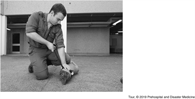
The study included use of the Combat Application Tourniquet generation six (CAT Resources LLC; Rock Hill, South Carolina USA) and the HapMed Tourniquet Trainer Serial no. 0023 (CHI Systems; Plymouth Meeting, Pennsylvania USA), both described thoroughly in a previous study,Reference Baruch, Benov and Shina15 and from here on will be referred to as The Tourniquet and The Simulator, respectively. The Tourniquet is a windlass-based design, a standard field tourniquet to deployed soldiers. The Simulator, presented in Figure 1, is a digital amputated right-thigh that measures time, pressure, and placement. It also provides an estimation of blood loss in any of seven built-in injury scenarios.
The HapMed Tourniquet Trainer.

Participants
The trial was conducted in the IDF Armored School. Male recruits aged 18-20 years enlisted to active military duty in August 2017 were included in the study. All recruits undergo basic training in the same base using the same facilities. In Israel, The Tourniquet used in the study is not in use outside of the army. Therefore, all participants had no previous experience. Recruits who, for any reason, did not participate in the practical aspects of training or failed either the written or practical exam, or did not accomplish the final assessment, were excluded.
Interventions
All combat recruits routinely undergo the Combat Lifesaver training, a two-day tactical first aid program. This program generally educates the recruit regarding combat protection equipment; fundamentals of body systems; hemorrhage control; extraction and evacuation; military trauma management protocol; climate injuries; chemical, biological, radiological, and nuclear defense; and mental injuries during combat. Specifically, hemorrhage control relates to tourniquet application and wound dressing.
During the Combat Lifesaver training, recruits apply The Tourniquet 12 times either on peers or on their own limbs (arm and thigh). Recruits are instructed to apply The Tourniquet as tight as they can since identifying hemorrhage control in combat, especially in darkness or under fire, is difficult. Instructors provide hands-on help and immediate feedback. Successful application in the program is determined by the absence of distal pulse, as palpated by the instructor. All recruits undergo standardized written and practical tests to complete the program. Instructors are qualified military medics (12 weeks of training) who further undergo four weeks of Combat Lifesaver Instructor training in the School of Military Medicine. This educational program was used as the control group.
The combat stress inoculation (CSI) group training was based on the principles mentioned above and included 12 tourniquet applications, albeit some of them in combat-like conditions. Participants were trained earlier to apply The Tourniquet as part of a whole treatment protocol, and one-third of the applications were blindfolded to simulate low-light conditions. The last application was post-physical-exertion, in which participants were blindfolded with an opaque cloth after they had each held The Tourniquet in their hands. The physical exertion was achieved by performing burpees (a jump followed by a push-up) for 60 seconds before tourniquet application. The two programs are available in Appendix 1 (available online only).
Aside from the applications themselves, both groups underwent identical Combat Lifesaver training, had similarly qualified instructors, with identically written and practical tests. To ensure the same amount of applications in both groups, each participant had a checklist of 15 items: twelve for the applications, one for the written exam, one for the practical exam, and one for the final assessment. The instructors checked items and signed to confirm the participant had completed the item.
Outcomes
One investigator (BY) assessed participants for up to 24 hours following the completion of the Combat Lifesaver program for tourniquet application competency. No additional applications took place during this interval. To minimize bias, participants did not engage in any physical activity in the 30 minutes prior, and did not carry any combat gear or weapon during the assessment.
In an isolated classroom, the investigator briefed each participant individually with an explanation of the trial and a description of a scenario in which an amputated victim, represented by The Simulator, is lying in a safe environment, where no threats are endangering the participant. The participant stood at the start line, approximately 0.5m from The Simulator, with The Tourniquet in his hands, and was instructed to do his best at tourniquet application, on command. The participants had only one assessment and were instructed to avoid any communication with the investigator. The investigator stopped The Simulator only when the participant stood up and called out “Done!” The investigator then recorded the results as measured by The Simulator.
The primary, pre-specified outcome was the proportion of participants applying The Tourniquet successfully over The Simulator. Three parameters defined success, and these parameters were measured by The Simulator: (1) applied pressure ≥200mmHg; (2) time to stop bleeding ≤60 seconds; and (3) placement up to 7.5cm above the amputation. Additional analysis was done on the proportion of participants unable to apply any pressure at all. No changes to trial outcomes were performed after commencing the trial.
Sample Size
The sample size was calculated using OpenEpi.Reference Sullivan, Dean and Soe17 Based on an expected 20% success rate found in earlier studies, to detect a 20% increase with a two-sided five percent significance level and a power of 80%, a sample size of at least 101 participants per group was necessary, given an anticipated dropout rate of 10%. Since there were no health risks involved and the trial was conducted for two days only, no interim analysis had been planned, and no stopping guidelines had been determined.
Randomization
The IDF has conscription in Israel. Immediately after conscription and basic training, all newly-formed armored platoons are similar in size, demographics, and capabilities. This is due to a routine process in the IDF in which a pre-enlistment thorough evaluation based on medical, psychosocial, and cognitive examinations is employed to randomize all recruits in a brigade into platoons uniformly.Reference Baruch, Benov and Shina15 , Reference Twig, Vivante and Bader18
As the educational program is platoon-based, in which an instructor trains a whole platoon, trial allocation was not based on randomized individuals but on randomized platoons. A computer random number generator was used to assign platoons into groups with a 1:1 allocation ratio. Only one sequence was generated.
The investigators concealed allocation from instructors until after the briefing at the beginning of each course. That way, investigators ensured that instructors did not prepare differently depending on allocation. Instructors were not allowed to change assigned platoon. Participants were pre-assigned to groups according to their platoon. Participants were not blinded at any point.
Both interventions were of the same length, based on the Combat Lifesaver course syllabus, had similarly trained instructors, included the same amount of tourniquet applications, and ended with identical written and practical exams. Unless a participant spoke to a participant from a different platoon undergoing the other intervention within the two-day course and compared training regimens, which is highly unlikely in large numbers, participants were unable to deduce information that could bias the results.
Statistical Methods
The investigators used Microsoft Excel spreadsheet Version 14.0.7212 (Microsoft Corporation; Redmond, Washington USA) to gather variables of interest. A pre-designed form and data validation functions were used to avoid data entry mistakes. Following anonymization, the database was transferred to SPSS Statistics Version 20.0.0 (IBM Corporation; Armonk, New York USA) for statistical analysis.
Time to stop bleeding, measured in seconds, was also categorized to a binary equal to or less than one minute. Applied pressure was measured in mmHg and was categorized to two different binary variables: (1) sufficient pressure representing pressure equal to or larger than 200mmHg; and (2) unable to apply any pressure reflecting pressure equal to 0mmHg. The primary outcome, successful application, was defined as the combination of sufficient pressure, sufficient time, and correct placement as noted earlier in the outcomes sub-section.
Comparison of categorical variables was performed using Chi-square. Quantitative variables were compared using the Student-T-test. Repeated comparisons were performed using the same methods after excluding participants unable to apply any pressure.
Results
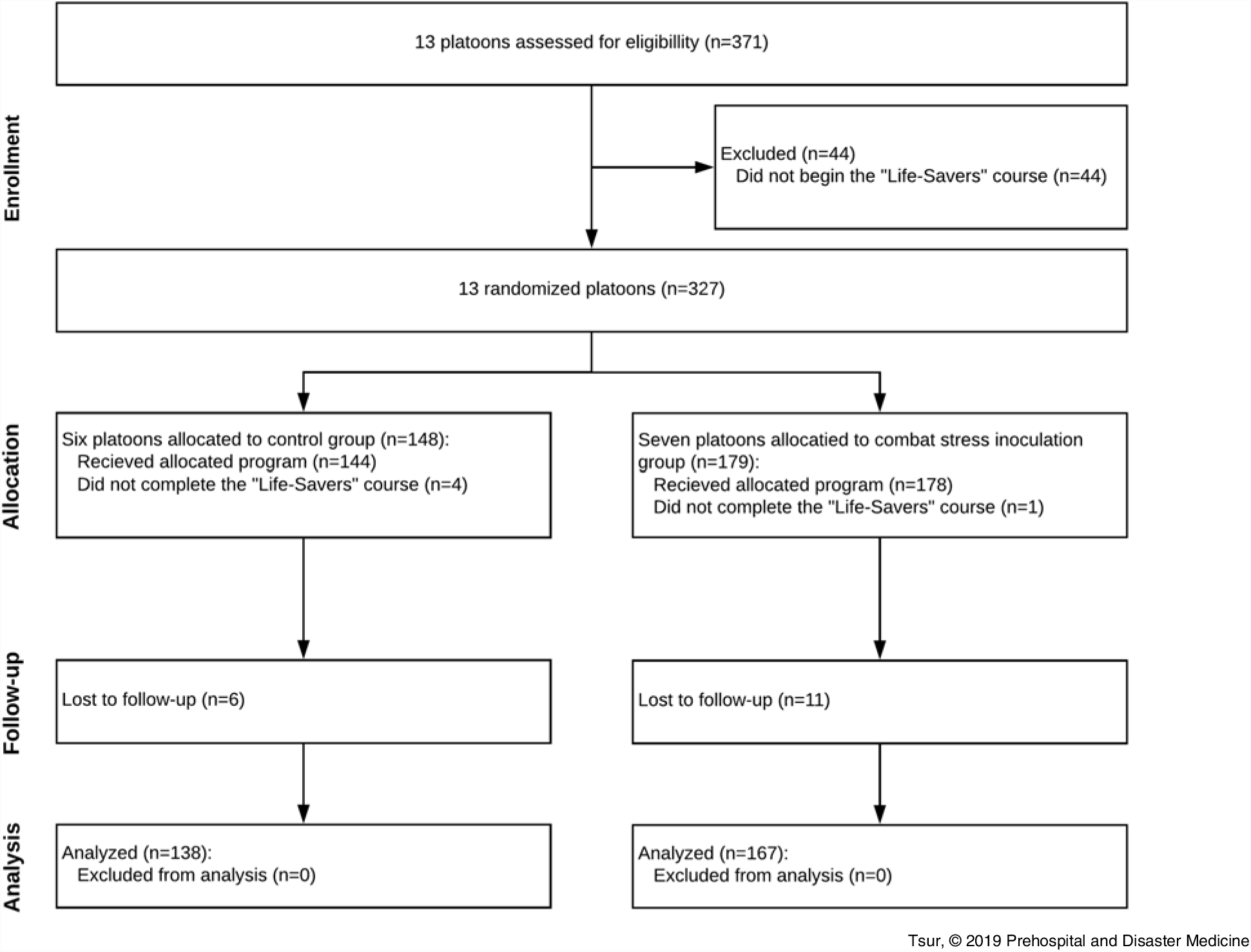
Three Combat Lifesaver courses took place from December 27, 2017 through January 5, 2018. Figure 2 presents trial enrollment, allocation, and follow-up. Out of the participants, 138 were assigned to the control group and 167 were assigned to the CSI group. Platoon mean sizes and standard deviations were 28.54 (SD = 3.41), 25.15 (SD = 4.18), and 23.46 (SD = 3.80) in the eligibility assessment, allocation, and analysis phases, respectively. The two groups were similar in age, education, and language fluency (Table 1).
Characteristics of Study Participants (n = 305)

Abbreviation: CSI, combat stress inoculation.
Enrollment and Randomization.
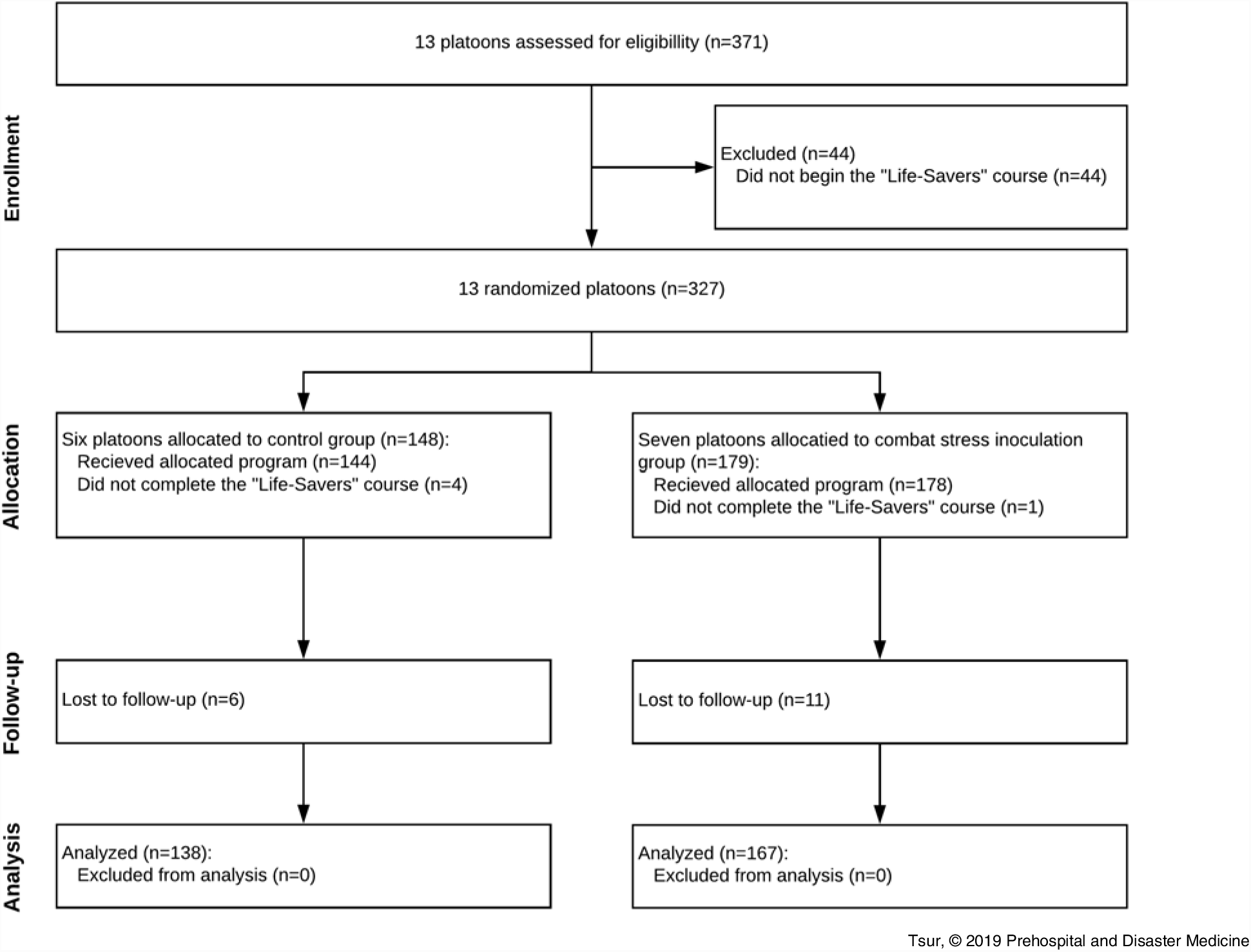
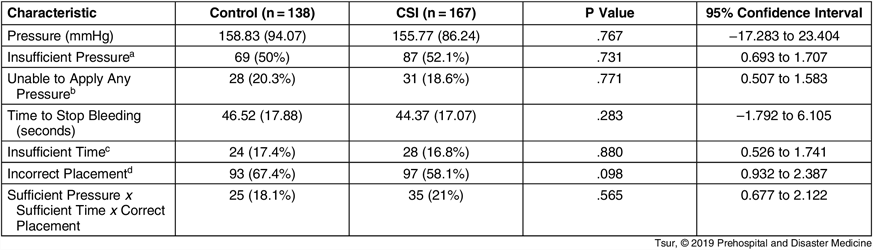
Table 2 presents the outcomes of the participants of the CSI group versus the control group in utilizing The Tourniquet on The Simulator. The overall failure rate was 80.33% (81.90% in the control group versus 79.00% in the CSI group; P value = .565; 95% confidence interval, 0.677 to 2.122). Differences in pressure, time to stop bleeding, or placement were not significant (95% confidence intervals, −17.283 to 23.404, −1.792 to 6.105, and 0.932 to 2.387, respectively). The difference in the rate of those unable to apply any pressure between the CSI group and the control group was not significant (18.6% versus 20.3%, respectively; 95% confidence interval, 0.507 to 1.583). Table 3 presents a sub-analysis only of those able to apply sufficient pressure. Differences in pressure, time to stop bleeding, and placement were not significant (95% confidence intervals, -4.836 to 16.413, 0.279 to 4.204, and 0.739 to 2.742, respectively).
Control versus CSI Group Outcomes

Abbreviation: CSI, combat stress inoculation.
a Applied pressure less than 200mmHg.
b Applied pressure equal to 0mmHg.
c Time to stop bleeding longer than 60 seconds.
d Placement higher than three inches above amputation.
Sub-Analysis of Participants Able to Apply Sufficient Pressure

Abbreviation: CSI, combat stress inoculation.
a Time to stop bleeding longer than 60 seconds.
b Placement higher than three inches above amputation.
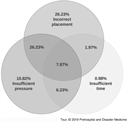
Figure 3 shows the distribution and mix of reasons of failure in utilizing The Tourniquet on The Simulator. Tourniquet placement was incorrect in most of the applications (62.30%), followed by insufficient pressure (51.15%), and insufficient time (17.05%).
Venn Diagram of Reasons for Failed Application.

Discussion
In 2013, the major philanthropist and global health promoter, Bill Gates, wrote: “I have been struck by how important measurement is to improving the human condition.”Reference Gates19 Measurement ought to be utilized not solely for treatment efficacy and epidemiological risk factor rates. All formal training should have specific objectives and train to competency.Reference Jacobs20 This allows for a thorough understanding of performance barriers, a focus of efforts on common pitfalls, and an establishment of a standard curriculum.Reference Jacobs21 These, in the field of tactical and emergency medicine, may result in saving lives.
This study found high rates of failure in tourniquet application (80.33%) and failure to apply any pressure (19.34%) immediately after successful completion of tourniquet training. It is probable that those reflect a flawed educational method. These findings are consistent with studies of trainingReference Sanak, Brzozowski and Dabrowski9 and combat alike.Reference King, van der Wilden, Kragh and Blackbourne10 Other studies show more optimistic rates.Reference Goolsby, Branting, Chen, Mack and Olsen11 , Reference Unlu, Kaya and Guvenc14 , Reference Schreckengaust, Littlejohn and Zarow22 However, these studies measure success using tools that are possibly less stringent and less objective. The feedback from testing a tourniquet application on a non-bleeding person using either pulse palpation or ultrasound is highly operator and limb dependent. The standard must be high as studies show that even simulated combat causes an increase in application time,Reference Schreckengaust, Littlejohn and Zarow22 and within minutes from an application, a significant tourniquet pressure drop may occur.Reference Rometti, Wall, Buising, Gildemaster, Hopkins and Sahr23
Training in stressful conditions similar to those encountered in combat is thought to improve outcomes. Therefore, blindfolding and exercise mimicked combat-like conditions. However, there were no significant differences in outcomes between the participants of the control group and the CSI group. It is possible that lack of comprehension, flawed basic skills, and skill acquisition in the current programs overshadow the effect of training in combat stress conditions and therefore should become a priority. Additional practice seems to accelerate the learning curve.Reference Baruch, Benov and Shina15 , Reference Clumpner, Polston and Kragh24 However, additional practice requires additional time and resources. It would be useful to find a way to further improve skills within current constraints. Color-coded tourniquets do not improve performance.Reference Goolsby, Chen and Branting25 A slack-reducing band improves the applied pressure significantly.Reference Nachman, Benov and Shovali26 Other design issues solved in the seventh generation of The Tourniquet, especially single routing, might contribute to performance.Reference Kragh, Moore, Aden, Parsons and Dubick27
The failure distribution found in this study implicates priorities to tackle. Incorrect placement is a common issue (62.30%). It may be useful to apply a four-finger method to measure appropriate distance proximal to the bleeding easily. However, if a bleeding location is uncertain, The Tourniquet should be placed as high on the limb as possible and later considered for re-location. Insufficient pressure, evident in 51.15% of the cases, could be mitigated by putting training emphasis on reducing slack before tightening and distal pulse elimination. As time seems to be the least common issue (17.05%) and mean time is quite short (44.37 versus 46.52 seconds in the CSI versus control group, respectively), it may be recommended nudging natural inter-participants rivalry during training from time towards pressure. Instructors should present the failure distribution to encourage early understanding of application difficulty.
The Combat Application Tourniquet investigated is the standard issue tourniquet in the United StatesReference Kragh, Burrows and Wasner28 and IsraeliReference Shlaifer, Yitzhak and Baruch29 armies, and is in wide-spread use elsewhere.Reference Savage, Pannell, Payne, O’Leary and Tien30 As the Combat Lifesaver training is similar across organizations,Reference Schreckengaust, Littlejohn and Zarow22 the results may indicate that better tourniquet training methods should be pursued.
Limitations
A limitation of this study is that neither participants, instructors, nor assessor were blinded. This was not possible due to the nature of the educational intervention. To mitigate this effect, instructors were similarly qualified, and allocation was revealed to them only immediately before the beginning of a course; both written and practical exams were identical; and educational programs were of identical length and content apart from the type of tourniquet applications. Another limitation is the platoon-based randomization. However, the IDF routine evaluation and randomization process ensured platoons of similar size and composition, which are less likely to be affected differently.
Conclusions
This study found high rates of failure in tourniquet application (80.33%) and failure to apply any pressure (19.34%) immediately after successful completion of tourniquet training. These rates did not improve with tourniquet training, including CSI. The results may indicate that better tourniquet training methods should be pursued.
Conflicts of interest
none
Supplementary Material
To view supplementary material for this article, please visit http://dx.doi.org/10.1017/S1049023X19004266