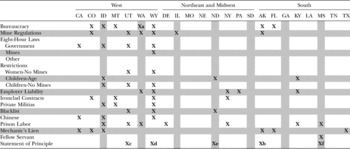
In the late nineteenth century, citizens in the western states and territories of the United States resented the neglect of the federal government, which they hoped would assist them with irrigation, transportation, corporate regulation, and keeping the peace. They asked even more of their state governments, which they wanted to be the voice of the West in Congress; the enforcing arm of popular will; a peacemaker between labor and capital; the protector of residents from the irrigation company, railroad, or mine; and the protector of the many from the distant, indifferent, and predatory few. At constitutional conventions held in the transition from territory to statehood, delegates designed state governments with these goals in mind.
My primary sources for these claims are the proceedings of five constitutional conventions held in the last quarter of the nineteenth century, those of Colorado (1876), California (1879), Montana (1888), Idaho (1888), and Wyoming (1889), and the texts of two state constitutions written during the same time period, Washington (1890) and Utah (1895). For each of these states, save California, the delegates wrote the “founding” constitution, the first for their state. The constitutions of these seven states form the entire set of constitutions that fall within my designated timeframe (last quarter of the nineteenth century) and region (the West).Footnote 1
The American West has been little studied in political science. Political scientists have rarely written about the West outside of California. Historians have written about the West, but have not been much concerned with politics. Writing about the Colorado constitution in 1904, Elmer Herbert Meyer lamented this neglect:
The pioneers of the West labored, like their fathers in the East, through years to establish free institutions; but, while the children of Colorado know well the history of the great struggle of the Puritans and the founders of Virginia, they know relatively nothing of the pathfinders of the mountains and the plains. Without this knowledge the younger generation cannot thoroughly appreciate the Commonwealth of their nativity. Nor will such study result in sectionalism, but rather in a broader view of the history of American institutions and in a realization that the work of the founders was to transplant the old institutions and to transform them, in a measure, to fit new conditions.Footnote 2
Such a broader view of American history may also be realized through study of the constitutions of each of the western states. The delegates who authored western state constitutions took their mission to be to craft documents appropriate for their own communities and, in the constitutions' goals and provisions, to be consistent with American history, law, and values.
Constitutional conventions were distinctive institutions. Their long agendas provoked conversation about a wide range of topics—the design of government, suffrage, corporations, settlement of the public domain, religion, and rights—revealing agreement and division about public life. Delegates did not design elegant, spare machines that would go of themselves, but complex governments with diverse institutions to address a broad range of tasks. The delegates to these conventions were elected, and broadly representative. Delegates were more conscientious and honest than the members of ordinary territorial legislatures. And, since the product of their labors was immediately subject to popular approval or rejection, delegates were more responsive to popular sentiment than territorial or state legislators. Delegates to constitutional conventions were not the worthy solons portrayed by the contemporary press. They engaged in interest-based self-seeking alongside principled debate. But there was principled debate, and the results of their deliberations differed from the decisions that would have been reached by ordinary legislatures. Most striking among these outcomes were protections for labor and expansions of bills of rights.
My exploration of constitutional deliberation makes several contributions to the study of U.S. politics and history. First, I propose a way for students of American political development to study state constitutions. Second, I present the distinctive characteristics of the western periphery. Third, I expand the focus of constitutional studies to include recognition of laws written, and institutions created, for state governments to encourage settlement and growth. I call this “managing the periphery.” I argue that, in their efforts to manage the periphery, delegates expanded the range and authority of state government. The sustained attention of constitutional scholars to constraints on state legislatures has obscured the ways delegates to constitutional conventions affirmed the prerogatives of the states. Attention to managing the periphery allows for a rereading of state constitutions that is more positive than the currently accepted reading.
I begin the essay with a selective review of academic writing about state constitutions. I offer an argument about how to study state constitutions and the conventions that authored them. In the subsequent section, I describe the western constitutional conventions and present delegates' debates and the provisions they wrote for managing the periphery. I focus on three issues: water, corporations and railroads, and the protection of labor. The three issues present three distinct patterns. Writing laws for rights to water was an issue peculiar to the western states. Deliberations about water rights involved intense arguments about priorities and property. In their consideration of railroads, western delegates' choices were much like those in other regions. Areas without railroads were most anxious to solicit them, areas well-crossed by railroads were concerned to regulate them. Delegates were universally timid about taxing or constraining corporations, more because of western dependence on outside investors than because of confidence in corporate organization; many delegates found the limited liability corporation morally suspect. Western constitutions offered substantial protections for labor, significantly more than appear in the Gilded Age constitutions of states in other regions. Some of the protections were narrow and explicit, others found in lofty general sentiment. Both in the specific and in the general, constitutional labor protections were important in the national development of labor law. These comparisons suggest that, to our narratives of American political development, most often centered on the Northeast, supplemented by accounts of the South, we should add a narrative about the West.
How to Think about State Constitutions and Constitutional Conventions
State constitutions are long documents, riddled with provisions limiting the power and range of state government, and bloated with legislation. The contrast between state constitutions and the elegant federal document led many academic commentators to disparage state constitutions as hasty, cut-and-paste constructs, uninformed by legal or political theory; as a result state constitutions received scant scholarly attention until recently. The spread of civil rights litigation in the 1970s, tentative reliance on state bills of rights in adjudicating civil rights claims, and the affirmation of the value of state bills of rights by two senior jurists provoked renewed scholarly interest in state constitutions.Footnote 3 Subsequently, the greater portion of writing about state constitutions has focused on civil rights jurisprudence. Several authors, however, have been attentive to the writing, history, and development of state constitutions, and their work has informed my effort here.
Christian Fritz mined the deliberations of state constitutional conventions and rethought the bugbears of scholars dismissive of state constitutions. Where other commentatorsFootnote 4 saw hasty cutting and pasting and lack of industry, Fritz saw seriousness of purpose. Delegates “carefully canvassed, studied, and ultimately chose provisions from many pre-existing state constitutions.”Footnote 5 Delegates were armed with “comprehensive compilations of existing state constitutions,” often pocket-sized, that they might read the provisions in place elsewhere.Footnote 6 These informed “extended debates over … different constitutional practices of other states.” The discussion below will show that, for western delegates, borrowing was a search for precedents and best practices. Delegates sought to borrow from a state that was arguably like their own. The subsequent prosperity, or peace, or consensus in the lending state demonstrated the provision's utility.Footnote 7
Where other commentators saw legislation inappropriately wed to organic law, Fritz saw delegates arguing that the great changes of the late nineteenth century justified “embracing in their fundamental law as much legislation as they [could] safely include … .”Footnote 8 Building upon past practices and writing detailed provisions (“legislation”) in state constitutions, delegates understood their work as part of a national endeavor to provide ever-better law and institutions to the states.
Delegates saw their meetings as “constituent assemblies,” “the practical embodiment of popular sovereignty.”Footnote 9 If in national politics popular sovereignty is only “rhetorical, and a political principle, but not a constitutional one, a ‘fiction’, even if a crucial one,” in state constitutional conventions, “during much of American history the people's sovereignty was the undisputed foundation of American constitutions.”Footnote 10 Both the writing of constitutions at the conventions and their ratification by popular vote were practices of popular sovereignty.
Cornell Clayton observed the affirmation of popular sovereignty in the constitution written for Washington state. The federal Constitution was designed to create a carefully calibrated distance between government and the many, while state constitutions provided for considerable popular participation. Authors of the Washington constitution “were strong believers in popular sovereignty and believed that liberty could best be secured through open, democratic government”; “the tyranny they feared most was not the tyranny of the majority, but the tyranny of corporate power … that might … control or … corrupt governing institutions.”Footnote 11
Delegates saw themselves as superior in talent and intent to state or territorial legislators, and the public agreed. In Idaho, one delegate declared, “The territory has never been represented as it is represented here today.”Footnote 12 Delegates felt empowered to elaborate constitutional provisions, write law, and circumscribe legislative practice. Delegates even took it upon themselves to write provisions with the aim of preserving popular and governmental morality. For example, the California convention of 1849 banned lotteries. The proposal passed even though it was contentious. “Ultimately,” Fritz reports,
the most persuasive argument used the prevailing view of a constitution's central purpose by describing the prohibition as an important moral restriction on the legislature that ought to become part of the state's fundamental law… . The state should not “adopt an immoral system of taxation as a source of revenue. The best policy for governments … is a strict adherence to legitimate and honorable means of support.”Footnote 13
Many states followed suit; almost every state that revised or wrote their constitution later in the century banned lotteries.
The sum of these insights challenged the central role of the federal Constitution and, with it, the Founding Fathers, in creating American constitutionalism. For Fritz, the U.S. constitutional tradition is not to be found in the federal Constitution, which represents “only the genesis of American constitutionalism.” Rather, it is in the many conventions and the sustained deliberations in the states that the practice and development of our constitutional tradition is to be found.Footnote 14
John Dinan's research and writing amplify the claim that the practice of American constitutionalism is found in the writing of state constitutions. In the deliberations of state constitutional conventions Dinan sees “a forum for reconsidering, and ultimately revising or rejecting, a number of governing principles and institutions that were adopted by the federal convention of 1787 …” The federal constitution, then, represents “only one part of the American constitutional tradition, and, … not necessarily the best expression of the accumulated wisdom and experience of American constitution makers.”Footnote 15 In the course of that reconsideration delegates to state constitutional conventions rethought and reconfigured central elements of republican government. The state governments they designed bear witness to their judgments about representation, separation of powers, rights, and citizen character. State constitutions are more easily amended than the federal Constitution, for example, and have departed from the federal model by the inclusion of positive rights. Like the delegates themselves, Dinan sees in their work the implementation of insights gained from observation of how government institutions functioned in the decades after 1787.
G. Alan Tarr has written an authoritative overview of state constitutions. In Understanding State Constitutions, Tarr presents a coherent account of state constitutionalism and tracks change and development of state constitutions over the course of U.S. history. Tarr identifies the distinctive characteristics of state constitutions—that they frame governments that vary little in institutional design; that they are long and detailed, including a fair amount of policy or “legislation”; and that they begin with long bills of rights. Most fundamentally, unlike the federal Constitution, state constitutions limit rather than grant power. The federal Constitution creates a government of enumerated, delegated powers, which the Constitution grants. All powers not granted to the federal government—“plenary legislative powers” belong to the states.Footnote 16 It follows that if the states were not to become little Leviathans, their constitutions must limit the reach of state authority. The “shall not” sections of the articles creating state legislatures are often the most lengthy and detailed. The California constitution, for example, lists thirty-three cases “in which the Legislature shall not pass local or special laws” (Art. IV, sec. 25). The Pennsylvania constitution of 1893 has an even longer list.Footnote 17 The wording “local or special” is central here. The language is a legacy of Jacksonian principles and worries (for example, in the 1830s, radical Democrat William Leggett denounced bank charters as “the unclean drippings of venal legislation”). Prohibitions of local or special legislation, and similarly, objections to “class” legislation, were efforts to forestall legislative favors to specific individuals or groups. Later in the century the same language was used to object to laws for the protection of labor.Footnote 18
By the middle of the nineteenth century there were additional reasons to limit legislative discretion. Large state debts, often incurred to assist railroads, cautioned delegates to place severe limits on government debt, and to forbid future subsidies. And the corruption of territorial assemblies and state legislatures by large interests was common enough that constitution writers felt compelled to put explicit and specific limits on legislative discretion, thereby “hamstringing” state legislatures.Footnote 19
The same disaffection from territorial and state legislatures that provoked constitution writers to place restrictions on state governments also made the opportunity to place policy and legislation in constitutions irresistible. Tarr calls this as “the constitutionalization of state politics.” Detailed provisions, like the prohibitions, limited the choices of governments to come. Although some provisions represent an interest finding an opportunity at a convention and taking it, Tarr sees more than “a search for group advantage.” On the contrary, “these provisions were designed precisely to limit the influence of such groups, to combat politics as usual, to change the way in which politics was conducted and the policies … it produced.”Footnote 20
Tarr also provides overviews of constitutional development in the South and New England. Tarr's account of constitutional development in the southern states in the nineteenth century shows that before the Civil War southern constitutions were much like those in the North, with the addition of protections for slavery. Seven of the eleven Confederate states wrote new constitutions as the Civil War began. In the wake of the Civil War, Reconstruction constitutions appeared in every state below the Mason-Dixon line. These reflected the Radical Republican agenda for the South, as they “guaranteed the rights of African-Americans… . Encouraged government support for economic enterprise, … expanded the scope of government responsibility with provisions for … public education, poor relief [etc., as well as] reconstructing local government to dislodge local oligarchies…”Footnote 21
The demise of Reconstruction brought new constitutions renouncing the activism of the years following the Civil War. In the last decade of the nineteenth century, new constitutions in several southern states consolidated white supremacist state regimes. Tarr's regional accounts suggest the mark of region on state constitutions, a point I elaborate below. In his concluding chapter, Tarr dismisses claims that state constitutions are unworthy of judicial or scholarly interpretation, and enjoins scholars (and presumably jurists) to undertake historically informed “textualism” and “originalism.” Scholars should make an effort to understand the goals that were embodied in the texts as the constitutions were written. Tarr's work has been foundational to subsequent studies of state constitutions.Footnote 22
David Johnson has written a social history of the founding constitutions of California, Oregon, and Nevada. In Founding the Far West, Johnson argues that in each state, antebellum thinking and values—political principles, understandings of society, and theories of political economy—informed delegates' deliberations. Within a generation these understandings were challenged by the Civil War, economic development, settlement, and population growth. For example, at California's first constitutional convention, delegates envisioned the world as welcoming individual initiative, and rich with reward for the industrious. Delegates believed there was a close correlation “between liberty and individual freedom in a market economy”; and they foresaw a “future in which individual proprietors, not corporate combinations, would flourish.” Delegates' reservations about corporations took shape in provisions for individual stockholder liability.Footnote 23 By contrast, at the 1878 convention, the chair of the corporations committee declared, “I now lay down the doctrine that where combination is possible, competition is impossible … .”Footnote 24 It was the world that had changed, not popular sentiment or delegates' principles. Indeed, calls for the second convention denounced contemporary politics in the very terms, the “old Jacksonian-egalitarian standards,” that had shaped California's first constitution.Footnote 25
The many constitutions of the states demonstrate the sensitivity of state constitutions to changes in national politics, to the appearance of social movements, and to changing patterns of economic growth. Hence, for Tarr, “comparison of state constitutions over time and among states … reveals patterns in American political development.”Footnote 26
For all the rethinking by academics of state constitutions, a longstanding critique remains. The consensus view among students of state constitutions is that the rambling state constitutions, packed with prohibitions and legislation, were meant to severely constrain the governments they created. Kermit Hall best expressed this understanding. In “Mostly Anchor, Little Sail,” Hall argued that state constitutions were “diffuse, overly long, negative documents that generally prevented the positive exercise of public authority.”Footnote 27 The constitutions thus crippled, by design, the very governments they were creating.
My reading of western state constitutions and the deliberations at the conventions where they were written, leads me to the conclusion that this consensus view is incomplete. Although delegates were wary of state legislatures, and denied them many powers, at the Gilded Age conventions I present here, delegates affirmed and expanded the prerogatives and authority of state government. They created new institutions for managing their economies and wrote property law for settlement and growth. They also greatly expanded bills of rights, creating positive rights, which mandated activity by state government. John Hicks read the constitutions of the Northwest states similarly. He saw that in the Gilded Age“… people were confronted … by the need of an immediate expansion of state activities to meet new and unprecedented conditions.”Footnote 28 The result was that “undoubtedly, the sentiment of the country favored more government, not less,” and more elected officials, not fewer.Footnote 29
In order to understand the development of state constitutions, context is essential. History matters in several ways. First, chronology matters. In the states, every generation of constitutional convention delegates had its own agenda of purposes and concerns. In this essay I examine constitutions from the last quarter of the nineteenth century. The central narratives of the Gilded Age—the appearance of large corporations, clashes between labor and capital, the mobilization of populist sentiment, and the settlement of the West, are all elaborated in the minutes of the constitutional conventions of this period. Not only is it important to recognize the influence of broadly identified eras (antebellum, Reconstruction, Progressive, and the like) but also the impact of changes in the legal environment over time. For example, delegates' discussions of corporate regulation were different after Munn v. Illinois and the creation of the Interstate Commerce Commission than they were before.
Every scholar of state constitutions has written about borrowing content from the constitutions of other states. With that in mind, we can understand the writing of state constitutions as an extended and far-flung conversation among the states. Borrowing, the compilations of state constitutional provisions, and their use by convention delegates demonstrate that the practice of writing state constitutions was autonomous of federal precedent. In the conventions I discuss here, borrowing was a search for best practices. It follows that history is consequential in borrowing; sequence matters. The western states that wrote constitutions after Colorado all looked to her laws as the most recent and truly western precedent, recommended by Colorado's rapid growth. Colorado pioneered innovations in water law and was the first state in the country to forbid so-called “ironclad” labor contracts in its constitution. Wyoming's constitution authors had access to, in addition, the recently written constitutions of neighboring Montana, Idaho, and North Dakota, from which they borrowed heavily.Footnote 30
Place matters, as well as time; region is particularly important. Regions have distinctive geographic, political, social, and economic histories. So it is an error to generalize from one region's experience to the whole set of constitutions. For example, looking at New York, James Henretta argued that in the Progressive Era, authors of state constitutions saw a “potential for tyranny … in party government. Parties … were the real majoritarian menace” and so “reformers turned their attention to systematically attacking the party machines” that exercised political control of state politics.Footnote 31 New York, Henretta claimed, was typical. Yet this is not the whole story of state politics in the progressive years. The West and the South feared other Goliaths. Differences among regions also follow from their different places in the U.S. economy, as will be elaborated in the next section. Recognizing the importance of time and place, some scholars of state constitutions have chosen their cases bounded by one or the other or both: Donald Johnson chose the first three constitutions written in the West—California, 1849, Oregon, 1859, and Nevada, 1864—to study the founding of the far West;Footnote 32 Hicks focused on the Northwest states;Footnote 33 and John Dinan selected constitutions written in the Progressive Era.Footnote 34
Within regions, individual states differed in social structure, economics, and politics. Each state's society shaped its constitutional provisions. In the discussion that follows, for example, Wyoming's radical water rights policy can be attributed to the dominance of stockgrowers in the territory's politics and economy. Several Rocky Mountain state economies were dominated by mining industries, and both owners and workers contributed to constitutional deliberations. Southern Colorado was largely settled by Mexicans, and there were also many German immigrants in the territory; their representatives won several concessions from the convention.
My central sources for this essay are the journals and minutes of the constitutional conventions. Any serious effort to understand state constitutions, and in particular the intent of their authors, must begin with the journals of the conventions. It is in the debate, argument, competition, and eventual agreements at the conventions that the concerns and goals of the delegates are revealed. Cornell Clayton and G. Alan Tarr have called for “originalism” in the interpretation of state constitutions. To infer an “originalism” or “textualism” requires all the historical understanding one can assemble. I argue the reverse of Tarr, that American political development sheds light on state constitutions.
For all their hundreds of pages, the journals of the conventions are incomplete. For example, there are no notes or journals from committee meetings, where one imagines there were many tough arguments, and where provisions were drafted before being discussed at the convention. And they are an insufficient source for explanation. Both secondary sources and other primary sources provide details that allow for a greater depth of understanding of both constitutional debates and their resolution. Newspaper coverage, which was explicitly partisan, is a source for party positions on various issues, but does not always provide the details of convention debates. Newspaper coverage also discusses which interests lobbied for, or were likely to benefit (or suffer) from, possible constitutional provisions. I used as source material convention coverage in the Denver Daily Tribune, scrapbooks of delegates to the Colorado convention, The Cheyenne Weekly Leader, The Helena Daily Herald, and The Idaho Weekly Statesman.Footnote 35 Their coverage suggests that the papers were reluctant to criticize convention proceedings, possibly for the same boosterish reasons that led the press to present idealized descriptions of the delegates. Delegates' post-hoc discussions of the conventions sometimes provide more frank appraisals of the proceedings (although sometimes self-congratulation inhibits full disclosure), as well as discussions of pressures from lobbyists and constituents not provided by the proceedings.
The items on the agendas of the constitutional conventions may be grouped under three headings. The first is the design of the state government—the three branches; the lesser governments of counties and cities; and the auxiliary institutions of education, prisons, and the like. The second is the expansion of bills of rights. The list of rights in state constitutions grew as the century progressed, and their scope increased as well. Unlike the federal Bill of Rights, written to protect liberty by limiting government (hence, “negative rights”), many Gilded Age additions to bills of rights were “positive rights” prohibiting private behaviors and requiring enforcement by state government.Footnote 36 The third is the design of law and institutions to facilitate growth and prosperity, a task I call “managing the periphery”. Managing the periphery is my focus in this essay. It is surprising that, despite the energy, effort, and many days convention delegates devoted to managing the periphery, scholars of state constitutions have paid remarkably little attention to their efforts. G. Alan Tarr observed, without elaboration, that in the late nineteenth century, authors “incorporated into their constitutions detailed legislation regulating railroads and other corporations” and “created institutions designed to monitor and, where necessary, curb illicit practices and abuses” even as they “acknowledged … that the prosperity of their states was … linked to the success of large ‘foreign’ corporations.”Footnote 37 Beyond Tarr's remarks, only Andrew Morriss has offered an account of institution building for growth: the creation of a Board of Control for water in Wyoming.Footnote 38
The West in the Gilded Age
In the last quarter of the nineteenth century, the West formed the periphery of the United States, not only as its geographic edge, but also, with the South, as the country's least-developed region. The American West displayed the characteristics Immanuel Wallerstein has described for areas peripheral to the world economy—it exported primary products, lacked resources necessary for its own development, and was dependent on distant investors and the equally distant federal government for its future prosperity.Footnote 39 Richard Bensel has given substance and measure to “core” and “periphery” in his work on the United States. His carefully charted exchanges among the regions have provided a portrait of U.S. political economy across the nineteenth century.Footnote 40 In Bensel's telling, three broad regions of the United States—the northeastern/midwestern core, and the peripheries of the South and the West—performed as the Republicans envisioned and the industrializing economy demanded. In different ways, wealth from the South and the West was transferred to the core. Protests against the extortions of the core were muffled; as Bensel reports, the claims of workers and farmers were heard neither in the nation's capital, nor by leaders of the major parties.
Three policies bound economic growth and political consent—the gold standard, the creation of a national market, and the tariff. The tariff provided benefits that secured such consent as there was. In the West, for example, Republicans and Democrats alike endorsed the tariff on wool. My summary of these arrangements does not present the density of Bensel's inventory of economic relations, nor am I reporting here his many analyses, arguments, and observations about economy and politics as the United States industrialized. The elegant arrangement of regions and policies Bensel presents is a view from the center.
For each region Bensel presents archetypal “claims on wealth.” In the core it was industrial workers who made claims, seeking higher wages and shorter workdays.Footnote 41 In the South poor farmers made claims on wealth, as they struggled with merchants and landlords for shares of income from cotton.Footnote 42 For the South, Lawrence Goodwyn captured well the futility of the small farmer's conflict with the furnishing merchant, as each year the farmer fell further into debt. Farmers organized Farmers' Alliance cooperatives and were the central constituents of the Populist Party.Footnote 43 The Republican victory of 1896 kept the farmers' agenda out of the nation's capital for nearly a generation. Elizabeth Sanders has shown that, in the states, farmers regrouped. Farmers created new organizations and elaborated a long list of political demands. For farmers, as for their standard bearer, William Jennings Bryan, the defeat of 1896 marked the beginning of another long and eventually more effective political campaign. Much of the “farmers' statist agenda,” as Sanders baptized their program, became Woodrow Wilson's program. And, during Wilson's presidency, representatives from the South became Progressivism's most consistent supporters.Footnote 44
To study the West is also to view the American political economy in the late nineteenth century from the periphery. The West was not to have the substantial (and, in the long view, rapid) impact on national politics that the South enjoyed. For much of the nineteenth century, most of the West was territorial, with only nonvoting representation in Congress. The West joined the union slowly, and was thinly settled. In 1880, only four of what became the eleven western states had voting representation in Congress. In 1890, when there were eight western states, the population of the West was so slight that the region sent only sixteen representatives to the House, while the South sent eighty-seven. In 1912, when all eleven western states were represented in Congress, twenty-four representatives spoke for them, while ninety-eight representatives were sent to the House from the eleven states of the South. Population was not the only political resource of the South. Although each region sent twenty-two senators to Washington, the South still wielded more influence. In the Senate the South's presence was bolstered by its staunch one-partyism and policy unity, while the West was divided by party and a variety of differences among the states.
Bensel's West is the whole area from the Pacific to the Mississippi, and in the South, from the Pacific to Texas and Oklahoma; it is not too much to say that in Bensel's account the West is the residual area of the United States, once the core and the Confederacy are identified.Footnote 45 In the West Bensel identified the archetypal claimant on wealth as the farmer of grain, suffering high mortgages and extortionate railroad rates.Footnote 46 Yet the grain farmer was not much in evidence in Bensel's West, and even less so in the eleven-state West. There were few places west of the Dakotas that grew much grain. In 1900 the nation's total production of wheat was 650 million bushels. The three states with the greatest production of wheat were Minnesota, North Dakota, and Ohio, which together harvested 205 million bushels. California was number six, at about thirty million bushels, Washington number eleven, at twenty-one million bushels, and Oregon number sixteen, at fourteen million bushels. The rest of the eleven-state West together harvested less than ten million bushels of wheat. For every other grain—corn, oats, rye, barley, and buckwheat—the eleven-state West produced an even smaller share of the national harvest.Footnote 47 And as it happens, in Montana farmers argued little with the Northern Pacific Railroad. In 1891 and 1892
the Rocky Mountain Husbandman, the state's leading agricultural newspaper, thanked the Northern Pacific for a favorable rate on wheat shipped to [Minnesota] … . The Northern Pacific became the bête noire of Montanans … because it threatened [to appropriate] mineral lands, the basis of their principal industry—mining.Footnote 48
The greatest contribution to the national economy from the eleven-state West was the products of its coal, silver, lead, and copper mines (and, of lesser dollar value, the region's cattle and sheep). It was the nonresident owners of the mines who provoked the greatest antagonism. In Montana, for example, “money had to be imported from Pacific Coast, Midwestern, Eastern, and foreign financial centers. San Francisco capital financed [the] Anaconda,” while money from Boston and France financed mines in Butte. The most important foreign source of investment was Britain.Footnote 49 Here the modal claim on wealth was, as it was in the core, workers' claims for better wages and, among other things, for the freedom to unionize and to bargain collectively; the abolition of scrip, the blacklist, the company store, and the fellow servant doctrine; and adoption of the eight-hour day and compensation for injuries suffered at work. I trace below the evolution and fate of those demands in the conventions, state politics, and state courts.
Even as they desired settlement, prosperity, and growth, delegates to constitutional conventions saw their territories as prey to “foreign” investors, and suffering from the indifference of the federal government. Their understanding was much like Wallerstein's. Delegates to state constitutional conventions hoped the state governments they created would protect their communities from the worst potential outcomes of relations with outside investors, and foster the best ones. In order to manage the periphery, the conventions were expansive in building new institutions and expanding the range and responsibilities of existing institutions of state government. The sustained focus on managing the periphery distinguishes the constitutions crafted in conventions in western states in the Gilded Age from earlier western state constitutions as well as from state constitutions elsewhere in the Union.
The Conventions
Constitutional conventions offered an unparalleled opportunity to shape the politics and character of the states. The character of the delegates and their sensitivity to public sentiment led to outcomes that were unlikely to arise from ordinary politics. Primary among these outcomes was protection for labor. Workers, especially miners, were organized, labor leadership was articulate, they had a clear list of laws they desired, and workers voted. Yet, in the ordinary political life of the territories, and later in the states as well, labor's political activism brought little reward. In Colorado, for example, “the demands of labor in the 1890s”—the eight-hour day, the abolition of scrip, and effective employers' liability—“were essentially the demands of labor in the 1880s,” showing how little was achieved in the earlier decade. James Wright explained,
The fact that all the political parties in Colorado had at one time or another included these same resolutions in their partisan platforms reflects the real gap between campaign rhetoric and statutory reality … . Few political candidates took an openly antilabor stance in their campaigning, but during the assembly sessions antilabor lobbying took its legislative toll.Footnote 50
Similarly, in Montana labor leaders hoped for gains from the new state government. Republican Governor Rickards supported several progressive measures, but not the eight-hour day.Footnote 51 In Colorado, Montana, Idaho, and Utah, only the appearance of the Populist Party enabled labor to effectively interrupt the consensus politics of the major parties.Footnote 52 Labor's advocates fared better at constitutional conventions.
State constitutional conventions were not elite assemblies in the style of the convention of 1787. Delegates were elected, and reflected the societies that elected them. More than other regions, the West enjoyed competitive party politics, and elections of delegates resulted, in most territories, in conventions without a predominant party. Montana's convention seated thirty-five Republicans, thirty-eight Democrats, one independent, and one Labor delegate. In Colorado, elections were, as a rule, particularly close, but low turnout in the southern part of the state meant a majority of convention delegates were Republican. Republicans claimed twenty-four seats, Democrats only fifteen.Footnote 53 In Idaho, in two counties citizens cast ballots, in ten counties the central committees of the parties selected the delegates, and in six counties the parties held conventions to elect delegates. By these various means Idaho sent thirty-eight Republicans, thirty-three Democrats, and one Labor representative to their convention.Footnote 54 In Wyoming, Governor Carey “arranged for an election” ostensibly “on a nonpartisan basis.” The results were consistent with the territory's usual party returns, as thirty-two Republican and nineteen Democrats were seated.Footnote 55 In California, the Workingmen's Party was at the forefront calling for the convention and, in response, some Democrats and Republicans collaborated in sponsoring nonpartisan candidates. Carl Swisher agreed with contemporary newspaper commentary that “the nonpartisan movement was itself partisan, and was a fusion to prevent reform.” The Workingmen elected fifty-one candidates, and the nonpartisans, seventy-seven. Eleven unregenerate Republicans and ten adamant Democrats, as well as three independents, were seated.Footnote 56
Among the delegates were men who had long lived in their territories, and migrants from other territories or states, some of whom had participated in a constitutional convention elsewhere. Henry Bromwell was one of several members of the Colorado convention with a long prior political career. Bromwell was the leader of the Granger faction of Republicans at the convention, who argued consistently for strong government. Bromwell migrated from Illinois, where he was an active member of his party, and cast his electoral college vote for Fremont in 1856 and Lincoln in 1860. Bromwell was also a delegate to the Illinois constitutional convention in 1869. At the Colorado convention Bromwell chaired the committees on commerce and public indebtedness.Footnote 57 At the California convention, Volney Howard could claim political seniority. In the later 1830s he was a member of the Mississippi legislature; in 1845 he moved to Texas and was almost immediately elected to its constitutional convention, and subsequently to the House of Representatives. Howard was elected to the California convention from Los Angeles, as a Democrat.Footnote 58
Every convention was attended by former territorial governors and future state governors. Although for decades there was unanimity in the press that presidential appointees were carpetbaggers at best and incompetent and corrupt at worst, former governors were in every convention treated with great respect. In Wyoming, John W. Hoyt was appointed by President Hayes. At the convention he offered the incendiary proposal that merit, not politics, determine the appointment of lesser government officials; it did not pass.Footnote 59 And there were future governors. Joseph K. Toole, a Democrat from Missouri, was the first governor of Montana, and served as governor again from 1901 to 1908. In the convention Toole argued strongly for one-man-one-vote apportionment of the state legislature (as opposed to allocating seats by county). Toole was a strong supporter of direct democracy and protections for labor.Footnote 60 Each convention hosted many lawyers, small businessmen, and representatives of larger interests.
Delegates to these conventions also included populist partisans, farmers' advocates, and workers from the mines. Peter Breen chaired the labor committee at the Montana convention. Breen left his midwestern home for the West at nineteen. He worked as a locomotive fireman, drove a mule team in the mountains, moved to Leadville and worked “at a smelting furnace in the winter and prospected in the summer.” Breen was a member of the Knights of Labor, and later, a founder of the Western Federation of Miners. The peripatetic Breen was in Idaho during the Coeur d'Alene Mining War and afterwards charged with murder. Found “not guilty” and back in Montana, Breen was elected as a Democrat to Montana's first and second legislatures, studied law, and was admitted to the bar. In 1900 Breen was serving as county attorney in Silver Bow, elected on a Populist ticket.Footnote 61
Among the delegates there were also cattle ranchers, investors in railroads, and owners of irrigation companies and mines. At the Colorado convention, Henry Thatcher, an investor in railroads, insisted on the necessity of investor freedom, and offered a doomsday scenario were the state to attempt to regulate the rails. Charles Burritt, a lawyer, Democrat, and investor in irrigation systems, presented the proposal for Wyoming's water board to the convention. Burritt was also a defiant proponent of women's suffrage. Women in Wyoming were granted the vote even before statehood; when it was suggested that the territory would be denied admission if women were allowed to vote, Burritt declared, “If they will not let us in with this plank in our constitution we will stay out forever.”Footnote 62
Delegates represented the diversity of occupations in the West, but the demography was narrow. There were no women, Native Americans, Chinese, or African Americans among the delegates. Mexican Americans were represented, among other reasons, because they voted. In Colorado, Casimiro Barela, Jesus Maria Garcia, and Agipeto Vigil represented the Mexican-American community. Barela had a long career in Colorado politics. At the convention he secured provisions important to his constituents. One was that laws be published in Spanish as well as English. Another was that there be no educational qualification for voting for twenty-five years. Barela also opposed the headless ballot (a ballot without party designations of the candidates), derided by his constituents as the “southern ballot.”Footnote 63
Delegates were attentive to constituent sentiment not only because they took that attention to be part of their job, but also because proposed constitutions required ratification by popular vote. Approval could not be assumed, as illustrated by the defeat of several proposed constitutions at the polls in Colorado and Montana, and by the fact that the margin by which the California constitution passed was not great.Footnote 64 Although not as distinguished as the men at the federal convention, delegates were men of better character than most state legislators. John Hicks saw this in the delegates to the conventions of the Northwest states:
Many citizens of national reputation, rarely or never available for service in a state legislature, willingly assumed the burden of leadership in the constitutional convention. Third-rate politicians were seldom candidates. They cared little for the hard work of convention delegates, which was not necessarily rewarded by future prominence, and might leave an embarrassing record on the questions of the day.Footnote 65
Hard work indeed. Conventions met all day, often six days a week, for the months it took to write a constitution. Wyoming and Montana wrote their constitutions in about a month; the California convention was the outlier, spending five months at argument and compromise; the four other conventions lasted from seven to twelve weeks. Delegates regularly complained of long days in meetings and many days away from work and family.
California delegates felt entitled to “[look] upon themselves as more truly the representatives of ‘the people’ than any subsequently chosen legislature.”Footnote 66 and lauded themselves for their efforts. Newspapers collaborated in presenting glowing portraits of delegates, with the boosterism that was an important and accustomed role for the western press. The Idaho Weekly Statesman provides an example. Reflecting on the convention in its closing days, the editors asked,
… when again shall Idaho have such a gathering of splendid talent and ripe experience. Nearly or quite half the Convention are Lawyers. Nearly all the famous attorneys of the Territory—men learned in the science of the law, men who have presided on the bench, men who have grown grey in the practice of their profession in the great Mining and Land suits of the Pacific Northwest are here… .
And there are men of affairs here—men who are handling great business ventures—bankers, merchants, owners and workers of great mines—men of experience in all the great relations of business life and of strong mental grasp… .
And there are men of our profession in the Convention …
And there are quite a number of Ranchmen and Farmers. But men of thought and inquiry, of keen observation… .
And there are practical Miners, like Armstrong, the sole representative of the Labor party, but of large influence on many questions.
It is a grand Convention. They are making a superb Constitution. They are a superb company of men… . The State of Idaho will for years rejoice in their work.Footnote 67
The audience for this praise was not only the local public, but also the president, on whom statehood depended. It would have been foolhardy to present the delegates as anything other than the worthy lawmakers they claimed to be. Even recognizing press accounts and self-descriptions as inflated public relations statements, it appears that convention delegates were more conscientious representatives than territorial legislators. And although there were conventions that were acrimonious (California), or at which elites bullied representatives of lesser interests (Wyoming), most deliberation was civil and collegial. The conventions rose above the rather low bar set by territorial legislatures; no accusations of venality or corruption were leveled against the conventions either in the contemporary press or in subsequent academic commentary.
Delegates had many reasons to write their preferences into the constitutions. The opportunity to legislate group preferences might well not reappear in state assemblies, encouraging them to seize the moment. Writing preferences into constitutional provisions not only shielded these provisions from ordinary political attack, it also insured their protection from state courts, an advantage especially important to advocates of protections for labor. Finally, negotiating agreement on some issues was very difficult. Delegates might well ask, with the press, when again would consensus be found? When would there be another gathering of such hard-working delegates, with so much public attention, and afterwards, so great a claim to popular mandate?
Managing the Periphery, Designing Western States
Managing the periphery placed great responsibilities on western state governments. Major tasks in managing the periphery included creating systems of water rights, the distribution of public lands, regulating and taxing corporations, and the protection of labor. These issues shared distinctive characteristics. Each had enormous economic value, presenting opportunities, often realized, for corruption. Issues of managing the periphery had widespread salience. These were not arcane debates, but the stuff of community interest, likely to move citizens when constitutions were judged by popular vote. Managing the periphery required difficult moral and political choices, especially trying when the alternatives (as in the cases of water and land) appeared to be zero-sum. Finally, managing the periphery presented complex practical, political, and intellectual puzzles. For the states to perform these tasks, delegates to constitutional conventions created new institutions and added to the responsibilities of existing institutions, increasing the reach of state government.
The delegates did not begin without precedents. Strategies, tactics, and precedents for managing the periphery were created in practice, in courts, and in territorial legislatures. The initial forays of the territories form the subtext, and sometimes provided the actual text, of convention deliberations. The text of the constitutions was merely the tip of an iceberg of common law, legislative compromise, judicial decision, and extra-governmental practice. And for all the efforts of convention delegates to bring order and clarity to managing the periphery, arguments about government and growth, legislative compromise, judicial decision making, extragovernmental practice, and the incremental change of common law continued once the constitutions were in place.
Water
Each of my claims about managing the periphery, and the inescapable centrality of state government to that effort, can be illustrated by convention discussions of water rights. Water rights was an issue with enormous economic stakes and high salience that required difficult choices and the solution of complex puzzles. Discussion of water and irrigation also brought to the fore the resentment of the West toward corporations, and the region's wistful demands of the federal government. At the same time, water presented a particularly western problem. As one delegate remarked, “God does not sprinkle these plains, and so they are an absolutely barren waste, and without water can never be used.”Footnote 68
Not a territory in the West had enough water when and where it was needed, and the region was without a well-developed legal framework for water rights. Yet there was great potential for the West's settlement and prosperity, if the region were properly irrigated. In a typically optimistic appraisal of the region's prospects, a delegate to Montana's convention argued the territory “was capable of supporting a population of ten million people if a proper system of irrigation can be had there … .”Footnote 69
The shortfall between “barren waste” and prosperous settlement made water and irrigation important political issues. Delegates commonly expressed hostility to water and irrigation companies, both foreign and domestic. Farmers in Colorado were dissatisfied with private irrigation companies, supported state ownership of water companies, and endorsed demands for federal reclamation projects.Footnote 70 In Montana, corporations did not have a good record for providing irrigation. When out-of-state companies invested in irrigation systems, they set extortionate rates for water. “The … law that provides that the county commissioners shall regulate the price of water has been practically abrogated by the promoters of this enterprise going to the farmers themselves and exacting from them contracts” at “exorbitant” prices.Footnote 71 As a result, farmers in Montana were unhappy with private irrigation companies, and pressed for federal assistance from the Populist Era until the turn of the century.Footnote 72 In Idaho, political agitation about irrigation was at the heart of Populist politics. Farmers' Alliances in Washington, Elmore, and Latah counties denounced plans to “contribute a billion dollars to improve the rivers that could be navigated only by turtles and catfish,” but failed “to appropriate a cent to irrigate arid land in … South Idaho.”Footnote 73 In these three states, then, as well as California, there was broad mobilization around water issues before the conventions, and for decades after.
The management of water raised several issues. Convention delegates were called upon to create a legal framework for water rights and to make decisions about eminent domain and its delegation, the reach of beneficial or public use, and the regulation of corporations that constructed irrigation systems or sold water. The organizing principles of water management were not well established. Delegates at various conventions argued that in the Midwest and the East the common law of riparian rights provided adequate guidelines for the distribution of rights to water.Footnote 74 Riparian rights awarded use (although not exclusive use) of water to those whose lands were adjacent to the natural waters of rivers, streams, and lakes; but the flow of water was not to be substantially diminished. Where water was plentiful, riparian doctrine served as a practical general guide. Instances of dispute were resolved in court, not with reference to legislation, but rather as matters of common law adjudicated by the presentation of facts and the exercise of the court's judgment. As exercises in common law, these decisions were guided by principle, custom, fact, and considerations of equity. At the conventions, farmers championed riparian rights.
A competing doctrine to riparian rights, the doctrine of “first appropriation” or “first in claim, first in right,” meant exactly what it said. First appropriation was a rule embraced in the early days of mining to protect the discoveries of prospectors. By the Gilded Age the day of the prospector was over, and companies, often incorporated elsewhere, were coming to dominate mining. Mining and smelting industries were ardent proponents of “first in claim.” Unlike riparian rights, rights of first appropriation were in principle unlimited. A mining company's claim near the headwaters of a river, for example, could deprive farmers downstream of water that ran through their property. Or water might be polluted with tailings and other detritus of mining, making it unsuitable for irrigating crops.
There were also community or pueblo rights, in some places legacies of Mexican settlement, reinforcing government's claim to water management. The details of convention deliberations should not obscure how fundamental the question of water rights—that is, property in water—was. At issue was not only to whom the water “belonged” but also, whether ownership or right meant use alone, or the right to pollute or destroy the source of water. At the California convention, James Hale described the central puzzle of designing rights to water: “There are two distinct phases of this question … . One is the security of the rights of those parties who make these appropriations [of water], and the other to secure the public against oppression from their use.”Footnote 75 Henry Bromwell's recollection was that finding compromises, or resolving these issues, was tough. “The irrigation committee, wherever found,” he wrote, “is (to its members) a mild form of martyrdom.”Footnote 76
Writing the West's first Gilded Age constitution, delegates in Colorado had to confront these difficulties concerning water rights immediately. The Committee on Irrigation, Agriculture, and Manufacture proposed a first section of the article on water innocently enough: “The water of every natural stream within the State of Colorado is hereby declared to be the property of the people of said State, and the same is dedicated to their use forever.” It was quickly objected that “the section interfered with the rights of individuals under the old doctrine of riparian rights,” to which another delegate responded “there was no such thing as riparian rights in Colorado.”Footnote 77 The second section proposed that priority of appropriation should give priority of right. To priority of appropriation it was objected that although the principle may once have been drafted to protect “the poor man,” in the present the provision “would operate to enable rich corporations to appropriate all the water of the streams, to the serious injury and grievous oppression of the poor.” Surely all could agree that “when a man took up land in a valley adjoining the valley of a stream, he ought to have the right to secure water to irrigate it.”Footnote 78 To repair the potential deficit to agriculture, two provisions were required. First, priority of appropriation was modified by a hierarchy of uses, so that when water was insufficient for all purposes, domestic use would have first priority, then agriculture, and then manufacture. Of course disputes about water rights were going to continue; these were to be settled by lower courts. Second, county commissioners were empowered “to establish reasonable maximum rates to be charged for the use of water.”Footnote 79
Colorado's deliberations introduced the terms that were to be included in subsequent state constitutional convention debates about water rights: riparian rights; rights of prior appropriation; the hierarchy of domestic use, agricultural use, and industrial use; government price setting; and, at least implicitly, the role of the courts in setting water policy. Fifteen years after the Colorado constitution was ratified, Bromwell wrote of the courts,
[their judgments] have proved so satisfactory throughout the many water districts, that they have never found their way into the reports of Supreme Court decisions … it may now be truly said that our courts have given to Colorado a far better system of adjudicated irrigation law, than could have been expected, under the scanty enactments of Congress, the Territorial legislature, [or] the constitution and statues of the State.Footnote 80
For Bromwell, this record was a vindication of common law processes.
Discussion of water rights at California's convention began with a long disquisition explaining that large-scale irrigation systems faced insurmountable hurdles. “The use of water for irrigation and mining was, until the last twenty-five or thirty years, practically unknown to the American people… . when we attempt to … place it under legislative control, we are embarking on a new era.” William Tinnan, a merchant and banker, argued that all the world's experience of large-scale irrigation was in autocratic countries. Egypt and India were cases in point. Their governments, unhindered by the rights of the people, imposed taxes and enlisted labor as they willed. The cost had only to be calculated to reveal that prospects for such grand projects in a democracy were poor. Large-scale irrigation systems were expensive, and who would be willing the pay the taxes necessary to build them? Estimating the cost at “three or four hundred millions of dollars to even start this great enterprise,” Tinnan asked “would the farmers of San Diego, Los Angeles, Santa Barbara, Ventura, Santa Clara, Humboldt, Mendocino and miners of the state of California, submit to such a tax? Certainly not.”Footnote 81
The subsequent discussion of water rights was acrimonious. Issues and conflicting interests common to water rights deliberations in other conventions were debated in California with strong statements, ad hominem aspersions, and little resolution. Three issues triggered debate. The first divisive issue provoking hostile debate was about the meaning of “rights” in water. Dennis Herrington, a lawyer from Santa Clara, explained that rights to water were only use. “There never has been any higher degree of proprietorship of in the waters of this state than a use. That is all. And there is no one that can acquire any other different property in it, except he appropriate it, and the extent of that appropriation goes only to that which he uses personally.”Footnote 82 C. W. Cross agreed. “…[I]t is only the use of water that any man can have. No law in any country has ever intended to grant any man any interest in water, except the right to the use of water than any man can have.”Footnote 83
Joseph Brown countered that “water is property, and it is not the use which is taken, but the water itself… . a man has a right to waste or destroy it, just the same as he has a right to kill his own horse if he chooses.”Footnote 84 Volney Howard read a law text endorsing Brown's view: “a grant of land conveys to the grantee not only the ‘field’ … but all the growing timber and water standing and being thereupon; and a stream of water is therefore as much the property of the owner of the soil over which it passes as the stones scattered over it.”Footnote 85 At the second discussion of water Brown objected again to the idea that property in water was simply use: “This idea that there can be no property in water is wrong… . These wild notions are all wrong… . We had better be guided by the decisions of the courts of the land, and by experience, and by a sense of justice than to launch out upon an unknown sea.”Footnote 86
The second contentious issue was the rights might follow from the doctrine of first appropriation. How extensive were the privileges justified by the doctrine “first in claim, first in right”? Herrington described the dangers of the rule:
When they made these appropriations of the headwaters of the San Joaquin, who ever asked permission of the farmers along the banks of that stream? No man. And when the miners wanted water, which of them asked the farmers along the banks of the Sacramento and its branches? Never a solitary instance… . No one has a right to take these waters unless it can be shown that it is taken for a public use, and for the benefit of the public. Anything else is robbery.Footnote 87
He further argued that appropriation made no difference. “What different right do you acquire by sticking up a notice, and declaring that you take it? It is all nonsense.” Corporations were painted as the villains in water rights disputes. A delegate from San Francisco made the case most forcefully: “We find, all over the State, an attempt made to condemn and monopolize all the waters of the State by corporations. Especially, sir, this is the case in San Francisco, where the influence of these tremendous water companies is so manifest.”Footnote 88 San Francisco had recently suffered the effort, by the Spring Valley Water Company, to sell its works to the city at a greatly inflated price; this provoked an effective if disorderly protest from Kearny and other Workingmen's Party leaders.Footnote 89 The influence of the company—or suspicion of it—was also felt in the convention. “I am thoroughly convinced,” observed Herrington, “that if this question had been managed and manipulated by the Spring Valley Waterworks, it could not have been managed more to suit their taste ….”Footnote 90
The third divisive issue (also debated in Colorado, Idaho, and Montana) was whether water users should have access to water if access were dependent on a path through the land of someone else. This privilege, were it granted, devolved the power of eminent domain to individuals whose takings were possibly for private use. Objection was immediately voiced. “This I look upon as only another mode of confiscation… . This is simply an attempt to infringe upon the sacred right of private ownership where no public interest is involved.”Footnote 91 In Colorado, Idaho, and Montana, devolution of eminent domain for the creation of ditches for irrigation or for functions related to mining was confirmed. In California, possibly because mining was not so great an industry as in the three mountain states, it was denied.Footnote 92
In the California convention of 1878, debate about water was so heated and bitter that it was not possible to draft a set of water rights or rules that could gain majority support. The result was a minimalist article that nevertheless affirmed the role of government in managing water. The article specified, first, that all appropriated water was a public use, and so subject to state regulation; second, that the right to collect rates or compensation for water supplied to the public was a franchise, to be awarded and regulated by law; and third, that boards of supervisors or other local governments should set water rates annually.
Idaho and Montana repeated the conflicts and compromises of the Colorado convention, as well as arguments from California. At Idaho's convention there were repeated protests that the doctrine of prior appropriation “might exclude the riparian owner,” and “overturn the common law.”Footnote 93 It was argued that if “the water power of this country can be used to prevent irrigation, if it can be held by virtue of a prior right, good-bye to all the prosperity that we expect to come from the use of the water in irrigating our plains ….”Footnote 94 This was the very objection raised at California's convention, where corporations made first appropriation claims.
Idaho and Montana followed the path cleared by Colorado. At Idaho's convention, Edgar Wilson explained,
Colorado … is generally conceded [to] have the best laws relating to the question of irrigation of anywhere in the United States …. I have been over that state a little, … particularly in the portions where they irrigate … and I know to what perfection the country which was naturally an arid country has been redeemed by this until land is worth $100 an acre for agricultural purposes alone, and I don't think we can do very much better than to follow them.Footnote 95
Territorial legislation from 1881 served as the starting point of deliberation. Territorial statute protected settlers along ditches, declaring their right to the amount of water “good husbandry shall require.” The same law guaranteed all landowners near streams a right to use the water for irrigation. Having thereby endorsed riparian rights, Idaho's statute also endorsed the rule of prior appropriation. Leaving no legitimate claim unrecognized, the law required courts to recognize any existing custom and practice of common right. These were the provisions recommended by their use in Colorado.
Finally, the law created water districts to select, by majority vote, water masters to supervise and distribute water.Footnote 96 The creation of water districts was also meant to serve as a political settlement between farmers and miners, as mining areas and farming areas were for the most part distinct from one another. In Montana too the familiar set of articles was proposed: that all water not yet appropriated be declared a public use; that the right to divert unappropriated water to beneficial uses not be denied, that priority of appropriation gave the better right, and that county commissions should set “reasonable maximum rates” for water.Footnote 97
Delegates at Wyoming's constitutional convention created even more government. Article VIII, Irrigation and Water Rights, opened with the declaration, “Water is state property. The water of all natural streams, springs, lakes, or other collections of still water … are hereby declared to be the property of the state.” Subsequent sections provided for a board of control to “have the supervision of the waters of the state, and of their appropriation, distribution, and diversion…” (although its decisions were subject to review in the courts) and for a state engineer. The state was to create four water divisions; their superintendents and the engineer would comprise the Board of Control. Priority of appropriation “gave the better right” to water.Footnote 98
The declarations of Article VIII, presented to the convention by the Irrigation Committee on September 12, were met with confusion and protest. Did not the federal government have eminent domain over all the country's land? Would a settler need two titles, one to land and one to water? What of riparian rights? Might it not be best to declare all irrigation ditches common carriers? What of the large alternate tracts of land owned by the railroads? Would a settler on one of the public tracts have access to water from a railroad tract, or might the railroad sell the water at extortionate prices? Charles Burritt, chair of the Irrigation Committee, intervened to say that the territory's irrigation system was in a sorry condition. Elwood Mead, the territorial engineer, had written a report explaining “the evils of our present irrigation system, and the … state board of control [proposed] to reverse that system.”Footnote 99 Copies of the report were distributed, and discussion of Article VIII was postponed.
Nine days later Burritt had succeeded at persuading the convention to adopt Article VIII. On the question of irrigation, he claimed, the article “is twenty-five years ahead” of California and Colorado, and hence of any area in the arid West. More, the system proposed “would give [Wyoming] the most perfect water system that has been tried in this country.” In their haste to arrange for irrigation, many had lost sight of the other beneficial uses of water, other just claims—mining, manufacture, stock raising, and domestic purposes—”all of which, so far as our constitution is concerned, are entitled to equal protection and privileges.” No one need worry about the small farmer, for if a man settled on his hundred and sixty acres, and there was a small stream running through it, his “domestic and family purposes, should by all laws of nature give [him] the better right,” even if the stream commenced a bit outside the boundaries of his farm.Footnote 100 Reassurance was rejected as disingenuous; here as in the other conventions, vociferous objection to the doctrine of prior appropriation remained. Attempts to define “appropriation” were deterred by arguments against “putting definitions” in the constitution, “making this a dictionary.” With only a few delegates dissenting, Article VIII was adopted at the next reading.Footnote 101
Why did Wyoming adopt the Board of Control to manage water and water rights? Andrew Morriss has argued that Wyoming's system of water management by experts and bureaucrats was the system of choice of the territory's cattle ranchers.Footnote 102 In Wyoming, farmers and mine owners were lesser players than in Montana, Colorado, and Idaho; in Wyoming cattle ranchers were dominant in the economy, in politics,Footnote 103 and at the constitutional convention. The same men invested in irrigation, another sizable business effort in the territory. The Cheyenne Daily Leader explained, “in every part of the territory are favorable locations for the investment of capital in the construction of irrigation works of great magnitude.”Footnote 104 The new water law regime was a weapon in the long-running war of cattlemen and irrigation investors against farmers whose homesteads interfered with their ability to control land and threatened their control of water.Footnote 105 If, in Colorado, Bromwell lionized the courts as providers of justice and equity, for those very reasons the courts in Wyoming were the bane of cattlemen's dominance. For those who raised cattle, juries were “a ‘vexatious’ problem because they followed popular notions of justice rather than the letter of the law.”Footnote 106
From Wyoming's constitution, with the most elaborate provision for centralized public water management, through the three mountain states with their competing principles and hierarchy of uses, to California's constitution, with the most brief and minimal article on water rights, the single constant was the critical role of state government in the management of water. It was never proposed in any of the conventions that the market, left to its own devices, would deliver water to all who needed it. Private-sector provision of water or water management was nowhere praised; hostility to corporate water management was the rule. One Montana delegate expressed resentment toward “foreign” corporations that might provide irrigation:
If you have got to coddle and fondle and caress these great capitalists in order to get them to come out here and invest their money in these enterprises, then I … say that we don't want these entrepreneurs, for home capital will produce them; home capital will be invested in these enterprises just as fast as the demands of the people call for it ….Footnote 107
In California, the common view was that domestic corporations oppressed their fellow citizens: “We find, all over the State, an attempt made to condemn and monopolize all the waters of the State by corporations. Especially, sir, this is the case in San Francisco, where the influence of these tremendous water companies is so manifest.”Footnote 108
One delegate to Montana's convention expressed common sentiment about the ultimate resolution of disputes about irrigation: he looked to government. “… I hope to see the day come,” he said,
when systems of irrigation shall be either under the control of the state or of the United States …. We are opposed to landlordism; we don't want any company or any corporation or any individual to own vast tracts of the land in which they may have tenants. But … if the companies or individual or corporations are to own the vast water courses, that would be a species of landlordism of the worst kind ….Footnote 109
Another delegate endorsed the view that water and irrigation should be public functions. “Well now,” he began,
suppose heaven, in its infinite mercy, would bestow a little sense upon these men in Congress—it is devoutly to be hoped for, although unreasonable to be expected—and those men would wake up to the interests of northern Dakota [Territory], that is capable of supporting a population of ten million people if a proper system of irrigation could be had there, and the waters that are now going to waste could be mixed with the soil of God's earth to bring forth its increase. Until that thing is done there is no reason for us to hope for a permanent dawn of prosperity.Footnote 110
Even the Republican Helena Daily Herald agreed. “We hold that it is clearly the best policy,” the editors wrote,
not to encourage the establishment of private companies interested in the ownership and supply of water …. The allowance of private corporations to monopolize and control the water supply will delay the attainment of the more desirable end of creating a public supply …. Of this we are certain, that if the nation does not carry out the irrigation system in detail, the State must do it, either directly or indirectly.Footnote 111
Absent federal or state initiatives, water issues remained a continuing source of conflict and adjudication across the West for some time to come.
Railroads and Other Corporations
Corporations, especially corporations with out-of-state owners, were a most important concern in managing the periphery. For western leaders, including delegates to constitutional conventions, outside corporations brought both the alluring possibilities of growth and prosperity and the threatening potential for exploitation, struggle, and disruption. No corporations presented these alternatives more forcefully than the railroads, and in no other area of constitutional concern did the western states so closely follow the path of the states that preceded them on the road to statehood. As much as any other set of issues in managing the periphery, the management of railroads and other corporations was weighted with tremendous economic stakes; was of great concern to mining industries, farmers, and all who desired more settlement; and posed difficult puzzles and choices for delegates.
The regulation of railroads was an issue across the United States. Debate about railroads moved from East to West with the rails. In regions without railroads, states and towns were eager to recruit them; by contrast, regions well crossed by railroads insisted on their regulation.Footnote 112 Early in the nineteenth century states and towns subsidized the growth of railroads—an experiment resulting in unfortunate consequences. The lessons of that experience were written into the content of Gilded Age constitutions: states were not to own or subsidize corporations, and the debt of county and town governments was severely limited.
Changes in railroad organization after the Civil War magnified the divergence of railroad from community interests. In an earlier time, towns or counties might reasonably have imagined that their community and a small railroad shared prospects for growth; a decade after the war it was clear that the enormous railroad corporations, with interests spanning whole regions, had their own goals and prospects, independent of communities or states. Despite these experiences, after the war, areas without railroads remained most anxious to recruit them. This was especially so in the West because its main exports—precious metals, lead, and coal—were very heavy, and bound for distant markets. As a result, short of outright subsidy, communities without railroads were generous in offering freedom of action to railroad corporations. Yet in the West, as in the East and on the Plains, where railroads were well developed, citizens were most anxious to regulate them.Footnote 113 The impulse to regulate took institutional form in the 1870 Constitution of Illinois and the legislation passed in its wake to create a railroad commission.
At Colorado's constitutional convention, the familiar debate between regulation and welcome was between counties that had railroads and counties that did not, between investors and advocates of railroads and delegates with Granger views (advocating state government regulation of corporate activity). After carefully counting votes at the convention, the constitution's historian declared, “party affiliation meant nothing.”Footnote 114 The argument for regulation was based on both experience and principle. George White, from Jefferson, voiced a bitter critique of railroads. By land grants and subsidy, the “government had built the railroads, and now the … great cormorant power was reaching out and swallowing up all the railroads in the country. The counties of Jefferson and Boulder had been grievously wronged by these companies … should there not be placed in the constitution a clause for the protection of the people?”Footnote 115
In 1876, as the convention met, there were only 675 miles of track in a territory where all pinned their future on the mines, and none of the track served mining areas. Short as the lines were, many counties had gone far into debt offering subsidies in their efforts to lure railroads. Those sad experiences were a prime motive for constitutional limits on county debt (subsequently flaunted). The outcome of this debate could hardly have been in doubt. The railroads were well represented among delegates and, according to Bromwell, the “siege upon the convention in the railroad matter was led by the most influential of the public men of the Territory ….”Footnote 116 Henry Thatcher, representative from Pueblo and an investor with large holdings in railroads, offered a doomsday scenario if rate regulations were placed in the constitution. Wisconsin and Minnesota had regretted and repealed their regulatory legislation, he claimed, while Kansas and Iowa refused to countenance enacting it. And wherever railroad commissioners had been appointed, they concluded that setting rates was too complex a task for government. To the proposal that Colorado courts determine fair rates, Thatcher replied, “Enact these sections and not another mile of railroad will be built in Colorado. Capital, ever sensitive and timid, will find more secure investment elsewhere.” “Competition,” Thatcher insisted, “… will do more to regulate and cheapen the rates of fare and freight than all the legislation of the country ….”Footnote 117 Although the constitution declared railroads common carriers (thereby requiring that they treat all passengers and shippers equally), delegates refused to appoint any agency to regulate rates, as it declined even to deny the use of free passes to state workers or politicians.
California wrote its second constitution just two years after Colorado wrote her first. As Colorado, with few railroads, was most reluctant to constrain them, so California, well traversed by railroads, was most aggressive at regulation. Of course delegates recognized the contribution of the railroads. “The railroads redeemed this State from a wilderness and made it what it is today,” explained James Shafter. “The railroad property of the state today pays taxes on five hundred millions of dollars … Take away these roads, tear up the rails, and the country would soon revert to savagedom.”Footnote 118 Nevertheless, in California, railroads provoked tremendous hostility that was fully expressed at the constitutional convention. When the corporations article was discussed, several delegates reviewed the state's miserable experience with railroads. “Way back in eighteen hundred and sixty,” one delegate recalled, “this railroad excitement commenced. There was not a man in the State would not turn his pockets wrong side out to help build a railroad. The people were willing to give them all they asked and all they did was to take all the people gave them.”Footnote 119
Volney Howard agreed. Los Angeles had “contributed seven hundred and fifty thousand dollars to the railroad by way of subsidies, to enable the road to cut our own throats. They have not only bought up the landings and wharves they are virtually monopolizing the ocean, by driving off all competition.”Footnote 120 Morris Estee,Footnote 121 who as a candidate criticized the Workingmen's parties for insufficient commitment to their supporters, and who chaired the committee on corporations, drew the moral of this history: “… I now lay down the doctrine that ‘where combination is possible, competition is impossible,’ that in truth and fact there is no such thing as competition today in the great carrying trade of the country on land … except by and through the sovereign will of the state.”Footnote 122 Moreover, in the wake of Munn v. Illinois it was perfectly clear that it was legally proper for states to regulate railroads. In 1877, the Supreme Court confirmed the authority of state governments to regulate business. By the California Convention, then, delegates could argue that it was perfectly clear that it was legally proper for states to regulate railroads.
Little could be hoped for from the California state legislature. James Hale articulated the common judgment that although the state and federal governments agreed that regulation was legal and necessary, “this … fact stares us in the face, that we have been attempting, through the medium of the Legislature, to exercise this control for the past fifteen years, and thus far all efforts … have been abortive.”Footnote 123 Charles O'Donnell claimed popular support for the convention to act. “Who has any confidence in the legislature that have been in the state for the last fifteen or twenty years? Most of us members were sent here for the purpose of regulating freights and fares …. Now don't you leave this thing to the legislature.”Footnote 124
The committee on corporations proposed a Railroad Commission for the state. California was to be divided into three districts, each to elect a commissioner. Together the three commissioners would set rates and arbitrate claims. Were the convention to adopt the proposed commission, it would “mark a new era in the history of the state; it will stamp upon the organic law of California that right of … regulation of railroads necessary for the protection of our people.”Footnote 125 It was argued that the proposal for a commission recommended itself both because regulating railroads was beyond the competence of the legislature (it was corrupt and only met “once in every two years”) and because the multiplicity of disputes and claims could not be resolved by legislation.Footnote 126
Although there was agreement that railroads needed regulation, some delegates thought the commission would be even more vulnerable to corruption than the legislature. Marion Biggs made the case against the commission:
I am opposed to the Report of the Committee of the Whole; and I want gentlemen to understand that I do not wear the collar of the railroad, or the corporation, or anything else. I am opposed to this report. It gives too much power to these men …. There is no appeal. They are the lords of all California; they are the lords of everything.Footnote 127
William Dudley agreed. Insisting on his innocence of fealty to the railroads, Dudley argued, “Power over corporations is a power that belongs to the people of California. Now, it is proposed here, by one fell swoop, to take that power from the people and give it into the hands of a triumvirate. I believe it is a mistake.”Footnote 128 Proponents of the commission countered that many states had created commissions to regulate railroads; Wisconsin and Illinois were happy with their commissions. Morris Estee offered an optimistic forecast: “I believe that you can trust the people to elect three men who will deal fairly with these great evils …. Great responsibilities always bring great attention to duty, and I believe that the very existence of such a Commission will have a most marked influence upon the future prosperity of this state.”Footnote 129 Despite the qualms of some delegates, the commission carried the day.
Morris Estee's optimistic forecast did not come true. At the first election of commissioners, the Democratic, Workingmen's, and Republican parties and their candidates all pledged that the commission would protect the public by prescribing fair rates. One Democrat, one Republican, and one Workingman were elected, and each failed to keep his pledge. That disappointing outcome was repeated after each election. Writing about the commission in 1895, S. E. Moffett concluded,
a body created sixteen years ago for the sole purpose of curbing a single railroad corporation with a strong hand, was found to be uniformly, without a break, during all that period its apologist and defender. Not a single majority report has ever issued from the … Railroad Commission of a nature unsatisfactory to the company the Commission was established to control.Footnote 130
By the time Idaho, Montana, and Wyoming held their conventions, federal actions had changed the law of regulation. Munn v. Illinois (1877) confirmed the authority of state governments to regulate business; the Interstate Commerce Commission (1887) was the institutional result of the judgment that regulation was required. Although Munn legitimated state regulation of the rails, and the federal commission confirmed the need for regulation, they failed to embolden Idaho, Montana, and Wyoming to follow the lead of Illinois. As in Colorado, the desire of the three territories for railroads, their lack of experience with railroads, the presence of railroad interests at the conventions, and dependence on outside investors stopped the creation of railroad commissions. The pressing need for railroads was often voiced. In Idaho John Morgan declared, “the great need in this country, it seems to me, is railroad lines, and whether they are competing or not I do not care, so we can get the railroads.” William Claggett agreed, “We are a young country and what we want of all things is local lines of railway.” Surely “every sensible man sees at once that if we have railroads built here it will not be by our own people; we haven't the money; the money has to come from abroad.” Dependence suggested caution. In response to a proposal that the constitution ban consolidation of railroads, one delegate declared, “It seems to me that we are acting upon the theory that now is the time to keep railroads from coming here.” As only the Union Pacific operated in Idaho, discouraging other railroads would “leave our state for all time in the hands of this one corporation.”Footnote 131
Nevertheless, the constitutions of Montana, Idaho, and Wyoming stated clearly the states' prerogative to set rates. State authority followed from declaring railroads to be public highways and common carriers, hence “subject to legislative control.” So in each constitution the legislature was given “the power to regulate and control by law the rates of charges for the transportation of passengers and freight” (Mont. Const. art. XV, sec. 6; and, similarly, Wyo. Const. art. X, sec. 2; Idaho Const. art. XI, sec. 5). In Wyoming, former territorial governor John Hoyt provided the justification for exercising state authority:
I think every member appreciates the value of railroads, and we need more of them, and wishes to deal justly and fairly with them, but there are certain interests of the public, which the railroads themselves will concede, which should be preserved and protected, and the object of this proposition is to … protect the interests of the entire public.Footnote 132
In the West the limited liability corporation remained morally suspect. Some delegates thought the corporation should be done away with, and business conducted by partnerships. In Colorado, S. J. Plumb., a Republican rancher, wanted to abolish limited liability.Footnote 133 For these delegates, as for their antebellum forebears, it seemed just plain immoral that, through the device of the corporation, men would not be held accountable for the troubles, injuries, and deaths that occurred as consequences of their businesses. One response to was to expand the liability of corporate directors, making them more accountable. California's convention supported expanded stockholder liability, placing this section in the constitution:
Each stockholder of a corporation … shall be individually and personally liable for such proportion of all its debts and liabilities contracted or incurred, during the time he was a stockholder, as the amount of stock or shares owned by him bears to the whole of the subscribed capital stock or shares of the corporation.Footnote 134
Of the other western states, only Utah also expanded the liability of stockholders, to twice the value of their stock (Utah. Const. Art XI, sec. 18).
There were other assertions of state authority over corporations. Every western state constitution made clear that the power of eminent domain was a power to regulate corporations.Footnote 135 California's declaration is typical:
The exercise of the right of eminent domain shall never be so abridged or construed as to prevent the legislature from taking the property and franchises of incorporated companies and subjecting them to public use, and the exercise of the police power of the state shall never be so abridged or construed as to permit corporations to conduct their business as to infringe on the rights of individuals or the general well-being of the state. (Calif. Const. Art. XII, sec. 8)
Wyoming's constitution went further, affirming the status of corporations as creatures of the state:
All powers and franchises of corporations are derived from the people, and are granted by their agent, the government, for the public good and general welfare, and the right and duty of the State to control and regulate them for these purposes is hereby declared. The power, rights and privileges of any and all corporations may be forfeited by willful neglect or abuse …. The police power of the State is supreme over all corporations as well as individuals. (Wyo. Const. Art. X, sec. 2)
Nevertheless, delegates failed to deny corporations their customary privileges. Only California and Idaho outlawed free railroad passes for public officials, only Utah banned blacklists, and although labor representatives hoped payment in scrip would be outlawed, delegates at the conventions failed to include such provisions in the state constitutions.
Protection of Labor
Every Gilded Age constitution in the West provided protections for labor. Table 1 displays protections for labor provided in state constitutions, both in the western states and states from other regions, written between 1870 and 1899. Protections for labor were for the most part confined to constitutions of the western states. The presence of workers among the delegates was critical to the passage of these protections. Suggested provisions puzzled some delegates, but the testimony of workers, from their own experiences, persuaded their colleagues. Delegates were also moved by violent labor-management conflicts in mining that occurred between the admission of Colorado (1876) and the conventions of the other western states. Although western state constitutions contained more protections for labor than other state constitutions, labor did not get all it wanted. Only Utah outlawed the blacklist, and not a single convention forbade scrip, or company stores, or abrogated the fellow servant doctrine. Montana and Washington failed to pass provisions requiring the eight-hour day for any workers. Some of these omissions were repaired by legislation before 1900. Delegates passed provisions creating the post of mine commissioner and establishing bureaus of labor, immigration, and agriculture. Constitutions declared eight hours the working day for government employees as well as in the mines; set minimum ages for the employment of young people; made recovery of compensation for injuries suffered at work more generous and more available; outlawed private militias; and provided mechanics' liens. Emily Zackin's analysis of constitutional labor rights over a longer period (1870–1940), which included amendments to state constitutions, also shows the greater number of positive rights for labor in the western states.Footnote 136
Constitutional Provisions for the Protection of Labor, 1870–1899

a. Wash. Const. Art. II, sec. 34: “… a bureau of statistics, agriculture, and immigration …” (Glynn, vol. 2, 610).
b. Ark. Const. Art. XIX, sec.18: “The General Assembly by suitable enactments shall require such appliances and means to be provided and used as may be necessary to secure as far as possible the lives, health, and safety of persons employed in mining and of persons traveling upon railroads, and by other public conveyances, and shall provide for enforcing such enactments by adequate pains and penalties” (Glynn, vol. 1, 147).
c. Utah Const. Art. XVI: Sec. 1, “The Rights of labor shall have just protection through laws calculated to promote the industrial welfare of the State;” Sec. 3, “The Legislature shall prohibit … [part] 4. The Political and commercial control of employes[sic];” Sec. 6, “… the Legislature shall pass laws to provide for the health and safety of employes in factories, smelters, and mines” (Utah 1898, p. 1878).
d. Wyo. Const. Art. I, sec. 22: “The rights of labor shall have just protection through laws calculated to secure to the laborer proper rewards for his service and to promote the industrial welfare of the State” (Glynn, vol. 2, 764).
e. N.Dak. Const. Art. I, sec. 23: “Every citizen of this State shall be free to obtain employment wherever possible, and any person, corporation, or agent thereof, maliciously interfering or hindering in any way any citizen from obtaining or enjoying employment already obtained, from any other corporation or person shall be deemed guilty of a misdemeanor” (Glynn, vol. 2, 94).
f. Miss. Const. art. VII, sec. 191: “The legislature shall provide for the protection of the employes[sic] of all corporations doing business in this State from interference with their social, civil, or political rights by said corporations, their agents, or employes” (Glynn, vol. 1, 1085).
Art. VII, sec. 193: “Every employe[sic] of any railroad corporation shall have the same right and remedies for any injury suffered by him from the act or omission of said corporation or its employes as are allowed by law to other persons not employes” and limits the use of the fellow servant doctrine by the railroads (Glynn, vol. 1, 1086).
Sources: For all constitutions, except Utah and New York:
George A. Glynn, ed., Convention Manual of the Sixth New York State Constitutional Convention, 1894 (Albany, NY: The Argus Company, 1894), vols. 1 and 2.
New York: Francis Newton Thorpe, ed., The Federal and State Constitutions of the United States of America (Washington, DC: Government Printing Office, 1909), vol. V.
Utah: Utah 1898, p. 1878.
The deliberations surrounding the adoption of protections for labor were somewhat different than the considerations leading to different outcomes in the courts. There were several grounds on which judges might find protections illegitimate. The courts' continuing fealty to Jacksonian even-handedness inclined judges to view labor protections as illegitimate “class legislation.” In addition, “class legislation, discriminating against some and favoring others [was] prohibited by the fourteenth amendment.”Footnote 137 A government might act under its police powers to serve a public purpose, but not to transfer resources from one group to another out of sympathy for the latter. However, a state might properly intervene between employer and employee to protect public health or safety. Hours laws for women were necessary because of their weaker and more vulnerable status, and were also justified by women's role as “mothers of the race.”Footnote 138 It was sometimes argued that hours legislation unconstitutionally interfered with the liberty of an individual worker to negotiate his or her own contract with his or her employer. Both of these arguments were made in Colorado in 1895, when the state supreme court offered an advisory opinion on a proposed eight-hour law. The court declared that the law would be “class legislation” and violate “the right of parties to make their own contracts.”Footnote 139 Over time, however, the “liberty” of workers was more and more recognized as illusory, given “the vulnerable, dependent status of wage earners.”Footnote 140 As constitutional conventions deliberated proposals for protections for workers, these arguments were sometimes invoked clearly, sometimes echoed, sometimes implicit, and sometimes absent altogether.
Among the delegates at the Wyoming, Colorado, Montana, Idaho, and Utah conventions were both mine workers and mine owners. In California, the Workingmen's Party was the leading force calling for the convention and a major presence in convention deliberations. From Colorado's constitutional convention in 1876 through Utah's in 1895, issues of concern to labor were discussed at every constitutional convention in the West. Deliberations at the Colorado convention anticipated many of the issues raised in subsequent western conventions. Colorado's constitution outlawed so-called “ironclad” contracts, provided for a commissioner of mines, specified that the legislature pass laws creating safety standards for the underground construction of mines, and allowed for boards of arbitration. Later conventions in other territories debated employers' liability for worker injuries, hours of labor, protection of women and children at work, competition with prison and Chinese labor, scrip, blacklists, and workmen's liens. As delegates considered these provisions, laws were also being passed by state legislatures and there were judicial rulings on their appropriateness and constitutionality.
Colorado was the first state in the union to ban the “ironclad” contract, which required employees to renounce any effort to hold their employers liable for injuries suffered at work, even when injuries were the direct consequence of employer negligence. Article XV Corporations, Section 15, of Colorado's constitution declared, “It shall be unlawful for any person, company, or corporation to require of its servants or employes [sic], as a condition of their employment … any contract or agreement whereby [the employer] shall be released … from liability or responsibility on account of personal injury ….”Footnote 141
Introduction of the same language at the Wyoming convention met with immediate resistance. Anthony Campbell argued this provision
… introduces a new element in the relation of master and servant, and … if it is passed no corporation or person can afford to engage in any business whatever …. The doctrine of master and servant is pretty well defined, the courts are getting away from the rule further every year and giving it a more liberal construction in favor of the servant.Footnote 142
Thomas Reed, defending the provision, argued that Campbell's reading was far too broad, and explained the correct interpretation:
… this is to reach what we originally call the old ironclad agreement. I can see the object of this because I have worked on all the railroads west of Chicago … and they have all adopted a policy that this here touches upon. It was called the ironclad agreement, by which a man when he entered the employ of the company agree to release the company from all liability for any accident that might occur to him, no matter whether the fault was directly traceable to the company or not… . I believe it should pass. It is to protect the poor man ….Footnote 143
George Baxter lent his support, pointing out that the “answer to the objection that it will keep out capital, I have only to say this is found in the constitution of Colorado, and I doubt if any state in the union has received more rapid development and growth than that state ….”Footnote 144 Geroge C. Smith tried to make the provision more expansive, offering an amendment: “and the rule of common law as to the negligence of fellow servants shall not prevail in the courts of Wyoming.”Footnote 145 The amendment failed, not to appear again in western constitutions until Arizona wrote its founding constitution in 1910.Footnote 146 At the Wyoming convention, the authoritative statement on labor rights in Wyoming was Louis Palmer's:
I believe it is nothing more than right for us say that a railroad corporation, or any other corporation, cannot say to a man, if we employ you, you must take all the chances yourself, and this company will not be responsible to you for any damage that may result by reason of the negligence of ourselves or of any of our employes [sic].Footnote 147
The provision was a middle ground, not abrogating the fellow servant rule, but effectively obviating the doctrine of “acceptance of risk.” Banning ironclad contracts passed unanimously (See Wyo. Const. Art. XIX, Labor Contracts). Wyoming and Utah passed in addition a provision that there were to be no limits to damages, nor a deadline by which injured workers, or their survivors, must file for compensation for injuries suffered at work (See Wyo. Const. Art. X, sec. 4; Utah Const. Art. XVI, sec. 5). California, Montana, and Utah too outlawed ironclad contracts (See Calif. Const. Art. XII, sec. 17; Mont. Const. Art XV, sec. 16; Utah Const. Art. XVI, sec. 5). In Idaho the provision was defeated. Opponents argued, incorrectly but successfully, that any contract requiring workers to renounce their rights would be found invalid in the courts. The section was deleted.Footnote 148
Colorado's constitution provided for a commissioner of mines. Subsequently Idaho, Montana, Wyoming, Utah, and Washington created (or provided for) public officials whose obligations in one way or another involved labor. In Idaho, discussion of the article on labor began a proposal for the creation of a commissioner, and bureau, of labor. The bureau would be important, as Idaho was soon to be admitted as a state, and so would “very soon be confronted with problems of a very difficult nature relating to labor.” The legislature and governor would need information to act wisely. More, the bureau would, in its annual reports, give labor a voice. Of course, labor might petition the government, but “the trouble with petitions is … when they come up nobody knows whether they are the result of careful inquiry … or not” while “if you have a commission whose special object is … to keep run [sic] of all these matters … we have a collection of statistics which may prima facie be considered as reliable.”Footnote 149 The same argument was made in Montana.Footnote 150 Over time, the bureaus became “effective advocates” for labor.Footnote 151
Delegates also created agencies to regulate and oversee working conditions in the mines. In Colorado and Wyoming, commissioners of mining were to devise safety standards for underground mines, including both ventilation requirements and requirements for shoring up ceilings. Like state bureaucrats who assembled credible information, mining commissioners became important advocates for working miners. In Wyoming there was also to be an inspector of mines “to go about and see that the laws governing mines are carried out,” and he was to be certified by a board of engineers to be competent to make those judgments.Footnote 152
California, Idaho, Utah, and Wyoming declared eight hours to be the length of the working day in public employment and, in Wyoming, also for underground workers in mines. Proposals to limit the workday in public employment raised questions in Idaho: Why should a man be paid for a day's work of eight hours in public employment if in the private sector he has to work ten hours? William Claggett did not think the section should stand:
If that is so I am in favor of striking it out, for the reason that I do not believe the state should have any pets of any kind … I believe that when that man works for the state he should give the state just as good and honest a day's work as when he gives it to the individual.Footnote 153
Claggett's objection to “pets of any kind” echoed judicial reasoning opposing protections enacted only to protect specific groups of workers. On the other hand, to declare eight hours a day's work for government would be consistent with general practice:
For all classes of labor there is a fixed and general price. For instance, a bricklayer receives so many dollars a day in the community; so with the carpenter or any other mechanic. And if a municipality employs a man by the day at these wages, they are required to work only eight hours.Footnote 154
Moreover, were the state to adopt the eight-hour day for public-sector workers, this would be a powerful example. H. S. Hampton offered his reading:
I take it that one object of this section is or should be a sort of entering wedge, as it were, to enforce or bring about the custom of eight hours of labor among laboring people. I believe this is enough for any man to work hard, and if the state will adopt the idea that eight hours is sufficient for a day's labor, it will have the effect of introducing such a custom among other people, and for that reason I am in favor of it.Footnote 155
That reading being acceptable to the delegates, the provision passed without further debate.
Proposals to protect women and boys by restricting their employment were passed in Wyoming. In Wyoming, banning employment of boys under the age of fourteen was supported by argument that there was good evidence that underground work was “ruinous to their health.” It was argued that minimum-age requirements not only protected boys, but also protected other workers from boys' immature judgments. There was brief resistance to prohibiting women from working underground. “This convention has delegated to women the right to vote, she ought to have to right to dig coal if she wants to.”Footnote 156 When it was suggested that limitations on work for women and boys were properly matters for the legislature, it was countered that:
It is proper to restrict the legislature, it is proper to say right here that no boy shall be permitted to go into a coal mine to work, and there is nothing wrong about our putting it into the constitution that I can see. Colorado and Nevada and other states have this same restriction, and I see no reason why we should not put it into our constitution.Footnote 157
The proposal passed.
Labor also brought demands to suppress competitors, in particular, prisoners and the Chinese. Conversations about prisoners began with supporters of labor claiming that it was degrading to honest workmen to ask them to work alongside (as in road construction) or to compete with prisoners. It was countered that to keep prisoners idle was cruel and unusual punishment, and that states should make efforts for the rehabilitation of prisoners. The compromise arrived at was everywhere the same. Delegates agreed that leasing prisoners to employers outside of prison grounds was forbidden; work to maintain the prison itself was appropriate for inmates but not threatening to labor.Footnote 158
Demands that Chinese be kept from labor and residence were powered by racism as well as fear of competition. Anti-Chinese sentiment was the motive force of California's Workingmen's Party, and “no single issue mobilized popular forces so effectively.”Footnote 159 The California article on the Chinese enjoined the legislature to “protect” the state “from the burdens and evils” that might arise from the presence of some aliens in the state; to forbid employment of Chinese workers in the private sector or by government; and required the legislature to discourage the immigration of Chinese and assist cities and towns in expelling Chinese residents or confining them to “prescribed portions” of city limits (Calif. Const. Art. XIX). The article passed easily.Footnote 160 Its provisions were later declared unconstitutional.
Hostility to the Chinese was not exclusive to California, nor were anti-Chinese constitutional provisions passed only in that state. Only in California, however, was there was a large proportion of delegates, a third, elected by the Workingmen's Party, of which the slogan was “The Chinese Must Go.” The greater intensity and success of anti-Chinese activism in California is likely attributable to the presence of talented and ambitious political entrepreneurs, who were also very effective rabble-rousers. In addition, the Chinese presence in California was far greater than in any other state, about 70,000 out of 865,000 residents in 1880.
In Wyoming and Colorado, as in California in the months preceding the convention and in years to come, there were attacks on Chinese residents, their expulsion from towns and cities, and burning of their communities.Footnote 161 Nevertheless, no other state passed provisions like California's about the Chinese. A similar article was introduced at the Montana convention, and sent to the Committee on Labor. Without explanation, the committee reported proposed sections back with a recommendation that they not pass.Footnote 162 A few delegates voiced qualms about losing Chinese labor. In Idaho, the question of employing Chinese workers was finessed. Section 5 of the article on labor provided that “No person not a citizen, or who has not declared his intention to become such, shall be employed” in state or municipal work.Footnote 163 One delegate worried that this might apply to Chinese, “because we work 400 Chinamen here” on the streets. In Wyoming the government could employ only citizens, although one delegate wondered, “why a law of this kind should apply to a Chinaman and not to a Finlander. From my personal knowledge the Chinaman is the more intelligent of the two …. Perhaps … the Chinaman can't vote and the Finlander can. But that does not make it just and right.”Footnote 164 Of course Chinese, who were barred from citizenship, could not declare their intent to become citizens.
Conventions also looked to a government role in the prevention of labor-management conflict. Delegates argued for the creation of boards or courts of arbitration that might peacefully resolve their differences. A railroad worker in Wyoming testified to the effectiveness of arbitration. Although agreements proposed by the arbiters were not made mandatory, and no powers of enforcement were granted to them, provisions for arbitration were placed in constitutions in Wyoming, Idaho, Colorado, and Utah.
Delegates sought to prevent the worst instances of conflict—and these were very soon to be upon them—by prohibiting the import of private armed forces into the state, except at the request of the government. At the Montana convention J. K. Toole proposed, “No armed person or persons shall be brought into this state from any other state to preserve the peace, except upon the application of the legislature, or of the Executive when the legislature cannot be convened.”Footnote 165 The targets of this provision, and others like it in Wyoming and Idaho, were mercenary forces assembled by employers. In support of Toole's proposal William Fields argued:
In Pennsylvania and other Eastern states in the past … armed bodies of men have been imported … for the purpose of intimidating and coercing honest laboring men … [Congress investigated this and discovered that] in one valley alone … there were 712 armed men under corporations … to preserve the peace, and … the workingmen of those districts … were in a state which I would term chattel slavery.Footnote 166
Peter Breen explained, “The resolution … is offered particularly against those vast armed bodies of men, known as the Pinkerton detectives.” In Washington territory the constitutional convention “had the same matter before it, only they had an illustration of it last winter when there were armed forces of Pinkerton detectives brought into their coal mines …. We see examples of it all over the country ….”Footnote 167 Despite their experience, delegates at the Washington convention did not adopt the section. In Wyoming, local experience lent support to the proposal. Alexander Sutherland, a rancher (R, Albany County), explained that the target of the resolution was:
… the Pinkerton men, who we all know came into the territory a few years ago to suppress a strike. They stood around day after day not trying to put down an insurrection, but trying to start one… . I heard one of them say “I just wish they would start up something, I would like to turn loose on them.” Some of these men were convicts who had been pardoned not ten days from the Lincoln penitentiary … that was the kind of men that were sent here; we stood it … and I want to see a law passed to stop it. We called for it in the legislature, but the bill was pocketed and pigeon holed until it was almost smothered and murdered …Footnote 168
Wyoming too outlawed hired militias. Despite the good intentions of the delegates, and the provisions they wrote, no agency of government prevented private armed forces from intervening in Coeur D'Alene, Butte, Cripple Creek, and Ludlow in the years to come.
The western constitutions also included declarations of principle about labor. Wyoming's bill of rights included a promise that “the rights of labor shall have just protection through laws calculated to secure to the laborer proper rewards for his service and to promote the industrial welfare of the state.”Footnote 169 Utah's constitution included the same promise (Art. XVI, sec. 1). In Idaho, the commissioner of immigration, labor, and statistics was required to collect information not only about compensation and hours of work, but also “upon … its relation to capital … and the means of promoting [workers'] material, social, intellectual and moral prosperity” (Idaho Const. Art. XIII, sec. 1). These general statements of state governments' obligations swept away arguments about “class legislation” and the proper scope of police powers. By using the term “shall,” statements of principle acted as declarations that states were to take a proactive role in the protection of labor. In that way these provisions became the basis for court rulings approving state laws limiting hours of labor and, later, setting minimum wages.Footnote 170 Legislation passed under these provisions made the “pragmatic jurisprudence” of the western states possible, because the state's role as “paternalistic guardian of industrial workers” was “assigned in its constitution.”Footnote 171 Eventually, the same pragmatic jurisprudence persuaded the U.S. Supreme Court to abandon Jacksonian restrictions on laws for the protection of labor.
Conclusion
Aware of their lack of financial and political resources, and desirous of population, prosperity, and social peace, delegates to the western states' constitutional conventions during the Gilded Age wrote law and designed institutions to “secure property” while also securing the public against “oppression from its use.” In their deliberations, the reader can trace the importance of changing national political and legal environments, including the rulings in the Granger cases, the increased activism of farmers, and the organization of labor, each made its impress on debates and constitutions. The distinctive history of the West, its dependence on outsiders for resources and its distance, political as well as geographic, from the resources the territories needed, informed the writing of the western state constitutions, which included many provisions for attempting to manage the fragile economies of these states. Distinctive too were the new rights written into these constitutions: positive rights requiring government to intervene between the many and the few.
Provisions for the protection of labor, like other provisions reported here, were drafted in the service of managing the periphery. There were instances of legislation in the constitutions. For example, there were sections limiting the workday of public employees and miners, and others limiting the labor of women and children. Yet, for the most part, delegates recognized that the dilemmas of the Gilded Age could not be resolved by legislation, but were ongoing, and required more government. More often than legislation, then, delegates created agencies, or confirmed the authority of existing agencies and governments, to resolve conflicts among residents or between residents and “outside” interests. The conventions gave rise to laws for rights to water, but more importantly, created rules or principles for resolving disputes about competing claims to water and delegated implementation of these rules to courts, counties, and new bureaucracies. Striving to be damned neither by the presence nor by the absence of railroads, delegates tread gingerly toward regulation, finally asserting that all corporations existed by the grace of government, and insisting on the authority of government to regulate railroads. Anticipating conflicts between labor and employers, delegates created bureaus to monitor working conditions below ground and to keep track of wages and hours, and outlawed mercenary militias. When the delegates' work was completed, they had designed more government—agencies, bureaus, courts, and commissions—to manage the periphery.
In the political economy of the western states toward the end of the nineteenth century we see the less-advanced politics and economics of uneven development. If older states were marching in step with New Jersey to accommodate corporate capital,Footnote 172 the West was near the back of the line, where every step brought resistance, dissent, and argument. Nevertheless, the narrative of the western states is not simply the same story as the eastern states told at a later date, nor is the narrative an entirely negative or defensive one. The greater accommodation of labor in western constitutions was evidence of collaboration between some political leaders and labor and of a common recognition of contemporary dilemmas. At the conventions, when eight-hour workday provisions were proposed, no delegates argued that eight-hour laws would deprive workers of the liberty to negotiate their work contracts individually. Similarly, the issue of use of the states' police powers to protect labor was controversial as a matter of economic stakes, but not as a legal matter.
The arguments here are only a small part of the research and writing that might be done on state constitutions. Most writing on state constitutions is resolutely textual, as befits authors whose central concerns are legal history and the courts. Students of American political development should have a broader range of inquiry. As we try to understand state constitutions, we should not leave aside our understanding of the broad determinants of social development, or our recognition of the importance of institutions and institutional design. Nor should we forsake the opportunity to theorize the peculiarities of state constitutions. Why was the resolution of some issues constitutionalized in some states, while others were not? How can the outcomes of interest-based conflict at the conventions be accounted for? And in the institutional setting of the convention, what was rational? Sensible? Did states with Traditional Party Organizations write their constitutions differently? What of Kansas and other states where the Farmers' Alliance was best established and Populist sentiment most widespread? What mark did farmers leave on their constitutions? And, in the generation succeeding statehood, what force did constitutional provisions have? Did the legislature enact, agencies implement, and courts uphold convention resolutions? How were constitutional provisions tested, and how did they fare?
The journals of the conventions are a rich source of information about life in the states and territories. Reading convention debates provides an opportunity to rethink what we think we know were the values of earlier generations. For example, the perceived antigovernment stance of the western states is a staple assumption of western history and political studies. No less eminent western historians than Lewis Gould and William Lilley, for example, have argued that western states did not create public agencies to build and manage irrigation systems because “the West remained a prisoner of its belief that free enterprise alone should manage the work of irrigation;” and “… the region's unchanging commitment to a laissez-faire status quo” made the West “its own worst enemy.”Footnote 173 As reported here, it was precisely the opposite of “laissez-faire” that was voiced by delegates to the conventions, and by the territorial press, who saw no good in the private development or corporate provision of water. And what is more, there are long debates in the proceedings about corporations: about voting rules within corporations, about whether to tax and how to tax them, about the liability of corporate directors and investors, about whether capital was timid or the “cormorant power,” and about what states might do to manage their presence.
There are also questions about social and political life beyond those I considered. For example, there is debate about women's place in politics. Even in Wyoming, which as a territory enacted woman suffrage, there was debate about woman suffrage. In Colorado, there were arguments about why women should play important roles in the management of schools. “The duties of a school director were so irksome,” Byron Carr explained, “that businessmen, who could rightly guard the interests involved, would not assume the direction … because they would not spend their time … to act on the board … By placing women upon the school board, more care would be exercised in the selection of school officers and teachers …”Footnote 174 Finally, although I did not explore this issue here, there are in the proceedings many observations about race and ethnicity. Some of those observations were, for the delegates, relevant to the topic at hand (suffrage, the public domain); other comments seem random. Close attention to these remarks, and the debates to which they contributed, should cast light on the creation of racial fault lines in the West. As for the discussions of corporations, taxes, the federal government, suffrage, labor, and questions of race, stenographers and newspaper reporters recorded it all.
In the last quarter of the nineteenth century, the constitutional conventions of the western states expanded the purview of state government, creating new laws and institutions. As William Tinnan explained to the California convention, “… we are embarking on a new era. We stand upon the shores of an unknown and unexplored sea.”Footnote 175 State governments were both constrained and empowered. To manage the periphery, delegates at western constitutional conventions not only forged anchors, they also began to tailor sails—creating bureaus of labor and principles of labor law, and appointing mine commissioners, water masters, and land trustees—to enable their small ships of state to navigate the wide seas of the Gilded Age.