In keeping with an organizational perspective of development, peer relationships are a fundamental developmental system. Establishing peer competence during early childhood is essential for adaptive development and for the negotiation of subsequent developmental tasks (Ladd, Price, & Hart, Reference Ladd, Price, Hart, Asher and Coie1990; Sroufe, Egeland, & Carlson, Reference Sroufe, Egeland, Carlson, Collins and Laursen1999). In addition, an understanding of peer social functioning may assist professionals in identifying those children who may need additional support or intervention services (e.g., Odom et al., Reference Odom, McConnell, McEvoy, Peterson, Ostrosky and Chandler1999). From a developmental tasks theoretical perspective, the major developmental task with which children in middle childhood are confronted concerns the forming, sustaining, and coordinating of peer interactions (Sroufe, Carlson, & Shulman, Reference Sroufe, Carlson, Shulman, Funder, Parke, Tomlinson-Keasey and Widaman1993). The long-term costs are serious for not developing appropriate positive peer relationships during childhood (Denham & Holt, Reference Denham and Holt1993).
The aggression literature generally has focused on physically aggressive acts as the hallmark behavior of externalizing problems, which are often more representative of boys than girls during childhood (Collett, Ohan, & Myers, Reference Collett, Ohan and Myers2003; National Institute of Child Health and Human Development Early Child Care Research Network [NICHD ECCRN], 2004). However, recent evidence suggests that other subtypes of aggression (i.e., indirect, relational, and social) may be more developmentally salient for girls (Björkqvist, Reference Björkqvist1994; Cairns, Cairns, Neckerman, Ferguson, & Gariepy, Reference Cairns, Cairns, Neckerman, Ferguson and Gariepy1989; Crick & Grotpeter, Reference Crick and Grotpeter1995; Galen & Underwood, Reference Galen and Underwood1997). That is, girls may use relational aggression more than they display physical aggression, and relational aggression may be more likely to be associated with adjustment problems for girls relative to boys during this developmental period (e.g., Murray-Close, Ostrov, & Crick, Reference Murray-Close, Ostrov and Crick2007; Putallaz et al., Reference Putallaz, Grimes, Foster, Kupersmidt, Coie and Dearing2007). Relational aggression is defined as behaviors in which damage or threat of damage to salient relationships serves as the agent of harm (e.g., exclusion, ignoring or the silent treatment, and spreading malicious gossip, secrets, lies, or rumors; Crick & Grotpeter, Reference Crick and Grotpeter1995). Recent research has indicated that indirect, relational, and social aggression may be associated with both positive and negative outcomes across developmental periods (Heilbron & Prinstein, Reference Heilbron and Prinstein2008). For example, a recent multimethod and informant study revealed that relational aggression is associated with increases in both positive and negative friendship qualities (Banny, Heilbron, Ames, & Prinstein, Reference Banny, Heilbron, Ames and Prinstein2011). In addition, relational aggression is positively associated with perceived popularity (e.g., Cillessen & Mayeux, Reference Cillessen and Mayeux2004), but these same children are often not accepted by their peers (e.g., Bowker, Ostrov, & Raja, Reference Bowker, Ostrov and Raja2012; Rose, Swenson, & Waller, Reference Rose, Swenson and Waller2004). Relational aggression is associated with intimate friendships as well as with time-dependent increases in internalizing symptoms (Murray-Close et al., Reference Murray-Close, Ostrov and Crick2007). However, there is also evidence suggesting that relational aggression is associated directly with poor social–psychological adjustment in several developmental periods (e.g., peer rejection, loneliness, depressed affect, anxiety symptoms, and delinquency; Crick, Casas, & Ku, Reference Crick, Casas and Ku1999; Crick, Casas, & Mosher, Reference Crick, Casas and Mosher1997; Crick, Ostrov, & Werner, Reference Crick, Ostrov and Werner2006; Ellis, Crooks, & Wolfe, Reference Ellis, Crooks and Wolfe2009; Kawabata, Crick, & Hamaguchi, Reference Kawabata, Crick and Hamaguchi2010; McNeilly-Choque, Hart, Robinson, Nelson, & Olsen, Reference McNeilly-Choque, Hart, Robinson, Nelson and Olsen1996). In middle childhood and early adolescence these behaviors may be associated with serious symptoms of psychopathology (e.g., attention-deficit/hyperactivity disorder, Blachman & Hinshaw, Reference Blachman and Hinshaw2002; Zalecki & Hinshaw, Reference Zalecki and Hinshaw2004; conduct problems and oppositional defiant symptoms, Keenan, Coyne, & Lahey, Reference Keenan, Coyne and Lahey2008) and personality pathology (e.g., borderline personality features, Crick, Murray-Close, & Woods, Reference Crick, Murray-Close and Woods2005; psychopathy, Marsee & Frick, Reference Marsee and Frick2007). To date, however, we do not fully understand how relationally aggressive behavior may place children at risk for adaptive or maladaptive developmental trajectories.
There is also a need for further work to elucidate the developmental predictors of peer victimization (Sullivan, Farrell, & Kliewer, Reference Sullivan, Farrell and Kliewer2006). Researchers have documented the important link between physical aggression and physical victimization (Hodges & Perry, Reference Hodges and Perry1999; Schwartz et al., Reference Schwartz, Dodge, Coie, Hubbard, Cillessen and Lemerise1998). That is, behavioral problems and physical aggression predict increases in physical victimization (Dhami, Hoglund, Leadbeater, & Boone, Reference Dhami, Hoglund, Leadbeater and Boone2005; Schwartz, McFadyen-Ketchum, Dodge, Pettit, & Bates, Reference Schwartz, McFadyen-Ketchum, Dodge, Pettit and Bates1999). In addition, there is a subgroup of children who may display elevated levels of both physical aggression and victimization (i.e., provocative victims or aggressive victims; e.g., Schwartz, Proctor, & Chien, Reference Schwartz, Proctor, Chien, Putallaz and Bierman2001). Despite the extensive study of physical victimization, only recently have peer relationship experts begun to study relational victimization (e.g., Crick & Grotpeter, Reference Crick and Grotpeter1996; Prinstein, Boergers, & Vernberg, Reference Prinstein, Boergers and Vernberg2001; Sullivan et al., Reference Sullivan, Farrell and Kliewer2006; Yeung & Leadbeater, Reference Yeung and Leadbeater2007) or related constructs of indirect victimization (e.g., Craig, Reference Craig1998; Kochenderfer & Ladd, Reference Kochenderfer and Ladd1996b; Waasdorp & Bradshaw, Reference Waasdorp and Bradshaw2011) and social victimization (e.g., Rosen et al., Reference Rosen, Underwood, Beron, Gentsch, Wharton and Rahdar2009; Sandstrom & Cillessen, Reference Sandstrom and Cillessen2003). A recent meta-analysis firmly supports the need for focus on the development of relational victimization and associations with maladaptive pathways (Hawker & Boulton, Reference Hawker and Boulton2000). Relational victimization is the chronic or frequent receipt of relational aggression (Crick & Grotpeter, Reference Crick and Grotpeter1996). Crick and Grotpeter (Reference Crick and Grotpeter1996) demonstrated that relational victimization was associated with indices of social–psychological adjustment (e.g., loneliness and social anxiety), even after statistically controlling for physical victimization. Moreover, Crick and Bigbee (Reference Crick and Bigbee1998) found that relational victimization was associated with social–psychological adjustment problems even after controlling for relational aggression. In addition, Prinstein et al. (Reference Prinstein, Boergers and Vernberg2001) found that relational victimization added to physical victimization in attempts to understand the development of psychopathology. During middle childhood and early adolescence, relational and physical victimization have differential outcomes (e.g., externalizing and internalizing problems, and substance use; Cullerton-Sen & Crick, Reference Cullerton-Sen and Crick2005; Leadbeater, Boone, Sangster, & Mathieson, Reference Leadbeater, Boone, Sangster and Mathieson2006; Sullivan et al., Reference Sullivan, Farrell and Kliewer2006).
Social Process Model
Existing theory suggests that peer aggression and victimization are potentially associated in important ways across development. Boivin and Hymel (Reference Boivin and Hymel1997) introduced the sequential social process model of the causes of peer harassment and posit that stable behavioral tendencies like aggression may directly lead to peer victimization and ultimately negative social self-perceptions (Boivin, Hymel, & Hodges, Reference Boivin, Hymel, Hodges, Putallaz and Bierman2001). An indirect pathway was also hypothesized, whereby aggression first predicted peer rejection and then indirectly peer victimization. Evidence from the Quebec Longitudinal Study of Children confirmed both of these pathways for physical aggression and victimization. Research by Buhs and Ladd (Reference Buhs and Ladd2001) has provided further confirmation of this model. Recent work has demonstrated support for the prospective direct pathway between relational aggression and relational victimization in a sample of young children (Ostrov, Reference Ostrov2008). Moreover, peer rejection partially but significantly mediated the association between relational aggression and future relational victimization (Ostrov, Reference Ostrov2008). In addition, Giesbrecht, Leadbeater, and Macdonald (Reference Giesbrecht, Leadbeater and Macdonald2011) in a longitudinal study of children from Grades 1 to 3 showed that those children who were physically aggressive according to teacher reports showed increases in self-reported peer victimization over time. Moreover, those who were high on teacher-reported emotional dysregulation (e.g., “has temper tantrums”) at school increased in their rates of relational victimization over time (Giesbrecht et al., Reference Giesbrecht, Leadbeater and Macdonald2011). Thus, the direct and indirect path sequential social process model of the causes of peer harassment (Boivin et al., Reference Boivin, Hymel, Hodges, Putallaz and Bierman2001) was supported for relational aggression and victimization in early childhood, but no known studies have tested these links in middle childhood. To date, only two other known mediation studies of relational aggression and victimization have been conducted, and they were an exploration of the role of hostile attribution biases (HAB; Yeung & Leadbeater, Reference Yeung and Leadbeater2007) and other social–cognitive processes (Hoglund & Leadbeater, Reference Hoglund and Leadbeater2007) believed to be integral to the sequential social process model. For example, Hoglund and Leadbeater (Reference Hoglund and Leadbeater2007) found that hostile attributions for instrumental provocations partially mediated the concurrent link between physical aggression and relational victimization in early adolescence. In addition, social perspective awareness and interpersonal skills partially mediated the concurrent association between physical aggression and relational (as well as) physical victimization. An additional study by Hoglund, Lalonde, and Leadbeater (Reference Hoglund, Lalonde and Leadbeater2008) further documented that individual differences in the capacity to understand others’ social cues and emotions may be related to children's overall adjustment in middle childhood.
Existing theory and literature also supports an alternative developmental model in which peer victimization predicts aggressive behavior over time. Rose and Rudolph (Reference Rose and Rudolph2006) presented a peer-socialization model that supports hypothesized paths from relational victimization (i.e., “exposure to peer stress”) to relational aggression (p. 116). Yeung and Leadbeater (Reference Yeung and Leadbeater2007) posited that aggression may be a retaliatory response to peer victimization, and in the first known test of this theoretical assertion these authors found evidence that relationally victimized children become more relationally aggressive over time. Furthermore, in a short-term prospective study with young children, Ostrov (Reference Ostrov2010) replicated this effect by demonstrating that relational victimization was uniquely associated with increases in relational aggression, whereas physical victimization was uniquely associated with increases in physical aggression. Building on Yeung and Leadbeater's (Reference Yeung and Leadbeater2007) assertion, Ostrov (Reference Ostrov2010) argued that children who are involved in peer victimization experiences learn from these interactions, and if properly reinforced for the display of aggressive behaviors, they may adopt these behaviors as a potentially effective strategy for reducing their own peer victimization.
Hypothesized Mediators
Three hypothesized mediators of the prospective relations between relational aggression and victimization will be tested: loneliness, HAB for relational provocations, and depressive symptoms. We believe these effects will be statistically unique, which is consistent with prior literature that has, for example, found that relational victimization was uniquely associated with both depression symptoms and loneliness (Prinstein et al., Reference Prinstein, Boergers and Vernberg2001). Moreover, these constructs were treated as mediators in the present study due to the aforementioned theory and research that suggests they may serve as indirect processes between relational aggression and relational victimization. The present study was not designed to test all possible associations among these constructs; rather, we attempt to test the most theoretically derived set of hypotheses from the extant developmental literature.
Loneliness
Although normative across development, feelings of loneliness at school are an important risk factor for subsequent adjustment problems (Asher & Paquette, Reference Asher and Paquette2003), especially internalizing problems (Goosens & Beyers, Reference Goossens and Beyers2002). Children's own reports of loneliness have been found to be associated with peer rejection status in both the early school years (Cassidy & Asher, Reference Cassidy and Asher1992) and middle childhood (Asher & Wheeler, Reference Asher and Wheeler1985). Loneliness is further associated with having friendships that do not fulfill important relationship provisions (e.g., validation and caring or help and guidance; Parker & Asher, Reference Parker and Asher1993). Lonely children tend to be more anxious, physically aggressive, and excluded by peers in kindergarten (Coplan, Closson, & Arbeau, Reference Coplan, Closson and Arbeau2007), more socially withdrawn in middle childhood (Prakash & Coplan, Reference Prakash and Coplan2007), and victimized by peers in adolescence (Storch et al., Reference Storch, Milsom, DeBraganza, Lewin, Geffken and Silverstein2007). Coplan et al. (Reference Coplan, Closson and Arbeau2007) further documented that after controlling for peer exclusion, physical aggression was significantly related to loneliness for girls but not for boys. They argued that additional research including assessments of relational aggression was important when exploring predictors of loneliness in young children.
Several studies support the theoretical link between relational aggression and loneliness (Crick, Reference Crick1997; Crick & Grotpeter, Reference Crick and Grotpeter1995; Soensens, Vansteenkiste, Goossens, Duriez, & Niemiec, Reference Soensens, Vansteenkiste, Goossens, Duriez and Niemiec2008; cf. Prinstein et al., Reference Prinstein, Boergers and Vernberg2001). For example, Crick and Grotpeter (Reference Crick and Grotpeter1995) demonstrated that relationally aggressive children reported significantly higher levels of loneliness, depression, and isolation relative to their peers that were not engaging in relational aggression at high levels. Moreover, a randomized intervention for explicitly reducing relational aggression among girls during middle childhood demonstrated that children receiving the intervention program were more likely to decrease in loneliness from baseline to posttreatment relative to the controls, and this was a moderate effect (Leff et al., Reference Leff, Gullan, Paskewich, Abdul-Kabir, Jawad and Grossman2009). Scholars have posited that because children who display relational aggression are often rejected by their peers (Crick, Reference Crick1997; Ostrov, Reference Ostrov2008), it is difficult for them to initiate and support the formation of high-quality friendships during early developmental periods, which may lead to loneliness (Soensens et al., Reference Soensens, Vansteenkiste, Goossens, Duriez and Niemiec2008). Recent evidence supports these hypotheses in that self-reported relational aggression was significantly and positively associated with self-reported loneliness, although share method variance may have artificially increased the effects (Soensens et al., Reference Soensens, Vansteenkiste, Goossens, Duriez and Niemiec2008). Theoretically, much like peer rejection (Bierman, Reference Bierman2004; Ostrov, Reference Ostrov2008), loneliness may increase the likelihood of being an easy target for peer victimization.
The link between loneliness and peer victimization is well established (Boulton & Underwood, Reference Boulton and Underwood1992; Kochenderfer & Ladd, Reference Kochenderfer and Ladd1996a; Schwartz, Farver, Chang, & Lee-Shin, Reference Schwartz, Farver, Chang and Lee-Shin2002). Crick and Grotpeter (Reference Crick and Grotpeter1996) have documented the concurrent link between relational victimization and loneliness in middle childhood, and this association was supported in adolescence (Prinstein et al., Reference Prinstein, Boergers and Vernberg2001). In a sample of children with diabetes, self-reports of relational victimization were positively associated with feelings of loneliness (Asher Loneliness Scale; Storch et al., Reference Storch, Lewin, Silverstein, Heidgerken, Strawser and Baumeister2004). Finally, Crick and Bigbee (Reference Crick and Bigbee1998) reported that feelings of loneliness was concurrently associated with relational victimization for girls and boys even after controlling for relational aggression and several indices of adjustment problems (e.g., peer rejection, social anxiety, emotional distress). Despite the lack of prospective findings, the concurrent results provide justification for testing an indirect pathway from relational aggression to loneliness and in turn relational victimization. In sum, this theory and literature suggests that relationally aggressive behavior predicts feelings of loneliness because perpetrators of social exclusion may have limited opportunities for high-quality peer relationships (Soensens et al., Reference Soensens, Vansteenkiste, Goossens, Duriez and Niemiec2008). Recent findings have demonstrated that positive friendship provisions or reporting receiving help from friends serves as a protective factor against relational victimization (Schmidt & Bagwell, Reference Schmidt and Bagwell2007). Thus, loneliness is theorized to in turn predict subsequent peer victimization due to the reduced probability of having social support and high-quality friends to intervene in future peer harassment situations.
HABs
HABs are a particular social–cognitive attribution that has been widely studied with respect to physical aggression and instrumental provocation situations. In keeping with the social-information processing (SIP) model of children's adjustment, Crick and Dodge (Reference Crick and Dodge1994) theorize that after encoding of internal and external cues, individuals interpret those cues. It is at this second step that attributions of hostile intent may be generated. The SIP model has been widely used to explain the development of aggressive behavior from early childhood to adolescence (Egan, Monson, & Perry, Reference Egan, Monson and Perry1998; Lemerise, Gregory, & Fredstrom, Reference Lemerise, Gregory and Fredstrom2005). Studies that have explored both physical and relational aggression have shown that participants categorized as relationally aggressive display HAB for ambiguous relational provocation scenarios (e.g., not being invited to a party), whereas physically aggressive individuals display HAB for ambiguous provocations of an instrumental (e.g., a physical bump from behind) manner (Crick, Reference Crick1995; Crick, Grotpeter, & Bigbee, Reference Crick, Grotpeter and Bigbee2002; cf. Crain, Finch, & Foster, Reference Crain, Finch and Foster2005; Nelson, Mitchell, & Yang, Reference Nelson, Mitchell and Yang2008). Bailey and Ostrov (Reference Bailey and Ostrov2008) recently explored these associations in emerging adulthood, and in keeping with predictions they found that reactive physical aggression was uniquely associated with HAB for instrumental provocations, whereas reactive relational aggression was uniquely associated with HAB for relational provocations.
Associations between HAB and peer victimization have also been theorized and supported. In a novel study, Yeung and Leadbeater (Reference Yeung and Leadbeater2007) found that HAB for relational provocations partially mediated the concurrent association between relational aggression and relational victimization. The present study is informed by this past theory and research suggesting an indirect pathway and will add to this growing body of work by examining the prospective associations between these constructs. In sum, in keeping with prior literature (Godleski & Ostrov, Reference Godleski and Ostrov2010), we argue relational aggression may predict future HAB for relational provocations, which is also in keeping with the cyclical and reinforcing feedback process implied in the SIP model (Crick & Dodge, Reference Crick and Dodge1994). In turn, we posit that having a HAB increases the probability of future peer victimization. However, there is some evidence that HAB might also be an indirect mechanism that accounts for the association between peer victimization and future aggression. For example, Rosen, Milich, and Harris (Reference Rosen, Milich and Harris2007) proposed a model that integrates some of the core features of Crick and Dodge's (Reference Crick and Dodge1994) reformulated social information processing model of children's social–psychological adjustment and asserts that peer victimization is associated with social–cognitive processes like the development of “victim schemas” that when activated under ambiguous threat conditions may lead children to engage in aggressive behaviors (p. 212).
Depressive symptoms
The link between depressive symptoms and both externalizing problems and victimization has been supported (e.g., Kochenderfer-Ladd & Skinner, Reference Kochenderfer-Ladd and Skinner2002). Internalizing problems are a major correlate and outcome of relational aggression during middle childhood (Crick et al., Reference Crick, Ostrov and Werner2006; Ellis et al., Reference Ellis, Crooks and Wolfe2009; Kawabata et al., Reference Kawabata, Crick and Hamaguchi2010; Murray-Close et al., Reference Murray-Close, Ostrov and Crick2007). For example, in a large and diverse sample, relational aggression trajectories were positively associated with growth in internalizing problems for both boys and girls (Murray-Close et al., Reference Murray-Close, Ostrov and Crick2007). In addition, a recent study of school-aged children (N = 276) admitted to a child psychiatric inpatient facility revealed that relational aggression was directly associated with depressive symptoms, which in turn was associated with suicidal ideation, even after controlling for physical aggression and history of maltreatment (Fite, Stoppelbein, Greening, & Preddy, Reference Fite, Stoppelbein, Greening and Preddy2011).
Internalizing problems and relational victimization have also been associated in past studies (Crick & Grotpeter, Reference Crick and Grotpeter1996; Crick & Nelson, Reference Crick and Nelson2002; Cullerton-Sen & Crick, Reference Cullerton-Sen and Crick2005; Hoglund & Leadbeater, Reference Hoglund and Leadbeater2007). For example, relational victimization by a friend was uniquely associated with internalizing problems controlling for physical victimization by a friend in a sample (N = 496) of third to sixth graders (Crick & Nelson, Reference Crick and Nelson2002). Physical victimization by a friend did not uniquely predict internalizing problems controlling for relational victimization (Crick & Nelson, Reference Crick and Nelson2002). Self-reports of relational victimization have been found to be positively associated with concurrent depressive symptoms (i.e., Children's Depression Inventory [CDI]; Storch et al., Reference Storch, Lewin, Silverstein, Heidgerken, Strawser and Baumeister2004), even after controlling for the influence of physical victimization. In middle childhood, relational victimization has been found to be uniquely associated with depressive symptoms in typically developing ethnically diverse samples as well (Storch, Phil, Nock, Masia-Warner, & Barlas, Reference Storch, Phil, Nock, Masia-Warner and Barlas2003; see also Prinstein et al., Reference Prinstein, Boergers and Vernberg2001). Finally, as mentioned previously, Schmidt and Bagwell (Reference Schmidt and Bagwell2007) recently documented that positive friendship quality, marked by certain relationship provisions (e.g., help from the friend), moderated the association between relational victimization and self-reported depressive symptoms (as assessed by the CDI). That is, girls who indicated they received a high amount of help from friends were less likely to be relationally victimized and less likely to be depressed when they were relationally victimized. In keeping with this past theory and research, we argue that relationally aggressive children who experience depressed affect and distress may be more likely to be seen as “easy” targets by peers, and recent research suggests that vulnerable and depressed children are likely to be targets of future peer victimization (Sweeting, Young, West, & Der, Reference Sweeting, Young, West and Der2006). Thus, there is sufficient evidence to hypothesize an indirect prospective effect from relational aggression to depressive symptoms and in turn relational victimization.
Role of Gender
Theory suggests several possible differences (Ostrov & Godleski, Reference Ostrov and Godleski2010). Both within- and between-group gender differences have been posited. The within-gender differences seem to be rather robust with school-aged samples. That is, boys typically use physical aggression more than relational aggression, whereas girls typically display more relational aggression than physical aggression (e.g., Putallaz et al., Reference Putallaz, Grimes, Foster, Kupersmidt, Coie and Dearing2007). The current literature appears to suggest that mean-level differences in relational aggression are present (favoring the hypothesis that girls are more relationally aggressive than boys) but that the magnitude of the effect is small and trivial (see Card, Stucky, Sawalani, & Little, Reference Card, Stucky, Sawalani and Little2008). Given the possibility of gender effects, we statistically control for the role of gender in the present study.
Justification of Methods
In the present study, we elected to use a teacher report of aggression and parent report of peer victimization for several reasons. First, peer reports, which are often the gold standard form of aggression assessment during middle childhood (Perry, Kusel, & Perry, Reference Perry, Kusel and Perry1988), and self-reports, which are often used for peer victimization assessments in this developmental period (Ladd & Kochenderfer-Ladd, Reference Ladd and Kochenderfer-Ladd2002), were not included as part of the National Institute of Child Health and Human Development Study of Early Child Care and Youth Development (NICHD SECCYD) data set. Second, teachers appear to be valid and reliable reporters of school-aged children's aggressive behavior and are often used when peer reports are not available (Crick, Reference Crick1996; Henington, Hughes, Cavell, & Thompson, Reference Henington, Hughes, Cavell and Thompson1998; Ladd & Profilet, Reference Ladd and Profilet1996). Third, teacher reports of peer victimization during middle childhood are rare (Ladd & Kochenderfer-Ladd, Reference Ladd and Kochenderfer-Ladd2002), perhaps because parents may be more privy to peer victimization than teachers during this developmental period in which children move to different classrooms during the day. Fourth, parent reports of peer victimization have been found to be reliable and valid in the past and more stable than teacher reports of peer victimization over longer time intervals (Ladd & Kochenderfer-Ladd, Reference Ladd and Kochenderfer-Ladd2002). Moreover, parent reports of relational victimization are moderately correlated with both self-reports and peer reports of relational victimization (Cole, Maxwell, Dukewich, & Yosick, Reference Cole, Maxwell, Dukewich and Yosick2010). Fifth, the use of independent, multiple informants from various contexts is a clear strength of the present study. The timing of our assessments was based on both conceptual and practical considerations. That is, our a priori goal was to maintain as much independence between constructs and assessment periods as possible. Given our theoretical model, we selected the first time point in which relational aggression/victimization assessments were available in the NICHD SECCYD study (Grade 3), and we also selected the oldest assessment of relational aggression/victimization available to us at the time of our study conceptualization (Grade 6). We a priori selected fifth grade as the optimal assessment period for our mediators, given the desire to maintain temporal independence from the predictor and outcome. In addition, given the cognitive demands of the self-report tasks, we selected the fifth-grade assessment period rather than fourth grade.
Hypotheses
In sum, the primary goal of the current study is to identify potential mechanisms by which aggression and peer victimization are associated in middle childhood. We hypothesize that a significant direct pathway from relational aggression in third grade to relational victimization in sixth grade will be revealed. Moreover, mechanisms of indirect association are proposed and will be tested. We hypothesize that loneliness will partially mediate the prospective association between relational aggression in third grade and relational victimization in sixth grade. Next, we specifically hypothesize that HAB for relational provocations will partially mediate the association between relational aggression and future relational victimization. We further hypothesize that depressive symptoms will partially mediate the prospective association between relational aggression in third grade and relational victimization in sixth grade. In addition, the reverse direction of effects will also be tested. That is, a second model will be tested in which relational victimization will serve as the initial predictor in third grade, the three mediators will be maintained, and relational aggression will be the key outcome variable in sixth grade. Prior theory and research suggests support for this model, and we anticipate direct paths from relational victimization to future relational aggression. Based on the aforementioned past theory and research, we hypothesized that HAB will partially mediate the direct association between relational victimization and aggression. We examine if loneliness and depressive symptoms also mediate these associations in the alternative model, but given the novelty of these developmental paths, these effects were exploratory. The respective hypotheses for each model will be tested simultaneously in conservative structural equation modeling (SEM) path models to control for the associations among the potential mediators and reduce the number of models and risk for Type 1 error.
Method
Participants
The present study includes the third phase, or Grades 3 through 6, of the NICHD SECCYD, which was conducted by a network of investigators, the ECCRN. In this longitudinal data collection, participants were recruited beginning in January 1991 through November 1991 from hospitals in 10 urban and suburban collection sites throughout the United States. A conditionally random sampling plan was employed, such that there was a mixture of mothers returning to work and those not, and there was demographic diversity because both single- and two-parent homes were included (for details, see NICHD ECCRN, 2001; NICHD ECCRN & Duncan, Reference Duncan2003). A sample of 1,364 women and their newborn children was recruited. It is important to note that the sample is not statistically representative of a specific population; however, it is demographically diverse (Dearing, McCartney, & Taylor, Reference Dearing, McCartney and Taylor2006). In Phase III, 1,077 families remained in the study, indicating a high rate of retention from birth (79%). For the purposes of the study, those that had missing data (3.4%) on four or more of the key study variables (i.e., more than half of the variables) were removed, resulting in a sample of 1,039. Another four participants were also removed because two participants were missing gender demographic information and another two were extreme multivariate outliers, resulting in a sample of 1,035 (N = 522 girls). After this attrition across the study and removal of participants with significant missing data, the ethnicity of the remaining sample comprised: American Indian, Eskimo, Aleutian, Asian or Pacific Islander (2%), Black/African American (13%), other race (5%), or White/Caucasian (80%). Instead of being based on age, the data collected during these grades was collected on a year in school basis. However, the average age was 100 months (SD = 2.78), or 8 years, 4 months at the third grade. Families and children who stayed in the study from birth through third grade were more likely to be white and to have a higher income to needs ratio (NICHD ECCRN, 2004).
Measures
Relational aggression/victimization
Teacher report of relational aggression in third grade (and sixth grade) consists of six relational aggression items (e.g., “ignoring another child when s/he is mad at him or her” or “telling friends that s/he will not like them if they don’t do what s/he says.”) from the Children's Social Behavior Scale—Teacher Report (CSBS-TR: Crick, Reference Crick1996; Crick, Bigbee, & Howes, Reference Crick, Bigbee and Howes1996). There are also three items (e.g., “Is excluded from peers’ activities” and “Peers say negative things about him/her to other children”) that index relational victimization from the Perceptions of Peer Support Scale (Kochenderfer & Ladd, Reference Kochenderfer and Ladd1996a) and from the Child Behavior Scale (Ladd & Profilet, Reference Ladd and Profilet1996), which was used in both third and sixth grades. Teachers rated the CSBS-TR aggression items, and mothers completed the Perceptions of Peer Support Scale/Child Behavior Checklist victimization items on a 3-point scale (0 = not true, 1 = sometimes true, and 2 = often true), which varies from the original 5-point scale (Crick, Reference Crick1996). Items were summed to create scores for relational aggression and victimization. The relational aggression scale specifically has demonstrated a Cronbach α of 0.89 (Crick et al., Reference Crick, Bigbee and Howes1996). Past relational victimization measures with the same number of items and similar content (e.g., the Social Experiences Questionnaire–Teachers) has demonstrated appropriate levels of internal consistency (Cronbach α = 0.82) and significant correlations with both peer reports (r = .34, p < .01) and self-reports (r = .29, p < .05) of relational victimization during the same developmental period (Cullerton-Sen & Crick, Reference Cullerton-Sen and Crick2005). In the present study, reliability was acceptable for teacher-reported relational aggression in third grade (Cronbach α = 0.83) and sixth grade (Cronbach α = 0.84). In addition, reliability was acceptable for parent-reported relational victimization in third grade (Cronbach α = 0.79) and sixth grade (Cronbach α = 0.76). In support of the validity of the relational victimization scale during sixth grade, the teacher reports and parent reports were significantly associated in the present data set (r = .30, p < .001).
HAB
The child's self-report of relational intent attributions in response to socially ambiguous situations was assessed in Grades 3 through 5 using a measure of intent attributions, the Assessment of Intent Attributions (Crick, Reference Crick1995). Based on Crick (Reference Crick1995), this measure involves hypothetical-situation vignettes of socially ambiguous relational and instrumental provocation situations. Children were asked to imagine that the events in the stories were happening to them. Two stories depicted relational provocation focusing on potential rejection (e.g., discovering that a friend is playing with someone else); however, in fifth grade only one story of relational provocation was included. For each story, the child indicated a reason for the provocation with two options indicating hostile intent (coded as 1), such as “Your friend was mad at you,” and two indicating benign intent (coded as 0), such as “Your friend didn’t see you on the playground.” Three stories depicted instrumental provocation focusing on ambiguous intent property destruction and were collected but will not be used in the proposed analyses. The next question asked the child whether the provocative behavior was intended to be mean (1 = trying to be mean) or not mean (2 = not trying to be mean). Children's responses to each of the two questions across the relational stories were summed across third to sixth grades. Four independent studies (Crick, Reference Crick1995; Crick et al., Reference Crick, Grotpeter and Bigbee2002; Hoglund & Leadbeater, Reference Hoglund and Leadbeater2007; Leff et al., Reference Leff, Crick, Angelucci, Haye, Jawad and Grossman2006) have demonstrated Cronbach α levels ranging from 0.65 to 0.76 for the items assessing hostile intent attributions for relational provocations (these values were only below 0.70 in one study; see also Nelson & Coyne, Reference Nelson and Coyne2009, for a slightly adapted measure that was reliable). Despite concerns about reliability (see Crain et al., Reference Crain, Finch and Foster2005), Leff et al. (Reference Leff, Crick, Angelucci, Haye, Jawad and Grossman2006) reported a 2-week test–retest reliability of 0.79 for relational provocation items. Within the current data set and based on prior research with this sample and the lack of reliability for the fifth-grade assessment that only contained one relational provocation story (Godleski & Ostrov, Reference Godleski and Ostrov2010), a composite score was created from child-report HAB from Grades 3, 4, and 5 by summing the items across these years. In keeping with prior research, the composite was created because the measure of relational provocation has been truncated by the NICHD ECCRN from its original format of five items to two, thus creating low internal consistency. Thus, in all cases the present study used whatever existing stories/items were available in the NICHD data set at the particular time points. The Cronbach α for the composite was 0.76. Interitem correlations were examined to test if there was greater internal consistency for the composite due to item overlap across the years, and this was not the case (rs = .04–.28).
Loneliness and social dissatisfaction questionnaire
Cassidy and Asher's (Reference Cassidy and Asher1992) standard loneliness measure (see also Asher, Hymel, & Renshaw, Reference Asher, Hymel and Renshaw1984) was used in fifth grade. Children respond to ratings of 16 items (e.g., “Do you have friends at school” and “Do you have others to play with at school”) rated on a 1 (not true about you) to 3 (true about you) scale that includes questions about making friends, playing at school, getting along with classmates, and having friends in their class. Responses across items were summed. This measure has revealed appropriate factor structure (Cassidy & Asher, Reference Cassidy and Asher1992) and has been shown to discriminate between those children who are rejected by their peers and those who are not, and predicts future anxiety, aggression, and socially withdrawn behavior (Coplan et al., Reference Coplan, Closson and Arbeau2007; Prakash & Coplan, Reference Prakash and Coplan2007). There has been appropriate internal consistency in past research with this measure (e.g., Cronbach αs = 0.79–0.90; Asher et al., Reference Asher, Hymel and Renshaw1984; Cassidy & Asher, Reference Cassidy and Asher1992). This scale is reliable in the current sample (Cronbach α = 0.91).
Depressive symptoms
CDI-Short Form (CDI-S; Kovacs, Reference Kovacs1992) is a self-report measure of childhood depressive symptoms (e.g., Garber & Flynn, Reference Garber, Flynn, Ingram and Price2001) and was used in fifth grade. The CDI-S consists of 10 items in which children are asked to choose one of three statements that best describes them during the past 2 weeks (e.g., “I am sad once in a while,” “I am sad many times,” or “I am sad all the time”). Items are scored from 0 to 2, with higher scores indicating greater severity of depressive symptoms. Responses across items were summed. The short form correlates well with the full instrument (i.e., r = .89; Kovacs, Reference Kovacs1992), which has demonstrated appropriate psychometric properties in the past (e.g., Fristad, Weller, Weller, & Teare, Reference Fristad, Weller, Weller and Teare1991; Kovacs, Reference Kovacs1985; Timbremont, Braet, & Dreessen, Reference Timbremont, Braet and Dreessen2004). This scale is reliable in the current sample (Cronbach α = 0.73).
Physical aggression
Teacher report of physically aggressive behavior for the study children was derived from the aggressive behavior subscale of the Teacher Report Form (Achenbach, Reference Achenbach1991) in third grade (physical aggression items were not collected as part of the CSBS-TR in the SECCYD). This checklist (a parallel measure to the Child Behavior Checklist) is a widely used measure to assess the social competence and problem behavior of children 4 to 18 years old. From the Teacher Report Form, a series of behaviors (118 items) are rated on 3-point scales from 0 (not true of the child) to 2 (very true of the child; Achenbach, Reference Achenbach1991). There are extensive validity data indicating that clinically referred children receive elevated scores on this measure and that elevated scores are predictive of the onset and continuation of problems (Collett et al., Reference Collett, Ohan and Myers2003). Five items reflecting physical aggression to people, animals, and objects will be selected, as was done by NICHD ECCRN (2004) and in other recent publications (Godleski & Ostrov, Reference Godleski and Ostrov2010). These items are (a) destroys own things; (b) destroys others’ things; (c) gets in many fights; (d) cruel, bully, mean to others; and (e) physically attacks people. Raw scores for the relevant items will be summed. Physical aggression items will be used over more general indices of disruptive or conduct disorder behavior (i.e., lying or stealing) of the aggressive behavior scale to avoid a focus on more deviant, oppositional behavior. Responses across items were summed for the purposes of this study. Physical aggression is often moderately correlated with relational aggression (see Crick, Ostrov, & Kawabata, Reference Crick, Ostrov, Kawabata, Flannery, Vazsonyi and Waldman2007) and is in the current sample (r = .47, p < .001), and thus it will be a covariate to explore the unique effects of relational aggression.
Procedures
Of the families who were contacted and met eligibility criteria, 58% agreed to participate in the study (NICHD ECCRN, 1997; further recruitment and selection procedures are described in detail on the study website: http://secc.rti.org). The aggression measures were completed by teachers in the third and sixth grades in the spring semester after having been given questionnaire packets by research staff. Teachers were compensated $50 for their completion of the questionnaire packet. Children came to the laboratory in the third through fifth grades to complete the HAB, loneliness, and depressive symptoms measures. The timing of the laboratory sessions typically occurred during the spring/early summer for most participants. The measures were presented to the children as an interview with a trained interviewer while the children were able to read along in their own copy of the questionnaires and mark their own responses. Parent report of victimization occurred during lab visits. Families received a small payment at the end of the lab/home visit (~$25 in thank you gifts). At the end of the sixth grade data collection (i.e., Phase III), regardless of complete data or not, families who continued to participate were entitled to $250 cash or a $500 savings bond. Informed consent and assent were obtained.
Missing data
It is well known that missing data is a concern in this longitudinal data set due to attrition and failure to participate in all assessments (e.g., Belsky et al., Reference Belsky, Vandell, Burchinal, Clark-Stewart, McCartney and Owen2007). Only 291 families (21%) formally withdrew from birth through sixth grade, but most children have some missing data and this is usually teacher ratings rather than direct assessments (Belsky et al., Reference Belsky, Vandell, Burchinal, Clark-Stewart, McCartney and Owen2007). Recall that those who had missing data (3.4%) on four or more of the key study variables (i.e., more than half of the variables) were a priori removed using listwise deletion because we reasoned it is inappropriate to impute values for the majority of key variables for these few participants. As previously mentioned, another four participants were also removed because two participants were missing gender demographic information and another two were extreme multivariate outliers. Kline (Reference Kline2005) suggests that 5%–10% or less missing data is not large (p. 72). Preliminary analyses suggested that between 3.0% and 10.9% of the data was missing for each of the respective key study variables (including those participants who were a priori removed from the sample): relational aggression in third grade (teacher report, 10.6% missing), physical aggression in third grade (teacher report, 9.5% missing), relational victimization in sixth grade (teacher report, 3.0% missing), loneliness in fifth grade (self-report, 5.1% missing), CDI-S in fifth grade (self-report, 3.6% missing), and the HAB composite (self-report, 10.9% missing). Analyses suggest no differences on key demographic (i.e., family income) or any of the central study variables. That is, mother report of relational and physical aggression was not significantly different for those with or without teacher report of these variables in third grade.
Analytic plan
The current study has several empirical goals. Prior to testing the formal hypotheses, skew and kurtosis were calculated for all study variables and were <3 for skew and <8 for kurtosis, indicating that the data does not violate the assumption of normality (Kline, Reference Kline2005). Bivariate correlations were run with age and were not significant, so age will not be a covariate in the analyses. Similarly, correlational analyses were conducted with socioeconomic status and there were no significant associations, so socioeconomic status will not be a covariate in the models. To test the central hypotheses, a series of path analysis models with maximum likelihood estimation using a standard SEM software package (i.e., Mplus 5.1; Muthén & Muthén, Reference Muthén and Muthén2009) was conducted. The indirect mediational pathways were assessed using the bias-corrected bootstrap method using 1,000 bootstrap draws (Efron & Tibshirani, Reference Efron and Tibshirani1993). In keeping with recommendations of Hu and Bentler (Reference Hu and Benter1999), the standardized root mean square residual (SRMR) and the comparative fit index (CFI) were used to evaluate model fit. A cutoff of 0.08 or lower for SRMR and a value of 0.95 or larger for the CFI is viewed as a good fit, and these two fit indices have been found to provide an appropriate balance between Type I and II error rates (Hu & Bentler, Reference Hu and Benter1999). Covariates were entered in the path model and included initial physical aggression and gender.
Results
Data cleaning
According to the guidelines provided by Kline (Reference Kline2005), data were subject to several phases of data cleaning prior to any data analysis. Because the data was missing at random, missing data was imputed with multiple imputation (Rubin, Reference Rubin1987; Schafer & Graham, Reference Schafer and Graham2002) using regression procedures to estimate missing values for each of the key study variables. Multivariate outliers were determined using Mahalanobis distances as outlined by Tabachnick and Fidell (Reference Tabachnick and Fidell2007), and 149 cases of multivariate outliers were truncated to three standard deviations from the mean (Kline, Reference Kline2005). Then multicollinearity was assessed and was not of concern because none of the variables correlated higher than .53. Finally, the variances of the key variables were rescaled.
Preliminary analyses
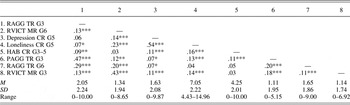
Descriptive statistics for and intercorrelations between each of the constructs assessed are presented in Table 1. The correlations between the constructs ranged from low to moderate (rs = .03–.54). Relational aggression and relational victimization were significantly correlated at both time points. Further, loneliness in particular was significantly correlated with both relational aggression in Grade 3 and relational victimization in Grades 3 and 6.
Descriptive statistics and correlations

Note: RAGG, relational aggression; RVICT, relational victimization; HAB, hostile attribution biases; PAGG, physical aggression; TR, teacher report; MR, mother report; CR, child report; G, grade; G3–5, composite of grades 3, 4, and 5.
*p < .05. **p < .01. ***p < .001.
Hypothesized models
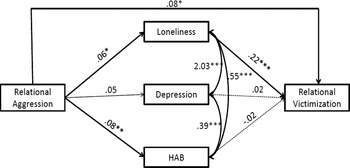
A structural equation modeling path analysis was conducted using maximum likelihood estimation in MPlus version 5.21 (Muthén & Muthén, Reference Muthén and Muthén2009). In the first hypothesized model tested (N = 1,035), relational victimization in sixth grade was regressed on each of the mediators (i.e., HAB for relational provocations, loneliness, and depression) as well as relational aggression in third grade and paths between relational aggression and each of the mediators was also tested (see Figure 1). Two theorized covariates (i.e., physical aggression and gender) were also included. For the tested model, the goodness of fit indices were good, SRMR = 0.027, CFI = 0.966, root mean square error of approximation (RMSEA) = 0.066; χ2 (6) = 32.77, p < .001 (Hu & Bentler, Reference Hu and Benter1999), and thus this model was adopted. Physical aggression was associated with concurrent relational aggression (β = 0.57, p < .001) but was not significantly associated with relational victimization (β = 0.06, ns). Gender (coded as 1 = boys and 2 = girls) was significantly associated with relational aggression (β = 0.32, p < .001) but was not significantly associated with relational victimization (β = 0.10, ns).
The final adopted model testing the direct and indirect paths between relational aggression in third grade and relational victimization in sixth grade. Relational aggression is teacher reported. Loneliness, depressive symptoms, and hostile attribution biases (HAB; for relational provocations) are child reported. Loneliness and depressive symptoms are from fifth grade. HAB is based on a composite from third to fifth grades. Relational victimization is from maternal report. Unstandardized path coefficients are presented. Physical aggression from third grade teacher report and gender were added as covariates (see text) and are not presented for ease of communication. Thick lines are significant, thin lines are nonsignificant trends (p < .06), and dotted lines are not significant. *p < .05. **p < .01. ***p < .001.

One thousand bootstrap samples and the 95% bias-corrected confidence intervals (CIs) were used to test the significance of the hypothesized specific indirect effects. In the adopted model, child-reported loneliness was found to partially mediate the relation between relational aggression and relational victimization (β = 0.01, 95% CI = 0.003–0.027). The remaining indirect effects were not significant, because relational aggression was predictive of HAB for relational provocations; however, HAB was not significantly associated with relational victimization, and the indirect effect was not significant (β = –0.001, 95% CI = –0.008 to 0.003). Further, depression was not significantly associated with relational aggression or victimization, and the overall indirect effect of this path was not significant (β = 0.001, 95% CI = –0.003 to 0.008) within the path analysis. Overall in the adopted model, 7% of the variance in relational victimization was accounted for by its predictors.
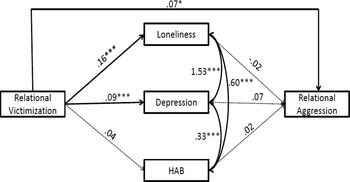
In the second model, the reverse direction of effects were tested from maternal-reported relational victimization in third grade to teacher-reported relational aggression in sixth grade (N = 1,030). Relational aggression was regressed on each of the mediators (i.e., HAB for relational provocations, loneliness, and depression) as well as relational victimization, and paths between relational victimization and each of the mediators was also tested (see Figure 2). In keeping with the first model, the two theorized covariates (i.e., physical aggression and gender) were also included. For the tested model, the goodness of fit indices were good, SRMR = 0.031, CFI = 0.942, RMSEA = 0.069; χ2 (6) = 35.25, p < .001 (Hu & Bentler, Reference Hu and Benter1999), and thus this model was adopted. Physical aggression was associated with concurrent relational victimization (β = 0.18, p < .001) and with relational aggression in sixth grade (β = 0.20, p < .001). Gender was not significantly associated with relational victimization in third grade (β = 0.04, ns) but was significantly associated with relational aggression in sixth grade (β = 0.09, p < .01).
The final adopted model testing the direct and indirect paths between relational victimization in third grade and relational aggression in sixth grade. Relational victimization is from maternal report. Loneliness, depressive symptoms, and hostile attribution biases (HAB; for relational provocations) are child reported. Loneliness and depressive symptoms are from fifth grade. HAB is based on a composite from third to fifth grades. Relational aggression is from teacher report. Unstandardized path coefficients are presented. Physical aggression from third grade teacher report and gender were added as covariates (see text) and are not presented for ease of communication. Thick lines are significant, and dotted lines are not significant. *p < .05. **p < .001.

One thousand bootstrap samples and the 95% bias-corrected CIs were used to test the significance of the hypothesized specific indirect effects. The indirect effects were not significant, because relational victimization in third grade was predictive of loneliness; however, loneliness was not significantly associated with relational aggression in sixth grade and the indirect effect was not significant (β = –0.003, 95% CI = –0.014 to 0.007). Further, depression was significantly associated with relational victimization in third grade but not relational aggression in sixth grade, and the overall indirect effect of this path was not significant (β = 0.006, 95% CI = –0.002 to 0.020) within the path analysis. Finally, HAB for relational provocations was not significantly associated with either relational victimization or relational aggression, and the overall indirect effect of this path was not significant (β = 0.001, 95% CI = –0.001 to 0.006) within the path analysis. Overall, in the adopted model, 6% of the variance in relational aggression was accounted for by its predictors.
Discussion
There were several goals of the current study. First, we predicted a direct prospective link between relational aggression and relational victimization. We anticipated that this direct path would be statistically significant even after controlling for physical aggression and gender. Second, we predicted an indirect association between relational aggression and future relational victimization, such that loneliness, HAB for relational provocations, and depressive symptoms would each uniquely mediate the direct path. We found overall support for our first hypothesis. That is, we documented that relational aggression was directly associated with future relational victimization, even after controlling for initial physical aggression and gender during middle childhood. We revealed some support for our second hypothesis testing the indirect pathway of the social process model. That is, we found that loneliness mediated the prospective association between relational aggression and relational victimization. However, the findings were not confirmed for HAB for relational provocations or for depressive symptoms. In keeping with predictions, relational aggression was significantly associated with HAB for relational provocations. Despite these findings, we did not find subsequent statistical support for the link between the mediator (HAB) and the outcome variable (relational victimization). Correlations indicate that HAB for relational provocations was significantly associated with both loneliness and depressive symptoms. Third, depressive symptoms were not associated with either the predictor (relational aggression) or the outcome (relational victimization). Correlations indicated that depressive symptoms were associated with both of the other potential mediators. These findings suggesting that the mediators were associated are generally consistent with prior literature and support the validity of these constructs in the present study. That is, loneliness and depression are often found to be associated for both boys and girls in middle childhood and adolescence (e.g., Kochenderfer-Ladd & Skinner, Reference Kochenderfer-Ladd and Skinner2002; Prinstein & La Greca, Reference Prinstein and La Greca2002). In addition, depression and HAB for relational provocations have been significantly associated concurrently (Hoglund & Leadbeater, Reference Hoglund and Leadbeater2007; cf. Prinstein, Cheah, & Guyer, Reference Prinstein, Cheah and Guyer2005). However, it is possible that the moderate intercorrelations between some of these mediators (e.g., loneliness and depressive symptoms) may have attenuated the hypothesized effects. Our path model controls for the influence of all these variables simultaneously and thus yields a conservative estimate of these prospective links, and it is conceivable that individual mediation models would have yielded predicted significant effects but with the risk of greater Type I error. Fourth, the predictors in the model accounted for only 7% of the variance in relational victimization, and future research should build on the current study by including other theorized predictors to improve the magnitude of these effects.
Given the extant theory, the present study emphasized one possible direction of effect (i.e., from aggression to peer victimization). However, recent work suggests that via social learning processes, the reverse direction of effect may also be supported (i.e., children who are victimized learn from these experiences and are more prone to display aggression with peers in the future; Hanish & Guerra, Reference Hanish and Guerra2000; Ostrov, Reference Ostrov2010). The alternative direction of effect was therefore tested and supported. That is, as hypothesized, the direct effect from peer victimization to aggression, which was supported by theory and past findings (Rose & Rudolph, Reference Rose and Rudolph2006; Yeung & Leadbeater, Reference Yeung and Leadbeater2007), was confirmed in the present longitudinal study. Thus, the present study adds to the growing evidence that supports the theoretical notion, with regard to the direct association between aggression and peer victimization, that both directions of effect are present and account for developmental changes in peer relations. The alternative model accounted for nearly the same amount of variance (i.e., 6%) as the original hypothesized model, and therefore the present findings underscore the importance of testing dynamic bidirectional associations between aggression and peer victimization in future research. However, the three indirect effects in the alternative model and in particular those via HAB that were hypothesized were not supported, despite past theory that suggests this developmental pathway (e.g., Rosen, Milich, & Harris, Reference Rosen, Milich and Harris2007). It is conceivable that the methodological limitations associated with the assessment of HAB in the current data set limited our ability to detect these potential pathways, and future work is needed to further test these social process models. Similar to the first model, it is also possible that the high degree of association among the three mediators in our conservative statistical model constrained our ability to test these unique indirect effects. It is also conceivable that other developmentally related constructs such as peer rejection or negative friendship quality might mediate the paths from relational victimization to relational aggression, and future research will benefit from testing additional alternative models. The alternative model also shows prospective associations between relational victimization and both loneliness and depressive symptoms, which adds to the extant developmental psychopathology literature by showing the negative outcomes associated prospectively with relational victimization during this and later developmental periods (e.g., Desjardins & Leadbeater, Reference Desjardins and Leadbeater2011; Nixon, Linkie, Coleman, & Fitch, Reference Nixon, Linkie, Coleman and Fitch2011; Prinstein et al., Reference Prinstein, Cheah and Guyer2005; Sullivan et al., Reference Sullivan, Farrell and Kliewer2006).
The current findings have clear implications for theory, and the study contributes novel information to the extant developmental literature. Specifically, this is the first evidence supporting both direct and indirect pathways of the social process model of peer harassment in middle childhood for relational aggression and victimization. The findings indicate that relational aggression is uniquely (controlling for physical aggression) associated with future relational victimization and that relational victimization predicts future relational aggression. However, there is also evidence for an indirect prospective pathway, and this pathway suggests a possible mechanism by which aggressors become victims. That is, relational aggressors increase in feelings of loneliness over time and in turn are potentially an easier target for future peer harassment and victimization because they do not have others to protect them from this harm (Bierman, Reference Bierman2004; Hodges & Perry, Reference Hodges and Perry1999). Given the overlap between peer rejection and loneliness documented in the literature (e.g., Asher & Wheeler, Reference Asher and Wheeler1985) these findings and interpretation are in keeping with recent studies that have found that relational aggressors also become future victims via peer rejection during early childhood (Ostrov, Reference Ostrov2008). Therefore, the present findings support both the direct and indirect components of the social process model of peer harassment, which has previously been tested and supported in middle childhood but only for physical subtypes of aggression and peer victimization (Boivin & Hymel, Reference Boivin and Hymel1997; Boivin et al., Reference Boivin, Hymel, Hodges, Putallaz and Bierman2001).
We had anticipated that both HAB for relational provocations and depressive symptoms would also mediate the prospective association between relational aggression and peer victimization (as well as between relational victimization and relational aggression), but these hypotheses were not supported. In keeping with past research and theory, HAB was associated with initial relational aggression, which further underscores the importance of studying the link between relational aggression and social cognitions like HAB (see Ostrov & Godleski, Reference Ostrov and Godleski2010). These findings lend some important prospective support to the notion that relational aggression is associated with HAB for relational provocations, which is not always found in the developmental literature (Crain et al., Reference Crain, Finch and Foster2005; Nelson et al., Reference Nelson, Mitchell and Yang2008; cf. Bailey & Ostrov, Reference Bailey and Ostrov2008; Crick et al., Reference Crick, Grotpeter and Bigbee2002).
Limitations and future directions
We believe our study has a number of strengths, which include theoretically informed hypotheses, a multi-informant (i.e., teacher, child, and parent) and multimeasure longitudinal design, and use of sophisticated SEM path models. Despite these and other strengths, there are some important methodological limitations that our secondary analysis could not overcome. First, although the study was designed to represent typically developing children from various geographic regions of the United States, it was not a nationally representative study, and as such our findings may not generalize to all children in middle childhood. Future work is needed with a more ethnically and socioeconomically diverse sample, and additional contexts (i.e., after school programs, neighborhood community centers, and summer campus) and samples (e.g., at risk, clinic referred, and detained) should be considered. Second, due to changes to the original measure (i.e., reduction in the number of vignettes), we relied on an assessment strategy that has been previously published with this data set (i.e., an internally consistent composite of HAB was created across third to fifth grades; Godleski & Ostrov, Reference Godleski and Ostrov2010). Thus, there was some overlap in time between the assessment of teacher-reported relational aggression/mother-reported relational victimization (i.e., third grade) and child-reported HAB for relational provocations (i.e., third through fifth grades), and future developmental research should test models in which there is no temporal overlap between the predictor and mediator variables (Selig & Preacher, Reference Selig and Preacher2009). In addition, it is conceivable that the present use of the truncated measure of HAB and resulting composite may have reduced the likelihood of finding associations with relational victimization, and future research is needed with the full measure and better psychometric properties. Third, we used valid and reliable teacher reports and parent reports, and there is an extensive history for using these instruments in this developmental period; however, replication with other assessments such as peer reports (Prinstein & Cillessen, Reference Prinstein and Cillessen2003), structured interviews (e.g., Tackett, Waldman, & Lahey, Reference Tackett, Waldman and Lahey2009), laboratory/observational paradigms (e.g., Banny et al., Reference Banny, Heilbron, Ames and Prinstein2011), and the inclusion of physiological methods (Murray-Close, Han, Cicchetti, Crick, & Rogosch, Reference Murray-Close, Han, Cicchetti, Crick and Rogosch2008) is called for in future replication and extension studies. Fourth, the magnitude of the effects for the present models were small (i.e., accounting for only 6%–7% of the variance), and comparisons to prior literature are difficult given differences in the selected models, methodologies, and developmental periods. The present findings are smaller than other studies that included similar constructs and analytic approaches (e.g., Hoglund & Leadbeater, Reference Hoglund and Leadbeater2007), and the present findings must be replicated. However, it is not uncommon to find small amounts of variance accounted for in studies of relational aggression or victimization (e.g., Crick & Bigbee, Reference Crick and Bigbee1998; Ostrov, Reference Ostrov2008; Sullivan et al., Reference Sullivan, Farrell and Kliewer2006), and we believe that they are meaningful because these effects are evident over several years and using independent informants in the present longitudinal study.
The extent to which the children in the study were aggressive victims or provocative victims (i.e., high on both aggression and victimization; see Schwartz et al., Reference Schwartz, Proctor, Chien, Putallaz and Bierman2001) was not assessed, and future work should more carefully examine how the present pathways may be different for these children compared to passive victims or nonaggressive victims (see Schwartz, Reference Schwartz2000). Given recent attention to the functions of aggression (Card & Little, Reference Card and Little2006), future work should examine how the present model holds for both proactive (i.e., goal oriented and instrumental) and reactive (i.e., retaliatory, impulsive, and hostile) aggression. The current study did not include assessments of positive peer relationships or social competence, and a more balanced approach with respect to nonphysical forms of aggression has been called for in the literature (Heilbron & Prinstein, Reference Heilbron and Prinstein2008; Xie, Swift, Cairns, & Cairns, Reference Xie, Swift, Cairns and Cairns2002). It is certainly anticipated that relational aggression predicts positive friendship quality in some developmental contexts (e.g., Banny et al., Reference Banny, Heilbron, Ames and Prinstein2011; Murray-Close et al., Reference Murray-Close, Ostrov and Crick2007; Rose et al., Reference Rose, Swenson and Waller2004), and the associated relationship provisions might serve as a protective factor against future peer victimization (see Schmidt & Bagwell, Reference Schmidt and Bagwell2007). Thus, the inclusion of social competence mechanisms should be tested in future social process models. Recent empirical work during middle childhood supporting a relational vulnerability model suggests that the links between relational aggression and HAB for relational provocations may be moderated by relational victimization and emotional distress (Mathieson et al., Reference Mathieson, Murray-Close, Crick, Woods, Zimmer-Gembeck and Geiger2011). Future developmental models will need to have a greater appreciation for the role of various theorized moderators (e.g., culture; Kawabata et al., Reference Kawabata, Crick and Hamaguchi2010).
Conclusions
The present secondary analyses of the SECCYD data set will advance the scientific literature in three important ways. First, this study contributes to the growing literature on the development of both relational aggression and victimization using a large prospective sample. Second, the study revealed theoretically driven mechanisms by which relational aggression and victimization are associated across time and during middle childhood. Moreover, the findings lend novel support to the social process model for the study of relational subtypes of aggression and victimization during this developmental period. Third, the present findings have clear implications for informing the development of prevention and intervention efforts for aggression and peer victimization. Improving peer relationships through intervention programs could include reducing relationally aggressive behavior and providing coping mechanisms for relational victimization. In particular, the social process model highlights possible mechanisms for intervention efforts, and specifically targeting loneliness in intervention programs may be an important area for future work. That is, the present evidence suggests that programs should focus on reducing aggressive behavior and promoting skills for friendship building and maintenance (e.g., Leff et al., Reference Leff, Gullan, Paskewich, Abdul-Kabir, Jawad and Grossman2009; Webster-Stratton & Reid, Reference Webster-Stratton and Reid2003) but should also target skills for reducing peer victimization (e.g., Leadbeater, Hoglund, & Woods, Reference Leadbeater, Hoglund and Woods2003) as well as coping with loneliness. Reducing peer victimization may help alleviate potential feelings of loneliness and in turn avoid setting the children on a maladaptive pathway marked by social–psychological adjustment problems and future psychopathology.