
I. INTRODUCTION
Porous ceramics exhibit a unique combination of fascinating properties, including low bulk density, high porosity, and permeability, as well as good thermal stability, which increasingly enable them to have wide applications in the field of light-weight structures, filters, catalyst carriers, adsorption, and thermal insulation, and so on. Reference Davis1–Reference Colombo, Vakifahmetoglu and Costacurta5 In most of these applications, high mechanical properties accompanied with at least one other functional property such as high porosity, high permeability, or low thermal conductivity are much desirable. Contrary to the polymeric and metallic porous architectures, pores have been traditionally avoided in ceramic components because of their native inherent brittleness. Reference Studart, Gonzenbach, Tervoort and Gauckler6 To achieve the goals of superior performances and high reliability of porous ceramics, various methods such as replica, Reference Sakthivel, Huang, Chen, Lan, Chen, Kim, Ryoo, Chiang and Liu7,Reference Wang, Liu, Hou, Lu, Sun and Zhou8 partial sintering, Reference Ohji and Fukushima9,Reference Wang, Xiang, Sun, Liu, Hou and Zhou10 direct foaming, Reference Colombo11–Reference Colombo, Hellmann and Shelleman14 and sacrificial templating, Reference Shibuya, Takahashi and Koyama15–Reference Krawiec, Schrage, Kockrick and Kaskel17 have been developed. However, these methods have several limitations since they are often size-confining or time-consuming, too costly, and not eco-friendly. Reference Bai, Chen, Delattre, Tomsia and Ritchie18 An ideal strategy for engineering pores into ceramic materials in a more facile way has yet-to-be-realized. Foam-gelcasting, an attractive approach that combines the merits of both foaming and gelcasting techniques, can overcome many of these above limitations, due to its simple preparation process, complex geometry, and homogeneous structure of obtained porous ceramics after pressureless sintering. Reference Sepulveda and Binner19–Reference Wu, Sun, Wan and Wang21 Also, foam-gelcasting derived porous ceramics exhibit a highly interconnected porous network, which could contribute to the good thermal resistance. Reference Studart, Gonzenbach, Tervoort and Gauckler6,Reference Ohji and Fukushima9,Reference Colombo, Hellmann and Shelleman14
The conventional foam-gelcasting procedure; however, suffers from an intolerable shortcoming, that is, considerable hazardous gaseous phases are released during sintering because large quantities of organic additives are utilized. Reference Deng, Wang, Liu, Zhang, Li, Duan, Lu, Huang, Zhao and Zhang22 To circumvent this problem, an emerging nontoxic copolymer of isobutylene and maleic anhydride (Isobam) has been exploited. The outstanding benefits of Isobam are summarized as follows. (i) It can be acted as both dispersant and gelling agent simultaneously. (ii) It can be carried out under air atmosphere and humidity conditions. (iii) It has high dispersion capacity but only very small dosages are needed. (iv) It has improved stability of aqueous ceramic slurry. (v) It is eco-friendly (green) due to completely removal after firing. Such benefits have provided the motivation for using Isobam to prepare different types of porous ceramics, including Si3N4, Reference Wan, Yao, Hu, Xia, Zuo and Zeng23 Al2O3, Reference Yang, Shimai, Sun, Dong, Kamiya and Wang24 and mullite. Reference Deng, Wang, Liu, Zhang, Li, Duan, Lu, Huang, Zhao and Zhang22 However, the products have low porosity (e.g., 50–56% for porous Si3N4) or relatively low compressive strength (e.g., ∼15.3 MPa for porous mullite and ∼25 MPa for porous Al2O3 under 76% porosity). Although Isobam has been applied in the above ceramic systems, to the best of our knowledge, few studies have been performed to make a new class of mixed oxide porous ceramics such as Yb3Al5O12 with Isobam, which significantly restricts the feasibility and wide application of Isobam. Necessarily mentioned, previous works are mostly limited to fabricate a porous material, but a good understanding of the relationship between microstructure and performance is still lacking, thus, further investigation is needed.
The purpose of this work is to explore the feasibility of novel Isobam system with Yb3Al5O12 and to gain a deep insight into the relationship between microstructures and properties. Herein, Yb3Al5O12 is selected because it has high melting point (∼2000 °C), excellent vapor corrosion resistance, superior mechanical properties, and good damage tolerance, and very low thermal conductivity (<2.0 W/(m·K) at 1000 °C) so that it has potential applications as thermal insulating and thermal/environmental barrier coating (T/EBC) materials in aerospace industries. Reference Zhou, Xiang and Feng25–Reference Wang, Xiang, Liu, Hou, Sun and Zhou29 To demonstrate the advantages of this method and the superior performances of the obtained porous Yb3Al5O12 ceramics, the influence of processing parameter on rheological properties and gelling behaviors of the Yb3Al5O12 suspensions is studied first. Then, the phase composition, microstructural characteristics, porosity, and shrinkage behaviors are investigated. Finally, the mechanical properties and gas permeability of highly porous Yb3Al5O12 ceramics are evaluated. The failure mechanisms and microstructure-property relationship are also discussed in detail.
II. EXPERIMENTAL
A. Sample preparation
The starting materials used in the present work were phase-pure Yb3Al5O12 powders, deionization water, and Isobam (Kuraray Co. Ltd., Osaka, Japan). Phase-pure Yb3Al5O12 powders were synthesized via a solid mixing method from Yb2O3 and Al2O3 powders, and then ball-milled for 20 h to break up the agglomerates. The mean particle size of the Yb3Al5O12 powders is determined to be 0.6 μm, using a laser particle-size analyzer (Nano ZS90, Malvern, UK). Details on the preparation of the Yb3Al5O12 powders and molecular structures of the Isobam can be found elsewhere. Reference Wang, Xiang, Sun, Liu, Hou and Zhou27,Reference Wang, Xiang, Liu, Hou, Sun and Zhou29 All the chemical reagents were used without further purification. Experimental procedures can be described as follows. First of all, 50 vol% Yb3Al5O12 powders, 0.4 wt% Isobam (as both dispersant and gelling agent), and 50 vol% deionization water were added in sequence and then magnetically stirred to ensure a good dispersion. After stirring for 1 h, 0.005–2.0 vol% surfactant EMAL TD (Surf-E, as foaming agent) (C12H25OSO3H·N(C2H4OH)3, Kao Chemical Co. Ltd., Tokyo, Japan) was added and vigorously agitated with a full speed of 1200 rpm for 10 min. Foams could be generated by rapid mechanical frothing with the action of foaming agent. Subsequently, the foamed ceramic slurries were poured immediately into a nonporous mold, and then consolidated gels were formed at 30 °C through in situ polymerization and coagulation. After drying and demolding, the gelcasted green bodies were finally sintered at 1600 °C for 4 h in muffle furnace under air atmosphere using a heating rate of 5 °C/min. After the furnace cooled down naturally, the near-net-shaped porous Yb3Al5O12 ceramics were obtained.
B. Instrumental methods
Zeta potentials of the suspensions were measured by an acoustic and electroacoustic spectrometer (Zetaplus, Brookhaven Inc., Holtsville, NY). The rheological properties and viscosity of the ceramic slurries were studied using a stress-controlled rheometer (SR5, Rheometric Scientific Inc., Piscataway, NJ). Thermal behavior of the gelcasted green body was analyzed using a thermal analyzer (NETZSCH STA 449 C, Selb, Germany). Phase identification was examined in the 2θ range between 15° and 60° using an x-ray diffractometer (XRD, D8 advanced, Bruker, Karlsruhe, Germany) with Cu Kα radiation (λ = 1.54178 Å). The tube voltage, current, step size, and scanning rate were set at 40 kV, 40 mA, 0.02°, and 2°/min, respectively. Phase compositions were determined with the help of Jade 6.0 software (Material data Inc., USA). Powders used for XRD analysis were made by crushing and grinding the as-prepared samples in an agate mortar. The microstructure and morphology of the fabricated porous Yb3Al5O12 were observed using a scanning electron microscope (SEM, Apollo 300, CamScan, Cambridge, UK) equipped with an energy dispersive spectroscopy (EDS) system at an accelerating voltage of 15 kV, after being coated with gold by sputtering at 30 mA for 90 s. Bulk density was calculated from the mass and dimensions of three samples having regular shapes. Porosity was evaluated from the ratio of apparent density of a porous sample to the theoretical density of fully dense Yb3Al5O12 (ρs = 6.67 g/cm3). Cell size was obtained by using an image analyzer (Leica Qwin). For flexural and compressive strength measurements, the top and the bottom of the samples were removed with a slow speed saw leaving the final sizes around 3 × 4 × 30 mm and 2 × 2 × 4 mm, respectively. The crosshead speed in both flexural strength and compressive strength tests was 0.5 mm/min. Specimens were tested with a cardboard pad on both sides to minimize the effect of superficial defects and misalignment. Each strength value was averaged over at least five samples. To calculate gas permeability, the pressure drops of the disc samples (Φ 30 × 6 mm) were measured with increasing volumetric flow rate of nitrogen gas.
III. RESULTS AND DISCUSSION
A. Effect of surfactant on the Yb3Al5O12 suspensions
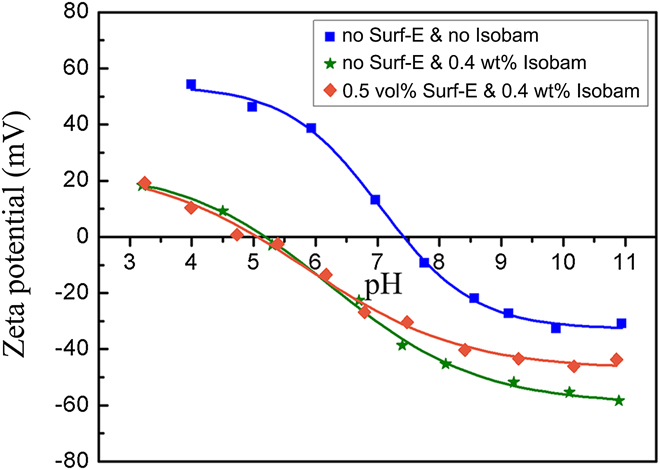
Before making porous Yb3Al5O12, the influence of surfactant EMAL TD (Surf-E) on the suspensions is investigated to optimize the foam-gelcasting parameters. Zeta potential as a function of pH value is usually measured for semiquantifying the aqueous dispersion process. The tests are performed for the diluted Yb3Al5O12 suspensions with or without the desired amounts of Isobam and Surf-E, and the results are presented in Fig. 1. As can be seen, the isoelectric point (IEP) of Yb3Al5O12 without any additive is pH = 7.4. The addition of 0.4 wt% Isobam results in a pHIEP = 5.2 and zeta potential of −40 mV at pH = 7.4. When both 0.4 wt% Isobam and 0.5 vol% Surf-E were added, the zeta potential of Yb3Al5O12 suspensions is −30 mV at pH = 7.4, reflecting that the addition of 0.5 vol% Surf-E has little negative effect on the dispersion role of Isobam. Previous work by Yang et al. Reference Yang, Shimai, Sun, Dong, Kamiya and Wang24 demonstrated that small Surf-E (added after stirring Al2O3, deionized water, and Isobam mixtures) has no opportunity to adsorb on the Al2O3 particles and can neutralize electronic charges of long-chain Isobam polymer. Similar mechanism can be used here to explain that the zeta potential of Yb3Al5O12 suspensions is not as high as that of Isobam alone. Therefore, a stable and well-dispersed suspension consisted of Yb3Al5O12 powders, Isobam polymer, and Surf-E can be obtained.
Effect of Surf-E on the zeta potential of Yb3Al5O12 suspensions.

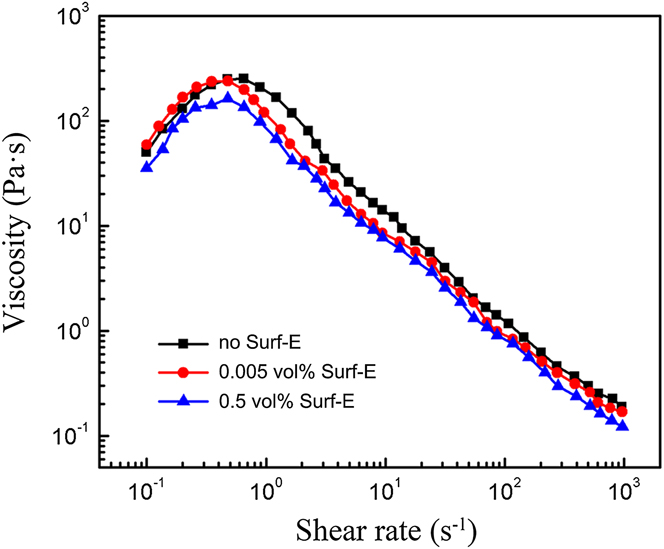
Figure 2 shows the rheological properties of the Yb3Al5O12 ceramic slurries (50 vol% solid loading, 0.4 wt% Isobam) with different contents of Surf-E added prior to foaming. Little change in viscosity with the addition of Surf-E can be found in Fig. 2. Furthermore, all specimens present an interesting rheological behavior, that is, an apparent increase in viscosity with the rising shear rate under near rest conditions is observed first, and then a remarkable decrease in viscosity with the rising shear rate is appeared. From the earlier investigation of our group, Reference Wang, Xiang, Liu, Hou, Sun and Zhou29 the first increase in viscosity is just behaving elastically due to the structure acquired under rest conditions and thus demands for heightening applied stresses to overcome the limit of elasticity. After that for higher applied shear speed, the system gradually disrupts and exhibits a shear-thinning characteristic. This shear-thinning feature is beneficial to the improvement of foaming and stabilizing the bubbles.
Rheological flow curves of Yb3Al5O12 ceramic slurries as a function of Surf-E concentrations.
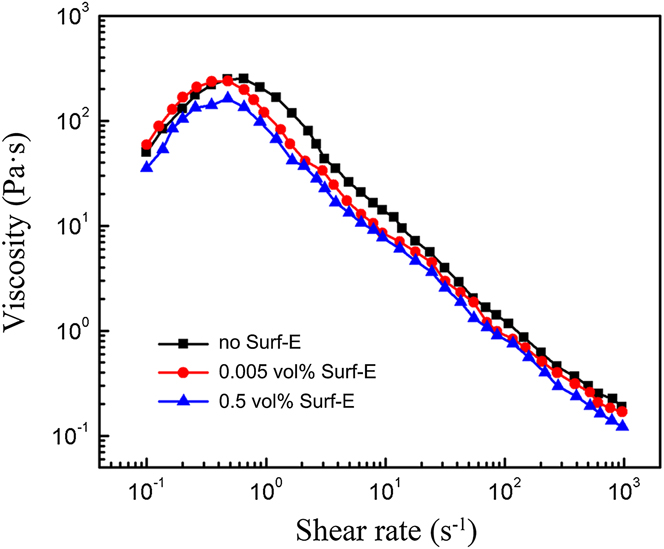
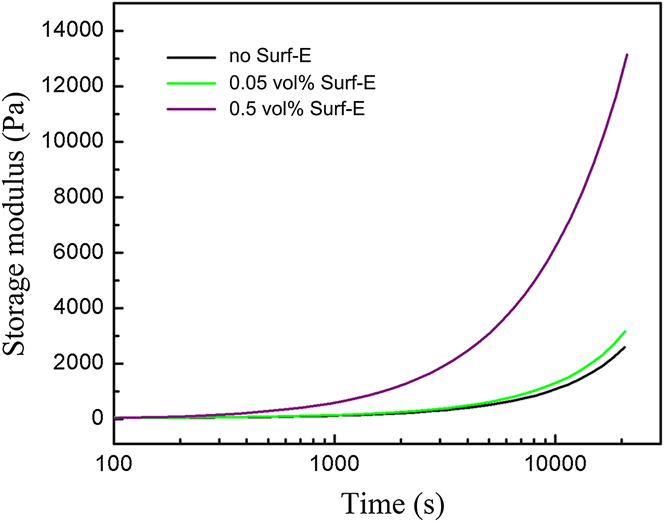
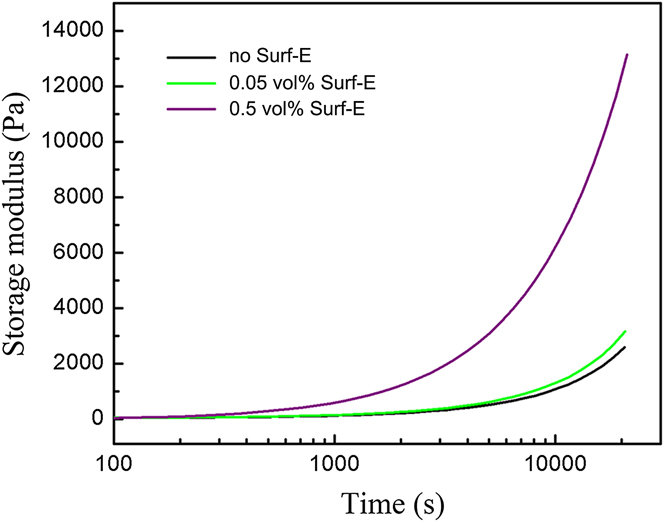
Figure 3 illustrates the effect of Surf-E concentrations on the gelling behaviors of the ceramic slurries with 50 vol% Yb3Al5O12 powders and 0.4 wt% Isobam before foaming. It should be noted from Fig. 3 that the addition of the Surf-E evidently accelerates the gelation speed. If we take a storage modulus value of 1000 Pa as a goal, the gelation time is calculated to be about 28, 133, and 157 min for 0.5 vol% Surf-E, 0.05 vol% Surf-E, and no Surf-E addition, respectively. This accelerated gelling rate with the increasing Surf-E dosages is principally related to the esterification reaction between –OH groups derived from Surf-E and –COOH groups originated from hydrolyzed Isobam. Reference Yang, Shimai, Sun, Dong, Kamiya and Wang24 Hence, the gelation time of the Yb3Al5O12 ceramic slurries are adjustable by changing the Surf-E concentration.
Storage modulus varies with different dosages of Surf-E added before foaming.
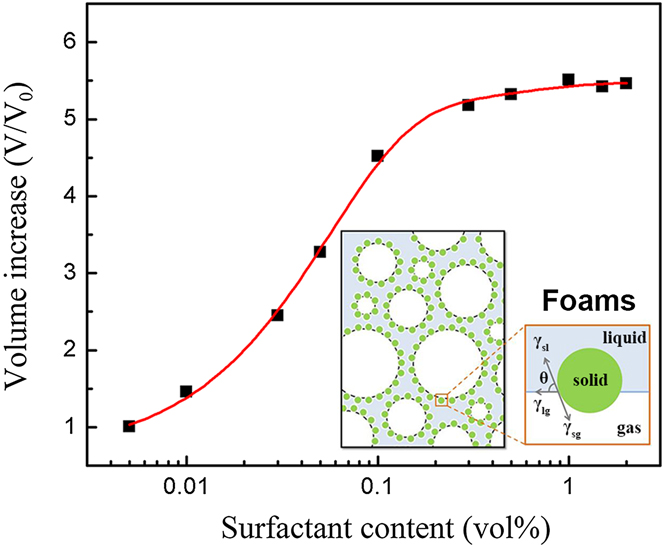
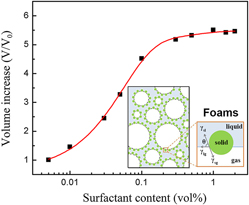
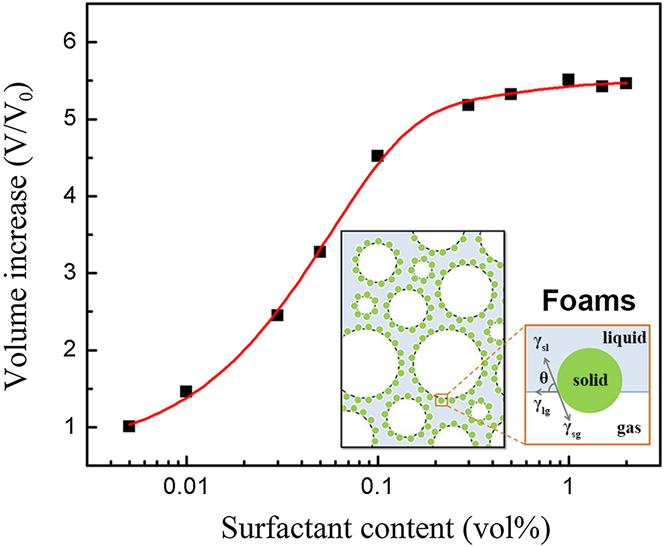
After obtaining stable Yb3Al5O12 ceramic slurries, their foaming abilities are studied. The foaming ability of the ceramic slurries versus the content of Surf-E is characterized using the volume expansion ratio, namely, the ratio of the foamed ceramic slurry volume to that of the original one, as plotted in Fig. 4. It can be seen that the foaming ability is markedly enhanced with the increasing Surf-E concentration, and achieves a maximum ratio of 5.6 when 1.0 vol% Surf-E is added. When the Surf-E concentration surpasses 1.0 vol%, the volume expansion ratio maintains approximately the same level, indicating that further increasing the Surf-E amounts cannot improve in foaming ability of the ceramic slurries. This is due to the fact that Surf-E adsorbed at the gas–liquid interface decreases the interfacial energy (see inset of Fig. 4), which facilitates the generation of bubbles. Reference Yang, Shimai, Sun, Dong, Kamiya and Wang24,Reference He, Zhou and Su30 More Surf-E addition causes the interfacial free energy decreasing to a minimum level, meanwhile, slurries are foamed more adequately and tend to saturation. Reference Yang, Shimai, Sun, Dong, Kamiya and Wang24,Reference Chuanuwatanakul, Tallon, Dunstan and Franks31,Reference Gonzenbach, Studart, Tervoort and Gauckler32 As a result, further increasing Surf-E content has little effect on enhancing the foaming ability of the ceramic slurries. On the other hand, the experimental conditions including agitation rate and stirring time are fixed. These maintained technological parameters are conducive to keeping foaming ability constant.
Foaming capacity versus surfactant content, the inserted drawings illustrate the force balance at equilibrium for Yb3Al5O12 particles lyophobized to foams.
B. Characterization of porous Yb3Al5O12 ceramics
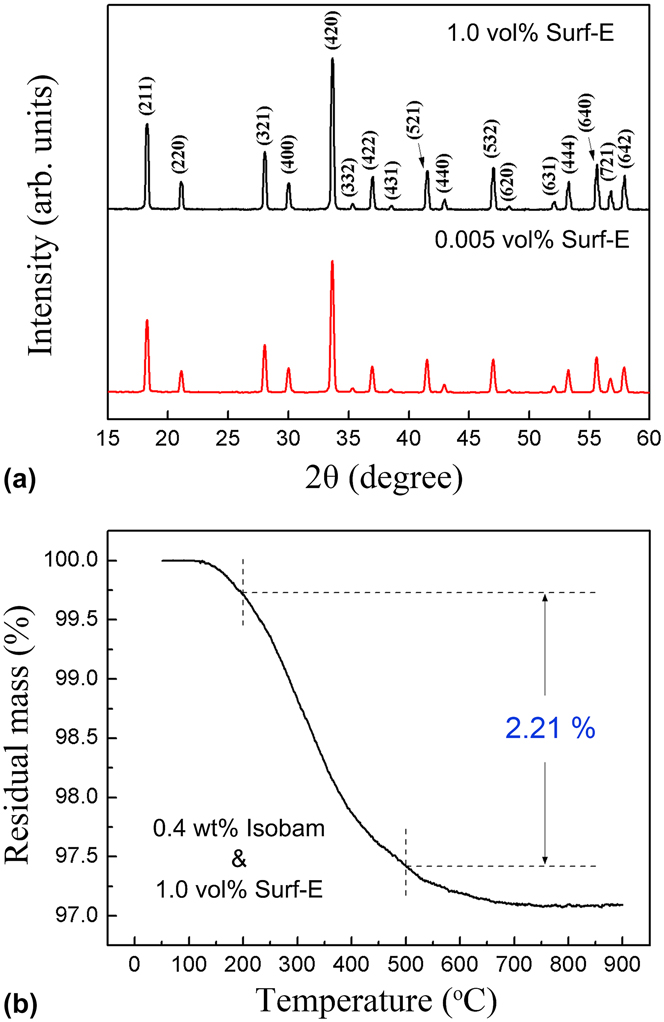
After pressureless sintering in air at 1600 °C for 4 h, the obtained porous Yb3Al5O12 ceramics are intact without any cracks and flaws. Figure 5(a) compares the XRD patterns of the as-fabricated porous samples with different Surf-E additions of 0.005 vol% and 1.0 vol%, from which one can see that all the porous materials are pure Yb3Al5O12 without impurity phases according to JCPDS card No. 73-1369. Also, the peak positions between the XRD pattern of 0.005 vol% Surf-E specimen and that of 1.0 vol% Surf-E specimen coincide well, besides, the intensities of all reflections are identical. This implies that all additives (Isobam and Surf-E) are completely removed after heat-treatment. The samples derived from various Surf-E dosages of 0.01, 0.03, 0.05, 0.1, 0.3, 0.5, 1.5, and 2.0 vol% have similar XRD patterns to the 0.005 vol% and 1.0 vol% samples and are not shown here for brevity. Additionally, no diffraction peaks of other new phases can be detected via XRD in the final products sintered at 1600 °C for 4 h, suggesting excellent structural stability for porous Yb3Al5O12 ceramics.
(a) XRD patterns of porous Yb3Al5O12 samples derived from different Surf-E concentrations after pressureless sintering at 1600 °C for 4 h in air. (b) Thermal behavior of dried Yb3Al5O12 green body obtained by foam-gelcasting.
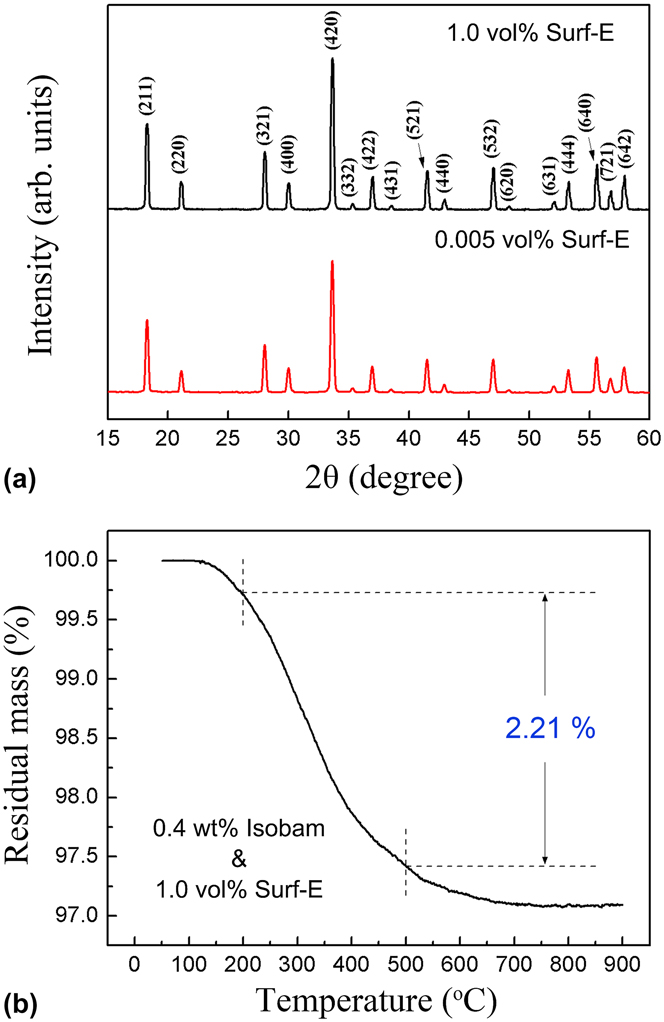
Thermogravimetry (TG) behavior is conducted on the dried Yb3Al5O12 green body from a slurry of 50 vol% solid loading, together with 0.4 wt% Isobam for gelation, and 1.0 vol% Surf-E for foaming, as shown in Fig. 5(b). It can be seen that the dominating weight loss of Yb3Al5O12 green body occurred between 200 and 500 °C is about 2.21 wt%, this value is comparable to those of analogous Isobam system. Reference Deng, Wang, Liu, Zhang, Li, Duan, Lu, Huang, Zhao and Zhang22,Reference Yang, Shimai, Sun, Dong, Kamiya and Wang24 The low weight loss is mainly due to very small amounts of the additives introduced, which renders the sintering process more simpler and environmental friendly. Thus, porous Yb3Al5O12 ceramics have been obtained in only one-pot without a separate debinding procedure. On the other hand, the foamed green body is much easy to debinder than the dense body, since it contains abundant cells and channels to let pyrolysates escape. As consequences, a rapid heating rate of 5 °C/min is successfully adopted in the current research to remove the organic additives without flaws and cracks.
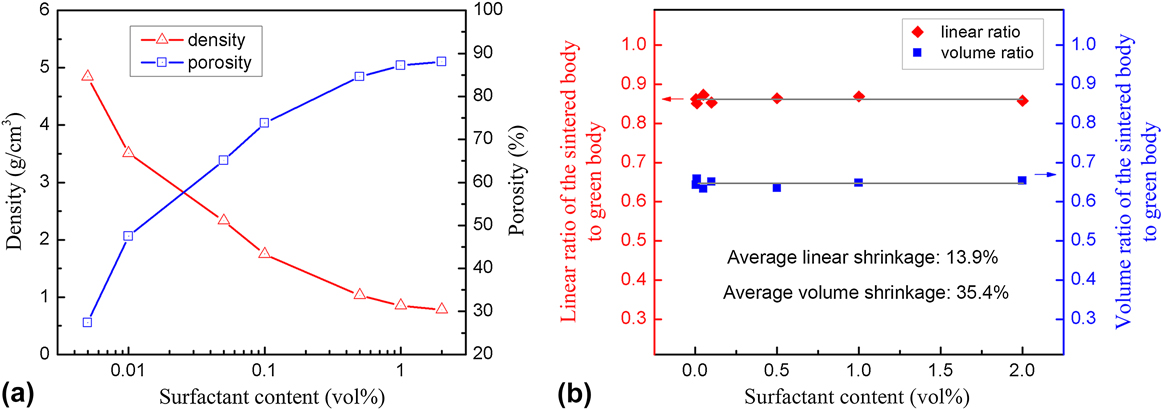
Figure 6(a) portrays the variation of the bulk density and porosity of porous Yb3Al5O12 ceramics as a function of the Surf-E concentration. When the content of Surf-E increases from 0.005 vol% to 1.0 vol%, the bulk density decreases from 4.84 g/cm3 to 0.85 g/cm3, whereas, the porosity increases from 27.4% to 87.2% correspondingly. Further increasing Surf-E content up to 2.0 vol% results in only slight change in the density and porosity. This can be interpreted as below: foams in the ceramic slurries are thermodynamically unstable due to gas/liquid interphase energy, increasing the amount of Surf-E enhances the stability of wet foams and effectively decreases unstable phenomenon. Reference Wu, Li, Yan, Yin, Liu, Huang, Lee and Jiang33 Therefore, more steady foams are captured in the slurries and hence more pores are remained in the sintered bulk samples to increase the porosity. Nevertheless, there is a critical amount of Surf-E for the porosity increase because of the presence of critical micelle concentration. Consequently, no obvious variations in the bulk density and porosity can be seen when the content of Surf-E exceeds 1.0 vol%. Our results suggest that the density and porosity of porous Yb3Al5O12 ceramics are controllable by varying the Surf-E dosages.
(a) Variation of density and porosity of porous Yb3Al5O12 as a function of surfactant content. (b) Change of shrinkage ratios of porous Yb3Al5O12 with different porosity.
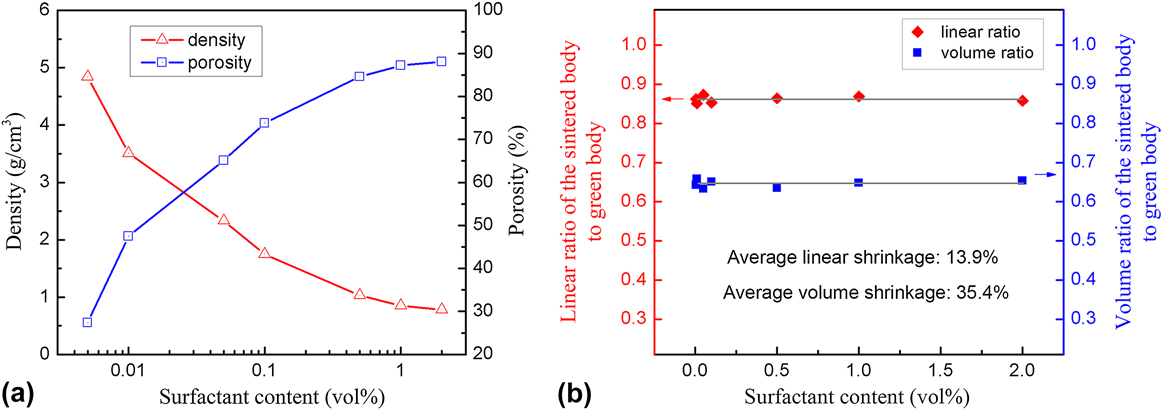
When considering the investigations and applications of a porous ceramic material, shrinkage behavior plays a crucial role in dimension design. Figure 6(b) gives the shrinkage ratios of porous Yb3Al5O12 ceramics with different contents of Surf-E. The linear ratio of the sintered bodies to green bodies is determined to be between 0.8 and 0.9, while the volume ratio of the sintered bodies to green bodies is obtained to be between 0.6 and 0.7. Usually, a packing density of a green body, related with shrinkage, is depending on the surfactant. However, one can see that the shrinkage ratios for porous Yb3Al5O12 ceramics with various dosages of Surf-E nearly maintain a similar level [see Fig. 6(b)]. This is due to the fact that the strut density is almost the same since the amounts of organic additives including gelling agent and foaming agent are extremely small (i.e., 0.4 wt% Isobam and 1 vol% Surf-E). In addition, it is also worth mentioning that the average linear shrinkage of our porous Yb3Al5O12 fabricated at 1600 °C is only 13.9%. This value is ∼56% lower than porous Y2O3-stabilized-ZrO2 (fabricated at 1550 °C), Reference Hu and Wang34 ∼40% less than porous SiO2 (fabricated at 1150 °C), Reference Xu, Liu, Du, Guo and Hou35 and ∼33% smaller than porous Y2SiO5 (fabricated at 1450 °C). Reference Zhang, Fang, Chen, Pei, Wang and Wang36 As for the less shrinkage value of porous Yb3Al5O12, we highlight two important points: (i) densification temperature and (ii) packing density. First, sintering generally means the increase of density and the grain growth with shrinkage. Our previous work demonstrated that fully dense Yb3Al5O12 ceramic can be obtained by sintering the powder compact at 1600 °C for 4 h. Reference Wang, Xiang, Sun, Liu, Hou and Zhou27 For the present case, the shrinkage of cell wall can be related with the densification. Low shrinkage value means limited densification of skeletons. Second, shrinkage value is strongly dependent on packing densities. If packing densities are lower, green body can be densified with larger shrinkage. On the other hand, if those are high, shrinkage can show small value. The average porosity of the Yb3Al5O12 green bodies is determined to be ∼75%, while the average porosity of the Al2O3 green bodies prepared by the similar Isobam system is ∼82%. Reference Yang, Shimai, Sun, Dong, Kamiya and Wang24 The relatively low green porosity indicates that high packing density in the present study is obtained, which results in less shrinkage. The low shrinkage could endow porous Yb3Al5O12 having good shape stability.
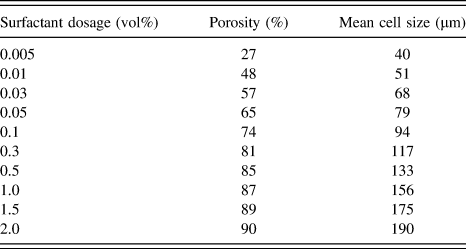
SEM micrographs (Fig. 7) reveal that spherical-like pore structures are generated in the as-prepared porous Yb3Al5O12 ceramics and some of them are interconnected through circular windows, and varying in size depending on the density. These spherical-like cells are constructed by the bubbles produced during foaming. Reference Janney and Omatete37 The formation of the circular windows connecting the cells is the results of communal films of adjacent gas bubbles ruptured due to exothermic reaction during the polymerization of foam-gelcasting. Reference Yao, Chen, Chen, Shen and Zhang38 The corresponding porosity and mean cell size of porous Yb3Al5O12 varied with the surfactant (Surf-E) dosage are summarized in Table I. As the Surf-E dosage increases from 0.005 to 2.0 vol%, the porosity of porous Yb3Al5O12 increases from 27% to 90%, while the mean cell size increases from about 40 μm to 190 μm. To better understand this, we provide the following explanations. (i) When low content of Surf-E is introduced, small and isolated pores are formed because the distances between gas bubbles are too “far” for them to coalesce with each other before gelation. Upon addition more Surf-E, a number of large pores are interconnected by small windows because of the increased bubble density and bubble coalescence. Reference Yang, Shimai, Sun, Dong, Kamiya and Wang24,Reference Wu, Sun, Wan, Li, Hu and Wang39 (ii) Owing to the diversity of bubble sizes in the foamed slurries, pressure difference exists among gas bubbles, thus diffusion of the gas-interphase occurs and causes the growth of gas bubbles. When the Surf-E content is increased, foams are generated enough, resulting in more concentrated bubbles and thinner liquid films. Reference Wu, Li, Yan, Yin, Liu, Huang, Lee and Jiang33,Reference Hiemenz and Rayagopalan40 Thus, the increase of cell size is caused because of more intense diffusion among bubbles. Furthermore, it is also noticed from Fig. 7 that the obtained porous Yb3Al5O12 ceramics exhibit no preferred orientation, which is a representative for direct foaming technology produced porous material. This type of morphology may lead to an isotropic property for porous Yb3Al5O12. Reference Colombo41,Reference Mao, Shimai and Wang42
Typical microstructural features of porous Yb3Al5O12 ceramics prepared using various amounts of surfactant: (a) 0.005 vol%, (b) 0.01 vol%, (c) 0.1 vol%, (d) 1 vol%, (the porosity of each sample is shown on the top left of the corresponding picture).

Summary of porosity and mean cell size of porous Yb3Al5O12 ceramics varied with the surfactant dosage.

C. Mechanical properties and gas permeability investigations
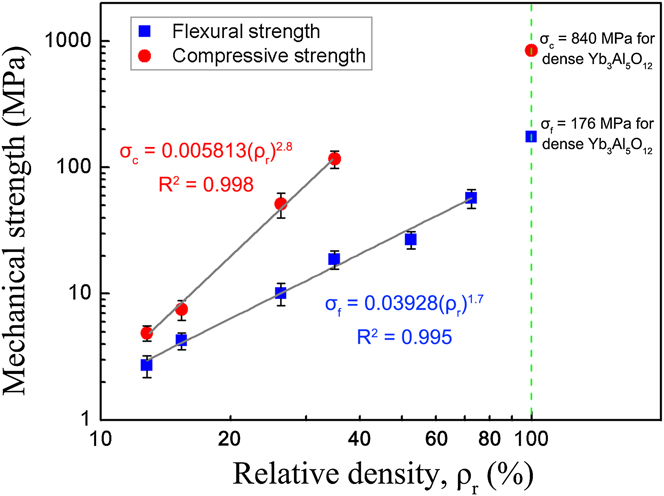
Mechanical strength is an important parameter for a given porous ceramic material. Generally speaking, pore structure highly determines the mechanical response of porous materials. Identifying the failure behavior and mechanisms that govern fracture can lead to more optimized architectures and better properties. Figure 8 presents the flexural strength and compressive strength of porous Yb3Al5O12 ceramics with different relative densities. It can be found that the strength declines with the decreasing relative density (increased porosity). The reduction of the overall solid area as relative density decreases under load explains this trend, in addition to structural factors intrinsic to the manufacturing method, such as strut thickness and shape with density. Reference Brezny and Green43–Reference Gibson and Ashby45 On the basis of the classic theory for cellular solids proposed by Gibson and Ashby, Reference Gibson and Ashby45 an empirical equation is successfully used in describing the dependence of strength of porous ceramics on its relative density:
 $$\sigma = C\mathop {{\rho _{\rm{r}}}}\nolimits^n \quad ,$$
where σ is the strength of porous ceramic, ρr is the relative density, C and n are constants. The strengths versus relative density in double log plot in Fig. 8 are fitted using Eq. (1). For porous Yb3Al5O12, the obtained values of the exponent n in the fitting equation are 1.7 for flexural strength and 2.8 for compressive strength. These values are comparable to those reported by past literature regarding ceramic foams. Reference Sepulveda, Ortega, Innocentini and Pandolfelli44,Reference Takahashi, Sato, Sodesawa, Goto, Matsutani and Mikami46,Reference Oliveira, Dias, Fátima and Fernandes47 Generally, for dense ceramics, compressive strength is much higher than flexural strength (e.g., for fully dense Yb3Al5O12 ceramic that prepared by hot-pressing in our previous work, Reference Wang, Xiang, Sun, Liu, Hou and Zhou28 its compressive strength is 840 MPa, while its flexural strength is 176 MPa). However, it is apparent that the difference between compressive strength and flexural strength of porous Yb3Al5O12 is dramatically declined as relative density decreases (see Fig. 8), which implies that the crushing collapse of porous Yb3Al5O12 occurs as a flexural rupture mode. Reference Mao, Shimai and Wang42,Reference Gibson and Ashby45 Moreover, it should be noted that the mechanical property of the foam-gelcasting derived porous Yb3Al5O12 is remarkably high. Even when the relative density is reached to 20%, the compressive strength and flexural strength are still remained as high as 19.7 and 6.3 MPa, respectively. Besides that, compared with those reported highly porous ceramic materials fabricated by analogous Isobam system, when the porosity is about 76%, the compressive strength of ∼45 MPa for porous Yb3Al5O12 is greatly higher than 15.3 ± 0.3 MPa for porous mullite, Reference Deng, Wang, Liu, Zhang, Li, Duan, Lu, Huang, Zhao and Zhang22 and ∼25 MPa for porous Al2O3. Reference Yang, Shimai, Sun, Dong, Kamiya and Wang24
Flexural strength and compressive strength of porous Yb3Al5O12 ceramics against relative density. Mechanical strength values for dense Yb3Al5O12 ceramic are also plotted for comparison.
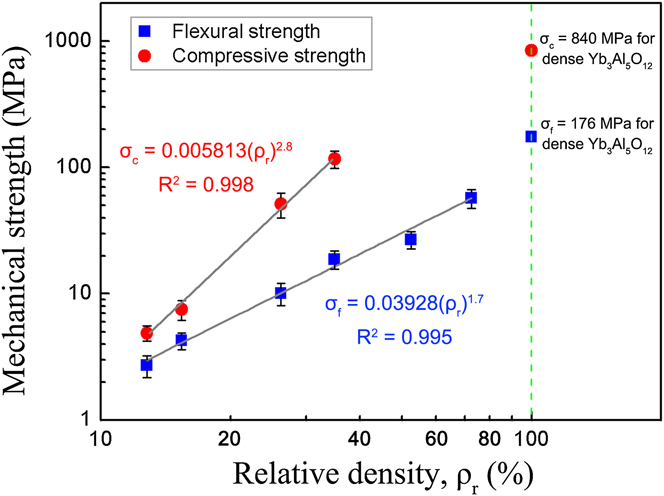
It is well known that the limiting property of a highly porous ceramic material is typically the mechanical strength. Reference Fabri, Celotti and Ravaglioli48 The current results indicate reasonably good flexural- and compressive-strength values for such high-porosity Yb3Al5O12 samples. We propose that the high mechanical strength might be originated from its microstructure. If porous structures contain defects, in this case, there are a large proportion of pensile bonds (i.e., not tangled with each other) forming a hanging nest so that only a small percentage of solid meshwork supports the applied load. In contrast, the micrographs shown in Fig. 7 illustrate that porous Yb3Al5O12 ceramic possesses an intense continuous network with homogeneous structures, which could provide more uniform load distribution under low density. On the other hand, stress-shielding usually occurs since the higher mechanical strength material tends to absorb more load than the lower one, as would typically occur in dense ceramic or metallic implants (e.g., elastic modulus > 100 GPa). Reference Sepulveda, Ortega, Innocentini and Pandolfelli44 Under unloaded conditions, skeleton suffers reabsorption because it requires load to regenerate itself. This reabsorption incurs deleterious consequences in implant bonding, leading to loosening of the implants. Reference Fabri, Celotti and Ravaglioli48 Fortunately, such stress-shielding effects in highly porous Yb3Al5O12 could be prevented owing to continuous solid network in the skeleton. During loading process, the rupture of the struts among pores leads to an uninterrupted damage accumulation by interlocking their lateral motion and hence conduces to high mechanical strength. Reference Meille, Lombardi, Chevalier and Montanaro49,Reference Seuba, Deville, Guizard and Stevenson50 The superior mechanical properties accompanied with high porosity further demonstrate the advantages of foam-gelcasting for making porous ceramics compared to other traditional methods.
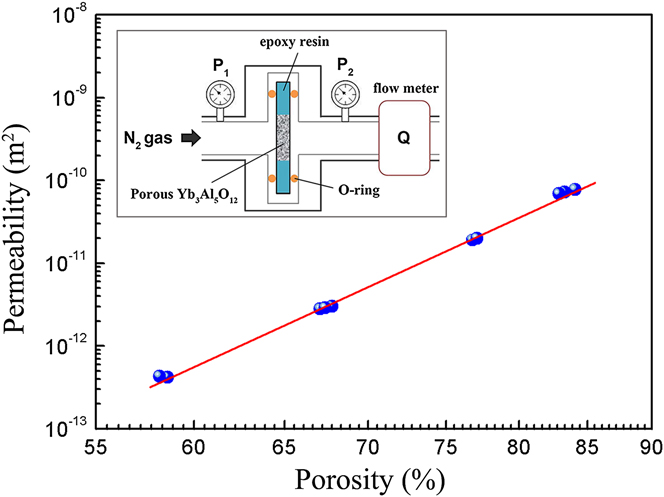
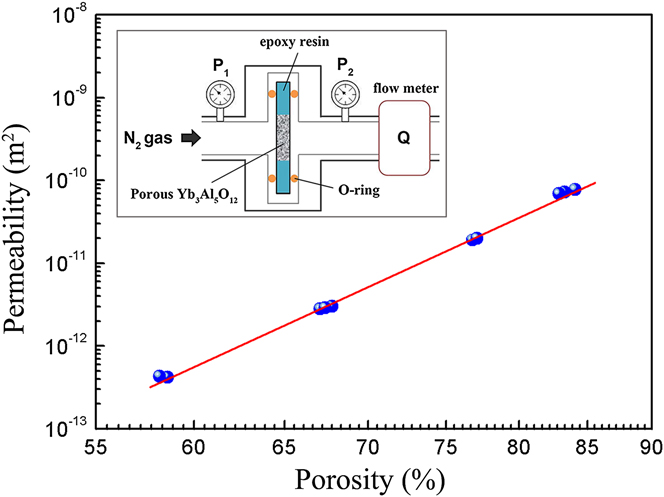
When pores of a ceramic material are interconnected, a fluid like gas can be made to flow through the material. As an advanced porous ceramic for engineering applications, in addition to high strength, permeability is also a considerable performance. It normally predicts the pressure drop necessary to achieve a specific gas flow rate for a fixed flow area. Reference Kennedy, Zhang, Fritzsch, Akhtar, Bakken and Aune51,Reference Li, Moraes, Colombo and Shen52 The relationships between pressure drop, flow rate, and gas permeability can be illustrated on the basis of Darcy's equation Reference Despois and Mortensen53,Reference Isobe, Kameshima, Nakajima, Okada and Hotta54 :
 $${{\Delta P} \over L} = {{\eta Q} \over {kA}}\quad ,$$
where ΔP is the pressure drop on a sample, L is the sample length, η is the dynamic viscosity, Q is the volumetric flow rate, A is the flow area through sample, and k is the Darcian permeability. Figure 9 shows the effect of porosity on the Darcian permeability of porous Yb3Al5O12, using the gas permeability model shown in the inset of Fig. 9 with the value of 1.7 × 10⁻⁵ Pa·s for the dynamic viscosity (η) of N2 at ambient temperature. From Fig. 9, one can see that the Darcian permeability increases exponentially with increased porosity, indicating that gas permeability is in direct proportion to the efficient porosity. For porous Yb3Al5O12, this efficient porosity is mainly contributed by the interconnected open pores going from one side to another of the porous sample (Fig. 7). With increasing the porosity, the inertia interaction between gas and porous walls is diminished, thus, the Darcian permeability is enhanced. Reference Qing, Zeng and Jiang55,Reference Innocentini, Salvini, Coury and Pandolfelli56 High permeability also indicates that the flux of fluids within the material is facilitated through the large interconnections. Furthermore, the gas permeability of porous Yb3Al5O12 with porosity ranging from 58% to 84% varies between 4.3 × 10⁻¹³ and 7.8 × 10⁻¹¹ m2. Hence, the gas permeability of porous Yb3Al5O12 ceramics is tunable by adjusting the porosity. This tunable variation of permeability could be a valuable tool when one wishes to control the rate of liberation of desired substances. Based on all the above results, we have successfully demonstrated a facile and scalable processing approach based on a novel Isobam system for fabricating of an exotic mixed oxide porous ceramic (Yb3Al5O12). The manufactured porous Yb3Al5O12 shows a unique combination of favorable properties including excellent structural stability, low shrinkage and mass loss, superior mechanical strength and variable permeability, which render this green route having prospective applications for making various kinds of advanced porous materials, even for future ceramic 3-D printing field.
Relationship between gas permeability and porosity of porous Yb3Al5O12, the inserted sketch displays the gas permeability model used in this study.
IV. CONCLUSIONS
In this study, the feasibility of the new Isobam system with an exotic mixed oxide Yb3Al5O12 ceramic has been demonstrated by a facile and green foam-gelcasting method and successfully yields a porous material. The produced porous Yb3Al5O12 ceramics with spherical pore architectures possess the advantages of controlled porosity and excellent structural stability up to 1600 °C, as well as low linear shrinkage (13.9%) and low weight loss (2.21 wt%). Investigations based on the mechanical tests reveal that both flexural strength and compressive strength of the porous Yb3Al5O12 ceramics show a power law relationship against the relative density. The gas permeability can be tuned by regulating the porosity. These results suggest high-performance porous Yb3Al5O12 being a potential light-weight ceramic part applied in harsh environments. Finally, our demonstrated green route has promising applications for the manufacturing of other advanced and technical porous materials, even for future ceramic 3-D printing field.
ACKNOWLEDGMENTS
This work was supported by the National Outstanding Young Scientist Foundation for Y.C. Zhou under Grant No. 59925208, Beijing Municipal Science & Technology Commission under grant number Z151100003315012, and the Natural Sciences Foundation of China under Grant No. U1435206.