The growing literature on the role of the politics of memory in post-1989 eastern Europe has focused predominately on commemorative practices in the context of the nation-state. Much has been written about the way in which remembrance work conducted by post-communist political elites has sought to legitimise new political regimes, discredit the followers of communist regimes and strengthen national cohesion during the difficult period of economic transition.Footnote 1 Studies on the use of specific anniversaries, the role of war memorials and investigations into media debates, and how they have influenced domestic politics, have been complemented by studies that concentrate on how collective memory has been a determining factor in east European foreign policy.Footnote 2 However, the examination of a politics of memory conducted by second- and third-order local elites with the intention of influencing local identity formation and legitimising the authority of regional institutions has, so far, received limited attention.Footnote 3 Equally, the pluralisation of historical narratives within regions and the competition in memory production between local power groups are issues that have been under-examined, despite the impact of commemorative practices on regional development in eastern Europe, especially border regions.Footnote 4
The diversification of a politics of memory and the composition of specifically regional narratives of the past are very much present in Poland. This development has been encouraged by a number of factors. First, post-1989 democratisation resulted in the empowerment of groups that were discriminated against during the years of communist rule (including ethnic minorities), thus producing diverse and active communities of memory on national, regional and local levels. Second, the re-energised institutions of memory, such as museums and heritage centres, have actively engaged in commemorative practices which have aimed at promoting regional historical narratives. Third, the administrative and territorial reforms of 1990 and 1999 created stronger self-governing regions which need to respond to a historical heritage that impacts on their socio-economic future.Footnote 5 Finally, the enlargement of the European Union in 2004 facilitated further co-operation within the Euro-regions and encouraged cross-border interaction in which public commemorations play an important part.
Within Poland, Upper Silesia has experienced a noticeable growth in commemorative activities related to its past. This is a historical border region, made up of an ethnically diverse population, which has an inefficient heavy-industry-based economy, a heavily polluted environment and a tense relationship with central government. During the 1990s the region underwent a restructuring programme (although this was much postponed due to the political power of the trade unions within the region), resulting in a dramatic rise in unemployment and the growth of separatist tendencies among the native Upper Silesian population. Regional elites needed to assert their authority over both a dissatisfied local population and a distrustful central government. The emerging Silesian national movement, conversely, has tried to strengthen its position by campaigning against Warsaw's ‘colonisation’ of the region. Under these conditions the region's past became central to debates within local politics and became the battleground on which wider issues were played out. Central to these debates was a subject that had become taboo during the communist era – the 1945 deportations of Upper Silesians to the Soviet Union.
This article concentrates on the politics of memory in Upper Silesia, particularly in relation to the deportations of 1945. It investigates the degree to which remembrance of the deportations has facilitated the formation of a post-1989 Upper Silesian regional identity and shaped power constellations in the region. Further, the article explores the relationship between Silesia's traumatic past and the emergence of a Silesian separatist movement, which argues for regional autonomy on the basis that a distinct Silesian national identity exists.
Upper Silesia: a historical overview
Upper Silesia, a centre of coal mining and heavy industry, is situated in southern Poland. In the Middle Ages it was ruled by the Piast dynasty (which was Polish) and eventually became a possession of the Bohemian crown in 1339. In the middle of the sixteenth century it came under the control of the Austrian Habsburgs, who lost Upper Silesia to the Kingdom of Prussia during the eighteenth century. One hundred years later the region was incorporated into the German empire. After the First World War and three Silesian uprisings (between 1919 and 1921), which were staged in support of Poland, the fate of Upper Silesia was decided by plebiscite, and eventually the region was divided between Poland and Germany. The western part, with its capital Oppeln, was incorporated into Germany (hereafter the Oppeln regency), and the eastern part, with Katowice as its capital, became part of Poland (hereafter the province of Silesia).
Upper Silesia was, throughout the centuries, a place of settlement for many ethnic groups. Alongside Silesians of west Slavic origin lived Germans, Poles, Czechs and Jews. It was only in the nineteenth century, with the heavy industrialisation of the region, that Germans became the dominant group in towns and cities, especially in the western regions of Upper Silesia. Major industrialists, administrators and managerial cadres, despite coming from a range of ethnic backgrounds, predominantly identified with German culture, traditions and forms of government. Concomitantly, agricultural communes, inhabited by rural Silesians, who mostly felt cultural, religious and linguistic affiliation with the Poles, had, by the end of the nineteenth century, largely aligned themselves with a Polish national identity.
In 1939 all Upper Silesian territory which had been granted to Poland after the First World War was incorporated into the Third Reich and all inhabitants of Upper Silesia became German citizens. Upper Silesians known for their pro-Polish sympathies were imprisoned and sent to concentration camps. By October 1943 the Nazi administration registered all Upper Silesians from the province of Silesia on the Deutsche Volksliste (DVL). The list divided the population into four categories according to the degree of their ‘Germanness’.Footnote 6 Being assigned to any of the first three categories meant conscription into the Wehrmacht.
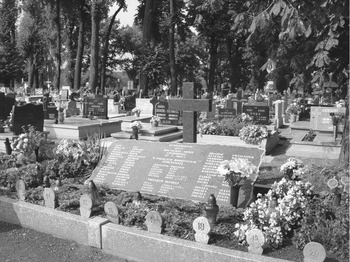
A memorial tablet listing the names of villagers from Przyszowice in Upper Silesia killed by the Red Army in January 1945. The tablet was unveiled in 2005 to commemorate the sixtieth anniversary of the massacre. Photograph by Ewa Ochman, 2006.

In January 1945 the Wehrmacht was driven out of Upper Silesia by the First Ukrainian Front under Marshal Konev. In the days that followed, Red Army soldiers plundered towns and villages, raped women and killed civilians.Footnote 7 With immediate effect, the Red Army military headquarters took control of the region. Units of the NKVD – the Soviet secret police – and SMERSH – the counter-intelligence wing of the Soviet army – played their own part in controlling the population. A Polish administration was established in the province of Silesia on 29 January 1945 and in the Oppeln regency on 18 March. However, the region was governed by both a Polish administration and the Red Army military headquarters until the summer of that year. During 1945, as the Polish western border shifted further to the west, most of the ethnic Germans from Upper Silesia were expelled.Footnote 8 The region, especially the former Oppeln regency, was repopulated by Poles transferred from Poland's eastern territories, which had been annexed by the Soviet Union, and by internal migrants from central Poland. Between 1945 and 1949 Upper Silesians were put through a process of verification and rehabilitation designed to establish their ‘Polishness’ and to segregate Polish Upper Silesians from German Upper Silesians, who were destined for forced transfer to Germany.Footnote 9 Resettlement camps and forced labour camps were organised for ethnic Germans and members of the local population accused of collaboration with the Nazis or perceived as hostile to the new communist authorities. Most of the camps operated within the public security apparatus.Footnote 10
The deportations of Upper Silesians in 1945
At the beginning of February 1945, throughout Upper Silesia announcements appeared in the streets in both German and Russian demanding that all men aged between 17 and 50 report for work. The order followed resolution no. 7467 taken by the Soviet Union's State Council of Defence on 3 February 1945 to mobilise all physically able Germans from the territory taken by the 1st, 2nd and 3rd Belarusian and 1st Ukrainian Fronts for work.Footnote 11 Later that month this ‘mobilisation’ policy was also agreed at the Yalta Conference, where it was decided that Germany should pay war reparations in the form of labour provided by its citizens. As well as mobilising Upper Silesians for work, a cleansing of the newly conquered territory at the rear of the Red Army of those perceived as enemies of the Soviet Union commenced. There was a range of categories of ‘enemy’ who were arrested: ex-Wehrmacht soldiers who had deserted from the German army were interned and joined groups of prisoners of war imprisoned during the Silesian offensive: members of the Nazi movement – the National Socialist Workers Party (NSDAP), the Schutzstaffeln (SS) and the Sturmabteilungen (SA) – members of German organisations including the Hitlerjugend and the Bund Deutscher Mädel, and Polish fighters from the underground Home Army (Armia Krajowa, hereafter AK) who were also considered to be ‘hostile elements’. In some instances arrests were justified merely on the grounds of registration on the DVL. It is unclear how many people were interned as a result of this cleansing process, but the overwhelming majority of deported Upper Silesians was mobilised for work rather than arrested.Footnote 12
Since the 1990s historians from Upper Silesia have been trying to reconstruct the history of mobilisation and the subsequent deportations of Upper Silesians. Key facts have been established, mainly on the basis of testimonies and interviews with deportees and their relatives. In February 1945 registration points were organised where men had to register for work. Those who did not register voluntarily were forcibly collected from homes, streets and places of work. In some instances whole workforces were interned at the end of a shift.Footnote 13 As all inhabitants of the region were treated by the Soviets as German citizens, this meant that potentially any Upper Silesian could be used for forced labour.Footnote 14 However, most of those mobilised for work were specially targeted, and deportees were mainly miners and those with technical skills. Estimates of the number of deported Upper Silesians vary from 30,000 to 90,000.Footnote 15
The internees were held in detention centres set up in schools, factory halls and public buildings, and were later moved to transit camps. Here, they were interrogated and either sent to camps situated on Polish territory (although this constituted only a minority) or sent in cattle wagons to Donbas, Kazakhstan, Chechnya, Turkmenia, Georgia and Murmansk. Upper Silesians were forced to work mostly in mines but also in foundries, quarries, sawmills or on kolkhozy, the Soviet Union collective farms. The mortality rate is estimated to have been 50 per cent during the first two years; illness and epidemics (primarily typhoid and dysentery) triggered by inadequate food rations, polluted water, exhausting working conditions and overcrowded accommodation were the main causes of death.Footnote 16 Although small groups of deportees started returning from the Soviet Union in summer 1945 it was not until January 1947 that Upper Silesians started returning home in significant numbers. It has been estimated that only 20 per cent of deported Upper Silesians returned.Footnote 17
The making of the myth
After the war the deportations were rarely discussed in Upper Silesia, and the official position was that only ethnic Germans and collaborators had been interned. In an atmosphere of the de-Germanisation and intensive re-Polonisation of Upper Silesia, the official history of the region was ‘smoothed over’ and deprived of its complexities and ambiguities.Footnote 18 The issue of the DVL, the compulsory conscription into the Wehrmacht and the expulsion of Upper Silesians classified as Germans were matters that were not discussed. The more general problem of the borderland peoples, who had unclear or shifting identities but a strong allegiance to their regional traditions, customs and land, had not been acknowledged. In the official narrative Upper Silesia had been liberated by a heroic Red Army, Germans had been repatriated and the Polish native population had enthusiastically contributed to the rebuilding of the Fatherland. The reality was somewhat different. Upper Silesians were not trusted and the communist regime installed new elites from the neighbouring Dąbrowa region, who were considered to be more Polish and therefore more reliable.Footnote 19 Use of the Upper Silesian dialect was actively discouraged and evidence of the multicultural past of the region erased.
The situation changed after the fall of the Berlin wall in 1989, when a period of ‘re-remembering’ history began in eastern Europe. In Poland the focus was, for the most part, on events of the Second World War which had been falsified or excluded from history textbooks in the communist period. Primarily, these events included the 1939–41 Soviet occupation, the contentious liberation of Poland by the Red Army in 1944–5, Ukrainian–Polish ethnic cleansing, and Polish–Jewish relations.Footnote 20 The re-remembering of the past was undertaken through state-orchestrated and state-sponsored commemorative initiatives and aimed at the nationalisation of the past, achieved by drawing on Polish narratives of resistance, martyrdom, patriotism, national honour and Catholicism.Footnote 21 Simultaneously, a different phenomenon – particularly at a time when Poland had to fulfil certain conditions in order to join the European Union – was evident, and the official remembering the past concentrated on narratives that emphasised values seen as central to liberal democracies, such as openness, tolerance and human rights, and promoted Poland as progressive and modern society.
Although the contentious issue of Polish–Soviet relations during the Second World War received the most attention, the deportations of Upper Silesians to the Soviet Union in 1945 were not included as part of attempts to rediscover this past. This lack of interest was noted by Upper Silesians, particularly because the 1939–41 deportations from Kresy, pre-war Poland's eastern borderlands, to Siberia or Kazakhstan have been extensively commemorated across the country with anniversaries, monuments and street names dedicated to Kresy victims.Footnote 22 As a result, the regional elites in Upper Silesia decided to respond to this exclusion from the national collective memory, and a new prominence given to the specifically Upper Silesian past on the regional stage was encouraged for several reasons.
In the early 1990s, increasing numbers of Upper Silesians migrated to Germany, and the German minority in Poland, now officially acknowledged, grew rapidly.Footnote 23 The extremely difficult first years of economic transformation increased the fragmentation and dislocation of local communities across the region. A national campaign against the Silesian mining industry, which criticised its inefficiency, high pollution levels and the fact that it was heavily subsidised by the state, contributed to the perception of the region as peripheral and lagging behind more dynamic and diversified areas of the country. Regional elites sought ways to counter this image, and used the previously overlooked cultural and historical heritage of Upper Silesia as a means of promoting a new regional identity.
The first official commemoration of the deportations was organised in Zabrze, one of the major mining towns in Upper Silesia, on 25 February 1991. Representatives of Związek Górnośląski (the Upper Silesian Association) and Związek Sybiraków (the Association of those Formerly Deported to Siberia), delegates from neighbouring town councils and local politicians were invited to an extraordinary session of the town council, commemorating the forty-sixth anniversary of the deportations. During the session speakers unanimously called for further historical research, the publication of memoirs, the disclosure of related documents from Russian archives, a proper burial for deportees and an official investigation into the deportations. Hence an outline of a commemorative project emerged. It was recognised that the initiative had little chance of success without the combined efforts of historians, regional activists, artists and councillors.Footnote 24
Regional elites openly acknowledged that this campaign for the commemoration of the deportations was linked to the Upper Silesian attempts to redefine perceptions of their region as part of their ‘identity project’.Footnote 25 It was noted that establishing a shared conception of the events of the past would help to create a common consciousness among Upper Silesians and that this would aid the task of building social cohesion within the region. Public commemorations of the deportations would, in time, encourage national sympathy for the region, generate respect for native Upper Silesians and encourage pride in the region's history.
However, using the deportations of 1945 for the purpose of building social cohesion, legitimising a new authority and improving the standing of the region in the country was a complicated task. While the deportations had to be defined as a unique and distinctive event in the history of Upper Silesia, it also had to resonate with the current inhabitants of the region. The Upper Silesia of 1991 was very different from that of 1945. Migration to and from the region meant that only approximately one third of the region's population identified with a specifically Upper Silesian past. If the memory of the deportations was to support the process of forging regional unity it had to allow for identifications across cultural and historical divisions. The understanding of the past had to relate to all post-war inhabitants of the region, but it also had to be perceived as distinctive in relation to the national narratives of the Second World War. Therefore both the similarities between the history of Upper Silesia and of Poland and the differences between the deportations of miners and the nationally commemorated deportations of Poles from Kresy had to be stressed.
Thus a number of speakers at the session attempted to show the broader significance of the deportations for a range of groups. First, there was an attempt to reconfigure the identity of the deportees and set a new standard of inclusion and exclusion to apply to this group of victims. Consequently, the deportation of Upper Silesian AK soldiers rather than miners was stressed.Footnote 26 Second, contributions to the debate focused on the shared persecution of Poles and Silesians.Footnote 27 Here, special attention was given to the Soviet Union, which had attacked Poland on 17 September 1939, had allowed the Germans to quash the Warsaw Uprising of 1944 and had deported Upper Silesians in 1945. Equally responsible for Polish suffering were Polish communists, who had oppressed the whole country and had exploited and environmentally damaged Upper Silesia. The truth about the deportations and other forms of oppression could be revealed because of the existence of the Solidarity movement.
Third, some of the commemorative narratives focused on the recent history of Upper Silesia and drew comparisons between the 1945 deportations and the fate of the generation that had lived in the region during the period of martial law. In the words of one Upper Silesian MP, ‘The biographies of people interned in 1944–6 did not differ too much from the interment that I was part of. Almost half a year in Strzelce Opolskie, later in other prisons, these transports, food parcels . . . history repeated itself in this land.’Footnote 28 Here, apart from an explicit reference to the continuities of persecution, victimhood was situated geographically on Silesian soil, rather than linked directly with the people. It was the land that had been marked by the events of 1945, not individuals. Binding contemporary communities of the region to the landscape rather than to particular groups or events allowed for the bringing together of seemingly unbridgeable divides.
Significantly, the growth of German minority associations, the increasing migration to Germany and the intensification of anti-Polish sentiment in some quarters of the region were not openly addressed in any of the speeches. However, it is precisely these issues that can be discerned as the impetus behind the extraordinary session. There was a clear recognition that if native Silesians were to identify with Polish Upper Silesia their story of oppression had to be given prominence. Concomitantly, the tragedy of the Upper Silesians had to be recognised as an integral part of Polish history, and the responsibility for the post-war suffering of the Upper Silesians had to be placed with the communists rather than the Poles. The narrative therefore became linked with that of Solidarity and their achievements in bringing about the end of communism in Poland. As well as imaginatively aligning the Upper Silesians with the heroes of the anti-communist movement, this also served to help collaboration between Silesians and new regional elites in reforming the region, as many local government officials had roots in the Solidarity movement.
This reluctance to talk openly about the so-called German factor during the session was indicative of how the myth of the deportations would be constructed in the future. There were two main reasons why there was a reluctance to confront the issue of Upper Silesians applying for German nationality, despite the 1989 victory over communism. First, the post-war narrative about prehistoric Polish Upper Silesia had a strong psychic hold. Second, the reluctance to explore the German issue was connected to painful family histories and unconsciously blocked truths. Many members of the regional elites were themselves Upper Silesians. Their grandparents could have fought in the Silesian uprisings on opposing sides. Relatives might have belonged to the four different categories of the DVL and might have been murdered by the Nazis in concentration camps or deported by the NKVD to the Soviet Union. An open debate would have to probe issues that only a few activists in the region had the courage to face: the rival identities of Upper Silesians on the one hand and the fluidity of Upper Silesians’ self-identification on the other.Footnote 29 There was also the embarrassing issue of economic migrants claiming German nationality.Footnote 30
The regional project
The official commemorative project outlined during the extraordinary session in Zabrze was carried out as planned. Regional municipalities supported the memorial project, by erecting monuments honouring the victimsFootnote 31 or financing educational projects.Footnote 32 Historians based at the Silesian University and local museums began several research projects on the deportations, and the first publications based on this research were published in 1993.Footnote 33 In June 1991 an official investigation into the deportation of 10,000 Polish miners was launched by the Katowice branch of the Institute of National Remembrance (Instytut Pamięci Narodowej, IPN). In April 1991 the Society of the Memory of the Silesian Tragedy 1945 was formed in Knurów, a small mining town. Its aim was ‘to save from oblivion the Silesian Tragedy of 1945 and pay respect to the thousands of Upper Silesians deported in 1945 to the Soviet Union’.Footnote 34 The society was supported by three trade unions of the local coalmine, KWK Knurów, and by all its directors.
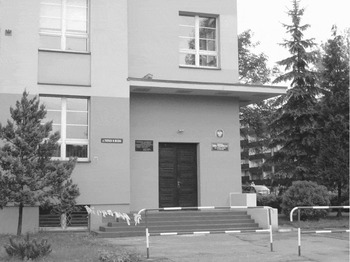
A primary school in Knurów which was used in February 1945 as a detention centre for Upper Silesian deportees. A plaque commemorating the deportees was unveiled at the main entrance of the school in 1993. Photograph by Ewa Ochman, 2006.

As might be expected, the society became an official symbol of community remembrance and of the spontaneous collective effort to secure recognition of the victimhood of Upper Silesians. It was awarded local and regional prizes for ‘preserving regional values’Footnote 35 and was promoted by voivodeship authorities.Footnote 36 In 1995 the regional parliament (sejmik) voted for a resolution calling on journalists, teachers, academics, non-government societies and local authorities to support the society in its remembrance work. In the Polish Parliament the MP Krystyna Szumilas praised the society for ‘doing all so that the world remembers’.Footnote 37
However, in the long term it was the Katowice Branch of the IPN Public Education Office (Biuro Edukacji Publicznej, BEP) that was the leading force in the memorialising project. One of the most successful BEP commemorative initiatives was a touring exhibition held under the auspices of the president of the IPN, Leon Kieres, and leading political and religious figures in the region. The exhibition opened in 2003 and was dedicated to the deportation process, life in the labour camps and the return home. A krowiok (wagon for transporting livestock), which had been used to transport Upper Silesians to the Soviet Union, and a barracks from a typical camp were reconstructed.Footnote 38
The BEP also supported an educational ‘memory trail’ commemorating the sixtieth anniversary of the deportations. Several high schools from the region took part in the initiative; students met survivors and visited sites across Upper Silesia connected with the deportations.Footnote 39 The memory trail outlined the territory of the tragedy and marked out lieux de mémoire. Familiar, everyday spaces (schools, public buildings and railway stations used during the deportations) were transformed into a ‘memory landscape’. However, if the victims of deportation were to elicit not only a sense of grief but also pride they had to be remodelled as local heroes; they could not simply be ordinary people caught up in the tragedy of war. Thus participants in the memory trail were introduced to a set of typical victims: ‘a member of the Home Army’, ‘a miner’, ‘an Upper Silesian insurgent and ex-prisoner of Dachau’ and a young man who ‘despite the fact that he did not fight in Wehrmacht was sentenced for doing so’.Footnote 40 Such victims highlighted a particular version of events. It seems that the account of deportations established by local historians – many working for the IPN – was perceived as too diffuse to be claimed for educational use. The story that emerged from interviews conducted with deportees and witnesses by the IPN was full of contradictions, illuminating the complexity of the region. To draw on such a past for education projects would first require a great deal of rewriting of the history textbooks.
The national project
The project of ‘nationalising’ Upper Silesia's past was essential to the process of constructing a regional identity. If the events that had taken place in Silesia during the Second World War were to be officially recognised and celebrated as part of the region's heritage they had to be ‘polonised’ in order to be relevant to all inhabitants of the voivodeship. Moreover, if the deportations were to be seen as important to all Upper Silesians they had to be discussed in a way that would be perceived as empowering Upper Silesia in relation to other regions and be recognised and commemorated across Poland, not just regionally. However, to be accepted into a broader national conception of Polish victimhood, the victims of the deportations had to be re-imagined as martyrs beyond reproach. The victims had to be recategorised, and narratives of heroism and bravery – similar to those of national narratives of Polish martyrdom – had to be invented.
The search for national recognition of the deportations has been a lengthy process, and its progress can be charted through statements made by Upper Silesian MPs in the Polish parliament. At the beginning of the 1990s, Polish miners were at the centre of narratives that were intended for a national audience.Footnote 41 The case of the 1945 deportations was presented in the parliament, through MPs’ interpellations, in two key ways: either as part of Stalinist repressions inflicted on the nation, or as part of the history of the Polish mining industry, economically exploited by the Soviet Union. As Polish victims of Stalinist policies of repression, the miners increased the number of Polish deportees in the statistics.Footnote 42 In the second scenario the deportations were principally related to the tragedy of Polish political prisoners and conscripts who were forced to work in Silesian mines in place of those miners who had been deported to the Soviet Union.
However, by 2003 the regional myth surrounding the deportations was presented in the national parliament in its own right. The Katowice MP Jan Rzymełka made a statement in parliament in which the tragedy was shown to be part of a long history of deportation of Polish citizens. In this account it was not only the miners who were remembered, but also other categories of deportees from Upper Silesia, such as women, artists, foresters and, especially, resistance fighters. Now the deportations were understood not only as a means of obtaining qualified workers for Soviet mines but also as the ‘liquidation of the national underground and representatives of this part of society which, in the opinion of “liberators”, could potentially threaten the establishment of the new system’.Footnote 43
Two years later another Upper Silesian MP, Krystyna Szumilas, drew national attention to the deportations. In her parliamentary statement on the sixtieth anniversary of the deportations she evoked the memory of ‘hundreds of thousands of Upper Silesians murdered and harmed by the Soviets’.Footnote 44 On this occasion miners were no longer singled out as the only deportees; these also included ‘people of many professions, representatives of the intelligentsia, insurgents of the Silesian uprising and even ex-prisoners of concentration camps’. The deportees were, in the main, referred to as Upper Silesians, but when Szumilas described life in the labour camps she identified the deportees as Poles: ‘living in primitive barracks, having minimal food rations, limited access to drinking water, without medical help, Poles were forced to do exhausting physical labour’. The MP's narrative was constructed around two central images: the so-called krowiok and a barracks. The first image evoked the other infamous deportations of Poles from Kresy, commemorated most significantly by the Monument to the Fallen and Murdered in the East, in Warsaw, which depicts a wagon on a track, overloaded with crosses.Footnote 45 The latter image resonated with the well-established tradition of representing Polish suffering in concentration camps through the symbolic wooden barracks. By metaphorically linking the Silesian tragedy with these icons of Polish victimhood, Szumilas could expect that her call ‘to make sure that victims are commemorated nationally and young generations of Poles in the whole country are taught about the tragedy’ had a chance of success.
In order to become part of the national collective memory, the regional narrative of the deportations had to undergo a fundamental process of reinvention and ‘legend-making’. Thus victims could not be described as ordinary workers interned en masse at the end of a shift or in labour registration centres, as they had been in the western part of Upper Silesia. The myth of the deportations could not deviate to any extent from the established tradition of the memorialisation of heroic insurgents (such as victims of the Warsaw Uprising), patriotic intelligentsia (for example deportees from Kresy, victims of Katyń) and prisoners of concentration camps, such as victims of Auschwitz. Of course, this is not to say that representatives of the intelligentsia, insurgents of the Silesian uprising and ex-concentration camp prisoners were not deported in 1945 from Upper Silesia, but they were the exception rather than the norm. The story presented in parliament on the sixtieth anniversary of the deportations also omitted the fact that most of the deportees were German citizens before the Second World War. The complexity of the DVL and compulsory conscription into the Wehrmacht could not be explained at a national level when these were subjects that were not even discussed at regional level. However, by not referring to the fact that many deportees were interned as Wehrmacht prisoners of war or that some deportees were German Upper Silesians the issue of the number of deportees was entirely misrepresented. There was no basis in fact for the claim of ‘hundreds of thousands of Upper Silesians murdered and harmed by the Soviets’ recalled by Szumilas. Regional politicians faced a difficult task. Could they lobby successfully for the inclusion of the deportations into the national collective memory if they admitted that it was difficult to determine the nationality of the majority of the deportees, as many Upper Silesians felt neither Polish nor German?
The counter-myth
It seems that one of the most significant moments of the first official commemorations in 1991 was the unexpected confession made by a special guest to the Zabrze extraordinary session, Gertruda Cierpka. Cierpka's husband had been shot by the Red Army in front of her two children and she was invited to speak about her memories of the events of January 1945. However, when it was her turn to take the floor she began crying and in a broken voice said to the chairwoman of Bytom Town Council, Magda Kopeć, ‘Zostałam teroz sama. Pani! Dzieci wyjechali . . . [I've been left on my own. Madam! My children have gone . . .[to Germany]].’Footnote 46 There followed the story of her struggle to survive in post-war Upper Silesia. In this extraordinary twist to the commemorative programme a different aspect to remembrance of the deportations was exposed. Cierpka's speech reflected local anxieties and represented a distinctively Upper Silesian memory of the deportations. It also pointed to problems that fuelled the ‘other’ myth of the deportations which emerged within a few years of the first official commemorations.
One of the most contentious issues of the first decade after the collapse of communism, apart from migration to Germany, was the increasing trend among Polish citizens to apply for German passports so that they could take up seasonal jobs in Germany and the Netherlands. Accusations of betrayal and disloyalty incited conflict and divided communities. There was also much resentment because such applications were only possible for those who were descendents of citizens of the pre-war Oppeln regency.Footnote 47 These conflicts were played out against environmental crises (in Upper Silesia more than seven hundred dangerous pollutants were emitted in the late 1990s) and health crises (deaths from heart disease were 20 per cent higher than the national average).Footnote 48 The situation was further destabilised by the de-industrialisation of the region, which could not, by the late 1990s, be postponed any longer. As mines were closed there was a widespread feeling, particularly in those communities hit hardest by the decline of the mining industry in the region, of having been abandoned by central government. For Silesians the closure of the mines meant a threat to the very existence of their communities, traditionally organised around local mines.
In these conditions, organisations such as the Silesian Autonomy Movement (Ruch Autonomii Śląska, RAŚ) emerged on the regional stage. RAŚ campaigns for autonomy for the region, its own parliament and constitution, an elected mayor and a separate budget. In 1996 the organisation tried to register the Union of People of Silesian Nationality (Związek Ludności Narodowości Śląskiej, ZLNŚ).Footnote 49 The application was declined and RAŚ took the case to the European Court of Human Rights, claiming that the refusal to register the ZLNŚ violated the organisation's right of freedom of assembly.Footnote 50 The Polish government argued that Silesians are not a national or even ethnic minority, as they do not have a common language (Silesian is a local dialect), history (the Silesians have no distinct history but share the history of the Polish, Czech and German states) or territory (the land is divided between Poland and the Czech Republic). However, despite the official consensus that Silesians were merely an ethnic group, over 173,000 Polish citizens declared Silesian nationality in the 2002 census, making it the biggest national minority in Poland.Footnote 51 However, the outcome of the census was interpreted by elites not as a sign of the existence of a Silesian nationality, but as either ‘a protest of the population against the lack of interest on the part of the government concerning Silesia, against unemployment and the closing of mines’Footnote 52 or ‘a loud manifestation of difference, peculiarity and intercultural bonds which connect Silesians’.Footnote 53 Whatever the case, the result empowered RAŚ and launched national and local debates on the status of Silesians in Poland and the economic prospects of the region. RAŚ is presently represented in local municipalities, claims to have six thousand members and has stepped up its campaign for Silesian autonomy and recognition of Silesian nationality.
In order to form the Silesian nationalist movement, RAŚ needed to create a narrative which focuses on the creation of a common past for Upper Silesia, distinct from Polish or German history. This past has to do three things: encourage collective responsibility for the ‘nation’, identify the notion of ‘others’ and legitimise Upper Silesians attempts to establish an autonomous, self-governing region.Footnote 54 Thus within the last decade an elaborate ‘myth’ about the so-called tragedy of the Upper Silesians has emerged.Footnote 55 According to RAŚ's version of the tragedy, it encompasses persecution and crimes against all Upper Silesians, regardless of citizenship, carried out by Poles and Soviets in the first decade after the end of the war. This narrative identifies three key instances of persecution: first, the deportation of approximately 90,000 Upper Silesians to labour camps in the Soviet Union; second, the imprisonment of tens of thousands of Upper Silesians, considered to be enemies of Poland, in labour camps which, allegedly, resembled Nazi concentration camps; and third, the expulsion of Silesians to Germany. The coherency of this narrative is built on the conviction that the inhabitants of the Oppeln regency and the province of Silesia were Silesians and any other national identity – Polish or German – had been forced upon them.
RAŚ activists had strong links with and roots in the Upper Silesian locality, and many of its members had been marked directly by the legacy of deportations, making them effective myth-makers. Their commemoration projects included organising screenings and talks, commissioning plaques and campaigning for a monument dedicated to the 1945 deportations.Footnote 56 In order to position themselves as in control of the memorialisation of the deportations at local level, RAŚ has developed links to the generally respected Society of the Memory of Silesian Tragedy 1945. Andrzej Roczniok (the leader of the ZLNŚ) has secured the nomination for representing the society in its attempts to reopen the recently concluded IPN investigation.Footnote 57 The investigation was discontinued in 2006 as it became impossible to identify a single perpetrator still alive who could be held responsible for a concrete crime.Footnote 58 The ZLNŚ has demanded a new investigation, since the alleged Polish involvement in the deportations (namely co-responsibility for the interment of Upper Silesians) was not investigated, and members of the Polish Militia (Milicja Obywatelska, MO) as well as officials from local authorities were not prosecuted.
As we can see, RAŚ deviated from memorialising the deportations of 1945 either as a singular event or as a continuation of the deportations of Polish citizens by the Soviets, begun in 1940. In this counter-myth the deportations of 1945 were situated in a different sequence of events and, in contrast to the narratives of the regional elites, it was posited that these events began in 1945. The victims are identified as Silesians, stigmatised as Germans, and collectively punished by both Poles and Soviets for Nazi crimes. Moreover, in opposition to official narratives of remembrance, the local perpetrator is not identified as a communist (or Polish communist) but as a Pole. The insistence on claiming a national rather than an ideological identity for the oppressors helps to extend the list of perpetrators. Poles were no less responsible than the Soviets for the Silesian deportations. This narrative strategy allows for the distinction of Upper Silesians from Poles or Germans, and the defining of the events as something that is not shared with any other group.
Conclusion
The regional elites of Upper Silesia have supported public commemorations of the Silesian victims of Soviet deportations in order to further the formation of a new Upper Silesian identity which would stimulate local solidarity, elicit a sense of pride and inspire responsibility for the region as it undergoes post-communist political and economic transformations. In order to make the events meaningful to the diverse population of contemporary Upper Silesia the narrative of the deportations had to reconfigure the identity of the victims and exclude contradictory loyalties and appropriate symbols of the national Polish martyrological past. At the same time there emerged a counter-narrative which was utilised for a different project. Here, the identity of the victim is simplified as the undifferentiated Upper Silesian who is loyal only to his or her Heimat. The counter-narrative creates a unique Upper Silesian historical heritage, which is used to legitimise a claim to Silesian national identity and to support the separatist movement's demands that Upper Silesia be granted the status of an autonomous region. The case of Upper Silesia demonstrates how important the politics of memory have become on a regional level in a post-1989 Poland that has been administratively decentralised. As regional elites seek to establish themselves as autonomous actors controlling local development they need to invent new myths to overcome the historical heritage that impacts on the socio-economic future of their regions. But the case of Upper Silesia also shows how, in border regions, these local politics of memory can become fragmented and diversified.