Implication
Past studies indicate that feeding milk at variable amounts during the milk-feeding period improves calf performance, compared with feeding at a constant rate. However, the difference in total amount of milk fed during pre-weaning period differs greatly among the protocols, leading to the hypothesis that if the total amount of milk is held constant during the milk-feeding period, the method of milk feeding would have negligible effects on calf performance. Overall, starter feed intake and growth performance were slightly affected by method of milk feeding. A consistent milk-feeding program is recommended as a less labor-intensive program.
Introduction
Neonatal calf performance is known to be largely influenced by the amount and method of milk feeding over the pre-weaning period (Khan et al., Reference Khan, Lee, Lee, Kim, Ki, Hur, Suh, Knag and Choi2007a, Reference Khan, Lee, Lee, Kim, Kim, Ki, Ha, Lee and Choi2007b and Reference Khan, Weary and von Keyserlingk2011b). Over the past decade, there has been a movement toward feeding large volumes of milk (8 to 10 l/day) to calves because increased supply of nutrients from milk accelerates growth rate, promotes rumen–reticulum development and alters the phenotypic expression for milk yield potential (Khan et al., Reference Khan, Weary and von Keyserlingk2011b; Bach, Reference Bach2012; Soberon et al., Reference Soberon, Raffrenato, Everett and Van Amburgh2012).
To further promote weight gain and initiation of a functional rumen fermentation, several milk-feeding programs have been developed. One simple method is conventional (restricted) milk-feeding method in which calves are fed milk or milk replacer at a constant rate of 10% of their BW until weaning (Khan et al., Reference Khan, Lee, Lee, Kim, Ki, Hur, Suh, Knag and Choi2007a and Reference Khan, Lee, Lee, Kim, Kim, Ki, Ha, Lee and Choi2007b). Alternatively, for a gradual adaptation of calves to increased milk allowance and at the same time a slow adaptation to solid feed (to minimize distress at weaning), feeding liquid feed at variable amounts during the pre-weaning period has been proposed. For instance, in the step-down (STD) method the amount of milk changes according to the calf age, which is increased up to 20% of the calf BW for the first 3 weeks and then gradually limited to 10% of BW until weaning (Khan et al., Reference Khan, Lee, Lee, Kim, Kim, Ki, Ha, Lee and Choi2007b). Calves fed milk using the STD method had greater weight gain and better rumen development compared with those fed milk through conventional method (Khan et al., Reference Khan, Lee, Lee, Kim, Kim, Ki, Ha, Lee and Choi2007b). Likewise, in step-up/step-down (SUSD) protocol the rate of milk allowance is increased to reach its peak (8 to 10 l/day) in the middle of the milk-feeding period, and then is gradually declined to the lowest level (2 l/day) near weaning (Omidi-Mirzaei et al., Reference Omidi-Mirzaei, Khorvash, Ghorbani, Pezeshki and Ghaffari2015). The SUSD protocol improved the calf performance compared with the STD or restricted milk-feeding procedure.
Although the earlier studies (Terré et al., Reference Terré, Devant and Bach2007; Khan et al., Reference Khan, Lee, Lee, Kim, Ki, Hur, Suh, Knag and Choi2007a and Reference Khan, Lee, Lee, Kim, Kim, Ki, Ha, Lee and Choi2007b; Omidi-Mirzaei et al., Reference Omidi-Mirzaei, Khorvash, Ghorbani, Pezeshki and Ghaffari2015) reported improvement in calf performance when milk was fed through STD or SUSD compared with those fed at fixed (restricted) rate, a large difference exists in the offered amount of milk among the protocols. For example, the STD method supplied 120 l more milk than the restricted method (Khan et al., Reference Khan, Lee, Lee, Kim, Kim, Ki, Ha, Lee and Choi2007b). Similarly, the SUSD protocol provided 162 and 220 l more milk during the pre-weaning period (56 days) compared with the STD and conventional procedures, respectively (Omidi-Mirzaei et al., Reference Omidi-Mirzaei, Khorvash, Ghorbani, Pezeshki and Ghaffari2015). It appears therefore, the large difference in milk allowance among the protocols but not the milk-feeding protocol itself, would have contributed to the improvements in calf performance. This led to the speculation that if the total amount of milk intake is maintained constant over the course of the milk-feeding period, the method of feeding would have minor effects on calf performance. A priori assumption, this could be of paramount importance because a milk-feeding protocol based on the inconsistency of milk feeding demands considerable labor force and is subject to delivery errors in each feeding, which makes the feasibility of its on-farm implementation problematic in intensive calf-rearing operations. The present study investigated how calf performance is influenced by the method of milk feeding (CONS v. SUSD or CONS v. STD) when total milk intake is held constant over the milk-feeding period.
Material and methods
Experiments were conducted from 20 March through 12 June 2015, at a local dairy farm (FKA Agriculture and Animal Husbandry, Isfahan, Iran). Animals were managed under the guidelines and approval of the Iranian Council of Animal Care (1995).
Experiment 1
Calves, management and treatments
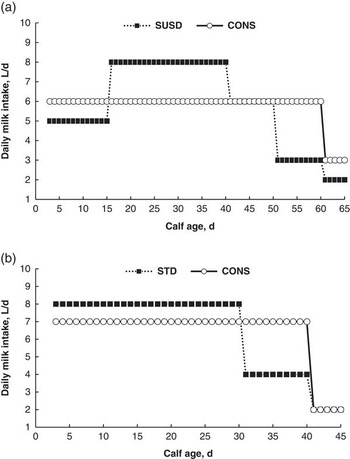
In total, 44 3-day-old female Holstein calves were separated from their dams immediately after birth, weighed, and housed at random in individual pens (1.5 m wide×2.5-m long, bedded with sawdust). The bedding was renewed with fresh sawdust every 1 to 2 days. All calves were fed 3 to 4 l of colostrum within 2 to 6 h after birth. The animals (BW=39.2±4.3 kg) were distributed randomly to one of two milk-feeding protocols (Figure 1a), namely, (1) CONS=6 l/day of milk from days 3 to 60 and 3 l/day from days 61 to 65 of age or (2) SUSD=5 l/day of milk from days 3 to 15, 8 l/day from days 16 to 40, 6 l/day from days 41 to 50, 3 l/day from days 51 to 60 and then 2 l/day from days 61 to 65 of age. Calves were fed pasteurized waste milk (hereafter referred to as milk; 3.2±0.10% fat, 2.65±0.07% CP, 4.48±0.05% lactose and 11.3±0.15% total solids; based on the mean of bulk tank samples collected on days 0, 30 and 60 of experiment) into two equal morning and evening meals (at 0800 and 1500 h) until day 60, which was then offered only in morning feeding. On-farm batch pasteurization in both experiments was performed after heating waste milk to reach the target temperature of 65°C for 30 min, and then cooling to reach 39°C until fed to calves. Weaning occurred at 65th day of life and the experiment ended when calves were 80 days old. The total volume of milk (38±0.5°C) consumed by calves in both milk-feeding methods was similar over the pre-weaning period (360±3 l per calf). From day 3 onwards calves had free-choice access to a texturized starter diet (at least 10% refusal). The ingredients and nutrient compositions of calf starter, formulated to meet the National Research Council (2001) nutrient requirements of the calf, are shown in Table 1.
The schematics represent the amounts of milk fed to calves during pre-weaning period by different procedures. (a) Experiment 1: consistent (CONS)=6 l/day of milk from days 3 to 60 and 3 l/day from days 61 to 65; step-up/step-down (SUSD)=5 l/day of milk from days 3 to 15, 8 l/day from days 16 to 40, 6 l/day from days 41 to 50, 3 l/day from days 51 to 60 and then 2 l/day from days 61 to 65. (b) Experiment 2: CONS=7 l/day of milk from days 3 to 40 and 2 l/day from days 41 to 45; step-down (STD)=8 l/day of milk from days 3 to 30, 4 l/day from days 31 to 40 and then 2 l/day from days 41 to 45.

Ingredients and nutrient content of calf starter fed in the two experiments

DM=dry matter, ME=metabolizable energy, NEg=net energy for gain.
1 Contained per kilogram of supplement: 250 000 IU of vitamin A, 50 000 IU of vitamin D, 1 500 IU of vitamin E, 2.25 g of Mn, 120 g of Ca, 7.7 g of Zn, 20 g of P, 20.5 g of Mg, 186 g of Na, 1.25 g of Fe, 3 g of S, 14 mg of Co, 1.25 g of Cu, 56 mg of I and 10 mg of Se.
2 Calculated according to NRC (2001).
Experiment 2
Calves, management and treatments
Male Holstein calves (n=26) were separated from their mothers, weighed and housed individually in 1.2 m by 2.5 m pens bedded with sawdust that was renewed every 1 to 2 days. The animals (BW=39.4±4.1 kg) were allocated randomly at 3 days of age to one of two milk-feeding protocols (Figure 1b), namely, (1) CONS=7 l/day of milk from days 3 to 40 and 2 l/day from days 41 to 45 of age or (2) STD=8 l/day of milk from days 3 to 30, 4 l/day from days 31 to 40 and then 2 l/day from days 41 to 45 of age. Colostrum was fed as described previously for experiment 1. The pasteurized waste milk (3.3±0.11% fat, 2.70±0.05% CP, 4.43±0.05% lactose and 11.6±0.15 total solids; based on the mean of bulk tank samples collected on days 0, 20 and 40 of experiment) fed in each program was offered in equally divided amounts twice daily (at 0800 and 1500 h) until day 40 and then once per day (morning feeding) until weaning, which occurred on day 45. Calves remained in the study until day 60. The total amount of milk consumed by calves in each milk-feeding method was equal throughout the pre-weaning period (275±3 l per calf). All calves had free access to fresh water and the same starter ration (Table 1) throughout the experiment.
Data collection and sampling
In experiment 1, starter dry matter intake (DMI) was recorded weekly on an individual basis and each calf was weighed on days 3 (initial), 45, 65 (weaning) and at the end of the study period (day 80). Heart girth and hip width were measured on days 3, 65 and 80. Blood samples were collected 3 h after the morning feeding on days 3, 45 and 80. In experiment 2, starter DMI was measured every 15 days and BW was recorded on days 3, 15, 30, 45 and 60 after birth. Heart girth and hip width measurements were made at birth, day 45 and at the end of the study period (day 60). Blood samples were collected 3 h after morning feeding on days 3, 35 and 60. In both experiments, blood samples were collected via jugular venipuncture into evacuated tubes containing ethylenediaminetetraacetic acid, and immediately placed on ice after collection. The tubes were then centrifuged at 3 000×g for 15 min at 4°C. The plasma was partitioned into aliquots and stored at −20°C until analyzed for glucose and β-hydroxybutyrate (βHBA).
Laboratory analysis
Subsamples of feeds and refusals were mixed thoroughly and hammer-milled (Wiley’s pulverizer for laboratory; Ogaw Seiki Co. Ltd, Tokyo, Japan) to pass through a 1-mm sieve, before chemical analysis. The dry matter (DM) (method no. 930.15), CP (method no. 984.13), ether extract (method no. 954.02) and ash (method no. 942.05) contents were determined according to standard procedures outlined by Association of Official Analytical Chemists (1990). Ash-exclusive NDF was determined according to the method of Van Soest et al. (Reference Van Soest, Robertson and Lewis1991) without sodium sulfite and with heat-stable α-amylase (100 μl per 0.50 g of sample; number A3306; Sigma Chemical Co., St. Louis, MO, USA). Ash-free ADF was determined according to the method of Robertson and Van Soest (Reference Robertson and Van Soest1981). The concentration of milk constituents was determined using an automated near-IR spectroscopy analyzer (MilkoScan, 134 BN; Foss Electric, Hillerød, Denmark). Plasma concentration of glucose (glucose oxidase-phenol 4-aminoantipyrine peroxidase method) was determined by an automated biochemical analyzer (Technicon RA 1000; Bayer Corp., Tarrytown, NY, USA) using a commercial kit (Pars Azmoon Co., Tehran, Iran). Plasma concentration of βHBA was quantified enzymatically (βHBA dehydrogenase; kit 310-UV; Sigma Chemical Co.).
Statistical analysis
In experiment 1, the performance data were analyzed separately for the pre-weaning (from days 3 to 65), post-weaning (from days 66 to 80) and overall (from days 3 to 80) periods. In experiment 2, the performance data were analyzed separately for the pre-weaning (from days 3 to 45), post-weaning (from days 46 to 60) and overall (from days 3 to 60) periods. The data obtained over time (DM intake, overall average daily gain (ADG) and feed efficiency, and blood metabolites) were analyzed using the Mixed model (SAS Institute, 2002) with time as a repeated measure. To account adequately for within-calf correlations over time, the data were run through three variance–covariance structures (compound symmetry, autoregressive and Toeplitz); the first-order autoregressive structure yielded the least absolute Bayesian information criterion (closest to zero) and was selected to model the error term for random effects of repeated measurements (Littell et al., Reference Littell, Pendergast and Natarajan2000). The method of milk feeding was considered as a fixed effect and calf as a random effect. To improve the accuracy of statistical evaluation initial BW was used in the model as a covariate for DM intake, ADG and feed efficiency. The initial hip width and heart girth were added to the model as a covariate for skeletal growth variables. Initial plasma concentration of glucose and βHBA was considered as a covariate for each corresponding blood metabolite. When differences were detected in the treatments or interactions, means separation was accomplished using the Tukey’s test. The effects and differences were considered significant if P≤0.05 and trends were defined as: 0.05<P<0.10.
Results
All milk offered was consumed in either of the two experiments. No calves died or were removed from the experiments. In addition, average fecal scores, recorded during the milk-feeding period, did not differ between treatments.
Experiment 1
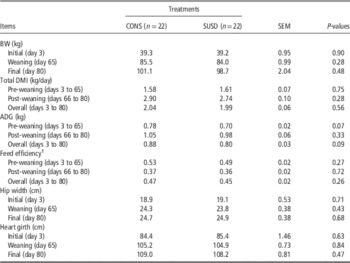
Means of total DMI, daily BW gain, feed efficiency, hip width and heart girth are presented in Table 2. Body weight at days 65 (weaning) and 80 was not different across treatments and averaged 84.8 and 99.9 kg, respectively. No difference was detected in total DMI and feed efficiency between the SUSD and CONS calves in any measurement period. No difference was observed in hip width and heart girth between the CONS and SUSD calves. However, pre-weaning and overall ADG tended to be greater in CONS than in SUSD calves (of about 80 g/day; P=0.07). Weekly starter DMI was not affected by milk-feeding method (Figure 2).
Mean (±SE) values of weekly starter intake in experiment 1. CONS=consistent milk-feeding procedure (○); SUSD=step-up/step-down milk-feeding procedure (■); DM=dry matter.

Dry matter intake (DMI), average daily gain (ADG), feed efficiency, hip width and heart girth in calves fed milk through different methods (see ‘Experiment 1’ section)
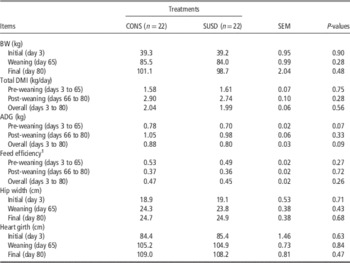
CONS=consistent milk-feeding procedure; SUSD=step-up/step-down milk-feeding procedure.
1 Feed efficiency=kg of BW gain/kg of total DMI.
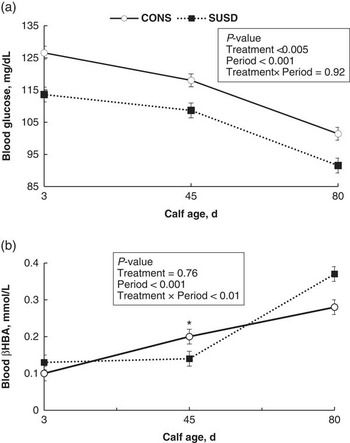
Mean plasma concentration of glucose and βHBA analyzed at three time points, including days 3 (baseline), 45 (before weaning) and 80 (end of experiment) are presented in Figure 3. Plasma glucose was consistently higher (P<0.005) with CONS calves and declined with calf age (P<0.001; Figure 3a). However, no significant treatment-by-time interaction was observed for glucose concentration. Blood βHBA was lower at day 45 in SUSD than in CONS calves and increased with calf age (P<0.001; Figure 3b).
Mean (±SE) blood concentrations of (a) glucose and (b) β-hydroxybutyrate (βHBA) in experiment 1. CONS=consistent milk-feeding procedure (○); SUSD=step-up/step-down milk-feeding procedure (■).

Experiment 2
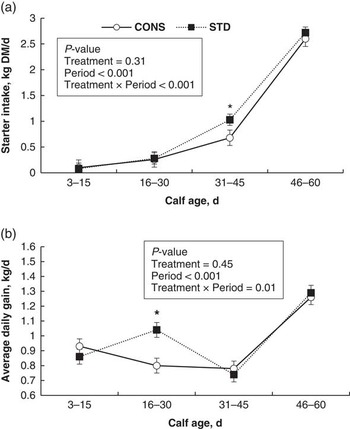
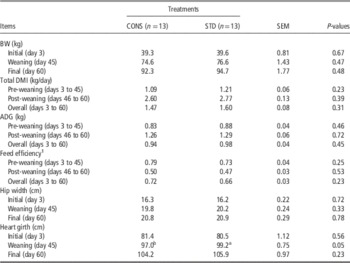
The data for total DMI, ADG, feed efficiency, hip width and heart girth are presented in Table 3. The milk-feeding program (STD v. CONS) had no effect on the performance measurements. From days 30 to 45, starter DMI was greater in STD (1.03±0.12) than in CONS (0.67±0.10; P<0.05), and increased with calf age (P<0.001; Figure 4a). However, no difference was observed in starter intake after weaning. From days 15 to 30, mean solid feed intake was similar among treatments (0.27±0.08 kg/day; mean±SE), but STD calves had greater ADG (of >240 g/day) than CONS calves during this time period (Figure 4b). Heart girth at weaning was greater in STD (99.2 cm) than in CONS animals (97.0 cm; P=0.05).
Mean (±SE) values of (a) starter intake and (b) average daily gain in experiment 2. CONS=consistent milk-feeding procedure (○); STD=step-down milk-feeding procedure (■); DM=dry matter. * denotes a significant difference.

Total dry matter intake (DMI), average daily gain (ADG), feed efficiency, hip width and heart girth in calves fed milk through different methods (see ‘Experiment 2’ section)

CONS=consistent milk-feeding procedure; STD=step-down milk-feeding procedure.
a,bLeast square means within a row with different superscripts differ (P<0.05).
1 Feed efficiency=kg of BW gain/kg of total DMI.
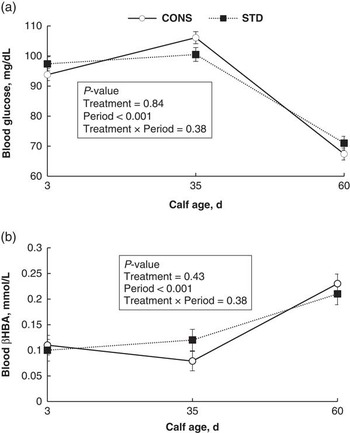
Mean plasma concentration of glucose and βHBA in calves receiving milk through CONS or STD feeding protocols, analyzed at three time points, including days 3 (baseline), 35 and 60 (end of experiment) is presented in Figure 5. Blood glucose was not affected (P=0.84) by the milk-feeding protocol but decreased with time of sampling (P<0.001; Figure 5a). Blood βHBA was unaffected by milk-feeding regimes and increased with calf age (P<0.001; Figure 5b).
Mean (±SE) blood concentrations of (a) glucose and (b) β-hydroxybutyrate (βHBA) in experiment 2. CONS=consistent milk-feeding procedure (○); STD=step-down milk-feeding procedure (■).

Discussion
To our knowledge, this is the first study to describe the influence of milk-feeding method on calf performance when the total amount of milk offered remained constant over the milk-feeding period (360±3 and 275±3 l for experiments 1 and 2, respectively). Khan et al. (Reference Khan, Lee, Lee, Kim, Kim, Ki, Ha, Lee and Choi2007b) reported that calves fed milk through a STD strategy had improvements in pre- (days 29 to 49) and post-weaning (days 50 to 63) starter DMI, growth rate and skeletal growth measurements compared with calves fed a limited amount of milk (that milk fed at 10% of their BW during the pre-weaning period). However, the difference in the total amount of milk between STD and restricted feeding program was about 120 l. More recently, Omidi-Mirzaei et al. (Reference Omidi-Mirzaei, Khorvash, Ghorbani, Pezeshki and Ghaffari2015) reported that the SUSD procedure improved the pre-weaning DMI of calves compared with the STD or conventional method. In their study, the SUSD calves received more milk (424 l) than those in the STD (262 l) or restricted (209 l) protocols. Contrary to these earlier studies suggesting that feeding large amounts of milk at variable amounts (i.e. STD or SUSD methods) improved the calf performance, the present study found that feeding milk at variable amounts did not improve starter DMI and growth rate during and after weaning. It therefore seems that the similar intake of milk before weaning among the different feeding strategies contributed to the lack of significant difference in starter DMI and growth performance of calves, which again emphasizes the important effect of total milk amount rather than method of milk feeding on calf performance. In agreement, Silper et al. (Reference Silper, Lana, Carvalho, Ferreira, Franzoni, Lima, Saturnino, Reis and Coelho2014) compared the three milk replacer feeding strategies and reported that calves fed large volumes of milk replacer at a constant rate (6l/day; 360 l) had superior performance compared with those fed milk replacer at a limited (240 l) or variable rate (300 l).
Feeding large amounts of milk during milk-feeding phase may contribute to an underdeveloped reticulorumen (Baldwin et al., Reference Baldwin, McLeod, Klotz and Heitmann2004) and the insufficient establishment of microbial ecosystem in the rumen (Terré et al., Reference Terré, Devant and Bach2007). These present challenges for calves during the transition onto solid feed such as decreased solid feed intake and digestibility of nutrients (Terré et al., Reference Terré, Devant and Bach2007; Hill et al., Reference Hill, Bateman, Aldrich and Schlotterbeck2010), and thus delayed weight gain (Bach et al., Reference Bach, Terré and Pinto2013). These consequences can even be more severe if milk feeding is terminated abruptly (Sweeney et al., Reference Sweeney, Rushen, Weary and De Passillé2010; Meale et al., Reference Meale, Leal, Martín-Tereso and Steele2015), which is why the gradual reduction in milk allowance before weaning was proposed as a solution to provide a smooth transition from milk to solid feed, with the aim to stimulate more starter intake and minimize weight depression and distress during and after weaning (Roth et al., Reference Roth, Keil, Gygax and Hillmann2009; Weary et al., Reference Weary, Huzzey and von Keyserlingk2009; Khan et al., Reference Khan, Weary and von Keyserlingk2011a). In the present study, compared with the consistent milk-feeding method, SUSD or STD method provided a more gradual rate of reduction in the offered amount of milk as calves approached the weaning age. Contrary to our expectation, growth rate and starter DMI, during and after weaning, exhibited no difference between the different milk-feeding regimes. Part of this observation might be explained by the inclusion of alfalfa hay in the starter diet in both experiments, which its provision before weaning is known to stimulate solid feed consumption and rumen–reticulum development (increased physical stimuli) (Khan et al., Reference Khan, Weary and von Keyserlingk2011a; Beiranvand et al., Reference Beiranvand, Ghorbani, Khorvash and Kazemi‐Bonchenari2014a and Reference Beiranvand, Ghorbani, Khorvash, Nabipour, Dehghan-Banadaky, Homayouni and Kargar2014b).
In general, high milk-fed calves consume less solid feed (Jasper and Weary, Reference Jasper and Weary2002; Cowles et al., Reference Cowles, White, Whitehouse and Erickson2006; Raeth-Knight et al., Reference Raeth-Knight, Chester-Jones, Hayes, Linn, Larson, Ziegler, Ziegler and Broadwater2009), which is due to a hypophagic effect triggered by the mechanical (curd formation) and chemical (greater blood insulin and glucose) stimuli (Khan et al., Reference Khan, Lee, Lee, Kim, Kim, Ki, Ha, Lee and Choi2007b and Reference Khan, Weary and von Keyserlingk2011b). In other words, less milk consumption stimulates solid feed intake and thus promotes rumen metabolic development (Bach et al., Reference Bach, Terré and Pinto2013; Meale et al., Reference Meale, Leal, Martín-Tereso and Steele2015). These might explain the greater starter DMI (from days 30 to 45) in STD than in CONS calves because from days 30 to 45 of the experiment, STD calves received 29 l less milk than CONS calves (Figure 1b). In agreement, Khan et al. (Reference Khan, Weary and von Keyserlingk2011a) found that starter DMI increased rapidly when the offered amount of milk was diminished from 8 to 4 l/day.
Calves fed milk using STD program were observed to have similar starter DMI (0.27 kg/day) but greater ADG from days 15 to 30 of age. This observation was expected because during this period (days 15 to 30), STD calves consumed 16 l more milk than CONS calves (128 v. 112 l; Figure 1b). In agreement, earlier studies reported a higher rate of growth in calves receiving higher quantities of milk, which is a function of greater nutrients provided (Bartlett et al., Reference Bartlett, McKeith, VandeHaar, Dahl and Drackley2006; Khan et al., Reference Khan, Weary and von Keyserlingk2011b; Silper et al., Reference Silper, Lana, Carvalho, Ferreira, Franzoni, Lima, Saturnino, Reis and Coelho2014). In other words, during the early weeks of life (at 5 weeks of age) the reticulorumen of calf is underdeveloped and physiologically non-functional (Khan et al., Reference Khan, Weary and von Keyserlingk2011b), which does not enable low milk-fed calves to increase their starter DMI to a level that they can entirely compensate for the lower supply of nutrients from milk (Jasper and Weary, Reference Jasper and Weary2002). Contrary to an earlier study (Jasper and Weary, Reference Jasper and Weary2002) suggesting that if the potential of calf for rapid growth during the first few weeks of life is not met by the sufficient plane of nutrition, high levels of intake later in life may not permit for compensatory growth, the present study found that STD calves did not maintain this weight advantage and ADG of STD or CONS calves was not different during and after weaning (Figure 4a).
With advancing age, calf experiences a normal physiological shift in the energy source from glucose to short-chain fatty acids (VFA) metabolism which is triggered by a transition from the liquid feed (milk or milk replacer) to solid feed and increased microbial fermentation of carbohydrates, thus contributing to the initiation of a metabolically functional rumen fermentation. These events may help explain the decreasing blood concentration of glucose with calf age (Daniels et al., Reference Daniels, Hill, Knowlton, James, McGilliard and Akers2008; Terré et al., Reference Terré, Castells, Khan and Bach2015). However, an explanation for the consistently lower glucose concentration of SUSD calves is difficult, because intake of milk or starter feed was similar between treatments at any sampling time (days 3, 45 and 80).
In the current experiments, post-weaning solid feed intake increased dramatically, which was coincided with increased blood βHBA, a marker of rumen epithelial development (ruminal ketogenesis), which its elevated concentration indicates increased ketogenic capacity of rumen epithelial cells (Lane et al., Reference Lane, Baldwin and Jesse2000). With increased solid feed consumption, fermentation occurs and the rumen begins development, which is accompanied by the greater contribution of VFA to the energy requirements of calf, thus resulting in heightened concentration of βHBA (Quigley et al., Reference Quigley, Caldwell, Sinks and Heitmann1991; Klotz and Heitmann, Reference Klotz and Heitmann2006). In overall, although the milk-feeding protocol, when total milk intake is kept constant, slightly affected the pre-weaning blood βHBA and glucose (see ‘Experiment 1’ section), the post-weaning blood metabolites were not different which is again supported by the performance measurements, which were marginally affected by milk-feeding methods.
Conclusion
When equal quantities of milk were fed during the milk-feeding period, the method of milk feeding negligibly affected starter consumption and growth rate before the weaning phase, which narrowed as calf age advanced after weaning. It appears, therefore, feeding milk at a consistent rate can be recommended as a less labor-intensive, more economical milk-feeding protocol in intensive calf-rearing operations, where feeding milk at variable amounts presents delivery errors and operational difficulties.
Acknowledgments
This project was financially supported by FKA Agriculture and Animal Husbandry (Isfahan, Iran). We gratefully acknowledge the farm staff (Jamshid Jalilnejad, Amir Khamesi-Tehrani, Mahmood Motamedi, Alireza Shafiee, Alireza Mirzakhani, Farzan Sabzevari, Vahid Moharamdi and Mohammad Mohammadi) at FKA Agri-Animal Production Co. for assisting with experiments. The authors thank Dr Farzad Hashemzadeh-Cigari, Dr Ebrahim Ghasemi of Isfahan University of Technology and Dr Mojtaba Yari of Malayer University for their technical assistance with the experiments. The authors also express their appreciation to the farm veterinarians Dr Hamid-Reza Sahabi, Dr Mehdi Safahani-Langrodi and Dr Mohsen Khosravi-Bakhtiari for their valuable assistance.