


In recent decades, economic reforms aimed at reducing the role of the state in the economy have swept the developing and formerly communist worlds. Yet, despite high hopes, the effect of these reforms has been sharply uneven. Why have similar economic reforms been successful in some environments but not others? Are reform failures the consequence of leviathan states that hinder private economic activity, or of weak states unable to implement policies effectively and provide a supportive institutional environment? We explore these questions in a study of privatization in post communist Russia. Taking advantage of large variation across Russia's regions in the size of public administrations, and employing a multilevel research design that controls for preprivatization selection in the estimation of regional privatization effects, we examine the relationship between state bureaucracy and the impact of privatization on firm productivity.
The role of the state in economic reforms has been central to the study of postcommunist transitions. In response to the sometimes disappointing outcome of these reforms, especially in the countries of the former Soviet Union, many have stressed what seems to be the particularly dysfunctional nature of postsocialist bureaucracies (e.g., Frye and Zhuravskaya Reference Frye and Zhuravskaya2000; Hellman, Jones, and Kaufmann Reference Hellman, Jones and Kaufmann2000). Beyond this general consensus, however, there is little agreement on whether the problem is too much of the wrong kind of state, one that projects a “grabbing hand,” or not enough of the right kind of state, one unable to offer a “helping hand” (Frye and Shleifer Reference Frye and Shleifer1997). Certainly rent-seeking bureaucrats raise the cost of doing business in postcommunist countries, a fact established in various cross-national enterprise surveys (e.g., EBRD 2005). At the same time, state officials have often failed to enforce contracts, implement antitrust and bankruptcy laws, and generally provide an institutional environment conducive to private economic activity (Grzymala-Busse and Jones Luong Reference Grzymala-Busse and Luong2002). Together with the relative difficulty of extracting tax revenues in many postcommunist countries (e.g., Gehlbach Reference Gehlbach2008a; Treisman Reference Treisman1999), this has led some observers to characterize postsocialist states as more “incapable” than “grabbing” (Easter Reference Easter2002).
Existing theories of the role of the state in economic development suggest two avenues by which state bureaucracies might help or hinder market-oriented reforms. The first of these stresses the structure of bureaucracies. Motivated both by the classic Weberian description of administrative effectiveness and the apparent role of the state in East Asian development (e.g., Evans Reference Evans1995; Johnson Reference Johnson1982; Kohli Reference Kohli2004; Wade Reference Wade1990), scholars have emphasized that bureaucracies work better when recruitment is meritocratic and career advancement rewards effort.Footnote 1 Economic theory provides a complementary perspective: the rent-seeking behavior of officials depends on the internal structure of the bureaucracy (i.e., on how the corruption network is organized) (Shleifer and Vishny Reference Shleifer and Vishny1993).
A second channel through which bureaucracy might affect economic performance is the size of the public administration. Large bureaucracies may have greater capacity to interfere with market mechanisms, a critique implicit in various accounts of rent-seeking and development failures (e.g., Bates Reference Bates1981; Krueger Reference Krueger1974). Yet, capacious states may also be better able to provide the public goods necessary for economic development. Notably, Botswana and Mauritius–two of the best-performing African economies–have comparatively large bureaucracies (Goldsmith Reference Goldsmith1999). Acemoglu and Verdier (Reference Acemoglu and Verdier2000) make the simple but important point that there may be a trade-off between market failures and corruption. The optimal bureaucracy size is therefore greater than zero but smaller than would be the case if all bureaucrats were honest.
Incentives within state organizations may also be affected by the number of bureaucrats, with the presence and direction of any effect dependent on various factors (Shleifer and Vishny Reference Shleifer and Vishny1993). To start with, if bureaucrats collude, then size may not matter for rent-seeking behavior. That said, the more bureaucrats there are, the more difficult collusion is likely to be. If bureaucrats do fail to collude, then there are two further cases to consider. On the one hand, the power of any individual bureaucrat to extract rents may be less when bureaucrats are numerous if they compete to provide the same service (e.g., license or permit). In this case, where bureaucrats are substitutes for one another, the environment for private economic activity is better when there are more bureaucrats. Alternatively, when bureaucrats provide separate services that are complementary from a private actor's point of view, each additional bureaucrat may act as a “toll taker” who fails to internalize the impact of his or her “toll” (e.g., bribe) on the demand for other bureaucrats' services. In this environment, an increase in the number of bureaucrats raises total corruption and worsens the business environment.
Given the diversity of possible effects, whether bureaucracy helps or hinders market-oriented reforms is as much an empirical as a theoretical question. In this article, we focus especially on the latter of the two general perspectives discussed earlier, examining the impact of bureaucracy size on postsocialist economic reforms. Postcommunist governments were asked to perform tasks fundamentally different from those of their communist predecessors, and the sheer number of bureaucratic agents may have influenced the degree to which they could provide the necessary institutional support for new markets. Critically, the bureaucracies of Eastern Europe and the former Soviet Union are not large by world standards, and some–most notably Russia's–are in fact quite small (Brym and Gimpelson Reference Brym and Gimpelson2004).Footnote 2 At the same time, the collapse of the party-state apparatus increased the scope for opportunistic behavior by autonomous state officials. In an environment of noncollusive corruption, larger bureaucracies might be associated with either less or more rent-seeking, depending on whether bureaucrats are complements or substitutes for each other.
In particular, we investigate the relationship between bureaucracy size and the effectiveness of privatization, the central policy in the effort to transform economies oriented around public ownership and bureaucratic coordination into ones where private economic activity and market coordination predominate. The premise of this policy was that the profit-motivated owners of privatized enterprises would engage in active restructuring to improve their firms' performance. Unlike passive state-owned enterprises, privatized firms were expected to invest in new technology and equipment, lay off surplus labor or restructure their workforces, and develop improved or completely new products and markets. In each case, the active participation and cooperation of the bureaucracy would be essential. A bureaucracy geared toward grabbing, or one that was simply incapable, could raise the costs of any actions that the new private owners might want to carry out, and in the limit might prevent any improvements from taking place. In contrast, a bureaucracy oriented toward helping would issue the necessary permits and approvals, and provide the complementary legal infrastructure that would reduce the costs of restructuring. The opportunities for bureaucratic influence–both predatory and supportive–are therefore especially important for privatized firms, such that an examination of the relationship between state bureaucracy and privatization effectiveness offers an important test of the role of the state in market-oriented economic reforms.
To explore the relationship between state bureaucracy and privatization effectiveness, we exploit a unique panel data set spanning the years 1985 to 2004 on the performance of nearly 25,000 state-owned and privatized firms in 77 Russian regions, taking advantage of large regional variation in bureaucracy size for reasons exogenous to the postcommunist transition. Using statistical methods originally developed to control for selection bias in labor market programs, we estimate the impact of privatization on firm performance at the regional level while controlling for the possibility that firms with systematically different levels of and growth rates in productivity were more likely to be selected for privatization. We find large regional variation in the impact of privatization on multifactor productivity. We then examine region-level determinants of estimated regional privatization effectiveness, focusing on the size of state bureaucracy, measured as the number of employees in public administration (not public employment more generally), controlling for population. This focus on within-country variation allows us to hold constant many features of the macroeconomic environment and privatization policy design that vary across countries, while focusing on institutional variation as an explanation for variation in privatization outcomes.
We find that privatization has a larger (more positive) effect on firm performance in regions with relatively large state bureaucracies. The estimated effect–which controls for regional differences in industrial structure–is quite large and robust to model specification (including estimation by OLS, FGLS, and 2SLS), choice of sample, and inclusion of numerous controls. Differences in the predicted effectiveness of privatization in regions with large and small bureaucracies are comparable in magnitude to observed differences in privatization effectiveness across postcommunist countries. Our estimates suggest that this effect is driven by increases in the performance of privatized firms in regions with relatively large bureaucracies rather than decreases in the performance of state-owned enterprises. Furthermore, we find that of the three categories of bureaucrats for which we have disaggregated data, the impact on privatization effectiveness is limited to variation in the size of regional and local executive branch bureaucracies, which plausibly have the greatest influence over the regional business environment. We observe little evidence that state bureaucracy influences privatization effectiveness through privatization program implementation, as might be the case if more effective owners were selected in regions with relatively large bureaucracies. In contrast, we find some evidence using data from two recent surveys of Russian firms that the size of regional and local bureaucracies affects the postprivatization business environment, with private firms in regions with relatively large bureaucracies reporting shorter waiting times and fewer bribes when dealing with bureaucrats.
This article proceeds as follows. In the following section, we review the literature on postcommunist privatization and firm performance, emphasizing the puzzles that have been raised by this research and how our paper helps to address them. We then introduce our data and discuss our empirical strategy. Following this, we present our main findings, establishing a positive relationship between bureaucracy size and privatization effectiveness, and we explore two alternative mechanisms through which this relationship might operate. We offer concluding thoughts in the final section.
RESEARCH ON POSTCOMMUNIST PRIVATIZATION AND FIRM PERFORMANCE
The design of privatization policies and their consequences for firm performance have been among the most discussed and researched issues in postcommunist Eastern Europe and the former Soviet Union. From the early 1990s, many policy makers and observers viewed privatization as the linchpin of a strategy to improve managerial incentives, encourage firm restructuring, and generally effect a shift to a “private property regime” (Frydman and Rapaczynski Reference Frydman and Rapaczynski1994, 169). The initial enthusiasm for ownership change led in most countries to rapid divestment through programs of “mass privatization,” which generally used vouchers for citizens to acquire shares (Blanchard et al. Reference Blanchard, Boycko, Dabrowski, Dornbusch, Layard and Shleifer1993; Boycko, Shleifer, and Vishny Reference Boycko, Shleifer and Vishny1995). Some of these programs also gave special preferences to employees of the companies concerned, leading to large-scale ownership by managers and workers, in degrees varying with the design of the program and with the particular outcomes for each company. The emphasis on privatization became decidedly less fashionable in the late 1990s, as many critics argued that the programs either had done little good and resulted in misplaced priorities (e.g., by neglecting institutional change) or had actually caused damage (e.g., by facilitating asset stripping) (e.g., Roland Reference Roland, Pleskovic and Stern2001; Stiglitz Reference Stiglitz1999).
Yet, until recently, the empirical support for either position was quite weak. The pro-privatization enthusiasm at the beginning of transition had little or no relevant previous experience that could serve as its basis, and there had been few systematic studies by the late 1990s to corroborate the negative views of the critics. The little evidence available to support such evaluations was limited to either macroeconomic performance indicators or detailed observations of a few firms. Just as the critics' position, which was part of a broader attack on the “Washington consensus,” seemed to become dominant, a surge of statistical studies of privatized firms appeared. These studies, as summarized in Megginson and Netter (Reference Megginson and Netter2001) and Djankov and Murrell (Reference Djankov and Murrell2002), tended to find positive effects of privatization on measures of firm performance in many countries. However, the studies suffered from enough methodological weaknesses to make them ineffective in persuading most skeptics.
Among the important methodological problems in the research summarized in these reviews are small sample size and short time series, with concomitant inability to conduct meaningful comparisons and control for selection bias in the privatization process. Short of a randomized experiment, an analysis of privatization effects requires detailed panel data containing a large enough number of privatized and state-owned firms within industries and a long time series of observations on each firm before and after the privatization process. Yet, nearly all studies until the early 2000s used survey samples of at most a few hundred firms, and the data were either cross-sectional or had only a few years of data at best. The small samples made it difficult to carry out appropriate comparisons, so that privatized firms in some industries were evaluated relative to state-owned firms in others. The short time series made it difficult to take into account possible biases in the selection of firms to be privatized. For example, if firms with inherently higher productivity or more rapidly growing productivity have a higher probability of privatization, then a simple comparison of pre- and postprivatization performance would result in a positively biased estimate of the true privatization effect.
These methodological issues have been addressed in more recent research, in particular, by Brown, Earle, and Telegdy (Reference Brown, Earle and Telegdy2006). Their results for Hungary, Romania, Russia, and Ukraine provide much stronger support for the earlier conclusion of the Djankov and Murrell (Reference Djankov and Murrell2002) survey that the effect of privatization is considerably stronger in Eastern Europe than the CIS.Footnote 3 However, the pattern across countries raises some puzzles: Although the effect of privatization to foreign investors on productivity is uniformly positive and large (generally 20%–40%, depending on the precise specification), the effect of privatization with new domestic owners is largest in Romania (14%–24%), followed by Hungary (5%–15%) and Ukraine (2%–4%).Footnote 4 The estimates are actually negative for Russia, and although small in magnitude (−3% to −5%), they are always statistically significantly different from zero. Further analysis of the dynamics of these effects shows that whereas in Hungary, Romania, and Ukraine the impact of privatization tended to be fairly immediate (i.e., in the first postprivatization year, with a slight lag in Ukraine), in Russia the initial effect was distinctly negative and progressively worse through the first four postprivatization years, with a modest positive impact appearing only after about seven years.
Why does the effectiveness of privatization vary so much, and why is the Russian effect zero or even negative? A leading hypothesis is that institutional variation across countries plays a role in producing these divergent outcomes–Miller and Tenev (Reference Miller and Tenev2007) write, for example, that Russian privatization was “implemented in an environment of a weak state, which did not have the capacity to protect its ownership rights and coordinate reforms”–but this explanation alone is inconsistent with the finding that Romania's privatization impact is larger than Hungary's, and Ukraine's larger than Russia's.Footnote 5 The much debated methods of privatization might also be part of the answer, and that explanation is certainly consistent with the much larger and more uniform effect of ownership by foreign investors, but it does not fully account for the cross-country differences in the estimates. Among other candidate explanations, Brown, Earle, and Telegdy (Reference Brown, Earle and Telegdy2006) find little systematic variation in effectiveness of privatization by cohort (which could arise from changes over time in privatization methods or from learning about how to implement privatization more effectively), calendar year (different macroeconomic conditions or business environments across time), growth in the firm's industry, or industrial composition.
A major difficulty in these attempts to identify the source of variation in privatization effectiveness is that the small number of countries for which careful estimates of privatization effectiveness are available precludes reliable statistical analysis. Moreover, there is substantial variation across postcommunist countries in privatization design and macroeconomic performance, both of which may affect institutional development and privatization performance, and thus much heterogeneity that is difficult to hold constant in cross-national comparisons. Our focus on Russia in this article allows us to take advantage of institutional variation across a comparatively large number of regions, as well as variation in the impact of privatization on firm performance. We are thus able to more carefully investigate one candidate explanation for cross-sectional variation in privatization effectiveness, even while holding basic privatization design and the general macroeconomic environment constant to a degree not possible in multicountry studies. Our particular emphasis on state bureaucracy addresses the fundamental question about postcommunist institutions we raised earlier: is the problem too much of the wrong state, or not enough of the right one?
DATA
As briefly outlined previously and discussed more fully in the following section, our research design employs a multilevel approach. We first use panel data on manufacturing enterprises in Russia to estimate the effect of privatization on firm-level multifactor productivity at the regional level, following which we identify regional determinants of privatization effectiveness. The firm-level data we use for the first exercise are collected by the Federal State Statistics Service (Rosstat), the Russian successor to the corresponding agency in the USSR. The basic statistical methodologies and data collection mechanisms have remained unchanged throughout this period. We combine information from industrial enterprise registries with joint venture registries and balance sheet data to construct comprehensive data and fill in missing values.
According to the Federal State Statistics Service, the industrial registries are supposed to include all industrial firms with more than 100 employees, plus those that are more than 25% owned by the state and/or by legal entities that are themselves included in the registry. In fact, the practice seems to be that once firms enter the registries, they continue to report even if the original conditions for inclusion are no longer satisfied. The data may therefore be taken as corresponding to the “old” sector of firms (and their successors) inherited from the Soviet system. Certainly with respect to this set of firms, the databases are quite comprehensive. At the beginning of the transition process in 1992, the firms in the Russian industrial registry accounted for 91% of officially reported total industrial employment. The Russian data are available as an unbalanced panel from 1985 to 2004.
We exclude nonmanufacturing sectors and nonprofit organizations from this data set. To focus on the effects of privatization with a relatively homogeneous comparison group, we also include only firms that are state owned on entry into the database. Finally, we retain firm-years in the sample only when they contain complete information, which does not reduce the sample appreciably. The resulting sample of initially state-owned firms, some of which were then privatized, contains information on 24,684 enterprises, with 269,390 firm-year observations from 1985 to 2004.
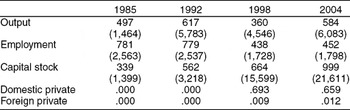
Table 1 presents summary statistics for the firm-level variables used in this analysis. The data include measures of Output, Employment, and Capital stock, as well as industry affiliation and regional location. The data do not contain an ownership variable prior to 1993, nor do they distinguish between minority and majority shares, instead containing codes for 100% state, mixed state-private, 100% (domestic) private, joint ventures, and 100% foreign. Mixed state-private and 100% (domestic) private are both labeled Domestic private: virtually all privatizations in our data are mass privatizations (not lease buyouts), so the earliest they could have taken place was October 1992, and other sources suggest that nearly all of these led to majority private ownership (e.g., Boycko, Shleifer, and Vishny Reference Boycko, Shleifer and Vishny1995). We classify all joint ventures as Foreign private, combining them with the 100% foreign category, but together they comprise only about 1% of the sample by the end of the period of observation. As we discuss later, our emphasis is on the relationship between privatization to domestic owners and firm productivity; the foreign variable is included only as a control.
Firm-Level Variables and Summary Statistics

Notes: Means and standard deviations. Capital and output are expressed in constant 2004 million rubles. Output equals the value of gross output net of VAT and excise taxes. Employment equals the average number of registered industrial production personnel, which includes nonproduction workers, but excludes “nonindustrial” employees who mainly provide employee benefits. Capital equals the average book value of fixed assets used in the main activity of the enterprise, adjusted for revaluations. The domestic and foreign private dummies are based on Rosstat ownership classifications as of December 31 of the previous year. The nonmonotonicity of the mean of the domestic private dummy is due to split-ups of state-owned firms that are subject to later privatization.
To measure bureaucracy size in each region, we use employment in federal, regional, and local public administration per 1,000 residents, which we term Bureaucracy (with “per 1,000 residents” implied), provided for the years 1995 to 2004 by the Federal State Statistics Service. This category is far narrower than all public employment, excluding teachers, doctors, and other state employees not part of the bureaucracy. Included are employees of the executive, legislative, and judicial branches of government, with the exception of personnel of the Ministries of Interior (i.e., police) and Defense, which are excluded by Rosstat. Approximately three-fourths of the employees in our bureaucracy measure are civil servants, with the remainder being support staff such as secretaries and drivers (Brym and Gimpelson Reference Brym and Gimpelson2004); data for 2004 suggest little regional variation in the ratio between the two. For some exercises, we disaggregate public administration employment into three broad categories for which data are available from 1995 to 2004: executive branch employees formally subordinated to the federal government (Federal executive bureaucracy); executive branch employees formally subordinated to regional and local governments (Regional/local executive bureaucracy); and public administration employees in other branches of government (Bureaucracy, other branches), the vast majority of whom work either in the court system or the procuracy.
Because we estimate an average regional privatization effect–not a separate effect for each region-year–we average public administration employment per 1,000 residents from 1995 to 2004 in most regressions; we discuss possible endogeneity concerns associated with this treatment in what follows. We use the log of this measure, and in all regressions, we control for the log of regional Population in the appropriate period (e.g., log of average population from 1995 to 2004). This specification accounts for economies of scale in public administration (e.g., Alesina and Spolaore Reference Alesina and Spolaore2003; Gehlbach Reference Gehlbach2008b), which imply that per capita bureaucracy will be smaller on average in more populous regions,Footnote 6 and controls for the direct impact of population on privatization effectiveness (e.g., through attractiveness to investors, given fixed costs of investment in a region).
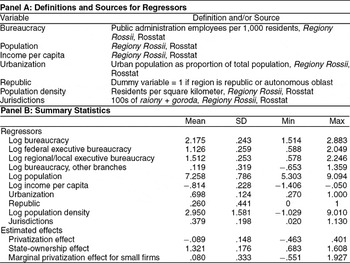
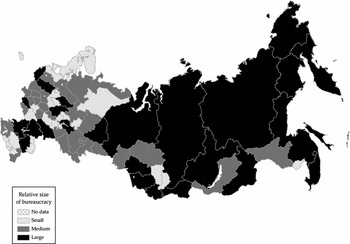
As Table 2 and Figure 1 illustrate, there is substantial and systematic variation across regions in our measure of public administration employment. This variation appears to be driven in part by historical experience and other idiosyncratic factors: It is remarkably stable over time–the bivariate correlation between any two adjacent years is never below .99–and not fully explained by other regional characteristics. In particular, although there is a general increase in the size of bureaucracies over this period, this affects all regions more or less equally, as would be the case if employment in any given year were benchmarked against previous year staffing levels. Moreover, as Gimpelson and Treisman (Reference Gimpelson and Treisman2002) report, any variation over time appears not to be driven by changes in regional revenues, as might be the case if variation in economic performance produced variation in public administration employment. Nonetheless, to ensure that our use of average public administration employment does not drive our results, we reran all regressions reported below using public administration employment in 1995 rather than average employment; the results are qualitatively similar.
Variable Definitions, Sources, and Summary Statistics for Region-Level Variables
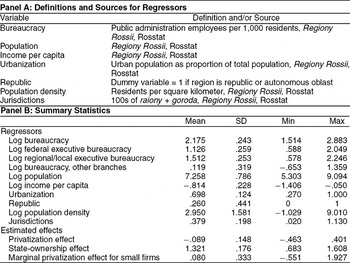
Notes: Privatization effect, state ownership effect, and marginal privatization effect for small firms estimated from firm-level data summarized in Table 1; see text for details.
Regional Variation in State Bureaucracy

The stability of regional variation in public administration employment suggests little reason to be concerned that bureaucracy is endogenous to regional privatization effectiveness. Nonetheless, our estimates of the impact of state bureaucracy on privatization effectiveness could be biased by the omission of some regional characteristic correlated with both public administration employment and privatization effectiveness. Although our results are robust to the inclusion of numerous covariates, as a further robustness check we employ instrumental variables techniques, identifying the impact of state bureaucracy from plausibly exogenous regional variation in public administration employment. In particular, we instrument (log) bureaucracy on log Population density and number of Jurisdictions. These variables affect the size of bureaucracy through two different types of scale economies, the former because less densely populated regions may require relatively more bureaucrats, and the latter because regions with more jurisdictions require more bureaucrats.Footnote 7 As a consequence, any effect of bureaucracy on privatization effectiveness identified through this instrumentation strategy is likely to operate through incentives within the bureaucracy rather than through capacity, as bureaucracies that are larger for only these reasons may not be physically more capable of producing public goods or intervening in the economy (e.g., because any individual bureaucrat would spend more time transporting him- or herself across a Siberian region than across Moscow). We report Hansen J statistics from such two-stage least-squares regressions to test the assumptions that these instruments have been properly excluded.
In addition to log population, in our region-level regressions we control for a number of characteristics that may be correlated with both regional privatization effectiveness and our measure of state bureaucracy. We include (log) Income per capita and Urbanization because both variables may affect product and input markets and so potentially the gains from privatization, and because they could also reflect the demand for shares in the privatization process. As these variables may in turn be affected by the success of privatization, we use data from 1991, before the initiation of mass privatization in Russia, although as we discuss our results are robust to using values from later years. We also include a dummy variable equal to one if the region is an ethnic Republic (20 regions, including the Jewish Autonomous Oblast, which has a unique jurisdictional designation) because the legal and institutional environment might differ in regions granted more autonomy.Footnote 8 In further robustness checks, we also control for a number of other geographic, economic, and political characteristics of regions, as described in what follows.
EMPIRICAL STRATEGY
We employ a multilevel research design that first estimates regional privatization effectiveness from firm-level data and then regresses those region-level estimates on various regional characteristics. For the first stage of this two-stage procedure, we follow the estimation approach of Brown, Earle, and Telegdy (Reference Brown, Earle and Telegdy2006) in using program evaluation techniques to assess and control for selection bias in the privatization process. Brown, Earle, and Telegdy show that estimated effects of privatization are extremely sensitive to the specification of underlying heterogeneity across firms, and they demonstrate that the data imply that firms selected for privatization not only tend to be more productive on average than firms remaining state owned, but also exhibit faster productivity growth. Once these two idiosyncratic factors are taken into account, however, no discernable selection bias remains. A number of specification tests imply that the specification containing both a firm fixed effect (FE) and a firm-specific trend (FT) is preferred to specifications omitting these components, and we thus employ this specification (FE&FT) to estimate regionally varying privatization effects in this article. We also permit the technology parameters to vary across industries, and we include a full set of industry-year effects to control for time-varying industry characteristics and shocks that may be correlated with both ownership and productivity.
Our estimating equation for multifactor productivity in the first stage is

where j indexes firms and t indexes 20 time periods (years 1985 to 2004). The variable xjt is output, f is a 1 × 10 vector of industry-specific production functions, kjt is capital stock, ljt is employment, Y is a 1 × 200 vector of industry-year interaction dummies, γ is the associated 200 × 1 vector of coefficients, wt is a vector of aggregate time variables, αj is the vector of associated individual-specific slopes, Fjt is an indicator of whether the firm was foreign owned at the end of year t − 1, and φ is the associated coefficient. The variable Djt is an indicator for domestic private ownership, I is a 1 × 10 vector of industry dummies with θ the associated vector of coefficients, R is a 1 × 77 vector of region dummies, and δ is the vector of coefficients of interest in this article: the region-level productivity effect of domestic privatization. Finally, ηjt is an idiosyncratic error.
Concerning the functional form of f, we focus on the Cobb-Douglas function in this article, as Brown, Earle, and Telegdy (Reference Brown, Earle and Telegdy2006) show that estimated privatization effects are robust to alternative functional forms (including translogs and a variety of assumed factor shares). The estimated functions are permitted to vary across industries, and the inclusion of interactions between domestic private ownership and industry dummies removes the effect of regional variation in industrial composition. We always include a full set of unrestricted industry-year interactions, the Y, which allows different productivity levels for each industry in each year, controlling for any time- and industry-varying factors such as price changes not captured by deflators, unmeasured factors of production, and quality differences across industry-year cells.
Our methods of controlling for selection bias are embodied in the specification of wt. The FE&FT model has wt ≡ 1, t), so that αj ≡ α1j, α2j), where α1j is a fixed unobserved effect and α2j is the specific trend for firm j. In practice, the FE&FT model is estimated in two steps: the first detrends all variables for each firm separately, and the second estimates the model on the detrended data. Standard errors are corrected for correlation of error terms across observations for the same firm.Footnote 9
Given the small number of foreign-privatized firms in our data set, we do not attempt to estimate a separate foreign privatization effect for each region, but rather assume an effect φ that is constant across regions. In fact, as discussed previously, Brown, Earle, and Telegdy (Reference Brown, Earle and Telegdy2006) find uniformly positive and large effects of foreign privatization across the countries in their study, in contrast to the quite different effects of domestic privatization that are our focus.Footnote 10 For conciseness, we often refer simply to estimated privatization effects, omitting the qualifier “domestic.”
For the second stage of our multilevel procedure, we want to estimate parameters of the model δr = θ + Brζ + Zrμ + ur, where δr is the productivity effect of domestic privatization for region r; θ is a constant; Br is log bureaucracy and ζ the associated coefficient; Zr is a vector of control variables described in the previous section, including log population, with μ the associated vector of coefficients; and ur is an error term with spherical variance σ2. We do not, however, observe δr directly, but instead have an estimate  r = δr + vr from estimation of Equation (1). Our estimating equation for the second stage is therefore
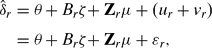
where we define ϵr ≡ ur + vr and assume that ur and vr are independent. The difficulty in estimating Equation (2) is that the precision of first-stage estimates of δr will generally be greater in regions with more firm-year observations, implying that ϵr will have smaller variance in such regions. Estimation of Equation (2) by ordinary least squares would therefore be inefficient and could produce inconsistent standard errors.
We address this problem of second-stage heteroskedasticity in two ways. First, we simply estimate Equation (2) by ordinary least squares but calculate heteroskedasticity robust standard errors. This produces consistent parameter estimates and standard errors, but it does not exploit the known variance structure arising from the first-stage estimation procedure. Second, we employ a feasible generalized least squares (FGLS) estimator first suggested by Hanushek (Reference Hanushek1974; see Lewis and Linzer Reference Lewis and Linzer2005, and Jusko and Shively Reference Jusko and Shively2005, for recent treatments).Footnote 11 The logic of this estimator is that more weight should be given to regions where δr has been estimated relatively precisely, but only to the degree that vr is an important component of ϵr.
Formally, denote the standard error of r from first-stage (firm-level) estimation as  r, and the N × N estimated variance matrix (where N is the number of regions) associated with the vector as
 . Furthermore, denote the residual for region r from OLS estimation of Equation (2) as er. An unbiased estimate of σ2 is thus
 , where K is the number of regressors in the second-stage model, and X is the N × K matrix of regressors. We then define the estimated variance matrix
 for use in FGLS estimation.
As discussed in the previous section, we check the robustness of our results by instrumenting bureaucracy on population density and the number of jurisdictions at the regional level. We present results from two-stage least-squares regressions, calculating heteroskedasticity robust standard errors to account for heteroskedasticity arising from estimation of regional privatization effects.
RESULTS
This section begins by discussing results for the key relationship in this article: the impact of bureaucracy size on the effectiveness of privatization. Next, we summarize the results from a large number of robustness exercises, including controlling for possibly confounding influences and employing instrumental variables. Finally, we discuss some issues of interpretation, and we disaggregate the bureaucracy variable to assess which level and branch of government may be responsible for the overall relationship we have documented.
Estimating the Impact of Bureaucracy on Privatization Effectiveness
In the first stage of our multilevel procedure, we estimate the region-level productivity effect of domestic privatization from firm-level data. Because we include both firm fixed effects and firm-specific trends in Equation (1), these estimates are based on deviations resulting from privatization from the productivity trend for each individual firm, controlling for industry-year shocks.Footnote 12 Furthermore, because Equation (1) allows the privatization effect to vary across sectors as well as regions, our estimates of regional privatization effectiveness control for the composition of regional industry (e.g., that Tyumen has more firms in natural resource processing than does St. Petersburg).
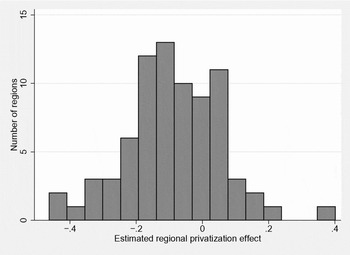
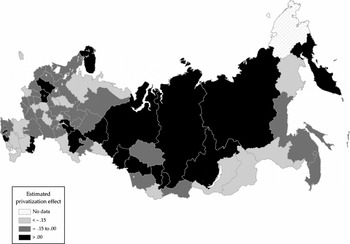
The estimated regional effects display large variation, ranging from a 46% reduction in multifactor productivity in the Jewish Autonomous Oblast to a 40% increase in Kamchatka,Footnote 13 with an unweighted mean across regions of minus 9%. Figure 2 illustrates the frequency distribution of these estimates, and Figure 3 provides a map.
Frequency Distribution of Estimated Privatization Effects

Geographic Distribution of Estimated Privatization Effects

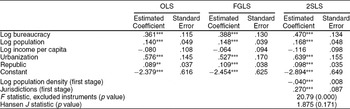
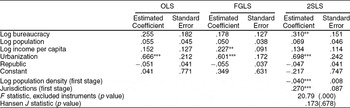
Table 3 summarizes the key result of this article, the estimated impact of state bureaucracy size on regional privatization effectiveness. The first two columns present OLS and FGLS regressions of our estimates of regional privatization effectiveness on log bureaucracy (per 1,000 residents) and the covariates discussed previously. In each regression, the estimated effect of log bureaucracy on regional privatization effectiveness is large and statistically significant. The estimated effect of bureaucracy size is slightly larger in the FGLS regression, where greater weight is given to regions in which first-stage privatization effects are estimated with relative precision. Controlling for other regional characteristics, a one standard deviation increase in log public administration employment is associated with an increase in regional privatization effectiveness of approximately 9 percentage points. To put this result in perspective, Brown, Earle, and Telegdy (Reference Brown, Earle and Telegdy2006), using the same (FE&FT) estimation method that we employ in the first stage of our multilevel procedure, estimate the impact of privatization to domestic owners in four postcommunist countries to range from −3% in Russia to 14% in Romania. Thus, variation in bureaucracy size within Russia is associated with differences in privatization effectiveness comparable to those observed across postcommunist countries.
State Bureaucracy and Privatization Effectiveness

Notes: Dependent variable is estimated regional privatization effect from firm-level FE&FT regression. Log population density and number of jurisdictions used as instruments in 2SLS regression. Heteroskedasticity robust standard errors reported for OLS and 2SLS regressions. See text for details on FGLS estimator. N = 77 in all regressions. Significance levels: *** = .01, ** = .05, * = .10.
Robustness
This estimated relationship is robust to changes in specification and sample. As discussed previously, we obtain a similar estimate of the relationship between state bureaucracy and privatization effectiveness if we substitute log bureaucracy in 1995 for the log of average bureaucracy from 1995 to 2004. We also replaced our regional characteristics with values for various years between 1995 and 2004, with no fundamental change in our results.Footnote 14 Our results are also essentially unchanged if we run the OLS model having excluded influential observations (i.e., those with large DFBETA statistics).Footnote 15 Moreover, we obtain similar results from a one-stage “interaction model,” where we model the regional privatization effect as a deterministic function of regional characteristics. We have checked that our results are robust to exclusion of Moscow and St. Petersburg from the sample and to inclusion of numerous other covariates, including regional output and employment concentration; quality of local transportation infrastructure; distance from Moscow; share of population in higher education; mean January temperature; border region; presence of a semiautonomous region embedded within the larger region; proxies for democracy, government transparency, media freedom, party strength, and governor power; and vote for Yeltsin in 1991.Footnote 16
Our results thus point to a strong effect of bureaucracy size on privatization effectiveness. In principle, this relationship could be spurious if large bureaucracies were also better paid, as greater formal compensation may encourage bureaucrats to exert effort and refrain from rent seeking. To verify that this is not driving our results, we constructed various measures of expenditures on government administration, adjusting for regional CPI and considering different aggregations across levels of government. Although positively correlated with bureaucracy size after controlling for population, inclusion of (the log of) these measures produces little substantive change in our results, and the estimated effect of the expense variables themselves is never significant.
In principle, the bureaucracy–privatization effectiveness relationship could also be spurious if privatization were more effective in natural resource processing sectors and if regions with more firms in natural resource processing also happened to have larger bureaucracies.Footnote 17 As we previously discussed, however, such “composition effects” are removed in the first stage of our multilevel procedure (Equation (1)), which allows the privatization effect to vary across sector. In other words, the privatization effect is more positive for firms in a given sector (e.g., natural resource processing) in regions with large bureaucracies than it is for firms in the same sector in regions with small ones. It is also possible that the bureaucracy privatization result could be driven by natural resources through other channels (e.g., for political economy reasons, or if the other manufacturing firms in the region use more natural resource-intensive production processes than firms in their sector in other regions). We therefore confirmed that the results are robust to the inclusion of share of regional output in resource extraction in the second-stage regression.
Further evidence that bureaucracy size drives privatization effectiveness comes from our instrumental variables regression, presented in the last column of Table 3, where population density and number of jurisdictions are the instruments excluded from the second stage. Both instruments are strongly correlated with bureaucracy in the first stage of the 2SLS regression, in a direction consistent with scale economies in public administration, and the Hansen J statistic (which allows a test of overidentification in the presence of heteroskedasticity) provides evidence that these variables are properly excluded. The second-stage estimate of the impact of bureaucracy on privatization effectiveness is statistically significant and of a magnitude slightly larger than in the FGLS regression.
As discussed earlier, this instrumental variables regression can also shed some light on whether the bureaucracy effect works through increased capacity and/or improved incentives. Bureaucracies that are larger only because of scale diseconomies (i.e., when population density is low and jurisdictions are numerous) may not be physically more capable of producing public goods or intervening in the economy. Thus, the positive estimated effect of bureaucracy in the instrumental variables regression suggests that bureaucracy size may work through incentives, introducing competition among bureaucrats and thus improving the environment for privatized firms. Consistent with this interpretation, Shetinin et al. (Reference Shetinin, Zamulin, Zhuravskaya and Yakovlev2005) report that regional officials in Russia often issue permits in areas where they have no formal licensing authority, with the cost of such permits less than that of the corresponding licenses from federal authorities. If firms are able to choose among such approvals, then the cost of acquiring licenses to engage in economic activity could be negatively associated with the number of regional officials. We present further evidence of this effect in the discussion of mechanisms that follows.
Interpretation and Disaggregation
In principle, a positive estimated relationship between state bureaucracy and regional privatization effectiveness could reflect two different effects. First and perhaps most obviously, it is possible that larger bureaucracies improve the performance of privatized firms, while having less impact on state-owned enterprises. Second, it may be that large state bureaucracies find it easier to meddle in the affairs of state-owned enterprises, thus worsening their performance; to the extent that bureaucrats are unable or disinclined to similarly interfere with the operation of privatized firms, the estimated impact of privatization on firm performance would be greater in regions with relatively large bureaucracies. Combinations of both effects are also possible.
Unfortunately, we cannot evaluate these possibilities in any specification that includes firm fixed effects, as in any such specification only the relative magnitude of firm characteristics can be estimated. The only way to address this issue is in a pooled OLS context, in which it is possible to estimate separate regional effects for state and private firms. We therefore estimate the following equation:

This equation differs from Equation (1) in omitting the detrending term wtαj, and in including separate ownership–industry and ownership–region interactions for state-owned (Sjt = 1, Djt = 0) and domestically owned private (Sjt = 0, Djt = 1) firms. Given the issues associated with selection bias in the privatization process, the difference in estimated regional private (ν) and state (χ) effects is not our preferred estimate of regional privatization effectiveness. What is of interest is whether the estimated state effect is the same or larger in regions with relatively large bureaucracies. If that is the case, then the evidence would suggest that state bureaucracy improves privatization effectiveness by disproportionately improving the performance of privatized firms, rather than by worsening the performance of state-owned enterprises.
Table 4 presents results from regressions of the state effect estimated in Equation (OLS) on state bureaucracy and other regional characteristics, using the same three estimators as in Table 3. In each specification, the estimated coefficient on log bureaucracy is positive, and in the 2SLS specification, it is statistically significant. The evidence implies that state bureaucracy does not affect privatization performance by making state-owned enterprises worse off; on the contrary, bureaucracy may improve state enterprise efficiency. However, the estimated effect of bureaucracy on the productivity of privatized firms is even greater.Footnote 18 On balance, the hand of the state “helps” rather than “grabs.”
Impact of State Bureaucracy on State-Owned Enterprises

Notes: Dependent variable is estimated regional state ownership effect from firm-level OLS regression. Log population density and number of jurisdictions used as instruments in 2SLS regression. Heteroskedasticity robust standard errors reported for OLS and 2SLS regressions. See text for details on FGLS estimator. N = 77 in all regressions. Significance levels: *** = .01, ** = .05, * = .10.
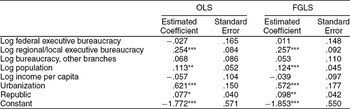
But which hand? Table 5 reports results from regressions analogous to those in Equation (2), but with disaggregated state bureaucracy. (Because we have three bureaucracy categories but only two instruments, we cannot employ our instrumental variables estimator here.) Of the three categories for which we have annual data from 1995 to 2004, only regional/local executive branch bureaucracy is associated with privatization effectiveness. This is consistent with an interpretation of regional and local bureaucracies as having the most direct influence over the regional business environment. The Department of Economic Planning and Industrial Policy in the Siberian region of Krasnoyarsk, for example, has wide-ranging influence over local economic activity, including regulation of energy tariffs, price regulation for medicines and for all goods sold in the far north, licensing in certain sectors of the economy, and regional property management. The federal bureaucracy, in contrast, is represented to a substantial extent by regional offices of Rosstat, the Central Bank, the Pension Fund, and other such agencies.Footnote 19
State Bureaucracy and Privatization Effectiveness: Branch and Subordination

Notes: Dependent variable is estimated regional privatization effect from firm-level FE&FT regression. Heteroskedasticity robust standard errors reported for OLS regression. See text for details on FGLS estimator. N = 77 in all regressions. Significance levels: *** = .01, ** = .05, * = .10.
In principle, it is possible that this result is driven by variation in the power of regional governors vis-à-vis the center if that variation is reflected in variation in the relative size of regional and federal bureaucracies. However, if we include the ratio of regional/local to federal employees together with (log) bureaucracy, then the estimated impact of bureaucracy is statistically significant, as in Table 3, whereas that of the ratio of regional/local to federal employees is not.
The evidence in this section is thus that bureaucracy size, and in particular the number of bureaucrats employed by the executive branch of regional and local governments, is associated with better privatization performance. In the following section, we explore two alternative mechanisms through which this effect might have operated.
STATE BUREAUCRACY AND PRIVATIZATION EFFECTIVENESS: MECHANISMS
Why do privatized firms perform better in regions with relatively large state bureaucracies, and in particular, with relatively large regional executive branch bureaucracies? In principle, state bureaucracy might affect privatization performance through two separate mechanisms, which are not mutually exclusive. First, it is possible that privatization was conducted differently in regions with more bureaucrats. For example, it is possible that privatization in regions with large regional and local bureaucracies resulted in higher-quality owners (i.e., those who were more willing or able to restructure). Second, it may be that the postprivatization business environment was different in regions with relatively large regional and local bureaucracies, so that privatized firms found public officials more supportive of their efforts to restructure. In this section, we explore the “privatization implementation” and “postprivatization business environment” hypotheses in turn. In each case, we face data constraints that prevent us from drawing strong conclusions, so the results we report should be viewed as suggestive but not definitive.
Privatization Implementation
Ideally, we would examine the possibility that bureaucracy size affected privatization implementation by examining the relationship between public administration employment and various indicators of privatization “quality,” such as concentration of ownership or the types of owners who acquired stakes in privatized firms. Unfortunately, our data–although comprehensive in terms of firm-year coverage–offer little detail about postprivatization ownership structure. (As discussed previously, we observe only whether a firm was privatized to a domestic or foreign owner; given the paucity of foreign privatizations, we focus on domestic privatization effects.) We may, however, explore the privatization implementation hypothesis through other tests. In the results we report from these tests, we define bureaucracy as the number of public administration employees in the relevant category in 1995, the first year for which we have data and the year most relevant for the privatization implementation hypothesis, as mass privatization in Russia was conducted from late 1992 to mid-1994. However, our results are robust to defining bureaucracy as the average from 1995 to 2004, as in the previous section.
Our first exercise takes advantage of substantial variation across regions in the proportion of firms privatized. The Russian privatization program relied on managers and employees to organize the cumbersome processes of corporatization and initial share allocations, and the bureaucracy's primary role was to check that the proper procedures were followed (Boycko, Shleifer, and Vishny Reference Boycko, Shleifer and Vishny1995; Frydman, Rapaczynski, and Earle Reference Frydman, Rapaczynski and Earle1993). The bureaucracy thus mainly performed a blocking function in the overall process, so that poorly operating and understaffed bureaucracies might have been less successful in preventing poorly designed privatizations from going forward, resulting in worse ownership structures and lower privatization effectiveness.Footnote 20
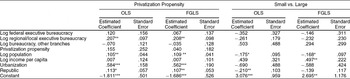
We test this hypothesis by controlling in our second-stage regressions for the fraction of firms in each region that were eventually privatized (Privatization propensity). If this variable at least partially drives the observed relationship between regional bureaucracy and privatization effectiveness, then the estimated effect of privatization propensity should be negative and the estimated effect of regional/local bureaucracy in Table 5 should decline when privatization propensity is added to the equation, in the limit becoming insignificantly different from zero. Our results, shown in the first two columns of Table 6, contradict this hypothesis. The estimated relationship between privatization propensity and privatization effectiveness is not significantly different from zero. The estimated coefficients on log regional/local executive bureaucracy are only slightly smaller than those in Table 5, and conventional statistical tests fail to reject equality between the two sets of estimates.
State Bureaucracy and Privatization Effectiveness: Privatization-Implementation Hypothesis

Notes: Dependent variable in first two models is estimated regional privatization effect from firm-level FE&FT regression. Dependent variable in second two models is estimated marginal privatization effect for small firms from firm-level FE&FT regression. Heteroskedasticity robust standard errors reported for OLS regressions. See text for details on FGLS estimator. N = 77 in all regressions. Significance levels: *** = .01, ** = .05, * = .10.
A second test of the privatization implementation hypothesis is suggested by a particular feature of the Russian privatization program. According to Russian privatization legislation, regional governments retained control over privatization of small enterprises, defined as enterprises with up to 200 employees and one million rubles of fixed assets as of January 1, 1992; all other privatizations were governed from Moscow (Frydman, Rapaczynski, and Earle Reference Frydman, Rapaczynski and Earle1993). Consequently, if bureaucrats influenced the privatization process for firms in their regions, this was more likely the case for small rather than large firms. Evidence that state bureaucracy–and, in particular, regional executive branch bureaucracy–improves privatization effectiveness more for small than for large firms would therefore be consistent with the privatization implementation hypothesis.
To explore this hypothesis, we estimate the following first-stage equation:

As in Equation (1), we control for selection bias in the privatization process through our specification of wt. The inclusion of the term Ljt Djt Rψ captures the marginal privatization effect for small firms, measured at the regional level, where the dummy variable Ljt equals one if a firm meets the definition of small (“little”) in the privatization legislation and zero otherwise. Our interest is in the vector of coefficients ψ: A positive relationship between estimates of these effects and regional/local bureaucracy would be consistent with the hypothesis that bureaucracy influences privatization effectiveness, at least in part, through the process of privatization itself.Footnote 21 As shown in the second two columns of Table 6, however, the effect of the bureaucracy variables, including regional/local executive bureaucracy, is statistically indistinguishable from zero.
The evidence thus does not support the hypothesis that regional or local bureaucracies influence privatization effectiveness through the process of privatization itself, as any such influence would likely be reflected in regional differences in the propensity to privatize or in variation in the effect of privatization on small and large firms.Footnote 22 In the following section, we explore the alternative hypothesis that regional and local bureaucracies influenced privatization effectiveness through the postprivatization business environment.
Postprivatization Business Environment
Our firm-level data contain no direct measures of business–state relations, so we turn to two alternative data sets: a Centre for Economic and Financial Research (CEFIR) survey monitoring the regulatory burden of small enterprises conducted in the spring of 2002 (hereafter referred to as the “Monitoring” survey), and the Russia sample from the 2005 round of the EBRD-World Bank Business Environment and Enterprise Performance Survey (BEEPS). Although cross-sectional in nature, late relative to the bulk of Russian privatization, and far less comprehensive in regional coverage than the firm data we use in the rest of this article, each survey includes questions that can be used to evaluate the regional business environment. The Monitoring sample was constructed from random draws from lists of registered firms within each region, whereas the BEEPS survey employed quotas for employment, location, industry, ownership, and exporter status.Footnote 23
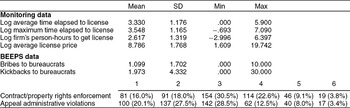
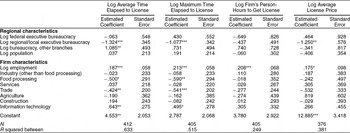
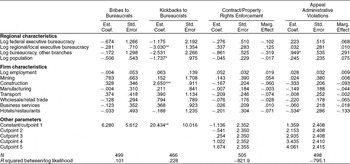
We focus on measures of business–state relations that could plausibly be affected by the size of regional and local executive branch bureaucracies, on the one hand, and affect the relative performance of privatized firms, on the other. For the Monitoring survey, we examine the relationship between bureaucracy and four “objective” measures of the firm's regulatory burden, each focusing on licenses received in the second half of 2001, and each measured in logs: Average time elapsed to license, Maximum time elapsed to license, Firm's person-hours to get license, and Average license price (including official payment, costs of using intermediaries and consultants, gifts, etc.). For the BEEPS, we examine measures of the magnitude of Bribes to bureaucrats and Kickbacks to bureaucrats (measured as percentage of sales and contract value, respectively) for firms in the respondent's “line of business,” as well as categorical measures of the degree of Contract/property-rights enforcement and the firm's ability to Appeal administrative violations without recourse to unofficial payments (i.e., bribes). Table 7 presents summary statistics and complete wording for these measures.Footnote 24
Summary Statistics for Monitoring and BEEPS Data

Notes: Full wording of Monitoring questions: “On average, how many days elapsed/What is the maximum time [in days] elapsed between the start of the licensing or authorization procedure and the moment you were officially notified that your request had been approved or denied?” “On average, how much time [in person-days] was spent by you and personnel of your firm filling out forms and contacting licensing officials?” “On average, how much did you pay to receive a license or authorization (including official payments, payments to intermediaries and consultants, gifts, etc.)?” Full wording of BEEPS questions: “On average, what percent of total annual sales do firms like yours typically pay in unofficial payments/gifts to public officials?” “When firms in your industry do business with the government, what percent of the contract value would be typically paid in additional or unofficial payments/gifts to secure the contract?” “I am confident that the legal system will uphold my contracts and property rights in business disputes.” “If a government agent acts against the rules I can usually go to another official or to his superior and get the correct treatment without recourse to unofficial payments/gifts.” Possible responses for contract/property rights enforcement: “strongly disagree” (1), “disagree in most cases” (2), “tend to disagree” (3), “tend to agree” (4), “agree in most cases” (5), “strongly agree” (6). Possible responses for appeal administrative violations: “never” (1), “seldom” (2), “sometimes” (3), “frequently” (4), “usually” (5), “always” (6).
For both data sets, we are forced to draw region-level inferences from a small number of regions: 20 for the Monitoring survey and 14 for the BEEPS.Footnote 25 We therefore rely on parsimonious specifications, relating measures of business–state relationships to size of bureaucracy and regional population (measured the year prior to the survey), as well as to various firm-level characteristics. Consistent with our estimation strategy in the rest of the article, we assume the presence of unobserved region-level effects. This is conservative, as the standard errors we calculate from these “random effects” models are generally larger than the analogous heteroskedasticity robust standard errors that correct for arbitrary correlation within clusters.Footnote 26
Because we have too few state-owned enterprises in either data set to evaluate the interactive effect of ownership and regional characteristics, we drop these firms from the subsequent analysis. Our results should thus be viewed as reflective of the business environment for private firms. In principle, the regional and local business environment for state-owned enterprises might vary either in similar or quite different ways, but privatized firms likely had a larger motivation to undertake costly restructuring to improve their performance; therefore, they had the most to gain or lose from the performance of public officials.
Our primary interest is in the impact of regional/local executive bureaucracy–the only category of bureaucracy significantly associated with privatization effectiveness–on the business environment for private firms, although the effect of the other measures may be of some independent interest. Table 8 presents results from the Monitoring regressions. Regional/local executive bureaucracy is negatively associated with all four measures, implying a lower waiting time and cost to obtain a license in regions with more regional executive bureaucrats per capita.Footnote 27 With the exception of the third model, where the firm's person-hours to get a license is the dependent variable, the estimated coefficients on regional/local executive bureaucracy are statistically significant. We obtain similar results from other specifications, including OLS regressions with heteroskedasticity robust standard errors that do and do not adjust for regional clustering, between-effects regressions, and regressions that include other regional controls (including income per capita, urbanization, and republic). In all cases, the estimated coefficient on regional/local executive bureaucracy is negative, and it is always significant in regressions where the dependent variable is average or maximum time elapsed to license.
State Bureaucracy and Postprivatization Business Environment: Monitoring Data

Notes: Random effects regressions, with random effects specified at level of region (20 total). Excluded category is other sectors. Significance levels: *** = .01, ** = .05, * = .10.
Table 9 presents results from the BEEPS regressions, including marginal effects for ordered probit regressions where categorical measures are the dependent variable. Regional/local executive bureaucracy has a large and statistically significant effect on kickbacks to bureaucrats, with a one standard deviation increase in log regional/local executive bureaucracy predicted to reduce kickbacks by close to 1% of the contract value. This result is robust to the same alternative specifications as with the Monitoring data: only for the between-effects regression does the estimated effect of regional/local executive bureaucracy lose significance, although the magnitude is still sizeable. The estimated effect of regional/local executive bureaucracy in the other three models is not statistically significant, but it always has the expected sign.
State Bureaucracy and Postprivatization Business Environment: BEEPS Data

Notes: Random effects (first two models) and random effects ordered probit (second two models, implemented with Stata package gllamm) regressions, with random effects specified at level of region (14 total). Marginal effects for ordered probit models are changes (continuous or discrete) in Pr(outcome = 4) + Pr(outcome = 5) + Pr(outcome = 6). Excluded category is other services. Significance levels: *** = .01, ** = .05, * = .10.
Thus, within the limits imposed by the small number of regions represented in these data sets, the results here provide some evidence that larger regional and local executive bureaucracies–which the regressions in Table 5 identified as that portion of the bureaucracy responsible for better privatization performance–contributed positively to the postprivatization business environment, reducing wait times and lowering costs for licenses and government contracts. In principle, lower wait times could be driven either by increased capacity or better incentives (i.e., competition among bureaucrats) in larger bureaucracies. In contrast, the relationship between bureaucracy size and the cost of licenses and government contracts may be more consistent with improved incentives resulting from bureaucratic competition. Without discounting the numerous frustrations of private firms in Russia in dealing with public officials, it appears that those problems may be smaller in regions where there are more bureaucrats with whom to work, with positive consequences for the relative performance of privatized firms.
CONCLUSION
In principle, large bureaucracies may help or hinder market-oriented economic reforms. Taking advantage of large variation across Russian regions in the size of public administrations, and controlling for possible selection effects in the privatization process, we find strong evidence that privatization has a larger (more positive) impact on manufacturing firm productivity where bureaucracies are large. This estimated relationship is robust to controlling for a variety of possibly confounding regional characteristics, to changes in the sample of regions, and to the use of alternative estimation techniques, including instrumental variables. The positive relationship between bureaucracy size and privatization effectiveness is limited to that portion of the bureaucracy subordinated to regional and local executives. Our analysis suggests that the effect of bureaucracy size works primarily through the postprivatization business environment, rather than on the process of privatization itself.
Scholars accustomed to viewing bureaucrats as inefficient and venal may be surprised by our finding of a positive relationship between bureaucracy size and privatization effectiveness. Yet, inefficiency does not imply that bureaucrats are inherently incapable of providing institutional support for reform, but merely that bureaucratic capacity may need to be augmented. With respect to venality, our results point especially to an incentive effect of bureaucracy size, where rent seeking by any individual bureaucrat is diminished when bureaucracies are large. One normative implication of this analysis is that the recent emphasis on providing better compensation to fewer bureaucrats may be misplaced. Making more officials available to individuals with business before the state may be the best way to ensure that state authority is not misused.
Strong policy recommendations await further research, however, with a need to examine the impact of bureaucracy size in other policy and political contexts. Moreover, greater attention must be given to the direct cost of building a large bureaucracy: this article focuses only on the impact of bureaucracy size on reform outcomes. The results of this research will help illuminate the trade-offs involved in choosing the optimal size of the state apparatus.



Comments
No Comments have been published for this article.