INTRODUCTION
Social cognition (SC) is defined as a set of cognitive and affective processes relevant for social interaction, which enable an individual to identify, perceive, interpret, analyze, remember, and generate responses to intentions, emotions, and behaviors of other people (Happé, Cook, & Bird, Reference Happé, Cook and Bird2017). These processes help us to distinguish ourselves from others, to understand their affective states, and to react to them. For all these reasons, the increasing research and clinical interest in SC are not surprising. There is, however, some disagreement regarding the processes and components included in SC, as well as the relationships among them. This is reflected by the overlapping lexicon used to refer to its components (Happé et al., Reference Happé, Cook and Bird2017). Notwithstanding, there is basic agreement about the main concepts related to SC (e.g., empathy, theory of mind, social perception). These, in turn, may be deconstructed into more basic processes for the purpose of measuring them (Schaafsma, Pfaff, Spunt, & Adolphs, Reference Schaafsma, Pfaff, Spunt and Adolphs2015).
In this line, and in order to provide a practical guide to assessing SC in neurological diseases, Henry, von Hippel, Molenberghs, Lee, and Sachdev (Reference Henry, von Hippel, Molenberghs, Lee and Sachdev2016) synthesized most of the existing literature and distinguished four different components of SC and a set of instruments to assess each one. These can be described as follows: social perception (the ability to recognize and respond to basic social and emotional cues, such as interpreting facial expressions, body language, or voices); theory of mind (ToM, the ability to understand other people’s mental states and feelings and that these mental states might differ from our own); empathy (one’s emotional response to the perceived situations of others); and social behavior (social sensitivity and manners, consideration of interpersonal boundaries, and keeping an adequate nonaffiliative contact with strangers). In accordance with this clinical perspective, the latest edition of the Diagnostic and Statistical Manual for Mental Disorders (DSM-5) includes SC as one of the six key domains of mental function that should be evaluated in patients with neurocognitive disorders, such as those affected by Parkinson’s disease (PD) (American Psychiatric Association, 2013; Duclos, Desgranges, Eustache, & Laisney, Reference Duclos, Desgranges, Eustache and Laisney2018; Sachdev et al., Reference Sachdev, Blacker, Blazer, Ganguli, Jeste, Paulsen and Petersen2014). The other five domains, corresponded to perceptual motor function, language, executive function, learning and memory, and complex attention, should be evaluated.
PD, classically defined as a movement disorder, is now conceived as a multi-system neurodegenerative disease, and most patients exhibit nonmotor symptoms such as sleep disturbances, autonomic dysfunctions, cognitive decline, or neuropsychiatric symptoms (Mitkova et al., Reference Mitkova, Ardito, Castelli, Azzaro, Ademzato, Enrici and Simon2017; Pfeiffer, Reference Pfeiffer2016). Impairments in SC have also been documented in PD patients and plausibly play a significant role in the reduction in communicative interactions and increasing social isolation which characterize PD course (Carcone & Ruocco, Reference Carcone and Ruocco2017). In fact, van Uem et al. (Reference van Uem, Marinus, Canning, van Lummel, Dodel, Liepelt-Scarfone and Maetzler2016), in an exhaustive review of studies on health-related factors of quality of life in PD, remark that psychosocial factors are the main contributors to their perceived decline in quality of life.
SC impairment has also been related to the well-known frontostriatal damage found in PD (Abu-Akel, Reference Abu-Akel2003; Hill et al., Reference Hill, Suzuki, Polania, Moisa, O’Doherty and Ruff2017; Kennedy & Adolphs, Reference Kennedy and Adolphs2012; Xu et al., Reference Xu, Han, Lin, Wang, Wu and Shang2020). For example, it has been proposed that cognitive and affective constituents of SC could rely on separate systems and circuits, which are differentially damaged in PD. While dorsolateral prefrontal areas and nigrostriatal dopaminergic circuits could be related to cognitive components (e.g., inferences about the mental states of others); ventromedial, orbitofrontal prefrontal cortex and mesolimbic circuits could be associated with the ability to infer emotional states in others. Moreover, some authors have proposed an early degeneration in nigrostriatal pathways (cognitive) compared to mesolimbic ones (affective) (Bodden, Dodel, & Kalbe, Reference Bodden, Dodel and Kalbe2010). However, recent studies of frontal, limbic, and striatal networks in PD patients observed damage in white matter tracts involving both nigrostriatal and mesolimbic circuits since early stages (Koirala et al., Reference Koirala, Anwar, Ciolac, Glaser, Pintea, Deuschl and Groppa2019; Luo et al., Reference Luo, Song, Chen, Zheng, Chen, Cao and Shang2014; Nigro et al., Reference Nigro, Riccelli, Passamonti, Arabia, Morelli, Nisticò and Quattrone2016).
The assessment of SC in PD has become an increasing focus of interest, although not all its proposed components have been investigated to a similar degree. In fact, the most studied SC components are ToM and social perception. Regarding ToM, several studies have indicated that this ability is impaired in PD, although the results are not conclusive (Bora, Walterfang, & Velakoulis, Reference Bora, Walterfang and Velakoulis2015). For example, when applying the Reading the Mind in the Eyes Test (RMET; Baron-Cohen, Wheelwright, Hill, Raste, & Plumb, Reference Baron-Cohen, Wheelwright, Hill, Raste and Plumb2001), one of the most used instruments, some studies reported deficits (Bodden et al., Reference Bodden, Dodel and Kalbe2010; Mimura, Oeda, & Kawamura, Reference Mimura, Oeda and Kawamura2006; Tsuruya, Kobayakawa, & Kawamura, Reference Tsuruya, Kobayakawa and Kawamura2011), while others failed to find differences between PD and healthy controls (HCs) (Péron et al., Reference Péron, Vicente, Leray, Drapier, Drapier, Cohen and Vérin2009). These differences also occur with the clinical features of PD patients. For example, some studies found ToM ability to even be impaired in early nondemented PD patients (Bora et al., Reference Bora, Walterfang and Velakoulis2015; Palmeri et al., Reference Palmeri, Lo Buono, Corallo, Foti, Di Lorenzo, Bramanti and Marino2017). However, other studies that separate PD patients according to disease severity found that recently diagnosed PD patients perform significantly better than moderate or advanced PD (Nobis et al., Reference Nobis, Schindlbeck, Ehlen, Tiedt, Rewitzer, Duits and Klostermann2017; Peron et al., 2009; Poletti, Vergallo, Ulivi, Sonnoli, & Bonuccelli, Reference Poletti, Vergallo, Ulivi, Sonnoli and Bonuccelli2013; Roca et al., Reference Roca, Torralva, Gleichgerrcht, Chade, Arévalo, Gershanik and Manes2010). By contrast, ToM performance appears to be independent of other clinical variables such as depression or medication status (Poletti et al., Reference Poletti, Vergallo, Ulivi, Sonnoli and Bonuccelli2013; Roca et al., Reference Roca, Torralva, Gleichgerrcht, Chade, Arévalo, Gershanik and Manes2010).
Regarding social perception, this is usually measured by emotional facial expression (EFE) or prosody recognition tasks. These capacities appear to be impaired in these patients, although the extent of the difficulty is still in debate (Ariatti, Benuzzi, & Nichelli, Reference Ariatti, Benuzzi and Nichelli2008; Coundouris, Adams, Grainger, & Henry, Reference Coundouris, Adams, Grainger and Henry2019; Dara, Monetta, & Pell, Reference Dara, Monetta and Pell2008). Several clinical and methodological features have been proposed to explain these discrepancies. Concerning impairments in clinical features, these seem to increase as disease severity progresses, although this does not occur with mood disorders such as depression or anxiety (Argaud, Vérin, Sauleau, & Grandjean, Reference Argaud, Vérin, Sauleau and Grandjean2018; Gray & Tickle-Degnen, Reference Gray and Tickle-Degnen2010). With regard to methodological issues, there is a concern about the type of task used to assess EFE recognition abilities. Although most studies use static prototypes of the emotional faces (photographs), this clearly differs greatly from how EFE is usually seen. The convenience of using stimuli that include some of the basic properties of real EFE, such as movement, has therefore been highlighted. In healthy individuals, several reviews have concluded that dynamic EFEs are more accurately recognized than static ones and evoke different patterns of brain activation (Krumhuber, Kappas, & Manstead, Reference Krumhuber, Kappas and Manstead2013; O’Toole, Roark, & Abdi, Reference O’Toole, Roark and Abdi2002; Trautmann-Lengsfeld, Domínguez-Borràs, Escera, Herrmann, & Fehr, Reference Trautmann-Lengsfeld, Domínguez-Borràs, Escera, Herrmann and Fehr2013). Dynamic EFE stimuli (i.e., video) could be especially interesting for PD patients, given their difficulty to produce facial movements (hypomimia), and the possibility that EFE recognition could run parallel to these motor difficulties (Argaud et al., Reference Argaud, Delplanque, Houvenaghel, Auffret, Duprez, Vérin and Sauleau2016). Hence, dynamic stimuli could provide a more accurate view of recognition skills. Although in PD patients difficulties to recognize EFEs have been observed with both static and dynamic stimuli (Argaud et al., Reference Argaud, Delplanque, Houvenaghel, Auffret, Duprez, Vérin and Sauleau2016; Kan, Kawamura, Hasegawa, Mochizuki, & Nakamura, Reference Kan, Kawamura, Hasegawa, Mochizuki and Nakamura2002; McIntosh et al., Reference McIntosh, Mannava, Camalier, Folley, Albritton, Konrad and Neimat2015), only two studies have compared the patients’ performance with both types of stimuli, with contradictory results. Whereas Wasser et al. (Reference Wasser, Evans, Kempnich, Glikmann-Johnston, Andrews, Thyagarajan and Stout2018) did not observe any differences between patients and controls for either static or dynamic stimuli, Kan et al. (Reference Kan, Kawamura, Hasegawa, Mochizuki and Nakamura2002) reported that their patients’ recognition of static stimuli was less accurate than their recognition of dynamic stimuli.
Another important debate about SC abilities in PD refers to the dependence on, or independence from, other cognitive domains (Palmeri et al., Reference Palmeri, Lo Buono, Corallo, Foti, Di Lorenzo, Bramanti and Marino2017). Executive functions, in particular, more than any other cognitive area, have been related to SC abilities in PD (Narme et al., Reference Narme, Mouras, Roussel, Duru, Krystkowiak and Godefroy2013; Yu & Wu, Reference Yu and Wu2013). In fact, lower scores in social perception and ToM tasks have been related to attention, working memory, and other executive function impairments (Assogna et al., Reference Assogna, Pontieri, Cravello, Peppe, Pierantozzi, Stefani and Spalleta2010; Narme, Bonnet, Dubois, & Chaby, Reference Narme, Bonnet, Dubois and Chaby2011). However, other studies have failed to find this link (Alonso-Recio, Martín-Plasencia, Loeches-Alonso, & Serrano-Rodríguez, Reference Alonso-Recio, Martín-Plasencia, Loeches-Alonso and Serrano-Rodríguez2014; Bodden et al., Reference Bodden, Dodel and Kalbe2010; Herrera, Cuetos, & Rodríguez-Ferreiro, Reference Herrera, Cuetos and Rodríguez-Ferreiro2011; Pietschnig et al., Reference Pietschnig, Schröder, Ratheiser, Kryspin-Exner, Pflüger, Moser and Lehrner2016; Roca et al., Reference Roca, Torralva, Gleichgerrcht, Chade, Arévalo, Gershanik and Manes2010). No studies, to date, have simultaneously explored neural correlates of cognitive decline and SC abilities. However, it has been found that cognitive impairment in overall cognitive function, and in several sub-cognitive domains, is related to damage in limbic areas, and particularly to a reduced orbitofrontal connectivity (Wang et al., Reference Wang, Mei, Gao, Huang, Qiu, Zhang and Nie2020). As mentioned, in PD these areas have been linked to affective components of SC, such as emotion recognition problems (Ibarretxe-Bilbao et al., Reference Ibarretxe-Bilbao, Junqué, Tolosa, Marti, Valldeoriola, Bargallo and Zarei2009). Moreover, thinking about others’ mental states has been found to activate the medial orbitofrontal cortex, among other areas, and their role might involve linking an emotional valence to the actions or thoughts of a particular person (Molenberghs, Johnson, Henry, & Mattingley, Reference Molenberghs, Johnson, Henry and Mattingley2016; Péron et al., Reference Péron, Le Jeune, Haegelen, Dondaine, Drapier and Sauleau2010). All this evidence could suggest that some of the brain areas damaged in PD have an overlapping participation in both general cognition and SC processes.
Until now, the relationship between SC and cognitive functioning has been studied in relation to specific cognitive processes, such as those associated with executive functions. Nevertheless, the possible link between SC and global cognitive state has barely been addressed and the results are far from conclusive. In this line, Rossetto et al. (Reference Rossetto, Castelli, Baglio, Massaro, Alberoni, Nemni and Marchetti2018) observed a worse performance in a ToM task by a group of PD patients with mild cognitive impairment (MCI) compared with PD patients without cognitive impairment and a group of HC. Assogna et al. (Reference Assogna, Pontieri, Cravello, Peppe, Pierantozzi, Stefani and Spalleta2010) also observed a correlation between EFE recognition abilities and Mini-Mental State Exam scores. On the contrary, Narme et al. (Reference Narme, Mouras, Roussel, Duru, Krystkowiak and Godefroy2013) found that deficits in EFE recognition remained in PD patients, even after excluding individuals with global cognitive decline. On the other hand, no studies have explored in-depth the relationship between diverse SC abilities and other areas of cognition, apart from executive functions.
In synthesis, a significant number of studies suggest that PD patients present several SC deficits, although the findings are not unanimous. Our study aims to assess SC in PD patients with a double objective. First, we analyze SC in PD considering its multifaceted nature, by measuring the main components of the construct (social perception, ToM, empathy, and social behavior). Second, we explore whether general cognitive functioning affects SC abilities in PD patients comparing the performance of a group of PD patients with cognitive impairment, a group of cognitively preserved PD patients and an equivalent HC group. We also explore two specific issues related to these main objectives. With regard to the first objective, concerning the analysis of SC components, we explore social perception in greater depth by contrasting two tasks that differ in their ecological validity, namely static and dynamic EFE. Respecting the second objective related to cognitive functioning implication, we analyze relationships between SC and specific cognitive processes, such as processing speed, visuospatial abilities, memory, language, and executive functions.
METHOD
Participants
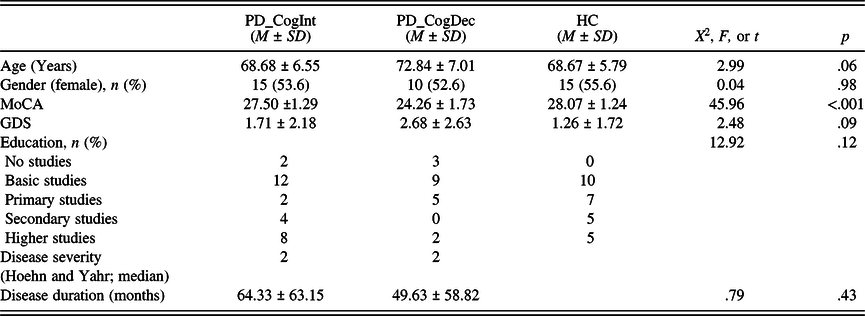
The sample was composed of 28 cognitively intact PD patients (PD_CogInt), 19 PD patients with cognitive decline (PD_CogDec), and 27 neurologically HCs matched for age, gender, depression, and education (see Table 1). PD patients were recruited from two different institutions from Madrid (Spain; Parkinson Association of Alcorcon and other municipalities, and Parkinson Association of Madrid). Common exclusion criteria were major medical illness, neurological disease (other than idiopathic PD in the case of patients), psychiatric disorders, or visual deficits.
Descriptive variables and general cognitive/affective performance for PD_CogInt, PD_CogDec, and HC groups

Note: GDS = Geriatric Depression State; M = Mean; MoCA = Montreal Cognitive Assessment; SD = Standard Deviation
PD groups were diagnosed by neurologists specialized in movement disorders on the basis of international guidelines (Hughes, Ben-Shlomo, Daniel, & Lees, Reference Hughes, Ben-Shlomo, Daniel and Lees1992) and were being treated with anti-Parkinsonian pharmacological treatment. Participants were classified according to their scores in the Montreal Cognitive Assessment (MoCA; Nasreddine et al., Reference Nasreddine, Phillips, Bédirian, Charbonneau, Whitehead, Collin, Cummings and Chertkow2019) as PD_CogInt (MoCA > 26) and PD CogDec (MoCA < 26). Regarding this variable, analysis of variance (ANOVA) revealed differences between groups (F(2,73) = 45.96, p < .001). Bonferroni post hoc tests revealed that PD_CogDec (M = 24.26, SD = 1.73) had a lower score (p < .001) than PD_CogInt (M = 27.50, SD = 1.29) and HC (M = 28.07, SD = 1.24). There were no differences between PD_CogInt and HC (p = .22). Both PD groups were matched for disease severity according to the Hoehn and Yahr Scale (Hoehn & Yahr, Reference Hoehn and Yahr1967) and disease duration. In addition, the three groups were matched for gender, educational level, manual dominance and did not differ in the Spanish version of the Geriatric Depression Scale Reduced scores (GDS-R; Izal, Montorio, Nuevo, Pérez-Rojo, & Cabrera, Reference Izal, Montorio, Nuevo, Pérez-Rojo and Cabrera2010) (see Table 1).
Participants were informed of the confidential and anonymous treatment of their data and signed the informed consent. The study was completed in accordance with the Helsinki Declaration and approved by the Ethical Committee of the Universidad Autonoma de Madrid (Spain).
Instruments and Procedure
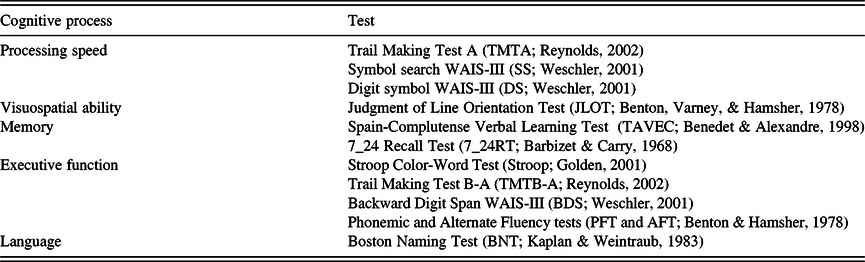
Before social cognition assessment, each participant completed standardized tests to assess his/her cognitive performance. The neuropsychological tests administered were categorized into five groups: processing speed, visuospatial abilities, memory, language, and executive functions, and are recorded in detail in Table 2.
Cognitive assessment protocol

To assess social perception, we administered two emotional categorization tasks, one with 50 static (photograph) and another with 50 dynamic (videos) stimuli, showing facial expressions of happiness, sadness, fear, anger, and neutral face (10 of each emotion) on a computer screen and using the E-prime 2.0 program (Schneider, Eschman, & Zuccolotto, Reference Schneider, Eschman and Zuccolotto2002). The task consists in choosing from five emotional categories (happiness, sadness, fear, anger, and neutral) the one which best describes the EFE shown by the model. The photographs were selected from the FACES Database (Ebner, Riediger, & Lindenberger, Reference Ebner, Riediger and Lindenberger2010), a validated database containing a set of images of natural faces of 171 individuals including young people (N = 58), middle-aged adults (N = 56), and older adults (N = 57), showing each of the following emotional facial expressions: happiness, sadness, fear, disgust, surprise, fear, and neutral. The videos were selected from the Amsterdam Dynamic Facial Expression Set (ADFES; van der Schalk, Hawk, Fischer, & Doosje, Reference van der Schalk, Hawk, Fischer and Doosje2011), a validated database composed of 370 videos of an average duration of 1040 ms each in which 12 actors (7 men and 5 women) express emotions of anger, fear, sadness, surprise, happiness, pride, contempt, shame, disgust, and neutral, with low, intermediate, or high intensity.
To evaluate ToM, we administered the Spanish adaptation of the RMET (Baron-Cohen et al., Reference Baron-Cohen, Wheelwright, Hill, Raste and Plumb2001). This consists of 36 photographs of the eye region of the faces of male and female actors presented in different papers. Four adjectives corresponding to complex mental state descriptors (e.g., hateful, panicked) accompany each photograph, with one adjective in each corner and the photograph in the middle. One of these words (the target word) correctly describes the mental state of the person in the photograph, while the others are included as foils. Participants were required to select the word that best describes what the individual in the photograph is thinking or feeling. There was no time limit. The test–retest reliability of the Spanish version of this test, assessed by Fernandez-Abascal, Cabello, Ferández-Berrocal, and Baron-Cohen (2013), was .63 (p < .01).
To measure empathy, we used the Empathy Quotient (EQ; Baron-Cohen & Wheelwright, Reference Baron-Cohen and Wheelwright2004), a self-report measure of empathy. The task comprises 60 questions, broken down into two types: 40 questions tapping empathy and 20 filler items to distract the participant from a relentless focus on empathy. Responses are given on a 4-point scale ranging from “strongly agree” to “strongly disagree”, and approximately half of the items are reversed. Participants received 0 for a “nonempathic” response, whatever the magnitude, and 1 or 2 for an “empathic response” depending on the strength of the reply. The total score is out of 80. EQ shows an adequate internal consistency and test–retest reliability. In particular, the Spanish version of the questionnaire we use shows an internal consistency of .83 in a nonclinical sample and correlations with other empathy measures, indicating that it is a reliable and valid measure to evaluate empathy (Redondo & Herrero-Fernández, Reference Redondo and Herrero-Fernández2018).
Finally, to assess social behavior, we administered the Spanish version of Dysexecutive Questionnaire (DEX; Shaw, Oei, & Sawang, Reference Shaw, Oei and Sawang2015). The DEX is a 20-item questionnaire designed to address everyday signs of intentionality, interference management, inhibition, planning, and social regulation. This Spanish version shows a high internal consistency (Cronbach’s α = 0.91) and discriminant validity (Pedrero et al., Reference Pedrero, Ruiz-Sánchez de León, Rojo, Llanero, Olivar, Bouso and Puerta2009). It has been used in a considerable number of papers to compare diverse clinical and healthy populations. Recent structural analysis has shown that the main (and only) latent variable assessed by the DEX accounts for symptoms of oversight malfunction in activities of daily living, related to prefrontal function (Pedrero-Pérez et al., Reference Pedrero-Pérez, Ruiz-Sánchez-de-León and Winpenny-Tejedor2015). A higher score represents a greater severity of the symptoms.
Subjects were tested independently in a quiet room. To display static and dynamic facial expression, a high-resolution monitor was used at a visual distance of 60 cm. The PD group was assessed at a time of day when their symptoms were less severe (“on-state”). The study was performed in two different sessions of 60 min duration each. The first began by recording the patient’s sociodemographic and clinical data followed by cognitive screening and the test to assess specific cognitive processes. In the second session, participants performed the static and dynamic facial expression recognition task, the RMET, the EQ, and the DEX tests.
RESULTS
Cognitive Background
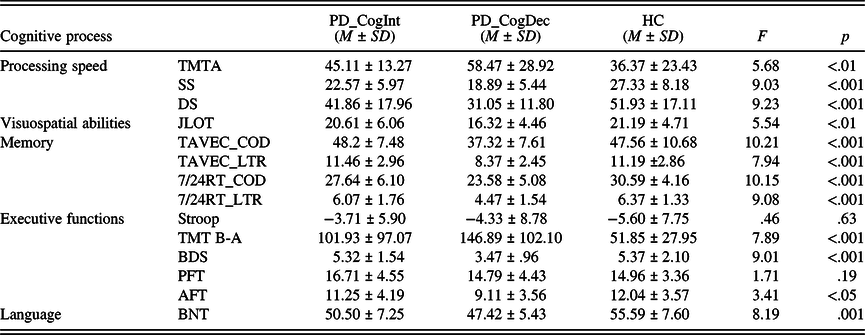
Differences between the three groups in the cognitive tests were analyzed by performing a unifactorial ANOVA. As shown in Table 3, there are differences between groups in all of them except for the Stroop and Phonemic Fluency Test (PFT) tests. Bonferroni multiple comparisons test revealed that the PD_CogDec group performed worse than the HC group (p < .05) in Trail Making Test A (TMTA), symbol search (SS), digit symbol (DS), Judgment of Line Orientation Test (JLOT), Spain-Complutense Verbal Learning-Codification (TAVEC_COD), Spain-Complutense Verbal Learning Test-Long Term Recall (TAVEC_LTR), 7_24 Recall Test-Codification (7/24RT_COD), 7_24 Recall Test-Long Term Recall (7/24RT_LTR), Trail Making Test B-A (TMTB-A), backward digit span (BDS), Alternate Fluency Test (AFT), and Boston Naming Test (BNT). PD_CogDec also performed worse than PD_CogInt (p < .05) in JLOT, TAVEC_COD, TAVEC_LTR, 7/24RT_COD, 7/24RT_LTR, BDS, and BNT. By contrast, we did not observe any significant differences between PD_CogInt and HC in these cognitive tests.
Mean and standard deviation in cognitive test for PD_CogInt, PD_CogDec, and HC groups.

Note: TMTA = Trail Making Test A; SS = Symbol Search; DS = Digit Symbol; JLOT = Judgment of Line Orientation Test; TAVEC_COD = Spain-Complutense Verbal Learning-Codification; TAVEC_LTR = Spain-Complutense Verbal Learning Test-Long Term Recall; 7/24RT_COD = 7_24 Recall Test-Codification; 7/24RT_LTR = 7_24 Recall Test-Long Term Recall, TMT B-A = Trail Making Test B-A; BDS = Backward Digit Span; PFT= Phonemic Fluency Test; AFT = Alternate Fluency Test; BNT = Boston Naming Test; M = Mean; SD = Standard Deviation
Social Cognition Performance
Social perception
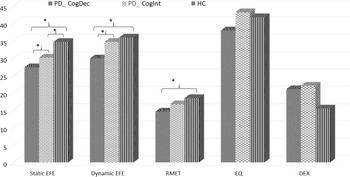
We analyzed the number of correct responses from static (photographs) and dynamic (videos) EFEs in the three groups, by performing a mixed ANOVA 3 (Group: PD_CogInt, PD_CogDec, and HC) × 2 (Task: Static and Dynamic). The analysis revealed a significant main effect of Task (F(1,71) = 43.05, p < .01, η 2 = .38), with all groups performing better in the dynamic task (M = 33.57) than in the static one (M = 30.79). We also observed a main effect of Group (F(2,71) = 10.87, p < .01, η 2 = .23). Bonferroni post hoc multiple comparison tests indicated that the PD_CogDec group (M = 28.68) scored lower than the HC (M = 35.37; p < .01) and PD_CogInt (M = 32.48; p < .05). By contrast, no differences were found between HC and PD_CogInt (p = .09). In addition, we observed a significant Group × Task interaction effect (F(2,71) = 5.84, p < 0.01, η 2 = .14). Analysis of simple effects revealed significant differences among groups in both tasks. In the static task (F(2,71) = 12.94, p < 0.01), Bonferroni post hoc multiple comparison tests revealed that both PD groups performed worse than HC (M PD_CogDec = 27.42; M PD_CogInt = 30.21; M HC = 34.74; p < .05). In the dynamic task (F(2,71) = 7.87, p < 0.01), post hoc multiple comparisons indicated that PD_CogDec (M PD_CogDec = 29.95) performed worse than HC (M HC = 34.75) and PD_CogInt (M PD_CogInt = 36) (p < .01, in both cases) (see Figure 1).
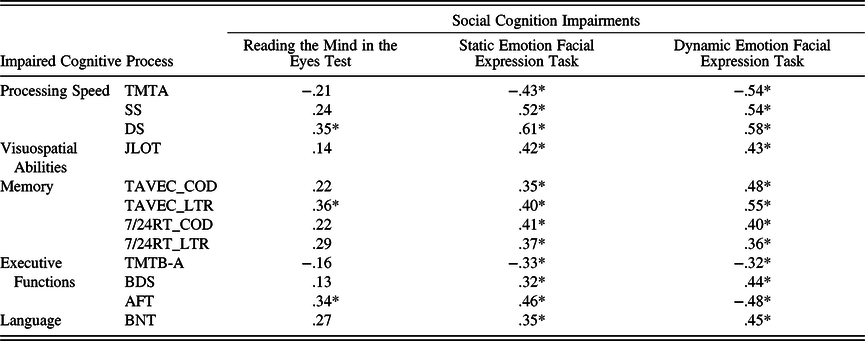
Correlation between the impaired social cognition components and the impaired cognitive processes in PD patients (both PD patients with cognitive decline and cognitively intact PD patients)

* p <.05
Note: TMTA = Trail Making Test A; SS = Symbol Search; DS = Digit Symbol; JLOT = Judgment of Line Orientation Test; TAVEC_COD = Spain-Complutense Verbal Learning-Codification; TAVEC_LTR = Spain-Complutense Verbal Learning Test-Long Term Recall; 7/24RT_COD = 7_24 Recall Test-Codification; 7/24RT_LTR = 7_24 Recall Test-Long Term Recall, TMT B-A = Trail Making Test B-A; BDS = Backward Digit Span; AFT = Alternate Fluency Test; BNT = Boston Naming Test.
Histogram representing the mean scores in all the social cognition tasks administered to Cognitively Intact PD (PD_CogInt), Cognitively Declined PD (PD_CogDec), and Healthy Control (HC) groups.
Note: Static EFE = Static emotional facial expressions recognition, Dynamic EFE = Dynamic emotional facial expressions recognition, RMET = Reading the Mind in the Eyes Test, EQ = Empathy Quotient, DEX = Dysexecutive Syndrome Questionnaire. *= p < .05 in Bonferroni post hoc multiple comparison test

Theory of mind
We analyzed the number of correct responses in the RMET by performing a unifactorial ANOVA that revealed significant differences among the groups (F(2,71) = 4.88, p = .01). Bonferroni post hoc comparisons revealed that while PD_CogDec performed worse than HC (M PD_CogDec = 14.63; M HC = 18.52; p < .01), there were no differences between PD_CogInt and HC (M PD_CogInt = 16.75; M HC = 18.52; p = .26), or between PD_CogInt and PD_CogDec (M PD_CogInt = 16.75;M PD_CogDec = 14.63; p = .21) (see Figure 1).
Empathy
We analyzed the number of correct responses in the EQ by performing a unifactorial ANOVA. The analysis revealed no differences among the groups (F(2,71) = 1.17, p = .32) (see Figure 1).
Social behavior
We analyzed the number of correct responses in the DEX by performing a unifactorial ANOVA. This analysis revealed no significant differences between groups (F(2,71) = 2.71, p = .07) (see Figure 1).
Relationship between SC Impairments and Specific Cognitive Domains
Finally, in order to study the possible relationship between the impairments found in SC components and specific cognitive processes in PD patients, we calculated Pearson correlations between these variables. In Table 4, we can observe significant correlations between both static and dynamic facial expression tasks and all the cognitive processes we measured (processing speed, memory, visuospatial ability, executive functions, and language). With respect to RMET, we observed significant correlations with DS (processing speed), TAVEC_LTR (memory), and AFT (executive functions).
DISCUSSION
This study aims to analyze SC abilities in PD patients compared to a HC group using a multifaceted perspective of the construct, which includes measures of social perception, ToM, empathy, and social behavior. We also study whether SC deficits are affected by cognitive decline. Our results show that PD patients do not present an overall impairment in SC abilities. Deficits are only evident in social perception and ToM. Moreover, these deficits are mainly present in the PD group with cognitive decline, reflecting that cognitive functioning is required for some SC abilities. These results should be studied in depth to understand their full implications.
Regarding SC problems, the most consistent ones are found in social perception. We find a worse EFE recognition ability in the PD_CogDec group compared to HC both for static and dynamic EFE tasks, while the PD_CogInt group’s performance was only worse than that of HC in the static task. This last result contradicts the findings of Wasser et al. (Reference Wasser, Evans, Kempnich, Glikmann-Johnston, Andrews, Thyagarajan and Stout2018), who did not find differences between PD and HC, either for static or dynamic tasks. However, they did observe a trend towards a worse performance in PD than in the HC group in both tasks, and the difference with our results could arise from the fact that these authors did not differentiate patients based on their cognitive status. Our results are, however, quite similar to those reported by Kan et al. (Reference Kan, Kawamura, Hasegawa, Mochizuki and Nakamura2002) in cognitively unimpaired PD patients. According to these authors, the different results in static and dynamic EFE recognition tasks could be caused by the greater artificiality of the static stimuli, and our results support a similar interpretation. This could also explain why our PD_CogInt group performed comparably to HC in the dynamic EFE task. Therefore, when the stimuli provide more similar cues to those found in daily life contexts (e.g., with facial expressive movements compared to static photographs), this group of PD patients can perceive these cues and use them for a correct recognition. This improvement in EFE recognition ability, when shown videos instead of photographs, has also been observed in the healthy population (Krumhuber et al., Reference Krumhuber, Kappas and Manstead2013).
It has been proposed that recognition of affective states is substantially based on the constant monitoring of changes in facial muscles that occur during emotion expression (Yoshikawa & Sato, Reference Yoshikawa and Sato2008). Hence, the dynamic information provided by facial movement, not available in static faces, could provide additional cues which facilitate recognition (Kamachi et al., Reference Kamachi, Bruce, Mukaida, Gyoba, Yoshikawa and Akamatsu2001). This difference in EFE recognition between static and dynamic stimuli has also been supported by neuroimaging studies. In addition to showing dissociable neural activations in response to each of them, they also find a greater brain activity in response to dynamic ones. Furthermore, the most active brain areas to dynamic EFEs are those related to socioemotional processing (Kessler et al., Reference Kessler, Doyen-Waldecker, Hofer, Hoffmann, Traue and Abler2011; Trautmann, Fehr, & Herrmann, Reference Trautmann, Fehr and Herrmann2009). In summary, our results agree with the view that dynamic facial expression provides more ecological validity than static facial expression to evaluate social perception abilities in PD (Ambadar, Schooler, & Cohn, Reference Ambadar, Schooler and Cohn2005; Fiorentini & Viviani, Reference Fiorentini and Viviani2011).
If we consider the dynamic task as a better measure of social perception capacities, our results indicate that deficits in EFE recognition are only entirely demonstrated in cognitively impaired PD patients. This could be in relative disagreement with a few studies that observed a significant impairment in the recognition of dynamic facial expressions among cognitively preserved PD patients (Argaud et al., Reference Argaud, Delplanque, Houvenaghel, Auffret, Duprez, Vérin and Sauleau2016; Garrido-Vásquez, Pell, Paulmann, Sehm, & Kotz, Reference Garrido-Vásquez, Pell, Paulmann, Sehm and Kotz2016; McIntosh et al., Reference McIntosh, Mannava, Camalier, Folley, Albritton, Konrad and Neimat2015; Paulmann & Pell, Reference Paulmann and Pell2010). However, there were relevant differences in the design and objectives of these studies compared to ours. Thus, McIntosh et al. (Reference McIntosh, Mannava, Camalier, Folley, Albritton, Konrad and Neimat2015) compared patients undergoing dopaminergic therapy versus deep brain stimulation patients (with no differences between groups); Garrido-Vásquez et al. (Reference Garrido-Vásquez, Pell, Paulmann, Sehm and Kotz2016) differentiated right versus left motor onset PD patients (and deficits were found only in left side onset ones); Paulmann and Pell (Reference Paulmann and Pell2010) included vocalizations in the facial expressions they showed, and, finally, Argaud et al. (Reference Argaud, Delplanque, Houvenaghel, Auffret, Duprez, Vérin and Sauleau2016) only found differences between PD and HC groups in response to happy and neutral but not to angry faces. These differences, together with the fact that they did not classify patients by their cognitive status, could contribute to explaining the discrepancies with our results.
The other SC component that seems to be affected in our cognitively impaired PD group is ToM. These results are in accordance with other studies that show difficulties in the ability to infer other people’s mental states such as beliefs, desires, or feelings in PD patients compared with HC (Bodden et al., Reference Bodden, Dodel and Kalbe2010; Mimura et al., Reference Mimura, Oeda and Kawamura2006; Tsuruya et al., Reference Tsuruya, Kobayakawa and Kawamura2011). With our data, we can specify that these deficits are only significant in patients with cognitive impairment. This is quite similar to observations made by Rossetto et al. (Reference Rossetto, Castelli, Baglio, Massaro, Alberoni, Nemni and Marchetti2018), who compared cognitively preserved PD, MCI, and HC groups with the same test we used (RMET). In their results, MCI (but not cognitively preserved PD) had lower scores than HC. Compared to other ToM measures, RMET could be considered as a complex test, as it demands inferences about the other person’s intentions and feelings based only on information provided by the area around the eyes. These demands, which intermix cognitive and affective inferences, probably involve a considerable cognitive effort (Mitchell & Phillips, Reference Mitchell and Phillips2015). Hence, cognitive decline patients might be expected to perform worse than the other cognitively preserved groups.
Regarding empathy and social behavior, we did not observe any differences in PD patients compared to HC. Nevertheless, it is important to take into account that these two components were measured with self-report questionnaires instead of performance-based tasks. A recent meta-analysis performed by Coundouris, Adams and Henry (Reference Coundouris, Adams and Henry2020) showed that PD patients exhibited impairments in ToM when assessed with performance-based tasks, but not with self-report measures. In addition, although we did not observe significant differences in social behavior, a trend in mean scores was appreciable. Probably, the great dispersion in the scores of the PD groups (as shown by standard deviations) could explain this result and could also be interpreted as reflecting the possible inadequacy of self-report measures, particularly in patients with cognitive decline. In the same vein, given that deficits in other SC components were only found in the cognitively impaired PD group, anosognosia (which can be characteristic of these patients) could possibly be an influential factor in this group’s responses to the questionnaires (Coundouris et al., Reference Coundouris, Adams and Henry2020).
The lack of an overall decline in SC abilities in our PD patients could be caused by each component being affected differently by the course of the disease. In this regard, it is interesting to consider our results in relation to the distinction usually made between the cognitive and affective dimensions of SC, and how each of these can be affected in PD. The cognitive dimension entails understanding the other person’s intentions or motivations. The affective dimension, however, requires understanding the feelings and emotions of the interlocutor (Kalbe et al., Reference Kalbe, Schlegel, Sack, Nowak, Dafotakis, Bangard and Kessler2010). Two recent meta-analyses have addressed this matter in PD, but their results point in opposite directions. Hence, whereas Bora et al. (Reference Bora, Walterfang and Velakoulis2015) conclude that the cognitive dimension may be more impaired than the affective one, Coundouris et al. (Reference Coundouris, Adams and Henry2020) indicate that both components could be similarly impaired. Although our study does not focus on this distinction, the requirements of the RMET and EFE tasks we use could contribute to this debate. In short, RMET implies making inferences about intentions (cognitive) and feelings or emotions (affective) from information provided by the eyes. On the other hand, EFE recognition tasks probably entail a basic skill required for affective SC abilities (Mitchell & Phillips, Reference Mitchell and Phillips2015). On the basis of these findings, we can conclude that cognitive and affective dimensions of SC are similarly damaged, at least in this group of patients. This would agree with some most recent findings about neural correlates of SC abilities in PD. These indicate that damage in nigrostriatal and mesolimbic pathways related, respectively, to cognitive and affective decline, may have been similarly altered since early stages of the disease (Koirala et al., Reference Koirala, Anwar, Ciolac, Glaser, Pintea, Deuschl and Groppa2019; Luo et al., Reference Luo, Song, Chen, Zheng, Chen, Cao and Shang2014; Nigro et al., Reference Nigro, Riccelli, Passamonti, Arabia, Morelli, Nisticò and Quattrone2016).
Another main objective of this research was to study the dependence, or independence, of SC on specific cognitive processes such as executive functions, memory, visuospatial ability, language, and processing speed. According to our results, the PD group with cognitive impairment scored lower than the other two groups in most of the cognitive domains assessed. Moreover, in the EFE tasks a significant correlation was found between performance in these tasks and in all the cognitive domains studied. In the RMET, a significant correlation was also observed with DS, TAVEC_LTR, and AFT, which assess processing speed, verbal memory, and executive functioning, respectively. In this last case, it is noteworthy that no differences were observed in the performance of this task by the two PD groups. In sum, our results show that as deficits in SC become more evident, the correlation with cognitive processes also increases.
In any case, our results indicate that SC impairment is not related to specific cognitive processes. In particular, EFE recognition was correlated with performance in all the cognitive domains we measured and ToM impairments seem to be related to all cognitive processes (memory, executive functions, and speed processing tasks), except language. This contrasts with previous studies which conclude that the impairment is associated with executive functions (Narme et al., Reference Narme, Mouras, Roussel, Duru, Krystkowiak and Godefroy2013; Yu & Wu, Reference Yu and Wu2013). However, since these were limited to evaluating only this process, a direct comparison cannot be made with our findings. A parsimonious conclusion from these results would be that SC deterioration is related to a widespread cognitive decline, and not only to executive functioning. Additionally, in an attempt to link these results with the neural damage observed in PD patients, they appear to be compatible with some recent findings suggesting broad structural and functional brain network changes in this disease, which affect both emotional and cognitive states (Yuvaraj et al., Reference Yuvaraj, Murugappan, Rajendra Acharya, Adeli, Ibrahim and Mesquita2016). Here, the reduced connectivity that characterizes the white matter structural organization in the orbitofrontal cortex could also be of relevance, as this area has been related both to SC and global cognitive functioning (Wang et al., Reference Wang, Mei, Gao, Huang, Qiu, Zhang and Nie2020).
Nevertheless, owing to the complexity and diversity of the possible manifestations and symptoms of PD, caution must be exercised when interpreting our results. One of the areas that could be explored more thoroughly is the relationship between mood state (depression, anxiety, and apathy) and SC. Although we avoided this complication by selecting nondepressive individuals in our PD groups, it may be interesting to study to what extent SC abilities are affected in patients presenting these and other mood disorders.
In this study, we did not consider the influence of pharmacological treatment or deep brain stimulation on SC ability nor of laterality onset or motor subtype (akinetic-rigid, tremor-dominant, and mixed). We did not take into account the possible relationship between facial expressivity problems (hypomimia) and emotion recognition impairments. All these variables could significantly affect performance, as some previous studies have shown (e.g., Garrido-Vásquez et al. Reference Garrido-Vásquez, Pell, Paulmann, Sehm and Kotz2016; McIntosh et al. Reference McIntosh, Mannava, Camalier, Folley, Albritton, Konrad and Neimat2015). Moreover, considering the likely increasing influence of SC impairments on PD course (Christidi, Migliaccio, Santamaría-García, Santangelo, & Trojsi, Reference Christidi, Migliaccio, Santamaría-García, Santangelo and Trojsi2018), a longitudinal perspective would be desirable.
In summary, in our study we did observe a decline in social perception and ToM SC components in cognitively impaired PD patients. It is concordant with the conclusions of a recent meta-analysis performed by Christidi et al. (Reference Christidi, Migliaccio, Santamaría-García, Santangelo and Trojsi2018), which shows that SC problems emerge during PD course as a critical aspect of the disease. Impairments in these abilities probably have a clear impact on patients’ psychosocial functioning and quality of life (van Uem et al., Reference van Uem, Marinus, Canning, van Lummel, Dodel, Liepelt-Scarfone and Maetzler2016). It would, therefore, be recommendable to evaluate these components as part of the clinical diagnosis of the disease. This is in line with the DSM-5 recommendations to evaluate SC together with the other cognitive areas commonly assessed in neurodegenerative diseases.
ACKNOWLEDGMENTS
We thank the Asociacion Parkinson Alcorcon and other municipalities (Madrid, Spain), the Asociacion Parkinson Madrid and different Elderly Municipal Centers from Toledo (San Anton, Santa Barbara Ángel Rosa, Santa Maria de Berenquerencia) and Ciudad Real (I and II) for their collaboration in this study. This work was supported by a grant from the Spanish Ministerio de Ciencia, Innovación y Universidades PGC2018-095934-B-I00.
CONFLICT OF INTEREST
The authors report no conflict of interest.