Introduction
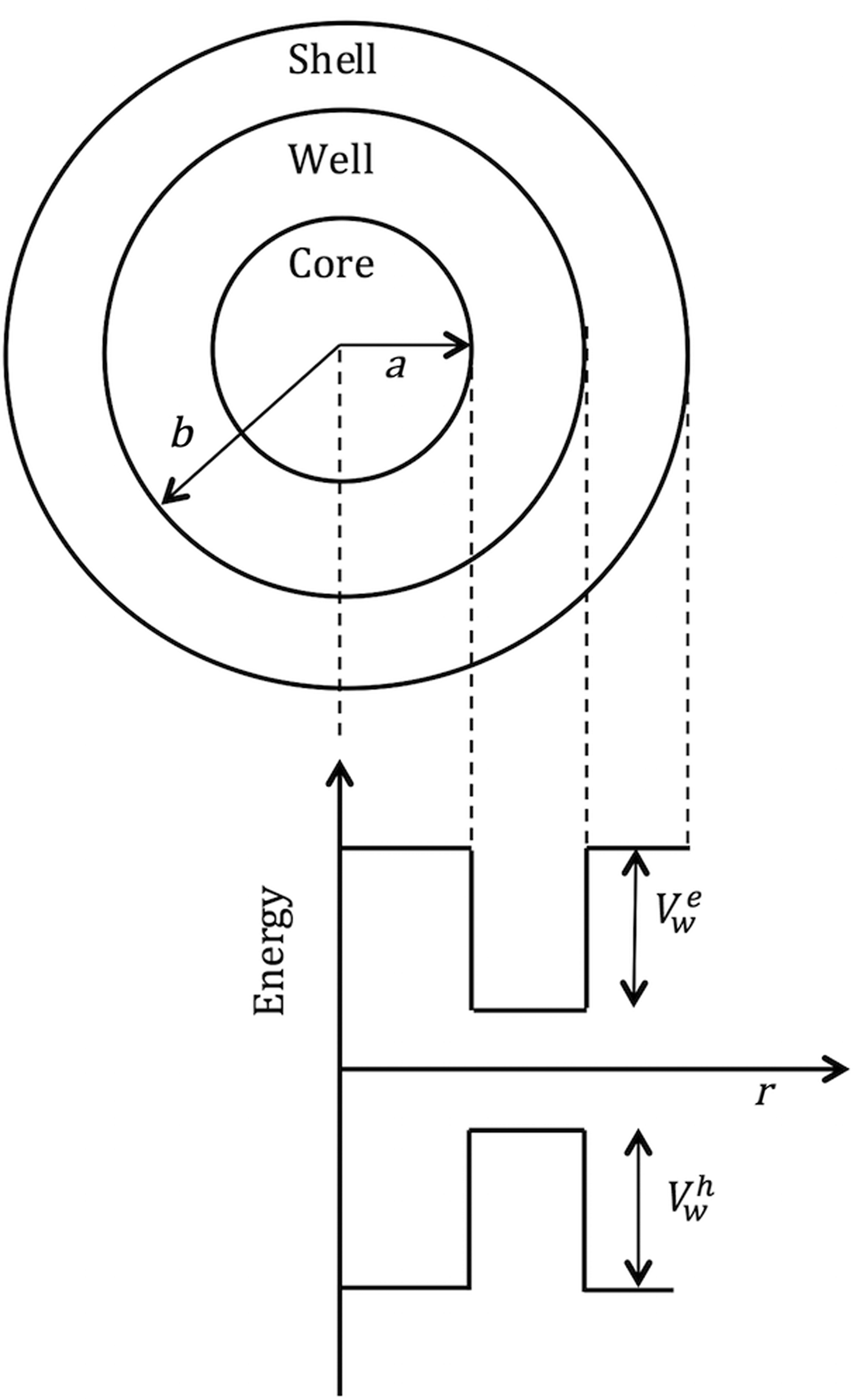
Recently, the advance in material science and materials growth methods renders the possibility to produce a new generation of heterostructures called core/shell quantum dots (CSQD), composed of different geometrical shapes and material compositions.[Reference Kortan, Hull, Opila, Bawendi, Steigerwald, Carroll and Brus1–Reference Haus, Zhou, Honma and Komiyana4] They are typically composed of two semiconductor materials with different band gaps: the core is made with a material with smaller bulk band gap, and the shell is made with a material of the larger band gap (Fig. 1). The advantage of these nanostructures is the possibility of controlling the material properties of the CSQDs by varying their sizes/thickness, and hence realizing the manipulation of their energy levels, as well as the intra- or inter-band transitions through absorption or emission. In the literature, a great deal of studies has been realized for these (CSQDs).[Reference Kortan, Hull, Opila, Bawendi, Steigerwald, Carroll and Brus1, Reference Zhou, Honma and Komiyama2, Reference Spanhel, Weller and Henglein5, Reference Hoener, Allan, Brad, Campion, Fox, Mallouk, Webber and White6] From these works, we can conclude that these nanostructures have shown interesting physical properties, through redistribution of the electron and hole wave functions, such as the energy dependence of the core/shell radii ratio, an increase in the band-edge absorption for small band gap shell material, and a drastic change in the intensity of the luminescence.
Schematic representation of a spherical core/shell quantum dot (SCSQD).

It is widely accepted that the confinement of excitons in semiconductor nanostructures gives an increased excitonic effect in their band gaps, which is more desirable in the design of novel photoelectric or LED devices. The behavior of excitons in CSQDs has been a subject of various studies; Bryant[Reference Bryant7] has shown that the internal well effects pair correlations in inhomogeneous quantum dots (IQDs), and that the model with screened pair interaction quantitatively gives excitons in the ground state energy. Ferreyra and Proetto[Reference Ferreyra and Proetto8] have shown that the excitonic binding energy decreases as the size of the core increases and becomes as pronounced as in homogeneous quantum dots (HQDs) when the effect of the induced polarization charges is taken into account. El Khamkhami et al.[Reference El Khamkhami, Feddi, Assaidc, Dujardind, Stèbè and Diouri9] have reported that the excitonic binding energy in IQDs depends heavily on the core and the shell radii.
The influences of hydrostatic pressure on the excitonic binding energy attract great attention due to the induced changes in the materials parameters.[Reference Yu and Cordona10] According to these characteristics, various studies concerning exciton states under hydrostatic pressure are reported. Ha and Ban[Reference Ha and Ban11] have investigated the excitonic binding energies of heavy holes in a wurtzite GaN/Al0.3Ga0.7N quantum well by considering hydrostatic pressure and their results suggest that the excitonic binding energies increase considerably with increasing pressure. Arunachalam et al.[Reference Arunachalama, Peter and Lee12] have investigated the hydrostatic pressure-induced binding energy of a shallow hydrogenic impurity in a InAs/GaAs quantum wire and found that the binding energy increases as the applied hydrostatic pressure increases. El-Yadri et al.[Reference El-Yadri, Aghoutane, Feddi and Dujardin13] have investigated the influences of the temperature and pressure on the binding energy of a strained, ultra-thin GaAs quantum disk; they reported that the applied pressure increases the attraction between electrons and holes, whereas the temperature increases the electron–hole recombination. Another study done by El Haouari et al.[Reference El Haouari, Talbi, Feddi, El Ghazi, Oukerroume and Dujardin14] showed that, based on the studies of linear and non-linear (third-order) optical properties of a single dopant in a strained AlAs/GaAs spherical CSQD (SCSQD), the excitonic binding energy increases as hydrostatic pressure increases and yields a maximum when the donor is located at the center of the shell.
As a contribution to understanding the influences of hydrostatic pressure on the excitonic binding energy in a AlN/GaN/AlN SCSQD, we report in this research paper the pressure effect as dependent on the core/shell sizes/thickness (radii ratio), the dielectric constant, and the effective masses, through a variational analysis. The calculations were performed under the framework of effective mass approximation. Our paper is structured as following: first we present the theory used in the calculation, then we discuss the results and comment the characteristics of the binding energy and the mean distance 〈r eh〉 between hole and electron, and in the end, our conclusions are reported.
Theoretical framework
Let us consider an exciton X(e,h) positioned in a AlN/GaN/AlN SCSQD. Using the effective mass approximation and ignoring any induced polarization change at the surface, the Hamiltonian of this system under an external hydrostatic pressure P can be given by:
 $$H_X = - \displaystyle{{\hbar} ^2 \over {2m_{\rm e}^{\ast} (P)}}\Delta _{\rm e} - \displaystyle{{\hbar} ^2 \over {2m_{\rm h}^{\ast} (P)}}\Delta _{\rm h} - \displaystyle{{e^2} \over {\varepsilon (P)r_{{\rm eh}}}} + V_{\rm w}^{\rm e} + V_{\rm w}^{\rm h},$$
with  $r_{{\rm eh}} = \left\vert {{\vec r}_{\rm e} - {\vec r}_{\rm h}} \right\vert$, where
 $\vec r_{\rm e}$ and
 $\vec r_{\rm h}$ are the positions of the electron and hole, respectively. ε(P) is the pressure-dependent dielectric constant, and
 $m_i^{\ast} (P)(i = {\rm e},{\rm h})$ are the effective masses of the electron and hole, also pressure dependent.
The effect of hydrostatic pressure on the dielectric constant can be obtained by the following equation[Reference Ha and Ban11, Reference Wagner and Bechstedt15, Reference Duque, Morales, Mora-Ramos and Duque16]:
 $$\varepsilon (P) = 1 + [\varepsilon (0) - 1]{\rm exp}\left[ { - \displaystyle{5 \over {3B_0}}(0.9 - f_{\rm i})P} \right],$$
where f i is the Phillips ionicity parameter of GaN, B 0 is given by:
 $$B_0 = \displaystyle{{(C_{11} + C_{12})C_{33} - 2{(C_{13})}^2} \over {C_{11} + C_{12} + 2C_{33} - 4C_{13}}}.$$
The hydrostatic pressure's effect on the effective masses of the electrons and holes can be calculated by[Reference Eshghi17]:
 $$m_{i\;} ^{\ast} = \displaystyle{{m_0} \over {1 + C_i/E_{\rm g}(P)}},\quad \; i = ({\rm e,\; h}),$$
where m 0 is the mass of free electron and C i is a constant for GaN. E g(P) is the pressure-dependent band gap of GaN at the Γ center of the Brillouin zone, which can be calculated (in meV) with the following expression[Reference Zhang and Shi18]:
 $$E_{\rm g}(P) = E_{\rm g}(0) + \alpha P + \beta P^2.$$
It should be noted that in all the relations above the pressure GPa are used. Because of the considerable band offsets between AlN(E g = 6.2 eV) and GaN(E g = 3.4 eV), the probability density (therefore the wave function) is only important in the GaN region, and the charge carriers (electrons and holes) are therefore considered confined in the GaN well. As a consequence, it is a good approximation to assume an infinite potential barrier to represent the confining potentials:
 $$V_{\rm w}^i (r_i) = \left\{ {\matrix{ {0, \; \;\ {\rm if} \,a \lt r_i(P) \lt b}\hfill \cr {\infty, \; \; {\rm if}\; r_i\left( P \right) \lt a\; \,{\rm and}\,\; r_i\left( P \right) \gt b \quad} \cr} i = ({\rm e,\; h})} \right..$$
It is well established that the hydrostatic pressure significantly influences the volume of solid materials. Yu and Cordona[Reference Yu and Cordona10] have reported that low-dimensional semiconductor systems are also affected by hydrostatic pressure. They demonstrated that the volumes as well as energy states of such systems under pressure undergo deformation caused by changes in the elastic constants. Such behavior can be described by assuming the core/shell radii following the equation below:
 $$\eqalign{& R_i(P) = R_i(0)[1 - 3P(S_{11} + 2S_{12})]^{1/3}, \cr & \quad \; i = ({\rm core,}\,{\rm shell}).}$$
R i(0) is the radius when no hydrostatic pressure is applied (i.e., P = 0), and S 11 and S 12 are the compliance constants of GaN given by the following expressions of the elastic constants C 11 and C 12[Reference Culchac, Porras-Montenegro and Latge19–Reference Barseghyan, Mora-Ramos and Duque21]:
 $$S_{11} = \displaystyle{{C_{11} + C_{12}} \over {(C_{11} - C_{12})(C_{11} + 2C_{12})}}$$
and
 $$S_{12} = \displaystyle{{C_{12}} \over {(C_{11} - C_{12})(C_{11} + 2C_{12})}}\;. $$
Taking the excitonic units  $a_X = \hbar ^2\varepsilon /\mu e^2$ for length and
 $R_X = \hbar ^2/2\mu a_X^2 $ for energy, where the reduced excitonic mass is given by
 $1/\mu {\rm = 1/m}_{\rm e}^{\ast} {\rm + 1/m}_{\rm h}^{\ast} $, and the Hamiltonian (1) is written as:
 $$\eqalign{H_X & = - \displaystyle{1 \over {1 + \sigma}} \left[ {\displaystyle{{m_{\rm e}^{\ast} (0)} \over {m_{\rm e}^{\ast} (P)}}} \right]\Delta _{\rm e} - \displaystyle{\sigma \over {1 + \sigma}} \left[ {\displaystyle{{m_{\rm h}^{\ast} (0)} \over {m_{\rm h}^{\ast} (P)}}} \right]\Delta _{\rm h } \cr & - \displaystyle{{2\varepsilon (0)} \over {\varepsilon (P)r_{{\rm eh}}}},}$$
where the electron-to-hole mass ratio comes from σ = 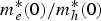 $ m_{e}^{\ast}(0) /m_{h}^{\ast}(0) $.
Hylleraas coordinates (r e, r h, r eh, z e, z h) are often chosen for convenience, in a two-body system like exciton, for variational integral calculations.[Reference Dujardin, Feddi, Assaid and Oukerroum22–Reference El Khamkhami, Feddi, Assaid, Dujardin, Stébé and Diouri24] The Laplacian transformation for such a system can be given as following:
 $$\eqalign{\Delta _{\rm e} = & \displaystyle{{\partial ^2} \over {\partial r_{\rm e}^2}} + \displaystyle{2 \over {r_{\rm e}}}\displaystyle{\partial \over {\partial r_{\rm e}}} + \left( {\displaystyle{{r_{\rm e}^2 - r_{\rm h}^2 + r_{{\rm eh}}^2} \over {r_{\rm e}r_{{\rm eh}}}}} \right)\displaystyle{{\partial ^2} \over {\partial r_{\rm e}\partial r_{{\rm eh}}}} \cr & + \displaystyle{2 \over {r_{{\rm eh}}}}\displaystyle{\partial \over {\partial r_{{\rm eh}}}} + \displaystyle{{\partial ^2} \over {\partial r_{{\rm eh}}^2}} + \displaystyle{{2z_{\rm e}} \over {r_{\rm e}}}\displaystyle{{\partial ^2} \over {\partial z_{\rm e}\partial r_{\rm e}}} \cr & + 2\left( {\displaystyle{{z_{\rm e} - z_{\rm h}} \over {r_{{\rm eh}}}}} \right)\displaystyle{{\partial ^2} \over {\partial z_{\rm e}\partial r_{{\rm eh}}}} + \displaystyle{{\partial ^2} \over {\partial z_{\rm e}^2}} \;,} $$
Δh can be obtained by switching the indices “e” to “h”.
The fundamental energy E X and its corresponding envelope wave function of the exciton X(e,h) are solutions of the Schrödinger equation H XΨX(r e, r h, r eh, z e, z h) = E XΨX(r e, r h, r eh, z e, z h). This energy is then computed by minimizing the mean value of H X:
 $$E_X = \min \displaystyle{{\langle \psi _X \vert H_X \vert \psi _X\rangle} \over {\langle \psi _X \vert \psi _X\rangle}}. $$
The trial wave function can be chosen this way:
 $$\psi _X = \Phi _{\rm e}(r_{\rm e})\Phi _{\rm h}(r_{\rm h}){\rm exp}( - \gamma r_{{\rm eh}}),$$
where  $\Phi _i(r_i) = \displaystyle{{sin\{ [{\pi / {(b - a}})]\,(r_i - a)\}} / {r_i}}$ (i = e,h). Coulombic spatial correlation between the electron and the hole is given by exp(−γr eh), and the non-linear variational parameter, γ, has be calculated so as to obtain the minimized mean value of energy.
The elementary volume dv in Hylleraas coordinates is given by the following expression:
 $$dv = \displaystyle{{8\pi r_{\rm e}r_{\rm h}r_{{\rm eh}}dr_{\rm e}dr_{\rm h}dr_{{\rm eh}}dz_{\rm e}dz_{\rm h}} \over D}.$$
The denominator D is written as
 $$D = \sqrt {4\left( {r_{\rm e}^2 - z_{\rm e}^2} \right)\left( {r_{\rm h}^2 - z_{\rm h}^2} \right) - {(r_{\rm e}^2 + r_{\rm h}^2 - r_{{\rm eh}}^2 - 2z_{\rm e}z_{\rm h})}^2}. $$
The integrations over z e and z hwere carried out following the generalization of Atanasoff integrals[Reference Atanasoff25] and performed in the intervals −r e ≤ z e ≤ r e and Z 1 ≤ z h ≤Z 2, where Z 1 and Z 2 are the roots of the above expression D.
Results and discussions
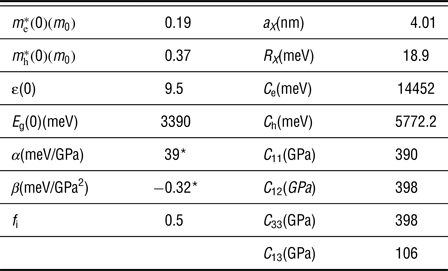
The aim of this work is the investigation of the influences of hydrostatic pressure and core/shell sizes of SCSQD on the binding energy of an exciton confined within, whose physical parameters used in the calculation are listed in Table I.
Physical parameters of wurtzite GaN.[Reference Ha and Ban11, Reference Zhang and Shi18]

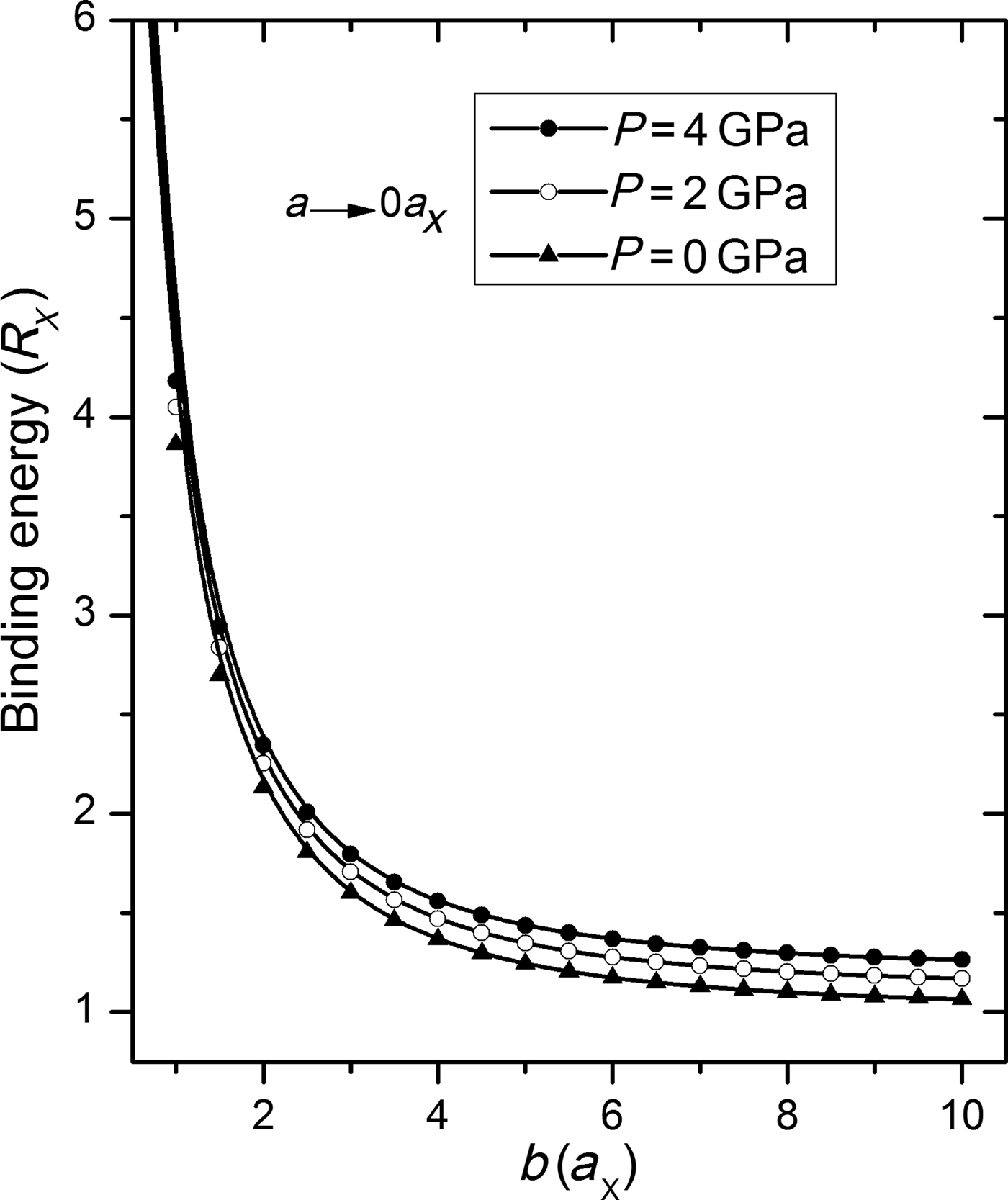
Firstly, let us take the case when a → 0 (HQD); and to investigate the influence of the pressure P on the excitonic binding energy, we present in Fig. 2 the excitonic binding energy for (P = 0, 2, and 4 Gpa) as a function of shell radius b. We remark that the binding energy is defined as the energy difference between uncorrelated and correlated electron hole pair calculated by minimizing the mean value of the Hamiltonian H X: E B = E e + E h−E X. From Fig. 2 we remark that for a specific hydrostatic pressure, the binding energy increases as shell radius b decreases due to the confinement effect and tends toward the three-dimensional (3D) binding energy limits of 1R X for P = 0 Gpa. We also remark that under the strong confinement regime (b≤1.5a X), the excitonic binding energy is less sensitive to the hydrostatic pressure P because of the prominent strong confinement causing the correlated pair is not influenced by this hydrostatic pressure. But by increasing the HQD size, we find that the pressure effect becomes more pronounced because the excitonic orbital is more expansive near the surface of the HQD and therefore becomes more sensitive to the pressure effect. This increase of binding energy with P is attributed to reduction in the lattice parameters, which is affected by the pressure following the formula: a GaN = a GaN(1 − P/3B 0),[Reference Ha and Ban11] where B 0 is given in equation (3); as we can see, the lattice parameters depend on the pressure and decrease when the pressure is applied and therefore a confinement reinforcement appears, and also due to an increase in the excitonic Rydberg energy since the applied pressure increases the reduced excitonic mass (equation 4) and meanwhile decreases the dielectric constant (equation 2).
Excitonic binding energy variation as a function of the shell radius for a → 0 and (P = 0, 2, and 4 GPa).

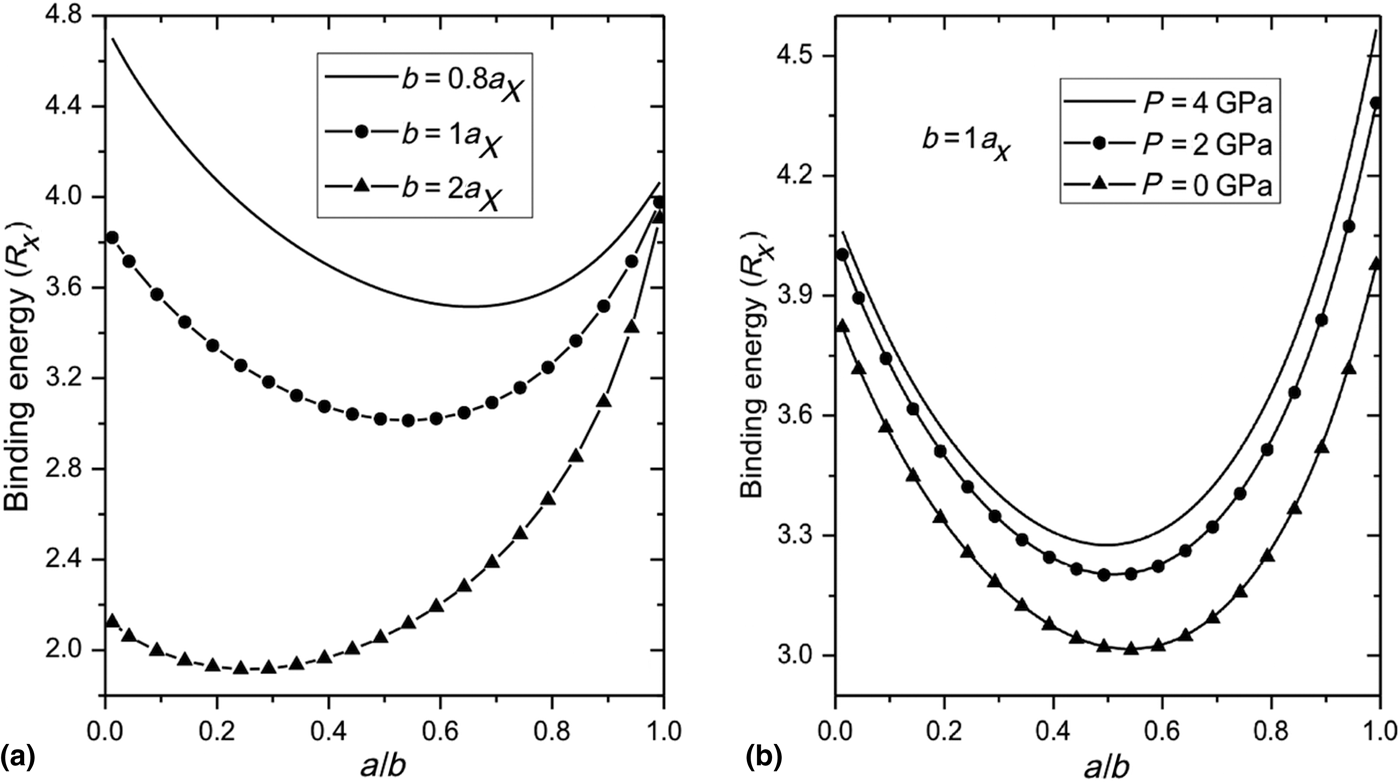
To analyze the size effect of SCSQD on the binding energy, we plot in Fig. 3(a) the excitonic binding energy as a function of the radii ratio a/b for b = 0.8a X, 1a X, and 2a X, our results indicate that the binding energy for b = 0.8a X is more important than that obtained for b = 1a X that is also larger compared with b = 2a X due to the confinement effect, and for the situation (a/b = 0), we observe that the binding energy decreases when the radius b increases and eventually tends to 1R X, which corresponds to the binding energy of the bulk material (3D limit); this situation is clearly remarked in Fig. 2. We also find that when a/b tends to unity, the binding energy tends to the well-known 2D excitonic binding energy limit of 4R X. Indeed, we remark that for a given critical value a/b cri, the binding energy presents a minimum. This minimum moves toward the larger values of a/b when b decreases and vanishes for the large values of b. When a/b varies from critical a/b cri to unity (minimal value to the 2D limit), the electron and hole constitute a free rotation on the GaN well spherical surface and therefore the coulombic energy becomes less important compared with the kinetic energy, which leads to an increase of the excitonic binding energy. Indeed the increasing of the biding energy beyond the a/b cri means that the spherical surface acts as 2D materials formed by few layers of GaN. This critical value a/b cri permits us to delimit between spherical surface confinement and 3D geometrical.
(a) Excitonic binding energy variation as a function of core-to-shell radii ratio a/b for b = 0, 0.8a X, 1a X, and 2a X; (b) excitonic binding energy variation as a function of core-to-shell radii ratio a/b for b = 1a X and (P = 0, 2, and 4 GPa).

Now let us discuss the hydrostatic pressure effects. In Fig. 3(b), we plot the excitonic binding energy as functions of the core/shell radii ratio a/b for b = 1a X and (P = 0, 2, and 4 GPa). We observe that the binding energy increases with the increasing pressure, i.e., that the pressure effects induce an additive confinement (the wave function of the exciton becomes more strongly localized), which will be added to the geometrical one. This is because of a decrease in the lattice parameters of GaN under pressure, as well as an increase of the reduced excitonic mass and a decreased dielectric constant. When the pressure increases, the variation of these material parameters leads to increased Rydberg energy and hence an increase of the excitonic binding energy; in other words, the pressure keeps the electron and hole close and even the SCSQD size becomes larger.
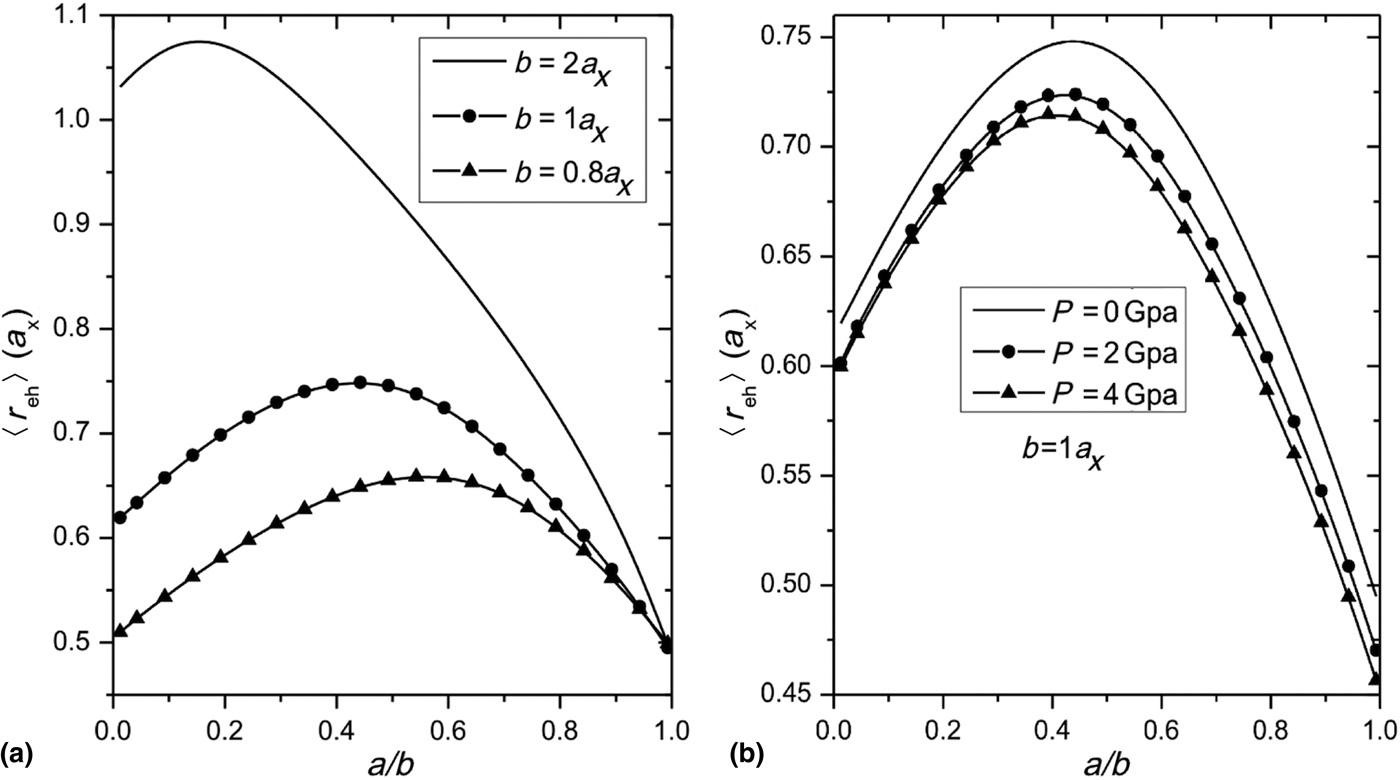
For more physical interpretation of the binding energy behavior discussed above, we have plotted in Figs. 4(a) and 4(b) the mean distance between the hole and electron 〈r eh〉 defined as 〈r eh〉 = 〈ΨX|r eh|ΨX〉/〈ΨX|ΨX〉. In Fig. 4(a), we present the 〈r eh〉, without hydrostatic pressure, for different shell thickness b = 0.8a X, 1a x, and 2a x. Firstly, we remark that the inter-particle distances increase when the shell radii b increase, which is justified by the decreasing of the binding energy. We can also clearly see that for a fixed shell thickness the mean distance increases when the a/b ratio value ranges between 0 and 0.54, for b = 0.8a X, between 0 and 0.44 for b = 1a X, and between 0 and 0.14 for b = 2a X. In these ranges, the electron and hole move away from each other, which leads to diminish the overlapping of the wave functions and therefore a significant drop of the binding energy is remarked. From a/b = 0.54 for b = 0.8a X, 0.44 for b = 1a X, and 0.14 for b = 2a X, the inter-particle distance begins to decrease and tends to 0.5a X for all shell radii values when a/b tends to unity. This means that the electron and hole become close now, and consequently the wave function of the exciton is more strongly localized, which approves the binding energy increase remarked in these ranges of a/b values. Figure 4(b) represents the variation of the mean value of the electron–hole distance for a fixed shell thickness b = 1a X and for different hydrostatic pressure values P = 0, 2, and 4 GPa, we found that the electron–hole distance decreases when the pressure increases indicating that the applied pressure acts as a supplemental confinement and strengthens the interactions between the charges carriers, and therefore the binding energy increases as applied pressure increases.
(a) Average distance between electron and hole 〈r eh〉 versus core-to-shell radii ratio a/b for different shell radius values: b = 0.8, 1, and 2a X; (b) average distance between electron and hole 〈r eh〉 versus core-to-shell radii ratio a/b for different hydrostatic pressure (P = 0, 2, and 4 GPa) and for b = 1a X.

Conclusion
The influence of the core/shell size/thickness and pressure effects on the behavior of the binding energy of excitons confined in a spherical core/shell quantum dots (SCSQD) were investigated by using a variational method, plus adiabatic approximation, under the framework of the effective mass approximation. The results demonstrated that the binding energy and electron–hole distance strongly depend on the shell thickness and tend to the well-known 2D limit of excitonic binding energy, when a/b tends to unity. We also found that the electron–hole attraction is favored under the applied pressure; therefore, the excitonic binding energy (electron–hole distance) increases (decreases), when the pressure increases (decreases).
Acknowledgments
G. L. acknowledges St John's University's Startup Fund, Seed Grant, and Support of Summer Research to support this research. G. L. also acknowledges CFN for providing facilities access. This research also used resources of the Center for Functional Nanomaterials, which is a US DOE Office of Science Facility, at Brookhaven National Laboratory under Contract No. DE-SC0012704.