1. Introduction
The recent publication of the appendicular sclerites of the middle Cambrian fossil Hallucigenia demonstrates their remarkable morphologic similarity to the morphology of claws and jaws of the extant onychophorans and a close phylogenetic relationship between the groups Onychophora and Euarthropoda (Smith & Ortega-Hernández, Reference Smith and Ortega-Hernández2014). This material also raises the question of the biological affinities of fragmented, organic sclerites or cuticles that are occasionally preserved in the earlier, Ediacaran successions that are popularly known to yield mostly metazoan impression or compression fossils. The exception is the organically preserved body fossil Sabellidites from terminal Ediacaran sediments, which has been recently interpreted as a siboglinid annelidan (Moczydłowska, Westall & Foucher, Reference Moczydłowska, Westall and Foucher2014). The earliest biomineralizing forms of unresolved biological affinities, such as Cloudina, Namacalathus, Namapoikia and Sinotubulites, appeared in the coeval successions (Grant, Reference Grant1990; Grotzinger, Watters & Knoll, Reference Grotzinger, Watters and Knoll2000; Chen et al. Reference Chen, Bengtson, Zhou, Hua and Yue2008).
Organically preserved microfossils resembling fragments of larger organisms that are likely to be metazoans have been recovered from terminal Ediacaran sediments on the East European Platform in Poland together with unicellular eukaryotes (acritarchs and algae) and prokaryotic cyanobacteria and studied in palynological preparates (Moczydłowska, Reference Moczydłowska1991, Reference Moczydłowska2008; Fig. 1). The palynological method of extracting microfossils by acid treatment indicates that they are constituted of refractory biopolymers, as does their appearance of being rigid and showing distinct morphologic features and a multilayered structure. More diverse microfossils extracted from Cambrian strata, referred to as small carbonaceous fossils (SCF), have been recognized as crustacean mandibles (Harvey & Butterfield, Reference Harvey and Butterfield2008), molluscan radulae (structures in mouth for rasping food), paraconodonts, pterobranch tubes, priapulid-type scalids and some other sclerites of unresolved affinities (Butterfield & Harvey, Reference Butterfield and Harvey2012; Harvey et al. Reference Harvey, Ortega-Hernández, Lin, Zhao and Butterfield2012). Cuticular spines with a characteristic cone-in-cone construction also seen in the claws of the lobopod Hallucigenia may be synapomorphic with onychophorans (Caron, Smith & Harvey, Reference Caron, Smith and Harvey2013; Smith & Ortega-Hernández, Reference Smith and Ortega-Hernández2014). These SCF are contemporaneous with metazoan body fossils that represent the extant phyla. The record of similar and undoubtedly Ediacaran organically preserved microfossils suggests the presence of bilaterians that are not yet documented by whole organisms before the Cambrian record.
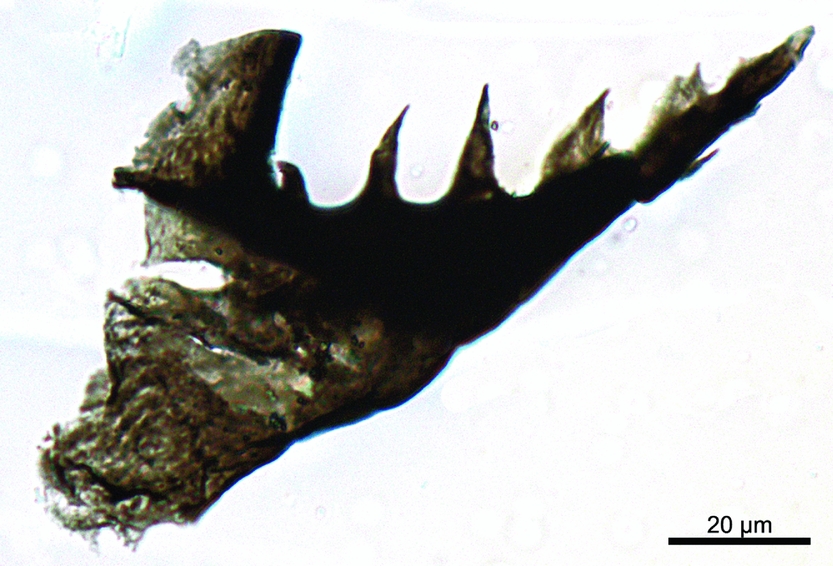
Organically preserved sclerite from the terminal Ediacaran Włodawa Formation in the Łopiennik IG-1 drillcore at a depth of 5376.7m in Poland. Specimen in microscopic slide 1, England Finder Coordinates M/34/1.

2. Materials and methods
The sclerite microfossils derive from an interval of alternating shales and sandstones containing phosphorite nodules of the Włodawa Formation in the Łopiennik IG-1 borehole in SE Poland (Moczydłowska, Reference Moczydłowska1991). The Włodawa Formation spans the upper Ediacaran and lowermost Cambrian strata. The lower Cambrian boundary has been recognized by a means of characteristic fossils in its top portion and is correlated with the Global Boundary Stratotype Section and Point (GSSP) in Fortune Head, Newfoundland (Moczydłowska, Reference Moczydłowska2008). The succession of the Ediacaran Harlaniella podolica Zone and the basal Cambrian Trichophycus pedum Zone is recorded in several boreholes and is laterally extending in the area (Pacześna, Reference Pacześna1986); the Ediacaran–Cambrian boundary is therefore biostratigraphically well established. The stratigraphic level of sclerite occurrence is c. 70m below the base of the Cambrian that also coincides with the Platysolenites antiquissimus Zone in the regional subdivision on the East European Platform (Moczydłowska, Reference Moczydłowska1991; Pacześna, Reference Pacześna1986, Reference Pacześna2014). The sediments containing microfossils have been deposited on a tidally influenced, shallow marine shelf. The absolute age interval for the time of deposition is between c. 541±1 and 551±4Ma, i.e. between the beginning of Cambrian and the isotopically dated tuff layer at the top of the Sławatycze Formation in the neighbouring Kaplonosy IG-1 borehole (Compston et al. Reference Compston, Sambridge, Reinfrank, Moczydłowska, Vidal and Claesson1995). The basalts with tuffs of the Sławatycze Formation also underlie in the Łopiennik IG-1 borehole, and the Ediacaran–Cambrian successions in both boreholes are precisely correlated. The dated tuff layer is some 190m below the studied layers containing the sclerite microfossils.
Microfossils were extracted from the rock samples of the Włodawa Formation in the Łopiennik IG-1 borehole at a depth of 5376.7m by palynological maceration method. In this procedure, hydrofluoric and hydrochloric acids were used to digest the minerals and residue was rinsed in distilled water and decanted. Flotation in a solution of heavy metals (CdJ2+KI) and final centrifugation was applied. Remaining organic residue was embedded in glycerol jelly strew mounts for microscopic observations. Examination of microscopic slides followed using a transmitted light microscope Olympus UC30 with attached camera CMAD-2 for microphotography. The fossil collection is housed at the Museum of Evolution, Palaeontological Section, Uppsala University.
3. Description
New microfossils reported here are part of the assemblage consisting of cyanobacteria, filamentous vendotaenids, green microalgae (chlorophyte Leiosphaeridia sp. and prasinophyte Pterospermopsimorpha sp.), some organic-walled biota of uncertain affinities (Valkyria) and fragments of larger organic fossils such as Ceratophyton (Moczydłowska, Reference Moczydłowska2008). The sclerites are rare because the preparation method was not intended for their recovery but for other types of microfossils. However, several specimens of Ceratophyton vernicosum Kirjanov in Volkova et al. Reference Volkova, Kirjanov, Piscun, Pashkavichene, Jankauskas, Keller and Rozanov1979, unidentified fragments of larger scleritomes and a single, morphologically complex sclerite illustrated here (Fig. 1) are recovered.
All the microfossils studied are organically preserved and resisted strong acid treatment for their extraction from sediment. It shows that regardless of being unicellular, filamentous, possibly multicellular organisms (Valkyria) and metazoan (Ceratophyton and the new sclerite described here), they are composed of refractory biopolymers in their cell walls or soft body integument. This record in siliciclastic rocks and without diagenetic mineralization, volcanic ash coating or bacterial ‘death mask’ that are the taphonomic windows of most Ediacaran biota demonstrates not only the feasibility of soft-bodied cuticle-bearing metazoan preservation but most significantly their existence during Ediacaran time.
The sclerite with conspicuous indentation pattern (Fig. 1) is of interest because it pre-dates the occurrence of similar morphotypes affiliated with metazoans known from Cambrian deposits. Recent records of SCFs from Cambrian sites of exceptional preservation reveal diverse specimens with comparable morphology to certain modern faunas (Harvey & Butterfield, Reference Harvey and Butterfield2008; Butterfield & Harvey, Reference Butterfield and Harvey2012; Harvey et al. Reference Harvey, Ortega-Hernández, Lin, Zhao and Butterfield2012; Caron, Smith & Harvey, Reference Caron, Smith and Harvey2013; Smith & Ortega-Hernández, Reference Smith and Ortega-Hernández2014; see discussion in Section 4).
The Ediacaran specimen (Fig. 1) fossil sclerite is conical, mildly curved, has a sharp distal spike, one side smooth and the opposite, with the more concave side bearing five denticles and is broad (but broken apart) at the proximal base with a larger spine apparently projecting out perpendicularly from it. Two organic layers, or constituent elements, are visible as transparent outer and opaque counterparts; their significance is discussed in the following. The basal part is transparent and was either apparently less sclerotized or consists of fewer layers than the rest of the sclerite. The length exceeds 130µm and maximum width is >60µm. We identify the sclerite as a metazoan cuticle fragment by comparison to sclerites recorded in Cambrian deposits.
Ceratophyton vernicosum appears to be among the earliest sclerites recorded in the transitional Ediacaran–Cambrian strata in the Ukraine, Poland, Latvia, Lithuania, Belarus and Russia, and then more frequently in the Cambrian strata and worldwide, additionally in Sweden, Spitsbergen, South Australia, Canada and China. This sclerite is of a simple, conical shape, is hollow inside and tapers towards a sharp-pointed termination and has a wide opening on the opposite end that is irregularly broken. Specimens range 100–200µm in length and 20–60µm in width across the opening. Ceratophyton vernicosum associated with the present record has been illustrated by Moczydłowska (Reference Moczydłowska2008) and similar specimens are newly observed. Because of non-diagnostic morphology of the microfossil various interpretations of its affinity were possible, including unidentified plant or animal remains (incertae sedis microorganisms). It also somewhat resembles the spiny elements of the early Cambrian molluscan radula (Butterfield, Reference Butterfield2008, fig. 6) which has been suggested to be a possible element of a radula-like apparatus (Harvey et al. Reference Harvey, Ortega-Hernández, Lin, Zhao and Butterfield2012). However, an important new study on the diversity of sclerites in the Cambrian priapulid Ottoia suggests that these too are cycloneuralian sclerites (Smith, Harvey & Butterfield, Reference Smith, Harvey and Butterfield2015, p. 11).
A distinctive microfossil of this assemblage is Valkyria borealis Butterfield in Butterfield, Knoll & Swett, Reference Butterfield, Knoll and Swett1994 which is an organic-walled, elongated oval vesicle with a few lobose lateral extensions freely connected with the vesicle cavity (illustrated by Moczydłowska, Reference Moczydłowska2008). Although suggested to be a complex, multicellular and possible benthic metazoan organism of Cryogenian age (Butterfield, Knoll & Swett, Reference Butterfield, Knoll and Swett1994), the mode of life and affinity of the species remain to be established. Multicellularity is not evident, and it may alternatively represent a cyanobacterial colony or a fragment of algal thallus without morphologic differentiation of the cells.
4. Discussion
Although the Ediacaran specimen shows some similarities to the jaw of the onychophoran, and may possess a similar ‘stacked’ morphology, the presence of onychophoran-like jaws during Ediacaran time seems unlikely because no such jaws are known from the Cambrian (stem-group) onychophorans (Smith & Ortega-Hernández, Reference Smith and Ortega-Hernández2014). In addition, the striking logarithmic morphology of the onychophoran claw is missing. By ‘stacked’ morphology, we mean a multilayered structure of the sclerite with an outer transparent layer mimicking the shape of the internal and dark layer; an alternative explanation of this morpholoy is presented below. Nonetheless, the complexity of its morphology suggests a metazoan and even bilaterian affinity, which would accord with the presence of bilaterians (Erwin et al. Reference Erwin, Laflamme, Tweedt, Sperling, Pisani and Peterson2011; Moczydłowska, Westall & Foucher, Reference Moczydłowska, Westall and Foucher2014) and the emerging bilaterian trace fossil record of the time (Jensen, Reference Jensen2003). In particular, these denticulate sclerites show a strong resemblance to the scalids of (total group?) priapulids illustrated by, for example, Butterfield & Harvey (Reference Butterfield and Harvey2012, fig. 2C, F) and Harvey et al. (Reference Harvey, Ortega-Hernández, Lin, Zhao and Butterfield2012, fig. 7G–J). Broadly similar structures have also recently been described from Ottoia and other Cambrian priapulids (Smith, Harvey & Butterfield, Reference Smith, Harvey and Butterfield2015). Although both fossil and extant priapulid sclerites are typically bilaterially symmetrical (a feature which the new sclerite does not obviously demonstrate), this feature may be obscured by the angle of flattening in known priapulid sclerites (Smith, Harvey & Butterfield, Reference Smith, Harvey and Butterfield2015). As for known Cambrian examples, the new sclerite is >100μm in length; it consists of a secondarily dentate prong with a fragmentary perpendicar ‘spur’ at its base, apparently attached to a broad and less-sclerotized region that is comparable to the ‘pad’ described by Smith, Harvey & Butterfield, Reference Smith, Harvey and Butterfield2015 (e.g. figs 3, 10D and other examples). In this interpretation, the apparently ‘stacked’ morphology may rather represent the superposition of two sides of a laterally compressed bilaterally symmetrical sclerite.
The oldest sclerites with denticulate morphology are two morphotypes of Redkinia (R. spinosa Sokolov, Reference Sokolov1977, and R. fedonkini Aseeva, Reference Aseeva1988) from the early Ediacaran Redkino Stage of Russia and the Ukraine (Sokolov, Reference Sokolov, Sokolov and Iwanowski1990; Runnegar & Fedonkin, Reference Runnegar, Fedonkin, Schopf and Klein1992). They are not comparable in morphology to the present record apart from having spiny elements, but are complex in shape and arrangement of spines. Redkinia sclerites show a mildly curved basal element (platform) bearing conical robust spines of equal length (R. spinosa) or with additional small spines of various length between them (R. fedonkini). They were regarded as scolecodonts (polychaete jaw apparatus elements; Sokolov, Reference Sokolov, Sokolov and Iwanowski1990) or fragments of arthropod cuticle (Runnegar and Fedonkin, Reference Runnegar, Fedonkin, Schopf and Klein1992). Redkinia sclerites differ in overall morphology from any described Cambrian cuticle fragments. However, a consistent pattern of two sizes of spines alternating in a row along the basal platform in R. fedonkini (Schopf, Reference Schopf, Schopf and Klein1992, holotype illustrated) is seen in early Cambrian cuticular elements identified as mandibular molar surfaces as in crustaceans (Harvey & Butterfield, Reference Harvey and Butterfield2008). The latter elements have a very different and wide, scale-shaped basal part with a marginal row of spines, whereas Redkinia’s platform is a fragmentarily preserved margin with spines only. An affinity with ecdysozoans is therefore perhaps another possibility for the affinities of this enigmatic fossil.
Bilaterians surely existed during latest Ediacaran time and such sclerites as that figured here, together with Redkinia, extend the SCF record before Cambrian time and may yield information about the earliest stages of bilaterian evolution. This prompts the search for sclerites and cuticle fragments, which appear to be made of refractory biopolymers and preservable, by using more suitable methods for recovery that would prevent fragmentation or destruction.
Acknowledgements
Research by M. Moczydłowska and H. Agić was supported by the Swedish Research Council (Vetenskapsrådet, VR, grant no. 621-2012-1669 to M. Moczydłowska) and by G. E. Budd by the Swedish Research Council (Vetenskapsrådet, VR, grant no. 621-2011-4703).