Introduction
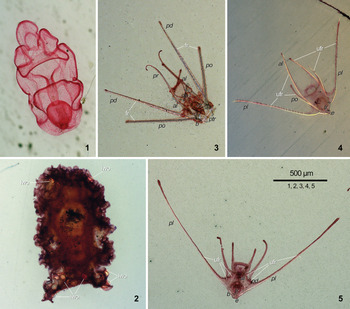
Marine invertebrate larvae have fascinated scientists for centuries, and their implications for animal evolution and ecology have been the object of study since Johannes Müller's initial work (Müller, Reference Müller1853) on echinoderm larvae (e.g., Lacalli, Reference Lacalli2000; Nielsen, Reference Nielsen, Carrier, Reitzel and Heyland2018). It has been recognized that all modern echinoderm representatives, such as sea urchins, starfish, and sea cucumbers, with the exception of crinoids (Nakano et al., Reference Nakano, Hibino, Oji, Hara and Amemiya2003), have feeding (planktotrophic) larvae composed of a distinctive body plan, whereas benthic, free-living feeding larvae are missing in echinoderms (McEdward and Miner, Reference McEdward and Miner2001). Lecithotrophic (non-feeding) larvae with benthic (or planktonic) habits have been reported in all modern echinoderm representatives (e.g., McEdward and Miner, Reference McEdward and Miner2001; Arnone et al., Reference Arnone, Byrne, Martinez and Wanninger2015). All of these types of echinoderm larvae have unique morphologies, and, with the exception of the asteroid bipinnaria (Fig. 1.1), a calcitic skeleton (e.g., Pennington and Strathmann, Reference Pennington and Strathmann1990; Smith, Reference Smith1997; Raff and Byrne, Reference Raff and Byrne2006). The pluteus of ophiuroids and echinoids has long arms supported by skeletal rods (Fig. 1.3–1.5) that greatly extend the ciliary bands, while the shorter-armed bipinnaria and auricularia characterize asteroids and holothuroids, respectively. In addition, the auricularia of sea cucumbers (Fig. 1.2) is unique in possessing distinct wheel-shaped ossicles (Metschnikoff, Reference Metschnikoff1869; Mortensen, Reference Mortensen and Hensen1898, Reference Mortensen and Drygalski1913, Reference Mortensen1920, Reference Mortensen1921, Reference Mortensen1931, Reference Mortensen1937, Reference Mortensen1938; Dan, Reference Dan, Kumé and Dan1968; Hendler, Reference Hendler, Giese, Pearse and Pearse1991; Holland, Reference Holland, Giese, Pearse and Pearse1991; Smiley et al., Reference Smiley, McEuen, Chafee, Krishnan, Giese, Pearse and Pearse1991; Balser, Reference Balser and Young2002; Byrne and Selvakumaraswamy, Reference Byrne, Selvakumaraswamy and Young2002; Emlet et al., Reference Emlet, Young, George and Young2002; McEdward et al., Reference McEdward, Jaeckle, Komatsu and Young2002; Sewell and McEuen, Reference Sewell, McEuen and Young2002).
Modern echinoderm larvae. All polarized light micrographs (crossed nicols). (1) Bipinnaria (Asteroidea); larval stage of Asterias rubens (Linnaeus, Reference Linnaeus1758) (ZMUC TM-F/45)—Strib, Kattegat (collected in 1879). (2) Auricularia (Holothuroidea); giant larva ‘Auricularia nudibranchiata Chun’; larval stage of Protankyra brychia (Verrill) (ZMUC TM-F/36)—Misaki, Sagami Bay (collected in 1899). (3) Fully formed echinopluteus (Echinoidea); larval stage of Heterocentrotus mamillatus (Linnaeus, Reference Linnaeus1758) (ZMUC TM-F/51)—Hurghada, Red Sea (collected in 1936). (4) Six-armed ophiopluteus (Ophiuroidea) [‘Ophiopluteus mancus Mortensen’]; larval stage of Amphiura filiformis (O.F. Müller, Reference Müller1776) (ZMUC TM-E/86)—Kristineberg, Gullmarfjord (collected in 1918). (5) Not fully formed ophiopluteus (Ophiuroidea); larval stage of Macrophiothrix propinqua (Lyman, Reference Lyman1861) (ZMUC TM-E/100)—Hurghada, Red Sea (collected in 1936). Note wheel-shaped ossicles of holothuroid auricularia (2) and skeletal rods in plutei (3–5). All specimens from (permanent) microscopic slides mounted with Canada Balsam stored in T. Mortensen collection at ZMUC. Abbreviations in white letters: fr = fenestrated skeletal rods; ufr = unfenestrated skeletal rods; lwo = larval wheel ossicles. Abbreviations in black letters: al = anterolateral rod; b = body rod; da = dorsal arch; e = end rod; pd = posterodorsal rod; pl = posterolateral rod; po = postoral rod; pr = preoral arm; ptr = posterior transverse rod; r = recurrent rod; tr = transverse rod; vtr = ventral transverse rod. Scale bar = 500 μm.

Anyone working with Recent echinoderm larvae would probably consider preservation and fossilization to be unlikely, given their apparent fragility and size. Taphonomic studies, such as those on sea urchin embryos and larvae by Raff et al. (Reference Raff, Villinski, Turner, Donoghue and Raff2006), showed that larval skeletal elements can be preserved under non-reduced and normal sea water conditions, giving echinoderm larvae the potential to fossilize, for example, as proposed by Wray (Reference Wray1992).
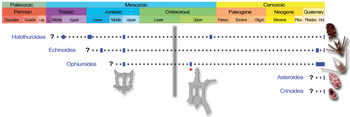
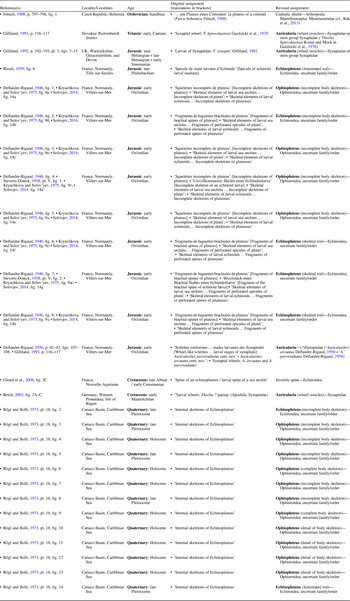
Echinoderms have an excellent fossil record since the Cambrian (Lefebvre et al., Reference Lefebvre, Sumrall, Shroat-Lewis, Reich and Webster2013; Zamora et al., Reference Zamora, Lefebvre, Álvaro, Clausen, Elicki, Harper and Servais2013; Reich et al., Reference Reich, Stegemann, Hausmann, Roden and Nützel2018), making them ideal subjects for investigating larval skeletons and patterns and processes of life history evolution. However, not much attention has been paid to fossil larvae or larval skeletons of Echinodermata (Williamson, Reference Williamson2013). Apart from some misinterpreted fossils from the Palaeozoic (e.g., Fritsch, Reference Fritsch1908) and Mesozoic (e.g., Girard et al., Reference Girard, Schmidt, Saint Martin, Struwe and Perrichot2008), some larval skeletons from ophioplutei and echinoplutei (Ophiuroidea, Echinoidea) were briefly described or figured from early (Rioult, Reference Rioult1959) and late (Deflandre-Rigaud, Reference Deflandre-Rigaud1946; refigured and interpreted in Sieverts-Doreck, Reference Sieverts-Doreck and Freund1958; Kryuchkova and Solov'yev, Reference Kryuchkova and Solov'yev1975; Solovjev, Reference Solovjev2014) Jurassic sediments of Normandy, France. In addition, a few larval ossicles of Holothuroidea were reported from European Triassic (Gilliland, Reference Gilliland1993), Jurassic (Gilliland, Reference Gilliland1992; Reich and Stegemann, Reference Reich and Stegemann2012), and Cretaceous (Reich, Reference Reich2003) strata (see Table 1 and Fig. 3).
Summary of fossil record of modern echinoderm larvae (Crinoidea, Asteroidea, Ophiuroidea, Echinoidea, Holothuroidea), based on data presented in Table 1. Gray vertical bar in Lower Cretaceous (ca. 110 Ma) highlights first appearance of representatives of Ophiuridae (Ophiurida), Ophiocomidae (Ophiacanthida), Amphiuridae, Ophiactidae, and Ophiotrichidae (latter all Amphilepidida; systematics after O'Hara et al., Reference O'Hara, Hugall, Thuy, Stöhr and Martynov2017)—modern ophiuroid families in which ophioplutei occur. Stratigraphic position of first Cretaceous ophiopluteus described herein indicated by (red) asterisk.

Fossil larval skeletons of modern echinoderm representatives reported in the scientific literature (in stratigraphic order, revisions included).

Thus, the current available fossil record of echinoderm larvae is essentially nonexistent (Jablonski and Lutz, Reference Jablonski and Lutz1983) and biased due to missing studies or lack of awareness of such small and fragile microfossils. However, modified micropaleontological techniques and/or the detailed study of residues below 100 μm have the promise to provide a much better fossil record for skeletal elements of echinoderm larvae, and therefore yield insights into developmental modes during echinoderm evolution (Bottjer et al., Reference Bottjer, Davidson, Peterson and Cameron2006). Here, I explore this issue, presenting a promising first example for future focused studies.
Materials and methods
This study is based on a single specimen from partly silicified limestones (cherty limestones, according to other authors) embedded in Late Cretaceous chalk. The material is very well preserved due to the fact that the silicification process caused by weakly acidic environmental conditions started very early diagenetically before sediment compaction (Herrig, Reference Herrig1982, Reference Herrig1993). After processing these sediments with hydrofluoric acid (HF; e.g., Schallreuter, Reference Schallreuter, Bate, Robinson and Sheppard1982), the (SiO2-impregnated) sediment matrix was dissolved and all the calcareous material was (secondarily) changed into calcium fluoride (CaF2). The method has been used to great effect in extracting calcareous microfossils from otherwise unyielding rocks, such as Late Cretaceous cherty chalk or the Late Ordovician Backstein (‘Brick’) limestone and Öjlemyr flint (all in the Baltic Sea area). The treatment of these kinds of cherty limestones resulted in large amounts of excellent, well-preserved ostracode (e.g., Schallreuter, Reference Schallreuter1971; Herrig, Reference Herrig1994, Reference Herrig2004; Schallreuter and Hinz-Schallreuter, Reference Schallreuter and Hinz-Schallreuter2013; Horne and Siveter, Reference Horne and Siveter2016) and echinoderm (e.g., Schallreuter, Reference Schallreuter1975; Reich, Reference Reich1995, Reference Reich2002, Reference Reich2010) material, among these numerous rarely found groups from the fossil record, making this ‘preservational window’ unique to science. The fluoridization process mentioned above normally results in replication of even the finest details of the former calcium carbonate shell or ossicle, such as fine pores or fragile spines (Reich, Reference Reich2014, p. 9–11). The focus of this method is different from the simple fluoridization process used (e.g., Sohn, Reference Sohn1956; Lane and Sevastopulo, Reference Lane and Sevastopulo1981) to get translucent or clean microfossils.
To date, this special extraction method used here was largely neglected and often misunderstood with regard to detailed disaggregation of the cherty limestones, as well as the transformation and preservation of calcareous fossils after treatment (e.g., Melnikova et al., Reference Melnikova, Tolmacheva and Ushatinskaya2010). The method used in the present study should not be mistaken for another hydrofluoric acid treatment (Pessagno and Newport, Reference Pessagno and Newport1972) used to extract siliceous microfossils such as radiolarians from compact cherts or flints. The main difference consists in the host rock: partly silicified limestone or chalk versus pure chert or radiolarite.
Locality and stratigraphic information
The partly silicified limestone was collected in 1994 at a small, abandoned chalk quarry near Kępa (Kamp; 53°52'44.93″N, 14°27'21.13″E), ~1.0 km northeast of the classic outcrop of the ‘Wolin Chalk’ between Lubin (Lebbin) and Wapnica (Kalkofen) (e.g., von Hagenow and Borchardt, Reference von Hagenow and Borchardt1850; Behrens, Reference Behrens1878; Deecke, Reference Deecke1907; Böhm, Reference Böhm1920; Alexandrowicz, Reference Alexandrowicz1966). The island of Wolin (Wollin) is located in the Odra River mouth, north of Szczecin (Stettin), NW Poland. The age of the chalk, based on its macro- and microfossil content, is late Turonian—Subprionocyclus neptuni ammonite zone, ca. 90 Ma (stratigraphic overview in Reich and Wiese, Reference Reich and Wiese2010).
Micropaleontological preparation techniques and documentation
Echinoderm ossicles from partly silicified limestones were isolated by a special micropaleontological method (see above), using 30–35% HF (see details in Wissing et al., Reference Wissing and Herrig1999, p. 42–44). After sufficient washing and careful sieving (sieve sizes: 0.03, 0.063, 0.1, and 1.0 mm), the residues were dehydrated at a temperature of ~70°C. All specimens were first picked and studied under a binocular microscope, and later mounted on stubs and gold-coated for investigation and imaging using a desktop scanning electron microscope (Phenom XL G2; Thermo Fisher Scientific).
The modern larval specimens for comparison were documented photographically using a digital microscope and camera equipment (Keyence VHX-7000); image stacks were prepared from up to five focal planes.
Repositories and institutional abbreviations
The figured fossil specimen is deposited at the Bavarian State Collection of Palaeontology and Geology (SNSB-BSPG), Munich, Germany. Deflandre-Rigaud's fossil echinoderm material is part of the micropaleontological collection at the Muséum National d'Histoire Naturelle in Paris (MNHN). Additional modern larval material figured is part of the Theodor Mortensen collection at the Natural History Museum of Denmark, University of Copenhagen (ZMUC).
Systematic paleontology
Abbreviations as in Figure 1 (nomenclature modified from Mortensen, Reference Mortensen1921).
Class Ophiuroidea Gray, Reference Gray1840
incerti ordinis
incertae familiae
Ophiopluteus, gen. and sp. A
Figure 2.1–2.3
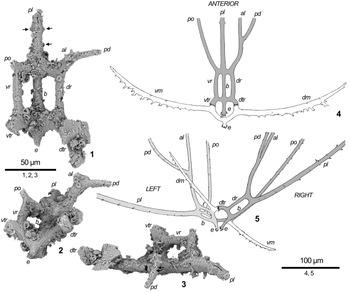
Late Cretaceous ophiopluteus in comparison with modern body skeletons. (1–3) Ophiopluteus, gen. and sp. A, right part of body skeleton (SNSB-BSPG 2020 XXXIX 5) from late Turonian chalk of Kępa, Isle of Wolin, NW Poland: (1) inner view; (2) inner oblique view; (3) lateral oblique view. Note small thorns at rods (black arrows). All scanning electron micrographs (specimen covered with coccoliths in part). (4, 5) ‘Ophiopluteus arcifer’ Mortensen, Reference Mortensen1921, Recent (linked adult species unknown), compound body skeleton (left part = light gray; right part = dark gray; median processes = white) reported from Gulf of Siam, Strait of Malacca, and off Jolo, Philippines (modified from Mortensen, Reference Mortensen1921). Abbreviations: al = anterolateral rod; b = body rod; dm = dorsal median process; dr = dorsal recurrent rod; dtr = dorsal transverse rod; e = end rod; pd = posterodorsal rod; pl = posterolateral rod; po = postoral rod; vm = ventral median process; vr = ventral recurrent rod; vtr = ventral transverse rod.. Scale bars = 50 μm (1–3), and 100 μm (4, 5).

Description
The partially preserved body skeleton (bs) is fairly robust and of compound type. Only the right part of the body skeleton is present (Fig. 2.1–2.3). Dorsal and ventral median processes are missing. The anteriorly directed, unfenestrated posterolateral (pl), anterolateral (al), posterodorsal (pd), and postoral (po) rods are partly broken off (Fig. 2.1), but with recurrent (r) and body (b) rods, as well as the other respective rod onsets, the main part of the body skeleton is still preserved. The incomplete posterolateral rod is set with bilaterally arranged small thorns (Fig. 2.1) and is circular in cross section (Fig. 2.3); the posterodorsal rod also has small thorns along the inner side (Fig. 2.3). The anterolateral and posterodorsal rods are somewhat erect, projecting to the center of the whole complex skeleton (Fig. 2.2). The short end rod (e), both transverse rods (tr), and the postoral rod are broken off. The body rod forms an angle of ~90° in cross section together with the dorsal and ventral recurrent rods. This structure is much longer than wide.
Material
SNSB-BSPG 2020 XXXIX 5, only known specimen from the late Turonian chalk of Kępa, Isle of Wolin, NW Poland.
Remarks
The assumed body length of this larva type is at least 0.17 mm. The incompleteness of the ophiopluteus skeleton described here with some processes broken off probably arose from handling during micropaleontological sieving and apparently does not have any taphonomic or diagenetic causes.
Modern ophioplutei occur only in the Ophiurida (Ophiuridae), Ophiacanthida (Ophiocomidae), and Amphilepidida (Amphiuridae, Ophiactidae, Ophiotrichidae) (McEdward and Miner, Reference McEdward and Miner2001; systematics after O'Hara et al., Reference O'Hara, Hugall, Thuy, Stöhr and Martynov2017). The following two main types can be distinguished within modern forms (Mortensen, Reference Mortensen1921): (1) simple body skeleton, having single body rods (b) only; and (2) compound body skeleton, a ventral (vr) and a dorsal (dr) recurrent rod forming together with the body rods (b) two coarse meshes in each side (left and right) of the body (Fig. 2.5).
The size and general shape of the above-described fossil ophiopluteus body skeleton most resemble the Recent ‘Ophiopluteus arcifer’ Mortensen, Reference Mortensen1921, reported from the Caribbean Sea, the Gulf of Panama, the Gulf of Siam, and the Strait of Malacca (Mortensen, Reference Mortensen1921, p. 158). Unfortunately, since the adult of this type of ophiopluteus is not yet documented (M. Byrne, written communication, 2020), an assignment of the Turonian ophiopluteus body skeleton to an ophiuroid order or family is not possible. Similar unidentified modern ophioplutei that have been sampled in the mid-ocean may be teleplanic (Hendler, Reference Hendler, Giese, Pearse and Pearse1991). Because ophioplutei in littoral waters normally reflect the benthic adult population (e.g., Rees, Reference Rees1954), these unidentified open sea ophioplutei are probably related to a deep-sea ophiuroid with essentially cosmopolitan distribution (Pacific and Atlantic Ocean), as similarly reported for bathyal/abyssal sea cucumbers (e.g., Protankyra brychia [Verrill, Reference Verrill1885] versus ‘Auricularia nudibranchiata’; Pawson et al., Reference Pawson, Gage, Belyaev, Mironov and Smirnov2003).
The mentioned type of modern ophiopluteus (‘Ophiopluteus arcifer’ Mortensen, Reference Mortensen1921) is somewhat narrower than the fossil one described herein, and the anterolateral and posterodorsal rods project in an anterior direction as do the posterolateral and postoral rods. The Cretaceous ophiopluteus skeleton is comparable to Upper Jurassic (lower Oxfordian) material described by Deflandre-Rigaud (Reference Deflandre-Rigaud1946; deposited at the MNHN). However, the structure formed by the body and recurrent rods is quadrangular, not rectangular, in shape (Fig. 3). Other published material from Pleistocene and Holocene sediments (Deep Sea Drilling Project) of the Cariaco Trench off Venezuela (Rögl and Bolli, Reference Rögl, Bolli, Edgar, Kaneps and Herring1973; misinterpreted as echinoplutei) shows that this ophiopluteus type in general apparently had a much greater diversity in Mesozoic and Cenozoic times than previously known. By reshaping the main skeletal structure from quadrangular to rectangular with different angles, it seems there have been evolutionary changes in which the body length of larvae is extended and the body flattened.
Conclusions
The late Turonian ophiopluteus body skeleton from NW Poland described herein originated from a larva of unknown ophiuroid species with a (?near-surface) planktotrophic larval stage. The fossil specimen is morphologically similar to a type of modern ophioplutei described by Mortensen (Reference Mortensen1921) that can probably be linked to deep-sea ophiuroid species. The new finding represents the first report of a Cretaceous ophiopluteus, which provides a window into the poorly known fossil record of echinoderm larvae.
Acknowledgments
Many thanks to M. Byrne, Sydney, Australia for additional information on the systematic status of Mortensen's published ophioplutei. T. Stegemann, Regensburg, Germany is thanked for comments on an earlier draft, A. Kroh, Vienna, Austria for discussions, and J. Ansorge, Greifswald, Germany, for technical help. J. Olesen and T. Schiøtte, Copenhagen, Denmark kindly provided access to the Mortensen collection, as well as A. Bartolini, Paris, France to the Deflandre-Rigaud collection. My stay at ZMUC and MNHN was financed in part by Synthesys grants (DK-TAF-3795, FR-TAF-1618), a program financed by European Community Research Infrastructure Action. In addition, the presented research was funded in part by an ‘SNSB innovativ grant’ (Bayerischer Pakt für Forschung und Innovation—BayPFI) funded by the StMWK (Bayerisches Staatsministerium für Wissenschaft und Kunst). Finally, the manuscript was greatly improved by helpful comments from reviewers S. Stöhr and L.G. Zachos, as well as editors R. Mooi and J. Jin.