Child maltreatment is a major public health concern, with national estimates indicating that annually over 3,000,000 children are involved in a child abuse and/or neglect investigation (USDHHS, 2021). Exposure to child maltreatment, including experiences of physical abuse, sexual abuse, emotional maltreatment, and neglect, can become embedded in children’s self-regulatory capacities and progressively impair both physical and mental health (Cicchetti & Tucker, Reference Cicchetti and Tucker1994). Indeed, individuals who have experienced child maltreatment are at enhanced risk for maladaptation throughout the life course (Cicchetti & Toth, Reference Cicchetti, Toth and Cicchetti2016). A multiple-levels-of-analysis approach is integral to more fully articulating the diverse ways that child maltreatment compromises development and health (Cicchetti, Reference Cicchetti, Beauchaine and Hinshaw2008).
The hypothalamic–pituitary–adrenocortical (HPA) axis is a major neuroendocrine system that works to assist the individual in adapting to acute and chronic stress with the release of cortisol, a glucocorticoid hormone (Lupien et al., Reference Lupien, McEwen, Gunnar and Heim2009; Smith & Vale, Reference Smith and Vale2006; Tsigos & Chrousos, Reference Tsigos and Chrousos2002). Given the critical role of the HPA axis in stress regulation, it has been widely researched within the area of child maltreatment, a form of early adversity that marks a severe breakdown in the caregiving environment and consequently chronic stress for the child. Cortisol evidences a diurnal rhythm characterized by an increase before waking, a peak approximately 30 min after waking, and a sharp decline by mid-morning, followed by a gradual decline across the day (Adam et al., Reference Adam, Quinn, Tavernier, McQuillan, Dahlke and Gilbert2017). Under conditions of prolonged and overwhelming stress, the HPA system can become dysregulated which can contribute to changes in levels and sensitivity of the hormones it produces and can have a neurotoxic effect (Kamin & Kertes, Reference Kamin and Kertes2017; Koss & Gunnar, Reference Koss and Gunnar2018). Because cortisol supports a range of vital physiological functions, including metabolism, immune functioning, and brain development, dysregulation of the diurnal rhythm of cortisol can have wide-reaching implications on both physical and mental health (Bernard et al., Reference Bernard, Frost, Bennett and Lindhiem2017). Allostatic load (McEwen & Stellar, Reference McEwen and Stellar1993; McEwen, Reference McEwen1998) represents the extent to which regulatory systems are overtaxed. In terms of the HPA axis, the chronic secretion of cortisol (hypercortisolism) has neurotoxic effects and cannot be sustained. Over time, the HPA axis may dampen down responsiveness to stress leading to a depletion of cortisol and low reactivity (hypocortisolism). Moreover, chronic stress may interfere with the diurnal rhythm of cortisol, resulting in flattening of diurnal cortisol (Koss & Gunnar, Reference Koss and Gunnar2018).
Dehydroepiandrosterone (DHEA) is an adrenal steroid that has anti-glucocorticoid properties and may function to protect from high levels of cortisol (Charney, Reference Charney2004). DHEA works in concert with the HPA axis in regulating stress, allostasis, and allostatic load. DHEA is highly developmentally sensitive and may be more strongly associated with puberty than cortisol (Saczawa et al., Reference Saczawa, Graber, Brooks-Gunn and Warren2013). Similar to cortisol, DHEA also follows a circadian pattern (Wilcox et al., Reference Wilcox, Granger, Szanton and Clark2014) and both cortisol and DHEA are central to the individual’s response to stress. Although cortisol and DHEA are both secretory signaling molecules involved in the stress regulatory system, they have opposing regulatory functions and mediate largely opposing biological functions (Kamin & Kertes, Reference Kamin and Kertes2017). Indeed, DHEA has been described as “anti-cortisol” because the effects are often in opposition to those of glucocorticoids (Gunnar & Talge, Reference Gunnar, Talge, Schmidt and Segalowitz2008).
There are a number of methods to index daily cortisol and DHEA regulatory activity including the awakening response, the diurnal slope, and diurnal area under the curve with respect to ground (AUCg). More specifically, the awakening response refers to increase in hormone concentration that occurs during the first 30 min after waking, diurnal slope assesses the linear rate of decline in cortisol and DHEA levels, respectively, throughout the day, and AUCg measures total daily output of the respective hormones across the day (Adam & Kumari, Reference Adam and Kumari2009; Pruessner et al., Reference Pruessner, Kirschbaum, Meinlschmid and Hellhammer2003). However, because cortisol and DHEA serve interconnected but opposing functions, there is merit in examining the two hormones together. As such, there has been much interest in simultaneously examining cortisol and DHEA, rather than employing a single hormone approach (Sollberger & Ehlert, Reference Sollberger and Ehlert2016).
One method to assess the joint contributions of cortisol and DHEA is to examine the ratio of the two hormones (Chen et al., Reference Chen, Raine, Soyfer and Granger2015). The ratio score has been advanced as a potentially more sensitive measure of HPA axis function because it facilitates an understanding of the balance of the two hormones (Sollberger & Ehlert, Reference Sollberger and Ehlert2016). Furthermore, the cortisol/DHEA ratio has been interpreted as a salient index of chronic stress, as well as a correlate of psychopathology. For example, higher cortisol/DHEA ratio scores have been interpreted to reflect a lower anabolic balance (Sollberger & Ehlert, Reference Sollberger and Ehlert2016; Steriti, Reference Steriti2010) and have been associated with chronic stress and negative physical and mental health outcomes (Cicchetti et al., Reference Cicchetti, Hetzel, Rogosch, Handley and Toth2016; Maninger et al., Reference Maninger, Wolkowitz, Reus, Epel and Mellon2009). However, there are numerous statistical and interpretational challenges associated with ratio scores in general which can make synthesizing findings across studies difficult (see Sollberger & Ehlert, Reference Sollberger and Ehlert2016 for review).
An alternative approach to simultaneous consideration of cortisol and DHEA co-regulation is the examination of within-individual coupling (covariation) of the hormones (Marceau et al., Reference Marceau, Ruttle, Shirtcliff, Hastings, Klimes-Dougan and Zahn-Waxler2015). With this within-person methodology, positive coupling indicates that within an individual, high levels of one hormone occur simultaneously with high levels of the other. Prior work has shown the developmental sensitivity of cortisol/DHEA coupling such that coupling between these hormones tends to become tighter over time (Ruttle et al., Reference Ruttle, Shirtcliff, Armstrong, Klein and Essex2015). Highlighting the importance of an individual’s development when interpreting the interplay of cortisol and DHEA, Shirtcliff et al. (Reference Shirtcliff, Dismukes, Marceau, Ruttle, Simmons and Han2015) asserted that coupling may appear within certain developmental stages and may be more or less salient in certain conditions, such as stressful environments.
Taken together, the literature on HPA axis regulation has relied on a number of varied metrics of regulation/dysregulation including awakening response, AUC, slope, basal levels of cortisol and DHEA, cortisol/DHEA ratios, and within-person coupling. Each metric represents a unique, albeit interconnected, measurement of HPA axis functioning, and these aspects of HPA axis functioning in turn contribute to developmental outcomes in distinct yet interconnected and complex ways. Person-centered data analytic approaches offer an opportunity to examine empirically derived common patterns of HPA axis dysregulation and in doing so allow for simultaneous investigation of multiple indices of the HPA axis. Specifically, person-centered methods, such as latent profile analysis (LPA), allow for the detection of unobserved (latent) subpopulations within a sample based on a set of observed variables (Lanza & Cooper, Reference Lanza and Cooper2016); in this case, the observed variables are various indices of HPA axis functioning.
Very few studies have adopted a person-centered method to capturing the heterogeneity in HPA axis functioning. Specifically, Hoyt et al. (Reference Hoyt, Zeiders, Chaku, Niu and Cook2021) examined profiles of five indices of cortisol activity including AUC, cortisol awakening response (CAR), diurnal slope, waking level, and bedtime level among young adults during the 2016 presidential election. Results supported five patterns of cortisol indices with one specific pattern (i.e., flat slope, high AUC, and high CAR) being most strongly associated with negative mental health outcomes. In addition, Bendezú and Wadsworth (Reference Bendezú and Wadsworth2018) employed a person-centered approach to examine patterns of cortisol and alpha-amylase reactivity among children during a stress paradigm. Person-centered methods represent an important advance in the simultaneous examination of multiple indicators of the neuroendocrine functioning and may facilitate a more nuanced understanding of the impact of stress of HPA axis dysregulation.
Child maltreatment and cortisol and DHEA regulation
The HPA axis in children exposed to maltreatment has not been shown to have a unitary response to ongoing stress. Rather, evidence for differential forms of dysregulation has been demonstrated and related to child psychopathology among maltreated children (Cicchetti & Rogosch, Reference Cicchetti and Rogosch2001a, Reference Cicchetti and Rogosch2001b; Cicchetti et al., Reference Cicchetti, Rogosch, Gunnar and Toth2010). Although there exists some consensus that children who have experienced chronic neglect display hypocortisolism (Koss & Gunnar, Reference Koss and Gunnar2018), other types and dimensions of maltreatment have shown less consistent patterns. For instance, recent reviews summarize disparate findings regarding the association of maltreatment with cortisol regulation such that multiple studies have linked maltreatment with hypocortisolism, and others have associated maltreatment with hypercortisolism (Bernard et al., Reference Bernard, Frost, Bennett and Lindhiem2017; Holochwost et al., Reference Holochwost, Wang, Kolacz, Mills-Koonce, Klika and Jaffee2020).
It is critical to highlight that maltreatment is a heterogeneous experience (e.g., Cicchetti & Rizley, Reference Cicchetti and Rizley1981; Jackson et al., Reference Jackson, McGuire, Tunno and Makanui2019; Warmingham et al., Reference Warmingham, Handley, Rogosch, Manly and Cicchetti2019) that has been conceptualized, measured, coded, and analyzed in a number of varied ways, all of which may contribute to these differential findings. Moreover, it is plausible that the influence of maltreatment on cortisol regulation may be conditional upon other important third variables, including sex (Koss & Gunnar, Reference Koss and Gunnar2018). For instance, Trickett et al. (Reference Trickett, Noll, Susman, Shenk and Putnam2010) longitudinal investigation of girls with and without sexual abuse histories advanced the literature by showing that sexually abused girls showed hypercortisolism in childhood which attenuated with time such that sexually abused girls evidenced hypocortisolism in early adulthood. These findings underscore the complexities inherent to research on child maltreatment and HPA axis dysregulation and emphasize the important role of development in these associations.
Although the majority of research on neuroendocrine dysregulation among children with histories of maltreatment has focused on cortisol regulation, a growing number of studies have also examined DHEA regulation, cortisol/DHEA regulation ratios, and/or cortisol/DHEA regulation coupling in relation to child maltreatment. Consistent with prior work focused exclusively on cortisol regulation, these studies also highlight the many complexities of associations between child maltreatment and neuroendocrine dysregulation. For example, Doom et al. (Reference Doom, Cicchetti, Rogosch and Dackis2013) showed the importance of sex moderation with results indicating that males with less pervasive CPS-documented maltreatment had lower DHEA but higher cortisol/DHEA ratio levels than females with similar maltreatment experiences. Higher cortisol/DHEA ratios have also been linked with higher internalizing symptoms among children who experienced recent maltreatment only (as opposed to early onset or chronic maltreatment; Cicchetti et al., Reference Cicchetti, Handley and Rogosch2015).
With regards to the coupling of cortisol and DHEA within individuals, a growing number of studies have demonstrated altered patterns of coupling among individuals with early adverse experiences, relative to those with less early adversity (Black et al., Reference Black, Lerner, Shirtcliff and Klein2018; Howland et al., Reference Howland, Donzella, Miller and Gunnar2020; King et al., Reference King, Graber, Colich and Gotlib2020; Ruttle et al., Reference Ruttle, Shirtcliff, Armstrong, Klein and Essex2015). For instance, Howland et al. (Reference Howland, Donzella, Miller and Gunnar2020) showed that post-stressor cortisol/DHEA reactivity coupling was dependent on pubertal stage for previously institutionalized children but was coupled regardless of pubertal stage for the non-adopted children, thus demonstrating the importance of not only consideration of adverse experience, but also pubertal development.
Cortisol and DHEA regulation and child outcomes
Much attention has also been paid to the physical and mental health correlates of various measures of HPA axis dysregulation. A recent meta-analytic review concluded that flatter diurnal cortisol slopes were associated with more maladaptive physical and mental health outcomes with effect sizes ranging from 0.09 to 0.29 (Adam et al., Reference Adam, Quinn, Tavernier, McQuillan, Dahlke and Gilbert2017). This pattern held at all ages of participants, with the exception of infants and toddlers, and for cross-sectional and longitudinal investigations. Furthermore, an increased CAR has been linked with higher levels of stress while a decreased CAR has been associated with constructs such as fatigue, burnout, and exhaustion (Chida & Steptoe, Reference Chida and Steptoe2009). Regarding other metrics of HPA axis regulation, high basal cortisol has been linked with internalizing symptoms and depression (Bernard et al., Reference Bernard, Frost, Bennett and Lindhiem2017; Stetler & Miller, Reference Stetler and Miller2011), as has higher cortisol/DHEA ratios (Chen et al., Reference Chen, Raine, Soyfer and Granger2015). Also, lower cortisol/DHEA ratios and lower basal cortisol have been observed among children with externalizing symptoms (Alink et al., Reference Alink, van IJzendoorn, Bakermans-Kranenburg, Mesman, Juffer and Koot2008; Kamin & Kertes, Reference Kamin and Kertes2017), although this finding is inconsistent across studies (e.g., Chen et al., Reference Chen, Raine, Soyfer and Granger2015).
Although the vast majority of research on maltreated children has highlighted the diverse negative developmental sequelae of this form of early-life adversity, a focus exclusively on deficits among individuals exposed to maltreatment ignores the critical ways in which positive adaptation and resilience are often displayed. Certainly not all maltreated children go on to experience negative mental or physical health outcomes; in fact, many go on to demonstrate positive adaptation across multiple domains of functioning (Cicchetti & Toth, Reference Cicchetti, Toth and Cicchetti2016). Competence is a multidimensional and dynamic process, and individuals may demonstrate high functioning in some domains and challenges in others (Luthar et al., Reference Luthar, Cicchetti and Becker2000). Prior studies on resilience among children exposed to maltreatment have focused on multiple domains of competence including social competence and emotion regulation (see Walsh et al., Reference Walsh, Dawson and Mattingly2010 for review). An adaptation-based approach to resilience (Ellis et al., Reference Ellis, Bianchi, Griskevicius and Frankenhuis2017; Ellis, Reference Ellis, Noll and Shalev2018) emphasizes that individuals exposed to harsh and unpredictable environments, such as child maltreatment, may develop specialized stress-adapted skills for navigating their challenging environments. They may develop certain adaptations that are particularly advantageous in conditions of adversity. These adaptations have been referred to as “hidden talents,” as they are typically underrecognized by researchers, policy makers, and service providers (Ellis et al., Reference Ellis, Abrams, Masten, Sternberg, Tottenham and Frankenhuis2020).
Despite the repeated calls for investigations of physiological manifestations of resilience in addition to behavioral displays of positive adaptation (e.g., Cicchetti Reference Cicchetti2010; Cicchetti & Rogosch, Reference Cicchetti and Rogosch2009; Curtis & Cicchetti, Reference Curtis and Cicchetti2003; Haglund et al., Reference Haglund, Nestadt, Cooper, Southwick and Charney2007; Ioannidis et al., Reference Ioannidis, Askelund, Kievit and Van Harmelen2020) research in this area is relatively limited. Notable exceptions include a study by Cicchetti and Rogosch (Reference Cicchetti and Rogosch2007) which showed that physically abused children who demonstrated resilient functioning evidenced high morning cortisol levels, and that high cortisol/DHEA ratio were associated with more resilient outcomes. Moreover, Chi et al. (Reference Chi, Slatcher, Li, Zhao, Zhao, Ren, Zhu and Stanton2015) found steeper diurnal cortisol slopes and higher morning levels of cortisol among resilient children of parents with HIV. Finally, there is also support for the notion of “skin-deep resilience” among Black individuals. Specifically, distinct samples have shown that Black youth and young adults who demonstrate high levels of outward competence may experience a physiological “cost” to this striving for resilience in the form of physiological maladaptation including higher allostatic load and inflammation (e.g., Brody et al., Reference Brody, Yu, Chen, Miller, Kogan and Beach2013; Russotti et al., Reference Russotti, Warmingham, Handley, Rogosch and Cicchetti2020). Much work remains to clarify the neuroendocrine correlates of resilience.
Current study
Given the numerous indices of HPA axis regulation, and the disparate findings regarding maltreatment effects on these varied metrics, as well as inconclusive findings regarding correlates of HPA axis indices and developmental outcomes, the current study sought to advance prior literature by examining naturally occurring person-centered patterns of multiple indices of neuroendocrine regulation. Person-centered methodology facilitates a novel simultaneous examination of multiple metrics of both cortisol and DHEA. Therefore, the first aim of this study is to identify naturally occurring profiles of cortisol and DHEA regulation among children with histories of maltreatment and demographically comparable non-maltreated children. Given inconsistent findings regarding the nature of the association between maltreatment and various indicators of HPA axis regulation, utilizing profiles of multiple metrics may provide valuable clarity in these relations. The second aim of this study is to test links between maltreatment and empirically derived profiles of cortisol and DHEA regulation. To capture heterogeneity within maltreatment, this aim will be tested with two different conceptualizations of maltreatment: number of maltreatment subtypes and chronicity of maltreatment. Finally, the third aim of this study is to determine whether profiles of HPA axis regulation relate to both symptomatology and adaptive outcomes among children with and without maltreatment experiences. Given the lack of prior research on the association between HPA axis regulation and adaptive outcomes among children exposed to maltreatment, we view this particular aim as exploratory.
Method
Participants and procedures
The present study included 1,258 children aged 8–12 (51.0% male; M age = 10.43 SD = 1.32). Participants were racially and ethnically diverse (64% Black, 21% White, 5% bi-racial, 2% other race; and 16% Latinx) and had histories of receiving public assistance (98.0%). The high-risk sample included maltreated children (n = 675; 53.7%) and non-maltreated children (n = 583; 46.3%), who participated in a research-based summer camp from 2004 to 2012 (see Cicchetti & Manly, Reference Cicchetti, Manly, Brody and Sigel1990 for more information about the research camp setting).
Participants were initially recruited based on documented records of child abuse and neglect through the Department of Human Services (DHS). A DHS liaison reviewed Child Protective Services (CPS) records and identified children who had been maltreated. The children were not in foster care placements and were residing with their biological mothers. The DHS liaison then contacted a random sample of eligible families and explained the study to parents who were free to either agree to participate or to decline to have their information released to project staff. Interested parents provided project staff with informed consent for both their and their child’s participation in the summer camp research program and for full access to any DHS records pertaining to the family.
Maltreated children are disproportionately from low-income, single-parent families (USDHHS, 2021). Therefore, the DHS liaison identified demographically comparable families (i.e., families receiving Temporary Assistance for Needy Families) without histories of CPS or preventive services involvement to recruit into the non-maltreated comparison group. As with the maltreated group, the DHS liaison contacted a random sample of eligible non-maltreated participants to discuss study details. If participants expressed interest, then their information was passed to project staff who were provided consent to search family DHS records and further verify the absence of maltreatment for all children in the family. Further, trained research staff conducted the Maternal Child Maltreatment Interview (Cicchetti et al., Reference Cicchetti, Toth and Manly2003) with all mothers to confirm the lack of maltreatment. If any conflicting information was provided that suggested the non-maltreated participants may have experienced maltreatment, then they were excluded from the comparison group.
Children enrolled in the study participated in week-long research summer camps and provided assent for research activities. Trained camp counselors, unaware of maltreatment status, worked with the same group of eight children (four maltreated and four non-maltreated) for the duration of the week (∼35 hr of contact). Counselors were upper-class undergraduate and graduate students recruited through local universities. Once hired, they completed an extensive 2-week training on completing behavioral assessments and were approved by an established trainer for validity and reliability via pilot sessions. After providing assent, children completed study procedures, including ratings of their own experiences, sociometric ratings of their camp peers, and provided salivary samples. At the end of each week, counselors completed measures of emotional and behavioral functioning for each child based on their observation and interactions.
Measures
Salivary cortisol and DHEA
Saliva samples were obtained by trained research assistants at daily, uniform times across the camp week: (1) at 9 a.m. upon arrival; (2) at 12 p.m. before lunchtime, and (3) at 4 p.m. upon departure. Research staff ensured that no food or drink was consumed for at least 30 min prior to each saliva sample. Due to the transportation time and initial time spent being greeted to camp, children had been awake for a minimum of 1 hr before providing the morning saliva samples. This resulted in a measure of morning cortisol that did not include awakening response. Samples were collected following recommendations by Granger et al. (Reference Granger, Schwartz, Booth, Curran and Zakaria1999). All children chewed Trident® sugarless gum to stimulate saliva flow and then passively drooled though a short drinking straw into a 20 ml plastic vial. Samples were frozen at −80°C for temporary storage and then, each week, were shipped overnight on dry ice for next day delivery to Salimetrics Laboratories (State College, PA) for assay. After thawing, each sample was processed by placing four to five 1 ml aliquots into 1.8 ml cryogenic storage vials and frozen at −40°C. Upon assay, samples were thawed to room temperature and centrifuged at 3,000 rpm for 15 min. The clear top plastic of the sample was pipetted into appropriate test tubes/wells. Salivary cortisol (in micrograms/deciliter) was assayed using an enzyme immunoassay kit (Salimetrics, State College, PA). This kit is commercially available and uses 25 μl of saliva. Its lower limit of sensitivity is 0.007 μg/dl (range up to 1.8 μg/dl) with average intra- and inter-assay coefficient of variation of <5.0% and 10.0%, respectively.
Cortisol was assayed from saliva for each day across the week that it was collected. Because of less variability in DHEA levels relative to cortisol, DHEA was assayed from saliva for 2 days, Tuesday and Thursday. Salivary DHEA (in picograms/milliliter) was also processed using an enzyme immunoassay kit (Salimetrics, State College, PA). This kit uses 550 μl of saliva. Its lower limit of sensitivity is 10.0 pg/ml (range up to 1,000 pg/ml) with average intra- and inter-assay coefficient of variation of <5.0% and 15.0%, respectively.
Cortisol and DHEA were checked for out of range values (cortisol < 0.012 or > 3.00 ug/dl; DHEA < 10.2 or > 1,000 pg/ml), and out of range values were recoded as missing. Data were then checked for outliers ±3 SD and were subsequently winsorized by recoding outliers to the value at ±3 SD from the mean. To calculate morning (i.e., AM) values, cortisol and DHEA were averaged across the week for each participant. To compute diurnal change in cortisol and DHEA, AM and evening (i.e., PM) values were averaged for each participant across the week. A difference score was then computed for each participant (AM value – PM value). Higher diurnal scores represent a steeper decline in hormone levels from morning to evening. Area under the curve for cortisol and DHEA was calculated using hormone data collected throughout each day. Before computing the AUC, values were averaged across the week for each time of day. The AUC score was calculated using Formula 2 (i.e., AUC with respect to ground) from Pruessner et al. (Reference Pruessner, Kirschbaum, Meinlschmid and Hellhammer2003).
Maltreatment
The Maltreatment Classification System (Barnett et al., Reference Barnett, Manly and Cicchetti1993) was used to code CPS records from birth until age 12. Exposure to the following subtypes were coded: neglect, physical abuse, sexual abuse, emotional abuse. Given that multi-type maltreatment exposure is frequently the norm (Vachon et al., Reference Vachon, Krueger, Rogosch and Cicchetti2015), we elected to operationalize maltreatment exposure in two ways. First, we calculated a continuous variable representing the number of subtypes a child experienced (ranging from 0 = nonmaltreated to 4 = exposure to all four subtypes). There were data available on subtypes for n = 638 maltreated children. Among these children, 269 (39.9%) were exposed to one form of maltreatment, 262 (38.8%) were exposed to two forms, 98 (14.5%) were exposed to three forms, and 9 (1.3%) were exposed to four types.
We also calculated a variable representing maltreatment chronicity by adding the number of developmental periods in which maltreatment was known to have occurred spanning the five developmental periods (infancy [birth-17 months], toddlerhood (18 months – 2 years), preschool age (3–5 years), early school age (6–7 years), and later school age (8–12 years). There were data available on maltreatment chronicity for n = 638 maltreated children. Among these children, 365 (54.1%) were exposed to maltreatment during one developmental period, 180 (26.7%) were exposed to maltreatment during two developmental periods, 69 (10.2%) were exposed to maltreatment during three developmental periods, 18 (2.7%) were exposed to maltreatment during four developmental periods, and 6 children (0.9%) were exposed to maltreatment during all five developmental periods. There were 37 children exposed to maltreatment (5.5%) who did not have subtype nor chronicity information due to lack of information within the CPS record. These 37 cases were not included in the maltreatment dimension analyses.
Symptomatology
Symptomatology
The Teacher Report Form (TRF) of the Child Behavior Checklist (TRF/CBCL; Achenbach, Reference Achenbach1991) is a 113-item measure widely used to assess emotional and behavioral symptoms in children. Each child was rated by two counselors after the 35-hr week of direct observation and interaction. Each item was rated on a 0–2 scale (0 = not true, 1 = somewhat true, or 2 = very true or often true) and scores were averaged across two raters. The Internalizing and Externalizing subscale T-scores were used to represent these two broadband dimensions of symptomatology. The average intraclass correlation (ICC) between raters for these scales indicated adequate reliability; ICCs across the years of camp ranged from 0.80 to 0.86 (M = 0.83) for externalizing symptomatology and from 0.64 to 0.79 (M = 0.73) for internalizing symptomatology.
Depressive symptoms
The Child Depression Inventory (Kovacs, Reference Kovacs1982) is a widely used, reliable, and well-validated 27-item self-report questionnaire to assess depressive symptomatology in school-age children (Saylor et al., Reference Saylor, Finch, Spirito and Bennett1984). Children chose from three options (scored 0–2) for each item in order to characterize their experiences and symptoms in the past 2 weeks, with higher scores representing more depressive symptomology. The 27-items were summed and used as an indicator of childhood internalizing symptoms (α = .86).
Conduct problems
The Pittsburgh Youth Survey (Loeber et al., Reference Loeber, Farrington, Stouthamer-Loeber and Van Kammen1998) is a self-report measure of conduct behaviors in childhood. Children self-reported 6-month prevalence of 25 behaviors (e.g., stealing, damaging property). This scale has strong evidence of convergent and predictive validity related to records of delinquency (Farrington et al., Reference Farrington, Barnes and Lambert1996). A count was computed for all endorsed items and used as a measure of childhood conduct problems (α = .79).
Adaptive outcomes
Likability
To assess social competence, two measures of likability were utilized including one measured by counselor report and another by peer report. Camp counselors conducted a sociometric peer rating measure with each child on the final day of camp (Bukowski et al., Reference Bukowski, Sippola, Hoza and Newcomb2000). Children were given a list of behavioral descriptors (e.g., “…starts fights, says mean things, pushes or hits others” or “I like…”), and asked to rate how true the descriptor was for each peer in their group on a 3-point scale (0 = not true to 2 = very true). In the current study, ratings from peers on how much a child was liked was used; all ratings from peers were averaged to yield a total peer rating of “liked most” score for each child.
The Pupil Evaluation Inventory (Pekarik et al., Reference Pekarik, Prinz, Liebert, Weintraub and Neale1976) is a 35-item assessment of social behavior. Counselors indicated which one or two children in their group best matched descriptive statements pertaining to aggression, withdrawal, and likability (e.g., “who are the children who are liked by everyone?”); no more than two children could be nominated for any one item. Aggregate scores were created for each of the three subscales based on the number of nominations a child received for respective scale items. Scores were averaged across counselor ratings (ICCs across the years of camp ranged from 0.67 to 0.82; M = 0.75). The likability scale was used in the current study as an indicator of an adaptive outcome.
Emotion regulation
The Emotion Regulation Checklist (ERC; Shields & Cicchetti, Reference Shields and Cicchetti1997) was used to assess emotional regulation and reactivity in childhood. The ERC is a well-validated (Shields & Cicchetti, Reference Shields and Cicchetti1997, Reference Shields and Cicchetti1998) and reliable (Kim-Spoon et al., Reference Kim-Spoon, Cicchetti and Rogosch2013) 24-item scale that relies on other-reporters (e.g., camp counselors) to rate children on a 4-point scale indicating their displays of affective behavior. This study included the emotion regulation subscale, consisting of items assessing appropriate emotional displays, empathic responses, equanimity, and emotional understanding.
Analytic plan
Analyses were conducted using Mplus version 8 (Muthén & Muthén, Reference Muthén and Muthén1998-Reference Muthén and Muthén2019). First, we used a LPA approach to find the best fitting cortisol and DHEA class solution. LPA indicators were AM cortisol, AUC cortisol, diurnal cortisol, AM DHEA, AUC DHEA, diurnal DHEA, cortisol/DHEA ratio. It is important to note that cortisol was assayed from saliva for each day across the week, and DHEA was assayed for saliva on Tuesdays and Thursdays only. Models with one through six classes were evaluated by considering entropy values, information criteria statistics (i.e., Akaike information criterion [AIC], Bayesian information criterion [BIC], sample-size adjusted BIC [ssBIC], and the log likelihood [LL]), and the Lo-Mendell-Rubin adjusted likelihood ratio test (LMR-LRT). We also considered theoretical interpretability, as recommended by Wickrama et al. (Reference Wickrama, Lee, O’Neal and Lorenz2016).
Next, once the best fitting class solution was chosen, we used a three-step approach to examine predictors of neuroendocrine class membership (Lanza et al., Reference Lanza, Tan and Bray2013). In this set of analyses, we used neuroendocrine class membership as the dependent variable (DV). The three-step approach allowed for the incorporation of predictors and covariates into the LPA model without any modifications to the class solution. A multinomial logistic regression framework was used to examine predictors of categorical neuroendocrine class membership. Three separate models were estimated, each with neuroendocrine class membership as the DV. Model 1 included the following covariate independent variables (IVs): age, sex, and the interaction of age and sex. Model 2 included the IVs from model 1 (age, sex, and age*sex) as well as number of maltreatment subtypes experienced and the interaction of maltreatment subtypes and sex. Model 3 included the IVs from model 1 (age, sex, and age*sex) as well as maltreatment chronicity and the interaction of maltreatment chronicity and sex.
Our next set of analyses used neuroendocrine classes as IVs and aimed to examine symptomatology and adaptive outcomes as DVs. To do so, we created a new categorical variable for the most likely neuroendocrine class membership based on posterior probabilities for each latent class. Note that the average latent class probabilities for most likely latent class membership ranged from 0.89 to 0.97 in our final LPA model. We then conducted a multivariate analysis of variance, covarying for age, sex, the interaction between age and sex, and maltreatment status, to examine mean differences on symptomatology and adaptive DVs between the neuroendocrine profiles (IVs). Internalizing symptoms, externalizing symptoms, depressive symptoms, conduct problems, liked most (counselor report), liked most (peer report), and emotion regulation were specified as separate DVs. We accounted for multiple comparisons using the Bonferroni correction.
The amount of missing data on study variables ranged from 0.5% to 20.7%, with conduct problems having the highest level of missing data. The result of Little’s MCAR test was significant, χ2 = 1,292.14 (df = 695), p < .001, indicating that data were not missing completely at random (MCAR; Schafer & Graham, Reference Schafer and Graham2002). Further inspection revealed that missing data on DHEA, internalizing, externalizing, and conduct problems were significantly related to participant age, such that younger participants were more likely to have missing data on DHEA, and older participants were more likely to have missing data on internalizing, externalizing, and conduct problems. Thus, we assumed that data were missing at random, meaning that the patterns of missingness were dependent on known variables (Schafer & Graham, Reference Schafer and Graham2002). Consequently, we used full-information maximum likelihood methods for parameter estimation in LPA models.
Results
Class solutions
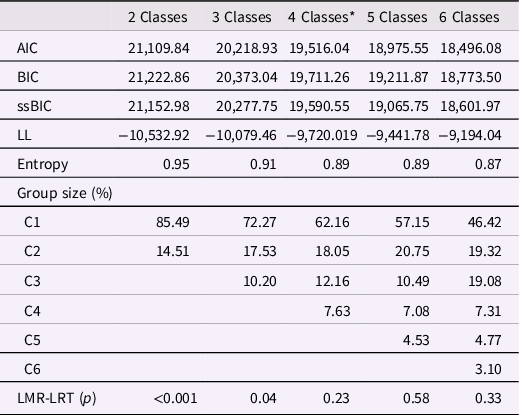
In order to determine the best class solution, we tested the latent model with one to six classes. The class solutions and fit indices are presented in Table 1. The four-class solution was the optimal model based on several statistical and theoretical factors. First, this solution presented lower AIC, BIC, ssBIC, and LL than solutions with one through three classes. Second, while the five and six class solutions did present lower AIC, BIC, ssBIC, and LL values, these models were not theoretically interpretable due to small class sizes (<5%), and the LMR-LRT test did not support these models. Thus, we proceeded with our analysis using the four-class solution.
Class solutions (N = 1,258)

Note. *Indicates class solution chosen as the best fitting model. AIC = Akaike information criterion; BIC = Bayesian information criterion; ssBIC = sample size-adjusted BIC; LMR-LRT = Lo-Mendell-Rubin adjusted likelihood ratio test.
Class characteristics
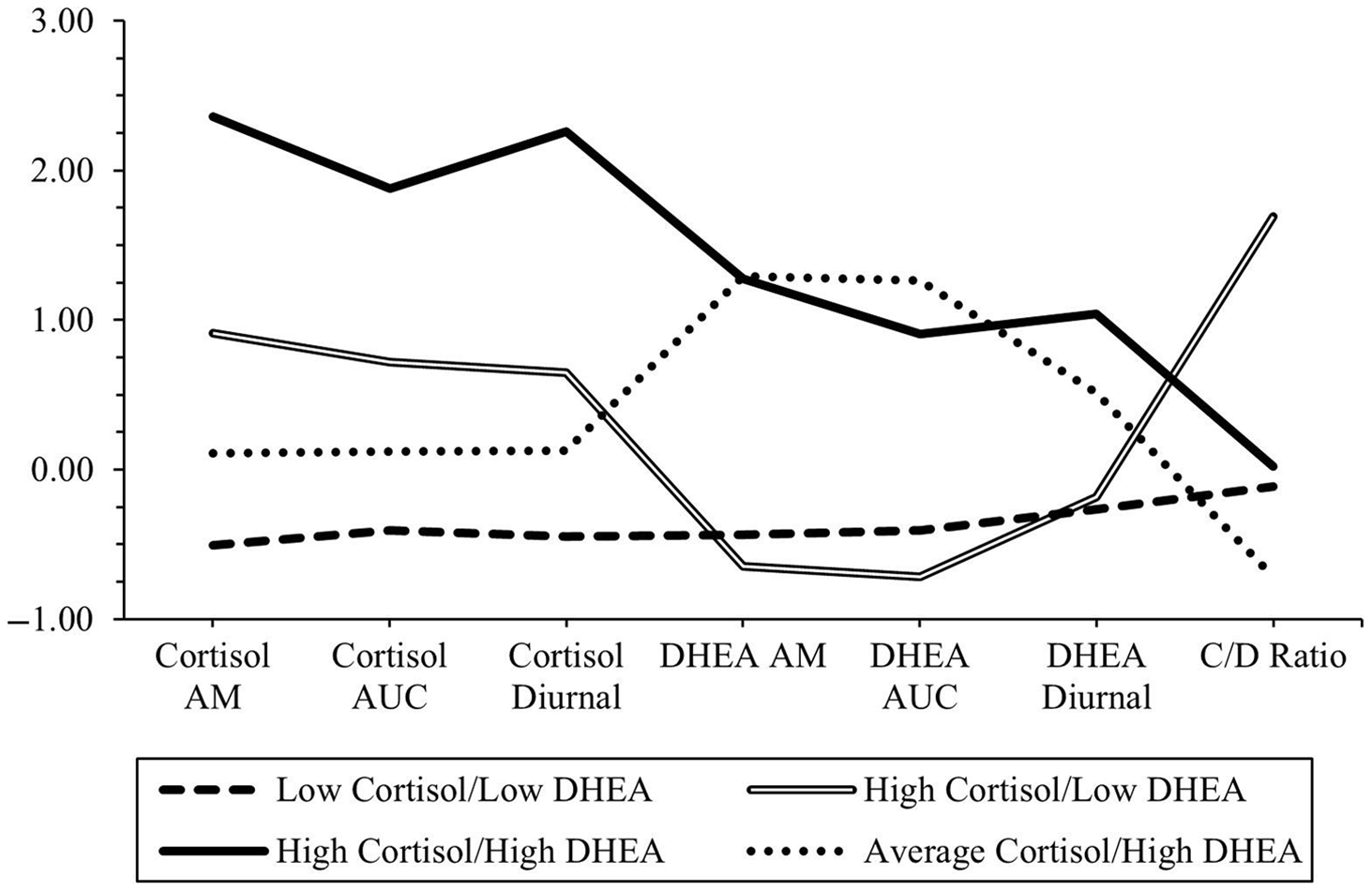
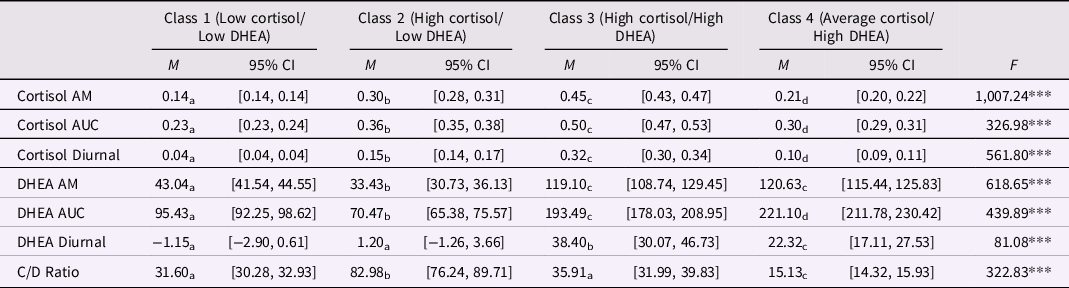
See Figure 1 and Table 2 for characteristics of the four-class solution. The largest class (62.16% of the sample, n = 782, Low Cortisol/Low DHEA class) was characterized by low cortisol AM, AUC, and diurnal scores, as well as slightly low DHEA AM, AUC, and diurnal scores. The cortisol/DHEA ratio was also approximately average within this class. The average latent class probability for most likely latent class membership in this class was 0.95. The second largest class (18.05% of the sample, n = 227, Average Cortisol/High DHEA class) was characterized by average cortisol AM, AUC, and diurnal scores, high DHEA AM, and AUC scores, average DHEA diurnal scores, and a low cortisol/DHEA ratio. The cortisol/DHEA ratio for this class was significantly lower than for all other classes. The average latent class probability for most likely latent class membership in this class was 0.92. The next largest class was characterized by high levels of cortisol AM, AUC, and diurnal levels, average-to-low DHEA AM, AUC, and diurnal scores, and a high cortisol/DHEA ratio (12.16% of the sample, n = 153, High Cortisol/Low DHEA class). The cortisol/DHEA ratio for this class was significantly greater than for all other classes. The average latent class probability for most likely latent class membership in this class was 0.88. Last, the smallest class was characterized by very high cortisol AM, AUC, and diurnal scores, high DHEA AM, AUC, and diurnal scores, and an average cortisol/DHEA ratio (7.63% of the sample, n = 96, High Cortisol/High DHEA class). The average latent class probability for most likely latent class membership in this class was 0.97. Because all average latent class probabilities for most likely class membership were greater than 0.80, classes were considered to be well separated. Furthermore, given the entropy for the four class solution was 0.89, this solution evidences good distinction among classes. All cortisol and DHEA scores, including the cortisol/DHEA ratio score, were significantly different between classes (see Table 2).
Four class solution. Note. The y-axis shows Z scores. AUC = area under the curve; C/D = cortisol/DHEA; Cort = cortisol.

Means for four-class model

Note. Cortisol is measured in µg/dl, and DHEA is measured in pg/mL. The C/D ratio score is measured in nmol/L. Means with a different letter subscript within the same row are significantly different from each other at p < .05. ***p < .001.
Predictors of cortisol and DHEA class
Demographic predictors
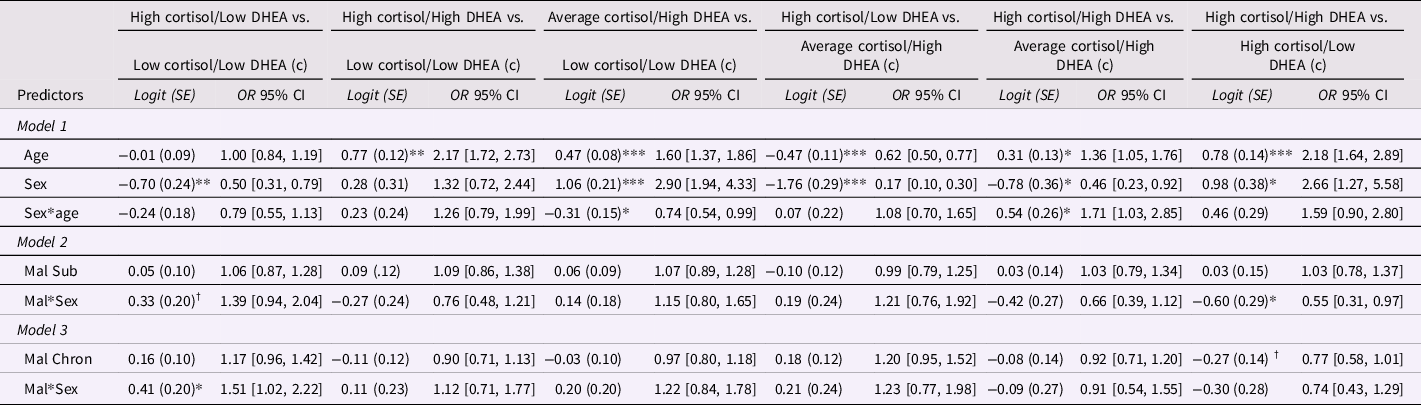
We subsequently examined predictors of classes in the four-class solution using a multinomial logistic regression framework (see Tables 3 and 4). In the first model, we examined two relevant demographic characteristics (age and sex) and the interaction between age and sex as predictors. Results showed that older youth were more likely to be in the high cortisol/high DHEA class and the average cortisol/high DHEA class compared to the low cortisol/low DHEA class. Additionally, younger children were more likely to be in the high cortisol/low DHEA class compared to the average cortisol/high DHEA class. Older participants were more likely to be in the high cortisol/high DHEA class versus the average cortisol/high DHEA class, and versus the high cortisol/low DHEA class. Compared to males, females were less likely to be members of the high cortisol/low DHEA class versus the low cortisol/low DHEA class, and versus the average cortisol/high DHEA class. Females were also more likely to be members of the average cortisol/high DHEA class versus the low cortisol/low DHEA class, and were more likely to be in the high cortisol/high DHEA class versus the high cortisol/low DHEA class. Finally, females were less likely to be members of the high cortisol/high DHEA class versus the average cortisol/high DHEA class. Overall, the results showed a pattern of females being more likely than boys to be in classes characterized by higher levels of DHEA.
Multinomial logistic regression results

Note. In model 1, N = 1,255. In model 2, N = 1,218. CI = confidence interval; OR = odds ratio; SE = standard error. “C” indicates the comparison group. Mal Sub = maltreatment # of subtypes. Mal Chron = maltreatment # of developmental periods. Sex is coded as 0 = male, 1 = female. † p < .10; *p < .05; **p < .01; ***p < .001.
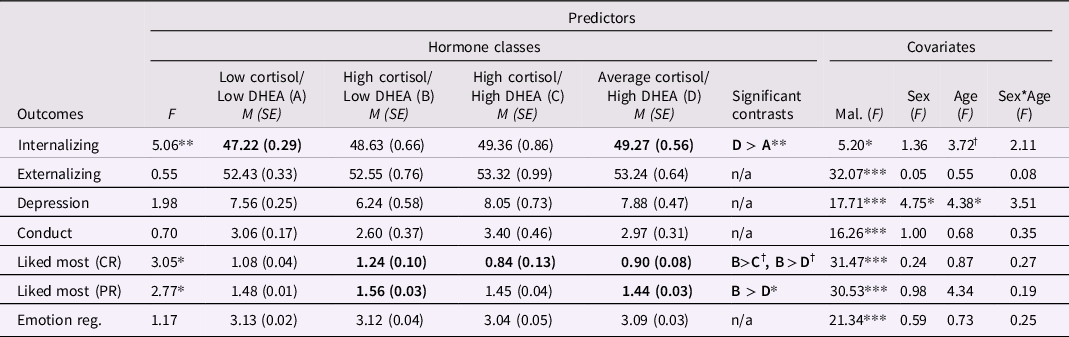
Analysis of covariance with symptomatology and adjustment outcomes

Note. CR = counselor report; Mal = maltreatment status; PR = peer report. Sex is coded 0 = male, 1 = female. Contrasts were adjusted for multiple comparisons using the Bonferroni correction. † p < .10; *p < .05; **p < .01; ***p < .001. For clarity, statistically significant contrasts are bolded.
There were also two significant effects of the interaction between sex and age, such that this interaction predicted a lower odds of membership in the average cortisol/high DHEA class versus the low cortisol/low DHEA class, and a higher odds of membership in the high cortisol/high DHEA class versus the average cortisol/high DHEA class. Probing these interactions revealed that there was a positive effect of age on odds of membership in the average cortisol/high DHEA versus the low cortisol/low DHEA class (i.e., older youth were more likely to be in the average cortisol/high DHEA class versus the low cortisol/low DHEA class), and that this association was stronger for boys than for females. Alternatively, while there was a positive effect of age on odds of membership in the high cortisol/high DHEA class versus the average cortisol/high DHEA class, this association was stronger for females than for males.
Maltreatment
See Table 3 for full results. Controlling for age, sex, and age by sex interaction, results showed that the interaction between number of maltreatment subtypes and sex predicted a lower odds of membership in the high cortisol/high DHEA class versus the high cortisol/low DHEA class. Probing this interaction showed that maltreatment increased the odds of membership in the high cortisol/low DHEA class versus the high cortisol/high DHEA class (i.e., the more maltreatment types a child experienced, the more likely they were to be members of the high cortisol/low DHEA class), and this association was stronger for females than for males. Likewise, there was a marginally significant finding that the interaction between maltreatment subtypes and sex predicted greater odds of membership in the high cortisol/low DHEA class versus the low cortisol/low DHEA class. Probing this interaction similarly showed that maltreatment increased the odds of membership in the high cortisol/low DHEA versus the low cortisol/low DHEA class, and this association was stronger for females than for males.
Regarding maltreatment chronicity (Table 3), the pattern of results is largely consistent with the results of analyses with number of maltreatment subtypes. Specifically, there was a significant interaction between maltreatment chronicity and sex such that chronic maltreatment increased the odds of membership in the high cortisol/low DHEA versus low cortisol/low DHEA class, and again this relation was stronger for females than males. Results also showed that more chronic maltreatment was marginally associated with an increased odds of membership in the high cortisol/low DHEA class versus the high cortisol/high DHEA class.
Symptomatology outcomes
We tested whether cortisol and DHEA classes differed on various symptomatology (i.e., internalizing symptoms, externalizing symptoms, depression, and conduct problems). See Table 4. There were significant group differences on counselor-reported internalizing symptoms. Contrasts revealed that youth in the average cortisol/high DHEA class had significantly higher internalizing symptoms compared to youth in the low cortisol/low DHEA class. There were no other significant group differences on other symptomatology measures.
Adaptive outcomes
Last, we tested whether cortisol and DHEA classes differed on likeability and emotion regulation. See Table 4 for full results. There were significant group differences on counselor-reports of children being liked most by peers. Post hoc comparisons revealed that children in the high cortisol/low DHEA class had marginally higher scores than children in the high cortisol/high DHEA class and the average cortisol/high DHEA class. There were also significant group differences on peer-reports of children being well-liked, such that children in the high cortisol were more well liked compared to children in the high DHEA class.
Given our findings that maltreatment (multi-subtype exposure and chronic maltreatment) predicted an increased odds of being in the high cortisol/low DHEA class, and the finding that youth with this neuroendocrine pattern were viewed as especially well liked by both peers and counselors, we conducted additional analyses to clarify this finding. Specifically, to determine whether this pattern of resilience directly applies to maltreated youth, we selected only the maltreated youth (N = 675) and found that among youth exposed to maltreatment, a profile of high cortisol/low DHEA was associated with increased likability, consistent with a pattern of resilience (F (3, 661) = 2.98, p = .03). Post-hoc comparisons using the Bonferroni correction showed that maltreated youth in the high cortisol/low DHEA class had marginally higher scores on counselor-reported likability (M = 1.10, SE = 0.12) compared to the average cortisol/high DHEA class (M = 0.69, SE = 0.11), p = .08.
Discussion
Using person-centered methodology, the current study identified naturally occurring profiles of seven key metrics of HPA axis regulation among children with and without histories of child maltreatment. We then examined whether certain neuroendocrine profiles best characterized children who had experienced maltreatment. Finally, we investigated which profiles of HPA axis regulation were most strongly associated with symptomatology and adaptive resilient outcomes. In doing so, we advance prior research by integrating person-centered methodology within the study of the physiological underpinnings of stress regulation among children with and without maltreatment experiences, and also by incorporating a multiple levels of analysis approach to the study of positive adaptation among this population.
First, results of our person-centered analysis identified four profiles of neuroendocrine regulation among this sample of children with limited access to financial resources and with and without child maltreatment. The most common neuroendocrine regulation profile (“low cortisol/low DHEA”), representing approximately 62% of the children, was characterized by relatively low morning cortisol and DHEA levels, and relatively low cortisol and DHEA daily output (AUC). The next largest neuroendocrine profile (“average cortisol/high DHEA”), evidenced by approximately 19% of the children, was marked by high morning DHEA, a high level of daily DHEA output (AUC), and an exceptionally low cortisol/DHEA ratio. In fact, the “average cortisol/high DHEA” profile was marked by a statistically lower cortisol/DHEA ratio than all other profiles. This configuration was demonstrated more often by older males, rather than younger males. Next, the “high cortisol/low DHEA” profile represented approximately 12% of the sample and was uniquely characterized by a large cortisol/DHEA ratio, relatively high morning cortisol levels and daily cortisol output (AUC), and relatively low morning DHEA levels and daily DHEA output. Younger children were more likely to evidence this configuration of neuroendocrine regulation in comparison to the “average cortisol/high DHEA” configuration. Moreover, males demonstrated this profile more often than they did the “low cortisol/low DHEA” profile. Lastly, approximately 8% of the children evidenced the “high cortisol/high DHEA” profile. This least common neuroendocrine profile (approximately 8% evidenced this profile) was marked by high morning cortisol and high morning DHEA, a relatively high daily output of both hormones, and a relatively steeper daily decline in both hormones. Older females were more likely to demonstrate this pattern than younger females.
Overall, these findings advance our understanding of neuroendocrine regulation among children by illustrating the utility of a person-centered approach to simultaneously consider multiple indices of HPA axis function. Much prior research has relied on a single metric of stress regulation which provides narrower insight into the interplay and balance of cortisol and DHEA. Results of our LPA underscore the importance of considering multiple indices to illuminate profiles of various forms of neuroendocrine regulation. For instance, both the “low cortisol/low DHEA” profile and the “high cortisol/high DHEA” profile evidenced similar (not statistically different) cortisol/DHEA ratio scores. However, a close examination of the overall patterns of neuroendocrine regulation for both profiles highlights vastly different configurations on all other metrics. Indeed, these two profiles show statistically significant differences on all other metrics of neuroendocrine functioning except the cortisol/DHEA ratio score. The person-centered approach taken in this study demonstrates that individual metrics, such as the ratio score, when considered in isolation, may obscure important and nuanced differences in physiological stress regulation. LPA offers an opportunity to analyze mutually dependent hormones while highlighting various forms of balance/imbalance within the HPA axis.
Prior research on the impact of child maltreatment on HPA axis functioning has been marked by inconsistencies and complexities and together underscore that the neuroendocrine metric, methodology, developmental stage and sex of the individual, type and timing of adversity, and co-occurring psychopathology are all critical considerations (e.g., Bernard et al., Reference Bernard, Frost, Bennett and Lindhiem2017; Holochwost et al., Reference Holochwost, Wang, Kolacz, Mills-Koonce, Klika and Jaffee2020). Given these complexities, we contributed to the prior work by utilizing person-centered methodology. This affords the opportunity for simultaneous consideration of multiple critical indices of neuroendocrine functioning in order to determine how maltreatment may be related to naturally occurring patterns of regulation, rather than to single indices. Consistent with prior research, our findings present a complex and nuanced picture.
Notably, for females, as the number of maltreatment subtypes increased, and for both males and females as maltreatment chronicity increased, likelihood of membership in the “high cortisol/low DHEA” class increased. These findings suggest that neuroendocrine functioning marked by high morning cortisol, low morning DHEA, and a high cortisol/DHEA ratio may best characterize children, and particularly females, with more multifaceted and pervasive maltreatment experiences. It’s important to highlight that this finding held when controlling for age, sex, and the interaction between age and sex, indicating that it is unlikely these findings reflect normative developmental or pubertal changes in cortisol and DHEA, but rather are indicative of a unique profile for children (and particularly females) with histories of pervasive and chronic maltreatment. A large cortisol/DHEA ratio has been interpreted as a cortisol/DHEA imbalance and a potential marker of HPA axis dysregulation because DHEA may not be functioning to counteract or protect from high levels of cortisol (Sollberger & Ehlert, Reference Sollberger and Ehlert2016).
Although the “high cortisol/low DHEA” neuroendocrine profile may characterize an imbalance within the HPA axis, maltreated children with this hormonal configuration demonstrated unique interpersonal competence not typically shown by children with other neuroendocrine profiles. Specifically, children who evidenced the “high cortisol/low DHEA” pattern were viewed by camp counselors and peers as more popular or well-liked socially. We view these findings as in line with the notion of “hidden talents” proffered by Ellis et al. (Reference Ellis, Abrams, Masten, Sternberg, Tottenham and Frankenhuis2020). Together our findings indicate that children with a history of maltreatment may adapt to this adversity by developing the stress-adapted skill of social competence among peers. It’s plausible that this form of interpersonal adaptation may develop to buffer the severe interpersonal disturbance characterized by the experience of maltreatment. Although they evidenced a pattern of HPA axis dysregulation marked by a cortisol/DHEA imbalance, behaviorally, on average these children demonstrated positive adaptation and displayed high prosocial abilities. This finding is particularly robust, given that children with this profile were perceived by both counselors and peers as especially likable. One can speculate about why this specific profile may be associated with interpersonal adaptation in response to stress. High cortisol production may offer an advantage by marshaling an adaptive effort to cope with anticipated social stress which, when paired with lower DHEA, a plausible indication of less pubertal maturation (Saczawa et al., Reference Saczawa, Graber, Brooks-Gunn and Warren2013), may facilitate easier navigations of interpersonal relationships. These results are consistent with those of Cicchetti and Rogosch (Reference Cicchetti and Rogosch2007), who showed that a large cortisol/DHEA ratio was associated with higher resilient functioning as indexed by seven markers of positive adaptation including social competence, school functioning, and lack of symptomatology. We advance this prior work by uncovering a multifaceted neuroendocrine profile that may underlie this adaptive resilience.
Previous research has shown a large cortisol/DHEA ratio to be linked with negative physical and mental health outcomes (e.g, Maninger et al., Reference Maninger, Wolkowitz, Reus, Epel and Mellon2009). Although our findings may seem contradictory, it is important to highlight that the demonstration of positive adaptation in one domain (e.g., interpersonal skills) does not necessitate maladaptation in another domain. Indeed, resilience is classically conceptualized as a multifaceted construct in which individuals may present with high adaptation and resilience in one domain and significant challenges in another (Luthar et al., Reference Luthar, Cicchetti and Becker2000; Masten, Reference Masten2001). Together our results suggest that females who experience pervasive maltreatment may evidence a unique pattern of neuroendocrine functioning characterized by high cortisol and low DHEA, and this pattern may also serve as a biomarker for interpersonal adaptive skill that may render children with maltreatment histories especially likeable among their peers.
With regards to symptomatology, we found that children who evidenced the “average cortisol/high DHEA” profile were perceived by camp counselors as experiencing significantly more internalizing symptoms than those in the “low cortisol/low DHEA” neuroendocrine profile. Thus, a profile marked by average morning cortisol, average daily cortisol output and diurnal change, and high morning DHEA and daily DHEA output and diurnal change as well as a low cortisol/DHEA ratio was the only neuroendocrine profile linked with symptomatology in this study. Our findings are consistent with prior research linking depressive symptoms (Goodyer et al., Reference Goodyer, Herbert, Tamplin and Altham2000) and anxiety symptoms (Mulligan et al., Reference Mulligan, Hajcak, Crisler and Meyer2020) with higher DHEA levels (Goodyer et al., Reference Goodyer, Herbert, Tamplin and Altham2000), and lower cortisol/DHEA ratio (Lee et al., Reference Lee, Peckins, Miller, Hope, Neblett, Assari, Muñoz-Velázquez and Zimmerman2021). However, our person-centered methodology advances prior work by linking a multi-indicator pattern of HPA axis regulation to symptomatology, rather than relying on individual indicators of HPA axis functioning. Although prior work has implicated a blunted diurnal cortisol slope among individuals with internalizing symptoms, it is worth clarifying that differences in methodology may make interpretations of diurnal change across studies challenging. Specifically, the present study took place in the context of a summer research camp which meant that the morning samples were collected upon arrival at camp (approximately 9 a.m.), not wake-up. Similarly, we did not have a measure of bedtime cortisol or bedtime DHEA. Therefore, our diurnal change represents a somewhat truncated measurement of across day change, and our morning cortisol and DHEA levels represent baseline, rather than awakening, levels. Thus, results may not generalize to studies with samples collected from wake-up to bedtime and are not analogous to studies that specifically investigated the awakening response.
Additionally, prior work has demonstrated the utility of examining maltreatment parameters within these associations. For example, research by Cicchetti et al. (Reference Cicchetti, Rogosch, Gunnar and Toth2010) with a sample of CPS involved children and demographically matched non-maltreated children showed that those who experienced early childhood physical or sexual abuse and who were experiencing high depressive symptoms demonstrated an attenuated diurnal decrease in cortisol. This pattern was not found among children who experienced later onset abuse, or early onset neglect or emotional maltreatment, which underscores the importance of a close examination of maltreatment dimensions within these associations. Future research would benefit from the continued careful examination of maltreatment parameters, as well as the investigation of a dimensional approach to conceptualizing childhood adversity more broadly (McLaughlin & Sheridan, Reference McLaughlin and Sheridan2016) when investigating the impact of early adversity on neuroendocrine dysregulation. Moreover, testing whether associations between neuroendocrine profiles and outcomes vary by maltreatment exposures will also be an important next step for research in this area.
It is evident that HPA axis regulation is highly developmentally sensitive and puberty is a salient construct within neuroendocrine functioning (Gunnar et al., Reference Gunnar, DePasquale, Reid, Donzella and Miller2019; Kamin & Kertes, Reference Kamin and Kertes2017; Koss & Gunnar, Reference Koss and Gunnar2018). Our results indicated a general pattern of females being more likely than boys to be in classes characterized by higher levels of DHEA. Moreover, older children were more likely to display the “high cortisol/high DHEA” profile compared to any other profile. Older children, especially females, may have been more likely to evidence higher DHEA levels because of relatively more advanced pubertal development. Indeed, DHEA has been shown to be especially sensitive to maturational changes with clear increases occurring in later childhood and adolescence (Kamin & Kertes, Reference Kamin and Kertes2017). Furthermore, cortisol and DHEA has been shown to be more tightly coupled as children develop into adolescents (Ruttle et al., Reference Ruttle, Shirtcliff, Armstrong, Klein and Essex2015). Although we did not conduct within-person analyses, our findings support a stronger positive association between cortisol and DHEA among older children, and especially older females, in our sample.
The present study advances our understanding of naturally occurring patterns of multiple indices of neuroendocrine functioning among children with and without histories of maltreatment, and their association with maltreatment and developmental outcomes. Strengths include the person-centered empirically derived approach to conceptualizing HPA axis regulation, multi-informant design with assessments of both symptomatology and adaptive functioning occurring via self-report and collateral-report methodologies, and attention to both negative consequences as well as the adaptive resilience among participants.
In spite of these strengths, there are limitations worth noting. First, we did not ask participants about their experiences of discrimination, nor did we measure systemic racism, which is noteworthy because the majority of the participants were children of color. As a result of factors such as racial bias, discrimination, and institutional racism, children and families of color are disproportionately represented in the child welfare system (Dettlaff & Boyd, Reference Dettlaff and Boyd2021). The trauma and added stress associated with racism represents a salient social determinant of health (Trent et al., Reference Trent, Dooley and Dougé2019). For instance, Lee et al. (Reference Lee, Peckins, Miller, Hope, Neblett, Assari, Muñoz-Velázquez and Zimmerman2021) showed that racial discrimination predicated a lower cortisol/DHEA ratio via a mechanism of increased depressive symptoms among Black young adults. Discrimination must be considered in future research on the physiology of the development of psychopathology and resilience. Second, although we included sex, age, and the interaction between sex and age in our statistical models in an effort to address developmental maturation that occurs during late childhood, these represent proxy measures for puberty. Puberty has been identified as a recalibration period in which effects of early adversity, such as maltreatment, may have the opportunity to be re-set (Koss & Gunnar, Reference Koss and Gunnar2018). Unfortunately, pubertal status was not assessed for all participants and was, therefore, not included in the present analyses. Future research will benefit from the careful inclusion of pubertal development within investigations of neuroendocrine functioning among children exposed to adversity. Third, we relied on cross-sectional data to examine links between HPA axis functioning and symptomatology and resilience. As such, we cannot assert directionality or causality in these contemporaneous associations. Relatedly, although it was considered best practice in saliva collection at the time of data collection, it is now known that oral stimulants may compromise the sample (Granger et al., Reference Granger, Kivligham, Fortunato, Harmon, Hibel, Schwartz and Whembolua2007). Furthermore, it is worth noting that cortisol was assayed from saliva collected across all days of camp and DHEA was assayed from saliva collected only on Tuesdays and Thursdays, and we did not include children’s use of medication in the statistical models. Finally, following the LPA, we assigned participants to classes to examine associations with symptomatology and adaptive outcomes. We recognize that this approach may introduce statistical bias; however, this is somewhat mitigated by the high entropy of our class solution which reduces the risk of classification error (Clogg, Reference Clogg, Arminger, Clogg and Sobel1995). Additionally, by using the classify and analyze approach to test the influence of class membership on symptomatology and adaptive outcomes, we were able to include important covariates (maltreatment, sex, age, and the interaction between age and sex) in our analyses.
In conclusion, the present study aimed to identify latent profiles of neuroendocrine functioning among a sample of children with and without experiences of child maltreatment, and to determine links between maltreatment and neuroendocrine profiles and symptomatology and positive adaptation. Four profiles of cortisol and DHEA regulation were identified. Among females, a pattern marked by high cortisol and low DHEA was associated with more pervasive maltreatment experiences. Furthermore, we found evidence of adaptive resilience in that children who evidenced this pattern of high cortisol and low DHEA also were viewed by adults and peers as more likeable than children with other neuroendocrine patterns. Finally, results pointed to higher levels of internalizing symptoms among children who displayed a profile marked by average cortisol and high DHEA. Our findings reflect the heterogeneity in HPA axis functioning that occurs in children exposed to maltreatment and identify patterns of neuroendocrine regulation associated with both adaptive and maladaptive outcomes. Research, policy, and service provision designed to address the sequelae of early-life adversity would do well to consider the complex, diverse ways that child maltreatment influences both maladaptive and adaptive development.
Acknowledgments
Thank you to the individuals who participated in the research.
Funding statement
We are grateful to the National Institute on Drug Abuse (R01-DA01774 to F.A.R. and D.C.), National Institute on Mental Health (R01-MH083979 to F.A.R. and D.C.), National Institute on Child Health and Human Development (R03-HD103779 to E.D.H. and P50-HD096698 to D.C.) for their support of this work.
Conflict of interest
None.