Introduction
The rapid ageing of the population has made long-term care for older adults a major policy topic in most Western societies. In many countries, individuals are being encouraged to age in their own homes as the costs of publicly funded home services are generally lower than the costs of institutional care (Lundsgard Reference Lundsgaard2005). Like in other Western European countries in recent years, the Dutch government has cut back on professional home care (help with household activities, personal care and nursing care) as well as on residential care and emphasises that older people should stay at home as long as possible (Da Roit Reference Da Roit, Ranci and Pavolini2013). As a result, many of the actual and potential long-term care users will have to rely more often on privately paid care and/or informal care. Informal care is here defined as long-term care provided to people who are health impaired, and where the care-giving arises from a social relationship, as with a spouse, child, relative, neighbour or friend. It is unclear how this shift towards more privately arranged care will work out in the near future. After several decades of quite generous and universalistic allocation of formal care, the reliance on publicly paid care is rather deeply rooted in Dutch society (Grootegoed and Van Dijk Reference Grootegoed and Van Dijk2012). Moreover, societal trends like individualisation, decline in fertility and increase in longevity have affected the availability of social relationships and the likelihood of receiving informal care from these relationships (Fingerman et al. Reference Fingerman, Pillemer, Silverstein and Suitor2012; Ryan et al. Reference Ryan, Smith, Antonucci and Jackson2012). More insight into the interdependence of formal and informal care use over time is needed in order to see to what degree current reforms in long-term care are feasible among the present and future older population.
The Behavioural Model of Health Service Use posits that care use is determined by societal factors, health service system factors and individual determinants (Andersen and Newman Reference Andersen and Newman2005). On a society level, cross-national studies have shown that whenever formal care is available in rather large quantities (as in Scandinavian countries, Western Europe or Israel), formal and informal care are more likely to be complementary instead of each other's substitutes (Bolin, Lindgren and Lundborg Reference Bolin, Lindgren and Lundborg2008; Bonsang Reference Bonsang2009; Litwin and Attias-Donfut Reference Litwin and Attias-Donfut2009; Motel-Klingebiel, Tesch-Roemer and Kondratowitz Reference Motel-Klingebiel, Tesch-Roemer and Kondratowitz2005; Suanet, Broese van Groenou and Van Tilburg Reference Suanet, Broese Van Groenou and Van Tilburg2012). But even in generous welfare regimes, the individual use of care depends on the individual need for care, one's disposition to use care and factors enabling the use of care (Andersen and Newman Reference Andersen and Newman2005). On this individual level, the use of formal care is generally considered to be an enabling (or restricting) factor for the use of informal care and vice versa (Geerlings et al. Reference Geerlings, Pot, Twisk and Deeg2005; Mitchell and Krout Reference Mitchell and Krout1998). More insight into how changes in formal care allocation affect individual use of care requires long-term, within-country panel analyses among age peers at various points in time. Studies in the United Kingdom and Sweden using such a design showed evidence of a reverse substitution effect between the 1980s and 2000s, in which restrictions on the formal care availability contributed to more informal care use by older adults (Johansson, Sundström and Hassing Reference Johansson, Sundström and Hassing2003; Patsios Reference Patsios2008; Pickard Reference Pickard2012). This corroborates the negative association between the two forms of care at the individual level, and suggests that further cutbacks in formal care in the Netherlands could result in higher levels of informal care use in the near future.
We add to the long-term panel studies by examining care use between 1992 and 2012 in the Netherlands, a period during which significant changes in the allocation of formal care took place. Moreover, we will compare age peers (65–85 year olds) at different points of time in order to provide more insight into the relative impact of individual-level determinants of care use. Specifically, we aim to examine: (a) trends in the use of formal and informal home care of community-dwelling older adults over the past 20 years, (b) whether the interdependence between informal and formal care has changed, and (c) to what degree trends in (the association between) informal and formal care use are associated with changes in individual determinants of informal and formal care use. To address these issues, we will employ seven waves of the Longitudinal Ageing Study Amsterdam (LASA), a cohort-sequential study on older adults' social, cognitive, emotional and physical functioning covering a time period of 20 years (1992–2012).
Developments in the Dutch health-care system
In the Netherlands, a long-term care scheme was introduced in 1968 through a national compulsory social insurance system (Da Roit Reference Da Roit2012). The core of this scheme posited the individual right to receive care in times of need, subsidised by the government. In the 1980s, the cost-reduction potential of de-institutionalisation policies became an important issue in the Netherlands where, compared to the United States of America (USA) and Southern European countries, higher percentages of older people were living in institutions. The de-institutionalisation policy combined with the maintenance of the universal and individual right to receive subsidised home care turned out to be much more expensive than expected and cost-containment reforms became inevitable (Da Roit Reference Da Roit2012). Citizens themselves, independently or through their social networks, were now held responsible for arranging the care support that they needed. Only when this care support could not be arranged could one apply for formal home care. This reflects the current Dutch policy discourse emphasising the proactive participation of citizens in informal care.
These developments in the long-term care scheme should be reflected in the individual use of formal home care since the early 1990s. Trends may not be linear, as policies have changed from becoming more generous to growing more limited over time. Empirically, we expect more formal home-care use during the de-institutionalisation policy in the 1990s and early 2000s and a decrease in formal care use after the more restricted allocation of formal care starting in the mid-2000s (Hypothesis 1).
Developments in availability of informal care
Societal changes that characterised the last two decades may have led to substantial changes in the availability of informal care-givers (Ryan et al. Reference Ryan, Smith, Antonucci and Jackson2012). Trends in partnerships and family structures observed in Western countries since the 1970s include a rise in divorce rates, remarriage and stepfamilies, as well as co-habitation and living-apart relationships. This signifies the greater degree of choice people have over their family lives (Allan Reference Allan2008). This growing individualisation of personal life is likely to have implications for the use of informal care, especially because it is known that older adults receive the majority of informal care from their partners and children (Li Reference Li2005). These societal changes may have decreased people's feelings of obligation and their willingness to care for their relatives (Fingerman et al. Reference Fingerman, Pillemer, Silverstein and Suitor2012). Thus, it is expected that from 1992 to 2012 the proportion of older people using informal care will have decreased (Hypothesis 2).
Interdependence of formal and informal care
Given the developments in the Dutch long-term care scheme over the past 20 years, it is likely that the de-institutionalisation policies in the 1980s combined with the universal right to subsidised formal home care resulted in more formal home-care use and less informal care (a substitution or ‘crowding out’ effect). Yet, the cost-containment policies enacted at the beginning of this century may have driven more people to use a complementary or supplementary combination of formal and informal care (‘crowding in’), or they may have been driven to use informal care only. It is not expected that a totally reversed substitution will take place, given the fact that in the Netherlands the right to subsidised home care is still protected despite containments. In this line of reasoning, it is expected that the association between formal and informal care use was negative at first over the past 20 years, reflecting substitution and crowding out, but that this effect has weakened over time, reflecting a trend towards a reversed substitution and more complementary or supplementary models of care (Hypothesis 3).
Developments in individual determinants of use of care
Older people nowadays have different characteristics compared to their age peers in 1992, which may have resulted in different needs, enabling and predisposing factors of care use. Trends in health status are indicative of changes in need for care. A study in the Netherlands using five homogenised different data-sets (Van Gool et al. Reference Van Gool, Picavet, Deeg, Klerk, Nusselder, Boxtel, Wong and Hoeymans2011) found no increase in the prevalence of functional limitations in the Dutch older population since 1990, although the number of chronic diseases increased. The same trends in functional limitations and chronic diseases were reported among the very old in Sweden (Parker, Ahacic and Thorslund Reference Parker, Ahacic and Thorslund2005), but US-based studies reported evidence of trends showing inclining rates of functional limitations (Freedman, Martin and Shoeni Reference Freedman, Martin and Shoeni2002). These mixed findings make it difficult to predict whether the need for care has changed over time.
With regard to enabling factors, the presence of a spouse, children and/or other social relationships is minimally required for the receipt of informal care. Therefore, a lack of these relationships should increase the use of formal care. With regard to trends in the availability of informal care-givers, Ryan et al. (Reference Ryan, Smith, Antonucci and Jackson2012) found no differences in the presence of a partner and children between a pre-baby boom cohort (1922–1940) and a cohort born before the Great Depression (1905–1921). Positive developments are found regarding social network size and diversity (Suanet, Van Tilburg and Broese van Groenou Reference Suanet, Van Tilburg and Broese van Groenou2013). However, trends of weakened norms of intergenerational solidarity are reported both in the USA and in the Netherlands (Cooney and Dykstra Reference Cooney and Dykstra2011; Gans and Silverstein Reference Gans and Silverstein2006). This suggests that, although present, close relations may not provide as much informal care compared to previous generations. Other enabling factors concern the resources for other sources of help such as privately paid care. As recent cohorts of older people have a higher income compared to their age peers in 1990 (Soede Reference Soede2012), they have more resources to spend on privately paid care, which may result in less use of formal and informal care. Whereas some trends in social resources (more privately paid help, weakened norms of solidarity) imply a potential decline in informal care, others (larger social network) suggest a potential increase in the use of informal care.
Finally, predisposing factors relate to older people's attitudes and willingness to ask for care, regardless of their need for care. Predisposing factors are often indicated by gender, age and socio-economic status (Li Reference Li2005; Mitchell and Krout Reference Mitchell and Krout1998). Women, younger persons and those with a higher socio-economic status use formal care less often because they rely on their own skills and abilities to arrange care themselves. Moreover, people with a higher educational level rely more on their own skills and abilities to arrange care themselves and thus this characteristic is negatively correlated with the use of formal care (Geerlings et al. Reference Geerlings, Pot, Twisk and Deeg2005). The same is true for the factor known as sense of mastery, which refers to the extent to which a person perceives himself or herself to be in control of events and ongoing situations (Pearlin and Schooler Reference Pearlin and Schooler1978). However, when there is a need for care, older people with a higher educational level and a higher mastery seem to prefer to seek professional formal care over informal care (Pinquart and Sörensen Reference Pinquart and Sörensen2002). It is, in particular, in these dispositional factors (higher level of education, stronger feelings of mastery) that recent cohorts differ in a positive way from earlier cohorts (Guberman et al. Reference Guberman, Lavoie, Blein and Olazabal2012), which may have contributed to a decrease in the use of formal and informal care.
As a result of the differences in the individual characteristics of older people in 2012 compared to their age peers in 1992, we expect the changes in the use of informal and formal care over time to be in part explained by the differences regarding these individual characteristics (Hypothesis 4a). As health status and availability of partner and children appear to be relatively stable over time, whereas the level of education, mastery, network size and the use of privately paid help are likely to show positive trends, it is expected that a decline in formal and informal care use may in particular be due to the increased disposition and ability of older persons to arrange care themselves (Hypothesis 4b).
Method
Sample
This study employs data obtained from the LASA from 1992 until 2012 (Huisman et al. Reference Huisman, Poppelaars, Van der Horst, Beekman, Brug, Van Tilburg and Deeg2011). LASA is an ongoing longitudinal study that started in 1992 and focuses on the physical, emotional, cognitive and social functioning of respondents aged 55 years and over in the Netherlands. Respondents were randomly selected from the registers of 11 municipalities in three regions in the Netherlands that vary in terms of religion and level of urbanisation, in such a way that the sample is representative of the Dutch older adult population in the Netherlands. In 1992, 3,107 respondents took part in the LASA baseline interview, with a co-operation rate of 60 per cent. Follow-up measurements took place every three years and were conducted in 1995–1996 (N = 2,545), 1998–1999 (N = 2,076), 2001–2002 (N = 1,691), 2005–2006 (N = 1,257), 2008–2009 (N = 835) and 2011–2012 (N = 614). In 2002–2003, a new sample was recruited following the same sampling frame as the earlier cohorts with a co-operation rate of 62 per cent (aged 55–65; N = 1,002). Follow-ups were carried out in 2005–2006 (N = 908), 2008–2009 (N = 833) and 2011–2012 (N = 694). Across the follow-up observations 82 per cent of the respondents were re-interviewed, 11 per cent had died before the follow-up, 2 per cent were too ill or too cognitively impaired to be interviewed, 5 per cent refused to be re-interviewed, and less than 1 per cent could not be contacted due to a residential relocation to another country or an unknown destination. For this study, the following participants were excluded at each time of measurement: institutionalised adults, people younger than 65 and older than 85 (to make the samples comparable in age over time), and those without valid responses on the dependent variables of informal and formal care use. The pooled data-set comprised 9,585 observations over the seven measurement points from 3,574 respondents. Table 1 shows the number of observations at each wave.
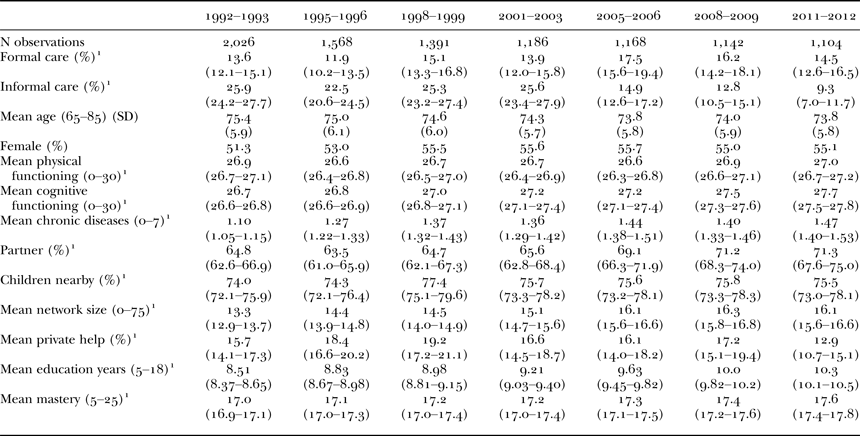
Means and percentages (with 95 per cent confidence intervals), and number of observations of the variables per wave

Notes: 1. For age at 74.5 and 54.1 per cent female. SD: standard deviation.
Source: Longitudinal Ageing Study Amsterdam data, 1992–2012, respondents aged 65–85, living independently.
Measurements
There are two dependent variables in this study: formal care use and informal care use. Care is defined as help with household as well as personal care. Formal care is delivered by professionals who do not have a social relationship with the older person but who deliver care as part of their paid work salaried by the government. Informal care is provided by persons with whom a social relationship exists, as with a partner, child, other relative, neighbour or other non-kin. A third form of care use, which is considered an enabling factor in this study, is privately paid care, i.e. care paid for by the person who needs it him- or herself.
Two questions were asked on use of household and personal care: ‘Do you receive help with household tasks (e.g. shopping, gardening, cooking, cleaning, taking garbage out and filling out forms) and personal care (e.g. washing, bathing or showering, dressing, going to the toilet, getting up and sitting down), and if so, from whom?’ Respondents could report different types of informal and formal care helpers. Two variables were created: use of formal care (0 = no formal care, 1 = household and/or personal care provided by professional home care paid for by the government) and use of informal care (0 = no informal care, 1 = household and/or personal care use provided by partner, (extra) resident child, other relative, neighbour or friend).
The need for care is indicated by the older person's level of physical and cognitive functioning and their number of chronic diseases. Physical functioning (range 0–30; higher scores indicate better functioning) is measured using six questions about difficulty doing activities of daily living and mobility (Katz, Ford and Moskowitz Reference Katz, Ford and Moskowitz1963; Smits, Deeg and Jonker Reference Smits, Deeg and Jonker1997). Cognitive functioning (range 0–30; higher score indicates better functioning) is measured using the Mini-Mental State Examination scale (Folstein, Folstein and McHugh Reference Folstein, Folstein and McHugh1975). The number of chronic diseases out of the seven explicitly asked about, (a) chronic non-specific lung disease, obstructive lung disease, and asthma or chronic obstructive pulmonary disease; (b) cardiac disease; (c) peripheral arterial disease; (d) diabetes mellitus; (e) cerebrovascular accident or stroke; (f) osteoarthritis; and (g) rheumatoid arthritis (Kriegsman et al. 1996), ranges from 0 to 7. Partner status is coded as 0 = no partner or 1 = having a partner within or outside the household. For older people who have children within 30 minutes travelling distance, the value for the proximity of children is coded as 1, and for those who have no children or only have children who live further than 30 minutes away, as 0. Network size (range 0–78; higher score indicates larger network size) is obtained using the domain–contact procedure which asks the respondent to name ‘those persons with whom regular contact exists and who is important to you’ for each of seven relationship domains (household, child, other relative, neighbour, work, organisations, others) (Van Tilburg Reference Van Tilburg1998). Private help refers to the use of either personal or household care that is paid for out of pocket (0 = no, 1 = yes). Education in years (range 5–18) indicates the number of years each older person received education. Sense of mastery (range 5–25; higher score indicates a greater sense of mastery) is measured by a five-item version of the Pearlin Mastery Scale (Pearlin and Schooler Reference Pearlin and Schooler1978), including questions like ‘I have little control over things that happen to me’ and ‘I often feel helpless dealing with the problems of life’. To investigate to what extent formal and/or informal care use changed between 1992 and 2012, the variable year of observation (range 0–20 years) is created using the exact date of the interview. To impute for missing cases in the independent variables, the value of the nearest observation point or, if that is not possible the mean score, is filled in.
Analyses
Descriptive statistics of all indicators were calculated for each of the seven times of observation. As the mean age and percentage of women differs between the waves, we adjusted all other variables for gender (54.1% female) and age (74.5) to make the values comparable, using analysis of variance. Multi-level generalised logistic regression analysis was applied using STATA12, for both formal care use and informal care use as the dependent variable. The data were hierarchically structured with observations (level 1) nested in the data of the older adults (level 2). Multi-level regression analysis offers the advantage that the estimates of period differences and other coefficients are not biased, because multi-level regression models account for repeated measures from the same individual (Snijders and Bosker Reference Snijders and Bosker1999). As the analyses focus on period differences, and not on longitudinal changes within individuals, the independent variables are entered as fixed effects, which are similar to regression parameters in ordinary regression analysis. A random effect at the respondent level is included to control for the dependency between observations from the same individuals.
First, bivariate regression analyses were performed for all independent variables to determine their individual effects, controlling for age and gender. Next, using a stepwise procedure, five models were estimated for each of the two dependent variables. Model 1, which was used to test Hypothesis 1 and 2, only included year of observation, controlling for age and gender. To test a non-linear relationship, year of observation squared was included in Model 1. Model 2 included the other type of care use (informal or formal) to examine the direct association between the two variables. Model 3 included the interaction term between year of observation and the other kind of care use, to test whether the association between formal and informal care use changed over time (Hypothesis 3). Model 4 included all independent variables that are associated with both formal and informal care to determine the net effect of the year of observation (Hypothesis 4). Model 5 included all the independent variables and the interaction term between year of observation and the other kind of care use to test the net effect of changes in interdependence between the two forms of care over the years. Each model is characterised by the −2 log likelihood (deviance, i.e. the lack of correspondence between the model and the data). In our analyses, we compared the deviance of our models to the preceding model, in order to determine whether there was an increased fit to the data.
To perform multi-level analyses, all the independent variables are centred to the mean. The intercept in the regression equation is therefore more readily interpretable as it is the expected value of the outcome variable, when all the explanatory variables have their mean value (Hox Reference Hox2010). To compare the relative importance of the different variables in determining formal and informal care use, the standardised coefficients of Model 5 are also included in Tables 2 and 3. To indicate the sizes of the effects, we transformed the estimates of the logit regression into probability (p) with the formula: p = 1/(1 + e−Z ). Here Z is the regressions' estimate taking into account the intercept, specific values for the explanatory variable of interest and average scores for other explanatory variables; p is reported as a percentage.
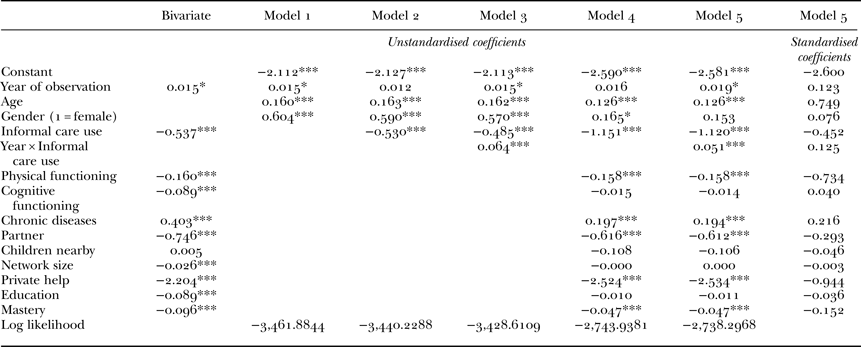
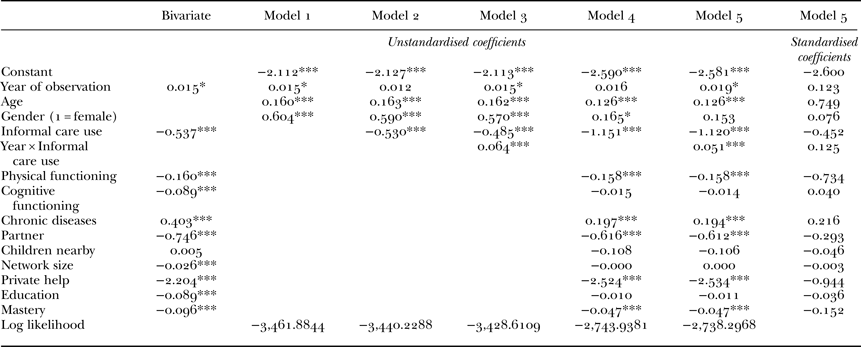
Multi-level logistic regression (link logit) of formal care use
Note: N = 9,598.
Source: Longitudinal Ageing Study Amsterdam data, 1992–2012, respondents aged 65–85, living independently. All variables are grand mean centred. Bivariate analyses are controlled for age and gender.
Significance levels: * p < 0.05, *** p < 0.001.
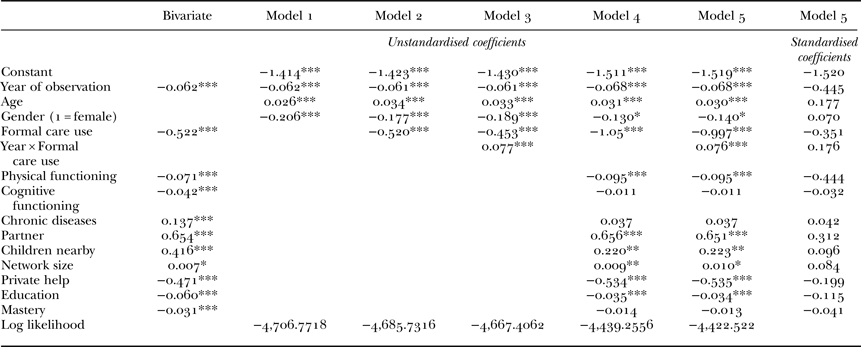
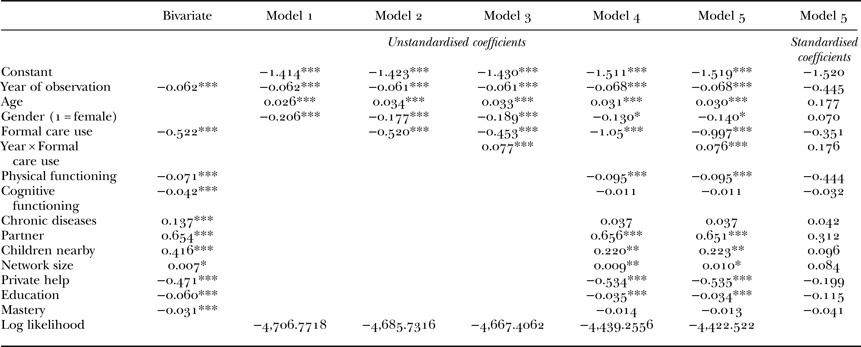
Multi-level logistic regression (link logit) of informal care use
Note: N = 9,598.
Source: Longitudinal Ageing Study Amsterdam data, 1992–2012, respondents aged 65–85, living independently. All variables are grand mean centred. Bivariate analyses are controlled for age and gender.
Significance levels: * p < 0.05, ** p < 0.01, *** p < 0.001.
Results
The descriptive statistics for the seven times of measurements (Table 1) show that the mean percentage of people who used formal care fluctuated over the seven waves, while the proportion of informal care users decreased over time. Regarding the need factors, the physical limitations stayed more or less the same over the years, while the number of chronic diseases increased and the cognitive functioning improved over time. Overall, the enabling factors for informal care use improved; more people had a partner and the network size was larger in 2012 compared to 1992. The percentage of people with children changed very little over time. The percentage of people who used privately paid care went up between 1992/93 and 2005/06 and then decreased in 2011/12. Table 1 also shows an upward trend in level of education and sense of mastery over the years.
To test Hypotheses 1 and 2, formal and informal care use were regressed on time controlling for age and gender. Model 1, presented in Tables 2 and 3, shows a positive effect of year of observation on formal care use and a negative effect of year of observation on informal care use. Use of formal and informal care increased with age. Men more often used formal care, while women more often used informal care. The quadratic term of year of observation was not significant and was therefore omitted from the model. Calculated probabilities indicate that 9.6 per cent of the older adults used formal care and 29 per cent used informal care in 1992, while 12.6 per cent used formal care and 11 per cent used informal care in 2012. Thus, the proportion of people using formal care increased just a little (plus 3%), whereas there was a larger decrease in the proportion of people using informal care (minus 18%).
Second, Model 2 (Tables 2 and 3) shows a significant negative effect of informal care use on formal care use and vice versa, which suggests that formal and informal care are each other's substitutes. The incorporation of informal care use in Model 2 improved the prediction of formal care use (χ2(1) = 21.66) and decreased the effect of time so that it became non-significant. This suggests that part of the increased use of formal care over the years is due to a decrease in the use of informal care. The incorporation of the formal care use in Model 2 improved the prediction of informal care use significantly (χ2(1) = 21.04), but the effect of time hardly changed. The latter suggests that the decrease in informal care use over time is not due to the increase in the use of formal care.
Third, the interaction term between the other form of care use and year is positive for both informal care use as well as for formal care use (Tables 2 and 3). These positive interaction terms suggest that the negative interdependence between formal and informal care use weakened over time. The incorporation of the interaction term improved the models significantly (χ2(1) = 11.62 for formal care use and χ2(1) = 18.33 for informal care use).
Fourth, taking the individual characteristics into account and leaving out the interaction between time and the other form of care (Model 4, Tables 2 and 3), the models improved significantly (χ2(9) = 684.67 for formal care use and χ 2 (9) = 228.15 for informal care use). The effect of time hardly changed in the models, suggesting that the decrease of informal care and the increase in formal care over time cannot be explained by the individual characteristics under observation. Comparing the bivariate and multivariate analyses showed that physical functioning, use of privately paid care and having a partner are the most important predictors for both formal and informal care use. Physical functioning was negatively associated with informal and formal care use, and having a partner was positively associated with informal care use and negatively with formal care use. The negative coefficients for privately paid care suggest that this type of care use is a substitute for both formal care and informal care use.
The negative effect of informal care use on formal care use (Table 2) and from formal care use on informal care use (Table 3) increased considerably from Model 2 to Model 4, which is indicative of a suppressor effect. Additional analyses showed that this was mainly attributable to the introduction of physical functioning in Model 4. This indicates that, when the level of physical functioning (and the other indicators) is accounted for, the negative association between informal and formal home-care use is even stronger.
To test whether the change in the association between formal and informal care use over time could be explained by changes in individual characteristics under observation, an interaction term between year and the other type of care use is added in Model 5 (Tables 2 and 3). This significantly improved the models (χ2(1) = 5.64 and χ2(1) = 15.73, respectively). A comparison of the interaction effect in Models 3 and 5 shows that only a small part of the interaction effect is accounted for by the individual characteristics.
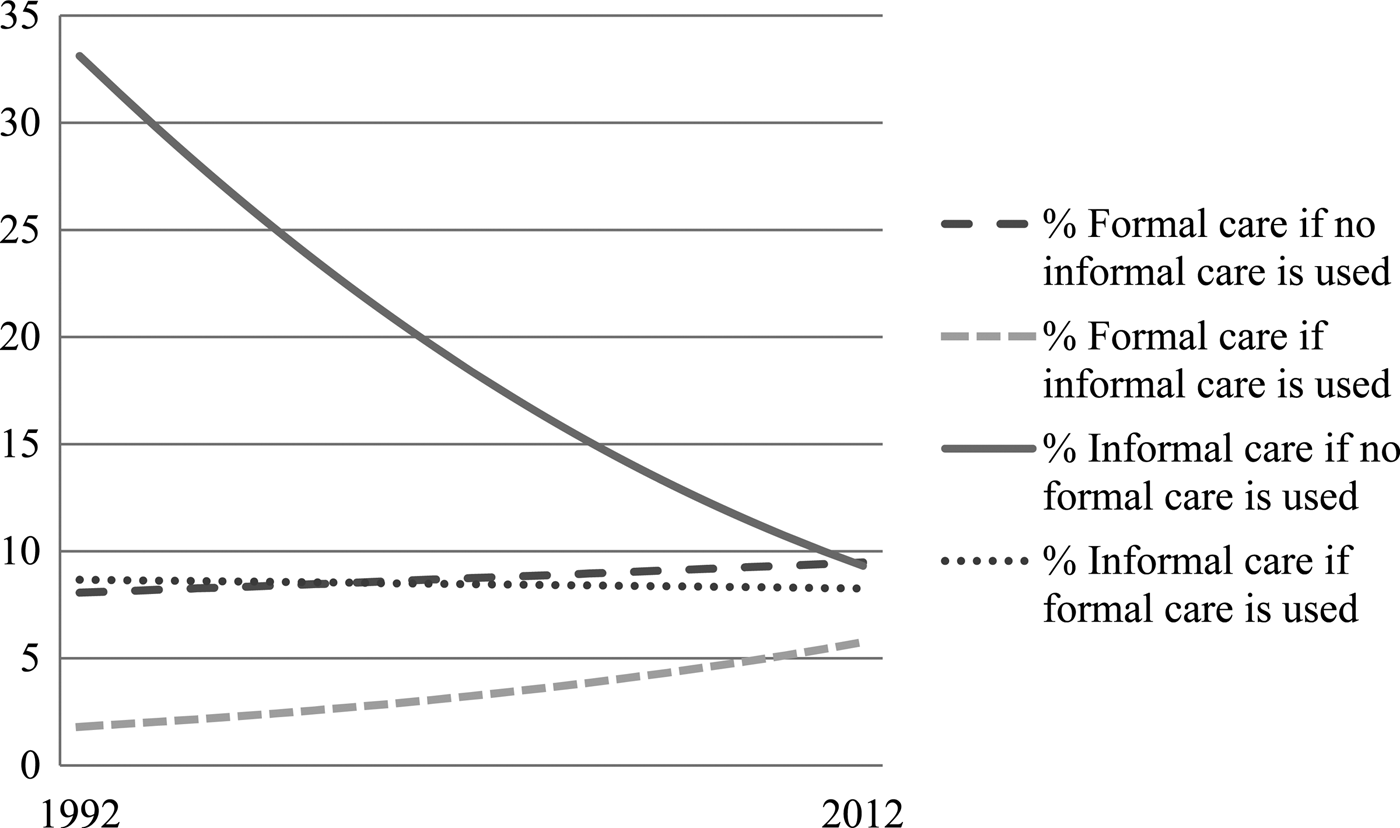
Figure 1 illustrates the net effects of formal and informal care use over time based on Model 5. The estimated proportion of respondents using formal care increased more between 1992 and 2012 among those using informal care (from 1.5 to 5.8%) than among those not using informal care (from 8 to 9.5%). Further, the estimated proportion using informal care decreased more among people who did not use formal care (from 33.0 to 9.3%) than for people who did use formal care (from 8.7 to 8.3%). It can be concluded that over time formal care was more likely to be used by those also using informal care, showing more complementarity between the two. Moreover, the probability of using informal care without using formal care decreased over the past 20 years and this cannot be explained by the individual characteristics under observation.
Trends in formal and informal care use between 1992 and 2012.

The standardised coefficients (final columns in Tables 2 and 3) show that for formal care use, physical functioning, privately paid care use and informal care use are the most important determinants; for informal care the most important determinants are physical functioning, having a partner and formal care use.
Discussion
This study examined trends in formal and informal care use by 65–85-year-olds between 1992 and 2012. There are four important findings of this study. First, formal care use increased a little over time, especially for those people who also used informal care. Given the changes in the Dutch long-term care scheme over these years, a fluctuating trend in the use of formal care was expected. The results showed a small linear increase instead, thus Hypothesis 1 can be rejected. Second, informal care use decreased over time, which supports Hypothesis 2, especially among those people who had no formal care use. Thirdly, while formal and informal care use are each other's substitute, this negative association weakens over time, which supports Hypothesis 3. Fourth, these changes in formal care use, informal care use and their interdependency cannot be fully explained by the individual characteristics included in the study. Thus Hypotheses 4a and 4b can be rejected.
The decrease of the negative association between formal and informal care use over time shows that the substitution model of the early 1990s has been replaced by a more complementary model in recent years. This seems to reflect the cost-containment policies enacted at the beginning of this century, as well as the recent policy discourse stressing the self-reliance of citizens. However, the effect of policy changes appears to be rather indirect as the small effect of year of observation on formal care use lost statistical significance after including informal care use in Model 2 and the other individual factors in Model 4 (Table 2). This suggests that individual factors are more important than societal-level availability of formal care. This is particularly demonstrated by the finding that privately paid help seems to serve as a substitute for formal as well as informal care use, suggesting that individual financial resources may help overcome cutbacks in formal care. Moreover, the effect of year of observation on informal care use remained statistically significant after formal care use was included in the analysis (Model 2, Table 3), showing that other explanations need to be sought for the decline in informal care use besides the use of formal care and the individual variables included in the study. Possible explanations for this finding could include changing attitudes, preferences and norms in favour of informal care or relationship quality (Bromley and Blieszner Reference Bromley and Blieszner1997; Pinquart and Sörensen Reference Pinquart and Sörensen2002) that we were not able to measure directly. In general, it can be concluded that there is a weak yet negative association between formal and informal care use on the individual level, but that further cut-backs in formal care allocation may only affect the use of informal care to a small degree due to its relatively strong association with factors such as health, attitudes and social resources.
This study does not corroborate the reversed substitution effect reported in Sweden (Johansson, Sundström and Hassing Reference Johansson, Sundström and Hassing2003) and Britain (Patsios Reference Patsios2008; Pickard Reference Pickard2012). This may be due to different definitions of care and the use of different sources of care among these studies. In our study, care included only help with household tasks and personal care, and informal care sources were far more often spouses than children, relatives or non-kin. Pickard (Reference Pickard2012) studied the impact of cut-backs in residential care on informal care use, while we studied the changes in formal home care. Increased informal care in Sweden included, in particular, more help from children, and Patsios (Reference Patsios2008) reported that an increase in the amount of help from neighbours and friends co-occurred with a decrease in the amount of professional home help. Cross-national comparison on the interrelation of formal and informal care use requires internationally collected data-sets using homogeneous measures of care use covering at least ten years of time. The Survey of Health, Ageing and Retirement in Europe is a good example of such an international data-set, but for this purpose it would have to continue for at least another five years. Another reason for a lack of reversed substitution may be that fewer people were institutionalised in the Netherlands after the year 2000, which will have increased the need for home care for many of them. Moreover, at that time those lacking spousal care could still obtain subsidised formal home care and the income-threshold was still relatively low. With the more restrictive policies coming into effect in 2015, a reversed substitution effect might become more apparent in the years to come.
The decrease in informal care remains largely unexplained by the variables in the study (better cognitive functioning, higher sense of mastery) as well as by the increased use of formal care. It is especially remarkable that the decrease occurs despite the increased availability of marital partners and social network members among older adults in this age range. One explanation would be that these network sources are less able or less willing to provide informal care. The latter may reflect a societal trend of weakened solidarity (Cherlin Reference Cherlin2004). As our data-set does not include information on norms of solidarity or preferences of the care recipient, we were not able to test this solidarity hypothesis. Future research should focus on additional arguments regarding the use of informal care by focusing on the care potential of the social network.
Another remarkable finding is that although more people reported having chronic diseases, the level of physical functioning did not change that much. This could be explained by the fact that technological developments and improved medical knowledge have reduced the amount of care needed for the same level of physical disability (Freedman, Martin and Shoeni Reference Freedman, Martin and Shoeni2002). The extent to which the use of walking devices and home adjustments may have replaced the use of informal and formal care is an issue for further research. Part of the increased formal care use may also result from the de-institutionalisation that took place over the past 20 years. People with less physical functioning used to be more easily admitted to institutions, but are now dependent on home care. The percentage of people in our sample who were institutionalised decreased from 4.7 per cent in 1992 to 1.5 per cent in 2009 (Galenkamp et al. Reference Galenkamp, Braam, Huisman and Deeg2013). The small proportion of the people who in 2009 lived at home instead of in a nursing home could be responsible for the increase in need for care and the related increase in formal care use reported in this study.
A limitation of this study is that the sample it uses under-represents the oldest-old people and the frailest members of the population. The use of an upper age limit of 85 years excluded those that are more likely to be in need of care, as physical and mental health problems tend to increase with age. In addition, we did not have complete data for the frailest people as they were not able to participate in the entire interview. Consequently, the results are likely to be an underestimation of actual care use in the population. A remark should be made about the sudden drop in informal care use between the 2001/03 and 2005/06 waves. This raises the question whether the decrease is attributable to the inclusion of a new cohort of 55–64-year-olds in 2001/03 as it decreases the mean age of the 65–85-year-olds in 2005/06, 2008/09 and 2011/12. Additional analysis showed that the decrease in informal care use among the new cohort added in 2001/03 is slightly smaller (from 10% in 2005/06 to 7% in 2011/12) than among the old cohort (from 16% in 2005/06 to 11% in 2011/12), whereas formal care use is stable in the new cohort (at 4%) and increased slightly in the old cohort (from 20% in 2005/06 to 25% in 2011/12). It can thus be concluded that the inclusion of the new cohort may have suppressed the (change in) use of informal and formal care to some degree as a result of their younger age and lower need for care, but most likely not very strongly. Also, as we adjusted for the mean age of the sample in all analyses, our results are corrected for the inclusion of a new age cohort in 2001/03.
An important implication of this study is that the expectation that people can rely on their social network for informal care when formal care becomes less available might be unrealistic. When formal care use becomes more restricted it is especially the people who cannot afford to pay for private care who will be vulnerable. In the near future, the demand for care will increase considerably. Increasing the involvement of family, friends and other personal network members in long-term care may be more difficult to achieve than expected, as this requires a reversal of the currently declining informal care use. As the majority of older adults do not lack social relationships, it is the care potential in these relationships that needs to be mobilised. This may be achieved by social policy paying (even) more attention to supporting current informal care-givers and extending their support services to identify new sources of care in the social networks of older adults.
Acknowledgements
This study is based on data from the Longitudinal Ageing Study Amsterdam, which is largely funded by the Dutch Ministry of Health, Welfare and Sport.