One of the most durable findings in the study of international security is the link between territory and political violence. Most interstate wars and a large share of intrastate wars are fought over territory (Toft Reference Toft2014). Territorial disputes are associated not only with conflict onset but with its escalation (Braithwaite and Lemke Reference Braithwaite and Lemke2011) and duration (Fuhrmann and Tir Reference Fuhrmann and Tir2009), and have been shown to be significantly more difficult to resolve (Fearon Reference Fearon2004).
Two competing explanations have been offered for this robust empirical association: the first emphasizes territory’s tangible value, conferring resources or strategic advantage (Goertz and Diehl Reference Goertz and Diehl1992; Carter Reference Carter2010). Though a bargaining space should theoretically exist when stakes are material, such bargains often fail in practice due to credible commitment problems—the fear that a rival will defect from an agreement, exploiting concessions to extract heavy costs (Fearon Reference Fearon1995; Powell Reference Powell2006). A second theory attributes the link between land and conflict to the unique hold territory is said to have on individuals, for biological, historical, ideological, or religious reasons. In this view, individuals attach symbolic value to territory that exceeds its tangible worth, leading politicians to highlight intangible dimensions to mobilize support (Huth Reference Huth1996; Senese Reference Senese2005; Tir Reference Tir2010). Consequently, any bargaining space that involves tangible tradeoffs is closed, rendering the territory effectively indivisible (Goddard Reference Goddard2006).
Most studies within these two competing approaches implicitly assume a unitary state concerned either with rival credibility or intangibility, depending on the territory involved. We argue that intangibility and tangibility are more fruitfully thought of as characteristics of political preferences rather than of land, and that analyzing domestic heterogeneity in attitudes is important for understanding barriers to territorial conflict resolution. To illustrate, consider a case in which an overwhelming majority of the population opposes territorial concessions due to concerns about rival credibility. Here, an appropriate policy prescription would be to devise mechanisms that enhance the credibility of commitments, such as mediation (Kydd Reference Kydd2006; Gent and Shannon Reference Gent and Shannon2010). These mechanisms will have limited utility in the converse situation, where a majority of the population values territory for intangible reasons and is far less concerned with the risks and benefits of compromise.
The assessment of heterogeneity in territorial attitudes poses a thorny empirical challenge, however. Many disputed territories have both tangible and intangible value, making the sources of individual attachment difficult to trace. The Israeli–Palestinian conflict over the West Bank is a paradigmatic example: On the one hand, the West Bank is strategically valuable, providing Israel with some territorial depth. Indeed, opposers of territorial concessions commonly claim that Israel’s population centers and key strategic sites would be threatened if the West Bank were controlled by groups hostile to Israel. On the other hand, the West Bank holds religious and historical significance as part of the biblical land of Israel, giving it a symbolic value that extends beyond strategic considerations.Footnote 1 Whether obstacles to conflict resolution stem from the absence of credible guarantees to uphold a negotiated settlement or from ideological attachment to the land is ultimately an empirical question that depends on the distribution of preferences in the population and the ways in which these preferences affect the bargaining space of leaders.
This article proposes a set of methodological tools for overcoming this challenge and distinguishing between those who oppose territorial concessions due to commitment concerns and those who oppose concessions due to territorial attachments that cannot be divided. Drawing on a series of original survey experiments in Israel, we show how the reasons underlying opposition to territorial concessions—material/security versus symbolic—vary in the population among those who support the deepening of Israel’s control over the West Bank. We then demonstrate how the distribution of preferences among those attached to the contested territory constrains policymakers by affecting the government’s bargaining space.
We find that a majority of Jewish-Israelis is willing to pay substantial material costs to deepen territorial control of the West Bank. While some of these individuals are concerned with rival credibility and the resulting risks of territorial compromise, a substantial segment of the Jewish population (~30–40 percent, far greater than previously thought (Rynhold and Waxman Reference Rynhold and Waxman2008; Zellman Reference Zellman2015)) rejects territorial compromise even when the credible commitment problem has been fully addressed; that is, for ideological, intangible reasons. We then use our mapping of heterogeneity in the source of preferences over territorial control, combined with information on individuals’ past vote choice, to demonstrate how it crucially shapes the prospects of conflict resolution in the Israeli–Palestinian case. We find that because voters with intangible attachment to territory form a substantial share of the constituents of Israel’s current largest political party (Likud), even a coalition with moderate parties would render territorial compromise a risky political move.
Our study contributes to the literature on territorial conflict in several ways. First, it makes an important theoretical contribution, arguing that conceptualizing materialism and symbolism as characteristics of preferences rather than of territory opens new ways of mapping public opinion in conflict zones. We then propose a set of methods that enable investigation of variation in motivation for attachment to disputed territories, thereby addressing the longstanding empirical challenge of disentangling material dimensions from symbolic ones.
Second, our study demonstrates the utility of using a micro-foundational approach for studying territorial conflict, shedding light on domestic mechanisms that lead to conflict entrenchment. Specifically, by showing how individual preferences in the Israeli case impede peaceful conflict resolution, our study joins a growing body of work that integrates public opinion into IR research, linking individual attitudes to macro-level outcomes. While public opinion does not always determine the security policies that leaders adopt, the preferences of domestic audiences, at least in democratic settings, pose a powerful constraint that can be difficult for leaders to overcome (Tomz and Weeks Reference Tomz and Weeks2013).
This study also aims to make a broader contribution by linking research on territorial conflict to a considerable body of work that examines the role of symbolic beliefs in shaping policy preferences. This literature has also contended with the methodological challenges involved in distinguishing between values and interests (Sears and Funk Reference Sears and Funk1991; Chong, Citrin and Conley Reference Chong, Citrin and Conley2001). The tools we propose here can therefore be applied to investigating of political preferences more broadly.
Finally, our study contributes to research on the Israeli–Palestinian conflict, which has long recognized that some Israeli Jews are “ideological” and others are “instrumental” (Pedahzur Reference Pedahzur2012), but has struggled to establish the distribution of these preferences in the population and consequently to assess its political implications. Work by Ginges et al. (Reference Ginges, Scott, Medin and Shikaki2007) has employed experiments to disentangle the two dimensions, but has focused on Israeli settlers, a narrow, ideological subset of the population, and has not shown how the overall distribution of domestic preferences shapes the bargaining space available to leaders. By doing so, we are able to shed light on an important domestic process through which public attitudes affect conflict resolution.
Theoretical Framework
Territorial disputes are associated with interstate and intrastate conflict onset, escalation, and recurrence (Huth Reference Huth1996; Diehl Reference Diehl1999; Gibler Reference Gibler2012; Toft Reference Toft2014). Yet while the relationship between territory and conflict has long been established, the factors leading to it are less clear (Goemans and Schultz Reference Goemans and Schultz2017). In general, existing explanations are of two varieties: a “rationalist,” tangible approach, and an approach focusing on the territory’s alleged intangible value, or symbolism.
The starting point of rationalist approaches is that states are utility-maximizing. Territory is valuable due to its association with a range of material benefits, from strategic importance (Carter Reference Carter2010) to economic resources (Caselli, Morelli and Rohner Reference Caselli, Morelli and Rohner2015). In principle, the tangible value of a territory should not make it more conflict-prone, since material stakes are divisible, allowing for a bargain to be reached (Fearon Reference Fearon1995). For a number of reasons, however, a bargain may nevertheless fail. Most prominent of these is the commitment problem: the initially weaker party cannot credibly commit to not exploit the increased power associated with territorial concessions to extract further concessions (Powell Reference Powell2006). This problem has motivated a body of work on the mechanisms enhancing commitment credibility, such as third-party guarantees, power-sharing institutions, and forced separation (e.g., Walter Reference Walter1997; Hartzell and Hoddie Reference Hartzell and Hoddie2003).
Arguing that the intrinsic value of territories accounts for only a small share of territorial conflicts (Huth Reference Huth1996), the second approach focuses on territory’s intangible salience. One strand of this literature attributes the presumed symbolic value of territory to the genetic predisposition of humans to be territorial (Vasquez Reference Vasquez1993). A second strand highlights ideology and identity, arguing that the roots of collective identity are grounded in particular homelands (Forsberg Reference Forsberg1996; Toft Reference Toft2003; Hensel Reference Hensel2012; Shelef Reference Shelef2016). Newman (Reference Newman1999), for example, argues that attachment to territory is a core element in the formation of group identity, forged through a historic process that imbues land with mythical or religious meaning. Hassner (Reference Hassner2003) attributes symbolic attachment to territory to the religious sanctity of particular spaces.
Whether the source of territorial attachment is genetic, primordial, or constructed, the key notion underlying theories of intangibility is that territorial conflicts are not primarily due to disputed territories’ intrinsic worth. Rather, it is symbolic value that renders disputed territories effectively indivisible. This symbolic value, it is argued, is then exploited by leaders appealing to domestic audiences to mobilize public support, thereby reducing their bargaining space over time (Vasquez Reference Vasquez1993; Goddard Reference Goddard2006).
These two approaches to territorial conflict are typically posited as mutually exclusive. Accordingly, they are usually tested at the cross-conflict level, employing measures designed to capture the value of territory. The Issue Correlates of War dataset, for example, includes proxy measures for tangible and intangible issue salience, to allow researchers to examine which issue is more likely to be associated with territorial conflicts (Hensel and Mitchell Reference Hensel and Mitchell2005).Footnote 2
In practice, however, many disputed territories hold both tangible and intangible value, and the same leaders may refer to strategic value on one occasion and to symbolic value on the other. This makes it difficult, and potentially misleading, to treat territorial stakes as either tangible or intangible. We argue that much can be gained by examining these dimensions as characteristics of citizen preferences rather than of territories. This shift to the micro-level allows identifying which segments of the population are driven more by tangible considerations and which are motivated by symbolic concerns.
As a first step in mapping the distribution of preferences over disputed land, we outline the micro-level implications of the two core territorial conflict explanations. The rationalist approach does not invoke domestic mechanisms directly, but has implications for public opinion, at least in democratic settings where the public’s policy preferences pose an important constraint on the bargaining space of leaders. Here, individuals’ valuation of the territory is derived from comparing the expected net benefits of territorial control to the expected net benefits of territorial concessions. When evaluating the costs and benefits of territorial control relative to those of concessions, voters incorporate concerns about the ability of the rival to credibly commit to an agreement.Footnote 3 We therefore operationalize tangible attachment to territory as the willingness to concede when benefits are sufficiently high and credible.
The symbolic approach, in contrast, views territorial attachment as intangible. Intangibility, that is, the appeal to emotive, ideological, or symbolic value, can be considered a useful theoretical construct only to the extent that political preferences cannot be explained by reference to material or security gains. Thus, the core implication of this approach is that publics are willing to bear substantial material costs to retain territorial control. In other words, intangible attachment to land is operationalized as support for territorial control even when it adversely affects one’s material welfare or security.
Both of these approaches may account for individuals’ preferences over maintaining control of a disputed territory. To assess the distribution of these preferences, we implement a set of original survey experiments designed to disentangle the material from the symbolic and then examine how this distribution affects conflict entrenchment in the Israeli–Palestinian case.
Data and Method
We fielded surveys online to a sample of 4525 Jewish Israeli adults.Footnote 4 The surveys were administered in three waves: the first, conducted in April 2014, included a sample of 1963 respondents. The second wave was administered in January 2015 to a sample of 1217 respondents. The third wave was administered in August 2017 to a sample of 1345 respondents. Summary statistics of all three samples, which were stratified by gender, age, religiosity and residence, are reported in the Supplementary Information (SI), Section 1.3.Footnote 5
The three survey waves took place in different contextual environments. The first wave was conducted in the relatively peaceful months of Israeli–Palestinian negotiations led by United States Secretary of State John Kerry. The second wave was fielded a few months after the collapse of the negotiations, and in the wake of the bloody conflict in Gaza 2014, which killed more than 2100 Palestinians and 72 Israelis.Footnote 6 The third wave was conducted in the summer of 2017, a time of relative political stability, punctured by bouts of violence over Palestinians’ concern that Israel may seek to alter the status quo of the Temple Mount/Haram al-Sharif. Despite the difference in time periods, we were able to replicate our main results in each of the three waves. We present the findings from our most recent wave here, and report the results from the first two waves in the SI.
Our research design has two related objectives: first, we establish the distribution of territorial preferences in the population, identifying the respondents for whom tangible concerns drive support for territorial control, and those whose rejection of territorial compromise is motivated by intangible concerns. To do so, we employ three strategies that place respondents in choice settings where they must tradeoff territorial control with material and security benefits: a conjoint experiment, a “credibility exercise,” and a “valuation exercise,” detailed in the following sections. We consider those who express support for territorial compromise when the benefits are sufficiently high (and risks are sufficiently small) as motivated, to the most part, by material considerations. By contrast, we consider those who are willing to incur high costs in order to maintain territorial control, and forgo tangible benefits even when those benefits are fully guaranteed, as those motivated by symbolic considerations. Second, we illustrate the utility of mapping this distribution of preferences by showing how it constrains the bargaining space of Israeli leaders.
Trading Off Material Benefits and Territorial Control
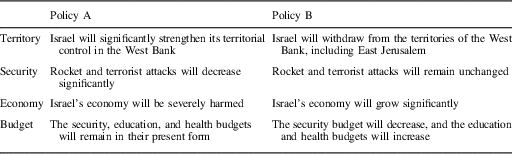
We begin with a conjoint experiment, which allows estimating the causal effects of many possible determinants of preferences simultaneously, and importantly, evaluation of the relative influence of each attribute on policy choice (Hainmueller, Hopkins and Yamamoto Reference Hainmueller, Hopkins and Yamamoto2014).Footnote 7 Our experiment asks participants to consider a hypothetical scenario in which, following various international developments, the Israeli government decided to enact a policy in the Israeli–Palestinian arena that could have substantial economic, security, and social implications. We then showed participants four possible attributes of two generic policies (“A” and “B”), as shown in the example in Table 1.
Experimental Design: Example

Imagine that you had the opportunity to time travel 10–15 years into the future, and to know with certainty what the future consequences of choosing Policy A or Policy B would be. Given the certain consequences of the consequences of each policy in 10–15 years, which policy would you support, if the decision was in your complete authority?
Policy A
Policy B
On a scale from 1 to 7, where 1 indicates full opposition and 7 indicates full support, how would you rate Policy A?
On a scale from 1 to 7, where 1 indicates full opposition and 7 indicates full support, how would you rate Policy B?
After the recent military operation in Gaza, the Israeli government came to the conclusion that it needs to take an action that may have a strong impact on Israel’s economy, security, and social arenas. Below are the consequences of two possible policies.
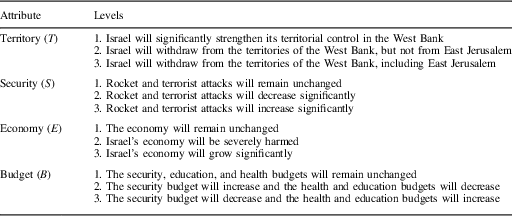
The four attributes varied along the domains that are central to policy debates in the Israeli–Palestinian conflict: the policy’s effect on security, the economy, budget allocation to social services versus defense, and Israel’s control over the disputed territory. Each likely outcome (attribute) took one of several values, as described in Table 2. For example, the policy’s impact on security was operationalized as its effect on terrorist and rocket attacks, since this has been perceived in Israel as the primary security threat since the decline of conventional interstate wars. Values on this item ranged from a substantial decrease in rockets and terrorist attacks to a substantial increase in such attacks. In the territorial domain, values varied between strengthening territorial control of the West Bank, withdrawing from the West Bank, and withdrawing from the West Bank and East Jerusalem. We distinguish between the West Bank and Jerusalem to capture the different in symbolic value attached to these two territories. However, it is important to emphasize that all two-state plans have included some loss of Israeli sovereignty over parts of Jerusalem, and withdrawal solely from the West Bank has never been on the negotiation table. We randomized the order of the attributes to prevent order effects, and restricted the experiment to exclude random combinations that were so unrealistic as to be non-credible to respondents.Footnote 8
Values for Policy Outcomes in Conjoint Experiment

To emphasize that these attributes were assured, respondents were asked to imagine they could travel forward 10–15 years in time and know for certain what the future consequences of each policy would be. Given that information, which policy would they choose today, if they had full authority? To capture the fact that respondents were constrained in their choices, and therefore may not have been enthusiastic about the choice they ultimately made, we then asked them to rank their support for the policy they had chosen (and the policy they had not chosen) on a scale of 1–7.
This approach has several unique features: first, the random assignment of policy attributes enables identification of the causal effect of each attribute on the probability of policy support.Footnote 9 This allows disentangling policy attributes that are naturally correlated, such as security and territorial control. Second, we measure the effect of all attributes on the same scale, which allows assessing the relative importance of each attribute. Finally, by asking not just about policy choice but about policy rankings we are able to measure the intensity of support for each attribute. Together these features make it possible to estimate whether or not respondents value territory above and beyond a variety of key strategic and material benefits.
Following Hainmueller, Hopkins and Yamamoto (Reference Hainmueller, Hopkins and Yamamoto2014), we first calculate average marginal component effects (AMCEs), which estimate the average difference in the probability that a policy with a given outcome—say, a reduction in rocket attacks—is preferred over a policy with a baseline outcome—here, no change in rocket attacks. Since the attributes (i.e., the outcomes) of a policy are randomly assigned, each outcome in a given domain is combined with the same distribution of outcomes in the other domains on average, which allows for a simple comparison of mean values. We estimate the AMCEs using a regression of the outcome variables Policy chosen and Policy ranking on a set of factor variables for each outcome in each domain. Since each respondent chooses between and ranks two policies, there are two possible policy profiles for each respondent. To obtain accurate standard errors, we cluster standard errors by respondent ID.
 $$Policy\,chosen\!/\!ranking_{i} {\equals}\alpha {\plus}\beta _{1} T_{{i,2}} {\plus}\beta _{2} T_{{i,3}} {\plus}\beta _{3} S_{{i,2}} {\plus}\beta _{4} S_{{i,3}} {\plus}\beta _{5} E_{{i,2}} {\plus}\beta _{6} E_{{i,3}} {\plus}\beta _{7} B_{{i,2}} {\plus}\beta _{8} B_{{i,3}} {\plus}{\epsilon}_{i} $$
Results
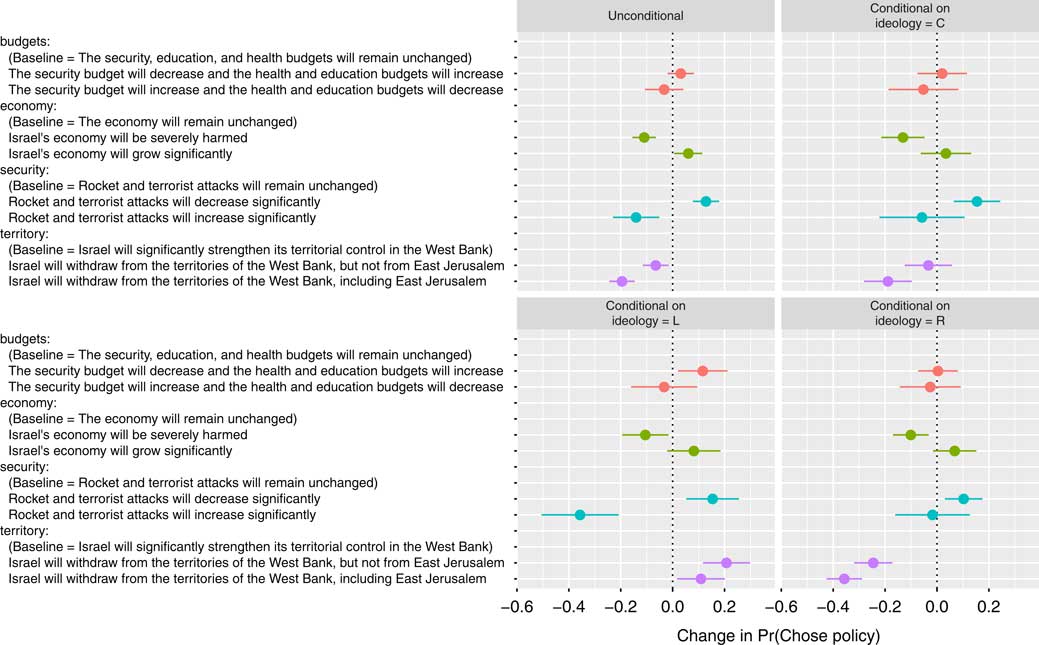
Figure 1 shows results for the conjoint experiment for four separate samples, plotting the AMCEs along with 95 percent confidence intervals (see SI, Section 2.2, for results in tabular form). The top left panel presents results for the full sample. Because territorial attachment is likely predicated on ideology, the other three panels present the results disaggregated by the three key political blocs in Israel.Footnote 10 The point estimate on each attribute represents its average effect on the probability that participants choose a policy containing this attribute over a policy with the baseline attribute.
Effects of policy attributes on probability of policy choice Note: The figure plots average marginal component effects (AMCEs) of randomly assigned policy attributes on the probability of a policy being chosen by survey participants, broken down by ideology. Standard errors clustered by respondent. Bars represent 95 percent confidence intervals.

Beginning with the pooled, unconditional sample, Figure 1 shows that a policy that results in withdrawal from the West Bank and East Jerusalem is 19 percentage points less likely to be chosen, all else equal, representing the largest effect on policy choice. A policy leading to an increase in rocket and terror attacks is 12 percentage points less likely to be selected, and a policy that reduces terrorist violence increases the probability of policy choice by 14 percentage points. In the economic domain, economic harm decreases the likelihood of a policy being chosen by 10 percentage points. Consistent with Zellman (Reference Zellman2015), the results further show that in the pooled sample, it is control over Jerusalem that is valued over material benefits, rather than control over the West Bank alone.
Turning to analysis by bloc, least surprising, perhaps, are the preferences of the left bloc, which does not exhibit any attachment to the disputed territory (bottom-left panel). A policy that involves territorial withdrawal is 21 percentage points more likely to be selected if it does not include East Jerusalem, and 11 percentage points more likely if it does. The driving motivation for policy choice among the left is security: a policy that involves increased terrorist and rocket attacks is 36 percentage points less likely to be selected.
Our primary interest, however, lies in understanding the preferences of those who support maintaining territorial control and identifying the source of these preferences. Our results indicate that both the center and the right blocs attach the highest priority to territorial control, though there are important differences between the two. For the center (top-right panel), control over Jerusalem is prioritized over security, the economy, and social welfare: the center is 19 percentage points less likely to choose a policy that involves withdrawal from the West Bank and East Jerusalem. Next in importance is improved security and the economy: a policy that reduces rocket and terrorist attacks is 15 percentage points more likely to be selected, while a policy that harms the economy is 13 percentage points less likely to be selected. Attachment to the West Bank is relatively weak—the effect of territorial withdrawal from the West Bank on policy choice, though negative, is small and statistically insignificant. These results provide initial evidence that even among Israeli centrists, East Jerusalem is highly valued for symbolic reasons.
Finally, we turn to the right bloc, which is the largest in our sample and in the Israeli-Jewish public at large. Figure 1 (bottom-right) shows that control over land plays an absolutely decisive role in the policy considerations of right-wing voters, dwarfing security and material considerations, which hardly factor into right-wing voters’ preference formation. A policy that involves withdrawing from the West Bank and East Jerusalem is 36 percentage points less likely to be chosen. However, it is not just Jerusalem that is driving the right’s preferences. A policy that involves withdrawal from the West Bank only is 25 percentage points less likely to be chosen, all else being equal, with no material dimension coming close in importance. Security and economy considerations have a far more modest effect on policy choice: a policy that significantly decreases rocket and terrorist attacks increases the probability of policy selection by 10 percentage points, while severe harm to the economy reduces the probably of policy selection by 10 percentage points.
Importantly, these results are robust to using how respondents rank their support for the policy they chose (see Figure 7 in the SI).
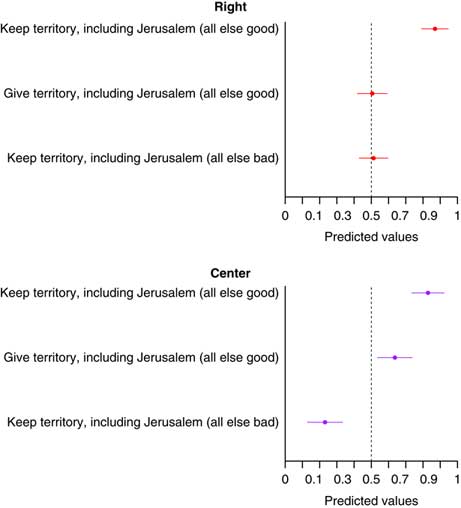
Results from the conjoint experiment provide initial evidence that territorial control is a key driver of policy attitudes of voters in the center and especially the right, as compared to important material considerations. Preference for maintaining territorial control due to intangible considerations, in our definition, must entail willingness to bear substantial material costs to avoid territorial compromise. By contrast, those supporting territorial control due to material considerations will be willing to accommodate a territorial compromise when the cost of continuous control of the disputed territory (compared to concessions) is high. To further investigate the distribution of tangible and intangible preferences, we return to analyzing centrist and right-wing voters, which our results indicate exhibit some degree of territorial attachment. Specifically, we estimate the proportion of voters that would support territorial concessions given substantial material benefits, by calculating the predicted values of respondents’ policy choice from the conjoint experiment, while holding the four policy attributes at specific values. We report the results in Figure 2.
Preferences for maintaining territorial control (by ideology) Note: The figure plots predicted values, by ideology, of policy choice while holding the attributes reported in Table 2 at specific values. For “Keep territory, including Jerusalem (all else good),” we set the Territory indicator to “Israel will significantly strengthen its territorial control in the West Bank”; the Security indicator to “Rocket and terrorist attacks will decrease significantly”; The Economy indicator to “Israel’s economy will grow significantly”; and the Budget indicator to “The security budget will decrease and the health and education budgets will increase.” For “Give territory, including Jerusalem (all else good)” we changed the Territory indicator to “Israel will withdraw from the territories of the West Bank, including East Jerusalem.” For “Keep territory, including Jerusalem (all else bad)” we set the territory indicator to territorial control and the other indicators to “Rocket and terrorist attacks will increase significantly,” “Israel’s economy will be severely harmed,” and “The security budget will increase and the health and education budgets will decrease.”

Focusing on the results for right-wing voters, reported in the top panel of Figure 2, we find that about 50 percent of right-wing voters are willing to support a policy that results in territorial compromise (“give territory including East Jerusalem”) if the policy is expected to reduce terror and rocket attacks, improve the economy and allocate greater resources towards social services (“all else good”). This finding suggests that approximately half of right-wing constituents generally oppose concessions due to commitment concerns. If benefits of concessions are high and guaranteed, they would be willing to support a policy that results in territorial withdrawal. For this group of right-wing voters, a bargaining space can thus be said to exist. On the other hand, we find that the other 50 percent of right-wing voters explicitly prefer deepening Israel’s control over the West Bank and east Jerusalem even when terrorist violence increases substantially, the economy is severely harmed, and the budget allocation to health and education is reduced (“all else bad”).
Among center voters, results are more attenuated but still rather striking: Around 64 percent are willing to support a policy that results in territorial compromise when all material outcomes are positive. However, about 23 percent of centrists prefer deepening control over the West Bank and east Jerusalem even when security, the economy, and social welfare are substantially harmed. This group of centrists and right-wing voters oppose concessions due to territorial attachment that appears insensitive to tangible costs and benefits. For them, no bargaining space exists, rendering the territory effectively indivisible. Turning to our full sample, we find that 29 percent of respondents would reject territorial compromise even when security, the economy, and welfare decline substantially.Footnote 11
Though clearly informative, the conjoint experiment has two limitations. First, it does not allow us to easily address the credible commitment problem; that is, the idea that voters might fear that Palestinians would exploit concessions to impose greater costs, or that a chain of events, such as a Hamas takeover of the West Bank, would undermine any agreement between Israel and the Palestinian Authority. Put differently, analysis of the conjoint cannot rule out the possibility that some respondents classified as holding “intangible” preferences would support territorial concessions if they could be fully assured of an agreement’s credibility. Second, the conjoint experiment is limited to the material outcomes listed therein. And while these are certainly key material aspects on which a policy would be judged, it may be that respondents attach tangible value to the territory, but their valuation is higher than the three attributes listed in the conjoint. We address each of these issues in experiments implemented in the second and third wave, respectively, and detailed in the next section.
Credibility and Valuation Experiments
One promising way to address the credible commitment problem, discussed above, is to measure the levels of economic and security-related risk that respondents are willing to assume in order to support territorial compromise. If individuals reject compromise even when there is no risk involved and the guarantee of benefits is completely credible, risk aversion and fear of rival defection cannot be driving policy positions. Our “credibility exercise,” implemented in wave two of our survey, consists of two related questions. The first of these questions posed the following scenario to respondents:
Imagine that the Israeli government is considering a number of far-reaching gestures to strengthen the Palestinian Authority (PA). These measures have an advantage and a disadvantage: On the one hand, they could lead to a substantial reduction in terrorism, of about 100 attacks a year, due to improved security cooperation with the Palestinians. On the other hand, should the gestures fail, they could strengthen Hamas and increase terrorism by about 30 attacks a year.
Respondents were then asked to state when they would support gestures toward the PA, understood in Israel as concessions, based solely on the information given in the question. Response categories ranged from “I will support the gestures in any case” through “I will support the gestures if their likelihood of success is at least 5%,” and continued in intervals of 10 percent until they reached “I will support the gestures only if their likelihood of success is 100%” and finally “I will not support the gestures under any circumstances.”
Our second question followed a similar format but highlighted material rather than security considerations:
Currently, Israel earns approximately a billion dollars a year from international trade. Recently, the U.N. Security Council has begun to discuss international sanctions against Israel due to continued military rule in the Territories. A team of senior experts estimated that if the sanctions are approved, the Israeli economy will lose approximately 300 million dollars a year. The Israeli government can avoid sanctions only if it ends the current political situation by an agreement with the Palestinians. Given the risk of sanctions, at what point would you support such an agreement?
Again, response categories ranged from “I will support such an agreement in any case” through “I will support the agreement if the risk of sanctions is at least 5%,” and continued in intervals of 10 percent until they reached “I will support the agreement only if the risk of sanctions is 100%” and finally “I will not support the agreement under any circumstances.”
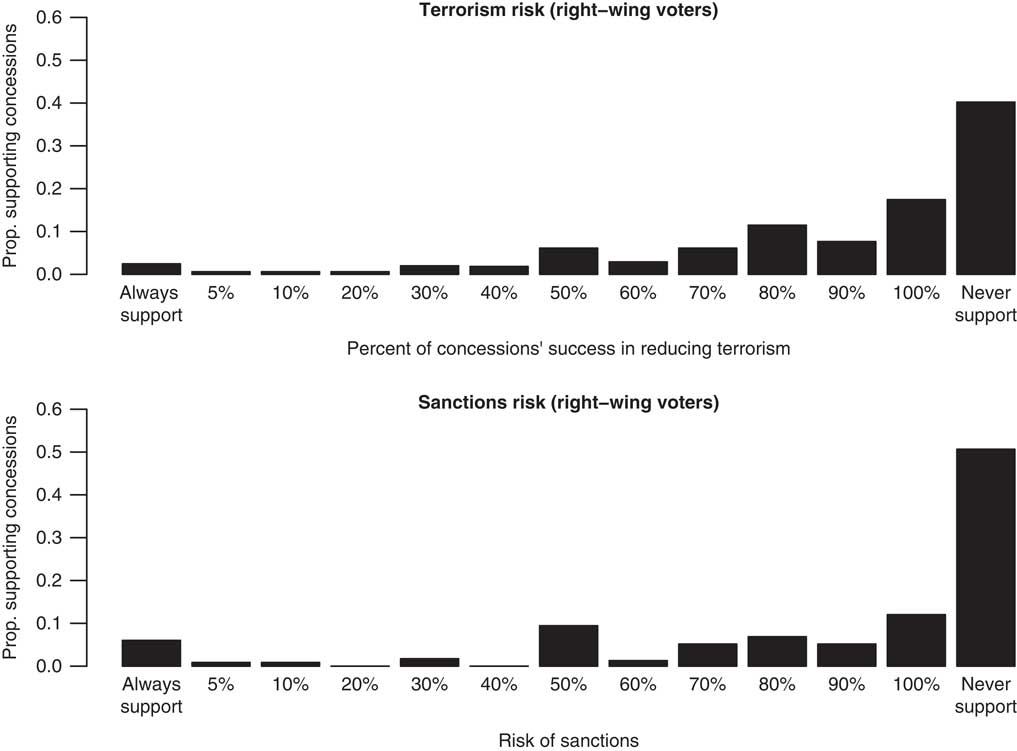
The top panel of Figure 3 demonstrates that about a half of those identifying with the political right would support concessions if the likelihood of success in reducing terrorism were greater than 50 percent. This is consistent with results from our conjoint experiment, which finds that around 50 percent of right-wing voters would concede territory if all other material outcomes were positive. On the other hand, a plurality of right-wing voters (40 percent) would never support concessions, regardless of the level of credibility. In a similar manner, the bottom panel of Figure 3 shows that when economic issues are at stake, around 51 percent of right-wing respondents would refuse to end the military occupation even with the certainty of severe economic sanctions. Considering both security and the economy, we find that a large minority (around 30–40 percent) of our sample is insensitive to important costs and benefits when territorial control is at stake.Footnote 12
Support for concessions and risk taking among right-wing voters Note: The figure plots the distribution of responses for level of risk survey participants are willing to take when supporting potentially beneficial Israeli concessions.

To assess whether apparently intangible preferences are simply an artifact of the specific costs and benefits listed in our conjoint experiment, the third wave of our survey included the following question (“valuation exercise”), which quantifies the costs which respondents are willing to bear for maintaining control over territory:
The European Union is Israel’s chief trading partner: Israeli exports to the EU are estimated at around 14 billion dollars a year. In 2015, the EU decided to label products from Israeli settlements, a decision whose damage to the country is estimated at around $50 million a year. Following the lack of progress in peace negotiations, the EU has begun discussing imposing additional sanctions on Israel. A senior and non-partisan team of experts from the Israel Central Bank estimated that if the sanctions are approved, the Israeli economy could be severely harmed, even if Israel increases its presence in alternative markets in Asia, Africa, and America. The Netanyahu government can avoid sanctions only if it agrees to substantial withdrawal from the territories of the West Bank as part of a peace agreement.
Respondents were then asked at what point they would support territorial withdrawal. Response categories ranged from “I will support withdrawal in any case” through “I will support withdrawal if sanctions will cause damage of at least 140 million dollars a year (around 1 percent of exports), and continued in regular increments until reaching “I will support withdrawal if sanctions cause damage of at least 14 billion dollars a year (100% of exports)” and finally “I will not support withdrawal under any circumstances.”
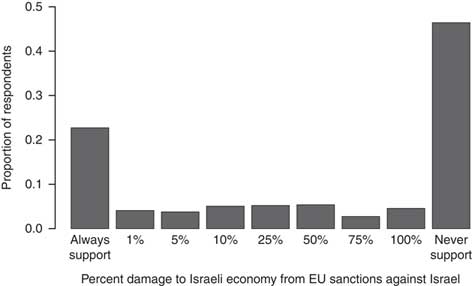
Figure 4 shows that 46 percent of the entire sample would not support territorial withdrawal at any level of economic cost. Among centrists, 35 percent state they would not withdraw regardless of economic costs. Among the right, this figure rises to a full 74 percent (disaggregated results reported in Figure 8 in SI). These results are highly consistent with our conjoint findings: voters with intangible preferences comprise more than half of the Jewish-Israeli right, and approximately a quarter of its centrists.
Support for concessions by cost Note: The figure plots the distribution of responses for level of economic cost resulting from EU sanctions that respondents are willing to endure when opposing territorial withdrawal.

Though on their own, results from each experiment could perhaps have been interpreted not as symbolic preferences but as the result of myopia or cognitive biases, the fact that three different experiments, in different survey waves, all produce substantively similar results increases our confidence that our findings reflect a deliberate tradeoff between tangible and intangible value. Simply put, the cumulative evidence indicates that a large share of Israeli respondents is willing to escalate conflict, risk economic sanctions and forgo welfare benefits in order to retain control of the West Bank. This distribution of preferences renders the bargaining space of leaders extremely limited. We turn to examine this dynamic more rigorously below.
Why the Distribution of Territorial Preferences Matters: From Public Opinion to Policy Making
One advantage of our “valuation exercise” is that it allows measuring the sensitivity of respondents’ willingness to support territorial concessions to changes in the costs of maintaining the status quo (Israel’s continuous control of the disputed territory). With these measures at hand, we then use demand curves of this elasticity to provide a graphical representation of the bargaining space of leaders.
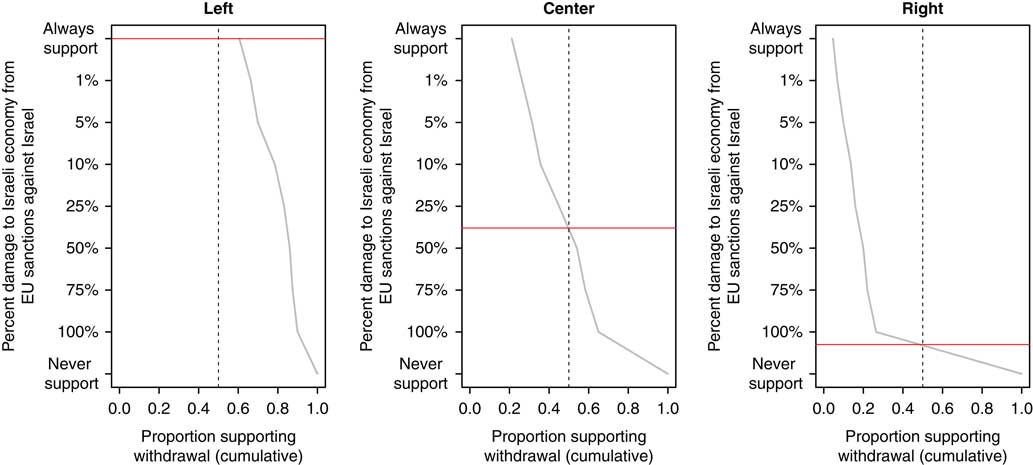
Figure 5 plots the share of respondents that supports territorial concessions for different levels of economic damage that respondents agree to assume. In the left panel we present results for left-wing voters: the graph is relatively elastic and generally linear, showing that, for every 25 percent increase in the value of the damage to exports to the EU, there is approximately a 10 percent increase in the proportion of people supporting significant territorial concessions. Importantly, a majority of left-wing voters (about 60 percent, represented by horizontal red line) support concessions at all damage levels. In contrast, the right panel shows that right-wing voters have fairly inelastic demand curves: the share of right-wing voters supporting territorial concessions will exceed 20 percent only if the damage from sanctions is extremely high (75 percent of exports to the EU). Even when faced with the prospect of eliminating all future exports to the EU, the share of right-wing respondents supporting concessions never reaches 30 percent. The vast majority of right-wing voters state that they will never support territorial withdrawal. As expected, centrist voters lie between these two extremes, with 53 percent of voters supporting territorial concessions when the cost of sanctions is 50 percent of Israel’s exports to Europe.Footnote 13
Support for substantial withdrawal by political block Note: The figure plots on the Y-axis the size of the damage to Israel’s exports to the EU; its single largest export market. The X-axis plots the cumulative proportion of respondents in each bloc (left, center, right) who are willing to support substantial withdrawal from the West Bank at different costs.

How does intangible public attachment to land shape leaders’ bargaining space? Existing theoretical accounts argue that by mobilizing public support around territorial issues, elites become locked into hardline positions that effectively narrow their bargaining range, limiting their ability to negotiate. Since the stakes are framed as intangible, any concessions will be too politically costly for elites to attempt (Goddard Reference Goddard2006). Our data do not allow us to test this proposition directly, as they focus on the public rather than elites. Nonetheless, we are able to shed light on the political effects of domestic territorial attachment by examining how the distribution of attachment among respondents relates to their vote choice in national elections.
We consider two alternative accounts: first, that ideological voters, insensitive to material costs, are primarily concentrated among the constituents of Israel’s most far-right parties. Here, leaders are constrained by coalition politics. If the prime minister forms a coalition with these parties (as Netanyahu did in the most recent elections in 2015), he becomes constrained by his coalition partners, polarizing his positions and rendering the disputed territory effectively indivisible. He nevertheless, in theory, has the option of forming a coalition with parties at the center-left, thereby opening a bargaining space for a possible resolution of the conflict. Alternatively, it may be that ideological voters are not concentrated at the far right but are distributed across the right-wing spectrum. If this is the case, a prime minister from the right is constrained not by his coalition partners but by his own base, the core voters of his party.
To investigate this question we rerun the conjoint analysis on the subset of right-wing voters. In this iteration of the model we add an interaction between the four treatment variables (i.e., the four randomized policy attributes) and a covariate capturing vote choice.Footnote 14 We dichotomize the variable such that voters for the more centrist Likud party form one category, and voters for more right-wing parties form the second category.Footnote 15 We then calculate the predicted probability that respondents with these covariates hold “effectively indivisible” policy positions; that is, that they select the generic policy that maintains territorial control even when all other outcomes (terror and rocket attacks, the economy and budget allocation to social services) “are bad.”
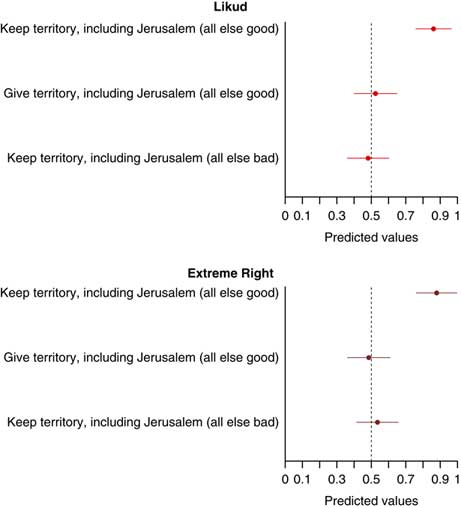
Figure 6 shows that the share of voters for far-right parties (54 percent) that prefer maintaining control of the disputed territory even if security, the economy, and social welfare were reduced (“all else bad”), is similar to the share of Likud voters (48 percent) with those preferences. This finding indicates that a right-wing leader such as Netanyahu must contend not only with his coalition partners but with his own political base, severely constraining his bargaining space and making negotiations highly challenging from a public opinion perspective.
Preferences for maintaining territorial control (right-wing bloc) Note: The figure plots the predicted values of policy choice, divided between Likud supporters (top panel) and farther right-wing parties (bottom panel), while holding the policy attributes reported in Table 2 at specific values. See Figure 1 for details on category definitions. Bars represent 95 percent confidence intervals.

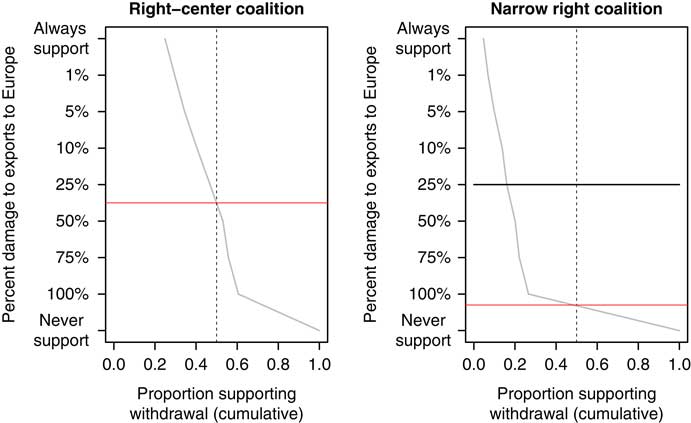
As a final illustration of how the distribution of preferences over territory affects the bargaining space of leaders, we examine the demand curve for concessions among two potential government coalitions: a narrow right-wing government (operationalized as the Likud and all parties to its right),Footnote 16 and a moderate right government that excludes Ultra-Orthodox parties and includes centrist parties.Footnote 17 We once again use data from our “valuation exercise,” which asked respondents for the level of cost that would be required for them to agree to support territorial compromise.
Figure 7 plots the demand for concessions by the size of the damage to the export sector in each potential coalition, as measured by voters for the parties included in the coalition. It shows that for a narrow right-wing government, at no sanction level would a majority of constituents support significant territorial concessions. This can help explain why negotiations with Palestinians have been frozen under Prime Minister Netanyahu’s current administration. Turning to a center-right government (left panel), the government is clearly less constrained than a right-wing coalition. However, a majority of such government’s constituents would agree to territorial withdrawal only when the value of the cost to the economy exceeded 35 percent of its largest export sector. This result reflects the fact that voters holding intangible preferences over the disputed territory are not necessarily concentrated in the far-right but form a core constituency of the Likud party. In understanding “effective indivisibility” as demand inelasticity, this figure provides a graphic illustration of what a narrow bargaining space means in practice.
Bargaining space by government coalition Note: The figure plots on the Y-axis the size of the damage to Israel’s export with the EU; the cost increases with the damage to the share of Israel’s export to EU. The X-axis plots the cumulative proportion of respondents in each coalition (right-center, narrow right) who are willing to support territorial concessions at different costs to the export economy.

Conclusion
The long-observed link between territorial disputes and conflict onset, escalation, duration, and termination has been attributed, on the one hand, to the tangible value of territory combined with the credibility problem, and on the other hand to intangible value. We have argued that tangibility and intangibility are better thought of as characteristics of preferences rather than of land, since territories often possess both material and symbolic worth. In addition, we proposed a set of methodological tools that can be used in diverse empirical contexts to disentangle tangible preferences from intangible ones, and to understand the implications of the nature of public attachment for the likelihood of conflict resolution.
Our empirical analysis reveals that in the Israeli case, a significant minority (approximately 45 percent) of our sample, identifying as left or centrist, does not appear to be particularly attached to the disputed territory, prioritizing other issues such as security and economic well-being.Footnote 18 We further find that between 30 and 40 percent Jewish-Israeli voters (depending on the measure employed), are willing to bear substantial material costs to retain control over the disputed West Bank territory and would not consider concessions regardless of the credibility of benefits or level of costs. This segment can be seen as symbolically attached to the territory. The remaining 15 to 25 percent of Jewish-Israeli voters reject concessions due to risk aversion: concerns about the credibility of the rival and the likelihood of their defection.
By systematically studying the heterogeneity of preferences within one case, we are able to identify patterns at the domestic level that may explain the persistence and recurrence of territorial conflicts. Our results therefore show that for “effective indivisibility” to take place, there is no need for a majority to hold intangible preferences over the disputed territory. Instead, we argue, the distribution of public preferences should favor political parties that are able to constrain political leaders’ bargaining space. As such, our study contributes to the large literature on territorial conflict by revealing how heterogeneity in territorial preferences shapes domestic political processes, which in turn lead to greater political intransigence.
In addition, our study provides a better understanding of the Israeli–Palestinian conflict, a territorial conflict that has long consumed the interest of policymakers. The literature on that conflict has been divided on the sources of attachment to territory: while some scholars have argued that, with the exception of an ideological minority, the majority of Israeli society views the control of the West Bank in instrumental terms as a strategic and material asset (Newman Reference Newman1999; Rynhold and Waxman Reference Rynhold and Waxman2008), others have argued that Israeli attachment to the West Bank is ideological and symbolic (Lustick Reference Lustick1993; Ginges et al. Reference Ginges, Scott, Medin and Shikaki2007). Our findings provide evidence that adjudicates among these claims, pointing to the limitations of a policy approach that focuses solely on increasing the material benefits of peace.
Our analysis suggests a number of avenues for future research. First, our findings regarding voter heterogeneity raise the question of who values territory and why. Second, as public opinion is not static but rather is subject to changes over time, an important question is whether and how attitudes towards territory can shift. Potential factors include, for example, elite cues and framing efforts (Zellman Reference Zellman2015) and exogenous shocks. If, for example, the costs of territorial control were to rise significantly (due to increased violence or external pressure, for example), then policy preferences among those who hold more rationalist views would likely change. Similar research, conducted at different points in time, could shed further light on this question. Finally, our finding of the existence of preference heterogeneity among those favoring territorial control suggests that territorial preferences vary across contexts. Indeed, we believe that such heterogeneity underpins the importance of in-depth analysis of specific cases. Future research could replicate this paper’s procedure in different conflict areas, such as the Indian state of Jammu and Kashmir or Eastern Ukraine.
In addition to the contribution to the theoretical debate on conflict and territory, our findings have important policy implications for the promotion of peaceful conflict resolution. First, they suggest that framing a peace agreement solely in instrumental terms, by highlighting security and material benefits, is unlikely to win over a substantial share of the Israeli population. At least in this context, peace-building efforts should take ideological dimensions seriously, in the discourse they employ and in the stakeholders they involve. Additionally, our findings point to the important role of leadership in advocating non-violent means to resolve conflict. When the public attaches high value to control over territory, leaders will need substantial individual and political clout to promote negotiations in the face of widespread public opposition.