Implications
Better identifying outcomes of pain mitigation for castration is a challenge for scientists and stakeholders in animal production. Here, we demonstrate that sheep experience pain up to 32 h post-castration, and that a combination of local anesthetic (LA) and non-steroidal anti-inflammatory (NSAID) can reduce behavioral and physiological responses for up to 3 days post-castration. This knowledge can help veterinarians and farmers better detect pain and refine their pain alleviation methods.
Introduction
Castration of male ruminants is a common livestock management practice in commercial farms, where it is used to reduce aggression and mounting behavior and to improve meat quality (Stilwell et al., Reference Stilwell, Lima and Broom2008). Castration can be performed either by surgical removal of the testes, or by methods that irreparably damage the testicles by cutting blood supply (i.e. rubber ring or a Burdizzo castration clamp). Burdizzo castration induces damages of skin, subcutaneous tissues and spermatic cords including pampiniform plexus, causing acute somatic and visceral pain (Mellema et al., Reference Mellema, Doherr, Wechsler, Thueer and Steiner2006). The tissue damage also triggers inflammation and associated pain (Coetzee, Reference Coetzee2013). In Europe, the European directive 98/58/EC in Article 3 states: ‘Member states shall (…) ensure that those animals are not caused any unnecessary pain, suffering or injury.’ The recommendations of the council of Europe concerning sheep states in Article 31: ‘castration, in particular by the use of rubber rings, should be avoided. If these procedures have to be carried out, only surgical methods preceded by anesthesia or haemostatic tongs should be used.’
A multimodal analgesic approach combining compounds that act on different receptor targets along the nociceptive pathway is more effective in mitigating the pain associated with castration in cattle than the use of a single analgesic agent (Coetzee, Reference Coetzee2013). In sheep, LA with lidocaine reduces pain response for 120 min following rubber ring (Kent et al., Reference Kent, Molony and Robertson1993) or burdizzo castration (Mellema et al., Reference Mellema, Doherr, Wechsler, Thueer and Steiner2006). The benefits of multimodal analgesia (i.e. LA plus NSAID) have been demonstrated in cattle (Earley and Crowe, Reference Earley and Crowe2002; Ting et al., Reference Ting, Earley, Hughes and Crowe2003). To our knowledge, little is known about the effectiveness of multimodal analgesia compared to LA alone in reducing pain associated with burdizzo castration in sheep.
The efficacy of a drug-based pain alleviation protocol can be assessed by monitoring the animals’ pain responses to a noxious stimulus. This assessment can be performed by recording the incidence of a clearly defined pattern of behaviors such as abnormal standing or lying (Molony et al., Reference Molony, Kent and Robertson1993; Molony et al., Reference Molony, Kent and McKendrick2002), ear postures (Guesgen et al., Reference Guesgen, Beausoleil, Minot, Stewart, Stafford and Morel2016) or facial expression (McLennan et al., Reference McLennan, Rebelo, Corke, Holmes, Leach and Constantino-Casas2016). The pain response can also be assessed by measuring activation of the hypothalamic–pituitary–adrenal (HPA) axis such as cortisol release (Mellema et al., Reference Mellema, Doherr, Wechsler, Thueer and Steiner2006), and activation of the autonomous nervous system (ANS) such as heart rate variability (HRV) (Pieler et al., Reference Pieler, Peinhopf, Becher, Aurich, Rose-Meierhöfer, Erber, Möstl and Aurich2013). Painful procedures also induce changes in biochemical markers of oxidative stress (Ting et al., Reference Ting, Earley, Hughes and Crowe2003) and inflammation such as haptoglobin and serum amyloid A (SAA) (Eckersall et al., Reference Eckersall, Young, McComb, Hogarth, Safi, Weber, McDonald, Nolan and Fitzpatrick2001). It is impossible to allocate a ‘pain score’ on the basis of changes in only one of these indicators, as most of them are not specific and/or sensitive enough. Multivariate analysis combining behavioral indicators increased acute pain intensity detection following castration and tail docking in lambs (Molony et al., Reference Molony, Kent and McKendrick2002). This was recently confirmed by Faure et al. (Reference Faure, Paulmier, Boissy, de la Foye, de Boyer des Roches and Durand2017) who demonstrated that multiparametric analysis combining behavior, HPA, ANS, inflammation and oxidative stress indices discriminated the pain experienced by sheep following various surgical procedures.
The general aim of this study was to monitor the behavioral and physiological pain response induced by burdizzo castration in sheep and to assess the efficacy of different drug protocols: no pain alleviation (‘Burd’), LA (‘Burd+LA’) or LA plus NSAID (‘Burd+LA+NSAID’). Pain was assessed by behavioral and physiological sheep responses. The hypotheses were (i) pain experienced in sheep varies according to time and analgesia stratedies, and (ii) a multiparametric approach combining several indicators, already tested in experimental surgery conditions (Faure et al., Reference Faure, Paulmier, Boissy, de la Foye, de Boyer des Roches and Durand2017), would efficiently discriminate these pain levels according to time post-castration.
Material and methods
This experiment was carried out at the multidisciplinary experimental research platform Herbipôle in France, with the approval of the Regional Ethics Committee for Experiments on Animals CEMEA Auvergne (CE-05092.01).
Animals, housing and diets
Twenty-four 12-month-old male Texel sheep (54.2±0.35 kg) were used. The sheep were housed by groups of three in straw-bedded pens measuring 3×5 m. The sheep received water ad libitum and a diet based on hay (80%) and concentrate (20%) to meet their requirements and intake capacity.
Treatments and study design
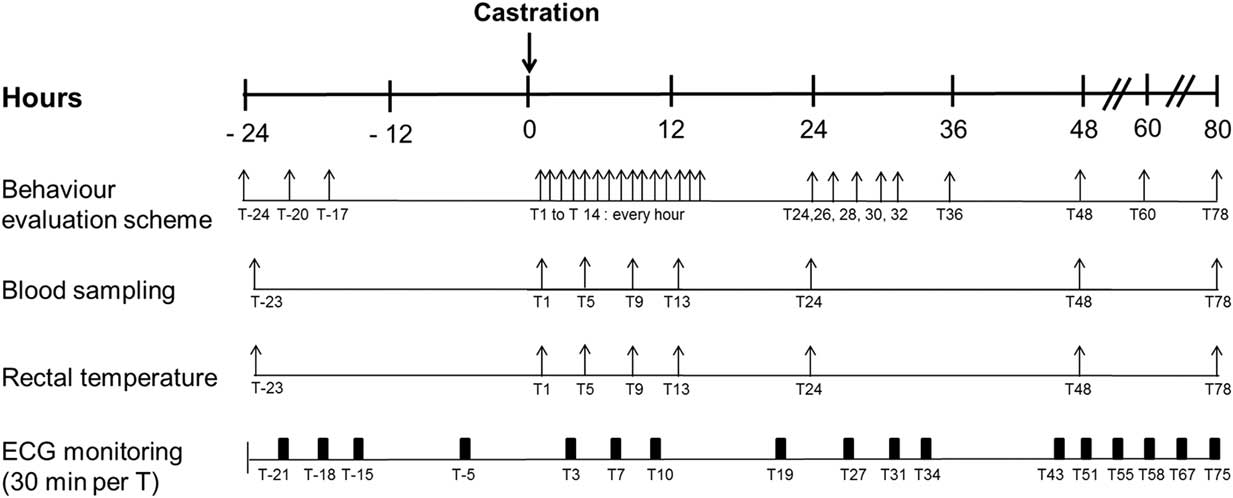
The 24 sheep were burdizzo-castrated after receiving either LA (Burd+LA, n = 8), a combination of LA and NSAID (Burd+LA+NSAID, n = 8) or physiological serum (Burd, n = 8) (see below for details). Sheep were randomly allocated into eight blocks of three sheep and then within each block sheep was randomly allocated to one of three treatments Two weeks before castration, the sheep were habituated to the housing conditions, handling for blood sampling and sitting position for castration (Figure 1).
Experimental protocol for investigating the effects of castration of 24 Texel sheep on physiological and behavioral indicators.

Drug protocol and castration
Castration was performed in the home-pen. The scrotal neck of Burd, Burd+LA and Burd+LA+NSAID sheep was disinfected with diluted povidone iodine solution (Betadine; Provet AG). Burd+LA and Burd+LA+NSAID sheep then received a 2.5 ml injection of lidocaine hydrochloride (Lidocaine HCI 2%, 20 mg/ml; BIMEDA) into each spermatic cord (just above scrotum) and a 5 ml injection subcutaneously around the scrotal neck. Burd sheep received 10 ml of physiological saline (0.9% NaCl) injected in a manner similar to the Burd+LA and Burd+LA+NSAID sheep. After the drug injections, the sheep were kept in a standing position, without restraint. Ten minutes after the injections, the sheep were placed back in sitting position for the castration. Burd+LA+NSAID sheep received 2 ml of NSAID (flunixin meglumine, FINADYNE®, 50 mg/ml; INTERVET) by intramuscular injection in the neck (musculus trapezius), while Burd and Burd+LA sheep received 2 ml of physiological saline. All sheep had each spermatic cord and associated scrotal tissue crushed once for 1 min with a burdizzo clamp (50 cm; Provet AG).
Data collection
Behavioral observations and physiological measurements were performed at regular intervals from 24 h pre-castration up to 80 h post-castration (Figure 1). The experimental period was split into three periods based on duration of drug effects, that is, period 0 (P0) spanned T-24 to T-1 h (i.e. pre castration), period 1 (P1) spanned T0 to T+2 h post-castration (i.e. LA effects), period 2 (P2) spanned T+3 to T+36 h post-castration (i.e. NSAID effects) and period 3 (P3) spanned T+48 to T+78 h post-castration (i.e. after drug action).
Behavior assessment scheme
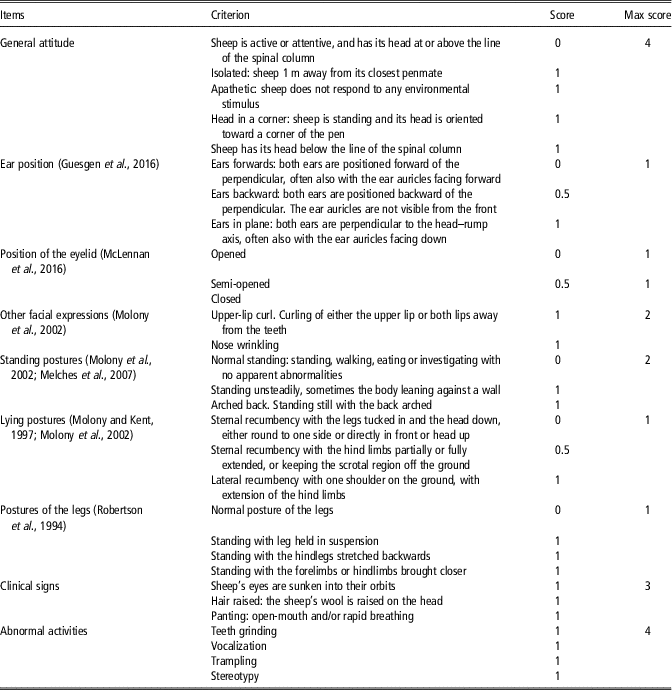
The behavior assessment scheme was based on pain behaviors selected from the literature (Robertson et al., Reference Robertson, Kent and Molony1994; Molony and Kent, Reference Molony and Kent1997; Molony et al., Reference Molony, Kent and McKendrick2002; Melches et al., Reference Melches, Mellema, Doherr, Wechsler and Steiner2007; Guesgen et al., Reference Guesgen, Beausoleil, Minot, Stewart, Stafford and Morel2016; McLennan et al., Reference McLennan, Rebelo, Corke, Holmes, Leach and Constantino-Casas2016; Faure et al., Reference Faure, Paulmier, Boissy, de la Foye, de Boyer des Roches and Durand2017), as described in Table 1. Based on the scientific literature, all the behaviors were weighted and graduated in levels, as some behaviors are considered more pain-specific than others (e.g. ‘in-plane ears’ had a score of 1, Table 1). Behavioral observations were conducted by seven appropriately trained observers via scan sampling (Martin and Bateson, Reference Martin and Bateson2013) once at each of the 26 timepoints pre- and post-castration, that is, at T-24, T-20, T-17, T+1, T+2, T+3, T+4, T+5, T+6, T+7, T+8, T+9, T+10, T+11, T+12, T+13, T+14, T+24, T+26, T+28, T+30, T+32, T+36, T+48, T+60 and T+78 (Figure 1). At each timepoint, the presence or absence of each behavior defined in Table 1 was recorded for each sheep on a digital tablet (AsusTeK Computer, Inc., Taipei, Taïwan) using an application called ‘EvaDoul’ developed by the INRA research team.
Description of criteria evaluated in the behavior assessment scheme in sheep

Physiological measurements
For each animal, eight blood samples were collected by venipuncture from the jugular vein pre- and post-castration, at T-23, T+1, T+5, T+9, T+13, T+24, T+48 and T+78 h, to determine physiological parameters (Figure 1). Blood samples were collected in vacutainer tubes containing Na2-Ethylenediaminetetraacetic acid (two 10-ml tubes) or lithium heparin (two 10-ml tubes). Plasma concentrations of haptoglobin (IDBIOTECH, Issoire, France) and SAA were determined by immunoprecipitation (Auboiron et al., Reference Auboiron, Sparrow, Beaubatie, Bauchart, Sparrow, Laplaud and Chapman1990) using an ELISA kit (catalogue no. TP 802; Tridelta Development Limited, Kildare, Ireland). Plasma concentrations of cortisol, non-esterified fatty acids (NEFA) and glucose were determined by radioimmunoassay (Boissy and Bouissou, Reference Boissy and Bouissou1994), enzymatic and colorimetric methods, respectively (Trinder, Reference Trinder1969; Scislowski et al., Reference Scislowski, Bauchart, Gruffat, Laplaud and Durand2005). Results of quality control tests for the critical methods are showed in Supplementary Material S1. Plasma concentrations of glutathione (reduced forms (GSH) and oxidized forms (GSSG)), vitamins A and E, and nitrite oxide (NO; Nitrite assay kit, Cayman Chemical Company, Ann Arbor, MI, USA) were measured by HPLC, HPLC-UV spectrophotometry and fluorometric assay (kit no. 780051; Cayman Chemical Company), respectively. Rectal temperature was measured using a thermometer at the eight timepoints scheduled pre- and post-castration (at T-23, T+1, T+5, T+9, T+13, T+24, T+48 and T+78 h, Figure 1). Heart rate variability was recorded continuously by a wireless telemetry system (emkaPACK4G telemetry system; emka Technologies USA, Falls Church, VA, USA). Three electrodes were placed on each sheep: one between the shoulder blades, and the two others on the sternum. The three electrodes were connected to an external transmitter. The electrodes and the transmitter were held in place by an elastic belt strapped around the sheep thorax. Each external transmitter sent the signal to the telemetry receiver positioned out of the pen, within 10 m from the transmitters. For all animals, recording began simultaneously at 1 h pre-castration and continued until 78 h post-castration. Heart rate measurements were determined for 30-min phases representing diurnal phases without any human intervention (care, food, blood samples, etc.) at 17 timepoints pre- and post- castration (Figure 1). Heart rate variability analysis via a time-domain approach provided the standard deviation in R–R length (SDNN) and root mean square of successive differences (RMSSD) (Pieler et al., Reference Pieler, Peinhopf, Becher, Aurich, Rose-Meierhöfer, Erber, Möstl and Aurich2013; Stubsjøen et al., Reference Stubsjøen, Knappe-Poindecker, Langbein, Fjeldaas and Bohlin2015). Standard deviation in R–R length is a measure of overall HRV and is sensitive to both sympathetic and parasympathetic modulations, while RMSSD reflects vagally mediated modulations in vagosympathetic balance. Frequency-domain analysis of HRV dichotomized beat-to-beat interval frequencies into low frequency (LF) or high frequency (HF) bands, both of which reflect the degree of parasympathetic tone.
Statistical analyses
For behavioral data recorded through the behavior assessment scheme, we established behavioral categories (called ‘item’ in Table 1) that comprised several behavioral criteria (e.g. the ‘facial expression’ item comprised ‘Upper-lip curl’ and ‘Nose wrinkling’). For each sheep in each period (P1, P2, P3) and for each criterion, its frequency of observation was multiplied by its initial score to give a weighted score. In each behavioral item, we then first summed all the weighted scores for each sheep at each phase and then divided the total by the maximum reachable weighted score. The final composite score for each behavioral item was thus expressed on a 0 to 100 scale.
For all indicators (haptoglobin, SAA, cortisol, NEFAs, GSH/GSSG ratio, behavioral item score, RMSSD, SDNN, LF/HF ratio, body temperature, vitamins A, E and NO), the mean value was calculated for each phase and each sheep, and that value was then used for further analyses. To compare Burd, Burd+LA and Burd+LA+NSAID sheep responses before castration (P0), a non-parametric Kruskal–Wallis test and a posthoc Dunn test were used. Then, for each treatment, sheep responses were compared between periods (P0, P1, P2, P3) using non-parametric Friedman and Nemenyi tests.
A discriminant analysis to statistically discriminate the three treatments during the pre- (P0) and the three post-castration periods (P1, P2, P3) was used. Discriminant analysis highlights the variables on which the q groups differ and identifies at most q−1 linear combinations of variables that best discriminate the groups (Lebart et al., Reference Lebart, Piron and Morineau1995). The analysis was run on all of the behavioral and physiological measures. To interpret the discriminant components of the factorial discriminant analysis, we focused on variables with an absolute correlation coefficient higher than 0.4. The discriminant analysis was followed by cross-validation to estimate the model’s performance. Cross-validation serves to calculate the probability of each animal being accurately assigned to the right treatment group. The performance of the multiparametric analysis was assessed based on its κ coefficient, sensitivity (percentage of sheep correctly predicted as belonging to a treatment; Se = true positive/true positive+false negative) and specificity (percentage of sheep correctly predicted as not belonging to a treatment; Sp = true negative/true negative+false positive). Sensitivity and Sp were calculated after a leave-one-out analysis performed after the discriminant analysis. Statistical analyses were performed using R 3.3.2 with the ade4 package for discriminant analysis (R Development Core Team, 2008). Threshold for significance was set at P = 0.05. R codes of statistical models are detailed in Supplementary Material S2.
Results
No animal reached the limit point as per the ethics statement.
Time–course variations for each physiological and behavioral indicator
Data on all the indicators are detailed in Supplementary Tables S1, S2 and S3.
Before castration (P0), there were no difference between Burd, Burd+LA and Burd+LA+NSAID sheep for all physiological and behavioral data (P > 0.05 in all cases).
Compared to P0, Burd sheep in P1 had higher glucose and cortisol levels, higher heart rate, RMSSD and SDNN (P < 0.05). In P2, they scored higher for facial expression and posture of the legs and had higher glucose levels (P < 0.05). In P3, they had higher haptoglobin and SAA levels and lower GSH/GSSG ratio, LF/HF ratio, vitamin A and vitamin E levels (P < 0.05 in all cases) (Table S1).
Compared to P0, Burd+LA sheep in P1 had higher cortisol levels, heart rate, LF/HF ratio, RMSSD and vitamin A levels (P < 0.05). In P2, they scored higher for eyelid position, facial expression, clinical signs and abnormal activities, and had higher glucose levels (P < 0.05). In P3, they had higher haptoglobin and SAA levels, higher body temperature, and lower GSH/GSSG ratio (P < 0.05 in all cases) (Table S2).
Compared to P0, Burd+LA+NSAID sheep in P1 had higher heart rate and LF/HF ratio (P < 0.05). In P2, they scored higher for attention and head position and had higher body temperature (P < 0.05). In P3, they had higher SAA levels and higher GSG/GSSH ratio (P < 0.05 in all cases) (Table S3).
Discriminant analysis of all physiological and behavioral indicators
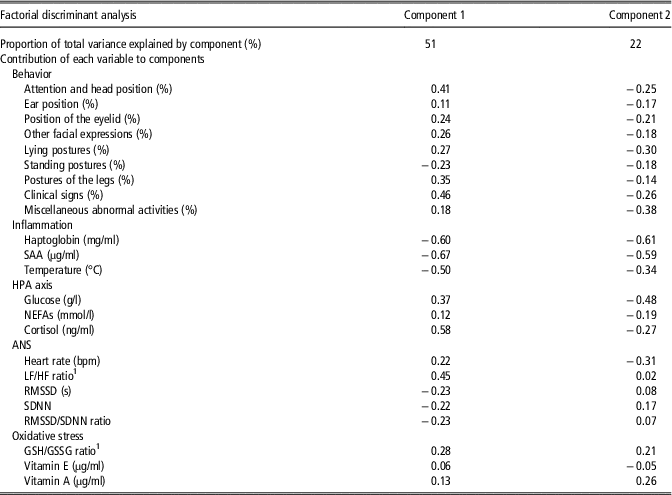
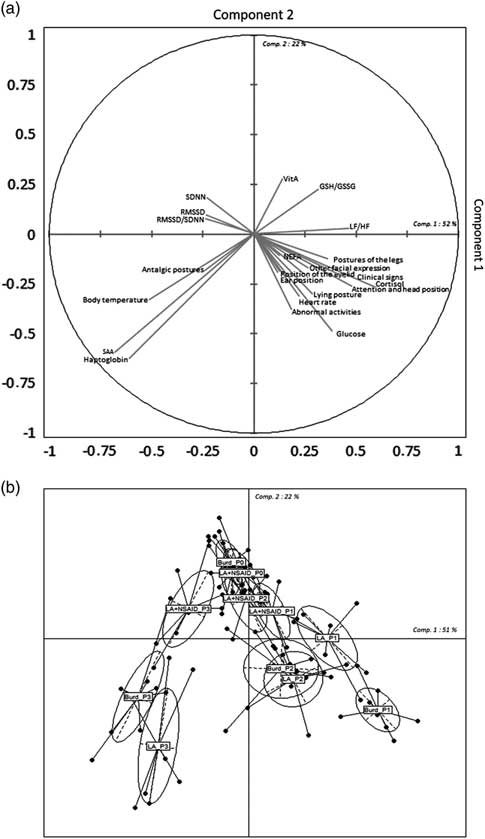
Discrimination of the 12 groups (four periods in three treatments) was tested (Table 2 and Figure 2, and Supplementary Figure S1). Components 1 and 2 accounted, respectively, for 51% and 22%, that is, 73% of total variance explained by the model. Component 1 was mostly explained (variable-to-component correlation) by cortisol (0.58), clinical signs (0.46), LF/HF ratio (0.45), score for attention and head position (0.41), and by SAA (−0.67), haptoglobin (−0.60) and body temperature (−0.50). Component 2 was mostly explained by haptoglobin (−0.61), SAA (−0.59) and glucose (−0.48) (Table 2). Figure 2a shows two groups of correlated indicators that contributed most to discriminate the 12 groups: (i) scores for abnormal activities, lying postures, attention and head position, cortisol, glucose, heart rate, (ii) SAA, haptoglobin and to a lesser extent body temperature. Figures 2a and b show that all sheep in P0 and Burd+LA+NSAID sheep in P1 and P2 tended to score globally lower on (i)-group and (ii)-group indicators overall. In the bottom right quarter of the factorial plan, Burd sheep in P1 and to a lesser extent Burd sheep in P2 and Burd+LA sheep in P1 and P2 tended to have the highest values for (i)-group indicators and LF/HF. In the bottom left quarter of the factorial plan, Burd and Burd+LA sheep in P3 tended to have the highest levels of SAA, haptoglobin and body temperature. In the top left corner, Burd+LA+NSAID sheep in P3 tend to have lower levels of all indicators (Table 2).
Factorial discriminant analysis on physiological and behavioral indicators from 24 Texel sheep burdizzo-castrated: without pain relief treatment (Burd), under local anesthetic (Burd+LA) or under local anesthetic plus non-steroidal anti-inflammatory drug (Burd+LA+NSAID) at period 0 (24 to 1 h pre-castration), period 1 (0 to 2 h post-castration), period 2 (3 to 36 h post-castration) and period 3 (48 to 80 h post-castration): proportion of variance explained by each component, and variable-to-component correlations

SAA = serum amyloid A; HPA = hypothalamic–pituitary–adrenal axis; NEFA = non-esterified fatty acids; ANS = autonomous nervous system; LF = low frequencies beat-to-beat interval; HF = high frequencies beat-to-beat interval; RMSSD = root mean square of successive differences; SDNN = standard deviation in R–R length; GSH = glutathione reduced forms; GSSG = glutathione oxidized forms.
1 LF and HF are expressed in ms, but their ratio does not include unit; GSH and GSSG are expressed in, nmole/ml but their ratio does not include unit.
Factorial map of the discriminant analysis on behavioral and physiological indicators of 24 Texel sheep burdizzo-castrated: without pain relief treatment (Burd, n = 8), under local anesthetic (Burd+LA, n = 8) or under local anesthetic plus non-steroidal anti-inflammatory drug (Burd+LA+NSAID, n = 8), at period 0 (24 to 1 h pre-castration), period 1 (0 to 2 h post-castration), period 2 (3 to 36 h post-castration) and period 3 (48 to 80 h post-castration): loadings of (a) the variables and (b) the individuals on axis 1 and axis 2 of the factorial discriminant analysis. Due to plot size limitations, the label tags have been simplified on the plot: ‘Burd_P3’ corresponds to Burd sheep in period 3, and so on. SDNN = standard deviation in R–R length; RMSSD = root mean square of successive differences; GSH = glutathione reduced forms; GSSG = glutathione oxidized forms; LF = low frequencies beat-to-beat interval; HF = high frequencies beat-to-beat interval; NEFA = fatty acids; SAA = serum amyloid A. See Table 2 for details of all variable-to-component correlations.

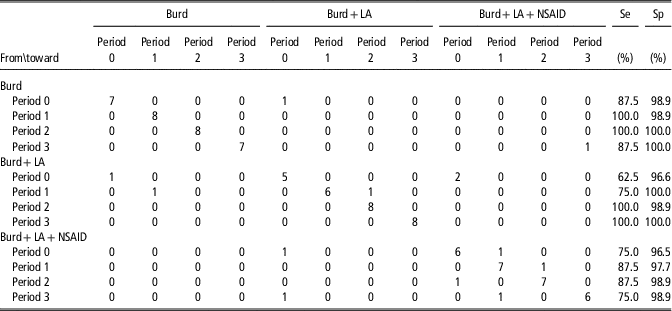
After cross-validation, sheep were correctly assigned to their original period and treatment group (κ coefficient 0.85), leading to an Se in the range 62.5% to 100% and an Sp in the range 96.5% to 100% (Table 3).
Cross-validation, sensitivity (Se) and specificity (Sp) of the factorial discriminant analysis on physiological and behavioral indicators from 24 Texel sheep burdizzo-castrated: without pain relief treatment (Burd), under local anesthetic (Burd+LA) or under local anesthetic plus non-steroidal anti-inflammatory drug (Burd+LA+NSAID) at period 0 (24 to 1 h pre-castration), period 1 (0 to 2 h post-castration), period 2 (3 to 36 h post-castration) and period 3 (48 to 80 h post-castration)

Discussion
Most studies over the past decade which have focused on pain induced by castration in sheep have often only measured one or two indices of welfare at a time (e.g. behavior, inflammation, ANS, etc.). Here, for the first time, a multiparametric evaluation of the sheep response to castration is given, taking into account all aspects of the pain response (behavior, HPA, ANS, inflammation and oxidative stress) in an integrative manner. The effects of different drug protocols (i.e. no pain alleviation, ‘Burd’; LA, ‘Burd+LA’; LA plus NSAID, ‘Burd+LA+NSAID’) over an 80 h pre-to-post-castration period are provided. Previous studies have described individual pathway responses (e.g. behavioral or ANS) (Molony et al., Reference Molony, Kent and Robertson1993; Melches et al., Reference Melches, Mellema, Doherr, Wechsler and Steiner2007) or described combined responses of behavioral and HPA indicators (Molony et al., Reference Molony, Kent and McKendrick2002), but on a per-hour or per-day basis and generally for a shorter time window (e.g. 3 h in Molony et al., Reference Molony, Kent and Robertson1993; 9 h in Melches et al., Reference Melches, Mellema, Doherr, Wechsler and Steiner2007). Here sheep responses were monitored over the course of 80 h, and the timeline of observation was defined according to duration of the drug effects: P0, T-24 to T-17 pre-castration; P1, T0 to T+2 h post-castration (covering LA effects); P2, T+3 to T+36 h post-castration (covering NSAID effects); P3, T+48 to T+78 h post-castration (no more drug action). This allowed us to identify the periods of greatest pain and best pain alleviation protocol. This knowledge is helpful to researchers investigating contrasts between procedures and analgesic approaches. In addition, the information of sheep behavioral reaction to castration can help farmers and veterinarians to identify sheep experiencing pain and initiate pain relief treatment accordingly.
We chose three periods of observation (P0, P1, P2 and P3) according to the duration of drug effectiveness from field data (Dr S. Junot, personal communication and Dr D. Durand, personal communication). From a pharmacokinetic point of view, for flunixin meglumine administrated by intra-muscular route in sheep, the plasmatic peak (C max) is reached at 60 min, which corresponds to the first observation time (around 1 h), its half-life is 200 min and its biodisponibility is 70% (Welsh et al., Reference Welsh, McKellar and Nolan1993). The plasmatic concentration is not necessarily correlated to the efficacy of the drug, which was assessed by clinical signs expressed by the animal. This lack of concentration has already been described elsewhere (Toutain et al., Reference Toutain and Lees2004). Therefore, the observed effects on sheep responses were due to drugs and not to a placebo effect.
Before castration, the baseline levels of cortisol, haptoglobin, SAA, body temperature, HRV (i.e. heart rate, RMSSD, SDNN, LF/HF), glucose and oxidative stress of Burd, Burd+LA and Burd+LA+NSAID sheep were similar to basal values reported in the literature (Molony et al., Reference Molony, Kent and McKendrick2002; Stubsjøen et al., Reference Stubsjøen, Knappe-Poindecker, Langbein, Fjeldaas and Bohlin2015). The sheep did not express any behavioral signs of pain similar to those described in the literature (Molony et al., Reference Molony, Kent and Robertson1993). Whole sheep response did not differ between treatments, demonstrating that before castration, the Burd, Burd+LA and Burd+LA+NSAID sheep were not experiencing any kind of pain or discomfort.
We tested the ability of a multiparametric analysis, gathering information from five pathways (behavior, inflammation, ANS, HPA, oxidative stress), to discriminate between sheep responses to castration according to the analgesic protocols they received. Discriminant analysis showed that sheep ‘whole’ response significantly differed in terms of variables from four pathways, that is behavior, HPA, ANS and inflammation in response to castration.
Following castration, the ‘whole’ Burd sheep response in P1 (i.e. the first 2 h post-castration) was significantly different from the pre-castration P0 and was characterized by a combination of high scores for attention and head position, clinical signs, cortisol levels, glucose levels and LF/HF ratio. This is in agreement with results of previous studies in 10-week lambs, which showed less active behavior in the first few hours after burdizzo castration (Melches et al., Reference Melches, Mellema, Doherr, Wechsler and Steiner2007). Burd sheep displayed a similar but less pronounced pattern of response in P2 (i.e. 3 to 32 h), which was also significantly different from the pre-castration P0. Their response in P3 (i.e. 36 to 78 h) was still significantly different to P0 and was characterized by a combination of high levels of haptoglobin, SAA and glucose and very low values of all other indicators. Pain responses are characterized by a combination of several behavioral reactions (Prunier et al., Reference Prunier, Mounier, Le Neindre, Leterrier, Mormede, Paulmier, Prunet, Terlouw and Guatteo2013), such as lowered attention (i.e. isolation from conspecifics, apathy, standing head in a corner or below the spinal column), clinical signs (e.g. panting) (Molony et al., Reference Molony, Kent and Robertson1993; Weary et al., 2006), increased plasma cortisol levels (Molony et al., Reference Molony, Kent and McKendrick2002; Melches et al., Reference Melches, Mellema, Doherr, Wechsler and Steiner2007; Prunier et al., Reference Prunier, Mounier, Le Neindre, Leterrier, Mormede, Paulmier, Prunet, Terlouw and Guatteo2013) and a high LF/HF ratio reflecting a regulatory shift toward sympathetic-dominant ANS activity (von Borell et al., Reference von Borell, Langbein, Després, Hansen, Leterrier, Marchant-Forde, Marchant-Forde, Minero, Mohr, Prunier, Valance and Veissier2007). The magnitude of cortisol response in P1 (median, 35.3 ng/ml) and P2 (12.9 ng/ml) was higher than values reported for adult sheep following unilateral osteotomy (mean cortisol, 6 ng/ml; Häger et al., Reference Häger, Biernot, Buettner, Glage, Keubler, Held, Bleich, Otto, Müller, Decker, Talbot and Bleich2017). The magnitude of LF/HF ratio in P1 (2.36 [1.44 to 3.17]) and P2 (1.44 [0.93 to 2.25]) was higher than or similar to values reported for adult sheep following footrot inoculation (median, 2; Stubsjøen et al., Reference Stubsjøen, Knappe-Poindecker, Langbein, Fjeldaas and Bohlin2015). Our results therefore indicate that burdizzo castrated sheep (Burd sheep) experienced pain in P1 and P2. In P3, the Burd sheep response was characterized by high scores for inflammatory indicators: crushing tissues with a burdizzo device produces injury discharges in afferent nerves and releases inflammatory mediators (Molony et al., Reference Molony, Kent and Robertson1993). However, the sheep did not display behavioral, ANS or HPA responses. This suggests that although the burdizzo-castrated sheep were still in an inflammatory stage (Coetzee, Reference Coetzee2011) in the 36 to 78 h period post-castration, this inflammation was not associated with sufficient pain or discomfort to cause a behavioral response. Our results confirm that 12-month-old sheep experience pain following Burd castration, similar to 2 to 7-day-old, 21-day-old, 42-day-old and 10-week-old lambs (Kent et al., Reference Kent, Molony and Robertson1993; Molony et al., Reference Molony, Kent and Robertson1993; Molony et al., Reference Molony, Kent and McKendrick2002; Mellema et al., Reference Mellema, Doherr, Wechsler, Thueer and Steiner2006), and that this pain lasts up to 36 h post-castration. These findings illustrate the need for pain alleviation when castrating 12-month-old sheep, as previously demonstrated in lambs.
Following castration, the ‘whole’ Burd+LA+NSAID sheep response in P1 and P2 was characterized by a combination of low scores for all indicators, and was significantly different from Burd sheep response in P1 and P2. Non-steroidal anti-inflammatory treatment may have inhibited COX enzyme activity, reducing the synthesis of prostaglandins, which are key mediators of stress-induced corticotropin-releasing hormone secretion and inflammatory processes (Coetzee, Reference Coetzee2011). This result therefore demonstrates that the combination of LA and NSAID efficiently reduces the pain caused by burdizzo castration for up to 32 h post-castration in 12-month-sheep, which confirms previous findings in cattle (Earley and Crowe, Reference Earley and Crowe2002; Ting et al., Reference Ting, Earley, Hughes and Crowe2003). However, the whole Burd+LA+NSAID sheep response did not significantly differ from pre-castration response (P0) until P3, where it was characterized by a small increase in an inflammation indicator (i.e. SAA). This suggests that the inflammation produced by the burdizzo clamp (Molony et al., Reference Molony, Kent and Robertson1993) was not totally reduced by administrating NSAID in the 36 to 78 h post-castration period. However, this inflammatory stage did not seem to be associated with pain or discomfort, since the Burd+LA+NSAID animals did not show behavioral, ANS, nor HPA responses between 36 and 78 h post-castration.
Following castration, the ‘whole’ Burd+LA sheep response in P1 was characterized by a combination of fairly high scores for attention and head position, clinical signs, cortisol level and LF/HF ratio that tended to be different from the Burd sheep response in P1. This result suggests that Burd+LA sheep may have experienced some pain in the first 2 h after burdizzo castration. Our results therefore confirm that LA only partially reduces the immediate pain response following burdizzo castration, as previously reported in 2 to 7-day-old lambs (Mellema et al., Reference Mellema, Doherr, Wechsler, Thueer and Steiner2006), 3-week-old lambs (Molony et al., Reference Molony, Kent, Hosie and Graham1997), 10-week-old lambs (Melches et al., Reference Melches, Mellema, Doherr, Wechsler and Steiner2007) and 13-month-old bulls (Ting et al., Reference Ting, Earley, Hughes and Crowe2003). These findings were further confirmed by Burd+LA sheep responses in P2 and in P3, which were significantly different from P0. In P2, the whole Burd+LA response was characterized by a combination of high scores for attention and head position, clinical signs, cortisol levels and LF/HF ratio, following a similar pattern to Burd sheep in P2. Whole Burd+LA response in P3 also differed from P0 and was characterized by a combination of high levels of haptoglobin, SAA and glucose, and very low values for other indicators. Therefore, the Burd+LA sheep seemed to experience some pain during P1 and intense pain during P2, but no pain or discomfort in the P3 period despite being in an intense inflammatory stage. These results are surprising, as we would have expected the Burd group to express the most intense ‘whole’ response to castration. Here, Burd+LA sheep showed a similar response to Burd sheep in P2 and P3. This might be explained (i) by an increase of pain response once lidocaine concentration declined, as previously observed in dehorned cattle (Stafford and Mellor, Reference Stafford and Mellor2005), and/or (ii) by an exacerbation of inflammatory response induced by the injection of LA in the scrotum and spermatic cords, again as previously described in cattle (Fisher et al., Reference Fisher, Crowe, Alonso de la Varga and Enright1996; Ting et al., Reference Ting, Earley, Hughes and Crowe2003).
The multiparametric approach, combining information from five pathways, showed good performances in discriminating burdizzo castration-induced pain in sheep according to the drug protocol. Even though the relevance of the indicators was dependent on time period post-surgery, all five pathways (behavior, HPA axis, SNA, oxidative stress, inflammation) brought information that contributed to the discrimination. Four pathways (behavior, ANS, HPA axis and inflammation) contributed most to the discrimination, as previously demonstrated in sheep after surgery (Faure et al., Reference Faure, Paulmier, Boissy, de la Foye, de Boyer des Roches and Durand2017) and in dairy cows experiencing Escherichia coli mastitis (de Boyer des Roches et al., Reference de Boyer des Roches, Faure, Lussert, Herry, Rainard, Durand and Foucras2017). This finding therefore confirms the need to combine information from these pathways to fully assess pain (Prunier et al., Reference Prunier, Mounier, Le Neindre, Leterrier, Mormede, Paulmier, Prunet, Terlouw and Guatteo2013), and to avoid the biasing of physiological and behavioral responses due to age of the animal (Ting et al., Reference Ting, Earley, Veissier, Gupta and Crowe2007) or handling per se (e.g. Anil et al., Reference Anil, Anil and Deen2005; Stewart et al., Reference Stewart, Stafford, Dowling, Schaefer and Webster2008).
This study included a group of sheep that did not receive any analgesia. Varying the level of analgesia allowed to set a controlled model of severe, moderate and mild pain, with respect to limit points approved by the Regional Ethics Committee for Experiments on Animals CEMEA Auvergne. If a group without analgesia was not included, two fundamental questions to set analgesia strategies would not have been addressed; (i) how much and how long do sheep experience pain following castration, and (ii) to what extend does each analgesic protocol (LA or LA+NSAID) sufficiently relieve pain. The experiment described here followed the principles of the 3Rs for performing a more humane animal research. More specifically, the number of animals used here was calculated based on published data (i.e. Reduction). In addition, the ultimate goal of this study was to refine both the pain assessment methods in ruminants used for breeding and experimental purposes, and the pain alleviation strategies (i.e. Refinement), that will benefit for a large number of sheep on farms in the future.
Conclusion
The multiparametric approach, combining information from five pathways, showed good performances in discriminating burdizzo castration-induced pain in sheep according to different drug protocols. This study demonstrated (i) that LA was partially effective at relieving pain, and only during its time of performance (i.e. 2 h), but (ii) that the combination of LA and NSAID was effective for up to 3 days post-castration. The findings of this study will help veterinarians and farmers better detect post-castration pain in sheep by observing their behavior and refine their pain alleviation methods accordingly, and thus enhance on-farm animal welfare.
Acknowledgements
The authors thank Denis Roux, Pascal Faure, Maxime Navech, Yoan Thomas, André Guittard, Sebastien Alcouffe, Bernard Mallet, Simon Collange and Julien Mongiat for providing technical assistance during the experiments, Agnès Thomas, Anne-Sophie Bage, Hervé Chandèze, Eric Delval, Stéphane Andanson and Christine Ravel for providing assistance with the laboratory analyses, Dr Caroline Prouillac and Dr Junot for pharmacological expertise, and A.T.T. for providing editorial support. This work was funded by INRA (Crédits incitatifs du département PHASE) and by VetAgro Sup.
Declaration of interest
The authors declare they have no conflicts of interest.
Ethics statement
This experiment was carried out with the approval of the Regional Ethics Committee for Experiments on Animals CEMEA Auvergne (CE-05092.01). Limit point was defined as a combination of eight behaviors (no feeding, no rumination, bruxism, panting, isolated sheep, lowered head, low ears and closed eyes) observed for more than 12 h. In this instance, veterinary assessment was required with consideration for welfare management, including administration of rescue analgesia consisting in 2 ml of flunixin meglumine by intramuscular injection and 1 ml/100 kg of morphine (Butorphanol, Torbugesic Vet®, 10 mg/ml; ZOETIS) by intravenous injection. If a sheep reached an limit point, it was excluded from the study.
Software and data repository resources
Data are available on request from the corresponding author.
Supplementary material
To view supplementary material for this article, please visit https://doi.org/10.1017/S1751731119000314