Introduction
The Brazilian Amazon harbours more than 100 species of lizard (Ávila-Pires, Reference Ávila-Pires1995). Despite this diversity, studies on helminths of Amazonian lizards are scarce and basically consist of species descriptions (see Freitas & Lent, Reference Freitas and Lent1938; Alho, Reference Alho1965; Bain, Reference Bain1974). However, there has been a recent increase in taxonomic studies and many species, such as Allopharynx daileyi from Uranoscodon superciliosus (Bursey et al., Reference Bursey, Goldberg and Vitt2005a) and Cosmocerca vrcibradici from Cercosaura eigenmanni and C. oshaughnessyi (Bursey & Goldberg, Reference Bursey and Goldberg2004) have been described.
There has also been an increase in ecological studies on parasitism and many lizard species have been studied, such as Anolis fuscoauratus (Goldberg et al., Reference Goldberg, Bursey and Vitt2006a), Anolis punctatus, A. transversalis (Goldberg et al., Reference Goldberg, Bursey and Vitt2006b), Alopoglossus angulatus, A. atriventris (Goldberg et al., Reference Goldberg, Bursey and Vitt2007a), Kentropyx calcarata, Leposoma osvaldoi and Potamites ecpleopus (Goldberg et al., Reference Goldberg, Bursey, Caldwell, Vitt and Costa2007b). However, the studies cited are restricted to the northern portion of Brazilian Amazon and no investigations have been carried out in the southern Amazon.
The aim of the present study was to analyse the helminth fauna of a lizard community in the municipality of Aripuanã, state of Mato Grosso, Brazil (southern Amazon region).
Materials and methods
Collection and examination of lizards
Ninety-five lizards were collected during the herpetofaunal monitoring programme of the Faxinal II hydroelectric power plant (10°9′0″S, 59°27′0″W) in the municipality of Aripuanã (Mato Grosso, Brazil). Captures were carried out using pitfall traps with drift fences and by hand from September 2006 to July 2008. The lizards were euthanized, fixed in a 10% formalin solution and preserved in 70% ethanol. Voucher specimens were deposited in the Zoological Collection of the Universidade Federal de Mato Grosso (Brazil).
In the laboratory, a longitudinal incision was made from the throat to the vent of each lizard specimen and the body cavity, lungs, biliary vesicle and gastrointestinal tract were examined using a dissecting microscope. Helminths were placed in vials with 70% ethanol for subsequent identification. Nematodes were cleared in phenol and trematodes and cestodes were stained in carmine and cleared with creosote. Species identification was performed with the aid of a computerized image analysis system (Qwin Lite 3.1, Leica Microsystems, Wetzlar, Germany). Voucher specimens are deposited in the Helminth Collection of the Instituto de Biociências of the Universidade Estadual Paulista, Botucatu Campus, city of Botucatu, state of São Paulo, Brazil.
Data analysis
The ecological terms used throughout this text follow Bush et al. (Reference Bush, Lafferty, Lotz and Shostak1997). The diversity of the nematode fauna associated with each host species was estimated using Brillouin's diversity index (Magurran, Reference Magurran1988), considering only parasitized individuals. The classification of helminths followed Roca (Reference Roca1993): prevalence values greater than 30% were considered indicative of core species and values between 10 and 30% were considered indicative of secondary species. The helminth classification as generalist (not restricted to a single host species) or specialist (in single host species) followed Bursey et al. (Reference Bursey, Goldberg and Kraus2005b). The classification of lizard foraging mode followed Vitt (Reference Vitt1991), Vitt & Zani (Reference Vitt and Zani1998) and Vitt et al. (Reference Vitt, Ávila-Pires, Zani, Sartorius and Espósito2003). The effect of lizard body size was tested by calculating Pearson's correlation coefficients between lizard snout–vent length (SVL) and both the total number of parasites and number of helminth species for each lizard host. The Jaccard index was used for the determination of between-species similarities in the composition of the nematode community using qualitative data only, thereby avoiding comparisons between specimens collected in different areas and seasons. To evaluate the similarity between species, the qualitative data were subjected to unweighted pair group method with arithmetic mean (UPGMA) cluster analysis using Sorensen's coefficient of the Multi-Variate Statistical Package (MVSP version 3.1) (Kovach, Reference Kovach2007).
Results
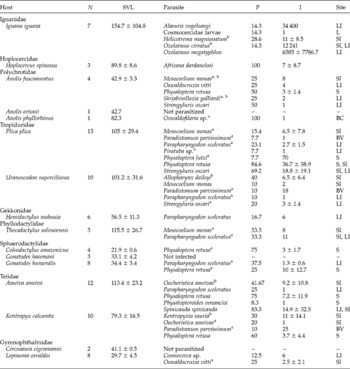
A total of 74,167 helminths belonging to 21 species were recovered (16 nematodes, 1 cestode and 4 trematodes). The overall prevalence was 67.37%. The nematodes Physaloptera retusa and Parapharyngodon sceleratus, from the stomach and large intestine, respectively, were found infecting more lizard species (6 each), followed by the trematode Mesocoelium monas, which infected four lizard species (table 1). Among the 41 records, few helminths (36.6%) were considered core species and the majority were considered secondary species. Physaloptera retusa attained the status of core species in more lizard species (table 1).
Epidemiological data on lizards and respective parasites in the municipality of Aripuanã, Mato Grosso, Brazil. For each host species, the number of specimens examined (N), mean snout–vent length (SVL), prevalence (P), intensity of infection (I, mean±SD) and infection sites of each nematode are given.

Abbreviations for infection sites: BC, body cavity; S, stomach; LI, large intestine; SI, small intestine; L, lungs.
a New host record.
b New state record.
Two (2.1%) individual lizards with a sit-and-wait foraging mode harboured the most helminth species (4): one Iguana iguana and one Plica plica. Eleven (11.6%) individual lizards harboured three helminth species (active foragers: six Ameiva ameiva and two Kentropyx calcarata; sit-and-wait foragers: two P. plica and one Anolis fuscoauratus). Another 20% harboured two helminth species and 33.7% were infected by only one helminth species.
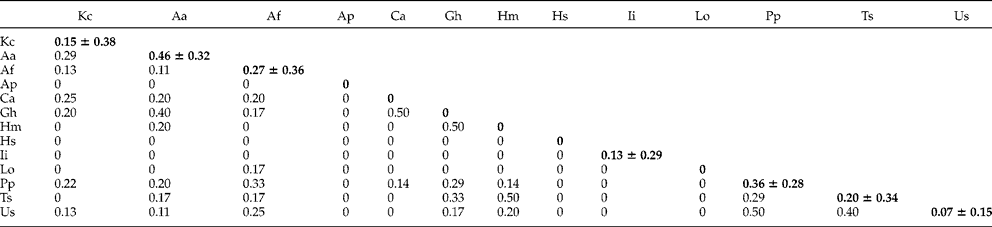
The highest diversity was found in the teiid A. ameiva (0.46 ± 0.32), followed by the tropidurid P. plica (0.36 ± 0.28) and the polychrotid A. fuscoauratus (0.27 ± 0.36) (table 2). However, P. plica was found to harbour more helminth species (7) (table 1).
Similarity (Jaccard index) and Brillouin diversity index (bold type in diagonal) of helminths for lizards in the municipality of Aripuanã, Mato Grosso, Brazil. Kc, Kentropyx calcarata; Aa, Ameiva ameiva; Af, Anolis fuscoauratus; Ap, Anolis phyllorhinus; Ca, Coleodactylus amazonicus; Gh, Gonatodes humeralis; Hm, Hemidactylus mabouia; Hs, Hoplocercus spinosus; Ii, Iguana iguana; Lo, Leposoma osvaldoi; Pp, Plica plica; Ts, Thecadactylus solimoensis; Us, Uranoscodon superciliosus.
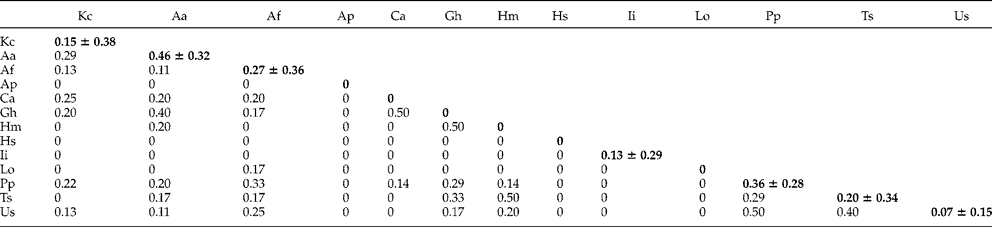
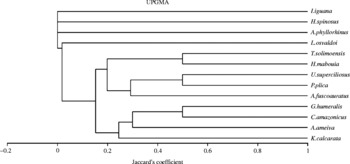
Both the total number of helminth species (R= 0.53, P< 0.001) and total number of parasites (R= 0.66, P< 0.001) were correlated with lizard SVL. Similarities in helminth fauna were greater between phylogenetically closer lizard species, such as two pairs of gekkotans (Thecadactylus solimoensis–Hemidactylus mabouia and Gonatodes humeralis–Coleodactylus amazonicus) and the tropidurids P. plica and Uranoscodon superciliosus (fig. 1). Three species (I. iguana, Hoplocercus spinosus and Anolis phyllorhynus) had no similarity in helminth fauna with any other lizard species.
UPGMA cluster analysis of helminth communities of lizards from the municipality of Aripuanã in the southern Amazon region of Brazil.

Discussion
Despite the small sample size for many lizard species, 17 new host records and seven new locality records are reported in the present paper, which can be considered a substantial contribution for the Amazon region. According to Aho (Reference Aho, Esch, Busch and Aho1990), the helminth fauna of reptiles is depauperate in comparison to other vertebrates and is dominated by generalist species. This statement is corroborated by a number of studies carried out in the Neotropical region (e.g. Vrcibradic et al., Reference Vrcibradic, Cunha-Barros, Vicente, Galdino, Hatano, Van Sluys and Rocha2000; Bursey et al., Reference Bursey, Goldberg and Parmelee2005c) as well as the present investigation.
Interesting patterns of helminth richness were observed between lizards with different foraging modes. The highest diversity was found in the active forager A. ameiva, followed by the sit-and-wait forager P. plica. However, when the total numbers of helminth species per individual and per lizard species were analysed, sit-and-wait foragers tended to harbour more helminths than active foragers. Although Aho (Reference Aho, Esch, Busch and Aho1990) suggests that active foragers tend to harbour a richer and more complex helminth fauna, a number of studies on Brazilian lizards reveal the opposite trend, with tropidurids exhibiting the richest fauna (see Ribas et al., Reference Ribas, Rocha, Teixeira-Filho and Vicente1998; Vrcibradic et al., Reference Vrcibradic, Cunha-Barros, Vicente, Galdino, Hatano, Van Sluys and Rocha2000). A diversified diet, with higher values of niche breadth, including plant material, and higher percentages of ants may be responsible for this pattern, as found in many tropidurid species (Vrcibradic et al., Reference Vrcibradic, Cunha-Barros, Vicente, Galdino, Hatano, Van Sluys and Rocha2000). Like populations of Tropidurus, lizards of the genus Plica have a diversified diet, involving a greater proportion of ants (Vitt, Reference Vitt1993).
Lizard body size exerts an effect on the diversity and abundance of helminths. This association has been tested in many lizard species (Fontes et al., Reference Fontes, Vicente, Kiefer and Van Sluys2003; Rocha et al., Reference Rocha, Vrcibradic, Vicente and Cunha-Barros2003; Anjos et al., Reference Anjos, Rocha, Vrcibradic and Vicente2005). According to Kuris et al. (Reference Kuris, Blaustein and Alio1980), this relationship is compatible with MacArthur and Wilson's Island Biogeography Theory: hosts may act as islands. Besides providing a larger niche, body size has a substantial impact on other ecological features of lizards, such as diet and habitat use (see Pianka & Vitt, Reference Pianka and Vitt2003), thereby influencing the associated helminth fauna.
Similarities in helminth fauna tend to be greater between closely related sympatric lizards (see Aho, Reference Aho, Esch, Busch and Aho1990; Vrcibradic et al., Reference Vrcibradic, Cunha-Barros, Vicente, Galdino, Hatano, Van Sluys and Rocha2000). Phylogeny has a substantial impact on lizard ecology (Pianka & Vitt, Reference Pianka and Vitt2003), which is reflected in the establishment of the helminth community (Poulin, Reference Poulin1997). This may explain the similarities found in the present study and may partially be related to the substantial differences found in I. iguana and H. spinosus, but do not explain the distinction of A. phyllorhynus regarding its helminth fauna. In the latter species, the small sample size may account for the lower degree of similarity and the most depauperate helminth fauna among all the lizard species analysed.
In conclusion, the patterns found in the present study are in agreement with those found in reptiles, i.e. depauperate fauna characterized by many generalist species and greater similarity, likely due to host phylogeny.
Acknowledgements
This study received financial support from the Brazilian fostering agency Fundação de Amparo à Pesquisa do Estado de São Paulo (process 06/59692-5). R.W.A. thanks Coordenação de Aperfeiçoamento de Pessoal de Nivel Superior for a grant. The authors would like to thank Marcos André de Carvalho and Ricardo Alexandre Kawashita Ribeiro for kindly providing the lizards for dissection. We also thank Richard Boike for help with the English version.