Past research suggests that people are motivated to suppress prejudiced tendencies, but that they can release prejudice when they have acquired moral credentials from past non-discriminatory behavior (i.e., a self-licensing effect; see e.g., Effron, Cameron, & Monin, Reference Effron, Cameron and Monin2009; Monin & Miller, Reference Monin and Miller2001). Self-licensing effects have been identified in a variety of domains (see Blanken, van de Ven, & Zeelenberg, Reference Blanken, van de Ven and Zeelenberg2015). However, they somehow contradict past research showing that people tend to act consistently with their past deeds (e.g., Festinger, Reference Festinger1957; Kiesler, Reference Kiesler1971). These conflicting findings suggest the existence of moderators determining when people will more likely remain coherent in their opinions and actions and when they will self-license (Mullen & Monin, Reference Mullen and Monin2016). In the present research, we explore further the licensing/consistency effect by investigating the combined moderating role of two factors: Initial intergroup attitudes and chronic motivational orientation (i.e., regulatory focus).
The moderating role of attitudes
There is preliminary evidence that initial attitudes can moderate the self-licensing effect but the exact nature of the effect is not clear yet. Indeed, some studies did not find initial attitudes to play any role in the licensing effect (e.g., Effron, Miller, & Monin, Reference Effron, Miller and Monin2012; Monin & Miller, Reference Monin and Miller2001), whereas other studies yielded seemingly opposite results.
On the one hand, and fitting with the idea that credentials release the expression of true but socially undesirable attitudes, some work suggests that self-licensing is most likely observed amongst individuals holding negative or unfavorable attitudes regarding the (moral) behavior under scrutiny, who should be more inhibited in the absence of credentials. For example, as compared to those holding egalitarian opinions, White participants who held prejudiced opinions favored their ingroup at the expense of a Black outgroup to a greater extent, in a resource allocation task, after having been given the opportunity to support Obama for president (Effron et al., Reference Effron, Cameron and Monin2009; Study 3). Similar results arose for pro-environmental behavior: Participants who initially reported low levels of concern about the environment expressed weaker environmental-friendly intentions after imagining buying environmental-friendly shoes than conventional shoes (i.e., self-licensing), whereas participants who reported high levels of concern expressed strong intentions, regardless of the type of shoes they imagined purchasing (Meijers, Reference Meijers2014).
On the other hand, there is evidence that self-licensing occurs amongst people with initial positive or favorable attitudes regarding the (moral) behavior under scrutiny. In their seminal study, Dutton and Lennox (Reference Dutton and Lennox1974) preselected participants to retain only White individuals with strong egalitarian attitudes. They first threatened these participants with a bogus autonomic feedback suggesting they were prejudiced, before providing them with the opportunity to donate money to a White vs. Black beggar vs. no such opportunity. The following day, they solicited participants again and asked them to donate time to a charity. Those egalitarian participants who had been given opportunity to donate money to the Black beggar (hence, supposedly, lifting the threat over their identity as an unprejudiced person) donated less time than participants in the other conditions (i.e., they self-licensed).
Other research yielded similar results. For instance, Democrat participants (who generally hold stronger pro-environmental attitudes) were found to self-license after having had the opportunity to recycle a plastic bottle, whereas Republican participants did not (Truelove, Yeung, Carrico, Gillis, & Raimi, Reference Truelove, Yeung, Carrico, Gillis and Raimi2016). In a similar vein, outside the moral domain, students strongly committed to their studies were less motivated to study for a core course after reflecting on their hard work done on a previously completed (vs. unaccomplished) coursework, whereas uncommitted students showed the opposite dynamics (Koo & Fishbach, Reference Koo and Fishbach2008).
Hence, initial attitudes seem to play a complex role in licensing dynamics, influencing it either positively, negatively, or not. These mixed findings suggest that the impact of initial attitudes might depend on other moderating factors. To the best of our knowledge, to date only two studies have investigated moderators of the effect of initial attitudes on self-licensing, namely the normative context (egalitarian vs. discriminatory; Falomir-Pichastor, Mugny, Frederic, Berent, & Lalot, Reference Falomir-Pichastor, Mugny, Frederic, Berent and Lalot2018) and the nature of the initial behavior (freely chosen vs. mandatory; Clot, Grolleau, & Ibanez, Reference Clot, Grolleau and Ibanez2016). Indeed, self-licensing was only observed amongst more prejudiced participants when an egalitarian norm was made salient (Falomir-Pichastor et al., Reference Falomir-Pichastor, Mugny, Frederic, Berent and Lalot2018). In the same vein, uncommitted (less environmental-friendly) participants self-licensed after performing a freely chosen environmental-friendly behavior, while committed (more environmental-friendly) participants self-licensed after performing a mandatory environmental-friendly behavior (Clot et al., Reference Clot, Grolleau and Ibanez2016).
Therefore, further research is needed in order to better understand the different ways in which initial attitudes may influence self-licensing dynamics. The present research aims to address this gap by focusing on a self-completion perspective of self-licensing and investigating the moderating role of individuals’ regulatory focus (Higgins, Reference Higgins1997).
Self-completion and self-licensing
Longoni, Gollwitzer, and Oettingen (Reference Longoni, Gollwitzer and Oettingen2014) proposed to rely on self-completion theory (Gollwitzer, Wicklund, & Hilton, Reference Gollwitzer, Wicklund and Hilton1982) to account for self-licensing effects. They suggested that moral credentials can be interpreted as a signal of fulfilment of the related self-defining goal, which in turn results in disengaging from this goal. Whether past behavior is considered sufficient to fulfil the goal would hence determine if the person would self-license or maintain a coherent course of action.
According to this perspective, moral credentials would inform about goal fulfilment only when past behavior targets a relevant, self-defining goal. Therefore, one could reasonably advance that moral credentials will result in a self-licensing effect only (or mainly) when initial attitudes are positive regarding the (moral) behavior under scrutiny. Put differently, there must be an existing identity-related goal in order for (in)completeness effects to occur (Gollwitzer et al., Reference Gollwitzer, Wicklund and Hilton1982; Longoni et al., Reference Longoni, Gollwitzer and Oettingen2014; Marquardt, Gantman, Gollwitzer, & Oettingen, Reference Marquardt, Gantman, Gollwitzer and Oettingen2016). This understanding is consistent with past research that identified self-licensing effects amongst egalitarian persons (Dutton & Lennox, Reference Dutton and Lennox1974). Accordingly, whether self-licensing effects are observed – in particular amongst relatively egalitarian individuals – depends on the extent to which these individuals consider their past behavior as reflecting completeness of their egalitarian identity goal. In order to investigate this process, the present research focused on the moderating role of regulatory focus.
The moderating role of motivational orientation
Regulatory focus theory distinguishes between two independent motivational orientations: Prevention and promotion (Higgins, Reference Higgins1997). Prevention focus is related to the accomplishment of obligations and duties, implies attention on the presence/absence of negative outcomes and preference for vigilant strategies, and results in quiescence/agitation-related emotions (Higgins, Shah, & Friedman, Reference Higgins, Shah and Friedman1997; Shah & Higgins, Reference Shah and Higgins2001). Promotion focus, on the other hand, is related to the accomplishment of hopes and ideals, implies attention on the presence/absence of positive outcomes and preference for eagerness strategies, and results in dejection/cheerfulness-related emotions.
Of particular interest for our present purpose, regulatory focus also orients individuals towards the realization of different goals – i.e., prevention focus orients towards minimal goals, whereas promotion focus orients towards maximal goals (Brendl & Higgins, Reference Brendl, Higgins and Zanna1996; Lalot, Quiamzade, & Falomir-Pichastor, Reference Lalot, Quiamzade and Falomir-Pichastor2018). Minimal and maximal goals differ in their nature (mandatory vs. ideal, respectively) and their magnitude (the former being lower than the latter). As such, one would expect that people interpret past behavior differently depending on the salient goal serving as a reference point: Prevention-oriented individuals, focusing on a minimal goal, should more easily infer goal-completeness from their past behavior. Contrariwise, promotion-oriented individuals whose focus is on the maximal goal should rather infer incompleteness, because of the higher magnitude and ideal nature of the goal. In consequence, regulatory focus should moderate the consistency/licensing effect, self-licensing (vs. consistency) appearing specifically in prevention (vs. promotion) focus. Indeed, there is preliminary evidence that past positive behavior leads to lower effort and behavioral intention in a prevention focus as compared to past negative behavior.
In one set of studies (Baas, De Dreu, & Nijstad, Reference Baas, De Dreu and Nijstad2011), participants were asked to recall a past event where they had experienced a promotion success (gain), prevention success (non-loss), promotion failure (non-gain) or prevention failure (loss). They then performed a creativity task. Performance dropped in one specific condition, that is, after recalling a prevention success. The authors explained this effect by a specific deactivation of the motivational system when a goal is reached in the prevention focus: As the person experiences feelings of relaxation and relief, they are “deactivated” and feel no need to invest cognitive resources in any further task. In contrast, promotion success implies activating feelings of joy and cheerfulness and translates in higher motivation to perform a second task. The authors replicated these results while asking participants to write an essay insisting on fear (prevention failure), anger (promotion failure), happiness (promotion success) or relief (prevention success) – the drop in performance occurring in this latter condition only (see also van Dijk & Kluger, Reference van Dijk and Kluger2011). In another set of studies more directly related to self-licensing (Lalot, Falomir-Pichastor, & Quiamzade, Reference Lalot, Falomir-Pichastor and Quiamzade2019), participants received a bogus feedback labelling their daily-life habits as rather environmental-friendly (i.e., moral credentials) or not environmental-friendly (absence of credentials). They then reported their pro-environmental intentions. Participants’ chronic regulatory orientation was measured beforehand. Results showed that prevention-oriented participants expressed weaker intentions when their past behavior had been labelled as environmental-friendly than when it had not (i.e., self-licensing), whereas promotion-oriented participants’ intentions did not depend on the level of past behavior. In other research, past positive behavior can even boost a consistent course of action in a promotion focus because it signals progress towards a yet unfulfilled maximal goal (e.g., Idson & Higgins, Reference Idson and Higgins2000). In sum, there is evidence that reaction to moral credentials is moderated by regulatory focus, and we believe that this relationship itself depends on participants’ initial attitudes.
Overview and Hypotheses
The present research aims to provide an understanding of the effect of initial attitudes on self-licensing based on a self-completion approach. Specifically, we investigate whether initial attitudes and regulatory focus jointly moderate the link between moral credentials and future intentions (i.e., consistency vs. self-licensing). In the studies reported here, we measured initial intergroup attitudes and chronic regulatory focus (promotion/prevention), then provided our participants with moral credentials as an egalitarian person (vs. not), and finally measured their support for affirmative action policies.
We reasoned that individuals with positive intergroup attitudes would be more likely to scrutinize their (non-)egalitarian behavior and interpret it as symbol of (un)fulfilment of their egalitarian identity goal. As a consequence, they would react to the presence of moral credentials by strengthening (consistency effect) or weakening (licensing effect) personal commitment, as a function of their regulatory focus. A prevention focus would lead to self-licensing because the minimal goal has been achieved, whereas a promotion focus would trigger consistency because a maximal goal still needs to be reached. Individuals with negative intergroup attitudes, in contrast, would care less about, and not react to, the absence or presence of moral credentials.
Accordingly, our specific hypotheses are the following. First, we expect an overall positive effect of initial intergroup attitudes on support for affirmative action (H1). Second, we expect a three-way Moral Credentials × Regulatory Focus × Initial Attitudes interaction (see Figure 1). Specifically, we expect moral credentials to decrease support for affirmative action only amongst participants holding positive intergroup attitudes and oriented towards prevention (i.e., self-licensing; H2). Finally, we expect moral credentials to increase support for affirmative action amongst participants holding positive intergroup attitudes and oriented towards promotion (i.e., consistency; H3).
Conceptual model of the hypothesised three-way interaction effect between moral credentials, regulatory focus, and intergroup attitudes, on support for affirmative action policies.

To enhance reliability of the results, we conducted two parallel versions of the same study in two different national contexts: Switzerland and France. The experimental design was in all points comparable, except for the minority group under scrutiny. To fit national geopolitical particularities, the French sample was questioned about Maghrebis (defined as “persons of Maghrebi origin (Algeria, Morocco, Tunisia) living in France, with or without the French nationality”) and the Swiss sample about immigrants in general. Initial attitudes and support for affirmative action were measured with respect to these groups, and the moral credentials manipulation was adapted accordinglyFootnote 1.
Despite our best efforts, recruitment of laypeople participants on a voluntary basis in public places proved difficult and we could only access 125 Swiss and 222 French participants. As a consequence, the samples taken separately could suffer from insufficient power to detect the expected three-way interaction effect. We therefore decided to merge the samples and conduct the statistical analyses on the overall sample, while including country as a control variable. This granted better statistical power and allowed for a more reliable estimation of the effect sizes. For transparency purposes, separate-sample results are reported in the Appendix. Similar results were obtained in the two samples separately.
Method
Participants and procedure
The study took the form of a paper-and-pencil questionnaire. Participants were laypeople approached in public spaces as well as students from a French high school. Condition to participate was to be a French (or Swiss) national or binational. A total of 346 people (57% female, M age = 19.1, SD = 4.68) completed the survey; demographics are reported in Table 1. The study adopted a 2 (moral credentials: Low vs. high) × Continuous (intergroup attitudes) × Continuous (regulatory focus) design; participants were randomly allocated to one moral credentials condition (in the Swiss sample: Low credentials: N = 61, and high credentials: N = 63; in the French sample: Low credentials: N = 113, and high credentials: N = 109). A sensitivity power analysis estimated the sample size was sufficient to detect a small-size 3-way interaction effect (Cohen’s d = .30) at 80% power.
Demographics and Descriptive Statistics for the Two National Samples

Note: RF score = Regulatory Focus difference score.
* p = .014.
We started by measuring initial attitudes towards social minorities. Participants then read a one-page-long text describing the principle of “equality and non-discrimination” as a fundamental aspect of a functional modern society (e.g., “Equality between groups and most notably non-discrimination of minority groups proves a fundamental value for a society to function adequately”). We subsequently asked participants to imagine they had just done, first, something incongruent with these values (i.e., they discriminated against somebody), and second, something congruent with these values (i.e., they had not discriminated), and to report to what extent they would experience certain emotions as a result, in both cases (Falomir-Pichastor, Mugny, Quiamzade, & Gabarrot, Reference Falomir-Pichastor, Mugny, Quiamzade and Gabarrot2008). The emotions proposed corresponded to either a promotion or a prevention focus (see Higgins et al., Reference Higgins, Shah and Friedman1997; Shah & Higgins, Reference Shah and Higgins2001). Emotions are indeed a core component of regulatory focus and of its precursor, self-discrepancy theory (Higgins, Reference Higgins1987). The degree to which participants endorse a type of emotions or the other hence constitutes a reliable measure of chronic regulatory focus (see also Baas et al., Reference Baas, De Dreu and Nijstad2011, Study 4). After the regulatory focus measure, participants were presented with a recruitment task that constituted the moral credentials manipulation. Participants selected one of four candidates applying for a job. The best candidate was either an immigrant (so that selecting him provided the participant with moral credentials) or a national (i.e., no credentials; Monin & Miller, Reference Monin and Miller2001). We finally measured support for affirmative action as the dependent variable. Upon completion of the questionnaire, participants were thoroughly debriefed; they all confirmed their consent to the use of their data.
Independent variables
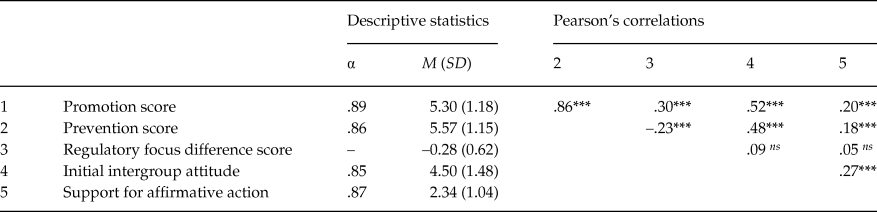
Initial intergroup attitudes. The initial attitudes measure included the three following items (bracketed text represents the two versions of the questionnaire): “Living standards of [Maghrebis/immigrants] currently living in [France/Switzerland] should be improved,” “[France/Switzerland] should implement measures ensuring equal rights of [French/Swiss] nationals and immigrants,” and “[France/Switzerland] should adopt a more favorable politic regarding [Maghrebis/immigrants]” (7-point scale, 1 = strongly disagree, 7 = strongly agree). Answers were aggregated in a single score, a more positive score reflecting more favorable attitudes towards social minorities. Descriptive statistics are reported in Table 1 (separate samples) and Table 2 (overall sample).
Descriptive Statistics and Correlations between the Variables Measured in the Study

Note: All variables were assessed on 7-point scales.
ns p > .05. *** p < .001.
Regulatory focus measure (emotions). Emotions were assessed on bipolar axes with a negative emotion on one side and its positive counterpart on the other side (7 point-scale, 1 = absolutely [the negative emotion], 4 = neither [the negative] nor [the positive emotion], 7 = absolutely [the positive emotion]). Three axes were promotion-related (disappointed-joyful, discouraged-satisfied, and sad-happy) and three were prevention-related (tense-relaxed, uneasy-quiet, and nervous-calm). Non-surprisingly, participants reported more positive emotions when they imagined themselves not discriminating (M = 5.61, SD = 1.26) than discriminating (M = 2.74, SD = 1.27), F(1, 344) = 567.2, p < .001, η2p = .62. We hence reverse-coded the emotions reported when imagining discriminating to obtain an index of the strength of “congruent emotions” (see Falomir-Pichastor et al., Reference Falomir-Pichastor, Mugny, Quiamzade and Gabarrot2008). We were then able to compute separate scores of promotion emotions and prevention emotions. To avoid complicating the analytical design, we computed a difference score reflecting a stronger orientation for one of the foci (promotion minus prevention; min = –3.00, max = 1.83, M = –0.28, SD = .62; for a similar approach, see e.g., Browman, Destin, & Molden, Reference Browman, Destin and Molden2017; Cesario, Grant, & Higgins, Reference Cesario, Grant and Higgins2004). It should be noted that analyses on separate scores yielded similar results (reported in Online Supplementary Material for information purposes).
Moral credentials manipulation. To manipulate moral credentials, we used a recruitment decision task (Falomir-Pichastor et al., Reference Falomir-Pichastor, Mugny, Frederic, Berent and Lalot2018; Study 1) that was adapted from the literature (Monin & Miller, Reference Monin and Miller2001). Participants indicated which of four applicants they would choose for a financial analyst position in a French (or Swiss) company. For each candidate (all male), we provided his name, nationality, and a brief curriculum. One candidate was clearly better than the three others (he held a Bachelor degree in Economics, a Master degree in Economics and Finance and had worked for two years as an analyst in a prestigious bank). In the credentials condition, this candidate was a Maghrebi (or Serbian) immigrant. In the non-credentials condition, he was a French (or Swiss) national. Participants chose one candidate and reported his name, surname, and nationality at the bottom of the page. Some participants did not select the most qualified candidate; however, excluding these participants did not influence the results and we hence retained them in the analyses.
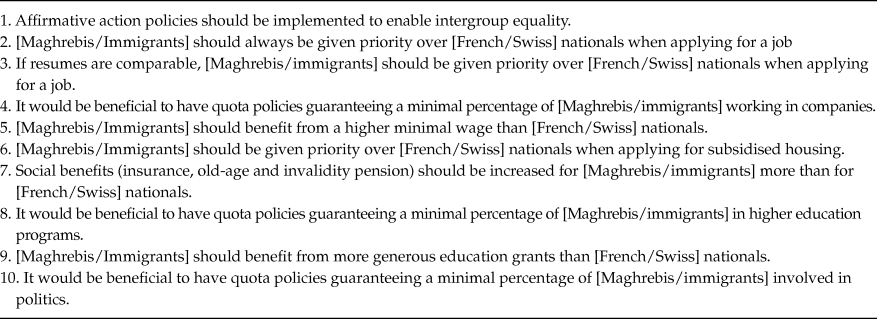
Dependent measure: Support for affirmative action. We developed 10 items to measure support for affirmative action that participants rated on 7-point scale (1 = strongly disagree, 7 = strongly agree). All items are reported in Table 3. We aggregated the items in an index of support for affirmative action (α = .87, M = 2.33, SD = 1.04). The distribution was not normal but moderately skewed to the left (Skewness = .66, SE = .13); as a consequence, we relied on robust regression analyses.
Items Forming the Support for Affirmative Action Scale

Note: Words in square brackets correspond to the two versions of the questionnaire, for the French and Swiss samples, respectively.
Results
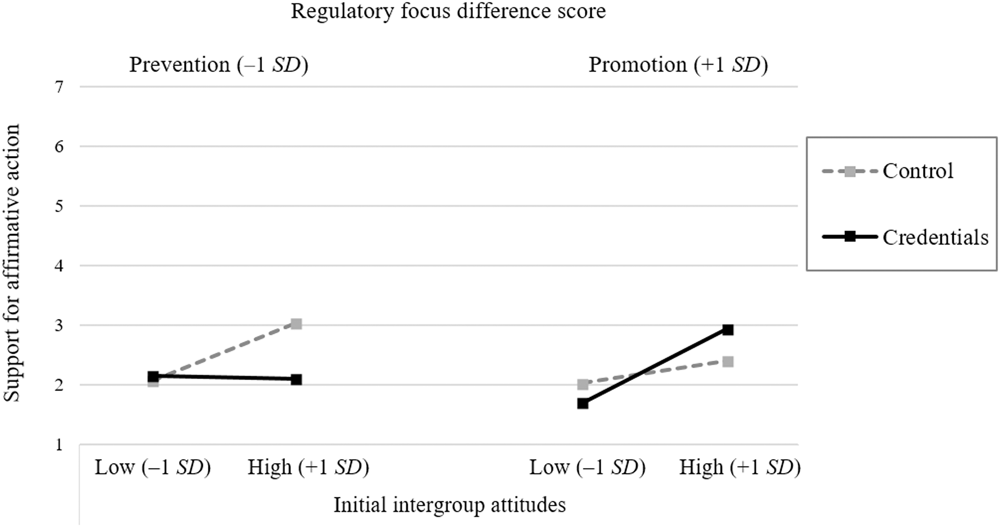
Using R and the package robustbase (Maechler et al., Reference Maechler, Rousseeuw, Croux, Todorov, Ruckstuhl, Salibian-Barrera and di Palma2018), we ran a robust regression model (MM-estimator) including country (–1 = French, 1 = Swiss), moral credentials (–1 = low credentials, 1 = high credentials), intergroup attitudes (standardized), regulatory focus difference score (standardized), and all their interactions, with support for affirmative action as the dependent variableFootnote 2. The analysis revealed a main effect of initial attitudes, so that more positive intergroup attitudes predicted stronger support for affirmative action, b = .31, t(329) = 5.49, p < .001, Cohen’s d = .60, 95% CI [.38, .83]. A two-way Credentials × Regulatory focus interaction was also significant, b = .15, t(329) = 2.15, p = .032, d = .24, 95% CI [.02, .45]. More interestingly, the expected Credentials × Attitudes × Regulatory focus interaction was significant, b = .27, t(329) = 4.18, p < .001, d = .46, 95% CI [.24, .68]. No other effect reached significance, t s < 1.59, p s > .11. Importantly, the 4-way interaction (Country × Credentials × Attitudes × Regulatory focus interaction) was not significant, b = .05, t(329) = 0.74, p = .46, d = .08, 95% CI [–.14, .30], suggesting that the effect was not different in the French and the Swiss samples. We hence decomposed the observed 3-way interaction (see Figure 2).
Support for affirmative action as a function of initial intergroup attitudes, regulatory focus score, and moral credentials condition.

Amongst relatively more prevention-oriented participants (regulatory focus difference score –1 SD), the attitudes by credentials interaction was significant, b = –.25, t(329) = –3.24, p = .001, d = –.36, 95% CI [–.58, –.14]. The positive effect of initial attitudes remained in the no-credentials control condition, b = .48, t(329) = 5.25, p < .001, d = .58, 95% CI [.36, .80], but disappeared in the credentials condition, b = –.03, t(329) = –0.20, p = .84, d = –.02, 95% CI [–.24, .20]. In accordance with our second hypothesis, participants with relatively stronger initial attitudes (+1 SD) expressed weaker support for affirmative action in the credentials than in the control condition, b = –.47, t(329) = –3.79, p < .001, d = –.42, 95% CI [–.64, –.20]. In contrast, support was not a function of the credentials manipulation amongst participants with relatively weaker initial attitudes (–1 SD), b = .04, t(329) = 0.35, p = .73, d = .04, 95% CI [–.18, .26]. Moreover, a direct comparison of promotion vs. prevention focus in the credentials condition amongst participants with stronger initial attitudes yielded a significant simple effect, b = .42, t(329) = 4.48, p < .001, d = .49, 95% CI [.27, .71], confirming that moral credentials triggered self-licensing in a prevention focus only.
Amongst relatively more promotion-oriented participants (regulatory focus difference score +1 SD), the attitudes by credentials interaction was also significant, b = .22, t(329) = 2.29, p = .023, d = .25, 95% CI [.04, .47]. Initial attitudes had a positive effect in the no-credentials control condition, b = .19, t(329) = 2.00, p = .047, d = .22, 95% CI [.003, .44], which got reinforced in the credentials condition, b = .62, t(329) = 3.75, p < .001, d = .41, 95% CI [.19, .63]. Participants with relatively stronger initial attitudes expressed a stronger support for affirmative action in the credentials than in the control condition, b = .27, t(329) = 2.44, p = .015, d = .27, 95% CI [.05, .49] (H3). In contrast, support was not a function of the credentials manipulation amongst participants with relatively weaker initial attitudes, b = –.17, t(329) = –1.18, p = .24, d = –.13, 95% CI [–.35, .09].
Discussion
We reported the aggregated results of two studies investigating the conditions under which the acquisition of moral credentials as a nonprejudiced person translates into behavioral consistency or self-licensing. Results show that the link between moral credentials and further support for affirmative action is moderated by initial intergroup attitudes and motivational orientation. Moral credentials triggered licensing or consistency only amongst participants with more positive intergroup attitudes, whereas participants with less positive attitudes did not react to the credentials manipulation. Consistent with our expectations, a promotion focus led to consistency whereas a prevention focus led to self-licensing. Initial intergroup attitudes, overall, significantly predicted support for affirmative action. Hence, our results seem to indicate that people lean by default towards behavioral consistency and demonstrate self-licensing in particular cases only – which reconciles a long tradition of research on consistency (e.g., Festinger, Reference Festinger1957; Heider, Reference Heider1946; Kiesler, Reference Kiesler1971) with the relatively more recent work on self-licensing.
The present study was duplicated in two different national contexts and targeted different minority groups, which increases its reliability. It remains, however, a single test of the interactive effect of moral credentials, attitudes and motivational orientation, and future research will need to make sure it replicates in other contexts. First, as self-licensing has been identified in several domains, the effect could be tested with respect to, e.g., pro-environmental behavior or interpersonal prosocial action. Second, our conceptualization of regulatory focus was centered on its emotional component, but focus can also be grasped through predominant needs, preferred action strategies, or more salient outcomes (Higgins, Reference Higgins1997). Future research should try and replicate the present results while relying on different measurements of regulatory focus and also while inducing it contextually (e.g., Cesario et al., Reference Cesario, Grant and Higgins2004). This last possibility would be particularly relevant in an applied perspective as it would allow to determine how information about one’s past behavior should be framed in order to increase consistency (or, if that is the purpose, self-licensing). Finally, the present study did not investigate the mechanism underlying the attitudes by regulatory focus interaction effect. We suggested that self-licensing (vs. consistency) could be due to a feeling of goal-completeness but future research is needed to elucidate this matter.
Moral self-licensing versus consistency
Overall, these results are consistent with a self-completion understanding of self-licensing dynamics (Dutton & Lennox, Reference Dutton and Lennox1974; Longoni et al., Reference Longoni, Gollwitzer and Oettingen2014; Truelove et al., Reference Truelove, Yeung, Carrico, Gillis and Raimi2016).
They are also consistent with past findings showing that regulatory focus moderates the effect of past behavior (Baas et al., Reference Baas, De Dreu and Nijstad2011; Lalot et al., Reference Lalot, Falomir-Pichastor and Quiamzade2019). Furthermore, they extend these past findings by taking into account initial attitudes, which had so far yielded mixed evidence. Specifically, they suggest that the direction of the attitudes effect depends on motivational orientation. As such, they reinforce the notion that attitudes should be considered in interaction with other factors (Clot et al., Reference Clot, Grolleau and Ibanez2016; Falomir-Pichastor et al., Reference Falomir-Pichastor, Mugny, Frederic, Berent and Lalot2018).
These results also relate to other previously identified moderators of consistency and licensing dynamics, namely, construal level and progress/commitment perspective. Authors found consistency (vs. licensing) to occur when past moral behaviors were construed at an abstract (vs. concrete) level (Conway & Peetz, Reference Conway and Peetz2012), and when these behaviors were perceived as proof of commitment (vs. progress) towards the goal (e.g., Susewind & Hoelz, Reference Susewind and Hoelzl2014). Interestingly, regulatory focus, construal level, and progress/commitment seem interconnected. Temporally distant and abstract (vs. near and concrete) actions are perceived as cues of commitment (vs. progress; Fishbach, Dhar, & Zhang, Reference Fishbach, Dhar and Zhang2006), and promotion (vs. prevention) focus triggers more abstract (vs. concrete) thinking (e.g., Lee, Keller, & Sternthal, Reference Lee, Keller and Sternthal2010). Hence, these parallel lines of research all hint in the same direction but it is not clear yet how these factors articulate. One could mediate the other (progress/commitment perspective, or prevention/promotion focus, could induce a more concrete/abstract thinking, or the other way around) or they could all operate through a common yet unidentified mechanism. Future work is needed to elucidate this issue.
Finally, it should be noted that some studies identified self-licensing effects in the absence of any moderator (e.g., Monin & Miller, Reference Monin and Miller2001). It is unclear yet whether such studies incidentally induced moderating conditions (e.g., implicit focus on progress, concrete construal level, promotion framing, temporally close behavior), or whether these identified moderators are actually not completely necessary for self-licensing to occur. Now that more moderators are being identified (e.g., Mullen & Monin, Reference Mullen and Monin2016), it would be beneficial to scrutinize past research and organize it as a function of the presence/absence of these moderators, testing for example their impact on the reported effect size, to try and answer this important remaining question.
Moral credentials and moral credits
In the present studies, all participants held relatively favorable intergroup attitudes, hence we could only distinguish strongly egalitarian and moderately egalitarian (or unconcerned) participants. An open question remains as to determine how individuals with truly negative attitudes would react to the (non-)acquisition of moral credentials. Research on self-licensing has almost entirely focused on socially desirable domains (e.g., egalitarian attitudes, pro-environmental behavior), hence the denomination of moral credentials. However, one could envision that a person holding an “immoral” identity-goal who interpret their past behavior as goal-congruent (i.e., “immoral” credentials) would similarly reduce their efforts towards the goal. Self-completion theory would support such a prediction (see Marquardt et al., Reference Marquardt, Gantman, Gollwitzer and Oettingen2016). Moreover, it fits earlier distinctions between moral credits and moral credentials (Mullen & Monin, Reference Mullen and Monin2016). According to the moral credentials model, the initial moral behavior is utilized to change the meaning of a second ambiguous behavior. According to the moral credits model, moral behavior translates into a currency that is stocked in a metaphorical bank account and used later on to purchase a right to deviate. Put differently, credentials only have value with respect to a normative social system that promotes some behaviors (see also Falomir-Pichastor et al., Reference Falomir-Pichastor, Mugny, Frederic, Berent and Lalot2018). In contrast, credits depend more on the person’s internal system of values and goals, and personal perception of desirable versus undesirable behavior. It should then be possible, even in an egalitarian society, to acquire “discrimination credits.” To the best of our knowledge, this intriguing possibility has never been tested yet. Future research is needed that investigate in more details the different ways in which the effect of initial attitudes can be moderated by individual and contextual factors.
Supplementary Material
To view supplementary material for this article, please visit https://doi.org/10.1017/sjp.2019.55.
Appendix
Separate analyses on the Swiss and the French samples
We report here the results of the robust regression analyses conducted separately on the French and the Swiss subsamples. The analyses included moral credentials (–1 = low credentials, 1 = high credentials), intergroup attitudes (standardized), regulatory focus difference score (standardized), and all their interactions, with support for affirmative action as the dependent variable.