1 Introduction
1.1 The relevance of phonetics to phonological patterning
Phonological patterns are often influenced by phonetic factors. The influence is manifested in a number of ways, the most common of which is the prevalence in cross-linguistic typology of patterns that have articulatory or perceptual bases and the scarcity of those that do not. For example, velar palatalisation before high front vowels, postnasal voicing and regressive assimilation for major consonant places have clear phonetic motivations and are extremely well attested, while velar palatalisation before low back vowels, postnasal devoicing and progressive consonant place assimilation are nearly non-existent. The typological asymmetry can also be manifested in terms of implicational statements. For example, in consonant place assimilation, if oral stops are targets of assimilation in a language, then ceteris paribus, nasal stops are also targets of assimilation (Mohanan Reference Mohanan and Goldsmith1993, Jun Reference Jun1995, Reference Jun2004). This is to be expected perceptually, as nasal stops have weaker transitional place cues and are thus more likely to lose their contrastive place than oral stops when articulatory economy is of concern (the Production Hypothesis; Jun Reference Jun1995, Reference Jun2004).
Evidence for the relevance of phonetics can also be found in the peripheral phonology of a language even when the phonetic effects are not directly evident in its core phonology. Such peripheral phonology may include the phonology of its established loanwords (Fleischhacker Reference Fleischhacker2001, Kang Reference Kang2003, Kenstowicz Reference Kenstowicz2007) and the speakers' judgements on poetic rhyming (Steriade & Zhang Reference Steriade and Zhang2001). For example, Steriade & Zhang (Reference Steriade and Zhang2001) show that although postnasal voicing is not neutralising in Romanian, its phonetic effect is crucial in accounting for poets' preference for /Vnt/~/Vnd/ as a semi-rhyme over /Vt/~/Vd/.
The parallels between the traditionally conceived categorical/phonological and gradient/phonetic patterns also indicate their close relation. Flemming (Reference Flemming2001), for instance, outlines the similarity of patterning between phonological assimilation and phonetic coarticulation as well as a number of other processes present in both the traditional phonological and phonetic domains.
1.2 Where should phonetic explanations reside?
Although the existence of some form of relationship between phonological typology and phonetics is relatively uncontroversial, the precise way in which this relationship should be captured is a continuous point of contention among phonologists. One possibility is to consider the phonetic basis to be part of the intrinsic mechanism of the synchronic phonological grammar. Many theories have been proposed within rule-based phonology to encode this relation, from the abbreviation conventions of SPE (Chomsky & Halle Reference Chomsky and Halle1968) and the innateness of articulatorily based phonological processes in Natural Phonology (Stampe Reference Stampe1979) to the grounding conditions for universal constraints in Grounded Phonology (Archangeli & Pulleyblank Reference Archangeli and Pulleyblank1994). Optimality Theory (Prince & Smolensky Reference Prince and Smolensky1993) further invites phonetic explanations into synchronic phonology, due to its ability to state phonetic motivations explicitly in the system as markedness constraints (Hayes & Steriade Reference Hayes and Steriade2004). Work by Boersma (Reference Boersma1998), Steriade (Reference Steriade1999, Reference Steriade2001, Reference Steriade, Hanson and Inkelas2008), Kirchner (Reference Kirchner2000, Reference Kirchner2001, Reference Kirchner2004), Flemming (Reference Flemming2001) and Zhang (Reference Zhang2002, Reference Zhang2004), among others, has proposed constraints that directly encode phonetic properties and intrinsic rankings based on such properties in synchronic phonology to capture typological asymmetries. There are various approaches as to how the phonetic substance gets to be encoded in the grammar. The strongest position is that the phonetically based constraints, intrinsic rankings, grounding conditions or other formal mechanisms are simply part of the design nature of the grammar on the level of the species (Universal Grammar (UG); Chomsky Reference Chomsky1986), and they predict true, exceptionless universals of phonological typology. It is also possible that the design scheme of the grammar only includes an analytical bias that draws from a type of grammar-external phonetic knowledge (Kingston & Diehl Reference Kingston and Diehl1994) and restricts the space of constraints and constraint rankings (weightings) to be learned by the speaker (Hayes Reference Hayes, Darnell, Moravcsik, Newmeyer, Noonan and Wheatley1999, Wilson Reference Wilson2006). This type of approach predicts strong universal tendencies in favour of phonetically motivated patterns, but allows ‘unnatural’ patterns to surface in grammars and be learned by speakers.
An alternative to the synchronic approach above is that the effect of phonetics on phonological typology takes place in the realm of diachronic sound change. The typological asymmetries in phonology are then due to the different frequencies with which phonological patterns can arise through diachronic sound change, which is caused by phonetic factors such as misperception (e.g. Anderson Reference Anderson1981, Ohala Reference Ohala, Masek, Hendrick and Miller1981, Reference Ohala, Kingston and Beckman1990, Reference Ohala1993, Reference Ohala, Hardcastle and Laver1997, Blevins & Garrett Reference Blevins and Garrett1998, Buckley Reference Buckley1999, Reference Buckley2003, Hale & Reiss Reference Hale and Reiss2000, Hansson Reference Hansson2001, Hyman Reference Hyman2001, Blevins Reference Blevins2004, Yu Reference Yu2004, Silverman Reference Silverman2006a, Reference Silverman and Goldsteinb).Footnote 1 Among researchers working in this framework, there are different positions on the role of UG in synchronic phonology in general, from categorical rejection (Ohala Reference Ohala, Masek, Hendrick and Miller1981, Reference Ohala, Kingston and Beckman1990, Reference Ohala1993, 1996, Silverman Reference Silverman2006a) to selective permission (Blevins Reference Blevins2004) to utmost importance (Hale & Reiss Reference Hale and Reiss2000). But all proponents of this approach agree that Occam's Razor dictates that if a diachronic explanation based on observable facts exists for typological asymmetries in phonological patterning, a UG-based synchronic explanation, which is itself hypothetical and unobservable, is not warranted (e.g. Hale & Reiss Reference Hale and Reiss2000: 158, Blevins Reference Blevins2004: 23, Hansson Reference Hansson2008: 882). For a comprehensive review on the diachronic explanations of sound patterns, see Hansson (Reference Hansson2008).
The synchrony vs. diachrony debate is very often centred around the strongest form of the phonetics-in-UG hypothesis. Earlier proponents of the synchronic approach in the OT framework were primarily concerned with establishing stringent implicational statements on phonological behaviour from typological data, discovering the phonetic rationales behind the implications, and proposing optimality-theoretic models from which the implicational statements fall out as predictions (e.g. Jun Reference Jun1995, Steriade Reference Steriade1999, Kirchner Reference Kirchner2001, Zhang Reference Zhang2002). Conversely, critics of the synchronic approach, beyond proposing explicit frameworks for the evolution of phonological systems, and for how perception, and possibly production, may have shaped the evolution, have made efforts to identify counterexamples to the phonetically based typological asymmetries and provide explanations for the emergence of such ‘unnatural’ patterns based on a chain of commonly attested diachronic sound changes (Hyman Reference Hyman2001, Yu Reference Yu2004, Blevins Reference Blevins2006; see also Bach & Harms Reference Bach, Harms, Stockwell and Macaulay1972, Anderson Reference Anderson1981). The debate between Blevins (Reference Blevins2006) and Kiparsky (Reference Kiparsky2006) on whether there exist true cases of coda voicing is a case in point. Regardless of the outcome of particular debates, this seems to be a losing battle for the synchronic approach in the long run, as the implicational statements gathered from cross-linguistic typology are necessarily inductive – provided that we have not looked at all languages, we cannot be certain that no counterexamples will ever emerge. Moreover, experimental studies showing that phonetically arbitrary patterns can in fact be readily learned by speakers (Dell et al. Reference Dell, Reed, Adams and Meyer2000, Onishi et al. Reference Onishi, Chambers and Fisher2002, Buckley Reference Buckley2003, Chambers et al. Reference Chambers, Onishi and Fisher2003, Seidl & Buckley Reference Seidl and Buckley2005) also seem to provide additional arguments in the diachronic approach's favour.
However, as we have mentioned earlier, a synchronic approach does not necessarily assume the strongest form of phonetics as a design feature. The analytical bias approach (e.g. Wilson Reference Wilson2006, Moreton Reference Moreton2008), for example, only favours the learning of particular patterns in the process of phonological acquisition, but does not in principle preclude the emergence or learning of other patterns. Pitched against the diachronic approach, the form of argument from either approach should come from experimental studies that show whether speakers indeed exhibit any learning biases in favour of phonetically motivated patterns, not whether phonetically unmotivated patterns can be learned at all.Footnote 2
Relatedly, there is a crucial difference between phonological patterns observed in a language and the speaker's internal knowledge of such patterns. Many recent works have shown that speakers may know both more and less than the lexical patterns of their language. For example, Zuraw (Reference Zuraw2007) demonstrated that Tagalog speakers possess knowledge of the splittability of word-initial consonant clusters that is absent in the lexicon but projectable from perceptual knowledge, and that they can apply the knowledge to infixation in stems with novel initial clusters; Zhang & Lai (Reference Zhang, Lai, Hsiao, Hsu, Wee and Ho2008) and Zhang et al. (Reference Zhang, Lai and Sailor2009a, Reference Zhang, Lai and Sailorb), pace earlier works on Taiwanese tone sandhi such as Hsieh (Reference Hsieh1970, Reference Hsieh and Koerner1975, Reference Hsieh1976) and Wang (Reference Wang1993), show that the phonologically opaque ‘tone circle’ is largely unproductive in wug tests, despite its exceptionlessness in the language itself. This opens up a new area of inquiry for the synchrony vs. diachrony debate: provided that we are interested in the tacit knowledge of the speaker, then we need to look beyond the typological patterns to see which approach provides a better explanation for experimental results that shed light on the speakers' internal knowledge. One likely fruitful comparison is to see whether there are productivity differences between two patterns that differ in the level of phonetic motivation, but are otherwise comparable.Footnote 3
1.3 Experimental studies addressing the role of phonetics in learning
In this section we provide a brief review of the relevant experimental literature on the role of phonetics in different types of learning situations.
One possible line of investigation is to examine in a language with phonological patterns that differ in the degree of phonetic motivation whether the patterns with stronger phonetic motivations are acquired more quickly and with greater accuracy in language acquisition.
The claim that phonetically motivated morphophonological processes are acquired earlier and with fewer errors has been made in the literature (e.g. MacWhinney Reference MacWhinney1978, Slobin Reference Slobin and Slobin1985, Menn & Stoel-Gammon Reference Menn, Stoel-Gammon, Fletcher and MacWhinney1995). For example, Slobin compared the effortless acquisition of final devoicing by Turkish children and the error-ridden acquisition of stop–spirant alternations in Modern Hebrew by Israeli children and suggested that there is a hierarchy of acceptable alternation based on universal predispositions that favour assimilation and simplification in the articulatory output (1985: 1209).
Buckley (Reference Buckley2002) points out that the role of such universal predispositions can only be established if the accessibility of the pattern, such as its distribution and regularity, is teased apart from the phonetic naturalness of the pattern. In demonstrating that many unnatural patterns are acquired readily, due to their high regularity and high frequency of occurrence, while many natural patterns are acquired with much difficulty due to their low accessibility, Buckley argues that accessibility, but not phonetic naturalness, determines the ease of learning. However, Buckley (Reference Buckley2002) does not show that when accessibility is matched, a process lacking phonetic motivations can be acquired just as easily as a phonetically motivated process. The only such comparisons that can be found in Buckley (Reference Buckley2002) are in Hungarian – the more natural backness harmony vs. the less natural /a/-lengthening, both of which are highly accessible, and the more natural rounding harmony vs. the less natural /e/-lengthening, both of which have low accessibility. MacWhinney (Reference MacWhinney1978)'s original work, cited by Buckley, showed that backness harmony is acquired earlier than /a/-lengthening, but rounding harmony is acquired later than /e/-lengthening. Therefore, phonetic naturalness does seem to affect the order of acquisition, but it is unclear what the precise effect is. Moreover, given that these comparisons are only made under a crude control of ‘accessibility’, the results cannot be deemed conclusive.
Another approach is to test the learning of patterns with different degrees of phonetic motivations in an artificial language. The artificial grammar paradigm (see Reber Reference Reber1967, Reference Reber1989, Redington & Chater Reference Redington and Chater1996) has been widely used to investigate the learnability of phonological patterns in both children and adults. The paradigm typically involves two stages – the exposure stage, in which the subject is presented with stimuli generated by an artificial grammar, and the testing stage, in which the subject is tested on their learning of the patterns in the artificial grammar, measured by their ability to distinguish legal vs. illegal test stimuli, reaction time or looking time in the head-turn paradigm for infant studies. It is particularly suited for the comparison of the learning of different patterns, as the relevant patterns can be designed to have matched regularity, lexical frequency and transitional probability. This line of research has been actively pursued, with conflicting results. Seidl & Buckley (Reference Seidl and Buckley2005) reports two experiments that tested whether nine-month-old infants learn patterns with different degrees of phonetic motivation differently. The first experiment tested whether the infants preferred a phonetically grounded pattern in which only fricatives and affricates, but not stops, occur intervocalically, or an arbitrary pattern in which only fricatives and affricates, but not stops, occur word-initially. The second experiment tested the difference between two patterns: a grounded pattern in which a labial consonant is followed by a rounded vowel and a coronal consonant is followed by a front vowel, and an arbitrary pattern in which a labial consonant is followed by a high vowel and a coronal consonant is followed by a mid vowel. In both experiments, the infants learned both patterns fairly well and showed no learning bias towards the phonetically grounded pattern, suggesting that phonetic grounding does not play a role in the learning of synchronic phonological patterns. But in Experiment 1, all fricatives and affricates used were stridents, and as Kirchner (Reference Kirchner2001, Reference Kirchner2004) shows, the precise articulatory control necessary for stridents in fact makes them less desirable in intervocalic position. Moreover, Thatte (Reference Thatte2007: 7) points out that there exist phonological generalisations other than the ones that Seidl & Buckley intended in their stimuli, and the infants might have responded to these generalisations. Therefore, Seidl & Buckley's claim that there is no learning bias towards phonetically grounded patterns is open to debate. In Jusczyk et al. (Reference Jusczyk, Smolensky, Arnold, Moreton, Houston, Seidl, Hollich, Johnson and Jusczyk2003), 4·5-month-old infants were presented with sets of three words, or ‘triads’, which consisted of two monosyllabic pseudo-words with the forms VC1 and C2V, followed by a disyllabic word in which either C1 or C2 assimilates in place to the adjacent consonant (an, bi, ambi; an, bi, andi). The C1 assimilation pattern is perceptually motivated and cross-linguistically extremely common, while the C2 assimilation pattern has no clear perceptual grounding and cross-linguistically extremely rare. In a head-turn procedure, infants showed no difference in looking time between the triads with regressive and progressive assimilations, indicating the lack of a priori preference for phonetically motivated phonological patterns. However, Thatte (Reference Thatte2007) 's study, which compared intervocalic voicing (pa, fi, pavi) and devoicing (pa, vi, pafi) using a similar methodology, showed that 4·5-month-old infants exhibited a preference for the phonetically motivated intervocalic voicing, while 10·5-month-old infants preferred the phonetically unmotivated intervocalic devoicing. Thatte argues that the 4·5-month-olds' results support the view that infants have an innate preference for phonetically based patterns and tentatively interpreted the 10·5-month-olds' results as the combined effect of their overall lower boredom threshold and their becoming bored with the phonetically motivated pattern earlier.
In addition to the conflicting results, as Seidl & Buckley (Reference Seidl and Buckley2005) point out, the A, B, AB triad procedure is quite novel in infant research, and the assumption that the infants take the AB string to be a concatenation of A and B may not be valid. Therefore, the extent to which the phonetic bases of phonological patterns are directly relevant to first language acquisition remains an open question.
Pycha et al. (Reference Pycha, Nowak, Shin and Shosted2003) tested adult English speakers' learning of three non-English patterns – ‘palatal vowel harmony’ (stem and suffix vowels agree in [back]), ‘palatal vowel disharmony’ (stem and suffix vowels disagree in [back]) and ‘palatal arbitrary’ (an arbitrary relation between stem and suffix vowels) – and found that although subjects exhibited better learning of the harmony and disharmony patterns than the arbitrary pattern, there was no difference between harmony and disharmony. Taking harmony to have a stronger phonetic motivation than disharmony, they concluded that phonetic naturalness is not relevant to the construction of the synchronic grammar. Wilson (Reference Wilson2003), in two similar experiments with similar results, interpreted the results differently, however. Wilson argued that both assimilation and dissimilation can find motivations in phonetics and thus both have a privileged cognitive status in phonological grammar. Wilson (Reference Wilson2006) showed that when speakers were presented with highly impoverished evidence of a new phonological pattern, they were able to extend the pattern to novel contexts predicted by a phonetically based phonology and linguistic typology, but not to other contexts; for instance, speakers presented with velar palatalisation before mid vowels could extend the process before high vowels, but not vice versa. A phonology that encodes no substantive bias cannot predict these experimental observations.
Two experiments on the learning of natural vs. unnatural allophonic rules in an artificial language conducted by Peperkamp and collaborators (Peperkamp et al. Reference Peperkamp, Skoruppa, Dupoux, Bamman, Magnitskaia and Zaller2006, Peperkamp & Dupoux Reference Peperkamp, Dupoux, Cole and Hualde2007) returned conflicting results. In both experiments, French subjects were exposed to alternations that illustrate intervocalic voicing (e.g. [p t k]→[b d g] / V—V) or a random generalisation (e.g. [p g z]→[Ӡ f t] / V—V). In the test phase, the subjects did not show a learning difference between the two types of alternations in a phrase–picture-matching task (Peperkamp & Dupoux Reference Peperkamp, Dupoux, Cole and Hualde2007), but did show a strong bias in favour of intervocalic voicing in a picture-naming task (Peperkamp et al. Reference Peperkamp, Skoruppa, Dupoux, Bamman, Magnitskaia and Zaller2006). Peperkamp and colleagues surmise that the different results might be due to a ceiling effect in the cognitively less demanding phrase–picture-matching task, and the difference between natural and unnatural alternations could lie in either the speed with which they are learned – natural alternations are learned faster – or the ease with which they can be used in processing once they have been learned – natural alternations can be used more easily, especially in cognitively demanding tasks. In either case, the account allows random alternations to be learned, but also admits that the phonetic nature of the alternation plays a role in its acquisition.
An additional issue with using the artificial language paradigm in adult research is that artificial learning at best approximates second language acquisition, whose mechanism is arguably very different from first language acquisition (Cook Reference Cook1969, Reference Cook and Ellis1994, Dulay et al. Reference Dulay, Burt and Krashen1982, Bley-Vroman Reference Bley-Vroman, Rutherford and Smith1988, Ellis Reference Ellis1994, among others), but the learning issue of interest here is the relevance of phonetics during the construction of native phonological grammars. Moreover, the artificial language paradigm often involves a heavy dose of explicit learning, while second language acquisition, like first language acquisition, often involves a significant amount of implicit learning. This increases the distance between artificial language learning and real language acquisition.
1.4 The current study
The current study complements the experimental works above by using a nonce-probe paradigm (‘wug’ test) (Berko Reference Berko1958) with adult speakers. In a typical wug test, subjects are taught novel forms in their language and then asked to provide morphologically complex forms, using the novel forms as the base. This paradigm has been widely used to test the productivity of regular and irregular morphological rules (e.g. Bybee & Pardo Reference Bybee and Pardo1981, Albright Reference Albright2002, Albright & Hayes Reference Albright and Hayes2003, Pierrehumbert Reference Pierrehumbert and Goldstein2006) and morphophonological alternations (e.g. Hsieh Reference Hsieh1970, Reference Hsieh and Koerner1975, Reference Hsieh1976, Wang Reference Wang1993, Zuraw Reference Zuraw2000, Reference Zuraw2007, Albright et al. Reference Albright, Andrade and Hayes2001, Hayes & Londe Reference Hayes and Londe2006). Our study wug-tests two patterns of tonal alternation (tone sandhi) that differ in the degree of phonetic motivation in Mandarin Chinese and compares the accuracies with which the sandhi patterns apply to nonce words.
This approach is in line with the assumption that the phonological patterns observed in the language may not be identical to the speakers' knowledge of the patterns, and provides us with a novel opportunity to test the role of phonetics in synchronic phonology. It uses real phonological patterns that exist in the subjects' native language, which circumvents the learning-strategy problem with the artificial language paradigm. It also allows easier manipulations of confounding factors such as lexical frequency and thus minimises the control problem in studying phonological learning in a naturalistic setting.
1.5 Organisation of the paper
We discuss the details of two tone sandhi patterns under investigation in Mandarin in §2. The methodology and results for the two experiments that compare the productivity of the two sandhi patterns are discussed in §§3 and 4. Theoretical implications of the results are further discussed in §5. §6 is the conclusion.
2 Tone sandhi in Mandarin Chinese and the general hypotheses
Mandarin Chinese is a prototypical tone language. The standard variety of Mandarin spoken in Mainland China, particularly Beijing, has four lexical tones – 55, 35, 213 and 51 – as shown in (1).Footnote 4
(1)


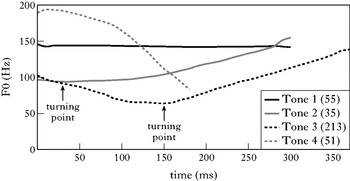
The pitch tracks of the four tones with the syllable [ma] pronounced in isolation by a male speaker, each averaged over five tokens, are given in Fig. 1. Although Tone 2 is usually transcribed as a high-rising tone 35, there is a small pitch dip at the beginning of the tone, creating a turning point, and research has shown that the perceptual difference between Tones 2 and 3 lies primarily in the timing and pitch height of the turning point (Shen & Lin Reference Shen and Lin1991, Shen et al. Reference Shen, Lin and Yan1993, Moore & Jongman Reference Moore and Jongman1997). Notice also that the different tones in Fig. 1 have different durational properties; in particular, Tone 3 has the longest duration. These observations will become important in the discussion of Mandarin tone sandhi and the experimental results.
Representative pitch tracks for the four tones in Mandarin.

In tone languages, a tone may undergo alternations conditioned by adjacent tones or the prosodic and/or morphosyntactic position in which the tone occurs. This type of alternation is often referred to as tone sandhi (e.g. Chen Reference Chen2000). Mandarin Chinese has two tone sandhi patterns, both of which involve Tone 3 (213). Specifically, 213 becomes 35 when followed by another 213 (the ‘third-tone sandhi’); but 213 becomes 21 when followed by any other tone (the ‘half-third sandhi’). These sandhis are exemplified in (2).
(2)
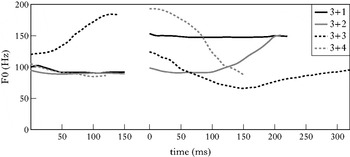
The pitch tracks for the four examples in (2) pronounced in isolation by a male speaker, each averaged over five tokens, are given in Fig. 2.
Representative pitch tracks for the tone sandhis in Mandarin.

Both of these sandhi patterns are fully productive in Mandarin disyllabic words and phrases, and they are both ‘phonological’ in the traditional sense, in that they involve language-specific tone changes that cannot be predicted simply by tonal coarticulation. However, we consider the half-third sandhi to have a stronger phonetic basis than the third-tone sandhi. Our judgement is based on the following three factors.
First, in terms of the phonetic mechanism of the tone change, although both sandhis involve simplification of a complex contour in prosodic non-final position, which has articulatory and perceptual motivations (Zhang Reference Zhang2002, Reference Zhang2004), the third-tone sandhi also involves raising of the pitch, which cannot be accounted for by the phonetic motivation of reducing pitch contours on syllables with insufficient duration. The half-third sandhi, however, only involves truncation of the second half of the contour. The third-tone sandhi is also structure-preserving, at least in perception.Footnote 5 Based on the closer phonetic relation between the base and sandhi pair in the half-third sandhi and the contrastive status of the sandhi tone 35 in the third-tone sandhi, we assume that the perceptual distance between the base and sandhi tones in the half-third sandhi is smaller than that in the third-tone sandhi. We take this as an argument for the stronger phonetic motivation for the half-third sandhi (cf. the P-map; Steriade Reference Steriade2001, Reference Steriade, Hanson and Inkelas2008).
Second, in the traditional Lexical Phonology sense, the third-tone sandhi has lexical characteristics – it is structure-preserving (in perception), and its application to a polysyllabic compound is dependent on syntactic bracketing; but the half-third sandhi is characteristic of a postlexical rule – it is allophonic and applies across the board. The syntactic dependency of the third-tone sandhi is illustrated in the examples in (3) and (4). The examples in (3a) and (b) show that for underlying third-tone sequences, the output tones differ depending on the syntactic branching structure: a right-branching sequence [213 [213 213]] has two possible output forms, 35 35 213 and 21 35 213, as in (3a), while a left-branching sequence [[213 213] 213] has only one output, 35 35 213, as in (3b) (from Duanmu Reference Duanmu2000: 238). Examples (3c) and (d), on the other hand, illustrate that the application of the half-third sandhi is not influenced by the branching structure: an underlying 213 35 213 sequence, regardless of branching structure, is realised as 21 35 213.
(3)
The examples in (4a) and (4b) show that prepositions have a special status, in that they permit the non-application of the third-tone sandhi. (4a) illustrates that in a [213 [[213 213] 213]] sequence, if the second syllable is a preposition such as [wɑŋ] ‘to’, there are three possible outputs: 35 35 35 213, 21 35 35 213 or 35 21 35 213. But if the second syllable is not a preposition, as in (4b), there are only two possible outputs: 35 35 35 213 or 21 35 35 213; *35 21 35 213, where the third-tone sandhi is blocked on the second syllable, is not a possible output (from Zhang Reference Zhang1997: 294–295). By contrast, (4c) and (4d) illustrate that a [55 [[213 51] 213]] sequence, regardless of whether the second syllable is a preposition, is realised as 55 21 51 213, demonstrating again the irrelevance of grammatical structure to the application of the half-third sandhi.Footnote 6
(4)
We should recognise that the third-tone sandhi is not truly lexical: it clearly applies across word boundaries ((3), (4)), its application in long strings is affected by speech rate ((3), (4)), and it is not structure-preserving in production under careful acoustic scrutiny (note 5). What is uncontroversial, however, is the clear difference between the two sandhis, in that the third-tone sandhi exhibits certain lexical characteristics, while the half-third sandhi does not. The close relation between the postlexical status of a phonological rule and its phonetic motivation is well established in the Lexical Phonology literature (e.g. Kiparsky Reference Kiparsky1982, Reference Kiparsky1985, Mohanan Reference Mohanan1982), and we take it as another piece of evidence that the half-third sandhi has a stronger phonetic motivation than the third-tone sandhi.
The third reason is that the third-tone sandhi corresponds to a historical sandhi pattern in Chinese, namely shang→yang ping /—shang, where shang and yang ping refer to the historical tonal categories from which 213 and 35 respectively descended. This historical sandhi pattern dates back to at least the 16th century (Mei Reference Mei1977). According to Mei's reconstruction, the pitch values for shang and yang ping in 16th century Mandarin were low level (22) and low-rising (13) respectively. The present-day rendition of the sandhi in Mandarin is the result of historical tone changes that morphed shang into low-falling-rising and yang ping into high-rising. The Mandarin third-tone sandhi was therefore not originally motivated by the phonetic rationale of avoiding a complex pitch contour on a short duration. The same point is made by the variable synchronic realisations of the same historical sandhi in related Mandarin dialects (Court Reference Court, Thurgood, Matisoff and Bradley1985). For instance, in Tianjin it is 13→45 /—13 (Yang et al. Reference Yang, Guo and Shi1999), in Jinan 55→42 /—55 (Qian & Zhu Reference Qian and Zhu1998) and in Taiyuan 53→11 /—53 (Wen & Shen Reference Wen and Shen1999). The half-third sandhi, on the other hand, does not have a similar historical origin; and due to the different tonal shapes of the historical shang tone in different present-day dialects, it does not have comparable synchronic realisations.
The differences between the third-tone sandhi and the half-third sandhi in their phonetic characteristics, morphosyntactic properties and historical origins all point to the possibility that the half-third sandhi has a stronger synchronic phonetic basis than the third-tone sandhi. It is important to note that we have not committed ourselves to an absolute cut-off point for what is phonetically based and what is not – to identify patterns that are useful for testing the synchronic relevance of phonetics, such a threshold is not necessary, nor do we believe that it exists. However, it is crucial to be able to make comparisons between patterns along the lines that we have considered for Mandarin in order to identify the relevant ones for the test.
Given the difference in phonetic grounding between the two sandhi patterns, the general question we pursue is whether Mandarin speakers exhibit different behaviours on the two sandhis in a wug test. Specifically, we test whether there is a difference in productivity between the two sandhis. In line with the synchronic approach, we hypothesise that the sandhi with the stronger phonetic motivation – the half-third sandhi – will apply more productively in wug words than the third-tone sandhi. This greater productivity may be reflected in two ways. First, the half-third sandhi may apply to a greater percentage of the wug tokens than the third-tone sandhi. Second, there is no difference in the rate of application, but there is incomplete application for the third-tone sandhi in wug words as compared to real words, while the half-third sandhi applies to the wug words the same way as it applies to the real words. In light of the earlier discussion on the difference between Tones 2 and 3, we specifically expect a lower and later turning point and a longer duration for the sandhi tone in wug words than in real words for the third-tone sandhi.Footnote 7
Finally, we must acknowledge that the third-tone sandhi and the half-third sandhi do not have the same lexical frequency in Mandarin. Calculations based on a syllable-frequency corpus (Da Reference Da2004) containing 192,647,157 syllables indicate that the numbers of legal syllable types with Tones 1–4 are 258, 224, 254 and 318 respectively, while syllables with Tones 1–4 account for 16·7%, 18·4%, 14·8% and 42·5% of all syllables in the corpus.Footnote 8 In other words, Tone 3 has the third-lowest type frequency and the lowest token frequency, which means that disyllabic words with the 3+3 tonal combination may have relatively low frequency. Moreover, the third-tone sandhi also has a limited environment as compared to the half-third sandhi. The environments in which the half-third sandhi applies, which include —55, —35 and —51, account for 75·9% of all sandhi environments by type-frequency counts. Therefore, we pay special attention in our study to whether the half-third sandhi behaves as a unified process before 55, 35 and 51. If so, it will present a challenge to the goal of the study, as any effect that conforms to our hypothesis may be due to the considerably higher lexical frequency of the half-third sandhi. If not, the frequency profile of the four tones in Mandarin will provide us with an opportunity to study the potential effect of lexical frequency on sandhi productivity and its interaction with the effect of phonetics. If lexical frequency influences sandhi productivity, we primarily expect a type-frequency effect (Bybee Reference Bybee1985, Reference Bybee2001, Baayen Reference Baayen1992, Reference Baayen1993, Ernestus & Baayen Reference Ernestus and Baayen2003, Pierrehumbert Reference Pierrehumbert, Bod, Hay and Jannedy2003, Reference Pierrehumbert and Goldstein2006, etc.), and thus a low productivity of the half-third sandhi for 3+2 sequences. But we also cannot exclude the possible effect of token frequency, which has been shown to be relevant to the productivity of Taiwanese tone sandhi in Zhang & Lai (Reference Zhang, Lai, Hsiao, Hsu, Wee and Ho2008) and Zhang et al. (Reference Zhang, Lai and Sailor2009a, Reference Zhang, Lai and Sailorb). If the frequency effect is mainly based on token frequency, we would expect 3+3 to have the lowest productivity.
3 Experiment 1
3.1 Methods
3.1.1 Stimuli
Following Hsieh (Reference Hsieh1970, Reference Hsieh and Koerner1975, Reference Hsieh1976)'s experimental design for a Taiwanese wug test, we constructed five sets of disyllabic test words in Mandarin. The first set includes real words, denoted by AO-AO (where AO=actual occurring morpheme). This set serves as the control for the experiment and is the set with which results of wug words are compared. The other four sets are wug words: *AO-AO, where both syllables are actual occurring morphemes, but the disyllable is non-occurring; AO-AG (AG=accidental gap), where the first syllable occurs, but the second syllable is an accidental gap in Mandarin syllabary; AG-AO, where the first syllable is an accidental gap and the second syllable actually occurs; and AG-AG, where both syllables are accidental gaps. The AGs were selected by the authors, who are both native speakers of Mandarin Chinese. In each AG, both the segmental composition and the tone of the syllable are legal in Mandarin, but the combination happens to be missing. For example, [phan] is a legal syllable, and occurs with tones 55 ‘to climb’, 35 ‘plate’ and 51 ‘to await eagerly’, but it accidentally does not occur with Tone 3 (213). Therefore, [phan213] is a possible AG.
For each set of words, we used four different tonal combinations: the first syllable always has Tone 3 (213), and the second syllable has one of the four Mandarin tones. Each tonal combination is therefore in the appropriate environment to undergo either the third-tone or the half-third sandhi. Eight words for each tonal combination were used, making a total of 160 test words (8×4×5).
The AO-AO words were all high-frequency words, selected from Da (Reference Da1998)'s Feng Hua Yuan character and digram frequency corpus. For the four wug sets, the digram frequencies are all zero, and we used the same first syllable to combine with the four different tones in the second syllable. For example, for AG-AG we used [phiəŋ213 ʂwən55], [phiəŋ213 thɤ35], [phiəŋ213 tsɤŋ213] and [phiəŋ213 tʂa51], along with seven other such sets. In the recorded stimuli, the same token was combined with different second syllables. The identity of the first syllable allows for the comparison of the two types of sandhi that the first syllable may undergo.
To avoid neighbourhood effects in wug words at least to some extent, we ensured that any disyllabic wug word was not a real word with any tonal combination, not just the one used for the disyllable. We specifically controlled for the tonal neighbours, because research on homophony judgement (Taft & Chen Reference Taft, Chen, Chen and Tzeng1992, Cutler & Chen Reference Cutler and Chen1997), phoneme (toneme) monitoring (Ye & Connine Reference Ye and Connine1999) and legal-phonotactic judgement (Myers Reference Myers2002) has shown that phonemic tonal differences are perceptually less salient than segmental differences, which entails that tonal neighbours in a sense make closer neighbours.
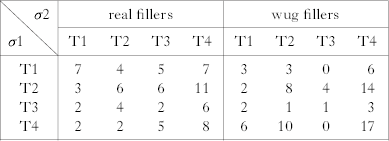
Finally, to disguise the purpose of the experiment, we also used 160 disyllabic filler words. All filler syllables were real syllables in Mandarin; half of the disyllabic fillers were real words, and the other half were wug words.
All test stimuli and fillers were read by the first author, a native speaker of Mandarin who grew up in Beijing. The Tone 3 syllables were all read with full third tones. The entire set of test stimuli, as well as additional information about the stimuli and fillers are given in the Appendix.
3.1.2 Experimental set-up
The experiment was conducted with the software package SuperLab (Cedrus) in the Phonetics and Psycholinguistics Laboratory at the University of Kansas. There were 320 stimuli in total (160 test items+160 fillers). Each stimulus consisted of two monosyllabic utterances separated by an 800 ms interval. The stimuli were played through a headphone worn by the subjects. For each stimulus, the subjects were asked to put the two syllables together and pronounce them as a disyllabic word in Mandarin. Their response was collected by a Sony PCM-M1 DAT recorder through a 33-3018 Optimus dynamic microphone placed on the desk in front of them. The sampling rate for the DAT recorder was 44·1 kHz. The digital recording was then downsampled to 22 kHz onto a PC hard drive using Praat (Boersma & Weenink Reference Boersma and Weenink2003). There was a 2000 ms interval between stimuli. If the subject did not respond within 2000 ms after the second syllable played, the next stimulus would begin. The stimuli were divided into two blocks of the same size (A and B) with matched stimulus types; there was a five-minute break between the blocks. Half of the subjects took block A first, and the other half took block B first. Within each block, the stimuli were automatically randomised by SuperLab. Before the experiment began, the subjects heard a short introduction in Chinese through the headphones which explained the task both in prose and with examples; they simultaneously read it on a computer screen. There was then a practice session involving 14 words (two each of AO-AO, *AO-AO, AO-AG, AG-AO and AG-AG, two real-word fillers and two wug fillers). The experiment began after a verbal confirmation from the subjects that they were ready. The entire experiment took around 45 minutes.
3.1.3 Subjects
Twenty native speakers of Mandarin (12 male, 8 female), recruited at the University of Kansas, participated in the study. All speakers were from northern areas of Mainland China, and, in the opinion of the authors, spoke Standard Mandarin natively, without any noticeable accent. Except for one speaker who was 45 years old and had been in the United States for 20 years, all speakers ranged from 23 to 35, and had been in the United States for less than four years at the time of the experiment. Each subject was paid a nominal fee for participating in the study.
3.1.4 Data analyses
All test tokens from the subjects were listened to by the two authors. A token was not used in the analysis if there was a large enough gap between the two syllables that they clearly did not form a disyllabic word. For the rest of the tokens, it was judged that both the third-tone sandhi and the half-third sandhi applied 100% of the time. Non-application of the sandhi processes should be easy to detect for native speakers, as they involve clear phonotactic violations (*213 non-finally). Therefore, the test for the productivity of the sandhis lies in the accuracy of their applications to the wug words. To investigate the accuracy of sandhi application, we extracted the F0 of the rhyme in the first syllable of the subjects' disyllabic response, using Praat. We then took a F0 measurement every 10% of the duration of the rhyme, giving eleven F0 measurements for each rhyme. For each tonal combination (3+1, 3+2, 3+3, 3+4), we did two comparisons. The first was between AO-AO and the rest of the word groups (*AO-AO, AO-AG, AG-AO, AG-AG); i.e. real disyllables vs. wug disyllables. The other was between AO-AO, *AO-AO, AO-AG and AG-AO, AG-AG; i.e. real σ1vs. wug σ1. The rationale for the two comparisons is that lexical listing could be at the disyllabic word or monosyllabic morpheme level; doing both comparisons allows us to tease apart the two possibilities. Our hypothesis for these comparisons is that the difference in sandhi tones between real words and wugs should be greater for cases of third-tone sandhi than half-third sandhi, due to the stronger phonetic motivation for the latter. In particular, we expect incomplete application of the third-tone sandhi in wugs, i.e. Tone 3 in σ1 will resist the change to Tone 2. Again, given the acoustic characteristics of Tones 2 and 3 in Mandarin, the hypothesis translates into a lower and later turning point and a longer duration for the sandhi tone in wug words than in real words.
Among the twenty speakers, there were two speakers (one male and one female) whose F0 values could not be reliably measured by Praat, due to high degrees of creakiness in their voice. We discarded these speakers' data in the F0 analysis.
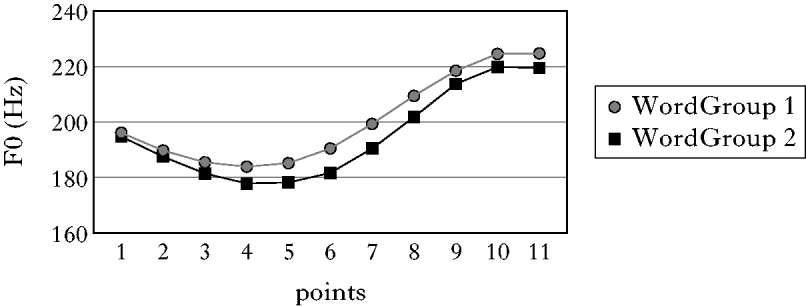
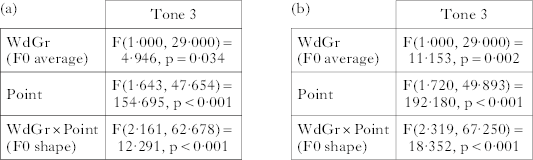
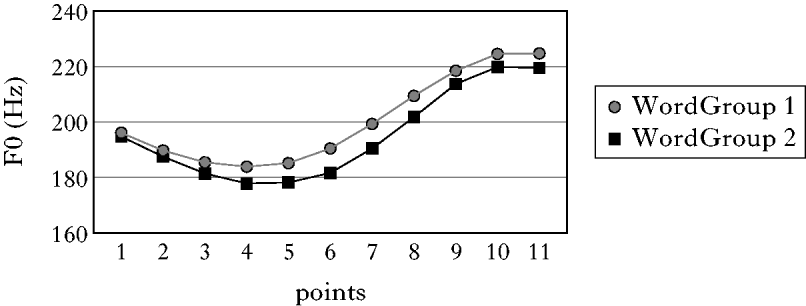
Figure 3 illustrates how we compared two F0 curves. We conducted a two-way Huynh-Feldt repeated-measures ANOVA, which corrected for sphericity violations, with WordGroup and Point as independent variables. The WordGroup variable has two levels, WordGroup 1 and WordGroup 2, and a significant main effect would indicate that the two F0 curves representing the two word groups have different average pitches. The Point variable has eleven levels, representing the eleven points where F0 data are taken. A significant interaction between WordGroup and Point would indicate that the two curves have different shapes. This method of comparing two F0 curves is used by Peng (Reference Peng, Broe and Pierrehumbert2000).
The comparison of two F0 curves.
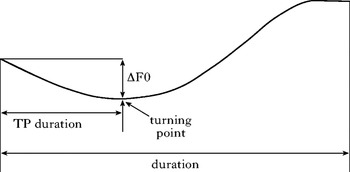
For σ1 in 3+3 combinations, we also measured the F0 drop and the duration from the beginning of the rhyme to the pitch turning point, as shown in Fig. 4. Comparisons between real and wug disyllables and between real and wug σ1 on these measurements were made using one-way repeated-measures ANOVAs. We expected the F0 drop to be greater and the TP duration to be longer for wug words than real words.
A schematic of the measurements taken from the pitch curve of the rhyme in σ1 in 3+3 combinations. ‘ΔF0’ and ‘TP duration’ are the pitch drop and duration from the beginning of the rhyme to the turning point respectively. ‘Duration’ is the duration of the entire rhyme.

Finally, we measured the σ1 rhyme duration for all the disyllabic combinations, and compared real and wug disyllables and real and wug σ1's for each tonal combination, using one-way repeated-measures ANOVAs. Based on the synchronic approach, we expected to find a longer rhyme duration for the wug words in 3+3 combinations, but no difference between wug and real words in other combinations.
3.2 Results
3.2.1 F0 contour
In this section, we report the results of comparison on the F0 of the first syllable of the subjects' response between real disyllables and wug disyllables, and between real-σ1 words and wug-σ1 words.
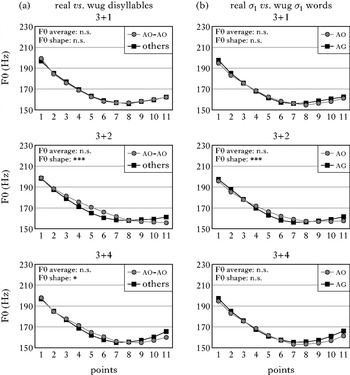
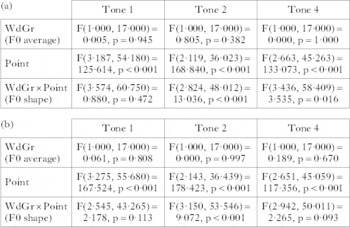
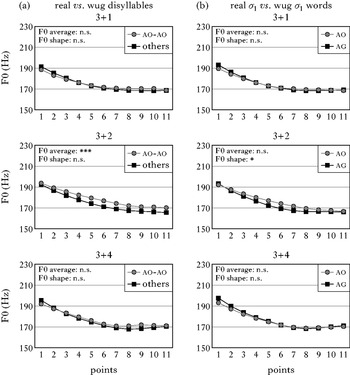
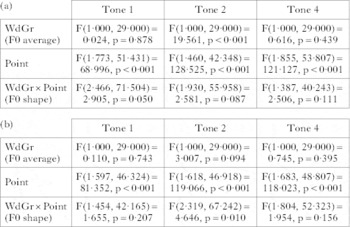
The results from the half-third sandhi comparisons are given in Fig. 5. In this and all following figures, ‘n.s.’ indicates no significant difference and ‘*’, ‘**’ and ‘***’ indicate significant differences at the p<0·05, p<0·01 and p<0·001 levels respectively. As we can see in Fig. 5, for Tones 1 and 4 the subjects’ performance on the half-third sandhi on wug words is generally identical to that on real words in terms of both the average F0 and the F0 contour shape. This is true for both the disyllabic and σ1 comparisons for Tone 1 and the σ1 comparisons for Tone 4. When σ2 has Tone 2, the shape of the F0 contour on σ1 is significantly different for real and wug words, for both comparisons. The statistical results for these comparisons are given in Table I.
F0 curves of the first syllable for the half-third sandhi. (a) represents the real disyllable vs. wug disyllable comparisons for the first syllable in 3+1, 3+2 and 3+4; (b) represents the real σ1vs. wug σ1 comparisons for the same tonal combinations.

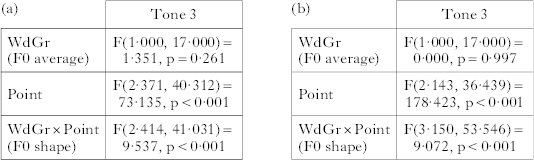
Two-way repeated-measures ANOVA results for the first syllable F0 curves in the half-third sandhi: (a) real vs. wug disyllables; (b) real σ1vs. wug σ1 words.

Figure 5 also shows that the F0 shape difference between real and wug words for 3+2 lies in the fact that the F0 shape for the wug words has a turning point at around 70% into the tone, while the F0 shape for the real words falls monotonically throughout the rhyme. This indicates that there may be incomplete application of the half-third sandhi in 3+2; hence its lower accuracy/productivity in this particular environment.Footnote 9 We currently have no account for why there is a significant F0 shape difference between AO-AO and other word groups for 3+4.
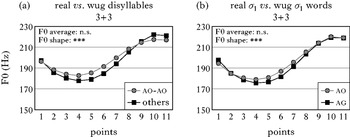
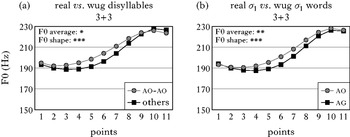
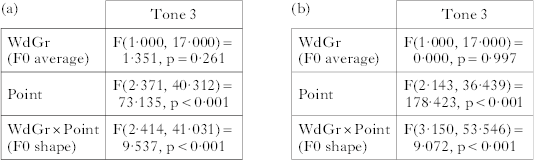
The results from the third-tone sandhi comparisons are given in Fig. 6. Two-way repeated-measures ANOVAs indicate that although the average F0 is the same for both comparisons, the F0 contour shape is significantly different between the real words and wug words for both comparisons. The ANOVA results are summarised in Table II.
F0 curves of the first syllable for the third-tone sandhi. (a) and (b) represent the real disyllable vs. wug disyllable and real σ1vs. wug σ1 comparisons respectively.

Two-way repeated-measures ANOVA results for the first syllable F0 curves in the third-tone sandhi: (a) real vs. wug disyllables; (b) real σ1vs. wug σ1 words.
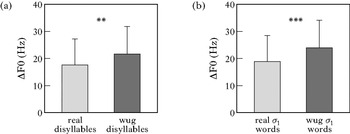
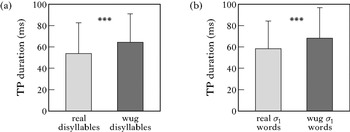
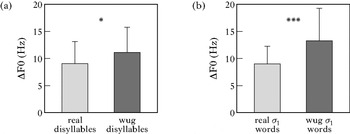
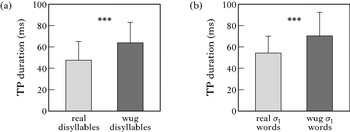
We can also see in Fig. 6 that for the curves representing wug words the turning points are both lower and later than their counterparts for the curves representing real words, indicating that there may be incomplete application of the sandhi. To quantify these turning point differences in σ1 of the 3+3 combination, we defined ΔF0 as the difference between the F0 of the beginning of the rhyme and the F0 turning point in the rhyme and TP duration as the duration from the beginning of the rhyme to the turning point. Results of comparisons between real and wug disyllables and between real and wug σ1's on ΔF0 and TP duration for 3+3 are given in Figs 7 and 8 respectively. In these and following figures, error bars indicate one standard deviation. One-way repeated-measures ANOVAs with WordGroup as the independent factor indicate that for ΔF0, AO-AO is significantly different from other word groups (F(1·000, 17·000)=8·543, p<0·01), as is σ1=AO from σ1=AG (F(1·000, 17·000)=48·254, p<0·001); for TP duration, AO-AO is significantly different from other word groups (F(1·000, 17·000)=19·561, p<0·001), as is σ1=AO from σ1=AG (F(1·000, 17·000)=21·343, p<0·001). These results support our hypothesis: with a lower and later turning point, the sandhi tone on wug words is more similar to the original Tone 3 than that on real words, indicating incomplete application of the sandhi in wug words.
ΔF0 results for 3+3. (a) and (b) represent the real disyllable vs. wug disyllable and real σ1vs. wug σ1 comparisons respectively.

TP duration results for 3+3. (a) and (b) represent the real disyllable vs. wug disyllable and real σ1vs. wug σ1 comparisons respectively.

3.2.2 Rhyme duration
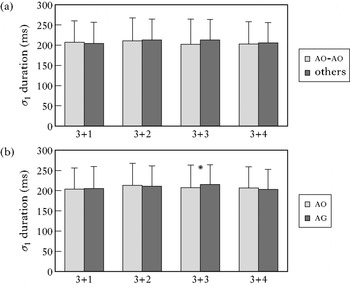
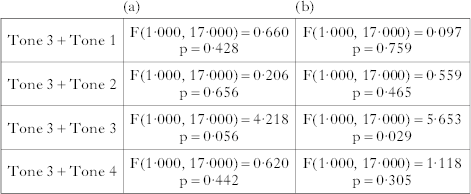
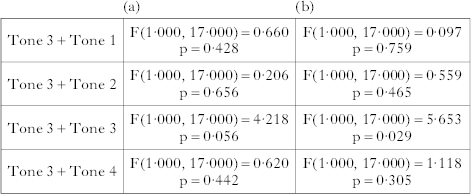
The results for σ1 rhyme duration for all the tonal combinations are given in Fig. 9, and the statistical results are summarised in Table III. One-way repeated-measures ANOVAs with WordGroup as the independent factor show that there are no significant differences between AO-AO and other word groups for any of the tonal combinations. But for 3+3, the difference approaches significance, at p<0·05 (F(1·000, 17·000)=4·218, p=0·056), and the difference is in the expected direction, i.e. wug>real. For AO vs. AG, 3+3 is the only combination in which the wug words have a significantly longer σ1 rhyme duration than the real words (F(1·000, 17·000)=5·653, p<0·05). These results support our hypothesis: the durational property for the sandhi syllables is identical for real and wug words for the half-third sandhi, but for the third-tone sandhi, the sandhi-syllable rhyme duration in wug words is longer than in real words, again indicating incomplete application of the sandhi in wug words. These results are consistent with an approach that encodes phonetic biases in the grammar, but not with a frequency-only approach, as the latter predicts a greater durational difference between real and wug words for 3+2 than for 3+3, due to the former's lower lexical frequency.
Rhyme duration of σ1 for all tonal combinations. (a) and (b) represent the real disyllable vs. wug disyllable and real σ1vs. wug σ1 comparisons respectively.

One-way repeated-measures ANOVA results for the σ1 rhyme duration in all tonal combinations: (a) real vs. wug disyllables; (b) real σ1vs. wug σ1 words.
3.3 Discussion
Our third-tone sandhi results indicate a significant difference between real words and wug words in the contour shape of the sandhi tone; in particular, the contour shape of the sandhi tone in wug words shares a greater similarity with the original Tone 3 in having a lower and later turning point and a longer tone duration. Given that we did not judge any 3+3 tokens in the data to have non-application of the third-tone sandhi, the difference between real and wug words for the third-tone sandhi was due not to the non-application of the sandhi to a limited number of tokens/speakers, but to the incomplete application of the sandhi to a large number of tokens. The real vs. wug comparison for the half-third sandhi, however, showed identical contour shapes for the sandhi tone for Tone 1, an inconsistent contour-shape difference for Tone 4 (a difference at p<0·05 level (p=0·016) for the disyllabic comparison, but no difference for the AO vs. AG comparison), and a significant contour shape difference for Tone 2, which indicates incomplete application of the sandhi. This shows (a) that the half-third sandhi behaves differently in different environments, and (b) that the sandhi with the lowest type frequency (3+2) also applies less consistently to wug words than to real words.
The real disyllable vs. wug disyllable and real-σ1vs. wug-σ1 comparisons returned similar results. But the difference between the two sandhis is more apparent in the real-σ1vs. wug-σ1 comparison, as indicated by the equal or more significant difference for the third-tone sandhi and the equal or less significant difference for the half-third sandhi between the two groups for all F0 measures.
Therefore, our hypothesis that the difference in sandhi tones between real words and wugs should be greater for cases of third-tone sandhi than half-third sandhi finds support in the facts that (a) the difference between real and wug words for the third-tone sandhi can be translated into incomplete application for the sandhi in wug words, and (b) there is no consistent difference between real and wug words for the half-third sandhi. We have also found an effect that is potentially due to type frequency: the half-third sandhi in 3+2 also applies incompletely to wug words. The effects overall, however, are not consistent with a frequency-only account, as the differences between real and wug words are more consistent for 3+3 than 3+2, as evidenced by the lack of rhyme duration difference in 3+2.
These results must be interpreted cautiously, however, for two reasons. First, the differences between real and wug words in the third-tone sandhi, although statistically highly significantly, are quite small. It is thus important for us to be able to replicate these results in a separate experiment. Second, although all of our participants came from northern areas of Mainland China and spoke Standard Mandarin natively without any noticeable accent, they did have backgrounds in different Northern Chinese dialects. This could potentially have an effect on the results. Experiment 2 was designed to address these issues.
4 Experiment 2
The goals of Experiment 2 are twofold: first, it serves as a replication of Experiment 1; second, it includes only participants who grew up in Beijing, and thus minimises the potential dialectal effects on the results.
4.1 Methods
The methods of Experiment 2 were identical to those of Experiment 1, except that the experiment was conducted in the Phonetics Laboratory of the Department of Chinese Language and Literature at Beijing University in China, and that the recordings were made by a Marantz solid state recorder PMD 671 using a EV N/D 767a microphone. The sampling rate of the solid state recorder was 44·1 kHz, and the digital recording was not further downsampled.Footnote 10
Thirty-one native speakers of Beijing Chinese (9 male, 22 female), recruited at Beijing University, participated in the experiment. All subjects had grown up and gone through their primary and secondary schooling in Beijing, and none reported being conversant with any other dialects of Chinese. The subjects ranged from 19 to 37 years in age. Each subject was paid a nominal fee for participating in the study. Due to technical problems with Superlab, we were not able to use one male speaker's data. We therefore report data from 30 speakers.
4.2 Results
4.2.1 F0 contour
The F0 contour results for the half-third sandhi comparisons are given in Fig. 10. For both Tones 1 and 4, the subjects' performance on the half-third sandhi on wug words is generally identical to that on real words in terms of both the average F0 and the F0 contour shape. This is true for both the disyllabic and σ1 comparisons for Tone 1 and the σ1 comparisons for Tone 4. For the disyllabic comparison for Tone 1, however, the p value is right at 0·05, and this needs to be acknowledged. When σ2 has Tone 2, the average F0 pitch on σ1 is significantly lower for wug words than real words for the disyllabic comparison, and the F0 shape between real and wug words is significantly different for the AO vs. AG comparisons. The statistical results for these comparisons are given in Table IV.
F0 curves of the first syllable for the half-third sandhi.

Two-way repeated-measures ANOVA results for the first syllable F0 curves in the half-third sandhi: (a) real vs. wug disyllables; (b) real σ1vs. wug σ1 words.

The difference in the F0 shapes of real-σ1 and wug-σ1 words for 3+2 lies in the fact that the F0 shape for the wug words has a turning point at around 80% into the tone, while the F0 shape for the real words falls monotonically throughout the rhyme. This is similar to the F0 shape difference in both real vs. wug comparisons in Experiment 1. It again indicates that there may be incomplete application, and hence lower accuracy/productivity, of the half-third sandhi in 3+2.
The results from the third-tone sandhi comparisons are given in Fig. 11. Two-way repeated-measures ANOVAs indicate that both the average F0 and the F0 contour shape are significantly different for real words and wug words, for both comparisons. The ANOVA results are summarised in Table V.
F0 curves of the first syllable for the third-tone sandhi.

Two-way repeated-measures ANOVA results for the first syllable F0 curves in the third-tone sandhi: (a) real vs. wug disyllables; (b) real σ1vs. wug σ1 words.
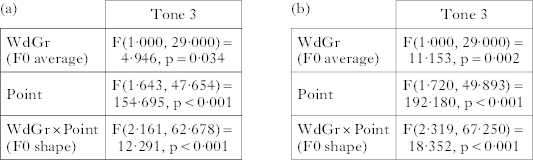
We have replicated our major finding regarding the F0 contours in Experiment 1: the σ1 in 3+3 sequences show consistent contour-shape differences for the real and wug words in the two comparisons. This experiment also shows that there is an average pitch difference for 3+3 between real and wug words. Moreover, other tonal sequences do not show differences between real words and wug words, except for 3+2 – the tonal combination that has the lowest type frequency. However, 3+2 differences between real and wug words are less consistent than 3+3 differences. This would not be consistent with a frequency-only account, but would be consistent with an account in which both phonetics and frequency are relevant.
From Fig. 11, we can see that the contour shape difference between real and wug words for 3+3 is similar to that in Experiment 1: the turning points for wug words are both lower and later than their counterparts in real words, indicating that there may be incomplete application of the sandhi in the wug words.
The comparisons between real and wug disyllables and between real and wug σ1's on ΔF0 for 3+3 are given in Fig. 12. A one-way repeated-measures ANOVA indicates that AO-AO has a significantly smaller ΔF0 than other word groups (F(1·000, 29·000)=4·457, p<0·05), as does σ1=AO in comparison with σ1=AG (F(1·000, 29·000)=28·523, p<0·001).
ΔF0 results for 3+3.

Comparisons between real and wug words for TP duration of 3+3 are given in Fig. 13. A one-way repeated-measures ANOVA indicates that AO-AO has a significantly shorter TP duration than other word groups (F(1·000, 29·000)=28·793, p<0·001), as does σ1=AO in comparison with σ1=AG (F(1·000, 29·000)=56·235, p<0·001).
TP duration results for 3+3.

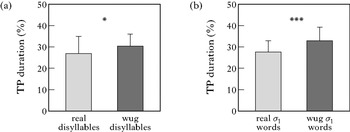
Given that we will see in §4.2.3 that wug words generally have a longer σ1 rhyme duration than real words, we also calculated the TP duration as a percentage of the entire σ1 rhyme duration and compared the real words with wug words, to ensure that the longer TP duration in wug words is not simply due to the longer σ1 duration. These comparisons are shown in Fig. 14. ANOVA results show that the AO-AO turning point is still significantly earlier than that of other word groups (F(1·000, 29·000)=5·082, p<0·05), as is σ1=AO in comparison with σ1=AG (F(1·000, 29·000)=34·617, p<0·001).
TP duration as a percentage of the entire σ1 rhyme duration in 3+3.

We have replicated our turning point results in Experiment 1: the σ1 turning point in 3+3 sequences is significantly lower and later in wug words than real words, which makes the tone more similar to the original Tone 3 in wug words, indicating incomplete application of the sandhi in wug words.
4.2.2 Rhyme duration
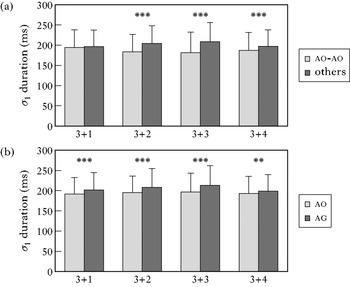
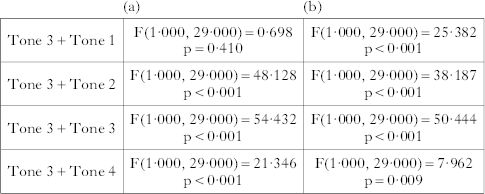
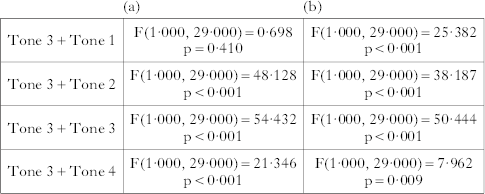
The results for σ1 rhyme duration for all the tonal combinations are given in Fig. 15. For the AO-AO vs. other comparison, a repeated-measures ANOVA shows that there is a significant WordGroup effect: F(1·000, 29·000)=58·058, p<0·001; the ANOVA results within each tone, summarised in Table VI, show that except for 3+1, the wug words have a significantly longer σ1 rhyme duration than AO-AO. For the AO vs. AG comparison, the ANOVA again shows a significant WordGroup effect: F(1·000, 29·000)=58·576, p<0·001; the ANOVA results within each tone, also summarised in Table VI, show that the AG words have a significantly longer σ1 rhyme duration than AO words for all of the tonal combinations.
Rhyme duration of σ1 for all tonal combinations.

One-way repeated-measures ANOVA results for the σ1 rhyme duration in all tonal combinations: (a) real vs. wug disyllables; (b) real σ1vs. wug σ1 words.
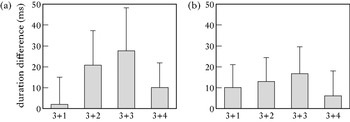
To compare the real vs. wug durational difference in different tonal combinations, we calculated the durational difference between AO-AO and other word groups, as well as between σ1=AO and σ1=AG for each tonal combination, as shown in Fig. 16, and we conducted a one-way repeated-measures ANOVA, with Tone as the independent variable and the durational difference as the dependent variable for each real vs. wug comparison. The ANOVA results show that for the AO-AO vs. other comparison, Tone has a significant effect on the durational difference between the two word groups (F(2·441, 70·783)=22·032, p<0·001), and post hoc tests show that the 3+3 and 3+2 sequences exhibit significantly greater durational differences than 3+1 and 3+4 (p<0·001 for all comparisons except for 3+2 vs. 3+4, which is at p<0·01). No other pairwise differences were found. For the σ1=AO vs. σ1=AG comparison, Tone also has a significant effect on the durational difference between the two word groups (F(3·000, 87·000)=6·174, p<0·005), and post hoc tests show that 3+3 and 3+2 exhibit significantly greater durational differences than 3+4 (p<0·005 for 3+3 vs. 3+4; p<0·05 for 3+2 vs. 3+4).
σ1 rhyme duration differences for all tonal combinations: (a) real vs. wug disyllables; (b) real σ1vs. wug σ1 words.

The σ1 rhyme duration data here differ from that of Experiment 1 in that wug words have an overall significantly longer duration than real words regardless of the tonal combination. But the durational difference in σ1 rhyme between real and wug words is dependent on the tonal combination. 3+3 and 3+2 sequences induced significantly greater durational differences between real and wug words than the other tonal sequences. The numerical differences between 3+3 and 3+2 observed in Fig. 16, though in the expected direction, did not reach statistical significance. These results indicate that in wug words, 3+3 and 3+2 sequences may have involved incomplete sandhi application, which would give the first syllable a longer duration. They are again consistent with a synchronic approach that take into account both phonetics and lexical frequency.
4.3 Discussion
Our data provide converging evidence with Experiment 1 for the lower application accuracy of the third-tone sandhi than the half-third sandhi. In all F0 comparisons between real and wug words in both Experiment 1 and Experiment 2, the contour shape of 3+3 sequences is the only comparison that consistently shows a significant difference. Moreover, the properties of the difference are consistent across comparisons and experiments: the turning point of the sandhi tone is significantly lower and later in wug words than in real words, and similarly to Experiment 1, these differences are not caused by the non-application of the sandhi to a limited number of tokens/speakers, indicating that the sandhi is incompletely applied to a large number of wug words.
The potential frequency effects observed in Experiment 1 are also replicated here. The 3+2 sequences exhibited differences between real and wug words, in that the sandhi tones in wug words showed properties of non-application – the existence of a turning point and a longer duration. But the difference in F0 shape is less consistent than in 3+3. This is consistent with an approach that encodes the effects of both phonetics and frequency, but not with a frequency-only approach, which would predict a more consistent difference between real and wug words for 3+2 than for 3+3.
Again as in Experiment 1, the difference between the third-tone sandhi and the half-third sandhi is more apparent in the real-σ1vs. wug-σ1 comparison, as indicated by the equal or more significant difference for the third-tone sandhi and the equal or less significant difference for the half-third sandhi for the two word groups for all F0 measures.
5 General discussion
5.1 The relevance of phonetics to synchronic phonology
Our F0 pitch-track, turning point and duration data from the two wug-test experiments collectively support our hypothesis that there is a difference in productivity between the two tone-sandhi patterns in Mandarin: the more innovative sandhi, which has a stronger phonetic basis – the half-third sandhi – applies accurately to wug words, except for 3+2, which has the lowest type frequency; the sandhi with the longer history and more opaque phonetic basis – the third-tone sandhi – applies incompletely to wug words, as evidenced by the significantly lower and later turning point in the sandhi tone.
The F0 data suggest that phonological patterns with different degrees of phonetic basis have different synchronic statuses: there is a bias that favours the pattern that has a stronger phonetic basis. Lexical frequency by itself cannot account for the data patterns, for two reasons. First, the half-third sandhi behaves differently in different environments, indicating that speakers do not pool these environments together when they internalise the sandhi. It is therefore inaccurate to say that the third-tone sandhi has an overall lower frequency than the half-third sandhi; rather, it has a lower type frequency than the half-third sandhi in 3+1 and 3+4, but a higher type frequency than the half-third sandhi in 3+2. Second, the difference between real words and wug words is more consistently observed in 3+3 than 3+2, as indicated by the rhyme-duration data in Experiment 1 and the F0 data in Experiment 2. A frequency-only account would predict the opposite.
The phonetic effect manifests itself here gradiently in the following sense: the sandhi with a weaker phonetic motivation applies without fail to the wug words, but the application is incomplete, in that the sandhi tone bears more resemblance to the base tone than the sandhi tone in real words. In a way, this is a more subtle gradient effect than the one in which the pattern applies to only a percentage of the structures that satisfy its environment, as shown by other work on gradience and exceptionality in phonology (e.g. Zuraw Reference Zuraw2000, Reference Zuraw2007, Frisch & Zawaydeh Reference Frisch and Zawaydeh2001, Ernestus & Baayen Reference Ernestus and Baayen2003, Hayes & Londe 2006, Pierrehumbert Reference Pierrehumbert and Goldstein2006, Coetzee Reference Coetzee2008a, Coetzee & Pater Reference Coetzee and Pater2008, Zhang & Lai Reference Zhang, Lai, Hsiao, Hsu, Wee and Ho2008, Zhang et al. Reference Zhang, Lai and Sailor2009a, Reference Zhang, Lai and Sailorb). Methodologically, this result indicates the importance of detailed phonetic studies that can reveal patterns that traditionally escaped the attention of phonologists, but could potentially shed light on issues of theoretical contention. This finds a parallel in the discovery of incomplete neutralisation in many processes thought to be neutralising, such as final devoicing in a host of languages (e.g. Charles-Luce Reference Charles-Luce1985, Slowiaczek & Dinnsen Reference Slowiaczek and Dinnsen1985, Port & Crawford Reference Port and Crawford1989, Warner et al. Reference Warner, Jongman, Sereno and Kemps2004), English flapping (Zue & Laferriere Reference Zue and Laferriere1979, Dinnsen Reference Dinnsen1984, Patterson & Connine Reference Patterson and Connine2001) and Mandarin third-tone sandhi (Peng Reference Peng, Broe and Pierrehumbert2000).Footnote 11
5.2 Frequency effects
As argued above, frequency effects alone cannot account for our data. But frequency does seem to correlate positively with sandhi productivity: the half-third sandhi in 3+2, which has the lowest type frequency, has the lowest application accuracy in wug words among all half-third sandhi environments, and the inaccurate application can be characterised as incomplete application of the sandhi, just as we have observed for the third-tone sandhi. The frequency effects here are also of a slightly different nature than the frequency matching of patterned exceptionality in the lexicon in wug tests (Zuraw Reference Zuraw2000, Albright Reference Albright2002, Albright & Hayes Reference Albright and Hayes2003, Ernestus & Baayen Reference Ernestus and Baayen2003, Hayes & Londe Reference Hayes and Londe2006et al.) – the pattern here is exceptionless in the lexicon, but is less frequent than other non-competing patterns. The effects are also subtler than a comparable case – Taiwanese tone sandhi – documented in Zhang & Lai (Reference Zhang, Lai, Hsiao, Hsu, Wee and Ho2008) and Zhang et al. (Reference Zhang, Lai and Sailor2009a, Reference Zhang, Lai and Sailorb), in which frequency differences in the lexicon cause application-rate differences in wug tests: the application rates here are consistently 100%; but the degree of application differs.Footnote 12
5.3 Alternative interpretations
Finally, we consider four other alternative interpretations to our results here, all of which were suggested by anonymous reviewers, to whom we are grateful.
An important alternative to consider is whether it is possible to treat Tone 3 as underlyingly 21 and insert a high pitch to the right when the tone occurs phrase-finally. The insertion of a pre- or post-[—αT] is cross-linguistically attested, and referred to as a ‘bounce’ effect by Hyman (Reference Hyman, Riad and Gussenhoven2007). The tone sandhi in the third-tone sandhi can then be considered as OCP avoidance, and the half-third sandhi as simply non-existent. The 21 underlying form for Tone 3 is a particularly attractive option for Taiwan Mandarin, in which Tone 3 is pronounced as 21 even in final position. This position is technically workable for Beijing Mandarin, but difficult to defend from a typological perspective. First, Northern Chinese dialects, of which Mandarin is one, are known to have ‘right-dominant’ sandhis that protect domain-final tones and change non-final tones (Yue-Hashimoto Reference Yue-Hashimoto1987, Zhang Reference Zhang2007). It is not clear why Mandarin would be an exception. Second, while contour simplification in non-final positions is extremely common cross-linguistically, contour complication, even in final position, is quite rare. Yue-Hashimoto's (Reference Yue-Hashimoto1987) typology of Chinese tone-sandhi systems identifies close to 100 cases of contour levelling or simplification, but only three cases of contour complication. It is not clear why we would want to entertain a typologically odd analysis when a better-attested option is available. These points are also made in Zhang (Reference Zhang2007: 260).
The second alternative relates to our observation above that the third-tone sandhi is sensitive to syntactic information, while the half-third sandhi is not. Another manifestation of this is that the third-tone sandhi sometimes does not apply across a [NP][VP] boundary, as shown in (5a): the [li] syllable has the option of not undergoing the third-tone sandhi, thus giving a 21 21 sequence in the output. This makes the processing of the third-tone sandhi potentially more difficult, as the speaker needs to access the syntactic information in order to determine whether the third-tone sandhi should apply. However, the stimuli that we used in the experiments were all disyllabic, and 3+3 disyllabic sequences do not have the option of not undergoing the sandhi even if the syntactic configuration is [NP][VP], as shown in (5b). The syntactic information is therefore immaterial to the stimuli that we used in the experiments.
(5)
The third alternative is that the productivity difference stems from the nature of lexical listing, in that the third-tone sandhi is lexically listed, while the half-third sandhi is productively derived from markedness and faithfulness interactions in an OT grammar. This is consistent with the fact that the third-tone sandhi has a long history and thus may have a higher degree of lexicalisation. Therefore, even if the two sandhis do differ in their synchronic phonetic motivation, it is their difference in lexical listing that causes the productivity difference.
There are two arguments against this alternative. First, if the nature of lexical listing is truly different between the two sandhis, then we would expect the third-tone sandhi to be entirely unproductive and the half-third sandhi to be entirely productive, regardless of lexical frequency. However, we observed a gradient difference between the two sandhis, and the half-third sandhi is affected by lexical frequency. These gradient effects, we believe, are better captured by an analysis that is gradient in nature rather than one that imposes a categorical distinction between the two sandhis based on the presence vs. absence of lexical listing. Second, despite the long history of the third-tone sandhi, its application to disyllabic words in Mandarin is in fact exceptionless, just like the half-third sandhi. Therefore, learners of Mandarin cannot conclude purely from input statistics that the former has a higher degree of lexicality than the latter. In order to reach this conclusion, it seems that the learner still has to access the phonetic nature of the sandhis, indicating the synchronic relevance of phonetics.
The final alternative capitalises on the observation that the subjects produced the half-third sandhi after hearing only one full Tone 3 in σ1 position followed by a different tone, but produced the third-tone sandhi after hearing two identical full third tones. It is thus possible that the production of the third-tone sandhi is influenced by a greater perceptual perseveration effect from the input than that of the half-third sandhi, which causes the nonce syllable in σ1 position of 3+3 to have more characteristics of Tone 3.
Although this approach correctly predicts incomplete neutralisation in both real and wug words (see note 5 for results on incomplete neutralisation between 3+3 and 2+3 in real word productions), it cannot predict the difference between them, as it is not clear why the perceptual perseveration effect should be stronger for wug words than for real words. But more importantly, the approach assumes tone priming irrespective of segmental content, as it assumes that the two third tones both have an effect on the subjects' production of Tone 3 affected by sandhi, even though the second syllable has completely different segmental contents from the syllable undergoing sandhi. However, whether tone by itself is an effective prime in a tone language is a controversial issue. Although Cutler & Chen (Reference Cutler, Chen, Elenius and Branderud1995) show that tone and segments in Cantonese behave similarly as primes for lexical decision, other studies on Mandarin (Chen et al. Reference Chen, Chen and Dell2002, Lee Reference Lee2007) and Cantonese (Yip et al. Reference Yip, Leung and Chen1998, Yip Reference Yip2001) show that priming effects in lexical decision and production latency are only found when the prime and the target share either segmental contents or segmental contents and tone. Tone by itself is an ineffective prime. This casts further doubt on the workability of this alternative.
6 Conclusion
In this paper, we have proposed a novel research paradigm to test the relevance of phonetics to synchronic phonology – wug testing of patterns differing in phonetic motivations that coexist in the same language. By directly addressing existing native patterns and allowing easier control of confounding factors such as lexical frequency, the wug-test paradigm provides evidence which converges with other research paradigms that have been used to test this issue, such as the study of phonological acquisition in a first language and the artificial language paradigm. The language we used was Mandarin Chinese, which has two tone-sandhi patterns which differ in their degrees of phonetic motivation, and our wug tests showed that Mandarin speakers applied the sandhi with a stronger phonetic motivation, the half-third sandhi, to wug words with a greater accuracy than the phonetically more opaque sandhi, the third-tone sandhi, thus supporting the direct relevance of phonetics to synchronic phonology. We also showed that lexical frequency is relevant to the application of the half-third sandhi in wug words, as reflected in the lower accuracy of the sandhi in the 3+2 environment. However, lexical frequency alone cannot account for the low sandhi accuracy of 3+3, as the sandhi tone differences between real and wug words are more consistent for 3+3 than 3+2, even though 3+2 has a lower lexical frequency.
We recognise that our position that phonetics, likely in the form of substantive biases, is part of the design feature of grammar construction complicates the search for phonological explanations in the following sense: it potentially creates a duplication problem for patterns whose explanation may come from either substantive bias or misperception; how, then, does one tease apart which is the true explanatory factor? This problem is pointed out by Hansson (Reference Hansson2008: 886), for example. We surmise that the answer will not come from individual cases for which the explanation may truly be ambiguous, but from comprehensive experimental studies on many different patterns to establish which approach makes better predictions on both the speakers' internal knowledge and the evolution of these patterns in general. Therefore, the study reported here can simply be viewed as food for future research into the phonetics–phonology relationship. To conduct similar studies, we need the two patterns under comparison to satisfy the following conditions: (a) they have comparable triggering environments, (b) they are of comparable productivity in the native lexicon, (c) they have comparable frequencies of occurrence in the native lexicon and (d) they differ in their degrees of phonetic motivation. There are many other Chinese dialects, especially the Wu and Min dialects, that have considerably more intricate patterns of tone sandhi than Mandarin, and we often find differences in the degree of phonetic motivation among the sandhi patterns in these dialects. We hope that our study on Mandarin will lead to similar research in other Chinese dialects, which will make further contributions to the phonetics–phonology interface debate.
Starting from Hsieh's seminal works on wug-testing Taiwanese tone sandhi, the productivity of complicated tone-sandhi patterns has been a long-standing question in Chinese phonology. This is especially true for patterns involving phonological opacity (e.g. the tone circle in Southern Min; see Chen Reference Chen2000 for examples) and syntactic dependency (e.g. the different sandhi patterns that subject-predicate and verb-object compounds undergo in Pingyao; see Hou Reference Hou1980). We hope that our research will inspire more psycholinguistic testing of these patterns that will shed light on this question. Some results on how sandhi productivity is gradiently influenced by phonological opacity have already been obtained for Taiwanese (Zhang & Lai Reference Zhang, Lai, Hsiao, Hsu, Wee and Ho2008, Zhang et al. Reference Zhang, Lai and Sailor2009a, Reference Zhang, Lai and Sailorb).
Finally, our results here shed additional light on the nature of gradience in phonology. Not only are the phonetic and frequency effects observed here gradient, they are gradient in an interesting way: the sandhis may apply to all wug words, but they apply incompletely in that the sandhi tone bears more resemblance to the base tone than the sandhi tone in real words. This complements well-attested gradient effects whereby a phonological pattern only applies to a certain percentage of the experimental test items.Footnote 14 This observation is both methodologically and theoretically significant: methodologically, it further demonstrates the importance of careful acoustic studies, which can reveal phonological patterns that have hitherto escaped our attention; theoretically, it forces us to rethink theoretical models of phonology, which need to provide a viable explanation for the multiple layers of gradience.
Appendix: Additional test-stimuli information

2 *AO-AO

3 AO-AG

4 AG-A0

5 AG-AG

6 Fillers
All filler syllables are real syllables in Mandarin; half of the disyllabic fillers were real words, and the other half were wug words. The tonal combinations of the fillers were chosen randomly and are given below.