In the summer of 2010, an explosion aboard the Deepwater Horizon drilling rig killed eleven workers and produced a massive oil spill. The spill ultimately released more than 200 million gallons of oil into the Gulf of Mexico, prompting characterizations of it as “the worst environmental disaster America has ever faced.”Footnote 1 The event triggered strong public calls to reconsider existing energy policies and on June 15, President Obama stated that “the time to embrace a clean energy future is now.”Footnote 2 However, since then, very little has changed in terms of American energy policies. While the spill itself constituted a unique disaster, the muted long-term reaction follows a historical pattern of failure to dramatically change energy policies in the wake of oil crises.
The 2010 Gulf of Mexico oil spill, or the BP spill, followed many historic shocks, each of which has reshaped public opinion toward oil and created the possibility of reform. The first significant shock occurred with the OPEC embargo of 1973 and the subsequent gas shortages. Similar disturbances include the first Gulf War (1989–91) as well as the war in Iraq during the early 2000s, both of which led to rapid rises in the price of gas. While not exclusive, these are perhaps the most prominent of the oil crises that had the potential to change U.S. energy policies for fossil fuels.
During the past forty years, public opinion, as well as leaders of both parties, has called for innovation, reform, and the development of alternative sources of energy. A Gallup poll in 2007 is illustrative as an impressive 86 percent favored spending government money to develop alternative sources of energy (12 percent opposed) and 81 percent supported more spending on developing solar and wind power (17 percent opposed).Footnote 3 In June 2010, during the Gulf oil spill, comedian Jon Stewart showed a brilliant retrospective on The Daily Show titled “Oil Addiction.” The piece used footage from the last eight American presidents, all of whom promised to change energy policies toward reducing our dependence on oil. Significant change, however, has not occurred despite such strong political support and the presence of dramatic focusing events.
The political science literature on policy change asserts a crucial role for shocks or crises to stable policy systems that shake the status quo of a policy system, thereby creating an opening for substantial alterations of existing policy. These four events certainly qualify under any definition of a major disturbance. In each of those four cases, presidents and other policymakers mobilized and promised changes. Yet despite these many dramatic shocks over time, America’s reliance on oil and other fossil fuels remains largely undiminished. Why has there been so little change, and what does this tell us about both our energy policies and the role that shocks have played in forming U.S. energy policy?
To answer these questions, we first seek to provide a detailed historical and political account of major shocks to oil policy. In describing this history, we would point out the similarities in how each crisis unfolds over time. While disasters such as the recent oil spill gain attention rapidly, this attention fades just as fast once the stimulus has been removed from sight. Following the decline in public attention, government action also dissipates at the end of a crisis. In each event, failure to act within the horizon of attention has led to little change in fossil-fuel energy over the past four decades.
On the basis of these accounts, we suggest several possible lessons for policy research. In particular, we suggest that the first shock to a policy system generates the greatest potential for change. Having weathered the initial storm, entrenched interests may find it easier, not more difficult, to take on the challenges of future crises. We would also point out the regularity for which long-term environmental concerns are often displaced politically by short-term economic interests. Efforts to fund alternative sources of energy are thus short-lived. Ultimately, we also hope to provide compelling insight into why, despite so many significant shocks, the oil policies of the United States remain substantially unchanged over time.
In the following section we discuss theoretical arguments about opportunities for policy change and suggest how to examine them in the context of American energy policies. Consistent with recent additions to the literature on policy change, we argue that even major shocks do not always produce substantial changes. Next, we outline several historical data sources and measures that we use to evaluate shocks over time. The following section, the bulk of the article, uses those theoretical arguments and empirical measures to review four prominent oil shocks and their accompanying opportunities to revise America’s energy policies related to the reliance on oil and other fossil fuels. We then discuss these historical trends with an eye toward informing theories of policy change and finish with conclusions on the possibility of reform.
The Possibility of Policy Changes
For decades, the conventional wisdom from political science literature on policy change argued that if it occurred at all, it occurred only slowly. This notion of incrementalism “dominated thinking about policy change since the 1950s.”Footnote 4 Empirical studies have shown, however, that policies, even those seemingly entrenched by subsystems of agency officials and private interests and public officials, can and do change substantially.Footnote 5 To explain these changes, scholars have offered theoretical frameworks that emphasize the confluence of different process streams, coordinated actions of like-minded individuals in advocacy coalitions, and the potential for new ideas to punctuate seemingly stable equilibria.Footnote 6
Most prominent theories of policy change state that something happens to shock stable policy systems. As one recent summary states, many models of policy change “assume that exogenous events stimulate the response of the system.”Footnote 7 The most likely exogenous events are natural disasters, economic crises, or international conflicts.Footnote 8 Such shocks or disturbances create opportunities for change advocates to advance new ideas or approaches to existing issues. Recent work, however, has emphasized the question of whether or not a potential shock or crisis may lead to lasting change. Several scholars have analyzed a range of crisis events to assess whether or not change proponents successfully established long-lasting reforms after the shock to the system.Footnote 9 Thus a shock or a crisis involving an existing policy system may or may not produce substantial policy change.
We build on this literature to offer several arguments about energy policies. We expect that oil shocks are likely to result in only minor or incremental changes. Even if dramatic, shocks are temporary disturbances. Momentum for energy policy changes ultimately competes with other issues. Notably, shocks affecting energy also typically impact the economy, with higher fuel prices and corresponding increases in inflation and unemployment. The resulting fade in momentum makes it even more difficult for pro-change coalitions to overcome the difficulties of passing reform legislation through Congress. We also extend the policy-change literature to examine the following possibility that the greatest opportunity for dramatically changing stable policy systems occurs with the first major shock. We consider the logic of first shock reform success in the discussion.
Measuring Shocks over Time
Using qualitative accounts, a multitude of survey results, and historical data on both media and government attention, we assess the opportunities for change in energy policy. Much of the information on energy consumption and use, as well as research and development, comes form the U.S. Energy Information Administration (EIA), including measures for gas prices (in nominal and constant dollars). The EIA and the Congressional Research Service (CRS) provide information on subsidies, tax incentives, and research and development funding for various energy sources.Footnote 10 Using these data provides consistent and comparable numbers through time. While ideally these data would always differentiate between oil and other fossil fuels, we are often forced to use aggregate data. We are, however, comfortable using these measures because the oil component is typically the majority of fossil-fuel use.
We used the New York Times (NYT) historical archive (1946–2006) as a measure of media attention to particular energy sources. Using search strings to assess articles on all energy sources over this time period, we noted how many were published each year and coded each one for content, issue frame, and tone. Additionally, the articles were coded as positive, neutral, or negative by deciding whether those in the specific energy industry being discussed (e.g., oil) would be pleased with the article. The NYT archives provide a rich data source that has been used for other policy studies with similar coding techniques.Footnote 11 After filtering out purely financial articles (such as stock issues), obituaries, and stories that are only tangential to energy policies, our inter-coder reliability scores were well over 90 percent.
Throughout our investigation we use a variety of indicators to assess public and political attention to energy policies. We collected as much public opinion data as possible on energy issues, including measures of salience and support for alternatives, mostly from various Gallup polls but also other sources.Footnote 12 Congressional hearings from 1946 to the present are used to measure governmental attention.Footnote 13 Also, we use the number of energy reports from the Government Accountability Office (GAO), which has long served as the investigative arm of Congress to provide oversight of public agencies and policies. The frequency of reporting is normalized using the total number of GAO reports each year so as not artificially to inflate congressional attention in prolific GAO years.
Finally, we used several additional measures as needed in the following discussions. These include political measures of party composition of Congress, party of the president, and levels of partisanship. The partisan vote gap on energy was created by subtracting Republican percentages of votes (percentages rather than numbers so as to be able to use both House and Senate) from Democratic percentages on thirty-seven significant pieces of energy legislation from 1971 to 2007. Measures of economic context include unemployment and inflation.
Half a Century of Little Policy Change
In contrast to many other policy areas, American energy policies involving fossil fuels have remained fairly stable over the past half a century. This stability has persisted in spite of several potentially substantial shocks to the energy system that created opportunities for change.
Energy Policies by the 1970s
Energy policies in the United States before the 1970s were neither comprehensive nor systematic but, rather, were fragmentary in nature. Policymakers addressed energy issues by individual sources such as coal or hydropower and made no attempt to coordinate across different areas.Footnote 14 Such an approach evolved for at least two reasons. First, sources came into use at different times and with different rates of development. Second, this fragmentation enabled members of Congress to fund individual energy projects such as large hydro dams in their own districts. However, it also precluded any systematic consideration of a national energy policy, such as independence from foreign sources or the development of renewable alternatives.
As a result, by the late 1960s, the United States had developed a strong dependence on fossil fuels for its energy needs. In 1968, the nation consumed 62.4 quadrillion British Thermal Units (BTUs) of energy and more than 58 quadrillion (94 percent) came from fossil fuels. Specifically, the nation relied on oil (43 percent), natural gas (30.7 percent), and coal (19.7 percent).Footnote 15 While some observers noticed this dependence, it received little systematic attention. In that same year, for instance, the New York Times devoted a total of two articles to fossil fuel usage. Congress held only six hearings involving these issues.
Other energy alternatives were available at this time. Hydropower had experienced a rapid growth in the United States in the 1950s and 1960s, but this sector was losing considerable momentum.Footnote 16 Wind and solar had long been recognized for their great potential. Indeed, as early as 1953, prominent analysts and scientists were touting solar as the answer to “the now familiar story of the day when there will be no more coal, no more oil, no more gas.”Footnote 17 But they were undeveloped. The most prominent of the alternatives discussed in the 1960s was nuclear power. Members of Congress and government officials nurtured and supported this fledgling industry with appropriations, protective legislation, and lax regulations that insulated the industry from external concerns.Footnote 18 Not surprisingly, the number of nuclear reactors in the country increased from zero in 1950 to 104 by 1977.
In addition to encouragement for the growing nuclear industry, American energy policies going into the 1970s promised continued support for the reliance on fossil fuels. These policies took several forms. First, no price is imposed on energy producers for externalities, such as the substantial pollution and health effects that result from burning fossil fuels. For instance, a recent National Academy of Science study of just one year (2005) concluded that monetized damages from human health effects due to fossil fuels totaled $120 billion.Footnote 19 Proposals to privatize the externalities of oil, such as a carbon tax, have existed for decades but have not been enacted. In 1990, the Congress and the first Bush administration amended the Clean Air Act to establish a form of cap-and-trade for sulfur dioxide emissions, but they never seriously considered a carbon tax.
Second, federal policies have traditionally provided support for the fossil fuel industries through tax breaks and subsidies. Full accounting of these for each source by year is difficult, but a recent study suggests they have been substantial. Tax policy alone from 1950 to 2006 provided $326 billion (in constant 2006 dollars) to energy sources. Of that, most tax breaks (173) went to oil as well as 88 to natural gas and 31 to coal.Footnote 20 The result of no externality costs and high subsidies is artificially low prices for fossil fuel energy. One 1998 study, for instance, concluded that if gas prices took into account all externalities and subsidies, including military costs in the Middle East, a gallon would cost more than $15.Footnote 21
Third, the federal government provides quite a bit of research and development (R&D) money for energy sources. A quick summary again shows strong support for the fossil fuel industries. Between 1948 and 2007, the nuclear industry received $85 billion (in constant 2008 dollars) or 53.5 percent, fossil fuels 25 percent, and renewable sources only 10.7 percent.Footnote 22 While the Obama administration did earmark funds to support renewables, this money was quickly raided to cover short-term economic needs prompting the characterization of green programs as “the government piggy-bank.”Footnote 23 As such, the relative allocations to energy sources each year have changed little over time.
The Oil Shortages of the Mid-1970s
Major crises in oil supply in the 1970s provided a potentially powerful motivation to change American reliance on fossil fuels. The shocks resulted from actions by the Organization of Petroleum Exporting Countries (OPEC). During the 1973 Yom Kippur War, OPEC nations imposed an embargo on nations supporting Israel, including the United States. The embargo led to gas lines, shortages, and a substantial increase in prices. By the end of 1973, the price had jumped from $5 to $16 per barrel.Footnote 24 In the United States, the price of a gallon of gasoline rose in nominal amounts from 36¢ in 1972 to 62¢ in 1977 or, in constant 2000 dollars, from $1.20 to $1.46. Federal price controls kept the prices from rising even higher, but those actions further exacerbated shortages.
Media coverage of energy issues changed in volume and in tone. At this time, the nation was importing about 6 million barrels of oil per day, or about one-third of its needs. The total number of NYT articles focused on fossil fuels jumped from 37 in 1972 to 290 a year later and to more than 500 in 1974. Most articles focused specifically on oil and these increased from 26 in 1972 to 225 in 1973 and 455 by 1974. Before 1973, the net tone of NYT coverage of the oil industry had never exceeded either +1 (1 more positive than negative article) or -2. By 1973, the net was strongly negative (-17), which continued through 1974 (-29) and 1975 (-24).
Not surprisingly, public interest also increased dramatically. Although oil prices had leveled off somewhat in the mid-1970s, many people still expressed concern about overall energy issues. As one indicator of that increased awareness, consider the public’s answer to the Gallup poll’s question as to “the most important problem facing this country today.” Although not even on the list of problems in 1973, energy ranked number 1 in 1974. In a Gallup poll taken that year, 83 percent of respondents viewed the energy crisis as either very (41 percent) or fairly (42 percent) serious.Footnote 25 Similarly, energy came in at number 4 in 1975 and number 3 in 1977. Many analysts insisted that the time was ripe to begin to end reliance on fossil fuels.Footnote 26
In 1975, however, members of Congress continued to pursue mostly piecemeal, limited responses to energy needs. President Ford’s proposal to shift energy production by allowing prices to rise by removing federal controls was not warmly received. Energy legislation that year did mandate fuel-efficiency standards for American automobiles, but little else was done. As Speaker of the House Tip O’Neill said of energy policy at the time, “This, perhaps, has been the most parochial issue that could ever hit the floor.”Footnote 27 Parochialism, in which local interests drive collective decisions, is an understandably common feature of energy politics in which the representatives of oil-, coal-, or automobile-producing states are hesitant to change policy in ways that may negatively affect their constituencies. Ultimately, Congress took little direct action on energy in 1976 other than approving some increases in research money for alternative sources.
The political context in 1977 seemed more promising for a comprehensive energy policy. President Carter promised action during his campaign and proposed sweeping legislation after taking office. In a televised speech in 1977, Carter referred to the energy crisis as, with the exception of war, “the greatest challenge our country will face during our lifetimes.” Carter and the Democrats enjoyed strong majorities in both the House (292–143) and the Senate (62–38) and political attention to energy policies was quite apparent in congressional activity. Congressional hearings on oil increased dramatically through the decade from 16 in 1972 to 42 in 1973 to 89 in 1979. Fossil fuels hearings also grew steadily from 29 in 1972 to 52 in 1975 to 174 in 1979. During this same period, GAO reports on energy climbed from 10 in 1972 to 74 in 1975 to 133 in 1979. In relative terms, 8.5 percent of GAO reports in 1975 were devoted to energy, up from 1.1 percent in 1972.
In 1977, President Carter and his supporters proposed an ambitious bill that would fundamentally change existing energy policies. Most notable was an oil equalization tax that would raise prices on domestic crude oil with revenue sent back to consumers, similar to carbon tax proposals. However, members of Congress signaled early on that a significant change to existing policies was unlikely and the Senate rejected the equalization tax even though Carter termed it the “centerpiece” of his program. In October 1977, a proposal by Senator Henry Jackson (D-Wash.) to retain new energy taxes was defeated by a 36–56 vote, the opposition mainly provided by Republicans (29–6 against the measure) and southern Democrats (15–3) from states with oil and gas production. Much of the debate then centered on natural gas, specifically how and how fast to deregulate the industry.Footnote 28
By the time Congress passed the 1978 Energy Bill, it contained only modest changes to policy such as utility rate reform. Faced with parochial concerns and partisan differences, members dropped controversial measures such as increasing the gasoline tax or banning gas guzzlers. Momentum for dramatic changes faded with increasing concerns about unemployment (over 7 percent in 1976 and 1977) and inflation. While Congress passed an energy bill, this legislation ultimately “promised to have little effect on the way Americans produced and consumed increasing quantities of energy.”Footnote 29 Carter eventually secured increased R&D funding for renewable energy, but those increases were ephemeral, lasting only until the incoming Reagan administration.
The Persian Gulf War of the Early 1990s
In 1990, Iraqi troops invaded Kuwait to gain strategic position and oil resources. The international community, led by the United States, responded militarily. This international energy shock followed events that had already primed the pump for concern over American reliance on oil. In his 1988 testimony before Congress, Dr. James Hansen of the Goddard Institute issued a disturbing warning that fossil fuels were increasing the chances of dangerous climate change. Within a year, a majority of Americans expressed a great deal (35 percent) or a fair amount (28 percent) of worry about the posited greenhouse effect.Footnote 30 Closely thereafter, the Exxon Valdez ran aground spilling more than 11 million gallons of crude oil into the formerly pristine environment of Prince William Sound. Together, these issues reminded Americans of their precarious reliance on oil, especially imported oil. Again, a disturbance had created an opportunity to fundamentally change American energy policies.Footnote 31
Similar to the late 1970s, significant changes to energy policies seemed possible. President Bush had asserted that “there is no security for the United States in further dependence on foreign oil.”Footnote 32 This view did not preclude increased development of domestic oil, but President Bush displayed awareness of the dangers in reliance on fossil fuels in general with his support of the 1990 Clean Air Act amendments. Furthermore, in response to the Exxon Valdez spill, Congress passed the Oil Pollution Control Act, mandating double hulls on oil tankers. By 1992, President Bush was dealing with a Congress wherein the Democrats controlled the House by a 100-seat margin and the Senate by 12. By this point, the two parties had diverged on environmental and energy issues with the Democrats showing much greater responsiveness to environmental demands.Footnote 33
Ultimately, congressional activity on energy was not nearly as visible in this time period as during the 1977–78 deliberations. Congress held fifty-four hearings on oil (85 total on fossil fuels) in 1989, but that number dropped to thirty-one (57) and twenty-eight (48) in the following two years. Additionally, GAO reports on energy stayed steady in the 1950s and 1960s, or about 4 percent to 5 percent of their total reports. Congress showed little enthusiasm for dramatic changes in reliance on fossil fuels. Notably, the Oil Pollution Control Act did nothing to reduce the actual transport of oil. At the same time, the debate over drilling in the Arctic National Wildlife Refuge (ANWR) intensified partisanship on energy priorities.
Media interest in energy issues in this period was evident but not nearly as prominent as in the 1970s. The number of NYT articles devoted to oil increased from 39 in 1988 to 46 in 1989 to 84 in 1990s, but then dropped off to 60 in 1991. Similarly, there were 92 total articles on fossil fuels in 1990 and then a drop to 71 in 1991. The tone of coverage on oil articles showed little trend toward negative or positive as well, hovering between -2 and +3 for the whole period, far from the critical tone shown in the mid-1970s.
Public interest in energy became apparent, but not with the same intensity as in the 1970s. During most of the 1980s, Americans did not even list energy as one of the most important problems facing the country, although in 1989 they listed environment/pollution at 5th and then at 3rd in 1990, only to fall to 14th in 1991. Energy concerns were relatively low. A simple explanation is that gasoline prices, even during the war, had not increased at severe rates. The price for a gallon of unleaded increased from 95¢ to $1.14 in nominal terms ($1.25 to $1.35 in constant 2000 dollars) between 1988 and 1991. Even though gas prices dropped, the economy struggled and immediate economic concerns (unemployment jumped to 7.5 percent in 1992) began to outweigh interests in long-term energy policies.
Political deliberation during this period did little to change existing energy policies. Congress eventually passed the 1992 Energy Bill, which offered a range of assistance to the coal industry (clean-coal technology research), the natural gas industry (reducing restrictions), the oil industry (increasing offshore production), and some research money for pilot renewable projects. At the behest of Republicans and oil-state Democrats, members removed the most controversial issues—drilling in ANWR and canceling offshore oil leases for environmental reasons. In other words, the legislation did what members had traditionally used energy policies for, to distribute money to constituents. Even Senator Al Gore (D-Tenn.) admitted the legislation was ultimately “the last of the big production bills” and observers concluded that it “did not chart a decisive course away” from current energy policies.Footnote 34
The Iraq War Shock of the Early 2000s
Following the 9/11 attacks, U.S. involvement in the Afghanistan and Iraq conflicts extended through most of the 2000s and created another potentially important shock to the nation’s energy policies. The connection was strong enough that even President George W. Bush, a former oilman, made it explicitly in his 2006 State of the Union address when he called America a nation “addicted to oil” and asserted that we have to “move beyond a petroleum-based economy.” Most Americans were already receptive to the view that these wars had affected fuel prices and thus the economy. Between 2002 and 2005, the price of a gallon of unleaded gasoline jumped from $1.36 to $2.30 in nominal dollars (or $1.30 to $2.03 in constant 2000 dollars). Again, an international conflict had created an opportunity to revise American energy policies.
President Bush had sought changes since coming into office, but political conditions for change were not promising. Both President Bush and Vice President Cheney (head of the energy task force) were unlikely to propose onerous reform of fossil fuel industries given their oil industry backgrounds. At first, the president enjoyed Republican majorities in both the House and Senate. However, by this point the partisan gap on energy votes in Congress had increased dramatically. Using decades as a crude categorization, the vote gap had increased from an average of 16.2 in the 1970s to 35.3 in the 1980s, to 50.9 in the 1990s, and to 52 in the 2000s.Footnote 35 As such, cooperation in Congress was difficult and surprisingly few hearings were held on energy issues during the time. Notably, Cheney’s energy task force conducted its work in secret sessions, which inspired a rare lawsuit from the GAO.
Media and public attention were somewhat muted compared to the 1970s. NYT articles on oil increased from 38 to 2002 to 96 in 2005. These constituted over 80 percent of the articles on fossil fuels in total. The tone of coverage was quite neutral, ranging from 1 to -2. Rising gas prices did motivate some public attention, as noted above. In 2005, 41 percent of respondents to a Gallup poll characterized gas/heating prices as extremely important.Footnote 36 Salience of the issue, however, varied with gas prices, and for most Americans fuel prices remained at the bottom of the list of most important problems facing the country. In 2003 and 2004, respectively, only 1 percent and 2 percent of respondents rated them at the top of the list, below more than a dozen other issues, notably the economy.
The 2005 Energy Bill did little to change existing energy policies. Legislators again dropped controversial issues such as ANWR drilling, formal recognition of climate change, consideration of a carbon tax, and provisions requiring a greater proportion of renewable energy. The legislation did contain subsidies for research into alternative sources of energy, but even much more was given to promote the oil and gas industries. To some, the Energy Policy Act of 2005 did more harm than good and the League of Conservation Voters actively opposed it. Many Democrats opposed the bill even though it brought money into their states and districts. The percentage gap between Democrats and Republicans on the legislation was 49 points. Critics quickly condemned the legislation for simply enhancing the status quo in energy policies.Footnote 37
The Gulf Oil Spill of 2010
The 2010 Gulf spill provided a potentially powerful shock to energy policies. By any measure, the devastation to the Gulf ecosystem, the local fishing industry, and the nation’s economy was severe. Similar to the disturbances discussed above, the spill evoked calls to revise energy policies, particularly those involving oil.Footnote 38 The event is so recent that neither all the data nor the results of this disturbance are complete, but we can offer an early assessment.
The story dominated media coverage through early summer. The Pew Center’s project on Excellence in Journalism shows that by the end of April, the spill was the top story with 32 percent of the “newshole,” measuring coverage by print, television, and radio.Footnote 39 The spill and the aftermath remained the top story in most media outlets until mid-July. For four weeks, it filled between 34 percent and 44 percent of the newshole, a remarkable figure rivaling stories such as the signing of the health-care law early in the year. The coverage was quite critical, both of the oil companies responsible and the government response.Footnote 40 Speaking for many, columnist Paul Krugman called for policy changes, concluding that “the catastrophe in the Gulf offers an opportunity.”Footnote 41
The public was quite attentive. A Gallup poll in late May showed 47 percent of Americans following the story very closely and 87 percent at least somewhat closely.Footnote 42 Further, they were angry. A majority of respondents rated the response as poor/very poor from President Obama (53 percent), the federal government (60 percent), and BP (73 percent).Footnote 43 Some began referring to the spill as “Obama’s Katrina.”Footnote 44
The political response focused largely on the immediate issues. Discussions about the Gulf spill focused on capping the leak, blame, and allocation of compensation. Congress held hearings in mid-May, asking why drilling companies had not been better prepared for such a disaster. Some demanded independent investigations. President Obama imposed a temporary, and highly contested, moratorium on offshore drilling and criticized the “cozy” oversight of such operations.Footnote 45 The presidential commission focused, somewhat understandably, on managerial mistakes and regulatory failures, but not on long-range energy plans.
Serious political consideration of proposals altering reliance on oil or other fossil fuels was rare. Efforts to increased regulation were resisted. In the first month that the moratorium was in place, regulators issued nineteen environmental waivers for gulf drilling projects and seventeen drilling permits.Footnote 46 They also advanced proposals for drilling new places such as the Arctic Ocean.Footnote 47 Ironically enough, the spill actually hampered ongoing discussions to address climate change. In a classic illustration of the power of partisan and parochial political pressures, tentative involvement by Senator Lindsey Graham (R-S.C.) in climate policy discussions with Democratic colleagues came to an abrupt end when the spill prompted questions about increased offshore drilling, one of Graham’s major demands.Footnote 48
Once the spill was capped, any remaining momentum for policy change dissipated quickly. The media moved on to the next big story, the economy. By mid-August, the spill was the fifth-rated story, receiving only 3 percent of the newshole. Public opinion was also fickle. In a Gallup poll in June, 18 percent of Americans considered natural-disaster response the most important problem facing the nation. One month later, that number had dropped to 7 percent.Footnote 49 Later, it did not even register behind concerns over the economy. Similarly, whereas a CNN poll in June showed a slight majority opposed to increased offshore oil drilling (51 percent to 49 percent), by early 2011 the vast majority of Americans favored such drilling (69 percent–31 percent). As with previous oil shocks, any opportunity to significantly change oil policies had come and gone.
Discussion
This article was not designed to review all aspects of the last four decades of American energy policies, but rather to discuss the potential for changes in energy policy resulting from major oil shocks. We should note that efforts to change American energy policies have occurred at times other than immediately following these disturbances. President Clinton, for example, proposed several reforms after taking office in 1993, including a BTU tax. These proposals gained very little traction. Despite strong Democratic majorities in Congress, the administration ultimately settled for a minimal increase in federal gas taxes. In retrospect, this is not at all surprising but rather consistent with the literature. Many scholars point to shocks as a necessary but not sufficient factor in producing change.Footnote 50
That lack of sufficiency is evident in our analysis. Even when major shocks did occur in 1973–74, 1990–91, 2002–4, and 2010, no durable and systematic change in policy related to fossil fuels resulted. As discussed earlier, the status quo energy policies going into the 1970s were reliance on fossil fuels and encouragement of nuclear power. In 1968, the nation relied on fossil fuels for 94 percent of its energy needs. In 2011, it relied on fossil fuels for 83 percent with the reduction in reliance due to the growth of nuclear energy, which supplied 9 percent. Thus, while consumption of hydro and nuclear power have undergone significant changes due to a changing policy environment, there has been no comparable shift in consumption toward renewable sources of energy. In 1968, renewable sources (including hydropower) provided 6.1 percent of American energy. Forty years later, the number had only increased to 6.7 percent. Oil was the primary source of energy in 1968 (27 quadrillion BTU), and it is the primary source still today (37 quadrillion BTU in 2008). Renewables are a small part of American energy consumption because policymakers have done little to change the status quo. The U.S. has no federal carbon tax and it still provides enormous subsidies to the fossil fuel industries of about $4 billion per year. By comparison, R&D subsidies for renewable sources has historically been very low. After a brief increase in renewable support in the late 1970s, subsidies were cut by over 80 percent. Recently, after all the discussion in support of solar and wind power, the federal government still spends more R&D money on fossil fuels or nuclear than on renewable sources. Between 1998 and 2007, nuclear power received 28.3 percent of federal R&D funding, fossil fuels received 23.7 percent, and renewable sources received 17.4 percent.Footnote 51
Given the seemingly path-dependent and incremental nature of energy policy, one might wonder, then, if shocks have ever created opportunities that led to dramatic change. Two examples are illustrative. The first involves hydropower. Between World War II and the mid-1960s, hydropower was popular on Capitol Hill. Federal agencies thus built or supported hundreds of dam projects all over the country, no matter how questionable economically or ecologically.Footnote 52 Then, a controversial dam at Glen Canyon prompted a highly visible fight over proposed dams in the Grand Canyon. Historians consider the government’s proposal a self-induced shock to the status quo surrounding hydropower that provided the “conservation movement’s coming of age” and ended dam-building as it had been practiced.Footnote 53
A second example involves nuclear power. Confidence in the industry had moderated by the 1970s for economic costs and safety concerns.Footnote 54 Nevertheless, a majority of Americans remained supportive of or at least indifferent to nuclear power through the mid-1970s.Footnote 55 A Louis Harris poll in 1975, for example, showed 64 percent of respondents regarded nuclear power as being somewhat–very safe and only 5 percent calling it dangerous.Footnote 56 Just two months after the shock of the partial meltdown at the Three Mile Island (TMI) nuclear reactor in Pennsylvania in 1979, however, polls show a dramatic shift. Specifically, Cambridge found that support and opposition levels of 50 percent and 32 percent before TMI had shifted to 39 percent and 44 percent, respectively.Footnote 57 In addition to the public reversal, Wall Street analysts also lost confidence in nuclear power.Footnote 58 Thus the nuclear component of American energy supply is the result of plants that were built before 1977.
Why have oil shocks not produced major changes? The fossil fuel industry, particularly the oil sector, enjoys strong political influence and has for decades. As Daniel Yergin pointed out repeatedly in his comprehensive history, “Oil is the world’s biggest and most pervasive business.”Footnote 59 In the 1990s, seven of the top twenty companies in the Fortune 500 were oil companies. Those companies were and continue to be astute, involved, and quite effective at using their influence politically.Footnote 60 That influence enhances the partisan and parochial impediments to change. For example, between 1990 and the early 2000s, the oil industry gave well over $100 million to political candidates and parties, some to Democrats, but the vast majority to Republicans.Footnote 61
The Bush administration was called “the most oil-dominated US administration in the history of the USA.”Footnote 62 This influence, at least among congressional Republicans, did not disappear with the outgoing Bush administration in 2009. For example, Representative Joe Barton (R-Tex.) publicly apologized to BP for what he termed a “shakedown” to get them to cover loss claims from the Gulf oil spill.Footnote 63 Although Barton later backtracked on his apology at the behest of the Republican leadership, the message was clear that the oil industry still has influential friends on Capitol Hill. Advocates for renewable energy sources in the United States have nothing close to this level of access or influence.
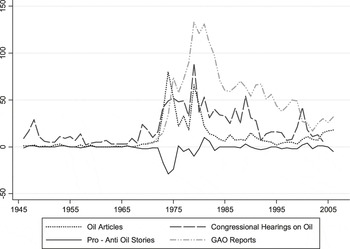
Was there ever a chance to substantially change energy policies? In retrospect, the oil shock of the 1970s provided a great opportunity. The president was committed to change and, as Figure 1 shows, media coverage was intense, public salience was high, and Congress was actively engaged. Further, the partisan vote gap on energy bills was considerably smaller as compared to today.Footnote 64 The partisan gap on other environmental issues was also much smaller.Footnote 65 Yet the opportunity was lost. Even during this time period, public interest was not sustained. Further, change proponents did not find ways to overcome existent partisan and parochial divisions. Subsequent endeavors faired no better.
Media and government attention to oil policies.

While the crises did not significantly change policies regarding oil, the opportunity did exist. One possibility was to dramatically refocus subsidies and support away from fossil fuels and toward renewables. Examples of such shifts in energy policy include the government’s movement toward, and then away from, nuclear and hydropower. Similarly, gasoline taxes could be adjusted for inflation or beyond. As the costs of oil increased and renewable technology grew, market forces would have promoted a shift in energy consumption. In this way, effective policy change would not have required the dramatic restructuring of the U.S. economy by Congress or executive agencies. These steps, while often discussed, have not been implemented.
The repeated failures to seize opportunities suggest a broader question: Is the first shock to a stable policy system typically the one that provides the greatest opportunity for policy change? Our analysis suggests several reasons for this argument. First, the original shock is the one that generates the most media attention, while subsequent shocks lose novelty. Second, the first major shock may produce the most critical condemnations of the status quo. Reaction to subsequent crises may be muted due to familiarity or prior industry response. Third, the first major crisis may well inspire the strongest public reaction in the form of outrage. Fourth, the first major shock may well produce the most active government response as political actors search for solutions. As a result, the first crisis may motivate an innovative, bipartisan policy response. As subsequent crises occur, policymakers will have drawn partisan lines regarding possible responses that are difficult to cross. Similar to the view that there is no love like the first love, there is no opportunity like the first one.
A full analysis is beyond the scope of this article, but some preliminary consideration suggests that “first shocks” have produced seminal changes. For example, the shocks of the late 1960s (the Grand Canyon dam, the Santa Barbara oil spill, the Cuyahoga River fire) fostered changes to what had been fairly dormant national environmental policies, resulting in seminal legislation such as the Clean Air Act, the Clean Water Act, and the Endangered Species Act, all within five years. Change proponents managed to sustain public interest in these issues for those years and built coalitions that crossed party lines. These laws were thus passed by large, bipartisan margins. Since 1973, media attention on environmental issues has waned, public support has softened, and partisan battle lines have hardened so that subsequent efforts, even when motivated by shocks, have not been as successful.
Conclusions
The broad American public as well as all of our recent presidents, Democratic and Republican alike, have voiced support for substantial changes to American reliance on oil. None of those presidents was successful, including four who arguably could have used the oil shocks discussed in this article as opportunities to revise status quo policies. A more satisfying study would have more variance in the dependent variable to explain why one of those occasions produced a successful outcome when the others did not. Then again, the fact that none produced significant change is important in its own right. Shocks can provide opportunities, but policy change still depends on sustained interest and effective coalitions. Those factors have yet to be apparent in efforts to change American policies that continue our reliance on oil for our energy needs.