INTRODUCTION
Water scarcity around the world has led many researchers to examine methods for improving water use efficiency (WUE) in crops as well as the reduction in crop water use. Canopy transpiration is determined by the canopy size, i.e. by the amount of leaf area present. Reducing the leaf area has been found to decrease transpiration in wheat (Midmore et al. Reference Midmore, Ockerby, Zhu, Radford and Yule2001; Zhu Reference Zhu2001), maize (Crookston & Hicks Reference Crookstoon and Hicks1988) and soybean plants (Ostlie & Pedigo Reference Ostlie and Pedigo1984) that, in turn, conserved soil moisture. However, leaves are also the site of carbon assimilation. Improving plant trade-offs between carbon assimilation and water loss as well as improving the partitioning of assimilates between reproductive and non-reproductive structures in relation to water availability are essential in developing agricultural field management techniques that match plant water requirements and increase grain yield.
Two aspects of plant physiology that are affected by defoliation are the relationship between the sink and the source in carbohydrate availability and modified water balance across the plant. Regarding the sink/source relationship, many researches have focused on accurate and precise assessments of foliar diseases (e.g. Guan & Nutter Reference Guan and Nutter2002). They have evaluated the yield and quality effects of defoliation on forage production to improve the ability of agronomists, farmers and crop insurance adjusters to assess the economic impacts of leaf damage (Roth & Lauer Reference Roth and Lauer2008). Models have been developed for a range of crops that simulate the impact of defoliation caused by pests on crops (Kropff et al. Reference Kropff, Teng and Rabbinge1995; Olesen & Grevsen Reference Olesen and Grevsen2000).
In these models, the balance of carbohydrates between the source and sink organs was assessed based on empirical data from defoliated plants. Empirical experiments for wheat showed that during the vegetative period, defoliation at early and middle tillering did not affect grain yield, while defoliation imposed at late tillering and at booting reduced grain yield under rain-fed conditions (Zhu Reference Zhu2001; Zhu et al. Reference Zhu, Mideore, Radford and Yule2004). Ahmadi & Joudi (Reference Ahmadi and Joudi2007) found that neither the grain yield nor the protein content of winter wheat was affected by defoliation, even with the removal of all of the leaves at the anthesis stage. Timing of defoliation played a critical role in the responses of crops to defoliation.
Modification of the water balance can be elicited by defoliation in water-limited conditions. Many studies have found that defoliation enhances the photosynthetic rates of the remaining leaves, compared to those of comparable leaves on non-defoliated control plants (Trumble et al. Reference Trumble, Kolodny-Hirsch and Ting1993; Rosenthal & Kotanen Reference Rosenthal and Kotanen1994). Gas exchange rates that were reduced by water deficit may increase in defoliated soybean (Shimada et al. Reference Shimada, Kokubun, Shibata and Matsui1992), sugarcane (Meinzer & Grantz Reference Meinzer and Grantz1990), cotton and maize (Yang & Midmore Reference Yang and Midmore2004) and rice (Fukoshima et al. Reference Fukoshima, Hinata and Tsunoda1985). For soybean (Shimada et al. Reference Shimada, Kokubun, Shibata and Matsui1992) and rice (Fukoshima et al. Reference Fukoshima, Hinata and Tsunoda1985), defoliating also alleviated the drop in water potential and water content of the remaining leaves. The high photosynthetic rate of defoliated plants may be achieved through a high gas exchange rate and a modified water balance of the remaining leaves.
The modification of water balance by defoliation may also affect carbohydrate translocation in wheat that has been affected by drought during the maturing stage. The ability of carbohydrate reserves (e.g. culms) to be remobilized to grains is likely to be an important characteristic used to maintain reproductive growth under a water deficit in various species, including cereal and some legumes (Blum et al. Reference Blum, Sinmena, Mayer, Golan and Shpiler1994). Assimilates produced pre-anthesis that are stored in the vegetative plant parts have an important role in buffering grain yields against unfavourable conditions for photosynthesis during the grain-filling period (Gallagher et al. Reference Gallagher, Biscoe and Hunter1976; Bidinger et al. Reference Bidinger, Musgrave and Fischer1977; Austin et al. Reference Austin, Morgan, Ford and Blackwell1980; Gaunt & Wright Reference Gaunt and Wright1992). Dry matter (DM) and nitrogen are mostly accumulated before anthesis and the contribution of pre-anthesis assimilates to kernels varies from 0·04 to 0·25 (Przulj & Momcilovic Reference Przulj and Momcilovic2001). Remobilization of reserves to grain is critical for grain yield under water deficit during the grain-filling period (Nicolas et al. Reference Nicolas, Lambers, Simpson and Dalling1985; Palta et al. Reference Palta, Kobata, Turner and Fillery1994; Ehdaie & Waines Reference Ehdaie and Waines1996) and the reserves contained in the stem and sheath contribute 0·25–0·30 of the final grain weight (Rawson & Evans Reference Rawson and Evans1971; Gallagher et al. Reference Gallagher, Biscoe and Hunter1976; Schnyder Reference Schnyder1993; Gebbing & Schnyder Reference Gebbing and Schnyder1999). Such results show that increased remobilization of stored assimilates in non-reproductive structures enhances the apparent photosynthesis rate of the retained leaves and decreases the maintenance respiration by source reduction that might buffer, or even enhance, grain yield under defoliation.
There are fewer studies concerning water use after either artificial defoliation or defoliation due to diseases and pests. Previous studies of spring wheat by Islam & Sedgley (Reference Islam and Sedgley1981) showed that shoot populations were optimized by detillering, resulting in a higher WUE, an increased grain yield and an increased harvest index (HI). In the North China Plain, winter wheat is cultivated under relatively low precipitation conditions; the seasonal rainfall is c. 100–150 mm. The yield of winter wheat can be reduced by up to 50% in the absence of irrigation (Zhang et al. Reference Zhang, Chen, Sun, Wang and Shao2008). It is hypothesized that partial defoliation during some of the growth periods of wheat might enable a reduction in water demand, optimizing the use of soil water and in-crop rainfall, and enhancing grain yield and WUE under water deficit conditions. In particular, the end of vegetative growth seems to correlate with the timing of modified gas exchange for photosynthesis and of water relations for the smooth translocation of pre-anthesis assimilates under drought conditions. The purpose of the present study was to test the effects of defoliation at heading and at anthesis in winter wheat under different soil moisture conditions on the following parameters: (1) yield and yield components; (2) DM remobilization (DRM); (3) the performance of the remaining leaves and (4) water use and WUE, to assess the possibility of defoliation as a water-saving measure in dry areas.
MATERIALS AND METHODS
Experimental site
The experiments were conducted from 2006 to 2008 at the Luancheng Agro-Eco-Experimental station of the Chinese Academy of Sciences (37°53′N, 114°40′S, 50 m asl), which is located in the northern part of the North China Plain at the base of Mount Taihang. The soil is loam with a high water-holding capacity between the field capacity (average 0·36 m3 water/m3 soil) and wilting point (average 0·14 m3/m3) for the upper 2 m soil profile. The average organic matter content in the tillage layer (0–0·2 m) was c. 1·7 mg/g. The available N, P and K were c. 75, 25 and 140 mg/kg, respectively, and the pH was c. 8. Rotation cropping of winter wheat and summer maize dominates in this region. The annual precipitation is 480 mm, of which 113 mm falls from October to May (the growing season of winter wheat) and 367 mm falls from June to September (the growing season of maize). The heavy irrigation during the winter wheat growing season has caused a rapidly falling groundwater table in this region.
Experimental design
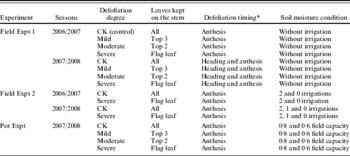
Winter wheat was sown on 10 October for both cropping seasons with a row spacing of 0·16 m and a sowing density of 300 seeds/m2. Chemical fertilizers were applied before cultivation as a base fertilizer at 107 kg N/ha and 108 kg P2O5/ha. Nitrogen was applied again at the jointing stage at 107 kg N/ha. In the spring, herbicide was sprayed to control weeds. No serious diseases or pests were observed in either of the two seasons. During 2006/2007, two experiments were conducted. Experiment 1 consisted of four treatments (control treatment with no defoliation (CK), mild, moderate and severe defoliation) under water deficit conditions (i.e. without irrigation). A randomized design with four replications of each treatment was used. The plot size was 1·5×1·5 m. Experiment 2 consisted of two defoliation treatments (CK and severe defoliation) under two water regimes (either two irrigations or without irrigation) following a randomized design. There were four treatments and each treatment was replicated four times. The plot size was 4×4 m with a 2 m depth access tube installed at the centre of each plot for soil moisture monitoring. Detailed descriptions of each treatment are given in Table 1. Leaves were defoliated immediately at the onset of anthesis (on 5 May 2007 in the 2006/2007 season) from the bottom, upwards along the stem. In each defoliation plot, the leaves designated for defoliation were cut manually, using scissors, at the junction of the leaf lamina and leaf sheath, i.e. the leaf lamina was removed but the leaf sheath remained. In mild defoliation the top three leaves were retained, in moderate defoliation the top two leaves were retained and in severe defoliation only the flag leaf was retained.
The design of the defoliation experiments

* Defoliation at heading was on 28 April 2008; defoliation at anthesis was on 5 May 2007 and 2008.
During the 2007/2008 season, Expt 1 was conducted with the same defoliation levels as in the 2006/2007 season, but with two defoliating times: 1 week before anthesis, on 28 April 2008, and during anthesis, on 5 May 2008. Both of these defoliations occurred under conditions of water deficit. Experiment 2 was conducted with two levels of defoliation as in 2006/2007 under three water regimes: two irrigations, one irrigation or without any irrigation. Additional pot experiments were arranged with four defoliation degrees under two water regimes (Table 1). At the recovery stage (i.e. when winter wheat begins growing after winter dormancy), soil was dug from the nearby field, and cut to a similar shape as the pot (270 mm in diameter and 300 mm in depth), removed and then placed, with the winter wheat, into the pot. The soil and wheat inside the pots were kept in conditions as close to the original as possible, without disturbing the plant. Soil moisture was measured during transplanting. The pots were left in the pits in the field and the soil moisture was maintained at 0·80 of field capacity by weighing the pots every three days until anthesis. When defoliation was carried out the soil moisture was controlled to two levels (0·80 or 0·60 field capacity). Each treatment had four replicates and a total of 36 pots were used.
Measurements
The above-ground DM in the field experiments was regularly measured by randomly cutting 40 plants at the soil surface in each plot. Plant density was recorded. The sampled plants were immediately separated into leaf laminae, stems plus leaf sheaths (hereafter termed stems) and ears. The area of green leaves was measured using a leaf area meter (LI-3100, Li-Cor). The plants were then dried at 80°C for 48 h and the DM of different parts of the plants was determined. At harvest ripeness, all of the plants in each plot were harvested manually and threshed by a grain separating machine. The grain was then air-dried prior to weight recording. Immediately before the harvest spike numbers per unit area were counted, 40 randomly selected plants in each plot were cut at ground level and collected to determine the kernel numbers per spike and the HI.
In Expt 2, roots were sampled at the mature stage by collecting soil cores down to 1·5 m in 0·1 m increments. The core was 100 mm in diameter. Each treatment was replicated three times and the roots were separated by washing and selecting (Bǒhm Reference Bǒhm1979). Root length was estimated using the line-intersect method with a 12·7 mm grid (Tennant Reference Tennant1975). The roots were oven-dried and the dry weight was measured.
Leaf photosynthetic rate (LI-6400, Li-Cor) and stomatal conductance (Leaf Porometer, Decagon Devices, Inc.) measurements were taken regularly by selecting clear days on which they were measured every 2 h from morning to evening. Soil moisture was monitored weekly using a neutron probe (IH-II, Cambridge) at intervals of 0·2 m down to a depth of 2 m.
Analysis
DMR after defoliation was calculated following the equations of Papakosta & Gagianas (Reference Papakosta and Gagianas1991)


where DMR is the dry matter remobilization, DM is the dry matter of aerial plant parts at the anthesis stage, DM* is the dry matter of leaves+stems+chaff at maturity, DMRE is the DMR efficiency, CDMRG is the contribution of the DM at anthesis to the grain and GY is the DM of the grain at maturity.
For these estimates, it was assumed that all of the DM lost from the vegetative plant parts was remobilized into the grain yield (eqns (1) and (2)); losses of DM due to plant respiration during grain filling were not considered.
WUE was calculated as

where GY is the grain yield and ET is the water use during the entire growing period (evapotranspiration). ET was calculated from the soil profile depletion, rainfall, irrigation and drainage (Zhang et al. Reference Zhang, Chen, Sun, Wang and Shao2008).
Analysis of variance (ANOVA) was used to identify the differences among treatments at P=0·05 and 0·01 (Clewer & Scarisbrick Reference Clewer and Scarisbrick2001). Standard error of the mean was used to indicate the variance of measurements for each treatment.
RESULTS
Grain yield and yield components
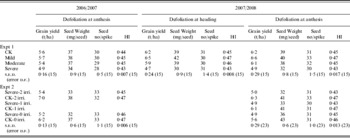
The purpose of Expt 1 was to examine the effects of the degree and timing of defoliation on the yield and yield components of winter wheat. Without irrigation during the entire growth period of winter wheat, the soil moisture in the top 1 m of the profile was 0·18 m3 water/m3 soil (0·50 of field capacity) in 2006/2007 and 0·19 m3 water/m3 soil by volume (0·53 of field capacity) in 2007/2008 at the time of defoliation. Winter wheat was in a condition of mild water deficit. The results show that severe defoliation at the heading and anthesis stages decreased grain yield significantly in both seasons (Table 2). Compared with the control (CK), severe defoliation decreased grain yield by 24% at heading and by 22% at anthesis in 2007/2008 and 14% at anthesis in 2006/2007. Neither mild nor moderate defoliation had a significant effect on grain yield in any of the treatments. Yield reduction due to moderate and severe defoliation at anthesis was less than when defoliation was imposed before anthesis. The seed number per spike was not affected by defoliation, but seed weight was significantly reduced by severe defoliation at both defoliating times. Seed weight was not affected by mild defoliation and reduced slightly by moderate defoliation. The HI was slightly improved under mild and moderate defoliation, while it was decreased under severe defoliation.
Grain yield, seed weight, seed numbers per spike and HI for winter wheat in Expts 1 and 2

Experiment 2 examined the defoliation effects under different irrigation regimes. When defoliation was carried out at anthesis, soil moisture for the top 1 m of the profile was 0·19 m3 water/m3 soil (0·53 of field capacity) for non-irrigation treatment and 0·25 m3 water/m3 soil (0·70 of field capacity) for the treatment with two irrigations in the 2006/2007 season. The soil moisture was 20 m3 water/m3 soil (0·56 of field capacity) for the non-irrigation treatment, 24 m3 water/m3 soil (0·65 of field capacity) for the one-irrigation treatment and 28 m3 water/m3 soil (0·80 of field capacity) for the two-irrigation treatment in 2007/2008. The soil moisture levels were quite different among the different irrigation treatments. The results show that severe defoliation at anthesis decreased the grain yield significantly under all soil moisture conditions. However, the reduction in yield was 21% under two irrigations, 19% under one irrigation and 12% under the rain-fed conditions for the severe defoliation treatment compared with the control in the 2007/2008 season. In the 2006/2007 season, the yield reduction was 23% under wet conditions and 15% under deficit conditions (Table 2). Seed numbers per spike were not affected, but the seed weight was significantly reduced by defoliation at anthesis stage under all soil moisture conditions.
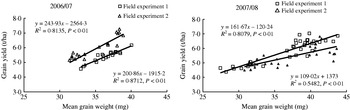
Defoliation either at heading or anthesis significantly reduced seed weight in both Expts 1 and 2 when only the flag leaf was retained. However, when the top three leaves were retained, grain yield was not reduced. Retaining the third leaf from the top contributed 0·06 of the grain production after defoliation at anthesis in 2006/2007, and 0·06 and 0·07 after defoliation at heading or at anthesis, respectively, in 2007/2008. The contribution of the second leaf from the top to the grain production after defoliation at anthesis was 0·10 in 2006/2007 and 0·20 and 0·21 after defoliation at heading or anthesis, respectively, in 2007/2008. The strong linear relationships between grain yield and seed weight (P<0·01) showed that DM production and transition to grains were the most important factors affecting grain yield after defoliation (Fig. 1).
Relationship between grain yield and seed weight in two field experiments in 2006/2007 and 2007/2008 under different defoliation intensities.

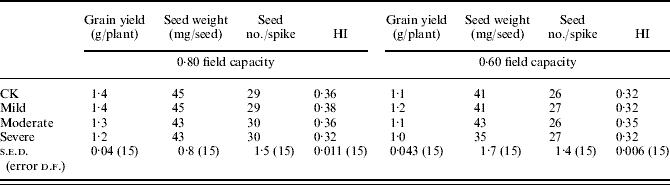
An additional pot experiment examined the effects of defoliation intensity and soil moisture conditions on the yield and yield components in winter wheat (Table 3). The results show that severe defoliation reduced yield, seed weight and HI significantly under the two soil moisture conditions. Mild defoliation improved grain yield under dry conditions. Yield was reduced by 5·8 and 1·8% under wet and dry conditions, respectively, for moderate defoliation, and by 12% under both wet and dry conditions for severe defoliation. Yield reduction for moderate defoliation was less under dry conditions than under wet conditions. Similar trends were found for the field experiments.
Grain yield, seed weight, seed numbers per spike and HI of winter wheat under three levels of defoliation at anthesis under two water regimes (pot experiment in 2007/2008)

DMR
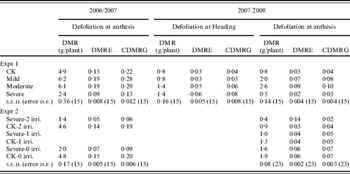
When leaf laminae were artificially removed, either before or after anthesis, DMR from the vegetative parts to the grains might be a response to reduced photosynthetic source. DMR, DMR efficiency (DMRE) and the contribution of DMR to grain yield (CDMRG) are presented in Table 4 for the tests across the two seasons. Marked differences among the different treatments were found. Mild and moderate defoliation resulted in higher DMR, DMRE and CDMRG compared with the CK treatment, while severe defoliation significantly reduced these three parameters (Table 4). It was observed that DMR, DMRE and CDMRG were higher for the CK than that for severe defoliation under any soil moisture conditions. The DMR, DMRE and CDMRG under severe defoliation for rain-fed treatments were greater than that for irrigated treatments, indicating that DMR was increased by severe defoliation under dry conditions.
DMR, DMRE and CDMRG for different defoliation intensities for winter wheat for Expts 1 and 2

Through the two years of field experiments, defoliation was generally more beneficial to DMR into grain under water deficit conditions than under well-watered conditions. Mild and moderate defoliation increased DMR into grains, and grain yield was thus less affected by defoliation at anthesis than at the heading period.
Water use
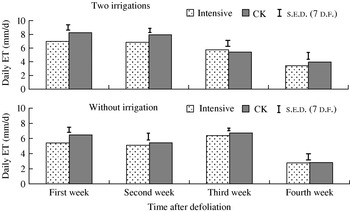
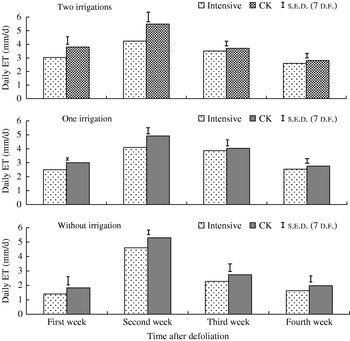
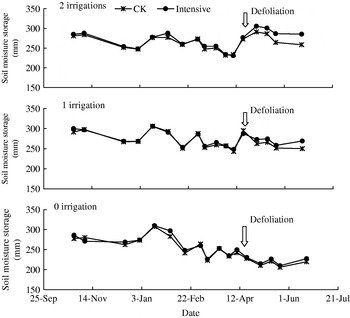
Leaf defoliation affected not only the equilibrium between DM production and remobilization but also canopy transpiration. The results from Expt 2 show that the daily water use (daily ET) was markedly decreased immediately after defoliation in both seasons (Figs 2 and 3). However, the reduction was not proportional to the decrease in leaf area by defoliation. The difference in the daily ET between defoliation and CK gradually became smaller because of the senescence of the leaves in the control plants. Defoliation decreased the water use of the crop to some extent. Daily ET was reduced by 15–20% during the first and second week after defoliation. The reduction under well-watered condition was greater than that under dry conditions. The total reduction in water use after defoliation was 20 and 14 mm for wet and dry conditions, respectively, in the 2006/2007 season. The reduction in water use was 39, 38 and 18 mm for the 2, 1 and 0 irrigation treatments, respectively, in 2007/2008. Figure 4 shows the change in soil water storage in the top 1 m of the soil profile in the 2007/2008 season. The storage of soil moisture after defoliation was immediately greater than that in the non-defoliation treatments. Defoliation conserved soil moisture in the root zone profile; this conservation might help the crop last longer under very dry conditions. The difference in the soil moisture storage between defoliation and non-defoliation treatments was greater under wet conditions than under dry conditions. The reduction in water use due to defoliation under wet conditions was greater than that under dry conditions.
Average daily water use (daily ET) after defoliation at anthesis for severe defoliation treatment and CK under two irrigation treatments for winter wheat (Expt 2, 2006/2007). Bars are s.e.d.

Average daily water use (daily ET) after defoliation at anthesis for severe defoliation and non-defoliation treatments under three irrigation treatments for winter wheat (Expt 2, 2007/2008). Bars are s.e.d.

Seasonal soil moisture storage change for the top 1 m soil profile for severe defoliation and non-defoliation treatments under three irrigation treatments (Expt 2, 2007/2008).

Root distribution
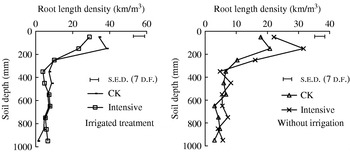
The distribution of roots in the soil profile is an important factor that determines the availability of soil water and nutrients to plants; it was closely correlated with the patterns of soil water uptake. Defoliation affected the total root length and the root distribution. In 2006/2007, the total root length of the top 1 m of the soil profile for irrigated treatments was 12·2 and 10·4 km/m2 (to a depth of 1 m) in CK and severe defoliation, respectively (Fig. 5). For non-irrigated treatments, the total root length was 8·3 and 11·1 km/m2 (to a depth of 1 m) in CK and severe defoliation, respectively. Defoliation reduced root growth under wet conditions and increased root growth under dry conditions, particularly in the topsoil profile. As a result, there was a marked difference in the root length density in the top 0·4 m profile between the defoliated and non-defoliated treatments.
The distribution of root length density of defoliated and non-defoliated winter wheat at maturity under irrigated and non-irrigated conditions (Expt 2, 2006/2007).

WUE
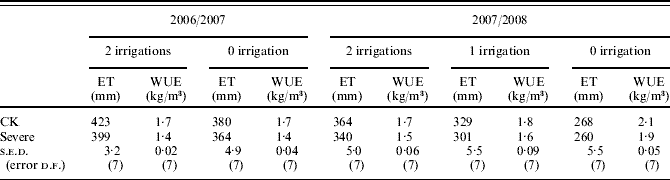
Defoliation decreased water use to some extent, but it significantly reduced the grain yield under severe defoliation. The overall effects of defoliation on the seasonal water use (ET) and the WUE are listed in Table 5. Under wet conditions, severe defoliation at anthesis reduced the seasonal ET by 6–8%, while the WUE was reduced by 15–18%. Under dry conditions, severe defoliation at anthesis slightly reduced the seasonal ET (by 3–4%), while the WUE was reduced by 10–15%. Reduction in the WUE was slightly less under dry conditions. The pot experiment showed that the WUE at mild and moderate defoliation levels was similar to the CK, but severe defoliation significantly reduced the WUE (Fig. 6). The results showed that the use of severe defoliation to reduce water use and to conserve soil moisture might not be an economic choice, even under dry conditions.
WUE of winter wheat under four levels of defoliation at anthesis and two soil moisture levels (0·80 and 0·60 of field capacity) (pot experiment 2007/2008). FC=field capacity. Bars are s.e.d.

Seasonal water use (ET) and WUE for different treatments in Expt 2

DISCUSSION
Previous studies of the effect of defoliation on wheat yield have found both decreases and increases in yields, with large differences. Yields are affected synergistically by the defoliation time (Olson et al. Reference Olson, Senft and Richards1989), plant genotype (Nugent & Wagner Reference Nugent and Wagner1995), leaf location and the number of leaves removed (Rao et al. Reference Rao, Yang, Berggren and Snow1989) and other environmental factors (Ovaska et al. Reference Ovaska, Walls and Vapaavuori1993). The stage of crop growth at which defoliation occurs influences the resultant effect on grain yield. The critical period for yield loss due to defoliation is between heading and flowering (Najad Reference Najad1981). Defoliation at tillering has the potential to increase the grain yield and the WUE (Zhu Reference Zhu2001; Zhu et al. Reference Zhu, Mideore, Radford and Yule2004). A general reduction in the weight of grains has been observed as leaf area was reduced, especially when the flag leaf and the leaf immediately below it were removed (Najad Reference Najad1981; Sairam & Dube Reference Sairam and Dube1984). Rao et al. (Reference Rao, Yang, Berggren and Snow1989) and Asghar & Ingram (Reference Asghar and Ingram1993) reported that the removal of the flag leaf and the top two leaves caused significant reductions in grain weight, while Aggarwal et al. (Reference Aggarwal, Fischer and Liboon1990) reported that flag leaf removal led only to a small reduction in the grain yield. A study by Ahmadi & Joudi (Reference Ahmadi and Joudi2007) showed that grain yield and protein content were not affected by defoliation; even the removal of all of the leaves at the anthesis stage did not have an effect. However, the results from the present study show that defoliation between the heading and the flowering periods reduces grain production significantly, with yield reduction at heading being greater than at anthesis when all of the leaves except the flag leaf were removed. Yield reduction was much less when one additional leaf immediately below the flag leaf was retained. Grain yield was not affected and even slightly increased when leaves other than the top three leaves were removed, which might have reduced the respiration consumption by the leaves at the bottom of the stem. Under water deficit conditions, yield reductions were less than under wet conditions, for all levels of defoliation tested. Mild or moderate defoliation might be beneficial to grain production when winter wheat is grown under water deficit.
Defoliation evokes many morphological and physiological responses in plants and most of these responses have been interpreted as mechanisms for compensatory growth (McNaughton Reference McNaughton1983; Foggo Reference Foggo1996). An increase in the photosynthetic rates of the leaves remaining on partially defoliated plants, compared to the rates of comparable leaves on non-defoliated control plants, has commonly been found (Trumble et al. Reference Trumble, Kolodny-Hirsch and Ting1993; Rosenthal & Kotanen Reference Rosenthal and Kotanen1994). In the present study, defoliation increased the photosynthetic rate of the remaining leaves (Fig. 7). Yang & Midmore (Reference Yang and Midmore2004) explained this evidence based on water status. When the net leaf photosynthesis is limited by water supply from the roots, reduced competition for water among the remaining leaves (after the removal of some leaf area) is the primary influence on photosynthetic activity. However, this increase in the photosynthetic rate caused by defoliation occurred in all of the water conditions in the present study. It has been suggested that the enhanced photosynthesis of defoliated plants results from compensatory growth mechanisms in the source–sink relationship following defoliation or from the reduced competition among the remaining leaves for nutrient or hormones supplied by the roots (McNaughton Reference McNaughton1983; Meyer Reference Meyer1998; Collin et al. Reference Collin, Epron, Alaoui-Sossé and Badot2000). The reduced competition for water among the remaining leaves, after the removal of a part of the leaf area, might not be the only significant influence on photosynthetic activity. In plants growing under water deficit, stomatal closure plays a role together with leaf photosynthesis (Cornic Reference Cornic2000). An increase in stomatal conductance was observed in the present study under all soil water conditions that was consistent with the photosynthetic rate increase.
Photosynthetic rate of flag leaf for different defoliation treatments (Expt 1, 2006/2007 and Expt 2, 2007/2008). Bars are s.e.d.

Grain filling of small-grain cereal occurs via the acquisition of assimilates from current photosynthesis and the translocation of stored non-structural assimilates accumulated before anthesis. A reinforced photosynthetic rate in the non-defoliated leaves may be an important factor buffering grain yield from declining under decreases in photosynthetic resources due to the removal of leaves. In the present study, yield was not significantly affected by mild, or even by moderate, defoliation. Yield reduction from severe defoliation was also less under dry conditions. DMR to the grain yield was enhanced by defoliation, which might have compensated for the assimilate reduction resulting from defoliation to some extent. Mild or moderate defoliation was beneficial to the grain yield under water deficit conditions, especially after anthesis.
Most studies have concluded that grain filling is affected by both the availability of assimilates (source) and the capacity of the grains (sink) to use them (Borrás et al. Reference Borrás, Slafer and Otegui2004). According to the ‘functional equilibrium’ theory, the root/shoot ratio of a plant is regulated to achieve a balance between the supply of carbon from the shoots and the supply of mineral nutrients and water from the roots (Brouwer Reference Brouwer1983). The response of plants to a shortage of carbon brought about by defoliation is generally to increase the allocation of resources to shoot growth and to decrease the allocation to root growth (De Roover et al. Reference De Roover, Van Laere and Van Den Ende1999; Todorovic et al. Reference Todorovic, Robin and Guckert1999). The present results show that defoliation did significantly reduce the root length density in the topsoil profile under well-watered conditions, but that root length density was increased under dry conditions.
Defoliation reduced water use, but under severe defoliation, yield reduction was much greater than the reduction in ET, resulting in lower WUE. Mild and moderate defoliation slightly decreased the ET but did not alter the WUE. The results show that efforts to conserve soil moisture by removing leaves might not be economical. The benefit of DM production by leaves is greater than the reduction in water use achieved by removing them. Removing the leaves decreases the shading provided to the soil surface and might increase soil evaporation as well. Under extreme drought conditions, the ET reduction due to removing leaves might conserve soil moisture and make the crop last longer. In very dry conditions, the benefits of defoliation on soil moisture preservation need to be considered. Under the conditions seen in the North China Plain, extreme dry seasons during the winter wheat growing season often occur and serious yield reductions happen under rain-fed conditions. Further studies on the timing of defoliation or the degree of leaf removal on water use and WUE under such very dry seasons are needed in order to provide crop management guidelines to enhance crop yield.
This research was funded by the National Program on Key Basic Research Project of China (Grant No. 2006CB403406), National High-tech R&D Program of China (Grant No. 2006AA100203) and KAKENHI (18688019) from the Ministry of Education, Culture, Sport, Science and Technology (MEXT) of Japan.