

The lack of data reuse is a pervasive problem in archaeological research and heritage management. Archaeologists are in possession of enormous amounts of data that usually go unused after the excavator's initial interpretations. I will rely on Huggett's (Reference Huggett2018:96) definitions of “use” versus “reuse,” where use is attributed to the actions of the originator(s) of the data, whereas reuse is tied to anyone other than the primary creator. An important foundation for encouraging this type of data reuse is the increasing number of platforms now available to retrieve open access data over the last two decades (Garstki Reference Garstki2020:35–44; Kansa Reference Kansa2015). And as the open data movement and FAIR data principles are established in archaeology, researchers have been more focused on the long-term accessibility and reusability of their data (Kansa et al. Reference Kansa, Atici, Kansa and Meadow2020). However, despite these ideals, archaeological data are still seldom reused. There are numerous reasons for the lack of reuse that range from primary data creation and collection being considered more important in academic circles, to researchers being unaware of existing and available data, to the reality that analyses using data created by others can often take longer than data creation (Cook et al. Reference Cook, Çakirlar, Goddard, DeMuth and Wells2018; Sobotkova Reference Sobotkova2018). The lack of data reuse is also partially based on a broader lack of data literacy in archaeology and related fields. Students of these fields are not often taught data principles, which leads to a gap in later professional knowledge.
Digital literacy—that is, the ability to communicate about, understand, and use digital tools—is tied closely to data literacy, including the reuse of open data. In this way, data literacy is the knowledge of data structures, principles, and their potential uses, whereas digital literacy refers to the practices surrounding the use of digital tools. As Cook and colleagues (Reference Cook, Çakirlar, Goddard, DeMuth and Wells2018:145) accurately point out, literacy in digital methods is crucial to expanding the use of open access data in all sectors of archaeology. However, the rate at which technologies change and new approaches evolve is too rapid to be thoughtfully integrated into normal curricula. It requires significant time to keep up with broad conversations in the discipline outside of one's own expertise and interests, let alone learning the new tools that become available to archaeologists. Yet despite these hurdles, Cook and colleagues (Reference Cook, Çakirlar, Goddard, DeMuth and Wells2018) have demonstrated that it is possible to integrate training in open access data reuse into existing classes.
Following Cook and colleagues’ model for addressing what I view as a deficit in digital literacy and data reuse instruction, I developed and taught an undergraduate and graduate course in spring 2020 for the Department of Anthropology at the University of Wisconsin–Milwaukee (UWM) called Digital Archaeology and Data Reuse. There were seven students in the course: one undergraduate and six graduate students. The course addressed the following issues:
(1) There are vast amounts of archaeological data that are not being (re)used.
(2) Students are not being taught how to use archived data—or even that they should.
(3) Emerging technologies in American archaeology tend to be taught/learned haphazardly and are often considered the purview of the “specialist.”
(4) Instructors may feel unqualified to teach digital tools or methods.
(5) There are limited resources that provide templates for activities that instructors can make use of.
The course was funded externally by the Alexandria Archive Institute (AAI), a 501(c)(3) nonprofit organization. AAI received an Infrastructure and Capacity-Building Challenge Grant from the National Endowment for the Humanities to support the development of a program with a key aim of developing data literacy among students and other practitioners of archaeology. To this end, a portion of the AAI's annual budget is earmarked for developing a data literacy program, which includes a variety of approaches such as workshops, undergraduate and graduate courses, and fellowships. This course was a part of this program, working to develop principles of archaeological data literacy and reuse. This article will outline the approaches taken to establish digital literacy and highlight data reuse for this group of students. All of the activities developed for this course are hosted in a GitHub repository and are archived through Zenodo, accessible to readers for their own use (see Data Availability Statement).
EDUCATIONAL APPROACHES TO DIGITAL AND DATA LITERACY IN ARCHAEOLOGY
Some postsecondary digital and data-oriented approaches to archaeology education have been innovative, although unfortunately they have been unevenly enacted across the discipline. Recently, a push toward “gamifying” learning opportunities has built on successful early interactive archaeological teaching applications such as Excavating Occaneechi Town: Archaeology of an Eighteenth-Century Indian Village in North Carolina (Davis et al. Reference Davis, Livingood, Ward and Steponaitis1998), Virtual Dig: A Simulated Archaeological Excavation of a Middle Paleolithic Site in France (Dibble et al. Reference Dibble, McPherron and Roth2000), and Adventures in Fugawiland: A Computer Simulation in Archaeology (Price and Gebauer Reference Price and Gebauer1997). For example, two recent volumes that focused on teaching in the digital humanities and the ancient Mediterranean—Digital Approaches to Teaching the Ancient Mediterranean (Heath Reference Heath2020) and Communicating the Past in the Digital Age (Hageneuer Reference Hageneuer2020)—included a number of articles emphasizing gamification in teaching. For example, Remmy (Reference Remmy and Hageneuer2020) describes his utilization of virtual geocaching in a course on Roman Cologne, and Blakely (Reference Blakely and Heath2020) outlines the use and continued development of Sailing with the Gods, an online, interactive game where the player is seafaring in the Hellenistic world and using social, ritual, and civic networks. These approaches harness the interactivity of games while situating archaeology (or the humanities more broadly) at their center.
Yet, as engaging as gamification can be to students, most gamification approaches do not directly teach the skills in data literacy that are sorely needed in the humanities and social sciences. One of the most thorough discussions of utilizing open archaeological data to develop students’ data literacy and critical thinking is Agbe-Davies and colleagues’ (Reference Agbe-Davies, Galle, Hauser and Neiman2014) publication. In it, they describe their use of the Digital Archaeological Archive of Comparative Slavery (DAACS) in several classes across universities that ranged from general education undergraduate courses to upper-level graduate courses. Most importantly, the classes provided new avenues for students to learn about slavery and demonstrate the utility of digital tools for addressing postmodern questions in archaeology. Taking data reuse in classrooms further, Markwick and colleagues (Reference Marwick, Wang, Robinson and Loiselle2020) have recently explored the importance of accessing archaeological datasets for reuse as well as reproducing analyses conducted in those initial studies. Just as reproduction of analyses teaches students the processes of knowledge creation, digital modeling and simulation can achieve similar ends. Holter and Schwesinger (Reference Holter, Schwesinger and Hageneuer2020) have argued that the use of 3D modeling of architecture or virtual simulations of past events encourages students to engage with the data itself, understanding how it was created, learning about biases, and questioning its fidelity through modeling. Graham (Reference Graham2020) has argued for similar ways of learning archaeology through agent-based modeling, albeit not in a classroom context.
Approaches to teaching archaeology have therefore included digital tools to teach archaeological concepts, although they rarely integrate the learning of digital tools, archaeological concepts, and a deeper understanding of data principles. However, some recent examples have demonstrated that this is indeed both feasible and useful. Cook and colleagues (Reference Cook, Çakirlar, Goddard, DeMuth and Wells2018) integrated open access datasets into their undergraduate and graduate courses in the Netherlands (Çakirlar), Canada (Cook), and the USA (Wells), establishing the importance of teaching data reuse as ethical practice, which includes attaining a level of digital literacy. In addition to documenting their work, Cook (Reference Cook2017) has also made her teaching resources for the class available—an important factor to making these types of teaching approaches accessible to a wider audience. Paralleling this approach are Beaulieu and Bucci (Reference Beaulieu, Bucci and Heath2020), who designed a Classics class with a focus on data literacy that leads to data analysis, all while situating these tools within the humanities broadly. The interesting conclusion they came to, and a principle that then structured the class, was that to accomplish the learning outcomes, the students did not need to learn computer programming. Instead, students used KNIME, an open-source platform that allows users to create data workflows without coding for specific actions. Beaulieu and Bucci (Reference Beaulieu, Bucci and Heath2020:132) therefore allowed students to learn computational thinking without necessarily learning coding.
However, if coding is an important skill for archaeologists or other humanists to learn, there are some excellent resources available. One of the best resources including activities and tutorials for learning digital tools is The Open Digital Archaeology Textbook (ODATE; Graham et al. Reference Graham, Gupta, Carter, Compton, Smith, Angourakis and Reinhard2019). ODATE is a digital textbook and web-based environment that integrates background on digital archaeology (broadly conceived), introductions to digital tools, and embedded exercises to learn these tools (see recent overview, Daems Reference Daems2020). In addition to its readability and clear instruction, ODATE situates the tools in broader discussions in the field. For a wider and more technical resource, one could explore the Programming Historian, a platform that provides individual peer-reviewed tutorials on a variety of digital tools that can be used for research or teaching.
COURSE DESIGN
The class at UWM was developed to address the concerns noted in the introduction and to focus on building a foundation from which students can continue to learn on their own. I felt that there were three directions to take a course like this: focus in detail on a few topics, use specific datasets as the basis for learning a smaller number of tools, or provide introductions to a broad set of topics. I chose the latter, given that these students might not have the opportunity to take a class such as this farther down the road in their academic careers, and that a wider breadth of knowledge of the many tools, techniques, and conversations occurring across the discipline is essential. The learning outcomes were chosen to establish general knowledge of data and data practices, and to develop the skills to become digitally and data literate. These skills are necessary for all segments of archaeological research but are also transferable to most sectors of contemporary professional life.
Course Learning Outcomes:
• Be able to access and collect data from open sources.
• Know the basics of data management and curation.
• Have knowledge of the methods for utilizing, visualizing, and performing analyses on digital data.
• Be able to assess published digital archaeological datasets knowledgeably.
• Know the different techniques for capturing 3D data and disseminating those data.
• Be familiar with the broad discussions in archaeology surrounding the use of digital technologies, and be able to engage productively in them.
In the design of this class, it was important that students were not only trained in using a tool but were also participating in the larger conversations surrounding the use of digital technologies in archaeological research and engagement in the modern world. For this reason, the semester included both in-class discussions and computer-based activities. Modern archaeological practice does not simply entail the use of emerging or existing digital techniques. It is situated within a larger sociopolitical context that structures practice and impacts real lives. Therefore, the students encountered a wide variety of topics in this course that ranged from more detailed background on coding languages such as Python or R to broad commentaries on ethics in digital archaeology.
Course Topics:
• Basic use of Git
• Jupyter Notebooks
• Data bias
• Born-digital data collection
• Data preservation, curation, cleaning
• Digital repositories
• Potential for data reuse
• Digital dissemination and publication
• Linked open data
• Legacy data
• Scraping
• Application programming interfaces (APIs)
• FAIR (Findable, Accessible, Interoperable, Reuse) data principles
• Organizing data
• CARE (Collective Benefit, Authority to Control, Responsibility, Ethics) data principles
• Archaeological statistics with R
• Big data
• Fidelity, accuracy, and authenticity of 3D models
• Computational photogrammetry
• Data visualization
• Geospatial data for the public
• Storytelling with geographic data
• Public digital archaeology
• Ethical digital archaeology
Most topics did not have full classes dedicated to them. Rather, complementary topics were covered as a unit, such as scraping, APIs, and digital repositories. The full syllabus, which outlines the weekly schedule for the course, is available. The in-class discussions centered on a selection of readings for the week, and there were some written assignments meant to facilitate conversation as well as provide avenues for participation for those less comfortable with verbal communication. Individual blog posts tied together the discussions and activities. Each student maintained their own blog, in which they discussed the results of their guided tutorials and contextualized them within the theoretical conversations occurring in class.
COURSE ACTIVITIES
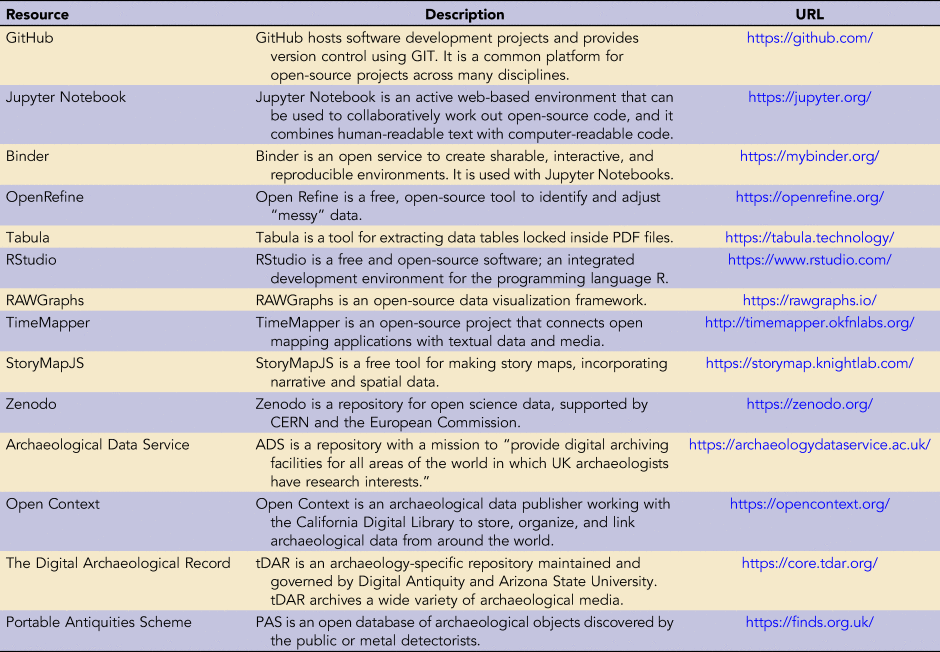
The course activities were developed specifically for this course with the aim of introducing students to a digital tool and utilizing open data in the process. ODATE was the basis for several of the activities and tutorials in this course, whereas other activities were developed independently. All of the open digital resources that were used in the course activities are presented in Table 1. Links to all the tutorials are included in the unit descriptions, and the archived DOIs are presented in the Data Availability Statement.
Open Access Resources Used during the Course.

Getting Started with the Platforms
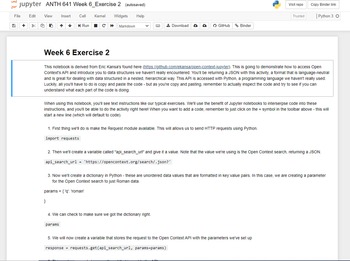
In the initial unit (accessible on GitHub here), the students are introduced to some of the digital platforms that are used regularly throughout the semester. Specifically, tutorials guide students through GitHub and Jupyter Notebook, and they provide a guide to Markdown. Markdown is a simple markup computer language that removes the content from the interface, like Microsoft Word, so that the information will be usable in the future regardless of platform. Here, the students are developing an understanding of how commands lead to outcomes while also becoming familiar with the user interfaces that are the center of their work. Following the lessons in Markdown, we then explore Python and R (activity from Graham et al. Reference Graham, Gupta, Carter, Compton, Smith, Angourakis and Reinhard2019:sec. 1.4). The goal is to demystify computer code, particularly for those who have not engaged much with it previously in school or in their personal life. These lessons are completed in Jupyter Notebooks and run through Binder, which emphasizes open, reproducible, and collaborative research and analysis (see Figure 1). Students can share their Notebooks with each other and the instructor, highlighting the benefit of reproducible analyses in archaeology. One aspect of these tools that the course did not explore—although it should in the future—is the possibility for sharing analyses outside traditional academic boundaries and contributing to a more public digital archaeology.
Screenshot of a Jupyter Notebook showing students how to access Open Context's API (adapted from Eric Kansa's notebook found here: https://github.com/ekansa/open-context-jupyter).

Data Management
This unit is intended to allow students to explore existing ways for researchers to archive, disseminate, and access archaeological data on open access platforms (accessible on GitHub here). Students explore platforms such as Zenodo, the Archaeological Data Service (ADS), Open Context, and the Digital Archaeological Record (tDAR) to understand how different platforms provide different data services and have different missions, and therefore are differently appropriate options depending on the desire for reuse, storage, or publication of data. Consequently, using these data resources in teaching helps further their institutional missions and fulfills the purpose of the open repository. A second part of this unit guides students through how we understand the integrity of the data we use, focusing on the “garbage in, garbage out” concept. We use OpenRefine to interrogate and “clean” a dataset retrieved from an open access repository, focusing on how minor differences in data recording—such as a typo—can reduce the reusability of a dataset (activity based on Graham et al. Reference Graham, Gupta, Carter, Compton, Smith, Angourakis and Reinhard2019:sec. 2.3). The final part of this unit provides students with an opportunity to explore an existing relational database and learn the underlying structures that make relational databases different from flat data tables.
Retrieving Data
This unit introduces additional methods for retrieving data (accessible on GitHub here, here, and here). First, a tutorial guides students through extracting data from PDFs. Many publications have data in the form of tables or appendixes, but it is time consuming to transcribe these data, and errors inevitably occur. We use the tool Tabula to extract data from sample PDFs, with both the downloaded application as well as through RStudio (tutorial is based on activity from Graham et al. Reference Graham, Gupta, Carter, Compton, Smith, Angourakis and Reinhard2019:sec 2.7). The students are also guided through data extraction using the R package metaDigitise, which extracts data from a PDF graph or plot. It is important to note that the class had an explicit discussion about both publication licenses and data licenses. Students are instructed to investigate all publication licenses before using these data, to cite the appropriate publication, and to even reach out to the author of the data when reusing them.
The next section of this unit focuses on the use of APIs to retrieve data from open access sources. APIs are simply the links between applications. So if an application—in this case a data repository—has an open API, it can be used to directly access and download a specific query from the repository onto one's own computer. Students work through the notebooks developed by ODATE and Daniel Pett to access data from the Portable Antiquities Scheme, and a notebook developed by Eric Kansa to access data from Open Context.
Data (Re)analysis
Two units are dedicated to exploring ways to organize data, basic statistical methods using R, and data visualization (accessible on GitHub here). Although many students in archaeology and anthropology are regularly exposed to research using statistical methods, the aim of this unit is to introduce students to one tool for performing these analyses—R. A tutorial teaches students about basic statistical summaries, cross tabulations, graphs and plots, and simple analyses. The tutorial uses data from the “archdata” R package, created by David L. Carlson and Georg Roth, to accompany the book Quantitative Methods in Archaeology Using R (Carlson Reference Carlson2017). The students then combine what they have learned in previous units about retrieving open access data, and they perform basic statistics with them using R.
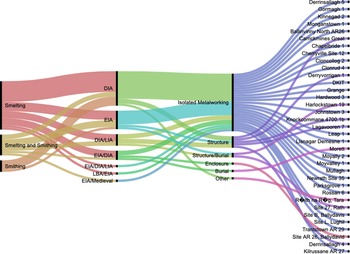
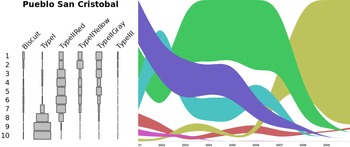
Students then explore different ways to visualize data in order to come to new insights or highlight patterns, first with R and then with RAWGraphs, an open-source data visualization framework that allows users to upload existing data and identify different variables to visualize and modes of visualization (Figure 2; Mauri et al. Reference Mauri, Elli, Caviglia, Uboldi and Azzi2017). Students are encouraged to experiment with visualizations and discover if there are different or more enchanting ways to experience data outside of a typical bar graph (Figure 3).
Alluvial Chart example using RAWGraphs, showing iron-working sites in Ireland by site type and period. LBA (Late Bronze Age):1200–800 BC; EIA (Early Iron Age): 800–400 BC; DIA (Developed Iron Age): 400–1 BC; LIA (Late Iron Age): AD 1–300. (Data from Garstki Reference Garstki2019.)

Seriation from R (left) and RAWGraphs (right) of the ceramics from a midden deposit at Pueblo San Cristobal (LA 80; Carlson Reference Carlson2017; Nelson Reference Nelson1916).

Spatial Data and Webmapping
The final unit of the course is focused on translating geospatial data into narrative forms (accessible on GitHub here and here ). Due to time constraints, students were not taught GIS methods, but they still engaged with data that have important spatial components. Storytelling is an undervalued aspect of archaeological research—that is, being able to distill archaeological data and develop a meaningful interpretation, digestible to those inside and outside the discipline. The first tutorial guides students through the creation of a TimeMap, an interactive webmap that includes a temporal component to tell a story through space and time. For this, we used TimeMapper, an open-source web application that allows users to upload a spreadsheet with (at least) geographical and temporal information and to create a narrative on the web that can be shared in various ways.
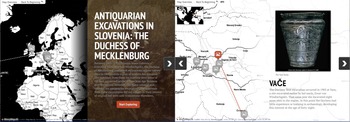
The second tutorial guides students through StoryMapJS (Figure 4), a free tool created through the Northwestern University Knight Lab, which provides students a platform to share geospatially focused stories. A storymap is a webmap that includes other media (images, text, video) to help contextualize the spatial data presented on the map. In this way, the multimedia experience makes space a central aspect of storytelling.
The storymap used for the tutorial of StoryMapJS. It can be viewed here.

RECEPTION
Given that the students were all aware that this course was funded by AAI, we discussed if it would be appropriate to generate formal before-and-after surveys to gauge the effectiveness of the teaching tutorials. In collaboration with the students, we decided not to pursue this formal quantitative assessment of the course, so I will not be discussing specific metrics on the students’ impressions of the course materials. Furthermore, COVID-19 struck around two-thirds of the way through the semester and pushed all classes online, so student impressions of the remaining portion of the course were heavily impacted by the confusion and dread brought on by the pandemic.
Students generally enjoyed the course and commented on the usefulness of many of the skills and tools they learned for their own research. Based on their blog posts, students had the most difficult time with activities that used Jupyter Notebooks and R, although students with prior experience with R from an anthropological statistics course learned both tools much more quickly. The highest level of interest came from the data visualization activities and the storymapping activity. This speaks to a growing interest in archaeological research that explores different methods to visualize data in exciting ways and to construct an engaging narrative in the process. For instructors of archaeology and related heritage fields, this is a useful starting point to guide the teaching of new digital technologies and data literacy. Graphical visualizations draw students into the data and the archaeology behind the data, and they spark imagination about how to tell that story more than spreadsheets filled with data points.
At the same time, students were engaging with real, often messy, archaeological data, some of them for the first time. The messiness of the data we used from open sources was frustrating for students who sometimes struggled to make a test work or a visualization show what they thought it should. Even while I was creating the tutorials, it took me hours to find appropriate datasets that showed at least part of what I was trying to demonstrate in the activity. Yet, as frustrating as this was for all of us, it was worth it. For the students, this is the type of data that they will encounter in their actual careers, and it reinforces the often imperfect process of creation in the data life cycle. As Agbe-Davies and colleagues (Reference Agbe-Davies, Galle, Hauser and Neiman2014:855) noted, “Wrestling with the complexities of real data highlights aspects of the scientific process for students who may not otherwise be forced to contemplate the construction of knowledge.” Students in this class had to think through why a particular dataset was structured in a certain way, what fields were chosen to record, and what discrepancies in recording might mean.
During the development of the course, as well as throughout the semester, I wrestled with the extent to which students should be asked to struggle with these tools. There is a fine line between letting students fail at a task, such as an R code returning an error, for the learning experience and creating a situation where students are so frustrated by the tool that they avoid it. In the latter case, failure and frustration provides an excuse not to use the tool in the future. However, the other end of the spectrum is the learning that comes from failing but understanding why something failed, which is what Graham and colleagues (Reference Graham, Gupta, Carter, Compton, Smith, Angourakis and Reinhard2019) have called “failing productively.” In this course, students had markedly different thresholds for being frustrated to the point of not wanting to use a tool again. Caraher (Reference Caraher and Heath2020) recently discussed the digital divides that he has recognized in his own classes. These are not only between those who might have more or less familiarity with hardware and software but also between those who consume digital products on the web versus those who produce them. An important takeaway from Caraher's arguments is that there is no “one size fits all” approach for teaching digital tools. For many, failing is a luxury that they do not have. Early-stage graduate students at UWM are either working as teaching assistants for tuition remission or are working other jobs to support themselves while also taking their classes. In this scenario, my goal was to work with students to attain the learning outcomes without taking a “work on it as long as it takes” approach, at which I was mostly successful. A few students wrote in their blogs about their frustration and feelings that “they weren't getting it.” This is bound to happen in every class, but it also reflected a failure on my part to communicate a tool or approach.
One of the most significant realizations from the course was that the students’ ability to explore the full potential of open access data was limited by a lack of background knowledge about the data themselves. In many activities, students were making use of data to try out different digital tools for summary, collaboration, analysis, or visualization. Yet, despite creating digital products from these data (statistical tests, plots, storymaps, etc.), the broader archaeological context was often missing. For example, students were asked to access and process the data about glass finds from the Poggio Civitate Excavation Project found on Open Context (Tuck Reference Tuck2012). Then, using a cross tabulation in R, students compared which types of glass objects were found in different areas of the site. However, what the students shared with me is that other than reading the project description (thorough as it is), they had little background knowledge on the archaeological context to really understand the results of their analysis. In an ideal scenario, data used in one of these exercises would be properly contextualized within a student's area of existing research, but this is unrealistic. Another option would be to design a course in which the dataset is foregrounded with an introduction to the archaeological context and only a few digital tools are introduced—a possible course structure mentioned above in “Course Design.” There were a few questions that arose from the realization that students did not connect with the dataset: Does this limited background knowledge about the data render the data meaningless to the students? Is it OK for students to use these data for skills building rather than their archaeological background?
An additional difficulty in incorporating data and digital literacy training into existing curricula is the lack of instructor background and training. As new tools continue to emerge with more advanced hardware, the onus of learning and becoming proficient with a tool rests with the instructor. There has been little change since Agbe-Davies and colleagues’ (Reference Agbe-Davies, Galle, Hauser and Neiman2014:839) study highlighted that there are limited models for using archived archaeological data for effective teaching. For example, I had never used Jupyter Notebooks or the Binder service prior to teaching this class, despite being well versed in digital archaeology. And although ODATE provided excellent foundations for activities, the process of designing my own tutorials and activities using these platforms required significant time. There are resources such as the Programming Historian that provide introductions to platforms such as Jupyter Notebooks, but they require time and often some existing knowledge. The perceived or real lack of technological knowledge is likely the main barrier to these tools or data management approaches becoming integrated into broader undergraduate and graduate curricula. One way to mitigate this problem is the expansion of models like the one developed at Michigan State University, which gathered archaeologists and students to build communities of practice for digital methods, creating workshops and working groups to learn skills and share knowledge (Watrall Reference Watrall2019). Expanding these types of communities could provide the necessary support to expose instructors to new digital techniques in the field and create foundations for improved teaching opportunities.
A final problem encountered during the course and in the preparation of this article was the need for maintenance and updates. A constant issue when using emerging digital tools in the classroom (and in research) is hardware becoming obsolete (e.g., floppy disks), software no longer being supported, broken links, or websites that are no longer hosted. For example, we could still make use of a printed workbook to illustrate principles of stratigraphy to archaeology students, but the Adventures in Fugawiland: A Computer Simulation in Archaeology (Price and Gebauer Reference Price and Gebauer1997) is no longer accessible on current computers. Taking it a step farther, when learning tutorials are created on an ad hoc basis, it is up to the creator to maintain the code or platform, and when the activity is based on open-source platforms this can be a significant time investment. All of these tutorials are likely to end up in the digital graveyard eventually, but how long can they be maintained until this happens?
CONCLUSION
The initial goal in developing this class was to create a model for contributing to archaeological students’ training in digital and data literacy, and to normalize data reuse in archaeological research. Despite some of the difficulties discussed above, the former goal was successful. In undergraduate and graduate programs that may not have the capacity to offer multiple courses in the myriad of developing digital methods, a class that introduces students to emerging techniques, tools, and conversations in digital and computational archaeology can go a long way toward building a foundation for students to build upon for themselves. Furthermore, by creating a suite of activities or tutorials for instructors to use and expand, entry into this field may seem less daunting for the instructor. It remains to be seen if this type of course is the catalyst for transitioning to a field where data reuse in research becomes as common as data creation, but it does contribute to the ongoing missions of the open access repositories and archives whose data formed the content of this course.
By reflecting on the process of developing and teaching this course, several themes stood out that can be built upon moving forward. First, we as instructors should lean into visual and narrative ways for presenting data as a teaching focus, because it is a significant interest to students. We should build on Perry's (Reference Perry2019) and Graham's (Reference Graham2020) suggestions about emphasizing the enchanting aspects of archaeological data; aspects of heritage that evoke emotional responses should be cultivated. Second, messy data are good to use in classes that reinforce the need for data reuse. Although it can be frustrating at times, learning with real archaeological data will prepare students to work with data in the future, whether in archaeology or elsewhere. Third, instructors must be able to gauge their students’ capabilities based on previous experience with digital tools and background knowledge about the datasets used in the class and to adapt the course accordingly. Fourth, a larger infrastructure must be in place—at the campus level or discipline level—to support instructor data and digital literacy. This infrastructure must also make room for long-lasting access to resources that contribute to the instructors’ ability to offer classes with this focus, even if it is outside their expertise.
One additional way forward is for instructors to intentionally build in activities and learning outcomes that deal with data reuse in nondigital archaeology classes. AAI and Open Context, for example, are in the midst of a large program to develop tutorials for this purpose. The initial tutorial, “Cow-Culating Your Data with Spreadsheets and R” (Przystupa and Dennis Reference Przystupa and Dennis2021), guides students through accessing data in the form of a spreadsheet, summarizing data using pivot tables, and visualizing and summarizing data in R. Expanding the role of data reuse in teaching requires that we find ways to support makers of educational digital content, either with resources or infrastructures to maintain content and disseminate them widely. The path toward more ubiquitous data-reuse practices in the field starts with this model of institutionally supported instruction.
Acknowledgments
Thanks are due to the Alexandria Archive Institute and Open Context, which financially supported the teaching of this class from an Infrastructure and Capacity-Building Challenge Grant from the National Endowment for the Humanities. Thanks are also due to the Department of Anthropology at the University of Wisconsin–Milwaukee, which supported this class. Thanks to the two anonymous reviewers, Adrienne Frie for extremely helpful comments on drafts of this article, and Dave Pacifico for his Spanish translation. Finally, I am indebted to the students of Anth: 641, who provided so much insight into the learning process.
Data Availability Statement
All content used and created for the course is available on GitHub (https://github.com/kgarstki/Introduction-Digital-Archaeology-Course) and archived in Zenodo.
Zenodo Archival Information:
https://doi.org/10.5281/zenodo.5765748
https://doi.org/10.5281/zenodo.5765750
https://doi.org/10.5281/zenodo.5765752
https://doi.org/10.5281/zenodo.5765754
https://doi.org/10.5281/zenodo.5765756
https://doi.org/10.5281/zenodo.5765758
https://doi.org/10.5281/zenodo.5765760
Competing Interests
The funding for the class on which this article is based was provided by the Alexandria Archive Institute (AAI), a 501(c)(3) nonprofit organization (EIN: 91-2146202). AAI received an Infrastructure and Capacity-Building Challenge Grant from the National Endowment for the Humanities to support the development of a program with a key aim of developing data literacy among students and other practitioners of archaeology, and the author received compensation from this grant to develop and teach the course.