In this paper I address the issues of production, exchange, and consumption of greenstone during the Early Formative period of Mesoamerica (1600–900 b.c., uncalibrated). The uses of greenstone by the Olmec archaeological culture are studied on the archaeological site of El Manatí (Ortiz Ceballos and Rodríguez Reference Ortiz Ceballos, Rodíguez and Schmidt1988; Ortiz Ceballos et al. Reference Ortiz Ceballos, Rodríguez and Delgado1997) and a very important offering of celts at the site of Cantón Corralito, Chiapas. New perspectives on greenstone for the Early Formative period in the southern Gulf Coast of Mexico are summarized with a focus on the manufacturing techniques of stone celts; their uses in special deposits; and the theoretical aspects of agency, prestige goods, complexity, and technological choice. These discussions are based on a general identification of rocks.
The purpose of this paper is to show the variation in finished and unfinished artifacts represented in the archaeological record. The degree of similarities and differences have the potential to tell us about the kind of interactions that were established between communities that shared many cultural features, such as systems of representation in the decorative motifs on pottery, figurines, other fired clay artifacts, and greenstone tools.
I compare on the one hand the diversity of raw materials that were used for the manufacture of artifacts and on the other the ways that ancient peoples transformed and consumed those raw materials. In the ancient economic exchange of artifacts we need to consider not only the chemical and geological attributes but also the exchange of process of production (sequences of operations) that are related to the anthropological categories of ethnicity, identity, and factionalization. The analysis in variability and diversity is one of the first steps for understanding the kinds of interactions that took place between polities of the southern Gulf Coast of Mexico (Stark Reference Stark, Clark and Pye2000) and other regions of Mesoamerica such as the Pacific Coast of Chiapas (Clark Reference Clark1997). We can see agency reflected in varied ways: how the acquisition of raw materials was established, how every community applied a particular sequence of operations, what techniques were similar in all regions, and how the unfinished and finished objects were used in the archaeological contexts. The objects considered in this paper come from primary archaeological contexts obtained through excavations.
ON THE STONES
The diversity of stones used in pre-Hispanic times was explored by Foshag (Reference Foshag1957) and later by Lange (Reference Lange1993) some 15 years ago. Recent discovery of blue jade quarries in Guatemala (Russell et al. Reference Seitz, Harlow, Sisson and Taube2001; Taube Reference Taube2004) and serpentinite quarries that were used by communities of southern Veracruz and Tabasco such as La Merced (Rodríguez Martínez and Ortiz Reference Rodriguez Martínez, Ortiz, Clark and Pye2000), El Macayal (Ortiz and Rodriguez Reference Ortiz Ceballos and Rodíguez1989), and El Manatí sites (Jaime-Riverón Reference Jaime-Riverón2003) represent important additions to this information base. In spite of these contributions, we need to overcome the limitations of the generic terms “jade” and “greenstone” when thinking in terms of interregional interactions. As there are important implications for analyzing the system of acquisition and distribution, we should rely on the study of a broader diversity of “greenstones” of multiple tones and colors. Considering data from primary contexts, we have the case of the Early Formative period site of El Manatí. At this settlement, Gulf Olmecs were using stone celts for offerings. The artifacts were made from rocks that exhibit dark tones like black jade (metagabro), blue jade, and dark green serpentinite. At a slightly later date, during the Middle Formative period, various communities of southeastern Mesoamerica used stone celts made of light green-yellowish serpentinite along with green jadeite of various light tones. In the transition from the end of the Early Formative to the beginning of the Middle Formative a change occurred in color spectrum preference in the selection of rocks for the manufacture of stone celts and beads. By studying the Mesoamerican indigenous ethnotaxonomies of rocks from the ethnohistorical sources and ethnoarchaeological information of axe-makers, we know that characteristics such as color, strength, refraction index, and cleavage were relevant for determining the qualities of rocks. We can distinguish the stones that were used as generalized wealth and the ones that were inalienable possessions (Weiner Reference Weiner1992). Inalienable possessions do not circulate in traditional societies. They are kept as important identity objects and are inherited for generations.
When we carefully examine the early acquisition of stones in Gulf Olmec sites, it is noticeable that a considerable percentage (30% at El Manatí) consist of metamorphic intrusive rocks (metagabros) and intrusive and extrusive igneous rocks (gabro and basalt), with the rest (70%) consisting of dark-toned jadeitites (mostly blue jadeite). At Formative sites, dark serpentinite was also important. The variety of jadeitites and metamorphic rocks found in the Early Formative period sites of El Manatí and Cantón Corralito can be found at a single geological setting—the Motagua River Valley of Guatemala. We need to de-essentialize our notion of “jade” as an emerald-greenstone of uniform and homogeneous green color and broaden the spectrum of rocks that were relevant in different archaeological contexts of the nuclear Olmec area during the early Formative period and, indeed, in some early Formative sites elsewhere, such as Cantón Corralito.
The case of Cantón Corralito is especially intriguing because the kinds of stone there correspond with those found at the Gulf Olmec site of El Manatí. The peoples of Cantón Corralito employed the same kinds of rocks for the manufacture of stone celts.
ON PRODUCTION
One important topic in the Olmec culture is the manufacture of stone celts, which are abundant in primary contexts in some Gulf Coast sites. There is a study of the manufacture techniques and the sequence of operations that the inhabitants of the Early Formative period followed for obtaining their artifacts (Jaime-Riverón Reference Jaime-Riverón2003). In that study it was noted that only 62% of the celts deposited in offerings were finished (746 out of a sample of 1190 celts from the sites of El Manatí, La Venta, La Merced, El Macayal, and Cantón Corralito). The remainder were deposited unfinished. With this corpus of information, it was possible to define the basic steps of the operative sequence for the manufacture of celts. It is important to take into consideration the productive aspects of these items. Unfinished celts have been called “pseudo-celts” (Drucker et al. Reference Drucker, Heizer and Squier1959; Lowe Reference Lowe1969, Reference Lowe and Benson1981, Reference Lowe1998), an ambiguous term because it is general and could refer to symbols and not the technological and material reality that is the basis of the genesis of the symbolic sphere (Jaime-Riverón Reference Jaime-Riverón2000). In order to have a frame of reference for making effective interregional comparisons, it is also important to take into account the phases or steps involved in the sequence of operations by which the celts were deposited in offerings or burials. If considering issues of craft specialization, attached production, and levels of political organization, we should begin by comparing the same attributes between regions.
ON SHAPE: TIME MARKERS AND POTENTIAL IDENTITY MARKERS
In our study, we have analyzed the shape of stone celts and their changes through time. The making of artifacts shows variation within and among polities. The style of artifacts, in a holistic sense, involves aesthetic values and taste, which are defined as a dialectic relationship between daily practices and canons imposed by local hierarchies (Yoffee Reference Yoffee2005). Production acquires a multidimensional scenario where we can analyze bodily practices (including the memory of the body in the making of artifacts in a social and shared time that involves unintended, habitual, and unreflected activities) and cognitive dimensions (intentionality, conscious manufacture of decorative motifs or the choice of colors, selection of representational systems for adscription of status, and transformation of wealth finance for the expansion of kin and non-kin networks) (see Connerton Reference Connerton1989; Pètrequin and Pètrequin Reference Pètrequin and Pètrequin2000; Stout Reference Stout2002, Reference Stout2003). The final product of these relationships is expressed in the way that artifacts are finished or almost finished when they are deposited in offerings or burials. We have examined the diachronic and synchronic variability of stone celts in some Olmec sites. In order to address the form of celts, we adopted a quantitative approach in order to define shape with different measurements. This method has been applied successfully in Neolithic Britain by Pitts (Reference Pitts1996), who synthesized previous quantitative applications (Celoria and Wilcock Reference Celoria and Wilcock1975; Roe Reference Roe1964, Reference Roe1968). We measured 27 categories in every artifact: weight, length, width, and other features. All the measurements were compiled and transformed in order to obtain comparable ratios. Cluster analyses (hierarchical and k-means methods) were used to define variation in shape categories and changes to them through space and time. When comparing stone celt production, we have the potential to see variability in the operative sequences that were implemented in different regions, in different levels of settlements hierarchies, or different epochs. Those differences in the way of making artifacts may correspond with identity markers, factionalization, technological traditions, or adaptations to particular social/environmental contexts. The subtle variations in forms can show important aspects of group and individual agencies.
INTERACTION BETWEEN THE SOUTHERN GULF COAST AND PACIFIC COASTAL CHIAPAS
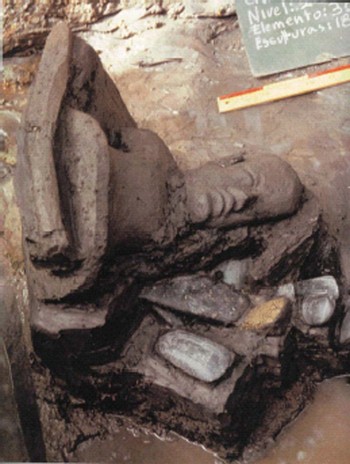
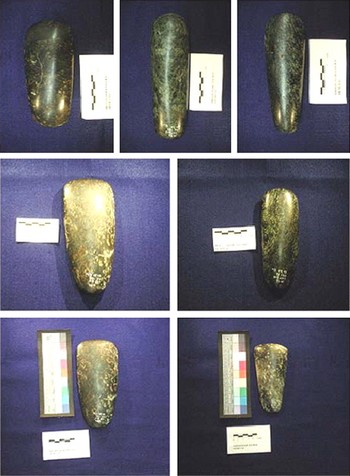
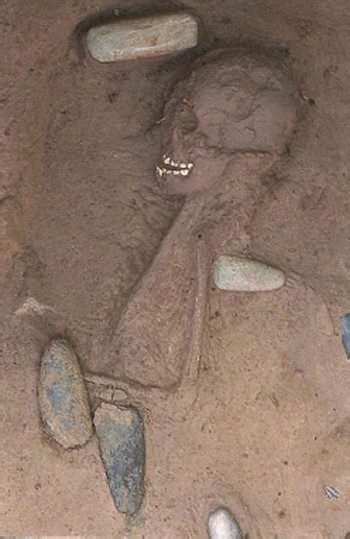
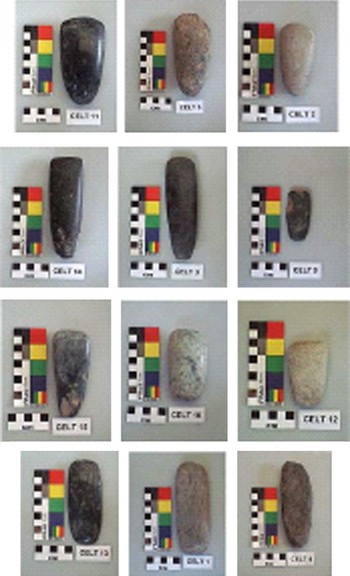
In order to explore the kind of interactions that occurred between communities of the southern Gulf Coast of Mexico and Chiapas through the exchange of greenstone artifacts, we will examine the manufacture of stone celts from El Manatí and Cantón Corralito. El Manatí is a multicomponent site in which there are three phases of offering deposits (Ortiz et al. Reference Ortiz Ceballos, Rodríguez and Delgado1997). The stone celts provide information about lithic technology, kinds of raw materials, and complexity of production. There is variation in the offerings from isolated goods to complex arrangements of artifacts that incorporated human bones, wooden sculptures, rubber balls, seeds, fruits, and staffs. In the case of Cantón Corralito, stone celts were used as a burial offering. At the macroscopic level there is an amazing similarity in the shape of the Cantón Corralito celts and those of the Macayal phase at El Manatí. In the cultural sequence of greenstone celts at El Manatí, similarity exists with the Pacific Coast of Chiapas (the cultural sequence of the Barra through Cherla phases). At the macroscopic level, it seems that there was an involution through time in the manufacture of celts at El Manatí, ranging from elaborate during the initial occupation to non elaborate during the last phase. This last phase is distinguished by the incorporation of human remains, represented by infant skeletons and wooden busts (see Figures 1 and 2). However, careful analysis of the stone celts indicates that their deposition with human remains and busts has to do with the number of steps represented in the process of production. The celts, in other words, are at different steps of the process of production: some are finished, and some are not. Along with the presence of skeletons and busts representing the human body, stone celts acquired a life cycle as beings in the theatrical representation of transformation. For instance, in Offering 30 of El Manatí and Burial 2 of Cantón Corralito (Figures 3 and 4) finished and unfinished celts were deposited and symbolized the process of production and how the rocks acquired social life after being transformed from raw materials to artifacts. This transformation happened in an engineered landscape, in swamps or tombs that combine nature and culture, the hybrid creation of human and embodied landscape.
Offering 30, El Manatí, Veracruz. Photo courtesy of Ponciano Ortiz.

Stone celts from Offering 30, El Manatí, Veracruz. Photograph by author.

Burial 2 (T3-5, B2), Cantón Corralito, Chiapas. Photo courtesy of David Cheetham (New World Archaeological Foundation).

Stone celts from Burial 2 (T3-5, B2), Cantón Corralito, Chiapas. Photograph by author.

THE STUDY OF SHAPE AND PROCESS OF PRODUCTION
Early Formative stone celts were made of jadeite, metagabro, basalt, and serpentinite (polymorph of antigorite) and deposited finished or unfinished, in the step of polishing after being shaped. In contrast, Middle Formative celts were made of various kinds of serpentinite (polymorphs like clinochlore or orthoclinochlore) and were deposited in the roughing or microflaking steps, before shaping. The Cantón Corralito and El Manatí celt offerings represent the same steps of production. Both display between six and eight steps of the operative sequence (fine-flaking, polishing, and smoothing). This identification is based on analyses of 1,200 objects from primary contexts in the Gulf Coast (Jaime-Riverón Reference Jaime-Riverón2003). It is important to note that this corpus is statistically relevant because it includes only complete artifacts intentionally deposited in offerings. This may represent an advantage over other kinds of archaeological materials, which are often fragmented (e.g., potsherds, pieces of obsidian blades) and found in secondary contexts. For the classification, we used a quantitative, multivariate statistical approach that has been implemented successfully in previous studies of Neolithic axes in Europe (see Figure 5). The system involves measurement ratios useful for detecting subtle variations in forms and proportions of populations of artifacts. There is a change in productive systems and consumption in every level of political organization, and in preindustrial economies we can see different degrees of emulation. The sharing of processes of production at an interregional scale should therefore be reflected in the level of similarity of artifacts between regions. Using this system we also have the potential to see multidimensional characteristics of the process of making artifacts and explore technological traditions present in economic diasporas, migratory processes, interregional emulation, or similar political-economic social processes.
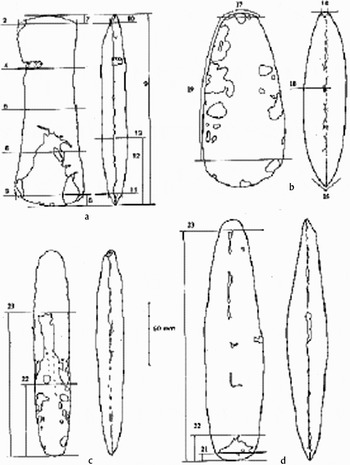
Measurements 1–23 recorded for each stone celt (after Pitts [1996]).

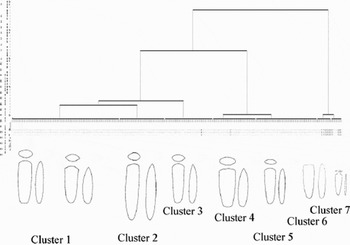
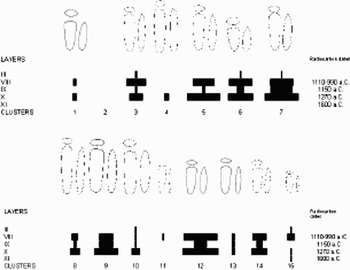
For the present case, 27 different measurements of shape were recorded for each celt (Table 1). Ratios were generated between several variables (e.g., maximum length and width), allowing proportions to be used for comparison rather than sizes. All variables listed in Table 1 (see Figure 5) were standardized through log-transformation and then the hierarchical Ward Method of cluster analysis was applied, which yielded seven clusters (Figure 6). A non-hierarchical k-means method was also tested. Based on the results, fifteen groups were chosen that I believe best reflect the diversity of the celts (Figure 7). In both methods similar patterns of distribution demonstrate a discrete distribution for celts corresponding to the offerings at El Manatí and Cantón Corralito. The analysis of forms that are shared between El Manatí and Cantón Corralito is important because it allows us to distinguish very subtle differences that correspond with variations in the making of these artifacts. Even though the makers of these objects used the same kinds of rocks and the sites share the same steps in the operative sequences that are represented, the form of the celts is related to the agency of the manufacturers. Indeed, on the basis of ethnoarchaeological data it appears that different regions tend to execute a particular signature in their artifacts (Hampton Reference Hampton1999; Levi-Strauss Reference Levi-Strauss1988; Pètrequin and Pètrequin 1990). In more complex political organizations the canons in representation become more severe, with elites imposing particular and distinctive attributes. However, in the case of complex chiefdoms and early microstates (Yoffee Reference Yoffee2005) with trade diasporas (economic enclaves or colonies) the application of hegemonic rules can be more flexible (Stein Reference Stein1999, Reference Stein2005). Taking all this potential variation into consideration, we tend to agree to some extent with Grove's notion of regional schools of manufacture with respect to greenstone objects (see Garber et al. Reference Garber, Grove, Hirth, Hoopes and Lange1993:211–231). This exploratory exercise should continue with more examples from primary contexts in order to expand this suggestive hypothesis.
Cluster analysis (by Ward method) of Olmec greenstone celts from El Manatí, Veracruz, and Cantón Corralito, Chiapas.

Cluster analysis of k-means showing frequencies through time for 15 clusters at the site of El Manatí, Veracruz.

Measurements taken for each stone celt and corresponding ratio abbreviations

1Ratio labels correspond to the initial letter of the labels in Spanish (database was written in Spanish).
ON RAW MATERIALS
In the Gulf Olmec heartland and other regions of Mesoamerica different color greenstones were used. Color preference in Mesoamerica has been studied more broadly (the names of colors and orientation of colors) through anthropological linguistics and ethnohistoric sources, using more than 120 languages (MacLaury Reference MacLaury1997; Thouvenot Reference Thouvenot1982). During the Early Formative period, stone celts and beads were made in blue jade, black jade (metagabros), basalt, gabro, and dark serpentine. All these blue-gray-black tones were prevalent in the beginning of the hierarchization process of these polities. Although transformation in the color of the rocks could possibly be caused by diagenetic processes, the case of El Manatí suggests otherwise due to the excellent preservation conditions. The El Manatí data allow us to track the transformation of jade color preferences during the development of the Olmec phenomenon in Mesoamerica. Considering this transformation as a process is interesting when viewed from a four-field anthropological approach. Robert MacLaury's Color and Cognition in Mesoamerica (Reference MacLaury1997) addresses agency, considers historical transformation, and investigates how categories of color were used in more than 120 languages. Using a diachronic perspective and recording variation in contemporary languages and changes in the uses of color spectrum, he discovered that during the transition toward complex political institutions there is transference of the category “cool” from the color blue toward the color green-yellow (MacLaury Reference MacLaury1997:333). This also appears to be the case in Formative Mesoamerica, especially with respect to changes in tones of rocks for the manufacture of inalienable goods and wealth finance. The change in perception, represented in green tones, of Middle Preclassic times is associated with the morphology of the landscape, a transformation in the economy from more aquatic resources with many swamps to a more engineered landscape as landesque capital (investments made in land with an anticipated life beyond that of the present crop or crop cycle (Brookfield Reference Brookfield1984; Widgren Reference Widgren2006, Reference Widgren, Alf Hornborg and Mcneill2007) that involve the monumentality of huge political projects and the construction and reproduction of nature. During the Early Preclassic period, the Gulf Olmecs and the residents of Cantón Corralito were using jade of the same tones, the “cool” blue category. Celts from Cantón Corralito Burial 2 of and El Manatí Offering 30 show a transition toward more green stones, but so-called black jade (metagabro) and basalt are also present. These offerings are snapshots in a transitional moment into the complexity of the political organization of Mesoamerica.
ON THE PROVENANCE OF RAW MATERIALS
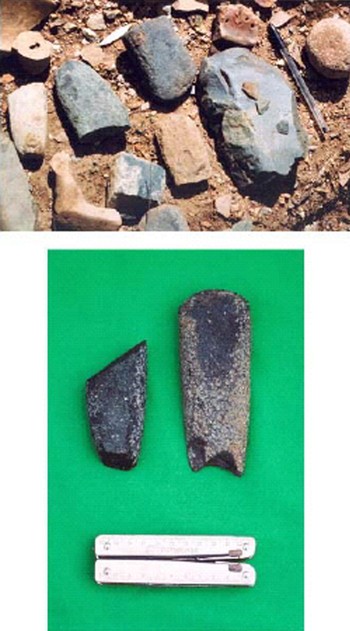
A preliminary step in the classification of rocks is to identify macroscopically the diversity present and, if possible, their provenance. At El Manatí, we have dark serpentinite (polymorphs of antigorite and chrysotile), metagabro (also called black jade), basalt, and blue jade (varieties called Princess Jade, Quebrada Seca, Mint Jade, and Moon Jade). The provenance of all these likely corresponds to the Motagua River valley. I sampled the sources of blue jade there (Figure 8) and noted the following categories:
Princess Jade: a blue jadeite pure composition, which is translucent.
Mint Jade: a jadeite omphacite metamorphic rock, which is present in the celts of El Manatí and Cantón Corralito.
Black Jade: a metagabro that is extremely scarce in the area of Sierra de Las Minas. It is very well represented in both Cantón Corralito and El Manatí.
Quebrada Seca Jade: shows mineralogical veins and darker tones of blue that are due to a more composite structure.
Black and blue jade celts discovered in situ, Motagua River Valley, Guatemala. Photograph by author.

In the case of serpentinite, celts from La Merced and La Venta are from the quarries of Tehuitzingo and Cuicatlan (Jaime-Riverón et al. Reference Jaime-Riverón, Castilleros, Calligaro and Cruz Ocampo2009). In the Motagua Valley serpentinite has particularly distinctive chemical compositional characteristics, and it will be interesting to determine the provenance of serpentinite celts at El Manatí and Cantón Corralito.
As noted, at the end of the Early Formative period, the stone color preferred for stone celts changed from dark blue-black tones to pale green-yellowish tones of jadeite and serpentinite. In the case of La Merced and La Venta, rough preforms and blanks of serpentinite were deposited. The transformation, in short, involved color and the manner in which stone celts were made. The final deposition of celts of El Manatí and some celts in Cantón Corralito Burial 2 show this transitional moment between the use of finished and unfinished artifacts with the incorporation of human bodies or the symbol of the human body (Ortiz, Rodríguez and Delgado Reference Ortiz Ceballos, Rodríguez and Delgado1997). In greenstone we have the representation of value. At some point in the Olmec development, it became the only raw material symbolizing the concentration of wealth. Serpentine shows interesting qualities that transform earlier uses of dark greenstones. The strength, color, and diagenetic patina that characterize this rock are important for comprehending the life cycle of rocks as visualized by the makers and users of celts. Actually, serpentine challenges our archaeometric techniques for tracking the provenance of artifacts. This kind of rock suffers diagenetic transformations after its deposition, and its polymorphs (minerals with the same chemical composition but different structure) show alteration after thousands of years. On the basis of data from La Merced and La Venta, the quarries of Tehuitzingo and Cuicatlan were important for the procurement of serpentine for mosaics, artifacts, and architectural features by the end of the Early Formative period (Jaime-Riverón Reference Jaime-Riverón2003).
ON MEANING: ICONICITY PROCESSES IN THE MANUFACTURING OF STONE TOOL PRODUCTION
During the early stage (Early Formative) of art development, Gulf Olmec artists followed a traditional semiotic process evolving from icons, through indexes, and finally to symbols. We use these terms in according to the connotations of Peirce (Reference Peirce1931–1958), a materialistic approach aimed at the life cycle of symbols. Recent anthropological literature (Gell 1999; Preucel and Bauer Reference Preucel and Bauer2001) has revived Peirce's important contribution because it helps to explain how signs called “icons” represent, in an imitative way, reality. At a later stage, amid increased complexity and abstraction of message contents, the signs of signs refer to parts or fractions of icons or “indexes.” Finally, symbols involve yet a further degree of abstraction and complexity and are the most complex category of signs. In short, signs are transforming through practice and evolving diachronically. The economic anthropological explanation is that special objects were the representation of quotidian tools, such as stone axes, grinding tools, cutting artifacts, and containers (vessels and jars, for instance). When a transmutation takes place from one utilitarian raw material to a rare and scarce substance, there is also a degree of iconicity, which implies abstraction and the alteration of time-space coordinates. The artifacts are fixed in time (made in more durable materials), and they are not incorporated from the production matrix in which they were once produced. They are transformed in a mobile value that is consumed and exchanged by political actors. These artifacts are the result of high degrees of investment of labor, and they were transformed into economic hypertrophic goods because they are not useful anymore as utilitarian artifacts.
In the beginning of the Gulf Olmec development, stone celts represented reality though imitation; they were icons. They were useful for showing power in face-to-face relationships in small towns and archipelagic Olmec systems. The simple chiefdoms of this incipient era of political development relied on the exhibition of wealth during ceremonies and daily life. The artifacts were efficient as icons when they emulated utilitarian things.
In order to make artifacts as icons, there was homogeinity in the uses of rocks: metamorphic lithology from Guatemala, which was difficult to obtain. There was also homogeneity of techniques between regions, an archaeological correlate of identity maintained in spite of an economic diaspora. During a second stage, to which pertain the cases of the Offering 30 at El Manatí and Burial 2 at Cantón Corralito, stone artifacts were transformed into indexes. The signs, stone tools, were the media referring to different semiotic fields. In both geographic regions discussed, the life cycle of human beings is reproduced though the technological metaphor of stone tool manufacture. In the excavations of both El Manatí and Cantón Corralito, there were the different steps of the productive sequence of stone celts associated with remains of human beings.
From a diachronic perspective, the historicity of color is explainable from a linguistic anthropological framework. There was a change in the tones of blue-green of the rocks initially used by the Gulf Olmec. This pattern is evident in other societies around the world during the transitional stage from a horticultural or hunter-gatherer way of life to a more sedentary and agricultural-dependent economy (MacLaury Reference MacLaury1997), with the color green coinciding with the implementation of grain or tuber-based agriculture. In Mesoamerica, maize and tubers (manioc, sweet potatoes, malanga, and so on) are representative of this transition. The operative sequences involved in celt manufacture correlate with variation in sizes, proportions, and shapes and mirror variation of social activities related to the division of agricultural surpluses and byproducts of corn and tuber production. We agree with Taube (Reference Taube2004 who asserts the possibility of a cult or ritual around maize, probably involving the worship of a Maize God, at least until Middle Formative times. In the latter part of the Olmec history, greenstone artifacts mirrored less labor investment. Sometimes the artifacts were deposited unfinished. This is a consequence of the transformation of political life. The energy and social organization was more focused on the elaboration of architecture. The artifacts mutated into symbols, and, as such, raw material symbolized the meaning of unfinished products. This epistemological transformation is a big step in the cultural history of Mesoamerica. It involved both the genesis of ancient forms of monies (Lesure Reference Lesure and Robb1999; Testart Reference Testart2001) and writing systems as demonstrated by the Cascajal block (Rodriguez Martínez et al. Reference Rodríguez Martínez, Ceballos, Coe, Diehl, Houston, Taube and Calderón2006), made of serpentinite.
RESUMEN
Los usos más tempranos de la piedra verde olmeca (jadeíta, piedra verde, esquisto cuarzo verde y otros) aceleraron el intercambio interregional de tecnología y materias primas. Estas relaciones provocaron la asimetría entre instituciones políticas de diferentes partes de Mesoamérica y dentro de los sitios olmecas. Existieron relaciones más fuertes entre la costa del Golfo y Chiapas. En términos generales, los artefactos de piedra verde muestran un proceso evolutivo similar a la cerámica y la escultura en basalto en el surgimiento de la sociedad compleja durante los finales del periodo formativo temprano. Este artículo se enfoca en el intercambio de opciones tecnológicas y la asimetría entre la costa del Golfo de México y el resto de Mesoamérica.
ACKNOWLEDGEMENTS
I would like to thank Ing. Joaquín García Barcena and the Consejo de Arqueologia of Instituto Nacional deAntropología e Historia for permission to source archaeological stone in Mexico and the Consejo de Arqueologia of Guatemala and Guillermo Díaz Romeu, Director of the Instituto Nacional de Antropología e Historia, for permission to source jadeite in the Motagua River valley. My professors and friends deserve special thanks: Carmen Rodríguez (Instituto Nacional deAntropología e Historia-Veracruz), Ponciano Ortiz (Universidad Veracruzana), Rebecca González Lauck (Instituto Nacional de Antropología e Historia-Tabasco and director of the La Venta Project), Conrado Rivera Mariscal, Raul Matadamas (Instituto Nacional de Antropología e Historia-Oaxaca), Dolores Tenorio (Instituto Nacional de Investigaciones Nucleares), Linda Manzanilla (Universidad Nacional Autónoma de México-Instituto de Investigaciones Antropológicas), Karl Taube (University of California-Riverside), Mary and Jay Ridinger (Jades, S.A.), John Clark (New World Archeological Foundation), David Cheetham (Arizona State University/New World Archaeological Foundation), and David Moecher (University of Kentucky). Finally, I thank Paul Schmidt (Universidad Nacional Autónoma de México-Instituto de Investigaciones Antropológicas) and Christopher Pool (University of Kentucky) for their advice. Funding was graciously provided by the Graduate School of University of Kentucky and Consejo Nacional de Ciencia y Tecnología (CONACYT)-Mexico.