Introduction
Cautleya (Royle ex Benth.) Hook.f. is a small genus in the family Zingiberaceae, subfamily Zingiberoideae, found in northern India, Nepal, Bhutan, southern China, Burma, Thailand and Vietnam. Both species are cultivated and can be grown outside in northwest Europe.
Royle originally intended to honour his friend Capt. Cautley F.G.S. with a genus, spelled Cautlea, in which he would combine Roscoea lutea Sm. This was to be published in his Illustrations of the Botany of the Himalayan Mountains (Royle, 1833–Reference Royle1839) but, in that work, he wrote that botanical friends advised him to keep this species in Roscoea. It was left to Bentham to take up this name for his section Roscoea sect. Cautlea Royle ex Benth. (Bentham & Hooker, Reference Bentham and Hooker1883), where he included Roscoea gracilis Sm. and R. spicata Sm. Hooker (Reference Hooker1888) regarded the spelling of Cautlea as an error, to be corrected to Cautleya, the spelling that has been used ever since. Support may be found in the International Code of Botanical Nomenclature (McNeill et al., Reference McNeill, Barrie, Burdet, Demoulin, Hawksworth and Marhold2006) for retaining the original spelling, on the grounds that Royle had consciously latinised Cautley’s name to ‘Cautleus’, dropping the letter ‘y’ which doesn’t occur in Latin. We prefer to follow paragraph 10 of the preamble to the ICBN which advises that ‘In the absence of a relevant rule or where the consequences of rules are doubtful, established custom is followed’. Nobody has used the spelling Cautlea since 1883 and to do so now would be contrary to the aim of stability in nomenclature.
Hooker (Reference Hooker1888) raised Bentham’s section to genus rank for Cautleya lutea (Royle) Hook.f. Not long afterwards, Baker (Reference Baker and Hooker1890) recognised five species: Cautleya lutea (Royle) Hook.f., C. cathcartii Baker, C. spicata (Sm.) Baker, C. robusta Baker and C. petiolata Baker. Then, Schumann (Reference Schumann and Engler1904) described two varieties, Cautleya lutea var. gracilior K.Schum. and C. lutea var. robusta K.Schum. Dandy (Reference Dandy1932) subsequently confirmed what is implicit in Hooker (Reference Hooker1888), namely that Roscoea lutea Royle and Roscoea gracilis Sm. are one species. Roscoea gracilis, having been published earlier than Roscoea lutea, takes priority and Roscoea lutea is a synonym of it. The type species of Cautleya, C. gracilis (Sm.) Dandy, was selected by Burtt & Smith (Reference Burtt and Smith1972).
At the beginning of this study, there were six names at species rank and four at varietal rank in Cautleya which had not been revised throughout its range since Schumann’s account of 1904. Smith (Reference Smith and Noltie1994), revising Bhutanese Cautleya, suggested that C. cathcartii might be a robust form of C. gracilis and that C. robusta might be synonymous with C. spicata but she left these questions to be resolved later. In this treatment, we recognise two species, one of which has two varieties.
Relationships
All species of Cautleya have previously been classified in Roscoea and, indeed, these two genera are very close to each other in morphology (Burtt & Smith, Reference Burtt and Smith1972). They consist of perennial, rhizomatous herbs which lose their above-ground parts during winter. New shoots arise each spring from the overwintering rhizome and the inflorescences are borne terminally on these shoots. In most Zingiberaceae the leaf sheath is open opposite the leaf blade but, in Cautleya and Roscoea, the sheaths are tubular up to the point where the ligule and blade divide from them. The inflorescence in both genera bears bracts which subtend a single, ebracteolate flower. The flowers of Cautleya and Roscoea resemble each other too, though those of Roscoea are generally larger. Crucially both genera have versatile anthers with the basal portions of the thecae sterile and forming a pair of spurs, very like the anther of Salvia (Labiatae) and presumably similar in function. The lateral staminodes are borne erect behind the anther and the labellum is conspicuously bilobed. Ngamriabsakul et al. (Reference Ngamriabsakul, Newman and Cronk2000) confirmed, using molecular systematic techniques, that Cautleya was monophyletic and sister to Roscoea.
The differences between Cautleya and Roscoea are that Cautleya usually has inflorescences of many flowers which are yellow while Roscoea has inflorescences of few flowers which are usually purple or white. In addition, the ovary and early-dehiscent fruit of Cautleya is short while Roscoea has an elongate ovary and tardily-dehiscent fruit.
Cytology
Sharma & Bhattacharyya (Reference Sharma and Bhattacharyya1959) published a somatic chromosome number of 2n = 34 for Cautleya spicata, indicating that they had also seen variants with 2n = 27 & 36. These numbers have not been reported again and, as no voucher slides are available, it is difficult to interpret these results. Haploid chromosome numbers of n = 12 and n = 13 have been reported in Cautleya (Ngamriabsakul, Reference Ngamriabsakul2004). Unfortunately, it is not possible to say how these counts relate to the taxa described below, particularly the varieties of Cautleya gracilis, because voucher specimens are not cited. Mehra & Sachdeva (Reference Mehra and Sachdeva1979) stated that
C. lutea (= C. gracilis) has been investigated for the first time. Two cytological races with n = 12 and n = 13 were found to occur in [the] Darjeeling hills. Meiosis in both taxa was found to be normal. Plants with n = 13 were shorter, possessed small-sized leaves and bracts and had lesser [sic] flowers per spike, in comparison to plants with n = 12. However, the size of the flower was almost the same in both the cases. It may be pointed out that the plants with n = 13 were always found to be occurring at higher altitudes (2,250–2,500 m) in contrast to those with n = 12 which occurred between 2,000–2,200 m.
This is a strong indication that there may be a chromosomal basis to the varieties of Cautleya gracilis but further work on material determined to variety will be needed.
IUCN Conservation Assessments
The species and varieties of Cautleya are not threatened globally. Each taxon occurs over a wide range and has been collected at many localities. Thus, the global IUCN conservation assessment is Least Concern in each case. Nonetheless, there are areas within the range of distribution which are undercollected, particularly Arunachal Pradesh and Burma, so national IUCN conservation assessments of these taxa may indicate a higher degree of threat.
Materials and Methods
The present revision is based on a study of approximately 260 dried herbarium specimens from A, BM, E, ECON, GH, HBG, K, K-W, L, LINN-SM, LIV, MICH, NY, P and UC. Unless otherwise stated, the measurements in the descriptions are taken from dry herbarium specimens.
The presence of a distinct petiole almost always distinguishes the two species of Cautleya though it can be difficult to assess this character. The petiole is usually longer at the apex of the pseudostem than at the base and it is the presence of a petiole at the apex which is important.
The principal distinction between the two species of Cautleya lies in the length and colour of the bracts. The length is measured by comparison to the calyx at anthesis so the real question is whether the apex of the calyx is included in the bract or exserted from it. Cautleya gracilis has green bracts which are shorter than or equal to the calyx while C. spicata has red bracts which are longer than or very rarely equal to the calyx. A few specimens do not fit well in this system, the most significant being the type of Cautleya petiolata (see discussion under C. spicata). The colour of the bracts may still be seen in recent herbarium collections but older material is more ambiguous.
The extent to which the aril covers the seed is believed to be of taxonomic significance but could not be assessed on the majority of herbarium specimens seen. Preliminary results, such as a survey of published photographs, indicate that the aril of Cautleya gracilis is very small. The dehisced fruit appears to contain a tight ball of black seeds (Larsen & Larsen, Reference Larsen and Larsen2006: 63) and the aril only becomes visible, near the connection with the placenta, when the seeds are picked apart. The aril of Cautleya spicata, by contrast, seems to cover the seeds so that the open fruit contains a white mass of seeds. In this species, the black colour of the seeds is only revealed when the aril is removed. More study of living collections, especially in the field, is required to ascertain the use of this character across the genus.
Another character which merits attention when more living material is available is the presence and size of the anther crest. Photomicrographs taken of the dissected flower of Cautleya gracilis var. robusta (Škorničková 71478, SING) show a distinct, rounded anther crest while R. M. Smith’s drawing of C. spicata (Burtt & Smith, Reference Burtt and Smith1972, fig. 15) shows no crest at all.
The Taxa and their Ranks
Three taxa of Cautleya are recognised here, confirming the results of an unpublished study of Cautleya carried out at the Department of Botany, Smithsonian Institution (Namgyel, Reference Namgyel1998). The characters used to delimit the taxa are mostly the same but we place two taxa at rank variety, while Namgyel placed all three at species rank. Cautleya gracilis and C. spicata are not in doubt but the third taxon may be a result of hybridisation between them. If it is recognised as a species, then Cautleya cathcartii is the only name available. Cautleya gracilis var. robusta (K.Schum.) Sanjappa cannot be raised to species rank because C. robusta Baker (= C. spicata) already exists. Only further experimental taxonomy can resolve the question of the origin of Cautleya gracilis var. robusta leading to a decision on the rank at which it should be placed.
Systematic Treatment
Cautleya (Royle ex Benth.) Hook.f., Bot. Mag. 114: t.6991 (1888). – Roscoea sect. Cautleya Royle ex Benth., Gen. Pl. 3: 641 (1883), as ‘Cautlea’. – Lectotype species: Cautleya gracilis (Sm.) Dandy, designated by Burtt & Smith (Reference Burtt and Smith1972).
Perennial, rhizomatous herbs, often epiphytic, when terrestrial then usually in steep, rocky places. Pseudostems deciduous, breaking away from the rhizome by an abscission zone before the winter. Leafy shoots 20–100 cm tall; leaf sheaths tubular, ligules bilobed, leaf blades few, usually elliptic, sometimes dark purplish red below, alternate. Inflorescence a terminal spike; bracts green or red, open to the base, subtending and enfolding one yellow flower; bracteoles absent. Calyx bilobed, split down one side, colour variable, from light green to dark red; floral tube about as long as calyx, dorsal corolla lobe boat-shaped, curved, mucronate, lateral corolla lobes narrowly acute at apex, connate to each other and to base of labellum; lateral staminodes petaloid, oblanceolate and erect, forming a helmet with the dorsal corolla lobe above the fertile anther; labellum deeply bilobed, lobes rather broad and rumpled with toothed margins; anther versatile, L-shaped when viewed from the side, with two orange spurs at base, anther thecae dehiscing longitudinally, anther crest small or lacking; style held between thecae of fertile stamen, stigma white, club-shaped, ostiole transverse, ciliate; ovary trilocular with axile placentation, epigynous glands 2, subulate. Fruit a globose, septifragal capsule with persistent calyx, dehiscing by 3 valves; seeds black with white aril, either small or covering seed in dehisced fruit.
Distribution. Two species, one with two varieties, from northern India, Nepal, Bhutan, southern China, Burma, Thailand and Vietnam.
Key to the taxa
1a. Leaves with a short petiole; bracts red, longer than the calyx 2. C. spicata
1b. Leaves sessile; bracts green, mostly shorter than the calyx 2
2a. Inflorescence lax or with solitary flowers, flowers usually < 10, bracts covering 1/2–2/3 of the calyx, leaves lanceolate 1a. C. gracilis var. gracilis
2b. Inflorescence dense, flowers ≥ 10, bracts covering > 2/3 of the calyx, leaves lanceolate or oblong 1b. C. gracilis var. robusta
1. Cautleya gracilis (Sm.) Dandy, J. Bot. 70: 328 (1932). – Roscoea gracilis Sm., Trans. Linn. Soc. London 13: 460 (1822). – Type: Nepal, 1818, E. Gardner (J.E. Smith’s collection, 9.7(1)) (lecto LINN-SM, designated here).
Roscoea elatior Sm., Trans. Linn. Soc. London 13: 460 (1822). – Type: Nepal, 1819, E. Gardner (J.E. Smith’s collection, 9.9) (lecto LINN-SM, designated here).
Roscoea lutea Royle, Ill. Bot. Himal. Mts. 1: 361 (1839). – Cautleya lutea (Royle) Hook.f., Bot. Mag. 114: t.6991 (1888). – Type: India, Mussoorie, J.F. Royle 13191x(1) (lecto LIV, designated here).
Cautleya lutea var. gracilior K.Schum., Pflanzenr. IV, 46 (Heft 20): 124 (1904). – Cautleya gracilis var. gracilior (K.Schum.) Sanjappa, Fl. Ind. Enum., Monocot. 291 (1989). – Type: India, Uttarakhand, Kumaon, N. Wallich 6531B (lecto K-W, designated here; isolecto BM, E).
1a. Cautleya gracilis var. gracilis.Fig. 1.
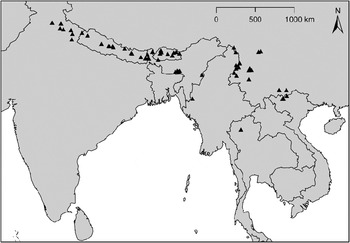
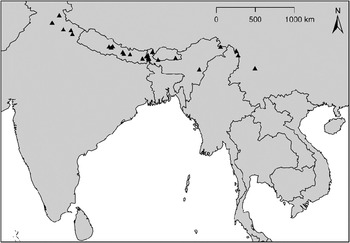
Distribution of Cautleya gracilis (Sm.) Dandy var. gracilis.

Leafy shoots 20–65 cm tall. Leaves: lamina sessile, lanceolate, rather narrow, 6.5–24 × 0.5–3(–4) cm. Ligules to 5 mm long. Flowers solitary or in a lax inflorescence, 4–11 cm long, of 2–10 (rarely more) flowers. Bracts green, lanceolate to obovate, 0.5–2 cm long, covering 1/2–2/3 of the calyx. Calyx tubular, 1.5–2.5 cm long, with small teeth, including at least half of the floral tube. Capsule red, globose, to 0.5–1 cm diameter. Seeds black, angular, aril greatly reduced, at base of seeds.
Distribution. Bhutan, Burma, China, India, Nepal, Thailand, Vietnam.
Habitat and ecology. Recorded from 1060–3940 m.
Proposed IUCN conservation assessment. Least Concern (LC). This variety is known from many localities across a wide area and there are no significant threats.
Additional specimens examined. Nepal. s.l., N. Wallich s.n. (P); N. Wallich 6531 (K, P); N. Wallich 6531A (E, NY); Dakcho, 1930, L. Dhwoj 7 (E); Bajhang, 23 vii 1953, J.B. Tyson 109 (P); Central Nepal, 24 vi 1973, C. Grey-Wilson & Phillips 118 (K); Darchula, Dhaulakot, 18 viii 1952, O.V. Polunin, W.R. Sykes & L.H.J. Williams 490 (E); Dolakha, 16 vii 1973, C. Grey-Wilson & Phillips 286 (K); East Nepal, 5 vi 1972, H. Kanai, H. Ohashi, K. Iwatsuki, H. Ohba, Z. Iwatsuki & P.R. Shakya 723608 (E); Ilam, 26 vi 1992, S. Noshiro, S. Akiyama & N. Acharya 9241112 (E); Kaski District, 28 viii 1994, M. Mikage, N. Fujii, T. Kajita, N. Kondo, S. Noshiro & K. Yoda 9485567 (A); Kosi, Sankhuwasabha, 31 vii 1990, M. Minaki, C. Yonebayashi, F. Miyamoto, H. Takayama, H. Sugita, H. Yagi, M.N. Subedi & H. Ikeda 9080073 (A); Kosi, Sankhuwasabha, Arun Valley, 11 ix 1956, J.D.A. Stainton 1632 (E); Lamjung, Pasgam, 25 vi 1954, J.D.A. Stainton, W.R. Sykes & L.H.J. Williams 5928 (E); Langtang, 27 vi 1937, F.M. Bailey (E); Parbat District, 10 vii 1983, H. Ohba, H. Kanai, M. Wakabayashi, M. Suzuki & S. Akiyama 8310201 (A, E); Ramechhap, 17 viii 1985, H. Ohba, T. Kikuchi, M. Wakabayashi, M. Suzuki, N. Kurosaki, K.R. Rajbhandari & S.K. Wu 8530859 (A); ibid., 4 viii 1985, H. Ohba, T. Kikuchi, M. Wakabayashi, M. Suzuki, N. Kurosaki, K.R. Rajbhandari & S.K. Wu 8571261 (A, E); ibid., 5 vii 1985, H. Ohba, T. Kikuchi, M. Wakabayashi, M. Suzuki, N. Kurosaki, K.R. Rajbhandari & S.K. Wu 8580075 (A).
India. s.l., H.F.C. Cleghorn (E); viii 1886, D. Prain 10 (K); V.V. Jacquemont 2406 (P). Uttarakhand: x 1969, Pant & Nainthani 39537 (K); Garhwal District, viii 1917, J. Marten (E); Garhwal District, Mussoorie, 1869, G. King (P); ibid., 30 viii 1937, R.R. Stewart 16098 (GH, NY); ibid., 1 ix 1843, W. Jameson 693 (NY); Garhwal District, Tehri, 25 viii 1944, R.R. Stewart 21184 (NY); Kumaon, Nainital, R. Strachey & J.E. Winterbottom 3 (GH, K, P); Uttarkashi, Kidarkanta, 26 vi 1904, J.R. Drummond 22729 (E, UC). Himachal Pradesh: Simla, 29 vii 1831, C. Brown (E); ibid., 24 viii 1889, G. Watt 9549 (E). West Bengal: Darjeeling, J.M. Cowan (E); ibid., J.M. Cowan (E); ibid., vii 1968, Anon. 1350 (ECON); ibid., vii 1874, J.S. Gamble 8129 (K); ibid., 4 viii 1972, H. Kanai, H. Ohashi, H. Hara, K. Iwatsuki & H. Ohba 721460 (E); Darjeeling, Mongpu, 9 v 1884, P.E. Boissier & W. Barbey-Boissier (P). Sikkim: J.D. Hooker (GH, P); 25 vi 1945, N.L. Bor & K. Ram 20746 (K); v 1878, J.L. Lister (P); 4 vii 1983, B.N. Starling, E.M. Upward, C.D. Brickell & B. Mathew 292 (K); Chhokha–Yuksum, 31 v 1990, G. Kirkpatrick 66 (E).
Bhutan. 12 vi 1949, F. Ludlow, G. Sherriff & J.H. Hicks 16528 (A); 15 ix 1998, H.J. Noltie, R. Pradhan, Sherub & T. Wangdi 213 (E); Dotena Chu, 5 ix 1984, I. Sinclair & D.G. Long 4848 (E); Gyasa Dzong, 12 vi 1949, F. Ludlow, G. Sherriff & J.H. Hicks 16528 (E); Khoma, 22 vii 2000, S.B. Lyon 13041 (E); ibid., 23 vii 2000, S.B. Lyon 13054 (E); Phuntsholing, 26 vi 1975, A.J.C. Grierson & D.G. Long s.n. (E); Punakha, 24 vii 1983, C. Sargent 19 (E); Tobrang, 5 vii 1949, F. Ludlow, G. Sherriff & J.H. Hicks 20836 (E).
China.Sichuan: P.G.E. Bonvalot & H. d’Orléans (P); vii 1922, G. Forrest 21951 (K); 1 viii 1908, Legendre 464 (P); Muli Zangzu Zizhixian, 8 viii 1915, H.R.E. Handel-Mazzetti 7534 (E). Yunnan: Wen-shan-hsien, Loa-jiun-shan, 12 viii 1947, K.M. Feng 11156 (A); Ghi Shan, E of Tali Lake, vii 1917, G. Forrest 15495 (E, K); Yangbi Yizu Xian, W side of Diancang Shan, vicinity of Xueshanhe, above Zhongshan village, 16 vi 1984, B.M. Bartholomew, D.E. Boufford, H.W. Li, C.G. Ma, D.H. Nicolson, T.S. Ying & S.W. Yu 160 (A); NW Likiang, Tsze-kou on Yangtze, 4 ix 1939, R.C. Ching 21433 (A); W Likiang, on the way from Tamichung to Tuchi, 20 viii 1939, R.C. Ching 21556 (A); E.B. Howell 332 (E); Shang-pa Hsien, 16 ix 1933, H.T. Tsai 54256 (A); Che-tse-lo (Zhiziluo), 11 ix 1934, H.T. Tsai 58497 (A); 1910–1919, G. Forrest 7009 (K); Mengsheng, Dah-meng-lung, Che-li Hsien, ix 1936, C.W. Wang 78404 (A); Dajiuping, 30 vi 1984, B.M. Bartholomew, D.E. Boufford, H.W. Li, C.G. Ma, D.H. Nicolson, T.S. Ying & S.W. Yu 601 (A, E); Dali range, H.D. McLaren B144 (E, K); ibid., viii 1906–ix 1906, G. Forrest 1890 (E, K); ibid., v 1906, G. Forrest 4805 (E); ibid., vii 1910, G. Forrest 7009 (E); Dulong Jiang, 28 vii 1938, T.T. Yu 19512 (E); ibid., 28 vii 1938, T.T. Yu 19512 (A); ibid., 2 viii 1938, T.T. Yu 19580 (A, E); Mengzi, A. Henry 9480 (NY); ibid., A. Henry 9480A (E, K); Longling Xian, 26 viii 2003, H. Li, Z. Dao, R. Li, Z. Jiang, B.M. Bartholomew & L. Zhou 17918 (E); Longyang Qu, 24 viii 2003, H. Li, Z. Dao, R. Li, Z. Jiang, B.M. Bartholomew & L. Zhou 17742 (E); ibid., 2 ix 2003, H. Li, Z. Dao, R. Li, Z. Jiang, B.M. Bartholomew & L. Zhou 18613 (E); Lushui County, 22 viii 2005, H. Li 27970 (E); Nujiang Lisu Autonomous Prefecture, Gongshan Co., Qi Qi Nature reserve, 17 vii 2000, H. Li 12935 (E); Shunning, 14 vi 1938, T.T. Yu 16237 (A); Tengyueh, 4 ix 2003, H. Li, Z. Dao, R. Li, Z. Jiang, B.M. Bartholomew & L. Zhou 18685 (E); ibid., 4 ix 2003, H. Li, Z. Dao, R. Li, Z. Jiang, B.M. Bartholomew & L. Zhou 18736 (E); ibid., 4 ix 2003, H. Li, Z. Dao, R. Li, Z. Jiang, B.M. Bartholomew & L. Zhou 18769 (E); ibid., 28 v 2006, H. Li 30753 (E); lava bed W of Tengyueh, vi 1912, G. Forrest 8435 (E, K); Yangbi Yizu Zizhixian, viii 1922, J.F.C. Rock 6500 (E); Yao Jia Ping Forest Station, 28 x 1996, Anon. 8206 (E); Yungning, vii 1922, G. Forrest 21951 (E).
Burma.Chin State: Mount Victoria, 1924, R.E. Cooper 6045 (E). Kachin State: 5 vii 1914, F. Kingdon-Ward 1726 (E); Chimi-li, vi 1925, G. Forrest 26953 (E, NY); Hpare, 11 vii 1919, R.J. Farrer 1085 (E); Laktang, 16 vi 1919, F. Kingdon-Ward 3220 (E); ibid., 20 vii 1919, F. Kingdon-Ward 3345 (E).
Thailand.Chiang Mai: Doi Inthanon, 17 vii 1922, A.F.G. Kerr 6319 (K); ibid., 20 ix 1995, K. Larsen, S.S. Larsen, C. Tange & D. Sookchaloem 46744 (L); Doi Inthanond, Pha Ngaem, 5 ix 1927, H.B.G. Garrett 439 (K).
Vietnam.Lao Cai: Man mei, A. Henry 9480 (E, K); Sa Pa, 16 viii 1926, E. Poilane 12960 (P); ibid., vii 1927, P.A. Pételot 3106 (P); ibid., 19 vii 2004, D.E. Atha 4910 (NY); ibid., viii 1930, P.A. Pételot 7527 (P).
1b. Cautleya gracilis var. robusta (K.Schum.) Sanjappa, Fl. Ind. Enum., Monocot. 291 (1989). – Cautleya lutea var. robusta K.Schum., Pflanzenr. IV, 46 (Heft 20): 125 (1904). – Type: Sikkim, J.D. Hooker s.n. (neo K, designated here). Figs 2,3.
Cautleya cathcartii Baker in Hook.f., Fl. Brit. India 6: 208 (1890). – Type: Sikkim, J.D. Hooker s.n. (lecto K, designated here).
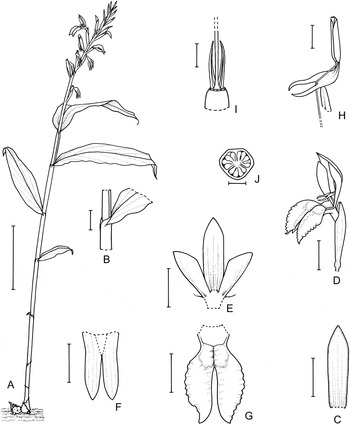
Cautleya gracilis (Sm.) Dandy var. robusta (K.Schum.) Sanjappa. A, habit; B, ligule; C, bract; D, flower; E, dorsal corolla lobe and lateral staminodes; F, lateral corolla lobes; G, labellum; H, anther; I, epigynous glands; J, ovary T.S. Scale bars: A = 10 cm; B–G = 1 cm; H = 3 mm; I = 2 mm; J = 1 mm. Drawn from RBGE living accession 19920038, originally collected in the Arun Valley, Nepal, 2000 m.

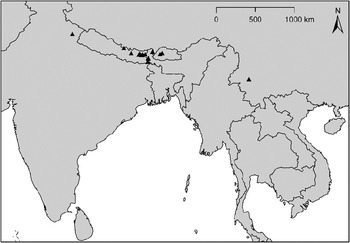
Distribution of Cautleya gracilis (Sm.) Dandy var. robusta (K.Schum.) Sanjappa.

Leafy shoots 36–80 cm tall. Leaves: lamina sessile, lanceolate to oblong, 10–26 × 1–7 cm. Ligules to 5 mm long. Inflorescence 7–16 cm long, dense, of 10 to more than 20 flowers. Bracts green, 1–2 cm long, covering at least 2/3 of the calyx. Calyx tubular, 1–2.5 cm long, with small and sharp teeth, including at least half the floral tube. Capsule red, globose, to 0.5–1 cm diameter. Seeds black, angular, aril greatly reduced, at base of seeds.
Distribution. Bhutan, China, India, Nepal.
Habitat and ecology. Recorded from 1520–3940 m.
Proposed IUCN conservation assessment. Least Concern (LC). This variety is known from many localities across a wide area and there are no significant threats.
Additional specimens examined. Nepal. East Nepal, Taplejung District, 16 v 1974, J.D.A. Stainton 7023 (E); ibid., 13 v 1992, M. Suzuki, N. Acharya, S. Akiyama, H. Koba, S. Noshiro & K.R. Rajbhandari 9240057 (A); ibid., 15 vi 1992, S. Noshiro, S. Akiyama & N. Acharya 9240828 (A); Kosi, Sankhuwasabha, 9 vii 1988, M. Suzuki, N. Naruhashi, N. Kurosaki, Y. Kadota, M.N. Subedi, M. Minaki, S. Noshiro & H. Ikeda 8820326 (A, E); ibid., 9 vii 1988, M. Suzuki, N. Naruhashi, N. Kurosaki, Y. Kadota, M.N. Subedi, M. Minaki, S. Noshiro & H. Ikeda 8880232 (A, E); Kosi, Sankhuwasabha, Arun Valley, 11 ix 1956, J.D.A. Stainton 1632 (E); ibid., 24 v 1981, J.D.A. Stainton 8302 (E); Kosi, Sankhuwasabha, Milke Danda, 1 x 1971, Beer BLM7 (K); Langtang, vii 1939, O.V. Polunin 1339 (E); Ramechhap, 5 vii 1985, H. Ohba, T. Kikuchi, M. Wakabayashi, M. Suzuki, N. Kurosaki, K.R. Rajbhandari & S.K. Wu 8570129 (A).
India. s.l., G. Watt 5617 (E). Uttarakhand: Kumaon, 25 vi 1948, W.N. Koelz 20830 (NY). West Bengal: Batasi, 20 v 1965, F.d. Vos & E.G. Corbett 187 (E); Darjeeling, 26 vii 1886, F.J. Harmand (P); ibid., 9 vi 1874, W.J. Treutler 184 (K); ibid., C.B. Clarke 26841 (K); ibid., W. Griffith 5673 (K, NY, P); ibid., W. Griffith 5786 (K); ibid., 24 v 1975, J.S. Gamble 680A (K); ibid., 24 v 1975, J.S. Gamble 680B (K); ibid., 19 v 2004, J. Škorničková 71478 (K); ibid., vii 1875, J.S. Gamble 8126 (K); Mamreng, 13 viii 1913, G.H. Cave (E); ibid., 13 viii 1913, G.H. Cave (E); Sonada, 8 vi 1913, G.H. Cave (E); Tongloo, 1857, T. Thomson 76 (K). Sikkim: s.l., J.D. Hooker (E); J.D. Hooker (GH); J.D. Hooker (K); 21 v 1879, G. King (K); D. Brandis (HBG); Rimbi Chhu, 19 v 1913, G.H. Cave (A, E); ibid., 13 viii 1913, G.H. Cave (A, E).
Bhutan. Punakha, 17 viii 1914, R.E. Cooper 2679 (E); Thimphu, 19 vii 1987, J.R.I. Wood 5596 (E).
China.Yunnan: Shunning, 14 vi 1938, T.T. Yu 16237 (E).
Schumann (Reference Schumann and Engler1904) lists only one collection in the protologue of Cautleya lutea var. robusta: ‘Var. β. Sikkim zwischen 2300 u. 2600 m ü. M. (Hooker f.)’. We have been unable to find a collection of Hooker’s which bears any indication that Schumann saw it or which matches the altitudinal range. For this reason, we assume that no original material is extant and choose a neotype for Cautleya lutea var. robusta (ICBN Art. 9.9, 9.11, McNeill et al., Reference McNeill, Barrie, Burdet, Demoulin, Hawksworth and Marhold2006).
J. F. Cathcart of the Bengal Civil Service had a folio of drawings made by local artists which he presented to J. D. Hooker when Hooker stayed with Cathcart in India. Back in London, Hooker engaged W. H. Fitch to make lithographs of these drawings and published them (Hooker, Reference Hooker1855). Baker (Reference Baker and Hooker1890) honoured Cathcart’s contribution with a new species, now reduced to synonymy. The lectotype of Cautleya cathcartii selected above bears a label in Hooker’s hand, ‘F of drawings’, i.e. Cathcart’s folio of drawings, and a determination in Baker’s hand which reads ‘Cautleya cathcarti, Baker’.
Further work is required to ascertain whether two varieties should be recognised in Cautleya gracilis. Stainton 1632 (E, 2 sheets) raises some doubt since one sheet belongs to each variety. This suggests that the varieties may be merely ecological forms, one growing more strongly than the other, or that they are cytological races, or that it could even be a hybrid, as discussed above.
2. Cautleya spicata (Sm.) Baker, Fl. Brit. India 6: 209 (1890). – Roscoea spicata Sm., Trans. Linn. Soc. London 13: 461 (1822). – Type: Nepal, 1819, E. Gardner (J.E. Smith’s collection, 9.5) (lecto LINN-SM, designated here). Figs 4,5.
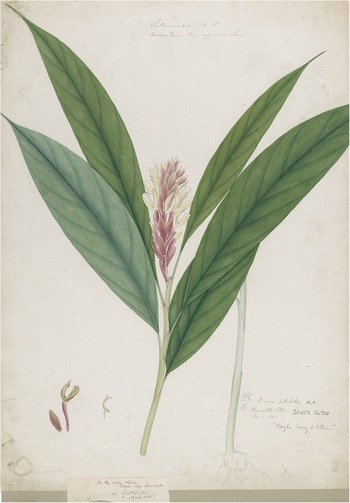
Cautleya petiolata Baker, Fl. Brit. India 6: 209 (1890). – Type: India, Uttarakhand, Garhwal District, J.F. Royle, icon, RBG Kew Library Archive (holo K). Fig. 6.
Cautleya robusta Baker, Fl. Brit. India 6: 209 (1890). – Type: India, West Bengal, Darjeeling, Kurseong, 11 x 1884, C.B. Clarke 36527 (lecto K, designated here).
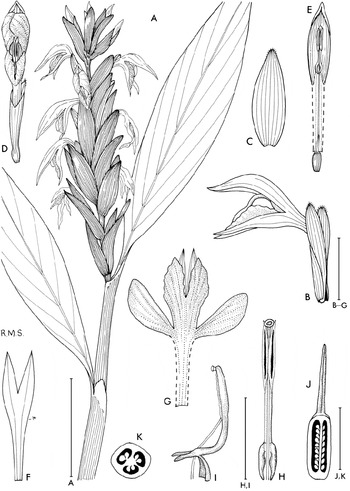
Cautleya spicata (Sm.) Baker. A, habit; B, flower with bract; C, bract; D, flower; E, corolla in L.S. showing dorsal petal, anther and tube; F, lateral petals, * indicating position of lateral staminodes; G, labellum and lateral staminodes; H–I, anther; J, ovary in L.S. and epigynous glands; K, ovary in T.S. Scale bars: A = 5 cm; B–G = 2 cm; H, I = 2 cm; J, K = 5 mm. From fig. 15 in Burtt & Smith (Reference Burtt and Smith1972).

Distribution of Cautleya spicata (Sm.) Baker.

Holotype specimen of Cautleya petiolata Baker.

Leafy shoots 40–100 cm tall. Leaves petiolate, lamina lanceolate, relatively broad, 11–38 × 2–11 cm. Ligules to 1.5 cm long. Inflorescence 7–24 cm long, dense, of 6 to more than 30 flowers. Bracts red or reddish, oblong to obovate, 1.5–4 cm long, longer than or equalling the calyx length. Calyx tubular, 1.5–3 cm long, with small margins, including at least half the floral tube. Capsule red, globose, to 1.5 cm diameter. Seeds black, globose, aril white, completely covering seed.
Distribution. Bhutan, Burma, China, India, Nepal.
Habitat and ecology. Recorded from 1210–3640 m.
Proposed IUCN conservation assessment. Least Concern (LC). This variety is known from many localities across a wide area and there are no significant threats.
Additional specimens examined. Nepal. s.l., N. Wallich 6530 (E, NY, P); 20 vii 1973, C. Grey-Wilson & Phillips 315 (K); Dakcho, 1930, L. Dhwoj 7 (E); Bagmati, Rasuwa, 24 vi 1985, J.B. Hankay Rai & P. Kumar Rai 103 (A); Central Nepal, Khimti, 5 vii 1974, J.D.A. Stainton 7179 (E); Kaski District, 26 vii 1996, T. Hoshino, M. Amano, H. Koba, K.R. Rajbhandari, M. Sato, R. Shrestha & S. Takatsuki 9662022 (A); Katmandu, 3 ix 1966, D.H. Nicolson 2251 (MICH); Mahabharat Lekh, 14 ix 1967, J.D.A. Stainton & L.H.J. Williams 8489 (K); Patan District, Phulchoki, 27 vii 1965, A.D. Schilling 574 (K); Seti Khola, 26 vii 1954, J.D.A. Stainton, W.R. Sykes & L.H.J. Williams 6503 (A, E); Singalila, 22 vii 1969, H. Hara, S. Kurosawa & H. Ohashi (E); Solukhumbu District, Phaplu, 1930, L. Dhwoj 82 (E).
India. s.l., T. Thomson (P), V.V. Jacquemont (P), K.P. Biswas 3524 (GH), W. Griffith 5689 (P). Uttarakhand: 9 vii 1923, R.N. Parker 2060 (K); Garhwal District, Dhunoultee, 1830, J.F. Royle 13190x(1) (LIV); Garhwal District, Tehri, 25 viii 1944, R.R. Stewart 21172 (K, NY); Kumaon, R. Strachey & J.E. Winterbottom (GH); ibid., x 1969, Pant & Nainthani 39509 (K). Himachal Pradesh: 1844, M.P. Edgeworth (K); 28 vii 1888, J.R. Drummond 23186 (K); 10 viii 1886, H. Collett 346 (K); Bashahr, 28 ix 1891, J.H. Lace 1044 (E); Simla, 1884, J.R. Drummond 1943 (E); ibid., 1887, J.R. Drummond 20950 (E); ibid., 1887, J.R. Drummond 20951 (E, K). West Bengal: Darjeeling, 10 x 1884, C.B. Clarke 36477 (K); Darjeeling, 6 viii 1893, J.M. Cowan (E); ibid., 3 ix 1912, ? G.H. Cave s.n. (K); ibid., 3 xi 1974, B.M. Bartholomew 249 (E, UC); ibid., W. Griffith 5664 (K); Darjeeling, Kurseong, 25 ix 1884, C.B. Clarke 35867A (K); Darjeeling, Mongpu, 10 x 1884, C.B. Clarke 36456 (K); Darjeeling, Rambi, 29 viii 1912, Anon. s.n. (K). Sikkim: J.D. Hooker (GH); 20 viii (year unknown), J.D. Hooker (K); J.D. Hooker (P); J.D. Hooker (P); 7 x 1884, C.B. Clarke 36328 (K); Rathang Chhu, 27 vii 1992, D.G. Long, R.J.D. McBeath, H.J. Noltie & M.F. Watson 772 (E).
Bhutan. Phuntsholing, 26 vi 1975, A.J.C. Grierson & D.G. Long s.n. (E); Tshilingor, 26 vi 1979, A.J.C. Grierson & D.G. Long 2268 (E).
China.Yunnan: P.J.M. Delavay (P); Binchuan Xian, 17 vii 1909, F. Ducloux 6565 (P); Dulong Jiang, 9 i 2006, H. Li 34421 (E).
Burma.Kachin State: Nyitadi, 28 vii 1920, R.J. Farrer 1767 (E).
Royle 13190x(1) (LIV) is labelled Roscoea petiolata in Royle’s hand but in the protologue Baker (Reference Baker and Hooker1890) says that Cautleya petiolata is ‘known only from an unpublished figure of Royle’s artist’. Thus, the figure is the sole original material and holotype, even though it may have been painted from 13190 (LIV) which Baker didn’t see.
Both Royle 13190x(1) (LIV) and Royle’s painting of Cautleya petiolata at K possess bracts that are a little shorter than the calyx and rather long petioles, at least for the upper leaves. Thus, they would key out to Cautleya gracilis. The overall Gestalt of the plant, however, leads us to regard it for now as a synonym of Cautleya spicata. Garhwal District of Uttarakhand, the origin of this material, has been relatively well-collected by botanists but no other collection has been made. The existence and nature of this rare variant will require further field research.
Dhwoj 7 (E) from Dakcho, Nepal consists of three sheets, two matching Cautleya spicata and the third matching C. gracilis var. gracilis.
Acknowledgements
We are very grateful to W. John Kress and Thinley Namgyel for sharing the results of their unpublished study of Cautleya of 1998 and to the curators of A, BM, E, ECON, GH, HBG, K, L, LINN, LIV, MICH, NY, P and UC for allowing us to consult their herbarium specimens and library archives. At the Royal Botanic Gardens, Kew, Nicholas Hind gave us valuable advice on the Wallich collection and Julia Buckley helped us to find the illustration shown in Fig. 6, which is reproduced with the kind permission of the Director and the Board of Trustees, Royal Botanic Gardens, Kew. Our thanks go to Claire Banks, who made the illustration in Fig. 2, and to Jana Leong-Škorničková (SING) for sending us photomicrographs of her collection Škorničková 71478. Mark Watson (E) has explained the history of collecting in Nepal to us, allowing us to attribute the types in J. E. Smith’s herbarium to the correct collector.