Introduction
Stink bugs, including the southern green stink bug, Nezara viridula (L.), the brown stink bug, Euschistus servus (Say), and the green stink bug, Chinavia hilaris (Say) (Hemiptera: Pentatomidae), are economic pests in many agricultural crops (McPherson & McPherson, Reference McPherson and McPherson2000). Generally, a farmscape is composed of multiple fields of different crop species whose edges interface with non-woodland and woodland habitats. In the coastal plain of the southeastern USA, corn, peanut, and cotton are agricultural crops common to farmscapes. Corn is an early-season host for both N. viridula and E. servus (Tillman, Reference Tillman2010), but it is not a host plant for C. hilaris (Tillman, Reference Tillman2013). Peanut generally is the second host crop available to the three stink bug species (Tillman et al., Reference Tillman, Northfield, Mizell and Riddle2009). Cotton is a mid-to-late-season host crop for C. hilaris, N. viridula, and E. servus (Bundy & McPherson, Reference Bundy and McPherson2000). Turnipseed et al. (Reference Turnipseed, Sullivan, Mann and Roof1995) and Bundy & McPherson (Reference Bundy and McPherson2000) noted in their studies that N. viridula and E. servus were the major stink bug pests of cotton in South Carolina and Georgia, respectively. However, Barbour et al. (Reference Barbour, Bradley and Bachelor1990) reported that C. hilaris was the predominant phytophagous stink bug in cotton in North Carolina. A recent study on colonization of C. hilaris, N. viridula, and E. servus in peanut–cotton farmscapes revealed that cotton was a relatively good host for all three stink bug species but peanut, although a good host for nymphal development of N. viridula and E. servus, was a surprisingly poor host for C. hilaris (Tillman, Reference Tillman2013).
Woodland and non-woodland habitats adjoining crops can harbor host plants of C. hilaris, N. viridula, and E. servus. For example, black cherry trees (Prunus serotina Ehrh.) and elderberry shrubs (Sambucus canadensis L.) are common early-season host plants of all three stink bugs in woodlands (Jones & Sullivan, Reference Jones and Sullivan1982). Dallisgrass (Paspalum dilatatum Poir.) is an early-season host plant for N. viridula and E. servus in non-woodland habitats (Jones & Sullivan, Reference Jones and Sullivan1982; Tillman, unpublished data). Virginia creeper [Parthenocissus quinquefolia (L.)] is a mid-summer host plant of C. hilaris in woodland habitats (Jones & Sullivan, Reference Jones and Sullivan1982). Blackberry (Rubus fruticosus L.) is a mid-summer host plant of E. servus in woodland and non-woodland habitats (Jones & Sullivan, Reference Jones and Sullivan1982). Mimosa (Albizia julibrissin Durazz.) is a known mid-to-late season host plant of both C. hilaris and E. servus in these habitats (Jones & Sullivan, Reference Jones and Sullivan1982). Both E. servus and N. viridula feed and develop mid-to-late season on pokeweed (Phytolacca americana L.) under trees in woodlands (Drake, Reference Drake1920). Adults of all three stink bugs feed on developing nuts of pecan [Carya illinoinensis (Wangenh.) K. Koch.] (Miner, Reference Miner1966; Yates et al., Reference Yates, Tedders and Sparks1991), and uncultivated trees can be numerous in woodlands in this region. These stink bugs also feed and develop on beggarweed seed [Desmodium tortuosum (Sw.) DC] late-season in non-woodland and woodland habitats (Tugwell et al., Reference Tugwell, Rouse and Thompson1973).
It has been well documented that stink bugs move within and between closely associated crop and non-crop habitats throughout the growing season in response to deteriorating suitability of their current host plants (Toscano & Stern, Reference Toscano and Stern1976; Velasco & Walter, Reference Velasco and Walter1992; Panizzi, Reference Panizzi1997; Ehler, Reference Ehler2000). However, even though we know in general that habitat edges can impact species dispersal in fragmented landscapes (Fagan et al., Reference Fagan, Cantrell and Cosner1999), we do not have a clear understanding of the impact of field edges, both those adjacent to field borders and the crop-to-crop interfaces, on the dispersal of stink bugs in crops in farmscapes. Indeed, very little information is available on the influence of plant height and absence of adult food in a crop, such as peanut, on stink bug dispersal across field edges. For instance, peanut is a low-growing crop without preferred seed or fruit (Todd & Herzog, Reference Todd, Herzog, Kogan and Herzog1980; Bundy & McPherson, Reference Bundy and McPherson2000; Mizell et al., Reference Mizell, Riddle and Blount2008) for adults, so the field edges likely would not impede dispersal by adult stink bugs into this crop. Recent research has shown that the crop-to-crop interface is a significant entry point for stink bugs into cotton (Reay-Jones et al., Reference Reay-Jones, Toews, Greene and Reeves2010; Reeves et al., Reference Reeves, Greene, Reay-Jones, Toews and Gerard2010; Tillman, Reference Tillman2011), but a detailed study on field edge effects on stink bugs in the three common farmscapes, i.e., corn–cotton, corn–peanut, and peanut–cotton, in this region can provide further insight on the impact of these field edges on dispersal of stink bugs. Also, the few reports on the impact of woodlands on stink bug dispersal in crops via transect sampling are quite variable (Reay-Jones, Reference Reay-Jones2010; Reeves et al., Reference Reeves, Greene, Reay-Jones, Toews and Gerard2010; Olson et al., Reference Olson, Ruberson and Andow2012).
We hypothesize that (1) field edges possibly can influence stink bug dispersal and distribution across farmscapes, (2) stink bug dispersal into a crop may be influenced by crop height, (3) the source crop may be a significant contributor of stink bugs dispersing into an adjacent crop, and (4) woodland and non-woodland habitats may be likely sources of stink bugs dispersing into these crops. Thus, our main objective was to examine the influence of field edges on colonization of stink bugs in corn, peanut, and cotton in corn–cotton, corn–peanut, and peanut–cotton farmscapes. Specifically, we aimed to: (1) assess the effect of distance from the crop-to-crop interface on density of stink bugs in each crop, (2) compare plant height for each crop, (3) compare density of stink bugs in field edges and in field interiors, and (4) determine occurrence of known host plants of stink bugs in habitats surrounding crops in farmscapes.
Materials and methods
Farmscape study sites
During the 6-year study, seven corn–cotton farmscapes (four in 2004 and three in 2006), eight corn–peanut farmscapes (seven in 2005 and one in 2008), and 13 peanut–cotton farmscapes (three in 2005, five in 2006, two in 2007, two in 2008, and one in 2009) were sampled at a total of 20 on-farm sites. The same sites could not always be sampled each year due to crop rotation. All farmscapes were located within a 32 km2 landscape near Ocilla, GA. Fields ranged in size from 9 to 22 ha.
All crops, including field corn, peanut, and cotton, were grown using University of Georgia Cooperative Extension recommended practices. Rows were planted 0.91 m apart for each crop, and rows in adjacent crops ran parallel to each other. A dynamic stink bug economic threshold, based on varying injury levels by week of bloom (weeks 1–8: 50, 30, 10, 10, 10, 30, 30, and 50%, respectively), was used (Greene et al., Reference Greene, Roberts, Bacheler, Toews, Ruberson, Reay-Jones, Robinson, Mott, Walker, Davis, Morrison, Pegram and Reeves2009). However, application of insecticides to cotton was not needed during stink bug colonization. Corn planting dates ranged from 6 to 15 March 2004, 11 March to 23 April 2005, 4 to 15 April 2006, 10 April 2007, 10 April 2008, and 23 March 2009. Corn varieties included DK (DeKalb) 697, DK C69-72, Pioneer 33M54, Pioneer 31G98, Pioneer 3167, Pioneer 31N26, Pioneer 31M26, and Croplan Genetics 841. Peanut planting dates ranged from 10 May 2004, 8 to 19 May 2005, 10 to 21 May 2006, 21 to 29 May 2007, 13 to 25 May 2008, and 19 May to 3 June 2009. Peanut varieties included C99R, Georgia 02C, Georgia Green, and AP-3. Cotton planting dates ranged from 6 to 8 May 2004, 18 to 21 May 2005, 27 April to 26 May 2006, 11 May to 11 June 2007, 8 May to 13 June 2008, and 5 May to 15 June 2009. Cotton varieties included DP (Deltapine) 449, DP 444, DP 5415, DP 555, DP 488, and Phy 370 WR.
Crop height
Mature plant height for each crop was measured for 100 randomly selected plants per crop at locations throughout the crop at each study site.
Insect-sampling procedures
In each farmscape, crops were examined weekly for presence of N. viridula, E. servus, and C. hilaris egg masses, nymphs, and adults during the growing season. Owing to the relatively low number of egg masses found in peanut and cotton, eggs and nymphs were grouped as immatures. Corn was sampled from pollination through ear maturation. For each corn sample, all plants within a 1.83-m length of row were visually checked for stink bugs. Cotton was sampled from onset of flowering through boll maturation. For each cotton sample, all plants within a 1.83-m length of row were shaken over a drop cloth and visually checked for stink bugs. Peanut sampling started at initiation of pegging (when budding ovaries or ‘pegs’ grow down into the soil) and continued until near harvest. In peanut, sweep nets (38 cm in dia.) were used to capture stink bugs. Before collecting a sample, the peanut canopy was visually observed for egg masses without disturbing adults. In 2005, the canopy within a 3.66-m length of row was swept for stink bugs, and for the remaining years the canopy within a 7.31-m length of row was swept. Stink bugs collected from peanut were examined in the laboratory for species identification; stink bugs from other crops were identified to species in the field.
Corn, cotton, and peanut all presented challenges when sampling for stink bugs. Tall corn plants with ears, cotton with bolls, and low-growing, vining peanuts made any one sampling technique difficult to uniformly apply. The sampling techniques used for cotton and corn in the current study were previously used by Tillman (Reference Tillman2006) and effectively determined the number of N. viridula adults per length of row in both sorghum and cotton. In that study, sampling before and after insecticide (i.e., dicrotophos) application revealed that densities of live, and then dead, adults were similar. Within peanut, Olson et al. (Reference Olson, Ruberson, Zeilinger and Andow2011) showed that different sampling techniques (i.e., drop cloth and sweep net) resulted in similar numbers of stink bugs sampled.
Within a farmscape, a crop field was partitioned into three sampling locations: (1) the interface, i.e., common boundary of two adjacent crops, (2) sides, i.e., the three field edges excluding the interface, and (3) the interior of the field. For each interface sampling site, samples were obtained at rows 1 (or ∼0.5 m) and 5 (or ∼4 m) from the field edge in corn and cotton during 2004 and at rows 1, 2 (or ∼2 m), 5, and 9 (or ∼8 m) from the field edge in these two crops the remaining years. For each interface sampling site in peanut, samples were taken at rows 1, 6 (or ∼5 m), and 10 (or ∼9 m) from the field edge for all years. For each side sampling site, samples were obtained at rows 1 and 5 from the field edge in corn, rows 1, 5, and 9 from the field edge in cotton and rows 1, 6, and 10 from the field edge in peanut. In interior field transects, samples were obtained at rows 16 and/or 33 from the interface and then approximately every 33 rows beyond row 33 from the interface depending on field width. All interior samples were at least 18.3 m from any side field edge.
For brevity, sampling sites at the interface and sides of the field are referred to as ‘samples’ in the following description of the number of sampling sites in the fields. In corn, two samples were obtained at the interface and each side in 2004. For the remaining years, there were 9–18 interface and 3–9 side samples in this crop. In peanut, there were 9–18 interface and 3–9 side samples over all years except in 2009 when side data were not collected from one peanut–cotton farmscape. In cotton, there were 9–18 interface and 6–9 side samples over all years. For corn in 2004 and 2005 and for peanut bordered by cotton in 2005, three interior transects were sampled per field. For the remaining fields, six interior transects were sampled per field. All sampling sites and locations of interior transects were chosen randomly along predesignated rows. The number of side samples was always equal for each of the of the field sides. Each side sample site was characterized as woodland, when adjacent to woodlands, or non-woodland. Known non-crop host plants in non-woodland and woodland field borders were identified to species and recorded.
Colonizing adults
For each stink bug species, colonizing adults were those adults that were found in a crop for five consecutive weeks after the presence of the first stink bugs. Development from eggs to adults for N. viridula requires about 35 days under field temperatures (Drake, Reference Drake1920; Harris & Todd, Reference Harris and Todd1980; Panizzi et al., Reference Panizzi, Parra, Santos and Carvalho2000). At temperatures somewhat lower than field temperatures at our study sites, mean egg-to-adult developmental time was 44.3 days for E. servus (Munyaneza & McPherson, Reference Munyaneza and McPherson1994) and 40.3 days for C. hilaris (Simmons & Yeargan, Reference Simmons and Yeargan1988). It was expected that during the time stink bugs were colonizing a crop, adults would be sampled. On the rare occasions when only eggs or young nymphs (1st and 2nd instars) were found in a crop during the first 2 weeks of colonization, their presence was considered to be evidence of an adult colonizer.
Statistical analyses
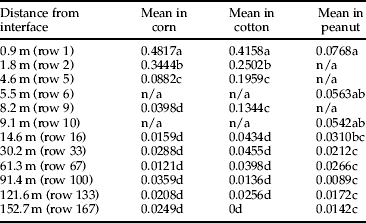
Density data for colonizing adults were compared at the various distances from the interface field edge for each stink bug species using the PROC MIXED procedure of the Statistical Analysis System (SAS Institute, 2008). The fixed effects were distance. Random effects were residual error. Least-squares means were separated by least significant difference (LSD, P<0.05) (SAS Institute, 2008) where appropriate. Analysis of density data revealed that the greatest dispersal activity of colonizing stink bugs in these farmscapes occurred at crop-to-crop interfaces and that stink bug dispersal into the field at these interfaces was highest up to 5, 9, and 16 rows from the field edge in corn, cotton, and peanut, respectively, in comparison to rows further away from the field edge (table 1). Thus, interface data from row 9 was added to interior samples in corn, and interior data from row 16 of peanut was added to peanut interface samples. Mature plant height for the three crops was compared using t-tests (SAS Institute, 2008).
Effect of distance from farmscape interface on mean (±SEM) density (number per 1.83 m length of row) of colonizing C. hilaris, N. viridula, and E. servus in corn, cotton, and peanut.

For each crop, differently lettered means (common SE=0.0246 for corn, 0.0173 for cotton, and 0.0191 for peanut) are significantly different at P<0.05. Distance is from the outermost edge of the crop field to the middle of the row sampled.
Numbers of colonizing stink bug adults were compared between interface field edges and field interiors, between interface field edges and side edges of fields, between woodland field edges and field interiors, and between non-woodland field edges and field interiors for crops in each farmscape using t-tests (SAS Institute, 2008). Only fields with >1 stink bug were included in the statistical analyses. For 2009 peanut–cotton, peanut was excluded in these analyses because side data were not collected. For C. hilaris, analyses were done only for peanut–cotton due to low numbers of this insect in corn and peanut fields associated with corn.
Because peanut fruit is inaccessible to stink bug adults, they are limited to feeding only on stems and leaves of this crop (Tillman, Reference Tillman2008a ), and so the presence of colonizing stink bug adults in this crop indicates that they are utilizing the crop for oviposition. Therefore, in addition to comparing colonizing adults, the numbers of colonizing stink bug immatures (egg masses and nymphs) in peanut also were compared between interface edges and field interiors and between interface edges and side edges using t-tests (SAS Institute, 2008). One C. hilaris nymph was found in peanut in corn-peanut farmscapes, and so only the two other stink bug species were examined in these farmscapes, but nymphs of all three stink bug species were used for peanut–cotton farmscapes. Stink bug immatures in peanut develop from egg masses oviposited on peanut, for even though 4th and 5th instar stink bugs will disperse from peanut into cotton at the crop-to-crop interface (Tillman et al., Reference Tillman, Northfield, Mizell and Riddle2009), late-instar stink bugs do not disperse from corn or cotton into peanut (Tillman, Reference Tillman2011).
Results
Stink bug species composition
Over the study, all developmental stages and both sexes of adult E. servus and N. viridula were present in each crop in each farmscape strongly indicating that all three crops served as reproductive host plants for these two stink bug species. In peanut and cotton, 50% of specimens of both species were adults. In corn, percentage of adult E. servus (66.3%) was higher than that of adult N. viridula (33.7%). Adults of C. hilaris were rarely found in corn (n=1), peanut (n=2) and in cotton associated with corn (n=3). In peanut–cotton farmscapes, adults of C. hilaris represented 7.3% of these three species in peanut and 13.3% in cotton. Peanut and cotton served as host plants for C. hilaris although the percentage of adults/nymphs of this bug was generally much lower in peanut (10.8/5.8%) than in cotton (89.2/94.2%). In corn farmscapes, N. viridula and E. servus occurred in corn before peanut or cotton, and when peanut and cotton crops were closely associated, all three stink bug species were present first in peanut.
Edge effects
In examining edge-mediated effects in these farmscapes, we first determined the distance colonizing adults dispersed into corn, peanut, and cotton fields at crop-to-crop interfaces. In corn, density of colonizing stink bugs was significantly higher (F=38.52; df=10, 3537; P=0.0001) up to ∼4.5 m away from the crop-to-crop interface than at distances further into the field (table 1). In cotton, density of stink bugs was significantly higher (F=29.05; df=10, 6771; P=0.0001) up to ∼8.2 m from the interface than at distances further into the field. In peanut, density of colonizing stink bugs was significantly higher (F=5.17; df=9, 4757; P=0.0001) at ∼0.9 m from adjacent crops compared to ∼14.6 m and beyond, but density of stink bugs at ∼9.1 m was not significantly higher than density at ∼14.6 m. We concluded that there was an edge effect in colonization of stink bugs up to 4.6 m from the interface field edge into corn, up to 8.2 m from the interface field edge into cotton, and up to 14.6 m from the interface field edge into peanut.
Mature plant height of corn, 2.67±0.02 m (n=100), was significantly higher than cotton, 1.2±0.02 m (n=100), (|t|=49.4; df=198; P<0.0001) or peanut, 0.38±0.01 m (n=100), (|t|=115.9; df=198; P<0.0001), and mature plant height of cotton was significantly higher than peanut (|t|=34.2; df=198; P<0.0001). We also note that in general, relative percentage differences in crop height remained the same regardless of the stage of crop development. The graph of mean crop height and the edge effect in colonization of stink bugs for each of the three crops (fig. 1) strongly suggests that stink bug dispersal into a crop decreases as crop height increases.
Crop height and distance of stink bug dispersal into peanut, cotton, and corn.

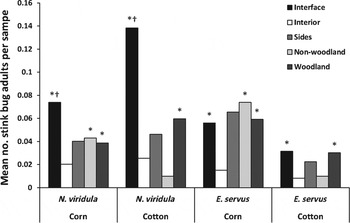
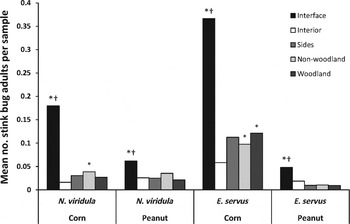
For most crops in all farmscapes E. servus, N. viridula, and C. hilaris density was significantly higher at the interface of the two crops compared to the interior of the field (figs 2–4; Supplemental Table 1). We note that this occurred for each crop at the farmscape crop-to-crop interface. The one exception was for C. hilaris in peanut in peanut–cotton farmscapes (fig. 4). A significant difference in density was not detected between the interface and the interior of the peanut fields for this stink bug in these farmscapes even though C. hilaris density in peanut was approximately twice as high at the interface compared to the field interior.
Mean (±SEM) number of N. viridula and E. servus adults per 1.83-m length of row colonizing field edges and the interior of the field in corn and cotton in corn–cotton farmscapes. Interface: field edge (0–4.6 m from outermost edge for corn and 0–8.2 m from outermost edge for cotton) at common boundary of the two crops; Interior: interior of the field (at least 18.3 m from outermost edge); Sides: other field edges (0–4.6 m from outermost edge for corn and 0–8.2 m from outermost edge for cotton); Non-woodland: sides adjacent to non-woodlands; Woodland: sides adjacent to woodlands; *, field edge, including interface, significantly higher than interior of field (t-test, P<0.05); †, interface significantly higher than sides (t-test, P<0.05).

Mean (±SEM) number of N. viridula and E. servus adults per 1.83-m length of row colonizing field edges and the interior of the field in corn and peanut in corn–peanut farmscapes. Interface: field edge (0–4.6 m from outermost edge for corn and 0–14.6 m from outermost edge for peanut) at common boundary of the two crops; Interior: interior of the field (at least 18.3 m from outermost edge); Sides: other field edges (0–4.6 m from outermost edge for corn and 0–9.1 m from outermost edge for peanut); Non-woodland: sides adjacent to non-woodlands; Woodland: sides adjacent to woodlands; *, field edge, including interface, significantly higher than interior of field (t-test, P<0.05); †, interface significantly higher than sides (t-test, P<0.05).

Mean (±SEM) number of N. viridula, E. servus, and C. hilaris adults per 1.83-m length of row colonizing field edges and the interior of the field in peanut and cotton in peanut–cotton farmscapes. Interface: field edge (0–9.1 m from outermost edge for peanut and 0–8.2 m from outermost edge for cotton) at common boundary of the two crops; Interior: interior of the field (at least 18.3 m from outermost edge); Sides: other field edges (0–9.1 m from outermost edge for peanut and 0–8.2 m from outermost edge for cotton); Non-woodland: sides adjacent to non-woodlands; Woodland: sides adjacent to woodlands; *, field edge, including interface, significantly higher than interior of field (t-test, P<0.05); †, interface significantly higher than sides (t-test, P<0.05); ‡, interior significantly higher than field edge (t-test, P<0.05).

Generally in corn–cotton, corn–peanut, and peanut–cotton farmscapes, density of colonizing stink bug adults was significantly higher in interface edges compared to side field edges for all three stink bug species in each crop (figs 2–4; Supplemental Table 1). However, in peanut in peanut–cotton farmscapes, there was only a tendency toward a higher number of C. hilaris adults in the interface vs. the sides, and in corn–cotton, there was no significant difference in E. servus density between interface and side edges for both crops.
For both farmscapes with peanut, density of combined stink bug immatures in peanut was significantly higher at the interface edge compared to the field interior during the period of time adults were colonizing the crop (table 2). Also, density of these immature stink bugs was significantly higher at the interface compared to the sides or the side edges in both corn–peanut and peanut–cotton. Thus, there was an edge effect in oviposition in peanut similar to that for dispersal of stink bug adults.
Mean (±SEM) number of stink bug immatures (eggs and nymphs) per 1.83 m length of row in field edges and within the field in peanut in corn–peanut and peanut–cotton farmscapes.

Interface, field edge (0–8.2 m from outermost edge) at common boundary of the two crops; interior, interior of the field (at least 18.3 m from outermost edge); sides, field edges (0–8.2 m from outermost edge) other than the interface.
Generally, E. servus and N. viridula density in corn in both corn farmscapes was significantly higher in non-woodland and woodland field edges than in field interiors (figs 2–4; Supplemental Table 1). For N. viridula in corn bordered by peanut, though, the number of stink bugs was only numerically higher in woodland edges compared to field interiors (fig. 3).
In cotton in both cotton farmscapes, density of all three stink bug species was significantly higher in woodland field edges than in field interiors, but it was never significantly different between non-woodland field edges and field interiors (figs 2–4; Supplemental Table 1). Approximately a week after stink bug colonization, stink bug boll damage reached economic threshold in woodland edges in 6 of the 13 cotton fields in peanut–cotton farmscapes. However, boll damage did not reach economic threshold in any cotton field edge adjacent to non-woodland habitats.
In peanut farmscapes, density of adults of all three stink bug species was not significantly different between the interior of the peanut field and either non-woodland or woodland field edges (figs 2–4; Supplemental Table 1). Thus, there was no observable edge-mediated effect in adult stink bug dispersal at the side edges of peanut fields.
Non-crop host plants in non-woodland and woodland field borders
Non-crop host plants of stink bugs grew in both non-woodland and woodland field borders adjoining crops in corn–cotton, corn–peanut, and peanut–cotton farmscapes. These non-crop host plants included black cherry, elderberry, mimosa, Virginia creeper, pokeweed, blackberry, uncultivated pecan, beggarweed, and dallisgrass. The first seven plant species were found in woodland habitats, but beggarweed could be found in either woodland or non-woodland habitats. Dallisgrass grew mainly in non-woodland habitats adjacent to corn. Even though every individual host plant in these farmscapes was not examined, we found E. servus, N. viridula, and C. hilaris on each of their respective host plants in each farmscape.
Generally, similar to crops in the farmscape, there was a seasonal sequence of host plant species in surrounding habitats in these farmscapes. Black cherry was an early-season (May to mid-July) host plant for all three stink bug species. Elderberry was another early-season (mid-May to July) host plant of each of these stink bugs. Adults and late-instars were observed feeding on ripening fruit of black cherry and elderberry. Dallisgrass was an early-season (May–June) host plant of N. viridula and E. servus. Both of these stink bugs commonly laid eggs on blades of dallisgrass, and adults and late-instars fed on seeds of this plant. Virginia creeper was a mid-season (mid-July to mid-August) host plant for C. hilaris; older nymphs and adults fed on fruit of the plant. Blackberry was mid-summer host plant of E. servus which were observed feeding on blackberry fruit starting to ripen. Pokeweed was a mid-to-late season (late July to August) host plant for both E. servus and N. viridula. Egg masses of both stink bug species occasionally were observed on leaves of this plant. These leaves provided food to young nymphs of both stink bugs while fruit was the main diet of late-instar and adult stink bugs. Mimosa served as a mid-to-late season (mid-July to early-September) host plant of both C. hilaris and E. servus, feeding on maturing seeds in pods. All three stink bug species fed on developing pecan nuts from late-July through September. On one occasion we found a N. viridula egg mass on a pecan leaf. Beggarweed served as a late-season (mid-August to September) host plant for all three stink bug species – adults fed on seeds while developing nymphs fed on stems and seeds.
Discussion
Colonizing N. viridula, E. servus, and C. hilaris exhibited edge-mediated dispersal at crop-to-crop interfaces in corn, peanut, and cotton in these farmscapes. Interestingly, edge effects varied by crop presumably due to differences in crop height. The depth of these edge effects ranged from 4.5 to 14.6 m into the crops. Perceptual range, i.e., the distance from which an organism can perceive a particular landscape element, may limit dispersal of insects at edges of landscapes (Lima & Zollner, Reference Lima and Zollner1996). The estimated perceptual range (∼8–12 m) of these insects (Mizell, unpublished data) fits well with observed stink bug behavior at crop-to-crop interfaces.
In recent years, crop-to-crop edge effects have been reported for various stink bug species for cotton adjacent to alfalfa, peanut, and soybean (Toscano & Stern, Reference Toscano and Stern1976; Bundy & McPherson, Reference Bundy and McPherson2000; Bagwell & Sharp, Reference Bagwell and Sharp2006; Tillman et al., Reference Tillman, Northfield, Mizell and Riddle2009; Toews & Shurley, Reference Toews and Shurley2009; Reay-Jones et al., Reference Reay-Jones, Toews, Greene and Reeves2010; Reeves et al., Reference Reeves, Greene, Reay-Jones, Toews and Gerard2010) and for wheat adjacent to corn (Reay-Jones, Reference Reay-Jones2010). In an earlier study in cotton, no differences in boll damage by stink bugs were detected among samples obtained 18.7 m distant from the edge of corn, peanut, or soybean with those obtained at the center of cotton plots (Toews & Shurley, Reference Toews and Shurley2009). Similarly, Reay-Jones et al. (Reference Reay-Jones, Toews, Greene and Reeves2010) found higher stink bug boll injury in cotton at locations <10 m from soybean fields. In rice, a relatively tall crop, there was a 9-m-deep edge effect in dispersal of the rice stink bug, Oebalus pugnax (F.) (Espino et al., Reference Espino, Way and Wilson2008). In wheat, another relatively tall crop, abundance of stink bugs up to 5 m from the field edge was greater than at 10 and 25 m for E. servus and O. pugnax (Reay-Jones, Reference Reay-Jones2010). Thus, the distances colonizing stink bugs entered interface edges in our study were within previously observed ranges for stink bugs in other studies/crops. Olson et al. (Reference Olson, Ruberson and Andow2012) set a 31 m field edge for examining edge effects in corn, peanut, and cotton. Previously, Reay-Jones et al. (Reference Reay-Jones, Toews, Greene and Reeves2010) determined that sampling stink bugs 32 m from cotton field edges lacked the precision needed to quantify edge effects in this crop. Therefore, the 31 m distance into the field used by Olson et al. (Reference Olson, Ruberson and Andow2012) was likely too great to detect all potential edge effects in these crops, and furthermore, differences in crop height were not taken into account.
Our results demonstrate that in general, as hypothesized, colonization of stink bugs was highest at crop-to-crop field edges in farmscapes. Our findings are similar to those of the few studies that have compared density of stink bugs in transects at crop-to-crop edges with density at non-crop field edges (Reay-Jones, Reference Reay-Jones2010; Reeves et al., Reference Reeves, Greene, Reay-Jones, Toews and Gerard2010).
So why would stink bug dispersal be greater at crop-to-crop interfaces compared to side field edges? Considering that stink bugs move more along rows than across rows in soybean and cotton (Panizzi et al., Reference Panizzi, Galileo, Gastal, Toledo and Wild1980; Tillman et al., Reference Tillman, Northfield, Mizell and Riddle2009), perhaps stink bugs are utilizing these interfaces as corridors, i.e., dispersing into crops along the interface. Interestingly, both plant height and host plant suitability can influence this edge-mediated dispersal of stink bugs. Our results suggest that stink bug dispersal into a crop decreases as crop height increases. As a low-growing crop with no fruit for adults, peanut does not impede dispersal of adults of each stink bug species, for edge-mediated effects with respect to stink bug dispersal were never detected in side edges of this crop. For C. hilaris, peanut is not only a low-growing plant but also a poor nymphal host plant (Tillman, Reference Tillman2013) such that both of these factors combine to promote dispersal across peanut fields, presumably to find suitable food and oviposition host plants. However, for N. viridula and E. servus, nymphs develop into adults in corn and peanut (Tillman, Reference Tillman2013) and then some disperse into cotton at the crop-to-crop interface where they aggregate while feeding on cotton bolls. For N. viridula and E. servus at interfaces in these farmscapes, the source crop (i.e., corn or peanut) provides a large stink bug breeding site that abuts the full length of the stink bug receiving crop (i.e., peanut or cotton). The other edges may have diverse, fragmented sources of stink bugs that can be limited in scope with respect to the farmscape. Even though corn and peanut are not significant sources of C. hilaris dispersing into cotton in peanut–cotton farmscapes (Tillman, Reference Tillman2013), C. hilaris adults still disperse into this crop and aggregate at the interface; likely the low growth of peanuts facilitates dispersal of C. hilaris from host plants in woodlands to the taller cotton. Cotton field edges, with relatively tall but suitable food plants, suppress dispersal of N. viridula, E. servus, and C. hilaris adults into the cotton field. These two factors (i.e., plant height and suitability as a food source) promote dispersal along field edges resulting in aggregation of these stink bugs in cotton field edges, especially at crop-to-crop interfaces.
An edge effect in oviposition likely occurred in peanut at the interface in corn–peanut and peanut–cotton farmscapes for both N. viridula and E. servus during colonization of the crop. At corn–peanut interfaces, females of these two stink bugs in corn dispersed into peanut to oviposit, but they could easily return to corn for adult food. In peanut–cotton farmscapes, N. viridula and E. servus females oviposit on peanut where egg-to-adult development of stink bugs occurs on vegetation (Tillman, Reference Tillman2008b ), and resulting late-instars and new adults in this crop disperse into cotton to feed on fruit (Tillman et al., Reference Tillman, Northfield, Mizell and Riddle2009). Stink bug females dispersing from peanut into cotton may have perceived the taller cotton along the interface as a barrier and continued ovipositing in peanut, or conversely maybe they preferred to oviposit in peanut over cotton. Previous studies also have observed that there is a significant amount of continual back-and-forth host plant switching with regards to feeding and oviposition at these crop-to-crop interfaces (Tillman et al., Reference Tillman, Northfield, Mizell and Riddle2009; Tillman, Reference Tillman2011).
As an exception to the generally observed trend, E. servus density was similar at the interface and side edges for both crops in corn–cotton farmscapes. We are uncertain why this occurred. In general terms, there were lower numbers of stink bugs in cotton adjacent to corn than in cotton adjacent to peanut. Similarly, Reeves et al. (Reference Reeves, Greene, Reay-Jones, Toews and Gerard2010) found significantly lower numbers of stink bugs in cotton bordering corn than in cotton-bordering peanut. Corn plant height may partially explain this observed outcome. Stink bug adults may not be able to disperse as easily across corn as in peanut; crop height tends to serve as a barrier to within field dispersal. Also, young females that develop on corn tend to search for oviposition sites (i.e., peanut) before sites with adult food (i.e., bolls) become available in cotton, especially for early-planted corn (Tillman, Reference Tillman2010). Indeed, stink bugs disperse into peanut and reproduce in this crop before cotton in corn–peanut–cotton farmscapes (Tillman, Reference Tillman2011).
In the current study, some stink bug adults and nymphs were observed on various known non-crop host plants in non-woodlands and woodlands closely associated with corn, peanut, and cotton. A recent study has revealed that for each respective known alternate host plant, N. viridula, E. servus, and C. hilaris females oviposit egg masses on leaves, early instars feed on these leaves, and late-instars and new adults fed on fruit (Tillman, unpublished data). Edge effects in dispersal of these stink bugs into crops adjacent to field borders, particularly woodland ones, indicate that stink bugs developing in field borders are likely sources of stink bugs into these crops. Indeed, the proximity of known host plants in woodland habitats and the spatial distribution of C. hilaris in peanut and cotton in peanut–cotton farmscapes suggest that these non-crop plants are sources of this stink bug moving into peanut and cotton (Tillman & Cottrell, unpublished data).
Except for adjacent crops, the impact of non-woodland habitats on stink bugs previously has not been examined. Over all farmscapes and stink bug species, edge effects in dispersal of N. viridula and E. servus adjacent to non-woodland borders were consistently detected only in corn. Herbaceous host plants, especially dallisgrass, were relatively abundant in non-woodland field borders during corn production. Even though stink bug density on these plants was not assessed in our study, all developmental stages of stink bugs were abundant on these non-crop host plants early-season. Therefore, these herbaceous plants in non-woodland habitats adjoining corn field edges may have been significant sources of these stink bugs dispersing into corn.
In this current study, edge effects with respect to stink bug dispersal into field edges adjoining woodlands were detected for each stink bug species in corn and cotton. Previous reports on the influence of woodland borders on stink bug dispersal are variable. As early as the 1930s, Mundinger & Chapman (Reference Mundinger and Chapman1932) reported that the greatest damage by E. servus on pear and by C. hilaris on apple occurred near woodlands or where an orchard bordered uncultivated land. Upon sampling stink bugs along transects in wheat fields adjacent to wheat and woodlands, Reay-Jones (Reference Reay-Jones2010) determined that E. servus was more abundant in wheat in transects adjacent to woodlands than next to other wheat fields. Reeves et al. (Reference Reeves, Greene, Reay-Jones, Toews and Gerard2010) sampled E. servus, N. viridula, and C. hilaris in transects in cotton adjacent to peanut, soybean, corn, cotton, and woodlands. Similarly as we found, stink bug density was significantly greater in cotton adjacent to peanut, and lower in cotton adjacent to woodlands. Also similar to our findings, Olson et al. (Reference Olson, Ruberson and Andow2012) found that colonizing E. servus adults in corn frequently were more abundant near woodland edges than in field interiors. In contrast with our findings, the same authors found that colonizing N. viridula adults were often more common in corn field interiors than in field edges adjacent to woodlands, and no woodland edge effects were found for E. servus and N. viridula in peanut, cotton, and soybean. However, Reeves et al. (Reference Reeves, Greene, Reay-Jones, Toews and Gerard2010) and our results showed woodlands to be a source of stink bugs in cotton at woodland edges. Olson et al. (Reference Olson, Ruberson and Andow2012) also found no edge effects for C. hilaris in soybean adjacent to woodlands, but Miner (Reference Miner1966) consistently found heaviest infestations of this pest in soybean on border rows next to woodlands. The differences in these studies are probably due to differences in distances from field edges used in examining edge effects. In our study and the study by Olson et al. (Reference Olson, Ruberson and Andow2012), C. hilaris was often more common near woodland edges than in field interiors in cotton. This is not surprising because the majority of C. hilaris host plants exist in woodland habitats (Jones & Sullivan, Reference Jones and Sullivan1982).
In conclusion, our results provide new insights regarding the influence of field edges on colonization of stink bugs in crops in the context of farmscapes, and thus they have important implications for management strategies against pentatomid pests in both conventional and organic cropping systems.
Supplementary Material
The supplementary materials for this article can be found at http://www.journals.cambridge.org/ber
Acknowledgements
The authors thank Kristie Graham (USDA, ARS, Crop Protection and Management Research Laboratory, Tifton, GA) and Ann Amis (USDA, ARS, Southeastern Fruit and Tree Nut Research Laboratory) for their technical assistance.