Introduction
The Bactrocera dorsalis complex of fruit flies (Diptera: Tephritidae) includes 75 described species endemic to Southeast Asia, several of which are polyphagous pests of economic importance (Drew and Hancock, Reference Drew and Hancock1994; Clarke et al., Reference Clarke, Armstrong, Carmichael, Milne, Raghu, Roderick and Yeates2005). The members of the dorsalis complex have commonly been regarded as major pests and expanding invaders in tropical environments. Nevertheless, there is little formally published information on host range and basic biology for most of the species in the complex.
Bactrocera pyrifoliae (Drew and Hancock) is a little known member of the dorsalis complex that has been reported from Thailand and Vietnam (Drew and Hancock, Reference Drew and Hancock1994; Clarke et al., Reference Clarke, Armstrong, Carmichael, Milne, Raghu, Roderick and Yeates2005) infesting seven species of plants in six genera and five families (Clarke et al., Reference Clarke, Armstrong, Carmichael, Milne, Raghu, Roderick and Yeates2005). In Vietnam, B. pyrifoliae has been reported to infest Prunus persica and Prunus domestica (Drew et al., Reference Drew, Trung and Khanh2001; Khanh et al., Reference Khanh, Hien, Tuu, Toan, Thong, Trang, Thanh and Thang2007). All that is known about the management of this species is that it is not attracted to traps containing methyl eugenol or cuelure, but that it responds to protein baits (Khanh et al., Reference Khanh, Hien, Tuu, Toan, Thong, Trang, Thanh and Thang2007, Reference Khanh, Tuu, Hien, Toan, Trang, Thong, Thanh and Thang2008).
Although fruit flies of the genus Bactrocera have traditionally been regarded as pests of tropical and subtropical commodities, recent interest in developing low-chill technologies for temperate-fruit production in high-elevation areas within the tropics (Rojanasoonthon, Reference Rojanasoonthon2005) makes it important to know the basic biology of B. pyrifoliae. Furthermore, given the recent increase in invasions of pestiferous fruit flies, especially species in the B. dorsalis complex (Clarke et al., Reference Clarke, Armstrong, Carmichael, Milne, Raghu, Roderick and Yeates2005), such information is useful for developing risk assessment and quarantine measures. Biological differences among members of the complex provide reference guidelines when attempting to clarify taxonomic status and evolutionary history. More importantly, the development of environmentally sound pest management schemes requires a comprehensive knowledge of the biology of pest species (Aluja and Rull, Reference Aluja, Rull, Aluja, Leskey and Vincent2009). Increased application of the sterile insect technique (SIT) for suppression in commercially important fruit-growing areas makes B. pyrifoliae a candidate for SIT-based integrated pest management. The following are important facts to consider: (1) in high-elevation areas of Vietnam, revenue from peach production is already three times greater than that from rice (Hai et al., Reference Hai, Ca, Dang, Hung and Ai2005); (2) there is an increasing trend in Southeast Asia to consume temperate fruits, (3) temperate-fruit growing represents an economic alternative to heroin production; and (4) there are plans to establish by 2010 150,000 ha of temperate-fruit production in northern Vietnam (Hai et al., Reference Hai, Ca, Dang, Hung and Ai2005).
In this study, the basic biology of and artificial rearing systems for B. pyrifoliae were investigated. Information on these is needed to effectively manage B. pyrifoliae and, in the long term, develop the SIT for this pest.
Materials and methods
Host range and distribution
To establish the host range and distribution of B. pyrifoliae in northern Vietnam, a total of 18 species of fruits in eight provinces with different climatic and agroecological conditions (mountainous region, middle land, Red River Delta) were collected. Fruits and vegetables were collected at a total of 16 sites over 5 years during the fruiting season (from April to August) of commercial hosts. Fruits were sampled directly from trees, at different stages of maturity (green, mature and ripe), in damaged or intact state, and under tree canopies after falling to the ground. Samples were placed into paper bags labelled with a sample number, the location and date of collection, and the name of the collector. Collected fruits were taken to the laboratory in Hanoi (7 masl, 32–35 °C, and 75–80% relative humidity (RH)), where samples were weighed and placed into plastic containers covered with close-fitting muslin; the bottoms of the containers were covered with sterilized sawdust. After 7 and 14 days, the sawdust was sieved to collect pupae that had been formed therein. Collected pupae were counted and placed in plastic containers (20 × 20 × 15 cm) and then covered with a thin layer of moistened sawdust and a close-fitting muslin cloth (mosquito net). Emerging adults were fed with yeast extract and sugar for 5–7 days to allow for full wing pigmentation, placed in a refrigerator at approximately 5 °C and then identified.
Seasonality and life cycle
To establish seasonal trends in the infestation rates of B. pyrifoliae in the field, we summed larval recovery per kg of sampled fruit over a period of 1 year. The durations of the different life stages were estimated in the laboratory on a carrot-based diet consisting of 86 g carrot, 10 g protein (torula yeast), 3 g sugar and 1 g nipagin per 100 g of diet.
Colonization and artificial rearing
A laboratory strain of B. pyrifoliae was colonized from c. 1000 pupae obtained in May and June 2005 from field-collected peaches in the Moc Chau District, Son La Province of northern Vietnam, and refreshed periodically with an additional 3000 pupae in 2006, 5000 in 2007, 5900 in 2008, and 1800 in 2009.
Holding conditions
After emergence, adults of B. pyrifoliae were transferred into rearing cages (50 × 50 × 60 cm) made from polyvinyl chloride 22 mm-diameter pipes and covered with nylon screen. Three environmental regimens were established: (1) constant mean temperature of 26 ± 1 °C and 60–70% RH; (2) constant mean temperature of 23 ± 1 °C and 60–70% RH; and (3) daytime temperature of 26 ± 1 °C, decreased to 21 ± 1 °C at night, and 75–85% RH for three generations, and then constant temperature of 22–24 °C and 75–85% RH for three generations.
Three days after emergence, sugar and water were supplied to the adults. From day 4 onwards, adults were provided with water and a mixture of hydrolysed yeast, sugar and water (20:80:1) and a weekly supplement of fruit juice (guava, carrot, mango, orange or peach). Mortality in cages (under different temperature regimens) was estimated by counting dead flies at 5, 10, 15, 20 and 25 days after emergence.
Adult density and sex ratio in colony cages
To determine optimal adult density in holding cages, comparisons of the number and percentage of dead flies, volume of egg production during 3 h/week for three consecutive weeks and percentage of egg hatch were made among cages holding 500, 1000 and 1500 flies per cage.
As adults originating from pupae recovered from field infested fruits emerged with a female-biased sex ratio, comparisons of the number of eggs per female and percentage of egg hatch were made among cages holding 1000 adults at a 1:1 male:female ratio (500♂:500♀), 2:3 male:female ratio (400♂:600♀) and 1:3 male:female ratio (250♂:750♀).
Experiments were replicated three times for each density and sex ratio.
Egg-collecting device
Several devices were tested for egg collection. The first device consisted of pieces of intact fruit – guava, carrot, papaya or mango. The second device comprised a series of oviposition devices consisting of plastic cylinders (3 cm diameter × 5 cm high) coated with juice and a piece of fruit inside to stimulate oviposition. Plastic cylinders were tested to avoid removal of eggs from fruits (which is a labour-intensive task). The fruits tested for this type of device were carrot, papaya, guava and mango. Starting at 22 days after adult emergence, eggs were collected at 3-day intervals. Three egg-collection time periods were compared: 08.00–11.00, 11.00–14.00 and 14.00–17.00 h. The experiment was replicated three times. The numbers of eggs recovered with each device at each time period were compared among the treatments by means of a one-way ANOVA.
Development of a low-cost larval diet
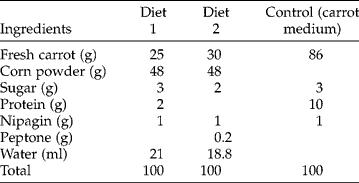
To develop a cost-effective rearing system for B. pyrifoliae, preliminary experiments on larval diets were conducted, focusing on replacing fresh carrot with rice, corn powder or soybean powder. Corn powder was identified as the best substitute for carrot. Two formulations based on carrot and corn powder were compared with a carrot-based diet (Table 1).
Formulations of cost-effective corn powder/carrot-based diets for artificial rearing of Bactrocera pyrifoliae
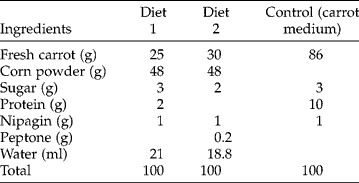
For each diet, three replicates of 100 eggs were seeded on a piece (2 × 2 cm) of moist filter paper placed on the surface of 50 g of each larval diet. The percentage of egg hatch, durations of the egg and larval stages, percentage of pupation, duration of the pupal stage, percentage of adult emergence and weight of 100 pupae were determined for each treatment and compared by means of a one-way ANOVA.
Results
Host range and distribution
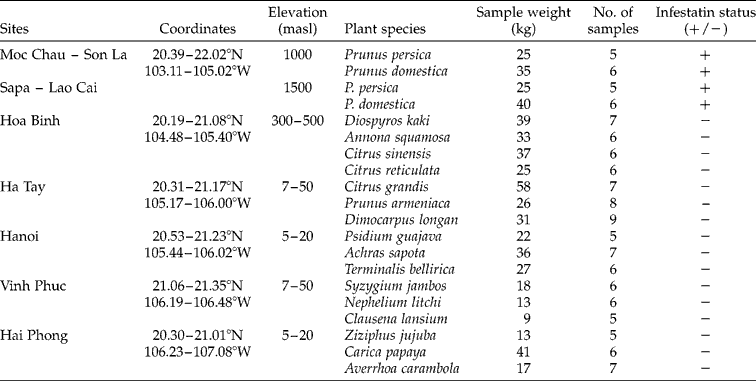
Based on the 18 host plants surveyed, B. pyrifoliae was recovered from peach P. persica in Moc Chau – Son La, with 34.33 ± 2.91 pupae per kg of fruit and 65.33 ± 2.60% of infested fruit, and in Sapa – Lao Cai, with 35.33 ± 2.33 pupae per kg of fruit and 61.67 ± 2.60% of infested fruit. Bactrocera pyrifoliae was also recovered from plum P. domestica in the same two localities, with 32.00 ± 3.61 pupae per kg of fruit and 37.67 ± 3.53% of infested fruit and 29.33 ± 4.66 pupae per kg of fruit and 29.00 ± 1.15% of infested fruit, respectively. Overall, 16 plant species in five provinces below 1000 m in elevation were found to be not infested with B. pyrifoliae (Table 2). Infested fruits were recovered from mid-June to mid-July.
Locality, coordinates, elevation, plant species, sample weight, number of samples and Bactrocera pyrifoliae infestation status (+/−) for fruits collected in northern Vietnam

From a sample of 5747 pupae from naturally infested fruits collected during 2008, 1532 male and 4415 female adults emerged. In 2009, a sample of 1871 pupae yielded 488 male and 1383 female adults. In general, there was a strong female bias (approximately 3:1) in adult emergence from field-collected samples.
Seasonality and life cycle
Artificial rearing of B. pyrifoliae larvae on a carrot-based diet revealed that the average duration of the egg stage was 2.51 ± 0.09 days, larval stage 9.69 ± 0.14 days, and pupal stage 11.50 ± 0.3 days. The age at sexual maturity of adults was 21.7 ± 0.37 days.
Colonization and artificial rearing
Holding conditions
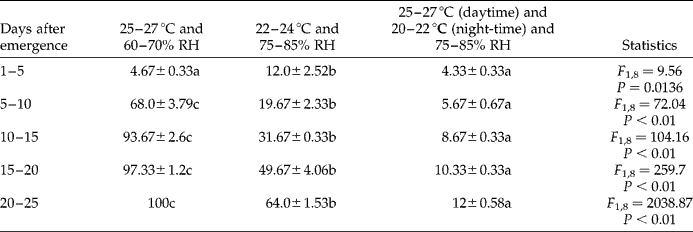
At constant temperature, adult mortality in colony cages was high. The best results were obtained by reducing the temperature at night for three generations followed by a period of constant mild temperature (Table 3).
Average percentage of adult mortality in colony cages containing 100 adult Bactrocera pyrifoliae under three regimens of temperature and relative humidity (RH)
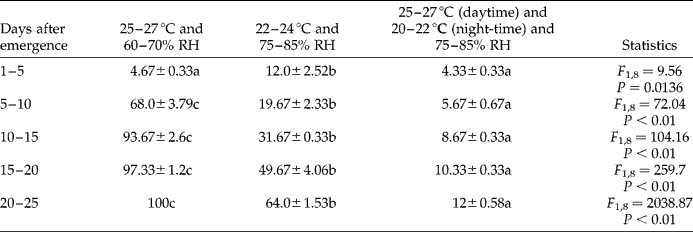
Means ( ± SE) within rows followed by the same letter do not differ significantly (ANOVA; α = 0.01).
Adult density and sex ratio in colony cages
Females laid a significantly greater number of eggs at a 1:3 male:female sex ratio (496.00 ± 5.90) than at a 2:3 ratio (356.00 ± 5.25) or at a 1:1 ratio (216.00 ± 8.08) (F 2,6= 479.9; P< 0.01). However, there was a significant increase in the percentage of egg hatch when the male:female sex ratio was changed from 1:3 (35.33 ± 1.45) to 2:3 (78.67 ± 3.18) or 1:1 (67.33 ± 1.45) (F 2,6= 101.6; P< 0.01). At a ratio of 1:3, which was encountered for pupae collected in nature, females tended to lay more number of eggs, but egg hatch was below 40%, indicating perhaps that several of the females in laboratory cages failed to mate.
After 30 days in adult cages (50 × 50 × 60 cm), the lowest percentage of adult mortality was observed at a density of 500 flies per cage (62.00 ± 3.46 (number of dead flies), 12.4%) (F 2,6= 514.4; P< 0.01). Significantly higher mortality occurred at a density of 1000 flies per cage (141.00 ± 5.03, 14.1%), and significantly higher mortality was observed again at a density of 1500 flies per cage (337.00 ± 8.73, 22.5%).
The highest egg-laying rate (average number of eggs laid over 3 h, 1000 adults per cage) was observed when females in cages were exposed to carrot (389.67 ± 24.67), followed by guava (250.33 ± 17.85), then papaya (211.33 ± 12.99) and finally mango (185.3 ± 36.36) (F 3,8= 13.94; P= 0.0015); results obtained for each fruit were significantly different from the others. Plastic cylinders covered with carrot (185.3 ± 36.36) or guava (109 ± 7.6) used as an egg-collecting device led to flies laying a significantly greater number of eggs than domes covered with papaya (90.0 ± 1.7) or mango (50 ± 2.1) (F 3,8= 25.7; P= 0.0002). With regard to the time of egg collection, a significantly greater number of eggs were recovered between 11.00 and 14.00 h (113.3 ± 4.3) than between 14.00 and 17.00 h (102.0 ± 2.1) and between 08.00 and 11.00 h (24.7 ± 1.5) (F 2,6= 276.9; P< 0.01).
Development of a low-cost larval diet
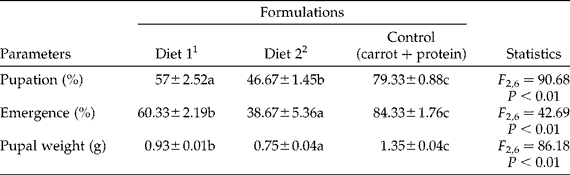
A cost-effective diet combining carrot and corn powder (diet 1; Table 4) gave satisfactory results, but yielded fewer and lighter pupae than a carrot-based diet.
Average percentage of pupation, percentage of adult emergence and pupal weight of Bactrocera pyrifoliae reared on three diet formulations
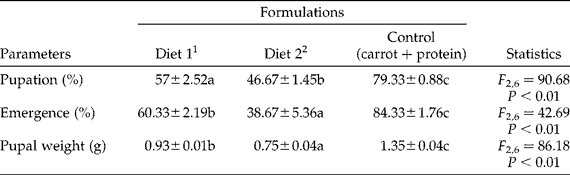
Means ( ± SE) within rows followed by the same letter do not differ significantly (ANOVA; α = 0.01).
1 Diet 1 – carrot 30 g, corn powder 48 g, sugar 3 g, protein 3 g, nipagin 1 g and water 21 ml.
2 Diet 2 – carrot 25 g, corn powder 48 g, sugar 2 g, nipagin 1 g, peptone 0.2 g and water 22 ml.
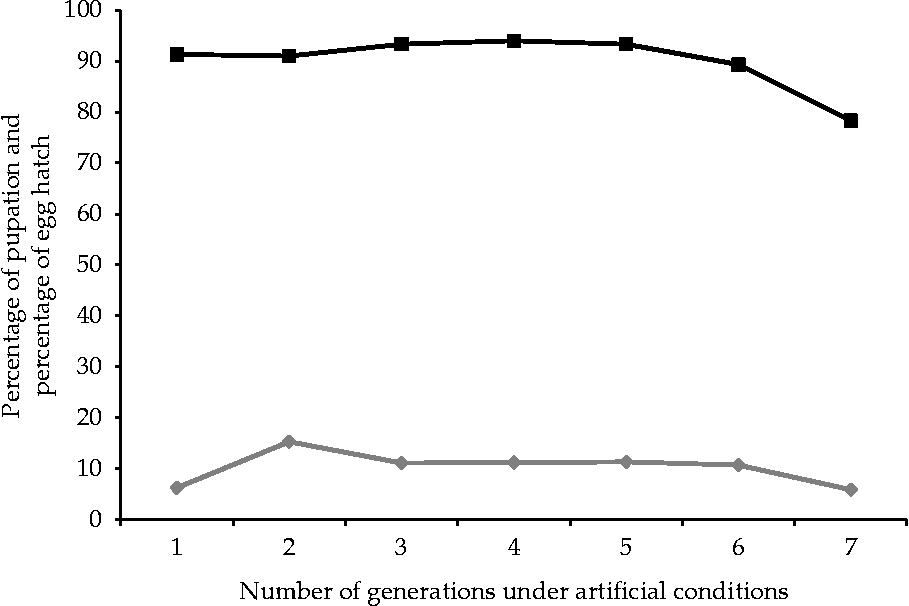
Over seven consecutive generations of mass-rearing, there was a significant decrease in both egg-laying and percentage of egg hatch (Fig. 1), perhaps due to inbreeding after colonization bottlenecks.
Percent pupation (black) and percent egg hatch (grey) over 7 successive generations for Bactrocera pyrifoliae.

Discussion
Host plant surveys have revealed that B. pyrifoliae appears to be restricted to high-elevation (1000–1500 m) areas of northern Vietnam. In this study, we found it in association with only two introduced commercial plants within the Rosaceae family, P. persica and P. domestica. Infestation was restricted to the period of June and July, even though sampling encompassed a much longer time period. Wild alternative hosts for B. pyrifoliae have thus far not been identified. Besides peach and plum, larvae of B. pyrifoliae have been found to infest Psidium guajava and Citrus reticulata (Khanh et al., Reference Khanh, Tuu, Hien, Toan, Trang, Thong, Thanh and Thang2008), but none of these plants is native to Southeast Asia. The development of efficient pest management schemes for this pest would be improved if it were known how this species survives and reproduces outside the peak of the peach and plum fruiting season. The most likely scenario is that B. pyrifoliae, similar to several species of tropical and subtropical fruit flies (Aluja, Reference Aluja1994; Aluja et al., Reference Aluja, Rull, Sivinski, Norrbom, Wharton, Macías-Ordóñez, Díaz-Fleischer and López2003), bridges the commercial host fruiting season by exploiting wild alternative hosts. Alternatively, when the average temperature drops, adults, larvae or pupae could slow down development or ageing, as has been found for the Mediterranean fruit fly in Greece (Papadopoulos et al., Reference Papadopoulos, Carey, Katsoyannos and Kouloussis1996, Reference Papadopoulos, Katsoyannos, Carey and Kouloussis2001). Finally, the least likely scenario, based on our rearing results, would be that during periods of host scarcity flies enter pupal diapause.
Under laboratory conditions, the mean duration of the life cycle of B. pyrifoliae, from egg deposition to sexual maturity of adults, averaged about 46 days. Depending on the duration of the susceptible stage of peach and plum fruits, this could indicate that there is an opportunity for only one generation of flies to exploit the commercial fruit. This also implies that infestation in orchards occurs through the immigration of gravid females from adjacent areas, presenting an opportunity to develop interception trapping (sensu Prokopy and Mason, Reference Prokopy, Mason, McPheron and Steck1996) or identify optimal time windows for cover sprays, bait-spray applications or the deployment of toxic-bait stations.
Bactrocera pyrifoliae was successfully reared on a carrot and corn powder-based diet, and insect-holding conditions were determined, but after seven generations colonies broke down. Development of strain refreshment schemes such as those proposed by Rull and Barreda-Landa (Reference Rull and Barreda-Landa2007), where laboratory-adapted females are crossed with wild males, could contribute to overcoming this hurdle and allow adaptation to improved diets. The SIT could be applied for population management purposes before the build-up of populations early during the peach fruiting season, as long as the total surface area planted with peaches in northern Vietnam makes this approach cost-effective on a regional basis. Current plans call for an increase by 2010 in the total planted area to 150,000 ha (Hai et al., Reference Hai, Ca, Dang, Hung and Ai2005).
A description of the mating behaviour of B. pyrifoliae is still required. This information is essential for developing strain quality control measures for an efficient SIT (Hendrichs et al., Reference Hendrichs, Robinson, Cayol and Enkerlin2002) and may have a bearing on the likelihood of using mating disruption for this pest (Clarke et al., Reference Clarke, Armstrong, Carmichael, Milne, Raghu, Roderick and Yeates2005). However, as far as is currently known, this species is not responsive to methyl eugenol or cuelure (Khanh et al., Reference Khanh, Hien, Tuu, Toan, Thong, Trang, Thanh and Thang2007). Eventually, it will be necessary to identify the appropriate irradiation doses. In the meantime, it is possible to rear B. pyrifoliae for experimental purposes.
Acknowledgements
Le Duc Khanh and Juan Rull acknowledge the International Atomic Energy Agency, Vienna, Austria, for providing funding.