INTRODUCTION
The term ‘amphoroid krater’ was coined by Arne Furumark some 60 years ago.Footnote 1 It is used here for a necked vessel with two opposite strap handles from rim to shoulder, and having a mouth with a diameter substantially larger than its base but less than its maximum diameter.
The amphoroid krater formed part of both the Late Minoan and the Mycenaean repertoire; however, in contrast to the Mycenaean version of the shape with its often elaborate decoration of chariots and other pictorial designs,Footnote 2 the Minoan amphoroid krater has up to now not received much attention.Footnote 3 The present article intends to redress this imbalance by exploring the origin and development of the Minoan amphoroid krater, its function(s) and its relationship with its Mycenaean counterpart. Throughout reference is made to the catalogue of published Minoan amphoroid kraters which follows the main text.
THE EARLIEST CERAMIC AMPHOROID KRATERS
The first known examples of the Minoan ceramic amphoroid krater can be dated to Late Minoan II–IIIA1 on stylistic grounds. Two large and impressive, if restored, examples of the shape were found in the settlement of Tylissos in central Crete. Standing to a height of nearly 60 cm, both vases have everted rims, short slightly concave necks with a distinct ridge at the base, centrally ridged vertical handles, conical-piriform bodies and flat-bottomed torus bases. The main elements of the decoration are as follows (here and subsequently, references to catalogue entries are in bold):
Tylissos 1: neck painted with opposing rock patterns; on body, repeated zones of similar rock patterns with dots.
Tylissos 2: on neck, row of simplified iris, with pairs of dots between; below, pendent rock pattern and large ‘sacral ivy’ motifs covering the upper two-thirds of the body; further down, group of body bands and zone with opposite rock patterns.
Both the large size and the decoration of the Tylissos amphoroid kraters link them closely with the ornate Palace Style jars of Late Minoan II–IIIA1 Knossos.Footnote 4 The structure of the decoration and individual motifs are also comparable. Parallels are readily found for a repeated motif in horizontal registers and for a decorative body zone extending below the maximum diameter, with additional narrower zones of decoration below. As for the individual motifs, variations on the rock pattern, used on both the Tylissos kraters, commonly decorate the neck and lowest decorative body zone of Palace Style jars (Niemeier Reference Niemeier1985, 115 motif 3 [‘verbundene Kreisbogen’]).
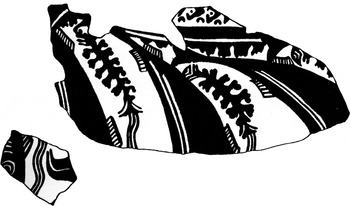
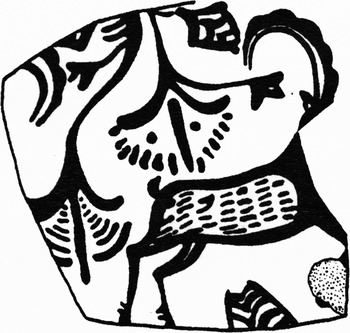
There are several finds of less well-preserved early amphoroid kraters from the palace and other buildings at Knossos. These date stylistically to Late Minoan II–IIIA1 and indicate that the shape was in use there when the palace was destroyed ‘at a time when pottery with stylistic characteristics of LM IIIA1 and IIIA2 seems to have largely overlapped’ (Hatzaki Reference Hatzaki and Momigliano2007, 199, 225). Among these finds a fragmentary example from the area of the West Magazines is well known for its pictorial decoration (Knossos 1). Parts of the neck and upper body are preserved. There is a slight ridge at the base of the neck, which has a row of iris, with a dot and single arcs as fillers. On the body, remains of four fish dive gracefully downwards, against a background of marine vegetation. From the area of the Cowboy Fresco in the north-eastern part of the palace comes a body fragment with an equally lively decoration of a goat in a floral setting (Knossos 4). A fragment with very similar decoration has no recorded find place at Knossos (Knossos 12).
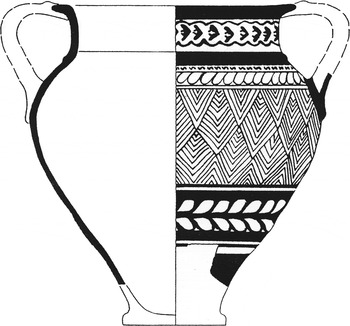
Remains of a restorable amphoroid krater and of another fragmentary example were found in the area of the West Magazines and the South Propylaeum of the palace. The restored vase (Knossos 2), again with a slight neck ridge, is decorated with iris between wavy lines on the neck; it has a deep body zone with a network of stacked ‘V's, flanked by a row of ‘letter’ motifsFootnote 5 and a single reserved foliate band above, and by a double reserved foliate band below. The fragmentary amphoroid krater (Knossos 3) has a pendent rock pattern with dots on the neck, a row of ‘letter’ motifs and a network of tricurved arcs with a fill of arcs on the upper body.
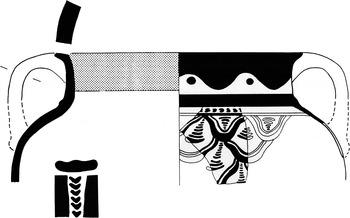
Fragments of three more early amphoroid kraters, from the Little Palace and South House at Knossos, display shoulder and body decoration of a network of stacked ‘V's, ‘letter’ motifs, festoons with iris and arcs and fillers, and foliate band (Knossos 5–7).
An incompletely preserved vase from a Late Minoan II deposit at Kommos in south-central Crete has been referred to as the first amphoroid krater from a well-dated find context.Footnote 6 This is improbable, for, unlike the early amphoroid kraters considered above, this vessel is small and more closely related to Late Minoan I kylikes from the same deposit and from Knossos (Watrous Reference Watrous1992, 23 nos. 382–8, figs. 18–20, pls. 9–10; Hatzaki Reference Hatzaki and Momigliano2007, 207, fig. 6.3). The deposit was originally attributed to Late Minoan II, but has recently been redated to Late Minoan IB Final (Rutter Reference Rutter, Brogan and Hallager2011, 318–24). Kommos has yielded some fragments that definitively belong to amphoroid kraters and which can be dated to Late Minoan IIIA1–2 on stratigraphical and/or stylistic grounds. One neck fragment (Kommos 2) has a pendent rock pattern with dots, two others (Kommos 14 and 19) a row of iris, in one case with dots and single arcs, thus recalling Knossos 1–3. Kommos 5 preserves the upper profile of an amphoroid krater with rows of ‘letter’ motifs on the neck and just below, and remains of festoons with a fill of arcs on the upper body.
From the joint Swedish–Greek excavations at Chania-Kastelli in west Crete the only evidence for the shape in a Late Minoan II context (Room A) is a possible neck fragment decorated with a foliate band.Footnote 7 The shape is relatively common in Late Minoan IIIA1 contexts at the site, with 30–40 examples.Footnote 8 Of special interest are two complete amphoroid kraters covered in monochrome paint from a Late Minoan IIIA1 pit (5.001). They conform to the basic shape of the examples already mentioned, but are not elaborately decorated; in addition, they do not exhibit the ‘metallic’ features of several other early and some later Minoan amphoroid kraters, such as the neck ridge and the ribbed or ridged handles with rivet-like knobs at their upper and/or lower attachments (for these, see below).
Among the decorated early amphoroid kraters from Chania-Kastelli many features are familiar: for example, the rock pattern on the neck (and sometimes the rim), and the foliate band and/or narrow row of ‘letter’ motifs on the shoulder. In other respects the early Chania-Kastelli amphoroid kraters are distinctive. In particular, the neck is often solidly painted, the handle section is consistently a flat oval and the body banding is composed of groups of triple bands.
Two early amphoroid kraters, identified as Minoan imports on the basis of their fabric, shape and decoration, come from a tomb at Anemomili-Makelli on the island of Karpathos (Karpathos 1–2). They provide further examples of the typical early form and range of decorative syntax. The neck has single or opposite rock patterns, in one case combined with wavy line; the body decoration includes foliate band, ‘letter’ motifs and filled festoons, as also seen at Knossos and Kommos.
Through these early examples the basic character of the Minoan amphoroid krater begins to emerge. The two large kraters from Tylissos provide a direct link with the Palace Style. At the same time the shape is more usually found in a smaller version, though, with an average height of 35 cm, it remains one of the largest fine decorated shapes in use during Late Minoan III. Another thread in the development is provided by the monochrome examples from Chania-Kastelli, suggesting regional variation.
The early Minoan amphoroid krater can be summarised as follows: it has an everted, flat-topped rim, handles with raised edges or a central ridge, and often with additional knobs where they join the rim and shoulder; the neck is short and straight or slightly concave, often with a ridge at its base; the body has a conical-piriform profile with a concomitant high centre of gravity; there is a flat-bottomed torus base. As regards the decoration, the flat top of the rim may have a wavy pattern, ‘adder mark’ or other motif, and the handles may have chevrons or transverse lines between their painted edges; characteristic is the use of neck decoration, frequently a row of iris or a rock pattern. Another common decorative element is a narrow zone of foliate band and/or a variety of ‘letter’ motifs immediately below the neck. The main field of decoration frequently extends over much of the body, though narrow zones of motifs alternating with horizontal bands are not unknown. The banding of the lower body (a combination of bands and lines) and the solid paint on the foot and base are typical. The immediate precursors of many aspects of the decoration, including most if not all of the individual motifs, are to be found in the Minoan ceramic repertoire, and particularly in the Knossian Palace Style.
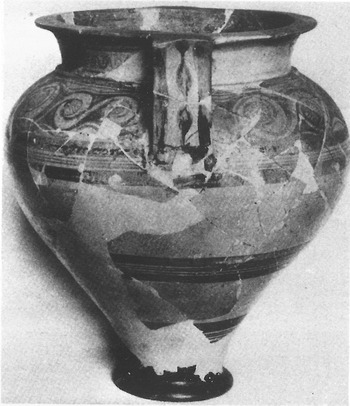
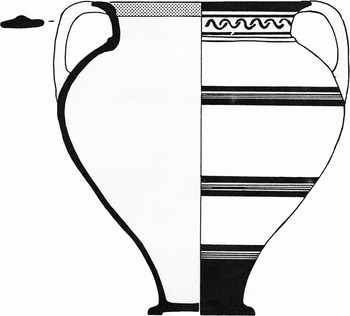
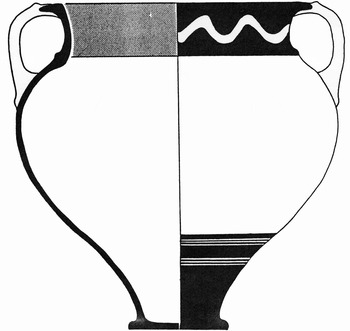
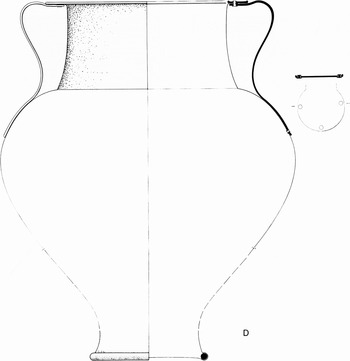
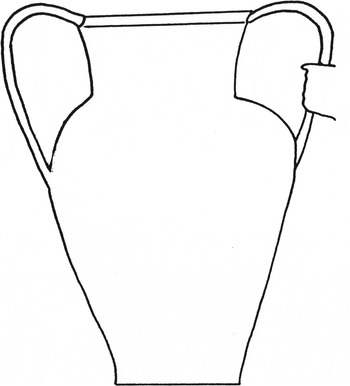
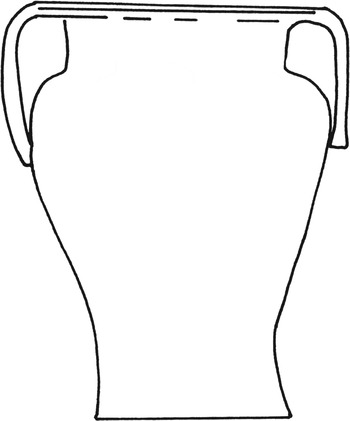
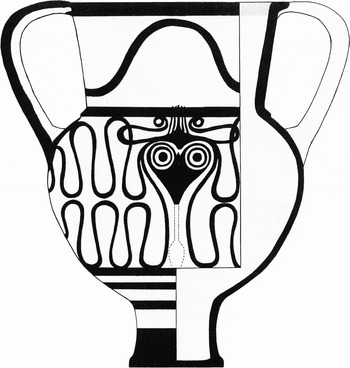
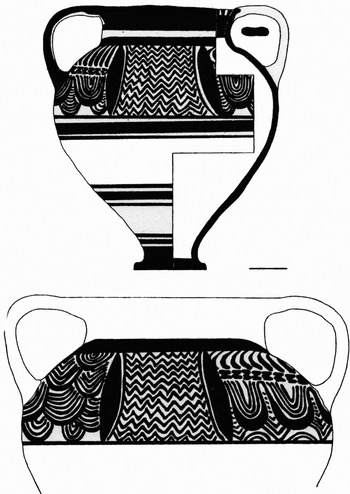
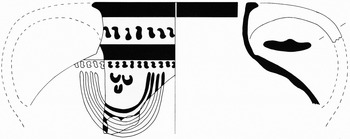
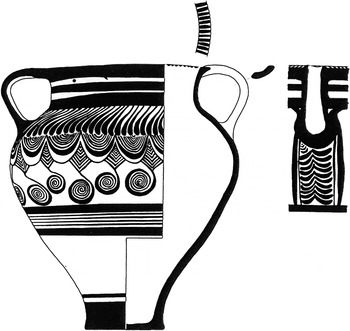
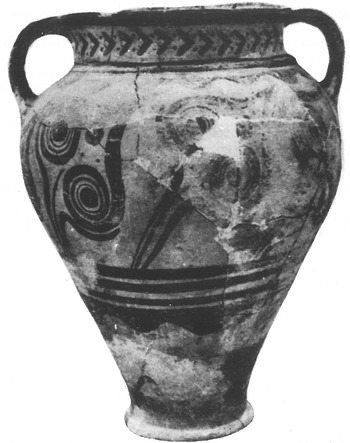
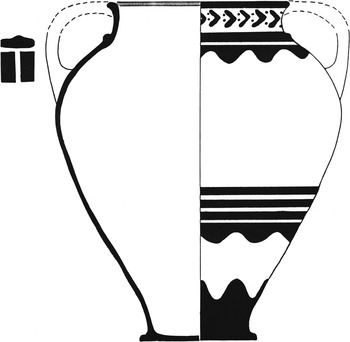
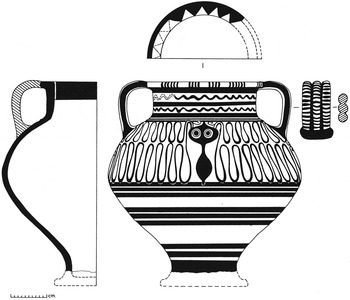
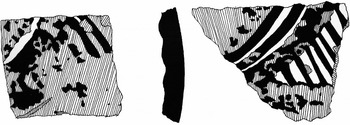
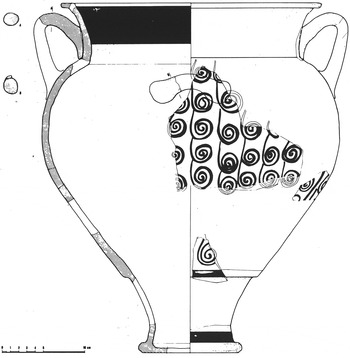
How do these Minoan amphoroid kraters relate to the earliest Mycenaean ones? That there are close links between them is demonstrated by some amphoroid kraters found in the Levant and Cyprus. One of these comes from a sanctuary of Nin-Egal at Qatna (present-day Misrife), a city in inland Syria which was destroyed by the Hittites c.1340 bc (Figs. 1, 2).Footnote 9 In both size and proportions the amphoroid krater from Qatna is similar to the two examples of Late Minoan IIIA1 from Karpathos (Karpathos 1 and 2): all have a high centre of gravity and, with a height of c.31–33 cm, fall at the shorter end of the shape range. As regards the decoration of the amphoroid krater from Qatna, the row of interlocking quirk motifs on the neck and the arrangement of the lower body band are also of Minoan character. The shoulder pattern of running spirals, with central rosette on dark ground, and the arrangement of the lower body bands are well paralleled in the Minoan repertoire (Niemeier Reference Niemeier1985, 102, fig. 43:16,19–20; Hatzaki Reference Hatzaki and Momigliano2007, fig. 6.13:5). Despite these Minoan features, it is improbable that the Qatna amphoroid krater was made in Crete, for it also displays features which are absent from the Minoan series. For example, the use of parallel chevrons on the upper part of the rim is rarely found there, while it is a common choice on Mycenaean amphoroid kraters and other shapes of Late Helladic IIIA2–IIIB1. More importantly, the fine, hard buff clay is characteristic of Mycenaean amphoroid kraters and not of Minoan products, which are commonly of more coarse, gritty fabric. Besides, the amphoroid krater from Qatna has a ring-base, which is not a typical feature of Minoan products at this time.
(Left) Qatna krater, sanctuary of Nin-Egal, after Åkerström Reference Åkerström1987, fig. 57:1.

(Right) Qatna krater, drawing C.E. Morris.

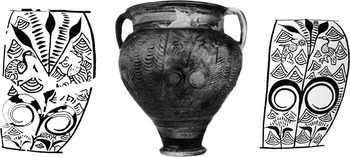
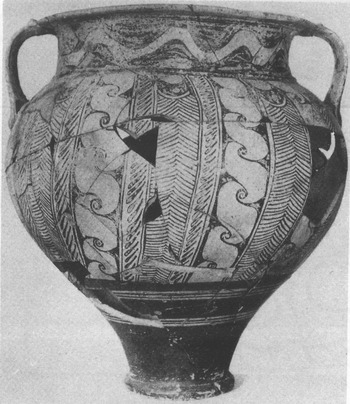
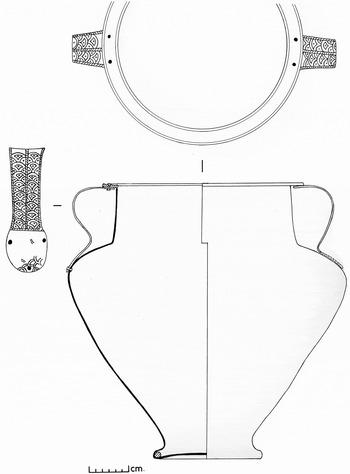
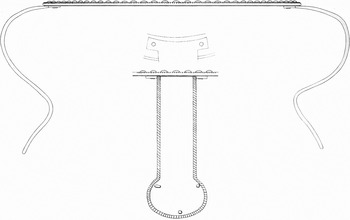
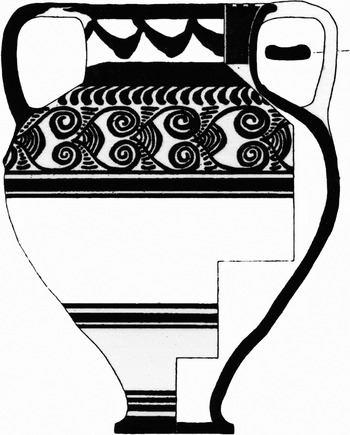
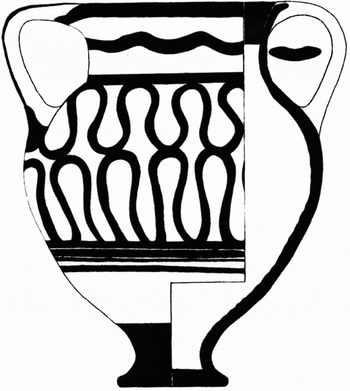
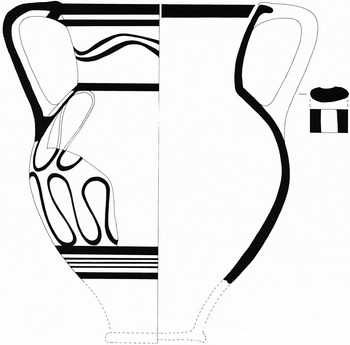
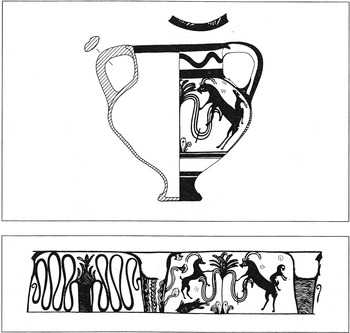
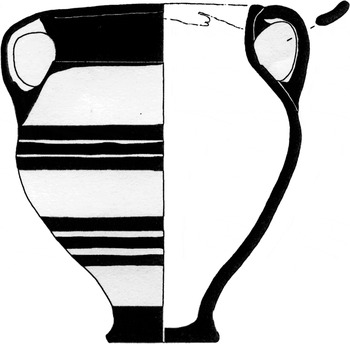
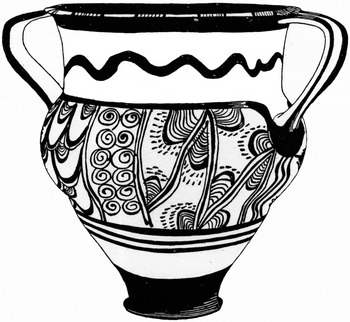
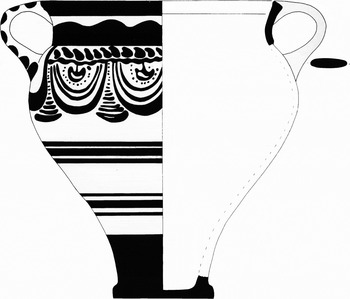
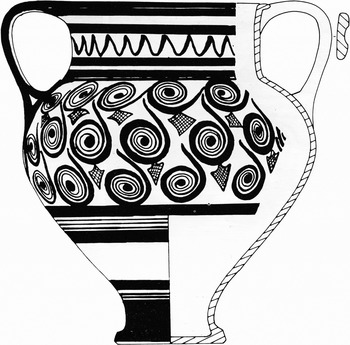
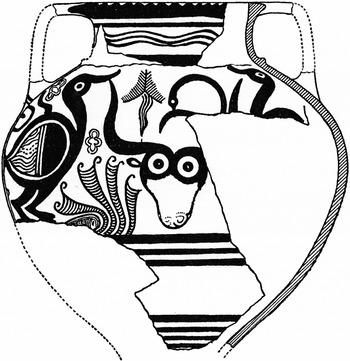
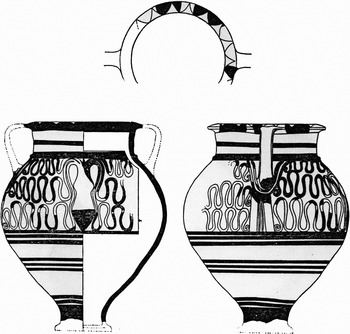
Excavations in Cyprus have yielded two other early amphoroid kraters with Minoan as well as Mycenaean connections. They come from tombs, both not fully published, at Dhekelia and Pyla-Verghi near the south-east coast of the island (Figs. 3, 4, 5). These amphoroid kraters are similar in shape (with a short neck, broad shoulder and conical-piriform lower part), in size (standing to an impressive 40 and 42.8 cm) and also in decorative syntax.Footnote 10 They are rather different from the Qatna example in their overall appearance, but can also be well paralleled in the Minoan series.
Dhekelia krater, after Åkerström Reference Åkerström1987, fig. 58.

(Left) Pyla-Verghi krater, after Åkerström Reference Åkerström1987, fig. 57:2.

(Right) Pyla-Verghi krater, drawing C.E. Morris.

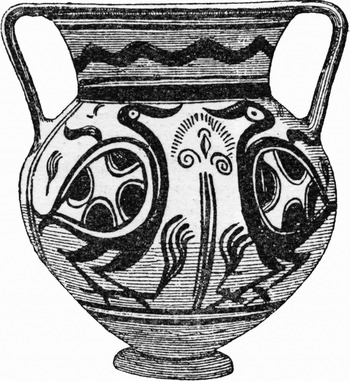
The necks are decorated with a reserved horizontal band and opposing rock patterns respectively. The amphoroid krater from Pyla-Verghi has a prominent neck ridge and a flat-bottomed torus base, and the handles are ridged and have additional knobs – features also appearing on early and some later amphoroid kraters found in Crete. On both the Pyla-Verghi and Dhekelia amphoroid kraters, the main body decoration is arranged in deep vertical panels filled with a variety of motifs. The decorative treatment of the neck and body recalls the Minoan Palace Style and continues in Crete on both amphoroid kraters and pithoid jars. Another Minoan trait, seen on the amphoroid krater from Dhekelia, is the pictorial elements in two of the panels: birds scattered among the foliage of a stylised tree (Crouwel and Morris Reference Crouwel and Morris1995, 174, 176–7; Reference Crouwel and Morris1996, 214). On the other hand, the fine, hard buff clay of this amphoroid krater suggests a Mycenaean product.
In the case of the Pyla-Verghi amphoroid krater, the fabric is gritty and therefore more Minoan-looking. At the same time, this vessel has holes pierced at the upper and lower points of attachment of the handles to the body. Such holes were probably intended to help against shrinking and water loss during the firing and drying processes of the manufacture of the pots. The same tomb contained at least two typical Mycenaean amphoroid kraters of somewhat later date,Footnote 11 as well as an amphoroid krater that may well be Minoan in view of its decoration – a wavy band on the neck and papyrus on the body – and gritty fabric (Pyla-Verghi 1). It may be noted that a nearby settlement site has yielded one complete and some fragmentary Minoan amphoroid kraters of similar-looking, gritty fabric, but these are mostly of later, Late Minoan IIIB date (Pyla-Kokkinokremos 1–7).
There is clearly a need for scientific analysis of the clays of these amphoroid kraters from Syria and Cyprus to determine their provenance, rather than simply relying on visual examination. As a matter of fact, few chemical, physical or petrographic analyses of Minoan or Minoan-looking amphoroid kraters have been undertaken so far.Footnote 12 By contrast, several of their Mycenaean counterparts of Late Helladic IIIA2–IIIB1, found in Cyprus and the Levant, have been sampled and shown to be imports from the Argolid.Footnote 13 The importance of archaeometric analysis of the clay is well illustrated by fragments of what was quite probably an amphoroid krater from the Levantine harbour site of Tell Abu Hawam. Neutron activation analysis has shown that the clay composition of these fragments, which preserve parts of a Minoan-looking bird, a papyrus and other motifs, is consistent with an origin in the Argolid.Footnote 14
What is clear, however, is that the Minoan ceramic amphoroid krater provided the immediate prototype for the Mycenaean version of the shape. First, the Minoan amphoroid krater has chronological priority over the Mycenaean in the material record. The earliest known Minoan examples date to Late Minoan II–IIIA1, the first Mycenaean ones probably to early in Late Helladic IIIA2.Footnote 15 Second, the first Mycenaean amphoroid kraters are demonstrably similar in form and many decorative elements to the Minoan ones. This is well illustrated by the vessels found in Syria and Cyprus that were considered above, and also by some other early but more definitely Mycenaean examples, such as the so-called Zeus Krater, from Cyprus.Footnote 16 These precede the mainstream typological development of the Mycenaean amphoroid krater of Late Helladic IIIA2–IIIB1 and have features of form and decoration which strongly link them to the Minoan series: the short neck and conical-piriform body, the reserved horizontal band on the neck and the row of ‘letter’ motifs (this time in added white paint) above the main pictorial design. That this relationship is one of influence from the Minoan side to the Mycenaean is further borne out by the subsequent development of the two series. The features that are considered to be Minoan occur only on the earliest Mycenaean amphoroid kraters, while the later Mycenaean ones have a solidly painted neck and a body that is often decorated with chariot scenes and other elaborate pictorial designs. In the Minoan repertoire, by contrast, there is continuity of early features, and it is also on Crete, particularly within the Palace Style tradition, that their precursors can be found. Another difference is that, on Minoan amphoroid kraters, chariot scenes are absent and truly pictorial compositions (thus excluding octopus designs) uncommon.Footnote 17
The transmission of this Minoan vase shape into the Mycenaean repertoire appears to have taken place not long before the palace destruction horizon at Knossos. The mechanisms of transmission remain unclear, but probably involved the movement of potters from Crete rather than merely the imitation of their products on the Greek mainland (Papadopoulos Reference Papadopoulos1997).
ORIGINS OF THE SHAPE
The influence of the ceramic Palace Style has been mentioned as a contributing factor to both size and decoration of the Minoan amphoroid krater. We also had occasion to mention ‘metallic’ features of the shape, such as the ridge at the base of the neck and the rivet-like knobs at the top and/or bottom of the handles. The neck ridge and more particularly the rivets on the handle attachments are integral to the construction of a metal vase, but have no practical function on a clay one. The neck moulding masks and strengthens the join between separate pieces of metal. The necks and bodies of clay vases are also often made separately, but the join is often strengthened on the inside by a thicker layer of clay and masked on the outside by a clay moulding. All of these ‘metallic’ features of the earliest amphoroid kraters also occur on Late Minoan II large bridge-spouted jugs from Knossos and elsewhere (see Mountjoy Reference Mountjoy2003, 113 nos. 442–3, fig. 4.27; Preston Reference Preston2007, 275 no. 4.1, fig. 15).
It has often been assumed that the prototypes for this and other ceramic shapes with such ‘metallic’ features are to be found in metalwork, the potter's craft imitating work in the more precious material.Footnote 18 In the case of the amphoroid krater, the idea of a metallic prototype was first suggested by Sir Arthur Evans and has gained wide acceptance over the years.Footnote 19 What is still controversial is whether such a metallic prototype for the Minoan ceramic amphoroid krater, which, as we have seen, is first attested in Late Minoan II–IIIA1, actually exists in the archaeological record. At present, all or parts of seven actual metal amphoroid kraters – all made of bronze – are known, one each from Crete and Euboea, the others from Cyprus. Where known, the find contexts are funerary, varying in date from the twelfth to the tenth century bc.Footnote 20
-
a. (Fig. 6) Rethymnon Museum. From Pantanassa (Amari district, western Crete), tholos tomb. Complete krater. Height 54 cm. Relief decoration on lower part of neck, incised decoration on rim handles. Date of context: Subminoan (11th century bc).
Stampolidis and Karetsou Reference Stampolidis and Karetsou1998, no. 55; Tegou Reference Tegou2001, 125–6, 131–5, 143–9, figs. 5b, 27–33; Kanta Reference Kanta, Stampolidis and Karageorghis2003a, 180–1, fig. 11a.
-
b. (Fig. 7) From Lefkandi, tomb under the ‘Heroon’. Much of krater restored from crushed fragments. Height 71 cm. Relief decoration on rim and handles. Date of context: Middle Protogeometric (c.950 bc).
Matthäus Reference Matthäus1985, 23 n. 18; Catling Reference Catling, Popham, Calligas and Sackett1993.
-
c. From Kouklia- (Palaepaphos-) Teratsoudhia (Cyprus), Tomb 104, Chamber N. Complete krater. Height 40.7 cm. Incised decoration on rim and handles. Date of context: beginning of Late Cypriot IIIA (c.1200–1150 bc).
Karageorghis Reference Karageorghis1990, 34, 63 no. 66, pls. 24, 54; Catling Reference Catling, Popham, Calligas and Sackett1993, 86–7, 91 no. 1.
-
d. Nicosia, Cyprus Museum (Fig. 8). From Kourion- (Episkopi-) Kaloriziki (Cyprus), Tomb 40. Krater reconstituted in 1986 from rim, handles, foot and body fragments. Height c.41 cm. Incised decoration on rim and handles. Date of context: end of Late Cypriot IIIB (c.1050 bc).
McFadden Reference McFadden1954, 138 no. 11, pl. 21, figs. 9–12; Catling Reference Catling1964, 157–61 no. 1, pl. 23a; Reference Catling, Popham, Calligas and Sackett1993, 86–8, 91 no. 2; Matthäus Reference Matthäus1985, 22 no. 525, pl. 68; Karageorghis Reference Karageorghis1990, 63, fig. 7; Demetriou Reference Demetriou2000, 432–6; Weingarten Reference Weingarten, Jasink and Bombardieri2010, 95–7, 99, figs. 1–5.
-
e. (Figs. 9, 10) Nicosia, Cyprus Museum. Probably from same tomb as d. Rim and handles only. Relief and incised decoration. Evans Reference Evans1928, 653–4, figs. 418–19; Reference Evans1935, 456–8, fig. 381; McFadden Reference McFadden1954, 140–1 no. 37, pl. 22, figs. 13–14; Catling Reference Catling1964, 158–61 no. 3, pl. 24; Reference Catling, Popham, Calligas and Sackett1993, 86–91 no. 3; Gill Reference Gill1964, no. 17, Beil. 3; Baurain and Darcque Reference Darcque and Poursat1985; Matthäus Reference Matthäus1985, 228–9 no. 526, pls. 66–7.
-
f. (Fig. 11) New York, Metropolitan Museum of Art 74.51.5685 (Cesnola Collection 4703). Presumably from Cyprus, ?Kition. Rim and handles only. Incised decoration on rim, relief decoration of handles.
Evans Reference Evans1935, 456–8, fig. 382; Catling Reference Catling1964, 157–61 no. 2, pl. 23b–c; Reference Catling, Popham, Calligas and Sackett1993, 86–8, 90–1 no. 4; Gill Reference Gill1964, 17 no. 18 (on provenance); Matthäus Reference Matthäus1985, 229–30 no. 528, pls. 68–9; Picón Reference Picón2007, no. 270 (with excellent, new photographs); Aruz Reference Aruz and Koehl2013 (with a contribution by D. Schorsch).
-
g. Nicosia, Cyprus Museum 1973/VIII-11/6. From Cyprus, ?Kourion (Episkopi). One handle with part of rim. Incised decoration.
Matthaüs Reference Matthäus1985, 22 no. 527, pl. 68; Catling Reference Catling, Popham, Calligas and Sackett1993, 8 no. 5.
Bronze krater a, Pantanassa Amariou, tholos tomb, after Kanta Reference Kanta, Stampolidis and Karageorghis2003a, fig. 11a.

Bronze krater b, Lefkandi, ‘Heroon’, after Catling Reference Catling, Popham, Calligas and Sackett1993, pl. 18D.

Bronze krater d, Kourion-Kaloriziki, Tomb 40, after Karageorghis Reference Karageorghis1990, fig. 7.

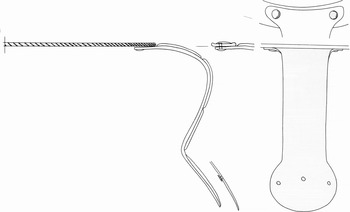
(Left) Bronze krater e, probably Kourion-Kaloriziki, Tomb 40, rim and handles, after Matthäus Reference Matthäus1985, pl. 66 no. 526.

(Right) Bronze krater e, detail of relief decoration, after Gill Reference Gill1964, Beilage 3.

Bronze krater f, rim and handles, after Matthäus Reference Matthäus1985, pl. 68 no. 528.

These bronze vessels are of great interest since they show that the amphoroid krater shape existed in a metal as well as a ceramic form.Footnote 21 If, however, their manufacture is to be dated to about the time of their deposition in tombs, they cannot readily be drawn upon as evidence for the existence of a metal prototype for the Late Minoan II–IIIA1 ceramic version.
Discussion has concentrated in particular on the origin and date of two of the bronze amphoroid kraters from Cyprus (e and f; Figs. 9, 10 and 11). Of these, only the decorated rims and handles with their roundels, i.e. disc-like lower attachments, are preserved. The cast relief decoration of e consists of a continuous frieze of beaked jugs on the rim, pairs of confronted Minoan genii on either side of a stylised palm tree trunk on the handles, and octopods among marine rockwork on the roundels below. With regard to the decoration of f, which is also in cast relief, it consists of a continuous frieze of lions pursuing bulls (? and boars) on the rim, pairs of confronted Minoan genii, each holding a beaked jug, on the handles, and frontal bulls' heads on the roundels below.
Items e and f are closely linked by the Minoan genii, which appear on both sets of handles, by the beaked jugs on the handles and rim respectively, and by the way in which these motifs are rendered. The two sets of rim and handles, which are also similar with regard to technique of manufacture, should be contemporary.
As Evans first pointed out (Evans Reference Evans1928, 652–65; Reference Evans1935, 456–8), the antecedents of much of the decoration on e and f is unequivocally Aegean, going back as early as the Neopalatial period (Middle Minoan III – Late Minoan IB) in Crete. On the other hand, Hector Catling and others have stressed links with Cypriot bronzework of the later thirteenth–twelfth century bc (Late Cypriot IIC–IIIA).Footnote 22 In Catling's view, the rim decoration of f is much closer to the animal friezes, also in cast relief, on some bronze stands made in that island than anything significantly earlier in the Aegean. With some hesitation he attributed e and f to a Late Cypriot II–IIIA workshop, as he did with much more conviction in the case of krater b from Lefkandi on Euboea. The latter also has elaborate decoration in cast relief: a series of pursuit scenes with archers, bulls and lions on the rim, bull–lion combats on the handles and stylised plant designs on the roundels below (called escutcheons by Catling). He also drew attention to what he calls the ‘sharp change’ in decoration between the handles and roundels as a feature common to these relief kraters and as indicative of a similar Cypriot manufacture and date (Catling Reference Catling, Popham, Calligas and Sackett1993, 88–9).
According to another view, going back to Evans, kraters e and f, unlike b, were made in the Aegean, more particularly Crete, and at a much earlier date.Footnote 23 This view, shared by us, rests not only on the similarity of individual elements of the iconography and their style, but also on the thematic unity of much of the decoration within a Minoan iconographic framework.
The Minoan genii of e and f, with their magnificent leonine heads, portly waists and gently curving carapaces, seem to be a natural development from the earliest Protopalatial Minoan examples. Stylistically they stand close to a stone triton shell with relief decoration from Mallia (Fig. 12), which can be dated to Late Minoan I on the grounds of find context, shape and decoration, and on which the genii are clearly different from later depictions.Footnote 24
Detail of stone relief triton, Mallia, after Baurain Reference Baurain, Darcque and Poursat1985, fig. 1.

The beaked jugs, carried by the Minoan genii on f and forming a continuous frieze on the rim of e, represent a vase shape with a long history in Minoan iconography (Baurain and Darcque Reference Baurain and Darcque1983, 37–40; Stürmer Reference Stürmer1985, 119–34). Catling observed that the best in corpore parallels for the shape are provided by bronze examples from Late Cypriot II–III contexts. (Among these are two from the same tomb at Kouklia-Teratsoudhia as our krater c.)Footnote 25 No actual beaked jugs of bronze have yet been found in the Aegean, but the numerous representations of the shape attest the shape's Aegean pedigree and suggest that it was a conservative one.
The marine ornament on the roundels of e have good parallels on fragments of stone relief vases of Neopalatial Crete (Evans Reference Evans1928, 503–5; Baurain and Darcque Reference Baurain and Darcque1983, 26–9). The similarities in style and composition – closer, for example, than the somewhat later and more stylised gold octopus cup from Dendra in the Argolid (Evans Reference Evans1928, 505–6; Marinatos and Hirmer Reference Marinatos and Hirmer1973, pls. 196–7; Hurwit Reference Hurwit1979) – suggest that the scene on e belongs to the same chronological horizon as the stone relief vases.
The frontal bulls' heads with their horns curving round towards the mouth, depicted on the roundels of f, also have parallels in the Aegean, but these cover a wider range in both time and place, and none are so close stylistically as to suggest contemporaneity with the roundels (for parallels, see Catling Reference Catling1964, 158).
The animal pursuit on the rim of krater f is closer to Cypriot bronzework than to Aegean, as stressed by Catling, but only in terms of general composition. Stylistically, this krater rim and the Cypriot material are not close, as Catling (Reference Catling, Popham, Calligas and Sackett1993, 88) himself admits, and the possibility remains that the relationship need be no more intimate than the shared use of a theme, which was popular and long lived throughout the Aegean and the Near East.Footnote 26
With regard to the combinations of most motifs on e and f, the Minoan genius, beaked jug, vegetation and marine world are thematically related in Minoan iconography. On the Mallia triton shell (Fig. 12) the Minoan genius is also associated with the beaked jug and the marine world. The latter is represented by the form of the shell itself and the marine rockwork that frames the main subject, a pair of genii, the one pouring something from a beaked jug onto the upheld paws of the other in an act of libation or ritual washing. (The beaked jug, it should be noted, is the object par excellence associated with the Minoan genius.) While on the handles of f the genii are both holding such a vessel, those on e raise one empty hand towards their forehead, while the other is stiffly held at the side. This is the typically Minoan salute, best known from bronze figurines and glyptic.Footnote 27 The genii on e appear to salute the palm tree trunk situated between them. The tree introduces the theme of vegetation, represented by a tree or branch in many other representations of the Minoan genius.Footnote 28
With respect to Catling's argument about the handles of the three relief kraters e, f and b being sharply differently decorated from the roundels below, this may simply have to do with the quite different compositional opportunities and restrictions presented by the vertical straps and their disc-like lower attachments. Anyway, we have just seen that the decoration on the roundels of e is linked thematically with that of the associated handles and rim.
The positive iconographic evidence – the Minoan character of the motifs and their thematic connections, and the close stylistic relationship of the Minoan genii and the marine ornament to Minoan works – lends strong support to the view that the two bronze kraters e and f are products of Neopalatial Crete. The other elements in the iconography of e and f are in themselves less susceptible to close dating, though they can be accommodated within the Minoan repertoire. Conversely, it is extremely difficult to see how the handles with the Minoan genius and the roundels with marine scenes could have been produced in later thirteenth–twelfth century Cyprus. The style of these motifs and the iconographic world to which they belong are entirely Minoan, and they stand apart from well-dated Cypriot works of the period in question.
As to the technique of the cast bronze relief decoration of e and f (and b), it indeed corresponds with that of the figured friezes on late thirteenth–twelfth century Cypriot bronze stands. However, in the Aegean, the rims, handles and masking collars of bronze vessels were embellished with cast relief decoration from the Neopalatial period onwards; the designs include continuous friezes of spirals, floral motifs, argonauts, tritons and bucrania (Catling Reference Catling1964, 159–60; Reference Catling, Popham, Calligas and Sackett1993, 87–8; Matthäus Reference Matthäus1980, 210–12). Thus the evidence available for technique does not preclude a Neopalatial date.
If the proposed Cretan origin and early date of two of the seven bronze kraters cited is correct, they represent actual metal prototypes for the Minoan ceramic amphoroid krater. At what time these bronze vessels would have left Crete, and when they came to Cyprus, is difficult to determine. It is not improbable that they reached the island, as heirlooms and precious links with the past, in the hands of Aegean people who came to Cyprus late in the Late Bronze Age.
Regarding the date and place of manufacture of the other bronze kraters, Catling's analysis has shown that b from Euboea, with its elaborate cast relief decoration, was probably made in Cyprus between the later thirteenth and twelfth centuries bc. This find also proves that such metal kraters were robust and valued enough to remain in use for many years, and could end up – as loot, guest-friend gifts or otherwise – a long way from where they had been made.Footnote 29 Cypriot workshops may also be assumed for kraters c, d and g, all with simple, incised decoration and found on the island (Catling Reference Catling, Popham, Calligas and Sackett1993, 87–92; Matthäus Reference Matthäus1985, 231–2; Morris Reference Morris1989, 78–80; Karageorghis Reference Karageorghis1990, 63). Thus, imported kraters such as e and f may have provided the stimulus for the production of a series of bronze kraters on Cyprus within a thriving bronze industry.Footnote 30
The discussion concerning the bronze kraters has received a renewed impetus from the recent discovery of a complete example in western Crete (a), in a funerary context of the eleventh century bc. Apart from simple traced ornaments, this krater is decorated with a continuous frieze of beaked jugs in cast relief, this time not running along the rim, as on e, but around the lower part of the neck. It remains to be decided whether this first amphoroid krater find on Crete was actually made there and, if so, how long before its time of deposition.Footnote 31 Another interesting aspect of the new bronze amphoroid krater is that it contained the cremated remains of an important individual, just like kraters d, and possibly e, from Kourion-Kaloriziki Tomb 40 and b from the grave beneath the ‘Heroon’ at Lefkandi.Footnote 32 There is no reason to suppose that these bronze amphoroid kraters were especially made for funerary use and as ash-urns. It is noteworthy that krater b from Tomb 104 at Kouklia-Teratsoudhia was found together with two bronze beaked jugs and a laver, which suggests use in feasting.Footnote 33
Other, independent evidence for the existence in the Aegean of metal amphoroid kraters at about the time of their first appearance in clay may well come from Egypt. The evidence consists of paintings in the tombs of high officials of the Eighteenth Dynasty at Thebes. The presence of envoys from the Aegean in these tomb paintings has long been recognised, on the grounds of their physical appearance, the objects carried by the envoys or displayed in the Aegean registers, and the associated textual evidence (Vercoutter Reference Vercoutter1956; Wachsmann Reference Wachsmann1987; Matthäus Reference Matthäus1995).
Among the objects depicted are several vessels of which the shapes have metal counterparts in the Aegean, such as the conical rhyton, Vaphio cup, pithoid jar and amphora.Footnote 34 Other pots fit the basic definition of the amphoroid krater shape: that is, a necked vessel with two opposite rim to shoulder handles, and having a mouth of greater diameter than the base (Vercoutter Reference Vercoutter1956, 338–47, pls. 40–1 [called hydries]; Morris Reference Morris1989, 81–90). While most of the krater-like vessels appear to be of Egyptian types, there are some which are morphologically distinct and rather resemble the early Minoan ceramic amphoroid kraters and the restored bronze example from Kourion-Kaloriziki Tomb 40 in Cyprus (our d).
The earliest painting of an Aegean-looking amphoroid krater occurs in Theban Tomb 131 of vizier Useramun which dates to the early year of Tuthmosis III (Fig. 13). (According to the dating system followed here, this pharaoh reigned 1504–1450 bc.) The text associated with the Aegean figures depicted in this tomb identifies them as from ‘the islands in the heart of the great green’. The vessel is clearly large, as it is carried by two men. It is painted white, which in Egypt indicates silver (Vercoutter Reference Vercoutter1956, 338 document 368, frontispiece and pl. 40).
Amphoroid krater, wall painting, Thebes, Tomb of Useramun, drawing C.E. Morris, after Vercoutter Reference Vercoutter1956, pl. 50 no. 368.

Next are two almost identical vessels depicted in Tomb 86 of Menkheperreseneb, which is contemporary with the late reign of Tuthmosis III. The vessels are again white-painted, and they are decorated in the shoulder area (Vercoutter Reference Vercoutter1956, 338 documents 370–1, pl. 40).
Finally, there is an Aegean-looking amphoroid krater (Fig. 14) in a painting from Tomb 100 of Rekhmire, which dates to the last years of Tuthmosis III but was repainted during the early years of Amenophis II, who reigned 1450–1425 bc. The text associated with the Aegean envoys in this tomb reads ‘Keftiu land and the islands which are within the great sea’. The amphoroid krater is similarly rendered in white and apparently decorated all over (Vercoutter Reference Vercoutter1956, 338 document 369, pl. 40).
Amphoroid krater, wall painting, Thebes, Tomb of Rekhmire, drawing C.E. Morris, after Vercoutter Reference Vercoutter1956, pl. 50 no. 369.

Several other vessels depicted in the same and other Egyptian tomb paintings have been compared with the Aegean amphoroid krater, but most of the comparisons are less convincing. In two cases the depictions are rather similar to Late Minoan II–IIIA1 clay kraters. Unlike the kraters shown in the earlier Theban tombs, however, there is nothing specifically Aegean about their contexts.Footnote 35
DEVELOPMENT
The Minoan amphoroid krater shape continued to be produced throughout Late Minoan IIIA2 and IIIB. To some extent, a general trend can be observed: the neck grows taller and the body assumes a more piriform profile in Late Minoan IIIA2. Several of the motifs also continue in use: the rock pattern or wavy band on the neck, and the banding on the lower body and solid paint on the foot and base. The pattern-decorated body zone may again be narrow or deep. There is also a trend towards greater stylisation of floral and other motifs, as can be observed in Minoan decorated pottery of Late Minoan IIIA2 in general (Betancourt Reference Betancourt1985, 164; Hatzaki Reference Hatzaki and Momigliano2007, 233). In addition, ‘metallic’ features are retained on some vessels (Kritsa 1; Milatos 1; Crete 1–2).
On the other hand, there is considerable variety in the Minoan amphoroid krater, in terms of size, proportions and details of shape, as well as decoration. Presumably this has much to do with the increasing regionalism of decorated pottery during Late Minoan IIIA2, which coincides with the disappearance of the strong unifying influences emanating from the pottery workshops that were connected with the once-great palatial centre at Knossos. Recent petrographic examination of amphoroid kraters from Mochlos indicates various provenances: central Crete (Mochlos 1, 14), central or west Crete (Mochlos 16), the Palaikastro region in east Crete (Mochlos 2, 9, 12, 19 and possibly 20) and the region of Gournia also in east Crete (Mochlos 18). Other fabrics suggest local products (Mochlos 3, 8, 10–11).Footnote 36
The Minoan amphoroid krater is an altogether much less standardised and specialised product than its Mycenaean counterpart of Late Helladic IIIA2 and IIIB1. The results of clay analysis and other evidence indicate that the latter was mainly made in one region, the Argolid, and in relatively few workshops (see below). In contrast, the Minoan amphoroid krater was produced in different parts of Crete.
The increasing regionalism of Minoan decorated pottery, in which certain features are introduced or retained in one area but not in another, causes problems in defining island-wide ceramic phases after the destruction of Knossos in (early) Late Minoan IIIA2. There is, for example, no clear dividing line between the end of Late Minoan IIIA2 and the beginning of IIIB. This affects the dating of several Minoan amphoroid kraters, particularly when they are not part of a chronologically homogeneous pottery assemblage. These vessels are best dated to Late Minoan IIIA2/IIIB.Footnote 37
Among the amphoroid kraters so dated are the three from a tomb at Ligortyno in central Crete, which also exemplify the variety in shape and decoration. One of these amphoroid kraters (Ligortyno 3) has a piriform profile, in line with Late Minoan IIIA2 amphoroid kraters. The neck is decorated with foliate bands, while there is a zone of alternating concentric arcs on the upper body.
The second amphoroid krater (Ligortyno 1) has a somewhat globular body, rather like some Late Minoan IIIB examples. The body decoration is much more elaborate, covering much of the available space: a hybrid palm tree/octopus motif on one side, and a version of the well-known theme of antithetically placed rampant goats nibbling at a tree on the other. This theme was adopted from the Near East (where it is often associated with a ‘tree of life’) in various artistic media in the Bronze Age Aegean.Footnote 38 On the Ligortyno amphoroid krater it is combined with two other pictorial motifs, a quadruped and a fish, into a design that lacks coherence. There are panels below the handles, as also seen on other amphoroid kraters (see below).
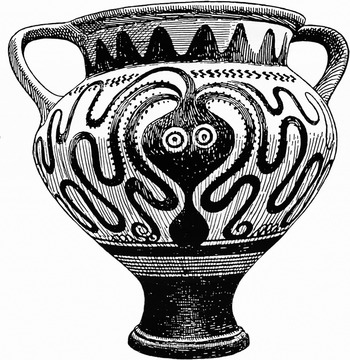
The third amphoroid krater (Ligortyno 2) has a rather conical profile, reminiscent of Late Minoan II–IIIA1 examples. Much of the body is occupied by a large stylised octopus, its tentacles extending symmetrically on either side of its body. The octopus motif has a long history in Minoan ceramics (Niemeier Reference Niemeier1985, 13–22). It figures prominently on Palace Style jars, but makes its first appearance on amphoroid kraters only in Late Minoan IIIA2 (Knossos 10). Interestingly, large but less stylised octopuses are also depicted on several complete or fragmentary Mycenaean amphoroid kraters of Late Helladic IIIA2, the majority of them from Cyprus, with two more from Rhodes (Crouwel and Morris Reference Crouwel and Morris1985, 92, 94 no. 14, 97–8).
Several of the amphoroid kraters dating to Late Minoan IIIA2 or IIIA2/IIIB exhibit a preference for panelled decoration, on both sides of the body and/or below the handles. The panels are filled with a variety of motifs (Episkopi/Ierapetra 3; Kritsa 1; Mallia 3; Mastampas 2; Crete 1; Karpathos 3, 6, 8–9; Kos 1; Hala Sultan Tekke 1; Pyla-Kokkinokremos 4). Elaborate panelled decoration is also found on an amphoroid krater with a proportionately very high neck from east Crete (Palaikastro 1); this idiosyncratic vessel has often been assigned to Late Minoan IIIB.
The amphoroid kraters more definitely of Late Minoan IIIB show several variations of the form. The profile may still be piriform, but is often better described as advanced or heavy piriform. Other amphoroid kraters have a body that is rather globular (Enkomi 1, whose base is incorrectly restored) or compressed globular (Mameloukou cave 1). In this period the decorative motifs become more highly stylised and are executed with increasing stiffness. A good example of this trend is the octopus, which is popular on amphoroid kraters of Late Minoan IIIB (Agios Onouphrios 1; Chania-Kastelli 1; Episkopi/Ierapetra 6; Episkopi/Pedhiada 1; Gra Lygra 3; Knossos 13; Mallia 1, 3; Mastampas 1; Palaikastro 3; Sachos 1; Stamnioi 1). The creature's body may now be omitted, with only the tentacles remaining; these are arranged like wavy bands in one to three tiers, and usually take up a large part of the vessel's body (e.g. Agios Onouphrios 1; Gra Lygia 1–2; Knossos 6–7; Mallia 4; Mameloukou 1; probably also amphoroid krater fragments from various sites).Footnote 39
At Chania-Kastelli the amphoroid kraters are rather standardised in the later part of Late Minoan IIIB, in terms of their size, tall neck, triple roll handles and the decoration on the rim (filled semicircles), neck (one or two wavy lines) and body (octopus; e.g. Chania-Kastelli 1).Footnote 40 These west Cretan amphoroid kraters show that regional trends are again strong in the island (Hatzaki Reference Hatzaki and Momigliano2007, 244).
A group of complete and fragmentary Late Minoan IIIB amphoroid kraters from Cyprus and the Levant stand out primarily for their very large size (the greatest recorded height, of Ugarit 1, is 74 cm).Footnote 41 While most of these amphoroid kraters are decorated with a highly conventionalised octopus on the body (Pyla-Kokkinokremos 1, 3; Ugarit 1; Lachish 1), two bear pictorial designs: two large birds, placed antithetically and facing each other over a stylised floral motif and a bucranium respectively (Enkomi 1, with panels below the handles, and Pyla-Kokkinokremos 2). Such large amphoroid kraters are not common in Crete, but there may be one, incomplete, example from a Late Minoan IIIB deposit at Kommos (Kommos 16); its neck is unusually painted solid, but the body more conventionally preserves remains of octopus tentacles in two tiers. There may also be a looser connection with the series of tall-necked amphoroid kraters with octopus designs best known from Chania-Kastelli. These are much smaller but share the distinctive triple roll handles of several examples of the large version (Enkomi 1; Kition 3; Pyla-Kokkinokremos 2–3, 7; Ugarit 1).Footnote 42
The amphoroid krater shape appears to continue into Late Minoan III C. Two such vessels from a tomb at Milatos in east Crete (Milatos 1 and 2) are themselves Late Minoan IIIB in character, on the grounds of their shape and body decoration which consists of vertical whorl shells and an octopus respectively. The several other vases from this much-discussed tomb are also predominantly Late Minoan IIIB in character, but one stirrup jar dates the latest use of the tomb to Late Minoan IIIC.Footnote 43
While the evidence from the Milatos tomb is ambiguous, finds from the settlement at Chania-Kastelli suggest that amphoroid kraters were still used, if not produced, in early Late Minoan IIIC. Eight fragments come from stratified deposits of such a date, while seven others derive from levelling and construction strata for buildings of early Late Minoan IIIC (Hallager Reference Hallager, Hallager and Hallager2000, 149–50 nos. 84-P 1683, 77-P 0204, 71-P 1024 and possibly 71-P 1291, pls. 55, 78b:2, 79b:4 and 5). What is preserved of the shape and decoration, including octopus designs on the body, is in most cases similar to the amphoroid krater fragments from Late Minoan IIIB deposits at the site. One of the fragments from an early Late Minoan IIIC context may have belonged to a small variant of the shape. In addition, unlike most of the large amphoroid kraters at the site and elsewhere on Crete, this vessel had a monochrome neck.Footnote 44
Better preserved, small amphoroid kraters are known from settlement and funerary contexts of Late Minoan IIICFootnote 45 and the ensuing Early Iron Age at sites in central and eastern Crete.Footnote 46 These vessels differ markedly from the earlier amphoroid kraters, not only in size (their height does not exceed 20 cm) but also in details of shape and in their simple decoration.
The large and impressive amphoroid kraters appear to have been replaced by versions of the ring-based krater. These first appear in Crete in Late Minoan IIIB and, with their often elaborate decoration, become popular in early Late Minoan IIIC (see Hallager Reference Hallager, Hallager and Hallager2000, 149; D'Agata Reference D'Agata and Moody2005, 23).
FUNCTION
The function of ceramic vase shapes such as the Minoan and Mycenaean amphoroid krater can in principle be explored from a variety of perspectives:
-
1. residue analysis
-
2. written sources
-
3. iconographic evidence
-
4. the characteristics of the shape
-
5. comparative evidence of analogous shapes
-
6. find context and associated finds.
The first of these categories of evidence can immediately be excluded: at present no amphoroid krater, whether Minoan or Mycenaean, has been subjected to residue analysis, unlike some other vase shapes. With regard to possible written sources, the amphoroid krater cannot be convincingly identified in the Linear B texts from Crete (or mainland Greece) or among the ideograms belonging to this and the Linear A script (see Vandenabeele and Olivier Reference Vandenabeele and Olivier1979, 181–275; Sherratt Reference Sherratt2004, 317–20; Wright Reference Wright2004, 148–53). Nor does it appear among the relatively few vase shapes that are illustrated in Minoan iconography (for a depiction in a late Mycenaean vase painting, see below).
Turning to the main characteristics of the amphoroid krater shape, they are its size, which is large as compared to that of most contemporary vase shapes, its wide mouth allowing relatively easy access but at the same time making it difficult to securely fasten a lid, and its two substantial vertical handles by which the vessel could be firmly grasped.Footnote 47
Stability is also a significant factor. The large size, combined with a broad shoulder and a narrow base, are features which make the amphoroid krater less stable. Indeed, the general development towards a more advanced or heavy piriform shape in the Minoan amphoroid krater can only have increased this problem. Such a shape could be stabilised by placing it in a clay stand, a form that was known in Late Minoan III Crete.Footnote 48 (In two cases an amphoroid krater – Milatos 1 and Pygi 1 – was actually found in a stand; see further below.)
Several conclusions can be drawn from the characteristics of the shape. It is unsuitable for the transport of commodities because of the problem of securely closing the mouth, and because the shape is relatively unstable and not obviously easy to stack. On the other hand, its capacity is considerable and access to the contents easy.
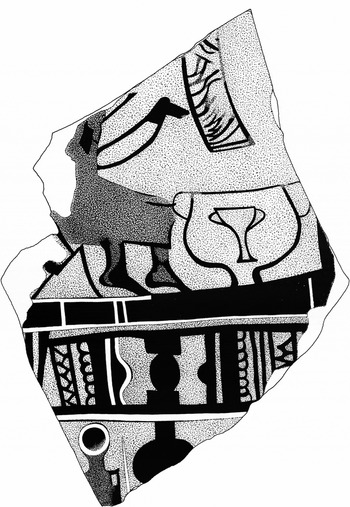
Examination of the use of similar shapes elsewhere can suggest possible uses for an amphoroid krater or other specific vase shape, though such general analogies should, of course, be treated with caution. The very term ‘krater’ that is used by scholars immediately calls to mind the later ceramic and metal Greek forms of the shape, which are synonymous with the mixing of wine and water, and indeed it is in such contexts that kraters are repeatedly illustrated in the Greek world of the Archaic and Classical periods. Scenes of symposia show the krater from which the liquid is drawn by ladles or jugs into drinking vessels. That the krater was perceived as the focus of the occasion is evident not only from art but also from literature, beginning with the Homeric epics.Footnote 49 Broadly comparable sets of drinking equipment catering to similar needs are illustrated in Etruria and Cyprus.Footnote 50 Such depictions indicate the widespread use of krater shapes as mixing vessels for drinking parties or ceremonies. They also illustrate the range of associated equipment, and highlight the importance of display and performance in this activity. Of particular interest here is a so far unique representation on a fragment of a painted ring-based krater of late Mycenaean (Late Helladic IIIC Middle, c.1150/1140–1100/1090 bc) date from the Xeropolis settlement at Lefkandi (Fig. 15) (Crouwel Reference Crouwel and Evely2006a, 238–9, 247–8 no. B 2b, pls. 59 and 71). It preserves part of a scene with a seated figure in a long robe and – in front, on the ground – a krater and a kylix. The two vessels, the kylix shown inside the krater which is quite probably of the wider-mouthed, neckless and stemmed type (Furumark Shape Number 8–9), clearly form a set, and almost certainly have to do with the consumption of wine.
Krater sherd, with representation of krater and kylix, Lefkandi, after Crouwel Reference Crouwel and Evely2006a, pl. 71 no. B2b.

This vase representation raises the question of whether the practice of mixing wine with water, so well attested in the historical period, goes back to the Bronze Age in Greece – and whether the Minoan and Mycenaean amphoroid kraters served this purpose.Footnote 51 These vessels were certainly of suitable size and shape, including the wide mouth, to have served the same function as the later kraters.
Study of the archaeological contexts in which the Minoan amphoroid krater is found may also provide important evidence for how the shape was used. In Crete itself, the shape occurs at many places and in many parts of the island. Elsewhere, it is found on the islands of Karpathos and Kos, and at several sites on Cyprus, as well as at a few places in the Levant and Egypt, and also in southern Italy and Sicily (Milena 1).Footnote 52 The numbers of Minoan amphoroid kraters found abroad are small when compared to the Mycenaean ones, which have a similarly wide distribution. On the other hand, the Minoan amphoroid krater is known in correspondingly larger quantities on Crete itself. The Mycenaean amphoroid krater is rare in mainland Greece, except at Berbati in the Argolid, a site which probably served as a production centre for the export of this and other (neckless and ring-based) types of pictorial krater to the eastern Mediterranean (Åkerström Reference Åkerström1987, especially 117–20; see also Morris Reference Morris1989, 243–66; Immerwahr Reference Immerwahr and Zerner1993, 219–20; Steel Reference Steel2013, 135–6, 209–12).
On Crete, the amphoroid krater is found in both settlements and tombs. Excavations in recent years at the coastal sites of Chania-Kastelli in the west, Kommos and Mochlos in the centre, and Petras in the east have sharply increased the number of finds from settlement contexts. At Knossos there are more fragments – among Evans' unpublished material and Sinclair Hood's Royal Road excavations – in addition to the examples that have been published so far. At Chania-Kastelli and Kommos, at any rate, the finds of this vase shape appear to derive from household debris. But there is at present no information as to precisely how the amphoroid krater was used in these and other settlements in Crete.
Evidence for the function of the amphoroid krater in funerary contexts on the island is limited, due to the relative rarity of published details concerning the position of individual finds and their relationship to one another and to particular burials.
The information provided by a Late Minoan IIIB–IIIC chamber tomb at Milatos in the eastern part of the island is therefore all the more valuable. According to Evans, who excavated it, the tomb was undisturbed and contained two terracotta larnakes; two separate groups of vases stood on the floor (Evans Reference Evans1906, 93–103). A tall amphoroid krater formed the centrepiece of each vase group. Group 1 consisted of an amphoroid krater (Milatos 1), with a cup inside it and set inside a stand, two stirrup jars, a kylix, a spouted bowl and a miniature jug. Group 2 was formed by an amphoroid krater (Milatos 2), two stirrup jars, a miniature jug, three bowls, one cup, two kylikes and a dipper. There is a strong emphasis on vessels connected with the serving and consumption of liquids – krater, jug, bowl, cup, kylix and dipper.
The two amphoroid kraters from the Temple Tomb at Knossos (Knossos 8–9) were discovered by Evans together with goblets, bowls and cups, which have a date range of Late Minoan II–IIIA (Evans Reference Evans1935, 1016–17). The vases were found in two groups: by the ‘Entrance Platform’ of the building, and outside the entrance to the inner chamber; the precise arrangement and groupings of the material are not described in the publication. The amphoroid kraters and one kylix form the latest element in the material, being Late Minoan IIIA2 in date (Popham Reference Popham1970, 75). Whatever the interpretation of the building and its contents – a continuing memorial cult or a shrine rather than a tomb (see Evans Reference Evans1935, 1015–17; Popham Reference Popham1970, 74–5; Soles Reference Soles1992, 154–5) – the concentration of drinking vessels over a period of time is highly suggestive of a repeated ritual involving the manipulation of liquids.
A similar emphasis cane be observed among the 21 ceramic vessels associated with the single larnax burial in a recently excavated tomb at Pygi. The vessels, which have been dated to Late Minoan IIIA2 (‘perhaps tending to IIIB’), include an amphoroid krater (Pygi 1) (Evely Reference Evely2009–10, 189, figs. 193–4).
A Late Minoan IIIA2/IIIB chamber tomb at Ligortyno in central Crete contained three amphoroid kraters, which are briefly discussed above (Ligortyno 1–3). The arrangement of the vases in the tomb was described by Evans in his notebooks (Savignoni Reference Savignoni1904, 657–9; Kanta Reference Kanta1980, 84). Two of the amphoroid kraters were found inside a larnax (one of two in the tomb), while the third amphoroid krater (Ligortyno 2) stood on a tripod table on the floor. The other vases in the tomb were either under the larnax or in it. Unfortunately, no conclusions can be drawn about the precise function of the offerings, since it is not possible to associate specific vases with particular burials, nor indeed is it clear how many burials are represented.
More informative are two recently excavated cemeteries on the central north coast at Mochlos. Chamber Tomb 15 of the Limenaria cemetery contained a single larnax burial of an adult male (44 to 56 years old) and dates to Late Minoan IIIA1–2.Footnote 53 Thirty objects had been placed outside the larnax, including a bronze blade and pair of tweezers, and as many as 24 vases, many of them (jugs, cups or bowls, a kylix, and four piriform and conical rhyta) again having to do with the manipulation of liquids. The vases were dominated in size by a linear-decorated amphoroid krater (Mochlos 2), which itself contained a jug and a pulled-rim bowl. Two other amphoroid kraters, with identical linear decoration and both probably dating to Late Minoan IIIA2, come from the same cemetery (Mochlos 5) and that in the Artisans' Quarter (Mochlos 6) respectively, but not from inside tombs. Mochlos 4 was actually ‘carefully laid on its side in a small cairn above tombs 26, 27 and 28’. Both amphoroid kraters have been interpreted as grave markers.Footnote 54
The find context of an amphoroid krater from the settlement at Palaikastro (Palaikastro 2) points to yet another function. This vessel, from Area 26 in Building 3, contained the almost complete skeleton of a small child, in a crouched position and with a small kalathos placed over its head (MacGillivray et al. Reference MacGillivray, Sackett, Driessen, MacDonald and Smyth1988, 274, pl. 47d and f).
Outside Crete the Minoan amphoroid krater is well represented in tombs on Karpathos, where there is some additional evidence for its association with vessels for pouring (jugs) and drinking (cups and kylikes). The contents of the Vonies chamber tomb include five amphoroid kraters (Karpathos 1–4), one of which was found together with a spouted cup inside a larnax with bone (Sampson Reference Sampson1979, 459–60; Melas Reference Melas1985, 39). No specific contexts are recorded for the other amphoroid kraters. The dominant shapes in this tomb were the amphoroid kraters, jugs, cups and kylikes, and stirrup jars.
At Tou Stavrou to Kephali on the island eight small vessels, miniature jugs, cups and kylikes were reportedly found (not during controlled excavation) inside a larger vessel, which E.M. Melas identifies with the amphoroid krater found with them in the same tomb (Karpathos 11). He further suggests that the amphoroid krater could have contained a cremation or inhumation, but it is unclear whether there is any evidence to substantiate this (Melas Reference Melas1985, 169).
At the Serraglio on Kos, a Minoan amphoroid krater of Late Minoan IIIA2 (Kos 1) was recorded in a settlement context, as was the fragment reported from Italy.
In Cyprus, the Minoan amphoroid krater usually appears in small numbers in tombs and settlements. In tombs, the Minoan amphoroid kraters were sometimes found together with the far more numerous Mycenaean examples. The frequency and degrees of use wear on the latter vessels, when found in tombs in Cyprus, suggest that they had first been used extensively by the living (Keswani Reference Keswani2004, 138). The Mycenaean amphoroid kraters found in the island – and the Levant – with their often elaborate, chariot and other pictorial designs, have often been taken for luxury items and status symbols reserved for the local elite (see especially Steel Reference Steel1998, 285–98; Reference Steel1999, 803–11; Reference Steel2004, 293–4). Susan Sherratt, however, has argued against such connotations, stressing that the true elite would have preferred metal to less precious ceramic vessels for wine-drinking and other activities (Sherratt Reference Sherratt, Crielaard, Stissi and Wijngaarden1999, 184–92; see also Wijngaarden Reference Wijngaarden2001, 84–9; Reference Wijngaarden2002, esp. 194–6, 268–9).
To return to the Minoan amphoroid kraters found in Cyprus, in one case there is well-documented contextual evidence for domestic function. Pyla-Kokkinokremos 1 was found together with a quern, a loomweight and a Cypriot juglet and coarse ware jug in a rather small room within a fortified building complex. The very large size of this and similar but fragmentary Late Minoan IIIB amphoroid kraters from the same site (Pyla-Kokkinokremos 2–3) may suggest a stationary position, and a use for storage of liquids (Karageorghis and Demas Reference Karageorghis and Demas1984, 17 [Complex D, Room 23], 50; see also Morris Reference Morris1989, 223–4; Kanta Reference Kanta and Bietak2003b, 529; Georgiou Reference Georgiou and Georgiou2012, 76).
Only two Minoan amphoroid kraters (of Late Minoan IIIB) are known from the Levant, in sharp contrast to the many Mycenaean examples from settlement and funerary contexts at the same and other sites.Footnote 55 A domestic function may be assumed for the very large Minoan amphoroid krater, also of Late Minoan IIIB, from Ugarit on the Levantine coast (Ugarit 1). It comes from a large mansion, known as ‘The House of Yabninou’, and was associated with storage jars.Footnote 56
The second Minoan amphoroid krater, again very large and of similar date, comes from more inland Lachish, its find context suggesting a use in the temple of Level V (Lachish 1).Footnote 57
It is tempting also to assume a use in a cult building for the one Minoan amphoroid krater known from Egypt. It is represented by two Late Minoan IIIA2 fragments, which came to light, together with several Mycenaean potsherds (none belonging to an amphoroid krater), during excavations in the area of the Great Temple at Tell el-Amarna (Tell el-Amarna 1). The sherds are of course of great importance for relative and absolute chronology, coming from this short-lived, well-dated site.
Altogether, the evidence indicates that the Minoan amphoroid krater was not restricted to a specific type of building or find context, in Crete itself or abroad. The shape cannot be categorised as purely domestic, funerary or ritual.Footnote 58 Rather, the amphoroid krater functioned in many different circumstances, though its physical form and the available contextual evidence point strongly to an important role in the presentation and handling of liquids. At the same time, its large size in relation to other painted vessels on Crete and elsewhere, which also offered sizeable surfaces for elaborate decoration, served to make the amphoroid krater a visually attractive focal point in any drinking assemblage.
WORKSHOPS AND PAINTERS
Several of the Minoan amphoroid kraters show similarities in details of their shape and painted decoration: they can therefore be arranged into stylistic groups. Sometimes the cohesion within these groups is so great that the vessels may be regarded as the output of a distinctive personality and his close dependents active in the same workshop. Recognition of the hand of individual potters and painters is more difficult, depending on the distinctiveness of their style and the degree to which the original shape and decoration have been preserved.Footnote 59
As noted above, we have seen that the Mycenaean amphoroid krater appears to have been produced in only one region, the Argolid, and in relatively few workshops, such as the one unearthed at Berbati. With its increasingly standardised chariot and other pictorial designs the Mycenaean amphoroid krater shows every sign of having been a highly specialised product, infrequently used in mainland Greece but with a strong directional long-distance distribution in Cyprus and the coastal Levant.
In marked contrast, the Minoan amphoroid krater was no specialised product but more integrated into the broader ceramic repertoire. Vessels of this shape were made in workshops in different parts of Crete, and primarily for use in the island itself.
Workshops connected with the palace at Knossos were clearly important producers of the first amphoroid kraters and other decorated vessels in Late Minoan II–IIIA1. Indeed, the ceramic amphoroid krater may well have originated there, the craftsmen using a metal prototype and at the same time finding inspiration in the large and ornate Knossian Palace Style jars. The amphoroid kraters of similar date found elsewhere in Crete (e.g. Tylissos 1–2; Kommos 1–5, 14, 19), and on Karpathos (Karpathos 1–2) may be either imports from Knossos or inspired by Knossian models.Footnote 60
The fish represented on Knossos 1 have been attributed by the authors not just to the same workshop but also to the same painter as those on the fragments of a bathtub larnax from the Royal Villa at Knossos and on a basket rhyton found at Varkiza in Attica – so strong is the stylistic similarity, based on the combined features of choice, structure and execution of the designs, which include fish and subsidiary marine elements. The hand of the ‘Knossos Fish Painter’ may also be recognised in the fragmentary fish design on the interior of a bowl or cup from the North-West House at Knossos. Several other fish representations on a variety of vase shapes from Knossos share some of the features of the painter. While not enough remains for similarity of execution to be confidentially assessed, a workshop connection seems certain (Morris Reference Morris and Morris1992; Crouwel and Morris Reference Crouwel and Morris1995, 180–1).
What remains of the lively compositions involving goats in an elaborate landscape setting on amphoroid krater fragments Knossos 4 and 12 suggests a single painter, again working at Knossos. The overall style is fluent and markedly similar, and so is the rendering of the animals' horns and their reserved ears (Crouwel and Morris Reference Crouwel and Morris1995, 181).
These pictorial examples confirm that amphoroid kraters and vessels of other ceramic shapes were made in the same workshops and painted by the same hand. A close connection between amphoroid kraters such as Knossos 1 and larnakes (of both the bathtub and chest type), with regard to both decorative motifs and compositions, continues in Late Minoan IIIA and IIIB.Footnote 61
Following the destruction of the palace at Knossos early in Late Minoan IIIA2, the existence of regionally distinct workshops in other parts of Crete becomes more clearly apparent from study of the pottery. Their identification rests mainly on stylistic criteria, combined with macroscopic examination of clay, slip and paint.Footnote 62 Much work is still needed in this field, including an extensive programme of archaeometric analyses and rigorous fabric descriptions.Footnote 63
Best known from its ceramic products is ‘The Local Kydonian Workshop’ at Chania-Kastelli in west Crete, so termed by Birgitta Hallager (Hallager Reference Hallager, Hallager and Hallager2000, especially 171–2; Reference Hallager, Hallager and Hallager2003, especially 220, 260–1; Reference Hallager, Hallager and Hallager2011, 305–7, 375–6, 379; see also Tzedakis Reference Tzedakis1969; Kanta Reference Kanta1980, 288–9). With their distinctive light-yellow clay and rather thick white slip, vessels produced in this workshop have been recognised all over the island. Amphoroid kraters appear to have been produced at Chania-Kastelli already in Late Minoan IIIA1, to judge from specific idiosyncrasies in their decoration (see above). By Late Minoan IIIB amphoroid kraters had become standardised, in terms of both shape and decoration.
Some of the Late Minoan IIIB amphoroid kraters found at Pyla-Kokkinokremos in Cyprus (Pyla-Kokkinokremos 1–3) and the two known from Levantine sites (Lachish 1; Ugarit 1) not only form a group but may have a workshop connection, in view of the shared very large size and gritty fabric as well as details of their shape and (octopus) decoration. One of these vessels, represented by a large fragment (Pyla-Kokkinokremos 1), may well have been decorated by the same hand as a much smaller amphoroid krater, its base incorrectly restored, from Enkomi (Enkomi 1).Footnote 64 These two vessels have large-scale pictorial designs on the body, centred around antithetic birds. The drawing of the birds is very close, showing a preference for contrasting dark with outlined parts. Apart from the birds with their distinctive common features of form and execution, there is a close similarity in the highly stylised plant motifs that feature among the subsidiary ornaments.
MINOAN AND MYCENAEAN AMPHOROID KRATERS COMPARED
This paper opened with the observation that Minoan amphoroid kraters have received relatively little scholarly attention in comparison to the much more intensively studied corpus of Mycenaean amphoroid kraters. The latter are, of course, well known for their striking pictorial decoration with files of chariots, plump water birds, bulls and goats, and specific human activities such as boxing or manning a ship. We have here argued the case for a Minoan origin for the Mycenaean version of the shape, taken a step further back to explore the origins of and influences on the Minoan ceramic form in metal and ceramic media, and then considered stylistic development, as well as touching on workshops and examining the morphological and contextual evidence for the uses of the shape. It is intriguing also to take stock of what the differences are between the two groups of material in terms of both production and consumption: in other words, what changes or is ‘lost in the translation’ of the amphoroid krater shape from Minoan to Mycenaean contexts. At a production level, variations in fabric and style of the Minoan amphoroid kraters indicate that the shape was part of the potter's repertoire throughout the island, showing both certain regional peculiarities and clear workshop connections with other vase shapes and with larnax production. As noted earlier in the discussion, there is clear evidence that Mycenaean amphoroid kraters were a specialist product of the Argolid, most likely made in rather few workshops, notably at Berbati where fragments (including wasters) of pictorial kraters were found in substantial numbers. The key evidence here is the results of clay analysis which makes the Argive provenance clear, but it can also be observed that close stylistic study of individual hands and workshop groupings would suggest only a small number of painters producing this material (Morris Reference Morris1989; Reference Morris1993, 51). At a technological level, a small but distinctive feature of Mycenaean amphoroid krater production is the series of two to three small piercings often located at the top and base of the handles (and more rarely around the foot of the vase). As the holes do not always pass right through the clay, they cannot be for attaching or suspending anything, and should therefore be related to the firing process. Such handle piercing does not seem to have been part of the Minoan potter's practice (Morris Reference Morris1989, 106–11; also Ben-Shlomo, Nodarou and Rutter Reference Ben-Shlomo, Nodarou and Rutter2011, 336).
In terms of painted decoration the Mycenaean amphoroid krater, along with the wider-mouthed, neckless krater (Furumark Shape 6–9), is the shape of choice for elaborate pictorial motifs, offering, as it does, a generous canvas for large, complex designs. Pictorial imagery has a rather more fluid role within the Minoan pottery repertoire, in terms of both the vase shapes used and the actual imagery (birds and fish are favourites, while animals and especially humans are rarer). Although there are a few elaborate examples of pictorial imagery on kraters (such as the agrimia on Ligortyno 1), the evidence does not indicate any special relationship between pictorial imagery and the krater shape on Crete; that is a specifically Mycenaean marriage of form and design. A short but interesting contribution to this issue of the significance of the relationship between vase shape and pictorial imagery has been made by Jeremy Rutter (Reference Rutter2005, 183). In a brief discussion he suggests that the pyxis shape might have been particularly favoured by Minoans as a ‘vehicle’ for pictorial imagery. He further speculates that that this could indicate a female consumer, in contrast to a presumed male consumer for the Mycenaean pictorial kraters, or, alternatively, that the differences relate to burial (Minoan) versus feasting/drinking (Mycenaean) contexts. These are important issues which merit further analysis. For the moment, however, the evidence does not support the impression of a special relationship between pictorial imagery and the pyxis shape on Crete. Nor does contextual evidence support the idea that all Mycenaean kraters were used in a wholly male context, though burial contexts in Cyprus do hint at possible gender differences in the use of open (neckless) and amphoroid kraters, and in the use of imagery.Footnote 65
As also discussed earlier in this article, the form of the amphoroid krater points clearly to its usage in feasting, specifically in the display and consumption of liquids (though, as with any vase shape, that does not mean that it could not have been put to other uses). Where it is recovered as part of a group of finds, we can see that it would have physically dominated an assemblage of other drinking shapes, including cups, small jugs and ladles, which one could easily insert into the krater for filling. There is, however, a striking difference in the way this vase form was used, or consumed, in Minoan and Mycenaean contexts. On Crete, the amphoroid krater, though never a common shape in Late Minoan III assemblages, is found across the island in both domestic deposits and in burials. Clearly, it was in widespread use or ‘at home’ in the Minoan repertoire. When the shape is adopted into the repertoire of the Mycenaean potter, something entirely different, and unusual, happens. It seems that the Mycenaeans found rather little practical use for this shape themselves, preferring the wider-mouthed, neckless krater for the mixing and dispensing of liquids. The amphoroid krater shape, in regular combination with elaborate pictorial decoration (which would have been labour intensive to paint compared to the repetitive designs found on most Mycenaean decorated pottery), was not produced for use within a local Mycenaean context. Rather it was produced for directional trade, especially to Cyprus and the Levant, and thus was translated and integrated into yet another new cultural context.
CATALOGUE
Crete
Achladia (Sitia district, east Crete)
-
1. From tholos tomb (Kanta Reference Kanta1980, 178; Löwe Reference Löwe1996, 109 Tomb 1). Krater intact. Height c.43 cm. Neck: wavy band. Upper body: multiple stem-and-tongue pattern (Furumark Motif Number 19). Late Minoan IIIA2/IIIB. Vagnetti and Tsipopoulou Reference Vagnetti and Tsipopoulou1975, 115, 123 no. 4a, figs. 91 right and 97.
Agioi Apostoloi (Amari district, west Crete)
-
1. Rethymnon Museum 4458. From tomb (Löwe Reference Löwe1996, 280–1, Tomb 807). Krater mended. Height 40 cm. Neck: horizontal band. Upper body: curved stripes (Furumark Motif Number 67). Late Minoan IIIA2. Gavrilakis Reference Gavrilakis and Rochetti1994, 40–1, figs. 8–9.
Agios Onouphrios (Kydonia district, west Crete)
-
1. ?From settlement. Krater, restored. Height 44 cm. Neck: wavy band. Body: octopus tentacles. Late Minoan IIIB. Papapostolou Reference Papapostolou1973–4, 930, pl. 698c; Karageorghis and Georgiou Reference Karageorghis and Georgiou2010, 308.
Chania-Kastelli
The Greek and joint Greek–Swedish excavations of settlement remains at the Agia Aikaterini Square have produced numerous amphoroid krater fragments, ranging in date from Late Minoan II to early Late Minoan IIIC. So far, those from the Greek–Swedish explorations of Late Minoan III A2, IIIB1 and 2, and early III C, find contexts have been fully published:
-
• Hallager Reference Hallager, Hallager and Hallager2011, 305–7, with fig. 93:26, pls. 100–3, 114, 132, 142, etc. (mostly fragments, too many to list individually, of Late Minoan IIIA2 and IIIB1).
-
• Hallager Reference Hallager, Hallager and Hallager2003, 220, with fig 48.21, pl. 60, etc. (fragments, too many to list individually, of Late Minoan II to IIIB2, and three of Late Minoan IIIB1).
-
• Hallager Reference Hallager, Hallager and Hallager2000, 149–50, with pl. 42 (no. 84-P 0721 + 72-P 0323), etc. (eight fragments from early Late Minoan IIIC deposits and seven levelling and construction strata, but all fragments attributed to Late Minoan IIIB2).
Best preserved is:
-
1. (Fig. 16) From Building 1, Room C. Krater restored. Height 41.8 cm. Neck: wavy band. Body: octopus; below handles, hanging spirals in two tiers. Late Minoan IIIB1. Hallager Reference Hallager, Hallager and Hallager2011, 306 no. 80-P 045+, pls. 101, 155b.
Chania-Kastelli 1, after Hallager Reference Hallager, Hallager and Hallager2011, pl. 101 no. 80-P 0845+.

See further:
-
• Greek excavations (1964) Body fragment. Octopus (tentacles) in two tiers. Late Minoan IIIB. Tzedakis Reference Tzedakis1965, 569, pl. 718b.
-
• Greek excavations (1966), trench B. Fragments of several kraters. Late Minoan IIIB. Tzedakis and Kanta Reference Tzedakis and Kanta1978, 24, figs. 20, 22, 28:6,9–10 and 13–14; Hallager Reference Hallager, Hallager and Hallager2003, 220.
-
• Greek–Swedish excavations. From a pit. Krater restored. Neck: wavy band. Upper body: row of iris (Furumark Motif Number 10A) between double wavy bands. Late Minoan IIIA1–2. Styrenius and Tzedakis Reference Styrenius and Tzedakis1970, fig. 3; Kanta Reference Kanta1980, 219.
Chondros Viannos (Pedhiada district, central Crete)
-
1. Heraklion Archaeological Museum 9250. From settlement. Body fragments. Octopus tentacles in two tiers. Late Minoan IIIB. Platon Reference Platon1957, pl. 71, bottom right; Kanta Reference Kanta1980, 117, fig. 47:1,4–6.
Episkopi (Pedhiada district, central Crete)
-
1. From Kephala hill, Tomb 1 dug by N. Platon, Reference Platon1952 (Löwe Reference Löwe1996, 182–3, Tomb 411). Octopus (Kanta). Late Minoan IIIB (Kanta). Kanta Reference Kanta1980, 61–2. Note: Kanta (Reference Kanta1980, 61–2) refers to two other amphoroid kraters from this tomb, both with ‘a semi-circle net motif’.
Episkopi (Ierapetra district, central Crete)
-
1. From tomb dug by R. Seager, 1906 (Kanta Reference Kanta1980, 147–8; Löwe Reference Löwe1996, 124 Tomb 102). Krater complete. Neck: two horizontal bands. Upper body: chain of elaborate floral motifs. Late Minoan IIIA2. Kanta Reference Kanta1980 274–5, fig. 58:5.
-
2. Heraklion Archaeological Museum 7626. From tomb dug by S. Xanthoudides, 1919 (Kanta Reference Kanta1980, 148–9; Löwe Reference Löwe1996, 124 Tomb 103). Krater almost complete. Height 38 cm. Neck: horizontal band. Body: octopus. Late Minoan IIIA2/IIIB. Xanthoudides Reference Xanthoudides1920–1, 160, fig. 8:2; Kanta Reference Kanta1980, 149, fig. 57:9; Stampolidis and Karetsou Reference Stampolidis and Karetsou1998, no. 31.
-
3. Ierapetra Museum. From one of two tombs dug by N. Platon, 1940 and 1946 (Kanta Reference Kanta1980, 150–60; Löwe Reference Löwe1996 124 Tombs 104–5). Krater complete. Neck: broad horizontal band. Body: panels, separated by outlined bulging bands; central panel with an octopus–palm hybrid and various subsidiary motifs, flanked by bulging bands, the outer panels with papyrus derivatives and vertically placed foliate band (Kanta). Late Minoan IIIA2/IIIB. Popham Reference Popham1967, 347–8, pl. 8a; Kanta Reference Kanta1980, 153, fig. 103:7.
-
4. Provenance as 3. Krater complete(?). Body: band of rhomboid lozenges and stylised argonaut (Kanta). Late Minoan IIIB (Kanta). Kanta Reference Kanta1980, 153.
-
5. Provenance as 3–4. Krater complete(?). Body (one side): panels, the central one with zigzag and concentric arcs, the outer panels with stylised argonaut. Body (opposite side): central panel with arc-filled triangles, the outer panels with network of semicircles filled with cross-hatched lozenges (Kanta). Late Minoan IIIB (Kanta). Kanta Reference Kanta1980, 153.
-
6. Provenance as 3–5. Krater complete(?). Body (one side): octopus. Body (opposite side): zigzag with dotted arcs in its corner (Kanta). Late Minoan IIIB (Kanta). Kanta Reference Kanta1980, 153.
Gra Lygia (Ierapetra district)
-
1. (Fig. 17) Agios Nikolaos Museum 12654. From Tomb 1. Krater almost complete. Height 34 cm. Neck: reserved horizontal band. Body: panels, the central one with horizontal rows of wavy lines between bulging bands, the outer panels with various motifs, including network of concentric semicircles, horizontal rows of foliate band, ‘letter’-pattern, festoons with arcs as fillers. Late Minoan IIIA1–2. Apostolakou Reference Apostolakou1998, 33–4 no. 5, fig. 9, pl. 9.
-
2. (Fig. 18) Agios Nikolaos Museum 12686. Provenance as 1. Krater almost complete. Height 38 cm. Neck: festoons. Upper body: foliate band (Furumark Motif Number 64) and, below, horizontal row of ‘sacral ivy’ (Furumark Motif Number 12) with concentric arcs in interstices. Late Minoan IIIA1–2. Apostolakou Reference Apostolakou1998, 52–3 no. 31, fig. 33, pl. 15.
-
3. Agios Nikolaos Museum 12651. Provenance as 1–2. Krater almost complete. Height 41.5 cm. Neck: broad horizontal band. Body: octopus tentacles in two tiers. Apostolakou Reference Apostolakou1998, 31–2 no. 2, fig. 6, pl. 6.
-
4. (Fig. 19) Agios Nikolaos Museum 122655. Provenance as 1–3. Krater almost complete. Height 44 cm. Neck: wavy band. Body: octopus tentacles in two tiers. Late Minoan IIIB. Apostolakou Reference Apostolakou1998, 34–5 no. 6, fig. 10, pl. 10.
Gra Lygia 1, after Apostolakou Reference Apostolakou1998, fig. 9.

Gra Lygia 2, after Apostolakou Reference Apostolakou1998, fig. 33.

Gra Lygia 4, after Apostolakou Reference Apostolakou1998, fig. 10.

Karteros (Pedhiada district, central Crete)
-
1. From tomb (Kanta Reference Kanta1980, 39–40; Löwe Reference Löwe1996, 195 Tomb 469). Krater complete. Height 24.5 cm. Neck: wavy band. Body (one side): large quatrefoils and rosettes. Body (opposite side): network of lozenges with arc fill. Late Minoan IIIB. Marinatos Reference Marinatos1927–8, 70 no. 3, pl. 1; Marinatos and Hirmer Reference Marinatos and Hirmer1973, pl. 125.
Knossos
-
1. (Fig. 20) Heraklion Archaeological Museum 3599. From the Palace, area of West Magazines. Set of joining fragments of neck and body and one non-joining body sherd. Neck: row of iris (Furumark Motif Number 10A) with dot and single arcs. Upper body: part of fish in marine setting. Late Minoan II–IIIA1. Evans Reference Evans1935, 305, fig. 239; Popham Reference Popham1970, 72, 76, pl. 47c; Niemeier Reference Niemeier1985, 35–6, fig. 21:24; Crouwel and Morris Reference Crouwel and Morris1987, 43; Reference Crouwel and Morris1995, 158, 167, 177–8, 180–1 no. 1, fig. 1a; Morris Reference Morris1989, 52–3, fig. 2; Morris Reference Morris and Morris1992, 188–9, figs. 3–4; Popham Reference Popham, Evely, Hughes-Brock and Momigliano1994, 99, 101, pl. 1d.
-
2. (Fig. 21) HM 5185. From the Palace, Eighth Magazine and South Propylaeum. Krater restored (rim to near base). Neck: row of iris (Furumark Motif Number 10A) between wavy lines. Body: row of ‘letter’ motifs, foliate bands (Furumark Motif Number 64) and network of stacked ‘V's. Late Minoan IIIA1. Popham Reference Popham1967, 345, pl. 84a; Reference Popham1970, 76, pls. 8a and 34g; Kanta Reference Kanta1980, 273; Betancourt Reference Betancourt1985, 170, pl. 2H; Morris Reference Morris1989, 53, fig. 3.
-
3. (Fig. 22) Heraklion Archaeological Museum. From the Palace, fragments spread between the West Magazines and South Propylaeum. Fragments (rim to upper body, with part of handle). Neck: pendent rock pattern and dots. Upper body: row of ‘letter’ motifs, network of tricurved arch with concentric arcs as fillers (Furumark Motif Number 62). Late Minoan IIIA1. Popham Reference Popham1970, 76, pls. 31j and 34f; Morris Reference Morris1989, 53, fig. 4.
-
4. (Fig. 23) Heraklion Archaeological Museum. From the Palace, area of the Cowboy Fresco (= Court of the Stone Spout). Body sherd. Part of goat in floral setting. Late Minoan II (date of deposit; see Hatzaki Reference Hatzaki and Momigliano2007, 200–1). Popham Reference Popham1970, pls. 26f and 46j; Reference Popham, Evely, Hughes-Brock and Momigliano1994, 101, fig. 3g; Crouwel and Morris Reference Crouwel and Morris1995, 158, 167, 179, 181 no. 2, fig. 1b.
-
5. Knossos, Stratigraphical Museum. From the Little Palace. Body fragments. Network of stacked ‘V's. Late Minoan IIIA1. Hatzaki Reference Hatzaki2005, 111, 174 no 333, pl. 1b.
-
6. Knossos, Stratigraphical Museum. from the Unexplored Mansion, Room A. Fragment (neck and upper body). Upper body: (?)octopus tentacle and flower motif. Late Minoan IIIB. Popham Reference Popham1984, 3, pl. 10g.
-
7. Knossos, Stratigraphical Museum. Provenance as 6. Fragment (neck and upper body with part of handle). Body: octopus tentacles in two tiers. Late Minoan IIIB. Popham Reference Popham, Evely, Hughes-Brock and Momigliano1994, 3, pl. 10h; Hatzaki Reference Hatzaki and Momigliano2007, 242, fig. 6.32:3.
-
8. From the South House. Two neck and upper body fragments. Upper body: row of ‘letter’ motifs and, below, zone of festoons with iris and arcs as fillers. Late Minoan IIIA1. Popham Reference Popham1970, pl. 3d bottom left; Mountjoy Reference Mountjoy2003, 129 no. 602, pl. 7d.
-
9. Knossos, Stratigraphical Museum. Provenance as 8. Upper body fragment. Foliate band-like motif (Furumark Motif Number 64). Late Minoan IIIA1. Mountjoy Reference Mountjoy2003, 129 no. 603, fig. 4:35.
-
10. (Fig. 24) Heraklion Archaeological Museum. From the Temple Tomb (Löwe Reference Löwe1996, Tomb 506). Krater complete. Neck: continuous rock pattern (Furumark Motif Number 32). Body: octopus below row of ‘letter’ motifs. Late Minoan IIIA2. Evans Reference Evans1935, 311, 1016, figs. 24 and 96k; Kanta Reference Kanta1980, 275.
-
11. Heraklion Archaeological Museum. Provenance as 10. Krater complete. Neck: wavy band. Upper body: floral motifs and stacked ‘V's. Late Minoan IIIA2. Evans Reference Evans1935, 1016, fig 96p; Hatzaki Reference Hatzaki and Momigliano2007, 230, fig. 6.23:2.
-
12. Joining neck and body fragments (photograph D. Mackenzie, on file in Oxford, Ashmolean Museum 71.H). Body: foliate band and, below, parts of two goats in floral setting. Late Minoan II (design very close to that of Knossos 4). Popham Reference Popham, Evely, Hughes-Brock and Momigliano1994, 101, fig. 3f; Crouwel and Morris Reference Crouwel and Morris1985, 164, 167, 179, 181 no. 60, fig. 5f.
-
13. Heraklion Archaeological Museum. Fragments (rim to body). Neck: wavy band. Body: octopus and subsidiary motifs. Late Minoan IIIA2/IIIB. Kanta Reference Kanta1980, 275, fig. 96:7–8.
Knossos 1, drawing C.E. Morris.

Knossos 2, drawing C.E. Morris.

Knossos 3, drawing C.E. Morris.

Knossos 4, drawing C.E. Morris.

Knossos 10, after Evans Reference Evans1935, fig. 246.

Kommos (district of Pyrgiotissa, central Crete)
-
1. From Deposit 30. Body fragment. Festoons with fringed stacked ‘V's as fillers. Late Minoan IIIA1–2. Watrous Reference Watrous1992, 36, 128 no. 612, fig. 27.
-
2. From Deposit 37. Rim and neck fragment. Neck: wavy band and dots. Late Minoan IIIA1. Watrous Reference Watrous1992, 37, 46, 128 no. 800, pl. 18.
-
3. From Deposit 46. Handle fragment. Late Minoan IIIA1–2. Watrous Reference Watrous1992, 50 no. 869.
-
4. Provenance as 3. Rim and neck fragment. Neck: two wavy lines. Late Minoan IIIA1–2. Watrous Reference Watrous1992, 52, 133 no. 914, pl. 20.
-
5. (Fig. 25) From Deposit 53. One-quarter preserved (rim to upper body, with part of one handle). Neck: row of ‘letter’ motifs. Upper body: ‘letter’ pattern and, below, zone of festoons with concentric arcs as fillers. Late Minoan IIIA1–2. Watrous Reference Watrous1992, 55, 133 no. 953, fig. 38.
-
6. From Deposit 63. Fragments (rim to shoulder, with part of one handle). Neck: wavy band between opposite rock patterns. Shoulder: traces of octopus tentacles. Late Minoan IIIA2/IIIB. Watrous Reference Watrous1992, 62 no. 1047, pl. 25.
-
7. From Deposit 65. Rim, neck and body fragments. Neck: wavy band. Body: ?octopus tentacles. Late Minoan IIIA2/IIIB. Watrous Reference Watrous1992, 64, 133 no. 1075, pl. 25.
-
8. From Deposit 66. Body and handle fragments. Body: alternating concentric arcs (Furumark Motif Number 42) and floral motifs. Late Minoan IIIA2/IIIB. Watrous Reference Watrous1992, 65, 133 no. 1093, pl. 26.
-
9. From Deposit 72. Neck and handle fragments. Late Minoan IIIA2. Watrous Reference Watrous1992, 69, 133 no. 1160, pl. 27.
-
10. From Deposit 78 (Watrous; equals Rutter's group 59). One-third preserved (from rim to lower body, including one handle). Neck: reserved wavy and horizontal lines. Upper body: zone of alternating concentric arcs (Rutter: linked whorl-shell pattern) (Furumark Motif Number 24) and, below, zone with chain of papyrus-like motifs and concentric arcs. Late Minoan IIIA2 (Rutter: Late Minoan III B). Watrous Reference Watrous1992, 79, 133 no. 1355, fig. 51, pl. 33; Rutter Reference Rutter, Shaw and Shaw2006, 542 no. 59/10; Karageorghis and Georgiou Reference Karageorghis and Georgiou2010, 307 (information from Rutter: preserved height 0.54 m, original height at least 0.70 m); Hallager Reference Hallager, Hallager and Hallager2011, 308 n. 480.
-
11. (Fig. 26) From Deposit 82. Fragments (rim to lower body, with one handle). Neck: two wavy lines. Body: octopus tentacles in two tiers. Late Minoan IIIB. Watrous Reference Watrous1992, 82, 143 no. 1405, fig. 53.
-
12. From Deposit 83. Body fragment. Octopus tentacles. Late Minoan IIIB. Watrous Reference Watrous1992, 88, 143 no. 1530, pl. 37.
-
13. From Deposit 97. Neck and upper body fragments. Paint very worn. Upper body: octopus tentacles. Late Minoan IIIB. Watrous Reference Watrous1992, 99, 143 no. 1715, pl. 44.
-
14. Group 52c. Neck fragment. Row of iris with dots. Late Minoan IIIA1. Rutter Reference Rutter, Shaw and Shaw2006, 501, 516 no 52c/1, pl. 3:56.
-
15. Group 55. Body fragments. Octopus or tentacles. Late Minoan IIIA2. Rutter Reference Rutter, Shaw and Shaw2006, 522 no. 55/4, pl. 3:58.
-
16. Group 66. Fragments (rim to lower body). Neck: solid paint. Body: octopus tentacles in two tiers. Late Minoan IIIB. Rutter Reference Rutter, Shaw and Shaw2006, 55 no. 66/11, pl. 3:76; Karageorghis and Georgiou Reference Karageorghis and Georgiou2010, 307–8.
-
17. Group 71a. Fragments (rim to upper body, with part of handle). Neck: pendent rock pattern and two horizontal lines. Late Minoan IIIA2/IIIB (Rutter: Late Minoan IIIB). Rutter Reference Rutter, Shaw and Shaw2006, 56 no. 71a/2, pl. 3:81; Karageorghis and Georgiou Reference Karageorghis and Georgiou2010, 307–8.
-
18. Group 77. Body fragments. Octopus tentacles. Late Minoan IIIB. Rutter Reference Rutter, Shaw and Shaw2006, 571–2 no. 77/6, pl. 3:84.
-
19. Unstratified. Neck fragment. Neck: row of iris (Furumark Motif Number 10A) with dot and single arcs. Late Minoan IIIA1. Watrous Reference Watrous1992, 107, 128 no. 1866, pl. 22.
-
20. Rim and neck fragment, with parts of triple roll handle. Neck: pendent rock pattern. Late Minoan IIIA2 (Watrous). Watrous Reference Watrous1992, 107, 133 no. 1886, pl. 49.
Kommos 5, after Watrous Reference Watrous1992, fig. 38 no. 953.

Kommos 11, after Watrous Reference Watrous1992, fig. 53 no. 1405.

Kritsa (Mirabello district, east Crete)
-
1. Agios Nikolaos Museum. From one of two tombs dug by N. Platon, 1951 (Kanta Reference Kanta1980, 134–9; Löwe Reference Löwe1996, Tombs 163–4). Krater complete(?). Body: panelled decoration; central panel with ribbed quatrefoils with dotted circles, one of the outer panels with diaper-net filled with arches, the other with octopuses divided by a vertical band of bivalve shells or papyrus derivatives (Kanta). Late Minoan IIIA2/IIIB (Kanta). Davaras Reference Davaras1982, no. 64; Kanta Reference Kanta1980, 135, 153 no. 130.
-
2. Agios Nikolaos Museum. Provenance as 1. Krater complete(?). Body (one side): ribbed quatrefoils with dotted circles. Body (opposite side): horizontal zone with leaves and flowers (Kanta). Late Minoan IIIA2/IIIB (Kanta). Davaras Reference Davaras1982, no. 65; Kanta Reference Kanta1980, 134–5 no. 131.
Ligortyno (Monophatsio district, central Crete)
-
1. (Fig. 27) Paris, Musée du Louvre CA 883. From Tomb 2 (Kanta Reference Kanta1980, 83–4; Löwe Reference Löwe1996, 234–5 Tomb 684). Krater complete. Height 32.5 cm. Neck: wavy band. Body (one side): antithetic agrimia with palm motif (Furumark Motif Number 15) in between, a quadruped, a fish, flower motifs and dot-rosettes. Body (opposite side): hybrid palm–octopus motif. Below handles: panels, one with horizontal wavy lines between vertical lines, the other with a vertical chain of outlined circles with dots between vertical outlined rock patterns. Late Minoan IIIA2/IIIB. Savignoni Reference Savignoni1904, 658, fig. 120 top left; Pottier Reference Pottier1907, 117–18, figs. 1–2; Mavrigiannaki Reference Mavrigiannaki1974, 51–4 no. 6, pls. 21–2; Kanta Reference Kanta1980, 84, 274–5; Betancourt Reference Betancourt1985, 172–3, pl. 30A–B; Watrous Reference Watrous1991, 299–300, pl. 8d; D'Agata Reference D'Agata2005, 116, fig. 3a–b.
-
2. Paris, Musée du Louvre CA 882. Provenance as 1. Krater complete. Height 40.8 cm. Neck: wavy line between opposite rock patterns. Body: octopus. Late Minoan IIIA2/IIIB. Savignoni Reference Savignoni1904, 658, fig. 120 middle; Pottier Reference Pottier1907, 119, fig. 3; Furumark Reference Furumark1941a, 26 n. 8; Mavrigiannaki Reference Mavrigiannaki1974, 449–50 no. 4, pl. 20; Kanta Reference Kanta1980, 275; Betancourt Reference Betancourt1985, 172–3, pl. 2 K.
-
3. Paris, Musée du Louvre CA 884. Provenance as 1–2. Krater complete. Height 34 cm. Neck: foliate bands (cf. Furumark Motif Number 64). Upper body: alternating concentric arcs (Furumark Motif Number 44). Late Minoan IIIA2/IIIB. Savignoni Reference Savignoni1904, 658, fig. 120 top right; Pottier Reference Pottier1907, 119–20, fig. 4; Furumark Reference Furumark1941a, 26 n. 8; Mavrigiannaki Reference Mavrigiannaki1974, 50–1 no. 5, pl. 19b; Kanta Reference Kanta1980, 84.
Ligortyno 1, after D'Agata Reference D'Agata2005, fig. 3a–b.

Mallia (Pedhiada district, central Crete)
-
1. From Room Ke 1 in the area of the Agora. Krater much restored and paint very worn. Height as restored 34 cm. Body: octopus. Late Minoan IIIB. Effenterre and Effenterre Reference Effenterre and Effenterre1969, 136 no. 269, pl. 70:2 and 5; Hallager Reference Hallager, Hallager and Hallager2000, 150 n. 137.
-
2. Heraklion Archaeological Museum 16854. From Quartier Epsilon, Level 1 (Floor 1). Krater somewhat restored. Height 34 cm. Neck: wavy band. Body (one side): octopus and flower motifs. Body (opposite side): stylised flower motif and filled triangles. Late Minoan IIIB. Pelon Reference Pelon1970, 119–21 no. 231, pls. 23:3–5, 24:1 and 36:5; Kanta Reference Kanta1980, 51; Farnoux Reference Farnoux, Driessen and Farnoux1997, 138.
-
3. From Quartier Mu, ‘Pièce IV’. Krater restored. Body: octopus with tentacles in two tiers. Late Minoan IIIB. Farnoux and Driessen Reference Farnoux and Driessen1991, 76, fig. 6.
-
4. From Quartier Nu, Building XIV. Fragment (rim to upper body, including one handle). Neck: ?wavy band. Body: octopus tentacles in two tiers. Below handle, floral motifs. Late Minoan IIIA2/IIIB. Driessen and Farnoux Reference Driessen and Farnoux1993, 675, fig. 10.
Mameloukou (Kydonia district, west Crete)
-
1. From cave. Krater somewhat restored. Neck: plain. Upper body: octopus tentacles in one tier. Late Minoan IIIB. Tzedakis Reference Tzedakis1968, 136, pl. 13b; Hallager Reference Hallager, Hallager and Hallager2003, 220.
Mastampa (presently part of Rethymnon, west Crete)
-
1. Rethymnon Museum 13. From tomb dug in 1947 (Kanta Reference Kanta1980, 211; Löwe Reference Löwe1996, 321 Tomb no. 1166). Krater complete. Neck: wavy band. Body: octopus. Late Minoan IIIB. Kalokyris Reference Kalokyris1950, pl. I; Kanta Reference Kanta1980, 211; Godart and Tzedakis Reference Godart and Tzedakis1992, 95 (site), pl. 160:1.
-
2. Rethymnon Museum 91. Krater complete. Neck: wavy band. Upper body: panels, the central one with horns of consecration and a floral branch in its middle, the outer panels with a scale pattern. Late Minoan IIIA2/IIIB. Tzedakis Reference Tzedakis1971, 512, pl. 523e; Kanta Reference Kanta1980, 211; Godart and Tzedakis Reference Godart and Tzedakis1992, pl. 161:1.
Milatos (Mirabello district, east Crete)
-
1. (Fig. 28 right) Heraklion Archaeological Museum 675. From tomb (Kanta Reference Kanta1980, 125–6; Löwe Reference Löwe1996, 142 Tomb 203). Krater almost complete. Height 41.5 cm. Neck: horizontal band. Body: octopus. Late Minoan IIIB. Evans Reference Evans1906, 95–6 no. A 9 (first group of pottery), figs. 104b, 105; Kanta Reference Kanta1980, 125, 274, 276, fig. 52:3; Hallager Reference Hallager, Hallager and Hallager2000, 150; Hallager Reference Hallager, Hallager and Hallager2003, 220.
-
2. (Fig. 28 left) Heraklion Archaeological Museum 674. Provenance as 1. Krater somewhat restored. Height 47 cm. Neck: wavy band between horizontal ones. Body: whorl shells alternating with vertical rows of flat strokes. Below handles: panel with quatrefoil between vertical bands and lines. Late Minoan IIIB. Evans Reference Evans1906, 97 no. J (second group of pottery), fig. 106; Kanta Reference Kanta1980, 126, 274, 276, fig. 52:1–2; Hallager Reference Hallager, Hallager and Hallager2003, 220.
Milatos 1 and 2 and associated groups, after Evans Reference Evans1906, figs. 105–6.

Mochlos (Mirabello district, central Crete)
-
1. (Fig. 29) Sitia Museum 9395. From Limenaria cemetery, Tomb 2. Krater complete. Height 36 cm. Neck: two horizontal bands. Upper body: foliate band, pendent concentric semicircles with parallel chevrons and pendent stemmed spirals. Lower body: linear decoration. Late Minoan IIIA1–2. Brogan, Smith and Soles Reference Brogan, Smith and Soles2002, 105, 115; Soles and Triantaphyllou Reference Soles2008, 136–7; Smith and Banou Reference Smith and Banou2010, 57–8 no. IIB.502, fig. 19, pl. 8. Note: One or two more amphoroid kraters were found in this tomb, but could not be located later in Sitia Museum (Brogan, Smith and Soles Reference Brogan, Smith and Soles2002, 115; Soles and Triantaphyllou Reference Soles and Triantaphyllou2008, 136, 202–3), as was also the case with an amphoroid krater from tomb 1 (Soles and Triantaphyllou Reference Soles and Triantaphyllou2008, 134–5).
-
2. (Fig. 30) From Limenaria cemetery, Tomb 15. Krater complete. Height 33.8 cm. Neck: solidly painted. Body: linear decoration. Late Minoan IIIA1–2. Soles and Davaras Reference Soles and Davaras1996, 221 no. P 1156, fig. 24 (plan of tomb), pl. 63a; Brogan, Smith and Soles Reference Brogan, Smith and Soles2002, 115; Smith Reference Smith2005, 196, fig. 8; Soles and Triantaphyllou Reference Soles and Triantaphyllou2008, 158, 160, pls. 28A and 29B–D; Smith and Banou Reference Smith and Banou2010, 58 no. IIB.503 (P 1156), fig. 20, pl. 8.
-
3. From Limenaria cemetery, Tomb 17 (surface). Five fragments from neck and body, which may not be associated with the tomb. Upper body: linked whorl shell pattern. Lower body: linear decoration. Probably Late Minoan IIIA2. Brogan, Smith and Soles Reference Brogan, Smith and Soles2002, 162–4, 195; Soles and Triantaphyllou Reference Soles and Triantaphyllou2008, 163–4, 195; Smith and Banou Reference Smith and Banou2010, 58 no. IIB.504 (P 3157), fig. 20.
-
4. Sitia Museum 11079. From Limenaria cemetery, cairn above Tombs 26, 27 and 28. Krater almost complete. Height 40.3 cm. Neck: solidly painted. Body: groups of multiple stem motifs above linear decoration. Late Minoan IIIA2. Soles and Walker Reference Soles and Walker2003, 136, 144 no. P 1581; Soles and Triantaphyllou Reference Soles and Triantaphyllou2008, 175–6, 195; Smith and Banou Reference Smith and Banou2010, 57–9 no. IIB.505 (P 1581), fig. 20.
-
5. Sitia Museum 11076. From Limenaria cemetery, Tomb 30. Krater complete. Height 33 cm. Neck: solidly painted. Body: linear decoration. Probably Late Minoan IIIA2. Soles and Triantaphyllou Reference Soles and Triantaphyllou2008, 182; Smith and Banou Reference Smith and Banou2010, 59 no. IIB.506, fig. 20.
-
6. From cemetery in the Artisans' Quarter. Krater almost complete. Height 37.9 cm. Body: linear decoration. Probably Late Minoan IIIA2. Soles and Walker Reference Soles and Triantaphyllou2003, 136, 144–5 no. IA.32 (P 796, 1909.1) fig. 83, pl. 35; Soles and Triantaphyllou Reference Soles and Triantaphyllou2008, 175–6.
-
7. From settlement. Rim fragment. Smith and Banou Reference Smith and Banou2010, 59 no. IIB.507 (P 3284), fig. 21.
-
8. From settlement. Rim and handle fragment. Smith and Banou Reference Smith and Banou2010, 58–9 no. IIB.508 (P 3334).
-
9. From settlement. Rim and neck fragment. Neck: solidly painted, with reserved angular motif. Smith and Banou Reference Smith and Banou2010, 58–9, 136 no. IIB.509 (P 3379), fig. 21.
-
10. From settlement. Rim and neck fragment. Neck: two wavy bands. Smith and Banou Reference Smith and Banou2010, 58–9 no. IIB.510 (P 3388), fig. 21.
-
11. From settlement. Neck and body fragment. Neck: wavy bands. Smith and Banou Reference Smith and Banou2010, 58–9 no. IIB.511 (P 3425), fig. 21.
-
12. From settlement. Neck, body and base fragments. Neck: wavy band. Smith and Banou Reference Smith and Banou2010, 58–9 no. IIB.512 (P 3526).
-
13. From settlement. Rim and handle fragments. Smith and Banou Reference Smith and Banou2010, 59 no. IIB.513 (P 3853), fig. 21.
-
14. From settlement. Rim and handle fragments. Smith and Banou Reference Smith and Banou2010, 58–9 no. IIB.514 (P 4452), fig. 22.
-
15. From settlement. Rim and handle fragments. Smith and Banou Reference Smith and Banou2010, 59 no. IIB.515 (P 4623).
-
16. From settlement. Rim and handle fragments. Smith and Banou Reference Smith and Banou2010, 58–60 no. IIB.516 (P 4714).
-
17. From settlement. Rim, neck and handle fragments. Smith and Banou Reference Smith and Banou2010, 60 no. IIB.517 (P 4724), fig. 22.
-
18. From settlement. Body and handle fragments. Body: curvilinear motif above linear decoration. Smith and Banou Reference Smith and Banou2010, 58, 60 no. IIB.518 (P 4767), fig. 22.
-
19. From settlement. Body and handle fragments. Body: curvilinear motif. Smith and Banou Reference Smith and Banou2010, 58, 60 no. IIB.519 (P 5264), fig. 22.
-
20. From settlement. Neck and body fragments. Neck: solid paint. Upper body: running spiral motif above linear decoration. Smith and Banou Reference Smith and Banou2010, 58, 60 no. IIB.520 (P 5311), fig. 22.
-
21. From settlement. Handle fragment. Smith and Banou Reference Smith and Banou2010, 60 no. IIB.521 (P 7057).
-
22. From settlement. Handle fragment. Smith and Banou Reference Smith and Banou2010, 60 no. IIB.522 (P 7268).
Mochlos 1, after Smith and Banou Reference Smith and Banou2010, fig. 19 no. IIB.502.

Mochlos 2, after Smith and Banou Reference Smith and Banou2010, fig. 20 no. IIB.503.

Myrsini (Sitia district, east Crete)
-
1. Agios Nikolaos Museum 1934. From Tomb A, dug by N. Platon, Reference Platon1960 (Kanta Reference Kanta1980, 163–73; Löwe Reference Löwe1996, 147 Tomb 240). Krater largely complete. Body: foliate band in groups separated by vertical wavy lines (Kanta). Late Minoan IIIA2/IIIB (Kanta). Kanta Reference Kanta1980, 167.
-
2. Agios Nikolaos Museum. From Tomb B, dug by N. Platon, Reference Platon1960 (Kanta Reference Kanta1980, 163–73; Löwe Reference Löwe1996, 147 Tomb 241). Krater largely complete. Neck: solid paint. Upper body: alternating concentric arcs (cf. Furumark Motif Number 44). Late Minoan IIIA2. Kanta Reference Smith1980, 167, fig. 67:3.
Olous (Mirabello district, east Crete)
-
1. From cemetery. Krater restored. Height (as restored) 69 cm. Painted decoration very worn. Late Minoan IIIA2/IIIB. Kanta Reference Kanta2001, 62, fig. 6; Karageorghis and Georgiou Reference Karageorghis and Georgiou2010, 308, fig. 20:1–2.
Palaikastro (Sitia district, east Crete)
-
1. (Fig. 31) Heraklion Archaeological Museum. From settlement, Block Gamma, Room 9. Krater restored but with complete profile. Neck: wavy band. Body (one side): panel-like decoration, including festoons with arcs, spirals, alternating tricurved arch-like shapes with fringed concentric arcs. Body (opposite side): panel-like decoration, including quatrefoil and rosettes, cross-hatched triangular shapes and other motifs. Below handles: vertical wavy lines, (on opposite side) festoons, spirals and tricurved arches with arc fill. Late Minoan IIIA2/IIIB. Dawkins Reference Dawkins1902–3, 318, fig. 18; Bosanquet and Dawkins Reference Bosanquet and Dawkins1923, 108, fig. 90; Kanta Reference Kanta1980, 189, 274, 276, fig. 77:1,4; Betancourt Reference Betancourt1985, 177, fig. 124.
-
2. From Building 3, Area 26. Krater incomplete. Neck: groups of vertical lines. Body: linear decoration. Late Minoan IIIA2/IIIB. MacGillivray et al. Reference MacGillivray, Sackett, Driessen, MacDonald and Smyth1988, 274, fig. 8:3, pl. 48e.
-
3. From Building 3, Area 26. Part of body. Octopus. Late Minoan IIIB. MacGillivray et al. Reference MacGillivray, Sackett, Driessen, MacDonald and Smyth1988, 274, 275, fig. 8:4.
Palaikastro 1, after Dawkins Reference Dawkins1902–3, fig. 18.

Petras (Sitia district, east Crete)
-
1–3. From settlement. Rim, neck and body fragments. Neck: wavy band(s). Body: octopus. Late Minoan IIIB. Tsipopoulou Reference Tsipopoulou1997, 219–21, fig. 18c and f (nos. 91.322.1, 92.218.6 and 91.296.6).
Pygi (Rethymnon district, west Crete)
-
1. From chamber tomb. Krater. Body: octopus. Late Minoan IIIA2 (‘perhaps tending to LM IIIB’). Evely Reference Evely2009–10, 189.
Rousospition (Rethymnon district, west Crete)
-
1. Krater. Body: octopus (no details). Late Minoan IIIB. Kanta Reference Kanta1980, 216.
Sarchos (Malevyzion district, central Crete)
-
1. Heraklion Archaeological Museum 1575. Krater complete. Neck: outlined wavy band. Body: octopus. Late Minoan IIIB. Kanta Reference Kanta1980, 18, 275, fig. 6:9.
Skoteino Cave (Pedhiada district, central Crete)
-
1. Body fragment. Octopus and tentacles. Late Minoan IIIB. Kanta Reference Kanta1980, 68.
Stamnioi (Pedhiada district, central Crete)
-
1. From tomb B (Kanta Reference Kanta1980, 53–8; Löwe Reference Löwe1996, 251 Tomb 766). Body fragment. Octopus. Late Minoan IIIB. Platon Reference Platon1952, 626–7, fig. 8 bottom row, 4th from left; Kanta Reference Kanta1980, 57.
Tourtouloi (Sitia district, east Crete)
-
1. Heraklion Archaeological Museum. From a building at the Prophitis IIias hill. Krater restored and paint very worn. Best preserved is a lower body zone with groups of stacked ‘V's. Late Minoan IIIA2/IIIB. Platon Reference Papadopoulos1960, 301, pl. 24a; Kanta Reference Kanta1980, 274, 276, fig. 65:7.
Tylissos (Malevyzion district, central Crete)
-
1. From settlement. Krater restored. Neck: opposing rock patterns. Body: multiple horizontal zone of opposite rock pattern with dots (cf. Furumark Motif Number 32:5). Late Minoan II–IIIA1. Hazzidakis Reference Hazzidakis1934, 92, pl. 25:1a; Furumark Reference Furumark1941a, 2 n. 4; Kanta Reference Kanta1980, 9, 273, 275; Morris Reference Morris1989, 51–2; Hallager Reference Hallager, Hallager and Hallager2011, 308 n. 480 (Late Minoan IIIA2).
-
2. (Figs. 32, 33) From settlement. Krater somewhat restored. Height 57 cm. Neck: row of iris (Furumark Motif Number 10A) with dots. Body: pendent rock pattern and ‘sacral ivy’ motifs (Furumark Motif Number 12). Late Minoan II–IIIA1. Hazzidakis Reference Hazzidakis1913, 82, fig. 7 right; Karageorghis Reference Karageorghis1965, 223 with n. 3, pl. 20:5; Kanta Reference Kanta1980, 273; Åkerström Reference Åkerström1987, 46, fig. 12:1; Morris Reference Morris1989, 51 and n. 8, fig. 1. Note: This amphoroid krater was incorrectly assigned by Karageorghis and Åkerström to Evans' excavations at Knossos, and more particularly to the Royal Tomb.
(Left) Tylissos 2, after Åkerström Reference Åkerström1987, fig. 12:1.

(Right) Tylissos 2, drawing C.E. Morris.

Vatheianos Kampos (Pedhiada district, central Crete)
-
1. Heraklion Archaeological Museum 9250. From tomb (Kanta Reference Kanta1980, 44–5; Löwe Reference Löwe1996, 255 Tomb 785). Krater complete. Neck: horizontal band. Body: alternating concentric arcs (cf. Furumark Motif Number 4). Late Minoan IIIA2. Kanta Reference Kanta1980, 44, 274–5, fig. 20:2.
Crete, but no provenance
-
1. Heraklion Archaeological Museum (Giamalakis Collection). Krater complete. Neck: solid paint. Body: two horizontal zones with flower motifs and rockwork. Below handles, panel with diaper-net (Furumark Motif Number 57) between vertical bands and lines. Late Minoan IIIA2. Karageorghis Reference Karageorghis1965, 223–4, pl. 20:6; Kanta Reference Kanta1980, 275, fig. 95:8–9.
-
2. Heraklion Archaeological Museum (Giamalakis Collection). Krater complete. Neck: wavy line between horizontal bands. Upper body: alternating concentric arcs (cf. Furumark Motif Number 44) and dotted circles. Late Minoan IIIA2. Kanta Reference Kanta1980, 275, fig. 95:6.
Aegean islands
Karpathos
-
1. (Fig. 34) Rhodes Museum 427. From Anemomiloi-Makelli, tomb. Krater more or less complete. Height 30.8–31.3 cm. Neck: rock pattern (cf. Furumark Motif Number 32:5). Upper body: row of ‘letter’ pattern and, below, zone of festoons with papyrus fill and arcs in between. Late Minoan IIIA1. Charitonidis Reference Charitonidis1961–2, 36 no. 2, pl. 13b; Kanta Reference Kanta1980, 273; Melas Reference Melas1985, 110 no. C 2, fig. 113; Morris Reference Morris1989, 54, fig. 5; Mountjoy Reference Mountjoy1999, 971 no. 3, fig. 395.
-
2. Rhodes Museum 305. Provenance as 1. Krater intact. Height 33.5 cm. Neck: wavy line between rock patterns. Upper body: rows of foliate band and parallel curves, and below, zone of festoons with papyrus fill, arcs and iris. Late Minoan IIIA1. Charitonidis Reference Charitonidis1961–2, 36–7 no. 3, pl. 12d; Kanta Reference Kanta1980, 274; Melas Reference Melas1985, 110 no. C 3, fig. 114; Morris Reference Morris1989, 54.
-
3. Rhodes Museum 295. Provenance as 1–2. Krater almost complete. Height 39 cm. Neck: wavy band. Body (one side): panels, the central one with scale pattern filled with curve-stemmed spirals, the outer panels with papyrus (Furumark Motif Number 11). Body (opposite side): panels, the central one with opposite, vertically arranged rock patterns, the outer panels with argonaut and papyrus respectively. Below handles: panel, in one case with quatrefoils, in the other with rosette and cross-hatched triangles. Late Minoan IIIA2. Charitonidis Reference Charitonidis1961–2, 33–6 no. 1, figs. 2–3, pls. 12b, 13a; Melas Reference Melas1985, 112–13 no. C 1, figs. 113, 140.
-
4. Rhodes Museum 428. Provenance as 1–3. Krater more or less complete. Height 38.9 cm. Neck: two wavy bands. Body: alternating concentric arcs (Furumark Motif Number 44) with shell fill. Late Minoan IIIA2. Charitonidis Reference Charitonidis1961–2, 37–8 no. 4, pl. 12a; Melas Reference Melas1985, 112–13 no. C 4, fig. 114; Mountjoy Reference Mountjoy1999, 975 no. 10, fig. 396.
-
5. Provenance as 1–4. Fragments (rim to upper body). Neck: row of quirk (Furumark Motif Number 48). Upper body: traces of foliate band and floral or spiraliform motifs (Melas). ?Late Minoan IIIA2. Melas Reference Melas1985, 11 no. C 81, fig. 135.
-
6. (Fig. 35) Rhodes Museum. From Vonies: Arkasa, tomb. Krater complete. Height 37.8–39 cm. Neck: wavy band between horizontal bands. Body (one side): three rows of interlocked spirals with subsidiary cross-hatched lozenges. Body (opposite side): network of tricurved arch (Furumark Motif Number 62) with concentric arcs. Below handles: panel with ‘tree-like form composed of spiraliform “leaves”’ (Morgan) between vertical bands and lines. Late Minoan IIIA2. Zachariadou Reference Zachariadou1978, 263–5 no. 24 (6869), fig. 8 (drawing incorrect), pl. 78a–c; Melas Reference Melas1985, 110–11 no. 986, figs. 36, 92; Morgan Reference Morgan1987, 186, pl. 3c.
-
7. Rhodes Museum. Provenance as 6. Krater restored. Height 36–37.5 cm. Neck: wavy band. Upper body: row of opposite cross-hatched triangles with spiral endings, and subsidiary motifs. Late Minoan IIIA2. Zachariadou Reference Zachariadou1978, 273, 286 no. 44 (6889), figs. 8, 17, pl. 79d–f; Melas Reference Melas1985, 113 no. 987, figs. 37, 93.
-
8. Rhodes Museum. Provenance as 6–7. Krater restored. Height 36.6–37.6 cm. Neck: plain. Body: double row of ‘letter’ motifs and, below, octopus. Below handles: panel with vertical row of dots between rock patterns. Late Minoan IIIA2. Zachariadou Reference Zachariadou1978, 272–3, 285–6 no. 4 (6888), figs. 8, 18, pl. 7a–c; Melas Reference Melas1985, 110–11 no. 988, figs. 37, 93.
-
9. Rhodes Museum. Provenance as 6–8. Krater restored. Height 36.4–37.1 cm. Neck: rock pattern (cf. Furumark Motif Number 32:5). Body: octopus. Below handles: panel with vertically arranged opposite rock patterns between bands and lines. Late Minoan IIIA2/IIIB. Zachariadou Reference Zachariadou1978, 272, 285–6 no. 42 (6887), fig. 8, pl. 78d–f; Melas Reference Melas1985, 113–14 no. 989, figs. 37, 94.
-
10. Rhodes Museum. Provenance as 6–9. Rim and neck fragment. Neck: wavy bands. Late Minoan IIIA2. Melas Reference Melas1985, 11 no. 99 (no illustration).
-
11. From Embasi, tomb. Krater mostly complete. Neck: horizontal band. Upper body: festoons with multiple arc and iris as fillers. Late Minoan IIIA2/IIIB. Melas Reference Maran1985, 11 no. 10, fig. 62.
-
12. From To Stavrou tou Kephali, tomb. Fragments (rim to base, but no complete profile). Neck: wavy band. Body: badly preserved design of floral and other motifs. Late Minoan IIIA2. Melas Reference Melas1985, 110–11 no. 362, fig. 78.
Note: Several fragments from (?settlement) sites have been attributed to Minoan amphoroid kraters with varying degrees of certainty. Melas Reference Melas1985, 114 nos. 710–12 and 720–23, fig. 86 (Psorari), nos. 1241–2, fig. 106 (Skamnos).
Karpathos 1, after Mountjoy Reference Mountjoy1999, fig. 295 no. 3.

Karpathos 6, after Melas Reference Melas1985, fig. 36 no. 986.

Kos
-
1. From Serraglio settlement. Fragments (neck to upper body, with parts of handles). Upper body: network of tricurved arch (Furumark Motif Number 62) with fringed arcs as filler. Below handles: panel with vertically arranged, outlined rock patterns. Late Minoan IIIA2. Morricone Reference Morricone1972–3, 337–8, figs. 326–7; Kanta Reference Kanta1980, 303; Melas Reference Melas1985, 114.
Cyprus
Aradhippou
-
1. From a tomb. Fragments. Octopus. Probably Late Minoan IIIB. Karageorghis Reference Karageorghis1964, 331; Åström Reference Åström1972, 405 types 56–7 no. l; Kanta Reference Kanta1980, 312; Catling Reference Catling and Papadopoulos1997, 39 no I.52.
Enkomi
-
1. (Fig. 36) London, British Museum 1897.4–964 (C 390). From (British) Tomb 48. Krater restored (base incorrectly). Height (as restored) 38.6 cm. Neck: wavy band between horizontal lines. Body: two large birds facing each other over a flower motif; subsidiary floral motifs. Below handles: panel with floral motif between vertical lines. Late Minoan IIIB. Walters Reference Walters1912, no. C 390, fig. 131; Furumark Reference Furumark1941a, 431, 433, 506, 510 (Furumark Shape Number 56:2); Catling and Karageorghis Reference Catling and Karageorghis1960, 113 no. 12, pl. 26d–e; Popham Reference Popham1967, 347–8, fig. 6:15 and pl. 8b; Åström Reference Åström1972, 404 type 56, no. a; Kanta Reference Kanta1980, 311; Catling Reference Catling and Papadopoulos1997, 39 no. I.77; Karageorghis and Georgiou Reference Karageorghis and Georgiou2010, 308.
-
2. London, British Museum (1897,0401.1147) no. C 386. From (British) Tomb 83. Krater almost complete. Height 37.7 cm. Neck: wavy band. Upper body: two rows of interlocked spirals. Late Minoan IIIA2. Walters Reference Walters1912, no. 386, fig. 128; Furumark Reference Furumark1941a, 506, 508 (Furumark Shape Number 54:7); Catling and Karageorghis Reference Catling and Karageorghis1960, 113–14 no. 13, pl. 27a; Åström Reference Åström1972, 404 types 56–7, no. a; Kanta Reference Kanta1980, 310; Catling Reference Catling and Papadopoulos1997, 39 no. I.78; Karageorghis and Georgiou Reference Karageorghis and Georgiou2010, 176, fig. 5.
-
3. Stockholm, Medelhavsmuseet. From (Swedish) Tomb 3. Krater restored. Height 41 cm. Neck: outlined rock pattern (Furumark Motif Number 32). Body: scale pattern (Furumark Motif Number 70). Late Minoan IIIA2. Gjerstad Reference Gjerstad1934, 484 no. 263, pls. 77 row 1:6 and 121:7; Furumark Reference Furumark1941a, 506, 509 (Furumark Shape Number 56:3); Catling and Karageorghis Reference Catling and Karageorghis1960, 114 no. 14, pl. 27b; Åström Reference Åström1972, 404 type 56, no. b; Kanta Reference Kanta1980, 310; Catling Reference Catling and Papadopoulos1997, 394 no. I.79.
-
4. From settlement, Area III, Room 27, floor of level IIIA. Neck fragment with horizontal band. Probably Late Minoan IIIB. Dikaios Reference Bosanquet and Dawkins1969–71, 267, 587, 906 no. 3662/2, pl. 73:21; Catling Reference Catling and Papadopoulos1997, 39 no. I.82.
Enkomi 1, after Walters Reference Walters1912, fig. 131 no. C 390.

Hala Sultan Tekke
-
1. Larnaca Museum MLA 1021. From (Cypriot) Tomb 2. Krater restored. Height (estimated) 4 cm. Neck: wavy band between horizontal bands. Body: octopus. Below handles: curved stripes (Furumark Motif Number 67) between outlined bulging bands. Late Minoan IIIA2. Åström Reference Åström1972, 405 types 56–7, no. j; Karageorghis Reference Karageorghis, Åström, Bailey and Karageorghis1976, 81–2, 86 no. 162, pls. 59, 78–9; Kanta Reference Kanta1980, 312; Catling Reference Catling and Papadopoulos1997, 395 no. I.93; Stampolidis and Karetsou Reference Stampolidis and Karetsou1998, no. 30.
-
2. Larnaca Museum. Provenance as 1. Krater restored. Height 38.5 cm. Neck: wavy band. Upper body: two pairs of birds facing each other over a floral motif; bivalve shells (Furumark Motif Number 25) and strokes as subsidiary motifs. Below handles: panel with diaper-net (Furumark Motif Number 57) between vertical lines. Late Minoan IIIA2. Åström Reference Åström1972, 405 types 56–7, no. i; Karageorghis Reference Karageorghis, Åström, Bailey and Karageorghis1976, 82, 86 no. 163, pls. 59, 79; Kanta Reference Kanta1980, 312; Catling Reference Catling and Papadopoulos1997, 395 no. I.94.
-
3. Larnaca Museum. Provenance as 1–2. Krater restored. Height (estimated) 38 cm. Neck: horizontal band. Upper body: spiral pattern and cross-hatched triangles in interstices. Below handles: small panel with horizontal wavy band between vertical bands. Late Minoan IIIA2. Åström Reference Åström1972, 405 types 56–7, no. k; Karageorghis Reference Karageorghis, Åström, Bailey and Karageorghis1976, 85 no. 216 + 217, pls. 49, 78–9; Catling Reference Catling and Papadopoulos1997, 395 no. I.95.
Kition
-
1. From Area I, Room 44. Neck and body fragment. Body: octopus tentacles. Late Minoan IIIB. Karageorghis Reference Stampolidis1985, 5–6 no. 369/1, pl. 9; Catling Reference Catling and Papadopoulos1997, 399 no I.124.
-
2. From Bamboula site. Handle and body fragments. Octopus tentacles. Late Minoan IIIB. Yon and Caubet Reference Yon and Caubet1985, 12 no. 276, fig. 59; Catling Reference Catling and Papadopoulos1997, 39 no. I.102.
-
3. From Chrysopolitissa, Tomb 9. Upper body fragment. Probably two rows of interlocked spirals. Late Minoan IIIA2. Karageorghis Reference Karageorghis1974, 56 no. 140, pls. 56 and 145; Catling Reference Catling and Papadopoulos1997, 39 no. I.121.
Pyla-Kokkinokremos
-
1. (Fig. 37) Larnaca Museum 1981.20. From settlement, Complex D, Room 23. Krater, somewhat restored. Height (as restored) 57.3 cm. Neck: two wavy lines separated by horizontal line. Body: octopus. Late Minoan Reference Karageorghis and DemasIIIB. Karageorghis and Demas Reference Karageorghis and Demas1984, 17, 34, 50 no. 20, pls. 18 and 34; Catling Reference Catling and Papadopoulos1997, 401 no. I.145; Kanta Reference Kanta and Bietak2003b, 529, 531, fig. 1C; Karageorghis and Georgiou Reference Karageorghis and Georgiou2010, 302–3, 309 no. 2, fig. 2:1–2.
-
2. (Fig. 38) Larnaca Museum 1953/III-9/1. Surface find. Fragments (rim to lower body, with parts of handles). Height (estimated, restored) 82 cm. Neck: three wavy and one horizontal lines. Body: two birds facing each other over a bucranium, on the left horn of which a snake is writhing; argonaut and other subsidiary motifs. Late Minoan IIIB. Catling and Karageorghis Reference Catling and Karageorghis1960, 115–16 no. 17, fig. 5; Karageorghis Reference Karageorghis1963, IIC no. 44 with pl. 38:4; Dikaios Reference Dikaios1969–71, 899, 906, 916, 918, pls. 237:1 and 297:1; Åström Reference Åström1972, 405 types 56–7, no. c; Catling Reference Catling and Papadopoulos1997, 40 no. I.147; Kanta Reference Kanta and Bietak2003b, 529, 531–2, fig. 11A; Karageorghis and Georgiou Reference Karageorghis and Georgiou2010, 302, 308–9 no. 1, fig. 1:1–10.
-
3. Larnaca Museum 1953/III-13/5. Surface find. Fragments (rim to body, with part of one handle). Height (of largest fragment) 35 cm. Neck: wavy band. Body: octopus tentacles in three tiers. Late Minoan IIIB. Catling and Karageorghis Reference Catling and Karageorghis1960, 116 no. 18, pl. 28a–b; Dikaios Reference Dikaios1969–71, 906, 918, pl. 297:2–3; Åstrom Reference Åström1972, 405 types 56–7, no. d; Catling Reference Catling and Papadopoulos1997, 40 no. I.146; Karageorghis and Georgiou Reference Karageorghis and Georgiou2010, 303, 309 no. 4, fig. 4:1–4.
-
4. Nicosia, Cyprus Museum 1953/III-9/2. Surface find. Body fragments with small part of handle. Dense ‘C’-pattern. Below handles: panel with curved stripes (Furumark Motif Number 67) between vertical lines. Late Minoan IIIA2. Catling and Karageorghis Reference Catling and Karageorghis1960, 116–17 no. 19, pl. 2c; Dikaios Reference Dikaios1969–71, 909, pl. 297:4; Åström Reference Åström1972, 405 types 56–7, no. e; Catling Reference Catling and Papadopoulos1997, 40 no. I.148; Karageorghis and Georgiou 2101, 303 no. 3, fig. 3:1–3.
-
5. Larnaca Museum 1959/IV-31. Surface find. Rim and body fragments. Neck: wavy band between horizontal bands. Body: complex interlocking curvilinear pattern (cf. Furumark Motif Number 24, linked whorl-shell pattern). Late Minoan IIIA2. Catling and Karageorghis Reference Catling and Karageorghis1960, 117 no. 20, fig. 6; Dikaios Reference Dikaios1969–71, 906, pl. 237:4; Åström Reference Åström1972, 405 types 56–7, no. f; Catling Reference Catling and Papadopoulos1997, 40 no. I.149; Karageorghis and Georgiou Reference Karageorghis and Georgiou2010, 304 no. 5, fig. 5:1–2.
-
6. Larnaca Museum (no inventory no.). Surface find. Part of rim and neck, with traces of handle. Neck: solid paint. Karageorghis and Georgiou Reference Karageorghis and Georgiou2010, 305 no. 11, fig. 11:1–2.
-
7. Larnaca Museum (no inventory no.). Surface find. Part of triple handle. Karageorghis and Georgiou Reference Karageorghis and Georgiou2010, 305 no. 12, fig. 12.
Pyla-Verghi (near Pyla-Kokkinokremos)
-
1. From Tomb 1. Complete profile preserved. Height 40 cm. Neck: wavy band. Body: papyrus (Furumark Motif Number 11) and floral motifs. Late Minoan IIIA2/IIIB. Dikaios Reference Dikaios1969–71, 916, 918 no. 38, pl. 232:1; Åström Reference Åström1972, 405 types 56–7, no. m; Kanta Reference Kanta1980, 310; Catling Reference Catling and Papadopoulos1997, 40 no. I.153.
Pyla-Kokkinokremos 1, after Catling and Karageorghis Reference Catling and Karageorghis1960, fig. 5 no. 17.

Pyla-Kokkinokremos 2, after Karageorghis and Demas Reference Karageorghis and Demas1984, pl. 34 no. 20.

Levant
Lachish (Tell ed-Duweir)
-
1. (Fig. 39) From Level VI, Locus 1031. Fragmentary. Height (original, estimated) c.64.5 cm. Neck: horizontal band. Body: octopus. Late Minoan IIIB. Hankey Reference Hankey and Karageorghis1979, 151–2 no. 15, fig. 3 (restored on paper); Hankey Reference Hankey and Tubb1985, 90–1; Hankey and Hankey Reference Hankey, Hankey and Ussishkin2004, 1426; Leonard Reference Leonard1994, 196–7 no. LM #19; Karageorghis and Georgiou Reference Karageorghis and Georgiou2010, 307.
Lachish 1, after Hankey Reference Hankey and Karageorghis1979, fig. 3.

Ugarit (Ras Shamra)
-
1. (Fig. 40) Damascus, Archaeological Museum. From ‘House of Yabninou’, entrance to ‘Salle’ 216. Krater, restored. Height (as restored) 74 cm. Neck: two wavy bands separated by horizontal band. Body: octopus. Late Minoan IIIB. Courtois and Courtois Reference Courtois, Courtois and Schaeffer1978, 346–7 no. 2, fig. 54:2; Hankey Reference Hankey and Karageorghis1979, 151–2, fig. 3; Leonard Reference Leonard1994, 197 no. LM #20; Wijngaarden Reference Wijngaarden2002, 6 (cat. no. 479); Karageorghis and Georgiou Reference Karageorghis and Georgiou2010, 307; Carbillet Reference Carbillet, Matoian and Al-Maqdissi2013, 208 no. I.D.1, pl. IV, fig. 12.
Ugarit 1, after Courtois and Courtois Reference Courtois, Courtois and Schaeffer1978, fig. 54.

Egypt
Tell el-Amarna
-
1. (Fig. 41) Amsterdam, Allard Pierson Museum 3326/10 and C. From area of the Great Temple, excavated by W.M. Flinders Petrie in 1892. Two body fragments. Alternating concentric arcs (cf. Furumark Motif Number 44). Late Minoan IIIA2. Hankey Reference Hankey, Phillips, Bell and Williams1997, 213, 215 no. 25, fig. 26; Reference Hankey, Betancourt, Karageorghis, Laffineur and Niemeier1999, 329; Crouwel Reference Crouwel2006b.
Tell el-Amarna 1, after Crouwel Reference Crouwel2006b, fig. 1b.

Sicily
Milena (near Agrigento)
-
1. (Fig. 42) From Monte Campanello necropolis, Tholos Tomb A. Krater, restored on paper. Neck: solid paint. Body: pendent stemmed spirals. Late Minoan IIIA2. La Rosa Reference Levi1986, 81, figs. 1, 10; Jones and Vagnetti Reference Jones, Vagnetti and Gale1991, 135; Reference Jones and Vagnetti1992, 56; Vagnetti Reference Vagnetti, Stampolidis and Karageorghis2003, 56, fig. 2:3.
Milena 1, after La Rosa Reference La Rosa, Marazzi, Tusa and Vagnetti1986, fig. 10.

ACKNOWLEDGEMENTS
The authors would like to express thanks to all the excavators and museum staff who have facilitated this research. Particular thanks are due to Dr Costis Davaras, Drs Birgitta and Erik Hallager, the late Mrs Vronwy Hankey, Dr Athanasia Kanta, Dr Vassos Karageorghis, Professor Joseph Shaw, Dr Yannis Tzedakis, Dr Maria Vlasaki and Dr Vance Watrous. Some of the research presented here has its origins in Morris' doctoral thesis, and she would like to acknowledge most warmly the support of the late Professor Nicolas Coldstream, an inspiring supervisor and scholar.
We are deeply grateful to Professor Jeremy Rutter for his critical reading of our manuscript and for supplying several bibliographical references.
Many thanks are also due to Anneke Dekker, Geralda Jurriaans-Helle, Maarten Sepert and Gert-Jan van Wijngaarden for invaluable help with the preparation of the text and illustrations.
APPENDIX
Some amphoroid kraters, or fragments thereof, not mentioned above have been identified as Minoan on insufficientgrounds. Other fragments do not allow for firm attribution to this rather than another pot shape. They include:
-
• From Gournes (Pedhiada district, central Crete), Tomb 1. Possible body fragment with octopus. Late Minoan IIIB. Kanta Reference Kanta1980, 48, fig. 22:7.
-
• From Knossos, Unexplored Mansion, Room C. Possible body fragment(s) with octopus tentacles. Late Minoan IIIB. Popham Reference Popham1984, pls. 107d top row right, 114e, bottom row right.
-
• From Kommos, settlement, Deposit 38. Amphora or krater (Watrous), body fragments. Floral motifs and rosettes. Late Minoan IIIA2. Watrous Reference Watrous1992, 46–7, 133 no. 822, pl. 19.
-
• From Kommos, settlement, Deposit 65. ?Amphoroid krater, neck and body fragments. Neck: wavy hand. Body: ?octopus tentacles. Late Minoan IIIA2. Watrous Reference Watrous1992, 64 no. 1075, pl. 25.
-
• From Palaikastro, Block M, Room 57. Rim, neck and upper body fragment. Neck: rockwork. Body: ‘arcs’ alternating with wavy lines. Late Minoan IIIA2/IIIB. Cunningham Reference Cunningham, Knappett and Cunningham2012, 226 no. 36, fig. 7:5 (called ‘amphoroid krater’, but could also be piriform jar).
-
• Izmir Museum. From Iasos in south-west Anatolia, settlement. Fragments (rim to base, but no complete profile). Neck: wavy band. Upper body: complex spiral pattern with wavy lines and pendent scale triangle. Despite the wavy band on the neck, which is a Minoan feature, this amphoroid krater may rather be grouped with the so-called Late Eastern (Late Helladic IIIB–IIIC) amphoroid kraters (so Mee and Benzi). Levi Reference Levi1969–70, 480–1, fig. 27; Mee Reference Mee1978, 136; Benzi Reference Benzi, Laffineur and Greco2005, 212.
-
• Archaeological Survey of Cyprus Collections. From Akanthou-Moulos in Cyprus, surface find. Large amphoroid krater or pithoid jar (Karageorghis), body fragments. ?Seabed scene. Late Minoan IIIA2. Karageorghis Reference Karageorghis1962, 376; Catling and Karageorghis Reference Catling and Karageorghis1960, 114–15 no. 16, fig. 4; Åström Reference Åström1972, 404 types 56–7, no. b; Catling Reference Catling and Papadopoulos1997, 390–1 no. I.51; Karageorghis and Georgiou Reference Karageorghis and Georgiou2010, 307.
-
• From Enkomi, British excavations (1896). Possibly amphoroid krater: two body fragments. Elaborate curvilinear pattern. Late Minoan IIIA2. Forsdyke Reference Forsdyke1911, 112, fig. 3; Catling and Karageorghis Reference Catling and Karageorghis1960, 118 no. 22, pl. 28d; Åström Reference Åström1972, 405 types 56–7, no. h; Catling Reference Catling and Papadopoulos1997, 394 no. I.83.
-
• From Enkomi, Swedish Tomb 18. Krater, complete. Height 33.3 cm. Body: diaper-net pattern (Furumark Motif Number 57). Minoan origin not obvious (so M.R. Popham apud Åström Reference Åström1972, 404). Gjerstad Reference Gjerstad1934, 556 no 52, pl. 90 row 2 no. 5; Furumark Reference Furumark1941a, 523 (Furumark Shape Number 57:2); Åström 1972, 404 type 57, no. a; Catling Reference Catling and Papadopoulos1997, 394 no I.80.
-
• From Hala Sultan Tekke, British Tomb 9. Amphoroid krater or pithoid jar, body fragment. A fish, bird(s) and accessory motifs. Late Minoan IIIA2. Forsdyke Reference Forsdyke1925, no. A 706, fig. 151; Catling and Karageorghis Reference Catling and Karageorghis1960, 117–18 no. 21, pl. 27d; Åström Reference Åström1972, 405 types 56–7, no. g; Bailey Reference Bailey, Åström, Bailey and Karageorghis1976, 17, pl. 17a; Kanta Reference Kanta1980, 312; Catling Reference Catling and Papadopoulos1997, 395–6 no. I.96; Karageorghis and Georgiou Reference Karageorghis and Georgiou2010, 307.
-
• From Kition, Area I, Room 20. ?Pithos (Karageorghis), amphoroid krater or pithoid jar (Catling), part of rim and neck. Zones with zigzag design. Late Minoan IIIB (Karageorghis). Profile rules out amphoroid krater. Karageorghis Reference Karageorghis1985, 54, 63–4 no. 894/1 pls. 2 and 51; Catling Reference Catling and Papadopoulos1997, 399 no. I.133.
-
• From Kition, Area I, Room 43, Floors IIIA–IV. Amphoroid krater or pithoid jar, body fragment. Octopus tentacles. Late Minoan IIIB. Karageorghis Reference Karageorghis1981, 3, 11 no. 16, pls. 1 and 8:7; Catling Reference Catling and Papadopoulos1997, 399, no I.125.
-
• From Pyla-Kokkinokremos, surface finds. Fragments of neck, body and base of five amphoroid kraters or piriform jars. Karageorghis and Georgiou Reference Karageorghis and Georgiou2010, nos. 6, 7, 8, 9, 10, figs. 6–11:1–2.
-
• From Sinda (Cyprus), Tomb I. Fragments. Although identified as Late Minoan IIIB by Åström, the krater is of so-called Mycenaean IIIC1 ware and was made in Cyprus. Åström Reference Åström1972, 404 type 57, no. b; Catling Reference Catling and Papadopoulos1997, 402 no. I.154; Furumark and Adelman Reference Furumark and Adelman2003, 92–3 no. P38, pl. 7:3.