Introduction
Balloon vine Cardiospermum grandiflorum Swartz (Sapindaceae) is a perennial, woody climber that occurs naturally in tropical Africa, Asia, and South and Central America. In the Americas, its distribution extends from Southern Mexico to Argentina (Cowan, Reference Cowan1983; Ferrucci, Reference Ferrucci, Spichiger and Ramella1991; BRAIN, 1997; Ferrucci, Reference Ferrucci and Hunziker1998; PIER, 2006). Introduced into many tropical areas of the world as an ornamental garden creeper, balloon vine has become an invasive weed in Australia, the Cook Islands, Hawaii, New Zealand and South Africa (Meyer, Reference Meyer and Sherley2000; Henderson, Reference Henderson2001; Carroll et al., Reference Carroll, Mathieson and Loye2005; GISD, 2005; USDA-NRCS, 2009).
Balloon vine was declared an invasive environmental weed in various regions of Australia and South Africa soon after its discovery in the 1920s and 1930s, respectively (Carroll et al., Reference Carroll, Mathieson and Loye2005; WESSA, 2006). It is known that some weeds have a latent period following introduction before a slight ecological adaption enables them to become invasive (Binggeli, Reference Binggeli2001; Groves, Reference Groves2006). Changes in biotic or abiotic factors, as well as human activities and perception and adaptive evolution are explanations for some observed time lags (Binggeli, Reference Binggeli2001; Lee, Reference Lee2002). It is only during recent years that balloon vine has begun to display signs of invasiveness in South Africa, and consequently has been one of the ‘emerging’ weeds targeted for biological control in South Africa since 2003 (Olckers, Reference Olckers2004).
Balloon vine is widely distributed in five South African provinces: Gauteng, Mpumalanga, Limpopo, KwaZulu Natal, Eastern Cape and neighbouring countries (Henderson, Reference Henderson2001). Also considered a ‘transformer’ weed, balloon vine forms dense infestations, competing with and smothering indigenous plants in forest margins, watercourses and urban open spaces in subtropical regions (Henderson, Reference Henderson2001; GISD, 2005; WESSA, 2006). Although the plant re-grows from root fragments, it reproduces mainly by seeds, which are dispersed inside floating capsules by the wind and along waterways (GISD, 2005; WESSA, 2006). Control methods used against balloon vine include stalk immersion and foliar spray with herbicides and hand pulling of roots and seedlings (BRAIN, 1997; WESSA, 2006). However, these control practices are highly labour intensive, expensive and unsustainable as the plant coppices aggressively when cut back, requiring follow-up monitoring and treatments. In addition, due to its ability to grow along watercourses and natural habitats, balloon vine is difficult to control chemically or mechanically, which makes it an ideal candidate for biological control (Zimmermann and Neser, Reference Zimmermann and Neser1999; Olckers, Reference Olckers2003, Reference Olckers2004).
The use of biological control on an emerging weed is regarded as a cost-effective strategy as the resources required to curb its spread are likely to be significantly less than those required when it has become a fully fledged weed (Zimmermann and Neser, Reference Zimmermann and Neser1999; Olckers, Reference Olckers2003, Reference Olckers2004). As part of this strategy, the Agricultural Research Council, Plant Protection Research Institute, Pretoria, South Africa and the United States Department of Agriculture, Agricultural Research Service, South American Biological Control Laboratory, Hurlingham, Argentina, initiated a co-operative biological control programme on balloon vine in January 2005. Previous studies conducted in the Neotropics indicated that balloon vine and its congeners are attacked by a suite of insect natural enemies (Carroll and Loye, Reference Carroll and Loye1987; Carroll, Reference Carroll1988). Recent surveys conducted in previously unexplored northeastern Argentina indicated that balloon vine populations there harbour new natural enemies. In this paper, we present a prioritized list of natural enemies associated with balloon vine and other Cardiospermum species in their native range, with information on their biology, distribution and host plants. We also discuss their potential as biological control agents against balloon vine in South Africa and elsewhere in the world.
Materials and methods
Exploration and field host range
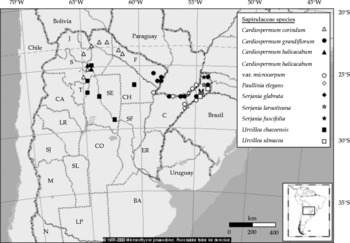
Extensive exploratory surveys on C. grandiflorum and other selected Sapindaceae were conducted along the main roads in the provinces of Chaco, Corrientes, Formosa, Jujuy, Misiones and Salta, in northern Argentina from January 2005 to April 2009 (Fig. 1). Forty sites were surveyed during the 4-year period, and most of the sites were scouted twice per year. Balloon vine occurring mainly along the natural forest edges and roadsides were scouted. Adult insects were collected by hand directly from the plants, while immature stages imbedded inside leaves, flower buds and fruits were transported to the laboratory in Buenos Aires, and reared to adulthood. In addition, leaves, stems and fruits of balloon vine and other Sapindaceae species were visually inspected for fungal pathogens. The infected material was collected from the field and preserved in a plant press for subsequent use at the laboratory.
Main collecting sites of natural enemies of Cardiospermum grandiflorum and other Sapindaceae in northern Argentina. CH, Chaco; C, Corrientes; F, Formosa; J, Jujuy; M, Misiones; S, Salta; SE, Santiago del Estero; T, Tucumán; BA, Buenos Aires; ER, Entre Ríos; CO, Córdoba; SL, San Luis; SJ, San Juan; SF, Santa Fe; CA, Catamarca; LR, La Rioja; M, Mendoza; N, Neuquén; LP, La Pampa. This figure was created using Atlas Mundial Encarta 2001 (Microsoft).

Organisms that were found were considered ‘rare’ when present at less than 10% of the sites, ‘occasional’ at 10–30% of the sites or ‘common’ at more than 30% of the sites. Similarly, the abundance per site was ranked as ‘+’ ( ≤ 10 individuals), ‘++’ (11–30 individuals) and ‘+++’ (>30 individuals). Organisms collected/reared were sent to taxonomists for identification or description of new species.
Natural enemies were prioritized according to their perceived potential to control balloon vine. The criteria used included their apparent host specificity as determined from field observations, published records, and information provided by entomologists and pathologists on specific groups of insects and pathogens. Some species were investigated further in the laboratory to determine their host specificity and potential impact on C. grandiflorum. Sympatric populations of Cardiospermum corindum L., Cardiospermum halicacabum L. and C. halicacabum var. microcarpum (Kunth) Blume were also inspected, together with other closely related species within the Sapindaceae such as Paullinia elegans Cambessèdes, Serjania fuscifolia Radlkofer, Serjania glabrata Kunth, Serjania laruotteana Cambessèdes, S. marginata Casaretto, S. meridionalis Cambessèdes, Urvillea chacoensis Hunziker, Urvillea ulmacea Kunth and Urvillea uniloba Radlkofer. Voucher specimens of the plants and organisms collected were deposited at the SABCL and at the Museo Argentino de Ciencias Naturales, Buenos Aires, Argentina.
Preliminary host-specificity testing of selected agents
Out of 11 natural enemies (two pathogens and nine insects) found on C. grandiflorum in the field, three (all insects) were further subjected to preliminary host-specificity tests in the laboratory. These included Gargaphia sp. (Hemiptera: Tingidae), Cissoanthonomus tuberculipennis Hustache (Coleoptera: Curculionidae) and Chlorostrymon simaethis sarita (Skinner) (Lepidoptera: Lycaenidae).
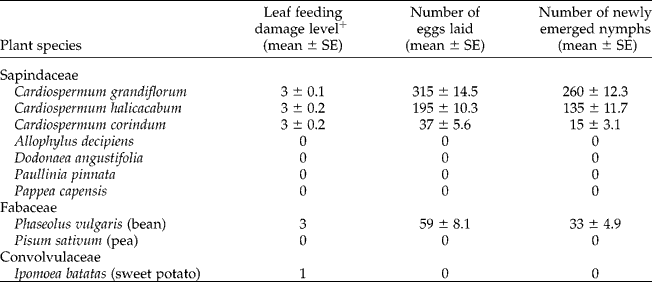
The sap-sucking lace bug Gargaphia sp. was subjected to adult no-choice oviposition tests in quarantine in South Africa. Plants tested included C. grandiflorum, C. corindum and C. halicacabum, a wide range of other Sapindaceae, and some crop species of economic importance in South Africa (Table 1). Each test plant was placed separately in a gauze-covered cage (0.55 × 0.55 × 0.95 m) for 10 days with six pairs of newly emerged adult bugs. The experiment was replicated four times, with each plant representing one replicate. After 10 days, each plant was examined for leaf damage and eggs deposited.
Plant species on which Gargaphia sp. was tested for adult feeding, oviposition and nymphal survival in no-choice tests
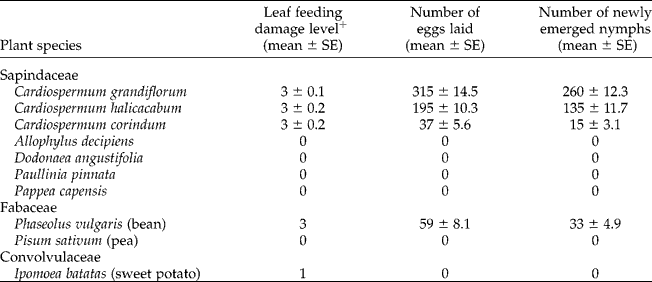
+ Level of feeding damage: none, 0; slightly damaged, 1; moderately damaged, 2; severely damaged, 3.
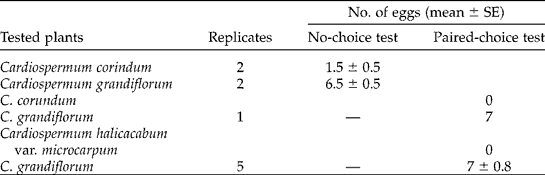
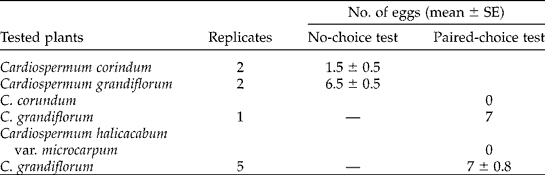
The seed-feeding weevil C. tuberculipennis was subjected to preliminary adult no-choice and paired-choice oviposition tests in Argentina. Oviposition was evaluated on C. grandiflorum, C. corindum and C. halicacabum var. microcarpum under controlled environmental conditions (25 ± 1 °C; 60–80% RH; 16 h light-8 h dark) using 1- and 3-l gauze-covered plastic containers for no-choice and paired-choice trials, respectively (Table 2). Five to ten soft green fruits (1–2 cm long) excised from each test plant were exposed to eight adults for 72 h. Moistened tissue paper was placed at the bottom of each container to delay desiccation of the fruits. The number of eggs deposited was recorded.
Preliminary host range testing of Cissoanthonomus tuberculipennis in Argentina
The seed-feeding butterfly C. simaethis sarita was subjected to adult no-choice oviposition tests in South Africa on C. grandiflorum, C. corindum and C. halicacabum. Fruit clusters, each containing approximately ten young fruits, were inserted by their stalks into a 400 ml flask full of water and placed inside a cage (0.5 × 0.5 × 1.0 m) constructed of a fine gauze material. Three pairs of adults were confined with the fruits for 10 days, and the fruits were inspected for oviposition. Eggs were kept until hatching, and emerging larvae were reared to adulthood on seeds of the same plant species. This experiment was repeated four times.
Results and discussion
Fungal pathogens
Puccinia arechavaletae Spegazzini (Uredinales: Pucciniaceae): this rust fungus was locally abundant throughout the wetter northeastern range of balloon vine in Argentina. It causes severe disease symptoms on C. grandiflorum, attacking the leaves, stems and fruits under natural conditions. P. arechavaletae has also been recorded on C. halicacabum var. microcarpum, C. corindum, as well as on other Sapindaceae plant species in tropical America (Farr and Rossman, Reference Farr and Rossman2009), but recent studies in South Africa have shown that host-specific strains do occur (A. Fourie et al., unpublished data). In general, rust fungi are host specific and are often used as weed biological control agents (Charudattan, Reference Charudattan2001, Reference Charudattan2005; Morin et al., Reference Morin, Evans and Sheppard2006). P. arechavaletae is an autoecious microcyclic rust, producing only teliospores and basidiospores. This is an added benefit with respect to host specificity, since it completes its life cycle on a single host. Preliminary results have suggested that the rust has good potential as a biological control agent for balloon vine in South Africa.
Phyllachora rimulosa Spegazzini (Phyllachoraceae): this tar spot fungus was found developing on the leaves, stems and fruits of balloon vine. It was described on Eugenia sp. (Myrtaceae) in Costa Rica (Spegazzini, Reference Spegazzini1919), and its presence on C. grandiflorum constitutes the first record for this species in Argentina (Cecilia Carmarán, personal communication). The Phyllachoraceae are widely distributed in the tropical regions of the world affecting different host plants, but without producing much damage (Cecilia Carmarán, personal communication). Hodges (Reference Hodges1988), searching for natural enemies of Psidium cattleianum Sabine (Myrtaceae) in Brazil, reported the presence of the congener Phyllachora subcircinans Spegazzini, but did not recommend it as a biological control agent because of insignificant levels of damage on its host. Considering this information, of the related species P. subcircinans, and the existence of P. arechavaletae, an apparently more effective pathogenic fungus of balloon vine P. rimulosa is not being considered for further studies.
Insects
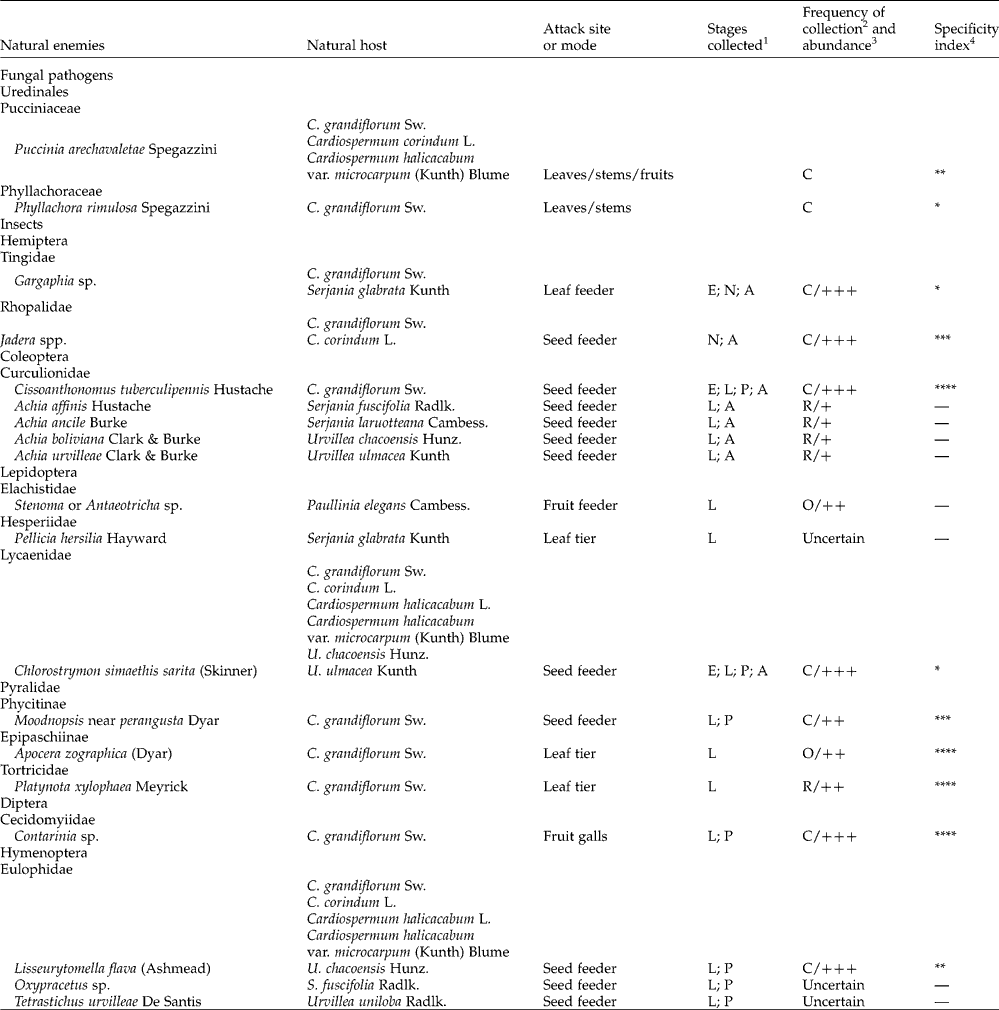
In total, 17 phytophagous insects were found associated with C. grandiflorum and other Sapindaceae species in northern Argentina within the orders Hemiptera (two species), Coleoptera (five species), Lepidoptera (six species), Diptera (one species) and Hymenoptera (three species) (Table 3). C. tuberculipennis, Contarinia sp. (Diptera: Cecidomyiidae) and Moodnopsis sp. nr perangusta Dyar (Lepidoptera: Pyralidae) were found exclusively on C. grandiflorum.
Natural enemies recorded on balloon vine Cardiospermum grandiflorum and other Sapindaceae in northern Argentina
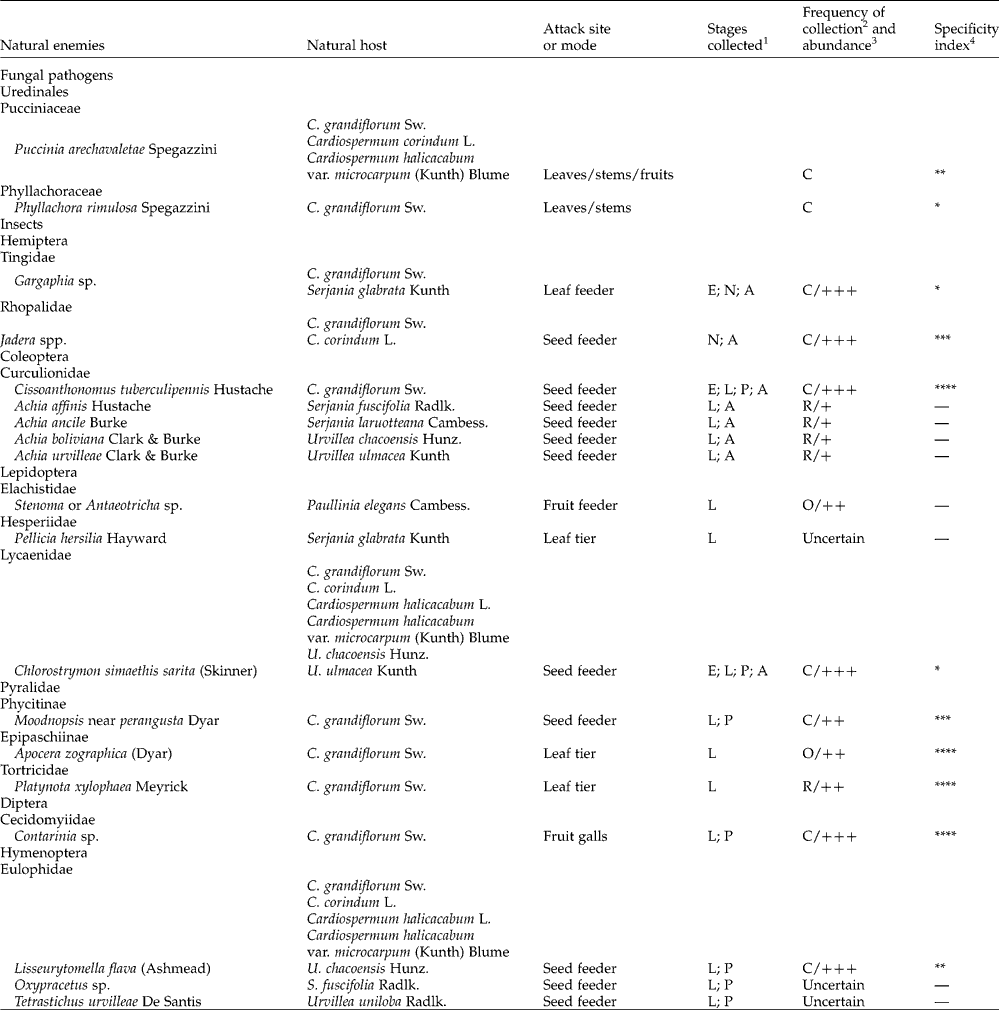
1 A, adult; E, egg; L, larva; N, nymph; P, pupa.
2 R, rare; O, occasional; C, common.
3 Abundance: +, ≤ 10 individuals; ++, 11–30 individuals; +++, >30 individuals.
4 Specificity index (calculated for those natural enemies that include C. grandiflorum as a natural host): *, host range exceeds Sapindaceae; **, host range restricted to Sapindaceae; ***, host range restricted to Cardiospermum species; ****, host range restricted to C. grandiflorum only.
Leaf feeders
Gargaphia sp.: the surveys indicated that this leaf-sucking lace bug was one of the most common natural enemies of balloon vine, occurring almost everywhere within the geographic range of the host plant. Egg batches are mostly deposited on the abaxial surface of the leaf. Nymphs and adults feed primarily on the underside of the leaves, causing severe chlorosis. Although Gargaphia sp. was found mainly on C. grandiflorum, further tests conducted in South Africa indicated a wider host range, attacking important plant species outside the Sapindaceae (Table 1), notably the common bean, Phaseolus vulgaris L. (Fabaceae). Because of its wide host range, further studies on Gargaphia sp. are not recommended.
Seed feeders
Cissoanthonomus tuberculipennis: this weevil was found on C. grandiflorum throughout its geographical range in Argentina. Adult weevils are brown to grey in colour, approximately 5 mm in length, have prominent tubercles on the elytra, and the fore femora are greatly enlarged with a large ventral spine. Eggs are inserted inside the young green fruits ( ± 1 cm long), and the larvae feed on the immature seeds inside the developing fruits. Greenish-blue pupae are found attached to the inner wall of the ripening fruit. Up to two adult weevils emerge from the ripening, well-developed pods. Adults were often found feeding on flower buds and flowers. Under laboratory conditions, adults fed on seeds of young fruits and on leaves when they were deprived of flower buds, flowers or fruits. In preliminary no-choice and paired-choice tests, C. tuberculipennis females laid more eggs on C. grandiflorum and only a few on other Cardiospermum species (Table 2). However, the present field surveys and studies by Clark (Reference Clark2006) and Clark et al. (Reference Clark, Burke and Mc Kay2007) suggested that C. grandiflorum is the only natural host of C. tuberculipennis. Aspects of the biology of C. tuberculipennis such as the longevity of adults (up to 4 months in controlled laboratory conditions), short generation times (approximately 40 days) and the severe feeding damage by larvae and adults suggest that this weevil has excellent potential as a biological control agent for balloon vine.
Chlorostrymon simaethis sarita: this ‘hairstreak moth’ occurs throughout Central and South America, from Mexico to Argentina (Nicolay, Reference Nicolay1980). We found it feeding on seeds of Cardiospermum and Urvillea species (Table 3). Larvae were reported inside the pods of C. corindum in Baja California, Mexico (Brown, Reference Brown1983). Round greenish-blue eggs are laid singly on the surface of the young fruit. Larvae bore through the papery fruit walls to reach the immature seeds. The larva is voracious, devouring all of the three seeds within a fruit before completing its development. The larva exits the empty fruit to pupate on the ground. During preliminary adult no-choice tests, this butterfly laid more (28 ± 8.4) eggs on C. grandiflorum compared with 8 ± 1.4 and 4 ± 1.1 laid on C. corindum and C. halicacabum, respectively. The highest percentage of surviving larvae that developed to adults was on C. grandiflorum (100%), followed by C. halicacabum (75%) and C. corindum (70%). Although the damage on the target weed C. grandiflorum was high, Pratt and Ballmer (Reference Pratt and Ballmer1991) reported a wide host range of this butterfly, which included species of the Fabaceae. Because of its wide host range, C. simaethis sarita is not recommended as a candidate biological control agent for C. grandiflorum.
Moodnopsis n. sp. near perangusta: this moth was found for the first time feeding on C. grandiflorum. Host plants for the six described Moodnopsis spp. are unknown (Robinson et al., Reference Robinson, Ackery, Kitching, Beccaloni and Hernández2009). In most cases, a single yellowish-white larva destroyed all three seeds within a pod. Pupation takes place inside a silk cocoon that remains attached to the inner walls of one of the three pod partitions. The grey-brown coloured adults (wingspan: 2–2.3 cm) emerge from the dry mature fruits. Although our surveys indicated that C. grandiflorum was the only natural host of this moth, larvae were recently found inside young fruits of a closely related species C. corindum in an open-field experiment currently in progress in Argentina (F. Mc Kay et al., unpublished data). However, further observation revealed that none of Moodnopsis n. sp. larvae completed development on this plant species. Therefore, the narrow field host range displayed and the level of damage exerted by this moth on the target weed justify further screening as potential biocontrol agent.
Lisseurytomella flava Ashmead (Hymenoptera: Eulophidae: Tetrastichinae): varying numbers of larvae (5–30) of this phytophagous wasp were found feeding on green seeds in immature fruits of C. grandiflorum and other Sapindaceae at several localities (Table 3), causing deformation of the seeds and possibly inhibiting their viability. Pupation takes place inside the pods and the adults emerge from the mature dehiscing pods. Two other microhymenoptera, Tetrastichus urvilleae De Santis (Eulophidae: Tetrastichinae) and Oxypracetus sp. (Eulophidae: Tetrastichinae) were found on the Sapindaceae species: U. uniloba Radlkofer and S. fuscifolia Radlkofer, respectively. So far, records in Argentina indicate that the host range of L. flava is restricted to species of Cardiospermum and Urvillea, the two closely related genera within the tribe Paulliniae (Ferrucci, Reference Ferrucci, Spichiger and Ramella1991).
Gall formers
Contarinia sp.: this gall midge was found damaging young fruits of C. grandiflorum at many sites, resulting in fruit deformation and destruction of seeds. The colour of the galls changes progressively from green in the early instars (0.5 cm in diameter) to greenish-brown at maturity (1.5 cm in diameter), during which the orange larvae exit the gall and drop onto the ground to pupate. To rear the adults, the mature galls were cut from the plant and placed in a plastic jar containing wet peat moss at the bottom. During the first day, midge larvae were observed exiting the gall and eventually burrowing into the soil to pupate. Adult emergence was recorded 2–3 weeks after the emergence of larvae from the galls. Unfortunately, high levels of parasitism by several hymenopteran wasp species including Oomyzus sokolowski Kurdjumov (Eulophidae) and Idiomacromerus sp. (Torymidae) and Torymus sp. (Torymidae) prevented the rearing and evaluation of this species in the laboratory. There are no host records of gall midges associated with either Sapindaceae or Cardiospermum species in North and South America (Gagné, Reference Gagné1989, Reference Gagné1994). So far, our field surveys indicate that C. grandiflorum is the only natural host of this gall midge. Because of its narrow field host range and the potential impact on reproductive capacity of C. grandiflorum, this gall midge appears to be a suitable biological control agent for this invader. Therefore, further host-specificity tests on this midge are strongly recommended.
Conclusions
Considering that balloon vine is an emerging weed that reproduces mainly by seeds, it seems that fruit- and seed-feeding agents like the weevil C. tuberculipennis and the midge Contarinia sp. would be more effective as biological control agents and should be prioritized for further studies. Indeed, our field surveys showed that seed-feeding agents are the most common and damaging agents and probably the key factors that regulate the abundance of balloon vine in its native range. Because there are no conflicts of interest associated with the control of balloon vine in South Africa, biological control may include agents that attack feeding niches other than fruits or seeds (e.g. leaves and stems). However, seed-attacking agents have played an important role in the long-term management of alien plant species, especially in reducing the cost of follow-up control operations (Neser and Kluge, Reference Neser, Kluge, Macdonald, Kruger and Ferrar1986; Zimmermann, Reference Zimmermann1991; Moran et al., Reference Moran, Hoffmann, Olckers, Cullen, Briese, Kriticos, Londsdale, Morin and Scott2004). It is therefore conceivable that seed feeders would be effective in curbing the spread of an alien invader such as balloon vine. Because C. tuberculipennis and Contarinia sp. are highly damaging and also displayed host ranges that are restricted to C. grandiflorum, they seem to be the best candidates for biological control of balloon vine in South Africa and elsewhere. It is strongly recommended that the two insects be subjected to further host-specificity tests.
Acknowledgements
We are grateful to the generous contributions of numerous workers to this study. We thank M. S. Ferrucci, Instituto de Botánica del Nordeste, Corrientes, Argentina, for the assistance with identification of the Sapindaceae of Argentina. For the identification of different insect groups, we thank D. Aquino (Chalcidoidea), Museo de La Plata, Argentina; F. Navarro (Apocera zographica), Universidad Nacional de Tucumán, Argentina; N. Vanucci (C. simaethis sarita); W. E. Clark, Auburn University, Alabama, USA and H. R. Burke, Texas A&M University, Texas, USA (Curculionidae); S. P. Carroll (Rhopalidae), University of California, California, USA; J. Burns (Pellicia hersilia), Smithsonian Institute; and A. Solis (Phycitinae), J. W. Brown (Elachistidae and Platynota xylophaea), R. J. Gagné (Cecidomyiidae) and T. J. Henry (Tingidae), all from the USDA/ARS/SEL. We also thank Mic Julien (CSIRO Entomology), Terry Olckers (University of KwaZulu-Natal), Juan Briano and Arabella Peard de Bugliani (USDA-ARS, SABCL) for their valuable comments and suggestions on the manuscript.