Introduction
The term chronic rhinosinusitis, as used in this paper, refers to both chronic rhinosinusitis with nasal polyposis and chronic rhinosinusitis without nasal polyposis. The presenting symptoms, predisposing factors, associated co-morbidities and response to surgery for chronic rhinosinusitis can be gender-dependent. Despite this, there are few studies in the medical literature that address the impact of gender on the clinical presentation of this condition.Reference Baumann and Blumenstock1
Facial pain and headache are common symptoms of paranasal sinus disease. However, diseases which do not affect the paranasal sinuses directly can cause both these symptoms, making accurate diagnosis a challenge. In addition, certain psychiatric illnesses such as depression can worsen headache. The prevalence of migraine headache, tension-type headache and depression can vary between the genders.Reference Lyngberg, Rasmussen, Jorgensen and Jensen2–Reference Hung, Wang, Hsu, Juang and Liu4
Anatomical obstruction of the osteomeatal unit is thought to play a role in the pathogenesis of chronic rhinosinusitis without nasal polyposis. Several of the anatomical variants that can block the osteomeatal unit are developmental, i.e. related to facial growth and pneumatisation of the paranasal sinuses, which can be gender-dependent. Moreover, allergic and non-allergic rhinitis commonly precedes or accompanies the inflammatory paranasal sinus disease. The prevalence of environmental allergy and asthma can differ between the genders.Reference Wieringa, Weyler, Van Bever, Nelen and Vermeire5 Furthermore, non-allergic rhinitis can be caused or worsened by female reproductive hormones. A classical example is gestational rhinitis.
The objective of this paper was to determine the impact of a patient's gender on the clinical presentation of chronic rhinosinusitis with and without nasal polyposis, by reviewing the presenting symptoms, co-morbidities, anatomical variants, diagnosis and surgical outcome.
Materials and methods
The study was reviewed and approved by our institution's Institutional Review Board (IRB).
This was a prospective study of 514 consecutive adult patients (age ≥18 years) who presented with chronic rhinosinusitis to a single tertiary care facility.
The patients were divided into two groups based on gender: female (n = 273) and male (n = 241).
The following data were collected: patient demographics, presenting symptoms, co-morbidities (environmental allergy, asthma and psychiatric illness), physical examination, nasal endoscopy findings, computed tomography (CT) findings, diagnosis and surgical outcome. The presence of environmental allergy was determined by a combination of medical history and allergy testing (skin test or Radio-Allergo-Sorbent Test (RAST)). Only those patients with a minimum post-operative follow-up period of six months were included in the analysis of surgical outcome.
The presenting symptoms were facial pain or headache (pressure, pulsating, pricking or stabbing pain), nasal drainage problems (anterior rhinorrhoea and/or postnasal drip), nasal congestion or obstruction, and dysosmia. We noted the following anatomical variants on physical examination and CT: septal deviation or spur, paradoxical middle turbinate, concha bullosa, agger nasi cell, and Haller cell. A septal deviation and/or spur was considered significant if it pressed against the middle turbinate or impinged into the middle meatus. Assessment of surgical outcome was based on a questionnaire completed by patients six months after surgery, which enquired about changes in the presenting symptoms, i.e. better, same or worse.
Statistical analysis using the chi-square test was performed to determine differences in the incidence of the above variables between the two gender groups. Statistical significance was set at a p value of <0.05.
Results
A total of 514 adult patients (273 women and 241 men) were evaluated in this study. The mean age was 45.5 years (range: 18–86 years). The mean age and the age range were similar in the two gender groups. In the female patients, the diagnosis was chronic rhinosinusitis without nasal polyposis in 68.2 per cent and chronic rhinosinusitis with nasal polyposis in 31.8 per cent. In the male patients, the diagnosis was chronic rhinosinusitis without nasal polyposis in 50.5 per cent and chronic rhinosinusitis with nasal polyposis in 49.5 per cent. The difference in the prevalence of chronic rhinosinusitis with nasal polyposis and of chronic rhinosinusitis without nasal polyposis between the two gender groups was statistically significant (p < 0.05).
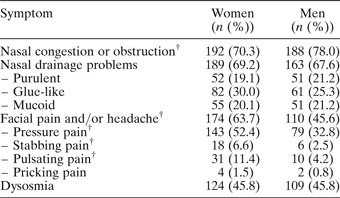
Nasal blockage and/or congestion were the most common presenting symptoms in both genders. However, the percentage of male patients who presented with nasal blockage and/or congestion (78.0 per cent) was significantly higher (p < 0.05) than that of female patients (70.3 per cent). On the other hand, the percentage of female patients who presented with facial pain and/or headache (63.7 per cent) was significantly higher (p < 0.05) than that of male patients (45.6 per cent). The higher prevalence of pain among women was true for the various reported pain characterisations, i.e. pressure, stabbing and pulsating. The prevalences of nasal drainage problems and dysosmia were similar between the genders. Nasal drainage problems were reported by 69.2 per cent of women and 67.6 per cent of men, while dysosmia was reported by 50.9 per cent of women and 50.4 per cent of men. The prevalence of purulent, glue-like or mucoid nasal drainage was similar in both genders (Table I).

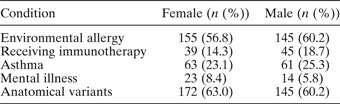
One hundred and fifty-five female patients (56.8 per cent) and 145 male patients (60.2 per cent) suffered environmental allergy. Thirty-nine female patients (14.3 per cent) and 45 male patients (18.7 per cent) were receiving immunotherapy at the time of presentation. Sixty-three female patients (23.1 per cent) and 61 male patients (25.3 per cent) had asthma. Twenty-three female patients (8.4 per cent) and 14 male patients (5.8 per cent) reported a mental illness, the vast majority being depression. The differences between the two genders in the prevalences of environmental allergy, asthma and mental illness did not reach statistical significance. Furthermore, the prevalences of allergic rhinitis and asthma were similar in both gender groups when data from patients with chronic rhinosinusitis with nasal polyposis and chronic rhinosinusitis without nasal polyposis were analysed separately (Table II).

As was stated in the ‘Materials and Methods’ section, the anatomical variants which can obstruct the osteomeatal unit and which were reported in this study were septal deviation or spur, paradoxical middle turbinate, concha bullosa, Haller cell, and agger nasi cell. The prevalences of these variants, when studied individually or in aggregate, were comparable in the two gender groups. One hundred and seventy-two female patients (63.0 per cent) had one or more of these anatomical variants, while 145 male patients (60.2 per cent) had one or more such variants. In addition, the prevalence of the anatomical variants was comparable between the two genders when calculated for the diagnosis of chronic rhinosinusitis without nasal polyposis, which is commonly associated with blockage of the osteomeatal unit.
Table III details the number and percentage of patients in each group which demonstrated improvement in the presenting symptom(s) following endoscopic sinus surgery. Four hundred and thirteen patients were followed up for a minimum of six months following their operation, and data from this subset of patients were included in the analysis of surgical outcome. The majority of patients in both gender groups reported improvement in all of their presenting symptom(s). Nasal blockage and/or congestion were the most likely symptoms to improve following surgery, but a statistically higher percentage of male patients (98.5 per cent) reported improvement than did female patients (94.3 per cent) (p < 0.05). The surgical outcomes for the remaining three presenting symptoms were comparable between the two gender groups. Nasal drainage problems were reported as ‘improved’ by 86.2 per cent of male patients and 85.7 per cent of female patients, as ‘same’ by 6.9 per cent of male patients and 8.9 per cent of female patients, and as ‘worse’ by 6.9 per cent of male patients and 5.4 per cent of female patients. Facial pain and/or headache were reported as ‘improved’ by 91.1 per cent of male patients and 93.3 per cent of female patients, as ‘same’ by 5.2 per cent of male patients and 5.4 per cent of female patients, and as ‘worse’ by 3.7 per cent of male patients and 1.3 per cent of female patients. Dysosmia was reported as ‘improved’ by 77.1 per cent of male patients and 78.4 per cent of female patients, as ‘same’ by 18.1 per cent of male patients and 18.5 per cent of female patients, and as ‘worse’ by 4.8 per cent of male patients and 3.1 per cent of female patients.

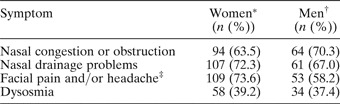
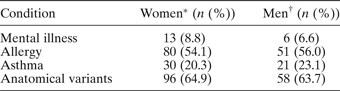
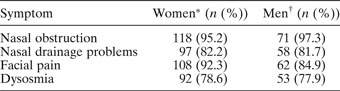
The above results were true for the subset of 306 patients (185 women and 121 men) who were diagnosed with chronic rhinosinusitis without nasal polyposis. As with the study population at large, facial pain and/or headache were more common among the female patients, while nasal blockage and/or congestion were more common among the male patients (Table IV). In addition, the prevalence of co-morbidites and anatomical variants was similar in the two gender groups. One hundred and twenty female patients (64.9 per cent) and 77 male patients (63.7 per cent) diagnosed with chronic rhinosinusitis without nasal polyposis exhibited one or more anatomical variants (Table V). The percentages of female patients with chronic rhinosinusitis without nasal polyposis who reported improvement in nasal blockage, nasal drainage problems, facial pain and dysosmia following surgery were 95.2, 82.2, 92.3 and 78.6 per cent, respectively. The percentages of male patients with chronic rhinosinusitis without nasal polyposis who reported improvement in nasal blockage, nasal drainage problems, facial pain and dysomia following surgery were 97.3, 81.7, 84.9 and 77.9 per cent, respectively (Table VI). The difference in the percentage of patients in the two gender groups who improved following surgery was not statistically significant.
Presenting symptoms among patients with chronic rhinosinusitis without nasal polyposis

* n = 185 patients;
† n = 121 patients.
‡ Statistically significant difference between the two gender groups (p < 0.05).
Prevalence of co-mobidities and anatomical variants among patients with chronic rhinosinusitis without nasal polyposis

* n = 185 patients;
† n = 121 patients.
Patients with chronic rhinosinusitis without nasal polyposis reporting improvement of presenting symptom(s) after surgery

* n = 124;
† n = 73.
Discussion
Several diseases demonstrate gender differences in their presentation, aetiological factors and response to therapy.Reference Phillips Bute, Mathew, Blumenthal, Welsh-Bohmer, White and Landolfo6, Reference Lee, Mayer, Schmulson, Chang and Naliboff7 Despite this, there is a paucity of studies in the medical literature which focus on the impact of gender on the clinical presentation of chronic rhinosinusitis. A recent paper by Baumann and BlumenstockReference Baumann and Blumenstock1 addressed the impact of gender on general health-related quality of life outcome measures (the Short Form-36 Health Survey and the European Quality of Life-5 Dimensions) in patients with chronic rhinosinusitis. These authors reported lower general health-related quality of life measure scores, over all domains, among female patients with chronic rhinosinusitis. The scores of female and male patients in their study became similar following endoscopic sinus surgery. However, the authors did not report on sinus-specific symptoms or outcome. Other papers reporting on the health impact of chronic rhinosinusitis or of endoscopic sinus surgery, as measured by disease-specific and general health outcome measures, did not address the impact of gender per se.Reference Gliklich and Metson8–Reference Catalano and Roffman10
Several of the presenting symptoms, predisposing factors and co-morbidities of chronic rhinosinusitis can be gender-dependent. The facial pain and headache reported by patients with paranasal sinus disease can be of non-sinus aetiology or may be exacerbated by paranasal sinus disease. Headache (both migraine and tension-type) is more common among women.Reference Lyngberg, Rasmussen, Jorgensen and Jensen2, Reference Lyngberg, Rasmussen, Jorgensen and Jensen3 Migraine headache is often confused with headache caused by paranasal sinus disease, since both may respond to decongestants or anti-inflammatory medications and may demonstrate an increased soft tissue signal in the paranasal sinus lining on imaging. In addition, headache is often associated with mental illness, especially depression.Reference Hung, Wang, Hsu, Juang and Liu4, Reference Barton-Donovan and Blanchard11 A study by Hung et al. showed that a higher Hamilton depression rating scale, female gender and chronic depression were independently associated with migraine or chronic daily headache.Reference Hung, Wang, Hsu, Juang and Liu4 Our data demonstrated that female patients with inflammatory paranasal sinus disease were more likely than male patients to complain of headache on presentation. This was true for our study population at large, and for the subset of patients who were diagnosed with chronic rhinosinusitis without nasal polyposis. The female patients in our study population had a slightly higher prevalence of depression, but the difference between the genders did not reach statistical significance. It is of interest that the percentage of patients of both genders who reported headache improvement following surgery (93.3 per cent of the women and 91.1 per cent of the men) was high and similar. This suggests the headache reported by our study population was caused by the paranasal sinus disease or exacerbated by it; this indirectly supports the benefit of surgery in such clinical situations.
• This study aimed to determine the impact of a patient's gender on the clinical presentation of chronic rhinosinusitis with and without nasal polyposis, by prospective study of 514 adult patients
• Facial pain and headache were more prevalent among women, while nasal obstruction was more prevalent among men
• There was no statistically significant difference in the prevalence of environmental allergy, asthma, psychiatric illness and anatomical variants obstructing the osteomeatal unit, comparing the genders
A higher percentage of our male patients complained of nasal obstruction at presentation. This is probably secondary to the higher percentage of men who were diagnosed with chronic rhinosinusitis with nasal polyposis. The prevalence of septal deviation and allergic rhinitis (which can lead to inferior turbinate hypertrophy) was similar among patients of both genders. Surgery is best suited to addressing nasal obstruction, which explains the very high percentage of patients of both genders who reported improvement of nasal obstruction following surgery. The slightly higher percentage of male patients who reported improvement in nasal obstruction could be a reflection of their disease, i.e. a higher percentage of chronic rhinosinusitis with nasal polyposis.
The prevalence of allergic rhinitis and asthma was similar in both genders in our study. However, more men than women were diagnosed with chronic rhinosinusitis with nasal polyposis. Our study was cross-sectional, but the suggestion that men are more prone to develop nasal polyps deserves further investigation.
The impact of gender on the development of concha bullosa, Haller cell, agger nasi cell and paradoxical middle turbinate has not been reported in the otolaryngology literature. Our data showed a similar prevalence of these anatomical variants among patients of both genders who presented with chronic rhinosinusitis. This finding cannot be extrapolated to the general population, since our study was cross-sectional. However, one can infer that the likelihood of developing chronic rhinosinusitis, once an individual acquires one or more of these anatomical variants, is similar in both genders.
Our study had several limitations. Its cross-sectional rather longitudinal design did not permit a full understanding of the impact of gender on paranasal sinus disease. In addition, the role of co-morbidities cannot be ascertained, since their onset in relation to paranasal sinus disease was not reported. Furthermore, the surgery outcome measure used had not been validated and was not quantitative. Further research is needed to fully address the impact of gender on this very common disease.
Conclusion
Gender impacts the clinical presentation of chronic rhinosinusitis with and without nasal polyposis. Female patients are more likely to complain of facial pain and/or headache and to be diagnosed with chronic rhinosinusitis without nasal polyposis. Male patients are more likely to complain of nasal congestion or obstruction and to be diagnosed with chronic rhinosinusitis with nasal polyposis. Both genders reported a high rate of improvement in their presenting symptoms, including facial pain and headache, following endoscopic sinus surgery. There was no difference in the prevalence of environmental allergy, asthma, mental illness and anatomical obstruction of the osteomeatal unit, comparing the two genders.