1. Introduction
Some cosmological models permitted by general relativity contain closed timelike curves that allow for “time travel” of a certain kind. In such models, a massive particle may both commence and conclude a journey through space-time at the very same point. And it turns out that in some models—such as the one introduced by Gödel (Reference Gödel1949)—this journey cannot be accomplished without accelerating: a rocket is needed. So, given these possible universes, a study of efficient time travel seems to be appropriate.
Here, we suggest one strategy for increasing efficiency. In those models in which acceleration is necessary for time travel, we hypothesize that a smooth closed timelike curve is never most efficient with respect to total (integrated) acceleration. Indeed, it seems that there is always some curve with a “kink” at the initial (terminal) point that fares better. (A closed timelike curve can fail to be smooth at this one point since initial and terminal velocities are not, in general, identical.) In what follows, we hope to lend support for our hypothesis in a variety of ways.
2. Background Structure
Our first task is to formulate precisely our hypothesis. To do this, we must review a few basic concepts of relativity theory.Footnote 1 An n-dimensional, relativistic space-time (for  ) is a pair of mathematical objects (M, gab). Object M is a connected n-dimensional manifold (without boundary) that is smooth. Here, gab is a smooth, nondegenerate, pseudo-Riemannian metric of Lorentz signature (+, − , … , −) defined on M. Associated with gab is a unique derivative operator ∇a with which the metric is compatible.
For each point  , the metric assigns a cone structure to the tangent space Mp. Any tangent vector ξa
in Mp will be timelike (if
 ), null (if
 ), or spacelike (if
 ). Null vectors create the cone structure; timelike vectors are inside the cone, while spacelike vectors are outside. A time orientable space-time is one that has a continuous timelike vector field on M. A time orientable space-time allows us to distinguish between the future and the past lobes of the light cone. In what follows, it is assumed that space-times are time orientable.
For some interval  , a smooth curve
 is timelike if the tangent vector ξa
at each point in
 is timelike. Similarly, a curve is null (respectively, spacelike) if its tangent vector at each point is null (respectively, spacelike). A timelike curve is future directed if its tangent vector at each point falls in the future lobe of the light cone. A timelike curve
 is closed if
 . A closed timelike curve may fail to be smooth at this initial (terminal) point γ(s) since the initial and terminal tangent vectors to γ will generally be different there (Malament Reference Malament1985, 777). We say a closed timelike curve is kinked if smoothness indeed fails at this point.
Consider a future-directed timelike curve  . The scalar acceleration of γ at each point is the quantity
 , where ξa
is the unit tangent to γ. The total acceleration of γ is the quantity
 , where s is elapsed proper time along γ. If
 , then γ is a geodesic.
We are now in a position to state precisely our hypothesis concerning efficient time travel.
Conjecture. In any space-time, if there exists a smooth nongeodesic closed timelike curve γ, then there also exists a kinked closed timelike curve γ′ such that  .
3. Euclidean Space
One way to get a grip on our hypothesis concerning the acceleration of closed timelike curves in four-dimensional space-time is to investigate the analogous hypothesis concerning the curvature of closed curves in three-dimensional Euclidean space. As we shall see, the classical analogue to our hypothesis turns out to be true.
Consider the manifold  . The Euclidean inner product assigns to any two ordered triples
 and
 in
 the quantity
 . This determines a norm
 associated with each triple. Given a smooth curve
 (parametrized by arc length s), the scalar curvature of γ at each point is the quantity
 . The total curvature of γ is the quantity
 . From this definition, it is clear that a straight line has zero total curvature. However, a circle with radius r has a scalar curvature of 1/r at each point and a circumference of 2πr. So it has a total curvature of 2π.
How are total curvature and total acceleration related? Imagine a point particle tracing out a curve in Euclidean space. Of course, the particle may accelerate by either changing its speed or changing its direction (or both). But if we require the speed to remain constant, the total acceleration of the particle will be identical to the total curvature of the curve it traces out.
Now, let us consider closed curves in Euclidean space. A theorem by Fenchel (Reference Fenchel1929) shows that any smooth closed curve will have a total curvature of at least 2π. So we naturally question whether there are closed curves with total curvature less than 2π if smoothness is allowed to fail at the initial (terminal) point. But of course there are.
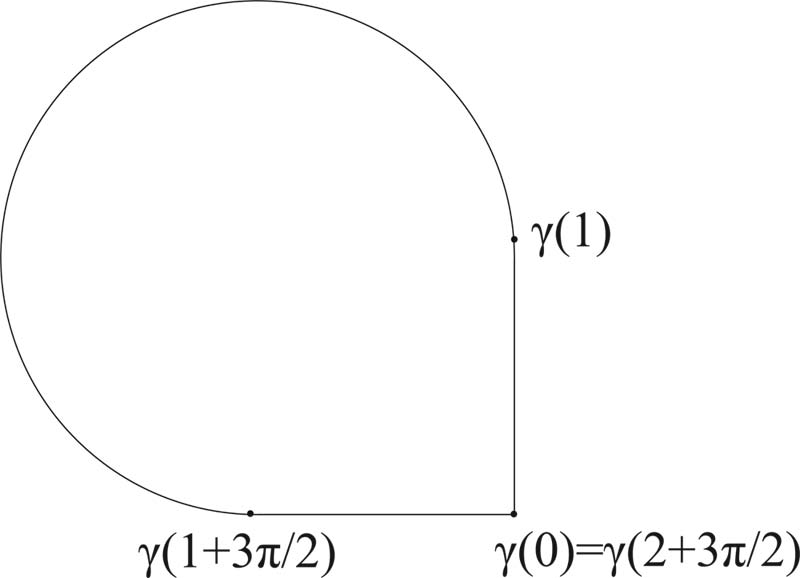
Consider the following curve  parametrized by arc length (see fig. 1):

Note that γ is closed since  . The curve is smooth everywhere except at γ(0), γ(1), and
 and is C 1 at the latter two points. The total curvature from γ(0) to γ(1) is zero. From γ(1) to
 , it is 3π/2. And from
 to
 , it is again zero.
Closed kinked curve γ.

It should be intuitively clear that we can alter the curve slightly near γ(1) and  so as to make the curve at these points smooth (instead of just once differentiable) and yet keep the total curvature under 2π. (Here, we omit the tedious proof of this claim.) We have the following result.
Proposition 1. In Euclidean space, there are closed kinked curves with total curvature less than 2π.
So, the analogue to our hypothesis holds in Euclidean space: a smooth closed curve is never most efficient with respect to total curvature if kinked curves are permitted. A curve simply does better if its initial and terminal tangent vectors do not point in the same direction. Now that we have motivated our hypothesis classically, let us turn our attention to relativity theory.
4. Multikinked Curves
We have assumed that a closed timelike curve may fail to be smooth at the initial (terminal) point. And, since there can be only one such point in any closed timelike curve, the study of multikinked curves may seem, at least at the outset, to be of little physical interest. However, as we shall see, the study of multikinked curves provides wonderful insight to our hypothesis. Indeed, in a certain sense to be made precise, we learn that the more kinks permitted, the smaller the total acceleration of a curve becomes.
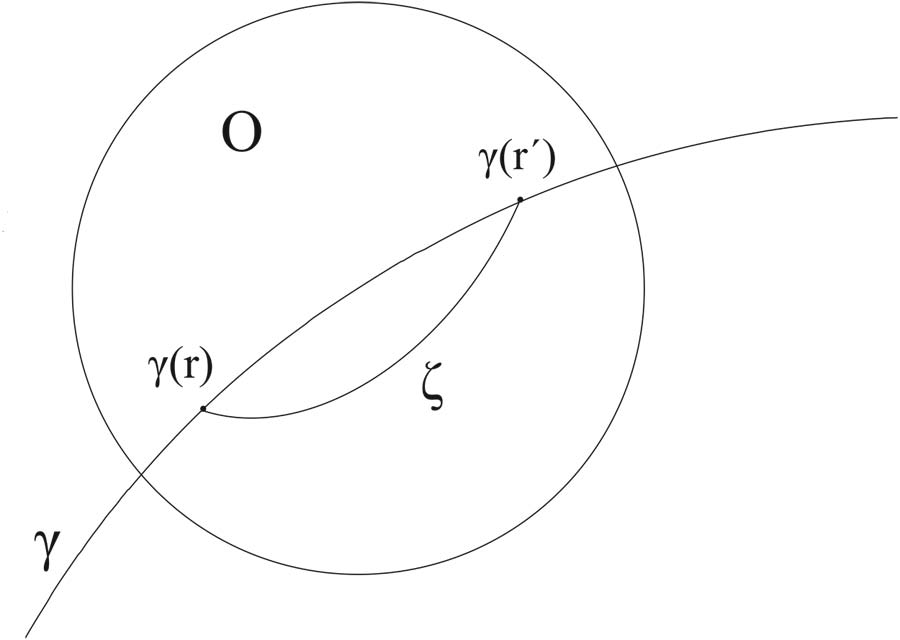
Let (M, gab) be any space-time containing a smooth nongeodesic closed timelike curve  . We know there will be a point p in the image of γ such that the scalar acceleration of γ at p is nonzero. Smoothness conditions near p guarantee that there will be some convex normal neighborhood O of p such that the total acceleration of γ restricted to O is nonzero. But, within any convex normal neighborhood, any two points may be connected by a unique geodesic contained in O (Hawking and Ellis Reference Hawking and Ellis1973, 34). So, let
 be such that and γ(r) and γ(r′) are in O. Now, let
 be the unique (timelike) geodesic running from γ(r) to γ(r′) in O (see fig. 2). Finally, consider the timelike curve
 defined as follows:

Neighborhood O containing the geodesic ζ and a portion of the closed timelike curve γ.

The curve is closed because  . And it should be clear that the curve is smooth everywhere except for the two kinks at γ′(r) and
 . What is TA(γ′)? It must be the quantity
 . But since
 , this implies that
 .
So, we have shown that, in any space-time, given any smooth nongeodesic closed timelike curve, there is always another closed timelike curve with two kinks that is more efficient with respect to acceleration. But nothing in the above argument turns on γ being smooth. Therefore, we have the following result.
Proposition 2. In any space-time, if there exists a nongeodesic closed timelike curve γ with n kinks, then there also exists a closed timelike curve γ′ with  kinks such that
 .
Of course, the proposition does not imply our hypothesis concerning once-kinked closed timelike curves. But, it does show a sense in which allowing a curve to have more kinks also allows it to have a smaller total acceleration.
Indeed, it is not difficult to see that any space-time containing closed timelike curves must contain a closed timelike curve γ with some number n kinks such that  . (Just cover the image of any closed timelike curve with a finite number of convex normal neighborhoods and iteratively use the construction outlined above.)
5. Gödel Space-Time
Given the results of the two previous sections, it may seem as though our hypothesis concerning the increased efficiency of once-kinked closed timelike curves is extremely likely: the analogous hypothesis is true in Euclidean space. And in general relativity, smooth curves are never most efficient if twice-kinked curves are permitted.
However, a conjecture by David Malament (Reference Malament, Asquith and Kitcher1986, Reference Malament1987) runs counter to our hypothesis. He identifies a particular closed timelike curve in Gödel space-time and states that it seems “overwhelmingly likely” that it is the most efficient with respect to total acceleration (Reference Malament1987, 2430). And although Malament (2430) explicitly permits kinked closed timelike curves, it turns out that the particular curve he identifies is everywhere smooth.
So, an investigation of Gödel space-time seems to be an important case study for our hypothesis. If Malament's conjecture is true, then our hypothesis is settled—it is false. However, if our hypothesis is indeed true, then there will be a kinked closed timelike curve in Gödel space-time that is more efficient than the one picked out by Malament. If we could find such a curve, we would show Malament's conjecture to be false and, in addition, provide greater support for our hypothesis. In this section, we do just that.
First, we introduce Gödel space-time.Footnote 2 The manifold is simply  . In cylindrical coordinates, the metric comes out as

Here,  ,
 ,
 , and
 , where
 is identified with
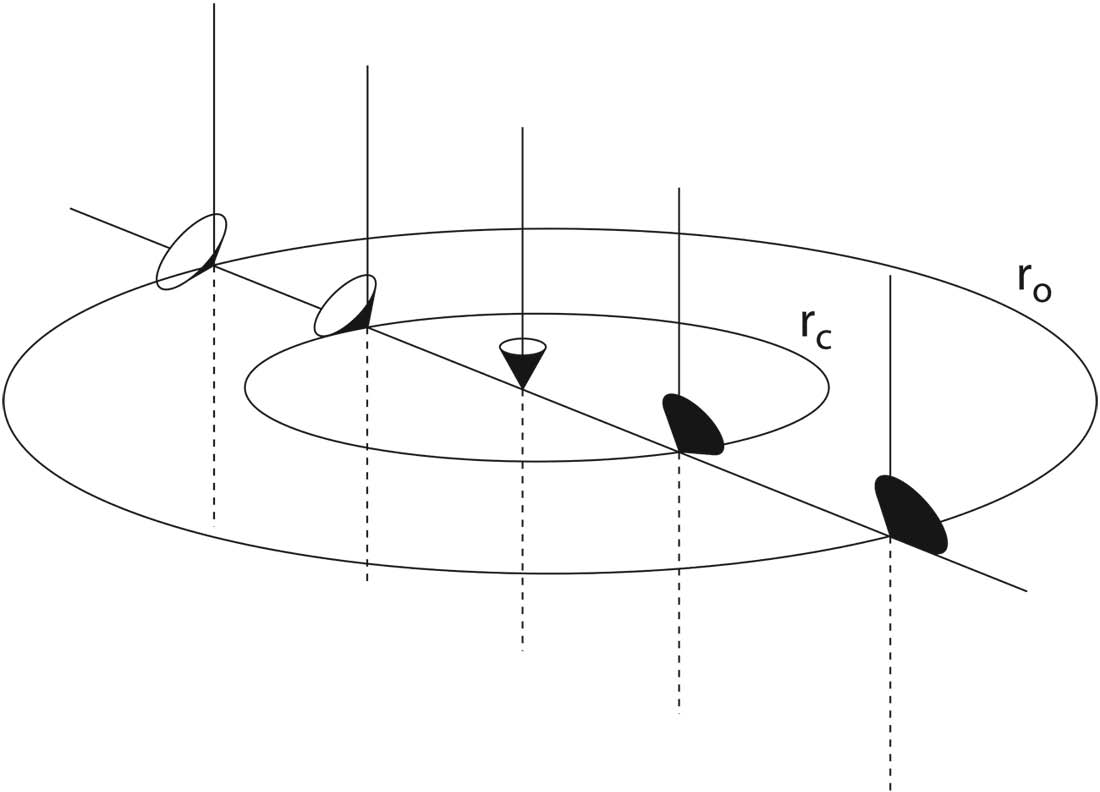
 . A space-time diagram (fig. 3) helps to conceptualize the basic features of the model. There, the unimportant spatial dimension y is suppressed. The vertical lines of constant r and ϕ coordinates are geodesics and represent the world lines of the major mass points of the universe. At
 , the light cone structure is upright. As r increases, the cones open up and, in addition, tip over. At the critical radius
 , the cones are tangent to the r-ϕ plane. At a radius larger than r c, the cones tip below it. Of course, the tipped cones allow for closed timelike curves. (Formally, one can verify that
 if and only if
 . So, closed curves contained within the r-ϕ plane with constant radius r will count as timelike if
 .)
Gödel space-time with the critical radius r c and the optimal radius r o indicated.

Although there are closed timelike curves in Gödel space-time, it can be shown that there no closed timelike geodesics. Indeed, every closed timelike curve (kinked or otherwise) has a total acceleration of at least  (Malament Reference Malament1985).
Now consider closed timelike curves contained in the r-ϕ plane with constant radius r. We will follow Malament in calling such curves Gödel circles. We have the following equation, which gives the relationship between the radius of the Gödel circle and its total acceleration (Malament Reference Malament1985, 775):

One can verify that  as
 and as
 . The function takes on the minimal value of
 when r is such that
 . Let us call this optimal radius r o (see fig. 3). Malament (Reference Malament, Asquith and Kitcher1986, Reference Malament1987) conjectures that the Gödel circle with radius r o has the lowest total acceleration of any closed timelike curve (kinked or otherwise) in the entire space-time. Of course, Malament's curve (call it γo) is smooth.
Now, is there a kinked closed timelike curve in Gödel space-time with total acceleration less than γo? Indeed there is.
Proposition 3. In Gödel space-time, there are kinked closed timelike curves with total acceleration less than  .
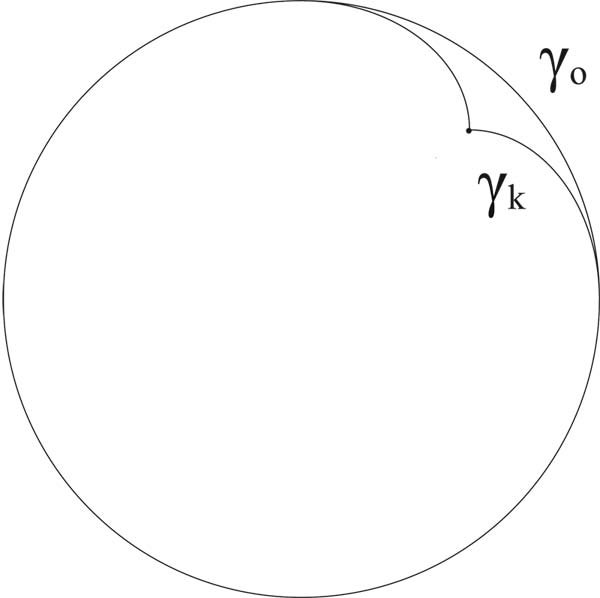
A proof of the claim is provided in Manchak (Reference Manchak2011). Here, we can only sketch the basic features of the more efficient kinked curve (call it γk). One constructs γk in a piecewise manner. The curve is contained entirely in the r-ϕ plane and is closely related to the optimal Gödel circle γo. Indeed, for some angle ε, the images of the two curves are identical for  . For
 , the image of γk is symmetric about the
 line and points inward creating a kink (see fig. 4).
Kinked curve γk, which has less total acceleration than the smooth optimal Gödel circle γo.

Intuitively, it may seem that the curve γk must have a greater total acceleration than γo. After all, the same inward-pointing kinked curve in Euclidean space certainly has a much larger total curvature than a Euclidean circle. But the result serves to highlight an interesting difference between classical space and relativistic space-time.
6. Conclusion
In this article, we have investigated the claim that a smooth nongeodesic closed timelike curve is never most efficient with respect to total acceleration if a kink is permitted at the initial (terminal) point. We have supported this hypothesis in a number of ways. First, we noted that the classical analogue to this hypothesis is true. Second, we showed one sense in which allowing a nongeodesic closed timelike curve to have more kinks also allows it to have a smaller total acceleration. Finally, we have established as true an important implication of our hypothesis: Malament's (Reference Malament, Asquith and Kitcher1986, Reference Malament1987) opposing conjecture concerning Gödel space-time is false.