Jeffery et al. discuss the human ability to estimate the slope of surfaces, and leave open the question of whether there is a dissociation between inaccurate conscious judgements of slope and accurate motor actions on the slope. They say that perceptual slope constancy exists – that is, a surface appears to have a relatively constant slope regardless of viewing distance, even though the angle the slope makes with the eye (the optical angle) changes. They also state that observers always overestimate slope, and that this cannot be explained by foreshortening of distance, because that would make downhill slopes appear flatter. Some of these statements can be challenged.
To perceive a geographical scene correctly, the two-dimensional image presented to the eye has to be turned into a three-dimensional image, and related to gravity and the angle of regard. Gravity information is obtained through the vestibular system and postural cues, and contributes to knowledge of the angle of regard. Translation to a three-dimensional image depends on distance information, which can be obtained from various binocular and monocular cues at short distances, and at all distances from the probabilistic relationship between images and their physical sources (Yang & Purves Reference Yang and Purves2003). Local relationships between different parts of the terrain can produce large slope illusions, or “anti-gravity hills” (Bressan et al. Reference Bressan, Garlaschelli and Barracano2003), perhaps by changing the probabilities.
Outdoor observations and experiments using long viewing distances show that apparent slope does vary with the viewing distance and viewing height. Distant uphill slopes appear steeper than near uphill slopes. Distant downhill slopes appear flatter than near downhill slopes, and very distant downhill slopes appear to slope uphill. Skiers at the top of a hill may observe skiers in the valley below apparently skiing uphill. These effects can all be explained by increased foreshortening of distance at further distances (Fig. 1). However, when viewing different parts of the terrain, observers also vary their angle of regard, and the optical angle will change. These effects are particularly marked at short viewing distances and may contribute to different perceptual effects with close viewing.
Figure 1.
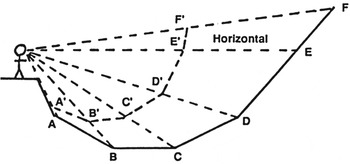
Distance foreshortening makes uphill slopes appear too steep (EF to E′F′) and downhill slopes too shallow (AB to A′B′). [Reprinted from Ross (1994) with permission]
It is well known that uphill slopes appear steeper from a far than a near distance. Alhazen used foreshortened distance in the 11th century to explain the vertical appearance of distant hills (Sabra Reference Sabra and Sabra1989). Ross (Reference Ross1974, p. 73) found that skiers gave steeper verbal estimates of an uphill slope from a far viewpoint than when standing on the slope. Creem-Regehr et al. (Reference Creem-Regehr, Mohler and Thompson2004) varied the viewing distance from the base of a hill to 70 meters away, and found an increase in slope estimates from the far distance. Bridgeman and Hoover (Reference Bridgeman and Hoover2008) had observers stand on a paved hill with an 11 degree slope, and judge the slope when looking up to a cone placed at 1, 2, 4, 8, and 16 meters uphill from them; their slope estimates increased with the viewing distance. Thus, quite short increases in viewing distance are sufficient to cause an increase in apparent uphill slope, at least when accompanied by a raised angle of regard. In this case the optical angle decreases with the viewing distance, and cannot be used as an explanation of the increase in apparent slope.
The appearance of downhill slopes is more controversial. Unlike uphill slopes, downhill slopes can only be viewed with a lowered angle of regard. For evidence that downhill slopes appear too steep the authors cite Proffitt et al. (Reference Proffitt, Bhalla, Gossweiler and Midgett1995) and Li and Durgin (Reference Li and Durgin2009). However, Li and Durgin conducted a laboratory experiment using very short viewing distances, and found that downhill slopes appeared steeper when viewed further back from the edge of a drop. The increased viewing distance was accompanied by a decreased optical angle and a less depressed angle of regard. For downhill views a smaller optical angle is associated with a steeper slope, and this may explain the effect. The experiment does not compare uphill and downhill views, or deal with large distances. Proffitt et al. used real outdoor hills, viewed from the base or the top. The hills had slopes of from 2 to 34 degrees, but their lengths were not specified. The hills were selected to be near footpaths on a university campus, and to be sufficiently long that the top of the hill was “well above the horizon” when viewed from the base. For an average viewer with an eye-height of 1.5 meters, the 2 degree hill would have to be more than 43 meters in length, but the steeper hills could be shorter. The authors also conducted a virtual reality experiment, in which they simulated the measurements for the real 5 degree hill and stated that it was 100 meters in length. The outdoor hill lengths must have varied, but are short in comparison with the mountainous terrain experienced by skiers and hill walkers. The authors found that slopes were overestimated both uphill and downhill, but very slightly more for the steeper downhill views on visual and haptic measures (but not on verbal angular estimates). Similarly, Ross (Reference Ross, Kornbrot, Msetfi and MacRae2006) found no difference between uphill and downhill views on verbal angular estimates, for outdoor slopes between 2 and 23 degrees, with maximum viewing distances of 15 meters for the 23 degrees uphill view, and views of around 50 meters or more for the downhill views. Ross (Reference Ross, Bastianelli and Vidotto2010) varied the viewing distance to a bench on a 7 degree downhill slope: She had observers stand on the slope 20 meters above the bench, or view it from a window in a building, giving a viewing distance of 36 meters. The verbal slope estimates were significantly less steep from the higher and further viewpoint. This shows that when viewing distances are well controlled, the flattening effect of a more distant viewpoint can be measured over fairly short distances. Ross (Reference Ross, Bastianelli and Vidotto2010) also had observers make angular estimates from the Wallace Monument, 100 meters above a flat plain. The mean estimate for the flat plain was +6.45 degrees, significantly steeper than the estimate of +0.93 degrees given by observers standing on a horizontal footpath, and demonstrating the apparent uphill slope of flat terrain when viewed from a height.
These errors have practical implications for skiers and mountaineers who are trying to decide whether a distant slope is navigable and what effort will be required. Large slope illusions are usually not detected as illusions (Bridgeman & Hoover Reference Bridgeman and Hoover2008) – unless evidence is available, such as skiers gliding uphill or water running uphill. One can learn from experience to guess what is navigable, but experience does not seem to change the false appearance of distant slopes. These observations cannot help the debate on whether there is a dissociation between perception and action, because by the time the traveller reaches the distant slope his perception usually corresponds to reality.





Jeffery et al. discuss the human ability to estimate the slope of surfaces, and leave open the question of whether there is a dissociation between inaccurate conscious judgements of slope and accurate motor actions on the slope. They say that perceptual slope constancy exists – that is, a surface appears to have a relatively constant slope regardless of viewing distance, even though the angle the slope makes with the eye (the optical angle) changes. They also state that observers always overestimate slope, and that this cannot be explained by foreshortening of distance, because that would make downhill slopes appear flatter. Some of these statements can be challenged.
To perceive a geographical scene correctly, the two-dimensional image presented to the eye has to be turned into a three-dimensional image, and related to gravity and the angle of regard. Gravity information is obtained through the vestibular system and postural cues, and contributes to knowledge of the angle of regard. Translation to a three-dimensional image depends on distance information, which can be obtained from various binocular and monocular cues at short distances, and at all distances from the probabilistic relationship between images and their physical sources (Yang & Purves Reference Yang and Purves2003). Local relationships between different parts of the terrain can produce large slope illusions, or “anti-gravity hills” (Bressan et al. Reference Bressan, Garlaschelli and Barracano2003), perhaps by changing the probabilities.
Outdoor observations and experiments using long viewing distances show that apparent slope does vary with the viewing distance and viewing height. Distant uphill slopes appear steeper than near uphill slopes. Distant downhill slopes appear flatter than near downhill slopes, and very distant downhill slopes appear to slope uphill. Skiers at the top of a hill may observe skiers in the valley below apparently skiing uphill. These effects can all be explained by increased foreshortening of distance at further distances (Fig. 1). However, when viewing different parts of the terrain, observers also vary their angle of regard, and the optical angle will change. These effects are particularly marked at short viewing distances and may contribute to different perceptual effects with close viewing.
Distance foreshortening makes uphill slopes appear too steep (EF to E′F′) and downhill slopes too shallow (AB to A′B′). [Reprinted from Ross (1994) with permission]
It is well known that uphill slopes appear steeper from a far than a near distance. Alhazen used foreshortened distance in the 11th century to explain the vertical appearance of distant hills (Sabra Reference Sabra and Sabra1989). Ross (Reference Ross1974, p. 73) found that skiers gave steeper verbal estimates of an uphill slope from a far viewpoint than when standing on the slope. Creem-Regehr et al. (Reference Creem-Regehr, Mohler and Thompson2004) varied the viewing distance from the base of a hill to 70 meters away, and found an increase in slope estimates from the far distance. Bridgeman and Hoover (Reference Bridgeman and Hoover2008) had observers stand on a paved hill with an 11 degree slope, and judge the slope when looking up to a cone placed at 1, 2, 4, 8, and 16 meters uphill from them; their slope estimates increased with the viewing distance. Thus, quite short increases in viewing distance are sufficient to cause an increase in apparent uphill slope, at least when accompanied by a raised angle of regard. In this case the optical angle decreases with the viewing distance, and cannot be used as an explanation of the increase in apparent slope.
The appearance of downhill slopes is more controversial. Unlike uphill slopes, downhill slopes can only be viewed with a lowered angle of regard. For evidence that downhill slopes appear too steep the authors cite Proffitt et al. (Reference Proffitt, Bhalla, Gossweiler and Midgett1995) and Li and Durgin (Reference Li and Durgin2009). However, Li and Durgin conducted a laboratory experiment using very short viewing distances, and found that downhill slopes appeared steeper when viewed further back from the edge of a drop. The increased viewing distance was accompanied by a decreased optical angle and a less depressed angle of regard. For downhill views a smaller optical angle is associated with a steeper slope, and this may explain the effect. The experiment does not compare uphill and downhill views, or deal with large distances. Proffitt et al. used real outdoor hills, viewed from the base or the top. The hills had slopes of from 2 to 34 degrees, but their lengths were not specified. The hills were selected to be near footpaths on a university campus, and to be sufficiently long that the top of the hill was “well above the horizon” when viewed from the base. For an average viewer with an eye-height of 1.5 meters, the 2 degree hill would have to be more than 43 meters in length, but the steeper hills could be shorter. The authors also conducted a virtual reality experiment, in which they simulated the measurements for the real 5 degree hill and stated that it was 100 meters in length. The outdoor hill lengths must have varied, but are short in comparison with the mountainous terrain experienced by skiers and hill walkers. The authors found that slopes were overestimated both uphill and downhill, but very slightly more for the steeper downhill views on visual and haptic measures (but not on verbal angular estimates). Similarly, Ross (Reference Ross, Kornbrot, Msetfi and MacRae2006) found no difference between uphill and downhill views on verbal angular estimates, for outdoor slopes between 2 and 23 degrees, with maximum viewing distances of 15 meters for the 23 degrees uphill view, and views of around 50 meters or more for the downhill views. Ross (Reference Ross, Bastianelli and Vidotto2010) varied the viewing distance to a bench on a 7 degree downhill slope: She had observers stand on the slope 20 meters above the bench, or view it from a window in a building, giving a viewing distance of 36 meters. The verbal slope estimates were significantly less steep from the higher and further viewpoint. This shows that when viewing distances are well controlled, the flattening effect of a more distant viewpoint can be measured over fairly short distances. Ross (Reference Ross, Bastianelli and Vidotto2010) also had observers make angular estimates from the Wallace Monument, 100 meters above a flat plain. The mean estimate for the flat plain was +6.45 degrees, significantly steeper than the estimate of +0.93 degrees given by observers standing on a horizontal footpath, and demonstrating the apparent uphill slope of flat terrain when viewed from a height.
These errors have practical implications for skiers and mountaineers who are trying to decide whether a distant slope is navigable and what effort will be required. Large slope illusions are usually not detected as illusions (Bridgeman & Hoover Reference Bridgeman and Hoover2008) – unless evidence is available, such as skiers gliding uphill or water running uphill. One can learn from experience to guess what is navigable, but experience does not seem to change the false appearance of distant slopes. These observations cannot help the debate on whether there is a dissociation between perception and action, because by the time the traveller reaches the distant slope his perception usually corresponds to reality.