Health technology assessment (HTA) plays an increasingly important role in enabling reimbursement bodies to make informed clinical and reimbursement decisions regarding the effective use of drugs and medical technologies (Reference Drummond, Schwartz and Jonsson11). However, the requirements and methods used have been shown to differ across jurisdictions (Reference Neumann, Drummond and Jonsson24). Although complete harmonization of all international HTA processes and formulary submission requirements is an unlikely objective (in particular, regional differences will always persist in costs, preferences, patient populations, and treatment patterns), greater harmonization of global HTA processes remains an important goal to reduce the variability in HTAs for the same product. To this end, several groups, including the European Network for Health Technology Assessment (EUnetHTA), have identified aspects of HTA for which there is general agreement on best practices and, therefore, upon which harmonization across guidelines might be achievable (Reference Drummond, Schwartz and Jonsson11–13;Reference Hutton, Trueman and Facey16).
Hutton et al. (Reference Hutton, Trueman and Facey16), in reviewing the possible approaches to harmonization of HTA, suggested that it should be recognized that harmonization of HTA across jurisdictions should not aim to produce a single decision on reimbursement and usage of a technology across all healthcare systems. The inherent differences between economies, societal preferences, and health systems means that similar decisions are not feasible, or even desirable, even if identical processes were used (Reference Hutton, Trueman and Facey16). The review by Hutton et al. (Reference Hutton, Trueman and Facey16) concluded that of the types of evidence, the most likely candidates for harmonization include the generation and evaluation of clinical evidence, which is generally thought to be less context-specific than the economic evidence (Reference Hutton, Trueman and Facey16).
Most formulary submissions to HTA bodies currently require the thorough collection of relevant clinical and economic data in a systematic and transparent manner. However, not all guidelines specify how this systematic approach is to be carried out, especially regarding how studies should be assessed and selected for inclusion in the HTA. Furthermore, when direct written guidance on the systematic approach is provided, the specific submission requirements may differ across the guidelines. Some of these differences may result in different bodies of evidence being included in the HTA, potentially contributing to different assessments of the value of alternative treatments.
The goal of this study was to increase our understanding of whether there were different requirements and/or recommendations for formulary submissions that could potentially affect the body of HTA evidence used for clinical and reimbursement decisions. To achieve this goal, we reviewed in depth the current formulary submission guidelines of major international pharmaceutical jurisdictions to identify important differences among these requirements and/or recommendations. We focused specifically on identification, abstraction, and synthesis of relevant clinical and economic data. We then provide some general and specific examples of how the different guidelines could impact the body of evidence used for clinical and reimbursement decisions. We believe that this review will stimulate a debate on the implications of differences in requirements and whether these differences can be justified; this discussion also will be useful for those preparing submissions for different jurisdictions.
METHODS
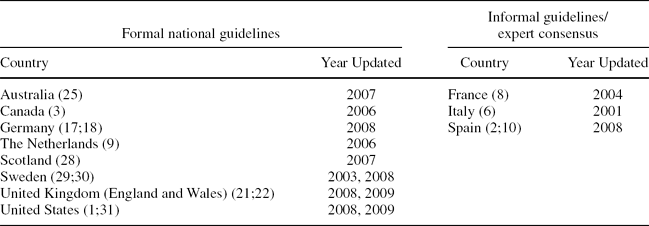
Current formulary submission guidelines for each of twelve countries (including managed care formulary submission guidelines in the United States [US]) were retrieved electronically from each agency's Web site and/or by means of the International Society for Pharmacoeconomics and Outcomes Research Web site, which maintains links to current Pharmacoeconomic Guidelines Around the World (19). In situations where a given jurisdiction requires the formal submission of clinical and economic data, it is customary to provide guidelines for the submission of such data, although sometimes there is a delay in developing and publishing the guidelines. Currently, there are thirty-three such sets of guidelines on the ISPOR Web site (19). Countries selected for inclusion in this article are listed in Table 1. These twelve countries were chosen because they represented major jurisdictions where HTA assessment is relatively well-developed and where national or expert guidelines or consensus statements were available in English. Although this list is by no means exhaustive, many countries with less formally developed HTA processes base their approaches on practices established by the major HTA agencies reviewed in this report.
HTA and Pharmacoeconomic Guidelines: Summary of Sources

Information from the selected formulary submission guidelines pertaining to guidance on selecting appropriate clinical and economic evidence was extracted and summarized for this report. Nine of the twelve countries had national or uniform submission requirements by jurisdiction. Some of these nine countries also had published consensus statements or expert guidelines (e.g., for Germany) (Reference Graf von der Schulenberg, Greiner and Jost15), but these were not included in our review. For the three countries without national HTA bodies and/or uniform requirements (France, Italy, and Spain), consensus statements or expert guidelines pertaining to formulary submission processes were retrieved and summarized.
For each of these guidelines, we reviewed the specific guidance for constructing clinical and economic evidence, including abstraction by two people and quality-control of the information by a third individual. The reviews were conducted with a focus on common topics that were addressed in most of the guidelines; these topics were used to summarize those guidelines. The common topics included in the review were as follows: (i) sources of clinical evidence including systematic literature reviews, selection of comparators, study designs and inclusion criteria, critical appraisal of clinical evidence, and clinical data analysis and synthesis; and (ii) sources of economic evidence, including economic model structures, methods for estimating health value measures, collecting resource use data, identifying unit costs, recommendations for uncertainty analyses, model validation, and appropriate subgroup analyses.
RESULTS
For this article, we categorized formulary submission recommendations into those pertaining to identifying and selecting clinical evidence and those pertaining to identifying and selecting economic evidence. Below, we present in simple tables and text a summary of our findings of how these recommendations varied among formulary submission guidelines. Detailed summaries of the identification and selection of clinical and economic HTA data for each country are available from the authors upon request.
Sources of Clinical Evidence
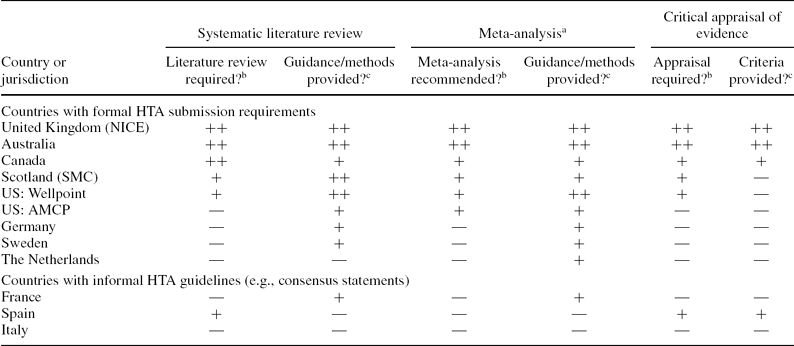
All formulary submission guidelines broadly advised identifying the most relevant sources of clinical evidence but varied widely in the degree of guidance provided. Key areas of divergence included directives for conducting a systematic literature review (whether one must be performed and guidance, if any, on how it is to be performed); how, if, and when data should be pooled; and guidance, if any, on how to critically appraise studies and select or exclude clinical evidence. Table 2 provides a summary of the degree to which each country recommends (or requires) these elements in an HTA submission and the degree to which specific guidance in each of these elements is provided.
Summary of Requirements or Recommendations for Systematic Collection of Clinical Evidence and Degree of Guidance Provided

AMCP, Academy of Managed Care Pharmacy; NICE, National Institute for Health and Clinical Excellence; HTA, health technology assessment; SMC, Scottish Medicines Consortium; US, United States.
a Meta-analysis used as a general term meaning pooling data from multiple studies.
b For the “required?” columns, (++), required; (+), recommended/encouraged; (—), not specified.
c For the “methods/criteria” columns, (++), guidance/criteria provided; (+), little guidance provided/several appraisal systems mentioned; (—), no guidance provided.
Systematic Literature Review
The HTA guidelines for England and Wales (the National Institute for Health and Clinical Evidence [NICE]), Canada, and Australia required an independent systematic literature review of the clinical evidence to be performed. Guidance on literature search methods was provided by each guideline (e.g., preferred databases, whether or not to supplement randomized, controlled trials (RCTs) with evidence from nonrandomized or observational studies), but many decisions are left to the individual reviewer (for example, inclusion of non–head-to-head RCTs, and inclusion of studies with mixed treatments or diagnoses). When specific literature databases were mentioned by individual guidelines, these recommendations often differed by country; while most such recommendations specified the use of MEDLINE, EMBASE, and the Cochrane Library, many guidelines specified additional databases (e.g., EconLit for NICE, Biosis for Canada, Australian Clinical Trials Registry for Australia), which may result in different studies being identified for submissions to each country. In addition, Australian guidelines encouraged a specific search for comparative harms relative to alternative treatments, using published studies and the Periodic Safety Update Reports.
Formulary submission guidelines from the United States (WellPoint), Scotland (Scottish Medicines Consortium), and Spain encouraged a systematic literature review to be performed, especially if existing systematic reviews were deemed insufficient but gave little guidance on search methods. Submission guidelines from the United States (Academy of Managed Care Pharmacy [AMCP]), Sweden, the Netherlands, Germany, France, and Italy did not require or encourage an independent systematic literature review to be performed.
Selection of Comparators
All guidelines regarding selection of appropriate comparator therapies required that the major comparators include therapies that are likely to be replaced by (or be an alternative to) the agent under evaluation as used in local practice (i.e., in that country's health system). In addition, the Scottish guidelines made specific mention that all comparators be identified, even when not used routinely in local practice. Many guidelines (e.g., Australia, Sweden) stated that nonpharmacologic interventions and unlisted drugs may be appropriate comparators, particularly in cases wherein no currently approved drug applies to the specific disease area or indication.
Study Designs and Inclusion Criteria
Because literature searches in different disease areas are expected to require disparate inclusion and exclusion criteria for selection of appropriate evidence, no country's guidelines provided an unambiguous list of criteria to be applied. However, some guidelines offered recommendations with regard to study designs (e.g., RCTs) to be included. The WellPoint guidelines provided the most information on possible exclusion criteria to be applied (e.g., serious methodological flaw, inadequate duration of follow-up). Most guidelines referred to the fact that direct, head-to-head RCTs are the preferred sources of clinical evidence to include, when available. The guidelines for Canada and Germany specifically mentioned that data from nonrandomized or retrospective studies are appropriate for supplementing evidence collected from RCTs. In contrast, the guidelines for NICE, Australia, Scotland, the United States, Sweden, the Netherlands, and France stated that directly comparative head-to-head RCTs are the preferred sources of evidence, and data from trials with less-rigorous study designs are appropriate only when direct RCTs for the comparators being evaluated do not exist.
Critical Appraisal of Clinical Evidence
With regard to critical appraisal of identified evidence, the guidelines for NICE and Australia provided a specific set of criteria to be applied to each study. Specific, external critical appraisal schemes that may be applied were mentioned in the guidelines for Spain (Jadad method). Guidelines for Canada referred to a source that required only a description of the method used to appraise the clinical evidence (British Medical Journal guidelines, Consensus on Health Economic Criteria List). Guidelines for Scotland and the United States (WellPoint) recommended a critical appraisal of the evidence but offered no specific guidance. Guidelines for the United States (AMCP), Sweden, the Netherlands, Germany, France, and Italy did not specify whether the identified clinical evidence should be formally appraised using validated scoring systems. Furthermore, even when critical appraisal of clinical evidence was mentioned or required, no guidelines gave specific instructions as to how to use the results of this appraisal to include or exclude studies; these decisions are largely left to the individual reviewer.
Data Analysis and Synthesis
The guidelines for NICE, Australia, Scotland, and the United States (WellPoint) stated that, given the appropriateness and homogeneity of the clinical evidence, a meta-analysis on key clinical outcomes should be performed. The Australian guidelines provided detailed technical guidance as to how the data synthesis should be performed but specified that indirect comparisons should not be conducted if head-to-head randomized trials are available. The NICE guidelines indicated that data from head-to-head trials can be supplemented using evidence from RCTs for the comparators, using analysis techniques for mixed-treatment comparisons. The guidelines for Canada and the United States (AMCP) mentioned meta-analyses and/or other indirect comparisons as appropriate data synthesis approaches, the methodology of which should be described if performed. The guidelines for Canada, NICE, and Australia recognized the need for indirect comparisons of clinical endpoints to enable evaluation of new treatments compared with current treatments where there are no head-to-head trial data available, and all three favored the use of well-validated statistical techniques to accomplish this. The guidelines for Sweden, the Netherlands, Germany, France, Italy, and Spain did not provide direction on how to synthesize clinical data, nor did they specify whether or not a meta-analysis should be performed.
Sources of Economic Evidence
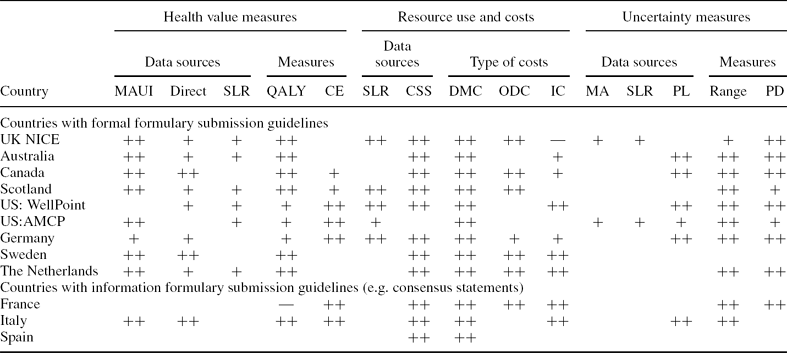
All submission guidelines for HTA agencies recommended a systematic or targeted approach to identify the most appropriate sources for resource use and costs and health value measures, including base-case estimates and ranges or distributions for sensitivity analyses. However, countries varied widely in the degree to which they recommended performing independent systematic reviews to identify the input data for the HTA and in the specific recommendations they provided for choosing the most appropriate data sources. Table 3 provides a summary of the degree to which each country recommends (or requires) systematic searching for data sources for health value measures, resource use, and costs in an HTA submission and the degree to which specific guidance on each of these elements.
Summary of Recommendations for Data Sources for Quality-Adjusted Life-Years, Resource Use and Costs, and Uncertainty Analyses

Note. ++, preferred approach or strongly recommended; +, acceptable approach; -, not recommended or should not be included; blank cell, no guidelines provided.
CE, clinical endpoint; CSS, country-specific standard sources; DMC, direct medical costs; IC, indirect costs; MA, meta-analysis; MAUI, multi-attribute utility index; ODC, other direct costs; PD, probability distribution; PL, plausible values; QALY, quality-adjusted life-year; SLR, systematic literature review.
Health Value Measures
Several guidelines (Germany, France, the United States [AMCP and WellPoint], and Italy) recommended that the results of cost-effectiveness analyses be based on effectiveness estimates for final clinical outcomes. These final clinical outcomes may need to be extrapolated from surrogate endpoints in clinical trials. In addition, guidelines from Germany required that the chosen clinical endpoints be cardinal measures of health outcomes. These HTA agencies will also consider estimates of cost-utility compared with current treatments, although France added the provision that a comprehensive set of the methodological challenges associated with the estimates of quality-adjusted life-years (QALYs) must be successfully addressed for the disease of interest.
For those agencies where guidelines for a cost-utility analysis were given, three alternative methods for obtaining the data required to estimate QALYs were generally deemed acceptable: a multi-attribute utility index (MAUI) given to patients during the clinical trials or as part of an observational study, with preference weights applied to the health states using a time trade-off (TTO) or standard gamble (SG) approach; a direct elicitation of utility for relevant health states, using a TTO or SG approach either within the clinical trials or in a separate study; or a systematic review of the published literature to identify utility weights estimated using a TTO or SG approach. The Netherlands guidelines indicated that a visual analogue scale also is an acceptable method for eliciting utility. The NICE and Scottish guidelines expressed a preference for the EuroQol 5D (EQ-5D) as the MAUI, with utility weights applied using the TTO approach, because of their concern that different MAUIs give different estimates of the differences in utility between health states and their desire for consistency across all healthcare interventions and health conditions. The NICE and Scottish guidelines also recommended mapping from a disease-specific quality-of-life measure to the EQ-5D as an appropriate method for estimating utility weights when EQ-5D data are not available. The Canadian, Australian, Dutch, and Italian guidelines all indicated that either TTO or SG applied to an MAUI, including the Health Utility Index Mark 2, the Health Utility Index Mark 3, the EQ-5D, and the SF-6D Health Survey, were all acceptable methods for deriving utility weights. With the exception of Sweden, all the guidelines recommended that the preference weights be derived from the general population in their own country; the Swedish guidelines recommended that patient preferences (rather than those of the general population) be used to derive utility weights.
Collecting Resource Use Data
All guidelines recognized that there are multiple sources for the resource use estimates, including clinical trials, observational data, national or local statistics, clinical guidelines, surveys, and expert opinion (to be used only if no other data sources are available). The sources for each resource use estimate should be provided in the analysis. Several guidelines, including NICE, Scotland, the United States (AMCP and WellPoint), and Germany, recommended that systematic literature and other data searches should form the basis for resource use estimates. The other guidelines did not specify the type of literature or data searches. All guidelines required that either country-specific data should be used or, when data on resource use from clinical trials or other countries are used, the methods used to adapt them to the country or health plan context should be presented, justified, and/or validated.
Guidelines varied as to what type of resource use and costs should be included in the economic evaluation. Guidelines from NICE, Scotland, and Germany asked for only the direct medical care costs and social services (NICE and Scotland) costs to be included in the analysis. The German guidelines suggested that the productivity gains can be presented separately as a benefit and that informal care costs can be included if they are an important component of overall costs. However, the other guidelines reviewed, except for those for Spain, required the analysis to include some or all of the following resource use in addition to direct medical care resource use: direct nonmedical care resource use, indirect resource use for the patient, and caregiver time. The Australian guidelines asked for only the direct resource use to be included in the base-case analysis; other resource use should be included in a sensitivity analysis. The Canadian guidelines asked for the productivity losses to be included in the base case, but not the caregiver time. In the United States, WellPoint guidelines required only estimates of medical care resource use and productivity losses, while the AMCP guidelines asked for payer-relevant resource use. Guidelines from Sweden, the Netherlands, France, and Italy asked for all resource use to be included, no matter who pays for it, while guidelines from Spain focused on only the cost for the new drug treatment compared with that of the current drug treatment.
Identifying Unit Costs
All guidelines recommended that country-specific unit costs be applied to the estimated resource use, and all recommended that resource use and costs be reported separately. Some guidelines recommended standard national cost data sources as the preferred data source (NICE, Australia, the Netherlands, France). For those guidelines that allowed inclusion of productivity losses either in the base-case or the sensitivity analyses, some recommended the human capital costing approach (Italy, Sweden), some recommended the friction costing approach (the Netherlands, Canada), one said that either approach can be used (France), and some did not specify the approach (United States [WellPoint and AMCP], Australia).
Uncertainty Analyses
Although all the guidelines reviewed in this study recommended some type of analysis be performed to determine the impact of uncertainty in the input parameter estimates on the results of the analysis, there was very little guidance provided as to how to obtain estimates of the ranges or distributions required for these types of analyses. NICE required that ranges and distributions used in the uncertainty analyses be fully justified from published literature or clinical trial data, with the option to use data from a Delphi panel if there is no alternative data source. Guidelines from Canada, the United States (WellPoint), Germany, and Italy asked for the ranges and distributions to be justified and documented. Australian guidelines asked for plausible values from trials or published data. Guidelines from France suggested the use of bootstrap methods when clinical trial data are available. Guidelines from the Netherlands, Sweden, and Scotland, although requiring uncertainty analysis, gave no guidance as to how to obtain the values for these analyses.
Economic Model Structures
Four guidelines—NICE, Australia, WellPoint, and AMCP—specified that a systematic literature search of cost-effectiveness analyses should be performed for comparator products to provide justification for the particular disease progression and treatment pathway assumptions included in the model. The German guidelines required the construction of an efficiency frontier for current treatments and provided some guidance for its construction. The US WellPoint guidelines required justification for the use of any model (rather than empirical analysis) and preferred a simple model to a more complex one.
Model Validation
Several country guidelines required that the impact of the chosen model structure and key assumptions on the results be tested in some type of sensitivity analysis, in addition to those sensitivity analyses to test uncertainty in the input parameter values (described above), but these guidelines were not very specific about how this is to be conducted. In the United States, AMCP asked for estimates of the results using alternative structures or assumptions and calibration of the model to observed clinical data. Australian guidelines suggested that the model be validated using disease natural history data and that systematic literature reviews be used to validate conversion of surrogate markers to final clinical endpoints and efficacy to effectiveness. Guidelines from France and Canada recommended the use of model validation methods but did not specify what these methods are. NICE, Scotland, and the US (WellPoint) guidelines asked for the impact of structural uncertainty to be explored. The other countries' guidelines did not mention estimating the impact of model uncertainty.
Appropriate Subgroup Analyses
Several of the guidelines reviewed made specific statements about their requirement for subgroup analyses. Guidelines from NICE and Scotland suggested that subgroup analyses are relevant where biologically or clinically plausible, while Swedish guidelines suggested that subgroup analysis should be performed when differences in cost-effectiveness are expected. Canadian guidelines preferred that subgroup analyses be planned before the trials are completed, while the US (WellPoint) and NICE guidelines recommended that subgroup efficacy be obtained from systematic reviews and meta-regression analyses. The US AMCP guidelines simply asked for subgroup analysis for relevant subgroups without any specifications.
DISCUSSION
The goal of HTA is to use the “most appropriate” clinical and economic evidence to inform healthcare and reimbursement decision making. However, the formulary submission guidelines from various countries reviewed in this study offered different recommendations for identifying the most appropriate evidence in several areas. In particular, recommendations differed regarding the range of comparators considered; the study designs included in the evidence base; the quality-appraisal methods for clinical studies; the methods used to synthesize the clinical data; the utility assessment methods for estimating the value of the clinical outcomes; the most appropriate economic model structures and outcomes of interest; the methods for estimating country-specific resource use and costs; the types of resource use and costs to be included in the economic evaluation, and the data sources for uncertainty analyses. If the formulary submission guidelines reviewed in this study were followed as written, differences in their recommendations for identifying and extracting relevant clinical and economic information likely would generate different (although overlapping) bodies of evidence for each country.
More specifically, as shown in our review, different clinical evidence bases are likely to be used to support decisions because of HTA agency preferences for randomized, controlled trial (RCT) data versus non-RCT data, preferences for meta-analysis of RCT data versus primary trial results, and preferences for head-to-head studies versus indirect comparisons. Additionally, the comparator drugs identified for consideration may not be identical across all HTA agencies; this may be a result of considering different drugs or regimens as the applicable standard of care in different jurisdictions. Furthermore, HTA agencies vary with regard to how economic data, resource use, and utility weights are to be collected, with all agencies preferring economic data collected from that specific country or region but only some agencies recommending a systematic literature review to identify input parameter values for utilities, resource use, and costs.
Although HTA agencies may express concern over the lack of head-to-head trials and the associated uncertainty in the economic analyses, they still may recommend a product that addresses a high clinical need. On the other hand, another HTA agency may reject a product submission, even if the product addresses a high unmet clinical need, if the agency believes there is a lack of head-to-head trials, unacceptable cost-effectiveness ratios, and/or lack of sensitivity analyses performed. Differences in the interpretation of pre-specified or post-hoc subgroup analyses may also result in different decisions across agencies such as willingness to accept a superiority result from a subgroup analysis in a non-inferiority trial.
The impact of the varied recommendations for selecting relevant clinical studies to include in the HTA can be illustrated by looking at recent HTAs for ustekinumab for psoriasis reviewed by NICE, Australia, and Canada. For the clinical evidence base, NICE included twenty studies, Australia included fourteen studies, and Canada included only three studies (5;23;27). This difference was partly due to differences in the choice of an appropriate comparator, as well as differences in study design. There also were differences among the HTA interpretations as to how the indirect treatment comparison was performed. However, the ultimate recommendation was the same for all three agencies (i.e., recommend with restrictions). In contrast, in the review of insulin glargine by NICE, the Pharmaceutical Benefits Advisory Committee (Australia), and the Common Drug Review (Canada), the number of trials included in the clinical evidence bases was similar across HTA agencies—19 to 20, although these were not all the same references (4;20;26). However, the ultimate recommendation of each agency differed, ranging from not being recommended by the Common Drug Review to an unrestricted recommendation by the Pharmaceutical Benefits Advisory Committee (after multiple submissions and intensive price negotiations). NICE recommended insulin glargine for a restricted population. Clearly, similar evidence submitted to various HTA agencies does not always result in similar decisions.
A recent study by Clement et al. (Reference Clement, Harris and Li7) has stated that “significant uncertainty around clinical effectiveness, typically resulting from inadequate study design or the use of inappropriate comparators and unvalidated surrogate endpoints, was identified as a key issue in coverage decisions.” Yet our review found very limited written guidance on how to estimate the inputs to an uncertainty analysis or how to design trials that would reduce the uncertainty about the clinical or surrogate endpoints for the total population or for the clinically relevant subgroups. This lack of specific guidelines may provide an opportunity for the collaborative, international development of more detailed guidelines on these topics.
Our study has compared the written formulary submission guidelines for various HTA agencies but this methodology has some limitations. The degree to which these guidelines are rigidly applied is difficult to ascertain. There are certainly cases where the written preferences of an HTA body cannot be met, due to availability of study data and other limitations. For example, in some disease areas or populations, RCTs may not comprise the most meaningful clinical evidence. Additionally, HTA agencies may impose additional restrictions not addressed in their written guidelines, and these may differ across countries and agencies. For example, subgroup analyses that were not prespecified may or may not be accepted as valid evidence to include in a submission. The ability to capture any such additional restrictions (especially ones that are informally applied) from the guidelines reviewed in this article is limited. Furthermore, the written guidelines for each jurisdiction continue to evolve, and any comprehensive summary of the guidelines only captures the information available at the time of review.
Our study shows that there are often important differences between the formulary submission guidelines in different jurisdictions. In so far as these differences exist, they are probably confusing for those that need to make submissions in multiple jurisdictions. This leads to the question as to how important such differences really are and whether they can be harmonized. Each jurisdiction has the right to ask for its own data, based on its views about the importance of different parameters and its views on methodological issues. However, some of the differences in requirements may not reflect real differences between jurisdictions in these matters. Rather, they may reflect the fact that some guidelines are older than others, or have not been subjected to the same levels of scrutiny. Initiatives like the EUnetHTA project are useful in this regard, because they offer the opportunity for different jurisdictions to discuss their differences in approach and to harmonize requirements where this makes sense. The work package by EUnetHTA on the “Core HTA” (14) is a good example of these efforts.
Regional and national differences in costs, preferences, available treatments, equity issues, and other factors will always persist, limiting the desirability of global HTA harmonization. In particular, having the same clinical and economic evidence base will not necessarily result in the same decision about the use of a new drug across jurisdictions because of national and regional differences. However, we suggest that there are benefits to encouraging international standardization of the methods used to generate the evidence base on which these decisions are founded. Such benefits include standardization of systematic review methodology, definitions and grading of appropriate study designs, methods for selection of relevant comparators, inclusion and exclusion criteria for meta-analyses based on study quality, and derivation of plausible ranges and probability distributions for inputs to uncertainty analyses. There is also a potential benefit from research to determine which of the differences in methods to generate the evidence base is the most likely to result in differences in the estimates of clinical or economic value. Global harmonization in methodology is generally part of standard research practice and therefore probably attainable. In the meantime, divergent assessments of the underlying clinical and economic evidence in HTA submissions will continue to contribute to heterogeneity in healthcare decision making, both across and within nations.
POLICY IMPLICATIONS
In this review, we show that the required or recommended methods for identifying and synthesizing the clinical and economic evidence for inclusion in an HTA agency formulary submission vary among countries. These differences may lead to different evidence bases being used as inputs to decisions made about reimbursement and access for a new health technology. The impact of methodological differences among guidelines on the final evidence base can provide guidance for future efforts for global harmonization of HTA.
CONTACT INFORMATION
Josephine Mauskopf, PhD (jmauskopf@rti.org), Vice President, Health Economics, Jeffrey Walter, PhD (jewalter@rti.org), Senior Associate, Market Access and Outcomes Strategy, RTI Health Solutions, 200 Park Offices Drive, Research Triangle Park, North Carolina 27709
Julie Birt, PharmD (birt_julie@lilly.com), Research Scientist, Global Health Outcomes, Lee Bowman, PhD (bowman_lee_LB@lilly.com), Senior Director, Oncology Business Unit, Global Health Outcomes, Eli Lilly and Company, Lilly Corporate Center, Indianapolis, Indiana 46285
Catherine Copley-Merriman, MS, MBA (kcmerriman@rti.otg), Vice President, Market Access and Outcomes Strategy, RTI Health Solutions, 3005 Boardwalk Street, Suite 105, Ann Arbor, Michigan 48108
Michael Drummond, BSc, MCom, DPhil (mike.drummond@york.ac.uk), Professor of Health Economics, Centre for Health Economics, University of York, Heslington, York, North Yorkshire YO10 5DD, UK
CONFLICT OF INTEREST
Josephine Mauskopf, Catherine Copley-Merriman and Jeffrey Walter report their institution has received funding from Eli Lilly and Company for performing this study. Julie Birt and Lee Bowman work for Eli Lilly and Company and have stock options in the company. Michael Drummond has received payment for discussing and reviewing this paper from Eli Lilly and Company.