INTRODUCTION
Symplectella rowi Dendy, Reference Dendy1924 is a lyssacine hexasterophoran glass sponge species (Porifera: Hexactinellida: Hexasterophora: Lyssacinosida) endemic to New Zealand waters (Dendy, Reference Dendy1924; Tabachnick, Reference Tabachnick, Hooper and Van Soest2002a; Van Soest et al., Reference Van Soest, Boury-Esnault, Hooper, Rützler, de Voogd, Alvarez de Glasby, Hajdu, Pisera, Manconi, Schönberg, Janussen, Tabachnick, Klautau, Picton, Kelly, Vacelet, Dohrmann, Díaz and Cárdenas2014). Although Dendy (Reference Dendy1924, p. 287) noted that his new genus ‘appears to be not without affinities with the Euplectellidae’, he assigned it to family Rossellidae. Seventy-eight years later, in the seminal revision of all sponge genera compiled by Hooper & Van Soest (Reference Hooper and Van Soest2002), Tabachnick (Reference Tabachnick, Hooper and Van Soest2002a) transferred the genus to Euplectellidae (Corbitellinae). The reasons for this move were rather vague, however: although Tabachnick (Reference Tabachnick, Hooper and Van Soest2002a, p. 1414) admitted that the absence of hypodermal pentactins also characterizes some rossellid species, he asserted that this feature supports assignment of Symplectella to Euplectellidae. Likewise, the absence of atrialia was considered ‘rather a feature of some Corbitellinae and some Euplectellinae than of Rossellidae’ (my italics). Finally, the absence of the euplectellid-specific large dermalia with long rays – Symplectella has small dermalia with short rays as is characteristic for Rossellidae – did not prevent him from advocating a euplectellid affinity. Instead, he argued that the thick-rayed nature of Symplectella's dermal hexactins and pentactins closely resembles spicules of the osculum-covering sieve plate found in many Corbitellinae. However, the sieve plate of Symplectella is constructed from regular diactins (Dendy, Reference Dendy1924, p. 288), and normal dermalia can hardly be homologized with specialized spicules restricted to the oscular region. The presence of a sieve plate per se also does not provide an unambiguous argument for a euplectellid affinity of Symplectella. Although sieve plates are widespread among euplectellids and unknown from any other rossellids, they are also found in distantly related families, namely Aphrocallistidae, Aulocalycidae and Hyalonematidae (Reiswig Reference Reiswig, Hooper and Van Soest2002a, Reference Reiswig, Hooper and Van Soestb; Tabachnick & Menshenina, Reference Tabachnick, Menshenina, Hooper and Van Soest2002), and therefore seem to be prone to convergent evolution. In my view, none of the characters cited by Tabachnick (Reference Tabachnick, Hooper and Van Soest2002a) provide compelling arguments for a placement of Symplectella in Euplectellidae. On the other hand, Dendy (Reference Dendy1924) did not provide any justification for the placement of his new genus in Rossellidae, either (besides, perhaps, the absence of floricomes, a spicule type that is however not present in all genera of Euplectellidae). The contrasting decisions of Dendy and Tabachnick seem to be largely subjective, necessitating independent evidence for a firm placement of Symplectella among the families of Lyssacinosida. Fortunately, I was able to obtain molecular sequence data from a specimen of S. rowi included in the National Cancer Institute (NCI) collection housed at the Smithsonian Institution's National Museum of Natural History (NMNH), which allowed me to test the competing hypotheses by means of molecular phylogenetic analysis.
MATERIALS AND METHODS
A specimen of S. rowi (NCI OCDN 6625-L), collected on 16 April 1999 off New Zealand at 200 m depth, was subsampled for molecular work at the NMNH, Washington, DC, and further processed at the Molecular Geo- & Palaeobiology Lab at LMU Munich. Identification as Symplectella rowi was confirmed by light microscopy investigation of temporary spicule preparations made by digesting small pieces of tissue in commercial bleach. DNA extraction, polymerase chain reaction (PCR) and Sanger sequencing to obtain phylogenetic markers established for Hexactinellida (Dohrmann et al., Reference Dohrmann, Haen, Lavrov and Wörheide2012b) were carried out using previously developed protocols (Dohrmann et al., Reference Dohrmann, Janussen, Reitner, Collins and Wörheide2008, Reference Dohrmann, Collins and Wörheide2009, Reference Dohrmann, Haen, Lavrov and Wörheide2012b). Despite substantial efforts, the cytochrome oxidase subunit I gene (COI), the 18S ribosomal RNA gene (18S rDNA), and the 5′-half of the 28S rDNA fragment could not be amplified (presumably because of DNA degradation during preservation of the specimen), leaving only the 16S rDNA fragment and the 3′-half of the 28S rDNA fragment for phylogenetic inference. The new sequences (GenBank accession numbers LN624751 and LN624750) were manually added to established alignments (Dohrmann et al., Reference Dohrmann, Göcke, Reed and Janussen2012a, Reference Dohrmann, Haen, Lavrov and Wörheideb). Initial phylogenetic analyses involving all available hexactinellid orthologues confirmed placement of S. rowi in Lyssacinosida (results not shown). For the final analyses, alignments were thus restricted to Lyssacinosida (plus Iphiteon panicea [Hexactinosida: Dactylocalycidae] as an outgroup) to allow inclusion of additional informative nucleotide positions that were unalignable across the whole taxon set. Phylogenetic analyses were conducted using maximum likelihood (ML) as implemented in RAxML v. 8.0.26 (Stamatakis, Reference Stamatakis2014) and were carried out on the 16S rDNA alignment (412 bp after removal of unalignable positions), the 28S rDNA alignment (1199 bp), a combination of the two (1610 bp) and a combination of all four markers (4805 bp). For COI and 16S rDNA, GTR + G models (Lanave et al., Reference Lanave, Preparata, Saccone and Serio1984; Yang, Reference Yang1994) were employed, and for 18S and 28S rDNA the S16 + G paired-sites model (see Savill et al., Reference Savill, Hoyle and Higgs2001) was assigned to stem-encoding regions in addition to GTR + G for loop-encoding regions. In the combined analyses, all model parameters except topology and branch lengths were unlinked across partitions (except the stem-encoding regions of 18S and 28S rDNA, which were treated as a single partition due to software limitations). Clade support was estimated using rapid nonparametric bootstrapping (Felsenstein, Reference Felsenstein1985; Stamatakis et al., Reference Stamatakis, Hoover and Rougemont2008) under the ‘autoMRE’ option to automatically determine the sufficient number of pseudoreplicates (Pattengale et al., Reference Pattengale, Alipour, Bininda-Emonds, Moret and Stamatakis2010). Alignments and trees are available at OpenData LMU (doi: 10.5282/ubm/data.62).
RESULTS
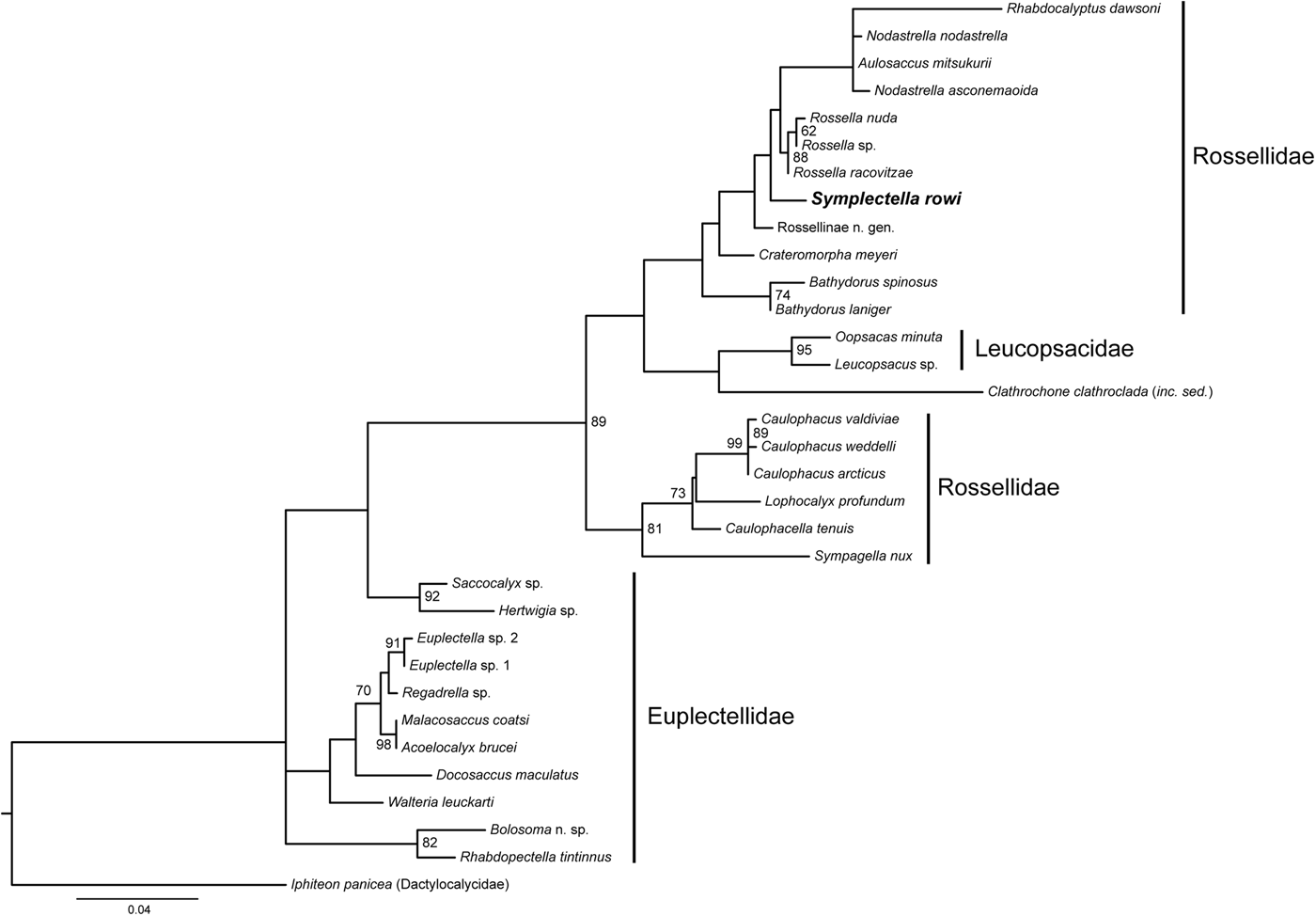
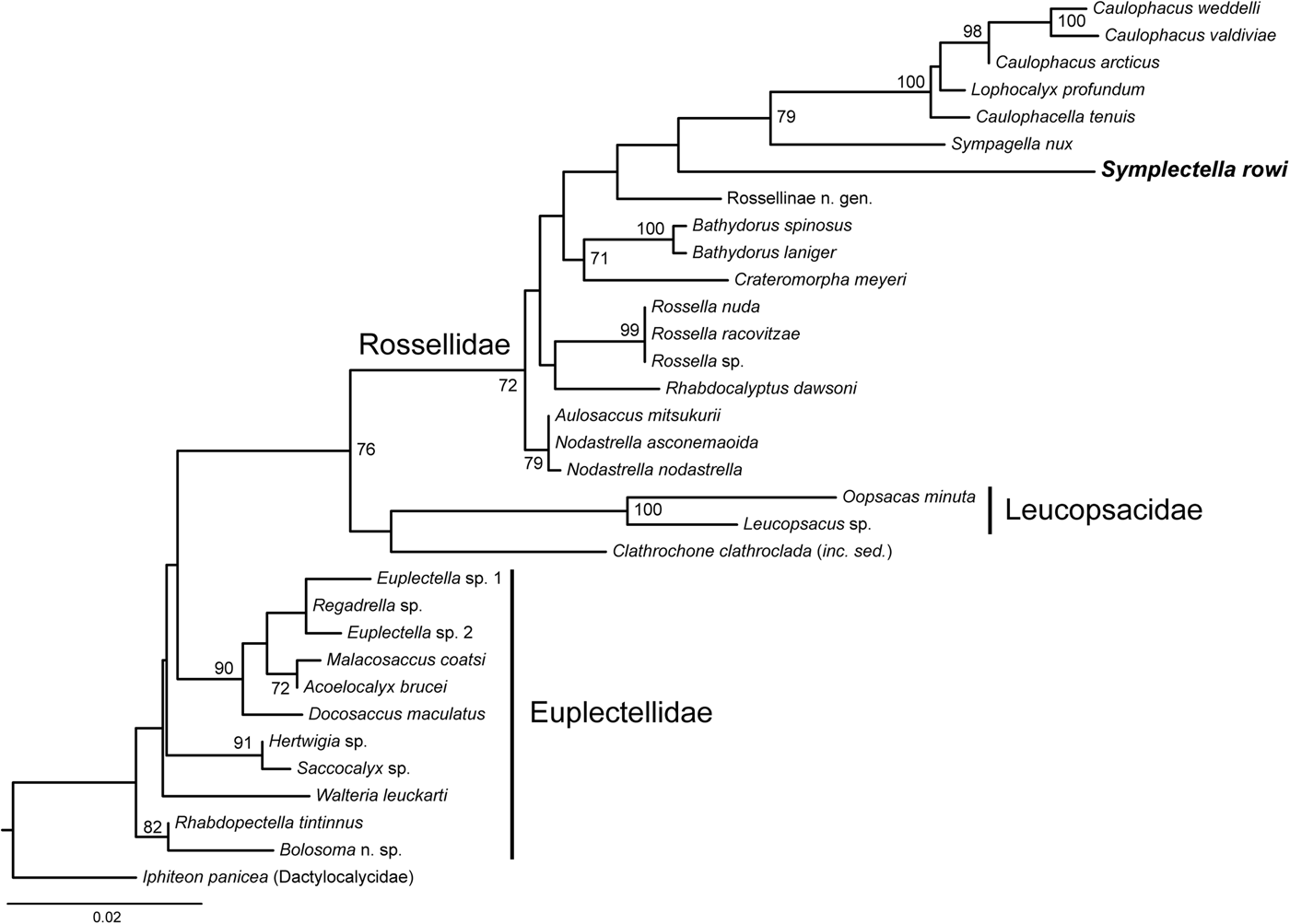
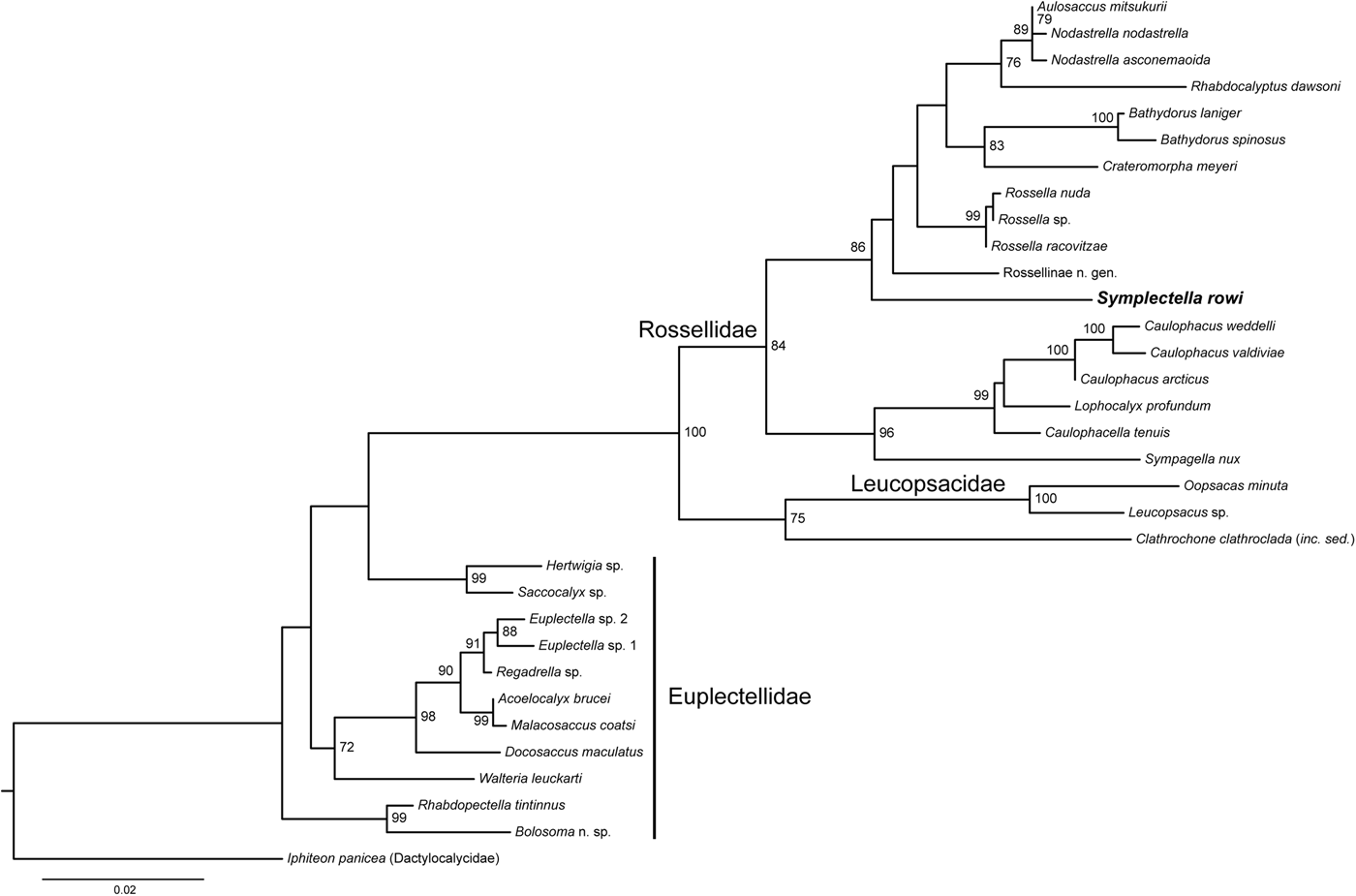
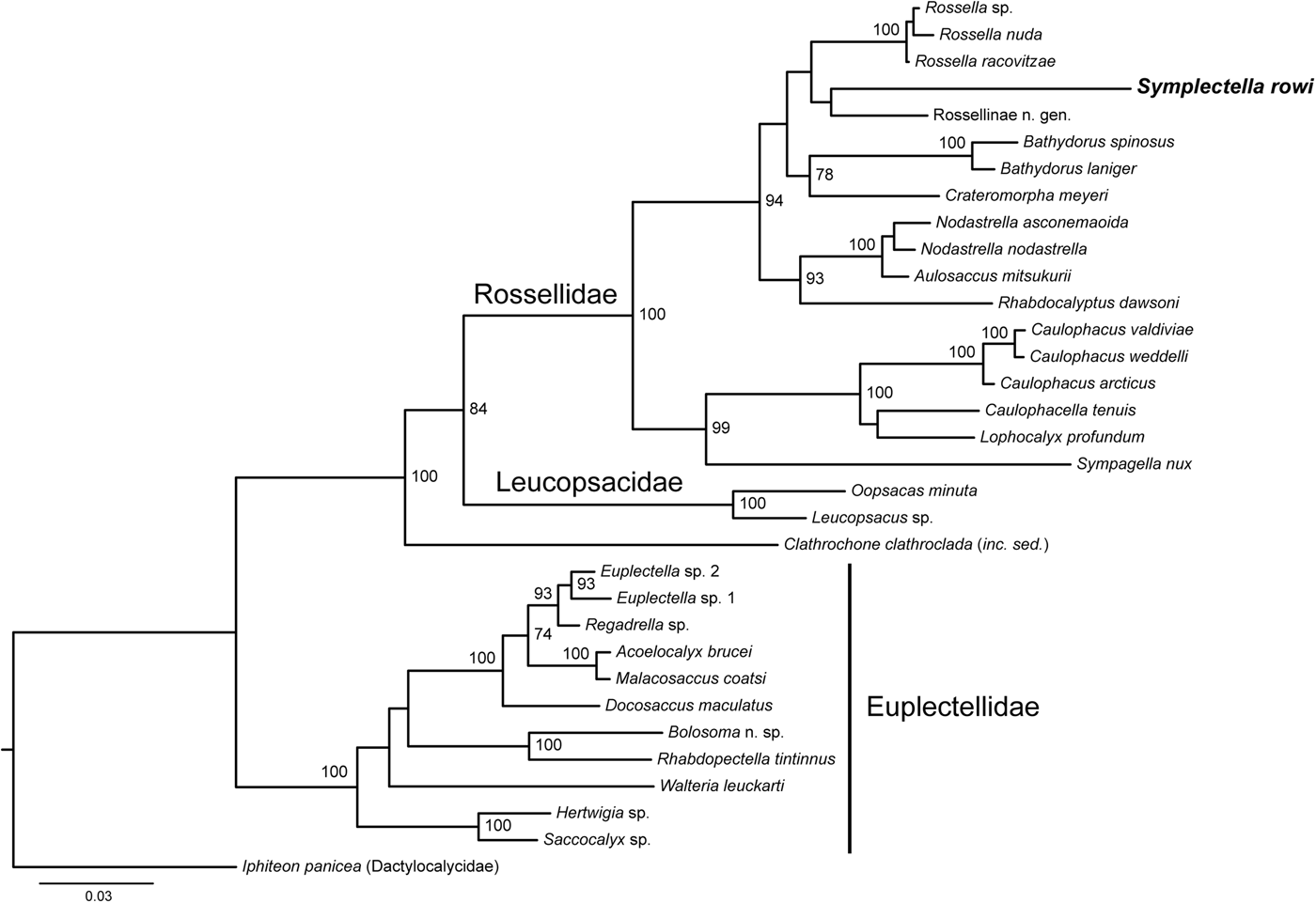
In the phylogeny reconstructed from the 16S rDNA alignment (Figure 1), neither Euplectellidae nor Rossellidae is monophyletic. However, Symplectella nests within a well-supported clade (89% bootstrap support [BS]) that includes all rossellids as well as Leucopsacus + Oopsacas (Leucopsacidae) and Clathrochone (incertae sedis) to the exclusion of the euplectellids. In the 28S rDNA phylogeny (Figure 2), Euplectellidae is likewise paraphyletic but Rossellidae including Symplectella is reconstructed as a clade (72% BS). In the combined 16S + 28S rDNA phylogeny (Figure 3), this clade has 84% BS and the Rossellidae (including Symplectella) + Leucopsacidae + Clathrochone clade has maximal support (100% BS). Finally, in the phylogeny based on all four markers (Figure 4), Symplectella firmly nests within Rossellidae (100% BS), in a well-supported (94% BS) subclade containing most members of subfamily Rossellinae (except Caulophacus and Caulophacella, which group with the two sampled representatives of Lanuginellinae) and Rhabdocalyptus (Acanthascinae); Euplectellidae excluding Symplectella is supported as a clade by 100% BS.
Maximum-likelihood phylogeny of Lyssacinosida inferred from 16S rDNA alignment. Numbers at nodes are rapid-bootstrap support values obtained from 900 pseudoreplicates. Only values ≥70% are shown (cf. Hillis & Bull Reference Hillis and Bull1993). Scale bar indicates expected number of substitutions per site.

Maximum-likelihood phylogeny of Lyssacinosida inferred from 28S rDNA alignment. Numbers at nodes are rapid-bootstrap support values obtained from 1000 pseudoreplicates. Only values ≥70% are shown (cf. Hillis & Bull, Reference Hillis and Bull1993). Scale bar indicates expected number of substitutions per site.
Maximum-likelihood phylogeny of Lyssacinosida inferred from combined 16S + 28S rDNA alignments. Numbers at nodes are rapid-bootstrap support values obtained from 750 pseudoreplicates. Only values ≥70% are shown (cf. Hillis & Bull, Reference Hillis and Bull1993). Scale bar indicates expected number of substitutions per site.
Maximum-likelihood phylogeny of Lyssacinosida inferred from combined 18S + 28S + 16S rDNA + COI alignments. Numbers at nodes are rapid-bootstrap support values obtained from 250 pseudoreplicates. Only values ≥70% are shown (cf. Hillis & Bull, Reference Hillis and Bull1993). Scale bar indicates expected number of substitutions per site.
DISCUSSION
Two different hypotheses for the family assignment of the monospecific glass sponge genus Symplectella have been proposed in the literature: in Rossellidae (Dendy, Reference Dendy1924) and in Euplectellidae (Tabachnick, Reference Tabachnick, Hooper and Van Soest2002a). The molecular phylogenetic analyses presented here clearly support the original hypothesis of Dendy (Reference Dendy1924). Morphologically, there are no strong characters in support of Tabachnick's hypothesis (see Introduction). Thus, I here move Symplectella back to its original position in Rossellidae. This placement implies secondary loss of hypodermal pentactins and atrialia, as well as convergent evolution of a sieve plate in Symplectella, but the family diagnoses of Rossellidae and Euplectellidae (Tabachnick, Reference Tabachnick, Hooper and Van Soest2002a, Reference Tabachnick, Hooper and Van Soestb) are sufficiently vague such that no emendations are required. Because neither strobiloplumicomes (cf. Tabachnick, Reference Tabachnick, Hooper and Van Soest2002b) nor discoctasters (cf. Reiswig & Stone, Reference Reiswig and Stone2013) are known from Symplectella, it has to be assigned to subfamily Rossellinae (which is unfortunately an artificial taxon; see Dohrmann et al., Reference Dohrmann, Haen, Lavrov and Wörheide2012b). Although the sister genus of Symplectella could not be determined here with confidence, likely candidates are Rossella, Nodastrella or Caulophacus, as in these taxa calycocomes also occur (see Dohrmann et al., Reference Dohrmann, Göcke, Reed and Janussen2012a). However, Nodastrella and Caulophacus appear to be firmly nested in well-supported clades with other genera (Figure 4), leaving only Rossella as a good candidate for the closest relative of Symplectella, a hypothesis that awaits to be tested with additional data.
ACKNOWLEDGEMENTS
I thank Allen G. Collins for hosting me at NMNH, the NMNH collection staff for providing access to the NCI collection, and the National Cancer Institute and David J. Newman for allowing the NCI natural product voucher to be used for taxonomic purposes, which was arranged within the framework of the National Science Foundation (NSF)-funded Porifera Tree of Life project. I further thank Gert Wörheide for access to computational resources at LMU and two anonymous reviewers for comments on the manuscript.
FINANCIAL SUPPORT
This research was supported by a Smithsonian Institution Postdoctoral Fellowship and grant DO 1742/1-1 of the Deutsche Forschungsgemeinschaft (DFG).