

1. Introduction
With an estimated death toll of almost 10 million people worldwide, cancer is among the leading causes of death (Sung et al., Reference Sung, Ferlay, Siegel, Laversanne, Soejomataram, Jemal and Bray2021). Both genetic and environmental factors contribute to the development of cancer, but evidence from twin studies (Ahlbom et al., Reference Ahlbom, P. Lichtenstein, Feychting and Pedersen1997; Lichtenstein et al., Reference Lichtenstein, Holm, Verkasalo, Iliadou, Kaprio, Koskenvuo, Pukkala, Skytthe and Hemminki2000) suggests that genetic factors are minor contributors to most types of tumors, while lifestyle and environmental factors play a major role in causing cancer (Perera, Reference Perera1997). Exposure to hazardous substances via food, water, air, and dermal contact is one of these factors. Although the contribution from industrial chemicals, air pollutants, and other toxic substances to cancer is difficult to quantify, existing estimates are in the range of 5–15 % (Madia et al., Reference Madia, Worth, Whelan and Corvi2019).
Many substances can cause cancer in multiple organs. Hexavalent chromium compounds, for example, may cause both lung cancer and cancer of the small intestine depending on their particle size (Thompson et al., Reference Thompson, Haws, Harris and Proctor2011). Arsenic, a common pollutant in drinking water, increases the risk of malignant tumors of bladder, lungs, kidneys, and liver (Palma-Lara et al., Reference Palma-Lara, Martínez-Castillo, Quintana-Pérez, Arellano-Mendoza, Tamay-Cach, Valenzuela-Limon, Garcia-Montalvo and Hernandez-Zavala2020). Exposure to per- and poly-fluoroalkyl substances has been linked to testicular cancer as well as kidney cancer (Steenland & Winquist, Reference Steenland and Winquist2020). The resulting cancer diseases are not equal as incidence and survival rates vary widely by age, gender, and across cancer types (Sung et al., Reference Sung, Ferlay, Siegel, Laversanne, Soejomataram, Jemal and Bray2021). This variability raises several challenges for policy analysts that seek to quantify the benefits of reductions in cancer risks associated with proposed or existing environmental or product safety regulations.
This matter is further complicated by the fact that some such analyses assess the lifetime excess cancer cases avoided by the regulations, and others the prevented cancer deaths. In theory, it is straightforward to convert the Value per Statistical Case of Cancer (VSCC)—the appropriate metric to monetize the benefits of cancer risk reductions—into a cancer Value per Statistical Life (VSL) to evaluate prevented cancer deaths, as the latter is simply equal to the former, divided by the conditional probability of dying from cancer (Alberini & Ščasný, Reference Alberini and Ščasný2018, Reference Alberini and Ščasný2021). In practice, however, this calculation becomes problematic when a regulation addresses substances that cause different types of cancer and/or cancer in different organs (perhaps as a result of different exposure pathways) and with different survival prospects: What if the VSCC itself depends on the survival prospects?
This question is the primary motivation of this paper. Since evidence from previous research that contrasts different illness types is mixed,Footnote 1 we ask whether a unique VSCC or cancer VSL applies to cancer diseases with very different survival prospects. Intuitively, reducing the risk of more severe cancers should be worth more than reducing the risk of less severe ones and, as cancer mortality is determined by both incidence and severity, the same conclusion might apply to more common cancers compared to rarer ones (Rheinberger et al., Reference Rheinberger, Herrera-Araujo and Hammitt2016).
Establishing whether one VSCC fits all is particularly important when examining the benefits of programs that either address multiple pollutants at the same time (e.g., through hazardous waste site remediation) or tackle one pollutant that may cause cancer in multiple organs. To this end, we first develop a theoretical model where, under general assumptions, the VSCC is shown to increase with (conditional) cancer mortality risk.
Since existing estimates of the VSCC (e.g., Gayer et al., Reference Gayer, Hamilton and Viscusi2000, Reference Gayer, Hamilton and Viscusi2002; Davis, Reference Davis2004) do not allow us to test the predictions from this theoretical model, we turn to a stated preference study where the conditional mortality risk is varied across two groups of subjects. We explore if, and by how much, the VSCC inferred from our subjects’ responses increases with the conditional mortality risk. Our online survey on cancer risk reductions was administered to samples from the adult population in the Czech Republic in 2019. Specifically, we deploy a split-sample approach, where half of the respondents report information about their willingness to pay (WTP) for reductions in the risk of developing cancer with 5-year survival chances that were 15 % larger than those received by the other half of respondents.
Our study design follows a WTP elicitation method that has proven to be robust in previous studies (Alberini & Ščasný, Reference Alberini and Ščasný2018, Reference Alberini and Ščasný2021).Footnote 2 A key difference with respect to other stated preference studies in the health risk literature (e.g., Hammitt & Haninger, Reference Hammitt and Haninger2010; Viscusi et al., Reference Viscusi, Huber and Bell2014; Bosworth et al., Reference Bosworth, Cameron and DeShazo2015; Jin et al., Reference Jin, Andersson and Zhang2020) is that the cancer risk reductions offered to respondents are described by two probabilities—that of developing cancer and that of dying from cancer conditional on developing it in the first place. In more abstract terms, we conceive of cancer as a compound lottery in which the first draw decides whether one gets the disease, and the second decides whether one survives (Rheinberger et al., Reference Rheinberger, Herrera-Araujo and Hammitt2016). This design allows us to estimate both the VSCC, that is, the WTP for a marginal reduction in the cancer incidence rate, and the cancer VSL, that is, the WTP for a marginal reduction in the unconditional risk of dying from cancer.
Survey respondents were asked to indicate whether they would stay with a specified risk of cancer and a specified chance of 5-year survival, or reduce the former at a cost. The 5-year survival rate was 60 % for one half of the respondents and 75 % for the other. The cancer risk reductions varied across and within respondents, as each respondent faced three dichotomous-choice questions constructed in this fashion. We find that the WTP is strictly proportional to the size of the resulting unconditional cancer mortality risk reduction, implying a constant cancer VSL. As predicted by theory, the VSCC is lower when the chance of surviving cancer is higher and exhibits proportionality to the conditional cancer mortality. Moreover, it increases significantly with the respondent’s income.
Impact assessments carried out in support of proposed hazardous substance regulations sometimes predict the total number of cases of cancer that would be avoided by restricting or prohibiting the use of certain substances or by removing them from the environment—without distinguishing between different types of cancer. Our results suggest that, when such assessments do distinguish for the type of cancer, the public’s valuation of the benefits of such regulations takes into account, at a minimum, the survival chance of each specific type of cancer.
The remainder of our paper is structured as follows. Section 2 provides theoretical background. Section 3 describes the design of our study, section 4 the empirical model, and section 5 the data. Section 6 presents the results. Section 7 concludes.
2. Theoretical background
While the VSL is generally defined as the WTP for a marginal change in one’s risk of dying from any cause (Schelling, Reference Schelling and Chase1968), it is possible to derive two metrics that are more specific to cancer (or other serious diseases). The first is the cancer VSL, that is, the WTP for a marginal change in one’s unconditional risk of dying from cancer; the second, the VSCC, is the WTP for a marginal change in one’s risk of developing cancer—a necessary precursor to dying of cancer. Both the cancer VSL and the VSCC are useful ex ante measures of the benefits of health and safety regulations, as they can be applied to value reductions in exposure to a variety of pollutants and other toxic substances.
However, in many cases such regulations protect against either exposure to different chemicals (giving rise to so-called mixture toxicity) or different exposure modes (e.g., respiratory and dermal exposure to a toxic substance). Therefore, it is often impossible to predict in which organ cancer will develop. From a policy perspective, it is important to account for differences in incidence and survival rates of various cancers, as this will often be the key determinant of a regulation’s benefits (Cropper et al., Reference Cropper, Hammitt and Robinson2011). The question is thus whether different survival prospects should affect the rate at which people trade off income against reductions in the risk of developing cancer.
In this section, we present a simple theoretical model to examine this question. Formally, we define the cancer VSL as the rate at which one is prepared to trade off income
 $ y $
for reductions in the risk of dying from cancer
 $ m $
. To account for the fact that people may die from other causes than cancer (Eeckhoudt & Hammitt, Reference Eeckhoudt and Hammitt2001), we use
 $ \theta $
to denote the risk of dying from a competing risk. Individuals will develop cancer with probability
 $ p $
and, if they do develop cancer, they will have a conditional probability
 $ q $
of dying from it. The unconditional probability of dying from cancer is thus given by
 $ m= pq $
.Footnote
3
As in Alberini and Ščasný (Reference Alberini and Ščasný2021), we assume that the utility of income in the healthy state is
 $ U(y) $
, the utility of income when the individual has or has had cancer but is alive is
 $ V(y) $
, the utility of income when dying from cancer is
 $ W(y) $
, and that when dying from any other cause is
 $ G(y) $
. Combining these assumptions yields the following expression for expected utility:
 $$ \mathrm{EU}=\left(1-\unicode{x03B8} \right)\left(1-\mathrm{p}\right)\mathrm{U}\left(\mathrm{y}\right)+\left(1-\unicode{x03B8} \right)\mathrm{p}\left(1-\mathrm{q}\right)\mathrm{V}\left(\mathrm{y}\right)+\left(1-\unicode{x03B8} \right)\mathrm{p}\mathrm{qW}\left(\mathrm{y}\right)+\unicode{x03B8} \mathrm{G}\left(\mathrm{y}\right). $$
If we normalize the bequest utility, that is, the utility of income when dead, to zero (Rosen, Reference Rosen1988), we have W(y)=G(y)=0. It then becomes straightforward to derive the cancer VSL as:
 $$ {\mathrm{V}\mathrm{SL}}_C\equiv \frac{\mathrm{dy}}{\mathrm{dm}}={\mathrm{q}}^{-1}\frac{\mathrm{U}\left(\mathrm{y}\right)-\left(1-\mathrm{q}\right)\mathrm{V}\left(\mathrm{y}\right)}{\left(1-\mathrm{p}\right){\mathrm{U}}^{\prime}\left(\mathrm{y}\right)+\mathrm{p}\left(1-\mathrm{q}\right){\mathrm{V}}^{\prime}\left(\mathrm{y}\right)}. $$
The second term in the right-hand side of Eq. (2) is the usual utility differential between the healthy and the sick state, divided by the expected marginal utility of income.Footnote 4 Eq. (2) shows that this term gets scaled by the inverse of the risk of dying when sick.
On differentiating Eq. (1) with respect to the probability of developing cancer, we obtain a formal definition of the VSCC:
 $$ \mathrm{VSCC}\equiv \frac{\mathrm{dy}}{\mathrm{dp}}=\frac{\mathrm{U}\left(\mathrm{y}\right)-\left(1-\mathrm{q}\right)\mathrm{V}\left(\mathrm{y}\right)}{\left(1-\mathrm{p}\right){\mathrm{U}}^{\prime}\left(\mathrm{y}\right)+\mathrm{p}\left(1-\mathrm{q}\right){\mathrm{V}}^{\prime}\left(\mathrm{y}\right)}. $$
Eq. (3) clarifies the proportional relationship between the cancer VSL and the VSCC—the former is equal to the latter divided by the conditional probability of dying from cancer.
Based on these definitions, we ask whether differences in the survival prospects of cancer affect the two cancer metrics. On taking the partial derivative of the cancer VSL and VSCC with respect to the conditional probability of dying from cancer, we obtain
 $$ \frac{\mathrm{\partial VS}{\mathrm{L}}_C}{\mathrm{\partial q}}=\frac{-{\mathrm{q}}^{-2}\left(\mathrm{U}\left(\mathrm{y}\right)-\mathrm{V}\left(\mathrm{y}\right)\right)\left[\left(1-\mathrm{p}\right){\mathrm{U}}^{\prime}\left(\mathrm{y}\right)+\mathrm{p}\left(1-\mathrm{q}\right){\mathrm{V}}^{\prime}\left(\mathrm{y}\right)\right]+\mathrm{p}{\mathrm{V}}^{\prime}\left(\mathrm{y}\right)\left[\left(\mathrm{U}\left(\mathrm{y}\right)-\mathrm{V}\left(\mathrm{y}\right)\right)+\mathrm{qV}\left(\mathrm{y}\right)\right]}{{\left[\left(1-\mathrm{p}\right){\mathrm{U}}^{\prime}\left(\mathrm{y}\right)+\mathrm{p}\left(1-\mathrm{q}\right){\mathrm{V}}^{\prime}\left(\mathrm{y}\right)\right]}^2}, $$
 $$ \frac{\partial \mathrm{VSCC}}{\mathrm{\partial q}}=\frac{\mathrm{V}\left(\mathrm{y}\right)\left[\left(1-\mathrm{p}\right){\mathrm{U}}^{\prime}\left(\mathrm{y}\right)+\mathrm{p}\left(1-\mathrm{q}\right){\mathrm{V}}^{\prime}\left(\mathrm{y}\right)\right]+\mathrm{p}{\mathrm{V}}^{\prime}\left(\mathrm{y}\right)\left[\left(\mathrm{U}\left(\mathrm{y}\right)-\mathrm{V}\left(\mathrm{y}\right)\right)+\mathrm{qV}\left(\mathrm{y}\right)\right]}{{\left[\left(1-\mathrm{p}\right){\mathrm{U}}^{\prime}\left(\mathrm{y}\right)+\mathrm{p}\left(1-\mathrm{q}\right){\mathrm{V}}^{\prime}\left(\mathrm{y}\right)\right]}^2}. $$
From Eqs. (4 a) and (4 b) one sees immediately that
 $ \partial VSCC/\partial q $
is strictly positive, whereas
 $ \partial VS{L}_C/\partial q $
cannot be unambiguously signed. We empirically test these predictions by developing a survey instrument that elicits information about the WTP for various reductions in the risk of developing cancer. The questionnaire is administered to two independent samples of individuals. One sample was told that the chance of 5-year survival since the diagnosis is 60 %, which is the average survival chance in Western countries across all types of cancers for people aged 45–60; the other was told that it is 75 %, roughly corresponding to the 5-year survival chance for kidney cancer patients.Footnote
5
If our theoretical predictions hold, we should obtain a lower VSCC for the setting that resembles kidney cancer—assuming that the expected utility model is a reasonable approximation of people’s preferences and that they are capable of processing probabilities correctly. How much larger is an empirical question, which we seek to answer below. We also seek to answer the question whether the cancer VSL held by the two samples differs from each other, and, if so, by how much.
3. Study design
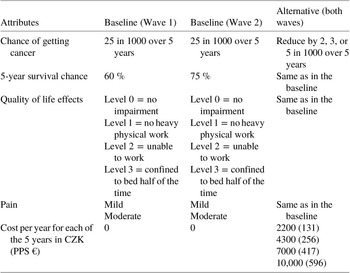
In our survey questionnaire, respondents were asked to indicate whether they would pay a specified amount of money to reduce the risk of developing cancer from its current level (25 in 1000 over 5 years, which is equivalent to 5 in 1000 per year). While this baseline risk was the same for all respondents, the risk reductions varied across and within respondents, as each respondent was asked a total of three valuation questions. The risk reductions were randomly selected out of an array comprised of 2, 3, and 4 in 1000 over 5 years.
The questionnaire informed the respondents about the survival rate at 5 years from diagnosis. Specifically, we told respondents in Wave 1 that the 5-year survival rate was 60 %, for an annual mortality rate of 0.097 (9.7 %). In Wave 2, which was conducted 3 months later and with different subjects, the 5-year survival rate was 75 %, which implies an annual mortality rate of 0.056 (5.6 %). Clearly, respondents in Wave 2 were asked to consider less fatal cancers, although they saw the same combinations of side effects and other cancer descriptors as the respondents in Wave 1. In both waves, the respondents were told the 5-year survival rate, but we did not present the corresponding annual mortality rate to them. The study design is summarized in Table 1.
Summary of the survey design.

Since the unconditional chance of dying from cancer is the product of the risk of developing cancer and the conditional chance of dying from it, a reduction in either of these risks implies a reduction in the unconditional chance of dying from cancer. Holding conditional mortality constant, a larger reduction in the risk of developing cancer therefore means a larger unconditional mortality risk reduction. To illustrate, the baseline cancer risk was 25 in 1000 over 5 years for each respondent. When multiplied by 0.097 (the annual mortality rate assigned to all respondents in Wave 1), this yields an absolute cancer mortality risk of 48.6 in 100,000 per year. If the risk of cancer were reduced by 5 in 1000 over 5 years (which is equivalent to 1 in 1000 per year), then the reduction in unconditional mortality risk would be 9.7 in 100,000 per year. Similarly, when multiplied by 0.056 (the annual mortality rate assigned to all respondents in Wave 2), the baseline cancer mortality risk would be equal to 28.0 in 100,000 per year and the mortality risk reduction following from a 1 in 1000 reduction in annual cancer risk would be 5.6 in 100,000 per year.
We did not present the above calculations to the respondents but, effectively, the subjects in the two waves combined were asked to consider a total of six hypothetical reductions in unconditional cancer mortality risk, ranging from 2.24*10-5 to 9.71*10-5 per year. Table 2 provides a summary of the risk variations in both waves. Moreover, we did not mention which organ would be affected by cancer, but we did describe the cancer disease in terms of its impact on quality of life during and after treatment (from perfectly normal life to being confined to bed half of the time) and pain (mild or moderate). We varied quality-of-life impacts and pain—if one gets cancer—from one valuation question to the next, but not within a valuation question. In other words, respondents could reduce their risk of developing cancer (and of experiencing the described consequences), but they could not “buy” a change in the severity of these consequences.Footnote 6
Risk variations in Wave 1 and Wave 2.

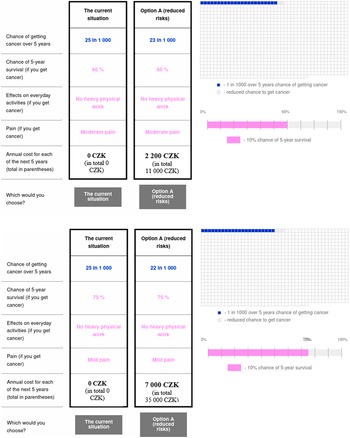
In sum, respondents received three dichotomous choice WTP questions. Each question asked whether they would choose to pay a specified sum to reduce their risk of getting some form of cancer that would be accompanied by certain impacts on quality of life and pain. The cancer risk reduction and the cancer severity (as measured by impacts on quality of life and pain) varied from one WTP question to the next, and across respondents. The 5-year survival chance was held constant within a questionnaire but varied across the two samples of respondents. Figure 1 shows a sample choice card for each of the two waves.
Sample choice card from Wave 1 (top) and Wave 2 (bottom).

4. Econometric model
The responses to the choice questions can be used to estimate the WTP for either the cancer risk reduction or the mortality risk reduction implied by it and derive the two key metrics for benefit-cost analysis—the VSCC and the cancer VSL.Footnote 7 We assume that the responses to the WTP questions are driven by the respondent’s true WTP, which we denote as WTP*, which remains unobserved because our questionnaire does not ask respondents to report exact WTP amounts (more on this below). We assume that this unobserved WTP* for the risk-reducing alternative depends on the magnitude of the risk reduction as follows:
 $$ {\mathrm{WTP}}_{\mathrm{ij}}^{\ast }=\exp \left(\unicode{x03B1} \right)\ast {\left({\Delta \mathrm{R}}_{\mathrm{ij}}\right)}^{\unicode{x03B3}}\ast \exp \left({\unicode{x025B}}_{\mathrm{ij}}\right), $$
where
 $ \Delta R $
denotes the reduction in either the risk of developing cancer stated in that alternative (e.g., 1 in 1000 per year) or the unconditional mortality risk implied by that alternative (e.g., 9.71*10-5), and
 $ \varepsilon $
is a normally distributed error term with mean zero and variance
 $ {\sigma}^2 $
.
On taking logs, Eq. (5) becomes:
 $$ \log \left({\mathrm{WTP}}_{\mathrm{ij}}^{\ast}\right)=\unicode{x03B1} +\unicode{x03B3}\ \mathrm{log}\left({\Delta \mathrm{R}}_{\mathrm{ij}}\right)+{\unicode{x025B}}_{\mathrm{ij}}. $$
The sign and magnitude of
 $ \gamma $
are of particular interest. At a minimum,
 $ \gamma $
should be positive and significant, as one would expect the WTP to be greater for a larger risk reduction. If
 $ \gamma $
is equal to one, this means that the WTP is perfectly proportional to the size of the risk reduction (Corso et al., Reference Corso, Hammitt and Graham2001), implying a single cancer VSL (if
 $ \Delta R $
stands for the unconditional mortality risk reduction) or a single VSCC (if
 $ \Delta R $
denotes the reduction in the risk of developing cancer) equal to exp(
 $ \alpha $
).
If we pool the data obtained from both waves, Eq. (6) needs to be amended to:
 $$ \log \left({\mathrm{WTP}}_{\mathrm{i}\mathrm{j}}^{\ast}\right)=\unicode{x03B1} +\unicode{x03B3}\ \mathrm{log}\left({\Delta \mathrm{R}}_{\mathrm{i}\mathrm{j}}\right)+\unicode{x03B4} {\mathrm{D}}_{\mathrm{i}}+{\unicode{x025B}}_{\mathrm{i}\mathrm{j}}, $$
where
 $ {D}_i $
is a dummy that takes on a value of 1, if subject
 $ i $
is assigned the higher survival chance. Our theoretical model suggests that
 $ \delta $
should be negative when WTP* is the WTP to reduce the risk of getting cancer (in which case
 $ \Delta R $
denotes the change in the chance of getting cancer), as we expect the VSCC to be larger, the smaller the baseline survival chance is. Our model does not offer an unambiguous prediction for the sign of
 $ \delta $
when WTP* is the WTP to reduce unconditional mortality risk (in which case
 $ \Delta R $
is the reduction in the unconditional mortality risk).
As mentioned, we do not observe the respondent’s exact WTP* for a specified risk reduction. All we can infer from the responses to the WTP questions is whether the latent WTP* amount is greater than the cost of the risk-reducing alternative—if the respondent chooses that alternative—or otherwise. This results in a binary choice model that describes the probability of selecting the risk-reducing alternative as a function of the magnitude of its risk reduction and cost:
 $$ {\displaystyle \begin{array}{l}\Pr\;\left(\mathrm{i}\;\mathrm{chooses}\;\mathrm{j}\right)=\Pr\;\left({\mathrm{WTP}}_{\mathrm{ij}}^{\ast}\ge {\mathrm{C}}_{\mathrm{ij}}\right)=\Pr\;\left(\log \hskip0.24em \left({\mathrm{WTP}}_{\mathrm{ij}}^{\ast}\right)\ge \log\;\left({\mathrm{C}}_{\mathrm{ij}}\right)\right)\\ {}\hskip9.3em =\Phi \left(\mathrm{a}+\mathrm{b}\;\log\;\left({\Delta \mathrm{R}}_{\mathrm{ij}}\right)+\mathrm{c}\;\log\;\left({\mathrm{C}}_{\mathrm{ij}}\right)\right),\end{array}} $$
where
 $ \varPhi \left(\bullet \right) $
denotes the standard normal cdf,
 $ \mathrm{a}=\unicode{x03B1} /\unicode{x03C3} $
,
 $ \mathrm{b}=\unicode{x03B3} /\unicode{x03C3} $
, and
 $ \mathrm{c}=-1/\unicode{x03C3} $
.
This model is appropriate if one choice task is considered in isolation (or if the respondent only answers one WTP question) and results in a probit model that, for now, contains only one regressor in addition to the log of the risk reduction, namely the log of cost. The original parameter
 $ \alpha $
in Eq. (5) is recovered as the intercept from the probit model, divided by the negative of
 $ \hat{c} $
; similarly, the standard deviation of
 $ \varepsilon $
is obtained as (
 $ -1/\hat{c} $
). In our survey, however, each respondent answered three WTP questions and the corresponding error terms are likely to be correlated due to unobserved characteristics of the respondent or individual perceptions that affect each choice task. If we assume that the correlation between any two pairs of responses is the same, that is,
 $ E\left({\varepsilon}_{i1}\;{\varepsilon}_{i2}\right)=E\left({\varepsilon}_{i1}\;{\varepsilon}_{i3}\right)=E\left({\varepsilon}_{i2}\;{\varepsilon}_{i3}\right) $
, then the model becomes a random effects probit.
If we further constrain
 $ \gamma $
= 1, Eq. (7), which refers to the WTP for a cancer mortality risk reduction, simplifies to:
 $$ \log \left(\frac{{\mathrm{WTP}}_{\mathrm{ij}}^{\ast }}{{\Delta \mathrm{R}}_{\mathrm{ij}}}\right)\equiv \log \left(\mathrm{cancer}\;{\mathrm{VSL}}_{\mathrm{ij}}^{\ast}\right)=\unicode{x03B1} +{\unicode{x025B}}_{\mathrm{ij}}, $$
and
 $ \log \left({\mathrm{C}}_{\mathrm{ij}}/{\Delta \mathrm{R}}_{\mathrm{ij}}\right) $
, that is, the natural logarithm of the cost per unit of risk reduced, enters in its binary choice econometric counterpart. In its simplest variant, the binary choice model includes only the log cost per unit of risk reduced. In more complex variants,
 $ \alpha $
is replaced by a linear combination of variables denoting respondent sociodemographics and risk perceptions.
5. Data
The survey questionnaire was administered in two waves—in May and October 2019, respectively—to two samples selected to be representative for income and education of the population of the Czech Republic aged 45–60. Attention was restricted to persons aged 45–60 for two main reasons. First, our experience is that it is extremely difficult to get younger persons to focus on adverse health outcomes—especially mortality outcomes—in surveys. Second, their cancer risk is very low, as 9 out of 10 cancers are diagnosed in people 45 and older, which makes it challenging to represent it using the conventional risk communication graphs (Ancker et al., Reference Ancker, Senathirajah, Kukafka and Starren2006).
By contrast, among older people the chance of getting cancer increases sharply with age. Theory suggests that the WTP to reduce the risk should increase with the baseline risk (Pratt & Zeckhauser, Reference Pratt and Zeckhauser1996), an effect that may be partially or completely offset by the elderly’s shorter remaining life expectancy (Krupnick et al., Reference Krupnick, Alberini, Cropper, Simon, O’Brien, Goeree and Heintzelman2002; Krupnick, Reference Krupnick2007). To avoid having to disentangle these opposing effects, we limit the sample to 45-60-year-olds and we show the respondents the average risk of getting cancer in this age group.
The questionnaire was identical across the two waves in all respects but the survival prospect if one develops cancer. This prospect was 60 % at 5 years in Wave 1 and 75 % at 5 years in Wave 2, which correspond to 40 and 25 % 5-year mortality rates, respectively.
The valuation section of the questionnaire was preceded by (i) questions about the health status of the respondents (in SF-36 type of format), (ii) a simple probability tutorial, (iii) the cancer incidence rate and average 5-year survival rate, (iv) a short description of the possible effects of cancer on quality of life (including possible impacts on family life and mental health), and (v) measures that can reduce the chance of getting cancer and/or the chance of dying from it, such as regular health screenings (mammograms, pap smears, colonoscopies, etc.), a healthy diet and lifestyle, and environmental programs.
As previously mentioned, throughout the questionnaire we always referred to a generic cancer, without identifying the organ that might develop cancer or naming specific types of cancer. We felt that doing so would have interfered with the respondent’s comprehension of the probabilities and would have limited our ability to apply the results of our study to a broad range of cancer diseases. In the valuation questions, the impact of cancer on quality of life was described in terms of limitations to everyday activities (none; unable to do heavy physical work; unable to work; bedridden half of the time) and pain level (mild or moderate).
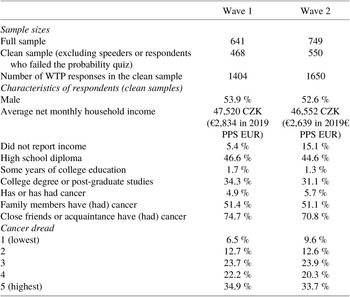
The respondents—all members of European National Panels (formerly known as Czech National Panel)—completed the questionnaire online.Footnote 8 After dropping “speeders” and respondents who failed a simple probability quiz, our final sample size is comprised of 468 completed questionnaires from Wave 1 (containing 1404 WTP responses) and 550 from Wave 2 (containing 1650 WTP responses), respectively. Descriptive statistics of the two samples are displayed in Table 3. They suggest that, after dropping speeders and persons who failed the probability quiz, the final samples were faithful to the sampling quotas and similar in terms of sociodemographics, as well as familiarity with and dread of cancer diseases.Footnote 9
Sample sizes and characteristics of the respondents.

A slight majority of the respondents were male. About one-third had a university degree and some 45 % had earned their high school diploma. More than half of the respondents reported that a family member had or had had cancer, and over 70 % knew of a friend or acquaintance that had or had had cancer. The level of cancer dread was similar across the two waves, with more than half of the respondents indicating that they had “high” or “very high” levels of cancer dread.
Comparison with the sociodemographics of the Czech population aged 45–60 (shown in Table A.1 in the Appendix) shows that our two samples are very similar to the population in terms of income. They were also somewhat more highly educated, and we had a slight overrepresentation of men.
6. Results
6.1 Basic checks
We start by examining the quality of the responses to the stated preference questions. Economic theory and common sense suggest that the share of respondents who choose the risk-reducing option should be increasing with the size of the risk reduction and decreasing with the cost of the option. This appears to be the case with our samples: 37.00 % of the respondents opt for the 2 in 1000 (in 5 years) cancer risk reduction, 43.97 % for the 3 in 1000 reduction, and 49.85 % for the 5 in 1000 reduction. Figure 2 shows that the percentage of the respondents who choose reducing the risk over the status quo decreases monotonically in the cost amount.
Percentage of the respondent who choose the risk-reducing option over the status quo, by cost amount.

Next, we fit random effect probit models where the latent dependent variable is log(WTP*), and the right-hand side includes logged cost and dummies for the size of the cancer risk reduction. This is the least restrictive specification, in that this model does not assume strict proportionality or any particular functional form of the relationship between the cancer risk reduction and the WTP. Whether we fit the model to Wave 1, Wave 2, or the pooled sample, all of the estimated coefficients have the expected signs and are statistically significant at the conventional levels.Footnote 10 We use them to compute the (median) WTP for the three cancer risk reductions. As shown in Table A.2, in all samples, the WTP increases monotonically with the size of the cancer risk reduction. Notably, for each given cancer risk reduction the WTP is lower in Wave 2 than in Wave 1, which is consistent with the predictions from the theoretical model (as the WTP is equal to the VSCC multiplied by the size of the risk reduction).
6.2 The cancer VSL
Turning to the cancer VSL, we first present the results of a random effects probit model where the latent variable is log(WTP*), which is regressed on the log of the reduction in the unconditional cancer mortality risk. We pool the data from the two waves. As shown in col. (A) of Table 4, the survey responses meet the usual expectations, in that respondents are more likely to choose the risk-reducing alternative when the mortality risk reduction is larger, and its cost is lower.
Cancer VSL estimation results from random effects probit models. The latent variable is the WTP for reducing the unconditional risk of dying from cancer. T statistics in parentheses.

Note: t-test of equality of the coefficients for log(ΔMORT) and -log(cost) is chi2 = 1.23 (p = 0.2668) for model (A) and chi2 = 1.33 (p = 0.2495) for model (B).
The coefficients on these variables imply that
 $ \gamma $
is not statistically different from one, which means that the WTP is strongly sensitive to scope.Footnote
11 The specifications in cols. (B) and (C) include a coefficient on the dummy for Wave 2, which is in both cases statistically insignificant. Taken together, these two results imply a single cancer VSL that holds for both waves. The model in col. (C) imposes the additional constraint that
 $ \gamma $
be equal to one and results in an estimate of the cancer VSL equal to €4.123 million (s.e. €762,085) (2019 PPS EUR).
This figure is consistent with recommendations for the EU ($3.7 million, 2005 USD) based on meta-analysis of stated preference studies conducted by OECD (Lindhjem et al., Reference Lindhjem, Navrud, Braathen and Biausque2011), as well as earlier stated preference studies in the Czech Republic. In Alberini and Ščasný (Reference Alberini and Ščasný2013), for example, the cancer VSL is 30.9 million Czech crowns (CZK). Footnote 12 On adjusting this figure for the income of the 2019 samples (using an income elasticity of one), we obtain €3.4 million (2019 PPS EUR).
Even after adjusting for the currency and year of the study, our cancer VSL estimate is substantially lower than the value of $6.03 million predicted for the Czech Republic in Viscusi (Reference Viscusi2020), where a VSL value for the US based on compensating wage studies is transferred to other countries assuming a unit income elasticity.Footnote 13 It is also half to one-third of the VSL values (€9–13 million, 2019 PPS EUR) inferred from labor market studies conducted in the Czech Republic (Ščasný and Urban, Reference Ščasný, Urban, Ščasný, Kohlová and Markéta2008; Melichar et al., Reference Melichar, Š. and Urban2010), although it should be noted that one of these two studies used subjective risks as reported by the workers and resulted in a VSL of €4.25 million (2019 PPS EUR).
6.3 The VSCC
Cols. (A) and (B) of Table 5 are similar to cols. (A) and (B) in Table 4, except that this time we relate the WTP to the size of the cancer risk reduction, instead of the cancer (unconditional) mortality risk reduction. The results suggest that the WTP is reasonably proportional to the size of the risk reduction (
 $ \gamma \approx 1 $
), but this time the Wave 2 dummy has a negative and strongly significant coefficient
 $ \delta $
. Again, col. (C) imposes proportionality, keeps the Wave 2 dummy, and predicts a VSCC of €400,000 (s.e. €74,013) for Wave 1, and a VSCC of €229,000 (s.e. €42,091) for Wave 2 (both in 2019 PPS EUR). In cols. (D) and (E), we separate the samples but retain the constraint that
 $ \gamma =1 $
, arriving at very similar VSCC estimates of €413,000 (s.e. €68,499) and €208,000 (s.e. €46,484), respectively (in 2019 PPS EUR).
VSCC estimation results from random effects probit models. The latent variable is the WTP for reducing the risk of developing cancer. T statistics in parentheses.

Note: t-test of equality of the coefficients for log(ΔMORT) and -log(cost) is chi2 = 1.32 (p = 0.2502) for model (A) and chi2 = 1.33 (p = 0.2495) for model (B).
Notice that the ratio between the VSCC estimates for Waves 1 and 2 is close to the ratio between the baseline risk reductions presented in the two survey variants. To see this, recall that the annual conditional cancer mortality risks are
 $ {q}_{W1} $
= 0.097 and
 $ {q}_{W2} $
= 0.056, respectively. The ratio between these two baseline risks is thus
 $ {q}_{W1}/{q}_{W2} $
= 1.74, whereas the ratio between the two VSCC values ranges between 1.75 and 1.99, depending on the model specification. This is in the ballpark of what one would expect from theory and suggests that our respondents paid due attention to both dimensions of cancer risk.
The specifications reported in Table 6 are variants of col. (C) of Table 5. They refer to the underlying WTP for cancer risk reductions, impose the restriction that
 $ \gamma $
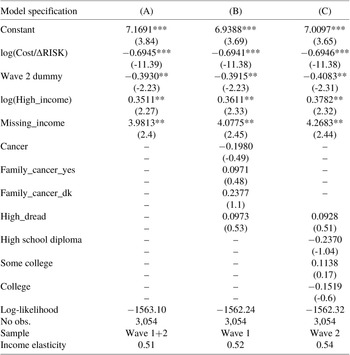
= 1, include the Wave 2 dummy, and further include, at a minimum, log household income (set to zero when missing) and a companion dummy denoting that the respondent did not report income. Income is an important determinant of the WTP. Specifically, model (A) in Table 6 produces an estimate of the income elasticity, when income is known, of the VSCC equal to 0.51 (s.e. 0.225). Respondents who chose not to report their household income appear to hold higher VSCC values.
Estimation results from random effects probit model with additional regressors. The latent variable is the WTP for reducing the risk of developing cancer. T statistics in parentheses.

In cols. (B) and (C), we added various dummies capturing whether the respondent has had cancer, whether family members have had cancer, whether he or she dreads cancer highly, education dummies, and whether the respondent believes that not smoking is an important behavior that avoids cancer (which could capture both concern about lung cancer and confidence that cancer can be controlled through behaviors and preventive actions). None was significantly associated with the WTP for the risk reductions. The income elasticity was consistently estimated between 0.51 and 0.56 across all specifications, and the coefficient on the Wave 2 dummy ranged between −0.39 and −0.43, indicating that the VSCC at higher survival is 65–68 % of the VSCC based on a lower survival chance.Footnote 14
7. Conclusions
We have developed a theoretical model that suggests that the VSCC increases with the risk of dying from cancer, conditional on getting cancer in the first place. The theoretical model does not unambiguously sign the effect of this conditional risk of dying from cancer on the cancer VSL.
We test these predictions with a dedicated survey where respondents were to report information about their WTP to reduce the risk of getting cancer. The conditional mortality rate was varied across two independent samples of subjects, allowing us to isolate the effect of lower (higher) survival chances on the WTP.
In addition to allowing us to test the predictions of the theoretical model, this study design offers another important advantage. Health risk valuation efforts must deal with the fact that it is extremely difficult to communicate probabilities to members of the general public. Earlier studies have detected that respondents confuse absolute and relative risks (Baron, Reference Baron1997), struggle with mathematically distinguishing between smaller and larger risks (Hammitt & Graham, Reference Hammitt and Graham1999), and tend to overstate small risks and understate larger ones (Kahneman, Reference Kahneman2003). By decomposing the unconditional cancer mortality risk into the probability of getting cancer and the probability of surviving cancer, and presenting respondents with both probabilities, we believe we helped people process probabilities. Indeed, we were able to collect survey responses driven by WTP amounts that are perfectly proportional to the size of the risk reduction and hence result in a single VSL figure, regardless of the size of the risk reduction offered to the respondent.
We find empirical evidence in support of the theoretical prediction that the VSCC decreases with increasing survival prospects. Indeed, we find that the VSCC reduces by 43–50 % if the baseline 5-year survival chance is raised from 60 to 75 %. As such an improvement corresponds to a 42 % reduction in the annual baseline mortality risk, these results seem entirely consistent with the proportional relationship between cancer VSL and VSCC suggested by our theoretical model.
We conclude that the assumption of a one-size-fits-all cancer VSL appears to be justified on both theoretical and empirical grounds, whereas a “generic” VSCC based on the average survival rates is not. Indeed, our experimental findings suggest that the VSCC increases in proportion to increases in baseline cancer mortality. A direct policy implication of this finding is that since the public’s valuation varies with at least one of the characteristics of the type of cancer(s) to be addressed by a regulation, a VSCC based on average survival chances is likely to overestimate the value of reducing less fatal cancers and underestimate the value of reducing more fatal cancers.
These considerations and suggestions should, as always, be interpreted with caution. In addition to varying the chance of survival across two groups of respondents, we varied other characteristics of the cancer within and across respondents. But these characteristics, namely the impact on quality of life experienced during and after treatment, and the level of pain did not seem to matter. This could have been due to the fact that our descriptions—developed with guidance from oncologists—did not resonate enough with our respondents or lost salience to them as they remained unchanged across the status quo and the risk-reducing alternative. It is also possible that the respondents commingled these measures of severity with the chance of survival and therefore paid no further attention to them.
Moreover, our study design only included two values of the chance of surviving cancer—the average one (60 %) and a higher one (75 %), which implies less fatal cancers. It seems reasonable to assume symmetry, namely that the VSCC should be higher for more fatal cancers, in proportion to this cancer’s conditional mortality rate relative to the average, but we have not yet had an opportunity to empirically test this conjecture. Should future research find experimental evidence in favor of it, policy analyses would be able to “scale” the average-survival VSCC upward or downward as needed, in proportion to the ratio of a cancer-specific conditional mortality rate to that of the average cancer.
Funding statement
The research presented in this paper received funding from the European Chemicals Agency (ECHA) under contract No. ECHA/2018/558. Ščasný gratefully acknowledges support from the Czech Science Foundation (grant no. 19-26812X) within the EXPRO Program. Secondments were supported from the European Union’s Horizon 2020 Research and Innovation Staff Exchange program under the Marie Sklodowska-Curie grant agreement No. 681228 (GEMCLIME-2020). The opinions reported in this paper are solely those of the authors and do not necessarily reflect official policies and opinions of the European Chemicals Agency.
Competing Interests
A.A. and M.Š. have no competing interests to declare. C.M.R. has informed the European Chemicals Agency of this journal submission and received approval.
Appendix
Comparison between the two samples and statistics for the population aged 45–60 in the Czech Republic. Averages for key sociodemographics.

WTP for each risk-reducing option (2019 PPS EUR). Standard errors in parentheses.