IntroductionFootnote 1
This article essentially argues that because of Angola’s historically uneven incorporation into the capitalist world economy, the country only partially fits the universal model of a progressive labor commodification.Footnote 2 In 1800, Angola was Africa’s main supplier of slaves to Atlantic markets, and within Angola slaves also formed the largest body of commodified workers. After the end of the Atlantic slave trade, slavery in Angola expanded as the Angolan economy commercialized under the impact of a new export trade in produce. But only part of this servile labor force was commodified, while another part worked under reciprocal relations. At the same time, a growing number of men, and some women, withdrew from subsistence production to participate in the new export economy. This was mainly done through self-employment, but also through wage labor, and often on short-term or seasonal basis only.
In the mid-twentieth century, a large part of Angola’s rural population worked and produced for the market; colonial policies aimed at self-sufficiency stimulated agricultural production. Wage labor – often cheap and sometimes obtained by force – was part of the story, but Angola’s colonial history was more remarkable for the fact that agricultural production was left to a large degree to independent African farmers. After independence in 1975, the market economy was increasingly limited to the urban areas, as decades of civil war destroyed the possibilities of commercial agriculture. Because of the war, people flocked en masse to the cities, and in the year 2000, more people lived in urban than in rural areas. Angola became primarily connected to the world economy through the oil industry, which supplies few jobs. Around this industry, a massive informal sector of petty traders has grown, further surrounded by a large pool of unemployed city dwellers. Wage labor has declined since independence, and has become increasingly tied to public sector employment. In the countryside, most peasant communities have been reduced to subsistence production.
Before exploring these issues in greater detail, this article begins with some brief remarks about the overall limited availability of empirical data for analyzing labor relations in Angola from 1800 to the present day. Next, it highlights some of the main demographic changes that have impacted labor relations over time – in particular the increasing ratio of young children under the age of ten in the population and twentieth-century urbanization. Section three discusses basic economic developments that have influenced the working lives of Angolan men and women, including slaves: the transition from an export slave trade to an export trade in commodities, the transformation of the latter under colonial rule, and the collapse of agricultural and industrial production after independence. The final two sections explain how these developments resulted in changes as well as continuities in labor relations in Angola. For lack of space and because of the current state of research in Angolan economic history, the evidence presented below is only occasionally based on in-depth description and remains far from conclusive. Therefore, instead of providing a definitive statement, this essay is perhaps best read as an outline for future study into the history of work in Angola.
Courtesy of the University of Texas Libraries, The University of Texas at Austin.
Map 1. Political map of Angola, 1990

Sources
Writing a history of labor relations in Africa over the longue durée on the basis of quantitative data is complicated by a dearth of primary source material.Footnote 3 Angola is no different from the rest of the continent in this regard, although the data for the pre-1900 period are in better shape than those of most African nations, mainly because of the country’s longer colonial history. In the eighteenth century, the Portuguese empire started counting its colonial populations. Consequently, it left behind an exceptional legacy of numerical data about Angola that can serve as an empirical foundation for analyzing labor relations at the 1800 benchmark. A number of surveys, produced between 1777 and 1820, provide information on the age and gender structure of the population as well as the number of slaves living in administrative domains (presídios) under nominal Portuguese control.Footnote 4 These surveys only included a small portion of the total population then living within the territorial boundaries of modern-day Angola. However, the age, sex, and slave ratios emerging from them have been used to create estimates of the total number of children, men, women, and slaves in Angola in 1800.
For 1900, the demographic data is richer, mainly because of the reports on “Native Affairs” that one diligent colonial official, José de Oliveira Ferreira Diniz, produced early in the twentieth century.Footnote 5 Diniz still lacked reliable census data. Nevertheless, his accounts provide relatively accurate indications of the age and gender structures of the total Angolan population and important data on the number of men and women enrolled in contract labor as well as the economic sectors in which these wage workers were employed. The Annuário estatístico dos domínios ultramarinos portuguesas, 1899 e 1900, an ambitious population survey carried out across the empire, supplies additional information on occupations held by Angolans in areas under colonial control.Footnote 6 However, because 1800 and 1900 remain poorly documented overall, most figures for these two benchmark years are estimates based on what the author thought historical reality looked like. Therefore, there is a risk that the argumentation in this article becomes circular, as it builds on the same assumptions used to create the data for explaining the outcomes. But the alternative to creating estimates based on scanty evidence, which is doing nothing, would mean excluding Africa from a comparative history along the lines of the Global Collaboratory, an unproductive strategy in my opinion.Footnote 7
The data for the 1950 cross-section have been drawn exclusively from the general census of 1960, which was the first complete population census carried out in Angola.Footnote 8 This census, which collected population data according to international standards of labor categorization, provides a comprehensive coverage of all the variables used by the Global Collaboratory. Consequently, the census data have been incorporated into the Collaboratory’s database without any changes, even though there are some flaws in the census, such as its low estimation of female gainful employment and its complete silence on the question of legalized forced labor (which was abolished in 1961).Footnote 9
The power to count is one of the capacities that post-colonial states in Africa have lost in relation to their subjects. Mainly because of perpetual warfare, Angola has not seen a general population census since the country’s independence. So for the 2000 cross-section, estimates of basic demographic indicators, occupations, and labor relations have been created using reports on socio-economic change from a number of international organizations, most importantly the United Nations Development Programme.Footnote 10
Demography
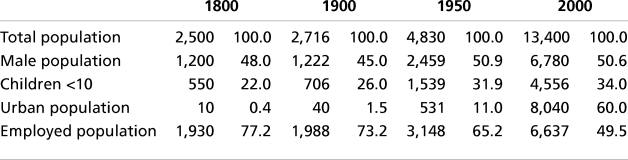
Before proceeding to the analysis of occupations and labor relations in Angola, a brief word is needed to explain some of the general demographic indicators that have shaped our calculations of how many people used to work, the kind of work they did, and the social relations under which they labored. As table 1 demonstrates, the population of Angola grew from roughly 2.5 million in 1800 to 2.7 million in 1900, after which it expanded rapidly to reach a size of 13.4 million in 2000. Within this population, the proportion of children younger than ten has increased over time. This has a major impact on the study of labor relations, as children under ten have been counted as inactive. Although in Africa and elsewhere, in the past as well as in the present, some children under the age of ten do work, we have followed the 1960 census in using this age limit to separate children who worked from those who did not. In doing so, it seems we are not excluding a significant segment of the active population from our calculations. Research conducted in Angola shortly after 2000 concluded that an estimated 20 percent of children aged 5–9 were working, while in the age group 10–14 it was 40 percent.Footnote 11 In addition to children under ten, people older than 75 make up another segment of the non-working population, but this group has always remained small. On the basis of the censuses conducted in 1950 and 1960, we may assume that in general the people older than 75 formed a mere 0.8 percent of the total population.Footnote 12 The long-term trend in Angola thus seems to be one of a growing juvenile population, and not one towards increased life expectancy beyond working age.
Population indicators, Angola 1800–2000 (in thousands and %)Footnote 13
Rapid urbanization in the twentieth century has been another important demographic factor in Angolan labor history. In 1800, only about 10,000 Angolans lived in cities, with Luanda and Benguela respectively counting 6,414 and 2,631 inhabitants in 1799.Footnote 14 In 1900, the urban population had grown to about 40,000 people, whose main economic activities lay in commerce. At the time, Angola counted nine cities or towns, though all except Luanda and Mossâmedes had fewer than 5,000 inhabitants.Footnote 15 By the mid-twentieth century, Angolan cities were expanding rapidly, a trend that has continued to the present under the impact of the civil war (1975–2002) and the resulting disintegration of the countryside. By the turn of the millennium, about 60 percent of the population was thought to live in urban areas, a number that included at least 1.5 million internally displaced persons.Footnote 16 Urbanization has been closely related to labor commodification, especially since a large part of the urban labor force has traditionally consisted of self-employed workers. This was the case in 1800 and 1900 – when Angola’s cities were still relatively small – perhaps less so in 1950, but again in 2000 with the explosion of an informal economy consisting mainly of petty traders.
In recent times, however, urban areas have been plagued by mass unemployment, which together with the growing juvenile population has greatly burdened the incomes of the economically active population.Footnote 17 In 2002, unemployment levels in Angola were estimated at 40 percent. However, they have gone down since, which suggests that unemployment was in part an effect of the civil war and the displacement of people due to the war.Footnote 18 Furthermore, official unemployment figures do not exist, and many of the so-called unemployed might also be seen as underemployed or as moving in and out of informal sector employment. But there can be little doubt that the segment of people with steady work rapidly declined towards the end of the twentieth century, accounting for only half the population in 2000.
Economic and Occupational Developments
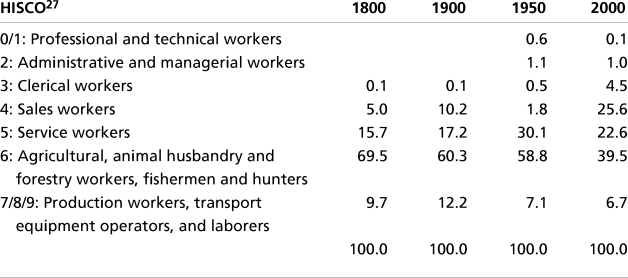
Table 2 shows changes in the relative importance of standard occupational categories between the four cross-sections.Footnote 19 The two most striking trends are the increasing employment of Angolans in commercial functions and the decline of the agricultural labor force between 1800 and 2000. Before the twentieth century, practically all Angolans lived in a rural setting. In the countryside, farming and, in some areas, cattle-herding determined the lifestyles of most people.Footnote 20 Generally, the household was the basic social unit around which most economic activities were organized. For lack of documentation, historians still know too little about household production in pre-colonial Angola. To determine who did what, we have followed John Thornton’s observation that in seventeenth-century Kongo, households on average consisted of five to six people and were centered on the marital union between husband and wife, who each contributed equally to the economic output of the family.Footnote 21 Most of the agricultural labor was performed by women, who also took care of domestic duties, such as cooking, cleaning, collecting water and firewood, and child-raising. Women typically spent the first half of the day, from sunrise to noon, working the fields. The other half of the day, they were home taking care of the household. Occasionally they went to local markets to trade foodstuffs and household utensils. Women also took part in riverine fishing, and devoted some time to pottery and the production of baskets and other gear.Footnote 22
Occupational groups in Angola, 1800–2000 (%)
Men in rural society devoted most of their time to tending tree crops, hunting and fishing, building and maintaining homes, and the production of cloth, agricultural tools, and weapons. Their agricultural duties were generally limited to clearing the land at the start of the rainy season. This gendered division of labor remained typical for much of the nineteenth century.Footnote 23 In 1800, a small segment of the male labor force was employed in commercial activities, in particular trading livestock, salt, iron, copper, pottery, ivory, and slaves. While long-distance trade in Angola was strongly developed at the time – with intricate ties to the Atlantic market – this commerce was often controlled by specialized trading groups, such as the Zombo and Soso in the north and the Cokwe from eastern Angola.Footnote 24 Within the colonial economy, African caravan traders were known as pumbeiros descalços, who were financed by Luanda-based merchants and obtained carriers from the administrators (capitães-mores) of Portuguese settlements in the interior.Footnote 25 Nevertheless, most Angolan men were excluded from such lucrative trading activities. Some communities near the coast, such as the Axiluanda on Luanda Island, specialized in commercial fishing. These groups organized their fishing activities on a family basis, although only men boarded their sea-faring canoes. Some of these fishermen were also recruited as sailors on Portuguese vessels. Other coastal communities were involved in salt production, an industry that was still important in the late colonial period.Footnote 26
In the second half of the nineteenth century, the market economy in Angola expanded. This initially happened under the impulse of a growth in ivory exports, but towards the end of the century, the commercialization of the economy was driven by a wide variety of products. In 1900, Angola exported 7,000 tons (kg) of coffee, 4,000 tons of palm kernels, 1,100 tons of palm oil, 2,400 tons of rubber, and 500 tons of wax. Including other important commodities – such as cotton, potato-gum or white rubber (almeidina), hides, gum copal, cudbear (urzela), and foodstuffs – the volume of Angolan exports reached over 15,000 tons.Footnote 28 This booming export economy not only affected Angolan households on the level of production, but also involved the labor of hundreds of thousands of carriers providing transport services. However, because most export commodities were produced, cultivated, or collected from the wild in Angola’s coastal hinterland, large parts of the interior remained unaffected by the expansion of the market economy. While there is a growing academic interest in the rise of commercial agriculture in Africa after abolition, it is important to remember that subsistence farming still remained the dominant economic activity for most African households in 1900.Footnote 29
In sum, the partial commercialization of the Angolan economy was reflected by the growing employment of Angolans in sales and transport activities (HISCO groups4 and 7/8/9). This occurred at the expense of male participation in the agricultural cycle (group 6) and in the production of tools and cloth (group 7/8/9), which, in turn, was partly offset by the growing imports of European manufactures.Footnote 30
Under colonial rule, Angolans lost control of the economy’s commercial sector to a small group of European trading firms. The withdrawal of Africans from the import and export trade was exacerbated by the modernization of transport after the First World War, as the introduction of the lorry made head-carrying rapidly redundant. In 1950, the larger part of the active population was still employed in agriculture.Footnote 31 Next to coffee, which accounted for a third of Angolan exports in 1950, maize and sisal were now cultivated as important export crops.Footnote 32 Most coffee was produced on Portuguese plantations in northern Angola by low-paid migrant workers recruited in the central highlands, while in 1942 an estimated 90,000 peasants were subjected to forced cotton cultivation in the Malanje district east of Luanda.Footnote 33 In spite of these blatant forms of colonial exploitation, associated with the coffee and cotton crops, Angolans maintained ownership of much of the agricultural land – except the most fertile lands, which had been alienated to white settlers.Footnote 34 Angolan peasants allocated and farmed this land in traditional ways, but now often for markets beyond the realm of subsistence. This economy of independent farmers made Angola practically self-sufficient in food crops, which included maize, manioc, beans, and rice.Footnote 35
Supported by a metropolitan policy of import-substitution, Angola also witnessed the development of construction-related industries – in particular that of cement – car and bus assembly plants, and a range of consumer industries, all of which produced mainly for the African market.Footnote 36 In terms of employment, however, the production sector was probably smaller than in 1900 and before. By contrast, the number of administrative, clerical, and service workers was slowly growing. Office jobs became more widely available – especially for male Portuguese immigrants – with the development of the colonial state and the resulting expansion of public sector employment. This trend continued after independence.
The civil war following decolonization pushed millions of Angolans from the countryside to urban areas, undermining – often literally – the viability of commercial agriculture and creating a massive informal sector of mostly retail traders.Footnote 37 The extraction of oil has increasingly dominated the Angolan economy at the expense of agriculture and manufacturing. In 2003, oil accounted for 48 percent of GDP, 94 percent of exports, and 77 percent of government revenue. But at most, 15,000 Angolans found salaried jobs in the oil industry, which has also provided few employment opportunities in ancillary laboring work.Footnote 38 As possibilities for marketing produce and keeping livestock were undermined by the effects of warfare, Angola’s rural population was mostly left to subsistence farming. In the 1990s, the central government – ruled by the MPLA (Movimento Popular de Libertação de Angola) – lost control over the eastern Lunda provinces to the opposition forces of UNITA (União Nacional para a Independência Total de Angola). Consequently, in this part of the country, the extraction of diamonds was taken over by thousands of informal sector artisanal miners (garimpeiros). Informal sector employment, especially in the retail business, has also become the fate of about half the urban population. At the same time, clerical work in public administration and within state companies has increased since independence, with the state assuming an ever more prominent role in the national economy. The informal economy has particularly affected women, who in 2002 held two-thirds of informal sector jobs, but only one-third of formal sector jobs; they occupied 40 percent of positions in the civil service, where they have usually been excluded from higher-ranked functions.Footnote 39
Labor Relations in 1800 and 1900
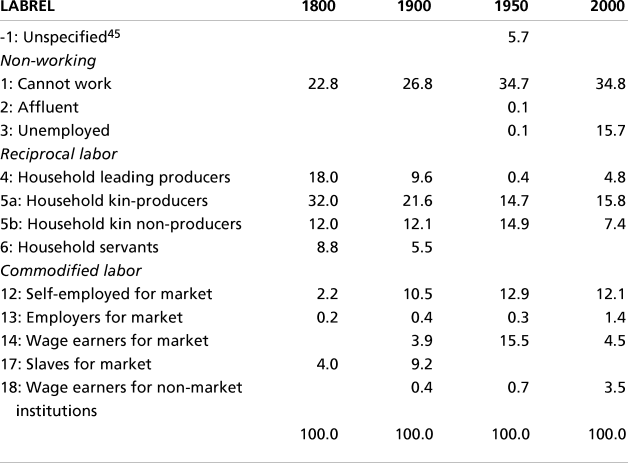
Table 3 indicates that in 1800 almost all of Angola’s working population, including slaves, labored in the reciprocal sphere. In other words, most families lived from subsistence agriculture – or agro-pastoralism in regions where cattle-herding was possible – a way of life that usually included small market transactions, as few communities were fully self-sustaining. But only a small number of Angolans worked or produced for the market. These tended to be household heads who employed themselves with some of their dependents in long-distance trading ventures or, if they lived close to Portuguese settlements, in the production of foodstuffs for the market. Some of these entrepreneurs were successful enough to employ several slaves for commercial purposes. But outside the colonial economy, slave labor in Angola was often not commodified. Instead, most slaves were integrated members of the communities they lived in, performing the same economic tasks as their free brothers and sisters. This requires some explanation.
Labor relations in Angola, 1800–2000 (%)
It has been argued that around 1600, presumably under the impact of a growing trade in high-value commodities, powerful “big men” had started the practice of extending their matrilineal households through the acquisition of slave women. These women became the foundation of dependent lineages that were attached to the founding free lineage of a community.Footnote 40 But how many Angolan families owned slaves? To how many slaves would an average village have been home before twentieth-century colonialism prohibited slavery in Angola? These are extremely difficult questions to answer. The descendants of purchased slaves rarely occupied a truly servile position in society; they often farmed and traded in ways similar to free community members. Moreover, most Angolan peasants did not enjoy the riches of Vansina’s “big men” and could only rely on the labor input of their wives and children. As several nineteenth-century travelers observed, at least in Kongo, one wife was the norm for most husbands.Footnote 41 It seems, therefore, that the best we can do is to provide an estimate of the total slave population of Angola in 1800.
Of a total servile population of roughly 300,000 individuals, perhaps two-thirds were incorporated as first generation slaves in African households, while another third lived and worked outside traditional kinship networks. Many of these were employed as farm hands on large plantations (arimos) along the banks of the rivers Bengo, Dande, and Kwanza, producing food and cotton for the colonial economy. Within the cities of Luanda and Benguela, hundreds of male slaves worked as craftsmen, while many female slaves were employed as domestic servants (mocambas) in colonial households. Fishing firms and salt factories (salinas) also used to hire small numbers of slaves. Slaves employed on the arimos in the hinterland of Luanda, in urban jobs, in fishing, and in salt production sometimes received payment for their labor, but much of it was transferred to their owners.Footnote 42 In addition, there was a group of enslaved Africans who were taken out of the reciprocal domain and marketed as trade slaves, with many ending up in the transatlantic slave trade. In the decade around 1800, about 35,000 slaves departed annually from the wider Angola region to the Caribbean and Brazil.Footnote 43 While it is difficult to translate departure numbers into enslavement numbers, it is clear that behind shipments of this size lay a massive transfer of individuals from the African economy to Atlantic slave markets, a process that historian Smallwood has aptly designated as “commodification.”Footnote 44
The commercialization of the Angolan economy after the end of the Atlantic slave trade pulled more individuals, especially men, out of self-subsistence into the market economy. This process of labor commodification was accompanied by two developments. On the one hand, there was an expansion of slavery within African households. On the other hand, a transition occurred in the colonial economy from a reliance on slave labor to the employment of contract workers (serviçaes), the first significant group of wage earners in Angolan history.
The expansion of “legitimate” commerce in Angola was to a large extent based on the use of family labor.Footnote 46 Nevertheless, there were at least a few thousand Portuguese and African farmers who employed contract workers and slaves for the production of export crops. Within the household, men generally dominated the production and trade of export commodities. Women participated in the production – but not the trade – of wild rubber and the cultivation of coffee plants, and sometimes they were able to profit from the commercial boom by marketing export crops or selling foodstuffs to caravans along the trade routes.Footnote 47 For example, in 1902, in one of the northern Angolan ports, the arrival of two women and one man with three bags of coffee for sale was recorded. Although the man was considered the main dealer, the women probably gained from selling their own share of the coffee.Footnote 48 But women typically felt the burden of subsistence production increasing as their male kinfolk devoted more time to the production of goods for export. Since the 1860s, ever larger numbers of family heads and their male dependents employed themselves in the caravan trade and in commercial farming. With a volume of 2,400 tons in 1900, the rubber trade alone would have required the labor of about 80,000 carriers per season. The long-distance caravan trade was often organized through kinship networks, with entrepreneurial “big men” recruiting sons, nephews, or slaves in collaboration with neighbors, together composing caravans of several hundred carriers.Footnote 49 Like coffee, the trade in palm produce was usually carried out by groups of only three or four persons, sometimes including female carriers.Footnote 50 Much of the carrying trade was seasonal, as it depended on agricultural cycles in the case of cash crops and dry roads in the case of rubber and wax collected from regions deeper inland.
Under the impact of the commercial revolution of the late 1800s, slavery increased in African society, as successful traders and farmers invested part of their wealth in people. Slaves were generally acquired to expand the productive base of the household, and often they contributed directly to the production of export crops or of food for trading caravans. But just as often, slaves were added to the kin group in order to assist free women in subsistence farming, as free men reserved for themselves most activities related to the export economy.Footnote 51
In the colonial nucleus, slavery was abolished in 1875. At that time, about 20 percent of the African population in the territories under nominal Portuguese rule was legally enslaved. After abolition, masters were forced to register their former slaves as serviçaes, a term that was soon employed to designate all contract workers in the colonial economy, whether of slave origin or not. In this context, it has been argued that the first large group of wage workers emerged in Angola from the population of freed slaves, although initially many of these workers only received a token wage and were practically enslaved.Footnote 52 In 1914, there were about 200,000 registered serviçaes; perhaps half of them were slaves, while the other half had either been coerced into contract labor under new colonial labor laws or volunteered to work for wages to pay the hut tax – officially introduced in 1906 – or to gain some measure of independence from their elders. Most serviçaes were employed on an annual, monthly, or daily basis by private European firms, mainly in agriculture and porterage, while only a small minority worked for the colonial government.Footnote 53
Some serviçaes were purchased as slaves by labor recruiters and still worked under conditions of slavery for a symbolic wage, for example in fisheries on the south coast and on coffee plantations in the north. In coffee producing regions like Cazengo, north of N’dalatando, the number of servile laborers increased rapidly around 1900. While in 1895, about 3,800 serviçaes labored on plantations in Cazengo, by 1914 their number had risen to about 17,000; most of them had been contracted outside of the region, arguably as slaves.Footnote 54 With stiff demand for labor from cocoa plantations in São Tomé driving up slave prices, Angolan planters were often only able to buy women and children. These planters increasingly favored a system of compulsory labor, also because forced laborers, in contrast to slaves, could be laid off in times of economic slump. The legal and moral obligation to work, codified in law in 1899, would form the basis of Portugal’s infamous forced labor regime in Africa. However, as Clarence-Smith has pointed out, “forced labour entailed a degree of control over African societies which the colonial state, by and large, did not exercise at this time.” Compulsory labor only became a reality after Portugal had militarily pacified the larger part of the country in the 1910s and government officials had sufficient power to force Angolans – by legal or illegal means – to work for the very low wages paid by employers.Footnote 55
Labor Relations in 1950 and 2000
Despite the increasing influence of the market on African working lives, we have to remember that at the start of the twentieth century most Angolans (49 percent) still worked under reciprocal labor relations in the subsistence economy. Only in 1950, we see a significant part of the Angolan population (29 percent) working under a commodified regime. This commodified labor force was predominantly male and consisted mainly of private sector wage earners – paid either monthly or on a weekly or daily basis – and independent farmers. Public sector employment was still relatively unimportant and, it seems, mainly reserved for Portuguese immigrants.Footnote 56
This rise in gainful employment among male workers in the late colonial period resulted in a large-scale withdrawal of household heads and some of their male kin from reciprocal labor. The official data suggest that most women were left to work in the subsistence economy as farmers, housewives, and domestic servants.Footnote 57 Indeed, according to the 1960 census, the commodified labor force was almost exclusively male (92 percent), whereas women populated most of the reciprocal sphere. In other words, husbands and sons, working as independent farmers or as paid employees of European planters and businessmen, were officially recognized as income-earners, whereas the labor of their wives and daughters was generally considered as a non-remunerated contribution to the maintenance of the household. This boundary between household and market production, and the distribution of female and male labor between the two, represents a colonial stereotype that, for lack of empirical studies of rural society in the colonial period, still persists today.Footnote 58 Historical reality was probably less clear-cut.
In 2000, the growth of wage labor under colonialism was undone by the collapse of the formal economy. Since independence, formal sector employment only increased within the state, as many Angolans found jobs in public administration, the police and armed forces, and in state-owned companies. Outside the public sector, Angola, like most African countries, witnessed the rapid expansion of the informal economy, especially in the urban areas. This informal sector has been dominated by, on the one hand, a growing set of small businessmen employing small numbers of wage laborers and, on the other hand, a large group of self-employed workers, mostly trying to scrape an income together from petty trade.Footnote 59
In the countryside, the effects of the civil war and the government’s heavy reliance on oil revenues have reduced the possibilities of commercial agriculture. The class of independent, self-employed farmers that flourished economically in the colonial period – accounting for 38 percent of people in gainful employment in 1960 – has disappeared, as most peasants have been thrown back to subsistence farming. Meanwhile, large plots of fertile land have been distributed to clients of the government, constituting a new class of big landowners (fazendeiros), but thus far without boosting Angola’s agricultural potential and creating many jobs for rural wage laborers.Footnote 60 However, in one area, the informal economy has also affected self-employment in the countryside. About 100,000 artisanal miners have been exploiting the alluvial deposits in the river valleys of the eastern Lunda provinces after the government lost control of the formal diamond sector in the 1990s.Footnote 61
At the turn of the twenty-first century, a war-torn Angola was experiencing rapid urbanization, mainly driven by a massive displacement of rural populations. Urban households, many carrying the burden of taking in displaced relatives, were confronted on a daily basis with hyper-inflation, increased poverty, and rising unemployment. They found solutions in the informal sector, which has become the primary and sometimes only source of income for most families. Even public servants often dabbled in private sector activities aiming to supplement dwindling real wages.Footnote 62 Economic pressures in the urban areas particularly stimulated the self-employment of women in the informal sector. Generally restricted to the sphere of reciprocal labor under colonial rule – at least in the colonial census, if not in reality – many women now became the principal bread-winners in the market-place. The reduction of formal sector employment and the resulting growth of self-employment in the informal sector have, therefore, also led to a reversal of traditional gender roles.Footnote 63
Conclusion
Analyzing two centuries of labor history in Angola, it is clear that the share of the population working in the reciprocal sphere has dropped considerably: roughly from 70 percent in 1800 to 28 percent in 2000. But this can be explained as much by the dramatic expansion of the non-working population (from 23 to 51 percent) as by the growth of commodified labor (up from 6 to 22 percent). Indeed, the most striking observation regarding the development of labor relations in Angola over the past two centuries is that the partial commodification of labor that took place under colonial rule has been reversed in the decades since independence.
In the colonial period, labor became gradually more commodified as industrial and agricultural firms hired Africans for wages – albeit often cheaply or by force – but also as many Angolan farmers produced for the market on their own account. The success of independent peasant production and the fact that for many peasants wage labor was no more than a temporary supplement to their own agricultural activities meant that most Angolan workers were never fully detached from the land and incorporated as “free” laborers in the market economy. After independence, possibilities for cash crop production, which had expanded rapidly since the late nineteenth century, dwindled under the impact of a civil war financed by oil and diamond revenues, throwing many peasants back to subsistence farming. In addition, the collapse of formal sector employment has upturned the growth of wage labor in Angola. The informal sector has offered opportunities for self-employment, thus continuing a trend that started with the commercial boom of the late nineteenth century. But in earlier times, self-employment in trade and commercial farming was often a strategy of predominantly male peasants to distinguish themselves socioeconomically – as was wage labor in many instances – while in the twenty-first century it has become very much an urban phenomenon and a matter of sheer economic survival.
Jelmer Vos is assistant professor of History at Old Dominion University. He has published several articles on the export slave trades from Liberia, Côte d’Ivoire, and the Congo River, as well as on slavery and the rubber trade in northern Angola. E-mail: jvos@odu.edu