Significant outcomes
• The anxiolytic‐like effect of citalopram in rat conditioned fear stress (CFS) model was completely prevented by the serotonin (5‐HT)‐depleting agent dl‐p‐chlorophenylalanine (PCPA).
• The 5‐HT1A receptor antagonist WAY 100635 did not reverse the anxiolytic‐like effect of citalopram.
Limitation
• 5‐HT concentrations in the rat brain were not determined.
• The studies using multiple antagonists and using the different doses of antagonists are needed to verify the pharmacological mechanisms underlying the anxiolytic‐like effect of citalopram.
• We investigated the mechanism of the acute, but not chronic, effect of citalopram.
Introduction
Selective serotonin reuptake inhibitors (SSRIs) have been used as first‐line drugs for treating various anxiety disorders Reference Zohar and Westenberg1, Reference Nutt2, Reference Bandelow, Zohar, Hollander, Kasper and Möller3 and major depressive disorder. However, the mechanisms underlying their anxiolytic effects remain unknown. Reports of in vivo microdialysis studies have described that SSRIs increase extracellular serotonin (5‐HT) concentrations in various brain regions Reference Fuller4. Therefore, it is speculated that SSRIs increase 5‐HT and activate 5‐HT receptors in the brain indirectly, engendering anxiolytic effects. Previous studies have shown that 5‐HT depletion by the tryptophan hydroxylase inhibitor PCPA blocks the antidepressant‐like effects of SSRIs in some animal models Reference Gavioli, Vaughan and Marzola5, Reference O'leary, Bechtholt, Crowley, Hill, Page and Lucki6. However, it has not been proven directly that SSRIs show the anxiolytic‐like effects by increasing 5‐HT concentration in any animal model.
The 5‐HT receptors are classified into 14 subtypes Reference Hoyer, Hannon and Martin7. At present, it remains unknown which of the 5‐HT receptor subtypes is involved in the anxiolytic effects of SSRIs. Clinical evidence has shown that 5‐HT1A receptor agonists are effective on generalised anxiety disorder Reference Bandelow, Zohar, Hollander, Kasper and Möller3, Reference Feighner, Merideth and Hendrickson8. Consequently, 5‐HT1A receptor might be involved in the anxiolytic effects of SSRIs. However, although the SSRIs are useful for anxiety disorders of various kinds, 5‐HT1A receptor agonists are effective in the treatment of generalised anxiety disorder but not panic disorder Reference Zohar and Westenberg1, Reference Bandelow, Zohar, Hollander, Kasper and Möller3. Their differences of clinical efficacy give rise to the speculation that SSRIs induce anxiolytic effects by activating 5‐HT receptor subtypes other than the 5‐HT1A. This supposition might engender the discovery of a new therapeutic target for anxiety disorders.
Most traditional anxiety animal models such as the social interaction test, the conflict test and the elevated plus‐maze test are useful to evaluate the efficacy of benzodiazepines Reference Borsini, Podhorna and Marazziti9. However, in these animal models, it is difficult to detect the anxiolytic‐like effects of SSRIs Reference Borsini, Podhorna and Marazziti9. We have reported that the anxiolytic‐like effects of both benzodiazepines and SSRIs could be evaluated using rat contextual CFS‐induced freezing behaviour Reference Hashimoto, Inoue and Koyama10, Reference Inoue, Tsuchiya and Koyama11, Reference Inoue, Li and Abekawa12, Reference Nishikawa, Inoue, Izumi and Koyama13. Therefore, the contextual CFS model is thought to be useful to elucidate the mechanism of the anxiolytic effects of SSRIs.
In this study, using a rat contextual CFS model, we examined whether the anxiolytic‐like effect of citalopram, which seems to be more selective among SSRIs Reference Sanchez and Hytell14, is reversed by pretreatment with the 5‐HT‐depleting agent PCPA. Next, we examined whether the anxiolytic‐like effect of citalopram is reversed by pretreatment with the different doses of the 5‐HT1A receptor antagonist WAY 100635. Furthermore, we investigated whether other 5‐HT receptor subtypes than 5‐HT1A are involved in the anxiolytic‐like effect of citalopram by co‐administration of citalopram and each subtype‐selective 5‐HT receptor antagonist: the 5‐HT2A receptor antagonist MDL 100907, the 5‐HT2C receptor antagonist SB 242084, the 5‐HT3 receptor antagonist tropisetron, the 5‐HT4 receptor antagonist GR 125487, the 5‐HT6 receptor antagonist SB 258585 or the 5‐HT7 receptor antagonist SB 269970.
Materials and methods
Animals
Male Sprague–Dawley rats weighing 230–300 g obtained from the Shizuoka Laboratory Animal Center (Shizuoka, Japan) were housed in groups of four and maintained under a 12‐h light–dark cycle (light phase: 06:30–18:30 h), in a temperature‐controlled environment (22 ± 1 °C) with free access to food and water. The rats were tested during the light phase. Experiments began after a 2‐week period of acclimatisation.
Drugs
In 0.9% sterile saline, we dissolved citalopram hydrobromide (a gift from Dainippon SumitomoPharma Co. Ltd., Osaka, Japan), PCPA methyl ester hydrochloride (Sigma‐Aldrich Japan K.K., Tokyo, Japan), WAY 100635 maleate {N‐[2‐[4‐(2‐methoxyphenyl)‐1‐piperazinyl] ethyl]‐N‐(2‐pyridinyl) cyclohexanecarboxamide maleate} (Sigma‐Aldrich Japan K.K.), MDL 100907 (R(+)‐alpha‐(2,3‐dimethoxyphenyl)‐1‐[2‐(4‐fluorophenylethyl)]‐4‐piperidine‐methanol) (a gift from Sanofi‐Aventis, Paris, France), tropisetron hydrochloride (3‐tropanylindole‐3‐carboxylate hydrochloride) (Sigma‐Aldrich Japan K.K.) and SB 269970 hydrochloride {(2R)‐1‐[(3‐hydroxyphenyl)sulfonyl]‐2‐[2‐(4‐methyl‐1‐piperidinyl)ethyl] pyrrolidine hydrochloride} (Tocris Bioscience, Bristol, UK). In distilled water, we dissolved SB 242084 hydrate dihydrochloride (6‐chloro‐5‐methyl‐1‐[[2‐(2‐methylpyrid‐3‐yloxy)pyrid‐5‐yl]carbamoyl]indoline hydrate dihydrochloride) (Sigma‐Aldrich Japan K.K.), GR 125487 sulfamate (5‐fluoro‐2‐methoxy‐[1‐[2‐[(methylsulfonyl)amino]ethyl]‐4‐piperidinyl]‐1 H‐indole‐3‐methylcarboxylate sulfamate) (Tocris Bioscience) and SB 258585 hydrochloride (4‐iodo‐N‐[4‐methoxy‐3‐(4‐methyl‐1‐piperazinyl)phenyl] benzenesulfonamide hydrochloride) (Tocris Bioscience). The PCPA dose was 300 mg/kg, which completely prevents the increase of extracellular 5‐HT concentrations in the rat brain induced by treatment of citalopram Reference Pozzi, Invernizzi, Garavaglia and Samanin15. Subtype‐selective 5‐HT receptor antagonists were administered at the following doses: the 5‐HT1A receptor antagonist WAY 100635 (0.1, 1 and 10 mg/kg), the 5‐HT2A receptor antagonist MDL 100907 (1 mg/kg), the 5‐HT2C receptor antagonist SB 242084 (0.5 mg/kg), the 5‐HT3 receptor antagonist tropisetron (1 mg/kg), the 5‐HT4 receptor antagonist GR 125487 (1 mg/kg), the 5‐HT6 receptor antagonist SB 258585 (10 mg/kg) and 5‐HT7 receptor antagonist SB 269970 (10 mg/kg). These doses of drugs are reported to block each receptor subtype in the rat brain Reference Yoshioka, Matsumoto, Togashi and Saito16, Reference Letty, Child, Dumuis, Pantaloni, Bockaert and Rondouin17, Reference Schreiber, Melon and de Vry18, Reference Martin, Ballard and Higgins19, Reference Harasawa, Ago, Itoh, Baba and Matsuda20, Reference Mitchell, Sexton and Neumaier21, Reference Wesolowska, Nikiforuk, Stachowicz and Tatarczynska22.
CFS‐induced freezing
The total duration of the conditioning session was 5 min. Rats were subjected individually to inescapable electric foot shocks for a total of 2.5 min in a shock chamber with a grid floor (19 × 22 × 20 cm; Medical Agent Co. Ltd., Kyoto, Japan). Five electric foot shocks (2.5 mA scrambled shock, 30 s duration each) were delivered at intershock intervals of 35–85 s (mean 60 s) using a shock generator (Model SGS‐02D; Medical Agent Co. Ltd.). At the setting of 2.5 mA, this generator gave a shock intensity of 0.2 mA to the rats. One day (or 4 days only in a PCPA experiment) after foot shocks, the rats were again placed in the shock chamber without foot shocks and observed for 5 min. During the observation period (i.e. testing), the duration of freezing behaviour was recorded using a modified time‐sampling procedure Reference Hashimoto, Inoue and Koyama10. Every 10 s, the animal was classified as being in either freezing or active according to its behaviour throughout the entire 10‐s period. Freezing was defined as the absence of all observable movement of the body and the vibrissae, except those related to respiration. All other behaviours were scored as activity. The percentage scores for the duration of freezing behaviour (% freezing) were calculated for the 5‐min observation period. The Hokkaido University School of Medicine Animal Care and Use Committee approved these procedures, all of which complied with the Guide for the Care and Use of Laboratory Animals, Hokkaido University School of Medicine.
Administration of drugs
One day after foot shock, citalopram (3–100 mg/kg) was administered to rats at 1 h before testing. For the experiment with PCPA, rats were administered PCPA (300 mg/kg) at 1 day after foot shock. Three days after treatment of PCPA (i.e. 4 days after foot shock), citalopram (30 mg/kg) was administered at 1 h before testing. Each 5‐HT receptor antagonist was administered to rats at 15 min prior to administration of saline or 30 mg/kg of citalopram (i.e. 1.25 h before testing), and saline or citalopram was administered at 1 h before testing. Citalopram, and WAY 100635 were injected subcutaneously (s.c.) in a volume of 1 ml/kg. PCPA was administered per os (p.o.) in a volume of 2 ml/kg and other drugs were injected intraperitoneally (i.p.) in a volume of 2 ml/kg.
Data analysis
All data are presented as means ± SEM of the individual values for each rat in all groups. Statistical analyses of the data were performed using one‐way analysis of variance (ANOVA) followed by Dunnett's test or the Tukey–Kramer test for multiple comparison as a post hoc test. Data from the combined treatments with two drugs were analysed using two‐way ANOVA. Statistical significance was inferred at a p‐value < 0.05.
Results
Effect of citalopram (3–100 mg/kg) treatment on conditioned freezing
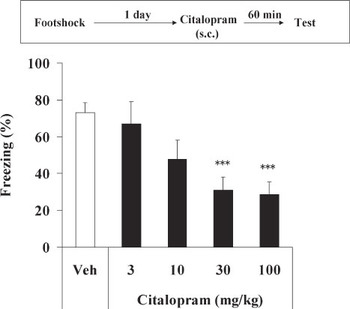
The selective 5‐HT reuptake inhibitor citalopram (3–100 mg/kg) dose dependently reduced the expression of conditioned freezing significantly [one‐way ANOVA, F(4, 59) = 7.92, p < 0.001]. Dunnett's post hoc test revealed that citalopram showed significant effects at 30 and 100 mg/kg, but not at 3 and 10 mg/kg (Fig. 1).
Effect of citalopram treatment on conditioned freezing. Citalopram was administered subcutaneously at 1 day after foot shock and 1 h before testing. Data are expressed as mean ± SEM of freezing scored for a 5‐min observation period. ***p < 0.001 compared with Veh (Dunnett's test). Veh, vehicle. N = 8–16.

Influence of PCPA on the anxiolytic‐like effect of citalopram (30 mg/kg) on conditioned freezing
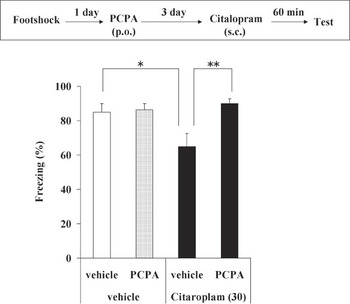
Two‐way ANOVA revealed a significant interaction [F(1, 60) = 5.15, p < 0.05] and a significant main effect of PCPA [F(1, 60) = 6.50, p < 0.05], but no significant main effect of citalopram [F(1, 60) = 2.41, p = 0.13]. A Tukey–Kramer post hoc test showed that vehicle–citalopram, but not PCPA–vehicle, significantly reduced freezing compared with control (vehicle–vehicle group); PCPA significantly reversed the anxiolytic‐like effects of citalopram (Fig. 2).
Influence of PCPA on the anxiolytic‐like effect of citalopram (30 mg/kg) on conditioned freezing. One day after foot shock, the tryptophan hydroxylase inhibitor PCPA (300 mg/kg, p.o.) was administered. Three days after treatment of PCPA (i.e. 4 days after foot shock), citalopram (30 mg/kg, s.c.) was administered 1 h before testing. Data are expressed as mean ± SEM of freezing scored for a 5‐min observation period. *p < 0.05; **p < 0.01 (Tukey–Kramer test). N = 16.

Influence of the 5‐HT1A receptor antagonist WAY 100635 (0.1–10 mg/kg) on the anxiolytic‐like effect of citalopram (30 mg/kg) on conditioned freezing
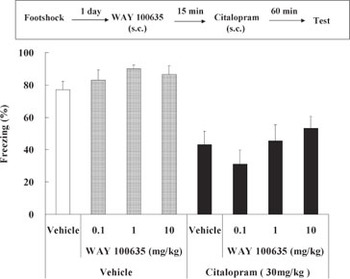
We used WAY 100635 at three doses: a low dose (0.1 mg/kg), a high dose (1 mg/kg) and a very high dose (10 mg/kg). Two‐way ANOVA revealed a significant main effect of citalopram [F(1, 88) = 49.08, p < 0.001], but showed no significant main effect of WAY 100635 [F(3, 88) = 1.39, p = 0.25] and no significant interaction [F(3, 88) = 0.59, p = 0.62] (Fig. 3).
Influence of the 5‐HT1A receptor antagonist WAY 100635 (0.1–10 mg/kg) on the anxiolytic‐like effect of citalopram (30 mg/kg) on conditioned freezing. One day after foot shock, citalopram (30 mg/kg, s.c.) was administered 1 h before testing. The 5‐HT1A receptor antagonist WAY 100635 (0.1–10 mg/kg, s.c.) was administered 15 min before citalopram treatment. Data are expressed as mean ± SEM of freezing scored for a 5‐min observation period. Two‐way ANOVA revealed only a significant main effect of citalopram (p < 0.001). N = 8–16.

Influence of various subtype‐selective 5‐HT receptor antagonists on the anxiolytic‐like effect of citalopram (30 mg/kg) on conditioned freezing
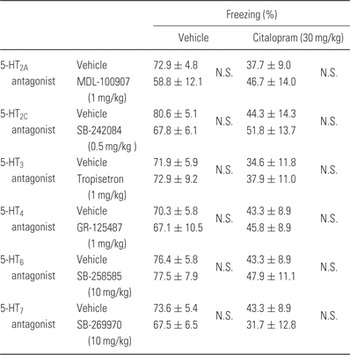
In each experimental group, two‐way ANOVA showed a significant main effect of citalopram, but no significant main effect of the subtype‐selective 5‐HT receptor antagonist and no significant interaction between citalopram and the subtype‐selective 5‐HT receptor antagonist (Table 1).
Influence of various subtype‐selective 5‐HT receptor antagonists on the anxiolytic effect of citalopram (30 mg/kg) on conditioned freezing

One day after foot shock, citalopram (30 mg/kg, s.c.) was administered 1 h before testing. Each subtype‐selective 5‐HT receptor antagonist was intraperitoneally administrated 15 min before citalopram treatment. Data are expressed as mean ± SEM of freezing scored for a 5‐min observation period. In each experimental group, two‐way ANOVA showed a significant main effect of citalopram, but no significant main effect of the 5‐HT receptor antagonist and no significant interaction between citalopram and the 5‐HT receptor antagonist. N.S., not significant (Tukey–Kramer test). N = 8–24.
Discussion
In agreement with previous studies Reference Hashimoto, Inoue and Koyama10, Reference Inoue, Tsuchiya and Koyama11, Reference Nishikawa, Inoue, Izumi and Koyama13, Reference Muraki, Inoue and Koyama23, the SSRI citalopram dose dependently reduced conditioned freezing behaviour, an index of anxiety (Fig. 1). To investigate the involvement of 5‐HT in the anxiolytic‐like effect of citalopram, we examined the effect of the tryptophan hydroxylase inhibitor PCPA on the anxiolytic‐like effect of citalopram in conditioned freezing. 5‐HT depletion by treatment with PCPA alone had no effects on freezing (Fig. 2). This result is interesting because 5‐HT depletion shows the anxiolytic‐like effects in other animal models of anxiety such as the social interaction test, the conflict test and the elevated plus‐maze test Reference File and Hyde24, Reference Söderpalm and Engel25, Reference Kshama, Hrishikeshavan, Shanbhogue and Munonyedi26, in which SSRIs do not show anxiolytic‐like effect Reference Borsini, Podhorna and Marazziti9. These anxiety models are based on establishing a conflict between avoidance of an aversive stimulus and a natural ‘approach’ drive (i.e. exploration, social behaviour, appetite, etc.). On the other hand, the CFS model is based on the expression of conditioned fear to an aversive stimulus without a competing drive to behave in another way, suggesting the freezing behaviour more directly reflects activation of fear circuitry. Therefore, the neural circuitry involved in behaviours may be distinct between the CFS model and other anxiety models, and the effects of citalopram and PCPA may be different as well. The anxiolytic‐like effect of citalopram in the CFS model was abolished completely by pretreatment with PCPA (Fig. 2). Although we did not determine extracellular 5‐HT concentrations in the rat brain, Pozzi et al. Reference Pozzi, Invernizzi, Garavaglia and Samanin15 showed that the same dose of PCPA completely prevented the 5‐HT increase induced by citalopram according to the same procedure. Moreover, our previous studies have shown the three following phenomena: (a) a 5‐HT precursor is effective in the CFS model Reference Inoue, Tsuchiya and Koyama11; (b) citalopram increases extracellular 5‐HT concentrations in the brain, with subsequent inhibition of CFS‐induced freezing Reference Hashimoto, Inoue and Koyama27; (c) the microinjection of citalopram into the amygdala inhibits CFS‐induced freezing Reference Inoue, Li and Abekawa12. Taken together, our data suggest that citalopram induces the anxiolytic‐like effect through 5‐HT increase in the CFS model.
Although citalopram seems to be more selective among SSRIs Reference Sanchez and Hytell14, Pozzi et al. Reference Pozzi, Invernizzi, Garavaglia and Samanin15 reported that a high dose of citalopram (25 mg/kg) increased cortical extracellular concentrations of not only 5‐HT, but also dopamine. This finding suggests that increased dopamine by high‐dose citalopram may affect conditioned freezing. However, they showed that PCPA prevented the effect of high‐dose citalopram on extracellular 5‐HT, but not extracellular dopamine. Furthermore, our previous study reported that a dopamine reuptake inhibitor failed to affect conditioned freezing Reference Hashimoto, Inoue and Koyama10. Therefore, it seems unlikely that the inhibitory effect of citalopram in the CFS model is mediated by increased extracellular dopamine.
Our findings are supported by some clinical studies, which show that tryptophan depletion, engendering 5‐HT depletion, reverses the therapeutic effect of SSRIs in panic disorder and social anxiety disorder Reference Nutt, Forshall, Bell and Rich28, Reference Argyropoulos, Hood and Adrover29, Reference Pyle, Argyropoulos and Nutt30. Therefore, the mechanisms underlying the anxiolytic‐like effects of SSRIs on the contextual CFS model might resemble those on anxiety disorders of some types.
Next, we investigated which 5‐HT receptor subtype is involved in the anxiolytic‐like effect of citalopram in the CFS model. 5‐HT receptors are classified into 14 subtypes Reference Hoyer, Hannon and Martin7. 5‐HT1A receptor is a potential candidate receptor that is involved in the anxiolytic effects of SSRIs, as described in the Introduction section. The 5‐HT1A receptors are located on both presynaptic and postsynaptic neurons Reference Hoyer, Hannon and Martin7. In the raphe nuclei, 5‐HT1A receptors act as presynaptic autoreceptors and regulate the 5‐HT release. However, the anxiolytic‐like effect of 5‐HT1A receptor agonist in the CFS model was not influenced by 5‐HT depletion Reference Inoue, Tsuchiya and Koyama11. Moreover, the microinjection of the 5‐HT1A receptor agonist into the hippocampus or amygdala inhibits CFS‐induced freezing Reference Li, Inoue and Abekawa31. These results suggest that a 5‐HT1A receptor agonist exerts anxiolytic‐like effects in the CFS model through stimulation of the postsynaptic 5‐HT1A receptors in the hippocampus and amygdala, but not through that of presynaptic 5‐HT1A receptors in the raphe nucleus. Therefore, we speculated that the anxiolytic‐like effects of SSRIs in the CFS model was mediated indirectly by the stimulation of postsynaptic 5‐HT1A receptors.
However, the low dose (0.1 mg/kg) of WAY 100635, the 5‐HT1A receptor antagonist, completely blocked the anxiolytic‐like effect of the 5‐HT1A receptor agonist tandospirone (data not shown), but not the anxiolytic‐like effect of citalopram (Fig. 3). The 5‐HT1A receptor antagonist markedly potentiates extracellular 5‐HT increases produced by the SSRIs through presynaptic 5‐HT1A receptor blockade Reference Romero, Ildefonso and Artigas32, generating the hypothesis that higher doses of WAY 100635 are necessary to block the postsynaptic 5‐HT1A receptor signalling activated by SSRI treatment. Actually Harasawa et al. Reference Harasawa, Ago, Itoh, Baba and Matsuda20 reported that the anxiolytic‐like effect of the other SSRI fluvoxamine on the mouse marble burying model was potentiated by the low dosage (0.1 mg/kg) of WAY 100635, but that it was partially blocked by the high dosage (1 mg/kg) of WAY 100635. However, in this study, neither the high dosage (1 mg/kg) nor the very high dosage (10 mg/kg) of WAY 100635 influenced the anxiolytic‐like effect of citalopram. Therefore, we were unable to confirm the involvement of 5‐HT1A receptors in the anxiolytic‐like effect of citalopram, suggesting the anxiolytic‐like effect of citalopram is mediated by the activation of 5‐HT receptor subtypes other than 5‐HT1A.
Schreiber et al. Reference Schreiber, Melon and de Vry18 reported that the anxiolytic‐like effect of SSRI is blocked completely by the 5‐HT2A receptor antagonist MDL 100907 (0.1 mg/kg) in the rat ultrasonic vocalisation (USV) model. However, the 10 times larger dosage of MDL 100907 (1 mg/kg) did not influence the effect of citalopram in our study (Table 1). Unlike a CFS test, 5‐HT depletion showed the anxiolytic‐like effect in the USV model Reference Schreiber and de Vry33. Therefore, the mechanisms underlying the anxiolytic‐like effect of SSRIs in a CFS model might differ from those in an USV model.
It is particularly interesting that, as opposed to our results, acute treatment with citalopram increased the freezing behaviour in auditory fear conditioning, which was blocked by the 5‐HT2C receptor antagonist SB 242084 (0.2 mg/kg) Reference Burghardt, Bush, Mcewen and Ledoux34. That different effect of citalopram might result from differences in neural circuits underlying the fear expression between auditory fear conditioning and contextual fear conditioning Reference Ledoux and Aggleton35. Although the effect of citalopram is opposite, the results of Burghardt et al. Reference Burghardt, Bush, Mcewen and Ledoux34 showed that the effect of citalopram is mediated by activation of 5‐HT2C receptors. However, in our study, the 5‐HT2C receptor antagonist SB 242084 (0.5 mg/kg), at a higher dose than that in the study by Burghardt et al. Reference Burghardt, Bush, Mcewen and Ledoux34, did not influence the effect of citalopram (Table 1), suggesting that 5‐HT2C receptors are not involved in the anxiolytic‐like effect of citalopram in the contextual CFS model.
Reportedly, each antagonist of 5‐HT3, 5‐HT4, 5‐HT6 and 5‐HT7 receptors shows anxiolytic‐like effects in traditional anxiety animal models such as the conflict test and the elevated plus‐maze test Reference Wesolowska, Nikiforuk, Stachowicz and Tatarczynska22, Reference Silvestre, Fernández and Palacios36, Reference Olivier, van Wijngaarden and Soudijn37, Reference Wesolwska, Nikiforuk and Stachowicz38. We specifically examined the involvement of these receptor subtypes in the anxiolytic‐like effect of citalopram. However, none of the subtype‐selective 5‐HT receptor antagonists significantly affected conditioned freezing or affected the anxiolytic‐like effect of citalopram (Table 1). Although we used antagonists at the single dose, each dose of antagonists was reported to block each receptor subtype in the rat brain Reference Yoshioka, Matsumoto, Togashi and Saito16, Reference Letty, Child, Dumuis, Pantaloni, Bockaert and Rondouin17, Reference Mitchell, Sexton and Neumaier21, Reference Wesolowska, Nikiforuk, Stachowicz and Tatarczynska22. Therefore, it is possible that none of the 5‐HT3, 5‐HT4, 5‐HT6 and 5‐HT7 receptors is involved in the anxiolytic‐like effects of SSRIs.
We reported previously that the 5HT1B/D receptor antagonist did not influence the anxiolytic‐like effect of citalopram in the CFS model Reference Muraki, Inoue and Koyama23. Moreover, 5‐HT1E receptors do not exist in rats Reference Bai, Yin and Johnstone39. Consequently, the 5‐HT1F and 5‐HT5A receptors that we have not investigated might be involved in the anxiolytic‐like effect of citalopram. However, there are no available antagonists selective for 5‐HT1F or 5‐HT5A receptors in rats. Moreover, we must consider the possibility that multiple 5‐HT receptor subtypes are intertwined complexly, engendering the hypothesis that the effect of citalopram is not antagonised unless multiple subtype‐selective 5‐HT receptor antagonists are pretreated simultaneously.
On the other hand, the therapeutic effects of SSRIs arise after weeks of chronic treatment Reference Bandelow, Zohar, Hollander, Kasper and Möller3, but we investigated the mechanism underlying acute anxiolytic‐like effects of SSRI in this study. Our previous study showed that chronic treatment with SSRI also shows the anxiolytic‐like effect in the CFS model Reference Li, Inoue, Hashimoto and Koyama40. Therefore, additional studies are necessary to investigate the mechanism underlying chronic anxiolytic‐like effects of SSRI.
We found out that the anxiolytic‐like effect of citalopram in the CFS model depends on 5‐HT availability. In addition, our data suggested that the CFS model is completely different from conventional anxiety models in neural mechanism or manners of serotonergic involvement. However, we did not identify the pharmacological mechanisms responsible for citalopram's effect. Therefore, further studies are needed because elucidation of the pharmacological mechanisms might lead to the discovery of a new therapeutic target for anxiety disorders.
Acknowledgement
This work was supported in part by Grants‐in‐Aid for Scientific Research No. 21591478 (T.I.) from Japanese Ministry of Education, Culture, Sports, Science and Technology.