Introduction
With 125 genera and 2,539 extant species worldwide (World Spider Catalog, 2022), Theridiidae Sundevall, Reference Sundevall1833, also known as comb-footed or cobweb spiders, is the fourth most diverse spider family in the world. Along with its rich extant taxa diversity, this family has a very rich fossil record, with 52 genera and 193 valid species (Dunlop et al., Reference Dunlop, Penney and Jekel2020), of which 36 are considered extinct (e.g., Koch and Berendt, Reference Koch, Berendt and Berendt1854; Petrunkevitch, Reference Petrunkevitch1942, Reference Petrunkevitch1963; Wunderlich, Reference Wunderlich1988, Reference Wunderlich2008, Reference Wunderlich2011, Reference Wunderlich2015, Reference Wunderlich2021). In Mexico, Theridiidae is represented by 172 extant species (World Spider Catalog, 2022), and 105 of the total Mexican diversity are found in the state of Chiapas (García-Villafuerte and Brescovit, Reference García-Villafuerte and Brescovit2019). At present, only six fossil Theridiidae species have been reported from Chiapas amber (García-Villafuerte, Reference García-Villafuerte2020): Eomysmena asta Petrunkevitch, Reference Petrunkevitch1971; Pronepos exilis Petrunkevitch, Reference Petrunkevitch1963; Pronepos fossilis Petrunkevitch, Reference Petrunkevitch1963; Episinus chiapasanus Petrunkevich, Reference Petrunkevitch1971; Episinus penneyi García-Villafuerte, Reference García-Villafuerte2006, and cf. Theridion hispidum O. Pickard-Cambridge, Reference Pickard-Cambridge1898 (García-Villafuerte, Reference García-Villafuerte2018b). This does not necessarily mean that the Theridiidae fossil record from Chiapas amber is poor, but the revision of new amber material might provide more information on new comb-footed spider fossil records, such as the genus Phycosoma in this investigation.
Phycosoma Pickard-Cambridge, Reference Pickard-Cambridge1880 is a theridiid genus belonging to the Hadrotarsinae subfamily, with 26 extant species distributed worldwide (World Spider Catalog, 2022). Three species of Phycosoma occur on the American continent: P. altum (Keyserling, Reference Keyserling1886), with a distribution range that extends from Mexico to Brazil; P. jamesi (Roberts, Reference Roberts1979), with a disjunct distribution range in Jamaica and Panama (World Spider Catalog, 2022); and P. lineatipes (Bryant, Reference Bryant1933), with the largest range, from the United States to Brazil (World Spider Catalog, 2022).
Very little is known about the ecology of the Phycosoma species, but general information suggests that they live in the tropical rain forest and secondary tropical montane evergreen broad-leaved forest, and they are also found in plantations of Paramichelia bailloni (Magnoliaceae), xerophytic bushes of semiarid forest, and cloud montane forest (Ibarra-Núñez et al., Reference Ibarra-Núñez, Maya-Morales and Chamé-Vázquez2011; Gao and Li, Reference Gao and Li2014; Malik et al., Reference Malik, Das and Siliwal2016). Furthermore, the literature suggests that Phycosoma spiders are ant-hunting specialists (Umeda et al., Reference Umeda, Shinkai and Miyashita1996; Liu et al., Reference Liu, May-Collado, Pekár and Agnarsson2016). Some Theridiidae spiders have abandoned web-building altogether and hunt for pedestrian prey (Porter and Eastmond, Reference Porter and Eastmond1982), while in Hadrotarsinae members, there is no evidence of web building (Benjamin and Zschokke, Reference Benjamin and Zschokke2003).
At present, no fossil Phycosoma species have yet been recorded. However, in the summary of fossil spiders compiled by Dunlop et al. (Reference Dunlop, Penney and Jekel2020), Lasaeola (Phycosoma) inclinata Wunderlich, Reference Wunderlich2012 from Madagascar copal is listed and assigned to the Quaternary. Wunderlich (Reference Wunderlich2012) argued that this species fits more with the genus Phycosoma because of the chaetotaxy and an armored opisthosoma. Nevertheless, Delclòs et al. (Reference Delclòs, Peñalver, Ranaivosoa and Solórzano-Kraemer2020) considered Madagascar copal to be recent in age.
We describe here an extinct new Phycosoma species, Phycosoma icti† n. sp., based on an adult male specimen found in an amber piece from Simojovel de Allende, state of Chiapas, southern Mexico. This new fossil species exhibits a complex theridiid palp, unlike the type species P. oecobioides, which shows a simpler palp. Phycosoma icti† n. sp. represents the oldest fossil record of the genus Phycosoma and the first record of the genus for Mexican amber.
Geological setting
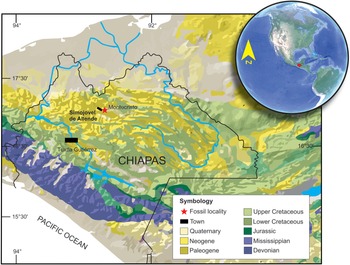
The specimen described herein was recovered from the Montecristo amber mines located near the town of Simojovel de Allende, 124 km northwest of Tuxtla Gutiérrez, in the state of Chiapas, southern Mexico (Fig. 1). The sediments that crop out in the Montecristo mines belong to the Mazantic Shale, a sequence of 310 m of dark-gray shales that overlay the La Quinta Formation (Allison, Reference Allison1967) and contain amber in association with marine invertebrates and vertebrates (Frost and Langenheim, Reference Frost and Langenheim1974; Vega et al., Reference Vega, Nyborg, Coutiño, Solé and Hernández-Monzón2009; Perrilliat et al., Reference Perrilliat, Vega and Coutiño2010), as well as some terrestrial vertebrates (Webb et al., Reference Webb, Beatty and Poinar2003; Ferrusquía-Villafranca, Reference Ferrusquía-Villafranca2006; Carbot-Chanona et al., Reference Carbot-Chanona, Rivera-Velázquez, Jiménez-Hidalgo and Reynoso2020). Overlying the Mazantic Shale is the Balumtum Sandstone, a gray sandstone sequence 760 m thick that preserves amber associated with marine invertebrates (Perrilliat et al., Reference Perrilliat, Vega and Coutiño2010).
Type locality “Montecristo mines,” Simojovel de Allende, state of Chiapas, southern Mexico, where the specimen was obtained.

The Mazantic Shale has been dated with an absolute age of 23 Ma based on 87Sr/86Sr isotopes from a sample of the gastropod shell Turbinella maya Perrillat, Vega, and Coutiño, Reference Perrilliat, Vega and Coutiño2010 from Los Pocitos, placing it in the lower Miocene (Aquitanian) (Vega et al., Reference Vega, Nyborg, Coutiño, Solé and Hernández-Monzón2009). We agree with these authors that the radiometric age of ca. 23 Ma represents a more accurate estimate for the amber deposits, although some authors have placed these deposits in the middle Miocene, with an age ranging between 20 and 15 Ma (e.g., Solórzano-Kraemer, Reference Solórzano-Kraemer2007, Reference Solórzano-Kraemer and Penney2010; Solórzano-Kraemer and Mohrig, Reference Solórzano-Kraemer and Mohrig2007).
Materials and methods
Preparation
To reveal the morphological characters necessary for the taxonomic identification, the amber piece was cut with a hair hacksaw then sanded and posteriorly polished using a commercial abrasive to eliminate the scratches left on its surface by the fine sandpaper (García-Villafuerte, Reference García-Villafuerte2018a).
Measurements and photographs
Anatomical data were gathered using a Zeiss Stemi 2000-C stereomicroscope. Photographs were taken with a Canon EOS Rebel SL3 camera (21 megapixels) mounted on the stereomicroscope. The images were stacked using Helicon Focus 6 software. The illustrations were made with Adobe Illustrator CC2015 software. All measurements are in millimeters. Eye diameter was taken at the widest point. The total body length does not include the length of the chelicerae or spinnerets (Gao and Li, Reference Gao and Li2014). Anatomical descriptions of the specimen follow Gao and Li (Reference Gao and Li2014).
Anatomical abbreviations
The labeling of the palp follows Agnarsson et al. (Reference Agnarsson, Coddington and Knoflach2007). The following abbreviations are used in the text and the figures: Ac, accessory apophysis; ALE, anterior lateral eyes; AME, anterior median eyes; C, conductor; Ci, cymbium; dg, dorsal grooves; E, embolus; fe, femur; Ma, median apophysis; mt, metatarsus; Op, opisthosoma; PME, posterior median eyes; PLE, posterior lateral eyes; plp, pedipalpus; Pr, prosoma; pt, patella; St, subtegulum; Te, tegulum; ti, tibia; tr, tarsus; TTA, theridiid tegular apophysis.
Repositories and institutional abbreviations
The specimen is a male spider preserved in a cut piece of amber approximately 15 mm long, 9 mm wide, and 4 mm thick, housed at the Paleontology Museum “Eliseo Palacios Aguilera,” Dirección de Gestión, Investigación y Educación Ambiental of the Secretaría de Medio Ambiente e Historia Natural (SEMAHN) in Tuxtla Gutiérrez, state of Chiapas, southern Mexico, catalogued under IHNFG-5975 code.
Systematic paleontology
Orden Araneae Clerck, Reference Clerck1757
Superfamily Araneoidea Latreille, Reference Latreille1806
Family Theridiidae Sundevall, Reference Sundevall1833
Genus Phycosoma Pickard-Cambridge, Reference Pickard-Cambridge1880
Type species
Phycosoma oecobioides Pickard-Cambridge, Reference Pickard-Cambridge1880 from New Zealand.
Remarks
The fossil spider described herein is identified as a member of the family Theridiidae because the diameter of the clypeus is more than twice the diameter of the anterior median of the eyes and because of the small chelicerae, spherical abdomen, palpal tibia widened distally, few spines on the legs, and a comb of serrated bristles on the tarsus IV. The specimen belongs to the genus Phycosoma because males of this genus have a very high and cylindrical carapace with deep dorsal grooves when viewed from above, the eye region projects beyond the clypeus, and there is no colulus.
Holotype
IHNFG-5975, almost complete male spider included in a small amber piece, housed at the Paleontological Collection of the Secretaría de Medio Ambiente e Historia Natural.
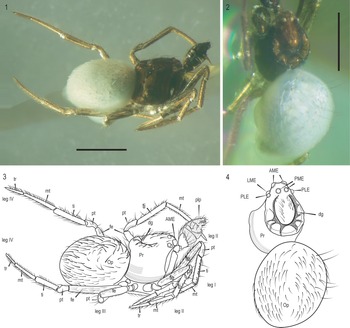
Phycosoma icti† n. sp. (1) Habitus lateral. (2) Habitus dorsal. (3) Drawing of habitus lateral. (4) Drawing of habitus dorsal. Scale bars = 1.0 mm. AME = anterior median eyes; dg = prosoma dorsal grooves; fe = femur; LME = lateral median eye; mt = metatarsus; Op = opisthosoma; PLE = posterior lateral eyes; plp = pedipalpus; PME = posterior median eyes; Pr = prosoma; pt = patella; ti = tibia; tr = tarsus.

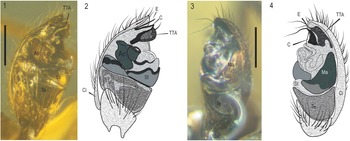
Phycosoma icti† n. sp. (1, 2) Right palp mesal view. (3, 4) Right palp prolateral view. Scale bars = 0.25 mm. Ac = accessory apophysis; C = conductor; Ci = cymbium; E = embolus; Ma = median apophysis; St = subtegulum; Te = tegulum; TTA = theridiid tegular apophysis.

Diagnosis
The new species differs from all extant congeners except P. corrugum Gao and Li, Reference Gao and Li2014 by the long embolus partly covered by the conductor. Phycosoma icti† n. sp. can be distinguished from P. corrugum by the constricted median apophysis, a narrow and pointed conductor, a long, curved, and bent TTA in its distal portion, and the prosoma ringed in the middle and along the ventral margin.
Occurrence
Montecristo amber mines (17°80′48″N, 92°42′30″W; 660 m), Simojovel de Allende, state of Chiapas, southern Mexico (Fig. 1). Mazantic Shale, lower Miocene (Aquitanian), 23 Ma.
Description
Total length 2.2 mm, carapace 0.85 mm long, 0.68 mm wide, 0.69 mm high, cylindrical, dark brown, with dark striate, dorsal groves in the base. Sternum, endites, and labium brown (it is not possible to see them clearly to take measurements due to the position of the legs). Opisthosoma 1.33 mm long, 0.85 mm wide, cream green with white spots, colulus not visible, dark brown spinnerets, like carapace. Eye measurements in millimeters: AME 0.12, ALE 0.06, PME 0.08, PLE 0.07, AME–AME 0.08, AME–LME 0.04, PME–PME 0.06, PME–PLE 0.09. Clypeus high, about four times the AME diameter, dark brown. Chelicerae brown, fangs long and slender. Leg measurements in millimeters: I 2.64 (fe 0.83, pt 0.26, ti 0.55, mt 0.66, tr 0.34); II 2.01 (fe 0.66, pt 0.22, ti 0.39, mt 0.41, tr 0.33); III 1.79 (fe 0.45, pt 0.21, ti 0.39, mt 0.41, tr 0.33); IV 2.47 (fe 0.74, pt 0.25, ti 0.53, mt 0.64, tr 0.31). All legs yellow brown; femur I–IV lacking spines, patella I–IV with two spines (1-0-1), tibia I, II, IV similar with two dorsal spines, tibiae III with one dorsal spine, metatarsus and tarsus I–IV with trichobothrium and lacking spines. Pedipalpus (Fig. 3) patella with two long spines, tibia with one trichobothria; dark brown cymbium with black spot; broad subtegulum; tegulum conjoined with median apophysis; long embolus partly covered by conductor; smooth median apophysis, oblique and constricted in the middle; long and curved TTA, bent in its distal portion. Female unknown.
Etymology
The specific epithet is dedicated to the Instituto de Ciencia, Tecnología e Innovación del Estado de Chiapas (ICTI), for its contribution and support in the rescue of amber pieces with fossil spiders.
Remarks
Emended diagnosis for the genus: Phycosoma differs from other hadrotarsines by the following characters: male carapace very high and cylindrical (Fig. 2.1, 2.3), with deep dorsal grooves when viewed from above (Fig. 2.2, 2.4) (Zhang and Zhang, Reference Zhang and Zhang2012; Gao and Li, Reference Gao and Li2014); female carapace if high, only anteriorly (Fitzgerald and Sirvid, Reference Fitzgerald and Sirvid2004; Zhang and Zhang, Reference Zhang and Zhang2012; Gao and Li, Reference Gao and Li2014). Eye region often projecting beyond clypeus (Fig. 2.1, 2.3). Male palp with or without median apophysis, conductor and embolus small (embolus long in the case of P. corrogum Gao and Li, Reference Gao and Li2014 and P. icti† n. sp.). Epigynum with a small scape (Gao and Li, Reference Gao and Li2014; Agnarsson and Levi, Reference Agnarsson, Levi, Ubick, Paquin, Cushing and Roth2017). Most species without colulus, except P. mustelinum (Simon, Reference Simon1889) with a colulus (Yoshida, Reference Yoshida2002; Fitzgerald and Sirvid, Reference Fitzgerald and Sirvid2004; Zhang and Zhang, Reference Zhang and Zhang2012; Gao and Li, Reference Gao and Li2014; Agnarsson and Levi, Reference Agnarsson, Levi, Ubick, Paquin, Cushing and Roth2017; Vanuytven, Reference Vanuytven2021).
Discussion
Taxonomic assessment of Phycosoma, Dipoena, and Lasaeola.—The genus Phycosoma has a controversial taxonomic history because of ambiguities on the morphological characters that are normally used to diagnose the genera Dipoena or Lasaeola, for example, male carapace often modified, high, elevated, or with a grooved pattern on dorsal view; clypeus frequently higher (Levi, Reference Levi1953; Fitzgerald and Sirvid, Reference Fitzgerald and Sirvid2003); female carapace, if high, only anteriorly; chelicerae very small without teeth (Fitzgerald and Sirvid, Reference Fitzgerald and Sirvid2003); embolus short (Wunderlich, Reference Wunderlich2011), or conductor and embolus larger (Yoshida, Reference Yoshida2002); and median apophysis usually present in palp (Yoshida, Reference Yoshida2002). Therefore, Phycosoma has not been properly described (Tso et al., Reference Tso, Zhu and Zhang2005). This has caused some extant Phycosoma species to be referred to Dipoena (Fitzgerald and Sirvid, Reference Fitzgerald and Sirvid2004; Saaristo, Reference Saaristo2006; Yin et al., Reference Yin, Peng, Yan, Bao, Xu, Tang, Zhou and Liu2012; Zhang and Zhang, Reference Zhang and Zhang2012). Zhang and Zhang (Reference Zhang and Zhang2012) argued that a review of the genus Dipoena could reveal that more species in this genus should be transferred to Phycosoma. Likewise, Wunderlich (personal communication, 2021) argued that the genus Lasaeola is probably a junior synonym of Phycosoma.
Judging from the preceding, it is very likely that the species assigned by Rodrigues (Reference Rodrigues2013) and Yang et al. (Reference Yang, Irfan, Liu and Peng2019) to the genus Dipoena (D. cidae Rodrigues, Reference Rodrigues2013, D. ericae Rodrigues, Reference Rodrigues2013, D. guaraquecaba Rodrigues, Reference Rodrigues2013, D. santaritadopassaquatrensis Rodrigues, Reference Rodrigues2013, D. bonitensis Rodrigues, Reference Rodrigues2013, and D. fozdoiguacuensis Rodrigues, Reference Rodrigues2013 from Brazil; D. crescenta Yang et al., Reference Yang, Irfan, Liu and Peng2019 and D. lirata Yang et al., Reference Yang, Irfan, Liu and Peng2019 from China) are in fact members of the genus Phycosoma. This statement is based on the fact that the diagnoses and descriptions of these species fit more with Phycosoma (e.g., Zhang and Zhang, Reference Zhang and Zhang2012; Gao and Li, Reference Gao and Li2014; Vanuytven, Reference Vanuytven2021) than with Dipoena since the carapace of the males is high and cylindrical with groves on dorsal view; the ocular area is projected beyond the clypeus; the male palps have median apophyses, the embolus is long or small, and the conductor and TTA are present; morphological characters present in P. icti† and extant species from Asia (e.g., Gao and Li, Reference Gao and Li2014). This shows that it is necessary to perform total evidence phylogenetic analyses that include molecular and morphological data, or any other informative set of characters, to adequately delimit the genera Phycosoma, Dipoena, and Lasaeola.
Phycosoma icti† is not included in the genus Dipoena because the males of this genus have a moderately raised cephalic region without a cylindrical, high carapace and no cervical grooves, and the male palp has a free median apophysis (Yoshida, Reference Yoshida2002; Gao and Li, Reference Gao and Li2014; Agnarsson and Levi, Reference Agnarsson, Levi, Ubick, Paquin, Cushing and Roth2017). By contrast, the median apophysis in Phycosoma is conjoined with the tegulum (Gao and Li, Reference Gao and Li2014). The genus Phycosoma was described by Pickard-Cambridge (Reference Pickard-Cambridge1880), and currently its status is valid (see World Spider Catalog, 2022, for details).
The taxonomic role of the median apophysis
Some authors have mentioned that the species of Phycosoma lack a median apophysis (e.g., Yoshida, Reference Yoshida2002; Fitzgerald and Sirvid, Reference Fitzgerald and Sirvid2003; Vanuytven, Reference Vanuytven2021). Wunderlich (Reference Wunderlich2012) described Lasaeola (Phycosoma) inclinata from Madagascar copal and mentioned that the absence of a median apophysis is not clear in L. inclinata, but because of the presence of chaetotaxy, a large scutum on the opisthosoma, carapace with cylindrical shape and presence of a dorsal groove, and the ocular area beyond the clypeus, L. inclinata must be placed in the genus Phycosoma. Zhang and Zhang (Reference Zhang and Zhang2012) mentioned that the male palps in Phycosoma have a median apophysis, and this is evident in some extant Phycosoma species from China (for details, see Zhang and Zhang, Reference Zhang and Zhang2012; Gao and Li, Reference Gao and Li2014).
In Phycosoma icti† and the extant species P. corrogum from China, the palp has a median apophysis and a long embolus (Fig. 3). Both species differ from the type species P. oecobioides, which has a short embolus and lacks a median apophysis. The median apophysis in Theridiidae is a sclerite positioned retrolaterally on the mesal side of the tegulum (Fig. 3) (Levi, Reference Levi1961; Agnarsson et al., Reference Agnarsson, Coddington and Knoflach2007); in some cases, the membrane is narrower than the median apophysis, giving the appearance of being fused to the tegulum (Agnarsson et al., Reference Agnarsson, Coddington and Knoflach2007). The median apophysis forms part of the theridiid BC-lock mechanism. This mechanism is unique and universal in Theridiidae; it is when the median apophysis interacts with the cymbial process to lock the bulb in the palp (Levi, Reference Levi1961). For details of the BC-lock mechanism, see Agnarsson et al. (Reference Agnarsson, Coddington and Knoflach2007).
Levi (Reference Levi1961) considered the absence of tegular sclerites in some theridiids as primitive. Later, he pointed out that the presence of simpler theridiid palps, in this case palps without a median apophysis, are probably derived rather than primitive (Levi, Reference Levi1983). Furthermore, Coddington (Reference Coddington1990) suggested that the possession of a median apophysis is probably primitive for Araneoidea. Agnarsson et al. (Reference Agnarsson, Coddington and Knoflach2007) mentioned that the median apophysis contains a loop in the spermatic duct in the basal-most theridiid. In this context, Phycosoma icti† is geologically the oldest known member of the genus exhibiting a median apophysis, which supports the hypothesis that this morphological character must be primitive rather than derived. Likewise, P. corrogum and other Asian Phycosoma species with a median apophysis could represent members of a primitive lineage.
Phycosoma as the first record from Mexican amber
The spider family Theridiidae, with 194 fossil species (including the new fossil species described herein), is the most diverse family in the fossil record (Dunlop et al., Reference Dunlop, Penney and Jekel2020). The oldest known theridiid fossils are Cretotheridion inopinatum Wunderlich, Reference Wunderlich2015, Burmatheridion sinespinae Wunderlich in Wunderlich and Müller, Reference Wunderlich and Müller2018, and Cornutheridion concavum Wunderlich, Reference Wunderlich2021 from Cretaceous Burmese amber (ca. 100 Ma). In addition, 130 fossil theridiid species in 36 genera have been recorded from the Eocene Baltic amber (47–43 Ma) and 43 fossil theridiid species in 15 genera from the Miocene Dominican Republic amber (20–15 Ma) (Dunlop et al., Reference Dunlop, Penney and Jekel2020). In the case of Mexico, six fossil theridiid species in four genera have been recorded. In this work, we add the genus Phycosoma to the theridiid fossil record, and we expand the diversity of the extinct species of this family.
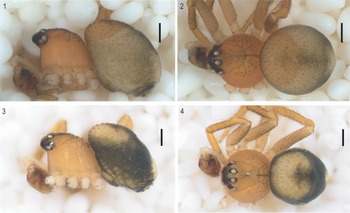
Currently, two extant Phycosoma species have been recorded from Mexico: P. altum (Fig. 4.1, 4.2; see also Roberts, Reference Roberts1979, p. 208–215, 222, figs. 1–57, 107, 111–114), and P. lineatipes (Fig. 4.3, 4.4; see also Roberts, Reference Roberts1979, p. 216–219, 222, figs. 58–87, 109–110). Of them, only P. altum, occurs in the cloud montane forest in Chiapas (Ibarra-Nuñez et al., Reference Ibarra-Núñez, Maya-Morales and Chamé-Vázquez2011). At present, the area of Simojovel de Allende is characterized by tropical rainforest vegetation, with a warm subhumid climate and precipitation in the summer from 192 mm to 334 mm (INAFED, 2017). However, Chiapas amber is the result of the resin polymerization of two extinct leguminous species, Hymenaea mexicana Poinar and Brown, Reference Poinar and Brown2002 and Hymenaea allendis Calvillo-Canadell, Cevallos-Ferriz, and Rico-Arce, Reference Calvillo-Canadell, Cevallos-Ferriz and Rico-Arce2010 (Poinar and Brown, Reference Poinar and Brown2002; Calvillo-Canadell et al., Reference Calvillo-Canadell, Cevallos-Ferriz and Rico-Arce2010), and available paleontological evidence (e.g., Solórzano-Kraemer, Reference Solórzano-Kraemer2007, Reference Solórzano-Kraemer and Penney2010; Calvillo-Canadell et al., Reference Calvillo-Canadell, Cevallos-Ferriz and Rico-Arce2010; Solórzano-Kraemer and Brown, Reference Solórzano-Kraemer and Brown2017) suggests that during the early Miocene, the Simojovel area was dominated by a Hymenaea tree community that developed near the ancient coast in estuarine environments, very similar to modern mangroves (e.g., Graham, Reference Graham, Wright and Robinson1993; Poinar and Brown, Reference Poinar and Brown2002; Vega et al., Reference Vega, Nyborg, Coutiño, Solé and Hernández-Monzón2009; Serrano-Sánchez et al., Reference Serrano-Sánchez, Hegna, Schaaf, Pérez, Centeno-García and Vega2015). We could assume that ancient members of this genus lived in Chiapas near estuarine environments, although our data with a single specimen is not conclusive. The presence of the extant species of the genus Phycosoma in or near current estuarine environments is not documented. However, studies with spiders are lacking in several current ecosystems in Chiapas, so the knowledge we have is still incomplete.
(1, 2) Phycosoma altum: (1) habitus lateral; (2) habitus dorsal. (3, 4) Phycosoma lineatipes: (3) habitus lateral; (4) habitus dorsal. Scale bars = 0.2 mm. Images modified from Álvarez-Padilla (Reference Álvarez-Padilla2012).

Conclusions
The morphological characters present in P. icti† n. sp. support its inclusion as a new fossil species in the spider family Theridiidae, increasing the diversity of the family in the fossil record. Phycosoma icti† is also the oldest fossil representative of the genus until now and the only known fossil species of the subfamily Hadrotarsinae in the lower Miocene Mexican amber.
Phycosoma icti† is taxonomically important because, unlike the type species P. oecobioides, it exhibits a complex theridiid palp like some extant Asian species of the genus. The presence of the median apophysis in the oldest known member of the genus Phycosoma supports the hypothesis that the relatively simple palps are probably derived rather than primitive. We believe that a taxonomic and phylogenetic revision, based not only in molecular data but also morphological data or any other informative set of characters, that at least includes the genera Dipoena, Lasaeola, and Phycosoma is important to adequately delimit these genera.
Acknowledgments
M.A.G.-V. is grateful for the scholarship support from the Consejo Nacional de Ciencia y Tecnología (CONACYT) for his master's degree studies. We thank the Instituto de Ciencia, Tecnología e Innovación del Estado de Chiapas (ICTIECH) for its support to acquire amber pieces with fossils spiders and the Secretaría de Medio Ambiente e Historia Natural (SEMAHN) for access to work at the Museum of Paleontology “Eliseo Palacios Aguilera.” Special thanks to Y. Marusik, J. Wunderlich, and P. Selden for their useful comments on an earlier version of this manuscript. Thanks to F. Álvarez-Padilla and one anonymous reviewer for providing useful comments and suggestions that improved the manuscript. C. Harleston provided proofreading assistance.
Competing interests
Author M.A.G.-V. is a master's student and has received support from the Consejo Nacional de Ciencia y Tecnología (CONACYT) for his graduate studies and from the Instituto de Ciencia, Tecnología e Innovación del Estado de Chiapas (ICTIECH) to acquire amber pieces with fossil spiders. Author G.C.-C. is employed at the Museo de Paleontología Eliseo Palacios Aguilera of the Secretaría de Medio Ambiente e Historia Natural. Authors G.R.V., W.A.M., and E.P.D.d.B. are employed at the Instituto de Ciencias Biológicas of the Universidad de Ciencias y Artes de Chiapas. “Competing interests: The authors declare none.”