Introduction
Arsenic enrichment of manganese deposits is a common phenomenon as arsenic is relatively easily absorbed by oxyhydroxides of Fe and Mn (Bowell, Reference Bowell1994) and thus the majority of manganese arsenates and arsenosilicates are found in Mn deposits of metamorphic origin. Accumulation of As is common in the initial Mn sediments, where it forms a syndepositional component in the form of primitive As-bearing manganese minerals that are subsequently mobilised by pore solutions and redistributed into vugs or veins by the tectonometamorphic processes (e.g. Cabella et al., Reference Cabella, Lucchetti and Marescotti1999; Kolitsch et al., Reference Kolitsch, Holtstam and Gatedal2004; Brugger and Meisser, Reference Brugger and Meisser2006; Vereshchagin et al., Reference Vereshchagin, Britvin, Perova, Brusnitsyn, Polekhovsky, Shilovskikh, Bocharov, van der Burgt, Cuchet and Meisser2019). The source of arsenic might vary but mostly it is dependent on fluid infiltration from a magmatic or volcanic source (Hofmann and Knill, Reference Hofmann and Knill1996; Kolitsch et al., Reference Kolitsch, Holtstam and Gatedal2004).
Metamorphosed manganese deposits with substantial arsenic content have been studied worldwide, with an emphasis on their mineral composition, geochemical characteristics and genetic aspects of their formation. The most important modern mineralogical studies of the Franklin and Sterling Hill deposits in the USA (Dunn et al., Reference Dunn, Peacor, Nelen and Norberg1981; Dunn and Peacor, Reference Dunn and Peacor1983; Dunn, Reference Dunn1995); the Långban and Pajsberg deposits in Sweden (Peacor et al., Reference Peacor, Dunn, Simmons and Wicks1986; Holtstam and Langhof, Reference Holtstam and Langhof1999; Jonsonn and Hålenius, Reference Jonsson and Hålenius2010); and the Gozaisho mine in Japan (Matsubara et al., Reference Matsubara, Miyawaki, Kato, Matsuyama, Mouri and Suzuki2001; Kampf, Reference Kampf2009; Nagashima et al., Reference Nagashima, Armbruster, Kolitsch and Pettke2014) provide a crucial role in understanding the incorporation of arsenic (and other constituents) in manganese minerals. Arsenic-rich manganese assemblages represented by the minerals ardennite, arseniopleite, brandtite, manganberzeliite, sarkinite, tilasite or tiragalloite, are well known from the numerous localities in the Alpine area (e.g. Albrecht, Reference Albrecht1990; Barresi et al., Reference Barresi, Kolitsch, Ciriotti, Ambrino, Bracco and Bonacina2005; Brugger and Meisser, Reference Brugger and Meisser2006; Castellaro et al., Reference Castellaro, Passarino, Kampf and Esposito2021; Gramaccioli et al., Reference Gramaccioli, Griffin and Mottana1980; Kolitsch et al., Reference Kolitsch, Schachinger and Auer2021; Reference Kolitsch, Schachinger and Auer2023; Marchesini et al., Reference Marchesini, Foianini, Foianini and Appiani2022), and hosted mostly in Mesozoic metamorphic sequences in Austria, Italy and Switzerland. In the Eastern Carpathian area only minor occurrences of manganese arsenates, arsenosilicates and As-sulfides have been described from Upper Precambrian to Lower Cambrian metamorphic Mn–Fe deposits such as Răzorae (Hîrtopanu and Udubaşa, Reference Hîrtopanu and Udubaşa2015) or Iacobeni (Hîrtopanu, Reference Hîrtopanu1997) in Romania.
The metamorphosed manganese mineralisation within the Western Carpathian area is known from the Gemeric tectonic unit at the localities of Čučma–Čierna baňa, Malá Hekerová–Bystrý potok near Smolník, Betliar–Július and Prakovce–Zimná Voda. Their polygenetic Variscan and Alpine metamorphic origin reflects the abundance of large numbers of mineral species (Kantor, Reference Kantor1953a, Reference Kantor1953b; Faryad, Reference Faryad1994; Peterec and Ďuďa, Reference Peterec and Ďuďa2003; Rojkovič, Reference Rojkovič2001; Števko et al., Reference Števko, Plecháček, Venclík and Malíková2015; Radvanec and Gonda, Reference Radvanec and Gonda2020; Števko et al., Reference Števko, Myšľan, Biagioni, Mauro and Mikuš2023; Myšľan et al., Reference Myšľan, Števko and Mikuš2023). In addition, a layer of manganese-enriched metasediments has been described from a borehole south of Rudňany, where piemontite and spessartine were present in the form of Mn–Fe nodules (Spišiak et al., Reference Spišiak, Hovorka, Rybka and Turan1989; Spišiak and Hovorka, Reference Spišiak and Hovorka2000). However, manganese arsenates and arsenosilicates were not discovered at any of these locations.
A unique occurrence of metamorphosed As-rich manganese mineralisation was discovered recently at Diely, in the vicinity of the Poráč, hosted in Early Palaeozoic rocks of the Gemeric Unit. This locality represents a first occurrence of metamorphosed manganese mineralisation with an abundant presence of arsenates and arsenosilicates in the Western Carpathian area. This article provides compositional data for all the minerals from the manganese assemblage and associated rocks, as well as comparison with similar localities within the Carpathian and Alpine region and elsewhere in the world.
Geological setting and location
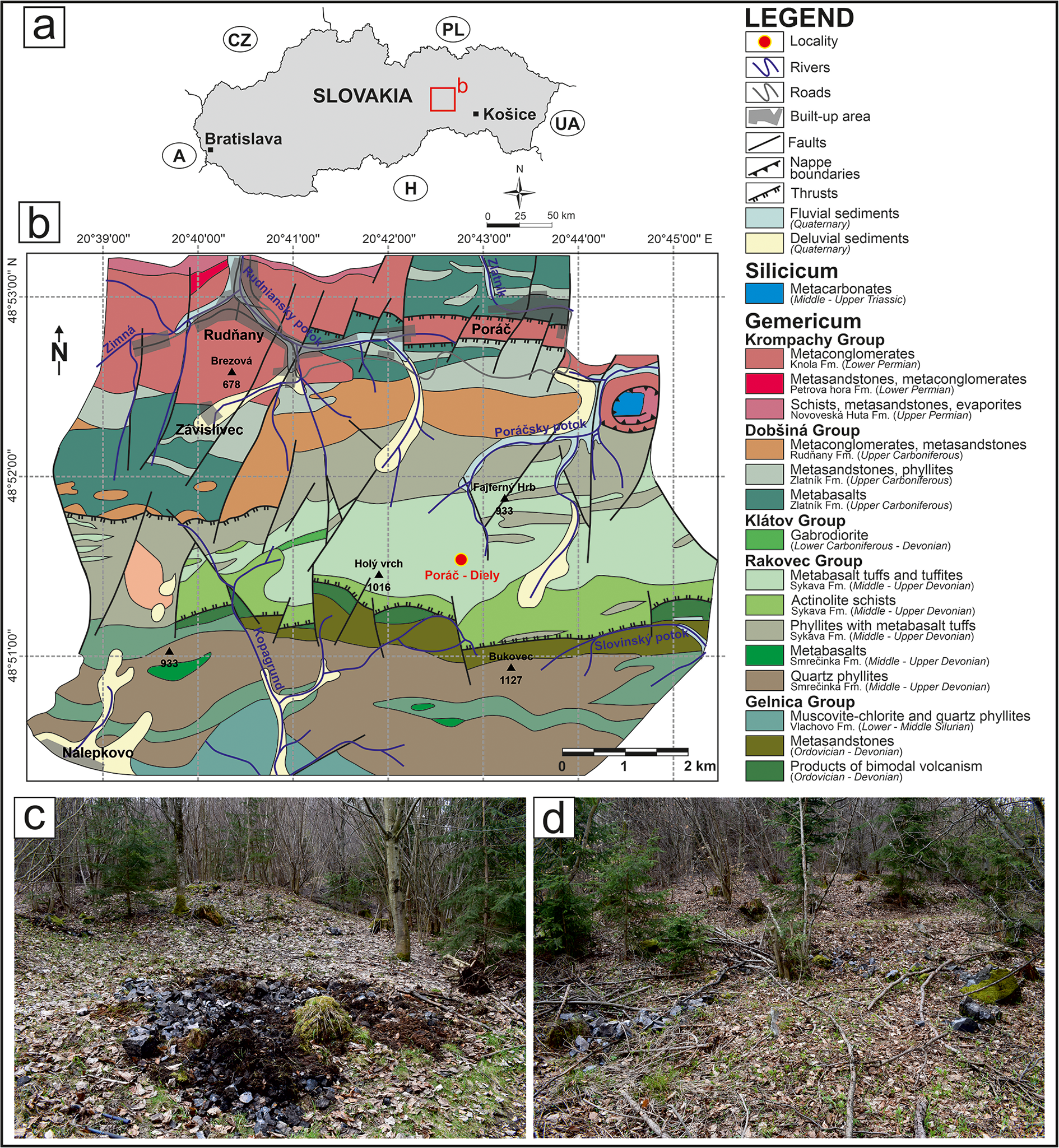
Arsenic-rich manganese mineralisation at the Diely occurrence near Poráč village is situated in the Early Palaeozoic, mostly low-grade, metamorphic rocks of the Gemeric Unit (Gemericum) in the Spišsko-gemerské rudohorie Mts. (Fig. 1a), Eastern Slovakia. The Gemericum consists of three lithological groups formed under different metamorphic conditions, referred to as the Klátov, Rakovec and Gelnica Groups. Permian granitic blocks, disintegrated during the Alpine tectonometamorphic event, are also present. The Klátov Group was metamorphosed under amphibolite-facies conditions generating mostly gneisses, amphibolites and gabbrodiorites. Both the Rakovec and Gelnica Groups underwent Variscan and Alpine metamorphism under greenschist- (locally blueschist-) facies conditions forming mostly metabasites and quartz phyllites in the Rakovec Group and different types of phyllites, lydites, metacarbonates and metarhyolitic effusive and volcanoclastic material with a small amount of metabasalts in the Gelnica Group. The northern Gemeric unit is represented by the high-grade amphibolites of the Klátov Group and low-grade Rakovec Group (Bajaník et al., Reference Bajaník, Ivanička, Mello, Pristaš, Reichwalder, Snopko, Vozár and Vozárová1983; Ivan, Reference Ivan2009; Vozárová et al., Reference Vozárová, Laurinc, Šarinová, Larionov, Presnyakov, Rodionov and Paderin2013; Faryad et al., Reference Faryad, Ivan and Jedlicka2020). The sedimentary cover of the Rakovec Group consists of Carboniferous formations of the Dobšiná Group, Ochtiná Group and Permian Krompachy Group (Laurinc and Vozárová, Reference Laurinc and Vozárová2011; Vozárová et al., Reference Vozárová, Nemec, Šarinová, Anczkiewicz and Vozár2021). The north Gemeric Unit might correlate with Upper Austroalpine units, for example with the Greywacke Zone (Schmid et al., Reference Schmid, Bernoulli, Fügenschuh, Matenco, Schefer, Schuster, Tischler and Ustaszewski2008).
(a) Map of Slovakia showing the location of the area investigated in (b). (b) Geological map of the area in the Northern Gemeric Unit. Red circle denotes the location of the As-rich manganese occurrence Diely near Poráč (modified after Bajaník et al., Reference Bajaník, Ivanička, Mello, Pristaš, Reichwalder, Snopko, Vozár and Vozárová1983). (c) Main exploration pit (in the background) with abandoned ore dump at the Diely Mn occurrence near Poráč. (d) Small outcrop created by a forest road cut approximately 10 m away from the exploration pit.

Metamorphosed manganese mineralisation at the Diely occurrence near Poráč is hosted in the narrow, tectonically limited, belt of the Rakovec Group rocks composed dominantly of mafic metavolcanic material – basalts, tuffs and tuffites, with local occurrence of andesites, dacites and their volcanoclastics (Fig. 1b). The Rakovec Group consists of the lower Smrečinka Formation and the upper Sykavka Formation (Bajaník et al., Reference Bajaník, Vozárová and Reichwalder1981). The Smrečinka Formation is composed of turbiditic metasandstones and metapelites with metabasalts situated on the top of this formation. The Sykavka Formation consists dominantly of metabasalts and metavolcanoclastic material with limited incorporations of fine-grained metasediments with affinity to a continental source (Bajaník et al., Reference Bajaník, Ivanička, Mello, Pristaš, Reichwalder, Snopko, Vozár and Vozárová1983; Ivan, Reference Ivan2009). The manganese mineralisation investigated is associated directly with tectonically affected lenses of metacherts developed in metabasalts and metavolcanoclastic material of the Sykavka Formation. Mafic rocks and their derivates were presumably generated during the submarine volcanic activity, as confirmed by the presence of pillow lavas. Geochemical studies of metabasalts show their affinity to E-MORB/OIT types (Hovorka et al., Reference Hovorka, Ivan, Jilemnická and Spišiak1988; Ivan, Reference Ivan2009). Mafic rocks of the Rakovec Group were generated during the Ordovician rifting of the Rakovec basin with continuous Silurian–Carboniferous back-arc spreading, consolidation and metamorphic evolution during the Variscan Orogeny (Vozárová et al., Reference Vozárová, Laurinc, Šarinová, Larionov, Presnyakov, Rodionov and Paderin2013; Faryad et al., Reference Faryad, Ivan and Jedlicka2020). Locally, metadacite bodies occur at the base of Rakovec complexes, which provided magmatic zircon ages in the Early Ordovician at 476 ± 7 Ma (Putiš et al., Reference Putiš, Sergeev, Ondrejka, Larionov, Siman, Spišiak, Uher and Paderin2008). The conditions of Variscan metamorphism were determined from the Na–Ca amphiboles in metabasites to comprise a temperature interval of 440–480°C at a pressure of 6–8 kbar (Faryad and Bernhardt, Reference Faryad and Bernhardt1996).
The Diely manganese ore occurrence is situated ∼2.6 km SE of the Poráč village on the NE slopes of the Holý vrch hill (1016 m a.s.l.) near Diely with GPS coordinates 48°51’41.6”N, 20°42’44.0”E (at altitude 921 m a.s.l.). The locality consists of one small exploration pit dug probably at the end of 18th to early 19th century, ∼4 m in diameter (Fig. 1c), and a small outcrop in a road cut 50 m away from the pit (Fig. 1d).
Analytical methods
Representative samples of the manganese mineralisation were collected at the dumps of the abandoned exploration pit and from the outcrop at the Diely occurrence near Poráč in the years 2022–2023.
Quantitative compositional (WDS) analyses of minerals were obtained using a JEOL-JXA850F electron probe micro-analyser (EPMA) (Earth Science Institute, Slovak Academy of Sciences, Banská Bystrica, Slovakia). The following conditions were applied: accelerating voltage 15 kV, probe current 20 nA for silicates, carbonates and sulfates; and accelerating voltage 20 kV and probe current 10 nA for arsenates and braunite. The beam diameter ranged from 1 to 10 μm and ZAF correction was used. The following standards and X-ray lines were used: albite (AlKα, NaKα); apatite (PKα); baryte (SKα, BaLα); celestine (SrLα); Co (CoKα); Cr2O3 (CrKα); diopside (SiKα, MgKα, CaKα); fluorite (FKα); GaAs (AsLα); hematite (FeKα); Ni (NiKα); orthoclase (KKα); rhodonite (MnKα); rutile (TiKα); ScVO4 (VKα) and tugtupite (ClKα). The detection limit of every element ranged from 0.002–0.03 wt.%. Elements which were analysed and were below the detection limit are not listed in the tables. All data from analyses of the minerals are listed in Supplementary Table S1. Abbreviations of minerals are defined in Warr (Reference Warr2021); apfu = atoms per formula unit.
Laser ablation inductively coupled plasma mass spectrometry (LA-ICP-MS) analyses of nambulite [LiMn2+4Si5O14(OH)] was conducted using a laser ablation system LSX-213 G2+ (CeETAC Technologies) operating with a wavelength of 213 nm coupled to a quadrupole ICP-MS spectrometer Agilent 7900 (Agilent Technologies, Japan) at the Department of Chemistry, Masaryk University, Brno, Czech Republic. The samples were placed in a two-volume ablation cell HelEx II and ablated material was carried out by helium flow (0.6 and 0.3 l/min). A sample gas flow of Ar was admixed to the He carrier gas flow after the laser ablation cell. Therefore, the total gas flow was 1.9 l/min. Optimisation of LA-ICP-MS conditions was performed with the glass reference material NIST SRM 610 with respect to maximum signal/noise ratio and minimum oxide formation (ThO+/Th+ counts ratio 0.2%, U+/Th+ counts ratio 1.1%). The LA-ICP-MS measurements used a single-hole drilling mode for 60 s for each spot. Laser ablation was performed with a laser spot diameter of 50 μm, laser fluency of 8 J·cm–2 and repetition rate of 10 Hz. From the measured elements, Cu, Rb, Zr, Nb, Mo, Cd, Sn, Cs, Pr, Sm, Eu, Gd, Tb, Dy, Ho, Er, Tm, Yb, Lu, Hf, Ta, Th and U were below detection limits.
The Raman spectra of OH-bearing garnet samples were collected in the range 30–3900 cm–1 using a DXR dispersive Raman Spectrometer (Thermo Scientific) mounted on a confocal Olympus microscope (Department of Mineralogy and Petrology of National Museum in Prague, Czech Republic). Detailed Raman spectra was collected in the range 3000–4300 cm–1. The Raman signal was excited by a green (532 nm) solid state, diode-pumped laser and detected by a CCD detector. The experimental parameters were: 100× objective, 10 s exposure time, 100 exposures, 400 lines/mm, 50 µm pinhole spectrograph aperture and 10 mW laser power level, 180° back-scatter geometry. The estimated resolution of the measurement was 8.1 –18.7 cm–1 and estimated lateral spot diameter was 0.7 µm. The spectra were acquired from three different grains in order to prove the presence of the OH end-member in a larger statistical sample set. The instrument was set up by a software-controlled calibration procedure using multiple neon emission lines (wavelength calibration), multiple polystyrene Raman bands (laser-frequency calibration) and standardised white-light sources (intensity calibration). Spectral manipulations were performed using the Omnic 9 software (Thermo Scientific).
Results
Textural features of manganese ores
Small siliceous/metachert lenses with Mn ore mineralisation at the Diely occurrence are hosted within the thick metabasalt sequences. Ore samples can be distinguished into two types according to their macroscopic appearance and mineral composition.
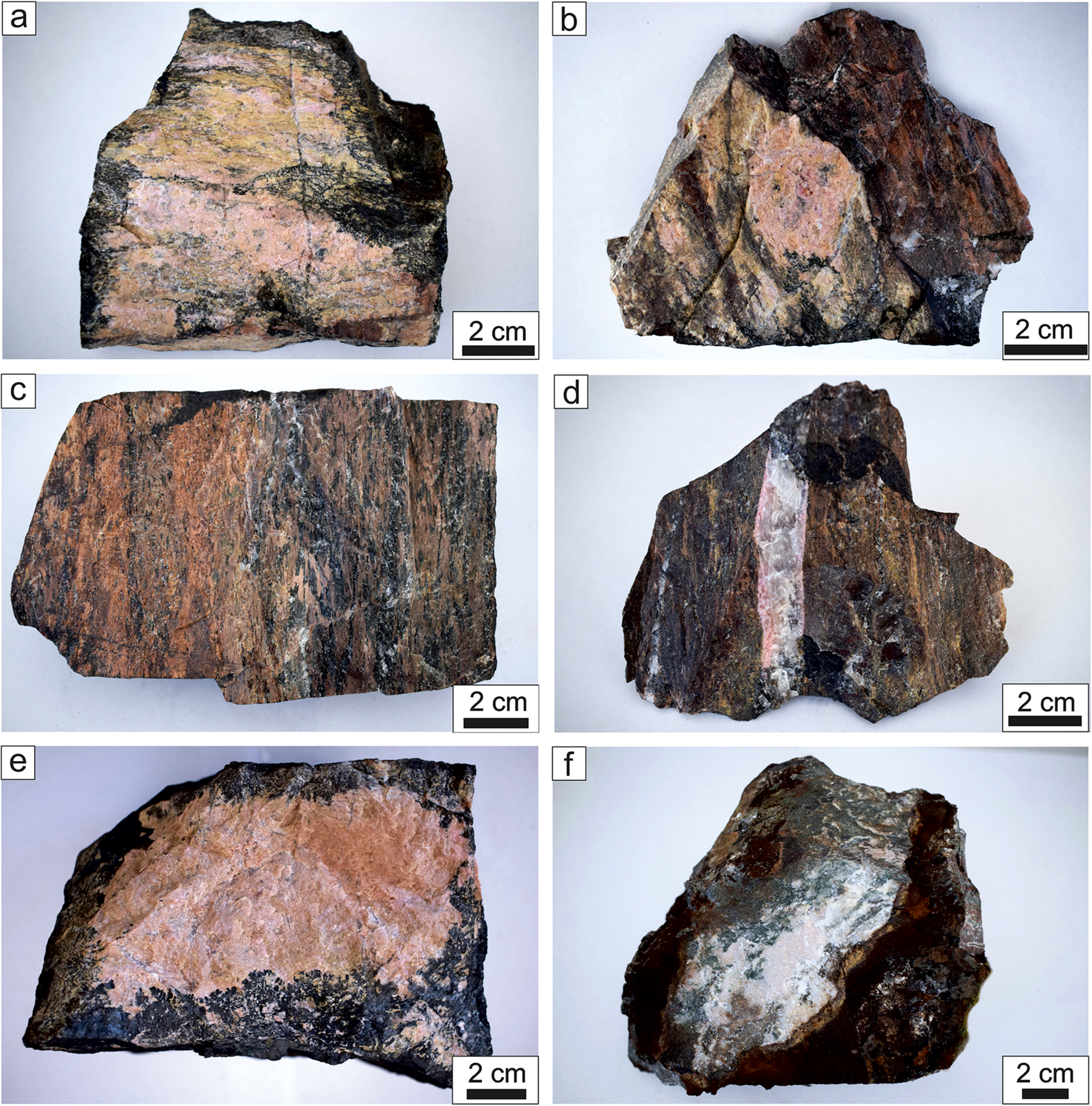
The first type of ore sample is represented by subparallel narrowly laminated quartz-rich rock/metachert composed of 1–3 mm thick bands of yellow, pink, orange, red, green, dark brown toblack alternating with transparent colourless areas (Fig. 2a). The variable colour of these laminated ores is caused by the presence of OH-free and OH-bearing garnets, rhodochrosite, kutnohorite, rhodonite, nambulite, pyroxenes, schallerite, mcgillite, baryte and amphiboles embedded in a quartz matrix. The laminated ore contains small pinkish nodules up to 5 mm in size (Fig. 2b), composed dominantly of rhodonite, rhodochrosite or kutnohorite with minor nambulite overgrown by pyroxenes, locally with orange accumulations and veins composed of pyrosmalite-group minerals. The dark colour of some nodules in the laminated samples is caused by the presence of braunite and hematite accumulations in association with pinkish areas composed of rhodonite, nambulite and pyroxenes with rare sarkinite inclusions (Fig. 2c).
Colour photographs of textures of representative samples of manganese mineralisation from the Diely occurrence: (a) laminated type of Mn ore with yellow (garnet) and pink (rhodonite–rhodochrosite) parts cut by a white quartz vein; (b) nodules of rhodonite–rhodochrosite–schallerite–mcgillite in the laminated type of Mn ore; (c) dark laminated type of manganese ore containing nambulite, braunite and As-enriched minerals; (d) quartz–rhodochrosite vein cutting laminated Mn ore; (e) rhodonite–rhodochrosite accumulation in massive Mn ore; (f) vein of pale pink kutnohorite in the hematite-rich chloritised metabasaltic rock.

The laminated ore is locally transitional to the second type of ore, which can be distinguished by a significant accumulation of Mn silicates and carbonates resulting in the formation of light- to dark-pink rhodonite–rhodochrosite masses, nodules and aggregates with dimension up to 30 cm in diameter (Fig. 2e). This ore type is formed mainly by rhodonite, rhodochrosite, kutnohorite and aggregates of garnets (OH-bearing andradite and grossular). These massive accumulations of manganese minerals, especially rhodonite, were observed to a lesser extent compared to the smaller nodular ones in laminated metachert. Both types of ores are cross-cut by a network of younger, white, orange or black veinlets, up to 2 mm thick, which are composed of variable amounts of quartz, rhodochrosite, kutnohorite, hematite, schallerite, friedelite, brandtite, manganberzeliite, svabite and tiragalloite (Fig. 2d).
The laminated manganese ore continuously transitions into hematite-rich parts at the contact with the laminated chloritised metabasalts host, locally containing veins of white to pinkish kutnohorite up to 0.5 cm thick (Fig. 2f).
Mineralogy of manganese ores
Rhodonite
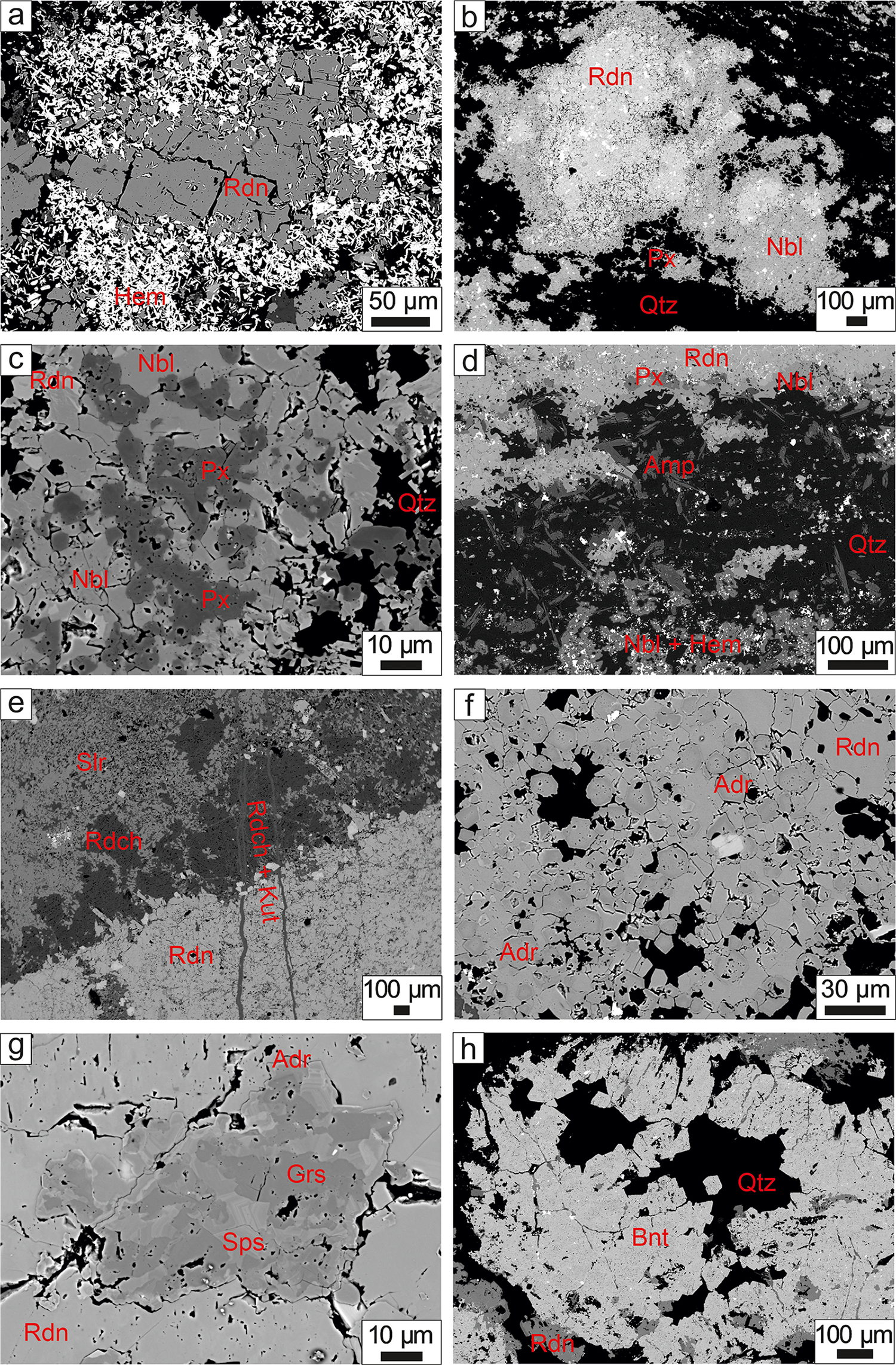
Rhodonite is a very common mineral which occurs both in laminated rocks and in rhodonite–rhodochrosite masses. It forms subhedral crystals up to 0.1 mm, mostly accumulated in up to 1 mm long aggregates in association with quartz, rhodochrosite, kutnohorite, (hydro-)garnets, hematite and friedelite or schallerite (Fig. 3a). In the laminated types of ore, rhodonite is occasionally overgrown by nambulite (Fig. 3b). Rhodonite was confirmed by powder X-ray diffraction (PXRD) analysis. Its composition is relatively homogenous (Table S1) and there are no differences between rhodonite from laminated and massive ores.
BSE images of the major and accessory minerals from the Diely manganese occurrence: (a) rhodonite and hematite in quartz; (b) rhodonite overgrown with nambulite and small inclusions of aegirine and aegirine–augite; (c) aegirine and aegirine–augite overgrown with nambulite; (d) amphiboles in association with quartz, rhodonite, nambulite and pyroxenes; (e) rhodochrosite, schallerite and rhodonite cross-cut by a rhodochrosite–kutnohorite vein; (f) (hydro)andradite in rhodonite matrix; (g) strongly zoned garnet in rhodonite; (h) braunite aggregate in association with quartz and rhodonite in matrix. Symbols from Warr (Reference Warr2021) including: Amp – amphibole; Adr – andradite; Bar – barnesite; Bdt – brandtite; Bnt – braunite; Brt – baryte; Grs – grossular; Hem – hematite; Kut – kutnohorite; Mbzl – manganberzeliite; Mcg – mcgillite; Nbl – nambulite; Px – pyroxene; Qtz – quartz; Rdch – rhodochrosite; Rdn – rhodonite; Slr – schallerite; Sps – spessartine; Srk – sarkinite; Sva – svabite; and Tga – tiragalloite.

The general structural formula of rhodonite-group minerals is VIIM5VIM1VIM2VIM3VIM4(Si5O15), giving the general formula M 5AM 1–3B3C(Si5O15), which is ideally CaMn3Mn(Si5O15) for rhodonite (Shchipalkina et al., Reference Shchipalkina, Pekov, Chukanov, Biagioni and Pasero2019). In rhodonite from the Diely manganese occurrence Mn is a dominant element (up to 4.36 apfu) in the M1, M2, M3 and M4 positions, and is replaced by minor amounts of Ca (0.60–1.09 apfu) in the M5 position (Tab. S1). The rhodonite contains only minor Fe2+ (up to 0.08 apfu) and Mg (up to 0.32 apfu).
Nambulite
Nambulite, ideally LiMn2+4Si5O14(OH), is a relatively rare mineral at the Diely locality; it was identified only in dark-orange laminated ores in close association with rhodonite, locally overgrown by younger aegirine and aegirine–augite (Fig. 4c). It forms subhedral to anhedral crystals which are grouped as aggregates up to 0.5 mm in size embedded in a quartz matrix. The composition of nambulite is homogenous. It consists dominantly of Mn (3.58–3.95 apfu) with an increased content of Ca (0.11–0.34 apfu) and Na (0.03–0.13 apfu) (Table S1). Other minor constituents identified in nambulite are Fe2+ (up to 0.17 apfu) and Mg (up to 0.06 apfu). The calculated content of Li, normalised on the basis of Li + Na = 1 and H = 1 (Matsubara et al., Reference Matsubara, Kato and Tiba1985), reaches values in the range 0.87–0.97 apfu (Table S1). A recent new structure refinement of nambulite confirms homovalent substitution between Li and Na (solid-solution nambulite–natronambulite) which modifies a short hydrogen-bonding system (Nagashima et al., Reference Nagashima, Armbruster, Kolitsch and Pettke2014).
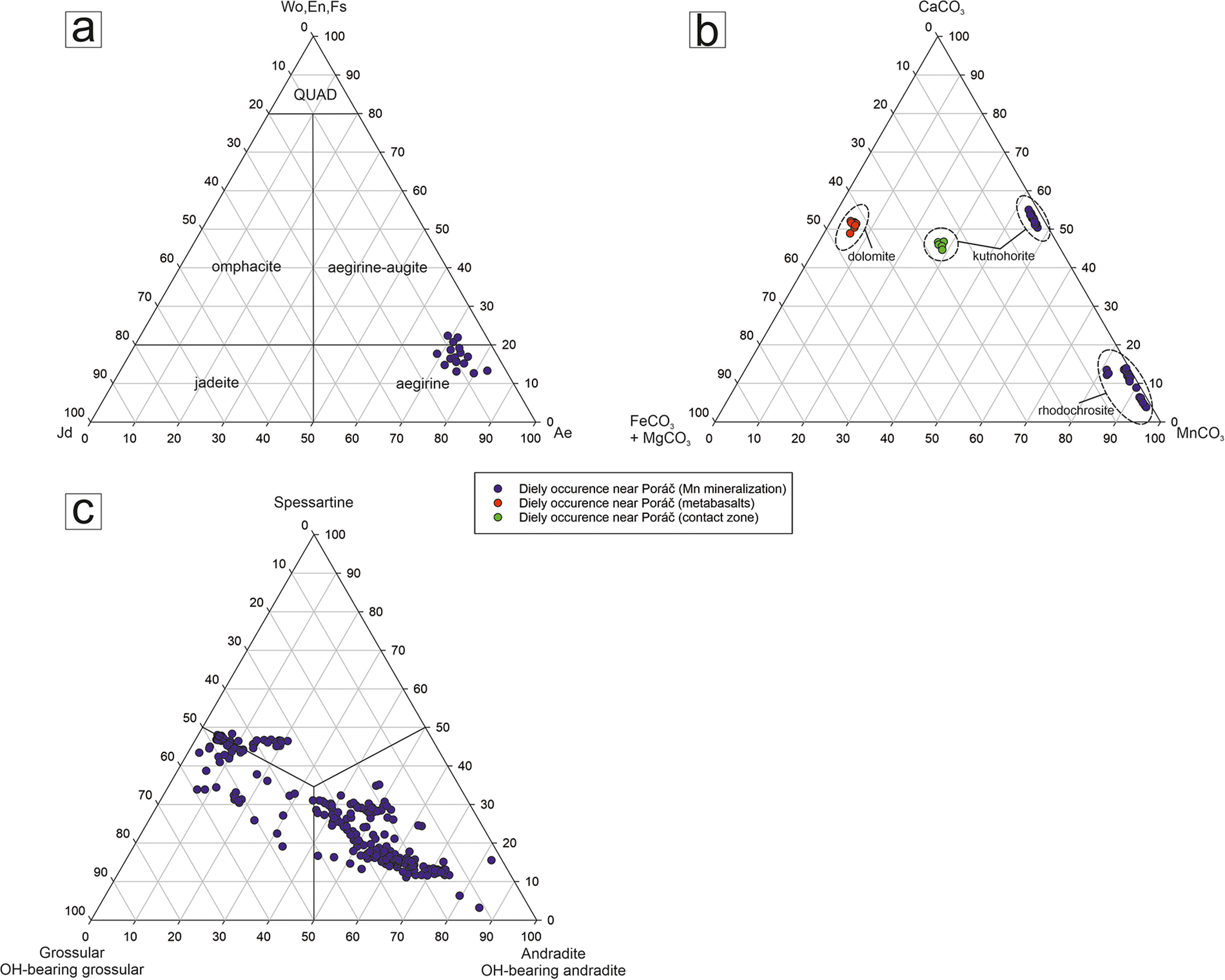
Classification diagrams of minerals embedded in manganese mineralisation at the Diely occurrence; (a) Quad–Jd–Ae triangular diagram of aegirine and aegirine–augite; (b) CaCO3–(MgCO3+FeCO3)–MnCO3 diagram for carbonates; (c) ternary diagram for the garnet–hydrogarnet series.

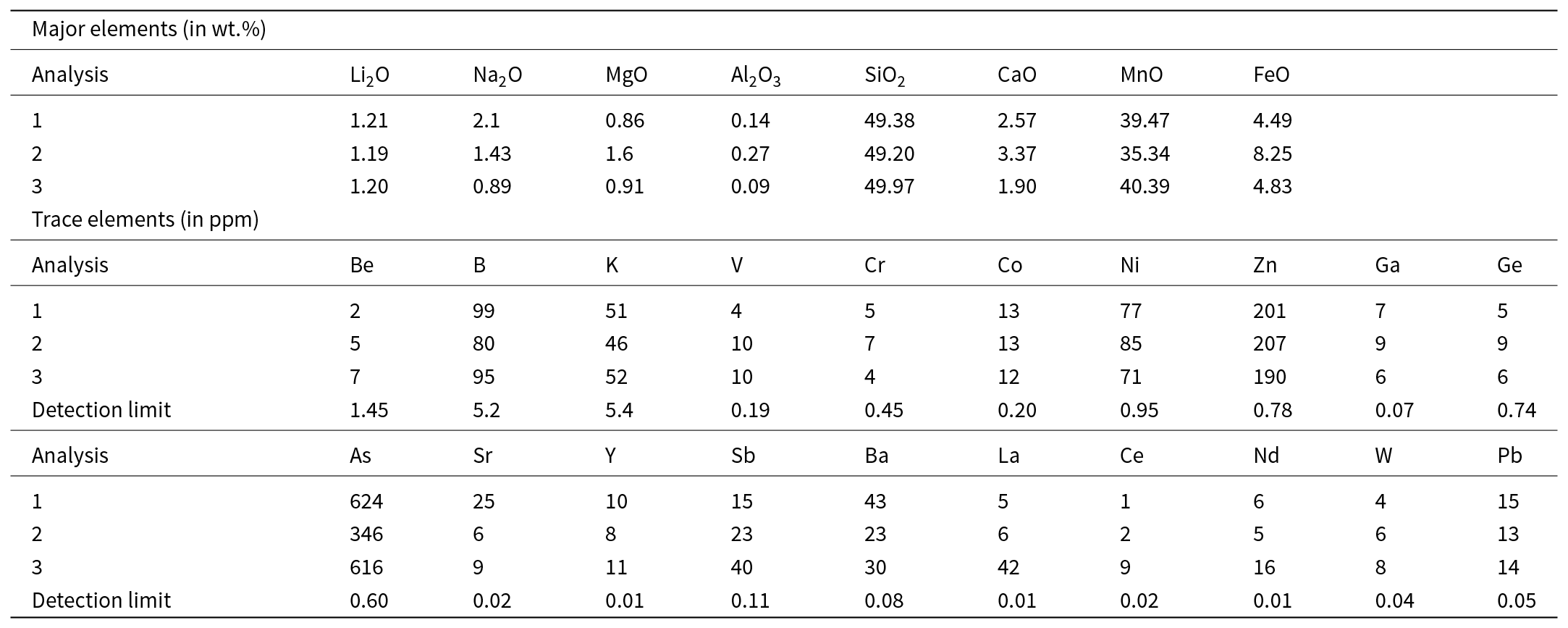
The presence of Li in nambulite was confirmed by LA-ICP-MS analyses however in comparison with the ideal end-member formula the data show increased contents of Na and decreased contents of Li (up to 1.21 wt.%) (Table S1), what corresponds to 0.60–0.83 apfu. This is caused by intimate overgrowths by aegirine and aegirine–augite (Fig. 3c) and therefore an overall relative decrease in Li content. In the LA-ICP-MS data, the contamination from pyroxenes in nambulite data, calculated on the basis of an average Li ratio from EPMA and LA-ICP-MS data is ∼25%. Relatively low values of Na compared to LA-ICP-MS data for nambulite were confirmed by EPMA (Table S1). Higher contents of As (up to 624 ppm), Zn (up to 207 ppm), Ni (up to 85 ppm), B (up to 99 ppm), K (up to 52 ppm) and Ba (up to 43 ppm) were also detected, whereas Be, V, Cr, Co, Ga, Ge, Sr, Y, Sb, La, Ce, Nd, W and Pb only occur in trace amounts (Table 1).
LA-ICP-MS data for nambulite from the Diely Mn occurrence near Poráč.

Aegirine and aegirine–augite
Sodium and Na–Ca pyroxenes occur strictly as isolated subhedral grains up to 10 μm in association with nambulite embedded in dark-orange laminated ores (Fig. 3c). Pyroxenes form continuous solid solutions (Fig. 4a), where the aegirine component prevails over jadeite and quad (quadrilateral Ca–Mg–Fe) components (Table S1). In aegirine–augite, the quad component is slightly increased (20.72–26.12 mol.%), and the jadeite component in both pyroxenes shows a slightly wider range (1.79–13.30 mol.%). In both pyroxenes, contents of Mn (0.07–0.18 apfu) and Mg (up to 0.08 apfu) in the M1 position are increased slightly. In the M2 position, aegirine contains more Na (0.81–0.93 apfu) and less Ca (0.04–0.15 apfu) than aegirine–augite (0.74–0.79 apfu Na, 0.09–0.20 apfu Ca).
Amphiboles
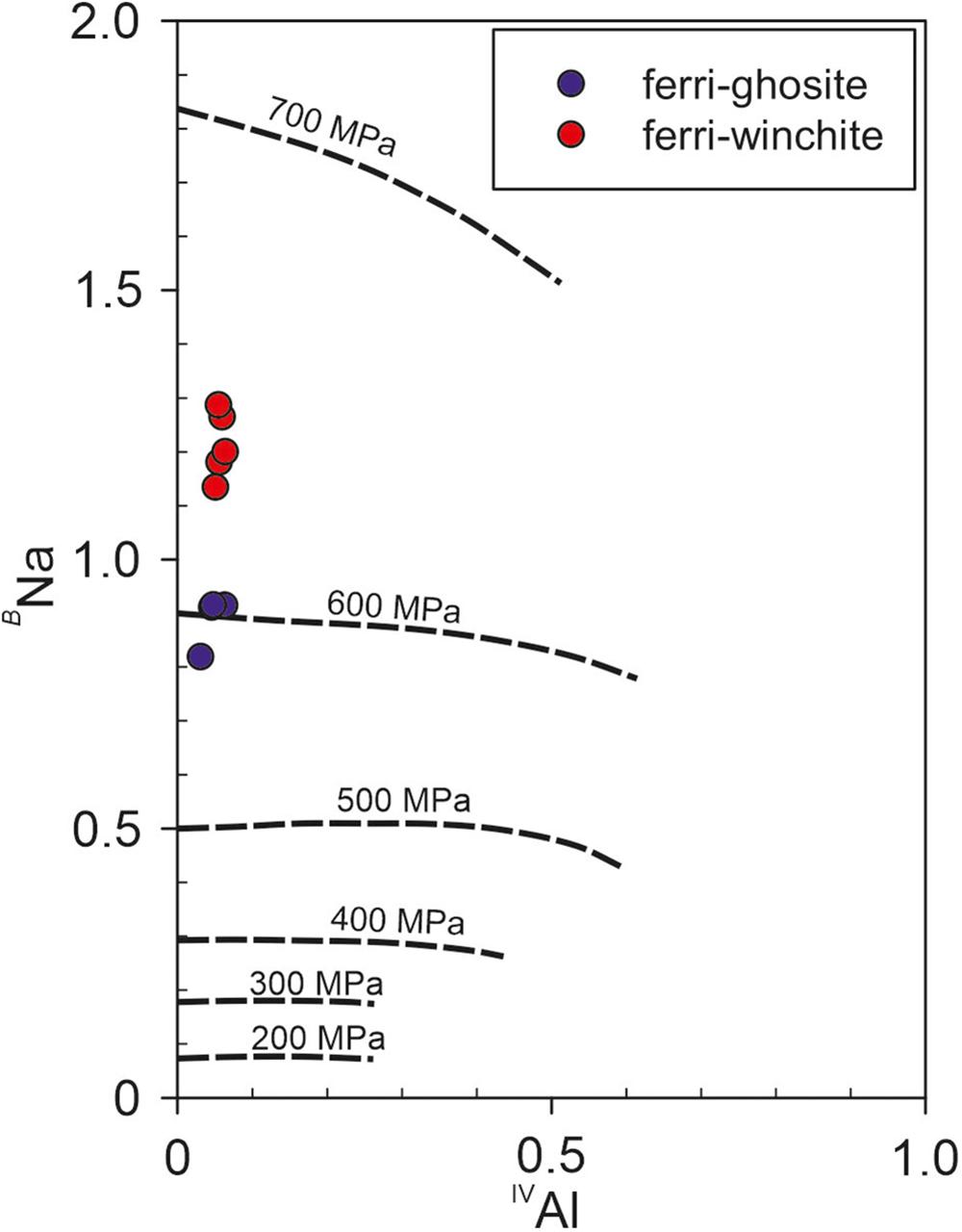
Amphiboles are less common, occurring as isolated flattened elongated crystals or aggregates up to 100 μm in size embedded in rhodochrosite. They were also observed in interstitial areas in rhodonite associated with nambulite, kutnohorite and hematite inclusions (Fig. 3d). In ferri-ghoseite, ideally □(Mn2+Na)(Mg4Fe3+)Si8O22(OH)2, the structural position A dominantly contains vacancies (□) with a minor content of K+. The B position is occupied by Na+ (0.82–0.92 apfu) with higher contents of Mn2+ (0.50–0.67 apfu) over Ca2+ (0.46–0.51 apfu). The crystallographic position C contains dominant Mg2+ (up to 3.97 apfu) with lower contents of Fe3+ (up to 0.83 apfu) and Mn2+ (up to 0.56 apfu) (Table S1). The composition of ferri-winchite, ideally □(NaCa)(Mg4Fe3+)Si8O22(OH)2, differs with a higher BNa+ content (1.18–1.29 apfu), a BCa content with a wider compositional range (0.43–0.67 apfu) and decreased BMn2+ content (up to 0.33 apfu). Position C is similarly occupied dominantly by Mg2+ (3.51–3.65 apfu) with minor Mn2+ (up to 0.70 apfu) and with slightly higher Fe3+ (up to 1.04 apfu). Position A is occupied by vacancies with minor K+ (Table S1).
Carbonates
Carbonates are represented by rhodochrosite and kutnohorite. Rhodochrosite is common together with kutnohorite, a common mineral in manganese nodules and accumulations, although it also occurs in the laminated type of Mn rocks (Fig. 4b). In BSE imaging, neither rhodochrosite nor kutnohorite are compositionally zoned and both are associated generally with rhodonite, (hydro)garnets and hematite (Fig. 3d). Rhodochrosite and kutnohorite also occur in the younger veins, associated typically with schallerite, mcgillite, hematite and quartz (Fig. 3e). In the quartz veins, rhodochrosite forms prismatic crystals, up to 1 cm long (Fig. 2d), or coarse-grained aggregates up to 3 cm.
The composition of rhodochrosite is slightly variable. Rhodochrosite in the matrix shows increased contents of the CaCO3 end-member (up to 14.39 mol.%) and MgCO3 end-member (up to 4.88 mol.%) (Table S1), whereas the younger generation of rhodochrosite in veins has higher content of MnCO3 end-member (up to 96.73 mol.%) and decreased contents of CaCO3 (2.19–6.36 mol.%). The composition of kutnohorite in matrix and veins is very similar (Table S1). Apart from dominant contents of Ca and Mn, only limited concentrations of the dolomite end-member (MgCO3 up to 2.38 mol.%) were observed.
Minerals of the garnet–hydrogarnet series
Garnets are common at the Diely occurrence and have been identified in various morphological habits with different compositions depending on the environment of their local occurrence. The most common are euhedral to subhedral crystals of (hydro)andradite–(hydro)grossular, which are mostly grouped to form accumulations embedded in rhodonite or rhodochrosite (Fig. 3f) in the laminated type of manganese mineralisation. Euhedral crystals typically reach up to 10 μm, exceptionally up to 80 μm. Accumulations of these garnets in the form of yellow to orange fine-grained aggregates can reach dimensions of up to 3 cm. Three types of garnets were distinguished based on their composition.
The first type of garnets is widespread in the laminated type of Mn ore. They are relatively homogenous and consist dominantly of andradite (up to 80.39 mol.%) or OH-bearing andradite (up to 85.14 mol.%), respectively, with slightly increased grossular (up to 40.62 mol.%) and spessartine (34.95 mol.%) end-members. Low analytical totals (96.87–98.98 wt.%) from the EPMA suggest elevated OH contents in the garnet structure with Si ranging between 2.69 and 3.00 apfu (Table S1).
The second type of garnet was identified in the nodules formed dominantly by rhodonite, rhodochrosite, kutnohorite and pyrosmalite-group minerals embedded in the laminated rocks. Garnets show simple bimodal zoning, where central parts are formed dominantly by the OH-bearing andradite end-member (up to 63.98 mol.%) with peripheral parts formed dominantly by the grossular (up to 57.42 mol.%) end-member with increased spessartine end-member (up to 47.37 mol.%). Content of Si in OH-bearing andradite is in the range 2.74–2.93 apfu. The same rule applies to garnets with a dominant spessartine end-member (43.84–47.90 mol.%) in the central parts with increased grossular end-member (32.51–47.60 mol.%) at the peripheral parts (Table S1).
The third type of garnet occurs rarely and it forms very heterogeneous and zoned polycrystalline aggregates of anhedral habit embedded in cracks of rhodonite–rhodochrosite masses (Fig. 3g). The darkest parts observed in BSE imaging are composed dominantly of grossular (37.83–59.12 mol.% Grs end-member) or OH-bearing grossular (46.67–54.04 mol.% Grs end-member) which coexist with slightly brighter zones corresponding dominantly to andradite (42.46–54.71 mol.% Adr end-member). Interstitial spaces are filled with spessartine (up to 48.16 mol.% Sps end-member) (Table S1) with strong concentric zoning. Si in the OH-bearing grossular is in the range 2.83–2.97 apfu (Table S1).
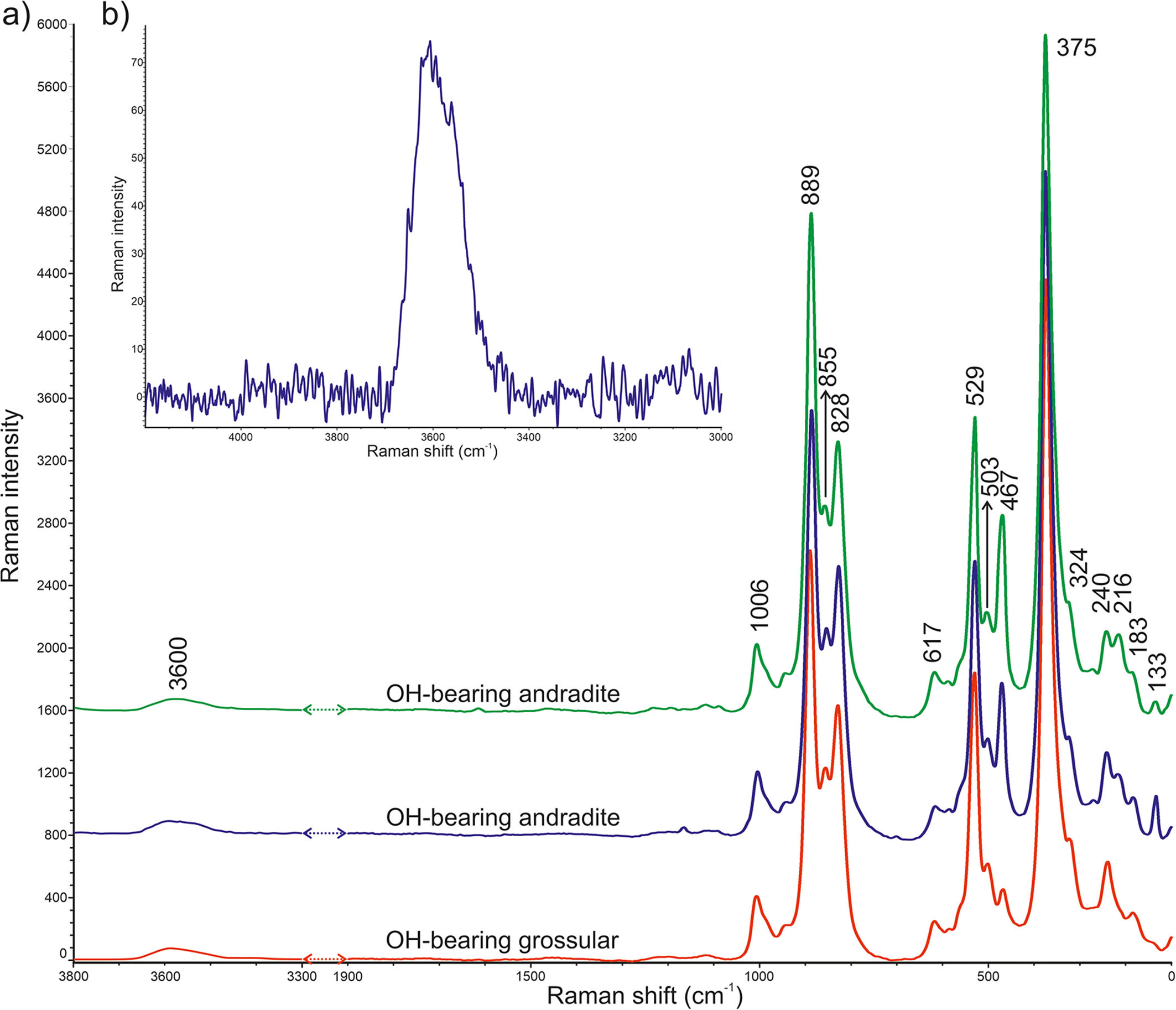
The Raman spectra of the OH-bearing garnets in the andradite–grossular series show main peaks in the range 71–1164 cm–1 assigned to lattice vibrations (below 400 cm–1) and internal Si–O vibrations (above 400 cm–1) (Bersani et al., Reference Bersani, Andò, Vignola, Moltifiori, Marino, Lottici and Diella2009). The region centred at approximately 3588–3607 cm–1 in Fig. 5a. is assigned to an O–H vibration band. Detailed Raman spectra of the latter region centred around 3600 cm–1 shows the presence of broad O–H bands (Fig. 5b). Vibrational bands in the 3580–3610 cm–1 region in OH-bearing andradite and grossular might be assigned to stretching vibrations of the O4H4 tetrahedra (Kolesov and Geiger, Reference Kolesov and Geiger2005). Incorporation of OH– in garnet follows the presence of ‘hydrogarnet’ substitution (O4H4)4– ↔ (SiO4)4–, where (O4H4)4– groups are, according to local configurations, located in Ca3Al2H12O12- and Ca3Fe3+2H12O12-like clusters (Geiger and Rossman, Reference Geiger and Rossman2020). The calculated H2O content from the EPMA data reach values up to 3.26 wt.% in OH-bearing andradite (corresponding to 0.45 OH apfu) and up to 1.85 wt.% in OH-bearing grossular (0.25 OH apfu). Garnets with dominant spessartine composition do not show low compositional totals and therefore they are assumed to contain minute or no OH– (Tab. S1).
(a) Raman spectra of OH-bearing garnets from different samples from the Diely Mn occurrence; (b) detailed Raman spectra in the range 4300–3000 cm–1 of OH-bearing andradite.

Pyrophanite
Pyrophanite is very rare as euhedral grains up to 10 μm associated with hematite in the laminated type of ore. Its composition has a wide range, where the pyrophanite end-member prevails (59.72–93.61 mol.%), with variable ilmenite end-member (6.34–40.16 mol.%) and minor geikielite end-member up to 0.99 mol.% (Table S1).
Pyrosmalite-group minerals
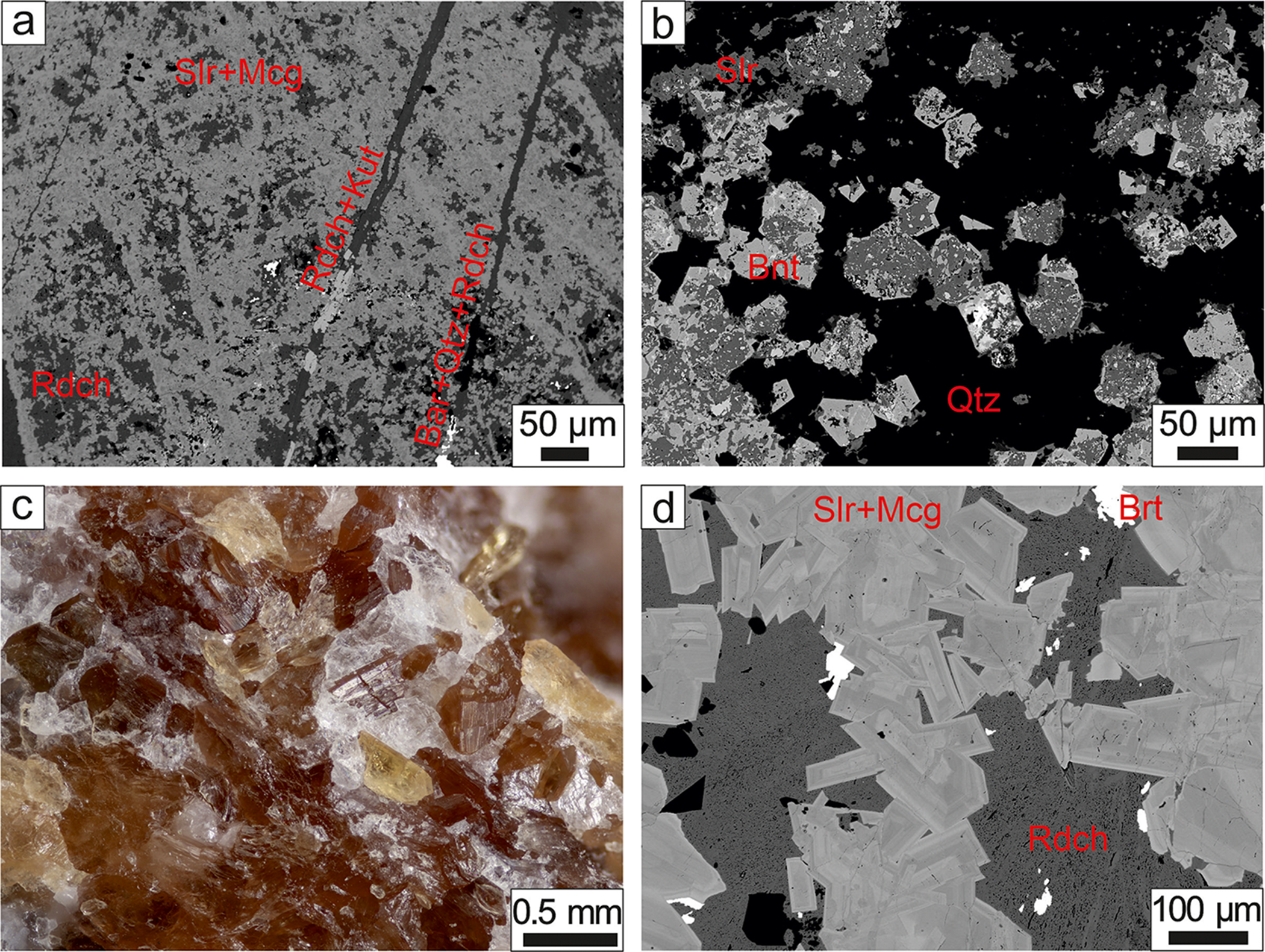
The most frequently occurring As-rich minerals at the Diely occurrence near Poráč are members of the pyrosmalite group, represented dominantly by schallerite, mcgillite and rarely friedelite. Pyrosmalite-group minerals were identified as accumulations embedded in matrix (Fig. 6a), locally overgrown by braunite crystals (Fig. 6b). However, more commonly they occur in the veins in the form of light- to dark-orange euhedral crystals up to 4 mm in size (Fig. 6c) and aggregates (Fig. 6d) with rhodochrosite, quartz and baryte. Strong oscillatory zoning observed in BSE images is caused by the presence of dark-grey mcgillite continuously grading into the lighter schallerite; rarely, grey friedelite occurs.
Pyrosmalite-group minerals: (a) an accumulation of pyrosmalite-group minerals in matrix cross-cut by rhodochrosite–kutnohorite veins; (b) schallerite overgrown by braunite; (c) microphotograph of pale yellowish schallerite–mcgillite grains embedded in rhodochrosite–quartz vein; (d) schallerite–mcgillite crystals with distinct zoning associated with rhodochrosite and baryte. Symbols in Figure 3.

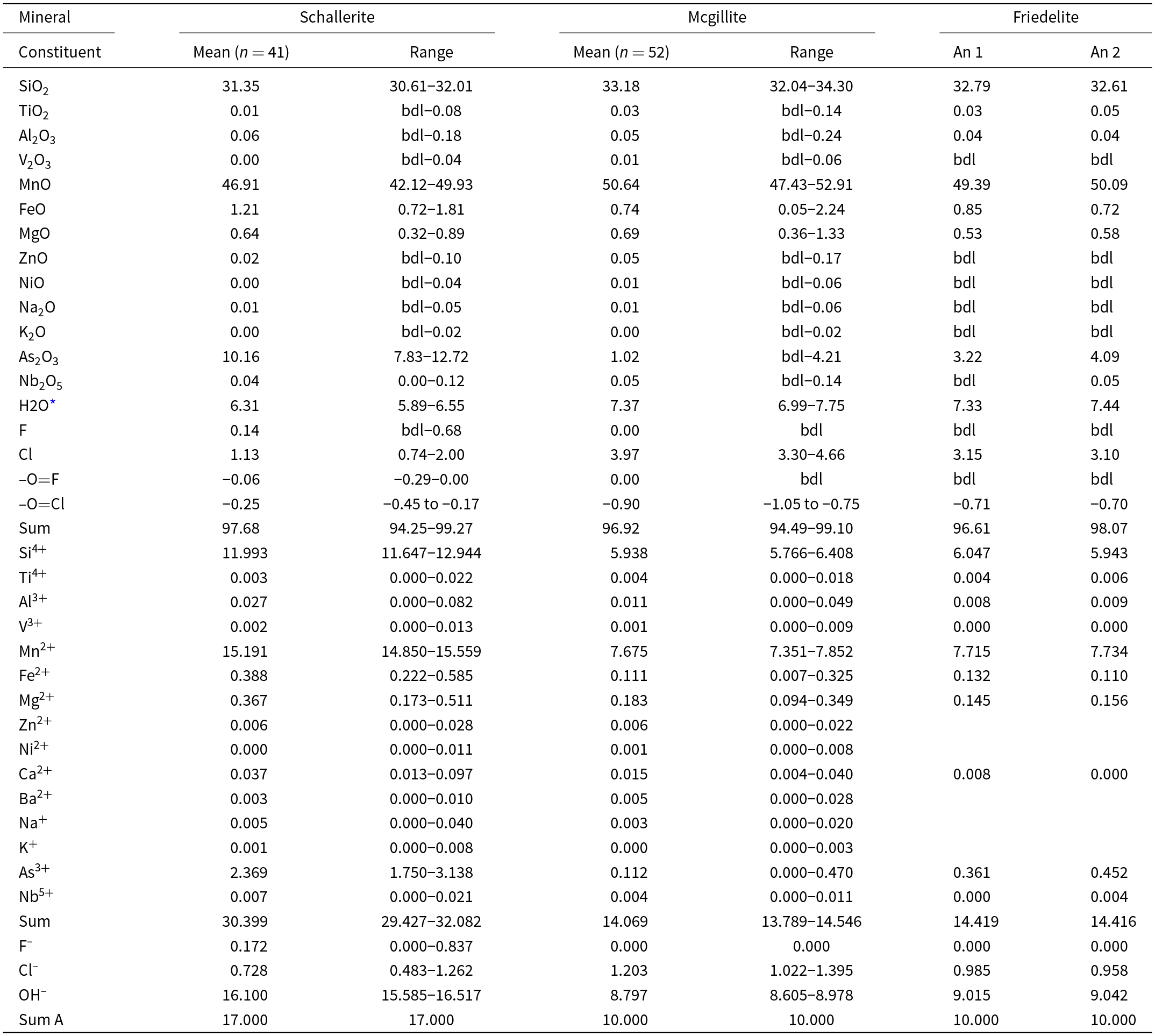
The empirical formula of schallerite was calculated on the basis of 16 octahedrally coordinated cations (Dunn et al., Reference Dunn, Peacor, Nelen and Norberg1981). The content of Mn in schallerite is low (14.85–15.56 apfu) compared to the ideal formula [Mn2+16As3Si12O36(OH)17], which is compensated by enrichment in Fe2+ (0.22–0.59 apfu) and Mg (0.17–0.51 apfu). The presence of As3+ in the samples varies considerably from 1.75 to 3.14 apfu and Si contents are in the interval of 11.65 to 12.94 apfu (Table 2). Characteristics are relatively high contents of Cl– (0.48–1.26 apfu) dominantly bound in the structure compared to the more minor F– (up to 0.84 apfu).
Representative compositions from EPMA (in wt.%) and corresponding calculated empirical formulae of pyrosmalite-group minerals from the Diely Mn occurrence near Poráč.

The compositional formulae of schallerite was calculated on the basis of 16 octahedrally coordinated cations and the formulae of mcgillite and friedelite on the basis of 8 octahedrally coordinated cations.
* Calculation of H2O from (OH)–; bdl – below detection limit.
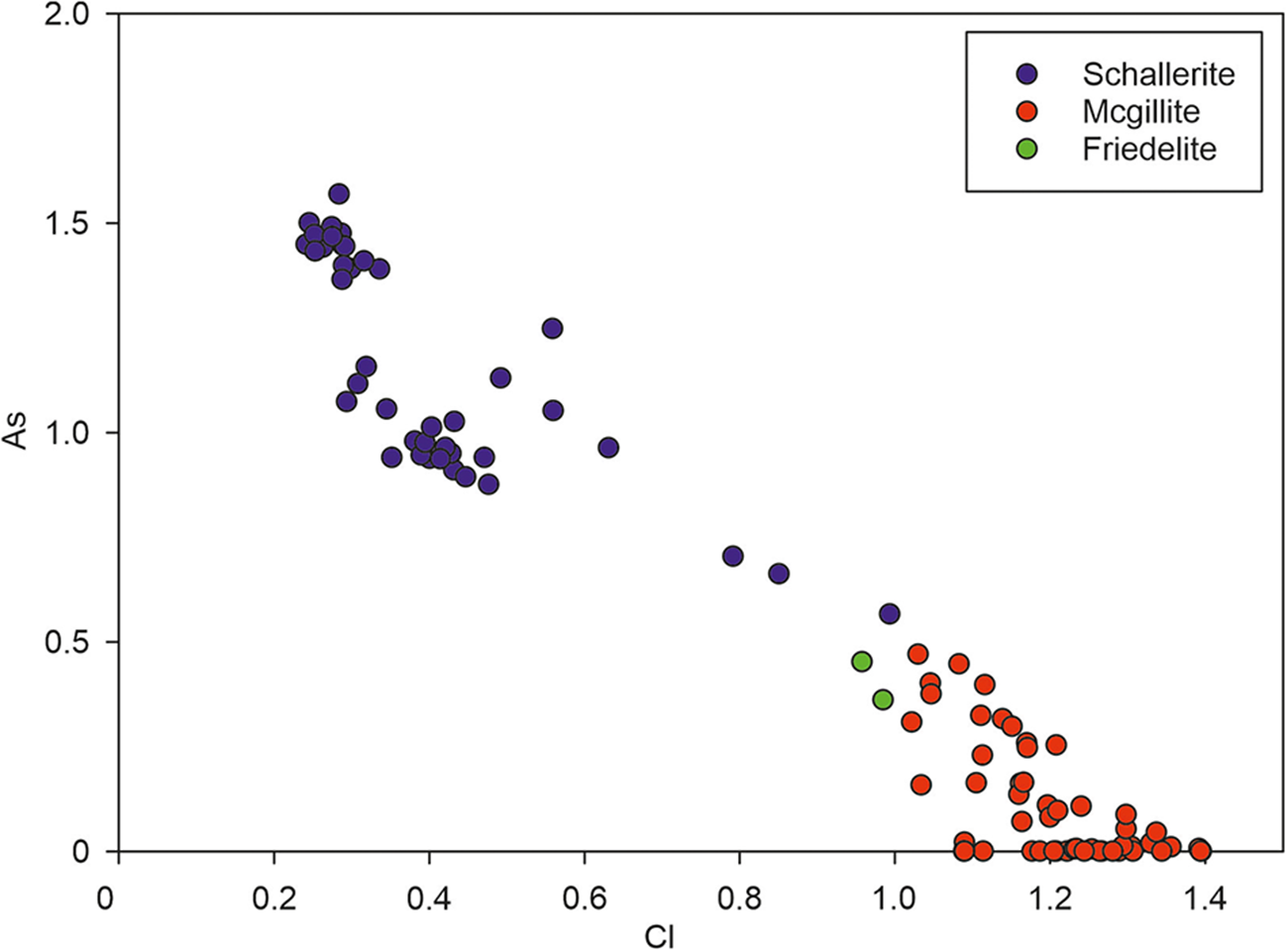
The empirical formulae of mcgillite and friedelite were calculated on the basis of 8 octahedrally coordinated cations (Donnay et al., Reference Donnay, Bétournay and Hamill1980). Mcgillite consists dominantly of Mn (7.35–7.85 apfu) with minor Mg (up to 0.35 apfu), Fe2+ (up to 0.33 apfu) and Zn, Ni, Ca, Ba, Na, K (up to 0.04 apfu) compared to ideal formula. It is enriched in As3+ (up to 0.47 apfu) with notable Cl– content (1.02–1.40 apfu) (Table 2). The composition of rare friedelite was verified by two electron probe micro-analyses which showed increased As3+ content (0.36–0.45 apfu) and decreased Cl– content (0.96–0.99 apfu) compared to mcgillite (Table 2).
In order to facilitate comparison with data for friedelite and mcgillite, the data of schallerite were recalculated on the basis of 8 octahedrally coordinated cations in order to fit numerically into the classification diagram. The composition of the three minerals of the pyrosmalite group (Table 2) indicate a negative correlation between As and Cl (OH respectively). A Cl-versus-As diagram (Fig. 7) illustrates the substitutional mechanism suggested by Dunn et al. (Reference Dunn, Peacor, Nelen and Norberg1981) that adheres to known structural relations and keeps charge balance between these studied pyrosmalite-group minerals, proposed as 2□ + 6(OH) ↔ 3[As3O6(OH)3].
Compositional data of pyrosmalite-group minerals from EPMA for the Diely occurrence showing Cl vs. As.

Braunite
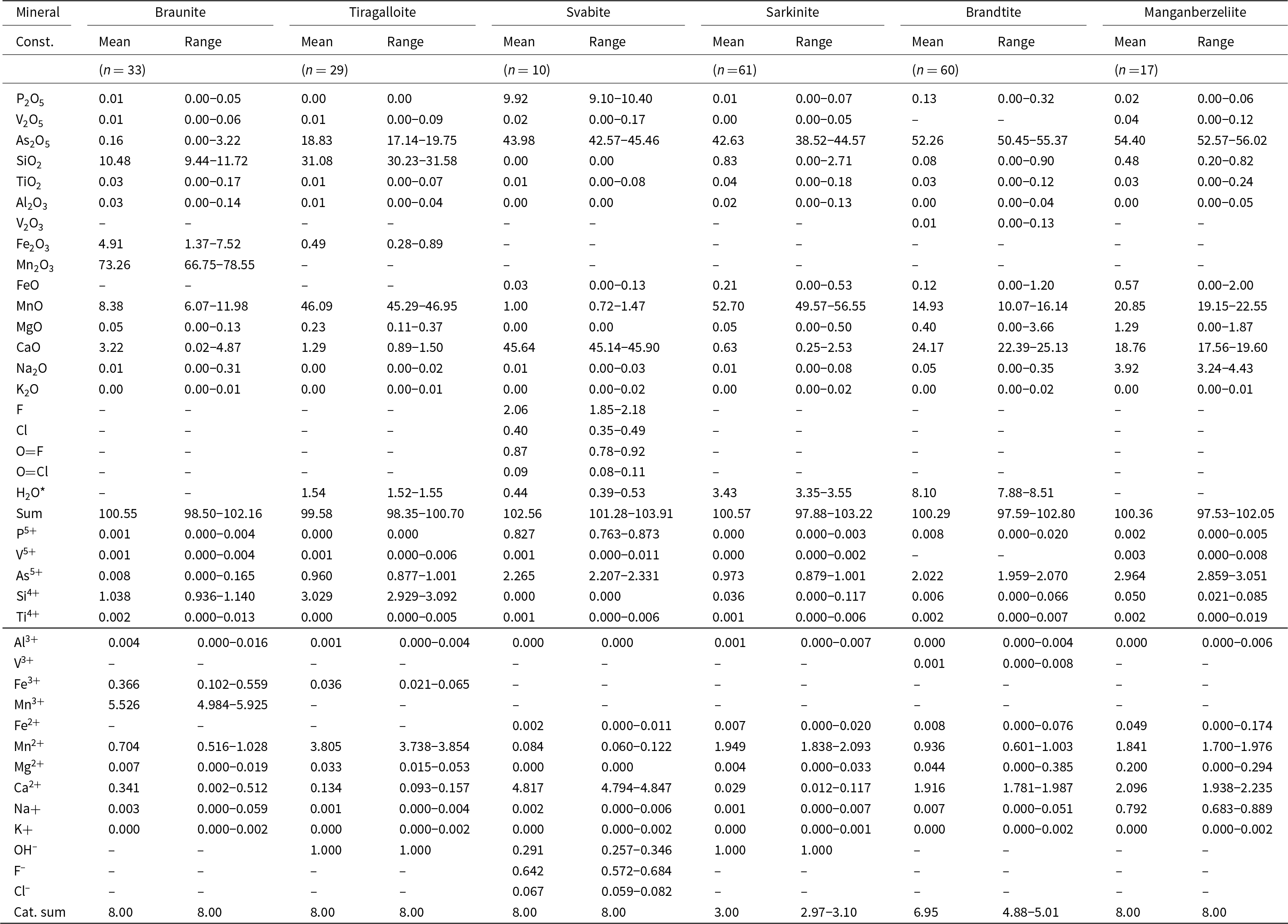
Braunite is an abundant mineral in the laminated type of manganese ore. It forms nodules up to 5 mm in diameter associated dominantly with rhodonite, rhodochrosite, hematite and quartz with minor minerals of the pyrosmalite group and sarkinite. Macroscopically it is the cause of the brownish to black colour of manganese ore and imparts a steel-grey metallic lustre. Braunite forms euhedral to subhedral tetragonal crystals up to 0.2 mm in size which are grouped mostly as monomineralic aggregates (Fig. 3h). The composition of braunite shows manganese as a dominant element (up to 5.93 apfu Mn3+ and 1.03 apfu Mn2+). Two analyses (Table S1, an32 and an33) gave a Ca2+ content slightly higher than 0.5 apfu, however the Mn2+/(Mn2+ + Ca) ratio is in the range 0.51–0.60, which corresponds to braunite. Silicon is in the range 0.94–1.14 apfu and there is a slightly increased As (up to 0.17 apfu) in some samples (Table 3).
Tiragalloite
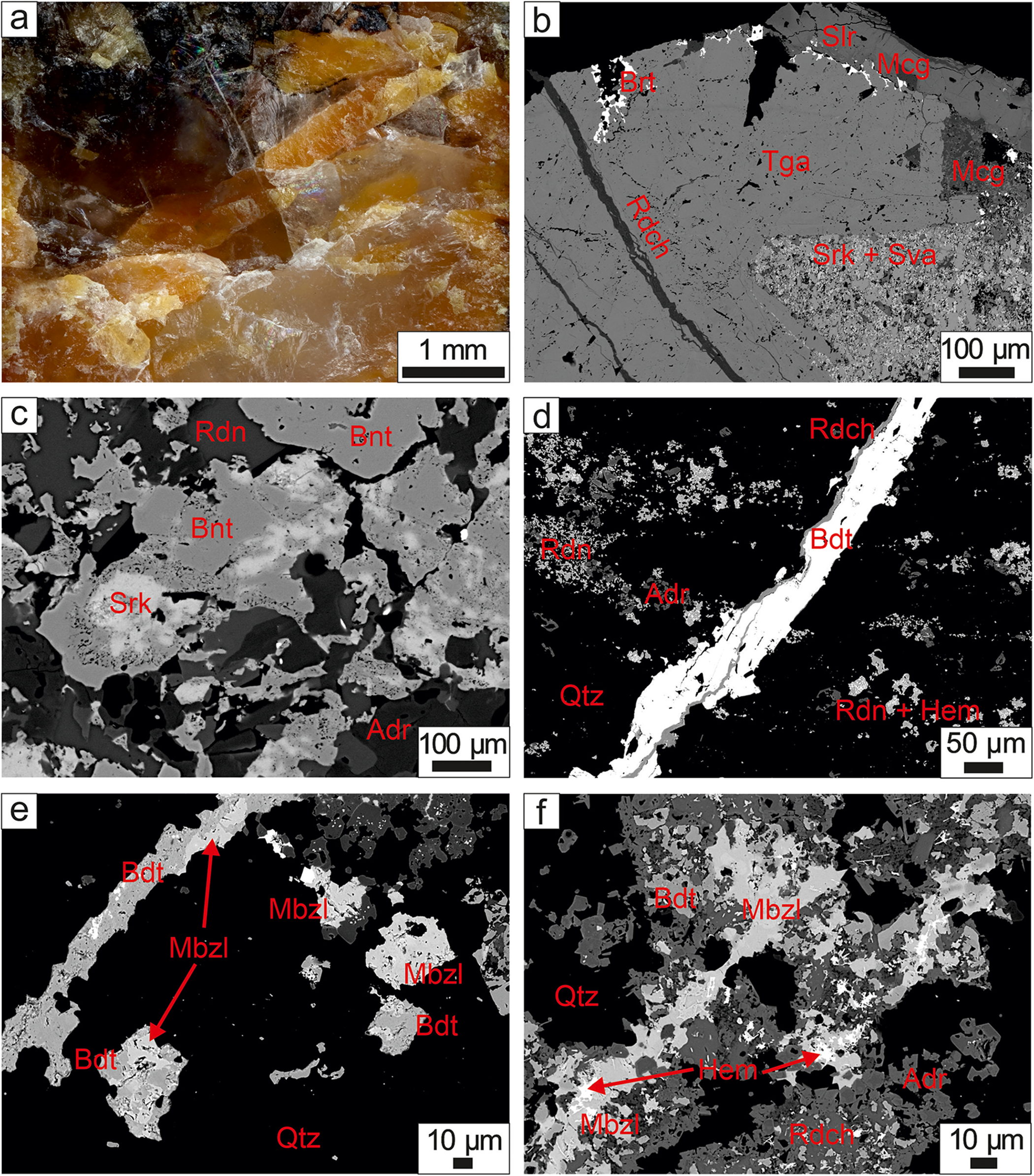
Tiragalloite was observed in younger veins where it is associated with quartz, sarkinite and svabite. It forms flat elongated euhedral crystals of orange colour up to 3.5 mm in size (Fig. 8a). It also appears in the vugs in the rhodonite matrix as isolated subhedral grains, rarely grouped to form bigger accumulations (Fig. 8b). Grains reach sizes up to 20 μm and are associated usually with braunite, quartz, rhodonite and baryte in the laminated type of manganese ore. The average composition of tiragalloite (n = 18) is given in Table 3, where the total (Si+As+V) content based on average composition is 3.98 apfu and Mn2+ reaches values in the range 3.46–4.00 apfu with slightly increased content of Na+ (up to 0.24 apfu), Ca2+ (up to 0.21 apfu) and Fe3+ (up to 0.20 apfu) (Tab. 3). As5+ is in the range 0.59–1.00 apfu. V5+ contents did not reach values higher than 0.01 apfu. Apart from Si > 3 apfu (up to 3.34 apfu), tiragalloite also contains Al3+ up to 0.12 apfu (Table 3), which supports the assumption that one of the T sites is occupied by pentavalent cations with contributions of Si4+ (or Al3+, respectively) in order to fill the central T site in the (As,V,P)O5 tetrahedron as suggested by Nagashima and Armbruster (Reference Nagashima and Armbruster2010).
Compositional formulae of braunite, tiragalloite, manganberzeliite and svabite calculated on the basis of 8 cation, sarkinite on the basis of 9 negative charges and brandtite on the basis of 10 O atoms per formula unit. In tiragalloite and sarkinite H2O is calculated assuming OH=1 apfu, in brandtite on the basis of 2 H2O, in svabite on the basis (OH+F+Cl)=1 apfu.

Svabite
Svabite, the As-analogue of fluorapatite, is a rare mineral found in the younger quartz veins with tiragalloite, intimately intergrown with sarkinite and minor rhodochrosite. Anhedral grains of svabite reach up to 50 µm in size and are grouped in bigger aggregates (Fig. 8b). The M site (Table 3) is occupied dominantly by Ca2+ (up to 4.85 apfu) with only minor Na and K incorporation. Locally slightly increased contents of Mn2+ (up to 0.12 apfu) were also observed. The T site is mostly filled by As5+ (up to 2.33 apfu) with elevated contents of P5+ (up to 0.87 apfu). In the monovalent anion site F (0.57–0.68 apfu) prevails over OH (up to 0.35 apfu) and Cl (up to 0.08 apfu). Svabite from the Diely occurrence shows increased contents of P2O5 (up to 10.40 wt.%; 0.87 apfu P5+, respectively), reflecting a As5+ ↔ P5+ substitution.
As-rich minerals: (a) orange tiragalloite crystals in a quartz–rhodochrosite vein; (b) a tiragalloite crystal with sarkinite (light grey) and svabite (dark grey) cut by the youngest rhodochrosite vein in an older schallerite–mcgillite vein; (c) sarkinite intergrowths with braunite in rhodonite matrix; (d) thin brandtite vein with younger rhodochrosite vein cutting the laminated type of Mn ore; (e) intergrowths of brandtite and manganberzeliite overgrowing in the vugs and veins of Mn ore; and (f) manganberzeliite vein with brandtite and hematite in association with quartz, rhodochrosite and andradite in the matrix. Symbols in Figure 3.

Sarkinite
Sarkinite was identified in the laminated type of Mn ore, dominantly in association with braunite. The first type of sarkinite was identified as isolated subhedral crystals up to 100 μm in size which crystallised in the interstitial areas in the laminated ore type. The second type of sarkinite is intergrown with svabite (Fig. 8b) or with braunite crystals and aggregates, where it forms inclusions up to 30 μm in size (Fig. 8c). Inclusions and crystals of sarkinite show no zoning. Its composition is close to the ideal composition, with slightly increased content of Fe2+ (up to 0.02 apfu) (Table 3). The mineral investigated has no distinct green and yellow pleochroism in polarised light (Hålenius and Westlund, Reference Hålenius and Westlund1998), hence we excluded the presence of eveite at the studied locality.
Brandtite
Brandtite was identified in multiple samples where it occurs dominantly as thin veins cross-cutting the laminated type of ore (Fig. 8d). Only in one case was brandtite also identified as anhedral grains up to 40 μm associated with manganberzeliite (Fig. 8e, f). The composition of brandtite (Table 3) shows high variability of Ca (1.78–1.99 apfu), Mn (0.60–1.00 apfu) and Mg (up to 0.39 apfu) contents. The latter reflects a solid solution with wendwilsonite [Ca2Mg(AsO4)2·2H2O].
Manganberzeliite
Manganberzeliite occurs rarely and it was identified in only one sample. It forms isolated anhedral grains up to 50 μm in diameter (Fig. 8e) or thin veins (Fig. 8f), which occur within the laminated type of ore. It is associated closely with brandtite and minor hematite. The composition shows small deviations in contents of Ca (1.94–2.36 apfu) and Na (0.68 0.89 apfu) at the X site. The Y site dominantly contains Mn (1.70–1.98 apfu) with minor Mg (up to 0.29 apfu) and Fe2+ (up to 0.17 apfu). The Z site is occupied dominantly by As5+ (2.86–3.05 apfu) (Table 3).
Mineralogy of the contact zone of manganese ores with metabasalts and associated volcanoclastics
The manganese ore mineralisation associated with metacherts is hosted in strongly chloritised metabasalts and its tuffs, and a continuous transition between the siliceous Mn mineralisation and associated rocks can be observed. Macroscopically metabasaltic rocks have a laminated appearance with a light to dark greenish colour. They consist primarily of chlorite, albite and dolomite with minor quartz and hematite inclusions. Chlorites are represented by clinochlore with a dominant content of Mg (2.33–2.70 apfu) over Fe2+ (1.83–2.28 apfu), and minor content of Mn (up to 0.23 apfu). Albite occurs as a nearly pure end-member with a composition consisting dominantly of the albite end-member (99.48–99.95 mol.%) with very minor anorthite and orthoclase components (up to 0.39 mol.%). Dolomite was identified with increased contents of FeCO3 (8.27–16.46 mol.%) and MnCO3 (4.46–6.13 mol.%) end-members. Closer to the contact of metabasalts with the siliceous manganese ore mineralisation, the content of Mn in the carbonates rises. In this area kutnohorite was observed, with a dominant MnCO3 component (26.50–34.18 mol.%) prevailing over the MgCO3 component (13.15–17.23 mol.%) (Table S1).
Discussion
Paragenetic relationships and crystallisation sequence of minerals
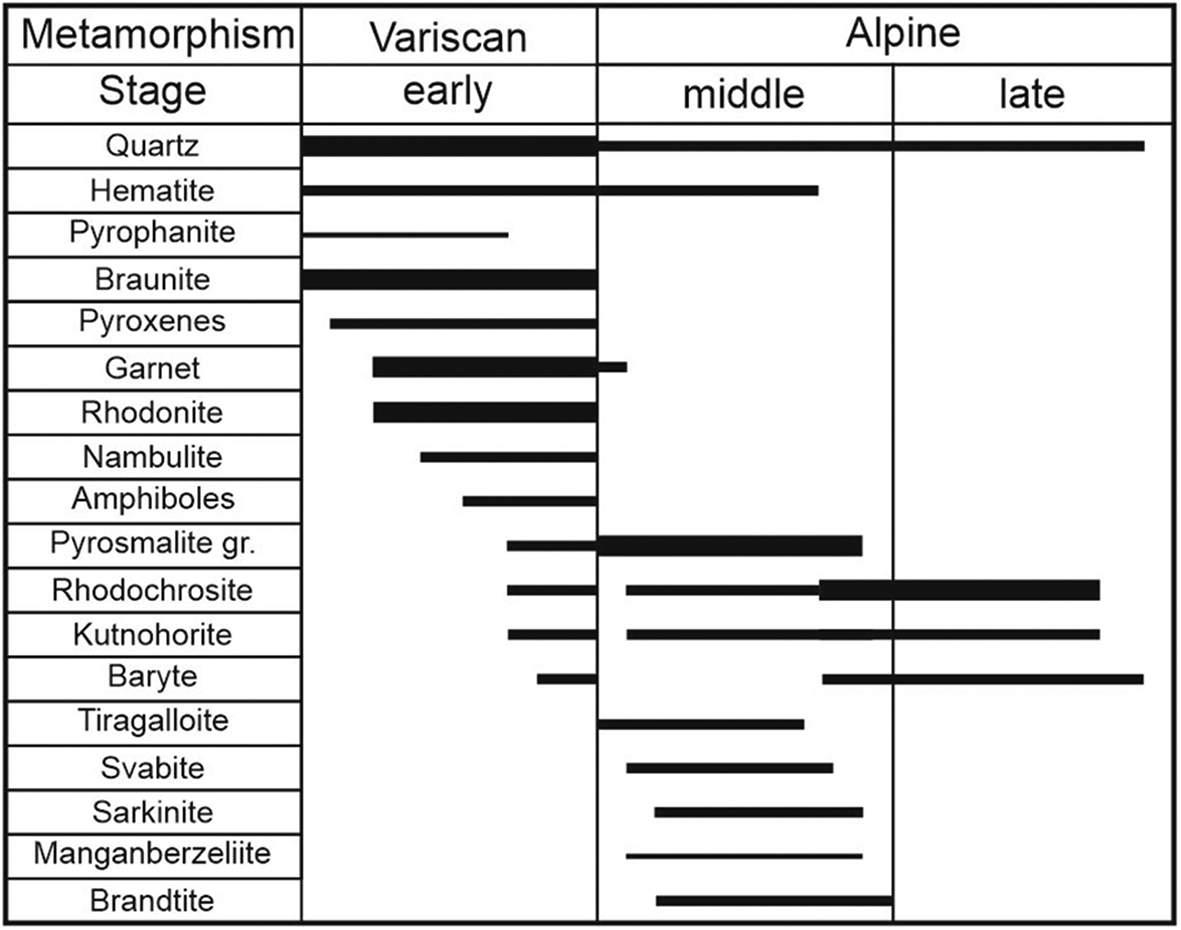
According to paragenetic and compositional observations, three main mineralisation stages have been distinguished at the locality studied (Fig. 9):
Mineral paragenesis chart for all the minerals identified in the As-rich manganese mineralisation from the Diely occurrence, assigned to metamorphic events with distinguished formation stages. The line thickness represents abundance in the manganese ore.

(1) The early stage is represented by minerals developed in accordance with the layering of the rocks, forming massive accumulations of quartz, rhodonite, rhodochrosite, kutnohorite, garnets, baryte, hematite and braunite with minor nambulite, Na/Na–Ca pyroxenes, amphiboles and pyrophanite ± pyrosmalite-group minerals. Minerals occur in the siliceous laminated type of manganese ore with local accumulations of pink masses of rhodonite-carbonate-garnet. These minerals were generated from precursor mineral assemblages with slightly elevated arsenic contents as products of prograde Variscan metamorphism in the gradual increasing pressure–temperature conditions.
(2) Minerals of the middle stage are represented by an As-rich mineral assemblage cross-cutting the rocks, non-parallel to layering, embedded in veins and cavities, consisting dominantly of schallerite, mcgillite, friedelite, brandtite, manganberzeliite, tiragalloite, sarkinite and svabite with minor hematite, quartz, rhodochrosite and kutnohorite. These minerals were generated during the decrease in pressure–temperature conditions by hydrothermal fluids released into the metamorphic system during the Alpine tectonometamorphic event.
(3) The late-stage minerals are represented by rhodochrosite–kutnohorite and quartz veins that cross-cut the first- and second-stage minerals. In addition, baryte was observed in the interstitial places of pyrosmalite-group minerals and therefore it is considered to be part of the youngest minerals remobilised during the late stage of the Alpine tectonometamorphic event.
Mineral composition of manganese ore and its comparison with localities in the Alpine–Carpathian area
The complex assemblage of manganese minerals at the Diely manganese occurrence near Poráč indicates that mineralisation is strongly dependent on the composition of manganese ore and associated rocks, concentration of oxygen and sulfur in pore solutions and subsequent effects of metamorphic pressure–temperature conditions. The dominant ‘oxidic’ mineral assemblage consisting of braunite, rhodonite, hematite and quartz is assumed to have high oxygen fugacity (Mottana, Reference Mottana1986), which can be sustained by the absence of organic matter, accumulation of precursor Mn oxides and hydroxides in the pre-metamorphic manganese accumulations and a relatively closed metamorphic system during the initial stages of formation of the mineralisation (Brusnitsyn, Reference Brusnitsyn, Starikova and Zhukov2017). The higher variability in mineral composition of manganese deposits is dependent on metamorphism and capacity of fluids to homogenise the overall  ${f_{{{\text{O}}_2}}}$ (Abs-Wurmbach and Peters, Reference Abs-Wurmbach and Peters1999). The most significant attribute of the manganese mineralisation is the abundance of quartz in the system, associated with hematite and braunite representing the common constituents generated at the early stages of ore formation with high stability during the metamorphic overprint. Braunite forms during the diagenesis or early metamorphic stages via reaction of Mn oxide–hydroxide phases with silica gels (Mottana, Reference Mottana1986). It is important to emphasise that the lack of sulfides in the manganese ore at this locality indicates low activity of sulfur in the pore solutions (Brusnitsyn, Reference Brusnitsyn2007) with sulfur being incorporated preferentially as S6+ into baryte.
The mineral composition of manganese ore identified at the Diely occurrence differs from those identified at the other localities in the Western Carpathian region. The most significant attribute is abundance of quartz, in contrast to the carbonate–silicate lenses composed dominantly of rhodonite and Mn-carbonates, characteristic for the other localities. Garnets from these localities are dominantly represented by spessartine (e.g. up to 84 mol.% in Čučma–Čierna baňa reported by Faryad, Reference Faryad1994; 84–95 mol.% in Betliar reported by Myšľan et al., Reference Myšľan, Števko and Mikuš2023). Garnets from the Diely occurrence near Poráč show an extended substitution series between the end-member components (Fig. 4a, Table S1) with dominant andradite and grossular end-members. An important feature is the presence of the OH– component in andradite and grossular (Fig. 5), which is formed within wide ranges of temperature, pressure and oxygen fugacity (Onuki et al., Reference Onuki, Akasaka, Yoshida and Nedachi1982). However, the large stability ranges of (hydro)garnets are problematic for evaluation of metamorphic conditions. The occurrence of andradite indicates low  ${f_{{\text{C}}{{\text{O}}_2}}}$ in the mineral-forming solutions (Brusnitsyn, Reference Brusnitsyn2007). The mineralisation contains rare nambulite, which has been questionably described at the locality Čučma–Čierna baňa by Peterec and Ďuďa (Reference Peterec and Ďuďa2003) based on incomplete analyses such as convincing confirmation of Li contents. Furthermore, the source of Na in manganese ore (Na/Na–Ca pyroxenes and amphiboles) has various explanations (Kolitsch et al., Reference Kolitsch, Schachinger and Auer2018) such as Na derived from the Na-rich precursor phases represented by nontronite, birnessite or vernadite (Brugger and Gieré, Reference Brugger and Gieré2000) or its addition by metasomatic processes (Mottana, Reference Mottana1986). However, Na/Na–Ca pyroxenes and amphiboles in associated rocks of the Rakovec Group occur due to their different metamorphic conditions during the geological environment formation. The absence of sulfidic mineralisation compared to other localities in the Western Carpathian region is a distinctive feature of the Diely occurrence.
The association of braunite alongside arsenosilicates and arsenates such as tiragalloite, brandtite, manganberzeliite and sarkinite at the locality represent a first occurrence in the Western Carpathian area. These minerals were recently identified at numerous Mesozoic localities in the Alps region, for example in Fuchs Alps (Kolitsch et al., Reference Kolitsch, Schachinger and Auer2021; Reference Kolitsch, Schachinger and Auer2023) and Tyrol (Albrecht, Reference Albrecht1990; Kolitsch et al., Reference Kolitsch, Schachinger and Auer2017) in Austria, at localities Val Gravelia (Gramaccioli et al., Reference Gramaccioli, Griffin and Mottana1980) or Cassagna Mine (Castellaro et al., Reference Castellaro, Passarino, Kampf and Esposito2021) in Liguria, Lower Scerscen Glacier in Lombardy (Marchesini et al., Reference Marchesini, Foianini, Foianini and Appiani2022) or Varenchce mine in Aosta Valley (Barresi et al., Reference Barresi, Kolitsch, Ciriotti, Ambrino, Bracco and Bonacina2005) in Italy and from the Neoproterozoic to Lower Palaeozoic Eastern Carpathian area such as Razorae (Hirtopanu and Udubasa, Reference Hîrtopanu and Udubaşa2015) or Iacobeni (Hirtopanu, Reference Hîrtopanu1997) deposits in Romania. Svabite occurs rarely and only a few occurrences of svabite in manganese occurrences at Jakobsberg mine in Sweden have been reported by Biagioni et al. (Reference Biagioni, Bosi, Hålenius and Pasero2016) or in the Tyrol Alps in Austria (Kolitsch et al., Reference Kolitsch, Schachinger and Auer2019). Similarly, As-rich pyrosmalite-group minerals (schallerite, mcgillite, friedelite) represent the first occurrence in the Western Carpathian region, although As-free pyrosmalite-(Mn) is relatively common and has been identified at all previously known localities in the Southern Gemeric Unit.
Origin of Mn mineralisation and P/T conditions during the ore formation
Generally, manganese deposits can be divided into three basic types based on multiple criteria including mineralogy, geochemistry and tectonic settings: (1) hydrogenous; (2) hydrothermal; and (3) diagenetic or biogenetic deposits. Only hydrothermal deposits precipitate directly from low-temperature hydrothermal solutions and are commonly laminated or form irregular bodies, lenses and veins. They are found in marine environments connected with divergent centres or subduction-related island arcs generated mostly by volcanogenic activity (Roy, Reference Roy1992; Hein et al., Reference Hein, Koschinsky, Halbach, Nicholson, Hein and Buhn1997).
Formation of manganese ore mineralisation in the Spišsko-gemerské rudohorie Mts. has been exclusively studied in the Southern Gemeric Unit, where multiple models of polycyclic development stages have been proposed, such as synsedimentary (Rojkovič, Reference Rojkovič2001), volcano and volcano-sedimentary (Grecula et al., Reference Grecula, Abonyi, Abonyiová, Antaš, Bartalský, Bartalský, Dianiška, Ďuďa, Gargulák, Gazdačko, Hudáček, Kobulský, Lörincz, Macko, Návesňák, Németh, Novotný, Radvanec, Rojkovič, Rozložník, Varček and Zlocha1995) or anatectic melting and skarn formation (Radvanec and Gonda, Reference Radvanec and Gonda2020). In contrast formation of the Diely manganese ore occurrence associated with metacherts was probably caused by migration of seawater into the tectonically fractured oceanic crust where increasing temperatures and acidity generated hydrothermal fluids enriched in Mn derived from the altered basaltic oceanic crust. Subsequent release of hydrothermal fluids due to the decrease in pressure and temperature allowed precipitation and deposition of precursor Mn oxides and hydroxides on the seafloor. During the Early Ordovician, the Rakovec group sedimentary basin developed on rifted Cadomian crust (Vozárová et al., Reference Vozárová, Laurinc, Šarinová, Larionov, Presnyakov, Rodionov and Paderin2013) with the concurrent crustal-derived felsic volcanism reported by Putiš et al. (Reference Putiš, Sergeev, Ondrejka, Larionov, Siman, Spišiak, Uher and Paderin2008). The following continued Ordovician–Silurian extension led to formation of back-arc mafic volcanic activity corresponding to the occurrence of E-MORB/OIT basalts (Ivan, Reference Ivan2009). Precursor manganese mineralisation was probably generated during this development stage. The present mineral association in metabasalts and its tuffs was formed at the initial phase of basin formation by hydrothermal alteration of volcanic material via chloritisation of volcanic glass, albitisation of plagioclase and filling of vesicles with carbonates at the ocean basin (Ivan, Reference Ivan2009). Influence of syngenetic basaltic volcanic activity during the formation of manganese deposits at the Gemeric Unit was suggested by Grecula et al. (Reference Grecula, Abonyi, Abonyiová, Antaš, Bartalský, Bartalský, Dianiška, Ďuďa, Gargulák, Gazdačko, Hudáček, Kobulský, Lörincz, Macko, Návesňák, Németh, Novotný, Radvanec, Rojkovič, Rozložník, Varček and Zlocha1995), who assumed that mineralisation is formed by volcano-sedimentary processes, accompanied by exhalations of hydrothermal vents, that brought Fe, Mn and SiO2. Approximate genetic models were proposed for similar localities with Mn mineralisation (e.g. Roy, Reference Roy1992; Fujinaga et al., Reference Fujinaga, Nozaki, Nishiuchi, Kuwahara and Kato2006; Khan et al., Reference Khan, Kakar, Ulrich, Ali, Kerr, Mahmood and Siddiqui2020). The absence of spessartine and the dominant presence of andradite–grossular with rare occurrence of pyrophanite indicates minimum contents of precursor detrital Al- and Ti-bearing minerals derived from a distal continental source.
Later, the manganese mineralisation, embedded in a quartz-rich environment, was subjected to the initial stage of Devonian–Carboniferous Variscan metamorphism in the subduction zone in prehnite–actinolite facies with increasing pressure, indicated by the occurrence of clinopyroxenes (aegirine and aegirine–augite) with subsequent medium increase in pressure conditions demonstrated by the presence of Na–Ca amphiboles or andradite–grossular garnets (Ivan, Reference Ivan2009). Pressure–temperature conditions were calculated from metabasites by Faryad and Bernhardt (Reference Faryad and Bernhardt1996) in the temperature interval of 440–480°C at a pressure of 6–8 kbar. Investigation of sodium amphiboles based on approximation using a geobarometric diagram (Fig. 10) from Mn ore at Diely confirmed a pressure in the interval 6–7 kbar. However, incorporation of Mn into metamorphic assemblages significantly affects the stability fields of individual minerals (e.g. Mahar et al., Reference Mahar, Baker, Powell, Holland and Howell1997; White et al., Reference White, Powell and Johnson2014). Contribution of water-rich fluids derived from basalts formed during the oceanic stage and subsequent increase in metamorphic conditions with enrichment in mobile elements (Ba, Sr) in cherts metamorphosed in higher greenschist- to blueschist-facies conditions is characteristic for hydrothermal types of manganese deposits (Mottana, Reference Mottana1986). Ba-rich phases in As-rich Mn environments are considered to be of hydrothermal rather than sedimentary origin (Crerar et al., Reference Crerar, Namson, Chyi, Williams and Feigenson1982, Albrecht, Reference Albrecht1990).
Approximate estimation of pressure conditions based on amphiboles embedded in manganese mineralisation at the Diely occurrence in geobarometric IVAl (apfu) vs. BNa (apfu) diagram (modified after Brown, Reference Brown1977).

A subsequent Alpine metamorphic stage under greenschist-facies conditions produced the present metamorphic association in manganese ore and associated metabasalts composed dominantly of chlorite, albite and carbonates (Hovorka et al., Reference Hovorka, Ivan, Jilemnická and Spišiak1988; Ivan, Reference Ivan2009). The presence of multiple assemblages of Mn-rich minerals with variable compositions signals significant changes during the Variscan and Alpine tectonometamorphic events, which based on detailed textural and mineralogical observations allowed the construction of a paragenetic model of manganese mineralisation at the Diely occurrence (Fig. 9).
Formation of Li-rich minerals in manganese ore
Nambulite from Diely occurs in association with rhodonite and Na/Na–Ca pyroxenes embedded in the laminated type of Mn ore. Synthesis of Li-pyroxenoids in the Li2SiO3–Mn2SiO4–SiO2–H2O system under a wide range of experimental conditions was performed by Ito (Reference Ito1972); he showed that nambulite was formed in a wide pressure–temperature stability range (from 500°C at 3 kbar to 750°C at 2 kbar), with reversible phase boundary, thus proving nambulite could also form as a retrograde phase. This type of nambulite was identified for example in pegmatite veins in manganese ore formed due to a later stage of metasomatic reactions from the host rhodonite at the Tirodi area in Central India (Mukhopadhyay et al., Reference Mukhopadhyay, Das and Fukuoka2005) or in vein systems connected with hydrothermal activity in the late stage of contact metamorphism (Schneider, Reference Schneider1987). Nambulite from Diely occurs in the form of grains and aggregates in matrix and does not form veins, therefore we assume that nambulite was generated as a product of prograde metamorphosis. Absence of a granitic/pegmatitic body suggests that the either formed with a contribution of Li-bearing fluids derived from oxidising sea water (Velilla and Jiménez-Millán, Reference Velilla and Jiménez-Millán2012) or was derived from subseafloor hydrothermal solutions (Mottana, Reference Mottana1986) with subsequent Variscan metamorphic event producing nambulite overgrowths with rhodonite and Na/Na–Ca pyroxenes (Fig. 3b).
Formation of As-rich minerals in manganese ore
The occurrence of As-rich minerals at the Diely locality is strictly connected to the manganese ores and it has not been observed in the associated host rocks. Minerals are present predominantly in younger veins and as filling in irregular cavities, locally generating bigger accumulations. LA-ICP-MS data confirmed increased content of As (up to 624 ppm) in nambulite (Table 1), which indicates higher concentration of arsenic in the initial Mn-silicates, probably caused by arsenic incorporation from the initial ore-forming source. An absence of textural indications of As from an external source suggests an early enrichment of As from precursor hydrothermal solutions. Furthermore, arsenic in hydrothermal fluids might have been remobilised from braunite with increased contents of As2O5 up to 3.22 wt.% (0.17 apfu As5+ respectively) (Fig. 8c). Similarly, trace amounts of As in braunite (Si:As ratio is ∼50:1) were observed in a metamorphosed Mn mineralisation from North Tyrol, Austria (Kolitsch et al., Reference Kolitsch, Schachinger and Auer2019).
Crystallisation of As-rich minerals originated from As- and Mn-rich hydrothermal fluids generated during the late stage of Alpine hydrothermal activity. Formation of tiragalloite requires low temperatures and low fugacity of water (Gramaccioli et al., Reference Gramaccioli, Griffin and Mottana1980). Manganberzeliite is a rare mineral defined structurally relatively recently (Nagashima and Armbruster, Reference Nagashima and Armbruster2012). Lack of reliable data on crystallisation temperatures or fluid inclusions and experimental measurements conducted by Matsubara (Reference Matsubara1975) suggest that manganberzeliite can be formed under a high oxygen fugacity and therefore could be stable within a wide range of metamorphic conditions. Manganberzeliite was identified dominantly in veins formed under the conditions of low-grade metamorphic facies, below 300°C (Barresi et al., Reference Barresi, Kolitsch, Ciriotti, Ambrino, Bracco and Bonacina2005; Matsubara, Reference Matsubara1975). Brandtite at the Diely locality was also identified in veins, which indicates similar forming conditions.
Schallerite, mcgillite and friedelite are layered manganese silicates belonging to the pyrosmalite group. Dunn et al. (Reference Dunn, Peacor, Nelen and Norberg1981) unified a number of previously known chemical data for schallerite and proved incorporation of arsenic to the mineral structure. Dunn et al. (Reference Dunn, Peacor, Nelen and Norberg1981) concluded, that friedelite could be considered as OH-rich equivalent of mcgillite with a variable structure. Mcgillite was proposed by Donnay et al. (Reference Donnay, Bétournay and Hamill1980), the structure was later specified by Ozawa et al. (Reference Ozawa, Takéuchi and Tahakara1983), who discovered that mcgillite and friedelite are monoclinic, however friedelite is considered to be a disordered equivalent of mcgillite. Therefore, based on the IMA rules on dominant occupancy of an anion site, we consider these As-free pyrosmalite-group minerals with dominant OH (Cl < 1 apfu) as friedelite and Cl > 1 apfu as mcgillite. Pyrosmalite-group minerals with As3+ > 1.5 apfu are referred as schallerite. Data presented in this study are in a good correlation with previously studied samples (Fig. 7, Table 2, S1).
According to paragenetic observations at Diely we consider pyrosmalite-group minerals as secondary products formed during the late influx of hydrothermal fluids, which caused formation of schallerite, mcgillite and rarely friedelite along with Mn-carbonates from a precursor quartz and anhydrous Mn silicates. This reaction requires infiltration of H2O-rich hydrothermal fluids with the presence of CO2 in the As-rich system, indicated by subsequent carbonate formation (Albrecht, Reference Albrecht1989). However, in some cases local accumulations of pyrosmalite-group minerals (Fig. 6a) cannot be clearly excluded as prograde primary phases. As-rich pyrosmalite-group minerals were observed replacing braunite crystals (Fig. 6b), which serves as evidence of formation of these minerals in the later stage of metamorphic formation during the Alpine metamorphic event. The source of chlorine is generally accepted to be derived from a Cl-rich environment (e.g. seawater), locally enriched in late-stage OH- and Cl-bearing fluids or from breakdown of some precursor Cl-bearing precursor minerals (Vaughan, Reference Vaughan1986).
Conclusions
An assemblage of manganese minerals at the newly discovered Diely manganese ore occurrence near Poráč is embedded in laminated siliceous lenses, referred to as metacherts, which are part of the metamorphosed volcano-sedimentary sequences composed primarily of basaltic rocks and its volcanoclastics. The occurrence primarily consists of a small exploration pit with Mn mineralisation occurring in the narrowly laminated quartz-rich rocks containing small pinkish nodules up to 5 mm in size gradually transiting into significant accumulations of Mn-silicates and carbonates with dimensions up to 30 cm in diameter.
The mineral association of these two types of metamorphosed manganese ore can be divided into three groups according to their paragenetic relations and composition formed during the start of the protolith processes and consecutive metamorphic stages. We assume that formation of the Diely manganese ore occurrence was probably caused by hydrothermal fluids dominantly enriched in Mn, Si, As and other constituents leached from the basaltic oceanic crust caused by seawater infiltration into the basaltic environment and subsequent precipitation and incorporation of manganese minerals in precursor siliceous sediments. The Mn-bearing hydrothermal fluids were enriched in Li, providing an additional element component in the manganese ore. Variscan and Alpine tectonometamorphic events led to the formation of the present manganese mineralisation. Peak metamorphic conditions reached a temperature interval of 440–480°C at a pressure of 6–8 kbar or 6–7 kbar as deduced from Na-rich amphiboles, characteristic for upper greenschist-facies conditions.
The Diely manganese mineralisation has a high silica content compared to the other currently known Western Carpathian localities and consists primarily of a first-stage mineral assemblage comprising rhodonite, rhodochrosite, kutnohorite, OH-free and OH-bearing garnets, nambulite, baryte, hematite, braunite, aegirine, aegirine–augite, ferri-ghoseite, ferri-winchite and pyrophanite ± schallerite. The second stage can be distinguished by the occurrence of As-rich minerals such as schallerite, mcgillite, friedelite, tiragalloite, manganberzeliite, brandtite, sarkinite and svabite with minor quartz, hematite, rhodochrosite and kutnohorite. As-rich minerals represent remobilisation and precipitation phases formed from As-rich hydrothermal fluids in the newly generated veins and cavities. The third stage is characterised by the occurrence of the youngest rhodochrosite, kutnohorite and minor quartz veins alongside baryte incorporations.
The Diely occurrence near Poráč represents a unique case of metamorphosed manganese mineralisation with an abundant presence of arsenates and arsenosilicates, previously unknown in the Western Carpathian region.
Supplementary material
The supplementary material for this article can be found at https://doi.org/10.1180/mgm.2024.51.
Acknowledgements
We are thankful to Principal Editor Stuart Mills, as well as reviewer Uwe Kolitsch and one anonymous reviewer for their helpful comments. We want to thank J. Sejkora who performed the PXRD analyses, T. Vaculovič for LA-ICP-MS analyses of nambulite and Ľ. Hrdlovič for microphotographs of minerals analysed in this study. The study was financially supported by APVV-22-0041, VEGA 2/0029/23 and DKRVO 2024-2028/1.II.a; 00023272 projects.
Competing interests
The authors declare none.