Background
External hemorrhage following severe injury is recognized as the main cause of potentially preventable death in the civilian populationReference Bulger, Snyder and Schoelles 1 and a leading cause of prehospital death on the battlefield.Reference Zietlow, Zietlow, Morris, Berns and Jenkins 2 – Reference Gerhardt 6 Command-directed Tactical Combat Casualty Care (TCCC) training in the United States Armed Forces involves aggressive prehospital tourniquet use, combat gauze to control bleeding, and use of a nasopharyngeal tube. In 2005, all combatants deploying to the theater of operations were required to carry a combat application tourniquet and hemostatic dressings.Reference Butler 7 By 2009, the Defense Health Board (Falls Church, Virginia USA) recommended TCCC training for all deploying personnel in support of combat operations, and by 2010, the United States Military, and most coalition partners, required all combat medic response personnel to have TCCC training.Reference Butler and Blackbourne 8
A retrospective study on prehospital tourniquet use for hemorrhage control in Operation Iraqi Freedom (2003-2011) found 67% of battlefield deaths may have been prevented by earlier tourniquet use.Reference Kelly, Ritenour and McLaughlin 9 Kragh, et alReference Kragh, Dubick and Aden 10 had similar results in their retrospective military study from 2001-2010, finding casualty survival rates increased when injuries were responsive to tourniquets. In a study of 419 battle injury casualties from the 75th Army Ranger Battalion (Fort Benning, Georgia USA), there were 32 fatalities, none of which had potentially lethal wounds.Reference Kotwal, Montgomery and Kotwal 11 Military data over the past 10 years strongly support the use of tourniquets and hemostatic dressings with an unprecedented survivability rate of 90%, versus 84% in the Vietnam War (1955-1975), and 80% in WWII (1939-1945).Reference Eastridge, Mabry and Seguin 5 Tourniquets are now viewed as the standard of care in the military for severe extremity injuries.Reference Butler and Blackbourne 8
Introduction
When active shooter (AS) and intentional mass-casualty incidents (MCIs) occur, law enforcement officers (LEOs) or Emergency Medical Services (EMS) personnel often see many similar injuries as in wartime. Tourniquets and hemostatic agents used by first responders have been determined to be quick and effective to stop bleeding. 12 Responsive and timely prehospital care is critical to saving lives in these situations. The wars in Iraq (2003-2011) and Afghanistan (2001-present), as well as recent domestic shootings and terrorist attacks, have forced emergency response planners to focus and rethink tactics, operations, and rapid hemorrhage control techniques.Reference Heightman 13
Created in 2011, the Committee for Tactical Emergency Casualty Care (C-TECC; Leesburg, Virginia USA) is an independent committee of academic and operational medical leaders with a mission to develop and maintain best practice guidelines for high-threat medicine.Reference Tang, Shapiro, Smith, Kamin and Callaway 14 The goal was to adapt the military’s TCCC principles to a civilian high-threat prehospital environment.Reference McSwain 15 In 2012, the Hartford Consensus Group (American College of Surgeons; Chicago, Illinois USA), a group of world-renowned experts dedicated to increasing the survivability of victims from AS and intentional MCIs, created a framework and built upon the Tactical Emergency Casualty Care (TECC) guidelines. Their concept was that no one should die from uncontrolled bleeding or a preventable death, and everyone can save a life. 16
The C-TECC focused on providing civilian first responders (LEOs, fire, and EMS) a seamless, integrated response to decrease preventable deaths in a civilian tactical prehospital setting. The TECC principles are formed around the ideas of damage control resuscitation.Reference Tang, Shapiro, Smith, Kamin and Callaway 14 This included teaching LEOs (and others) to use tourniquets and hemostatic dressings to control hemorrhage, needle decompression for tension pneumothorax, and airway management to treat victims of trauma. The TECC also provided LEOs the medical guidelines to use in everyday situations, as they are frequently the first responders to arrive on-scene.Reference Eastman, Chase, Stark and Preparing 17
The Fairfax County Police Department (FCPD; Virginia USA) and Arlington County Police Department (ACPD; Virginia USA) have both initiated TECC training programs for their LEOs. Data have been collected for all LEOs who used TECC skills learned during training. The objective of this study was to evaluate TECC training in improving patient outcomes and to answer the question: How has TECC training implemented in Fairfax County and Arlington County Virginia prepared LEOs with the operational tools necessary to provide immediate, on-scene medical care to successfully stabilize victims of trauma?
Method
This was a retrospective study using existing, de-identified TECC data from the FCPD seven-item TECC After-Action Questionnaire and data extracted from ACPD police reports completed in 2015 and 2016. The purpose of the study was to evaluate how TECC training prepared LEOs with the tools to provide immediate, on-scene medical care to stabilize victims of trauma.
Study participants included all LEOs from the FCPD and ACPD who completed TECC training. Participants included only those LEOs who used TECC training and skills on victims of trauma in a prehospital setting and completed a TECC Questionnaire or a police report following the incident. The study excluded LEOs who either did not have TECC training or did not have an opportunity to use their TECC training on victims of trauma in a prehospital setting, and/or those who did use their training but failed to document an event. This study was approved by the Institutional Review Board at A.T. Still University (Mesa, Arizona USA).
Usually, AS incidents are unpredictable, violent, and progress rapidly.Reference Mechem, Bossert and Baldini 18 Often, they are over within 10-15 minutes, before law enforcement arrives on-scene. 19 An MCI can be defined as an incident that has produced more casualties than a customary response assignment can handle.Reference Thomas 20 An intentional MCI is when the act is deliberate, such as the Columbine High School shooting (Columbine, Colorado USA; 1999),Reference Altheide 21 the World Trade Center bombing (New York, New York USA; 2001), 22 the Boston Marathon bombing (Boston, Massachusetts USA; 2013),Reference Brunner, Rocha and Chudgar 23 and the latest First Baptist Church shooting in Texas (Sutherland Springs, Texas USA; 2017).Reference Goodstein 24
This retrospective study used two years (January 1, 2015 - December 31, 2016) of results from the TECC After-Action Questionnaire developed by the FCPD (Appendix A; available online only). The questionnaire had seven items; four closed-ended and three open-ended items. The questionnaire aim was to evaluate how TECC training prepared LEOs to provide immediate, on-scene medical care to successfully stabilize victims of trauma.
As the questionnaire was already developed and the study was retrospective, there was no need for a pilot test, and the questionnaire could not be revised. The questionnaire was not validated by the FCPD as they were not using it as a research tool, but rather to gather data on TECC training.
Data collection for the FCPD and the ACPD immediately followed Institutional Review Board approval. The FCPD provided a copy of all original and aggregated data from the 2015 and 2016 TECC Questionnaires. Data were abstracted in a de-identified manner assigning a study identification number to each questionnaire to protect each LEO’s last name. The data were devoid of victim information.
The ACPD provided the de-identified police reports where TECC skills were used by LEOs in the field. The first author extracted data from the police reports to closely align information with the FCPD’s questionnaire. Neither police department required official written approval for access to data. The data from both police departments were input into a Microsoft Excel spreadsheet (Microsoft Corporation; Redmond, Washington USA) and imported into IBM SPSS Statistics for Analysis (IBM; Armonk, New York USA).
The purpose of the TECC After-Action Questionnaire was to evaluate the effectiveness of TECC training. There were four closed-ended and three open-ended items. The variables analyzed were mechanism of injury, type of wound(s), and the type of medical equipment used. Frequencies and percentages were calculated for all nominal variables. Statistical analysis was conducted using IBM SPSS Statistics Version 23.0.
Pearson χ2 tests were used to evaluate associations between wound type and equipment used. In cases where >20% of cells had expected counts less than five, Fisher’s exact test was used as an alternative to Pearson χ2. The level of significance was set at P<.05, two-tailed. Variables were recoded to compare penetrating versus non-penetrating wounds, and self-inflicted versus non-self-inflicted wounds. The analysis included what kind of wound(s) were caused by a specific mechanism of injury and what kind of medical dressing(s) were used to treat a certain wound. Based on this information, law enforcement organizations may be able to customize medical kits based on the mechanism of injury and wound types found in respective jurisdictions. The three open-ended items were additionally analyzed and common themes were identified.
Results
A total of 46 LEO TECC encounters were collected from January 1, 2015 through December 31, 2016. Of the 46 TECC encounters, 16 occurred in 2015 and 30 in 2016. Thirty-nine of the incidents occurred in Fairfax County and seven occurred in Arlington County. As indicated in Table 1, 84% (n=39) of data entries were from TECC After-Action Questionnaires and 15% (n=7) were from police reports (Table 1).
Location of Incident and Type of Report

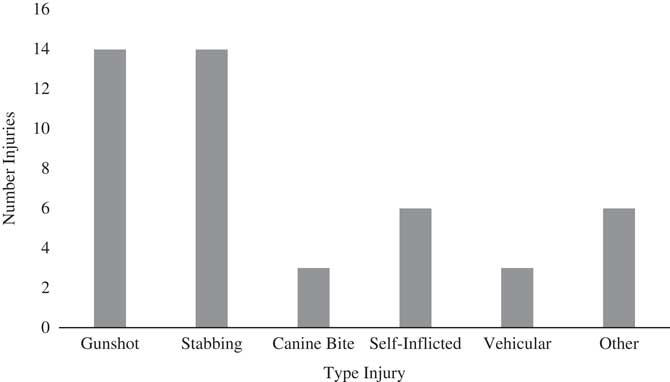
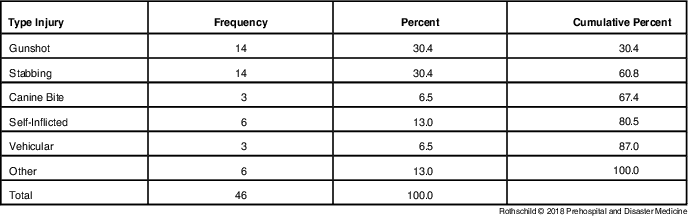
Trauma victims treated on-scene included 41 civilians, three officers, and two suspects. The mechanism of injury was mainly gunshots and stabbings, making up more than one-half of the injuries reported, as indicated in Table 2 and Figure 1. Additional causes were self-inflicted wounds (eg, cutting wrists), vehicular injuries, canine bites, and other (Table 2 and Figure 1).
Mechanism and Number of Injuries.

Mechanism and Frequency of Injuries

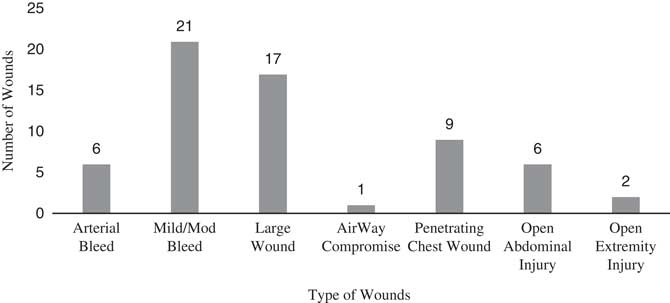
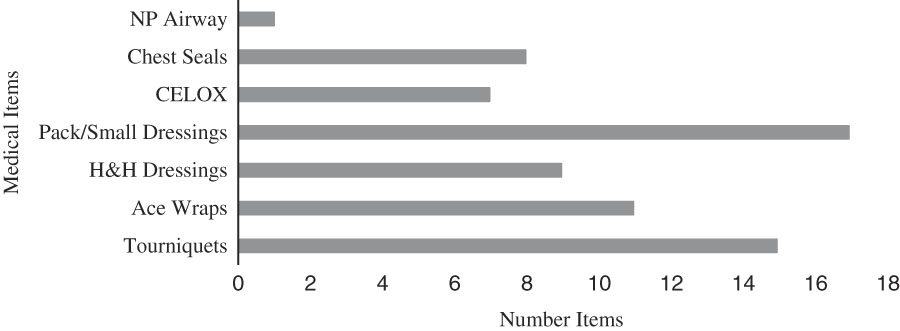
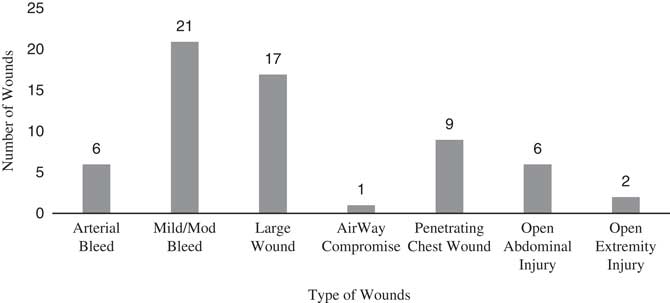
Of the 46 trauma victims, 65% (n=30) were treated for one wound, 28% (n=13) were treated for two wounds, and seven percent (n=3) were treated for four wounds. Figure 2 illustrates that the wounds included 13% (n=6) arterial bleeds, 46% (n=21) mild/moderate bleeds, 37% (n=17) large wounds, 20% (n=9) penetrating chest wounds, four percent (n=2) open extremity wounds, 13% (n=6) open abdominal wounds, and two percent (n=1) airway compromise (Figure 2). The items most frequently used from a medical kit to treat wounds were tourniquets to control bleeding; ACE wraps (3M; Maplewood, Minnesota USA) and H&H bandages (H&H Medical Corporation; Williamsburg, Virginia USA) used as an emergency dressing to control bleeding and as a compression dressing; pneumothorax; emergency trauma packing/small dressings and CELOX packings (MedTrade Products, Ltd; Crewe, United Kingdom) used as a hemostatic and clotting agent to control bleeding; and chest seals used to create a high-performance occlusive seal to control bleeding from an open chest wound (Figure 3).
Type and Number of Wounds.
Number of Different Medical Items Used.

All seven (100%) self-inflicted injuries required a tourniquet compared to 33% of all other injuries. Forty percent (n=6) of all tourniquets used in the study were for self-inflicted injuries. Other tourniquets used were for vehicular injuries (13%), gunshots (27%), stabbings (13%), and other (7%). There was a trend toward more self-inflicted injuries in Arlington County compared to Fairfax County (Fisher’s exact test; P=.06). In Arlington County, 42% (n=3/7) of injuries were self-inflicted, while in Fairfax County, 11% (n=4/35) of injuries were self-inflicted.
An association was observed between the use of chest seals and CELOX. Therefore, penetrating wounds (ie, gunshots and stabbings) were collapsed into a single category and compared to vehicular injuries, canine bites, self-inflicted wounds, and other that were also collapsed into a single category called non-penetrating wounds. For chest seals, a trend was noted for use in penetrating wounds; however, this was not significant (Fisher’s exact test; P=.12). Twenty-five percent of chest seals were used to treat gunshots while 63% were used to treat stabbings, and 13% were used to treat other types of injuries. There was a significant difference for the use of CELOX (Fisher’s exact test; P=.03), as all seven medical interventions using CELOX were for penetrating wounds. There was no significant association between penetrating (22%) and non-penetrating injuries (50%) and tourniquet use (Fisher’s exact test; P=.105).
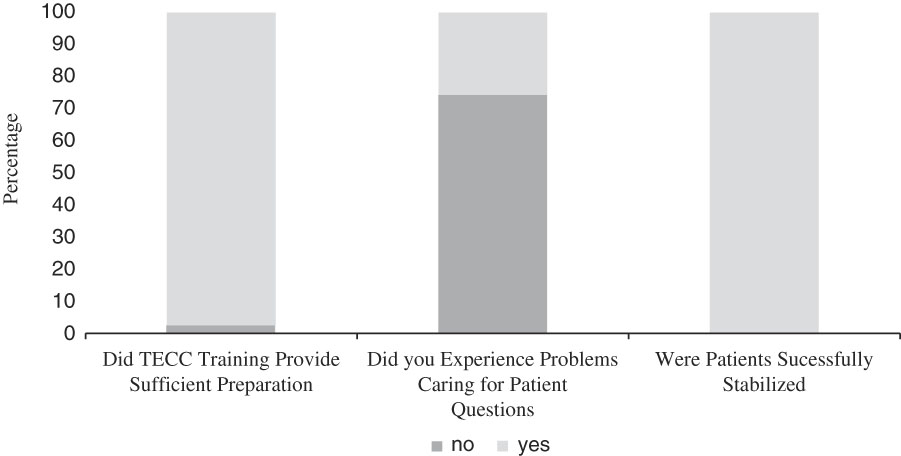
The last three items on the seven-item TECC After-Action Questionnaire (only answered by the Fairfax County LEOs) included three items requiring yes or no answers along with an area for comments. These three questions (Figure 4) were directly related to the hypothesis evaluating how TECC training prepared LEOs to provide immediate, on-scene medical care to stabilize victims of trauma. The questions with comments included: (a) Were you successful in stabilizing the injuries you encountered? Explain what you did. (b) Did you encounter any problems in caring for the patient you assisted? and (c) Did the TECC training provide sufficient preparation to manage this situation? (Figure 4).
Questions on TECC Training/Patient Care. Note: Many problems experienced while caring for patients were due to issues with items in the medical kit; they were not related to TECC training. Abbreviation: TECC, Tactical Emergency Casualty Care.

One-hundred percent of respondents were successful in stabilizing the patient injuries encountered. There were no central themes noted in the verbal comments. Seventy-four percent (n=26) of respondents did not encounter any problems caring for a patient they assisted while 26% (n=9) stated they encountered a problem. One definite problem and three potential problems were identified in this question.
On four separate occasions, it was reported that the chest seal packaging could not be opened due to warping or melting after being in a hot police cruiser. This failure occurred in four out of eight trauma incidents for a 50% failure rate. Three additional problems encountered included problems cutting the zip tie that secured the zipper closed on the medical kit, the inability of the medical kit’s scissors to cut through a victim’s clothing, and dealing with combative patients.
The last question directly addressed TECC training and asked if the training provided was sufficient preparation to manage the situation. Ninety-seven percent (n=37/38) of LEOs answered Yes, the TECC training provided was sufficient, and one (3%) officer answered that it was OK. Three of the comments addressed the lack of availability to obtain familiarity or hands-on time with the equipment in the medical kit.
Discussion
Tourniquets for hemorrhage control, whether during wartime or prehospital civilian use, have long been a contentious issue. Despite data from previous wars, the three major causes of death in the Afghanistan and Iraq wars were extremity hemorrhage, tension pneumothorax, and airway obstruction.Reference Butler and Blackbourne 8 , Reference Kotwal, Montgomery and Kotwal 11 Many recent studies have documented the successful use of TCCC during wartime, and currently, all deployed United States military personnel carry tourniquets and/or hemostatic agents and are trained in their use.Reference Kragh, Littrel and Jones 25 Within the past 15 years, tourniquet use during combat has become common place.
Tourniquets and hemostatic agents used by trained first responders are known to be quick and effective in stopping the bleeding from extremity and other severe wounds,Reference Brinsfield and Mitchell 26 and evidence shows emergency tourniquets are life-saving when used at the right time and in the right way.Reference Kragh, Littrel and Jones 25 Though civilian TECC is similar to the military’s TCCC, there are few studies that have documented its successful use. The purpose of this study was to evaluate how TECC training prepared FCPD and ACPD LEOs to treat prehospital civilian victims of trauma. This retrospective study documented 46 cases of LEO encounters. In all 46 cases, the victims were successfully treated and stabilized for transport to a higher echelon of care.
The last three questions on the TECC After-Action Questionnaire (only answered by the Fairfax County LEOs) were directly related to a LEO’s ability to stabilize a patient, state the problems encountered, and self-assess training. All LEOs reported they were successful in stabilizing the injuries of the patient they encountered, providing validation that the training was appropriate to treat victims of prehospital trauma. Thirty-eight LEOs answered Yes, the training provided was sufficient, and one LEO answered that it was OK. Most LEOs identified their training was appropriate for the victims they encountered; however, three LEOs commented that access to a medical kit would have been beneficial for staying current.
Seventy-four percent of LEOs did not encounter problems caring for a patient while 26% stated they encountered a problem. One definite problem and three potential problems were identified. On four occasions, the chest seal packaging could not be opened due to warping or melting. This failure occurred in four out of eight trauma incidents. The FCPD has addressed this concern with the vendor and new packaging was provided.
Additional issues encountered included problems cutting the zip tie that secured the zipper on the medical kit, the inability of the medical kit’s scissors to cut through clothing, and dealing with combative patients. The first two problems were addressed within the FCPD; most officers carry knives and would use knives to complete both tasks in case of failure. In the case of combative patients, since LEOs are police officers first and must be cognizant of their safety, they often must subdue or restrain a patient before they can offer life-saving care.
An unexpected finding occurred in analyzing medical kit items used to treat a wounded victim by mechanism of injury. There was a trend toward more self-inflicted injuries in Arlington County when compared to Fairfax County. The first author contacted the ACPD to inquire whether they were aware of the high-rate of self-inflicted wounds and if they might identify why the rate was higher in Arlington County than Fairfax County. They were not aware of this trend and could not provide a reason for this anomaly. As this was a secondary finding and not the focus of this study, it may be a topic for further study by the Arlington County Public Health Department (Arlington, Virginia USA).
The findings here, while preliminary, support TECC training for LEOs. The TECC training offers LEOs the skills, knowledge, and tools necessary to treat and stabilize civilian victims of trauma. Most LEOs are on the front-lines and will be the first responders on-scene in most scenarios. It is imperative that these first responders have the training and tools available to stop hemorrhaging and treat other severe wounds to achieve zero preventable deaths.
Limitations
There are several limitations to this study. The TECC After-Action Questionnaire was a self-reporting instrument which required LEOs to provide their name and unit of operation. Since the instrument was not anonymous, and a supervisor reviewed the data, this could lead to potential bias or inflated reporting by LEOs. The questionnaire was not a validated research instrument due to its use as a tool for data collection (not research) for the FCPD. Future efforts, based on the results of this study, may include collaboration with FCPD and ACPD to develop a validated, more in-depth, TECC After-Action Questionnaire for more comprehensive data collection.
The questionnaire lacked LEO demographics; therefore, the first author was unable to provide statistical data on the LEOs in the study which could have provided additional information and could identify trends. Items on the next survey tool should include LEO demographics for age, sex, initial TECC training date, follow-up training date, and years on a police force.
The study had a small sample size and was limited to only two counties in northern Virginia, which may not be representative of typical TECC training results for all counties or states. Future studies should also be expanded to additional counties in Virginia or additional states as to not introduce sample bias.
As a retrospective, de-identified study, follow-up could not be accomplished and therefore final patient outcomes could not be assessed. Final patient outcomes would further help document the success or failure of TECC training. Access to interview LEOs who performed the medical care would be beneficial to clarify questions or concerns. Additionally, creation of a national-level LEO de-identified database for TECC events would provide access to study trends and events nation-wide without bias.
Conclusions
This is the most comprehensive study of TECC and LEOs, to date, and it strongly supports the importance of TECC training for all LEOs in prehospital trauma care. Results of this study showed TECC training implemented in Fairfax County and Arlington County prepared LEOs with the operational tools necessary to provide immediate, on-scene medical care to successfully stabilize victims of trauma. The training, originally intended to increase survivability for victims of AS and intentional MCIs, has been repeatedly used by Fairfax and Arlington County LEOs to stabilize civilian victims of every day trauma. As LEOs are first on-scene in most cases, it is essential they are trained in the care of trauma victims and that there is a training program with the goal of zero preventable deaths. Continuing to train increasing numbers of LEOs in TECC is key to saving the lives of trauma victims.
Supplementary Material
To view supplementary material for this article, please visit https://doi.org/10.1017/S1049023X18000730