Introduction
Dry forests, also known as deciduous forests, cover a wide global distribution at altitudes ranging from sea level to around 2000 m and represent almost half of the tropical and subtropical forests (Trejo Reference Trejo2010). These tropical forests harbour high levels of biodiversity, but almost half have been lost globally and less than 10% are protected. Anthropogenic activities such as population growth and the consequent expansion of human settlements, cattle ranching, and various productive activities are considered the greatest threats to this type of ecosystem because they lead to deforestation, fragmentation, and habitat degradation (Maass et al. Reference Maass, Búrquez, Trejo, Valenzuela, González, Rodríguez and Arias2010; Curry Reference Curry2022).
Mexico is home to about 38% of the Neotropical deciduous forests, but more than 70% have been converted to other uses and less than 1% are under some kind of protection scheme (Curry Reference Curry2022). Natural protected areas represent a central component of many biodiversity conservation strategies and also mitigate the effects of land-use change. However, habitat loss and degradation in contiguous areas due to anthropogenic activities complicate conservation processes, exerting strong pressure on the reserves (Hansen et al. Reference Hansen, Knight, Marzluff, Powell, Brown, Gude and Jones2005). National parks constitute a classification of natural protected areas that are established in places with ecosystems that have mainly scenic beauty and recreational value, conserve special flora and fauna, and, above all, are suitable for tourism development – activities for which subzones for public use are established (Íñiguez et al. Reference Íñiguez, Jiménez, Sosa and Ortega-Rubio2014). The Cañón del Sumidero National Park (hereinafter “Cañón del Sumidero”) is a protected area located in a priority biological corridor for biodiversity conservation that includes several nature reserves established in the central–eastern region of the Mexican state of Chiapas (Comisión Nacional de Áreas Naturales Protegidas 2012). Despite its protected status, the park has been seriously affected by accelerated land-use change, exhibiting a high rate of primary vegetation loss (Figueroa and Sánchez-Cordero Reference Figueroa and Sánchez-Cordero2008).
Among the main vegetation types in the Cañón del Sumidero, tropical deciduous forest stands out. It represents 22.3% (5594.65 ha) of the park’s forest cover and occupies second place in territorial extension within the reserve (behind only the tropical subdeciduous forest with 10–712.97 ha; 42.67%). However, the area it occupies has suffered constant impact due to accelerated land-use change during the last decades. As a result, the ecosystem is becoming increasingly isolated and threatened. Activities such as agricultural expansion, logging, illegal hunting, and extraction of soil, plant, and stone material are among many problems affecting this protected area, but Cañón del Sumidero’s proximity to an urban area is considered the main threat to the reserve, due to irregular human encroachment and the advance of the urban sprawl (Comisión Nacional de Áreas Naturales Protegidas 2012).
Nearby Tuxtla Gutiérrez city has experienced accelerated urban expansion with little planning. This growth has allowed the city to expand horizontally and has given way to the formation of a metropolitan zone (Secretaría de Desarrollo Agrario, Territorial y Urbano 2018). This, combined with the absence of a sustainable management plan, means that the region’s vegetation cover has been replaced by agricultural and urban land. This reflected in the more than 4000 ha that the urban area has spread over in recent decades (Silva et al. Reference Silva, García and Hernando2015), of which about 2500 ha within the Cañón del Sumidero polygon has been developed. A modification of the park’s boundaries and extension has been proposed as a result, incorporating well-conserved neighbouring areas and, at the same time, excluding areas that have been transformed by urban growth, significantly reducing these areas within the park (Comisión Nacional de Áreas Naturales Protegidas 2012).
Changes in land use from undisturbed to urbanised are among the anthropogenic alterations that most significantly impact ecosystems and threaten biodiversity (Elmqvist et al. Reference Elmqvist, Zipperer and Güneralp2016). Adverse effects on biodiversity can be estimated by rapid, inexpensive, and effective assessments, such as of bioindicators’ use. Scarabaeinae dung beetles (Coleoptera: Scarabaeidae) comprise a group of insects with global distribution, with the highest diversity found in tropical and subtropical forests (Scholtz et al. Reference Scholtz, Davis and Kryger2009). Because their effectiveness in making assessments of changes in biodiversity caused by anthropogenic transformations has been widely demonstrated (Halffter and Arellano Reference Halffter and Arellano2002; Navarrete and Halffter Reference Navarrete and Halffter2008; Korasaki et al. Reference Korasaki, Lopes, Brown and Louzada2013; Noriega et al. Reference Noriega, March-Salas, Castillo, García-Q, Hortal and Santos2021), this insect group has been used as bioindicators to assess the conservation status of ecosystems (Halffter and Favila Reference Halffter and Favila1993; Spector Reference Spector2006; Nichols et al. Reference Nichols, Larsen, Spector, Davis, Escobar, Favila and Vulinec2007). The ecological importance of the Scarabaeinae lies in that they use mainly dung and carrion, and to a lesser extent, fruits, fungi, and decaying leaves as food and reproduction resources (Halffter Reference Halffter1991; Halffter and Halffter Reference Halffter and Halffter2009). These insects are significant recyclers, reincorporating nutrients into the soil through their burial activity. This niche makes the Scarabaeinae important to tropical and subtropical ecosystem dynamics (Nichols et al. Reference Nichols, Spector, Louzada, Larsen, Amezquita and Favila2008).
The objective of the present study was to evaluate the response of dung beetle assemblages to land-use change by comparing the Scarabaeinae within a conserved primary forest (outside the urban matrix) and within the adjacent anthropised area (within the urban matrix) located between a natural protected area and an urban zone in central Chiapas, Mexico, where the predominant vegetation is tropical deciduous forest. We used conventional metrics of assemblage structure (richness and abundance), composition, and habitat preferences to compare dung beetle assemblages of the conserved forest and the urban habitat.
Materials and methods
Study area
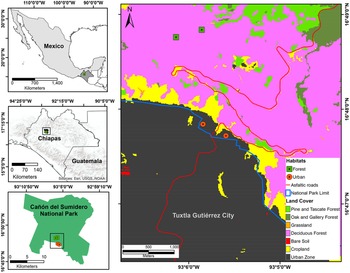
The study landscape is located in the Central Depression physiographic region, on the southern boundary between the Cañón del Sumidero polygon and an urban zone in the municipality of Tuxtla Gutiérrez, Chiapas, Mexico (Fig. 1). The predominant vegetation in this area is tropical deciduous forest, where species of the genera Acacia Miller (Fabaceae), Alvaradoa Liebmann (Picramniaceae), Bursera Jacquin ex Linnaeus (Burseraceae), Ceiba Miller (Malvaceae), Cochlospermum Kunth (Bixaceae), Haematoxylum Linnaeus (Fabaceae), Piscidia Linnaeus (Fabaceae), Pseudobombax Dugand (Malvaceae), and Swietenia Jacquin (Meliaceae) are the most important. Succulent plants are frequent, especially in the genera Agave Linnaeus (Asparagaceae), Cephalocereus Pfieff (Cactaceae), Opuntia Miller (Cactaceae), and Stenocereus (A. Berger) Riccob (Cactaceae) (Comisión Nacional de Áreas Naturales Protegidas 2012). According to Köppen’s climate classification, the region has a warm subhumid climate, with summer rains and a marked dry season (García Reference García2004). The mean annual temperature is 28.4° C with an average maximum of 38.5° C and a minimum of 18.4° C. The average annual precipitation is 1273.8 mm, with predominant rainfall from May to October (> 90% of total precipitation) and scarce precipitation during the rest of the year.
Location of the study habitats in the southern area of the Cañón del Sumidero polygon, central region of Chiapas, Mexico.

We selected two habitats with different land-use histories and contrasting characteristics for the dung beetle survey (Fig. 1). The two habitats were approximately 2 km apart. The first habitat corresponds to an area covered with primary native vegetation (conserved forest) located south–southeast of the Cañón del Sumidero (latitude 16° 48' 49", longitude –93° 05' 50"), within the core zone destined for protection, an area where the tropical deciduous forest predominates and exhibits a better continuum of vegetation (approximately 550 ha) characterised by a tree stratum ranging in height from 4 to 10 m and a reduced herbaceous stratum. The second habitat corresponds to an open area (urban habitat) that was converted after the implementation of the national park, located on the periphery of Tuxtla Gutiérrez city (latitude 16° 47' 45", longitude –93° 05' 45") and covering about 150 ha on the southern boundary of the Cañón del Sumidero polygon. This area is mainly characterised by the presence of human settlements (ca. 44.5 ha) and croplands (90 ha) and includes induced pastures, paved and dirt roads, and small areas of secondary vegetation (> 15 ha; Fig. 1; Comisión Nacional de Áreas Naturales Protegidas 2012).
Dung beetle sampling
We conducted 10 monthly samplings between July 2013 and June 2014, except in November and December 2013 because of logistical considerations. Pitfall traps with attractants were set up each month and were active for 48 hours for dung beetle sampling. The traps consisted of a cylindrical 1-L (11 cm diameter × 15 cm depth) plastic jar containing 250 mL of ethylene glycol to preserve collected material. Traps were baited with approximately 30 g of decaying squid or cattle dung that was placed in a gauze held with wires at the level of each container’s surface. Both baits offset the two main trophic habits of Scarabaeinae and represent two frequently used, effective attractants that have been successfully used in previous dung beetle diversity studies in nearby regions (Sánchez-Hernández et al. Reference Sánchez-Hernández, Gómez, Delgado, Rodríguez-López and Chamé-Vázquez2018, Reference Sánchez-Hernández, Gómez, Chamé-Vázquez, Navarrete-Heredia and González-Martín del Campo2022a). At each sampling habitat, we placed six pitfall traps in each of two sites (replicates; n = 24 total traps per sampling). Sites of the same habitat (e.g., urban habitat) were separated by a distance of approximately 500 m to prevent inter-sample interference (da Silva and Hernández Reference da Silva and Hernández2015), and individual traps at each site were installed and spaced at least 50 m apart to prevent inter-trap interference and were baited with alternating attractants, thus reducing pseudo-replication problems (Larsen and Forsyth Reference Larsen and Forsyth2005). Although our surveys did not follow the ideal trap spacing (100 m) later proposed by da Silva and Hernández (Reference da Silva and Hernández2015) to reduce interference between pairs of baited pitfall traps, a 50-m distance between traps is also recommended (Mora-Aguilar et al. Reference Mora-Aguilar, Arriaga-Jiménez, Correa, da Silva, Korasaki and López-Bedoya2023).
Taxonomic identification
Recovered beetles were stored in 70% ethanol and subsequently were separated, counted, and identified to species level using the taxonomic keys and descriptions of Rivera-Cervantes and Halffter (Reference Rivera-Cervantes and Halffter1999), Kohlmann and Solís (Reference Kohlmann and Solís2001), Génier and Kohlmann (Reference Génier and Kohlmann2003), Delgado and Kohlmann (Reference Delgado and Kohlmann2007), Génier (Reference Génier2009), Edmonds and Zídek (Reference Edmonds and Zídek2010), González-Alvarado and Vaz-de-Mello (Reference González-Alvarado and Vaz-de-Mello2014), Kohlmann and Vaz-de-Mello (Reference Kohlmann and Vaz-de-Mello2018), Moctezuma et al. (Reference Moctezuma, Sánchez-Huerta and Halffter2019), Arriaga-Jiménez et al. (Reference Arriaga-Jiménez, Escobar-Hernández, Röss and Kohlmann2020), Chamé-Vázquez et al. (Reference Chamé-Vázquez, Sánchez-Hernández and Bautista Arredondo2020), and Moctezuma and Halffter (Reference Moctezuma and Halffter2020, Reference Moctezuma and Halffter2021). Voucher specimens were deposited in the Insect Collection of El Colegio de la Frontera Sur, Chiapas, Mexico (ECO-SC-E).
Data analysis
To assess the inventory completeness in each habitat, a sample coverage (Ĉm) analysis was performed (Hsieh et al. Reference Hsieh, Ma and Chao2016). Sample coverage has values from 0 (minimal completeness) to 100% (maximum completeness) and is a common and robust measure of sampling completeness (Chao and Jost Reference Chao and Jost2012). We also generated species accumulation curves for each habitat, based on the total number of individuals captured during all sampling events, extrapolating abundances as a measure of species richness estimation (Chao et al. Reference Chao, Gotelli, Hsieh, Sander, Ma, Colwell and Ellison2014). These curves were constructed in the R package iNEXT (Hsieh et al. Reference Hsieh, Ma and Chao2016), using Hill numbers (qD = 0) with 95% confidence intervals.
We performed the nonparametric Mann–Whitney U test (α = 0.05) to assess whether the richness and abundance of dung beetles recorded in the samples differed between the two habitats. To gain insight into assemblage structure, patterns in species abundance distribution were explored using rank-abundance plots in each of the study habitats; these curves were built considering the relative abundance of each species (number of individuals), which were log-transformed (Log+1) and ranked from the most to the least abundant. To complement these curves and to quantify the degree of dominance in each habitat, we calculated the evenness factor proposed by Jost (Reference Jost2010). This index represents the proportion of dominant species in the assemblage. The evenness factor is 1 when the assemblage is equitable and approaches 0 when dominance increases (i.e., few species dominate, so most species are rare). To calculate the index, we consider the effective number of dominant species (2D) and the total number of species (0D). The evenness factor is calculated as 2D/0D (see formulas described by Jost Reference Jost2006), and for the calculation of 0D and 2D, we used the iNEXT package (Hsieh et al. Reference Hsieh, Ma and Chao2016).
We analysed changes in the composition of Scarabaeinae assemblages between habitats (conserved forest and urban habitat) using a nonmetric multidimensional scaling analysis, based on a Bray–Curtis dissimilarity matrix and using the abundance data for each month as sampling units. Also, an analysis of similarity was performed to verify differences in assemblages between habitats represented in the nonmetric multidimensional scaling (Clarke Reference Clarke1993). We used PAST software, version 4.06, to perform these analyses (Hammer et al. Reference Hammer, Harper and Ryan2001).
We assessed the habitat preference of species using the multinomial classification method developed by Chazdon et al. (Reference Chazdon, Chao, Colwell, Lin, Norden and Letcher2011). This model assigns a preference ranking for each species (i.e., specialist, generalist, or too rare) according to its relative abundances in two distinct habitats (i.e., conserved forest or urban habitat) and minimises potential bias due to insufficient sampling within each habitat (Chazdon et al. Reference Chazdon, Chao, Colwell, Lin, Norden and Letcher2011). The supermajority specialisation threshold (K = 0.667) and a significance level of α = 0.05 were used. The model was run in CLAM software, version 1.0 (Chao and Lin Reference Chao and Lin2011).
The structure of the functional groups was evaluated by combining two ecological characteristics, following Doube (Reference Doube1990): (1) according to their dung-processing behaviour, such as paracoprids, endocoprids, and telecoprids and (2) in terms of body size in three categories, small (< 10 mm), medium (10–18 mm), or large (> 18 mm). To compare assemblages by the number of individuals among functional groups, we used the nonparametric Kruskal–Wallis test. For pairwise multiple comparisons, the Mann–Whitney U test was used.
Results
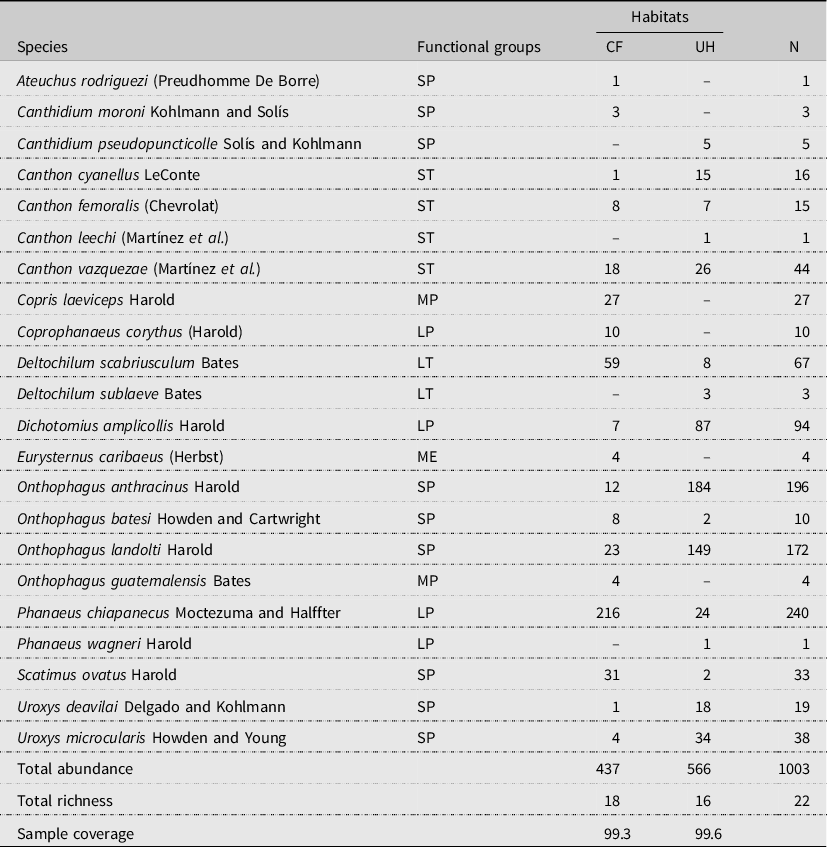
A total of 1003 individuals were captured, belonging to 22 species and 12 genera of Scarabaeinae (Table 1). Canthon Hoffmannsegg and Onthophagus Latreille were the genera that presented the highest richness, both with four species. Phanaeus chiapanecus Moctezuma and Halffter (n = 240), Onthophagus anthracinus Harold (n = 196), Onthophagus landolti Harold (n = 172), and Dichotomius amplicollis Harold (n = 94) were the most abundant species: together, they accounted for 70% of the total abundance. Ateuchus rodriguezi (Preudhomme De Borre), Canthon leechi (Martínez et al.), and Phanaeus wagneri Harold were represented by only single specimens.
Species composition, functional groups, and distribution of Scarabaeinae abundances in two habitats in the tropical deciduous forest of Cañón del Sumidero. SP, small paracoprid; MP, medium paracoprid; LP, large paracoprid; ST, small telecoprid; LT, large telecoprid; ME, medium endocoprid; CF, conserved forest; UH, urban habitat.

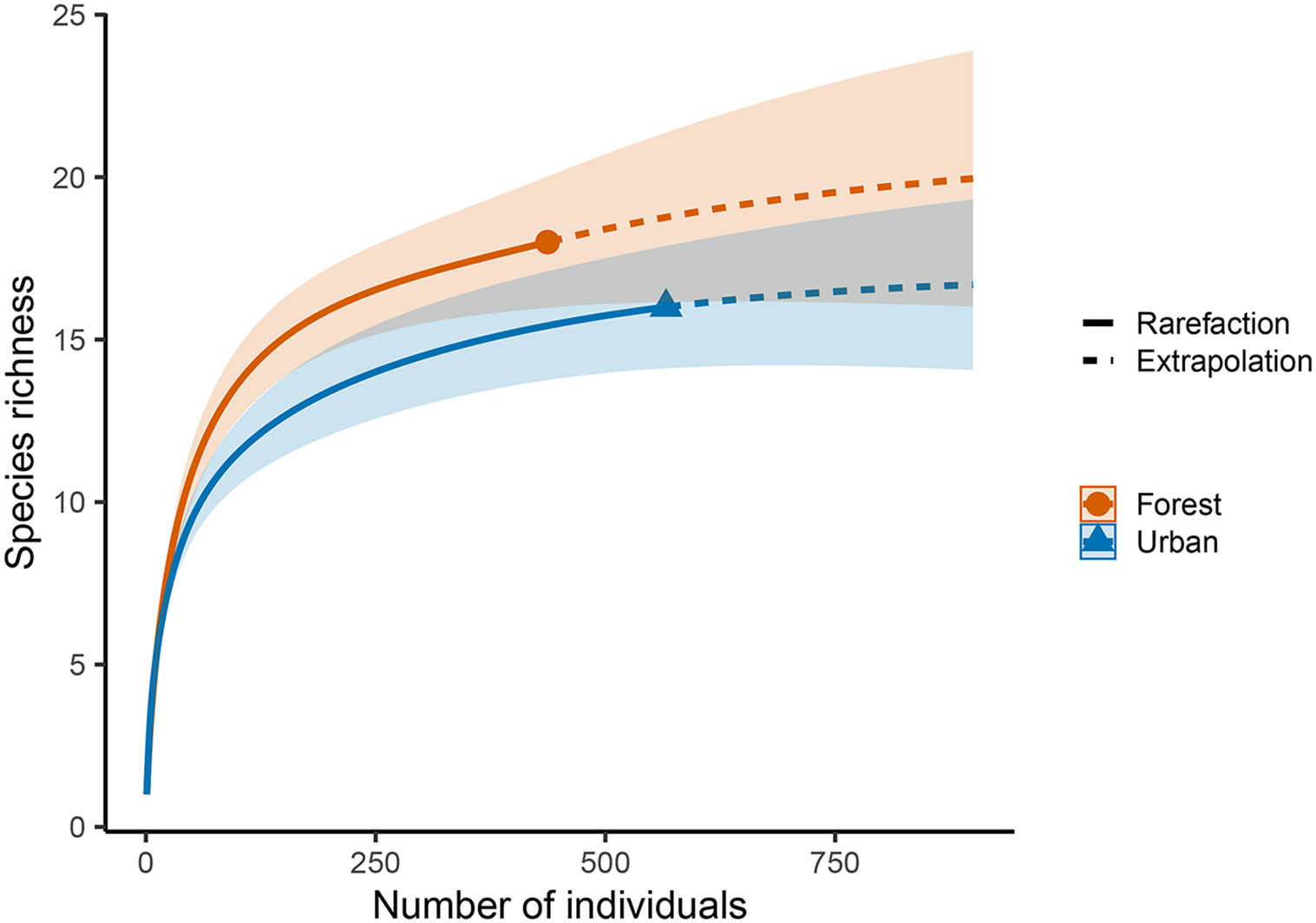
The sampling coverage was almost 100% at both habitats (Table 1). Species accumulation curves show asymptotic trends for the extrapolation values in both the conserved forest and the urban habitat (Fig. 2). This indicates that the sampling effort was adequate for both habitats and allowed us to characterise the local dung beetle assemblage.
Accumulation curves of species richness of the conserved forest (circle) and urban habitat (triangle) with 95% confidence intervals (shaded area).

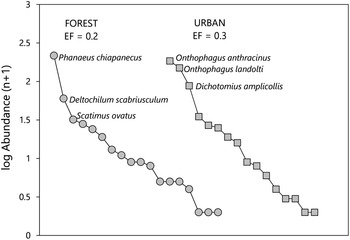
In the conserved forest, 18 species and 437 individuals (36.4 ± 5.7) were recorded, whereas in the urban habitat, 16 species and 566 individuals (47.1 ± 5.1) were captured. Neither species richness (z = 0.38, P = 0.69) nor the number of individuals (z = 0.64, P = 0.51) differed between habitats. The structure of the assemblages was similar in the two habitats because both had a high dominance and a similar number of rare species, with low evenness factor values; however, the identity of the dominant species differed in each habitat (Fig. 3). In the conserved forest, P. chiapanecus (49.43%), Deltochilum scabriusculum Bates (13.50%), and Scatimus ovatus Harold (7.1%) were the most abundant species. In the urban habitat, Onthophagus anthracinus (32.5%), O. landolti (26.3%), and D. amplicollis (15.4%) dominated (Fig. 3; Table 1).
Rank-abundance curves of Scarabaeinae assemblages in two study habitats of the Cañón del Sumidero, central region of Chiapas, Mexico. EF = evenness factor.

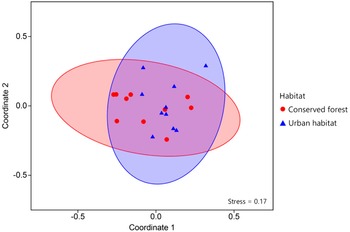
Species of the genera Ateuchus Weber, Copris Geoffroy, Coprophanaeus Olsoufieff, and Eurysternus Dalman were captured only in the conserved forest, whereas the other genera were represented in both habitats. A total of 10 (45.5%) species were exclusive to one or the other of the habitats: six species were found only in the conserved forest, and four were found only in the urban habitat (Table 1). Nevertheless, the nonmetric multidimensional scaling ordination diagram and analysis of similarity test indicated that species composition is not segregated between the habitats (Fig. 4), showing a high percentage of similarity and no significant differences in the assemblages (R = 0.0906; P = 0.1039).
Species composition of Scarabaeinae assemblages ordered by a nonmetric multidimensional scaling based on the Bray–Curtis dissimilarity index with 95% confidence intervals (ellipses).

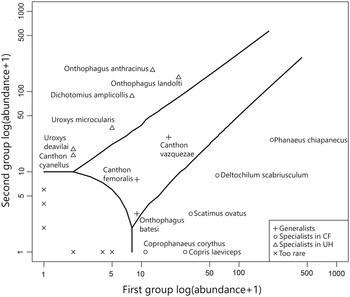
According to the multinomial classification method analysis, 11 species were considered specialists in one of the two habitats (Fig. 5) – five from the conserved forest and six from the urban habitat. Three other species presented generalist habits, whereas the remaining eight were too rare to be classified (n ≤ 5 individuals).
Habitat preference of Scarabaeinae species based on a multinomial classification method. Solid lines represent the preference threshold between specialists, generalists, and too-rare species. CF, conserved forest; UH, urban habitat.

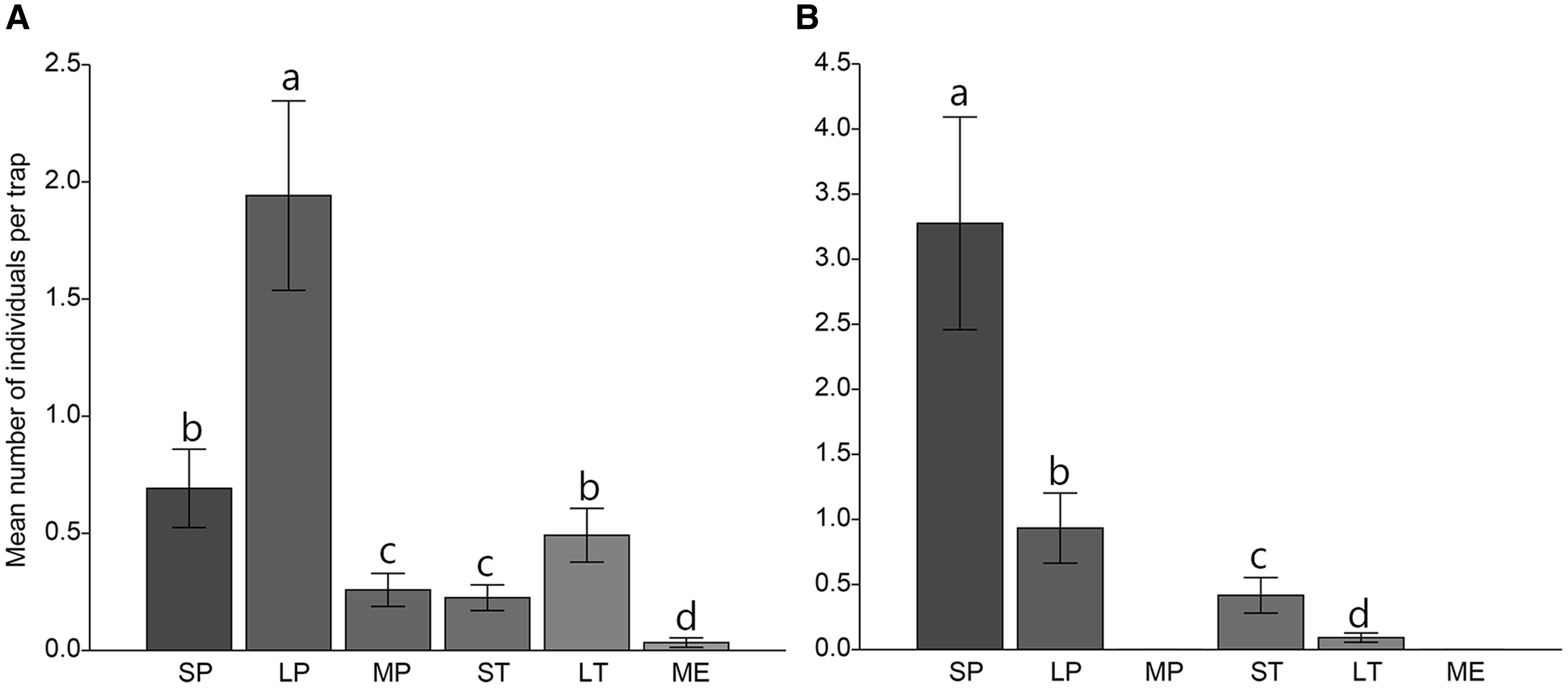
The captured species belong to six functional groups (Table 1). All six groups were represented in the conserved forest, but the abundance of large paracoprids was significantly higher than that of the other five (Fig. 6A; X 2 = 13.32, df = 5, P < 0.0001). In the urban habitat, only four functional groups were present, and small paracoprids were statistically the most abundant (Fig. 6B; X 2 = 10.8, df = 4, P = 0.0001).
Mean abundances of six functional groups of dung beetles in two study habitats: A, conserved forest, and B, urban habitat. Different letters above the bars denote significant differences (P < 0.05) according to the pairwise comparisons with the Mann–Whitney U test. SP, small paracoprid; LP, large paracoprid; MP, medium paracoprid; ST, small telecoprid; LT, large telecoprid; ME, medium endocoprid.

Discussion
The number of species found in the present study corresponds to approximately 18% (124 species) of the Scarabaeinae richness estimated for Chiapas (Sánchez-Hernández and Gómez Reference Sánchez-Hernández and Gómez2018; Sánchez-Hernández et al. Reference Sánchez-Hernández, Chamé-Vázquez and Gómez2019a). This proportion can be considered representative because the deciduous forests of Mexico are habitats of low Scarabaeinae diversity (Halffter and Arellano Reference Halffter and Arellano2002; Andresen Reference Andresen2008; Yanes-Gómez et al. Reference Yanes-Gómez, Tamariz-Flores, Silva-Gómez, Ortiz-Espejel and Castelán-Vega2018). At a regional scale, the found richness accounts for about 70% of the species reported by Arellano et al. (Reference Arellano, León-Cortés, Halffter and Montero2013) and Sánchez-Hernández et al. (Reference Sánchez-Hernández, Gómez, Chamé-Vázquez, Navarrete-Heredia and González-Martín del Campo2022a), whereas the species richness obtained was similar to that reported by Rodríguez-López et al. (Reference Rodríguez-López, Sánchez-Hernández and Gómez2019; 22 spp.) and Sánchez-Hernández et al. (Reference Sánchez-Hernández, Gómez, Rodríguez-López, Dávila-Sánchez and Chamé-Vázquez2021; 20 spp.), and most of the species (∼80%) are also commonly found in the tropical deciduous forests of the Central Depression region of Chiapas (Sánchez-Hernández et al. Reference Sánchez-Hernández, Gómez, Chamé-Vázquez, Dávila-Sánchez, Rodríguez-López and Delgado2020). Despite the region’s high level of fragmentation due to urban development and other land uses (Comisión Nacional de Áreas Naturales Protegidas 2012), these findings suggest the area holds a representative mixed pool of dung beetle species at both the local and regional scales, with a high sampling efficiency in our samplings.
In the Neotropics, diversity, structure, and evenness in the abundance’s distribution of Scarabaeinae assemblages are some of the parameters that respond more significantly to changes in forest cover structure, that is, the lower the degree of structural diversity of the vegetation, the lower the species richness and the greater the dominance of a few dung beetle species result (Navarrete and Halffter Reference Navarrete and Halffter2008; Arellano et al. Reference Arellano, León-Cortés, Halffter and Montero2013; Sánchez-Hernández et al. Reference Sánchez-Hernández, Gómez, Delgado, Rodríguez-López and Chamé-Vázquez2018). The urbanisation process is one of the most severe land-use changes in tropical forests because it exerts high pressure on various taxa, particularly arthropods (Fenoglio et al. Reference Fenoglio, Rossetti and Videla2020). For dung beetles to invade urban areas implies they have overcome additional restrictions to habitat alteration, such as soil compaction due to paving and low resource availability, which affect the beetle’s feeding and reproduction (Ramírez-Restrepo and Halffter Reference Ramírez-Restrepo and Halffter2016a). That is why dung beetles respond negatively to urbanisation, even in vegetation patches located on city edges, where species richness tends to decrease drastically compared to areas that are relatively well conserved (Korasaki et al. Reference Korasaki, Lopes, Brown and Louzada2013; Salomão et al. Reference Salomão, Alvarado, Baena-Díaz, Favila, Iannuzzi and Liberal2019).
In the habitats studied in the present study, the conserved forest has tree cover and a structural diversity of vegetation, whereas in the urban habitat, these characteristics are incipient because the trees are scattered and either have little well-developed secondary vegetation or almost now tree cover due to land-use change (Comisión Nacional de Áreas Naturales Protegidas 2012). Despite the differences in tree cover and land uses in the study habitats, our results indicate no significant spatial segregation in species richness and abundance between the urban setting and the conserved forest: both were characterised by similar assemblages of Scarabaeinae, with a comparable number of dominant species, and the composition of the assemblages did not show a pattern that would allow assemblage differentiation.
Several factors may have influenced this apparent biotic homogeneity in the Scarabaeinae assemblages. The high level of fragmentation at the regional level, the constant forest cover loss, the isolation of deciduous forest patches in the Cañón del Sumidero, and the proximity of the reserve to the urban zone can all contribute to inducing the loss of dung beetle species – mainly those that are forest dependent – that are unable to extend their populations into altered habitats, thereby allowing matrix-tolerant generalist species to establish and predominate, which is reflected in low rates of species turnover (Pinto Leite et al. Reference Pinto Leite, Mariano-Neto and da Rocha2018; da Silva et al. Reference da Silva, Nunes, Ferreira, Braga, Beiroz and Perillo2019; Rivera et al. Reference Rivera, Gómez, Navarrete-Gutiérrez, Ruiz-Montoya, Delgado and Favila2020; Sánchez-Hernández et al. Reference Sánchez-Hernández, Gómez, Chamé-Vázquez, Navarrete-Heredia and González-Martín del Campo2022a). On the other hand, the high production of dung by domestic animals in the area, mainly stray and feral dogs (Carnivora: Canidae) (Zúñiga and Sarmiento Reference Zúñiga and Sarmiento2014; Gómez-Méndez, unpublished data), is a resource that eventually replaces the absence of native mammals in cities (Cave Reference Cave2005; Ramírez-Restrepo and Halffter Reference Ramírez-Restrepo and Halffter2016b); in this way, the exploitation of these resources allows the maintenance, to some extent, of dung beetle assemblages in urban and peri-urban areas (Carpaneto et al. Reference Carpaneto, Mazziotta and Piattella2005). Likewise, human settlements have caused feral dog and cat (Carnivora: Felidae) densities to increase within the reserve in recent years, altering the dynamics of wild mammal communities – mainly of medium-sized species – with which the feral animals compete directly for resources (Zúñiga and Sarmiento Reference Zúñiga and Sarmiento2014). The presence of mammals in the ecosystem is strongly linked with the activity of Scarabaeinae assemblages; therefore, a decrease in wild mammal densities exerts a direct negative effect on dung beetle diversity (Nichols et al. Reference Nichols, Gardner, Peres and Spector2009; Bogoni et al. Reference Bogoni, da Silva and Peres2019; Correa-Cuadros et al. Reference Correa-Cuadros, Gómez-Cifuentes and Noriega2022). Finally, another important factor that could substantially contribute to this homogeneity is the use of cattle dung in the samplings. This attractant is generally much less effective than the dung of omnivorous mammals (mainly human excrement), which attract a greater number of species than carnivorous and herbivorous mammal dung, does especially in forest habitats (Filgueiras et al. Reference Filgueiras, Liberal, Aguiar, Hernández and Iannuzzi2009; Marsh et al. Reference Marsh, Louzada, Beiroz and Ewers2013; Rodríguez-López et al. Reference Rodríguez-López, Sánchez-Hernández and Gómez2021a). In addition, the isolation and reduction of forest fragments in the region do not allow the maintenance of large populations of herbivorous vertebrates (Comisión Nacional de Áreas Naturales Protegidas 2012), which limits the availability of this dung resource.
However, increased dung beetle species richness and total abundance in forested areas are not the only indicators of higher habitat quality. Although similarity in structure and species composition between habitats was evident, some metrics differed and allow for assemblage characterisations. Rank-abundance curves show that the identity of the dominant species differed in each habitat, and multinomial classification method analysis indicated that some species are strongly associated with one of the two habitats studied. Eleven species were identified that can be used to determine the direction of the ecological integrity of each habitat: five in the conserved forest and six in the urban habitat. Also, the structure of the functional groups differed in each habitat, and the conserved forest was the only one with exclusive genera. This suggests that, although a disturbed habitat may host a similar species diversity and composition as a conserved forest, other metrics at the species level within the assemblage may respond more efficiently to the alteration of the primary vegetation.
Most of the indicator species in the conserved habitat are large or medium body–sized Scarabaeinae. Copris laeviceps Harold is a medium-sized paracoprid species that is considered a specialist of conserved forests; although it can occupy disturbed spaces, its attraction seems to be related to areas with forest cover similar to well-conserved forest areas (Montes de Oca Reference Montes de Oca2001; Capello and Halffter Reference Capello and Halffter2019; Sánchez-Hernández et al. Reference Sánchez-Hernández, Gómez, Rodríguez-López, Dávila-Sánchez and Chamé-Vázquez2021). The other three indicator species (Coprophanaeus corythus Harold, Deltochilum scabriusculum, and Phanaeus chiapanecus) have been reported in diverse habitat types and appear to have generalist habits, but their presence in open or highly disturbed areas is rare. For example, D. scabriusculum has been reported as a common coprophagous species in tropical rainforests (Navarrete and Halffter Reference Navarrete and Halffter2008) but has also been abundantly captured in deciduous forests with carrion and dung traps (Naranjo-López and Navarrete-Heredia Reference Naranjo-López and Navarrete-Heredia2011; Arellano et al. Reference Arellano, León-Cortés, Halffter and Montero2013). Phanaeus chiapanecus (cited as P. endymion) and Coprophanaeus corythus are two typical denizens of mosaic habitats in dry and rain forests, respectively, but are more common in areas of continuous forest than in open areas (Navarrete and Halffter Reference Navarrete and Halffter2008; Sánchez-Hernández et al. Reference Sánchez-Hernández, Gómez, Delgado, Rodríguez-López and Chamé-Vázquez2018; Moctezuma and Halffter Reference Moctezuma and Halffter2021). This result is consistent with other studies and suggests that large species are more sensitive to ecosystem disturbances and are more susceptible to habitat modification. They generally do not tolerate drastic microclimatic changes caused by forest canopy disturbance because this could affect their reproductive success (Gardner et al. Reference Gardner, Hernández, Barlow and Peres2008; Nichols et al. Reference Nichols, Gardner, Peres and Spector2009; Noriega et al. Reference Noriega, March-Salas, Castillo, García-Q, Hortal and Santos2021).
Also noteworthy is the presence of Eurysternus caribaeus (Herbst) in the conserved habitat because, despite being under-represented, species of this genus are forest dependent and usually serve as indicators of conservation, mainly in tropical rain forests with little or no human disturbance (Navarrete and Halffter Reference Navarrete and Halffter2008; Rivera et al. Reference Rivera, Gómez, Navarrete-Gutiérrez, Ruiz-Montoya, Delgado and Favila2020). Therefore, the prevalence of this type of species in the conserved habitat could indicate a certain degree of conservation of the deciduous forest surrounding the urban zone of the study area. In this regard, the absence of this group of species (endocoprids) in open habitats or in areas with strong anthropic pressure may be because they nest on the food source, and when exposed to high temperatures and low humidity, dung desiccation occurs much faster in open and similar environments than in other environments, affecting the success of reproduction through impediments on larval feeding (Halffter and Edmonds Reference Halffter and Edmonds1982).
In contrast, most indicator species in the urban habitat are small in size and comprise mainly paracoprids (Dichotomius amplicollis, Onthophagus anthracinus, Onthophagus landolti, Uroxys deavilai, and Uroxys microcularis) and only one telecoprid (Canthon cyanellus LeConte). The distribution of these six species is usually associated with highly fragmented landscapes (Chamé-Vázquez et al. Reference Chamé-Vázquez, Sánchez-Hernández and Bautista Arredondo2020; Sánchez-Hernández et al. Reference Sánchez-Hernández, Gómez, Chamé-Vázquez, Navarrete-Heredia and González-Martín del Campo2022a), forest–pasture mosaic habitats of Chiapas (Arellano et al. Reference Arellano, León-Cortés and Ovaskainen2008, Reference Arellano, León-Cortés, Halffter and Montero2013; Navarrete and Halffter Reference Navarrete and Halffter2008; Rivera et al. Reference Rivera, Gómez, Navarrete-Gutiérrez, Ruiz-Montoya, Delgado and Favila2020), or areas where forest cover has been completely lost, such as cattle pastures (Alvarado et al. Reference Alvarado, Escobar, Williams, Arroyo-Rodríguez and Escobar-Hernández2018). Some of the species, such as O. anthracinus and U. microcularis, are also distributed over a wide altitudinal range in this same region, showing evident ecological plasticity, so it is not unusual for them to present abundant populations in habitats with a high degree of human intervention (Arriaga-Jiménez et al. Reference Arriaga-Jiménez, Escobar-Hernández, Röss and Kohlmann2020; Sánchez-Hernández et al. Reference Sánchez-Hernández, Gómez, Chamé-Vázquez, Navarrete-Heredia and González-Martín del Campo2022a). Small-sized species, as in this case, tend to be comparatively slow in removing manure from the environment. As a result, in habitats dominated by species with these characteristics, the ecosystem services they provide may be less effective than in habitats dominated by larger species because a higher proportion of small beetles will occur in situations where large mammals are absent (Nichols et al. Reference Nichols, Uriarte, Bunker, Favila, Slade and Vulinec2013; Correa-Cuadros et al. Reference Correa-Cuadros, Gómez-Cifuentes and Noriega2022).
The three species identified as generalists – Canthon vazquezae (Martínez et al.), C. femoralis (Chevrolat), and Onthophagus batesi Howden and Cartwright – are widely distributed in Neotropical forests (Capello and Halffter Reference Capello and Halffter2019; Sánchez-Hernández et al. Reference Sánchez-Hernández, Chamé-Vázquez, Salas-Suárez and Noh-Balam2022b) and are reported from diverse areas of Chiapas with different forest cover types (Sánchez-Hernández et al. Reference Sánchez-Hernández, Gómez, Chamé-Vázquez, Dávila-Sánchez, Rodríguez-López and Delgado2020). For example, Canthon vazquezae appears to adapt to dominant habitat conditions due to its trophic breadth. It has been collected in a wide variety of habitats and is attracted to both carrion and different types of dung from herbivorous, carnivorous, and omnivorous mammals (Sánchez-Hernández et al. Reference Sánchez-Hernández, Gómez, Delgado, Rodríguez-López and Chamé-Vázquez2018, Reference Sánchez-Hernández, Gómez, Rodríguez-López, Dávila-Sánchez and Chamé-Vázquez2021; Rodríguez-López et al. Reference Rodríguez-López, Sánchez-Hernández and Gómez2021a) but similarly makes use of other resources that are unusual for most Scarabaeinae species, including injured millipedes and their carcasses (Sánchez-Hernández et al. Reference Sánchez-Hernández, Agustín-Sánchez, Bueno-Villegas and Gómez2019b; Rodríguez-López et al. Reference Rodríguez-López, Gómez, Bueno-Villegas and Malo2021b). Canthon femoralis is abundant in continuous forests (Rivera et al. Reference Rivera, Gómez, Navarrete-Gutiérrez, Ruiz-Montoya, Delgado and Favila2020) but is also commonly found in habitats with different types of human intervention near forest areas (Sánchez-Hernández et al. Reference Sánchez-Hernández, Gómez, Delgado, Rodríguez-López and Chamé-Vázquez2018). For its part, Onthophagus batesi is a dung beetle species typical of pastures used for livestock (Rivera et al. Reference Rivera, Gómez, Navarrete-Gutiérrez, Ruiz-Montoya, Delgado and Favila2020), but at the same time, it can make use of different elements within fragmented landscapes (Montes de Oca Reference Montes de Oca2001; Rodríguez-López et al. Reference Rodríguez-López, Sánchez-Hernández and Gómez2019). However, generalist species depend on a certain degree of forest cover, are matrix-tolerant species, and can establish in degraded forested systems (Audino et al. Reference Audino, Louzada and Comita2014). These findings suggest that these species have a much higher dispersal capacity and are also less sensitive to habitat changes and the fragmentation process. It is therefore feasible that green areas within the urbanised landscape in the present study may represent a viable opportunity for them to inhabit in the search for resources.
Overall, our results showed that dung beetle assemblages respond differently depending on the attribute analysed. Diversity and species composition were similar between habitats; however, the specific restriction of some Scarabaeinae species to forest habitat and the wide dominance of those sensitive to habitat alteration (i.e., large paracoprids) observed in the present study indicate the importance of conserving those forest remnants, suggesting that although the constant advance of the urban zone and other land uses have affected the prevalence of primary vegetation in Cañón del Sumidero, relatively well-preserved areas still exist within the park that can compensate for habitat alteration, allowing the influx and establishment of species with moderate sensitivity to urbanisation.
Because Mexico’s dry forests are among the highest-priority ecosystems for conservation, we suggest that more attention be paid to the conservation status of the forest habitat in Cañón del Sumidero. Its isolated location and constant disturbance are limiting factors on the dung beetle assemblage in this region, which is reflected in a similar pattern of diversity among the sites analysed. Finally, we recommend future studies evaluate these patterns in other representative ecosystem types to determine if these responses represent a general pattern or a local condition.
Acknowledgements
The authors are grateful for the facilities provided by the management of Cañón del Sumidero National Park, particularly for the constant logistical support of the technical staff during fieldwork. Rolando Dávila Sánchez and Edivaldo Rodríguez López assisted in different aspects of the development of this work. The comments of two anonymous reviewers and the subject editor helped to improve this manuscript.
Competing interests
The authors declare they have no competing interests.