INTRODUCTION
The decline of soil fertility in smallholder farming systems of sub-Saharan Africa is said to be the greatest biophysical constraint to increasing agricultural productivity (Sanchez et al., Reference Sanchez, Shepherd, Soule, Place, Buresh, Izac, Uzo, Kwesiga, Nderitu, Woomer, Buresh, Sachez and Calhoun1997). The need to improve soil fertility management (SFM) has become a very important issue in the development policy agenda, because of the strong linkage between soil fertility and food insecurity. For instance, in western Kenya, a region where soil fertility levels have been declining over the years, Wangila et al. (Reference Wangila, Rommelse and de Wolf1999) reported that 89.5% of farmers had food deficiency and only 8.9% were food secure. Given the high poverty rates in most of sub-Saharan Africa, farmers often cannot afford to use fertilizers. Even for those who can, environmentalists have cautioned against their use, claiming that fertilizer residues are damaging in particular to soil structure and quality of water resources (Goss and Goorahoo, Reference Goss and Goorahoo1995; UNEP, 1997). It is therefore apparent that a sustainable low-cost farming system is needed that is compatible with the socio-economic and technological practices of farmers, but capable of sustaining or improving production and soil fertility. Organic materials such as cattle manure and crop residues can be used to improve soil fertility, but they are usually not available in sufficient quantities and quality. Typically most farmers in western Kenya have no more than one or two cattle, and a substantial number have none at all.
In order to address these challenges, scientists in western Kenya have in the past decade experimented on low-cost agroforestry options to replenish soil fertility. One of the more promising agroforestry options, which researchers in collaboration with farmers have suggested, is biomass transfer. Biomass from shrubs/trees grown away from the farm, or in some cases on-farm, is cut and incorporated in the soil as green manure when planting crops. A regular flow of nutrients becomes available for the crop when the green manure is mineralized under normal decomposition conditions. Biomass as used in this paper refers to green tender twigs and green leaves. One species, Tithonia diversifolia, subsequently referred to as Tithonia, was identified as the best among several species because of its ease of management, high concentration of nutrients in leaves, high decomposition rate, ready establishment through stem cuttings, ready availability, high biomass yield and ability to withstand multiple lopping.
Historical background: research and dissemination of Tithonia in western Kenya
Tithonia is a shrub found growing in the wild along roadsides and farm boundaries in western Kenya (Jama et al., Reference Jama, Palm, Buresh, Niang, Gachengo, Nziguheba and Amadalo2000). It belongs to the family Asteraceae; it originates from Mexico and is commonly known as the Wild or Mexican Sunflower. It is widely distributed in Africa, Asia, Central and South America. It was brought to Kenya by missionaries during the past century as an ornamental. In western Kenya it is mainly used for marking farm boundaries and to treat stomach ailments. The common practice of farmers is to lop a Tithonia hedge once or twice a year to reduce competition with crops in adjacent fields, and provide an attractive-looking hedge and fuelwood. Once lopped, the hedge grows rapidly. Other reported uses for Tithonia are fodder (Roothaert and Paterson, Reference Roothart and Peterson1997), treatment of hepatitis (Kuo and Chen, Reference Kuo and Chen1997) and protection of crops from termites (Adoyo et al., Reference Adoyo, Mukalama and Enyola1997).
Research on Tithonia in western Kenya began in the mid 1990s when researchers from the World Agroforestry Centre (ICRAF), Kenya Forestry Research Institute (KEFRI), Kenya Agricultural Research Institute (KARI) linked up with the Tropical Soil Biology and Fertility Institute of the International Centre for Tropical Agriculture (TSBF-CIAT)) in collaboration with 36 farmers from Siaya and Vihiga districts to assess the potential of locally available shrubs for their suitability as a nutrient source for crops. Screening of various species led to the selection of Tithonia as an effective source of nutrients for maize (Gachengo, Reference Gachengo1996; Niang et al., Reference Niang, Amadalo, Gathumbi and Obonyo1996). Studies in Malawi (Ganunga et al., Reference Ganunga, Yerokun, Kumwenda, Waddington, Murwira, Kumwenda, Hikwa and Tagwira1998) and in Zimbabwe (Jiri and Waddington, Reference Jiri and Waddington1998) also reported Tithonia biomass as an effective nutrient for maize. According to Jama et al. (Reference Jama, Palm, Buresh, Niang, Gachengo, Nziguheba and Amadalo2000), Tithonia leaves have a high concentration of nutrients, e.g. average concentrations of nutrients of green leaves collected in East Africa were 3.5% N, 0.37% P and 4.1% K on a dry matter basis. The N concentrations are comparable to those found in nitrogen-fixing leguminous shrubs and trees, whereas the P and K concentrations are higher than those typically found in shrubs and trees. It is important to note here that Tithonia is not a legume, and therefore does not biologically fix atmospheric N2, but the high concentration of N in its leaves is due to the fact that it is especially effective at N retrieval from subsoil (Jama et al., Reference Jama, Palm, Buresh, Niang, Gachengo, Nziguheba and Amadalo2000). Apart from having high concentrations of N, P and K, Tithonia has been reported by Gachengo et al. (Reference Gachengo, Palm, Jama and Othieno1999) to have 1.8% Ca and 0.4% Mg in its green biomass. When planted with maize, Niang et al. (Reference Niang, Amadalo, Gathumbi and Obonyo1996) found a substantial increase in maize yield of 4.8 t ha−1 compared to 1.6 t ha−1 in the control plot where maize had been grown without any inputs. Other locally occurring shrubs had a much lower increase of maize yield in comparison to Tithonia. Furthermore, combining Tithonia with phosphate fertilizers in phosphorous-deficient soils increased the yield of maize two-fold. Following these promising results, Tithonia was disseminated to farmers in 17 pilot villages within Siaya and Vihiga districts of western Kenya.
It has been several years since the benefits of Tithonia were disseminated to farmers and not much is known about its uptake, apart from a study undertaken by Obonyo and Franzel (Reference Obonyo and Franzel2004) which looked at adoption of Tithonia in Vihiga district by farmers experimenting with the practice in collaboration with research institutions and the Ministry of Agriculture. Obonyo and Franzel (Reference Obonyo and Franzel2004) assessed the uptake in 1995–1998 when on-farm experimentation was still at its infancy. Another study, by Place et al. (Reference Place, Adato, Hebinck and Omosa2005), looked at the impact of agroforestry-based soil fertility practices on poverty from 1997 to 2001. Since then, there has been no assessment undertaken to ascertain whether farmers are still using Tithonia for SFM and the constraints they may be facing. The study reported here therefore sought to assess the adoption dynamics of this promising species among farmers exposed to this technology in Siaya and Vihiga districts from 1997 to 2004. It was necessary as an initial step to undertake this study among farmers who had been exposed to the technology in order to understand the dynamics of the adoption process. If indeed, farmers are taking up the technology, then it can be scaled up to other regions with similar agro-ecological and socio-economic conditions. But if there is little or no adoption lessons learnt can be used to improve the design of future agroforestry projects.
MATERIALS AND METHODS
Description of study site
The study was undertaken in Siaya and Vihiga districts of western Kenya. This region is home to about 8 million people, and is one of Kenya's densely populated areas. Vihiga has an alarming population density of 800–1100 persons km−2, while Siaya has a somewhat lower density of 316 persons km−2 (Republic of Kenya, 2001). As a result, farm sizes are small, averaging 0.5 ha in Vihiga and 1.0 ha in Siaya. Soil fertility decline is a major problem in the area as a result of continuous cropping with little use of inputs. Farming is further constrained by heavy infestation of Striga (Striga hermonthica), a parasitic weed that substantially reduces maize yield. Land is privately owned and the farming system is characterized by a subsistence oriented mixed crop–livestock system with the major food crop being maize (Zea mays) intercropped with beans (Phaseolus vulgaris). Cassava (Manihot esculenta), sweet potatoes (Ipomea batatas), sorghum (Sorghum bicolor) and bananas (Musa spp.) are also commonly grown.
Methods
To understand the dynamics of Tithonia use, this study surveyed a random sample of farmers who had received information and been trained on the use of biomass transfer technology by research institutions and the Ministry of Agriculture. A list of 301 farmers from eight villages was compiled based on project records, information from agricultural extension officers and village elders; 120 farmers were selected for interviewing, 60 from each district. The villages are among 17 pilot villages that were selected by the ICRAF, KEFRI and KARI pilot project on soil fertility replenishment and recapitalization for research and dissemination of promising agroforestry technologies such as biomass transfer. Formal and informal interviews were carried out. Most of the responses were based on recall data, which was limiting because some farmers could not remember the exact years when they used Tithonia for SFM. This limitation was however addressed by thorough probing and asking farmers to relate the years when they used Tithonia to events that took place in their village or households.
During the study, farmers were classified according to their adoption status in relation to Tithonia. It was necessary to undertake this classification because different farmers were at different stages in relation to whether they used the technology or how long they used it. Adoption, according to Rogers (Reference Rogers2003), is a decision-making process in which an individual decides fully to make use of a technology. Most adoption studies have only assessed the use of a technology at a specific point in time, which in fact can give a false picture of whether a farmer has adopted the technology or not. According to Ajayi et al. (Reference Ajayi, Franzel, Kuntashula and Kwesiga2003) and Keil et al. (Reference Keil, Zeller and Franzel2005), the fact that a farmer may be using a technology at a particular point in time does not imply that he/she has adopted it; the farmer might only be testing/experimenting. This study, therefore, attempted to categorize farmers based on how long they had used the technology since 1997 to 2004 (i.e. over eight years or 16 seasons). Obonyo and Franzel (Reference Obonyo and Franzel2004) in their study of farmers collaborating with development projects in Vihiga district between 1995 and 1998 classified them into four categories: strong adopters, medium adopters, non-adopters and testers. Place et al. (Reference Place, Adato, Hebinck and Omosa2005) in a study of the impact of agroforestry based soil fertility practices on the poor in western Kenya classified farmers into three categories: early users who later dropped the technology, recent users and those who used throughout the period from 1997 to 2001. In any case, since farmers in both studies were still in their initial stages of experimentation, it was too early to tell whether they had fully taken up the technology or were only experimenting. The study reported here classified farmers into five categories: non-adopters, testers/rejecters, dis-adopters, adopters and re-adopters.
Non-adopters are farmers who, although exposed to the technology, have never tried to use it, while adopters are defined as farmers who have used the technology for six seasons continuously since first starting to use it. Dis-adopters on the other hand are defined as farmers who used the technology for four seasons or more but later stopped using it. Testers/rejecters are farmers who tried the technology for four seasons or fewer and then stopped using it. Re-adopters are farmers who stopped using the technology and then started using it again. Data were collected to allow various farm and household characteristics reported by Feder et al. (Reference Feder, Just and Zilberman1985), Obonyo and Franzel (Reference Obonyo and Franzel2004), Keil et al. (Reference Keil, Zeller and Franzel2005) and Place et al. (Reference Place, Adato, Hebinck and Omosa2005) to influence adoption of agricultural innovations to be assessed using a logistic regression model. These variables are: age of farmer, district, level of education, access to household labour, livestock ownership (a proxy for manure availability), type of household (whether female-headed or male-headed), ownership of improved cows (a proxy for wealth) and status in a farmers' group. Planting Tithonia on the farm and access to hired labour were also included, based on the hypothesis that they were likely to increase adoption of Tithonia for SFM.
RESULTS AND DISCUSSION
Dynamics of the use of Tithonia for SFM in pilot villages of Siaya and Vihiga districts from 1997 to 2004
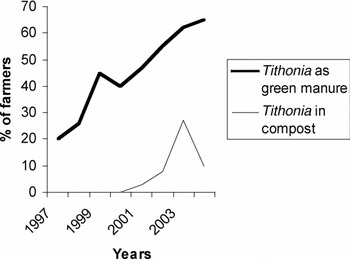
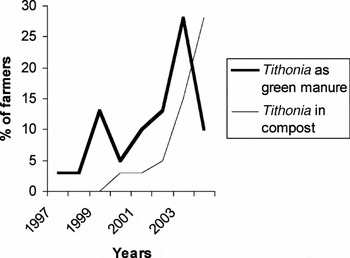
There was a steady increase in the number of farmers using Tithonia from 1997 to 1999, with a drop in 2000 in both districts, after which there was a steady increase in the use of Tithonia as a green manure in Siaya district. Some farmers also used Tithonia in compost instead of direct application. From 2002 more and more farmers in Vihiga have opted to use it in compost rather than as directly applied green manure. This in essence has led to a drop in farmers using Tithonia directly as green manure (Figure 2). In Siaya the situation is different, in that more and more farmers are using it as a green manure (Figure 1).
Trend in the use of Tithonia for SFM in pilot villages of Siaya district from 1997 to 2004.

Trend in the use of Tithonia for SFM in pilot villages of Vihiga district from 1997 to 2004.

The explanation for this is that, on average, farmers in Siaya have twice as much land as farmers in Vihiga (average 1.0 ha, compared to 0.47 ha in Vihiga) and therefore Siaya farmers have enough space to plant some Tithonia on their farms unlike their counterparts in Vihiga, who have no land to spare. As a matter of fact, 58% of farmers in Siaya have planted Tithonia on their farms compared to 13% in Vihiga. Planting Tithonia on farms saves on the time and labour associated with harvesting and transportation. Initially farmers used to get the plant from roadsides quite a distance from their homes but as more and more farmers came to realize the economic benefits of Tithonia, it became very scarce and, at the same time, farmers who had it on their land, would not allow their neighbours to harvest, unlike before. This prompted farmers in Siaya to grow it on their own land. Those in Vihiga who have no option of planting it on their farms prefer to compost it in order to reduce the labour requirements associated with chopping the leaves into small pieces before incorporating in a planting hole.
Classification of farmers into various adoption categories
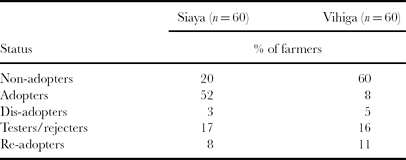
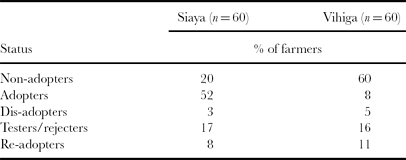
Classifying farmers into various adoption categories provides information on perceptions and motivations of different farmers and therefore enables development practitioners to target their research to constraints experienced by different categories of farmers. As of 2004, the majority of farmers (52%) in Siaya district were considered to be adopters in comparison to a paltry 8% in Vihiga district. In contrast, Vihiga district had more non-adopters (60%) than Siaya district (20%). Details of the other categories are presented in Table 1. It is important to note, though, that these categories are only relevant at a specific point in time, as adoption is a continuous process with farmers falling into different categories on the adoption continuum over time (Kiptot et al., Reference Kiptot, Hebinck, Franzel and Richards2007). A farmer who is an adopter today may dis-adopt tomorrow for a range of reasons, and may then re-adopt the technology when the circumstances are favourable.
Farmers' adoption status for Tithonia in December 2004.
Factors likely to influence adoption of Tithonia for soil fertility management
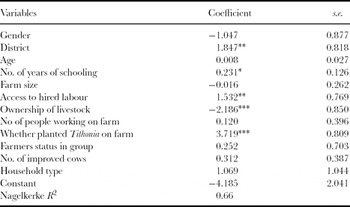
In order to assess factors likely to influence adoption of Tithonia for soil fertility, a logit regression model (Table 2) was developed.
A logistic regression model of factors likely to influence adoption of Tithonia for soil fertility management.

Dependant variable: adoption of biomass transfer 0 = No, 1 = Yes.
Independent variables: gender (Male = 0, Female = 1); district (Vihiga = 0, Siaya = 1); access to hired labour (0 = No, 1 = Yes); whether farmer has planted tithonia (No = 0, 1 = Yes); farmers status in group (official = 1, non-official = 0); livestock ownership (No = 0, Yes = 1); household type (female headed = 0, male headed = 1).
*,**,***Significant at 10%, 5%, 1% level of probability.
Ownership of livestock and planting of Tithonia on farms was found to strongly influence adoption of Tithonia (p < 0.01). The influence of livestock ownership, however, was negative, which implies that the greater the number of livestock on farms the less the likelihood that a farmer will adopt Tithonia. Farmers who have more livestock have more manure, which reduces the need for Tithonia. Previous research has shown that application of the optimum amount of 5t ha−1 of Tithonia requires 370 workdays ha−1 while application of animal manure takes only 1–7 workdays ha−1 (Jama et al., Reference Jama, Swinkels and Buresh1997), and therefore it is quite logical that farmers with manure will opt to use it instead of Tithonia. In contrast, increasing the planting of Tithonia on farms increases the likelihood of adoption. The farmer's district, and whether he/she had access to hired labour also influenced adoption (p < 0.05). This coincides with the finding that 52% of farmers in Siaya district are considered adopters in comparison to just 8% in Vihiga district (Table 1). The use of Tithonia biomass is a labour-intensive technology and this explains why it is more likely to be adopted where farmers have access to hired labour to cut and transport Tithonia for them, thereby avoiding a situation in which household labour meant for other farm activities is diverted to Tithonia. During the survey, it was found that even farmers with meagre resources occasionally hired casual labourers to assist them. A casual labourer charges KSh.50 (US$0.70) per day, which according to farmers, is small in comparison with the economic returns gained if Tithonia is used on high-value crops. More research on the cost–benefit analysis of hiring labour is therefore needed.
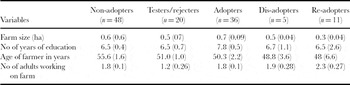
The number of years of schooling had a moderate influence over adoption probability (p < 0.10). This is perhaps a weaker relationship than found in much of the adoption literature, where adopters of agricultural technologies have been found to have significantly more years of schooling than non-adopters (Feder et al., Reference Feder, Just and Zilberman1985; Obonyo and Franzel, Reference Obonyo and Franzel2004). Other factors such as gender, age, farm size, household type, number of people working on farm, ownership of improved cows did not show any influence over adoption of Tithonia in the regression analysis, although the study found that adopters had slightly larger than average land holdings and were slightly younger (average age 50) than those who never adopted (average age 56) (Table 3).
Farm and household characteristics of various categories of adopters.

Figures in parenthesis are standard errors of mean.
Main reasons for non-adoption, rejection and dis-adoption of Tithonia
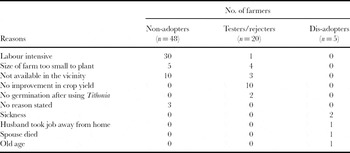
During the formal survey, those farmers who were non-adopters, testers/rejecters and dis-adopters were asked why they were not using Tithonia, even though they were aware of its benefits. Various reasons are presented in Table 4, as mentioned by farmers. It is clear that the main reason is labour intensiveness; this was mentioned by 30 farmers (Table 4). The same observation has been made by several other researchers (Jama et al., Reference Jama, Palm, Buresh, Niang, Gachengo, Nziguheba and Amadalo2000, Place et al., Reference Place, Adato, Hebinck and Omosa2005; Obonyo and Franzel, Reference Obonyo and Franzel2004).
Main reasons various categories of farmers gave for not using Tithonia for soil fertility management.

Transporting Tithonia, which is heavy when fresh, and then cutting and chopping into small pieces is a highly labour-intensive venture. Previous research has shown that because of its high labour requirements, it is not cost effective to use it on a low value crop like maize, but is only profitable when used on high-value crops such as tomatoes, kale and cabbages (ICRAF, 1997). This is the reason why many farmers apply it on very small portions and on high-value crops. Farmers therefore need to be further encouraged to use it on high-value crops.
The main reason cited by farmers who experimented and rejected the technology was the fact they did not notice any improvement in crop yields after using Tithonia. Ten farmers out of 20 mentioned this. This could be attributed to the fact that some farmers applied very small quantities of Tithonia, which in essence led to no noticeable effect on crop yield. Two farmers found that their crops did not germinate after using Tithonia. This might be attributable to the fact that the affected farmers applied seed directly over Tithonia without cover. Applying the Tithonia with a thin layer of soil first, before planting a crop is the recommended practice. This suggests the need for researchers and extension officers to get farmers fully to understand agronomic practices concerning how and when to use Tithonia.
As regards to farmers who dis-adopted the technology after using it for several seasons, a main reason cited was sickness. Malaria is endemic to the region and there are very high rates of mortality due to HIV/AIDS. This has impacted negatively on technologies that are labour intensive, such as use of Tithonia. The death of her spouse was also reported as having led to one farmer abandoning the use of Tithonia, as she could not cope with the extra work involved. Old age was also mentioned by one farmer. He indicated that he was simply too old to engage in such a technology, since it is so labour intensive. Although age was not found to be statistically associated with the adoption of Tithonia, the results in Table 3 suggest that the adopters are somewhat younger than the other farmers in the sample.
Farmers' reasons for adopting Tithonia
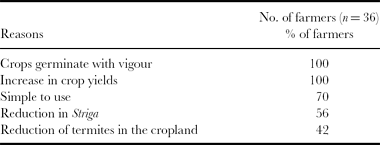
All farmers who had adopted Tithonia in the pilot villages indicated that when it is used, crops germinate with vigour and that crop yield increases (Table 5). Other reasons mentioned was the fact that it is a simple technology to use and it reduces infestation of termites and Striga on crop fields.
Farmers' reasons for adopting Tithonia.
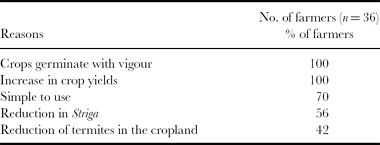
N.B. There were multiple responses hence the total is more than 100.
Farmer adaptations
Although the technology was initially promoted as a green manure to be used when planting maize, farmers have come up with a number of adaptations. The survey revealed that farmers used Tithonia for growing a variety of crops. Frequently mentioned were kale (45%), cabbages (20%), tomatoes (45%) and bananas (60%). A minority of farmers (15%) used it on maize. In addition they also used Tithonia for mulching their kale, tomatoes and cabbages. Furthermore, instead of only using it directly as a green manure, farmers are opting to compost it. As was shown in Figure 1 and 2, more and more farmers, especially in Vihiga district, prefer this composting option to direct application as a green manure. Other adaptations are the use of Tithonia for top-dressing maize and as a pesticide. Another major adaptation is that farmers now plant it on farms instead of relying on Tithonia found along roadsides and farm boundaries. The common planting practice used by farmers is to plant Tithonia along contours in the cropland to serve the dual purpose of controlling soil erosion and providing leafy biomass for soil fertility replenishment.
Constraints experienced by farmers using Tithonia
Various constraints experienced by farmers using Tithonia are scarcity, mentioned by 45% of farmers; bad smell (40%) and labour intensiveness (45%), while a majority (80%) mentioned that they did not know how much Tithonia to use in a planting hole. The normal practice is for farmers to chop Tithonia leaves into small pieces and then incorporate a handful of fragments in the planting hole. Farmers who use it to make compost incorporate as much as they can in the compost pit. The quantities applied are usually not measured and in most cases it is trial and error. The incidence of crops not germinating after using Tithonia is high and this could be attributed to insufficient knowledge on how much is needed. More research should be directed to this aspect, so that farmers know the quantities required for different crops. Although 45% of farmers using Tithonia mentioned labour intensiveness as a constraint, it did not necessarily prevent them from using Tithonia, but posed a major limitation to the area over which the farmer applies Tithonia biomass.
Although the bad smell of Tithonia was mentioned, this is probably not a major issue when compared to the economic returns associated with its use on high-value crops. Most farmers have learnt to deal with it. Scarcity is another constraint that was mentioned by some, and was also noted by Jama et al. (Reference Jama, Palm, Buresh, Niang, Gachengo, Nziguheba and Amadalo2000). Those who plant it argue that since many farmers in the pilot villages now know the economic importance of Tithonia, it is becoming more and more privatized. People can no longer simply go to anybody's farm to harvest it; now they have to ask for permission. Having a farm-based supply is the solution adopted by some, and others should be encouraged to do likewise. Even those with small farms can be encouraged to plant along terraces and on internal and external farm boundaries.
CONCLUSIONS
Two main conclusions can be drawn from this study. First and foremost, is that the use of Tithonia biomass for SFM is a promising option for farmers and therefore development professionals should scale up the practice to regions where farmers are willing to plant it on their farms and able to provide the necessary labour. Farm planting is a reasonable thing to do, since it reduces labour requirements associated with transportation, in addition to solving a scarcity problem. For those farmers who are limited by the size of their farms, alternative niches that do not compromise land for cropping should be explored, i.e. use of contours and internal and external boundaries. Since this technology has been shown to be profitable when used on high-value crops, development agents should encourage farmers to use it on those crops so as to improve their returns on labour. When planted along contours, it also serves the additional purpose of controlling soil erosion and should also be scaled up in hilly areas. Farmers can periodically lop these hedges to reduce shading on adjacent crops and use the biomass for soil fertility replenishment.
There are, however, two major outstanding issues that need further research. Firstly, farmers do not know the quantity of Tithonia that is required in a planting hole. Under-application or even applying too much has led to either crops not germinating or no improvements in yield. Another problem pointed out by Jama et al. (Reference Jama, Palm, Buresh, Niang, Gachengo, Nziguheba and Amadalo2000) is that Tithonia is a nutrient miner; it effectively retrieves nutrients deep in the soil. As farmers continue to lop the hedges planted on farm, it is more likely that in the long term the positive effects of Tithonia on crop yield will diminish, since on-farm Tithonia may eventually pump out nutrients rather than supply them, unless farmers are encouraged to manure/fertilize their hedges, an unlikely prospect. It is therefore important that more research is undertaken to determine the longer-term effects of using Tithonia hedges for on-farm SFM. This information will be invaluable in helping development agents and researchers devise agronomic options to be undertaken by farmers without compromising nutrient budgets on farms.
Secondly, the study has also shown that farmers in western Kenya have come up with various innovative strategies on how to use Tithonia. The original method, introduced by scientists, of chopping Tithonia into small pieces and applying it as green manure was found to be laborious by some farmers and therefore they experimented with the less laborious alternative of using it in compost. Furthermore, some are using it as a pesticide and for top dressing. The implication of this is that knowledge generation is not a preserve for scientists alone, and therefore researchers need to work continuously with farmers so as to capture new knowledge and skills which can then in turn be fed back into the research and development system in order to improve SFM strategies on-farm.
Acknowledgements
I am grateful to the Rockefeller Foundation for providing funding for this research. Special thanks go the Kenya Forestry Research Institute for logistical support, George Muok for his assistance in data collection and Franklin Mairura for advice on statistical analysis. My gratitude also goes to Professor Paul Richards and Dr Steve Franzel for their earlier comments on this work.