Introduction
Cactus cladodes are well-established as a feed for ruminants in semi-arid regions around the world. According to Shackleton et al. (Reference Shackleton, Witt, Piroris and van Wilgen2017), the family Cactaceae has 130 genera and 1922 species and has been disseminated throughout the world for different purposes, such as for use as ornamental plants, and human and animal food, thus contributing to the supply of animal products, especially for populations in marginalized areas, and helping to mitigate drought and combat desertification. Therefore, their use is an opportunity for income generation and the conservation of ecosystems (Ben Salem et al., Reference Ben Salem, Nefzaoui and Ben Salem2002; Nefzaoui et al., Reference Nefzaoui, Louhaichi and Ben Salem2014).
The main types of cactus cladodes used as forage in dairy production systems in the semi-arid areas of Brazil are Opuntia and Nopalea. These are especially popular during the drought season, when feed supply in the region is low (Santos et al., Reference Santos, Neves, Santos, Pereira, Gonçalves, Ferreira, Costa, Araújo, Scherer and Sollenberger2018). Although FAO (2017) described the Brazilian exploitation of Opuntia for forage, it is a clear example of technological adequacy of use in meeting the economic needs of the country; recently, cactus cladode plantations have been infested by the carmine cochineal insect (Dactylopius opuntiae Cockerell), which has motivated researchers to evaluate genotypes/cultivars with increased resistance to the pest. However, according to Silva et al. (Reference Silva, Ferreira, Oliveira, Santos, Gama, Chagas, Inácio, Silva and Pereira2018), information on the nutritional value of Opuntia is limited.
Santos et al. (Reference Santos, Neves, Santos, Pereira, Gonçalves, Ferreira, Costa, Araújo, Scherer and Sollenberger2018) evaluated nutritional characteristics of 13 forage cactus cladode genotypes (resistant, semi-resistant and susceptible to carmine cochineal) in the Arcoverde Experimental Station of the Agronomic Institute of Pernambuco, Brazil, and observed that resistant genotypes showed characteristics similar to traditional genotypes and recommended further studies to evaluate the performance of animals fed these genotypes.
With respect to the nutritional and productive aspects of cactus Nopalea cochenillifera Salm Dyck cladodes (Nopalea) and cactus Opuntia stricta [Haw]. Haw cladodes (Opuntia), Silva et al. (Reference Silva, Melo, Ferreira, Oliveira, Santos, Silva and Inácio2017) observed no difference in dry matter (DM) intake and feeding behaviour of crossbreed dairy heifers.
On the other hand, Rocha Filho (Reference Rocha Filho2012) observed a reduction in DM intake and milk production of crossbreed cows fed Opuntia (12.11 kg/day), compared with those fed Nopalea (14.96 kg/day) in association with concentrate, and attributed these results to the animals’ lower acceptability of Opuntia. Likewise, Silva et al. (Reference Silva, Ferreira, Oliveira, Santos, Gama, Chagas, Inácio, Silva and Pereira2018) reported a decrease of 1.4 kg/day in DM intake of crossbreed cows: the authors attributed these results to the non-fibrous carbohydrate content of the cactus cladodes (639.0 and 547.3 g/kg DM, for Nopalea and Opuntia, respectively), which may be responsible for altering the palatability of the diet.
Given the above findings and agronomic aspects of Opuntia, such as lower soil nutrient requirements, higher tolerance to water stress conditions and productivity of Opuntia (37 tons of DM/ha/2 years) and Nopalea (21 tons of DM/ha/2 years) in places with extended periods of drought (Santos et al., Reference Santos, Lira, Silva, Cunha, Pereira, Farias and Felix2008), it was hypothesized that a mixture of Opuntia and concentrate ratio could promote a similar performance to Nopalea for Holstein cows.
The aim was to evaluate the intake and content of digestible material of DM and its components, feeding behaviour, microbial protein synthesis, nitrogen balance, blood parameters, production and composition of milk of Holstein cows fed Opuntia associated with different concentrate levels.
Materials and methods
Animals and housing
Ten lactating Holstein cows with an average milk yield (MY) of 20 ± 2.1 kg/day, an average body weight (BW) of 567 ± 69.0 kg and an average of 12 weeks in milking were assigned to a double 5 × 5 simultaneous Latin square. The trial lasted 105 days, with four consecutive 21-day periods divided into 14-day adaptation and 7-day sampling periods. Individual BW was measured at the beginning and end of each experimental period, after milking. Cows were housed in individual pens, with approximately 24 m2 space, individual bunks and unrestricted access to water.
Experimental diets
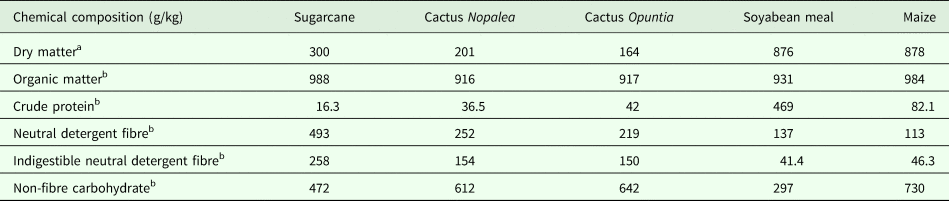
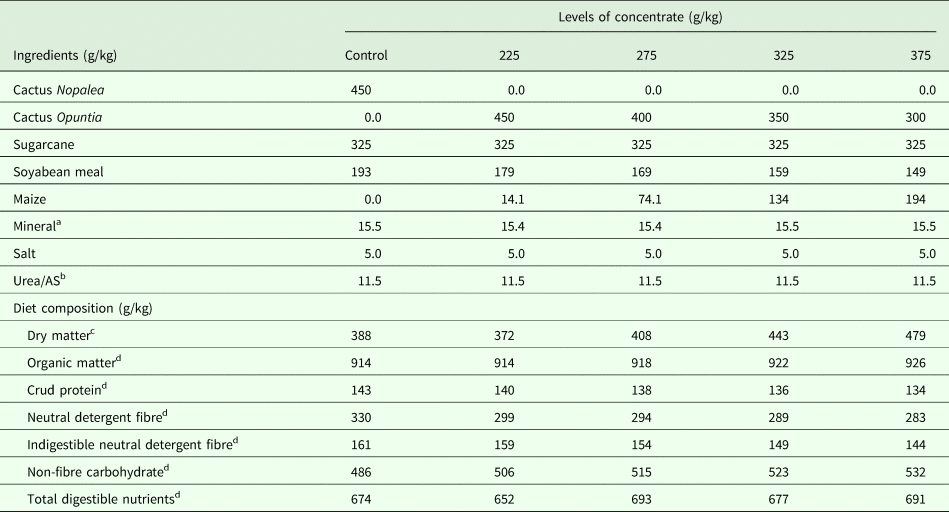
The five experimental diets consisted of: N. cochenillifera Salm-Dyck cladodes (Nopalea) plus 225 g/kg of concentrate (control diet); and O. stricta [Haw]. Haw. cladodes (Opuntia) with 225, 275, 325 or 375 g/kg of concentrate, on DM basis. The control diet, with a roughage:concentrate proportion of 775:225 g/kg was formulated to meet the requirements of dairy cows producing 20 kg of milk/day, with 3.5% fat (NRC, 2001). Feed was supplied ad libitum as total mixed rations, twice a day at 07.00 and 16.00 h, allowing 5–10% in orts (DM basis). The chemical composition of individual diet components is show in Table 1, while Table 2 shows the composition of the diets and the chemical composition of each mixture.
Chemical composition of ingredients

a As fed.
b Dry matter basis.
Proportion of ingredients and composition of experimental diets

a Components: dicalcium phosphate; limestone; salt; sulphur flower; zinc sulphate; copper sulphate; manganese sulphate; potassium iodate; sodium selenite.
b Nine parts urea and one part ammonium sulphate.
c Fresh weight basis.
d Dry matter basis.
Voluntary intake
Voluntary intake was evaluated from the 15th to the 21st day by recording the amounts of supplied diet and orts on a daily basis. In this sense, the amounts of supplied diet and orts were taken into account. Samples of diet ingredients and orts were pooled per animal and experimental period and stored in plastic bags at −20 °C. At the end of the experiment, the samples were oven-dried at 60 °C for 72 h and ground to pass through a 2 mm mesh for in situ ruminal incubation and through a 1 mm screen for further chemical analysis.
Digestibility assay
For estimated content of digestible material and total digestive nutrient (TDN) concentration, spot faecal samples were collected directly from the animals’ rectums between the 16th and 20th days of each experimental period (Torres et al., Reference Torres, Ferreira, Guim, Vilela, Guimarães and Silva2009). Samples were pooled per animal and experimental period and stored at −20 °C for chemical analysis. Total faecal excretion was estimated using indigestible neutral detergent fibre (iNDF) as an internal marker; iNDF contents from faeces, feed and orts were obtained after 288 h of ruminal incubation time (Valente et al., Reference Valente, Detmann and Sampaio2015). The lactation net energy (NEL) was estimated according to NRC (2001).
Chemical analysis
Feed and faeces samples were evaluated for DM, organic matter (OM), mineral matter and crude protein (CP) contents, according to AOAC (2005), methods 934.01, 942.05, 942.05, 990.13, respectively; ether extract was determined according to AOCS (2004). Neutral detergent fibre (NDF) was analysed according to Van Soest et al. (Reference Van Soest, Robertson and Lewis1991) using α-amylase, as recommended by AOAC (2005) method 973.18. The neutral detergent insoluble nitrogen was analysed using the Kjeldahl method (Licitra et al., Reference Licitra, Hernandez and Van Soest1996) and the non-fibre carbohydrates (NFC) were calculated according to Hall (Reference Hall2003). Milk nitrogen was quantified using milk total protein (6.38), and the milk urea nitrogen (MUN) was estimated using the equation N urine (g/day) = 12.54 × N milk (mg/dl).
Feeding behaviour
To evaluate feeding behaviour, data (ruminating, feeding and idling) were collected on the 15th day of each experimental period. Observations were made over 24 h using the scan sampling method proposed by Martin and Baterson (Reference Martin and Baterson2007). Feed and rumination efficiencies (g DM/min) were calculated by dividing the DM intake by total feeding time (FEE; feed efficiency) or rumination time (RUE; rumination efficiency), respectively.
Blood and urine sampling
Blood samples were taken on the 21st day of each sampling period, 4 h after the morning feeding, from the coccygeal vein of each animal. Samples were centrifuged immediately at 2100 g/min for a period of 15 min and the remaining plasma or blood serum was kept at −20 °C for further analysis of urea concentration.
Simultaneous to blood sampling, spot urine samples were collected from each cow (Chizzotti et al., Reference Chizzotti, Valadares Filho, Valadares, Chizzotti and Tedeschi2008). Urine was filtered through gauze and an aliquot of 10 ml was diluted immediately in 40 ml sulphurous acid (H2SO3; 0.036 N). Samples were stored at −20 °C for further analysis of nitrogen, urea, allantoin (AL), uric acid (UA) and creatinine.
To determinate AL in milk and urine, the colorimetric method was used as described by Chen and Gomes (Reference Chen and Gomes1992). Urine urea concentration was analysed via the enzymatic–colorimetric system of the urease method using commercial kits (Labtest Diagnóstica® S.A., Lagoa Santa, Brazil). Urine UA concentration in urine was analysed via the enzymatic Trinder method using commercial kits (Labtest Diagnóstica® S.A.). Urine creatinine concentration was analysed using ‘end point’ markers with picrate and acidification, using commercial kits (Labtest Diagnóstica® S.A.).
Daily total urinary volume was estimated through the daily urinary excretion of creatinine, using the observed values of creatinine concentration in urine as described by Valadares Filho and Valadares (Reference Valadares Filho, Valadares and Guimarães2001). The daily urinary excretion of creatinine was based on 24.05 mg/kg of BW of creatinine (Chizzotti et al., Reference Chizzotti, Valadares Filho, Valadares, Chizzotti and Tedeschi2008). Microbial protein synthesis was estimated according to Chen and Gomes (Reference Chen and Gomes1992), considering a recovery of absorbed purines of 0.85 and an endogenous contribution to the excretion of purines as recommended by Verbic et al. (Reference Verbic, Chen, Macleod and Orskov1990).
Milk sampling and composition analyses
Cows were milked twice a day (06.00 and 17.00 h), and MY was recorded from the 15th to the 21st day of each experimental period. Milk samples were collected on days 18 and 19 of both milking periods, after last collection, and pooled samples were made for each cow. A milk aliquot of 50 ml was conditioned in plastic bottles with preservative (Bronopol®), maintained between 2 and 6 °C, and sent to the PROGENE Laboratory for evaluation of lactose, fat, protein, total solids, non-fat solids, casein and urea, following the methods of ISO 9622/IDF 141C (IDF, 1996). Another 10 ml aliquot of milk was deproteinated with 5 ml of trichloroacetic acid (25%), filtered and stored at −15 °C for further AL analysis. The 3.5% fat-corrected milk yield (FCMY) was estimated by the equation FCMY (3.5%) = [(0.432 + 0.1625 × %milk fat) × MY kg/day] (Sklan et al., Reference Sklan, Ashkenazi, Braun, Devorin and Tabori1992).
Statistical analysis
The data were submitted for analysis of variance and regression using the MIXED procedure of the statistical program SAS (2009) (version 9.4, SAS Institute Inc., Cary, NC, USA), adopting P < 0.05 as significance level for the type I error, according to the following model:
 $$Yijkl{\rm}={\rm } \mu {\rm}+{\rm } \tau i{\rm}+{\rm } Qj{\rm}+{\rm } Pk{\rm}+{\rm (}A{\rm /}Q{\rm )} lj{\rm}+{\rm } \tau \,{\rm \times} \,Qij{\rm}+{\rm } \varepsilon ijkl$$
where Yijkl is the observation ijkl; μ, the general mean; τi, the treatment fixed effect i; Qj, the square random effect j; Pk, the period random effect k; (A/Q)lj, the animal l into square j random effect; τ × Qij, the interaction random effect of treatment i and square j; and εijkl, the random error with mean 0 and variance σ 2.
A Dunnett test was used to compare each treatment group mean (concentrate levels), with the mean from the control diet. Comparisons between concentrate levels associated with Opuntia were conducted by the decomposition of sum of squares in orthogonal linear contrasts and quadratic effects, at P < 0.05, with subsequent adjustments of the regression equations.
Results
Voluntary intake and digestibility
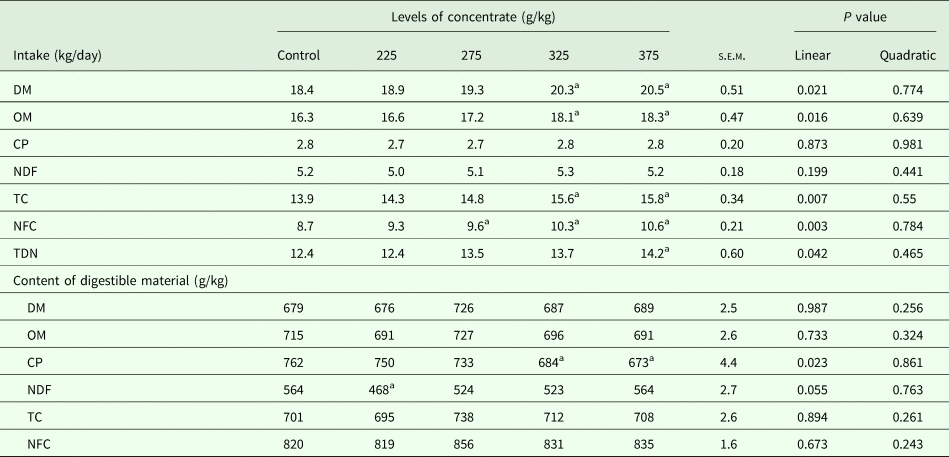
Intake and content of digestible material (Table 3) were similar between the control diet and the diet containing 225 g/kg concentrate with cactus Opuntia. On the other hand, greater DM and total carbohydrate (TC) intakes were observed when cows were fed diets containing 325 and 375 g/kg concentrate, as well as greater TDN for those that were fed a diet containing 375 g/kg and higher NFC for those that were fed any increase of concentrate (P = 0.050); however, there were no differences in CP and NDF intakes. Compared with the control diet, lower digestibility of NDF was only observed for the diet containing 225 g/kg concentrate and lower CP for the diets with 325 and 375 g/kg concentrate (P < 0.05). With respect to diets containing cactus Opuntia and concentrate levels, there was a linear increase in DM, OM, TC, NFC and TDN intakes (P = 0.021, 0.016, 0.007, 0.003 and 0.042, respectively; Table 3), whereas CP and NDF intake were not influenced (P > 0.05). There was also a linear reduction of the content of digestible material of CP (Table 3).
Nutrient intake and content of digestible material for cows fed cactus cladodes and concentrate levels

DM, dry matter; OM, organic matter; CP, crude protein; NDF, neutral detergent fibre; TC, total carbohydrate; NFC, non-fibre carbohydrate; TDN, total digestible nutrients.
a Values differ statistically from the control treatment by Dunnett test at P < 0.05.
Feeding behaviour
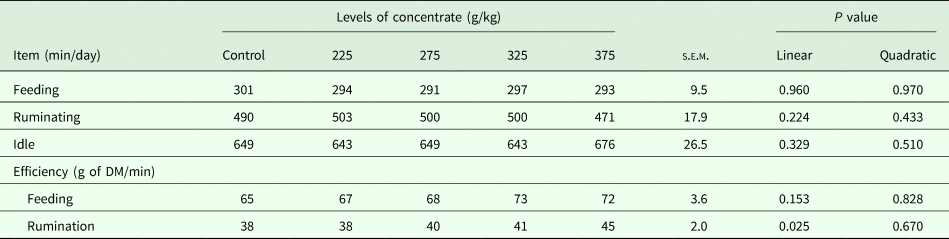
No differences were observed for time spent feeding, ruminating and idling, expressed in min/day (P > 0.05); greater RUE as a function of DM was observed for the diet containing 375 g/kg concentrate (P = 0.025; Table 4). In terms of the parameters related to feeding behaviour, only RUE was influenced, showing a linear increase with concentrate content (P = 0.025; Table 4).
Feeding behaviour of cows fed cactus cladodes and concentrate levels

Nitrogen balance and microbial protein synthesis
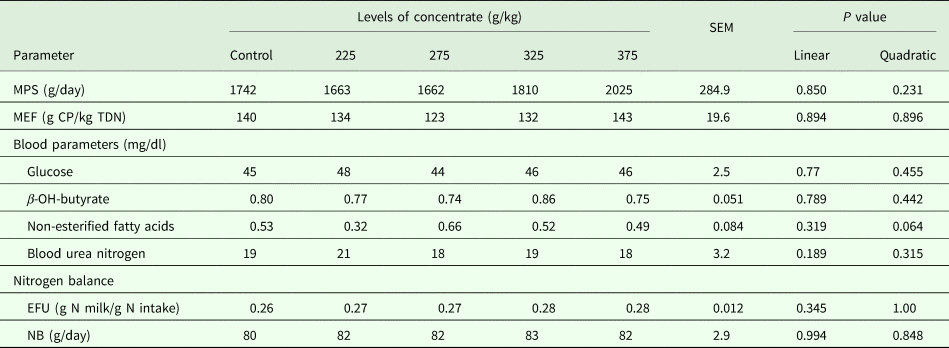
Values of microbial protein synthesis, microbial efficiency, blood parameters and nitrogen balance were similar between cows fed the control diet and Opuntia plus concentrate (Table 5). The increase of concentrate did not influence the microbial protein production and efficiency, or nitrogen balance. The increased concentrate levels did not influence blood parameters (P > 0.05; Table 5).
Microbial production and efficiency, blood parameters and nitrogen balance of cows fed cactus cladodes and concentrate levels

MPS, microbial protein synthesis; MEF, microbial efficiency; NB, nitrogen balance; EFU, efficiency of use.
Milk yield and composition
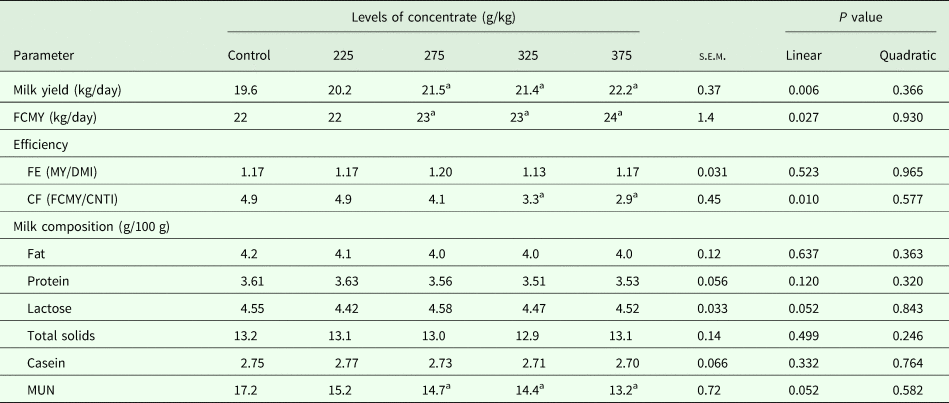
The diet containing 225 g/kg concentrate promoted a similar MY and milk composition compared with the control diet (P > 0.05), whereas greater MY was found in diets with increased concentrate proportions (Table 6). The different diets promoted similar compositions of protein, lactose, total solids and casein; however, reduction of MUN was observed with increased concentrate content (P = 0.03; Table 6). With respect to FEE of DM, there was no difference between the diets. Conversely, diets containing 325 and 375 g/kg concentrate promoted greater efficiency in the intake of concentrate (P = 0.010).
Performance, feed efficiency and milk composition of cows fed cactus cladodes and concentrate levels

MY, milk yield; DMI, dry matter intake; FCMY, 3.5% fat-corrected milk yield; FE, feed efficiency; CF, concentrate efficiency; MUN, milk urea nitrogen.
a Values differ statistically from the control treatment by Dunnett test at P < 0.05.
Both MY and FCMY increased according to concentrate levels, whereas MUN and efficiency of concentrate use decreased linearly (P = 0.006; 0.010; respectively, Table 6) with increasing concentrate levels.
Discussion
The control diet met expectations for DM intake and MY, based on previous studies with cactus cladodes (Ferreira et al., Reference Ferreira, Valadares Filho, Marcondes, Paixão, Paulino and Valadares2009a). The NRC (2001) recommends intakes of 18.50 kg/day of DM, 2.65 kg/day of CP and 11.10 kg/day of TDN to promote 20 kg/day of MY for cows with the same physiological characteristics as those used in the current experiment.
Diets containing the same concentrate content (225 g/kg) promoted an average intake of 18.60, 2.75 and 12.39 kg/day of DM, CP and TDN, respectively. Excessive TDN intake promoted an average BW gain of 0.46 kg/day/animal. Contrary results were reported by Rocha Filho (Reference Rocha Filho2012), who observed a reduction in the DM intake and MY of crossbreed cows, and by Silva et al. (Reference Silva, Ferreira, Oliveira, Santos, Gama, Chagas, Inácio, Silva and Pereira2018), who observed a reduction only in the DM intake of crossbred cows. The authors above attributed these results to: the lower acceptability of diets containing Opuntia, due to the lower sugar (137 and 115 g/kg DM for Nopalea and Opuntia, respectively) and starch contents (252 and 135 g/kg DM, respectively; Rocha Filho, Reference Rocha Filho2012); and lower palatability, as a consequence of the reduced carbohydrate content (639.0 and 547.3 g/kg DM, respectively; Silva et al., Reference Silva, Ferreira, Oliveira, Santos, Gama, Chagas, Inácio, Silva and Pereira2018). It is worth noting that the cows used in the above studies had lower milk production (14 and 12 kg/day, respectively) than those in the current study.
Factors such as the proportion of cactus cladodes in the diets, the quality of the roughage used, the amount of concentrate and the chemical composition of the cactus cladodes may have affected the animals’ acceptability of the diets. Further studies aimed at cactus cladode carbohydrate fractionation could elucidate these issues.
Cactus cladodes seem to be more effective for cows that produce <25 kg milk/day; this may be because DM intake is limited due to the water content in cactus cladodes. According to Estrada et al. (Reference Estrada, Delagarde, Faverdin and Peyraud2004), water content in the forage clearly limits voluntary feed intake while reducing the initial and average rate of DM intake. Further studies evaluating the effect of Opuntia on DM intake and the performance of Holstein cows producing >25 kg milk/day would also clarify these issues.
Finely ground concentrate feed reduces rumination time (Van Soest, Reference Van Soest1994) and promotes greater efficiency (Dulphy et al., Reference Dulphy, Remond, Theriez, Ruckebush and Thivend1980). Reduced rumination time per gram of feed generally leads to increased intake and the presence of feed particles in faeces (Van Soest, Reference Van Soest1994). During the experiment, these particles were not measured but it was possible to see them, which can be ratified by the increase in DM intake and the concomitant reduction of CP digestibility in diets containing higher concentrate levels.
Similar nictemeral behaviour related to the feed, rumination and idle time of crossbreed cows were observed by Silva et al. (Reference Silva, Ferreira, Oliveira, Santos, Gama, Chagas, Inácio, Silva and Pereira2018) when evaluating diets containing Nopalea or Opuntia; these diets were composed of equal concentrate contents (220 g/kg) and similar NDF contents. In contrast, Albright (Reference Albright1993) reported a quadratic effect for time spent ruminating and chewing when cows were fed diets containing 4% variation in NDF content (26, 30 and 34%). In the present study, the maximum range of NDF between diets was 4.6%; however, no differences or changes in behavioural variables were observed.
The blood and MUN concentrations are a consequence of the synchronization between energy and protein sources in the rumen; their values can be indicative of excessive or deficit nutrients in the diet. In milk, values >17 mg/dl indicate excessive N intake or degradable protein in the rumen and energy deficits. On the other hand, values <10 mg/dl are indicative of a deficiency in protein supply (Vasconcelos et al., Reference Vasconcelos, Leão, Valadares Filho, Valadares, Dias and Morais2010; Acharya et al., Reference Acharya, Schingoethe, Kalscheur and Casper2015). For all diets, MUN concentrations were within the normal range; however, lower concentrations were observed with the increase of concentrate in diets; thus, greater synchronization between energy:protein sources may have occurred for these diets.
However, similar responses to production and efficiency of microbial protein synthesis, blood parameters and nitrogen balance may be considered indicative that the nutrient requirements of these cows were met appropriately (NRC, 2001), without the need to mobilize body reserves to maintain MY and milk composition. Additionally, these values are normal for dairy cows according to González et al. (Reference González, Muiño, Pereira, Campos and Benedito2011).
Due to the greater NFC content and cactus cladode digestibility, diets containing these ingredients require low concentrate feed inclusion to promote better animal performance (Ferreira et al., Reference Ferreira, Silva, Bispo and Azevedo2009b). This was confirmed by de Almeida et al. (Reference de Almeida, Ferreira, Silva, Chagas, Véras, Barros and de Almeida2018), who tested diets with and without cactus cladodes and observed that in diets without cactus, the same MY was only achieved by adding 2.2 times more concentrate to the diet.
However, in the present study, when the efficiency of the concentrate use was quantified, it was observed that the intake of 1 kg of concentrate was responsible for the daily production of 4.74, 4.05, 3.24 and 2.88 l of milk, for diets containing 225 (Nopalea or Opuntia) 275, 325 and 375 g/kg concentrate, respectively. Therefore, MY was more efficient with a higher proportion of concentrate. On the other hand, feed efficiency as a function of DM intake was similar between the diets. It can be assumed that animals replaced the cactus cladode intake with concentrate, since less concentrate intake efficiency was observed for diets containing higher proportions of concentrate.
According to Dixon and Stockdale (Reference Dixon and Stockdale1999), the ruminant digestive system creates opportunities to maximize the efficiency of the utilization of feed, which is generally increased when grain is incorporated into a forage diet. For lactating dairy cows, it is more important to maximize the supply of microbial protein to the rumen. This can be affirmed by reductions in urea nitrogen concentrations in milk as the concentrate is increased in the diet.
Additionally, according to Monteiro et al. (Reference Monteiro, Melo, Ferreira, Campos, Souza, Silva, Andrade and Silva2014) and Dubeux Júnior et al. (Reference Dubeux Júnior, Santos, Mello, Cunha, Ferreira, Santos, Lira and Silva2015), the replacement of concentrate feed for cactus cladodes reduces animal production costs in semi-arid areas significantly. The price of both these ingredients and of milk can help the farmer to decide which diet should be used, as well as the choice of cactus cladode genotype to be used, with an emphasis on agronomic factors, when making this decision.
According to Lira et al. (Reference Lira, Santos and Silva2011) and Santos et al. (Reference Santos, Lira, Silva, Cunha, Pereira, Farias and Felix2008), respectively, Opuntia productivity is 46 and 37 tons of DM/ha/2 years, and Nopalea productivity is 22 and 21 tons of DM/ha/2 years. Additionally, according to Silva et al. (Reference Silva, Primo, Silva, Moura, Santos, Silva and Araújo2014), Opuntia has greater resistance to longer droughts through more efficient conservation of water. However, the exclusive choice of one crop over another can make the system more susceptible to new pests.
Conclusion
The results of the current study indicate that Opuntia cactus could be effective in replacing Nopalea in diets for Holstein cows, due to similar productive performance and conservation of the metabolic status of the animals.
Higher production occurs with greater inclusion of concentrates to the diet. The cactus Opuntia genotype is the best option due to agronomic characteristics, considering its productivity.
Financial support
The authors are grateful to the Brazilian Foundation, National Council for Scientific and Technological Development – CNPq for financial support, and the Agronomic Institute of Pernambuco (IPA). This study was financed in part by the Coordenação de Aperfeiçoamento de Pessoal de Nível Superior – Brasil (CAPES) – Finance Code 001.
Conflict of interest
None.
Ethical standards
The study was approved by the Ethics committee of the Federal Rural University of Pernambuco (License no 069/2016) and was conducted at the Experimental Station of the Agronomic Institute of Pernambuco (IPA), located at São Bento do Una, Pernambuco, Brazil, with a semi-arid climate Bsh (Koopen, Reference Koopen1948).