INTRODUCTION
Morphological systems often exhibit a distinction between regular and irregular forms. The former are typically predictable in form, segmentable into stems/roots and affixes, and regular affixes are productive, i.e. they readily apply to nonce words. The latter are typically idiosyncratic and opaque in form, and irregular affixes or forms are less productive in generalization, for example to nonce words. The best-known reflex of this linguistic distinction in child language acquisition are over-regularizations, e.g. in the acquisition of the English past tense, errors such as *beated and *drawed (Marcus, Pinker, Ullman, Hollander, Rosen & Xu, Reference Marcus, Pinker, Ullman, Hollander, Rosen and Xu1992: 148), in which -ed forms are applied to verbs that have irregular past tense forms (beat, drew). Over-regularizations have been intensively studied and have played a critical role in the rejection of behaviorist models of language learning; see Chomsky (Reference Chomsky1959). Over-regularizations are also one of the strongest indicators that children's language involves grammatical rule application and symbolic representations, rather than just memorizations of forms found in the input (see e.g. Brown & Bellugi, Reference Brown and Bellugi1964; McNeill, Reference McNeill, Smith and Miller1966).
In current research, we can distinguish between two alternative accounts of children's over-regularization errors. According to dual-mechanism accounts (Marcus et al., Reference Marcus, Pinker, Ullman, Hollander, Rosen and Xu1992), over-regularizations such as *bring-ed are due to the child applying a regular (-ed) affixation rule in cases in which the lexical entry for an irregular word form (e.g. brought) is not available, and they disappear once the child can reliably retrieve the correct irregular word form. An alternative theoretical viewpoint is represented by (different kinds of) single-mechanism models which hold that generalizations in children's use of inflected word forms follow from the formation of patterns between existing word forms (Bybee, Reference Bybee1995; Elman, Bates, Johnson, Karmiloff-Smith, Parisi & Plunkett, Reference Elman, Bates, Johnson, Karmiloff-Smith, Parisi and Plunkett1996; Langacker, Reference Langacker2000). In English, for example, -ed forms are highly frequent in the input, yielding a strong pattern compared to irregulars, and this makes them likely to appear in overapplication errors. In connectionist implementations of single-mechanism models (see Rumelhart & McClelland, Reference Rumelhart, McClelland, Rumelhart and McClelland1986; Plunkett & Marchman, Reference Plunkett and Marchman1996), for example, over-regularizations arise because the regular pattern will be exemplified by many different verbs, which will strengthen the link weights to the phonological and semantic features defining word forms with -ed. These strengthened weights could overwhelm the relatively weaker weights of links to irregular past tense forms, resulting in over-regularization errors.
Previous empirical studies of children's inflectional errors have analyzed the types of overapplications, their frequencies of occurrence and their developmental patterns. Psycholinguistic research into how children produce or recognize morphologically complex words (including over-regularizations) in real time is extremely scarce. There is only one published study (Clahsen, Hadler & Weyerts, Reference Clahsen, Hadler and Weyerts2004) examining children's spoken production of inflected word forms in a speeded production task. The children's on-line data revealed contrasts between regular and irregular forms. For example, high-frequency irregulars were produced faster than low-frequency irregulars, while there was no corresponding advantage for high-frequency regulars. This was taken to indicate that irregular forms (but not regular ones) are directly retrieved from memory and do not involve morphological computation.
The present study is an attempt to demonstrate how the processing of inflected word forms in children's on-line recognition can be investigated experimentally. We examined children's brain responses to spoken sentences containing different kinds of morphological error (including over-regularizations) by recording the event-related potential (ERP). ERPs consist of a series of positive and negative voltage changes in the ongoing electroencephalogram that are recorded from the intact human scalp while the participant is performing some task, such as reading or listening to a sentence. ERPs provide a rich source of data, including parameters such as polarity (negativity vs. positivity), time measures (onsets, latencies), amplitude and topographic distribution over the scalp. Given that ERPs have an excellent temporal resolution in the millisecond range and provide a continuous recording, they offer a detailed measure of on-line language processing. Previous ERP studies with adults have led to the identification of different components involved in lexical versus grammatical processing. Anomalous or unexpected words, e.g. a semantically inappropriate word or a pronounceable non-word, typically elicit an increased amplitude of the N400 component, i.e. a negativity at central electrode sites (see Kutas & Schmitt (Reference Kutas, Schmitt, Banich and Mack2003) for review). By contrast, grammatical violations were found to elicit anterior negativities (sometimes larger over the left than over the right hemisphere; see Münte, Matzke & Johannes (Reference Münte, Matzke and Johannes1997) ) and/or late posterior positivities (labeled P600 or Syntactic Positive Shift; see Hagoort, Brown & Osterhout (Reference Hagoort, Brown, Osterhout, Brown and Hagoort1999) and Friederici (Reference Friederici2002) for reviews). While the exact functional properties of these components are still controversial, it is safe to say that grammatical violations in adults reliably elicit characteristic brain responses that are different from those elicited by lexical violations.
We have adopted the ERP violation paradigm to investigate how children process over-regularized plural forms in German. If, as is claimed by dual-mechanism accounts, over-regularizations involve a ‘mental concatenation operation, similar to the core rules of syntax’ (Marcus et al., Reference Marcus, Pinker, Ullman, Hollander, Rosen and Xu1992: 132), we would expect brain responses characteristic of grammatical violations in both children and adults, i.e. anterior negativities and/or late positivities (P600). In contrast, if over-regularizations are due to associations between phonological and semantic features of word forms stored in memory (as claimed by single-mechanism models), they should elicit a lexical violation effect, specifically an N400.
ERP STUDIES OF MORPHOLOGICAL PROCESSING IN ADULTS
Several previous ERP studies have investigated the processing of regular and irregular morphology in different languages using one of two experimental paradigms. The erp priming paradigm builds on the finding that unexpected words elicit an N400 component, which is taken to reflect processes involved in lexical access (Kutas & Schmitt, Reference Kutas, Schmitt, Banich and Mack2003). When written words are repeated within a list, their second presentation produces an N400 that is reduced in amplitude relative to non-repeated words. The reduced N400 can be interpreted as a repetition priming effect in that lexical access is facilitated relative to unprimed words in the list. Münte, Say, Schiltz, Clahsen & Kutas (Reference Münte, Say, Schiltz, Clahsen and Kutas1999) examined English past tense forms in an ERP priming study. They found that uninflected verb forms (walk) primed by regularly inflected past tense forms (walked) showed a reduced N400 relative to unprimed verb forms (e.g. look). No such effect was observed either for irregular verbs or for control conditions that exhibited the same degree of orthographic and phonological overlap to their targets as regularly inflected verbs (card→car). The reduced N400 for regular past tense forms was taken to indicate that these forms are morphologically decomposed, thereby making the unmarked stem/root (e.g. walk) available for priming. Irregular past tense forms (drank), on the other hand, can only indirectly access the unmarked stem/root and therefore do not lead to a modulation of the N400. Similar results were obtained in Rodríguez-Fornells, Münte & Clahsen's (Reference Rodríguez-Fornells, Münte and Clahsen2002) ERP priming study of regular and irregular verbs in Spanish and in Weyerts, Münte, Smid & Heinze's (Reference Weyerts, Münte, Smid and Heinze1996) study of German participles.
The second set of ERP studies on morphological processing have employed the erp violation paradigm, investigating regular and irregular inflection in German (Penke, Weyerts, Gross, Zander, Münte & Clahsen, Reference Penke, Weyerts, Gross, Zander, Münte and Clahsen1997; Weyerts, Penke, Dohrn, Clahsen & Münte, Reference Weyerts, Penke, Dohrn, Clahsen and Münte1997; Bartke, Rösler, Streb & Wiese, Reference Bartke, Rösler, Streb and Wiese2005; Lück, Hahne & Clahsen, Reference Lück, Hahne and Clahsen2006), English (Newman, Izvorski, Davis, Neville & Ullman, Reference Newman, Izvorski, Davis, Neville and Ullman1999), Catalan (Rodríguez-Fornells, Clahsen, Lleo, Zaake & Münte, Reference Rodríguez-Fornells, Clahsen, Lleo, Zaake and Münte2001), Italian (Gross, Say, Kleingers, Münte & Clahsen, Reference Gross, Say, Kleingers, Münte and Clahsen1998) and Spanish (Linares, Rodríguez-Fornells & Clahsen, Reference Linares, Rodríguez-Fornells and Clahsen2006). With respect to German as a target language, two types of violation were tested in previous ERP violation studies: (i) over-regularizations formed by adding a regular suffix to a verb or noun that requires an irregular one; and (ii) irregularizations in which a verb or noun that takes the regular suffix appeared with an incorrect (irregular) ending. Penke, Weyerts, Gross, Zander, Münte & Clahsen (Reference Weyerts, Penke, Dohrn, Clahsen and Münte1997) examined participle formation and Weyerts et al. (Reference Weyerts, Penke, Dohrn, Clahsen and Münte1997) and Lück et al. (Reference Lück, Hahne and Clahsen2006) noun plurals. Penke et al. (Reference Penke, Weyerts, Gross, Zander, Münte and Clahsen1997) and Weyerts et al. (Reference Weyerts, Penke, Dohrn, Clahsen and Münte1997) presented their stimuli visually, Lück et al. (Reference Lück, Hahne and Clahsen2006) auditorily. In all these experiments, an anterior negativity between 300 and 800 ms (which was larger over the left than over the right hemisphere) was found for over-regularizations. Moreover, Lück et al. found a posterior positivity (P600) in the 800–1200 ms time-window for over-regularizations. For irregularizations, both the visual and the auditory studies on plurals elicited an N400-like negativity compared to their correct counterparts. Investigating different types of irregular plurals, Bartke et al. (Reference Bartke, Rösler, Streb and Wiese2005) found that allomorphs with low predictability elicited a more pronounced N400 effect than those with high predictability. The results from these different studies are consistent with a dual-mechanism account of morphological processing. From this perspective, over-regularizations are combinatory violations, i.e. misapplications of the participle -t or the plural -s to (irregular) verbs or nouns that would normally block these rules, producing illegal stem+affix combinations. Irregular inflection, in contrast, is claimed to be based on full-form storage. Consequently, misapplications of irregular inflection produce pseudo-words, which elicit an N400 effect for (plural) irregularizations.
PLURAL FORMATION IN ADULT AND CHILD GERMAN
German has a zero plural form and four overt plural suffixes (-e, -er, -(e) n, -s), some of which can co-occur with an altered (umlauted) stem vowel. The use of the different plural allomorphs with specific nouns is arbitrary to varying degrees, and for most of them there are preferred tendencies of plural formation interacting with the gender system and the phonological form of the singular form (see Marcus, Brinkmann, Clahsen, Wiese & Pinker, Reference Marcus, Brinkmann, Clahsen, Wiese and Pinker1995). In the main ERP experiment on noun plurals, we compared -s and -n plurals; the following remarks, therefore, focus on these two forms.
What is common to -s and -n plurals is that in contrast to the other plural forms they do not involve any stem changes (‘umlaut’). In other respects, however, they are very different from each other. First, according to the CELEX lexical database (Baayen, Piepenbrock & Rijn, Reference Baayen, Piepenbrock and van Rijn1993), -n is the most common of the five German plural allomorphs, with a type frequency of 48% and a token frequency of 45%, whereas -s is the least common plural form, with a type frequency of 4% and a token frequency of 1·8% (Sonnenstuhl & Huth, Reference Sonnenstuhl and Huth2002). Second, the plural allomorph that acts most clearly as the regular default is -s, despite its low frequency (see Marcus et al., Reference Marcus, Brinkmann, Clahsen, Wiese and Pinker1995). The -s plural is not restricted to a specific phonological environment and serves as the appropriate plural marking whenever a lexical entry is not readily available, i.e. it generalizes to novel, unusual-sounding words and to rootless and headless nouns derived from other categories. None of these properties holds for -n plurals. Instead, there are particular morphophonological properties of nominal stems that favor -n plurals.
Previous experimental research on adult native speakers has revealed processing differences between the regular default plural (-s) and irregular plural forms (see Clahsen (Reference Clahsen1999) for review). For example, while -s plurals have been shown to produce full stem priming and no word-form frequency effects, irregular plural forms were found to yield the opposite pattern, i.e. reduced stem priming and full-form frequency effects. These results have been taken to indicate that irregular plurals are stored, undecomposed forms which can only indirectly access their corresponding unmarked base. Regular -s plurals, on the other hand, have decomposed (stem+affix) representations, hence they can fully prime their corresponding base stem and do not show any full-form frequency effects (Sonnenstuhl, Eisenbeiss & Clahsen, Reference Clahsen1999).
The acquisition of the German plural system has been examined in a large number of studies (see Bartke (Reference Bartke1998) for review). Overapplications mainly involve the most frequent affixes -e and/or -n giving rise to the idea that German children overapply plurals on the basis of associative schemas (Köpcke, Reference Köpcke1998; Bybee, Reference Bybee1999). Note, however, that in most studies, the experimental items tested were either existing nouns or novel nouns that rhyme with existing nouns. In such cases, plurals could be formed by similarity (e.g. in the case of novel nouns, by analogy to existing rhyming nouns) or based on high-frequency patterns among existing nouns. The crucial question is what happens with words in which children cannot readily depend on analogy. Clahsen et al. (Reference Clahsen, Marcus, Bartke and Wiese1996) and Bartke (Reference Bartke1998) tested low-frequency nouns and found that children were more likely to inflect such nouns with the -s affix than with an irregular affix; -s plural over-regularizations were even found among the oldest children tested (eight- to nine-year-olds). Bartke, Marcus & Clahsen (Reference Bartke, Marcus, Clahsen, MacLaughlin and McEwen1996) and Bartke (Reference Bartke1998) also tested plural forms of rhyming and non-rhyming nonce words used as roots and as proper names. It was found that children prefer -s plurals for non-rhymes and for non-canonical words (proper names), indicating that -s plurals are applied under default circumstances, i.e. when similarity-driven analogy fails. These results are compatible with the (dual-mechanism) view that German -s plurals are rule-based forms. The question, however, of how children process such forms and whether they involve automatic processes of morphological computation has not been addressed in previous studies.
THE PRESENT STUDY
To investigate the processing of inflected word forms in children's on-line recognition, we used the ERP violation paradigm; see Weyerts et al. (Reference Weyerts, Penke, Dohrn, Clahsen and Münte1997) and Lück et al. (Reference Lück, Hahne and Clahsen2006) for corresponding studies of German plurals in adult native speakers. To make the experiment more child-friendly, the stimuli were presented auditorily, as in Lück et al. (Reference Lück, Hahne and Clahsen2006). ERPs were recorded as participants listened to sentences containing nouns with correct and incorrect plural forms.
According to dual-mechanism models, over-regularizations in production result from the application of a regular rule in cases where the lexical entry for an irregular word form is not available. In recognition, over-regularizations represent a combinatorial violation involving an incorrect pairing of a stem and a regular affix. If this is correct, we predict that over-regularizations should elicit anterior negativities and/or late positivities (P600) in children, that is ERP signatures that are characteristic of grammatical rule violations.
In single-mechanism models, the morphological structure of an inflected word is not explicitly represented, and morphological computation is not required for processing inflected word forms. Instead, over-regularizations in production are said to result from associative generalizations to patterns of word forms stored in memory. If this is correct, we would expect that in recognition, over-regularized forms are processed as lexical violations; a plural form such as *Apothekes, for example, may be perceived as an unexpected or anomalous word form, given the correct form Apotheken ‘pharmacies’ that is stored in lexical memory. If this is correct, one would expect over-regularizations to elicit N400 responses in children.
These predictions presuppose that children know the correct inflected word forms and can reliably recognize an incorrect form. In addition to the ERP experiment, we therefore performed an elicited production task to determine whether children at the age range tested know the correct plural forms of the items used in the ERP experiment.
Participants
All of the children tested were recruited from schools in the Leipzig area. Parental consent was obtained prior to their testing. All participants were monolingual native speakers of German, right-handed, and had no known developmental delays or disorders. Of the original pool of 96 children recruited for the ERP experiment, 36 had to be excluded from any further data analysis due to excessive movement artifacts, mostly blinks. Of the remaining 60 children, 20 had a mean age of 7 ; 1 (11 girls, 9 boys, age range 6 ; 6 to 7 ; 10), 20 a mean age of 8 ; 6 (15 girls, 5 boys, age range 8 ; 1 to 9 ; 9) and 20 a mean age of 11 ; 5 (10 girls, 10 boys, age range 11 ; 0 to 12 ; 10).
The elicited production task was administered to 48 children in the same age range and with the same general background as those tested in the ERP study. There were 16 children with a mean age of 6 ; 11 (7 girls, 9 boys, age range 6 ; 5 to 7 ; 3), 16 with a mean age of 8 ; 8 (6 girls, 10 boys, age range 8 ; 3 to 9 ; 11) and 16 with a mean age of 12 ; 0 (7 girls, 9 boys, age range 11 ; 1 to 12 ; 11).Footnote 1
Materials
Four groups of stimuli were constructed (see the examples in (1)): nouns that normally take -n as plural marker together with the correct ending as well as with the incorrect -s plural marker, the latter resulting in an over-regularization, and nouns which normally have -s plurals with the correct ending as well as with the incorrect -n ending.
(1)


There were 24 critical nouns in condition I, and 24 in condition II (see Appendix). The items for condition I were feminine nouns ending in a schwa (e.g. Apotheke ‘pharmacy’) that take -n plural forms. The reason for choosing schwa-final feminine nouns for this condition was that these nouns clearly favor -n plurals in German (see Sonnenstuhl & Huth, Reference Sonnenstuhl and Huth2002) so that violations should be easily detectable. The singular forms had a mean length of 2·42 syllables (SD=0·58; min=2, max=4), and their correct plural forms had a mean frequency of 2·17 per million (SD=1·83; min=0, max=6) according to the CELEX database (Baayen et al., Reference Baayen, Piepenbrock and van Rijn1993). The 24 items of condition II were loan words (of masculine or neuter gender) borrowed from other languages. Loan words clearly favor -s plurals in German (see Marcus et al., Reference Marcus, Brinkmann, Clahsen, Wiese and Pinker1995). The singular forms were 2·04 syllables long on average (SD=0·91; min=1, max=4), and their correct plural forms had a mean frequency of 1·46 per million (SD=1·79; min=0, max=6).Footnote 2
In the ERP experiment, each critical item was presented in a sentential context, as illustrated in (1); the complete list of experimental sentences is available from http://privatewww.essex.ac.uk/~harald/erp-kids.htm. To avoid potential artifacts at sentence-final positions, the critical nouns always appeared as a postverbal direct object followed by an adverbial or prepositional phrase; the critical nouns were all part of a complex noun phrase introduced by the determiner die ‘the-pl.’ followed by a prenominal adjective. Four different experimental sentences were constructed for each noun, and each of these 192 sentences was presented twice, once with the correct and once with the incorrect plural form of the critical noun. The different experimental sentences were counterbalanced across subgroups of participants, and each participant received 192 sentences. No participant received the same experimental sentence more than once; the critical word is therefore unlikely to be affected by repetition effects (see Besson & Kutas, Reference Besson and Kutas1993). The order of presentation was pseudo-randomized such that no more than two consecutive items belonged to the same condition or contained either only correct or only incorrect plural forms, and repetitions of the same noun were separated by at least 12 intervening sentences. Sentences were spoken by a trained female speaker of German and digitized at a sampling rate of 44 kHz. We analyzed possible differences in auditory stimulus length between the two conditions for four different regions: (a) from the sentence onset to the onset of the critical word; (b) from the onset of the critical word to the onset of the sentence-final word; (c) from the onset of the critical word to the end of the sentence; and (d) for the duration of the entire sentence. An ANOVA with the variables condition (Cond I versus Cond II) and Correctness (correct versus incorrect) did not reveal any significant main effects or interactions, indicating that the materials were properly matched in terms of auditory stimulus length.
In the elicitation task, 96 items were tested, the same 48 critical items as in the ERP experiment, and an additional 48 filler items that require plural forms other than -s or -n. The critical and filler items in the elicitation task were also pseudo-randomized for presentation.
Procedure
For the ERP experiment, participants were seated in a comfortable chair 130 cm in front of a computer monitor. Sentences were presented via loudspeaker while a fixation signal appeared on the screen. Trials were separated by an inter-trial interval of 3 sec. After four sentences, participants listened to a warning tone followed by a ‘probe sentence’ during which a question mark was shown on the screen, and participants were instructed to give a push-button response indicating whether this sentence had been presented as one of the previous four trials. Half of these probe sentences were exact repetitions of one of the four sentences previously presented and the other half differed with regard to the content words of any of the previous sentences. Participants were given a visual feedback on their responses. After every 32 sentences, participants were given a short break. Participants were asked to minimize eye and body movements during the presentation of the sentences and to look at the fixation point on the screen. Participants received detailed instructions and practice blocks in which they were asked to carefully listen to each sentence and to indicate via a push-button response whether or not a probe sentence was a repetition of one of the previous four sentences.
For the elicitation task, the children were tested individually in a dedicated room in their school. The experimenter read a noun phrase containing singular forms followed by a (plural) numeral and an elicitation prompt to the children. The children were asked to complete the second noun phrase (eine Apotheke, zwei … ? ‘one pharmacy, two … ?’).
Electrophysiological recording and data analysis
The EEG was recorded from 21 scalp sites by means of Ag/AgCl electrodes attached to an elastic cap: F3/4, F7/8, Fz, FC3/4, T7/8, C3/4, Cz, CP5/6, P7/8, P3/4, Pz, O1/2. Recordings were on-line-referenced to the left mastoid and off-line-rereferenced to the average of the two mastoid recordings. In order to control for eye movement artifacts, the horizontal electro-oculogram (EOG) was monitored from electrodes at the outer canthus of each eye and the vertical EOG from two electrodes located above and below the participant's right eye. Electrode impedances were kept below 5 kOhm. EEG and EOG channels were recorded continuously with a band pass from DC to 40 Hz with a digitization rate of 250 Hz. ERPs were filtered off-line with 8 Hz low pass for the plots, but all statistical analyses were computed on non-filtered data. All ERP averages were aligned to a 200 ms baseline before the onset of the critical word. Trials with ocular or amplifier saturation artifacts were excluded from the averages.Footnote 3 All statistical analyses were performed on the mean ERP amplitudes.
To determine ERP patterns in the children's data, we performed preliminary statistical analyses in successive 50 ms steps for the entire time-window from 0 to 1500 ms after the onset of the critical nouns. These analyses were administered separately for all electrode sites, both conditions, and the three participant groups. On the basis of the successive 50 ms analyses and visual inspection of the ERP plots, we chose different time-windows for the three participant groups; for the six- to seven-year-olds: 600–800 ms; for the eight- to nine-year-olds: 600–1300 ms and 900–1100 ms; and for the eleven- to twelve-year-olds: 600–1000 ms and 1000–1300 ms. Separate repeated measures ANOVAs were performed for these time-windows using three within-subject factors: Condition (correct versus incorrect), Hemisphere (left versus right) and Site (anterior versus central versus posterior). The variables Hemisphere and Site were completely crossed, yielding 6 regions of interest: left anterior (F7, F3, FC3), right anterior (F8, F4, FC4), left central (T7, C3, CP5), right central (T8, C4, CP6), left posterior (P7, P3, O1), right posterior (P8, P4, O2). The Greenhouse-Geisser correction was applied whenever effects with more than one degree of freedom in the numerator were evaluated. Below, we report uncorrected degrees of freedom and corrected probabilities.
RESULTS
Elicitation task
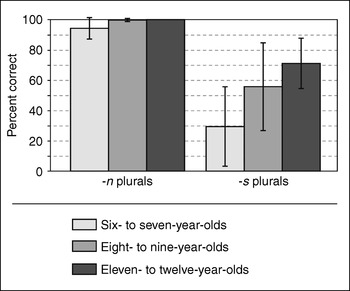
Figure 1 presents the percentages of correct responses and standard deviations indicated by lines for the 48 critical items.
Percentages correct plural forms in the elicitation task.

Figure 1 shows that the children in the three age groups tested performed almost at ceiling for -n plurals (=condition I). For the condition II items requiring -s plurals, however, performance was much worse. Even the oldest children provided only 70% correct answers. It is unlikely that the relatively low correctness scores on the condition II items in six- to twelve-year-old children reflected any lack of morphological knowledge for -s plural formation, because previous acquisition studies have shown that correct -s plurals are produced early in German child language, i.e. from 1 ; 10 onwards (see Clahsen, Rothweiler, Woest & Marcus, Reference Clahsen, Rothweiler, Woest and Marcus1992), and that -s plurals are frequently used in children's over-regularizations (see Clahsen et al., Reference Clahsen, Marcus, Bartke and Wiese1996; Bartke, Reference Bartke1998). It is more likely that the low accuracy scores for -s plurals in the present elicitation task are due to the fact that most of the items in condition II were loan words that the children are less familiar with than the native German words used for condition I.Footnote 4
Given the results of the elicitation task, we can be reasonably certain that children of the ages under study know the correct (-n) plural forms of the critical items of condition I, whereas this does not seem to be the case for the condition II (-s plural) items. For the ERP experiment we employed the violation paradigm, which directly compares ERP signatures to correct and incorrect word forms. The interpretation of results from this ERP paradigm presupposes that participants know the grammatically correct forms under study. In analyzing the ERP data, we therefore report the results for condition I only.Footnote 5
ERP results
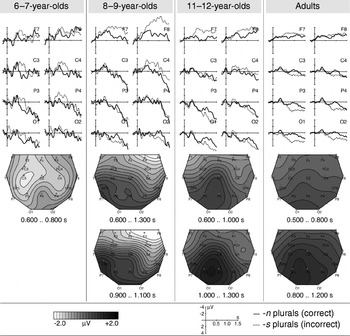
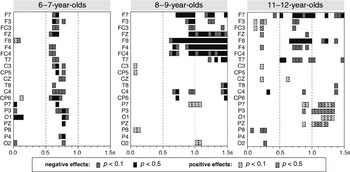
The ERPs for the critical nouns in condition I are shown in Figure 2Footnote 6) and the results of a statistical analysis in Figure 3. Figure 2 presents ERP waveforms at selected locations comparing correct and incorrect plural forms and topographical maps of the different waveforms; for the latter, isovoltage spline interpolation for the time points indicated for each participant group and condition was used. The first three panels of Figure 2 represent the data from the three age groups of children studied here; for comparison, the fourth panel presents the data from the group of 23 adult native speakers of German studied by Lück et al. (Reference Lück, Hahne and Clahsen2006).Footnote 7
Grand average ERPs and topographical maps for correct -n versus over-regularized -s plural forms in the three child groups and the adult control group.

Statistical analysis of all electrodes for correct -n versus over-regularized -s plural forms in the three child groups.

Consider first the data from the adult group. Lück et al. (Reference Lück, Hahne and Clahsen2006) found an anterior negativity between 500 and 800 ms for -s plural over-regularizations (which was larger over the left than over the right hemisphere) followed by a posterior positivity in the 800–1200 ms time-window (P600); this ERP pattern is illustrated in the fourth panel of Figure 2 for the adult group.
For the six- to seven-year-old children, Figure 2 shows a broadly distributed negativity for the incorrect items in the 600 to 800 ms time range. Unlike the adult group, there are no signs of a P600 effect in the youngest group of children. For the eight- to nine-year-olds, Figure 2 shows an anterior negativity (which is more pronounced over right electrode sites) starting at about 600 ms for the incorrect items followed by a small positivity (P600) from 1000 ms onwards at occipital electrode sites. In the eleven- to twelve-year-olds, -s plural over-regularizations elicited an anterior (slightly left lateralized) negativity between 600 and 1000 ms and a later positivity (1000 to 1300 ms) at parietal and occipital sites.
Figure 2 indicates that the participants' ERP responses to -s plural over-regularizations change with age. The negativity has a broad distribution in the youngest child group, an anterior maximum in the older child groups and a focal left distribution in the adult group. The positivity is absent in the youngest child group, it has a narrow posterior distribution in the older child groups and a broad centro-parietal distribution in the adult group. Moreover, the onset of the ERP effects in the child groups is generally later than in the adult group. The onset of the negativity in the adult group is around 400 ms, and 600 ms in the children; the positivity begins at approximately 600 ms for adults and at around 1000 ms in the children.
Consider now the results of the 50 ms stepwise analysis of all electrodes shown in Figure 3. For the six- to seven-year-olds, most electrodes in the 600 to 800 ms time range show a significant effect of Condition reflecting the broad negativity seen in Figure 2 for over-regularized -s plurals. This is confirmed by the factorial ANOVA in the 600–800 ms time-window which revealed a main effect of Condition (F(1, 19)=4·65, p=0·04, ω2=0·08) and no interaction with either Hemisphere or Site.
For the eight- to nine-year-olds, Figure 3 reveals significant differences at all frontal electrode sites in an extended time-window from 600 to at least 1300 ms, and marginal effects at some parietal and occipital electrode sites in the 900 to 1100 ms range. These differences reflect the anterior negativity followed by a small positivity (P600) for over-regularized plurals seen in Figure 2 for this group of children. The ANOVA in the 600 to 1300 ms time-window yielded a highly significant Condition×Site interaction (F(2, 38)=10·27, p=0·0003, ω2=0·13) and a marginal interaction of Condition×Hemisphere (F(1, 19)=3·57, p<0·08, ω2=0·03). To further explore the interaction of Condition and Site, we split the factor Site into three separate levels: anterior, central, posterior. A significant effect of Condition was found only for anterior sites (F(1, 19)=9·83, p=0·005, ω2=0·18), confirming the frontal distribution of the negativity seen in this group of children. Following up on the marginal Condition×Hemisphere interaction, an additional ANOVA revealed a marginally reliable effect for the right hemisphere (F(1, 19)=3·86, p<0·07, ω2=0·07) and no significant Condition effect for the left hemisphere (F<1) showing that the negativity is slightly right-lateralized. A factorial ANOVA was also performed over the 900 to 1100 ms time-window to examine the small positivity seen for the eight- to nine-year-olds. In contrast to the negativity, the analysis of the positivity did not reveal any significant effects over parietal electrodes.
For the eleven- to twelve-year-olds, Figure 3 demonstrates two clusters of significant Condition effects: (i) in frontal areas (particularly at the outermost frontal electrode sites F7 and F8) in the 600 to 1000 ms time-window; and (ii) in parietal and occipital areas between 1000 and 1300 ms. The former effects correspond to the anterior negativity and the latter to the late positivity (P600) seen in Figure 2 for this group of children. These findings were confirmed by factorial ANOVAs in the 600 to 1000 ms time-window which yielded a highly significant Condition×Site interaction (F(2, 38)=5·55, p=0·008, ω2=0·07). A subsequent analysis in which the factor Site was split into three separate levels revealed significant effects of Condition for anterior sites (but not for central or posterior sites) (F(1, 19)=4·45, p=0·05, ω2=0·08). These analyses confirm the presence of an anterior negativity for (-s plural) over-regularizations in this group of children. Statistical examination of the late positivity revealed a significant Condition×Site interaction in the 1000 and 1300 ms time-window (F(2, 38)=4·17, p=0·02, ω2=0·05). Further analyses to explore this interaction revealed an effect of Condition that approached significance for posterior electrode sites (F(1, 19)=4·03, p=0·059, ω2=0·08) but was non-significant for anterior and central sites. This confirms the posterior distribution of the positivity seen in this group of children.
Summarizing, we found that over-regularizations of -s plurals gave rise to an anterior negativity in the eight- to nine-year-olds, in the eleven- to twelve-year-olds and in adults (for whom the anterior negativity was more pronounced over the left hemisphere). The six- to seven-year-olds, on the other hand, showed a broadly distributed negativity for over-regularizations. While the adult group and the eleven- to twelve-year-olds showed a significant parietal positivity (P600), this effect was not obtained for the eight- to nine-year-olds and the six- to seven-year-olds, even though the ERP waveforms for the eight- to nine-year-olds (see Figure 2) indicate a small positivity. We also found that ERP components associated with language processing change from child to adult. The onsets of the ERP responses, both of the negativity and the positivity, were later in the children than in the adults. Secondly, the scalp distribution of the ERP effects changed over time, from a broad negativity in the youngest children to a focal (left-anterior) negativity in the adult group, and from a narrow positivity in the older child groups to a broad positivity in the adults.
DISCUSSION
From the perspective of dual-mechanism models of morphological processing, over-regularizations such as *Apothekes represent combinatorial rule-based violations in which two legal components (the stem and the regular affix) appear in illegal combination. Consequently, over-regularizations should elicit ERP signatures that are characteristic of grammatical processing. In previous ERP studies with adults, anterior negativities and/or late positivities (P600) effects have been obtained for a range of violations of grammatical rules in different languages (see Friederici (Reference Friederici2002) for review). Given these results, we would expect that incorrect plural forms such as *Apothekes elicit anterior negativities and/or P600 effects.
Given associative (single-mechanism) models, over-regularizations may be perceived as unexpected or anomalous word forms, i.e. as lexical violations. Many previous ERP studies have shown that unexpected or anomalous words elicit N400 responses, not only in adults (see e.g. Rugg, Reference Rugg1987), but also in children of the age range we tested (Holcomb, Coffey & Neville, Reference Holcomb, Coffey and Neville1992; Hahne, Eckstein & Friederici, Reference Hahne, Eckstein and Friederici2004). Friedrich & Friederici (Reference Friedrich and Friederici2004, Reference Friedrich and Friederici2005) even obtained N400 responses to unexpected or anomalous words from children aged 1 ; 02 and 1 ; 07, indicating that the N400 as an ERP signature of a lexical violation is observable early in development. Thus, if incorrect plural forms such as *Apothekes are processed as lexical violations, they should elicit N400 responses.
Consider, first, the results from the six- to seven-year-olds in the light of these predictions. This group of children displayed an unspecific broad negativity and no positivity in response to over-regularizations. We can think of two possible interpretations for these findings. One possibility is that this negativity represents an extended N400, suggesting that the younger children treated over-regularizations as lexical violations. A similar, broadly distributed negativity was also seen in Hahne et al. (Reference Hahne, Eckstein and Friederici2004) for children (n=18, mean age: 7 ; 2) in response to semantic violations such as Der Vulkan wurde gegessen ‘The volcano was eaten’. Another possibility is that this broad negativity represents two overlapping ERP components, an anterior negativity (as for the other participant groups) and an N400. Given this interpretation, the broad negativity may signal the involvement of both the lexical and the computational route in the younger children's processing of over-regularizations, perhaps because the -s plural rule is not yet completely stable and automatized in these children. Some evidence for this comes from the elicited production task in which the six- to seven-year-olds achieved relatively low accuracy scores for nouns requiring -s plurals (mean 29·4%). By making use of both routes for processing over-regularizations, an item such as *Apothekes will be recognized as an anomalous word (yielding an N400) and, at the same time, as a violation of the -s plural rule (yielding an anterior negativity). As these components have similar temporal dynamics, the summation of both effects will yield a broad negativity on the scalp. To decide between these two interpretations and to determine the functional significance of the broad negativity, further ERP studies with (young) children will be necessary.
Consider now the older child groups. In these children, there is little evidence that over-regularizations are processed as lexical violations. Over-regularizations did not elicit an N400 in the eight- to nine-year-olds or the eleven- to twelve-year-olds, but an anterior negativity in the former, and an anterior negativity followed by a late posterior positivity in the latter. The timing of these two ERP components, with the negativity having an earlier onset than the positivity, was parallel to the results from the adults. However, our results also show child–adult differences with respect to these ERP components. The negativity had a later onset in children and changed its topography from a right-lateralized anterior negativity in the eight- to nine-year-olds to a bilateral anterior negativity in the eleven- to twelve-year-olds, and to a focal left-anterior one in the adult group. Similar child–adult differences have been reported in previous ERP studies with children (Holcomb et al., Reference Holcomb, Coffey and Neville1992; Hahne et al., Reference Hahne, Eckstein and Friederici2004; Silva-Pereya, Riveira-Gaxiola & Kuhl, Reference Silva-Pereya, Riveira-Gaxiola and Kuhl2005). These differences may be due to developmental changes of the brain systems relevant for language processing. The later onsets could be due to slower and less efficient processing in children, and the less strongly lateralized negativity may be due to a not yet fully specialized brain system for language processing in children. Hahne et al. (Reference Hahne, Eckstein and Friederici2004), for example, found that word category violations elicited the left-lateralized anterior negativity familiar from corresponding studies with adults (Friederici, Reference Friederici2002) for thirteen-year-old children only, whereas younger children showed a bilateral anterior negativity for such violations. With respect to morphological violations, however, it should be noted that topographic variations of anterior negativities in the same time range as seen in the present study have been observed in a number of studies with adults. Several ERP studies examining morphological violations in adults found anterior negativities with a bilateral or even a right-lateralized topography (see e.g. Rodríguez-Fornells, Clahsen, Lleo, Zaake & Münte, Reference Rodríguez-Fornells, Clahsen, Lleo, Zaake and Münte2001; Gross et al., Reference Gross, Say, Kleingers, Münte and Clahsen1998), and the anterior negativities we found for the two older groups of children fall within the same range of variation. Consequently, the anterior negativity seen in the eight- to nine-year-olds and the eleven- to twelve-year-olds may signal the same processes as in adults, suggesting that over-regularizations involve grammatical processing in these children and are recognized as combinatorial (stem+affix) violations. Further ERP studies (with children and adults) are required to explore the significance of these topographic variations and to determine whether the observed child–adult differences represent changes of the developing brain.
Over-regularizations also elicited a late posterior positivity in the older children. The eleven- to twelve-year-olds showed a significant parietal positivity (P600), similar to adults, and the waveforms for the eight- to nine-year-olds indicated a small positivity. This waveform – due to its latency and distribution – can be identified as a P600, an ERP component that has been observed in previous studies in response to grammatical violations. Child–adult differences were also seen with respect to the P600. The component was not visible in the younger children's ERPs, and in the other child groups it was smaller than in the adult group and had a later onset. Later onsets for P600 effects in children than in adults have also been found in ERP studies on word-category violations (Hahne et al., Reference Hahne, Eckstein and Friederici2004) and have been taken to indicate that children need more time than adults for sentence-level integration and repair processes. For the present set of materials, the absence of a P600 in the younger children and the more narrow distribution of this component in the older children (compared to the adults) could mean that incorrect morphology (as in the case of an -s plural over-regularization such as *Apothekes) disturbs processes of syntactic integration in children less than in adults. Note that at the point at which the parser constructs the critical noun phrase (e.g. … die grossen *Apothekes …), the syntactic features of the determiner and the adjective (e.g. [+plural]) are checked against those of the noun, and that despite its morphological incorrectness, a noun form such as *Apothekes contains a syntactic feature [+plural]. Given these assumptions, the missing or reduced P600 effects suggest that purely morphological errors affect syntactic integration processes in children less than in adults.
On balance, our results are more in line with the dual-mechanism view of how over-regularizations are processed, i.e. as combinatorial violations involving processes of grammatical structure building, than with the single-mechanism view, according to which grammatical computation is said to be irrelevant for processing inflected words. Our results also revealed child–adult differences that may indicate developmental changes of ERP components associated with language processing. These changes could result from a child's smaller lexicon and from slower and less efficient processing in children than in adults, an interpretation that goes along with recent findings on the development of brain structures associated with language comprehension (Amunts, Schleicher, Ditterich & Zilles, Reference Amunts, Schleicher, Ditterich and Zilles2003; Gogtay et al., Reference Gogtay, Giedd, Luisk, Hayashi, Greenstein, Vaituzis, Nugent, Herman, Clasen, Taga, Rapoport and Thompson2004). Although the size of a brain of a six-year-old is 90% of an adult brain, there are developmental processes taking place around puberty (Casey, Tottenham, Liston & Durston, Reference Casey, Tottenham, Liston and Durston2005), in particular the myelination and pruning of neurons in the prefrontal and temporal areas, which could be responsible for the development of faster and more efficient processing capacities.
CONCLUSION
The purpose of the present study was to investigate children's on-line processing of inflected words. For adults, there is a rich experimental literature on morphological processing which focuses on delineating the balance between morphological computation and storage in the processing of inflected words, but little is known about these processes in children's production or recognition of morphologically complex words. To this end, we performed an ERP-violation experiment with three age groups of children listening to sentences containing correct or incorrect German noun plural forms.
Our most important finding is that (-s plural) over-regularizations elicited brain responses that are characteristic of grammatical violations. We interpreted the ERP results from the perspective of dual-mechanism models of inflection, arguing that the processing of over-regularizations involves morphological decomposition by which an over-regularized form is recognized as a combinatorial violation, e.g. as a combination of a regular (-s) plural affix and a noun which has a plural form that blocks the -s plural rule. Even though questions remain for the younger children, the results indicate that grammatical computation is available for processing purposes not only in adults, but also in children aged eight years or above.
APPENDIX
Critical items for condition I (which require -n plurals)
Apotheke ‘pharmacy’, Kapuze ‘hood’, Zitrone ‘lemon’, Gitarre ‘guitar’, Antenne ‘aerial’, Banane ‘banana’, Krawatte ‘tie’, Ameise ‘ant’, Eidechse ‘lizard’, Büchse ‘tin box’, Vase ‘vase’, Kralle ‘claw’, Möhre ‘carrot’, Beere ‘berry’, Biene ‘bee’, Blüte ‘blossom’, Traube ‘grape’, Tube ‘tube’, Bluse ‘blouse’, Pfütze ‘puddle’, Gurke ‘cucumber’, Eule ‘owl’, Torte ‘cake’, Kirsche ‘cherry’.
Critical items for condition II (which require -s plurals)
Chamäleon ‘chameleon’, Souvenir ‘souvenir’, Anorak ‘anorak’, Bumerang ‘boomerang’, Karussell ‘carousel’, Galopp ‘gallop’, Pudding ‘pudding’, Schluckauf ‘hiccup’, Sheriff ‘sheriff’, Ticket ‘ticket’, Ballon ‘balloon’, Bonbon ‘sweet’, Karton ‘cardboard’, Balkon ‘balcony’, Waggon ‘(railway) carriage’, Code ‘code’, Fan ‘(sports) fan’, Klub ‘club’, Kiosk ‘kiosk’, Steak ‘steak’, Team ‘team’, Akkordeon ‘accordion’, Parfum ‘perfume’, Trick ‘trick’.