




No CrossRef data available.
Article contents
Working memory deficits in chronic fatigue syndrome: Differentiating between speed and accuracy of information processing
Published online by Cambridge University Press: 06 February 2004
Abstract
To examine the relative influence of speed of information processing versus working memory ability, CFS participants with psychiatric comorbidity (CFS–Psych) and CFS without a psychiatric history (CFS–noPsych) were examined on tests of visual and auditory processing speed and visual and auditory working memory. Compared to healthy controls (HC) and a group of participants with rheumatoid arthritis (RA), the CFS–noPsych group displayed significantly reduced performance on tests of information processing speed, but not on tests of working memory. No significant differences were observed between the CFS–Psych group and any other group in the study. The implications of group heterogeneity on the understanding of cognitive impairment in CFS are discussed. (JINS, 2004, 10, 101–109.)
Information
- Type
- Research Article
- Information
- Journal of the International Neuropsychological Society , Volume 10 , Issue 1 , January 2004 , pp. 101 - 109
- Copyright
- © 2004 The International Neuropsychological Society
INTRODUCTION
Chronic fatigue syndrome (CFS) is a disorder of unknown etiology that is associated with debilitating fatigue that persists for 6 months or more, and presents with a variety of rheumatological, infectious, and neuropsychiatric symptoms (Fukuda et al., 1994; Holmes et al., 1988; Schluederberg et al., 1992). No pathogenic mechanism has been consistently identified by physical or laboratory tests, and therefore the diagnosis of CFS rests upon the exclusion of other medical explanations. Controversy exists as to whether the disorder results from a viral, immunological, or psychiatric etiology (Komaroff, 1988; Strober, 1994).
Cognitive complaints are among the most common symptoms, reported in up to 85% of patients (Grafman, 1994). Cognitive difficulties have been described as one of the more disabling and troubling symptoms of the illness (Abbey & Garfinkel, 1991; Tiersky et al., 2001). While early studies examining cognitive processes in CFS were generally equivocal, a number of more recent studies have documented subtle cognitive impairment during neuropsychological testing (see Tiersky et al., 1997, for a review). In addition, the level of cognitive impairment among CFS patients has been found to correlate with their degree of functional impairment (Christodoulou et al., 1998) and also affect other aspects of everyday life (Tiersky et al., 2001).
Among the most commonly identified cognitive deficits in CFS are impairments in complex information processing speed and/or efficiency (Tiersky et al., 1997). In particular, deficient performance on the Paced Auditory Serial Addition Test (PASAT) is perhaps the most consistent cognitive finding in the literature (e.g., Marshall et al., 1997; Michiels et al., 1999; but see Kane et al., 1997), further substantiated by three independent studies in our laboratory (DeLuca et al., 1993, 1995, 1997). Studies using other neuropsychological tests of complex attention, working memory or speed of processing (e.g., Stroop, Sternberg task, Digit Symbol) have also shown that CFS subjects perform significantly worse than healthy controls (e.g., Gaudino et al., 1997; Marcel et al., 1996; Smith et al., 1993; Vercoulen et al., 1998). CFS subjects have been shown to be impaired on a short-term memory task in which a distractor was interposed between presentation and recall (Johnson et al., 1998). Dobbs et al. (2001) report reliable group differences between CFS and a healthy control group as task difficulty increases, but no group differences on simple tests of attention, working memory and speed of processing. Working memory refers to the ability to simultaneously store, process, and manipulate information. It is a limited capacity system that provides only temporary storage of information (i.e., slave systems) and involves the manipulation (central executive) of this information (Baddeley, 1986).
The PASAT is a challenging task that involves the audiotaped presentation of a series of single-digit numbers (Roman et al., 1991). Following the presentation of each number, the subject must respond aloud by stating the sum of the last two numbers in the series. Accurate performance on the PASAT is dependent upon a number of cognitive processes. First, it requires the subject to engage working memory to maintain and manipulate the digits presented so that the last two digits can be summed. Second, the PASAT taps speed of information processing because the subject has only a limited amount of time to process the information and provide an answer before the next stimulus is presented.
While impaired PASAT performance among CFS patients is now well documented, the precise reason for the deficit is not clear. It is possible that the impairment arises from either inaccurate processing within working memory or from slowed speed of information processing, or both. The purpose of the present study was to directly examine which of these two alternative explanations best explains the data by administering neuropsychological tasks that attempt to tease apart these two constructs (working memory accuracy vs. speed of information processing).
Because it is well established that CFS is not a homogenous condition, and particularly because of the controversy over the role of psychiatric factors in CFS, an international NIH/CDC study group has recommended the creation of CFS subgroups based upon the presence of comorbid psychiatric conditions (Fukuda et al., 1994). Previous work has shown that CFS subjects without a concomitant Axis I disorder are more likely to have significant cognitive impairment (DeLuca et al., 1997), more frequent structural brain abnormalities on MRI (Greco et al., 1997; Lange et al., 1999), significant brainstem hypoperfusion on SPECT (Costa et al., 1995), and display more functional disability (Tiersky et al., 2001) compared to CFS subjects with Axis I pathology or healthy controls. Therefore, the present study examined the role of working memory and speed of information processing in those CFS subjects both with and without comorbid psychopathology.
METHODS
Research Participants
A total of 51 CFS subjects participated in the present study. They were either self or physician referred to the CFS Cooperative Research Center at UMDNJ–New Jersey Medical School. All received a complete history and physical examination at the CFS Center and were found to meet the revised case definition criteria of the Centers for Disease Control (CDC; Fukuda et al., 1994). The majority (57%) also met the original CDC criteria (Holmes et al., 1988) as modified by Schluederberg et al. (1992). In addition CFS subjects also had (1) an illness onset within the past 10 years; (2) no history of psychiatric disorder in the 5 years before the onset of CFS. The 51 CFS subjects were divided into two groups: (1) 29 CFS subjects without any prior or current psychiatric disorder (CFS–noPsych); (2) 22 CFS subjects with a major affective disorder either concurrently or since they were diagnosed with CFS (CFS–Psych). Because depression is among the most commonly identified comorbid psychiatric disorders in patients with CFS (e.g., Manu et al., 1988), and because of the related controversy as to whether CFS represents a somatic form of depression (e.g., Johnson et al., 1996b), we specified that CFS patients in the group with psychopathology must be diagnosed with an Axis 1 unipolar depression disorder as one of the comorbid disorders.
Two sets of control subjects participated in the present study: healthy subjects and rheumatoid arthritis (RA) patients. Healthy controls consisted of 29 subjects recruited from the local community, colleges, and healthcare staff. RA subjects served as a chronic medical illness control group. The 18 RA subjects were recruited from a local clinical rheumatology practice. Rheumatoid arthritis was diagnosed in accordance with the American College of Rheumatology revised criteria for classification of rheumatoid arthritis (Arnett et al., 1988). All RA subjects were in functional status class I, II, or III (Hochberg et al., 1992). All potential subjects across groups were screened for the following inclusion criteria: (1) no history of neurologic disorder; (2) no history of major psychiatric disorder (bipolar disorder, psychotic depression, schizophrenia, dementia); (3) no alcohol or drug abuse; (4) no loss of consciousness of 5 min or more; (5) no use of medications known to affect cognition (e.g., benzodiazepines, prednisone). Psychiatric diagnoses for CFS subgroup identification and psychiatric, drug, and alcohol exclusions were based upon the computerized version of the Diagnostic Interview Schedule (Q–DIS) (Marcus et al., 1990). Administration and scoring of all of the above tasks was in accordance with standard published procedures. All subjects were paid for their participation. All signed an IRB-approved consent form prior to starting the study.
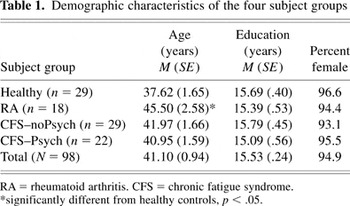
Demographic characteristics of each group are presented in Table 1. The groups predominantly consisted of females with an average of more than 15 years of education, and an average age in the late 30's to mid 40's. There was a significant, though relatively minor, difference in age between the healthy and RA groups.
Demographic characteristics of the four subject groups

Cognitive Tasks
As stated in the introduction, the primary purpose of this study was to determine whether PASAT deficits in CFS arise from inaccurate processing within WM or from slowed speed of information processing (or both). Therefore, subjects were administered tasks that were designed to measure speed and accuracy separately. These tasks are described below.
Information processing speed tasks
Complex information processing speed (modifications to the PASAT) Computerized tasks adapted from the PASAT were created in order to measure speed of complex information processing while controlling for accuracy of performance (DeLuca et al., 1998; Demaree et al., 1999). The Auditory Threshold Serial Addition Test (AT–SAT) was designed to present numerical stimuli in the auditory domain, while the Visual Threshold Serial Addition Test (VT–SAT) presents stimuli visually. These tests have been used in prior studies and with other populations such as MS (DeLuca et al., 1998), aging (Diamond et al., 2000) and traumatic brain injury (Madigan et al., 2000). Administration procedures for the AT–SAT and VT–SAT were similar to those of the PASAT (Brittain et al., 1991). As in the PASAT, subjects were presented with a series of numbers (ranging from 1–9) and instructed to add each number to the number that immediately preceded it, and to provide the answer aloud. On the VT–SAT, the presented numbers measured 5 mm in height and were presented on a computer monitor. For both the AT–SAT and the VT–SAT, subjects were presented with 50 numbers and required to make 49 responses. Both tasks utilize a method of limits procedure to determine the rate of stimulus presentation for each subject to achieve a 50% success rate. This interstimulus interval, referred to as threshold speed, represents an index of speed of information processing while controlling for accuracy. The initial average ISI was between 2 and 3 s, or roughly equivalent to the mid-range of difficulty on the traditional PASAT. The ISI was varied in an ascending and descending fashion based on the response of each individual subject. ISI increments and decrements were based on complex proprietary algorithms that responded to both trial and performance patterns. “Success” was not based on matching groups on performance accuracy (i.e., at approximately 50% across the 49 trials). The order of presentation of the AT–SAT and VT–SAT was counterbalanced between subjects.
Reaction time tasks measuring information processing speed Reaction time was measured with a series of simple and choice reaction time tasks. Two simple reaction time tasks were administered, one auditory and one visual. For the simple auditory reaction time task, subjects were instructed to press a response key as quickly as possible after the presentation of an auditory tone. The task consisted of 12 experimental trials, preceded by three practice trials. The simple visual reaction time task was identical to the auditory task, except that subjects responded as quickly as possible to the presentation of a plus sign (+) that spanned the vertical and horizontal axes' of the monitor. All of the reaction time trials were preceded by a capital ‘X’ that occurred at varying intervals before the plus sign so that participants could not anticipate the exact time of stimulus presentation on the computer monitor. For each task, the dependent variable was the median reaction time for each subject. The order of the two tests was counterbalanced between subjects.
Two choice reaction time tasks were also administered; again one of the tasks was auditory and the other was visual. In the choice auditory reaction time task, subjects were instructed to respond to a high tone by pressing a response key as quickly as possible, but to ignore a low tone. Following 24 trials of this task, the instructions were reversed, and subjects were told to respond to the low tone and ignore the high tone for the last half of the task. Three practice trials preceded the 48 experimental trials. The choice visual reaction time task was identical to the auditory analog except that the stimuli for the visual task consisted of a large square and a large circle. The order of the auditory and visual choice reaction time tasks was counterbalanced between subjects.
Working memory accuracy tasks
Two computerized tasks were used to measure WM accuracy. These two unpaced tasks, one verbal and one visuospatial, were based upon tasks used by Ruchkin and colleagues in a study of persons with multiple sclerosis (Ruchkin et al., 1994). The verbal WM task required subjects to phonologically process a pronounceable five-consonant non-word. The target non-word was visually displayed on the computer monitor for 1500 ms, followed 4000 ms later by a probe stimulus. The probe was either identical to the memory display (a match) or differed by one letter, thus changing the pronunciation of the probe (a mismatch). Subjects were instructed to mentally rehearse the sounds of the target stimulus and decide whether the probe stimulus matched or mismatched the target by pressing one of two keys with their dominant hand. The probe stimulus was terminated by the subject's response or after 8 s. The verbal WM task consisted of 60 trials, preceded by a practice session of 10 trials. The dependent variable was the number of errors.
The visuospatial WM task was similar to the verbal WM task, with the exception of the stimulus materials. In the spatial task, the target stimulus was a two-dimensional pattern consisting of five unconnected elements (all the letter ‘X’) in a spatial array on the screen. The probe stimuli were either identical to the target or differed by a single element (i.e., one element was in a different spatial location on the screen). The order of presentation of the verbal and visuospatial WM tasks was counterbalanced between subjects.
Data Analysis
Pairwise comparisons were used to examine whether either of the CFS subgroups (CFS–noPsych, CFS–Psych) displayed deficits in speed of information processing and/or WM accuracy as compared to either of the control groups (healthy controls, RA). Earlier research in our laboratory led to the prediction that the CFS–noPsych group would be more likely to display cognitive impairment than would the CFS–Psych group (DeLuca et al., 1997). Planned group contrasts therefore focused primarily on the CFS–noPsych subgroup. The three planned non-orthogonal pairwise group contrasts were: CFS–noPsych versus healthy controls, CFS–noPsych versus RA, and CFS–Psych versus Healthy Controls. It should be noted that it is not necessary to perform an overall omnibus test of significance before testing planned comparisons (Keppel, 1973). The t test was used for the planned group comparisons. Three additional pairwise comparisons were performed using Dunn's multiple comparisons procedure (Kirk, 1968). They were as follows: RA versus Healthy Controls, RA versus CFS–Psych, and CFS–noPsych versus CFS–Psych. When the assumption of equal group variances was not met, as assessed by Levene's test for the equality of variance, the calculation of the test statistic without the assumption of equal group variance was carried out.
RESULTS
Tasks Measuring Information Processing Speed
PASAT modifications
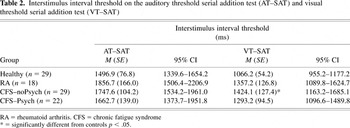
Performance on the VT–SAT and AT–SAT are presented in Table 2. On the VT–SAT, the CFS–noPsych group displayed a significantly higher (slower) threshold speed than the healthy controls [t(37.81) = 2.59, p < .05], but they did not differ from the RA group. The CFS–Psych group did not differ from healthy controls. No other significant group differences were found on the VT–SAT. On the AT–SAT auditory task, the CFS–noPsych group displayed a trend toward a higher (slower) threshold speed than the healthy controls [t(51.49) = 1.94, p < .10], but again did not differ from the RA group. The CFS–Psych group did not differ from healthy controls. No other significant group differences were found on the AT–SAT.
Interstimulus interval threshold on the auditory threshold serial addition test (AT–SAT) and visual threshold serial addition test (VT–SAT)

Reaction time measures of information processing speed (see Table 3)
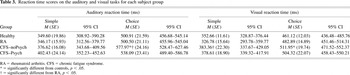
On the simple auditory reaction time task, no significant group differences were found, although a trend for the CFS–Psych group to be slower than the healthy control group was observed [t(94) = 1.93, p < .10]. On the simple visual reaction time task, the CFS–noPsych group did not differ from healthy controls, but was significantly slower than the RA group [t(94) = 2.11, p < .05]. The CFS–Psych group did not differ from healthy controls. No other group differences were found on the latter task. On the choice auditory reaction time task, the CFS–noPsych group was significantly slower than healthy controls [t(94) = 2.55, p < .05] and the RA group [t(94) = 2.25, p < .05). The CFS–Psych group did not differ from healthy controls. No other group differences were found on this task. On the choice visual reaction time task the CFS–noPsych group was significantly slower than healthy controls [t(94) = 2.20, p < .05], but did not differ from the RA group. The CFS–Psych group did display a trend toward being slower than the healthy control group [t(94) = 1.74, p < .10]. No other group differences were found on this task.
Reaction time scores on the auditory and visual tasks for each subject group

Tests of working memory accuracy independent of speed of information processing
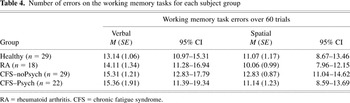
Mean performance on the working memory tasks is presented in Table 4. No significant group differences were found on either the verbal WM task or the visuospatial WM task. There was a trend toward more errors by the CFS–noPsych group relative to the RA group [t(94) = 1.72, p < .10] on the visuospatial WM task. The absence of significant differences did not appear to have resulted from ceiling effects, since accuracy on the working memory tasks ranged between 70 to 80% and with errors on the 60 trial tasks ranging from approximately 10 to 16 (50% accuracy would be expected by chance).
Number of errors on the working memory tasks for each subject group

DISCUSSION
The results of the present study show that CFS subjects, specifically those without a psychiatric history (i.e., CFS–noPsych) displayed significant deficits in speed of complex information processing, but did not show deficits in the accuracy with which they performed on WM tasks that had minimal time constraints. This finding of compromised speed of processing is most clearly evidenced in the CFS–noPsych group which displayed significant difficulty on the PASAT modification tasks (trend for AT–SAT) compared to healthy controls, as well as on the auditory and visual choice reaction time tasks. The VT–SAT and AT–SAT tasks were designed to specifically control for accuracy of performance (i.e., equated with controls at 50% accuracy) so that the speed of processing can be directly measured, uncontaminated by accuracy performance (i.e., speed–accuracy trade-off). As such, because task accuracy in the maintenance and manipulation within working memory between groups was essentially equivalent, differences in threshold point to a specific impairment of information processing speed. This interpretation is supported by the reaction time data, where the CFS–noPsych group differed significantly from the healthy control group on visual and auditory choice reaction time.
While CFS subjects displayed relatively slowed speed of information processing on tasks that controlled for accuracy and on choice reaction time, they did not show an impairment in the accuracy of performing the two WM tasks (verbal and spatial); tasks designed to minimize a speed of processing demand. The levels of performance on the WM tasks indicate that the tasks were adequately challenging for all subject groups, so the lack of significant differences on the WM tasks did not appear to have arisen from ceiling effects. In addition, these tasks were modeled after tasks that had been found to be sensitive to impairment in persons with multiple sclerosis (Ruchkin et al., 1994). Taken together, the compromised speed of processing observed when accuracy was controlled (i.e., VT–SAT, AT–SAT), compromised visual and auditory choice reaction time, in conjunction with intact performance on separate WM tasks, strongly argue that speed of information processing within WM is a primary deficit observed in CFS–noPsych subjects.
Of particular significance was the finding in the present study that there was no evidence of cognitive impairment in CFS subjects who had a comorbid psychiatric condition (i.e., CFS–Psych) relative to healthy controls. Specifically, while the CFS–noPsych group displayed significant impairment on the VT–SAT threshold task (trend on the AT–SAT), and the choice reaction time tasks, the CFS–Psych group displayed no significant deficits on any of the measures examined. This finding of cognitive impairment only in CFS subjects without comorbid psychiatric complications is consistent with earlier work from our laboratory where similar results were found in a different sample of CFS subjects (DeLuca et al., 1997). In addition, more recent work has shown that the pattern of learning and memory difficulties observed between the CFS–noPsych and CFS–Psych groups also differed significantly (DeLuca et al., in press). Additional work with these two CFS subgroups has shown that cerebral abnormalities on MRI were significantly elevated only in a CFS–noPsych group but not in a CFS–Psych group, relative to healthy controls (Greco et al., 1997; Lange et al., 1999). A similar differentiation between these two CFS subgroups has also been observed when examining brainstem hypoperfusion on SPECT (Costa et al., 1995). Further, functional disability is more severe among CFS–noPsych subjects relative to CFS–Psych. For instance, in a recent longitudinal study in persons with CFS, Tiersky et al. (2001) found that having a comorbid psychiatric diagnosis concurrently with CFS increases the odds of regaining employment and of overall level of disability relative to CFS patients without concurrent or history of psychiatric disorder. Christodoulou et al. (1998) reported that neuropsychological impairment was related to degree of functional disability in CFS, even after controlling for psychiatric comorbidity. Finally, Cook et al. (2001) found that CFS subjects with cerebral abnormalities on MRI experienced a greater degree of impaired physical functioning in everyday life compared to CFS subjects without MRI abnormalities. Taken together, these data strongly support the notion of heterogeneity in the pathophysiology and outcome in persons with CFS. Future studies in persons with CFS must consider this heterogeneity otherwise the myriad of confusing results and conflicting interpretation of findings will continue to impede progress in understanding how to assess and treat this chronic illness condition.
The deficit of the CFS–noPsych group in information processing speed and efficiency was not limited to the auditory/verbal domain, but instead was non-modality specific. While this finding is not consistent with an earlier finding in our laboratory using the PASAT (Johnson et al., 1996a), it is consistent with the recent work of Michiels and colleagues (1999), who also found a non-modality-specific dysfunction in CFS subjects. It should be noted that in the Johnson et al. (1996a) study the CFS participants were not subdivided into CFS–Psych and no–Psych groups, which may have contributed to the discrepancy.
It is important to note that WM is a complex construct that includes both systems for storage and maintenance of information (in separate verbal and visuospatial “slave” systems) as well as a system for active manipulation of information, referred to as the central executive (CE; Baddeley, 1986). It could be argued that the WM tasks employed in the present study did not sufficiently challenge the CE and thereby may underrepresent the extent to which WM (specifically the CE) may be impaired following CFS. Indeed the WM tasks in the present study simply required subjects to match a five-item probe to the immediately preceding target stimulus. As such, these WM tasks primarily required the utilization of the phonological loop and the visuospatial sketchpad. The finding that all CFS subjects in the present study did not differ from the control groups suggests normal functioning of these slave subsystems in WM in persons with CFS, which is consistent with the work of Dobbs et al. (2001) who also found “minimal or negligible” impairment on storage capacity within WM. This is not to say that the CE was not engaged in the presently employed WM tasks. Nonetheless, it remains possible that, if sufficiently challenged, CFS subjects may show impairment in the CE of working memory, independent of speed of processing.
Addressing this issue of CE involvement somewhat in the present study, the VT–SAT and AT–SAT in effect controlled for differences in CE challenge on a PASAT-like task by equating all groups on performance accuracy (all groups performed at 50% correct). This was done to obtain a direct measure of speed of processing. Employing the reverse logic (i.e., controlling speed of processing in order to directly assess accuracy) would be one way to more directly examine the role of CE of WM in CFS.
However, the concept of processing speed is itself not likely a unitary phenomenon (Salthouse, 2000). A simplistic interpretation of deficits in processing speed would predict that subjects with impaired processing speed should show deficient performance on all tasks that require speed of processing. However, this is rarely seen in psychological research. For instance, most studies (including the present study) find differential performance between measures of simple and complex reaction time. A recent factor analytic study found that measures of reaction time did not load on the same factor as measures of more complex information processing (e.g., PASAT), independent of the variance associated with WM (Chiaravalloti et al., 2003). Such data suggest the presence of at least two independent constructs of information processing speed: simple and complex. Impairment in the “simple” processing speed system would predict impaired performance on all tests that have a speeded component. In contrast, impairment in the “complex” system would predict that processing speed deficits would only be observed with significant cognitive challenge. The results of the present study support the hypothesis that CFS–noPsych subjects show impairment in this latter, “complex” processing speed construct.
Support for this notion of impaired “complex” processing speed is provided by the CFS literature. Dobbs et al. (2001) recently found that WM tasks that lacked manipulation and time constraints were less likely to result in deficits among CFS subjects. The deficit may not be specific to WM (note the reaction time deficits on tasks without WM demands found in this study and in the literature), but may be especially evident during timed, manipulative WM tasks because of the specific demands they place upon the information processing system. Future studies should be designed to systematically manipulate the level of central executive involvement within tasks in order to examine its possible effects upon CFS performance.
The RA subjects were included in the present study as a control for the effects of secondary or non-specific factors associated with having a chronic fatiguing illness, which may potentially influence performance. As such RA subjects were chosen, a group without known neurological involvement or particular psychiatric concomitants. Such a control group was included because secondary factors such as pain or sleep disturbance may potentially influence information processing capacity and may contribute to the pattern of results obtained in the present study. For instance, it is increasingly noted that chronic pain, which is frequently observed in persons with RA and CFS, can contribute to difficulties in concentration due to physical discomfort (see Hart et al., 2000, for a review).
The RA group did not display cognitive impairments in the present study. That is, the RA group did not differ significantly from the healthy control group on any of the cognitive measures in the present study. Interestingly, no significant difference on any cognitive measure was observed between the CFS–Psych and RA groups. When significant group differences with RA subjects were observed, it was with the CFS–noPsych group. If secondary factors were the primary contributor to cognitive difficulties in CFS, one would expect to find cognitive difficulties in both CFS groups. This was not observed. Difficulties were only observed in the CFS–noPsych group. These data suggest that while secondary factors may potentially contribute to the cognitive impairments reported in CFS, such factors alone cannot account for impairments across all CFS individuals.
This pattern of results may shed light on the relatively consistent finding of PASAT deficits among CFS subjects (DeLuca et al., 1993, 1995, 1997; Marshall et al., 1997; Michiels et al., 1999). The present results indicate that the PASAT deficits reported in persons with CFS are likely to be a function of slowed speed of information processing rather than inaccurate WM processing. These results suggest that future studies focusing on measuring speed of processing would increase the sensitivity of observing cognitive difficulties in CFS, and potentially increase consistency across studies. In addition, the present study once again points to the heterogeneity of the CFS population and the role of psychiatric comorbidity in the expression of this heterogeneity. Until this heterogeneity is clearly understood and incorporated into study designs, future studies will continue to be marred by inconsistent results and difficulties in replication. It is only then that a comprehensive understanding of this debilitating disease can be realized.
ACKNOWLEDGMENTS
This study was supported by grants R01-H52810A (JD) and AI-32247 (BHN) and from the National Institutes of Health, and the Henry H. Kessler Foundation (JD). Christopher Christodoulou is now in the Department of Neurology, State University of New York at Stony Brook.
References
REFERENCES
Abbey, S.E. &
Garfinkel, P.E.
(1991).
Chronic fatigue syndrome and depression: Cause, effect, or
covariate.
Reviews of Infectious Diseases,
13,
S73–S83.Google Scholar
Arnett, F.C.,
Edworthy, S.M.,
Bloch, D.A.,
McShane, D.J.,
Fries, J.F.,
Cooper, N.S.,
Healey, L.A.,
Kaplan, S.R.,
Liang, M.H.,
Luthra, H.S.,
Medsger, T.A., Jr.,
Mitchell, D.M.,
Neustadt, D.T.,
Pinals, R.S.,
Schaller, J.G.,
Sharp, J.T.,
Wilder, R.C., &
Hunder, G.G.
(1988).
The American Rheumatism Association 1987 revised criteria for the
classification of rheumatoid arthritis.
Arthritis and Rheumatism,
31,
315–324.Google Scholar
Baddeley, A.
(1986).
Working memory.
Oxford, UK:
Clarendon Press.
Brittain, J.L.,
La Marche, J.L.,
Reeder, K.P.,
Roth, D.L., &
Boll, T.S.
(1991).
Effects of age and IQ on Paced Auditory Serial Addition Task
(PASAT) performance.
Clinical Neuropsychologist,
5,
163–175.Google Scholar
Chiaravalloti, N.,
Christodoulou, C.,
Demaree, H., &
DeLuca, J.
(2003).
Differentiating simple vs. complex processing speed: Influence on
new learning and memory performance.
Journal of Clinical and Experimental Neuropsychology,
25,
489–501.Google Scholar
Christodoulou, C.,
DeLuca, J.,
Lange, G.,
Johnson, S.K.,
Korn, L.,
Gaudino, E., &
Natelson, B.H.
(1998).
The relationship between neuropsychological impairment and
functional disability in patients with chronic fatigue syndrome.
Journal of Neurology, Neurosurgery, and Psychiatry,
64,
431–434.Google Scholar
Cook, D.B.,
Lange, G.,
DeLuca, J., &
Natelson, B.H.
(2001).
Relationship of brain MRI abnormalities and physical functional
status in CFS.
International Journal of Neuroscience,
107,
1–6.Google Scholar
Costa, D.C.,
Tannock, C., &
Brostoff, J.
(1995).
Brainstem perfusion is impaired in chronic fatigue syndrome.
Quarterly Journal of Medicine,
88,
767–773.Google Scholar
DeLuca, J.,
Johnson, S.K., &
Natelson, B.H.
(1993).
Information processing in chronic fatigue syndrome and multiple
sclerosis.
Archives of Neurology,
50,
301–304.Google Scholar
DeLuca, J.,
Johnson, S.K.,
Beldowicz, D., &
Natelson, B.H.
(1995).
Neuropsychological impairments in chronic fatigue syndrome,
multiple sclerosis, and depression.
Journal of Neurology, Neurosurgery, and Psychiatry,
58,
38–43.Google Scholar
DeLuca, J.,
Johnson, S.K.,
Ellis, S.P., &
Natelson, B.H.
(1997).
Cognitive functioning is impaired in patients with chronic fatigue
syndrome devoid of psychiatric disease.
Journal of Neurology, Neurosurgery and Psychiatry,
62,
151–155.Google Scholar
DeLuca, J.,
Gaudino, E.A.,
Diamond, B.J.,
Christodoulou, C., &
Engel, R.A.
(1998).
Acquisition and storage deficits in multiple sclerosis.
Journal of Clinical and Experimental Neuropsychology,
20,
376–390.Google Scholar
DeLuca, J.,
Christodoulou, C.,
Diamond, B.J.,
Rosenstein, E.D.,
Kramer, N.,
Ricker, J.H., &
Natelson, B.H.
(in press).
The nature of memory impairment in chronic fatigue syndrome.
Rehabilitation Psychology.
Demaree, H.,
DeLuca, J.,
Guadino, E.A., &
Diamond, B.J.
(1999).
Speed of Information processing as a key deficit in multiple
sclerosis: Implications for Rehabilitation.
Journal of Neurology, Neurosurgery, and Psychiatry,
67,
661–663.Google Scholar
Diamond, B.J.,
DeLuca, J.,
Rosenthal, D.,
Vlar, R.,
Davis, K.,
Lucas, G., &
Richards, J.R.
(2000).
Information processing in older versus younger adults: Accuracy vs.
speed.
International Journal of Rehabilitation and Health,
5,
55–64.Google Scholar
Dobbs, B.M.,
Dobbs, A.R., &
Kiss, I.
(2001).
Working memory deficits associated with chronic fatigue syndrome.
Journal of the International Neuropsychological Society,
7,
285–293.Google Scholar
Fukuda, K.,
Straus, S.E.,
Hickie, I.,
Sharpe, M.C.,
Dobbins, J.G.,
Komaroff, A., &
The International Chronic Fatique Syndrome Study Group.
(1994).
The chronic fatigue syndrome: A comprehensive approach to its
definition and study.
Annals of Internal Medicine,
121,
953–959.Google Scholar
Gaudino, E.A.,
Coyle, P.K., &
Krupp, L.B.
(1997).
Post-lyme syndrome and chronic fatigue syndrome: Neuropsychiatric
similarities and differences.
Archives of Neurology,
54,
1372–1376.Google Scholar
Grafman, J.
(1994).
Neuropsychological features of chronic fatigue syndrome. In
E. Straus (Ed.),
Chronic fatigue syndrome (pp.
263–284).
New York:
Marcel Dekker, Inc.
Greco, A.,
Tannock, C.,
Brostoff, J., &
Costa, D.C.
(1997).
Brain MR in chronic fatigue syndrome.
American Journal of Neuroradiology,
18,
1265–1269.Google Scholar
Hart, R.P.,
Martelli, M.F., &
Zasler, N.D.
(2000).
Chronic pain and neuropsychological functioning.
Neuropsychology Review,
10,
131–150.CrossRefGoogle Scholar
Hochberg, M.C.,
Chang, R.W.,
Dwosh, I.,
Lindsey, S.,
Pincus, T., &
Wolfe, F.
(1992).
The American College of Rheumatology 1991 revised criteria for the
classification of global functional status in rheumatoid arthritis.
Arthritis and Rheumatism,
35,
498–502.Google Scholar
Holmes, G.P.,
Kaplan, J.E.,
Gantz, N.M.,
Komaroff, A.L.,
Schonberger, L.B.,
Straus, S.E.,
Jones, J.F.,
DuBois, R.E.,
Cunningham-Rundles, C.,
Pahwa, S.,
Tosato, G.,
Zegans, L.S,,
Purtilo, D.T.,
Brown, N.,
Schooley, R.T., &
Brus, I.
(1988).
Chronic fatigue syndrome: A working case definition.
Annals of Internal Medicine,
108,
387–389.Google Scholar
Johnson, S.K.,
DeLuca, J.,
Diamond, B.J., &
Natelson, B.H.
(1996a).
Selective impairment of auditory processing in chronic fatigue
syndrome: A comparison with multiple sclerosis and healthy
controls.
Perceptual and Motor Skills,
83,
51–62.Google Scholar
Johnson, S.K.,
DeLuca, J., &
Natelson, B.H.
(1996b).
Depression in fatiguing illness: comparing patients with chronic
fatigue syndrome, multiple sclerosis and depression.
Journal of Affective Disorders,
39,
21–30.Google Scholar
Johnson, S.K.,
DeLuca, J.,
Diamond, B.J., &
Natelson, B.H.
(1998).
Memory dysfunction in fatigue illness: Examining interference and
distraction in working memory.
Cognitive Neuropsychiatry,
3,
269–285.Google Scholar
Kane, R.L.,
Gantz, N.M., &
DiPino, R.K.
(1997).
Neuropsychological and psychological functioning in chronic fatigue
syndrome.
Neuropsychiatry, Neuropsychology, & Behavioral Neurology,
10,
25–31.Google Scholar
Keppel, G.
(1973).
Design and analysis: A researcher's handbook.
Englewood Cliffs, NJ:
Prentice-Hall.
Kirk, R.E.
(1968).
Experimental design: Procedures for the behavioral sciences.
Belmont, CA:
Brooks/Cole.
Komaroff, A.L.
(1988).
Chronic fatigue syndromes: Relationship to chronic viral infections.
Journal of Virology Research,
21,
3–10.Google Scholar
Lange, G.,
DeLuca, J.,
Maldjian, J.A.,
Lee, H.,
Tiersky, L.A., &
Natelson, B.H.
(1999).
Brain MRI abnormalities exist in a subset of patients with chronic
fatigue syndrome.
Journal of the Neurological Sciences,
171,
3–7.Google Scholar
Madigan, N.,
DeLuca, J.,
Diamond, B.J.,
Tramontano, G., &
Averill, A.
(2000).
Speed of information processing in traumatic brain injury: A
modality-specific impairment?
Journal of Head Trauma Rehabilitation,
15,
943–956.Google Scholar
Manu, P.,
Matthews, D.A., &
Lane, T.J.
(1988).
The mental health of patients with a chief complaint of chronic
fatigue. A prospective evaluation and follow-up.
Archives of Internal Medicine,
148,
2213–2217.Google Scholar
Manu, P.,
Lane, T.J., &
Matthews, D.A.
(1992).
Chronic fatigue syndromes in clinical practice.
Psychotherapy and Psychosomatics,
58,
60–68.Google Scholar
Marcel, B.,
Komaroff, A.L.,
Faglioloi, R.,
Kornish, J., &
Albert, M.S.
(1996).
Cognitive deficits in patients with chronic fatigue syndrome.
Biological Psychiatry,
40,
535–541.Google Scholar
Marcus, S.,
Robins, L.N., &
Bucholz, K.
(1990).
Quick diagnostic interview schedule III–R
(Version 1).
St. Louis, MO:
Washington University School of Medicine.
Marshall, P.S.,
Forstot, M.,
Callies, A.,
Peterson, P.K., &
Schenck, C.H.
(1997).
Cognitive slowing and working memory difficulties in chronic
fatigue syndrome.
Psychosomatic Medicine,
59,
58–66.Google Scholar
Michiels, V.,
de Gucht, V.,
Cluydts, R., &
Fischler, B.
(1999).
Attention and information processing efficiency in patients with
Chronic Fatigue Syndrome.
Journal of Clinical and Experimental Neuropsychology,
5,
709–729.Google Scholar
Roman, D.D.,
Edwall, G.E.,
Buchanan, R.J., &
Patton, J.H.
(1991).
Extended norms for the Paced Auditory Serial Addition Task.
Clinical Neuropsychologist,
5,
33–40.Google Scholar
Ruchkin, D.S.,
Grafman, J.,
Krauss, G.L.,
Johnson, R.,
Canoune, H., &
Ritter, W.
(1994).
Event-related brain potential evidence for a verbal working memory
deficit in multiple sclerosis.
Brain,
117,
289–305.Google Scholar
Salthouse, T.A.
(2000).
Aging and measures of processing speed.
Biological Psychology,
54,
35–54.Google Scholar
Schluederberg, A.,
Straus, S.E.,
Peterson, P.,
Blumenthal, S.,
Komaroff, A.L.,
Spring, S.B.,
Landay, A., &
Buchwald, D.
(1992).
NIH conference. Chronic fatigue syndrome research. Definition and
medical outcome assessment.
Annals of Internal Medicine,
117,
325–331.Google Scholar
Smith, A.P.,
Behan, P.O.,
Bell, W.,
Millar, K., &
Bakheit, M.
(1993).
Behavioral problems associated with the chronic fatigue syndrome.
British Journal of Psychology,
84,
411–423.Google Scholar
Strober, W.
(1994).
Immunological functioning chronic fatigue syndrome. In
S.E. Straus (Ed.),
Chronic fatigue syndrome (pp.
207–237).
New York:
Marcel Dekker.
Tiersky, L.A.,
DeLuca, J.,
Hill, N.,
Dhar, S.K.,
Johnson, S.K.,
Lange, G.,
Rappolt, G., &
Natelson, B.H.
(2001).
Longitudinal assessment of neuropsychological functioning,
psychiatric status, functional disability and employment status in
chronic fatigue syndrome.
Applied Neuropsychology,
8,
41–50.Google Scholar
Tiersky, L.A.,
Johnson, S.K.,
Lange, G.,
Natelson, B.H., &
DeLuca, J.
(1997).
Neuropsychology of chronic fatigue syndrome: A critical review.
Journal of Clinical and Experimental Neuropsychology,
19,
560–586.Google Scholar
Vercoulen, J.H.M.M.,
Bazelmans, E.,
Swanink, C.M.A.,
Galama, J.M.D.,
Fennis, J.F.M.,
van der Meer, J.W.M., &
Bleijenberg, G.
(1998).
Evaluating neuropsychological impairment in chronic fatigue
syndrome.
Journal of Clinical and Experimental Neuropsychology,
20,
144–156.Google Scholar
Demographic characteristics of the four subject groups
Interstimulus interval threshold on the auditory threshold serial addition test (AT–SAT) and visual threshold serial addition test (VT–SAT)
Reaction time scores on the auditory and visual tasks for each subject group
Number of errors on the working memory tasks for each subject group
 You have
Access
- 61
- Cited by